Comment: Gibbs Sampling, Exponential Families, and Orthogonal Polynomials
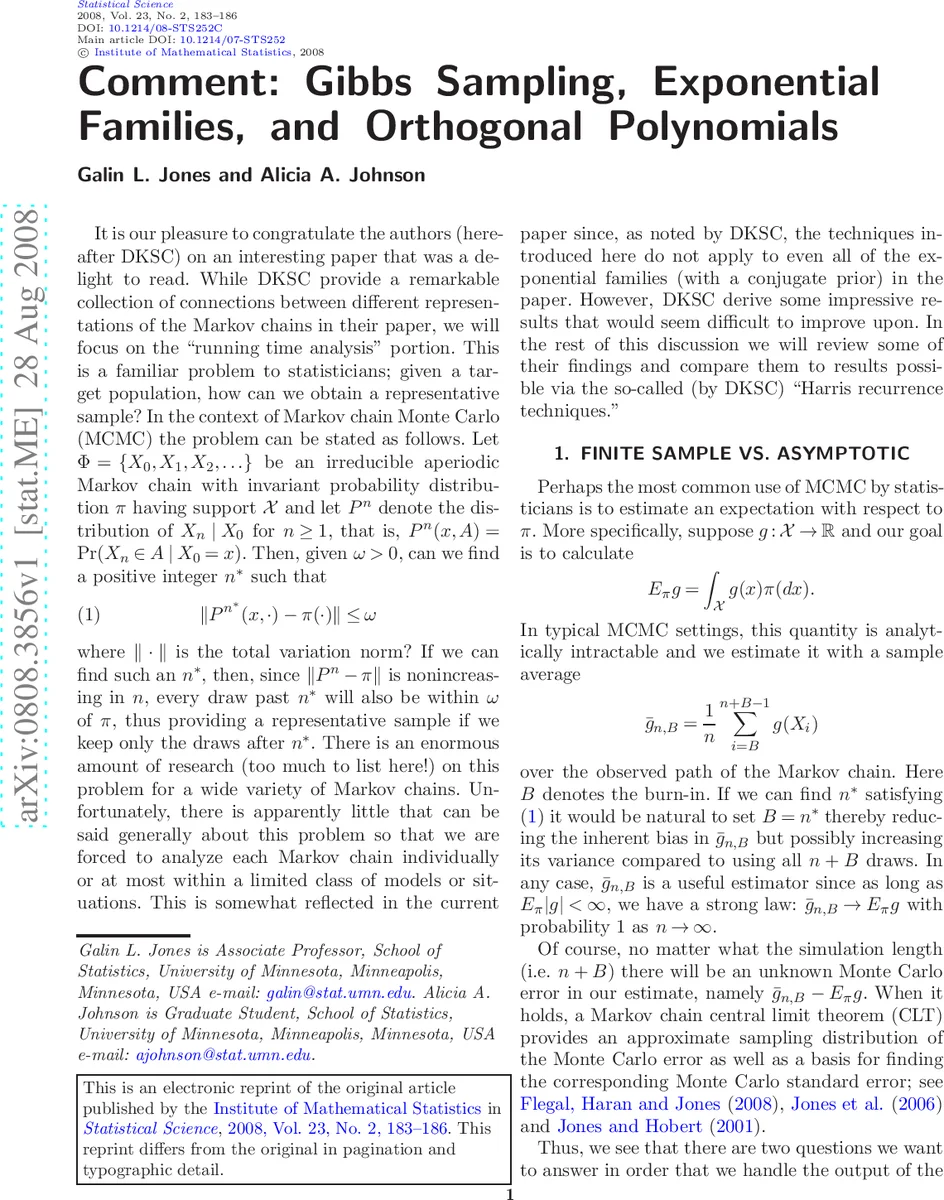
Comment on ``Gibbs Sampling, Exponential Families, and Orthogonal Polynomials’’ [arXiv:0808.3852]
💡 Research Summary
**
This paper is a commentary on the 2008 article by Diaconis, Khare, Saloff‑Coste (DKSC) titled “Gibbs Sampling, Exponential Families, and Orthogonal Polynomials.” While the original work focused on elegant connections between orthogonal polynomials, exponential families, and the spectral analysis of Gibbs samplers, the present note concentrates on the practical question of how long a Markov chain Monte Carlo (MCMC) run must be to guarantee that the chain is sufficiently close to its stationary distribution.
The authors begin by formalising the “running‑time” problem: given a target error tolerance ω>0, find the smallest integer n* such that the total‑variation distance ‖Pⁿ*(x,·)−π‖≤ω for all starting states x. They observe that this finite‑sample requirement is intimately linked to the asymptotic Central Limit Theorem (CLT) for ergodic averages. A standard sufficient condition for the CLT is geometric ergodicity, i.e. the existence of a function M(x) and a constant t∈(0,1) with ‖Pⁿ(x,·)−π‖≤M(x)·tⁿ. In practice M and t are rarely known explicitly, so the authors turn to drift and minorization conditions, which are more tractable and still imply geometric ergodicity.
A drift condition requires a non‑negative Lyapunov function V and constants 0<γ<1, L<∞ such that
E
Comments & Academic Discussion
Loading comments...
Leave a Comment