Theoretical Analysis of the Energy Capture in Strictly Bandlimited Ultra-Wideband Channels
The frequency selectivity of wireless communication channels can be characterized by the delay spread Ds of the channel impulse response. If the delay spread is small compared to the bandwidth W of the input signal, that is, Ds*W approximately equal …
Authors: Georg B"ocherer, Daniel Bielefeld
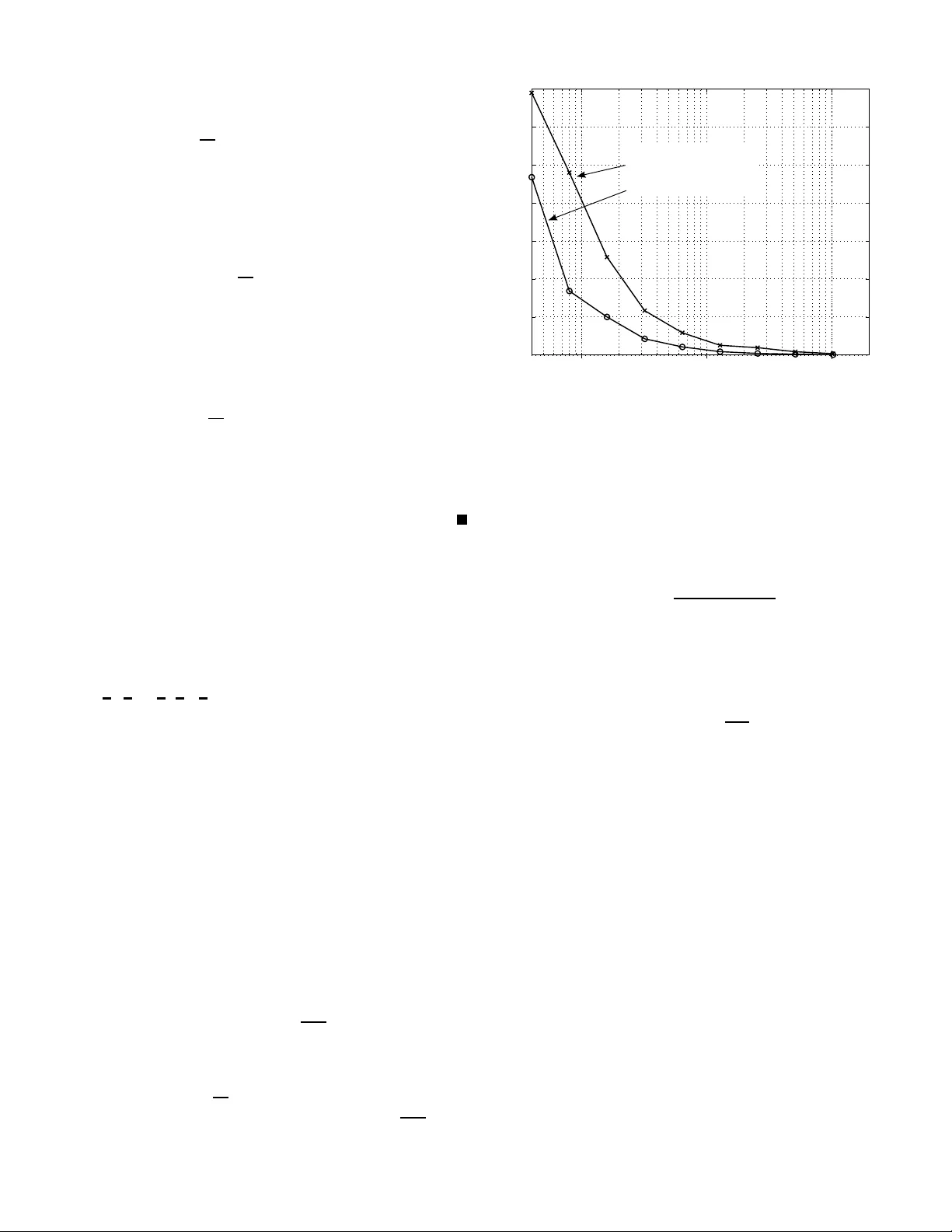
1 Theoretical Analysis of the Ener gy Capture in Strictl y Bandlimited Ultra-W ideband Chann els Georg B ¨ ocherer 1 , Dan iel Bielefeld 2 , Rudolf Mathar 3 Institute for Theor etical Information T echnology , RWTH Aachen Un iversity D-5205 6 Aachen, German y 1 boecherer@ti. rwth-aachen.de 2 bielefeld@ti. rwth-aachen.de 3 mathar@ti.rwt h-aachen.de Abstract —The frequency selectiv ity of wireless communication channels can be characterized by the delay spread D s of the channel impulse response. If the d elay spread is small compared to the bandwidth W of the input signal, that is, D s W ≈ 1 , the channel appears to be fl at fading. For D s W ≫ 1 , the channel appears to b e frequency selectiv e, which is usually the case for wideband signals. In the fi rst case, small scale synchronization with a p recision much high er th an the sampling ti me T = 1 /W is crucial to guarantee the maximum capture of energy at th e recei ver . In this paper , it i s shown by analytical means that th is is different in th e wideband regime. Here synchronization with a precision of T is su fficient and small scale synchronization c ann ot further increase the captured energy at the receiv er . Simulation results sh ow that th is effect alrea dy occurs f or W > 50 MHz for the IEEE 802.15 .4a chann el model. I . I N T RO D U C T I O N Ultra-wideban d commun ication offers the attractive possibil- ity to achieve high data rate s with low tran smission power and is a cand idate fo r the air interface o f n ext gen eration wir eless personal a rea networks [1]. The transmitted ultra-wid eband signal is u sually subject to frequen cy selective fading d ue to multi-p ath pr opagation . In literature, th e in volved c hannel has been mod eled in different ways. Physically inspired appro aches aim to g i ve a tapp ed delay-line model of th e pro pagation en viro nment in terms of a tim e-continu ous impulse response wh ich co nsists of the superpo sition o f ar bitrarily delay ed and scaled versions of the signal emitted by the send er . In [2], the auth ors refer to the number o f delayed and scaled versions assumed at th e rec ei ver as the d iversity level of the r eceiv er an d th ey observe th at with an increasing diversity level, th e amoun t of captu red en ergy increases. The authors in [3] u se a more genera l model. They assume a strictly bandlimited transmitted sign al and m odel the ch annel by the statistics of the taps as observed by the receiver af ter approp riate lowpass filterin g and sampling of the re ceiv ed signal with a s amp ling time according to the sampling theorem. The ob tained time-discrete ch annel mode l con sists o f a finite number o f chan nel taps. A similar m odel is used in [4], w here the samp ling time is referr ed to as th e system r esolu tion . In these mo dels, the observed chan nel tap s dep end he avily on the cho sen time instants o f th e sampling pro cess. For different timing o ffsets between tran smitter and receiver , corre sponding to different samp ling time instants, the receiver might ob serve different realizations o f th e channel, although the p hysical channel remains the same. In the f ollowing, the different realizations of channel taps for th e same physical chan nel in the time-discr ete model are referred to as channel cand idates . For a low nu mber o f ch annel taps, norm ally corre sponding to a low sign al band width, the u nknown timing o ffset can lead to a significant degradation of the amoun t of energy that c an be ca ptured by the rec ei ver, since different observed channe l candidates have in gen eral different chan nel gain s. T o account for this in practical com munication systems, syn chroniza tion algorithm s are employed to condu ct a precise estimate of the timing o ffset and to sync hronize the time references of transmitter and r eceiv er [5]. In this p aper, we analytica lly in vestigate the pro blem of different channel can didates in the wideban d limit. W e show that in th is case, all chann el candid ates have the same chan nel gain if a la rge scale synchr onization in th e or der of a samp ling time inter val is assum ed. This is n ot obvious: alth ough the system r esolution incr eases with incr easing ban dwith, also the degrees o f fr eedom of the e ffecti ve ch annel incr eases linearly with the ban dwidth [3], w hich cou ld cancel out the effect of increasing r esolution. This is illustrated in Figure 1 . Our result implies that fo r a large ban dwidth o f the inp ut sign al, it is not necessary to con sider the delay between transmitter and receiver by an addition al term in the discrete time ch annel model of [3], since it would not make the mode l mo re representative. T o validate our results and to obtain numerical values for the amount of th e perfor mance degradation for a realistic scen ario, simulations were con ducted using the I EEE 802 .15.4 a channel model. The r esults indic ate that for a narrow communicatio n bandwidth ( ≤ 16 MHz), a missing small scale sy nchron ization can lead to an ene rgy capture degradation o f more than 25 % . For in creasing ban dwidth, th e degrad ation vanishes. If we interpret th e cor respond ing number o f co nsidered chann el taps as the div er sity lev el of the receiver , this result is in accord ance with the ob servation in [2]. The remaind er o f th e p aper is organized as fo llows. In Sec- tion II, a ma thematical descr iption of the considered p roblem is given. Based on this, we investigate the pro blem analytically in Section I II. In Section I V, we d escribe the simulation proced ure and discuss th e ob tained results. 2 P S f r a g r e p l a c e m e n t s Power T ime (a) Sampling in narro wband P S f r a g r e p l a c e m e n t s Power T ime (b) Sampling in wideband Fig. 1. An impulse response of bandwidth 128 MHz (thin line) is in subfigure (a) filtered by a lowpassfilt er of bandwidth 8 MHz (bold line), and then sampled (circl es). In subfigure (b), the same impulse response is filtered by a lo wpassfilter of bandwidth 64 MHz and then sampled. As can be observ ed, both system resoluti on and degrees of freedom of the filtered impulse response increase with increasin g filter bandwidth. I I . S Y S T E M M O D E L W e con sider a linea r time- in variant (L TI) system that is specified b y a complex continuo us time impulse r esponse h , which we assume in th e following to be in L 2 ( R ) , the Hilbert space of energy lim ited signals. T he impulse re sponse is of finite leng th, th at is, ther e exists so me delay sprea d D s > 0 such that ∀ τ / ∈ [0 , D s ] : h ( τ ) = 0 . (1) The input-o utput ( I/O) relation between a transmitted signal s and the corre sponding receiv ed sign al y is th en given by the conv olution y ( t ) = ∞ Z −∞ h ( τ ) s ( t − τ ) d τ . (2) If the input signal is bandlimited to W , then the output signal is also band limited to W and we can define th e effective impulse r esponse h T of the L T I system as the result of lowpass filtering h by a unit-g ain lowpass filter of b andwidth W = 1 /T . It is importan t to note that th e effecti ve impu lse r esponse h as no longer a finite delay sp read, so we h av e in ge neral h T ( τ ) 6 = 0 for τ ∈ R . App lying th e sampling theo rem, the system can be described by the discrete time I/O relatio n g i ven b y y [ k ] = ∞ X l = −∞ h T [ l ] s [ k − l ] . (3) Although we have in gener al h T [ l ] 6 = 0 fo r l ∈ Z , it is infeasible in prac tice to tr eat an infinite num ber of ch annel taps. W e therefor e trunca te the I/O relation and co nsider only a finite n umber L of channel taps. T he tru ncated I /O r elation is g iv en by y [ k ] = L − 1 X l =0 h T [ l ] s [ k − l ] . (4) For the n umber L , an appropr iate n umber correspo nding to the delay spread D s should be ch osen. The relatio n (4) is a standard m odel for frequen cy selective channels, see [ 6]. Th e a uthors of [3] mod eled an UWB indo or en vir onment by (4) a nd based their measur ements on th is model. W e will take a closer look at how (4) is related to (2). The discrete tim e I/O r elation results from two samp ling pro cesses, one at th e sende r an d one at the receiver . W e assume that the drift b etween th e two sampling clocks is already co mpensated. What remains is a timing offset between th e two sampling clocks. W e m odel this offset b y in cluding an arbitra ry timing offset d b etween sen der and receiver in o ur mo del. The timing offset d can be written as d = d T T + δ (5) with δ ∈ [0 , T ) . W e assume that the system ha s alread y perfor med a large scale acquisition of the timing and kn ows ⌊ d/T ⌋ . W ithout loss of generality , we can th erefore assume ⌊ d/T ⌋ = 0 . The samples a re the n giv en by y [ k ] = y ( k T − δ ) , h T [ l ] = h T ( lT − δ ) , s [ k ] = s ( k T ) (6) where t is the timing refere nce at the sender and t − δ is the timing reference at the receiver . For a cer tain timin g o ffset δ , the ch annel cand idate, which will be estimated by the receiver , is g iv en by ˜ h ( δ ) T [ l ] = h T ( lT − δ ) , 0 ≤ l < L 0 , otherwise . (7) W e set the nu mber of chann el taps L equal to L = D s T . (8) This assign ment is to a certain extend arb itrary . The trade-off between system performance and complexity may lead to other values for L in prac tice. The small scale timing synch ronization at the receiver now consists in finding δ such that the correspo nding chann el candidate (7) u sed in (4) rep resents (2) in the best p ossible 3 way . T o qua ntify the quality of a c ertain chan nel c andidate (7), we look at the overall chann el gain k ˜ h ( δ ) T k 2 , which is giv en by T k ˜ h ( δ ) T k 2 = L − 1 X l =0 T | h T ( lT − δ ) | 2 . (9) Dependin g on the band width W and the corr espondin g sam- pling time T = 1 /W , the chann el g ain varies for different δ ∈ [0 , T ) . As we will see in the following sections, the variance of the chan nel gain g oes to z ero for W tending to infinity . I I I . A N A L Y S I S For the family of cha nnel cand idates ( 7), we state th e limit proper ty o f the overall chan nel gain as a the orem. Theorem 1. Let the chan nel can didates a s given in (7 ) be of bandwidth W = 1 /T . Then, for every δ ∈ [0 , 1 / W ) , the overall cha nnel gain co n verges to the maximum v alue given by k ˜ h ( δ ) T k 2 = k h k 2 when th e bandwidth W tends to in finity . Before we can give the proof of th e theo rem, we state Plancherel’ s Th eorem. It can be found e.g. in [7]. Theorem 2 . (Plan cher el) F or any x ∈ L 2 ( R ) ( the Hilbe rt space of ener gy limited signals), ther e exis ts a function F { x } ∈ L 2 ( R ) , such that lim T →∞ ∞ Z −∞ F { x } ( f ) − T 2 Z − T 2 x ( t ) e − j 2 π f t d t 2 d f = 0 (10) and lim W →∞ ∞ Z −∞ x ( t ) − W 2 Z − W 2 F { x } ( f ) e j 2 π f t d f 2 d t = 0 . (11) The function F { x } is called the Fourier transfo rm of x . W e assume in th e following that for all functions x of interest, the in tegral ∞ Z −∞ x ( t ) e − j 2 π f t d t (12) exists. Th e Fourier tran sform F { x } is then given by (12). W e will need the f ollowing convention in th e pr oof of T heorem 1. W e d efine th e effecti ve imp ulse resp onse h T point-wise b y the in verse Fourier transform o f F { h T } giv en by h T ( τ ) = ∞ Z −∞ F { h T } ( f ) e j 2 π f τ d f . (13) It can easily be shown that with this definition , h T is contin - uous. Pr oof o f Theorem 1: Th e ene rgy of ˜ h ( δ ) T is bo unded fro m above by k h k 2 ≥ k h T k 2 (14) ≥ T k ˜ h ( δ ) T k 2 (15) = ⌊ D s T ⌋− 1 X l =0 T h T ( lT − δ ) 2 (16) where δ ∈ [0 , T ) . W e show that (1 6) co n verges to k h k 2 for T → 0 . Calculating first th e limit for δ → 0 and th en the limit for T → 0 would lead to the desired re sult, but this implies not necessarily that (1 6) converges to the same value if δ and T ten d jointly to zero a long any path with δ < T , but it is the latter we have to show . W e introduce th e auxiliary p arameter T ′ and write ⌊ D s T ′ ⌋− 1 X l =0 T ′ h T ( lT ′ − δ ) 2 . The introductio n o f the param eter T ′ can b e interpr eted as a separation o f the sampling process fr om the lowpass filtering process. W e now ap proxim ate k h k 2 in th ree steps. 1. App r oximation. From Theor em 2, it fo llows that the integral ∞ Z −∞ | h ( τ ) − h T ( τ ) | 2 d τ (17) goes to 0 for T → 0 . Since the su pport o f h is [0 , D s ] , also D s Z 0 | h ( τ ) − h T ( τ ) | 2 d τ (18) goes to 0 . For any v , w ∈ L 2 ( R ) , th e rev erse triangular inequality states that |k v k − k w k| ≤ k v − w k . (19) It follows th at fo r any ǫ 1 > 0 there exists a T 1 such that D s Z 0 | h ( τ ) | 2 d τ − D s Z 0 | h T ( τ ) | 2 d τ < ǫ 1 (20) for all T < T 1 . 2. Appr oxima tion. For e very δ ∈ R , let h ( δ ) T denote the translation of h T defined by h ( δ ) T ( τ ) = h T ( τ − δ ) , τ ∈ R . According to [8, Theo rem 9.5 ], the mapping δ 7→ h ( δ ) T (21) is u niformly continu ous in L 2 ( R ) . T og ether with the r ev erse triangular inequality ( 19), this implies that fo r every ǫ 2 > 0 , there exists a δ 1 such that D s Z 0 | h T ( τ ) | 2 d τ − D s Z 0 | h T ( τ − δ ) | 2 d τ < ǫ 2 (22) for all δ < δ 1 . 4 3. App r oximation. Since h T is co ntinuou s (by con ventio n (13)) and since we consider it over a comp act interval, the term ⌊ D s T ′ ⌋− 1 X l =0 T ′ | h T ( lT ′ − δ ) | 2 is equ al to the Riem ann sum of | h T ( τ − δ ) | 2 over the interval [0 , D s ] . For T ′ → 0 , the Riemann sum co n verges to the integral. Theref ore, for every ǫ 3 > 0 , th ere exists a T ′ 1 such that D s Z 0 | h T ( τ − δ ) | 2 d τ − ⌊ D s T ′ ⌋− 1 X l =0 T ′ | h T ( lT ′ − δ ) | 2 < ǫ 3 (23) for all T ′ < T ′ 1 . W e define ǫ 0 = ǫ 1 + ǫ 2 + ǫ 3 and T 0 = min { T 1 , T ′ 1 , δ 1 } . Comb ining th e three app roximatio ns, we have shown that f or every ǫ 0 > 0 , there exists a T 0 such that k h k 2 − ⌊ D s T ′ ⌋− 1 X l =0 T ′ | h T ( lT ′ − δ ) | 2 < ǫ 0 (24) for all T , T ′ , δ < T 0 . Th is result is also valid for T ′ = T and δ and T jointly ten ding to zero with 0 ≤ δ < T . T his conclu des the proof. For a furthe r discussion of t h is result we refer to Section IV. I V . S I M U L AT I O N W e simulate th e effect of the timing offset δ onto th e overall gain of ch annel candid ates by calcu lating k ˜ h ( δ ) T k 2 for increa sing b andwidths W . As a data set, we use 100 impulse respo nses accor ding to th e IEEE 802.1 5.4a UWB channel model d efined in [9] by using the MA TLAB scrip t uwb sv ev al ct 1 5 4a.m, wh ich is also provided in [ 9]. The generated impulse resp onses have a normalized delay spr ead of D s = 27 9ns . Sinc e th e d ata set alread y com es in dig ital form and since we are limited to digital signal pro cessing in simu lation, it is difficult to co mpare all po ssible chan nel candidates for δ ∈ [0 , T ) , δ continuo us. W e the refore resort to the following. W e consider a gen eric all digital receiver that has a small scale timing synchron izer with a time r esolution of T / 4 . Wit h this receiver in min d, we compare the ch annel candidates for every impulse resp onse h ( i ) from the data set and every co nsidered band width W = 1 /T in the following way . Step 1. W e lowpass filter h ( i ) to o btain h ( i ) T . Step 2. W e rando mly gener ate a sm all timing offset ε u ni- formly distributed over [0 , T / 4) . T he generic receiver in mind will not resolve ε . Step 3. For m = 0 , . . . , 3 , we consider the sequ ence h ( i ) T l T − ε − mT 4 (25) and calculate the ch annel gain o f the tru ncated imp ulse re- sponse to k ˜ h ( i,m ) T k 2 = max k ⌊ D s T ⌋− 1 X l =0 T | h ( i ) T ( k T + l T − ε − mT 4 ) | 2 . (26) P S f r a g r e p l a c e m e n t s Penalty [%] 0 10 20 30 40 50 60 70 maximum penalty P T av erage penalty ¯ P T 10 100 1000 Bandwidth [MHz] Fig. 2. The av erage relati ve penalt y ¯ P T and the maximum relati ve penalty P T for timing acquisition without small scale timing synchroniz ation as a functio n of the bandwidth W = 1 /T . At the receiver , the m aximization over k correspo nds to a n energy based large scale timin g acquisition. The maxim um relativ e channe l g ain loss when sync hronizin g without a sm all scale timing syn chronize r is given by P ( i ) T , max = 1 − min m k ˜ h ( i,m ) k 2 max m k ˜ h ( i,m ) k 2 . (27) W e assess the simulation results by co nsidering both th e max- imum relative perf ormance penalty and the average re lati ve perfor mance p enalty gi ven b y P T = max i P ( i ) T , max and ¯ P T = 1 100 100 X i =1 P ( i ) T , max (28) as f unctions o f th e samplin g time T = 1 /W . I n T able I, we provide the simu lation results co nsisting of the corr espondin g values for the ban dwidth, th e worst case penalty , the av erag e penalty , and th e numb er of chann el taps. As can be seen from Figure 2, bo th th e worst case penalty an d the average penalty decrease mono tonically with an increasing ba ndwidth. Both curves converge to 0 , which corresp onds to ou r analytic r esult from th e previous sectio n. W e obser ve that, ro ughly for L = ⌊ D s W ⌋ > 10 , synch ro- nizing with a r esolution o f T is sufficient in term s of channel gain, since the maximum penalty is smaller than 5% . On the other hand , in a narrowband scen ario with L = ⌊ D s W ⌋ < 4 , the penalty due to a missing small scale synchro nizer can be over 5 0% . V . C O N C L U S I O N S W e hav e sho wn that for communications strictly bandlimited to W over an L TI channel with de lay spr ead D s , the truncated discrete tim e channel mo del y [ k ] = L − 1 X l =0 h [ l ] x [ k − l ] , L ≈ ⌊ D s W ⌋ (29) 5 T ABLE I S I M U L A T I O N R E S U LT S F O R D s = 279ns W [MHz] 4 8 16 32 64 128 256 512 1024 P [%] 68.9 48.0 25.8 11.7 5.8 2.5 1.9 0.9 0.4 ¯ P [%] 46.8 16.8 10.0 4.3 2. 1 0.9 0.4 0.2 0.1 L = ⌊ D s W ⌋ 1 2 4 8 17 35 71 142 285 is robust against unknown timing offsets δ ∈ [0 , 1 / W ) be- tween sender and receiver in the limit whe n the ban dwidth W of the co nsidered system goes to infinity . A simulation shows th at this theor etic resu lt is valid for the IEEE 802.1 5.4a channel model for W > 5 0 MHz. As a receiver design criterion, this m eans that small scale syn chroniza tion with a p recision higher than the sampling time T = 1 /W is not necessary for UWB co mmunicatio n systems. As an extension of our work, it may be of interest to investigate if the robustness again st the small scale timin g offset δ rem ains when drift compensatio n, large scale tim ing acq uisition and chann el estimation in the design of a wideba nd receiver are co nsidered jointly . A C K N O W L E D G M E N T This w or k was partly supported by the Deutsche Forschungs- gemeinschaf t (DFG) pr oject UKoLoS (gran t MA 1184 /14-1) and the UMI C excellence cluster of R WTH Aachen Univer- sity . R E F E R E N C E S [1] H . Ars lan, Z. Chen, and M. -G. Di Benede tto, E ds., Ultra W ideband W ir eless Communication . Hoboke n, New Jersey: Wile y-Interscie nce, 2006. [2] M. Wi n and R. S choltz , “On the energy capture of ultrawide bandwidth signals in dense multipat h en vironments, ” IEEE Commun. Lett. , vol. 2, no. 9, pp. 245–247, 1998. [3] U . Schuster and H. B ¨ olcsk ei, “Ultrawi deband channel modeling on the basis of information -theoretic criteria, ” IEE E Tr ans. W irel ess Commun. , vol. 6, no. 7, pp. 2464–2475, 2007. [4] I. T elat ar and D. Tse, “Capacit y and m utual informatio n of wideband multipat h fa ding channels, ” IEE E T rans. Inf. Theory , vol. 46, no. 4, pp. 1384–1400, 2000. [5] H . Meyr , M. Moeneclae y , and S. A. Fechtel, Digital Communicati on Receive rs . John Wi ley & Sons, Inc, 1998. [6] D . Ts e and P . V iswana th, Fundamental s of W ir eless Communication . Cambridge Uni versity Press, 2005. [7] R. E. A. C. Paley and N. Wi ener , F ourier T ransforms in the Complex Do- main , ser . Colloquium Publications. New Y ork: American Mathematica l Society , 1934, vol. XIX. [8] W . Rudin, Real and Complex Analysis , 3rd ed. McGraw-Hill Publishing Co., 1987. [9] A . F . Molisch, K. Balakrishn an, C. C. Chong, S. Emami, A. F ort, J. Karedal, J. Kunisch, H. Schantz , U. Schuste r, and K. Siwiak, “IEEE 802.15.4a channel model— final report, ” T ech. Rep., 2004. [Online]. A vai lable: http:/ /www .ieee802.org /15/pub/04/15- 04- 0662- 00- 004a- channel- model- final- r eport- r1.p d f
Original Paper
Loading high-quality paper...
Comments & Academic Discussion
Loading comments...
Leave a Comment