Linear Coloring and Linear Graphs
Motivated by the definition of linear coloring on simplicial complexes, recently introduced in the context of algebraic topology \cite{Civan}, and the framework through which it was studied, we introduce the linear coloring on graphs. We provide an u…
Authors: ** Kyriaki Ioannidou (그리스 이오아니나 대학교) Stavros D. Nikolopoulos (그리스 이오아니나 대학교) **
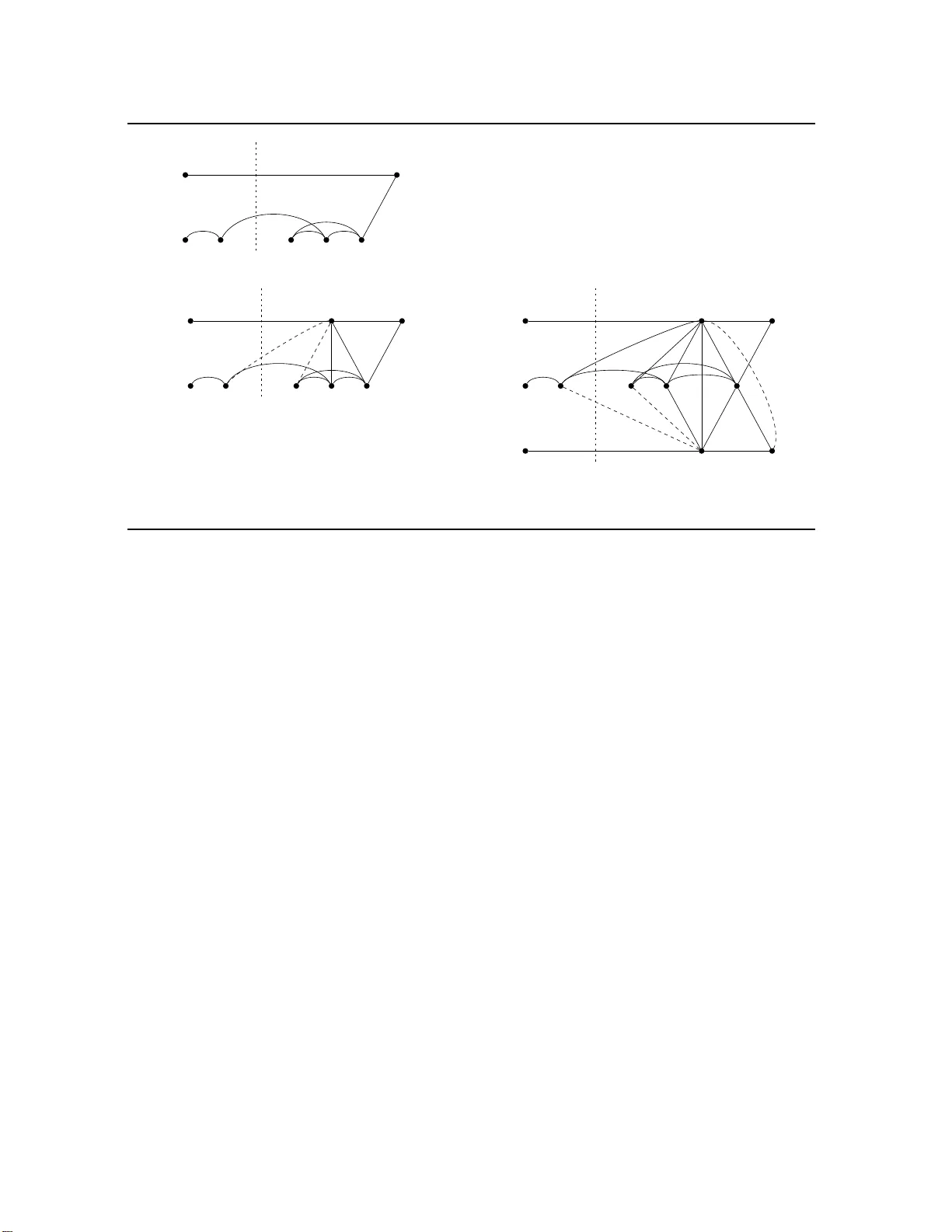
Linear Colorin g and Linear Graphs ∗ Kyriaki Ioannidou and Sta vros D. Nik olop oulos Dep artment of Comp u ter Scienc e, University of Io a nn ina P.O.Box 1186, GR-451 10 Io annina, Gr e e c e { kioa nnid, stavros } @ cs.uoi .gr Abstract: Motiv ated by the definition of linear coloring on s implicia l complexes, recently int r o duced in the co nt ex t of algebr aic top o logy [9], and the framew o rk thr ough whic h it was studied, w e introduce the linea r co loring on g raphs. W e provide an upp er b o und fo r the chromatic num b er χ ( G ), fo r an y gr aph G , and show that G can b e linearly color ed in po lynomial time by prop o sing a simple linear co loring algorithm. Based on these results, we define a new class of p erfect g raphs, which we call co-linea r graphs, a nd study their complement graphs, namely linea r graphs. The linear coloring of a graph G is a vertex coloring s uch that tw o vertices ca n b e assigned the same color , if their co rresp onding cliq ue sets ar e a sso ciated by the set inclus ion rela tion (a clique se t of a vertex u is the set of all maximal cliques containing u ); the line a r c hro matic num b er λ ( G ) of G is the least integer k for which G admits a linear c oloring with k color s . W e s how that linear g raphs a re those graphs G fo r which the linear chromatic num b er achiev es its theoretical low er b ound in every induced subgr aph o f G . W e prov e inclusion r elations betw een these t wo classes o f graphs and other sub classe s of chordal and co- chordal graphs, and also study the structure of the forbidden induced subgraphs of the class o f linear graphs. Keyw ords: Linear coloring , chromatic nu mber , linear graphs, co-linear gra phs, chordal graphs, co- chordal graphs, strong ly chordal graphs, alg orithms, complexity . 1 In tro du ction F ramew ork-Mo ti v ation. A line ar c oloring of a gr aph G is a coloring of its vertices suc h that if t wo vertices ar e a s signed the same color, then their corres p o nding clique sets are asso ciated b y the set inclusion relation; a clique set of a vertex u is the set of all maximal cliques in G co n taining u . The linear chromatic num b er λ ( G ) of G is the lea s t integer k for which G admits a linear coloring with k colors. Motiv a ted by the definition o f linear coloring on simplicia l complexes asso ciated to g raphs, first int r o duced by Civ an and Y al¸ cin [9] in the context of algebraic top o lo gy , we define the linear co loring on graphs. The idea for translating their definition in graph th eo retic terms came from studying linear colorings o n simplicial complexes which ca n b e represented b y a gr a ph. In particular, we studied the linear co loring on the indep endence complex I ( G ) o f a graph G , which can a lwa ys be re presented by a graph and, more spe c ifically , is identical to the complement graph G of G in graph theoretic terms; indeed, the facets of I ( G ) are exa ctly the maximal cliques of G . How ever, the tw o definitions cannot alwa ys be cons ide r ed as identical since not in all cases a simplicial complex can b e r epresented by a ∗ This research is co-financed b y E. U.-Europ ean Social F und (75%) and the Greek Ministry of Dev elopment-GSR T (25%). 1 graph; such an exa mple is the neigh b or ho o d complex N ( G ) of a graph G . Recen tly , Civ an and Y al¸ cin [9] studied the linear coloring of the neig hborho o d complex N ( G ) of a gr aph G a nd proved that, for any graph G , the linear c hr omatic n umber of N ( G ) gives an upper b o und for the c hroma tic num b er of the gr aph G . This approa ch lies in a gener al framew o rk met in algebra ic topolo gy . In the context of a lg ebraic top ology , one can find muc h w or k done on providing b o undaries for the chromatic num b er of an arbitra ry g raph G , by examining the top olo gy of the graph through different simplicial co mplex es asso cia ted to the gr aph. This domain was motiv ated b y K neser’s conjecture , which was p osed in 1955, claiming tha t “if w e s plit the n - subsets of a (2 n + k )-element s et into k + 1 classes, one of the classes will contain tw o disjoint n -subsets” [1 6]. Kneser’s conjecture was fir st prov ed by Lov´ asz in 19 78, with a pro of based on graph theory , by rephrasing the conjecture into “the chromatic n umber o f Kneser’s g raph K G n,k is k + 2 ” [17]. Ma ny more topo logical and com binato rial pro ofs follow ed the interest o f which extends b eyond the origina l co njecture [21]. Although Kneser’s conjecture is concerned with the chromatic n umbers o f certain graphs (Kneser graphs ), the pro of metho ds tha t are known provide low er bo unds for the chromatic num ber of any gra ph [18]. Th us, this initiated the applica tion of top olog ical to ols in s tudying graph theory problems and mo re par ticularly in gra ph color ing problems [10]. The in terest to pr ovide b o undaries for the chromatic num b er χ ( G ) of an arbitrary graph G through the study of different simplicial complexes asso ciated to G , whic h is found in algebra ic top o logy bibliography , drove the motiv ation for defining the linea r colo ring o n the gra ph G and s tudying the relation b etw een the chromatic num b er χ ( G ) and the linea r chromatic num ber λ ( G ). W e show that for any graph G , λ ( G ) is an upper b ound for χ ( G ). The interest of this result lies on the fa c t that we pres ent a linear coloring algor ithm that can be applied to a ny gr aph G and pr ovides an upp er bo und λ ( G ) for the chromatic num b er of the graph G , i.e. χ ( G ) ≤ λ ( G ); in particular , it provides a prop er vertex co loring of G using λ ( G ) colors. Additionally , reca ll that a known lower b o und for the chromatic num b er of any g r aph G is the c lique n umber ω ( G ) of G , i.e. χ ( G ) ≥ ω ( G ). Motiv a ted b y the definition of p erfect g r aphs, for whic h χ ( G A ) = ω ( G A ) holds ∀ A ⊆ V ( G ), it was interesting to study thos e g raphs for which the equa lit y χ ( G ) = λ ( G ) holds , a nd even more those graphs for which this eq uality holds for every induced subgraph. The outcome of this study was the definition of a new class of p er fect g raphs, namely co-linear graphs, a nd, further mo re, the study of the classes of co- line a r graphs and of their complemen t class , na mely linea r graphs. Our Resul ts. In this paper , we first in tro duce the linear colo ring of a graph G and study the rela tio n betw een the linear coloring of G and the prop er vertex coloring of G . W e pr ov e that, for any graph G , a linear coloring of G is a prop er vertex co loring of G and, th us, λ ( G ) is an upp er bound for χ ( G ), i.e. χ ( G ) ≤ λ ( G ). W e pres ent a linea r coloring alg o rithm that can b e applied to an y gr aph G . Mo tiv ated by these results and the Perfect Graph Theorem [14], w e study those gr aphs for which the equality χ ( G ) = λ ( G ) ho lds f o r ev er y induce subgraph and define a new cla ss of per fect gr aphs, na mely co-linear graphs; we als o study their complement class, na mely linear graphs. A graph G is a c o-line ar gr aph if and only if its chromatic num b er χ ( G ) equals to the linear chromatic num b er λ ( G ) of its co mplement graph G , and the equality holds for every induced subgr aph of G , i.e. χ ( G A ) = λ ( G A ), ∀ A ⊆ V ( G ); a gra ph G is a line ar gr aph if it is the co mplemen t o f a co -linear gra ph. W e show that the class of co-linear g r aphs is a sup er class of the class of threshold graphs, a sub clas s of the c lass of co- chordal graphs and is distinguished from the class of split graphs. Additionally , we g ive s ome structural and recognition proper ties for the classes of linear and co -linear g raphs. W e study the structur e of the forbidden induced subgraphs o f the class of linear gr aphs, a nd show that any P 6 -free chordal graph, which is not a linea r gra ph, prop erly contains a k -sun as a n induced subgra ph. Therefo r e, we infer tha t the sub class of chordal g raphs, namely linear g r aphs, is a sup erc la ss of the class of P 6 -free strongly chordal gr aphs. 2 Basic Defi ni tions. Some bas ic g raph theory definitions fo llow. W e consider finite undirected and directed gr aphs with no lo o ps or multiple edges. Let G b e such a gr aph; then, V ( G ) and E ( G ) denote the set of v ertices and of edges of G , resp ectively . An edge is a pair of distinct vertices x, y ∈ V ( G ), and is denoted by xy if G is an undirected graph a nd by − → xy if G is a directed graph. F or a set A ⊆ V ( G ) of vertices of the gr a ph G , the subgraph o f G induc e d by A is denoted by G A . Additionally , the car dinality of a s et A is deno ted b y | A | . F or a g iven vertex o r dering ( v 1 , v 2 , . . . , v n ) of a g raph G , the subgra ph o f G induced by the set of vertices { v i , v i +1 , . . . , v n } is denoted by G i . The set N ( v ) = { u ∈ V ( G ) : ( u, v ) ∈ E ( G ) } is called the op en neighb orho o d of the vertex v ∈ V ( G ) in G , sometimes denoted by N G ( v ) for clar ity reasons. The set N [ v ] = N ( v ) ∪ { v } is ca lled the close d neighb orho o d o f the v ertex v ∈ V ( G ) in G . In a graph G , the length of a path is the n umber of edges in the path. The distanc e d ( v , u ) from vertex v to vertex u is the minimum leng th o f a path from v to u ; d ( v , u ) = ∞ if there is no path from v to u . The grea test int eg er r for whic h a graph G contains a n indep endent set of size r is called the indep endenc e num b er or otherwise the stability numb er of G a nd is denoted by α ( G ). The cardinality of the v er tex set of the maximum clique in G is called the clique numb er of G and is denoted by ω ( G ). A pr op er vertex c oloring of a graph G is a co loring o f its vertices such that no tw o adjacent vertices a re assigned the same color. The chr omatic numb er χ ( G ) of G is the least integer k for which G admits a prope r vertex color ing with k colo rs. F or the num b ers ω ( G ) and χ ( G ) o f an arbitra ry gr aph G the inequality ω ( G ) ≤ χ ( G ) holds. In particular ly , G is a p erfe ct gr aph if the e q uality ω ( G A ) = χ ( G A ) holds ∀ A ⊆ V ( G ). F or mor e details on basic definitions in graph theory refer to [5, 1 4]. Next, definitions of some graph cla sses mentioned thro ughout the pap er follow. A g raph is called a chor dal gr aph if it do es not contain an induced subgraph iso morphic to a chordless c ycle of four or more vertices. A graph is c alled a c o-chor dal gr aph if it is the complement of a chordal gr a ph [14]. A hole is a chordless cycle C n if n ≥ 5; the co mplement of a ho le is an antihole. A gra ph G is a split gr aph if there is a partition of the vertex set V ( G ) = K + I , wher e K induces a clique in G and I induces an independent set. Split graphs are characterized a s (2 K 2 , C 4 , C 5 )-free. Thr eshold gr aphs are defined a s those g r aphs where stable subsets of their vertex sets can b e distinguished by using a single linear inequality . Threshold graphs w ere introduced by Chv´ atal and Hammer [8] and c har acterized as (2 K 2 , P 4 , C 4 )-free. Quasi-thr eshold graphs are ch a racterized as the ( P 4 , C 4 )-free graphs and a r e also known in the literature as trivially p erfect gr aphs [14, 2 0]. A graph is str ongly chor dal if it admits a strong p erfect e limination order ing. Strongly chordal graphs were intro duce d b y F arb er in [1 1] and are ch a racterized co mpletely as those chordal g raphs whic h contain no k -sun as an induced subgraph. F or more details on basic definitions in graph theory refer to [5, 1 4]. 2 Linear Coloring on Graphs In this section we define the linear coloring of a graph G , we prove some pr op erties of the linear colo ring of G , a nd pres e n t a simple algorithm for linear co loring that can b e applied to an y graph G . It is worth noting that similar prop erties of line a r co lo ring of the neigh b or ho o d complex N ( G ) hav e been prov ed b y Civ an a nd Y al¸ cin [9]. Definition 2.1. Let G b e a g raph and let v ∈ V ( G ). The clique set of a vertex v is the set of all maximal cliques of G con taining v and is denoted by C G ( v ). Definition 2.2. Let G be a graph. A s urjective map κ : V ( G ) → [ k ] is called a k - line ar c oloring of G if the collection {C G ( v ) : κ ( v ) = i } is linearly o rdered b y inclusion for all i ∈ [ k ], where C G ( v ) is the clique set of v , or, equiv alently , for t wo vertices v , u ∈ V ( G ), if κ ( v ) = κ ( u ) then either C G ( v ) ⊆ C G ( u ) or C G ( v ) ⊇ C G ( u ). The least in tege r k for which G is k -linea r color a ble is c a lled the line ar chr omatic numb er of G and is denoted b y λ ( G ). 3 1 2 1 2 1 2 4 3 1 1 2 2 2 K 2 C 4 P 4 λ (2 K 2 ) = 2 = χ ( 2 K 2 ) = χ ( C 4 ) λ ( C 4 ) = 4 6 = 2 = χ ( C 4 ) = χ (2 K 2 ) λ ( P 4 ) = 2 = χ ( P 4 ) = χ ( P 4 ) Figure 1: Illustrating a linear coloring of the g raphs 2 K 2 , C 4 and P 4 with the least p ossible co lors. 2.1 Prop erties Next, we study the linear coloring on graphs a nd its asso ciatio n to the prop er v er tex coloring. In particular, w e show that fo r any gra ph G the linear chromatic num b er o f G is an upp er b o und for χ ( G ). Prop ositi o n 2 .1. L et G b e a gr aph. If κ : V ( G ) → [ k ] is a k -line ar c oloring of G , then κ is a c oloring of the gr aph G . Pro of. Let G be a gr a ph and let κ : V ( G ) → [ k ] b e a k -linear co lo ring of G . F rom Definition 2.2, we hav e that for any tw o vertices v , u ∈ V ( G ), if κ ( v ) = κ ( u ) then either C G ( v ) ⊆ C G ( u ) o r C G ( v ) ⊇ C G ( u ) holds. Without loss o f genera lity , assume that C G ( v ) ⊆ C G ( u ) holds. Consider a maximal clique C ∈ C G ( v ). Since, C G ( v ) ⊆ C G ( u ), then C ∈ C G ( u ). Thus, b oth u, v ∈ C and therefore uv ∈ E ( G ) and uv / ∈ E ( G ). Hence, any t wo vertices a ssigned the same co lor in a k -linear color ing of G ar e not neighbors in G . Conc luding , any k - linear color ing of G is a co lo ring of G . It is therefore stra ightforw ar d to conclude the following. Corollary 2 .1. F or any gr aph G , λ ( G ) ≥ χ ( G ) . In Figure 1 we depict a linear co lo ring of the well known graphs 2 K 2 , C 4 and P 4 , using the least po ssible colors, and show the rela tion b etw een the ch r omatic num b er χ ( G ) of each gra ph G ∈ { 2 K 2 , C 4 , P 4 } and the linear chromatic num ber λ ( G ). Prop ositi o n 2.2. L et G b e a gr aph. A c oloring κ : V ( G ) → [ k ] of G is a k -line ar c oloring of G if and only if either N G ( u ) ⊆ N G ( v ) or N G ( u ) ⊇ N G ( v ) holds in G , for every u, v ∈ V ( G ) with κ ( u ) = κ ( v ) . Pro of. Let G be a g raph and let κ : V ( G ) → [ k ] b e a coloring of G . Assume that κ is a k -linea r coloring of G . W e will show tha t either N G ( u ) ⊆ N G ( v ) or N G ( u ) ⊇ N G ( v ) holds in G for ev ery u, v ∈ V ( G ) with κ ( u ) = κ ( v ). Cons ider t wo vertices v , u ∈ V ( G ), such that κ ( u ) = κ ( v ). Since κ is a linear coloring of G then, from Definition 2.2, either C G ( u ) ⊆ C G ( v ) or C G ( u ) ⊇ C G ( v ) holds. Without loss of g enerality , assume that C G ( u ) ⊆ C G ( v ). W e will show that N G ( u ) ⊇ N G ( v ) holds in G . Assume the contrary . Thus, a vertex z ∈ V ( G ) exis ts, such that z ∈ N G ( v ) and z / ∈ N G ( u ) and, th us, z u ∈ E ( G ) a nd z v / ∈ E ( G ). Now consider a maximal clique C in G whic h con tains z and u . Since z v / ∈ E ( G ) then v / ∈ C . Thus, there exists a maximal clique C in G such that C ∈ C G ( u ) and C / ∈ C G ( v ), whic h is a contrast to our assumption that C G ( u ) ⊆ C G ( v ). Therefore, N G ( u ) ⊇ N G ( v ) holds in G . Let G b e a gr a ph and let κ : V ( G ) → [ k ] be a c o loring of G . Assume now that e ither N G ( u ) ⊆ N G ( v ) or N G ( u ) ⊇ N G ( v ) holds in G , for every u, v ∈ V ( G ) with κ ( u ) = κ ( v ). W e will s how that the c o loring κ of G is a k -line a r coloring of G . Without loss o f generality , assume that N G ( u ) ⊇ N G ( v ) ho lds in G . W e will show that C G ( u ) ⊆ C G ( v ). Ass ume the oppo site. Thus, a maxima l clique C exists in G , such that C ∈ C G ( u ) and C / ∈ C G ( v ). Now consider a v er tex z ∈ V ( G ) ( z 6 = u a nd z 6 = v ), suc h that z ∈ C and z v / ∈ E ( G ). Such a vertex exists since C is maxima l in G and C / ∈ C G ( v ). Thus, z v / ∈ E ( G ) and z u ∈ E ( G ). Hence, z v ∈ E ( G ) and z u / ∈ E ( G ), whic h is a contrast to our assumption that N G ( u ) ⊇ N G ( v ). 4 T a king in to c o nsideration Definition 2.2 a nd Pr op osition 2.2, we s how the following. Corollary 2. 2. L et G b e a gr aph and let κ : V ( G ) → [ k ] b e a k -line ar c oloring of G . F or every p air of vertic es u, v ∈ V ( G ) for which κ ( u ) = κ ( v ) , the fol lowing statement s ar e e quivalent: (i) C G ( u ) ⊆ C G ( v ) or C G ( u ) ⊇ C G ( v ) (ii) N G ( v ) ⊆ N G ( u ) or N G ( v ) ⊇ N G ( u ) (iii) N G [ u ] ⊆ N G [ v ] or N G [ u ] ⊇ N G [ v ] . Pro of. F ro m Definition 2.2 a nd Prop o sition 2.2, it is e a sy to see that (i) ⇔ (ii) holds. What is left to show is (ii) ⇔ (iii), whic h is s traightforw a r d from basic set theory principles ; spec ifically , take in to consideratio n that N G ( u ) = V ( G ) \ N G [ u ], where N G ( u ) denotes the op en neighbor ho o d of u in G and N G [ u ] denotes the close d neig hbo rho o d of u in G . Observ ation 2.1. It is eas y to see that using Co rollar y 2.2, the definition of a linea r color ing o f a g raph G can be restated as follows: A coloring κ : V ( G ) → [ k ] is a k -linear coloring of G if the collection { N G [ v ] : κ ( v ) = i } is linear ly ordere d b y inclusio n for all i ∈ [ k ]. Equiv alently , for t wo vertices v, u ∈ V ( G ), if κ ( v ) = κ ( u ) then either N G [ v ] ⊆ N G [ u ] or N G [ v ] ⊇ N G [ u ]. 2.2 A Linear Coloring A lgorithm In this section we prese nt a po ly nomial time algorithm for linear co loring which can be applied to any graph G , a nd provides a n upp er b o und for χ ( G ). Although we hav e intro duce d linear co loring thro ugh Definition 2.2, in o ur algo rithm we exploit the prop erty stated in Obser v a tion 2.1, since the problem of finding all ma ximal cliq ues o f a gr aph G is not poly nomially solv able on gener al gra phs. Before describing our algorithm, w e first construct a directed acy clic g raph (DA G) D G of a g raph G , w hich we call DAG asso ciate d to the gr aph G , and w e use it in the prop osed algo rithm. The D A G D G asso ciated to the g raph G . Let G be a gr a ph. W e first compute the closed neighborho o d N G [ v ] of each vertex v of G , and then, w e construct the following directed a cyclic gra ph D , which depicts all inclusio n relations among the vertices’ clos ed neighbor ho o ds: V ( D ) = V ( G ) and E ( D ) = { − → xy : x, y ∈ V ( D ) and N G [ x ] ⊆ N G [ y ] } , where − → xy is a dir ected edge from x to y . In the case where the equality N G [ x ] = N G [ y ] ho lds, we choose to add o ne of the tw o edg es so that the r esulting graph D is acy clic (for exa mple, we can use the labelling of the vertices, and if x < y then we add − → xy ). It is easy to s ee that D is a tra nsitive directed a cyclic gra ph. Indeed, by definition D is co nstructed on a partially ordered set of elements ( V ( D ) , ≤ ), such that for s ome x, y ∈ V ( D ), x ≤ y ⇔ N G [ x ] ⊆ N G [ y ]. F or reaso ns of simplicity , we cons ider the vertices of D lo cated in levels. In the fir s t level we consider the vertices with indegree equal to ze r o. F or every v er tex y b elong ing to level ℓ ther e exists a t least one vertex x in level ℓ − 1 such that − → xy . F o r every e dg e − → xy , if x b elong s to level i a nd y b elongs to level j , then i < j . F or exa mple, in the case wher e the equa lity N G [ x ] = N G [ y ] holds, a nd vertices x and y are alrea dy loca ted in levels i a nd j r esp ectively , such that i < j , then w e choo se to add the edg e − → xy . The algorithm for linear coloring. Given a g raph G , the pr op osed algo rithm computes a linear coloring and the linear chromatic num b er of G . The a lgorithm works as follows: (i) compu te the closed neighborho o d set of every vertex o f G , and, then, find the inclusion relations among the neighborho o d sets and construct the DA G D G asso ciated to the g raph G . (ii) find a minimum path cov er P ( D G ), a nd its size ρ ( D G ), o f the transitive DA G D G (e.g. see [4]). (iii) assig n one color κ ( v ) to ea ch vertex v ∈ V ( D G ), such that vertices belong ing to the sa me path of P ( D G ) a re assig ne d the same color a nd vertices of different paths are assigned different co lors; this is a surjective map κ : V ( D G ) → [ ρ ( D G )]. 5 (iv) return the v a lue κ ( v ) for each vertex v ∈ V ( D G ) and the size ρ ( D G ) o f the minimum path cover of D G ; κ is a linea r colo ring of G and ρ ( D G ) equals the linea r chromatic num b er λ ( G ) o f G . Correctness of the algorithm . Let G b e a graph and le t D G be the DA G asso ciated to the g raph G . The computation of a minim um path cov er in a transitive D AG D is known to b e p olyno mially solv able; the problem is equiv alent to the maximu m matc hing pr oblem in a bipartite graph formed from D [4]. Consider the v alue κ ( v ) for ea ch vertex v ∈ V ( D G ) returned by the algorithm and the size ρ ( D G ) of a minim um path cov er of D G . W e show that the surjective map κ : V ( D G ) → [ ρ ( D G )] is a linear color ing of the vertices of G , and prov e tha t the size ρ ( D G ) of the minim um pa th cov er P ( D G ) of the DA G D G is equal to the linea r chromatic num b er λ ( G ) o f the gra ph G . Prop ositi o n 2.3. L et G b e a gr aph and let D G b e the D AG asso ciate d to t he gr aph G . A p ath c over of D G gives a line ar c oloring of the gr aph G by assigning a p articular c olor to al l vertic es of e ach p ath. Mor e over, the size ρ ( D G ) of the minimum p ath c over P ( D G ) of the gr aph D G e quals to the line ar chr omatic nu mb er λ ( G ) of the gr aph G . Pro of. Let G b e a graph, D G be the DA G asso ciated to G , and let P ( D G ) b e a minim um path cover of D G . The siz e ρ ( D G ) of the D AG D G , equals to the minim um num b er of dire c ted paths in D G needed to cover the vertices of D G and, thus, the vertices of G . Now, consider a coloring κ : V ( D G ) → [ k ] of the vertices of D G , such that vertices b elonging to the same path are assigned the same color and vertices o f different paths a re assig ned different color s. Therefor e, we hav e ρ ( D G ) color s and ρ ( D G ) sets of vertices, one for each color. F or e very set of vertices b elonging to the same path, their corr esp onding closed neighbor ho o d sets ca n b e linearly ordere d by inclusion. Indeed, consider a path in D G with vertices { v 1 , v 2 , . . . , v m } and edges − − − → v i v i +1 for i ∈ { 1 , 2 , . . . , m } . F rom the construction of D G , it holds that ∀ i , j ∈ { 1 , 2 , . . . , m } , − − → v i v j ∈ E ( D G ) ⇔ N G [ v i ] ⊆ N G [ v j ]. In other words, the corresp onding neighborho o d sets of the vertices b elong ing to a path in D G are linea rly ordered by inclusio n. Thus, the co loring κ of the vertices o f D G gives a linear colo ring of G . This linear coloring κ is optimal, uses k = ρ ( D G ) colo rs, a nd gives the linear c hr o matic num ber λ ( G ) of the g raph G . Indeed, suppo se that there exists a different linear color ing κ ′ : V ( D G ) → [ k ′ ] of G using k ′ colors, such that k ′ < k . F or every color given in κ ′ , consider a se t co nsisted o f the vertices ass ig ned that colo r. It is tr ue that for the vertices b elo ng ing to the s ame se t, their neighborho o d s ets ar e linearly order ed by inclusion. Therefor e , these vertices ca n b elong to the sa me path in D G . Th us, ea ch set of vertices in G corr esp onds to a path in D G and, additionally , all vertices of G (and therefore of D G ) a r e cov ered. This is a pa th cover of D G of size ρ ′ ( D G ) = k ′ < k = ρ ( D G ), which is a contradiction since P ( D G ) is a minim um path cov er o f D G . Therefore, we conclude that the linear coloring κ : V ( D G ) → [ ρ ( D G )] is optimal, and hence, ρ ( D G ) = λ ( G ). 3 Co-linear Graphs In Section 2 we showed that for any gr aph G , the linear chromatic num b er λ ( G ) of G is an upper bo und for the chromatic num ber χ ( G ) of G , i.e. χ ( G ) ≤ λ ( G ). Recall that a known low er bo und for the chromatic n umber of G is the clique n umber ω ( G ) of G , i.e. χ ( G ) ≥ ω ( G ). Motiv ated b y the Perfect Graph Theorem [1 4], in this section we explo it o ur r esults on linear colo ring and we study those graphs for which the equality χ ( G ) = λ ( G ) holds for every induce subgra ph. The outcome of this study was the definition of a new class of p erfect gr aphs, namely co-linear gra phs. W e also prove structural prop er ties for its members. Definition 3.1. A graph G is called c o-line ar if and only if χ ( G A ) = λ ( G A ), ∀ A ⊆ V ( G ); a graph G is called line ar if G is a co - linear graph. 6 Next, w e show that co-linear gr aphs are p erfect; actua lly , we show that they form a subclass of the class of co-chordal gra phs, a supercla ss o f the class of thr e shold graphs and they are distinguis hed from the class of split g raphs. W e first give some definitions and show some interesting results. Definition 3. 2 . The edge u v of a g raph G is called actual if neither N G [ u ] ⊆ N G [ v ] no r N G [ u ] ⊇ N G [ v ]. The set of all a c tual edges of G will b e deno ted by E α ( G ). Definition 3.3. A g raph G is called quasi-thr eshold if it has no induced subgraph iso mo rphic to a C 4 or a P 4 or, equiv alently , if it contains no actual edges. More details on actual edg es a nd characterizations of quas i-threshold gra phs through a clas sification of their edges can be found in [2 0]. The following result directly follows from Definition 3 .2 and Corollar y 2.2 . Prop ositi o n 3.1. L et κ : V ( G ) → [ k ] b e a k -line ar c oloring of the gr aph G . If the e dge uv ∈ E ( G ) is an actual e dge of G , then κ ( u ) 6 = κ ( v ) . Based on Definitions 3.1 and 3.2, and Prop ositio n 3.1, we prov e the following re sult. Prop ositi o n 3.2. Le t G b e a gr aph and let F b e the gr aph such that V ( F ) = V ( G ) and E ( F ) = E ( G ) ∪ E α ( G ) . The gr aph G is a c o-line ar gr aph if and only if χ ( G A ) = ω ( F A ) , ∀ A ⊆ V ( G ) . Pro of. Let G be a graph and let F b e a gr aph such that V ( F ) = V ( G ) and E ( F ) = E ( G ) ∪ E α ( G ), where E α ( G ) is the set of all actua l edges of G . F r om Definition 3 .1, G is a co-linear g r aph if and only if χ ( G A ) = λ ( G A ), ∀ A ⊆ V ( G ). It suffices to show that λ ( G A ) = ω ( F A ), ∀ A ⊆ V ( G ). F rom Corollar y 2.2, it is easy to see that tw o vertices which are not connected by an edge in G A belo ng necessarily to different cliques, and thus, they ca nno t r eceive the same color in a linea r co lo ring of G A . In other words, the vertices which ar e connected by an edge in G A cannot take the same c olor in a linear color ing of G A . Moreov er , from Pro p o sition 3.1 vertices which a re endp oints of actual edg es in G A cannot take the same color in a linear co loring of G A . Next, w e construct the g r aph F A with vertex set V ( F A ) = V ( G A ) and edg e set E ( F A ) = E ( G A ) ∪ E α ( G A ), whe r e E α ( G A ) is the set o f all actual edg es of G A . Every tw o vertices in F A , whic h hav e to take a differen t colo r in a linea r coloring of G A are connected by a n edge. Thus, the size of the maximum clique in F A equals to the size of the max imum set of vertices which pairwise must take a different co lor in G A , i.e. ω ( F A ) = λ ( G A ) holds for all A ⊆ V ( G ). Concluding, G is a co- line a r graph if and only if χ ( G A ) = ω ( F A ), ∀ A ⊆ V ( G ). T a king into considera tion Pr op osition 3.2 and the structur e of the edge set E ( F ) = E ( G ) ∪ E α ( G ) of the gra ph F , it is e a sy to see tha t E ( F ) = E ( G ) if G has no actual edges . Actually , this w ill b e true for all induced subgraphs, since if G is a quasi-threshold gra ph then G A is also a quasi-threshold graph for all A ⊆ V ( G ). Thus, χ ( G A ) = ω ( F A ), ∀ A ⊆ V ( G ). Therefore, the following result holds. Corollary 3 .1. L et G b e a gr aph. If G is quasi-thr eshold, then G is a c o-line ar gr aph. F ro m Corollar y 3.1 we obtain a more interesting result. Prop ositi o n 3.3 Any thr eshold gr aph is a c o-line ar gr aph. Pro of. Let G b e a threshold graph. It ha s been pro ved that a n undirected graph G is a thresho ld graph if and o nly if G and its complement G ar e quasi-thres hold graphs [2 0]. F r om Cor ollary 3.1, if G is quasi- threshold then G is a co-linear gr aph. Concluding, if G is threshold, then G is qua si-threshold and th us G is a co-linea r graph. 7 Figure 2: A graph G whic h is a split graph but not co- line a r, since χ ( G ) = 4 and λ ( G ) = 5 . 1 3 2 3 1 1 2 3 4 4 1 2 P 6 and λ ( P 6 ) = 4 P 6 and χ ( P 6 ) = 3 Figure 3: Illus tr ating the gra ph P 6 which is no t a co-linea r gr aph, since χ ( P 6 ) 6 = λ ( P 6 ). How ever, no t any co -linear graph is a threshold gr aph. Indeed, Chv´ atal a nd Hammer [8] showed that thre shold gr aphs are (2 K 2 , P 4 , C 4 )-free, and, thus, the graphs P 4 and C 4 are c o -linear gr aphs but not thr eshold graphs (se e Figure 1). W e note that the pr o of that any thres hold graph G is a co -linear graph can b e also o btained b y s howing that any colo r ing of a thre s hold gr aph G is a linear color ing of G b y using Prop o s ition 2.2 , Coro llary 2.1 a nd the prope rty that N ( u ) ⊆ N [ v ] or N ( v ) ⊆ N [ u ] for any t wo vertices u , v of G . How ever, Prop os ition 3 .2 and Cor ollary 3.1 actually g ive us a s tronger result since the class of quasi-threshold graphs is a sup erclas s of the class of thr eshold graphs. The following result is even more interesting, since it places the class of co-linear graphs int o the map of p erfect gr aphs as a sub class of co -chordal gra phs. Prop ositi o n 3.4. Any c o-line ar gr aph is a c o-chor dal gr aph. Pro of. Let G be a co- linear g raph. It has bee n show ed that a co-chordal gr aph is (2 K 2 , anti hol e )-free [14]. T o show that any co -linear gr a ph G is a co -chordal gra ph w e will show that if G has a 2 K 2 or an a ntihol e a s induced subg raph, then G is not a co-linear graph. Since b y definition a gr aph G is co-linear if and only if the equalit y χ ( G A ) = λ ( G A ) ho lds for every induced subgraph G A of G , it suffices to show that the graphs 2 K 2 and antihol e are not co-linea r gr aphs. The graph 2 K 2 is not a c o -linear g raph, since χ (2 K 2 ) = 2 6 = 4 = λ ( C 4 ); see Figure 1. No w, consider the gr a ph G = C n which is an a nt ihole of size n ≥ 5. W e will sho w that χ ( G ) 6 = λ ( G ). It follo ws that λ ( G ) = λ ( C n ) = n ≥ 5, i.e. if the gra ph G = C n is to b e colo red linearly , every vertex has to take a different co lor. Indeed, assume that a linear co lo ring κ : V ( G ) → [ k ] of G = C n exists such that for some u i , u j ∈ V ( G ), i 6 = j , 1 ≤ i , j ≤ n , κ ( u i ) = κ ( u j ). Since u i , u j are vertices of a hole, their ne ig hborho o ds in G ar e N [ u i ] = { u i − 1 , u i , u i +1 } and N [ u j ] = { u j − 1 , u j , u j +1 } , 2 ≤ i, j ≤ n − 1 . F or i = 1 or i = n , N [ u 1 ] = { u n , u 2 } and N [ u n ] = { u n − 1 , u 1 } . Since κ ( u i ) = κ ( u j ), from Cor ollary 2.2 w e obtain that one of the inclusion relations N [ u i ] ⊆ N [ u j ] or N [ u i ] ⊇ N [ u j ] m ust hold in G . Obviously this is p ossible if and only if i = j , for n ≥ 5; this is a contradiction to the a ssumption that i 6 = j . Th us, no tw o vertices in a hole ta ke the same c olor in a linea r colo ring. Therefor e , λ ( G ) = n . It suffices to show that χ ( G ) < n . It is easy to see that for the antihole C n , deg ( u ) = n − 3, for every vertex u ∈ V ( G ). Bro ok’s theor em [6] states that for an arbitrary g raph G and for all u ∈ V ( G ), χ ( G ) ≤ max { d ( u ) + 1 } = ( n − 3) + 1 = n − 2. Therefore, χ ( G ) ≤ n − 2 < n = λ ( G ). Thus the an tihole C n is not a co-linea r graph. W e hav e s how ed that the g raphs 2 K 2 and a n tihol e ar e not co-linear graphs. It follows that any co-linear gra ph is (2 K 2 , anti hol e )-free and, thus, any co-linear graph is a co -chordal gra ph. 8 Although an y co-linear g raph is co -chordal, the reverse is not always tr ue. F or example, the graph G in Figure 2 is a co-chordal gra ph but not a co-linea r graph. Indeed, χ ( G ) = 4 and λ ( G ) = 5. It is easy to see that this gra ph is als o a split graph. Moreo ver, the class of split g raphs is distinguished from the class of co -linear gr aphs since the graph C 4 is a c o -linear gr aph but not a split graph, a nd the graph G in Figure 2 is a s plit graph but not a co-linear graph. Howev er, the tw o classes are not disjoint; an example is the graph C 3 . Recall that a gra ph G is a split gr aph if there is a partition of the vertex set V ( G ) = K + I , where K induces a clique in G and I induces an indep endent set; split graphs are characterized as (2 K 2 , C 4 , C 5 )-free graphs. W e ha ve prov ed that co -linear gr aphs are (2 K 2 , anti hol e )-free. Note that, since C 5 = C 5 and also the chordless cycle C n is 2 K 2 -free for n ≥ 6, it is easy to see that co - linear gra phs are hol e - free. In addition, P 6 is another forbidden induced subgraph for co -linear graphs (see Figure 3). Thu s, we obtain the following result. Prop ositi o n 3.5. If G is a c o-line ar gr aph, then G is (2 K 2 , anti hol e, P 6 ) -fr e e. The forbidden graphs 2 K 2 , antihol e , and P 6 are not enough to characterize c ompletely the class of co-linear graphs, since split gr aphs do not con tain any of these gr a phs a s an induced subgr aph. Thu s, split graphs whic h ar e no t co-linea r gr aphs cannot be c har acterized b y these forbidden induced subgraphs; see Figur e 2. 4 Linear Graphs In this section we study the complement cla ss of co-linea r graphs , namely linear graphs, in terms of forbidden induced subgraphs, and w e derive inclusion rela tions b etw een the class of linear graphs and other classes of p erfect graphs. 4.1 Prop erties W e first provide a characteriz ation of line a r graphs by means of linear colo ring on graphs. Since c o - linear graphs are p erfect, it follows that if G is a co-linea r gr aph χ ( G A ) = ω ( G A ) = α ( G A ), ∀ A ⊆ V ( G ). Therefore, the following c har acterizatio n of linea r graphs holds. Prop ositi o n 4.1. A gr aph G is line ar if and only if α ( G A ) = λ ( G A ) , ∀ A ⊆ V ( G ) . F ro m Co rollar y 2.1 and Pro p o sition 4.1 w e obtain the following c har acterizatio n for linear g raphs. Prop ositi o n 4. 2. Line ar gr aphs ar e those gr aphs G for which the line ar chr omatic nu mb er achieves its the or etic al lower b oun d in every induc e d sub gr aph of G . Directly from Coro llary 3 .1 we c a n obtain the following r esult: any quasi-thres ho ld graph is a linear graph. F rom Prop ositions 3 .5 and 4.1 we obtain tha t linear graphs are ( C 4 , hol e, P 6 )-free. There fo re, the following result holds. Prop ositi o n 4.3. Any line ar gr aph is a chor dal gr aph. Although any linear g raph is c ho r dal, the reverse is not alw ays true, i.e. not any chordal graph is a linear graph. F o r exa mple, the complement G of the g raph illus trated in Figure 2 is a chordal g raph but not a linear g r aph. Indeed, α ( G ) = 4 a nd λ ( G ) = 5 . It is eas y to see that this gr aph is a lso a split g r aph. Mor eov er, the cla ss of split graphs is distinguished from the cla s s of linea r graphs since the gra ph 2 K 2 is a linear graph but no t a s plit gra ph, and the graph G of Figur e 2 is a s plit graph but not a linear g raph. Ho wever, the tw o class es are not disjoint; a n example is the gr aph C 3 . 9 co-chordal chordal co-linear split strongly chordal linear P 6 -free strongly chordal quasi-threshold threshold Figure 4: Illustrating the inclusion relations among the classes of linear graphs, co- linear graphs, and other classes of p erfect graphs. Another kno wn sub class of the class of chordal graphs is the cla s s of stro ng ly chordal graphs. The following definitions a nd r esults given by F arb er [11] turn up to b e useful in proving so me r esults ab out the structure of line a r graphs. More details a b out strong ly c horda l g raphs can b e found in [5 , 11]. Definition 4.2. (F arb er [11]) A vertex o rdering ( v 1 , v 2 , . . . , v n ) is a str ong p erfe ct elimination or dering of a graph G iff σ is a p erfect elimination o rdering and also has the prop erty that for each i , j , k and ℓ , if i < j , k < ℓ , v k , v ℓ ∈ N [ v i ], and v k ∈ N [ v j ], then v ℓ ∈ N [ v j ]. A graph is st r ongly chor dal iff it admits a stro ng perfect elimination ordering . Definition 4.3 . (F arb er [1 1]) Let G b e a gr a ph. A vertex v is simple in G if { N [ x ] : x ∈ N [ v ] } is linearly orde r ed b y inclusion. Theorem 4.1. (F a rb er [11]) A gr aph G is str ongly chor dal if and only if every induc e d sub gr aph of G has a simple vertex . Corollary 4.1. (Chang [7]) A str ong p erfe ct elimination or dering of a gr aph G is a vertex or dering ( v 1 , v 2 , . . . , v n ) s uch t hat for al l i ∈ { 1 , 2 , . . . , n } the vertex v i is simple in G i and also N G i [ v ℓ ] ⊆ N G i [ v k ] whenever i ≤ ℓ ≤ k and v ℓ , v k ∈ N G i [ v i ] . The follo wing c ha r acterizatio n o f strongly chordal gra phs will b e next used to derive prop erties ab out the str ucture of linear gra phs . W e fir st give the following definition. Definition 4.1. An inc omplete k -sun S k ( k ≥ 3) is a c hor dal gra ph o n 2 k vertices whose vertex set can b e partitioned into tw o sets, U = { u 1 , u 2 , . . . , u k } a nd W = { w 1 , w 2 , . . . , w k } , so that W is an independent set, and w i is adjacent to u j if and only if i = j or i = j + 1 (mod k ). A k -su n is an incomplete k -s un S k in which U is a complete gra ph. Prop ositi o n 4.4. (F arb er [11]) A chor dal gr aph G is str ongly chor dal if and only if it c ontains no induc e d k -s un. 4.2 F orbidden Subgraphs Hereafter, we study the str ucture of the forbidden induced subgraphs o f the clas s of linear gra phs, and we prove tha t any P 6 -free c hor dal graph whic h is not a linear gr aph pr op erly contains a k -sun as an induced subgra ph. 10 W e consider the class o f P 6 -free c hor dal gr aphs which we have shown tha t it prop er ly contains the class of line a r gra phs . Let F be the family of all the minimal forbidden induced subgr aphs of the class of linear graphs. Let F i be a member of F , whic h is neither a C n ( n ≥ 4) nor a P 6 . W e next prove the main result of this section: any graph F i prop erly contains a k -s un ( k ≥ 3 ) as an induced subgraph. F ro m Prop ositio n 4.4 it suffices to show that an y P 6 -free strongly chordal gr aph is a linear graph and also that the k -s un ( k ≥ 3) is a linear graph. Let G be a P 6 -free strongly chordal graph. In order to show that G is a linear gr aph w e will show that α ( G ) = λ ( G ) and that the equality holds for every induced subgraph of G . Let L b e the set of all simple vertices of G , a nd S b e the set of all simplicial v ertices o f G ; note that L ⊆ S since a simple vertex is also a simplicial vertex. First, w e co nstruct a maximum independent set I and a str o ng per fect elimination or de r ing σ of G with sp ecial prop er ties nee de d for our pro o f. Next, we ass ig n a coloring κ : V ( G ) → [ k ] to the vertices of G , wher e k = α ( G ) = | I | , a nd show that κ is an optimal linear co loring of G . Actually , w e show that we can assign a linear co lo ring with λ ( G ) = α ( G ) colors to any P 6 -free strongly chordal gr a ph, b y using the cons tr ucted strong p erfect elimination order ing σ of G . Finally , we show that the equa lit y λ ( G A ) = α ( G A ) holds for ev ery induced subg r aph G A of G . Construction of I and σ . Let G b e a P 6 -free strongly chordal graph, a nd let L be the set o f a ll simple vertices in G . F ro m Definition 4.2 , G admits a str o ng per fect elimination ordering. Using a mo dified v ersio n o f the algorithm given by F arb er in [11] we construct a strong p er fect elimination ordering σ = ( v 1 , v 2 , . . . , v n ) of the graph G ha ving sp ecific prop erties. O ur alg orithm also cons tr ucts the max im um independent set I of G . Since G is a chordal graph and σ is a p erfect elimination ordering, w e can use a k nown alg orithm (e.g. see [1 4]) to compute a maximum indep endent se t of the graph G . Throughout the a lgorithm, we denote by G i the subg raph of G induced by the set of vertices V ( G ) \{ v 1 , v 2 , . . . , v i − 1 } , where v 1 , v 2 , . . . , v i − 1 are the v ertices which hav e a lready been added to the ordering σ during the cons truction. Moreov er, we denote by I ∗ the se t of vertices which have no t b een added to σ yet and additionally do not have a neighbor a lready added in σ which belo ng s to I . In Fig ur e 5, w e present a modified version o f the alg orithm given by F ar be r [11] for constructing a strong pe rfect elimination ordering σ o f G . Our algor ithm in each iteratio n o f Steps 3–5 adds to the ordering σ all vertices which a re simple in G i , while F a rb er’s algorithm selects only one simple vertex of G i and adds it to σ . W e note tha t L i is the set of all the simple vertices of G i and v i is that vertex of L i which is added first to the o rdering σ . It is easy to see that the constructed ordering σ is a strong p erfect elimination o rdering of G , s ince every vertex which is simple in G is also simple in every induced subgra ph of G . Clearly , the constr ucted set I is a maximum independent set of G . F ro m the fact that G is a P 6 -free strongly chordal graph and from the construction of I and σ we obtain the following prop erties. Prop ert y 4.1. Let G be a P 6 -free strongly ch o rdal g r aph and let L b e the set of all simple vertices of G . F or each vertex v x / ∈ L , there e x ists a c ho rdless pa th of length at most 4 connecting v x to any vertex v ∈ L . Prop ert y 4.2. Let G b e a P 6 -free strongly chordal gr aph, L b e the set o f all simple vertices of G , and let I and σ b e the maxim um indep endent set and the or dering, resp ectively , constructed by o ur algorithm. Then, (i) if v i / ∈ L and i < j , then v j / ∈ L ; (ii) for each vertex v x / ∈ I , there exists a vertex v i ∈ I , i < x , suc h tha t v x ∈ N G i [ v i ]. Next, w e describ e an algorithm for ass igning a co loring κ to the v ertice s of G using exa ctly α ( G ) colors and, then, we show that κ is a linear coloring of G . 11 Input: a stro ngly c hor dal graph G ; Output: a stro ng perfect elimination order ing σ of G ; 1. set I = ∅ , I ∗ = V ( G ), σ = ∅ , n = | V ( G ) | , and V 0 = V ( G ); 2. Let ( V 0 , < 0 ) b e the par tial ordering on V 0 in which v < 0 u if and only if v = u . set V 1 = V ( G ) and i = 1; 3. Let G i be the subgraph of G induced b y V i , that is, V i = V ( G i ). constr uct an or dering on V i by v < i u if v < i − 1 u or N i [ v ] ⊂ N i [ u ]; set k = i ; 4. Let L k be the set of a ll the simple vertices in G i . while L k 6 = ∅ do ◦ const ruct an or dering on V i by v < i u if v < i − 1 u or N i [ v ] ⊂ N i [ u ]; choose a vertex v i which b elongs to L k and is minimal in ( V i , < i ) to add to the o rdering; set V i +1 = V i \{ v i } and L k = L k \{ v i } ; ◦ if v i ∈ I ∗ then set I = I ∪ { v i } and I ∗ = I ∗ \{ v i } ; delete all neighbors of v i from I ∗ ; ◦ set i = i + 1; end-wh ile; 5. if i = n + 1 then output the ordering σ = ( v 1 , v 2 , . . . , v n ) of V ( G ) and stop ; else go to s tep 3; Figure 5: A mo dified version o f F ar b er ’s algor ithm for constr ucting a strong p erfect elimina tion order- ing σ and a maximum indep endent set I of a stro ngly c hor dal graph G . The col oring κ of G . Let G be a P 6 -free strongly ch o rdal g r aph, and let L (r esp. S ) b e the set of all simple (r esp. simplicial) vertices in G . W e consider a maximum indep endent set I , and a stro ng elimination or dering σ , a s constructed ab ov e. Now, in order to compute the linear chromatic num ber λ ( G ) of G , we assign a co loring κ to the vertices of G and show that κ is a linear coloring of G . Actually , w e show that we can a ssign a linear coloring with λ ( G ) = α ( G ) colo rs to a ny P 6 -free str ongly chordal gr aph, by using the co nstructed strong p erfect elimination ordering σ of G . First, we assign a coloring κ : V ( G ) → [ k ], where k = α ( G ), to the vertices of G as follows: 1. Successively visit the vertices in the o rdering σ from left to right, and c olor the first vertex v i ∈ I which has not been a ssigned a color yet, with color κ ( v i ). 2. Color all uncolo red vertices v k ∈ N G i ( v i ), with color κ ( v k ) = κ ( v i ). 3. Rep eat steps 1 a nd 2 until there are no uncolored vertices v i ∈ I in G . Based o n this pr o cess, we obtain that ev er y vertex v i belo nging to the maximum indep endent set I of G is a ssigned a differen t co lor in s tep 1, a nd fo r each such vertex v i all its uncolo red neighbo rs to its right in the or dering σ are assig ne d the same color with v i in s tep 2. Therefore, so far we hav e a s signed α ( G ) colors to the vertices of G . No w, from Prop erty 4 .2(ii) it is easy to see tha t κ is a c o loring of the vertex s et V ( G ), i.e. ther e is no vertex in σ which has not b e en assigned a color. Th us, κ is a coloring 12 of G using α ( G ) co lors. Note that κ is not a prop er vertex coloring o f G . Actually , since the following lemma holds, from Pr op osition 2.1 it app ear s that κ is a prop er vertex color ing of G . Lemma 4 .1. The c oloring κ is a line ar c oloring of G . Pro of. Let G b e a P 6 -free strongly chordal gra ph, a nd let L (resp. S ) b e the set of all simple (resp. simplicial) vertices in G . W e consider a ma ximum indep endent set I , a strong elimination ordering σ , and a coloring κ of G , a s co nstructed ab ov e. Hereafter, fo r t wo vertices v i and v j in the ordering σ , we say that v i < v j if the vertex v i app ears b efore the vertex v j in σ . Next, we show that κ is a linear colo r ing of G , that is, the collection {C G ( v ℓ ) : κ ( v ℓ ) = j } is linearly ordered b y inclusion fo r all j ∈ [ k ]. F rom Co rollar y 2.2, it is equiv alent to show that the c o llection { N G [ v ℓ ] : κ ( v ℓ ) = j } is linearly ordered b y inclusion for all j ∈ [ k ]. E ach such co llection con tains exactly one set N G [ v i ] where v i ∈ I , a nd so me sets N G [ v k ] where v k are neighbo rs of v i in G i and κ ( v k ) = κ ( v i ). Thus, it suffices to sho w that for each vertex v i ∈ I , the collection { N G [ v k ] : v k ∈ N G i [ v i ] and κ ( v k ) = κ ( v i ) } is linearly ordered b y inclusion. T o this end, we distinguis h t wo case s regar ding the v er tices v i ∈ I ; in the first case we co nsider v i to b e a simplicial vertex, that is v i ∈ S , and in the seco nd ca se we consider v i / ∈ S . Case 1: The vertex v i ∈ I and v i ∈ S . Since σ is a strong elimination ordering, each vertex v i ∈ I is s imple in G i and th us { N G i [ v k ] : v k ∈ N G i [ v i ] } is linear ly order ed by inclusion. W e will show that { N G [ v k ] : v k ∈ N G i [ v i ] and κ ( v k ) = κ ( v i ) } is linearly ordered b y inclusion for all vertices v i ∈ I ∩ S . Recall that in the colo ring κ of G we assig n the color κ ( v k ) = κ ( v i ) to a v er tex v k / ∈ I , if v i ∈ I , v k ∈ N G i [ v i ] and there exists no vertex v i ′ ∈ I s uch tha t v k ∈ N G i ′ [ v i ′ ] and v ′ i < v i in σ . By definition, if v i ∈ L then the collection { N G [ v k ] : v k ∈ N G i [ v i ] a n d κ ( v k ) = κ ( v i ) } is linearly or dered by inclus ion. Thu s, her eafter we co nsider vertices v i ∈ I ∩ S and v i / ∈ L . Consider that the vertex v i has a neighbo r v 1 to its left in the ordering σ , i.e. v 1 < v i . Since v i is a simplicial vertex in G , its closed neig h b or ho o d forms a clique and, thus, v 1 ∈ N G [ v k ] for all vertices v k ∈ N G i [ v i ]. Therefore, the existence of such a vertex v 1 preserves the linear order by inclusion of { N G i [ v k ] ∪ { v 1 } : v k ∈ N G i [ v i ] } . Th us, N G [ v i ] ⊆ N G [ v k ], for a ll vertices v k ∈ N G i [ v i ] and κ ( v k ) = κ ( v i ). Now, consider that the vertex v i has tw o neighbors v k and v j to its right in the o rdering σ , such that v i < v k < v j and κ ( v k ) = κ ( v j ) = κ ( v i ); thus, N G i [ v k ] ⊆ N G i [ v j ]. In the ca se where the equalit y N G i [ v k ] = N G i [ v j ] holds , without loss o f genera lit y , we may ass ume that the degree of v k in G is les s than or equal to the degree of v j in G (note that σ is s till a strong elimination o rdering). Assume that N G [ v k ] ⊆ N G [ v j ] doe s not ho ld. Then, there exist vertices v 2 and v 3 in G suc h that v 2 ∈ N G [ v k ], v 2 / ∈ N G [ v j ], v 3 ∈ N G [ v j ], a nd v 3 / ∈ N G [ v k ]. Since N G i [ v k ] ⊆ N G i [ v j ], it is easy to see that v 2 < v i in σ . Assume tha t v 2 is the first (from le ft to right) neig hbo r of v k in σ . Since κ ( v k ) = κ ( v i ), it follows tha t v 2 / ∈ I . Moreover, from Prop erty 4.2 (ii) it holds that there exists a vertex v 4 ∈ I , such that v 4 < v 2 and v 2 ∈ N G [ v 4 ]. Additionally , since κ ( v k ) = κ ( v j ) = κ ( v i ) it holds that v k , v j / ∈ N G [ v 4 ]. Hence, the subgra ph of G induced by the vertices { v 4 , v 2 , v k , v j } is a P 4 . Co ncerning now the p osition of the vertex v 3 in the ordering σ , w e ca n have either v 3 < v i in the case where N G i [ v k ] = N G i [ v j ] holds, or v 3 > v i otherwise. W e will show that in bo th cases w e are leaded to a c o ntradiction to our initial assumptions; tha t is , either it results that G has a P 6 as a n induced subgraph o r that the vertices should b e added to σ in an order different to the one originally assumed. Case 1.1. v 3 < v i . It is ea sy to see that v 3 / ∈ I , since otherwise v j would ha ve ta ken the color κ ( v j ) = κ ( v 3 ) during the coloring κ of G . Thus, from Pr op erty 4.2 (ii) there exists a vertex v 5 ∈ I , such that v 5 < v 3 and v 3 ∈ N G [ v 5 ]. Therefor e, the vertices { v 4 , v 2 , v k , v j , v 3 , v 5 } induce a P 6 in G , which is also chordless since G is ch o rdal. Case 1 .2. v 3 > v i . Since v i / ∈ L , from Prop er t y 4 .2(i) it follows that v 3 / ∈ L . Thu s, from Prop erty 4.1 we obtain that there exists a chordless path o f length a t most 4 connecting v 3 / ∈ L to any vertex v ∈ L . 13 Case(A) G y v v 3 . . . v 4 . . . . . . v 2 . . . . . . v i . . . . . . v k . . . . . . v j . . . Case(B.a) G y (i) v v 5 v 3 . . . v 4 . . . . . . v 2 . . . . . . v i . . . . . . v k . . . . . . v j . . . G y (ii) v v 5 v 3 . . . v 4 . . . . . . v 2 . . . . . . v i . . . . . . v k . . . . . . v j . . . v ′ v z v x Figure 6: Illustrating Case ( A ) and Case (B.a) Similarly , it ea sily follows that v 4 ∈ L . How ever, we know that in a non-triv ial stro ngly chordal graph there exis t a t least tw o non a djacent simple vertices [11]. Th us, there ex ist a vertex v ∈ L , v 6 = v 4 , s uch that the distance d ( v , v 3 ) of v 3 from v is at most 4. Let d m ( v 3 , v ) = ma x { d ( v 3 , v ) : ∀ v ∈ L, v 6 = v 4 } . Since v 3 / ∈ L and G is P 6 -free, it follows that 1 ≤ d m ( v , v 3 ) ≤ 4. Next, w e distinguish four case s regar ding the maxim um dis ta nce d m ( v 3 , v ) and show that each one comes to a co nt r adiction. In each case we have that { v 4 , v 2 , v k , v j , v 3 } is a c hor dles s path on five vertices. W e first explain what is illustrated in Figures 6 and 7. Let G y be the induced subgraph of G , such that during the cons truction of σ the vertex v i is simple in G y , i.e. v i ∈ L y and v y ≤ v i . In the tw o figur es, the vertices are placed o n the horizontal dotted line in the order that app ear in the order ing σ . F or the vertices which are not placed on the dotted line, we are only interested about illustrating the edges among them. The vertices which are to the r ight of the vertical da s hed line belo ng to the induced subgraph G y of G . The das hed edg es illustrate edges tha t may or may not exis t in the s pe c ific case. Next, we distinguish the four cas es, and sho w that each one of them comes to a contradiction: Case (A): d m ( v 3 , v ) = 1 . It is ea sy to see that v j v / ∈ E ( G ), since otherwise v j would hav e been assigned the c o lor κ ( v ) and not κ ( v i ) as assumed. Thus, in this case there exists a P 6 in G induced b y the vertices { v 4 , v 2 , v k , v j , v 3 , v } ; since G is a chordal graph, other edges among the vertices of this path do not exist. This is a con tra diction to our assumption that G is a P 6 -free graph. 14 Case (B): d m ( v 3 , v ) = 2 . In this case there exis ts a v er tex v 5 such that { v 3 , v 5 , v } is a chordless path from v 3 to v . It follows that there exists a P 7 induced by the vertices { v 4 , v 2 , v k , v j , v 3 , v 5 , v } . Ha ving a ssumed that G is a P 6 -free gr aph, the path { v 4 , v 2 , v k , v j , v 3 } is chordless and v j , v k / ∈ N G [ v ], we obtain that v j v 5 ∈ E ( G ) and v k v 5 ∈ E ( G ). Next, we distinguish three case s reg arding the neighbo rho o d of the vertex v 3 in G and show that each one co mes to a contradiction. (B.a) The vertex v 3 do es not hav e neighbo rs in G other than v 5 and v j . In Case (i) we e xamine the ca s es where either v 2 v 5 / ∈ E ( G ) or v 2 v 5 ∈ E ( G ) and v j do es not hav e a neighbor v x in G i , such that v x v k / ∈ E ( G ). In Case (ii) we ex amine the case where v 2 v 5 ∈ E ( G ) and v j has a neighbor v x in G i , such that v x v k / ∈ E ( G ). (i) Assume tha t v 2 v 5 / ∈ E ( G ). In this case, we can see tha t during the construction of σ , after the first itera tion wher e v and v 4 are added in the order ing, the vertex v 3 bec omes simple in the remaining induced subgraph of G , since N [ v 5 ] b eco mes a subset of N [ v j ]. Thu s, v 3 can b e added to σ during the second itera tion of the algorithm, alo ng with v 2 . How ever, v i will not be added to the order ing b efore the third iteration, since v i is not simple befo r e v 2 is added to σ . Thus, we conclude that v 3 will b e added in σ b efore v i , and mo re specifica lly that v 3 < v y ≤ v i , a nd this is a contradiction to our assumption that v 3 > v i . Now, assume that v 2 v 5 ∈ E ( G ). W e know that v 2 is simple in the subgraph G 2 of G induced by the vertices to the right of v 2 in σ . If v 5 , v k ∈ N G 2 [ v 2 ], v 3 ∈ N G 2 [ v 5 ], and v 3 / ∈ N G 2 [ v k ], then N G 2 [ v 5 ] ⊃ N G 2 [ v k ]. More sp ecifically , since we ha ve assumed that v 2 is the first (from left to r ight) neig hbor o f v k in σ , it fo llows that N G [ v 5 ] ⊃ N G [ v k ]. W e know that N G i [ v k ] ⊂ N G i [ v j ], and since we hav e assumed that v j do es no t hav e a neighbor v x , such tha t v x < v i , it easily follows that N G i [ v k ] ⊂ N G i [ v j ] = N G [ v j ]. Thu s, for every neighbo r of v j in G , which is a lso a neighbor of v k , we obtain that it is a neighbor of v 5 as well. Therefore, in the ca se where v j do es not have a neighbor v x in G , and th us in G i , s uch that v x v k / ∈ E ( G ), it follows that N G [ v 5 ] is a sup erset of N G [ v j ] and, th us, the vertex v 3 is simple in G . Again we co nclude that v 3 will b e added to σ b efore v i , and more sp ecifically that v 3 < v y ≤ v i . This is a contradiction to our a ssumption that v 3 > v i . (ii) Consider now the cas e where v 2 v 5 ∈ E ( G ) and v j has a neigh b or v x in G , and th us in G i , suc h that v x v k / ∈ E ( G ). W e will show that in this ca se either v 3 is simple after the first itera tion, i.e . v x ∈ N [ v 5 ] or v x bec omes simple after the first itera tio n. Since v x > v i it follows that v x / ∈ L . Therefor e, ther e exists a path in G fro m v x to a vertex v ′ ∈ L o f length d ( v x , v ′ ) at most 4. Co nsider the case where d ( v x , v ′ ) = 1. If v ≡ v ′ , then v 5 v x ∈ E ( G ), s ince G is a chordal gr aph; thus, N [ v 5 ] ⊇ N [ v j ] and v 3 ∈ L . It is easy to see tha t v ′ 6 = v 4 , s inc e G is a chordal graph. Therefore, in the case where v ′ v x ∈ E ( G ), the g r aph G has a P 6 induced by the v er tice s { v 4 , v 2 , v k , v j , v x , v ′ } . Thu s, v ′ v x / ∈ E ( G ) and there exists a vertex v z such that { v x , v z , v ′ } is a c hor dless path from v x to v ′ . Therefore , there ex is ts a P 7 in G and, th us, v k , v j ∈ N G [ v z ]. Additionally , from Case(B.a )(i) we hav e that v 5 ∈ N G [ v z ] (recall that if v 2 v 5 ∈ E ( G ), then N G [ v 5 ] ⊃ N G [ v k ]). Note that, the vertices v x and v z play the same role in G a s the v er tice s v 3 and v 5 , resp ectively . Therefore, in the cas e where v 2 v z / ∈ E ( G ), the vertex v x is simple after the first iteration and will b e added to σ during the s econd iteration, while v i will be added dur ing the third. Th us, we will hav e v x < v y < v i which is a contradiction to our assumption that v x > v i . Consider now the ca se wher e v 2 v z ∈ E ( G ). Since v 2 15 Case(B.b) G y v ′ v ′ 5 v v 5 v 3 . . . v 4 . . . . . . v 2 . . . . . . v i . . . . . . v k . . . . . . v j . . . Case(B.c) G y v ′′ v ′ 6 v ′ v ′ 5 v ′′′ ≡ v v 5 v 3 v 6 . . . v 4 . . . . . . v 2 . . . . . . v i . . . . . . v k . . . v j . . . Figure 7: Illustrating Ca ses (B.b) and (B.c) of the pro of. is s imple in the subgraph G 2 of G induced by the vertices to the r ight o f v 2 in σ , we m ust hav e either v z v 3 ∈ E ( G ) or v 5 v x ∈ E ( G ). Without loss of gener ality a ssume that v 5 v x ∈ E ( G ). Concluding , w e hav e shown that even in the case where v j has a neighbor v x in G , and thus in G i , such that v x v k / ∈ E ( G ), then N G [ v 5 ] is a sup erset of N G [ v j ], and th us v 3 ∈ L . Thus, we have aga in v 3 < v y < v i which is a contradiction to our assumption that v 3 > v i . The same holds even if, additionally to the other edges, v 4 v 5 ∈ E ( G ). So far, we hav e shown that if v 3 has the vertices v j and v 5 as neigh b or s, then either v 3 ∈ L or v 3 is simple in the second iteratio n, that is befo r e v i can be added to σ (i.e. v 3 < v y ≤ v i ). This is due to the fact that for any neighbor v 5 of v 3 we hav e shown that N [ v 5 ] ⊆ N [ v j ] in the case where v 2 v 5 / ∈ E ( G ), and N [ v 5 ] ⊇ N [ v j ] in the case wher e v 2 v 5 ∈ E ( G ); thus v 3 will be added to σ b efore v i . Since we initially assumed that v 3 > v i in σ , i.e. that v 3 do es not b ecome simple b efore v i bec omes simple, we contin ue b y exa mining the ca ses where v 3 has neighbors in G y other than v 5 and v j . (B.b) The vertex v 3 has tw o neighbor s v 5 and v ′ 5 in G y , such that v 5 v ′ 5 / ∈ E ( G ). Since we have assumed that the max imu m distance of the vertex v 3 from v in G , for a ny vertex v ∈ L , v 6 = v 4 , is d m ( v 3 , v ) = 2, and v 3 has no neigh b or b elonging to L , it follows that v 5 , v ′ 5 / ∈ L and there exist vertices v , v ′ ∈ L such that the vertices { v 3 , v 5 , v } induce a chordless path from v 3 to v and { v 3 , v ′ 5 , v ′ } induce a chordless path from v 3 to v ′ . It is easy to see that v 6 = v ′ and v v ′ / ∈ E ( G ) since G is a ch o rdal gr aph. Therefore, from Cas e (B.a) we hav e v k , v j ∈ N G [ v 5 ] and v k , v j ∈ N G [ v ′ 5 ]. How ever, in this case there exists a C 4 in G induced by the vertices { v 5 , v 3 , v ′ 5 , v k } , since by a ssumption v 5 v ′ 5 / ∈ E ( G ) and v 3 v k / ∈ E ( G ). It ea sily follows that the same arg ument s hold for any tw o neighbors of v 3 in G . Concluding, the vertex v 3 cannot ha ve tw o neighbors v 5 and v ′ 5 in G , suc h that v 5 v ′ 5 / ∈ E ( G ). Th us, v 3 ∈ S . (B.c) The vertex v 3 has tw o neighbor s v 5 and v ′ 5 (where v 5 6 = v j and v ′ 5 6 = v j ) in G y , such that v 5 v ′ 5 ∈ E ( G ), but neither N y [ v 5 ] ⊆ N y [ v ′ 5 ] nor N y [ v ′ 5 ] ⊆ N y [ v 5 ]; th us, ther e exis t vertices v 6 and v ′ 6 in G y such that v 5 v 6 ∈ E ( G ) a nd v 5 v ′ 6 / ∈ E ( G ) and, also , v ′ 5 v ′ 6 ∈ E ( G ) and v ′ 5 v 6 / ∈ E ( G ). Since v 3 ∈ S , it follows that v 6 , v ′ 6 / ∈ N G [ v 3 ]. Since d m ( v 3 , v ) = 2 , there exists a vertex v ∈ L such that { v 3 , v 5 , v } is a chordless path from v 3 to v . Similarly , there exists a vertex v ′ ∈ L s uch that { v 3 , v 5 , v ′ } is a chordless path from v 3 to v ′ . W e hav e that v 6 = v ′ , v v ′ 5 / ∈ E ( G ) and v ′ v 5 / ∈ E ( G ), since otherw is e v and v ′ would not b e simple in G . Additionally , v v ′ / ∈ E ( G ), v v ′ 6 / ∈ E ( G ), and v ′ v 6 / ∈ E ( G ), since G is a chordal gr aph. Therefore, fro m Ca se (B.a) we have v k , v j ∈ N G [ v 5 ] and v k , v j ∈ N G [ v ′ 5 ]. Assume tha t there 16 exist vertices v ′′ , v ′′′ ∈ L , such that v 6 v ′′′ ∈ E ( G ) a nd v ′ 6 v ′′ ∈ E ( G ). It is easy to see that at least one of the equiv alences v ≡ v ′′′ and v ′ ≡ v ′′ holds, other wise G ha s a P 6 induced by the vertices { v ′′′ , v 6 , v 5 , v ′ 5 , v ′ 6 , v ′′ } . Without los s of generality , assume that v ≡ v ′′′ holds. Since v ∈ L , v 5 , v 6 ∈ N G [ v ], v ′ 5 ∈ N G [ v 5 ], and v ′ 5 / ∈ N G [ v 6 ], it follo ws that N G [ v 6 ] ⊂ N G [ v 5 ]. In the case where v k , v j / ∈ N G [ v 6 ] we have v 6 ∈ L a nd, thus, v 6 would b e a dded to σ in the firs t itera tion which is a contradiction to our a ssumption that v 6 ∈ G y . Assume that v j v 6 ∈ E ( G ); it follows that v k v 6 ∈ E ( G ), since o therwise G has a P 6 induced by the vertices { v 4 , v 2 , v k , v j , v 6 , v } . If v ′ ≡ v ′′ , the same arguments hold for v ′ 6 to o and, thus, if v j v ′ 6 ∈ E ( G ) then v k v ′ 6 ∈ E ( G ). In the ca se where v ′ 6 = v ′′ we hav e v ′ 6 v k ∈ E ( G ), since otherwise G ha s a P 6 induced b y the vertices { v 4 , v 2 , v k , v ′ 5 , v ′ 6 , v ′′ } . Thus, in any case v 6 , v ′ 6 ∈ N G [ v k ], and G has a 3-sun induced by the vertices { v k , v 5 , v ′ 5 , v ′ 6 , v 6 , v 3 } . Since other edges b etw een the vertices of the 3-s un do not exist, it follows that at lea st one of the v er tices v 6 and v ′ 6 do es not b elong to the neighbo rho o d of v k and, th us, of v j in G . Without los s of generality , let v 6 be that vertex. Th us, v 6 ∈ L a nd, s ubsequently , v 6 will b e added to σ during the fir st iteration. Th us, v 3 is simple and will be added to σ during the second iteration, along with v 2 , while v i will be added to σ after the second iteration (i.e. v 3 < v y ≤ v i ). This is a cont r adiction to our assumption that v 3 > v i . Using similar arguments, we can prov e that v 3 will b e added to σ b efore v i , even if ther e exist edges b et ween v 2 and the vertices v 5 , v ′ 5 , v 6 , and v ′ 6 . Actually , it ea sily follows that v 2 v 6 / ∈ E ( G ), since v 6 v k / ∈ E ( G ) and G is a chordal g raph. Additionally , v 2 v 5 / ∈ E ( G ), since w e know that v 5 v ′ 6 / ∈ E ( G ), v k v 3 / ∈ E ( G ) and v 2 is simple in G 2 . Therefor e, whether v 2 v ′ 5 , v 2 v ′ 6 ∈ E ( G ) o r not, it do es not change the fact that v 3 bec omes simple after the first iteration and, thus, v 3 is added to σ be fore v i . Note, that even in the case where v ≡ v 4 or v ′ ≡ v 4 , it similarly follows that v ′ 6 ∈ L o r v 6 ∈ L resp ectively and, th us, v 3 bec omes simple after the first iter ation and is added to σ befor e v i . Case (C): d m ( v 3 , v ) = 3 . In this case there exist vertices v 5 and v 6 such that { v 3 , v 5 , v 6 , v } is a chordless path from v 3 to v . Since now G ha s a P 8 , it follows that v 5 v j ∈ E ( G ) and, a dditionally , some other edges m ust exist among the v ertices v 2 , v k , v j , v 5 , and v 6 . In a ny case, we will prov e that either N G [ v 5 ] ⊆ N G [ v j ] or N G [ v j ] ⊆ N G [ v 5 ] and, thus, v 3 ∈ L . Similar ly to C a se (B), we distinguish three cases reg arding the neighborho o d of the vertex v 3 in G and s how that if v 3 / ∈ L then each one comes to a contradiction. (C.a) The v er tex v 3 do es not ha ve neigh b or s in G other than v 5 and v j . Consider the case where v 3 / ∈ L b ecause v 6 / ∈ N G [ v j ] a nd v k / ∈ N G [ v 5 ]. In this ca se, G has a P 7 induced by the vertices { v 4 , v 2 , v k , v j , v 5 , v 6 , v } which is ch o rdless since G is a chordal graph; this is a contradiction to our a s sumption that G is P 6 -free. Cons ide r , now, the case where v 3 / ∈ L bec ause v 6 / ∈ N G [ v j ] and v i / ∈ N G [ v 5 ]. Since G is P 6 -free it follows that v 5 v k ∈ E ( G ) a nd v 6 v k ∈ E ( G ). How ever, in this case G has a 3-s un, unless either v i v 6 ∈ E ( G ) and, thus, v j v 6 ∈ E ( G ), o r v i v 5 ∈ E ( G ). In either case it follows that v 3 ∈ L . Consider, no w, the case whe r e v j has another neighbor v x in G i such that v x v 5 / ∈ E ( G ). Using simila r arg umen ts a s in Ca se (B.a)(ii), we come to a contradiction to our a ssumptions. More sp ecifica lly , in the case where v 2 v 5 ∈ E ( G ), it is prov ed that N G [ v 5 ] ⊃ N G [ v j ], and th us v 3 ∈ L . Similarly , in the case where v 6 v j / ∈ E ( G ), it is prov ed tha t the vertex v x will be simple after the first iteration during the cons tr uction of σ , and thus v x < v y ≤ v i . (C.b) The vertex v 3 has tw o neigh b or s v 5 and v ′ 5 in G y , such that v 5 v ′ 5 / ∈ E ( G ). Using the same arguments as in Case (B.b), we o btain that in this case G ha s a C 4 which is a contradiction to our as sumptions. 17 (C.c) The vertex v 3 has tw o neighbor s v 5 and v ′ 5 (where v 5 6 = v j and v ′ 5 6 = v j ) in G y , such that v 5 v ′ 5 ∈ E ( G ), and neither N y [ v 5 ] ⊆ N y [ v ′ 5 ] nor N y [ v ′ 5 ] ⊆ N y [ v 5 ]; that is, there exist v er tices v 6 and v ′ 6 in G y such that v 5 v 6 ∈ E ( G ) and v 5 v ′ 6 / ∈ E ( G ) and, also, v ′ 5 v ′ 6 ∈ E ( G ) and v ′ 5 v 6 / ∈ E ( G ). Similarly to Case (B.c), we can prove tha t this case comes to a co ntradiction a s well. Note that, in this case d m ( v 3 , v ) = 3 and, thus, there exists a chordless path { v 3 , v 5 , v 7 , v } from v 3 to v . Again, at least one o f v ≡ v ′′′ and v ′ ≡ v ′′ m ust ho ld, since otherwise G has a P 6 induced by the vertices { v ′′′ , v 6 , v 5 , v ′ 5 , v ′ 6 , v ′′ } . Using the same arguments as in Case (B.c), we o btain that if v ≡ v ′′′ then v k , v j / ∈ N G [ v 6 ]. How ever, no w, we must additionally have v 6 v 7 ∈ E ( G ), since o therwise G has a C 4 induced by the vertices { v , v 7 , v 5 , v 6 } . Therefore, as in Ca se (B.c) we obtain v 6 ∈ L , which is a co ntradiction to our assumption that the vertex v i app ears in the ordering befo re the vertices v 6 , v ′ 6 , v 5 , and v ′ 5 . Case (D): d m ( v 3 , v ) = 4 . In this cas e there exist vertices v 5 , v 6 and v 7 such that { v 3 , v 5 , v 6 , v 7 , v } is a chordless path from v 3 to v . Since now G has a P 9 , it follows that v 5 v j ∈ E ( G ) and, additionally , some other edges must exist. Similarly to Cases (A) a nd (B), we distinguish three cases regar ding the neighborho o d of the vertex v 3 in G and s how that if v 3 / ∈ L then each one comes to a contradiction. (D.a) The v 3 do es not hav e neighbors in G other than v 5 and v j . If we ass ume that v 3 / ∈ L , then v 5 has a neighbor in G which is not a neighbor of v j and, additionally , v j has a neig hbor in G whic h is not a neighbor of v 5 . Thus, w e can hav e one of the following three cases, ea ch of which co mes to a contradiction: • v 2 ∈ N G [ v 5 ] and v 7 ∈ N G [ v j ]. Now, we have tha t v 2 v 6 ∈ E ( G ), sinc e otherwise G has a P 6 induced by the vertices { v 4 , v 2 , v 5 , v 6 , v 7 , v } . Howev er, in this case v 2 would not be simple in G 2 , where G 2 is the subgraph of G induced b y the vertices to the rig ht of v 2 in σ , since v 7 ∈ N G [ v 6 ] a nd v 7 / ∈ N G [ v 5 ] and, also, v 3 ∈ N G [ v 5 ] and v 3 / ∈ N G [ v 6 ]. Indeed, it suffices to show that the vertices v 5 , v 6 , v 7 , and v 3 belo ng to the induced subgraph G 2 of G . W e know that v 5 , v 3 ∈ N G [ v j ] a nd, thus, v 5 > v i and v 3 > v i since w e hav e assumed that v j do es not hav e a neig hbor v x , such that v x < v i . Additionally , fro m v 7 ∈ N G [ v j ] it follo ws that v 6 ∈ N G [ v j ], since o therwise G ha s a C 4 induced by the vertices { v j , v 5 , v 6 , v 7 } . The r efore, v 6 , v 7 ∈ N G [ v j ] a nd, thus, v i < v 6 and v i < v 7 . Ther efore, the vertices v 5 , v 6 , v 7 , and v 3 belo ng to the induced subgraph G 2 of G , and th us, the vertex v 2 is no t simple in G 2 , which is a contradiction to our a ssumption that σ is a strong p erfect e limina tion ordering. • v k / ∈ N G [ v 5 ] and v 6 / ∈ N G [ v j ]. F r om v k / ∈ N G [ v 5 ] we obtain that v 2 , v i / ∈ N G [ v 5 ]. In this case G has a P 8 induced by the vertices { v 4 , v 2 , v k , v j , v 5 , v 6 , v 7 , v } . This path is chordless since G is a chordal graph. • v i / ∈ N G [ v 5 ] and v 6 / ∈ N G [ v j ]. In this case, we ha ve a P 8 in G induced by the ver- tices { v 4 , v 2 , v k , v j , v 5 , v 6 , v 7 , v } ; thus, v k v 5 ∈ E ( G ). F ro m v i / ∈ N G [ v 5 ] we obta in that v 2 / ∈ N G [ v 5 ] and, th us, v 6 v k ∈ E ( G ). Now, G has a 3- s un induced by the vertices { v 5 , v k , v j , v 6 , v i , v 3 } , since we have ass umed that v i v 5 / ∈ E ( G ), v 6 v j / ∈ E ( G ), and other edges do no t exist by as sumption. T his is a contradiction to our assumption that G is a stro ngly c hor dal graph. Using similar ar guments as in Case (B.a )(ii) and Case (C.a), we can pr ove that if v 3 / ∈ L w e come to a cont r adiction, even in the case where v j has another neighbo r v x in G i such that v x v 5 / ∈ E ( G ). Indeed, in the case where v 2 v 5 ∈ E ( G ) we can prov e that N G [ v 5 ] ⊃ N G [ v j ] and, thus, v 3 ∈ L . In the c a se where v 6 v j / ∈ E ( G ), the vertex v x will b e simple after the first itera tio n during the constructio n o f σ and, thus, v x < v y ≤ v i . 18 (D.b) The vertex v 3 has tw o neigh b or s v 5 and v ′ 5 in G y , such that v 5 v ′ 5 / ∈ E ( G ). Using the same arguments as in Case (B.b), we o btain that in this case G ha s a C 4 which is a contradiction to our as sumptions. (D.c) T he vertex v 3 has tw o neighbor s v 5 and v ′ 5 (where v 5 6 = v j and v ′ 5 6 = v j ) in G y , such that v 5 v ′ 5 ∈ E ( G ), and neither N y [ v 5 ] ⊆ N y [ v ′ 5 ] nor N y [ v ′ 5 ] ⊆ N y [ v 5 ]. Using the same arg umen ts as in Cases (B.c ) and (C.c), w e ca n prov e that this case comes to a contradiction. Case 2: The v ertex v i ∈ I and v i / ∈ S . Since σ is a strong p erfect elimination order ing, each vertex v i ∈ I is s imple in G i and, thus, { N G i [ v k ] : v k ∈ N G i [ v i ] } is linearly o rdered by inclusion. W e will show that { N G [ v k ] : v k ∈ N G i [ v i ] and κ ( v k ) = κ ( v i ) } is linea rly ordered by inclusion fo r all v ertices v i ∈ I and v i / ∈ S . Since v i is not a simplicial vertex in G , there exist at least tw o vertices v ′ 2 , v ′ j ∈ N G ( v i ) s uch that v ′ 2 v ′ j / ∈ E ( G ). In the case where ther e e x ist no neighbors v ′ 2 and v ′ j of v i , such that v ′ 2 < v i < v ′ j and v ′ 2 v ′ j / ∈ E ( G ), we ha ve ex a ctly the sa me situation as in Ca se 1, where every neighbo r v ′ j of v i in G i was joined by an edge with every neighbor v ′ 2 of v i , such that v ′ 2 < v i < v ′ j . Let us now co ns ider the case where v i has tw o neighbors v ′ 2 and v ′ j , such that v ′ 2 < v i < v ′ j and v ′ 2 v ′ j / ∈ E ( G ). Using the same ar guments as in Case 1 we can prove that for any vertex v ′ i ∈ I a nd v ′ i / ∈ S , the set { N G [ v ′ k ] : v ′ k ∈ N G ′ i [ v ′ i ] and κ ( v ′ k ) = κ ( v ′ i ) } is line a rly ordered b y inclusion. First, we can ea sily see that for any tw o neighbors v ′ k and v ′ j of v i in G ′ i , such that v ′ i < v ′ k < v ′ j and κ ( v ′ i ) = κ ( v ′ k ) = κ ( v ′ j ), we c a n prove that either N G [ v ′ k ] ⊆ N G [ v ′ j ] o r N G [ v ′ k ] ⊇ N G [ v ′ j ], by substituting v k by v ′ k and v j by v ′ j in the pro of of Ca se 1. Additiona lly , we can see that for any neig hbor v ′ k of v ′ i in G ′ i , s uch that v ′ i < v ′ k and κ ( v ′ i ) = κ ( v ′ k ), we can prove that either N G [ v ′ k ] ⊆ N G [ v ′ i ] o r N G [ v ′ k ] ⊇ N G [ v ′ i ], b y substituting v k by v ′ i and v j by v ′ k in the pro of of Case 1 . It easy to see that by co mb ining these tw o results we obtain that the set { N G [ v ′ k ] : v ′ k ∈ N G ′ i [ v ′ i ] and κ ( v ′ k ) = κ ( v ′ i ) } is linearly o rdered by inclus ion, for any vertex v ′ i ∈ I and v ′ i / ∈ S . F ro m Cases 1 and 2 we co nclude that using the constructed stro ng pe r fect elimina tio n order ing σ of G , w e hav e pr ov ed that the set { N G [ v k ] : v k ∈ N G i [ v i ] and κ ( v k ) = κ ( v i ) } is linearly order ed by inclusion, for a n y vertex v i ∈ I . Thus, the lemma holds. F ro m Cor ollary 2.1, we hav e tha t λ ( G ) ≥ α ( G ) holds for any gr a ph G . Since κ is a linear co loring o f G using α ( G ) co lors, it follows that the equality λ ( G ) = α ( G ) holds for G . Since every induced subgraph of a strongly chordal graph is stro ngly chordal [11], we ca n constr uct a strong perfect elimination ordering σ as desc r ib ed ab ov e for every induced subgraph G A of G , ∀ A ⊆ V ( G ); thus, we can assign a coloring κ to G A with α ( G A ) co lors. Concluding, the eq ua lity λ ( G A ) = α ( G A ) ho lds for every induce d subgraph G A of a strong ly chordal gr aph G and, therefore, any strongly chordal gr aph G is a linear graph. Therefore, we have proved the following re sult. Lemma 4 .2. Any P 6 -fr e e stro ngly chor dal gr aph is a line ar gr aph. F ro m Lemma 4.2, we obta in the following r esult. Lemma 4 .3. If G is a k -sun gr aph ( k ≥ 3 ), then G is a line ar gra ph. Pro of. Le t G be a k -sun gr aph. It is easy to s e e that the equality α ( G ) = λ ( G ) holds for the k -sun G . Since a k -sun constitutes a minimal forbidden subgraph fo r the cla ss o f str o ngly chordal graphs, it follows that every induced subgra ph of a k -sun is a strong ly chordal g raph, and, thus, fr o m Lemma 4.2 G is a linear graph. F ro m Lemmas 4.2 and 4.3, we also derive the following results. Prop ositi o n 4.5. Line ar gr aphs form a sup er class of the class of P 6 -fr e e str ongly chor dal gr aphs. 19 W e ha ve prov ed that an y P 6 -free chordal graph which is not a linear g raph has a k -sun as an induced subg raph; how ever, the k -sun itse lf is a linear graph. The interest of these results lies o n the following characterization that we obtain for the cla ss of linear g raphs in ter ms of forbidden induced subgraphs. Theorem 4. 2. L et F b e t he family of al l the minimal forbidden induc e d su b gr aphs of the class of line ar gr aphs, and let F i b e a memb er of F . The gr aph F i is either a C n ( n ≥ 4 ), or a P 6 , or it pr op erly c ontains a k -sun ( k ≥ 3 ) as an induc e d sub gr aph. 5 Concluding Remarks In this pa per we introduced the linea r coloring o n gr aphs and defined tw o class es of p erfect graphs, which w e called co-linear and linear graphs. An obvious thoug h interesting op en question is whether combinatorial and/or optimizatio n problems can b e efficient ly solved on the clas ses of linear a nd co- linear g raphs. In addition, it would be interesting to study the r e lation b etw een the linear chromatic nu mber and other co loring num b ers such as the ha rmonious num b er and the achromatic n umber o n classes of g r aphs, and also inv estigate the c o mputational co mplexity of the the har monious c o loring problem and pair -complete coloring problem on the cla sses of linear and co- linear graphs. It is worth noting that the harmonious coloring pro blem is of unknown computational complexity on co-linear and connected linear graphs, since it is p olynomial on threshold and connected quasi- threshold graphs a nd NP-c o mplete on c o -chordal, chordal and disco nnected quas i-threshold gra phs; note that the NP-completeness r esults have b een prov en on the cla s ses of split and interv al g raphs [1]. How ever, the pair-complete colo r ing problem is NP-complete on the cla ss of linear gra phs, since its NP-completeness has been pr ov en o n quasi-threshold graphs, but it is poly nomially solv able on threshold g r aphs [2], and of unknown complexity on co-chordal and co- linea r graphs . Moreo ver, the Hamiltonian path and circ uit problems are NP-complete o n the cla s s of linear graphs, since their NP- completeness has b een pr ov en on the class o f split stro ngly chordal g raphs [19]. W e p oint out that, the complexity status of the path cover pr oblem is op en o n the class of co-line a r graphs. Finally , it would be interesting to study str uc tur al a nd reco gnition pr op erties of linear and co -linear graphs and see whether they can be c har acterized b y a finite set of forbidden induced subg raphs. References [1] K. A sdre, K. Ioannidou, S .D. Nikolopoulos, The harmonious coloring prob lem is NP-complete for interv al and p ermutation graphs, Discr ete Applie d Math. 155 (2007) 2377 –2382. [2] K. Asdre and S.D. Nik olop oulos, NP-completeness results for some problems on sub classes of b ipartite and chordal graphs, The or et. Comput. Sci. 381 (2007) 248–259. [3] A.A. Bertossi, Dominating sets for split and bipartite graphs, Inform. Pr o c. L ett. 19 (1984 ) 37–40. [4] F.T. Boesch and J.F. Gimp el, Cov ering the p oin ts of a d igraph with p oint-disjoin t paths and its application to co de optimization, J. of the A CM 24 (1977) 192–19 8. [5] A. Brandst¨ adt, V .B. Le and J.P . Spinrad, Gr aph Cl asses: A Survey , S IAM, Ph iladelphia, P A , 1999. [6] R.L. Brooks, O n colouring the no des of a net work, Pr o c. Cambridge Phil. So c. 37 (1941) 194–197 . [7] G.J. Chang, Lab eling algorithms for domination problems in sun -free chordal graphs, Discr ete Applie d Math. 22 (1988) 21–34. [8] V. Chv´ atal and P .L. Hammer. A ggregation of inequalities for integer p rogramming, Ann. Di scr ete Math. I (1977) 145–162 . 20 [9] Y. Civ an and E. Y al¸ cin, Linear colorings of simplicial complexes and collapsing, J. Comb. The ory A 114 (2007) 1315–1331. [10] P . Csorba, C. Lange, I. Sch urr, A. W assmer, Box complexes, neighborho o d complexes, and th e chromatic num b er, J. Comb. The ory A 108 (2004) 159– 168. [11] M. F arb er, Characterizations of strongly chordal graphs, Discr ete M ath. 43 (1983) 173–189. [12] M. F arb er, D omination, indep end ent domination, and du alit y in strongly chordal graphs, Discr ete Applie d Math. 7 (1984) 115–130. [13] M.R. Garey and D.S. Johnson, Computers and Intr actability: A Guide to the The ory of NP-c ompleteness , W.H. F reeman, San F rancisco, 1979. [14] M.C. Golumbic, Algorithmic Gr aph The ory and Perfe ct Gr aphs , Academic Press, Inc., 1980 . [15] H. Kaplan and R . Shamir, The domatic num b er problem on some p erfect graph families, I nform. Pr o c. L ett. 49 (1994) 51–56. [16] M. Kneser, Aufgabe 300, Jahr esb ericht der Deutschen Mathematiker -V er einigung 58 (1955) 2. [17] L. Lo v ´ asz, K neser’s conjecture, chromatic numbers and homotopy , J. Comb. The ory A 25 (1978) 319–324. [18] J. Matou ˇ sek and G.M. Ziegler, T op ological lo wer bound s for the chromatic num b er: a hierarc hy , Jahr es- b ericht der Deutschen Mathematiker- V er einigung 106 (2004) 71–90. [19] H. M¨ uller, Hamiltonian Circuits in chordal bipartite graph s, Discr ete Math. 156 (1996) 291–298. [20] S.D. Nikolopoulos, Recognizing cographs and t hreshold graphs through a classification of their edges, Inform. Pr o c. L ett. 74 (2000) 129–139. [21] G.M. Ziegler, Generalised Kneser coloring theorems with combinatorial pro ofs, Inventiones mathematic ae 147 (2002) 671–691 . 21
Original Paper
Loading high-quality paper...
Comments & Academic Discussion
Loading comments...
Leave a Comment