To Broad-Match or Not to Broad-Match : An Auctioneers Dilemma ?
We initiate the study of an interesting aspect of sponsored search advertising, namely the consequences of broad match-a feature where an ad of an advertiser can be mapped to a broader range of relevant queries, and not necessarily to the particular …
Authors: Sudhir Kumar Singh, Vwani P. Roychowdhury
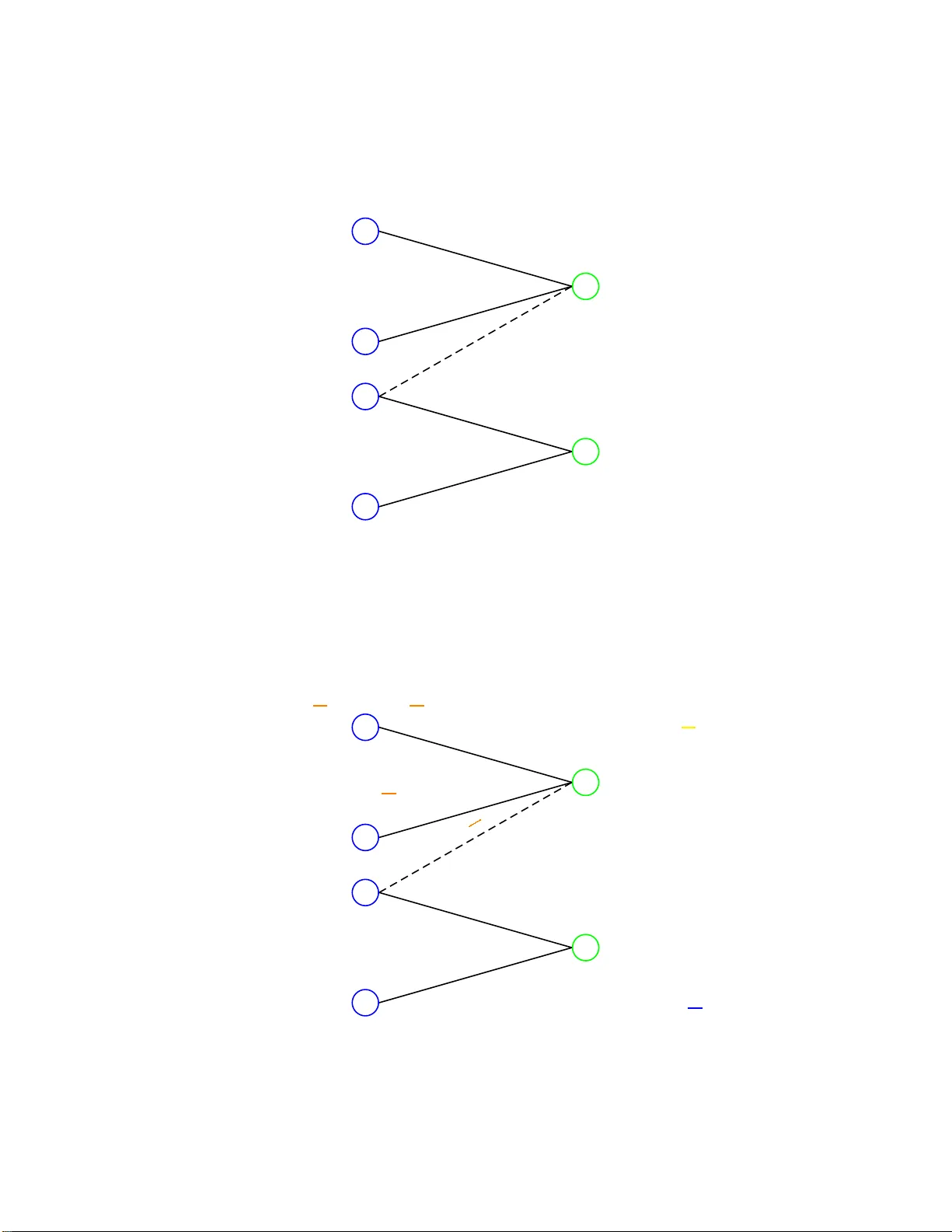
T o Broad-Matc h or Not to Broad-M atch : An Auctionee r’ s Dilemma ? ∗ Sudhir Kumar Singh † ‡ Vwani Roycho wdhury § October 29, 2018 Abstract W e initiate the study of an inte resting aspec t of s po nsored search advertising, n amely the conse- quences of br oad ma tch- a featur e where an ad of an advertiser can be map ped to a broade r range of relev ant queries, and not necessarily to the particular k eyword(s) that ad is ass ociated with. In spite of its unanimo usly belie ved impor tance, this aspect has n ot been fo rmally studied yet, p erhaps becau se of the inherent difficulty i nv olved in formulating a tractable framew ork that can yield meaningfu l conclusion s. In this paper, we p rovide a natural and rea sonable framework that allows us to ma ke definite statements about the econo mic outcom es of broad match. Starting with a very natura l setting f or strategies av ailable to the a dvertisers, and via a car eful loo k throug h the algorithmic lens, we first propo se solution concep ts for the game originating from the s trate- gic behavior of advertisers as they try to optimize their b udg et allocation across v ariou s keywords. Next, we con sider two broad match scenarios based on factors such as information asym metry b e- tween advertisers and the auc tioneer (i.e. the search en gine com pany), an d the extent of auction eer’ s control on the b udg et splitting. In the first scenario, the advertisers have the full information about broad match and relevant p arameters, and c an reapportio n their own budgets to utilize the extra information ; in particular, the auctioneer has no direct co ntrol over budget splitting. W e show that, the same bro ad match may lead to different equilibria, one leadin g to a re venu e impr ovement , whereas ano ther to a re v- enue loss . This lea ves the au ctioneer in a dilemma - whe ther to broad -match or not, and consequently leav es him with a co mputation al problem of pr edicting wh ich b road m atches will provably lead to r ev- enue improvement. This moti vates u s to con sider ano ther br oad match scenario, where the advertisers have information only abou t the curr ent scenario, i.e., without any br oad-match , and the allocation of the budgets u nspent in the cu rrent scenar io is in the co ntrol of the auction eer . Perhaps not sur prisingly , we observe that if the quality of broad match is good, the auctioneer can always improve his rev enue by judiciously using br oad match. Thus, info rmation seems to be a doub le-edged sword for the auction eer . Further, we also discuss the effect of both broa d match scenarios on social welfare. 1 Introd uction and M otivation The importanc e of understa nding the va rious aspects of spons ored search adver tising(SSA) is now well kno wn. Indeed, th is adverti sing frame work ha s been studie d e xtensi vely in recent years from algorith mic[12 , 6, 13, 18], game-theo retic[5 , 22, 1, 9, 3, 4, 11], learnin g-theoret ic[7 , 24, 19] pe rspecti ves, as well as, from the vie wpoint of emer ging div ersificatio n in the i nternet econo my[20 , 21]. Specifically , among others, these studie s include important aspects such as (i) the design of mechanisms for optimizing the re venue of the ∗ A preliminary version of this paper was pre sented at Fourth W orkshop on Ad Auctions. † Department of Electrical Engineering, Univ ersity of California, Los Angeles, CA 90095, Email:suds@ee.ucla.edu ‡ Financially supported by NetSeer Inc., Los Angeles, during course of this work. § Department of Electrical Engineering, Univ ersity of California, Los Angeles, CA 90095, Email:vwani@ee.ucla.edu 1 auctio neer , (ii) b udget optimization proble m of an adv ertiser , (iii) analy zing the bid ding beha vior of adv er- tisers in the au ction of a ke yword query , (i v) learning the Click-Thr ough-Rates and (v) the role of for -profit mediator s. In the present paper , our goal is to initiate the study of yet another interesting aspect of SS A, namely the con sequence s of br oad match . D espite its un animously belie ved importanc e, to the best of ou r kno wledge, this aspect has not be en formally studied yet, probably becau se of the hardne ss in emplo ying a proper framew ork for such an study . Our main aim in this paper is to attempt to provide such a frame work . In the rest part of this section, we start by an info rmal introdu ction to br oad match , then while establishi ng the need of a frame work to study br oa d matc h w e pro vide a glimpse of the present work. 1.1 What is Br oad Match? In S SA format, each adv ertiser has a set of key words rele va nt to her produc ts and a daily b udget that she wants to spend on the se k eyword s. Further , for each of these key words she has a true val ue asso ciated with it that she deri ves when a user clicks on her ad correspond ing to th at ke yword , and bas ed on this tru e v alue she reports her bid to the search engine company (i.e. the aucti oneer) to indicate the maximum amount she is willing to pay for a click. W hen a us er querie s for a ke yword, the auctio neer runs an auction among a ll the adv ertisers inter ested in that keyw ord whos e b udget is not ov er yet . T he adve rtisers winning in this auction are allocated an ad slot each, determined accord ing to the auction’ s alloca tion rule and an adv ertiser is char ged, whene ver th e user clic ks on her ad, an amoun t determined acco rding to the auction’ s payment ru le. In this way , for each of the advertis ers, each of her ads is matched to queries of the particu lar ke yword(s) that ad is associ ated with. Br oad Match is a feature where an ad of an advertise r can be mapped to a broader range of relev ant querie s, and not necessar ily to the particu lar keyw ord(s) that ad is associa ted with. Such relev ant queries could be possible v ariations of the associa ted ke yword or could ev en correspond to a completely dif ferent ke yword which is conce ptually re lated to the associat ed keywo rd. For exa mple, the vari ations of keyw ord “Scuba” could include “Scuba div ing”, “Scuba gear”, “Scuba shops in L os Angel es” etc and conceptu ally related ke ywords could include “Snork eling”, “unde r water photogra phy” etc. Similarly , for the ke yword “intern et advert ising”, the vari ations could includ e “banner adverti sing”, “PPC adve rtising”, “adv ertising on the internet”, “ke yword adv ertising” , “onlin e advertis ing” etc, and co nceptually related ke ywords could includ e “adwor d”, “adse nse” etc; for the ke yword “hors e race”, the va riations could includ e “horse rac- ing ticke ts”, “horse race betting ”, “online horse racing” etc, and a concept ually related keywo rd could be “thoro ughbred” . 1.2 The Need of a Framework to Study Br oad Match T o study the ef fect of i ncorporat ing br oad matc h on macrosco pic q uantities such as re venu e o f the auctio neer , social value etc, compared to the scenario without broad match, we must conside r the interaction among v arious ke ywords. W e must tak e into account the chang es in the bidding beha vior of adverti sers for specific ke yword querie s, as well as, the ef fect of chang es in their bu dget allocatio n acros s v arious keyw ords. As we mentione d earlie r , the in centi ve pro perties of q uery specific keyw ord auction is well analyzed in article s such as[5 , 22, 1 , 9, 3, 4, 11]. Further , the b udget optimiz ation problem of an advertis er , that is to spend the bu dget across v arious keyw ords in an optimal manner gi ven quantit ies such as keywo rd specific cost- per -clicks, e xpected number of clicks, and payof fs as a function of bid, has also been studied under v arious models[6, 13, 18]. Ho wev er , the incenti ve constr aints origina ting from such bu dget optimizing strategic beha vior of advertis ers has not been formally studied yet. In particular , there is no propo sed solu tion con cept pertin ent for predicti ng the sta ble beha vio r of adv ertisers in this game[2]. On the other hand, f or the analysis of the effe ct of incorpo rating br oad m atc h , it b ecomes inevitable to hav e such a solution concept , that is a notion of equilibr ium beha vior , under w hich we can compare the quantiti es such as rev enue of the 2 auctio neer , social va lue etc, for the two scen arios one with the broad match and the one without it at their respec tiv e equilib rium points . 1.3 Our Results Our first goal in this paper is to attempt to provide a reason able solutio n concep t for the game origina ting from the strategic beha vior of adv ertisers as they try to optimize their bud get allocation /splitting across v arious ke ywords . W e realize tha t without some reasonable restrictio ns on the set of a vai lable strategi es to the adve rtisers, it is a much harder task to achiev e[2 ]. T o this end, we consider a very natural setting for a vail able strategies - (i) first spl it/allocate the bud get across vario us keyw ords and then (ii) pla y the key word query specific bidd ing/auctio n game as long as you ha ve bud get left over for that k eyword when tha t query arri ves -t hereby divi ding the ov erall game in to tw o stage s. In the spiri t of [5 , 22] wherein the q uery speci fic ke yword aucti on is modeled as a s tatic one sho t game of comp lete information despite its re peated nature in practic e, we model the b udget splittin g too as a static one shot game of c omplete information because if the b udget splitting and bidding process eve r stabilize , advert isers will be pla ying static best responses to thei r competit ors’ strate gies. No w , with this one shot c omplete informatio n ga me modeling, the most na tural soluti on conc ept to con - sider is pur e N ash equilibr ium. Howe ve r , in our case, it seems to be a ver y strong notion of equilibriu m beha vior if we look through our algorithmic glasses 1 becaus e, as w e argue in the paper , an adve rtiser’ s proble m of choosing her best response is computationa lly hard. C onsequ ently , we first conside r a weaker soluti on concept based on local Nash equi librium. W e sho w that there is a strongly po lynomial time (poly- nomial in number of adve rtisers, k eywor ds and ad slots and not the vo lume of queries or tot al daily b udget ) algori thm to c ompute an adve rtiser’ s locally best res ponse. T his noti on of equilibriu m, which we cal l br oad match equilib rium (B ME), is define d in terms of mar ginal payof f (or ban g-per -bu ck ) for v arious k eywor ds corres ponding to a bu dget splitting, and loo ks simila r to the definiti on of user equilib rium/W aldr op equilib- rium in ro uting and transporta tion science literature[17]. Further , there is a strongly pol y-time algorith m to compute an adve rtiser’ s appr oximate best response as well. Theref ore, the appr oximate Nash equilib rium ( ǫ -NE) is also reasonable in our setting. Indeed, all the conclus ions of our work hold true irrespec tiv e of which of these two sol ution conc epts we ad opt, the BME or the ǫ -NE . In the full information setting, under the solution concept of BME we obtain sev eral observ ations by exp licitly constructi ng examples. In particu lar , eve n with this natural and reasonably restricted notion of stable beha vior , we observe that same br oad m atch might lead to diff erent B ME s where one BME might lead to an improveme nt in the re venue of the auctionee r ov er the scenario without br oa d match while the other to a loss in re ve nue, e ven when the quality of br oad-matc h is very good. This leav es the auct ioneer in a dilemma ab out whethe r he sh ould broad -match or no t. If he could someh ow predict which choice of broad match lead to a re venu e improv ement f or him and whic h not, he coul d potential ly choose the ones le ading to a re ve nue improv ement. F urther , the same e xamples imply the same co nclusions under the solu tion co ncept of ǫ -NE . This bring s forth one of the big ques tions left open in this paper , that is of efficien tly computing a BME / ǫ -NE , if one e xists, giv en a choice of br oad matc h . Note th at in the a bove scenario of broad m atch, t he adv ertisers had all th e rele v ant infor mation about the broad match, and the control of budg et splitt ing is in the hands of respecti ve adv ertisers. W e also explo re anothe r broad matc h scenar io where the ad vertise rs hav e info rmation only a bout the scenario withou t broad- match, and the y allo w the auctioneer to spend their e xcess bud gets (i.e the bu dget unspen t in the scenario without broa d match), in wha tev er way the auction eer wants , in the hope of potentia l impro vements in their payof fs. P erhaps not surprisi ngly , we observe that if the qualit y of broad match is good, the auction eer 1 Efficient computability is an important mo deling prerequisite for solu tion concep ts. I n t he words of Kamal Jain, “If your laptop cannot find it, neither can the market”[1 4 ]. 3 can always improv e his re venue. Thus, informatio n seems to be a double-edg ed swor d for the auctionee r . Further , we also discus s the eff ect of both broad match scenarios on social welfare. 1.4 Organization of the Pap er Rest of the paper is orga nized as follo ws. In S ection 2, we describe the formal setti ng of the query specific ke yword auctions. In Section 3, we define Br oad Match Graph , a weighted bipart ite graph between the set of adv ertisers and the set of ke ywords , which serv es as the basic back bone in terms o f which we formulate all our notio ns and results. In Section 4, we present the defining character istics of the two broa d ma tch scenarios studie d in this paper , in terms of factor s s uch as informati on as ymmetry and the extent of auction eer’ s control on th e b udget spli tting. The Section 5 is d ev oted to the stu dy of b r oad matc h sce nario in t he full informati on setting where the auctione er has no direct control on the b udget splitt ing. This is essential ly the most contri buti ng part of this pap er wherein first we appr opriately model the game ori ginating fro m the strate gic beha vior of adv ertisers as they try to optimize their b udget allocation/ splitting across va rious ke ywords, then w e propose appropria te soluti on concep ts for this game, and finally study the effect of broad match under this propo sed framewo rk. In Section 6, we study the other broad m atch scenario, where advertise rs do not ha ve full information about the broad m atch being performed and the auction eer partially controls the b udget splittin g. F inally , in Section 7, we conclu de with pot ential directions for future work moti v ated by the prese nt paper . 2 K eyword A uctions There are K slots to be allocated among N ( ≥ K ) bidders (i.e. the advert isers). A bidder i has a true v aluation v i (kno wn only to the bidder i ) for the specific keyw ord and she bids b i . The expe cted click thr o ugh rate (CTR) of an ad put by bi dder i when allo cated slot j has the fo rm C T R i,j = γ j e i i.e. separable in to a position ef fect and an adver tiser ef fect. γ j ’ s ca n be interpre ted as the probabili ty that an ad w ill be notice d when put in slot j and it is ass umed that γ j > γ j +1 for all 1 ≤ j ≤ K and γ j = 0 for j > K . e i can be interpr eted as t he probabil ity that an ad put by bid der i will be click ed on if noticed and is referred to as the r eleva nce of bidder i . The payo ff/u tility of bid der i when gi ven s lot j at a price of p per-cl ick is gi v en by e i γ j ( v i − p ) and they are assumed to be rational agents trying to maximize their payof fs. As of no w , Google as well as Y ahoo! use schemes closely modeled as RBR(rank by re venu e) with GSP(generaliz ed second pricing). The bidder s are ranked in the decreasi ng order of e i b i and the slots are alloca ted as per this ran ks. For simplicit y of notat ion, assume that the i th bidde r is the one all ocated slot i accord ing to this ran king rule , then i is char ged an amoun t equa l to e i +1 b i +1 e i per -click. This mechanism has been extensi ve ly studie d in recent years[5, 9, 22, 11]. The solut ion concept that is widely ado pted to study this auction game is a refinement of Nash equilib rium indep endently prop osed by V arian[ 22 ] and Edelman et al[5]. Under this re finement, the bid ders hav e no incenti ve to cha nge to ano ther position s e ven at t he current price paid b y the bidders cur rently at that positi on. Edelmen et al [5] calls it lo cally en vy-fr ee equili bria and ar gue that such an equilibri um arises if agent s are raising their bids to inc rease the payments of those abov e them, a practic e which is belie ved to be common in actual key word auctio ns. V arian[ 22 ] calle d it symmetric Nash equ ilibria(SNE) and provi ded some empirical e vidence that the Google bid data ag rees well with the SNE bid profile. In partic ular , an SNE bid profile b i ’ s s atisfy ( γ i − γ i +1 ) v i +1 e i +1 + γ i +1 e i +2 b i +2 ≤ γ i e i +1 b i +1 ≤ ( γ i − γ i +1 ) v i e i + γ i +1 e i +2 b i +2 (1) for all i = 1 , 2 , . . . , N . No w , recall that in the RBR with GS P mechanis m, the bidder i pays an amount e i +1 b i +1 e i per -click, therefo re the expecte d payment i makes per- impression is γ i e i e i +1 b i +1 e i = γ i e i +1 b i +1 . 4 Thus the best SNE bid profile for adv ertisers (worst for the auction eer) is minimum bid profile poss ible accord ing to Equation 1 and is gi ven by γ i e i +1 b i +1 = K X j = i ( γ j − γ j +1 ) v j +1 e j +1 (2) and therefo re, the re venu e of the auct ioneer at this minimum SNE is K X i =1 γ i e i +1 b i +1 = K X i =1 K X j = i ( γ j − γ j +1 ) v j +1 e j +1 (3) = K X i =1 ( γ j − γ j +1 ) j v j +1 e j +1 . 3 Broad Match Graph In this section, we set up a basic backbone to stud y the dynamic s of bidd ing acro ss v ariou s r elate d k eywor ds, in th e sponso red sea rch adve rtising, via a b ipartite graph b etween the se t of bi dders (i.e. the a dvertis ers) an d the set of ke ywords with the paramete rs ( N , M , K , S = ( s i,j ) , B = ( B i ) , V = ( V j )) as follo ws. • Keyw ords: M is the number of keywo rds in considerat ion. W e will denote the set of ke ywords { 1 , 2 , . . . , M } by M . Further , V j is the tota l (expected ) v olume of querie s f or the ke yword j for a gi ven period of time which w e call a “day ”. T hese may not be all the ke yword s a particular adv ertiser may be interested in bidding on b ut one of the sets of key words which are related by some categ ory/conc ept that the adv ertiser is in terested in bid ding on e.g. for selling the same product or service. • Bidders/Advertise rs: N is the tota l nu mber of bidders intereste d in the abov e M keywo rds. W e will denote the set of bidder s { 1 , 2 , . . . , N } by N . Further , B i is the total bud get of the bidder i for a “day ” that she wants to spend on thes e ke ywords . • Slots: K is the maximum number of ad-slots av ailable. Let L be the number of adv ertisers with suf ficient budg ets when a particula r query of a ke yword j arri ves then for that query of j , the slot- clicka bility (i.e. the position based CT Rs) are defined to be γ l corres ponding to a slot l for l ≤ min { K, L } an d zero othe rwise 2 . • V aluation Matrix: Let v i,j be the true va lue of the bidder i for the ke yword j and e i,j be her re le- vance 2 (quali ty sco re) for j . W e call the N × M matrix S , with ( i, j ) th entries defined as s i,j = v i,j e i,j , as the valuation matrix . For a k eyword j for which a bid der i has no in terest or is not allowed to bid, s i,j := − ∞ . In the re venue/ efficien cy/pay offs calculat ions at S NE, it is enough to know s i,j and not the v i,j and e i,j separa tely , therefore, in this paper w e will often refer only to s i,j and not v i,j and e i,j indi vidual ly . • Broa d Match Graph (BMG): Give n ins tance parameters ( N , M , K, S , B , V ) , a biparti te graph G = ( N , M , E ) , with verte x sets N and M and edge set E = { ( i, j ) : i ∈ N , j ∈ M , s i,j > 0 } , is constr ucted. Further , each edge ( i, j ) ∈ E is assoc iated with a w eight s i,j . The w eight of a node i ∈ N is B i and that of a node j ∈ M is V j . Furthermore, an i ∈ N will be calle d an ad-node and an j ∈ M w ill be referre d to as a ke y wor d-node . 2 W e assume that the clicks-through-rates(CTRs) are separable. 5 • Extension of a BMG: A B MG G ′ = ( N , M , E ′ ) for the instance ( N , M , K , S ′ , B , V ) is called an e xtension of a BMG G = ( N , M , E ) for the insta nce ( N , M , K, S, B , V ) if E ⊂ E ′ and s ′ i,j = s i,j for all ( i, j ) ∈ E . Inter pretation is that the instan ce represent ed by an extens ion is more broader in the sense tha t an ad vertise r has a cho ice to be and could be matched to a lar ger set of ke ywords . Indeed, we will formally refer an extens ion G ′ = ( N , M , E ′ ) to be a br oad-mat ch for its b ase G = ( N , M , E ) . Note that, without loss of g enerality , this definition of exte nsion (b road-match) ca ptures the p ossibility that ne w keyw ords are introduce d. This is because we can always think that a new keyw ord to be includ ed was alre ady there as an isol ated node and no w we are creatin g only edges . 4 Inf ormation Asymmetry , Budget S plitting and T wo Br oad Match Sce nar - ios Dependin g on ho w much i nformation the auctione er (i.e. the search engin e compan y) pr ovides to advertise rs about variou s parameters, such as C TRs, con v ersion rates, vo lume of queries etc, related to the ke ywords and dep ending on who s plits the dai ly budge t ac ross the v arious ke yword s, the auctione er or the adv ertisers, we consid er the follo wing two scena rios for broad matching : I) AdBM: Adverti sers Controlled Broad Match, extra informat ion to adv ertisers, adv ertisers split their b udgets. II) AcBM : Auctioneer Controlled Broad Match, no extra informat ion to advertis ers, auctionee r splits the b udget. Formally , let G ′ = ( N , M , E ′ ) be the br oad-matc h for G = ( N , M , E ) , then we chara cterize these two scenar ios of broad -match based on the follo wing factors (ref. T able 1 ): • Informatio n asymmetry: Of course , adve rtisers already ha ve all the informatio n about the BMG G . That is, they all kno w their CTRs, con v ersion rates, v olume of queries, who participat es ho w long, spend s and bids ho w m uch on which ke yword, across va rious ke ywords they are bidding currently . It is the knowle dge about these quantities for the part of the ex tension G ′ which is not in G i.e. along the edges in E ′ \ E that advertis ers may or may not be aw are of dependi ng on whether the auctio neer provide s this information to them or not 3 . In AcBM scen ario, advert isers do not hav e this informat ion. At most what they know is tha t there is some broad-matc h the auctioneer is performing and t hey can ef fect the dy namics on the e xtensio n G ′ only passi vel y through th eir bidd ing beha vior on G 4 . In AdBM sce nario, there is no such asymmetry in inf ormation. Advertise rs kno w (or are rat her informed by the auction eer) all the informatio n about E ′ \ E . • Extent of auctione er’ s contr ol on the b udget splitting : In AdB M scenario, the auctioneer has no contro l over the bud get splitting . It is upto the adve rtisers to decide which ke ywords they want to partici pate in and ho w much b udget the y want to spend on each of those keyw ords. Thus, the budg et splitti ng of an adve rtiser , across variou s ke ywords she is connected to in G ′ , is in her own control and she can split her budg et so as to maximize her total payof f across those keywo rds. As dis cussed in section 1.2, this brin gs in another layer of ince ntiv e constraints from adve rtisers besides choosing 3 Of course, to l earn these relev ance scores there might be a cost incurred by the auctioneer in the short run, nev ertheless if the broad-match quality is good, this cost will generally be minimal. 4 As we kno w , in the spon sored search advertising, adv ertisers ef fectiv ely deriv e their v aluations from the rate of con version which might very well change by broad match and accordingly bidders may adjust their true value s (and consequently the bids) due to broad match. This might lead to another level of cost to the auctioneer due to uncertainty in performing broad-match. Ne vertheless, if the broad-match quality is good, this cost will generally be minimal. 6 AdBM AcBM Informatio n asymmetry No Y es (adve rtisers know all info on ne w edges) (adve rtisers don’t know inf o on ne w edges) Extent of auctio neer’ s contr ol on the budg et splitting No Control Limited Control (only for the excess b udgets) An adver tiser’ s starting time for a keywo rd V ery First Query Any Query (only for the part auction eer controls) T able 1: T wo Broad-Matc h Scenari os the bid v alues for indi vidual quer ies. In AcBM scenario, the auction eer does ha ve some con trol ov er b udget splitting . At one e xtreme, an adv ertiser might gi ve the complete control to the auct ioneer for splitti ng her b udget across v arious keyw ords lettin g the auctioneer decid e ho w much should be spen t on which k eywor d. In thi s case, since the control will be completely in the hands of the auctionee r it can p erform the b udg et splitting so as to maximize h is o wn total re venue wit hout much c oncern to the welfar e of adv ertisers. Therefore , advert isers would har dly giv e such a full control to the auctionee r . Ho wev er , it is reasona ble that an adv ertiser allows the auc tioneer to spend her exc ess budge t i.e. the b udget unspen t in th e case of G , in whate ver w ay the au ctioneer wants to spend i t in G ′ , in h ope of an additi onal payo ff. N ote that t here must be some ad vertise rs with exce ss budge t for the A cBM to mak e sense. If e very advert iser is already spending its all budg et then w hy to take all the pain of doing a broad- match 5 . In our study of AcBM in S ection 6, we cons ider this limited con trol setting. Another issue the auctio neer fac es in AcBM is that what bid profiles to use along the edges in E ′ \ E . The auctio neer must perform these calcul ations in a manner to maintain equili brium across the keyw ords meaning that the advertis ers should not be indire ctly compelled to re vise their true va lues along the edges in G 4 . This assumptio n is re asonable as at SNE the auction eer can es timate the true v alu es from the equilibr ium bids on G and then along w ith the ne w information gathered for E ′ \ E , can do the proper SNE bids calcula tions on the behal f of the adve rtisers. • An advertiser ’ s starting time for a ke ywor d: In AdBM scenario, an advert isers participat es in all ke ywords she is interested in startin g with i ts first qu ery until her b udget alloc ated for that ke yword is spent or there are no more queri es for tha t keywo rd 6 . In AcBM scenario , ho wev er , since the auct ioneer is controllin g at least a part of the b udg et spl itting, and unlik e a dvertis ers, since it can easily track w hat happe ns at which que ry in an onli ne manner , it can choose to bring in an adv ertiser’ s bud get alo ng an edge star ting with any particular query of that key word. For example, it can bring adv ertiser i in the auctio n of ke yword j startin g at say 1000 th query of j . No w , let u s illustrate the abov e two sce narios via an example by co nsidering the BMG gi ven in Figur e 1 (i.e. the gr aph withou t the edge (3 , 1) ) and its e xtensi on giv en in the same figure (i.e. the gr aph incl uding the edge (3 , 1) ). Further , eac h query is sol d via a GSP auction (ref. Section 2), and the re ve nues are calculat ed at SNE (ref. Equations 2, 3 in Section 2). In the base BMG , under GSP the adve rtiser 2 pays zero amount for each query since there is no bidder ranked belo w her , therefor e ev en w ith a very small budge t she is able to particip ate in all the queries of ke yword 1 . Thus, the total rev enue extract ed in the base BMG is 5 In case, doing a broad-match encourages advertisers to increase their budgets, for the purpose of analysis, this increase can be considered as an exc ess budget. 6 In reality , Google/Y ahoo! roug hly allows the adve rtisers to specify which part of the day they want to spend most of their budg ets, neverthe less t his option does not gi ve a finer control such as specifying a particular query number they can start with. Therefore, to simplify the incentiv e analysis we do not consider such option in this paper . Further , note that if the advertisers are gi ven a chance to express their desire as to which part of the day the y wan t to spend ho w much budget, and as long as the day is divided in to fe w parts (say polynomially many in the size of the BMG), then this expressiv eness can be easily captured in t he present frame work by replicating the role of rele v ant ke yword n odes and di viding the total volume of queries for that k eyw ord node among these ne w nodes according to t he size of the v arious parts of the day . 7 0 . 9 V 1 + 0 . 6 V 2 , 0 . 9 V 1 from keyw ord 1 and 0 . 6 V 2 from the keywo rd 2 . Now in the extensi on, there is a ne w edge (3 , 1) . In the A dBM scenario, since the adve rtiser 3 has the control of splitting the budge t and whether she wants to participate for ke yword 1 , she participat es along (3 , 1) for all queries as she nev er needs to pay anything b ut certainly gets the second slot and positi ve payo ffs for all the queries after the adv ertiser 2 spends its all b udget and drops out i.e. for all the queries after the first ǫV 1 th query . Note that adv ertiser 2 no w pays a posi tiv e amount for each que ry and is forced to drop as its tot al budg et gets spen t. Therefore , the ne w rev enue of the aucti oneer is 0 . 9 V 1 + 3 . 1 V 1 ǫ − 0 . 3 3 . 1 + 0 . 6 V 2 which is smaller than the re venue g enerated in the bas e BMG if ǫ < 0 . 3 3 . 1 . H o wev er , in the AcBM scenario , the control is in the hands of auctio neer and he can cho ose not to spend the (exce ss) b udget of adv ertiser 3 along (3 , 1) , thereby av oidin g a potential re venu e loss. Moreov er , he has a finer con trol and can choo se to brin g 3 along (3 , 1) after some querie s for 1 has alrea dy arriv ed. In particula r , if he brings 3 along (3 , 1) starting (1 − ǫ ) V 1 + 1 th qu ery , the ne w re ven ue generate d is (1 − ǫ )0 . 9 V 1 + 2 . 3 ǫV 1 + 1 . 4 ǫV 1 + 0 . 6 V 2 which i s more than the rev enue gener ated in the base BMG . s 4 , 2 = 2 4 B 4 2 V 2 s 3 , 2 = 4 3 B 3 = 0 . 6 V 2 + 4 s 2 , 1 = 3 2 B 2 = 1 . 4 ǫV 1 1 V 1 s 1 , 1 = 5 1 B 1 = 0 . 9 V 1 + 1 . 4 ǫV 1 Adver tisers Ke ywords s 3 , 1 = 2 Figure 1: A BMG (without the ed ge (3,1) ) and an e xtension (with the edge (3 ,1)), K = 2 , γ 1 = 1 , γ 2 = 0 . 7 5 Advertisers Contr olled Broad Match (AdBM) In this section, we start out with our fi rst goal, that is to pro vide a reaso nable soluti on concept for the game origin ating from strategic behav ior of advert isers as they try to optimize their b udget allocat ion/splitti ng across v arious key words. W e realize that without some reasona ble restric tions on the set of a va ilable stra te- gies to the adve rtisers, it is a much harde r task to achie ve[ 2 ]. T o this end, we consider a very natural setting for av ailabl e strategie s- (i) fi rst split/al locate the b udget across v arious keyw ords and then (ii) play the key- word query specific bidd ing/aucti on game as lo ng as you ha v e budg et left ove r for that keyw ord when that query arri ves -there by di viding the ov erall game in to two stages. The second stage is exactl y the q uery spe cific ke yword auction and for that s tage we can u tilize th e equi - librium behavi or proposed in literature. There fore, in the second stage, w e are restricting the beha vior of adv ertisers in that, gi ven the av ailab ility of b udget to partici pate in the auction of a particu lar qu ery , an adver - tiser acts rationally bu t bei ng ign orant about a nd disr e g ar ding the fact that her bidding beha vior mig ht ef fect 8 her deci sion in the sp litting/all ocation of her b udg et across var ious key words in the first st age. For e xample, in the second stage, for the auction mechanis ms currently used by Google and Y ahoo ! i.e. General ized Secon d Price (GSP) Mechani sm, w e can ado pt the soluti on concept of Symmetric Nash Equil ibrium(SNE) propo sed in [5, 22]. That is, once the bu dget is spli t, for each query all adve rtisers, with av ailab le bud gets for the correspondi ng keywo rd, bid acc ording to a minimum SNE bid profile. Note that, even for the same ke ywor d , dif fer ent que ries may have diff er ent SNE bid pr ofiles because the set of adv ertiser s with available b udgets may be diff er ent when thos e quer ies arr ive . No w , for the first stage i.e. b udget splittin g, we do not put any restriction on how the advertise rs split their budg et across v arious ke ywords. Each advertise r , knowing the fact that all advertise rs will behave accor di ng to SNE for ke ywor d queries , chooses her budge t splitti ng so as to maximize her total payof f across all queries of all ke ywords for the day . Thus, with the restriction on the biddi ng behavi or in second stage, we are left only to analy ze the game of spli tting the b udget across var ious keywo rds. In the spir it of [5 , 22] wherei n the query speci fic key word auct ion is modeled as a stat ic one shot game of complete informatio n despite its repeated nature in practice, we model the budge t splitting too as a static one shot game of complete information because if the b udget splitting and bidding process ev er stabilize , adv ertisers will be playing static best responses to their competitors ’ strate gies. Let us refer to this game as Br oa d-Match Game . In the follo wing, we search for a reasona ble notion of stable bud get splitting i.e. a reason able solut ion conce pt for the Broad-Mat ch Game. 5.1 Advertisers’ Best Response Problem and Search for an Appr opriate Solution Concept f or Broad-Match Game Let the b udget of advertise r i decided for the keyw ord j be B i,j , then this budg et allo ws her to particip ate for the first V i,j number of qu eries for some V i,j ≤ V j . And gi ve n a number of que ries V i,j for j , there will be a budge t req uirement from i , dep ending on the bi dding interests of th e other bidd ers, their va luations etc, to participat e in the fi rst V i,j querie s of j . T hus, there is a one-to-on e correspon dence between the b udget spent on a particul ar ke yword by a bidder and the total number of queries of that key word starting the first one, that the bidder participates in. Clearly , then the splitting of b udget across va rious keyw ords can be equi v alently consider ed as deciding on how many queries to participate in, starting their first queries, for those ke ywords. No w , w ith the one shot complete informatio n game modeling, the most natural solutio n concept to consid er is pur e N ash equilib rium which in our scenario (i.e. for the Broad-Match G ame correspon d- ing to the instance ( N , M , K, S, B , V ) & BMG ( N , M , E ) ) can be defined as the matrix of query v alues { V i,j , ( i, j ) ∈ E } suc h that for each i , gi ve n that thes e valu es are fixe d for all l ∈ N − { i } , no other v alues of { V i,j } gi ves a better total payof f to the bidder i . Equi vale ntly , it is the matrix of v alues { B i,j , ( i, j ) ∈ E } such that fo r eac h i , giv en that the thes e values are fix ed for all l ∈ N − { i } , no othe r v alues of { B i,j } gi ves a better total payof f to the bidder i . The solutio n concept of pure Nash equilibriu m that we hav e propos ed above requires that the players (i.e. the advertis ers) are powerful enoug h to play the game rationa lly . In particular , they should be able to compute the best respons es to their competitors ’ strate gies. In the presen t case, for an adv ertiser i , it boils do wn to solvi ng an optimiz ation prob lem of finding the budg et-splitti ng across v arious key words with maximum total payof f, gi ve n the budg et- splitting of other advertise rs. That is, giv en the va lues { B n,j } for all n ∈ N − { i } and for all j ∈ M , to compute { B i,j } yielding m aximum payof f for the advertise r i . Of course , the details of BMG is known to e v ery player . T o justif y this solution c oncept o n alg orithmic g rounds, it should be essential that this optimizatio n probl em of adve rtiser i , hencefort h referr ed to as Advertiser s’ Best Response Pr oblem(AdBRP) , should be solva ble in time polynomia l in N , M , K . Note that we are strictl y asking the time comple xity to be poly nomial in N , M , K and not in V j ’ s and B i ’ s . T his is because V j ’ s a nd B i ’ s cou ld in gen eral be e xponenti ally lar ger tha n N , M , K . In fact, in practice this seem to be the 9 case as volu me of queries could be much lar ger than the number of advert isers and ke ywords. There fore, let us first formulate this optimizatio n problem for adve rtiser i . Let c ( m, j, l ) be the (expecte d) cost of adv ertiser m for the l th que ry of the k eyw ord j if she participat es in the query l and all th e previo us que ries of the keyw ord j . Similarly , u ( m, j, l ) is the (expe cted) payof f of adv ertiser m for the l th query of the ke yword j if she participates in the query l and all the pre vious queries of the ke yword j . Also define the mar ginal payof f or bang-pe r-b uc k for adv ertiser m for the l th query of key word j as π ( m, j, l ) = u ( m,j,l ) c ( m,j,l ) . T o be able to compute her best response, an adv ertiser must be able to ef ficiently compute these valu es first. For each ( i, j ) ∈ E there are O ( V j ) such va lues and at first glance it seems that the adve rtiser might tak e a time polynomial in V j , i.e. not in strongly polynomial time, to compute these val ues. Howe ver , if we observe carefully there is a lot of redund ancy in these value s as noted in the follo wing lemma. The idea is that the cost and the payof f of an advert iser for a query of a key word depends only on the set of adv ertisers participati ng in that query and the valua tions their of. Therefore , as long as this set is the same these quantit ies will remain the same. Lemma 1 F or each i ∈ N , given the BMG G = ( N , M , E ) and the b udg et split ting of all ad vertiser s in N − { i } (i.e. the B n,j values f or al l n ∈ N , j ∈ M ), ther e e xist non-ne gat ive inte g ers Λ j , z j, 0 , z j, 1 , z j, 2 , . . . , z j, Λ j for all j ∈ { j ∈ M : ( i, j ) ∈ E } suc h that Λ j = O ( N ) and for a ll 0 ≤ λ ≤ Λ j − 1 , c ( i, j, l ) = C ( i, j, λ ) , u ( i, j, l ) = U ( i, j, λ ) , π ( i, j, l ) = Π( i, j, λ ) ∀ z j,λ < l ≤ z j,λ +1 , wher e C ( i, j, λ ) := c ( i, j, z j,λ + 1) , U ( i, j, λ ) := u ( i, j, z j,λ + 1) , Π( i, j, λ ) := π ( i, j, z j,λ + 1) . Mor eove r , all these Λ , z , c, u, π values can be computed toget her in O ( M N 2 K ) time. Pro of: The proof follo ws from Algorith m 5.1 descri bed in the followin g. The idea in the Algorithm 5.1 is that the cost and the payof f of an adver tiser for a query of a ke yword depends only on the set of adv ertisers participati ng in that query and the valua tions their of. Therefore , as long as this set is the same these quantities will remain the same. F urther , there can be at most N choices of this set. For the v ery first query , this s et consi sts of all the advertise rs with positi ve b udget for that ke yword a long with the a dvertis er i (recall that the b udget splittin gs for other adv ertisers are gi v en). This set changes when adver tisers drop ou t as their b udgets get spent and they no long er hav e enough amount to buy the nex t query . This change can occur at m ost N − 1 times. T he Algorith m 5.1 tracks exact ly when the adve rtisers drop out and compute the c, u, π valu es acco rdingly . The Algorith m 5.1 runs in time O ( N 2 K ) . Initi alization requir es O ( N ) and the while loop require s O ( N K ) in each iterati on. There are at most O ( N ) ite ration of the wh ile loop be cause for ev ery tw o itera- tion at least one advert iser drops out. There is a N log N term, sub sumed by N 2 , that comes from the need to sort the v aluation s i,j ’ s b efore computing the SNE b id profile. 10 ✓ ✒ ✏ ✑ Algorithm 5.1: Q U E RY P A RT I T I O N ( G, j, B n,j ∀ n ∈ N − { i } ) A ← { n ∈ N − { i } : B n,j > 0 } λ ← 0 z j, 0 ← 0 while A 6 = φ do C ompute C ( n, j, λ ) ∀ n ∈ A ∪ { i } and U ( i, j, λ ) Π( i, j, λ ) ← U ( i,j,λ ) C ( i,j,λ ) if C ( i, j, λ ) = 0 then Π( i, j, λ ) ← ∞ y ← min n ∈ A {⌊ B n,j C ( n,j,λ ) ⌋} if y > 0 then A 1 ← A − { n ∈ A : B n,j C ( n,j,λ ) = y } B n,j ← B n,j − y C ( n, j, λ ) ∀ n ∈ A z j,λ +1 ← min { z j,λ + y , V j } A ← A 1 λ ← λ + 1 if z j,λ = V j then exit comment: Exit ing the wh ile LOOP else A ← { n ∈ A : ⌊ B n,j C ( n,j,λ ) ⌋ 6 = 0 } if A = φ then C ( i, j, λ ) ← 0 U ( i, j, λ ) ← γ 1 s i,j Π( i, j, λ ) ← ∞ λ ← λ + 1 z j,λ ← V j Λ j ← λ output (Λ j , { z j,λ } , { C ( i, j, λ ) } , { U ( i, j , λ ) } , { Π( i, j, λ ) } ) . 11 No w , us ing the abo ve lemma we are read y to formu late the AdBRP of adv ertiser i . Let us define, ˜ U ( i, j, l ) = ( l − z j,λ − 1 ) U ( i, j, λ − 1) + λ − 1 X m =1 ( z j,m − z j,m − 1 ) U ( i, j, m − 1) if z j,λ − 1 < l ≤ z j,λ . (4) ˜ C ( i, j, l ) = ( l − z j,λ − 1 ) C ( i, j, λ − 1 ) + λ − 1 X m =1 ( z j,m − z j,m − 1 ) C ( i, j, m − 1) if z j,λ − 1 < l ≤ z j,λ . (5) then the AdBRP is the follo wing optimizati on problem in non-ne gati ve inte ger vari ables x i,j ’ s . Max X ( i,j ) ∈ E ˜ U ( i, j, x i,j ) s.t. X ( i,j ) ∈ E ˜ C ( i, j, x i,j ) ≤ B i (6) 0 ≤ x i,j ≤ V j ∀ ( i, j ) ∈ E x i,j ∈ Z ∀ ( i, j ) ∈ E It is not hard to see that being a v ariant of Knapsac k Pr oble m (decisio n vers ion of) A dBRP is NP-har d . Its NP har dness follo ws from simple restrictio ns that m ake s it equi v alent to 0-1 Knapsa ck Problem or Inte- ger Knapsack Problem(IKP) respecti vel y . First, let us restrict all relev ant quantiti es such as budg et, utili ties and costs to be inte ger valu es. No w , in AdBRP , cho osing V j = 1 for all j ∈ M mak es it equiv alen t to the 0-1 Knapsack Problem. Also, in AdBRP , choosing Λ j = 1 for all j ∈ M (i.e. a single partition for each ke yword) makes it equ iv alent to the Integer Knapsack Problem. No w being N P-hard, AdBRP is unlik ely to ha ve an effici ent algorithm and thus the solution concept based on pure Nash equilibrium does not seem to b e reasonable and we should consider w eak er notions . One such reason able solutio n concept could be that based on local N ash equil ibrium, where the adver tisers are not require d to be so sophisticate d and can devi ate onl y local ly i.e. by small amounts from the their current strate gies. W e show that an advert iser’ s locally best re sponse can be computed via a greedy algorith m in strongly polynomial time. Furth er , this equilib rium notion is similar to the user equili brium/W aldr op equili brium in routing and transpor tation science literatur e[17 ]. Another solutio n concep t that we exp lore is moti vate d by the f act th at bein g a va riant of IKP and giv en tha t IKP can be approximated well, it may be possib le to ef ficiently compute a pretty good app roximation of the adv ertiser’ s best respon se, and the refore an app roximate Nash equil ibrium may als o make sens e. In the follo wing sub-sect ions we in v estigate these two sol ution con cepts. 5.2 Br oad Match Equilibrium(BME) Based on our discussion in section 5.1, let us first formally define the equilib rium notion based on local Nash equilib rium and let us refer to it as Br oad Matc h E quilib rium(BME) . Definition 2 Given a B MG G = ( N , M , E ), a BME for G is defined as the m atrix of query values { V i,j } and the b udget splittin g values { B i,j } if f the y satisfy the following conditions. E1) F or all i , if ( i, j ) ∈ E with V i,j > 0 , and ( i, l ) ∈ E w hic h is not query-s aturat ed meaning V i,j < V j then M P − i,j := u ( i,j,V i,j ) c ( i,j,V i,j ) ≥ M P + i,l := u ( i,l,V i,l +1) c ( i,l,V i,l +1) i.e. the advertis er i does not have an incentiv e to dev iate loc ally fr om ke ywor d j to ke ywor d l . 12 E2) F or all i , i spends her total b udget B i (on some ke ywor d or the other) unl ess eac h ( i, j ) ∈ E is either query- satura ted (i.e. V i,j = V j ) or b udg et-satur ated meaning that the left over b udg et of advertiser i for ke ywor d j is ins uffic ient to b uy the next quer y of j . No w giv en the { V n,j } and { B n,j } valu es for all n ∈ N − { i } , the locally best response proble m ( local AdBRP ) for i is to compute a set of { V i,j } and { B i,j } value s such that the y sa tisfy all conditio ns in th e abo ve definitio n of BM E . W e sho w in the follo wing theorem that the local A dBRP can be computed ef ficiently . Thus, BME is indee d a reaso nable solutio n concep t for the Broad-Matc h Game. The idea in the pro of of Theorem 3 is to first partition the que ries across v arious ke ywords via Lemm a 1 so that the payo ff, cost, and mar ginal payof f of i is the same for all queries in a giv en partition . Then, in a GREEDY ALLOCATION PHASE , to greedi ly distrib ute the b udgets across v arious ke ywords moving from one par tition to an other . Finally , in a GREED Y R EADJUSTME NT P HASE , if t here is an edge ( i, l ) which is not sta ble (i.e. the adverti ser i could profitably de viate local ly to this edge from another edg e(s)), a re ver se greedy approac h would take b udgets from edge with minimum marg inal payof f and put it to ( i, l ) until ( i, l ) becomes stable, again via moving from part ition to partition. Since w e always mov e from partit ion to partiti on and a p artition is visited at most o nce in each of the ab ove two phases, and there are at most O ( N ) partiti ons per ke yword, this algori thm is ef ficient. Theor em 3 Ther e is a str ongly pol ynomial time alg orithm for lo cal AdBRP . Pro of: The proof foll ows from th e Algorithm 5.2 pro vided in the followin g. The Algorit hm 5.2 first parti- tions the queri es across v arious ke ywords so that the pay off, cost, and mar ginal payof f of i is th e same for all querie s in a gi ven par tition. This is computed via Algorith m 5.1 which tak es O ( M N 2 K ) time. Initial- ization tak es O ( M ) time. In the G REED Y AL LOCATION PHASE , the algorithm greedily distrib utes the b udgets across vario us keyw ords movin g from one partition to another . Each iteration of the while loop in this phase takes O ( M ) time and since there are O ( M N ) partition s the total time taken for this loop is O ( M 2 N ) . GREE D Y READ JUSTMENT PH ASE first ch ecks if there is any edge ( i, l ) w hich is not stable i.e . the adv ertiser i could profitably de viate locally to th is edge from a nother edge(s). It is not h ard to see that at the end of G REED Y ALLOCATION PHASE , there can be at most one such edge (ref. Lemma 4). If there is such an edge, this phase a djusts the bud get to make t his ed ge stabl e without making any other edge unstable . This is a chie ved via a re vers e gree dy appro ach taki ng b udgets from edge with minimum mar ginal payof f and puttin g to ( i, l ) until ( i, l ) becomes stab le, again via movi ng from part ition to partitio n. Thus, Algorith m 5.2 corr ect ly computes a local ly best r esponse for adve rtiser i . The while loop in thi s readj ustment phase also terminate s in O ( M N ) iterations and therefore this phas e takes total of O ( M 2 N ) time. Hence, the running 13 time of Algorithm 5.2 is O ( M N 2 K + M 2 N ) i.e. strongly polynomial time. Algorithm 5.2: G R E E DY B U D G E T S P L I T T I N G ( G, B n,j ∀ n ∈ N − { i } , j ∈ M ) J i = { j ∈ M : ( i, j ) ∈ E } comment: Computing Λ , z , C , U, Π v alues for all rele van t j ’ s f or each j ∈ J i do Q U E RY P A R T I T I O N ( G, j, B n,j ∀ n ∈ N − { i } ) comment: Initiali zation λ j ← 0 ∀ j ∈ J i y j ← z j, 1 ∀ j ∈ J i C i,j ← 0 , B i,j ← 0 , V i,j ← 0 ∀ j ∈ J i C i ← 0 comment: GREEDY AL LOCATION PHA SE while J i 6 = φ do L ← arg max j ∈ J i Π( i, j, λ j ) if there are more than one such inde x tak e the minimum one if C i + y L C ( i, L , λ L ) > B i then y ← ⌊ B i − C i C ( i,L,λ L ) ⌋ V i,L ← V i,L + y B i,L ← B i,L + ( B i − C i ) C i,L ← C i,L + y C ( i, L, λ L ) C i ← C i + y C ( i, L, λ L ) exit comment: Exit ing the while LOOP else B i,L ← B i,L + y L C ( i, L , λ L ) C i,L ← C i,L + y L C ( i, L , λ L ) C i ← C i + y L C ( i, L , λ L ) V i,L ← V i,L + y L if λ L = Λ j − 1 comment: i.e. no more querie s for L is left then J i ← J i − { L } λ L ← λ L + 1 else y L ← z L,λ L +1 − z L,λ L λ L ← λ L + 1 comment: GREEDY RE ADJUSTMEN T PH ASE J i ← { j : ( i, j ) ∈ E and V i,j > 0 } l ← { l ∈ M : ( i, l ) ∈ E and ∃ j ∈ J i − { l } s.t. M P + i,l > M P − i,j } 14 comment: there can be at most one such l (re f. L emma 4) if such an l does not e xist then r eturn ( { V i,j } , { B i,j } ) comment: Readjustme nt not required while λ l < Λ l and M P + i,l > min j ∈ J i −{ l } M P − i,j do j ← arg min j ∈ J i −{ l } M P − i,j y ← ( V i,j − z j,λ j − 1 ) C ( i,j,λ j − 1)+( B i,j − C i,j )+( B i,l − C i,l ) C ( i,l,λ l ) if y < z l,λ l +1 − V i,l then B i,l ← B i,l + ( V i,j − z j,λ j − 1 ) C ( i, j, λ j − 1) +( B i,j − C i,j ) C i,j ← C i,j − ( V i,j − z j,λ j − 1 ) C ( i, j, λ j − 1) B i,j ← C i,j C i,l ← C i,l + y C ( i, l , λ l ) λ j ← λ j − 1 V i,j ← z j,λ j if V i,j = 0 then J i ← J i − { j } V i,l ← V i,l + y else ˜ y ← l ( z l,λ l +1 − V i,l ) C ( i,l,λ l ) − ( B i,j − C i,j ) − ( B i,l − C i,l ) C ( i,j,λ j − 1) m C i,j ← C i,j − ˜ y C ( i, j, λ j − 1) B i,j ← B i,j + [( z l,λ l +1 − V i,l ) C ( i, l , λ l ) − ( B i,l − C i,l )] C i,l ← C i,l + ( z l,λ l +1 − V i,l ) C ( i, l , λ l ) B i,l ← C i,l if ˜ y = V i,j − z j,λ j − 1 then λ j ← λ j − 1 V i,j ← z j,λ j if V i,j = 0 then J i ← J i − { j } else V i,j ← V i,j − ˜ y λ l ← λ l + 1 V i,l ← z l,λ l output ( { V i,j } , { B i,j } ) 15 . Lemma 4 At the end of GRE ED Y AL LOCA TION PHAS E of A lgorith m 5.2, ther e can be at most one unstab le edg e, that is | n l ∈ M : ( i, l ) ∈ E and ∃ j s.t. ( i, j ) ∈ E , V i,j > 0 & M P + i,l > M P − i,j o | < 1 . Pro of: W e will provide a proof by contradictio n. If pos sible, let there be two unsta ble edges namely ( i, l ) and ( i, m ) , thus th ere ex ist an edge ( i , j ) ∈ E with V i,j > 0 such that M P + i,l > M P − i,j and M P + i,m > M P − i,j . Note that there could be many such choices of j , let us choose the one w ith the mini mum valu e of M P − i,j . Thus, in the Figur e 2, we are gi ven tha t π 1 < m in { π 3 , π 5 } . Since the greed y allocati on phase fills up ( or selects ) the part itions with higher v alues first, star ting the markers on the first partition of all the k eyword s, there must be partitions with value s π 2 ≤ π 1 and π 4 ≤ π 1 as sho wn in Figure 2, otherwise all partitions of ( i, l ) before and w ith the va lue π 3 must ha ve been filled/selected before the partitio n with v alue π 1 and similarly for all partitio ns of ( i, m ) before and with the valu e π 5 . WLog let th e partiti on with the v alue π 2 is filled before that with π 4 . T herefor e, π 3 ≤ π 4 otherwis e the open par tition ( i.e. the one not yet completely filled ) w ith value π 3 would ha ve been filled before π 4 . Further , by using π 2 ≤ π 1 and π 1 < π 3 we get π 2 < π 3 and conseq uently π 2 < π 4 . As before we can again ar gue that there exist a partition with v alue π 6 < π 2 b ut we must also hav e π 3 ≤ π 6 otherwis e the open partition with valu e π 3 would hav e been filled before π 6 . B ut this implies π 3 < π 2 which is a contradi ction. . . . . M P − i,j = π 1 < min { π 3 , π 5 } . . . . . . . . . π 2 π 3 . . . . . . M P + i,l = π 3 > π 2 . . . π 4 π 5 . . . . . . M P + i,m = π 5 > π 4 Figure 2: There can not be two unstable edges at the end of GREED Y ALLOCATION PH ASE in Algorithm 5.2. The π valu es shown in the figu re are the margin al payo ffs of i in the respecti ve partitio ns. “ . . . ” sho wn between two part itions ind icate that there cou ld be se v eral or n o partitions between the se partitions. One might also like to consider anothe r natural strongly polynomial time greedy algorithm based on the alg orithm for fraction al knaps ack pr ob lem , consider ing each k eywor d as an item, total payof f (from all the queries that can be bought w ithin the budg et constraint) as the value and the correspondi ng total cost as the size, sorting the key words by effect ive margina l payof fs i.e. total payo ff total cost , and greedil y selecting the ke ywords unti l bud get is exhaus ted. H o wev er , it can be shown (F igure 4) t hat this gree dy approach does not alw ays lead to a locally best response of an adverti ser i.e. t here are examp les where the solution giv en by this algorithm is not stable and the advertis er can improv e her payof f by local de viation. Furthe r , it is not clear whet her some readjustmen t proce dure as in the GREED Y READJUSTMENT PH ASE of the Algori thm 16 5.2 could be applied to make such solution s stable. In this paper , we ha ve not expl ored this directio n in details and it might be interesting to make this algorith m work, if possible, by some suita ble readjustment, and compare its performanc e with to that of Algorithm 5.2. For an initial insight, first note that, in the exa mple gi ven in Figure 3, the mar ginal pay offs for a k eywor d are increasin g with the partit ion number i.e. Π( i, 2 , 1) > Π( i, 2 , 0) . The effect iv e m ar ginal payof f for keyw ord 2 is 4 . 5 V 1 − 7 . 5 2 V 1 − 2 > 2 when V 1 > 7 and this algo rithms therefore spends all budge t on ke yword 2 , givin g a pa yoff be tter than Algorithm 5.2. Also, it is a sta ble solution because M P − i, 2 = 3 > 2 = M P + i, 1 . In fact, in this particu lar example it is the global optimum. In gene ral, clearly when this algorithm returns a stable solution without a need for readjustment , it alw ays chooses a bet ter b udget splittin g than Algorithm 5.2, howe ver as we gi ve an ex ample belo w in the Figure 4, it might not alw ays return a stable solution. z 1 , 0 = 0 z 1 , 1 = V 1 U ( i, 1 , 0) = 4 C ( i, 1 , 0) = 2 Π( i, 1 , 0) = 2 z 2 , 0 = 0 z 2 , 1 = V 1 + 1 U ( i, 2 , 0) = 1 . 5 C ( i, 2 , 0) = 1 Π( i, 2 , 0) = 1 . 5 z 2 , 2 = V 2 U ( i, 2 , 1) = 3 C ( i, 2 , 1) = 1 Π( i, 2 , 1) = 3 Figure 3: Let B i = 2( V 1 − 1) and V 2 ≥ 2 V 1 − 2 . Algorith m 5.2 outputs ( B i, 1 = B i , B i, 2 = 0 , V i, 1 = V 1 − 1 , V i, 2 = 0 ) with total payof f of 4 V 1 − 4 to the adve rtiser . Ho wev er , the splitting ( B i, 1 = 0 , B i, 2 = B i , V i, 1 = 0 , V i, 2 = 2 V 1 − 2 ) gi ves a total payof f of 4 . 5 V 1 − 7 . 5 > 4 V 1 − 4 when V 1 > 7 . 17 0 20 U ( i, 1 , 0) = 3 . 3 6 C ( i, 1 , 0) = 0 . 8 Π( i, 1 , 0) = 4 . 2 0 10 U ( i, 2 , 0) = 2 C ( i, 2 , 0) = 0 . 4 Π( i, 2 , 0) = 5 30 U ( i, 2 , 1) = 3 . 2 C ( i, 2 , 1) = 0 . 8 Π( i, 2 , 1) = 4 Figure 4: Greedy frac tional knapsack algo rithm may not return a stable solution . B i = 12 . This algo rithm alloca tes all the b udget to the ke yword 2 as the ef fecti ve mar ginal payof fs is 2 × 10+3 . 2 × 10 0 . 4 × 10+0 . 8 × 10 = 52 12 which is greater than that of keywo rd 1 w hich is 3 . 36 × 15 0 . 8 × 15 = 50 . 4 12 . Ho wev er , the edge ( i, 1) is no w unstable as M P + i, 1 = 4 . 2 > 4 = M P − i, 2 . 18 5.3 Ap proximate Nash Equilibrium( ǫ -NE) Let us first define the appro ximate Nash equili brium for our setting as follo ws. Definition 5 Given a BM G G = ( N , M , E ), an ǫ -NE for G is defi ned as the matrix of query value s { V i,j } and the budg et splitting values { B i,j } suc h that for all i , P ( i,j ) ∈ E ˜ U ( i, j, V i,j ) ≥ (1 − ǫ ) P ( i,j ) ∈ E ˜ U ( i, j, ˜ V i,j ) for all alterna tive str ate gy choices { ˜ V i,j } of adverti ser i that satisfies the constr aints in Equat ion 6. No w giv en the { V n,j } and { B n,j } value s for all n ∈ N − { i } , th e ap proximate best respon se problem ( ǫ -AdBRP ) for i is to compute a set of { V i,j } and { B i,j } v alues satisfying the condition s in th e abov e defini- tion of ǫ -NE . As we mentioned earlier , the A dBRP is a va riant of knapsa ck problem and we also kno w that the later can be approximate d very well. Further , if we expect to get an F PT AS for A dBRP , w e would expect that it also admits a pseudo -polynomial time algorithm (i.e. polyno mial in N , M , K , V j ’ s , and B i ’ s ) as well [23, 16]. Furth ermore, all kno wn pseudo-pol ynomial time algorithms for NP -hard problems are based on dynamic programming [23, 16]. Therefo re, naturally w e try a similar approac h. P erhaps not surpris ingly , we design a pseudo-po lynomial time alg orithm for A dBRP . Howe ver , unlik e the case of standard knapsa ck proble ms[8 , 10, 23, 16], this algorithm does not immediatel y gi ve a FPT AS due to dif ficulty in handli ng the v olume of queries and because for a gi ven keywo rd (i.e. the item) querie s may ha ve differ ent costs and utilit ies (i.e. all units of an item are not eq uiv alent in co st and v alue) etc. Nev ertheless , by judiciou sly utilizi ng the pro perties of th e optimum a nd a double-la yered app roximation we will indeed pres ent a FPT AS for AdBRP (Theorem 6). W e will dev ote the Sections 5 .3.1, 5.3.2, 5.3.3 on de v eloping a FPT AS f or AdBRP . Theor em 6 Ther e is a FPT AS for AdBRP . Thus, ǫ -NE is ind eed an other reasonable sol ution con cept for the Broad -Match G ame. 5.3.1 A Pseudo Pol ynomial Time Algorit hm f or AdBRP W ithou t loss of generality , first let us assume that all relev ant parameters such as b udge t, utilities, and costs are integer v alued . This can be ach iev ed by suita ble approximat ion to rat ional numbers and then by appro- priate multiplic ation facto rs, withou t sig nificant incr ease in inst ance size. Let P be the maximum total utility that the adv ertiser i can deri ve from a single ke yword i.e. from any one of the j ∈ M while respecting her b udget constraint. Theref ore, M P is a triv ial upperbound on the total utility that can be achie ved by any solution (i.e. any choice of feasible x i,l ’ s ). For j ∈ M and p = 1 , 2 , . . . , M P let us define, A ( j, p ) = Min P j l =1 ˜ C ( i, l , x i,l ) s.t. P j l =1 ˜ U ( i, l , x i,l ) ≥ p 0 ≤ x i,l ≤ V l for l = 1 , 2 , . . . , j x i,l ∈ Z for l = 1 , 2 , . . . , j ∞ if no solutio n to the abov e minimization problem exist s (7) Clearly , the v alues A (1 , p ) for all p = 1 , 2 , . . . , M P can eac h be ef ficiently c omputed ( in O ( N log ( V 1 )) time) by utiliz ing the partitio n structure as per Lemma 1 and the Equatio ns 4 and 5. The term l og ( V 1 ) 19 instea d of V 1 comes from the the fact that it is enough to perfor m a binary search inside a partit ion for an appropri ate x i, 1 . Therefore, the v alues A (1 , p ) for all p = 1 , 2 , . . . , M P can be together computed in O ( N log ( V 1 ) M P ) time. Let V = P j ∈ M V j . N o w , A ( j, p ) for all j = 2 , 3 , . . . , M and p = 1 , 2 , . . . , M P can be computed together in O ( M 2 P N V ) using follo wing recu rrence relation. Further , for each ch oice of j = 1 , 2 , 3 , . . . , M and p = 1 , 2 , . . . , M P , w e also compute and store the se t of x i,j ’ s v alues that achie v es the v alue of A ( j, p ) , and thi s tas k can be p erformed in s ame order of time complexity . A ( j + 1 , p ) = Min P j l =1 ˜ C ( i, l , x i,l ) + ˜ C ( i, j + 1 , x i,j +1 ) s.t. P j l =1 ˜ U ( i, l , x i,l ) + ˜ U ( i, j + 1 , x i,j +1 ) ≥ p 0 ≤ x i,l ≤ V l for l = 1 , 2 , . . . , j + 1 x i,l ∈ Z fo r l = 1 , 2 , . . . , j + 1 ∞ if no solutio n to the abov e minimization problem exist s = min x i,j +1 ∈{ 0 , 1 , 2 ,...,V j +1 } : ˜ U ( i,j +1 ,x i,j +1 ) ≤ p n ˜ C ( i, j + 1 , x i,j +1 ) + A ( j, p − ˜ U ( i, j + 1 , x i,j +1 )) o (8) After computing the A ( j, p ) ’ s, w e can obt ain the solu tion of AdBRP and the optimu m v alue via O P T = max p =1 , 2 ,...,M P { p : A ( M , p ) ≤ B i } . (9) Thus, we ha ve a pseud o-polynomia l time algorithm for AdBRP . 5.3.2 A Pseudo Pol ynomial Time Appr oximatio n Scheme f or AdBRP No w , we will con v ert the pseudo p olytime algor ithm of Section 5.3.1 to an approx imation scheme by appro- priatel y roun ding the payo ffs of the advertis ers. Let us call this scheme AS1 . For a gi ven ǫ > 0 , let T = ǫP M and let us round the utility functio ns from ˜ U ( i, l , x i,l ) to ˜ U ′ ( i, l , x i,l ) = ⌊ ˜ U ( i,l,x i,l ) T ⌋ . Now , let us use the abov e dynamic programming algorithm by replacing the upper bound on utility P to ⌊ P T ⌋ and utilities ˜ U ( i, l , x i,l ) to ˜ U ′ ( i, l , x i,l ) . L et us denote the solution return ed as V ′ i,j i.e. the optimum of the problem after abov e round ing is attained at x i,j = V ′ i,j , j ∈ M . Correspo ndingly , let the optimal solution without any rounding is V i,j , j ∈ M . Note that the v alues { V i,j } are still feasible for the round ed problem. No w since { V ′ i,j } is optimal for the rounde d problem we ha ve X j ∈ M ˜ U ′ ( i, j, V ′ i,j ) ≥ X j ∈ M ˜ U ′ ( i, j, V i,j ) ≥ X j ∈ M ˜ U ( i, j, V i,j ) T − 1 ! = X j ∈ M ˜ U ( i, j, V i,j ) T − M (10) 20 Further , using the inequal ity 10, we can get X j ∈ M ˜ U ( i, j, V ′ i,j ) ≥ X j ∈ M T ˜ U ′ ( i, j, V ′ i,j ) ≥ X j ∈ M ˜ U ( i, j, V i,j ) − T M = X j ∈ M ˜ U ( i, j, V i,j ) − ǫP ≥ (1 − ǫ ) X j ∈ M ˜ U ( i, j, V i,j ) where the last inequali ty is implied by the fact that the optimal value without round ing will at least be the maximum deri ved from a single ke yword i.e. P j ∈ M ˜ U ( i, j, V i,j ) ≥ P . Therefore, the { V ′ i,j } gi ves an (1 − ǫ ) approximatio n to the adv ertiser i ’ s best respo nse. T he time complex ity of the dy namic programmin g applie d to obtain the soluti on { V ′ i,j } is O ( M 2 ⌊ P T ⌋ N V ) = O ( M 2 N ( ⌊ M ǫ ⌋ ) V ) which is polynomial in N , M , V and 1 ǫ . Note that this sche me is stil l pseudo polyn omial due to appearance of V . This terms appears becaus e when w e buil d up the dynamic programming table we need to use the Equation 8. Nev ertheless, this algori thm will be helpfu l in design ing our FPT AS. 5.3.3 FPT AS f or AdBR P No w using the appro ximation scheme AS1 and by judiciou sly truncatin g set of possible query value s we will present an FP T AS for A dBRP . Let us fi rst note that for each ke yword only the number of queries, startin g the first one, that can be bought under b udget const raint B i are fea sible. Therefor e, for the ease of notati on, w ithout loss of generalit y , we can assume that V j is infa ct the maximum number of querie s that can be bought un der b udget co nstraint meanin g all possible queries of a particula r ke yword are feas ible if i wante d to sp end her total b udget on thi s ke yword. Let V = P j ∈ M V j . Also, withou t loss of generali ty we ha ve U ( i, j, λ ) > 0 for all λ and j such that ( i, j ) ∈ E . No w , we perform a first layer of ap proximation b y jud iciously trunc ating the set of possible query v alues to obtai n Lemma 8. Lemm a 7 is just a warmu p. Lemma 7 Ther e is a feasible solut ion { ˆ V i,j } of AdBRP with the total utility ˆ O P T satis fying the following pr op erties wher e O P T is the t otal ut ility fo r the o ptimal solution of AdBRP : • At most for one j ∈ M , ˆ V i,j / ∈ { z j, 0 , z j, 1 , z j, 2 , . . . , z j, Λ j } • ˆ O P T ≥ (1 − δ ) O P T w her e δ = max j,λ U ( i,j,λ ) O P T . Pro of: Consider all the key words j for which V i,j / ∈ { z j, 0 , z j, 1 , z j, 2 , . . . , z j, Λ j } . N o w among these keyw ords, for the ke ywords with the maximum v alue of π ( i, j, V i,j ) , mov e the bud get from one to the other un- less all key words of such type exce pt one satisfies the abov e condit ion, this m ovin g around of budge ts among the ke yword s with the same valu e of π ( i, j, V i,j ) does not change the total utility . Thus, we can safely assume that there is a single ke yword satisfy ing V i,j / ∈ { z j, 0 , z j, 1 , z j, 2 , . . . , z j, Λ j } with the maxi- mum va lue of π ( i, j, V i,j ) and say its l . Further , w e can move b udget from all other keyw ords satisfy ing V i,j / ∈ { z j, 0 , z j, 1 , z j, 2 , . . . , z j, Λ j } to l until the y satisfy V i,j ∈ { z j, 0 , z j, 1 , z j, 2 , . . . , z j, Λ j } , while losing at 21 most u ( i, l , V i,l ) . This is because while doing this reallocati on we lose only when we do not ha ve enough b udget to m ov e to b uy the next quer y of l . . Lemma 8 F or every given paramete r ǫ < 1 , ther e is a feasib le solutio n { ˆ V i,j } of A dBRP with the total utility ˆ O P T satisfyin g the following pr oper ties wher e O P T is the total utility for the optimal solutio n of AdBRP : • ˆ O P T ≥ (1 − ǫ 2 ) O P T • ˆ V i,j ∈ { y j, 0 , y j, 1 , y j, 2 , . . . , y j,n j } for all j ∈ M wher e the y j,. values ar e defin ed as follows: for eac h partiti on λ = 1 , 2 , . . . , Λ j of the ke ywor d j let z j,λ − z j,λ − 1 = a ⌈ M ǫ 2 ⌉ + b wher e a and b are non-ne gative inte ge rs and b < ⌈ M ǫ 2 ⌉ (r ecall that z j,λ − z j,λ − 1 is the size of partitio n λ ). Now divide the par tition λ in to min { a, 1 } . ⌈ M ǫ 2 ⌉ + b sub-partiti ons, the first min { a, 1 } . ⌈ M ǫ 2 ⌉ sub-par titions being of size a queries each and the ne xt b partitions each of size 1 query eac h. Define y j, 0 = 0 and y j, 1 , y j, 2 , . . . , y j,n j as the end point s of the sub- partitions cr eate d as abo ve. Pro of: Clearly , each partiti on is di vided in to at most 2 ⌈ M ǫ 2 ⌉ sub-p artitions and since Λ j = O ( N ) we obtain n j = O ( N M ǫ 2 ) . Let { V i,j } be an optimal solu tion for AdBRP , then we find a soluti on { ˆ V i,j } as follo ws: • if V i,j ∈ { y j, 0 , y j, 1 , y j, 2 , . . . , y j,n j } then ˆ V i,j = V i,j , ther efore we do not lose anythin g in total uti lity coming from ke yword j by moving fro m V i,j to ˆ V i,j . • if V i,j / ∈ { y j, 0 , y j, 1 , y j, 2 , . . . , y j,n j } then define ˆ V i,j to be the maximum val ue among { y j, 0 , y j, 1 , y j, 2 , . . . , y j,n j } which is smaller than V i,j . Note that this case arises only when V i,j comes from a sub-partit ion of size a > 1 and in that case the re are at least ⌈ M ǫ 2 ⌉ sub-partitio ns of size a with the same utility v alue u ( i, j, V i,j ) for e ach q uery in those sub-partit ions. The max imum u tility th at we can lose by trunc ating V i,j to ˆ V i,j is ≤ a u ( i, j, V i,j ) ≤ 1 ⌈ M ǫ 2 ⌉ ⌈ M ǫ 2 ⌉ a u ( i, j, V i,j ) ≤ 1 ⌈ M ǫ 2 ⌉ O P T ≤ ǫ 2 M O P T . Note that the way we ha ve constru cted { ˆ V i,j } , it satis fies the b udget constraint of the adver tiser i becaus e ˆ V i,j ≤ V i,j and hence { ˆ V i,j } is a feasible solution of AdBRP . No w , across all the keyw ords we can lose at most M ǫ 2 M O P T i.e. ǫ 2 O P T by truncatin g the optimal solutio n { V i,j } to the feasible soluti on { ˆ V i,j } . . No w we perform a se cond layer of approx imation by ap plying AS1 with truncat ed set o f possible query v alues as per Lemma 8. W e present this approximatio n algorithm called AS2 in the follo wing. 1. Div ide eac h partitio n of each ke yword in to se veral sub-partitio ns as fol lows (same as in the proof of Lemma 8). For each partitio n λ = 1 , 2 , . . . , Λ j of the k eywo rd j let z j,λ − z j,λ − 1 = a ⌈ M ǫ 2 ⌉ + b w here a and b are non-ne gati ve integ ers and b < ⌈ M ǫ 2 ⌉ (recall tha t z j,λ − z j,λ − 1 is the siz e of partition λ ). Now di vide the pa rtition λ in t o min { a, 1 } . ⌈ M ǫ 2 ⌉ + b sub-pa rtitions, the first min { a, 1 } . ⌈ M ǫ 2 ⌉ sub-partiti ons being of size a quer ies each and the next b partitio ns each of size 1 query each . Define y j, 0 = 0 and y j, 1 , y j, 2 , . . . , y j,n j as the end point s of the sub- partitions create d as abo ve. 2. Apply A S1 by restricti ng the query value s to tak e va lues only from the set { y j, 0 , y j, 1 , y j, 2 , . . . , y j,n j } i.e. by chang ing the recurre nce relati on 8 to A ( j + 1 , p ) = min x i,j +1 ∈{ y j, 0 ,y j, 1 ,y j, 2 ,...,y j,n j } : ˜ U ( i,j +1 ,x i,j +1 ) ≤ p n ˜ C ( i, j + 1 , x i,j +1 ) + A ( j, p − ˜ U ( i, j + 1 , x i,j +1 )) o (11) 22 and with the error parameter ˜ ǫ , where 1 ˜ ǫ = 1 ǫ + 1 ≤ 2 ǫ . The total utility of the solutio n returned by the algorith m AS2 is ≥ (1 − ˜ ǫ )(1 − ǫ 2 ) O P T = (1 − ǫ 1 + ǫ )(1 − ǫ 2 ) O P T = (1 − ǫ ) O P T . The time complexity in const ructing the sub-partitio ns is O ( N M ǫ 2 ) and that of applying AS1 on the trunca ted se t of query v alues { y j, 0 , y j, 1 , y j, 2 , . . . , y j,n j } is O ( M 2 N ( ⌊ M ˜ ǫ ⌋ ) N M ǫ 2 ) = O ( M 4 N 2 ǫ 3 ) as 1 ˜ ǫ = 1 ǫ + 1 ≤ 2 ǫ = O ( 1 ǫ ) . T herefo re, AS2 is indeed a FPT AS for AdBRP . 5.4 T o Broad-match or not to Br oad-match In this section , we start out with a very impo rtant observ ation in the follo wing theorem. Theor em 9 A BMG does not necessa rily have a unique BM E and the dif fer ent BME s can yield dif fer ent r even ues to the auctione er . Mor eover , in one of the m the auc tioneer loses while in the othe r one it gains in terms of r eve nue. The Theorem 9 lea ves the auctio neer in a dilemma about whether he should broad-ma tch or not. If he could someh ow pr edict which choice of broad match lead to a re ven ue improv ement for him and which not, he could potent ially choose the ones leading to a re venue improv ement. T his brings forth one of the big questi ons left open in this paper , that is of effici ently computing a B ME / ǫ -NE , if on e e xists, gi ven a choice of br oad match . W e plan to exp lore it in our future works. The proof of the abov e theorem follows from exa mples con structed in Figu res 5, 6 , 7. F urther , in all the examples we take K = 2 , γ 1 = 1 , γ 2 = 0 . 7 . W e also note se veral other observ atio ns such as • introduc ing an edge may or may not shift the BME ( See Figures 8,9) • introduc ing an edge can shift the B ME to one yieldi ng less rev enue to the auction eer , as well as, to one with less ef ficiency i.e. social welfa re ( See Figure 1, 9) • introduc ing ne w edges can shift the BME to one yield ing more rev enue to the au ctioneer (See Figures 9, 5, 6, 7) • unlik e in Figur e 9, an extension of a BMG may not ha ve a BME where for all nodes the de gree is the same as in the BME for the base BMG . See Figures 1, 6, 7. It is instructiv e to n ote that all the above obser vations ( including Theorem 9 ) continue to hold under the solution concept of ǫ -NE. 23 2 6 B 6 > 0 3 V 3 3 5 B 5 = 0 . 6 V 3 1.5 4 B 4 > 0 2 V 2 5 3 B 3 = 2 . 25 V 2 3 2 B 2 = 0 . 6 V 3 1 V 1 5 1 B 1 = 2 . 3 V 1 R 0 = 0 . 9 V 1 + 0 . 45 V 2 + 0 . 6 V 3 Adver tisers Ke ywords E 0 = 7 . 1 V 1 + 6 . 05 V 2 + 4 . 4 V 3 3.4 2 4 Figure 5: A BMG (without dashed edges) and its ext ension (with dashed edges). T he v alues sho wn along the edges are s i,j respec tiv ely . Further , note that it is a good broad-match as v aluatio ns s i,j of an advertise r along ne w edges is greater than her valu ation alon g old edges. 24 V 3 6 3 0 5 V 2 4 2 V 2 3 0 2 1 V 1 1 R = R 0 + 11 . 4 V 3 7 − 0 . 3 V 1 E = E 0 + 1 . 4 V 3 − 0 . 7 V 1 V 3 V 1 4 7 V 3 M P + 2 , 1 = 0 . 5 M P − 2 , 3 = 4 . 67 M P − 5 , 2 = 1 . 67 M P + 5 , 3 = 0 . 5 Figure 6: O ne B ME for the exte nsion of BM G in F igure 5 ( the va lues V i,j at this BME are shown along corres ponding edges) . Not a pure Nas h equ ilibrium b ut an ǫ -NE for ǫ ≥ 0 . 15 . 25 V 3 6 3 V 3 5 V 2 4 2 V 2 3 3 7 V 3 2 1 V 1 1 R = R 0 + 9 . 3 V 3 7 − 0 . 3 V 1 E = E 0 + 0 . 7 3 V 3 7 − 0 . 7 V 1 0 V 1 0 M P − 2 , 1 = 0 . 5 M P + 2 , 3 = 0 . 48 M P + 5 , 2 = 1 . 67 M P − 5 , 3 = 4 Figure 7: A nother BME for the exte nsion of BMG in Figu re 5 . Also a pure Nash e qu ilibrium, ther ef ore an ǫ -NE for ǫ ≥ 0 . 26 2, V 2 4 B 4 u 4 = 1 . 4 V 2 2 V 2 R 2 = 0 . 6 V 2 4, V 2 3 B 3 = 0 . 6 V 2 u 3 = 3 . 4 V 2 3, V 1 2 B 2 = 1 . 4 ǫ V 1 u 2 = 2 . 1 V 1 1 V 1 R 1 = 0 . 9 V 1 5, V 1 1 B 1 = 2 . 1 V 1 u 1 = 4 . 1 V 1 R = 0 . 9 V 1 + 0 . 6 V 2 Adver tisers Ke ywords 4, 0 E = 7 . 1 V 1 + 6 . 4 V 2 Figure 8: No Shift in Equilibriu m du e to the ne w edge (3,1) . The v alues sho wn along edge ( i, j ) is ( s i,j , V i,j ) . u i denote total payo ff of advertis er i . 2, V 2 4 B 4 u 4 = 2 V 2 2 V 2 R 2 = 0 . 0 4, 0 3 B 3 = 0 . 6 V 2 u 3 = 3 . 56 7 V 2 3, V 1 2 B 2 = 1 . 4 ǫ V 1 u 2 = 2 . 1( V 1 − V 2 6 ) 1 V 1 R 1 = 0 . 8 V 2 + 0 . 9 V 1 5, V 1 1 B 1 = 2 . 1 V 1 u 1 = 1 . 4 V 2 6 + 4 . 1( V 1 − V 2 6 ) R = 0 . 8 V 2 + 0 . 9 V 1 > 0 . 9 V 1 + 0 . 6 V 2 Adver tisers Ke ywords 25, V 2 6 Assume: V 1 > V 2 6 E = 6 . 749 V 2 < 7 . 583 V 2 for V 1 = V 2 6 Figure 9: A S hift in Equilib rium due to the ne w edg e (3,1). The v alues sho wn along edg e ( i, j ) is ( s i,j , V i,j ) . u i denote total payo ff of advertis er i . 27 6 A uctioneer Controlled Br oad Match(AcBM) In th is sectio n we stud y the seco nd broad match scenario i.e. AcB M as de scribed in se ction 4. First, we need a fe w definitions. Definition 10 Excess B udget: Let G = ( N , M , E ) be a BMG an d G ′ = ( N , M , E ′ ) b e an ex tension (br oad- match ) of G . F or an i ∈ N , let D i denote the budg et of i unspent in G and le t s i = max j ∈ E s i,j . W e say tha t i has an ex cess budg et in G iff s i ≤ D i . Intuiti v ely , what we mean by an adv ertiser to ha ve an exce ss bud get is tha t she has enough amount curr ently left unspent so that she can part icipate in at leas t one query of any of the keyw ords she is currently bid ding on, if gi ven a chance , irrespe ctiv e of the v aluation s of her competitors . Definition 11 Reve nu e Improv ing Bro ad-Match: A n exten sion G ′ = ( N , M , E ′ ) of BMG G = ( N , M , E ) is called r ev enue impr oving if ther e exist an all ocation of the e xcess budg ets along new edges (i.e. edges in E ′ \ E ) so tha t the sum of total budg et spent by all the advertiser s is mor e in G ′ than in G , as well as, ther e is a str ong ly poly nomial time alg orithm to find suc h an allocation of the exces s b udget s. No w , for a ke yword j , let I ( j, l ) denote the set of advertise rs ha ving sufficien t bu dget to partici pate in the l th query of this k eywo rd. The follo wing lemma can be ob tained in a way similar to the Lemma 1 and again utilizing the partition structure per this lemma, we obtain Observ ation 13 that as long as the quality of broad -match is goo d in some s ense, the auctioneer can guaran tee a better re venue for himself by su itably exp loiting the e xtension . Lemma 12 Given the bu dget splittin g of all the advertiser s for the BMG G = ( N , M , E ) (i.e. the cur- r ent bu dget splitting ), that is the values B i,j ’ s for all ( i, j ) ∈ E , ther e exis t non-ne g ative inte ge rs Λ j , z j, 0 , z j, 1 , z j, 2 , . . . , z j, Λ j , and sets I j, 1 , I j, 2 , . . . , I j, Λ j , I j for all j ∈ M } suc h that Λ j = O ( N ) and for all 0 ≤ λ ≤ Λ j − 1 , c ( i, j, l ) = C ( i, j, λ ) , I ( j, l ) = I j,λ +1 ∀ z j,λ < l ≤ z j,λ +1 wher e C ( i, j, λ ) := c ( i, j, z j,λ + 1) , I j,λ +1 := I ( j, z j,λ + 1) and I j = { i ∈ N : ( i, j ) ∈ E , i has an e xcess bu dget in G } . Mor eov er , all these Λ , z , C , I values can be computed toge ther in time polyn omial in N , M and K . Observ ation 13 Let G ′ = ( N , M , E ′ ) be an exten sion of BMG G = ( N , M , E ) , I = ∪ j ∈ M I j , J i = n j ∈ M : ( i, j ) ∈ E ′ \ E o for i ∈ I , Γ j = n i ∈ N : ( i, j ) ∈ E ′ o , and Φ = j ∈ M : I j, Λ j = φ . T his e xtension is r e venue impr ov ing if ther e is an i ∈ I hav ing on e or more of the followin g pr operties/co nditions: a) ∃ j ∈ J i \ Φ suc h th at I j, Λ j = I j and | m ∈ I j, Λ j : s m,j > s i,j | < K . b) ∃ j ∈ J i ∩ Φ such that | { l ∈ I ∩ Γ j : s l,j = s i,j } ∪ { l ∈ Γ j : s l,j < s i,j } | > 1 . c) ∃ j ∈ J i \ Φ suc h th at I j, Λ j 6 = I j and s i,j > max l ∈ I j, Λ j \ I j s l,j . Intuiti v ely , the properties a ) and c ) says that there is an adv ertiser i w ith exce ss b udget in G and a k eyword j such that i has a good enough v aluation for j in G ′ so as to obtain a slot, and moreo ver if i is brough t in for the last query , all adver tisers already partici pating in that query hav e still enough budge t to particip ate in that query . The condition b ) says that there is a ke yword j with unso ld queries in G and we can sell these que ries in G ′ to at leas t two adv ertisers 13 . T hus, these co nditions allo w the auctio neer to bring add i- tional a dvertis er(s) for the ke yword j to j ’ s last q uery or eq uiv alen tly the very first query in the l ast parti tion 13 Note that just selling to one advertiser does not generate any money in GSP . In practice, ho we ver G oogle/Y ahoo! charges a minimum amount i.e. a reserve price for the last slot. Nev ertheless, all the results we present remains unchang ed by i ntroducing reserve prices for the last slot. In that case, the condition b ) will change to ∃ j ∈ J i ∩ Φ . 28 ( ( z j, Λ j − 1 + 1) th query) so that rev enue extract ed from this particu lar query is improve d without changing the re venue generate d from any other query . Therefore, in terms of the existenc e of a rev enue improvin g ext ension we ha ve the abov e observ ation. Nev erthele ss, in general the auction eer can do m uch more than the abov e tri vial way . In partic ular , there might be se ve ral i and j ’ s sa tisfying the prop erties in Observa tion 13 and he could explo it this profitably . Recall that he has a finer control ove r which query to start with and whatev er part of excess budge t he can spend along edges in E ′ \ E . So his task is to choose splittin g of excess b udgets along new edges as well as to decide a starting query number . In general, there could be O ( N ) adv ertisers with exce ss b udgets and there cou ld be O ( M N ) new edges, finding the best splittin g is a vari ant of Integer Knapsack problem again and thus computat ionally hard. Nev ertheles s, it is clearly possib le to design strong ly polynomial time sub-o ptimal algorith m that does significan tly better than the tri vial improvemen t possib le by increasing competitio n for the last query . The problem with participatin g startin g a query in other partitio ns is that it may change the partiti on structure in a way that is not re ven ue impro ving, bu t since there are only O ( N ) such partitio ns for each keywo rd, we could chec k for each parti- tion wheth er starting with its first que ry is re venue improv ing or not. Indeed, it is easy to th ink of a strong ly polyn omial time algorithm that finds exc ess bu dget splitting s which impr oves r ev enue, one th at mov es from partiti on to part ition, taking starting query as the first query in that partition and then doi ng a binary searc h for app ropriate bud get (as high as po ssible) to be allocated and tracks which one of thes e possibilitie s lead to the high est rev enue. Note that since w e are doing a binary search on b udget (and equiv alen tly on the number of queries to partici pate in), w e are still in strongly polynomial time regime. Finally , it should be interes ting to search for efficient algorithms generati ng better rev enue and in particula r a FPT AS , possibl y by ef ficiently searching for which quer y to start with along with efficien tly sea rching fo r ho w many quer ies to parti cipate for . No w , gi ven t hat auct ioneer’ s goal is pri marily to impro ve reve nue, we sh ould also analyze what happens to the ef ficiency (i.e. social welfare ), if the auctioneer implements such re venue improving broad-match . First, it is clear that if auction eer’ s goal were to improve social w elfa re instead of rev enue, he could cer - tainly do so in a way simil ar to the one discu ssed abo ve for re ven ue improve ment. Moreov er , rev enue and social welfare could infact be improv ed together if one of the conditions in Observ ation 13 holds and the proof is same as that for Observ atio n 13 by bringing in app ropriate adverti ser(s) in the last query of an ap- propri ate keyw ord. Howe ver , if auction eer de viate s from thi s tri vial way of impro ving re ve nue, which in fact he will d o if his goal is to maximize rev enue, th ere ca n o ften b e a trade off with social welfare. For an e xplicit exa mple of this tradeof f please refer to F igure 10. Furthermore, even w hen t he conditio ns in Observation 13 ar e NO T satis fied, ther e might still be a possib ility of r even ue impr ovement (ref. Figure 1). 29 1 4 B 4 = 20 2 V 2 = 100 1 . 5 3 B 3 = 40 3 2 B 2 = 37 1 V 1 = 100 5 1 B 1 = 45 2 z 1 , 0 = 0 z 1 , 1 = 50 I 1 , 1 = { 1 , 2 } R 0 = 50 × (0 . 3 × 3) = 45 E 0 = 50 × (5 + 0 . 7 × 3) + 5 0 × 3 = 50 5 z 1 , 2 = 100 I 1 , 2 = { 2 } a ) 0 19 { 1 , 2 , 3 } 36 { 2 , 3 } 100 { 3 } R a = 19 × (0 . 3 × 3 + 2 × 1 . 4 × 2) + 1 7 × (0 . 3 × 2) = 80 . 5 > R 0 E a = 19 × (5 + 0 . 7 × 3) + 1 7 × (3 + 0 . 7 × 2 ) + 64 × 2 = 33 7 . 7 < E 0 b ) 0 { 1 , 2 } 50 100 { 2 , 3 } R b = 50 × (0 . 3 × 3) + 50 × (0 . 3 × 2) = 7 5 > R 0 E b = 50 × (5 + 0 . 7 × 3) + 50 × (3 + 0 . 7 × 2) = 57 5 > E 0 R 0 < R b < R a but E a < E 0 < E b c ) 0 { 1 , 2 } { 1 , 2 , 3 } { 2 , 3 } 40 3 21 100 { 3 } R c = 3 × (0 . 3 × 3) + 18 × (0 . 3 × 3 + 2 × 0 . 7 × 2 ) + 19 × (0 . 3 × 2 ) = 80 . 7 E c = 21 × (5 + 0 . 7 × 3) + 1 9 × (3 + 0 . 7 × 2) + 6 0 × 2 = 352 . 7 R c > R a Figure 10: Trad eoff in re venu e and socia l welfa re, the bas e B MG does not includ e edge (3 , 1) , its ex tension does. The rev enue and efficien cy value is just for key word 1 , as these valu es do not change for keyw ord 2 ev en in the exte nsion. In a) and b) adve rtiser 3 is brought in for ke yword 1 starting with first query in partiti on 1 and 2 respecti ve ly . Note that the choice of partition with better re venue is the one where ef ficiency decreases. c ) sho ws that just starting with the first query of a partition may not lead to optimal re venue , for example if 3 is started with 4 th query then the re venue improv ement is ev en better than a ) or b ) . 30 7 Futur e Directions W e ha ve in itiated a study of broad- match, an inte resting aspect o f spo nsored search advertisi ng, and as com- mon to pap ers that initiate a ne w directio n of study , this paper leav es out sev eral important open problems that deserv e theor etical in ve stigation and analys is. W e discuss some of these intere sting proble ms in the follo wing. Budget Splitting Games(BSG): Abstracting the s ettings i n Broad-Match Game can pro vide us with a ric h class of mutli-playe r games ha ving compact represe ntations. It sho uld be interest ing to study these games and to consid er the b udget splitting/al location scenarios beyond the currently pre va iling models for spon- sored search adve rtising, as well a s, oth er interesting app lications . Herebelo w we provide an abstract ion. An instan ce of BSG is gi ven by ( N , M , E , B , V , O ) . N is the set of players, M is set of distinct type of indivi sible items and ( N , M , E ) is a bi-par tite graph between the playe rs and items wherein an ( i, j ) ∈ E if f the player i ∈ N is interes ted in b uyi ng the item j ∈ M (i.e. i hav e a positi ve v aluat ion for j ). B = { B i } i ∈ N is the bu dget vector , B i being the total bud get of player i . V = { V j } j ∈ M is the vo lume vector , V j being the total number of units of the item j for sale. Let | N | = N and | M | = M . O is an oracle that take s as input ( i, j ) ∈ E and a set of b udget valu es { B n,j } n ∈ N −{ i } and output the set of v alues Λ j = O ( N ) , z j, 0 = 0 , z j, 1 , z j, 2 , . . . , z j, Λ j = V j , and C ( i, j, λ ) , U ( i, j, λ ) for all 0 ≤ λ ≤ Λ j − 1 , to be interprete d as follows: giv en that for all n ∈ N − { i } , the player n spends /allocates an amount B n,j on the item j , C ( i, j, λ ) and U ( i, j, λ ) respe ctiv ely are the cost and the utility for each unit of the item if the player i decide s to b uy z j,λ < V i,j ≤ z j,λ +1 units of the item j . Each player has access to the ora cle O . The strate gy of a player i is to split her budge t across va rious items that is to choose the value s { B i,j } j ∈ M :( i,j ) ∈ E such that P j ∈ M :( i,j ) ∈ E B i,j ≤ B i and c orrespond ignly the numbe r of units o f the v arious items { V i,j } j ∈ M :( i,j ) ∈ E with V i,j ≤ V j . The pay off of a player is the total utility it de riv es across all the items from thei r units she bough t as per her chose n strate gy . Note that this abstraction nicely captures the Broad-Match Game studied in the present paper w herein an item is a ke yword and a query of a ke yword corre sponds to a unit. The oracle O corres ponds to the Lemma 1. Further , by vary ing the propertie s satisfied by the valu es C ( i, j, λ ) , U ( i, j, λ ) ’ s we may obtain other interest ing scenar ios. Complexity of A u ctioneer’ s D ilemma: The Theorem 9 leav es th e auct ioneer in a dilemma abo ut whether he should bro ad-match or not. If he could someho w predi ct which choice of broad match lead to a re venue impro vement for him and wh ich not, he could potential ly choose the ones leading to a re ven ue impr ove ment. This brings forth one of the big question s left open in this paper , that is of ef ficiently computing a BME / ǫ -NE , if one exists, giv en a choice of br oad m atch , as well as, to efficientl y decide whether a giv en broad match is re venu e impro ving or no t in t he A dBM scena rio. Existence of pur e NE/ ǫ -NE/BME in Br oad-Match Game: Despite some ef fort we hav e not been able to sho w that a Broad-Mat ch G ame always admits pure N E or e ven ǫ -N E or BME. On the ot her hand we hav e also not been able to construc t examples where they do not exis t. The prob lem arises from the fact that the payof f funtions are discontin uous and not ev en quasi-conca v e. T herefor e, the existing techni ques or their simple extensio ns do not seem to work . This calls for de ve loping ne w techniques for provin g the e xistence of pure Nash equilibri a and the comple xity of deciding the existence in general, and for the Broad-Matc h Game and BSGs in partic ular . Quantifying the Effect of Bro ad-Match: A s per v arious observ ations includi ng T heorem 9 obta ined in the Sec tion 5.4 we kn ow th at the the re ve nue of the autioneer and the s ocial welfare could v ery well degrade 31 by incorpo rating broad -match and it would be int eresting to ch aracterize the e xtent of such degra dation. T otal Click-Thr ough-Rates as Pay off: It wo uld be interesti ng to analyze the eff ect of broad-match in a scenar io w here the advertise rs are interes ted in maximizing their total Click-Throu gh-Rate across v arious ke ywords rath er than their total utiliti es. Note that the b udget spli tting game arising in this sc eneario indeed fits in our abtract model of B SG disc ussed earlier in this section. W ith the intuiti on de velop ed from this pap er , we belie ve that similar conclu sions hold true e ven in the case of total Click-Thr ough-Rates as payo ffs. BME vs ǫ -NE: As we argued in the paper , both the BME and ǫ -NE are reasonable solution concep ts for the Broad-Match Game. Further , we constructe d examples where the both solution concep ts coinci de. Nev erthele ss, it would be nice to study these two concept comparati vely at a finer le vel. For e xample, BME may not pro vide good approximati on guarantee to the advert isers b ut it demand s less shop histication lev el from them than that requi red for good appro ximation guara ntee. Network L ev el Competition via Bro ad-Match Game: The frame work pro vided in the present paper is easily applicable to the scenari o where advertis ers are trying to optimall y split bu dgets across variou s ke ywords comin g fr om sever al competin g sear ch engines. How does the re venue of one search engin e gets ef fected by the fact that anoth er competeting search engine offer s broad-match? For e xample consider the BMG in the Figure 9, without the dashed edge (3 , 1) , and suppose that the ke yword 1 is coming from the search engine 1 and the ke yword 2 is coming from the serach engine 2 . Now if the search engine 1 does broad- match and introduc es the ne w edge (3 , 1) then w e can see that the rev enue of the search engine 1 increa ses whereas tha t of search engin e 2 decreas es. It s hould be interesting to further e xplore t his direc tion. For malizing a Notion of “Good” Broad-Mat ch: In the analys is we hav e presented , we hav e not con- sidere d costs incurred by the auctioneer in the short run due to uncertainty about the exte nded part of the BMG , althoug h we c an e xpect t hat as long a s the quality of broad matc h bei ng perfo rmed is good, such costs should be minimal. Nev erthele ss, formalizin g a notion of good broad match should be interestin g. Feature s such as the improv ement in the relev anc e scores and con v ersion rates should be an essential ingredien t of a good broad match. Further , the conditions noted in the Observ atio n 13 also pr ovides so me sense of what should be the features of a good broad -match from the vie wpoint of the auctionee r . Acknowledgements: W e thank Gunes Ercal, Himawan Gunadhi, Adam Meyerson and B ehnam Rezaei for discussions and anonymous re vie wers of an ea rlier v ersion for val uable comments and sugge stions. S KS thanks Zo ¨ e Abrams, Arpita G hosh, Gagan Goel, Jason Hartline, Aranyak Mehta, H amid Nazerzadeh, and Zoya Svitkin a fo r use ful dis cussions du ring WINE 20 07. Refer ences [1] G. Aggarwa l, A. Goel, R. Motw ani, Truth ful Aucti ons fo r Pricing S earch Ke yword s, EC 2006. [2] C. Bor gs, J. Chaye s, N. Immorlica, K. J ain, O. Etesami, and M. Mahdian, Dynamics of b id optimiza- tion in onli ne adv ertisement auctions, WWW 2007. [3] M. C ary , A. Das, B. Edelman, I. Giotis, K . H eimerl, A. R. K arlin, C. Mathieu, and M. Schwarz , Greedy biddi ng strate gies for keyw ord auc tions, E C 2007. [4] B. Edelman and M. Ostrovs ky , Strate gic bidder beha vior in sponsored search a uctions, Dec is. S uppor t Syst., 43(1):1 92-198, 2007 . 32 [5] B. Ede lman, M. Ostro vsk y , M. Schwarz, Int ernet Adve rtising and th e Generali zed Second Price Auc- tion: Sellin g Bill ions of D ollars W orth of K eyword s, Ameri can Economic Revie w , 9 7(1):242- 259, 2007. [6] J. Feldman, S. Muthu krishnan, M. Pal, and C. Stein , Budget opti mization in search -based advert ising auctio ns, EC 2007 . [7] R. Gonen and E. Palko v , A n Incent iv e-Compatible Multi-Armed Bandit Mecha nism, PODC 200 7. [8] O. H. Ibarra and C. E. Kim, Fast Approximation Algorithms for the Knapsack and Sum of S ubset Problems, J A CM , V ol. 22 , pp:4 63 - 468 , 19 75. [9] S. Lahaie, An Analysis of Alternati ve Slot Auction Designs for Sponsored Search, EC 2006. [10] E. L. Lawler , Fast Approximat ion Algorithms for Knapsack Problems Mathematics of Operation s Research , V o l. 4, pp: 339-356, 1979. [11] S. Lahaie , and D. Pennock, Re venue Analysis of a Family of Rankin g Rules for K eywo rd Auctio ns, EC 2007. [12] A. Meht a, A. Saberi, U. V azirani, and V . V aziran i, AdW ords and genera lized on-line matching , F OCS 2005. [13] S. M uthukr ishnan, M. P ´ al, and Z. Svitkina, Stochasti c Models for Budget O ptimizatio n in Search- Based Adver tising, WIN E 2007 . [14] C. H. Papad imitriou, The Complex ity of Finding Nash E quilibr ia, Chapter 2, Algorithmic Game Theory , Cambridge U ni versit y P ress, 2007. [15] C. H . Papadimitriou , and T . Roughgard en, Comput ing Equilibri a in Multi-Playe r G ames, SOD A 2005. [16] C. H . Papadimitr iou, and K . Steiglitz, C ombinato rial Optimization: Algorithms and C omple xity , Dov er Publicatio ns 1998. [17] T . Roug hgarden, Selfish Routing and the Price of Anarchy , MIT Press, 200 5. [18] P . Rusmevic hientong, and D. P . W il liamson, A n ada ptiv e algorithm for selecting profitable key words for sear ch-based adv ertising services, EC 2006. [19] S. K . Singh, V . P . Roycho wdhury , M. Bradonji ´ c, and B . A. Rezaei, Exploratio n via design and the cost of unce rtainty in ke yword auctio ns, Submitted. [20] S. K. Singh, V . P . Roycho wdhury , H. Gunadhi, and B. A. Rezaei, C apacity Constrain ts and the In- e vitability of Mediators in Adword Auctions , WINE 2007. [21] S. K. Singh, V . P . Roycho wdhur y , H. Gunadhi, and B. A. Rezaei, Div ersification in the Internet Economy:The Role of For -Profit Mediators , Submitted. [22] H. V arian, Positio n Au ctions, Internat ional Jo urnal of Industr ial Or ganiza tion, 25( 6):1163-1 178, 2007. [23] V . V . V aziran i, Appr oximation Algorith ms , Spring er 2001 . [24] J. W ortman, Y . V orobe ychik, L. Li, and J. Langford , Maintain ing equilibr ia during explo ration in spons ored searc h aucti ons, WINE 200 7. 33
Original Paper
Loading high-quality paper...
Comments & Academic Discussion
Loading comments...
Leave a Comment