On the Multiplexing Gain of K-user Partially Connected Interference Channel
The multiplexing gain (MUXG) of $K$-user interference channel (IC) with partially connected interfering links is analyzed. The motivation for the partially connected IC comes from the fact that not all interferences are equally strong in practice. Th…
Authors: Sang Won Choi, Sae-Young Chung
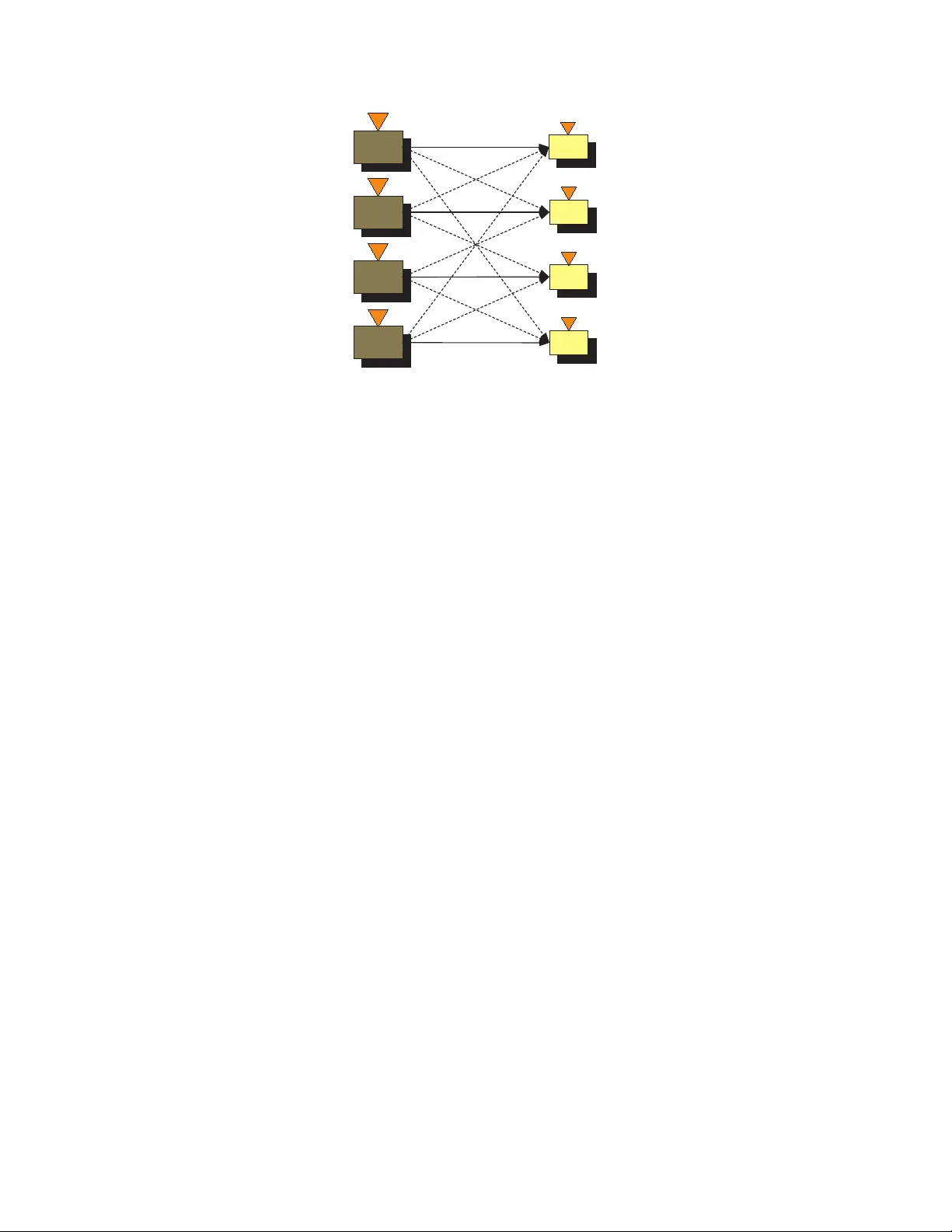
1 On the Multiple xing Gain of K -user P artially Co nnected Interfe rence Channel Sang W on Choi, Student Member , IEEE , and Sae-Y oung Chung, Senior Membe r , IEEE Abstract The multiplexing g ain (MUXG) of K -user interference channel (IC) with partially connected interfering links is analyzed. The moti vation for the partially connec ted IC comes from the fact th at not all interferenc es are equally strong in practice. The MUXG is ch aracterized as a fun ction o f th e number ( K ) of users and the number ( N ≥ 1 ) of interfering links. Our analysis is mainly based on th e interferen ce alignmen t (IA) tech nique to m itigate inter ference. Our ma in resu lts are as f ollows: One m ay expect that hig her MUXG can be attained when some of in terfering links do n ot exist. However , when N is odd and K = N + 2 , the MUXG is not increased b eyond the op timal MUXG of fully co nnected IC, which is K M 2 . The numb er of interf ering link s has no influenc e on the achiev ab le MUXG using IA, but affects the efficiency in terms of the numbe r of requir ed ch annel realization s: Whe n N = 1 or 2 , the optimal MUXG of th e fu lly con nected IC is achiev able with a finite number of ch annel realizatio ns. In case of N ≥ 3 , h owe ver, the MUXG of K M 2 can be achieved asympto tically as the nu mber of chann el realizations ten ds to infinity . Index T erms Interfer ence alignm ent (IA) , multiplexing ga in (MUXG), and partially c onnected inte rference chan - nel (IC). I . I N T RO D U C T I O N The interest for an ef ficient comm unication with limited resources (for example, power , time, and frequenc y) has led u s to a cellular network system. Due to the resource sharing , ho wever , October 31, 2018 DRAFT 2 interference is una voidable in the cellular netw ork, which results in the de gradation of the throughput. When we shift from poin t-to-point channel to multipoint-to -multipoin t channel, in addition, the interference management is one of the k ey issues for maximizing system throughput. Thus, t he informati on theoretic understandin g of the int erference channel (IC) motiva tes our interest as a basic building block for the shared comm unication si tuation. The asymptot ic throughput performance of the IC has been studied recently [1], [2]. Specif- ically , in case o f 2 -user multipl e-input multiple-output (MIMO) Gaussian IC with an arbitrary number of ant ennas, the zero forcing (ZF) has been shown to achiev e the upper- bound (UB) on the multiplexing gain (MUXG), which is deri ved by reducing the noise co var iances and using MIMO strong IC results [1]. Wh en the number of users is greater than or equal t o 3 , howe ver , the ZF has lim itation i n m itigating interference effec tiv ely . As a solution to this limit ation, a new interference mit igation scheme called ‘interference alig nment (IA)’ has b een proposed [2] for K -us er IC: The optimal MUXG of K 2 has been shown to be achieved provided that many diffe rent channel realizations are a vailable. Main id ea is that the interference is suppressed b y choosing transmit beamform ing vec tors to align som e interferences at the desired recei ver such that interferences do not swamp all the degree s of freedom at the recei ver . Recently , the IA which requires only l ocal channel kno w ledge vi a iterati ve algorithms has been prop osed i n [3]. In this correspondence, we consi der the K -user IC with an arbit rary number of int erfering links, i.e., partially connected IC and analyze the achiev able MUXG using t he IA. The motiv ation for the partially connected IC comes from t he fact that the interfering link far a way from a recei ver is negligible in the practical sense. Dependi ng o n the path loss exponent that affe cts signal attenuation as a fun ction of distance, th e ef fective number of interfering transmitters can var y . The main contribution of thi s correspondence is as follows: First, we d eri ve UBs and lower - bounds (LBs) on t he MUX G according to the number of users and the numb er of interfering links. Second, we examine when the LB coincides with the UB. The structure of this correspondence is as foll ows: In Section II, we describe the channel model. Alo ng with the com ment on IA in Section III, the M UXG of K -user IC with an arbitrary number of interfering links is analyzed in Section IV . Finally , we conclude our correspond ence in Section V . October 31, 2018 DRAFT 3 I I . C H A N N E L M O D E L In this section, we describe our partially connected K -user IC model wit h K transmitters and K receiver s. Each transm itter and receiv er are equipped with M ( ≥ 1) antennas. W e assume each recei ver gets interference from N ( ≤ K − 1) adj acent transmi tters in a cyclic way . Specifically , when we arrange th e indices of K transmitters cyclically , the k -th recei ver gets interference from preceding ⌈ N 2 ⌉ transmitt ers and foll owing ⌊ N 2 ⌋ transm itters, wh ere ⌈ x ⌉ ( ⌊ x ⌋ ) is the smallest (biggest) integer big ger (smaller) than or equal to x . F ig. 1 describes the K -user IC with K = 4 and N = 2 , where each mobile station (MS) gets int erference from N adjacent base statio ns (BSs). Note that N = K − 1 means the fully connected K -us er IC. In this channel e n vironment , the receive d signal v ector Y [ j ] of the j -th receiver is represented as Y [ j ] = K X i =1 H [ j,i ] X [ i ] + Z [ j ] , j = 1 , 2 , · · · , K (1) at a specific time and frequency slot. Here, the ( r, t ) -th elem ent of the M × M channel matrix H [ j,i ] represents the channel coef ficient from the t -th antenna of the i -th transmitter to the r -t h antenna of the j -th receive r , and X [ i ] is the signal vector of the i -th transm itter . Here, the channel matrix changes i ndependently in each slot. The noise vector Z [ j ] has M noise elements which are i ndependent and i dentically di stributed (i.i.d.) complex Gaussian with zero mean and unit var iance. The noise component s are assumed to be independent of all the transmit ted s ignals. When N < K − 1 , we ha ve K -us er IC free of s ome interfering links. For example, when N = 1 , the following m atrices are zero matrices for j = 1 , 2 , · · · , K . H [ j,i ] = 0 , unless i = j or i = { ( j − 2 ) mo d K } + 1 . (2) The following shows the m ain assumptions in this correspondence. Channel matrix assump tion is applied to interfering links and desired lin ks. 1) Signals are encoded o ver multipl e tim e slots or multiple frequency slots. 2) All elements of channel matrices H [ j,i ] ’ s are drawn i.i.d. from a cont inuous channel distribution. 3) The channel is assumed to b e block fading, i.e., the channel st ate is fixed w ithin a slot and changes independent ly from slot to slot. 4) Channel st ate information (CSI) is known i n advance at all n odes. October 31, 2018 DRAFT 4 BS#1 BS#1 BS#3 BS#3 BS#2 BS#2 BS#4 BS#4 MS#1 MS#1 MS#3 MS#3 MS#4 MS#4 MS#2 MS#2 Fig. 1. Interference channel with K = 4 and N = 2 (solid arrow: desired link, dotted arrow: interfering link) a) Wh en encoding is accomplished over mult iple time slots, all nodes know CSI non- causally as was done in [2]. Note that no ncausal CSI does not exist. Howe ver , one can wait for d esired CSI states and transmit partial code words incrementally if delay is not a problem. This is equ iv alent to ha vi ng noncausal CSI. b) When we encode sign als over multiple frequency slots, all CSI st ates over multiple frequency slots are known at all no des. Note that coding over frequency sl ots is better for implementat ions than coding over time slots. Let n t and n f denote the numbers of t ime and frequency sl ots over which signals are encoded, respectiv ely . W e define ¯ H [ j,i ] ( i, j = 1 , 2 , · · · , K ) as a block d iagonal matrix representing the channels from the i -th transm itter to the j -th recei ver , where the ( l , l ) -th block is a full-rank channel m atrix of size M × M for l = 1 , 2 , · · · , n t n f . Not e that the block diagonal matrices ¯ H [ j,i ] ’ s ( i, j = 1 , 2 , · · · , K ) are of size M n t n f × M n t n f . I I I . I N T E R F E R E N C E A L I G N M E N T When we deal with multi point-to-mul tipoint channel, interference management is one of the key issues for M UXG. In th e sense o f supp ressing interference, the IA scheme is very effecti ve [2]. In case of K -user SISO IC, the IA uses ‘supersym bol’ coded over multiple time sl ots or frequency slots. Assuming that bo th transmitters and receivers kno w all the channel coefficients ove r multiple time slots or frequenc y slots, we hav e a structured MIMO wit h zero of f-diagonal terms. Then, October 31, 2018 DRAFT 5 we attain MUXG prop ortional to the number of users b ased on the IA scheme. Thi s is p ossible by choosing transm it beamformin g vectors such that interferences from other users are aligned to mini mize t he degrees of freedom occupied by the sub space from t he interferences at each recei ver . Th e IA is feasible because there are m ultiple ( n t n f ) di f ferent realizations of channels. The definition of MUXG [4] in K -user IC is Γ = lim SNR →∞ C + ( SNR ) log( SNR ) , (3) where C + ( SNR ) is the sum capacity (per slo t) at signal-to-noise ratio (SNR). Note that the ZF is enough to achieve the opt imal mu ltiplexing gain for the point to poin t channel, MA C, and BC [1]. In case of fully connected IC with K ≥ 3 , along with ZF at the receiver , the transm it beamforming such that other interferences are aligned is required to achie ve the optimal MUXG of K 2 asymptoticall y when M = 1 . When K = 3 with M ≥ 2 , it is shown that we achie ve the optimal MUXG of K M 2 with only one slot , i.e., n t n f = 1 [2]. I V . M U LT I P L E X I N G G A I N A. Upper-bound When K = 2 , we have the following UB on the MUXG assu ming that all t he channel matrices are full-rank. It is obt ained by reducing nois e cov ariance at each recei ver such t hat t he channel matrices of the i nterfering links are diagonali zed and strong interference conditions are m et. Then, we h a ve two result ing MIMO MA Cs and get the UB on the MUXG as t he minimu m o f MUXGs of the two MA Cs. Explicit expression is as follows: Lemma 1: The op timal M UXG o f 2 -user Gaussian IC comprised of M i transmit a nd N i recei ve antennas for user i ( i = 1 , 2 ) is Γ = min { M 1 + M 2 , N 1 + N 2 , max( M 1 , N 2 ) , max( M 2 , N 1 ) } . (4) Pr oof: It follows from Theor em 2 in [1]. Theor em 1: When we ha ve M i transmit and N i recei ve antennas for user i ( i = 1 , 2 , · · · , K ) , the MUXG Γ is upper-bounded by Γ ≤ 1 K − 1 K ( K − 1) 2 X k =1 Γ k , (5) October 31, 2018 DRAFT 6 where Γ k is min n M π ( k, 1) + M π ( k, 2) , N π ( k, 1) + N π ( k, 2) , max( M π ( k, 1) , N π ( k, 2) ) , max( M π ( k, 2) , N π ( k, 1) ) o . Here, π ( k , i ) ( i = 1 , 2) i s the i -th component of the k -th combination among K C 2 sets comprised of unordered two user indices. (1 , 2) , (1 , 3) , · · · , ( K − 1 , K ) . For example, when K = 3 , we hav e 3 C 2 = 3 inde x sets { 1 , 2 } , { 1 , 3 } , { 2 , 3 } and π (1 , 1) = 1 , π (1 , 2) = 2 , π (2 , 1) = 1 , π (2 , 2) = 3 , π (3 , 1) = 2 , and π (3 , 2 ) = 3 . Pr oof: W it hout loss of generality , we pick nod es 1 and 2 , respectively . Then, t he other transmit nodes 3 , 4 , · · · , K interfere with receive nodes 1 and 2 . Then, we obtain the UB from ( 4 ) by ign oring such interferences. In a similar manner , we ha ve the UB on the M UXG for other user p airs. Since there are K ( K − 1) 2 user pairs resulti ng i n K − 1 ti mes the sum of the individual rates, we get ( 5 ) . Cor ollary 1: The optimal MUXG of K -user fully connected IC wi th M antennas at each nodes is less than or equal t o K M 2 . Pr oof: It is straightforwardly obtained from Theor em 1 when we use M i = N j = M ( i, j = 1 , 2 , · · · , K ) . Remark 1: From Cor ollary 1 with M = 1 , the UB of K 2 [5] on the MUXG is deriv ed in the K -user SISO IC. Cor ollary 2: In partially connected K -user ICs, the UB of K M 2 on the MUXG is still main- tained only when we have N = 2 p + 1 and N = K − 2 with a nonnegativ e integer p . Pr oof: From Theor em 1 , it is clear that the UB of K M 2 on t he MU XG is maintained if and only if any 2 -us er indices in the user index set { 1 , 2 , · · · , K } form a 2 -user IC with at least one interfering l ink. Let the number of s uch 2 -user ICs be T . Since T = K ( K − 1) 2 is equi valent to the UB of K M 2 on the M UXG from Theor em 1, it su f fices to find minimum N which g uarantees T = K ( K − 1) 2 . (6) Note that N and N + 1 result in same T for odd N . • When K is e ven, we obt ain T = K p + K 2 for N = 2 p + 1 . From ( 6 ) , we ha ve N = K − 1 , which means that only fully connected K -user IC guarantees the outer bound of K M 2 on the MUXG. October 31, 2018 DRAFT 7 • When K i s odd , we ha ve T = K ( p + 1) for N = 2 p + 1 . From ( 6 ) , we get N = K − 2 . Thus, partially connected K -user IC wit h N = K − 2 has the outer bound of K M 2 on t he MUXG. Remark 2: Except for th e cases i n Cor ollar y 2, the UBs on the MUXGs for K -user p artially connected ICs are always greater than K M 2 . B. Lower -bou nd when N = 1 Now , we consid er the achie va ble MUXG with respect to the numb er ( N ) of interfering links . Note that the number ( M ) of antenn as and the number ( K ) of users are arbitrary . Theor em 2: When N = 1 i n K -user IC, the MUXG o f K M 2 is achiev ed based on s imple time division multi plexing (TDM) or ZF wi th number of required slots (NRS) of 1 or 2 . Pr oof: W e prove this for all cases of M and K . • M = 1 : T he TDM strategy with NRS o f 1 gives us the MUXG of K 2 and K − 1 2 for even K and od d K , respecti vely . When t he ZF is used wi th NR S of 2 , the MUXG o f K 2 is ac hiev ed for all K . Note that in case of fully connected K -user IC with M = 1 and K ≥ 3 , the NRS to achiev e the MUXG o f K 2 goes to infinity [2]. • M and K are ev en: W e obtain MUXG of K M 2 by the TDM st rategy . Alternatively , the MUXG of K M 2 is achiev able by th e ZF . O ne thing worth noting is that the NRS is only 1 in both cases. • M is even and K is odd: The MUXG of ( K − 1) M 2 with NRS of 1 is achiev able by alternating between even- and odd-ind ex ed users. W e can increase the achiev able MUXG by t he following procedure: Each transmitter transmits M 2 streams, eac h recei ver gets the desired streams by ZF . Then, we h a ve the MUXG of K M 2 with NRS of 1 . • M ≥ 3 is odd and K is even: From the TDM st rategy , the MUXG of K M 2 is achiev able with NRS of 1 . One in teresting thing is t hat the ZF gives us th e MUXG of K M 2 , where e ven- and odd-indexed users transmit M +1 2 and M − 1 2 streams, respecti vely . A t each receiv er , the ZF is used to extract the desired streams. Then, we attain th e MUXG of K 2 · M + 1 2 + K 2 · M − 1 2 = K M 2 with NRS of 1 . October 31, 2018 DRAFT 8 • M ≥ 3 and K are odd: we h a ve the follo wing achiev able MUXG with respect t o NRS. First, when we use TDM strategy , we have MUXG of ( K − 1) M 2 with NRS of 1 . Second, the MUXG of ( K M − 1) 2 is attained by ZF , where each of e ven- and odd-ind ex ed users transm its M +1 2 and M − 1 2 streams, respectiv ely . Then, each receiv er gets the desired streams by ZF . Thus, we achiev e the M UXG of K − 1 2 · M + 1 2 + K + 1 2 · M − 1 2 = K M − 1 2 with NRS of 1 . Another way to achiev e the MUXG of K M 2 is that all transmi tters transmit M streams over 2 slots and all the recei vers get the desired streams by ZF . Remark 3: Since the number of interferences is 1 per each recei ver , the IA is not applicable, and the ZF at each rece iv er is suf ficient to mi tigate the adjacent interference ef fectiv ely in the sense of the MUXG. In T able I, we summarize the MUXG wit h respect to NRS when N =1 or 2 . Note that the IA implicitl y includes ZF when N =1 , whi ch means that th e IA becomes th e ZF when N = 1 . It is seen that the MUXG of TDM is comparable to that of ZF . Since the ZF requires relati vely more CSI than the TDM, the TDM strategy seems to be more reasonabl e in the sense of the MUXG per required CSI overhead. Howe ver , when M is lar ge enough wit h od d K , the loss in the MUXG becomes in no way negligible. Remark 4: When the num ber ( K ) of users tends to infinity , the MUXG from TDM strate gy is asymptoticall y sam e as that from ZF . Remark 5: For all cases of M with K = 3 , ZF g iv es us optimal MUXG with NRS of 1 or 2 . Remark 6: In case of odd M and odd K , NRS of 1 with Z F is enough t o approach MUXG of K M 2 when either K or M tends to infinity . Remark 7: It s eems to be re asonable to use TDM s trategy when K is large eno ugh and ZF when either K or M is large enoug h. C. Lower -bound when N = 2 Theor em 3: When N = 2 in K -u ser IC, the MUXG of K M 2 is av ailable with NRS of 1 or 2 . October 31, 2018 DRAFT 9 Pr oof: Assume that M is e ven. The IA con ditions are form ed by aligni ng interferences at each recei ver and we have the fol lowing IA condit ions ¯ H [1 ,K ] V [ K ] + ¯ H [1 , 2] V [2] , ¯ H [2 , 1] V [1] + ¯ H [2 , 3] V [3] , ¯ H [3 , 2] V [2] + ¯ H [3 , 4] V [4] , . . . ¯ H [ K − 2 ,K − 3] V [ K − 3] + ¯ H [ K − 2 ,K − 1] V [ K − 1] , ¯ H [ K − 1 ,K − 2] V [ K − 2] + ¯ H [ K − 1 ,K ] V [ K ] , and ¯ H [ K, K − 1] V [ K − 1] + ¯ H [ K, 1] V [1] , (7) where V [ k ] is the M × M 2 transmit beamforming m atrix of the k -th user ( k = 1 , 2 , · · · , K ) and P + Q means that the column space of P is the same as that of Q . Here, the first equation in ( 7 ) comes from the condit ion that the interferences from adjacent 2 -nd and K -th transmi tters with beamforming vectors i n V [2] and V [ K ] are ali gned at receiver 1 . The remaining conditions are obtained in a sim ilar manner . When K is o dd, t he transm it beamforming matrices V [ k ] ’ s ( k = 1 , 2 , · · · , K ) are obtained in the following order V [2] → V [4] → · · · → V [ K − 1] → V [1] → V [3] · · · → V [ K ] → V [2] (8) from (7). Once we set the transmit beamforming matrix V [2] , we obtain V [4] and V [ K ] from V [2] using ( 7 ) . Ne xt, V [6] and V [ K − 2] are deri ved from the known v alues V [4] and V [ K ] using ( 7 ) . All the remaining transmi t b eamforming matrices are also obtained by the IA conditions ( 7 ) . In ( 8 ) , an initial transmit beamforming matrix V [2] is composed of any set of M 2 eigen vectors of A = n ( ¯ H [3 , 2] ) − 1 ¯ H [3 , 4] ( ¯ H [5 , 4] ) − 1 ¯ H [5 , 6] · · · ( ¯ H [ K − 2 ,K − 3] ) − 1 ¯ H [ K − 2 ,K − 1] o · ( ¯ H [ K, K − 1] ) − 1 ¯ H [ K, 1] · n ( ¯ H [2 , 1] ) − 1 ¯ H [2 , 3] ( ¯ H [4 , 3] ) − 1 ¯ H [4 , 5] · · · ( ¯ H [ K − 1 ,K − 2] ) − 1 ¯ H [ K − 1 ,K ] o · ( ¯ H [1 ,K ] ) − 1 ¯ H [1 , 2] , which is full-rank with probabili ty 1 . October 31, 2018 DRAFT 10 Finally , each k -th transmitter ( k = 1 , 2 , · · · , K ) transmi ts M 2 streams with transmit beamforming matrix V [ k ] and the correspond ing recei ver k obtains the M 2 streams per sl ot by ZF . Second, when K is even, the transmit beamforming matri ces V [ k ] ’ s ( k = 1 , 2 , · · · , K ) are chosen in the following order V [1] → V [3] → · · · → V [ K − 3] → V [ K − 1] and V [2] → V [4] → · · · → V [ K − 2] → V [ K ] , where two init ial t ransmit beamforming matrices V [1] and V [2] consist of any set o f M 2 eigen- vectors o f B = n ( ¯ H [2 , 1] ) − 1 ¯ H [2 , 3] ( ¯ H [4 , 3] ) − 1 ¯ H [4 , 5] · · · ( ¯ H [ K − 2 ,K − 3] ) − 1 ¯ H [ K − 2 ,K − 1] o · ( ¯ H [ K, K − 1] ) − 1 ¯ H [ K, 1] and C = n ( ¯ H [3 , 2] ) − 1 ¯ H [3 , 4] ( ¯ H [5 , 4] ) − 1 ¯ H [5 , 6] · · · ( ¯ H [ K − 1 ,K − 2] ) − 1 ¯ H [ K − 1 ,K ] o · ( ¯ H [1 ,K ] ) − 1 ¯ H [1 , 2] , respectiv ely . Thus, interference-free K M 2 streams per sl ot are obtain ed by ZF at each receiv er , which giv es us MUXG of K M 2 . When M is odd, we have essentially the same IA condit ions ( 7 ) by using 2 slot s. Even though the form of t he channel matrix is block diagonalized, the fact that t he channel matrices A, B , and C are full-rank is not changed. Thus, th e MUXG of K M 2 is also obtained with 2 slot s in case of odd M . Anoth er way i s th at e ven- and odd-indexed users transmit dif ferent amount of streams: When K is even or odd, the transm it beamforming matrices V [ k ] ’ s ( k = 1 , 2 , · · · , K ) are constructed from the IA conditio ns ( 7 ) . Note that t he size of the transmit beamforming matrices are M × M +1 2 . Even-indexed users transm it M +1 2 streams, and od d-indexed users trans mit M − 1 2 streams. By extracting the desired streams using ZF , we have K 2 · M + 1 2 + K 2 · M − 1 2 = K M 2 (9) October 31, 2018 DRAFT 11 T A BLE I M U X G W I T H R E S P E C T T O N R S W H E N N =1 O R 2 TDM IA K MUXG K M 2 K M 2 M (ev en) NRS 1 1 (ev en) K MUXG ( K − 1) M 2 K M 2 (odd) NRS 1 1 K MUXG K M 2 K M 2 M ≥ 3 (ev en) NRS 1 1 (odd) K MUXG ( K − 1) M 2 K M − 1 2 K M 2 (odd) NRS 1 1 2 and K − 1 2 · M + 1 2 + K + 1 2 · M − 1 2 = K M − 1 2 (10) when K is even and o dd, respectiv ely . Remark 8: When K and M are odd and eith er K or M tends to infinity , the MUXG of K M 2 is achie ved asym ptotically by IA scheme with NRS o f 1 . Remark 9: When N = 2 , the ZF itself at each receiv er is no t enough to achiev e the optimal MUXG since t he number of interferences to each receiv er is greater than 1 and interferences need to be aligned to minim ize the dimension o f the signal space occupied by the interferences. As shown in T abl e I, the MUXG of K M 2 is stil l achie vable by the IA when the number ( N ) increases from 1 t o 2 . Considering t he CSI overheads, the TDM rather than the IA seems to be reasonable s ince the IA requires all the CSI states of all links in general. All the MUXG characteristics of the TDM when N = 2 are e xactly sam e as those when N = 1 . D. Lower -boun d when 3 ≤ N ≤ K − 1 Lemma 2: The optimal M UXG of K 2 is achieved asym ptotically with i nfinitely many slots in fully connected K -user SISO IC. October 31, 2018 DRAFT 12 Pr oof: If follows from Theor em 1 in [2]. Cor ollary 3: For the K -user IC with M mul tiple antennas at each nodes, the optimal MUXG of K M 2 is achie ved asym ptotically with infinitely many slots. Pr oof: First , when IA conditio ns are m et for K M -user ful ly connected SISO IC, the same IA conditions are also satisfied for the K -user fully connected IC wi th M antennas. Second, the IA condi tions for K -user parti ally connected IC wi th M antennas are less restrictive than those for t he fully connected on e. Thus, the M UXG of K M 2 is achiev able asymp totically with infinitely many s lots in the K -user partially connected MIMO IC. Theor em 4: The MUXG of K M 2 from encoding over a finite number of slot s is not achiev able with probability 1 in the K -user MIMO IC. Pr oof: Since IA conditions for N ≥ 4 are m ore restrictive than those for N = 3 and in clude IA conditions for N = 3 , it suffices to show t hat there are no explicit transmi t beamforming matrices satisfyi ng the IA condit ions for N = 3 . W e prove this using contradicti on. First, we consider the case where M is ev en. Assume that there exist transmit beamforming m atrices satisfying the following IA conditions ¯ H [1 , 2] V [2] + ¯ H [1 ,K − 1] V [ K − 1] + ¯ H [1 ,K ] V [ K ] , ¯ H [2 , 1] V [1] + ¯ H [2 , 3] V [3] + ¯ H [2 ,K ] V [ K ] , ¯ H [3 , 1] V [1] + ¯ H [3 , 2] V [2] + ¯ H [3 , 4] V [4] , . . . ¯ H [ K − 1 ,K − 3] V [ K − 3] + ¯ H [ K − 1 ,K − 2] V [ K − 2] + ¯ H [ K − 1 ,K ] V [ K ] , and ¯ H [ K, K − 2] V [ K − 2] + ¯ H [ K, K − 1] V [ K − 1] + ¯ H [ K, 1] V [1] . (11) Note that the IA conditions ( 11 ) are necessary conditions for achie v ing the MUXG of K M 2 with a finite NRS. From ( 11 ) , the t ransmit beamforming matrices V [ K − 1] and V [ K − 2] must satisfy V [ K − 1] + ( ¯ H [1 ,K − 1] ) − 1 ¯ H [1 ,K ] V [ K ] , V [ K − 1] + ( ¯ H [ K, K − 1] ) − 1 ¯ H [ K, 1] ( ¯ H [2 , 1] ) − 1 ¯ H [2 ,K ] V [ K ] , V [ K − 2] + ( ¯ H [ K − 1 ,K − 2] ) − 1 ¯ H [ K − 1 ,K ] V [ K ] , and V [ K − 2] + ( ¯ H [ K, K − 2] ) − 1 ¯ H [ K, 1] ( ¯ H [2 , 1] ) − 1 ¯ H [2 ,K ] V [ K ] . (12) October 31, 2018 DRAFT 13 Thus, the transmi t beamform ing matrix V [ K ] must hav e the following relations V [ K ] + D V [ K ] and V [ K ] + E V [ K ] , where D = ( ¯ H [1 ,K ] ) − 1 ¯ H [1 ,K − 1] ( ¯ H [ K, K − 1] ) − 1 ¯ H [ K, 1] · ( ¯ H [2 , 1] ) − 1 ¯ H [2 ,K ] and E = ( ¯ H [ K − 1 ,K ] ) − 1 ¯ H [ K − 1 ,K − 2] ( ¯ H [ K, K − 2] ) − 1 ¯ H [ K, 1] · ( ¯ H [2 , 1] ) − 1 ¯ H [2 ,K ] . Howe ver , there i s no t ransmit beamforming matrix V [ K ] composed of any set of K 2 eigen vectors of D and E simu ltaneously since all th e i.i.d. components of the channel matrices are assum ed to be drawn from a continuous distribution. Thus, it is a contradiction. When M is odd, the above contradiction is also shown in essentiall y the same manner . E. MUXG characteristics According to the number of users and th e num ber of interfering links, we can class ify K -user IC as shown in T able II. Note that ‘ × ’ represents the case that cannot happen since N ≤ K − 1 in T able II. Based on the IA scheme, the MUXG of K M 2 is achiev ed with a finite (or asymp totically many) NRS. The UB is deriv ed from Theor em 1. Then, the following relations b etween LBs and UBs along with NRS are summ arized. 1) LBs and UBs o n the MUXG a) Op timal MUXG is equal to K M 2 ( ). One thing worth mentioning is when we have N = 2 p + 1 and K = N + 2 with nonnegativ e integer p : The opti mal MUXG is equal t o th at of fully connected IC, which is K M 2 . This is confirmed by Cor oll ary 2 and Cor ollary 3. October 31, 2018 DRAFT 14 T A BLE II C L A S S I FI C A T I O N O F K - U S E R I C ( : U B = L B = K M 2 , : U B > L B = K M 2 ) K NRS 2 3 4 5 6 7 8 9 1 1 or 2 2 1 or 2 × 3 × × N 4 × × × 5 ∞ × × × × 6 × × × × × 7 × × × × × × b) The MUX G of K M 2 is achieva ble and does not coincide with the UB in Theor em 1 ( ). In this case, the UB on the MUXG i s greater than K M 2 since there exists at l east one 2 -user pair in the user i ndex set such that it forms a 2 -us er IC with no in terfering links and results in increase of t he UB over K M 2 from Theor em 1. 2) Num ber of required slots a) Wh en N = 1 or 2 , the NRS i s finite to attain the MUXG of K M 2 . In case of N = 1 , simple TDM or ZF giv es us the achie vable M UXG of K M 2 , which is confirmed by Theor em 2. When N = 2 , the IA is applicable sin ce it is poss ible to construct beamforming matrices satisfyin g IA con ditions from Theor em 3. b) When N ≥ 3 , infinitely man y s lots are requi red to achieve the MUXG of K M 2 asymptoticall y . October 31, 2018 DRAFT 15 From Cor ollary 3, the NRS goes to infinity , which is support ed by Theor em 4: There do not exist e xplicit beamforming matrices satisfying IA conditi ons with a finite NRS. V . C O N C L U S I O N As an asymptotic performance measure, the MUXG of K -user IC was in vestigated in this correspondence. One of mai n result s i s t hat in term s of the NRS, it is possib le to hav e more ef ficient communi cations for K ≥ 4 when the number of i nterfering links is 1 or 2 , which is no t seen in fully connected IC. But, when th e n umber of interfering links is greater t han or equ al to 3 , asymptoticall y many sl ots are sti ll necessary for achie ving the optimal MUXG. In som e cases, the UB on the MUXG in Theor em 1 does not coincide with the MUXG achie ved by t he IA scheme even with asymptotically many s lots. In comparison with t he fully connected IC, one might expect that the optimal MUXG would increase wh en the numb er of interfering links decreases. Counter-intuiti vely , it was observe d that when N = 2 p + 1 and K = N + 2 with a nonnegativ e integer p , the MUXG is equal to the optimal MUXG of the ful ly connected one, which is K M 2 . As a further w o rk, either tigh ter UBs or higher LBs for partially conn ected IC s need to be dev eloped. R E F E R E N C E S [1] S. A. Jafar and M. J. Fakhereddin, “Degrees of freedom for the MIMO interference channel, ” IEE E T rans. Inf. Theory , vol. 53. no. 7, pp. 2637-2642 , July 2007. [2] V . R . Cadambe and S. A. Jaf ar, “In terference alignment and spatial de grees of freedom for the K user interference chan nel, ” preprint. [3] K. Gomadam, V . R. Cadambe, and S. A. Jafar , “ Approaching the capacity of wireless networks through distributed interference alignment, ” preprint. [4] L. Zheng and D. N. C. T se, “Di versity and multiplexing: A fundamen t al tradeof f in multiple-antenna channels, ” IEEE Tr ans. Inf. Theory , vol. 49. no. 5, pp. 1073-1096, May 2003. [5] A. H ø st-Madsen, “The multiplexing gain of wireless netw orks, ” in Proc. IEEE Interna tional Symposium on Information Theory (ISIT 2005), Adelaide, Australia pp. 2065-20 69, Sep. 2005. October 31, 2018 DRAFT
Original Paper
Loading high-quality paper...
Comments & Academic Discussion
Loading comments...
Leave a Comment