Predicting Regional Classification of Levantine Ivory Sculptures: A Machine Learning Approach
Art historians and archaeologists have long grappled with the regional classification of ancient Near Eastern ivory carvings. Based on the visual similarity of sculptures, individuals within these fields have proposed object assemblages linked to hyp…
Authors: Amy Rebecca Gansell, Irene K.Tamaru, Aleks Jakulin
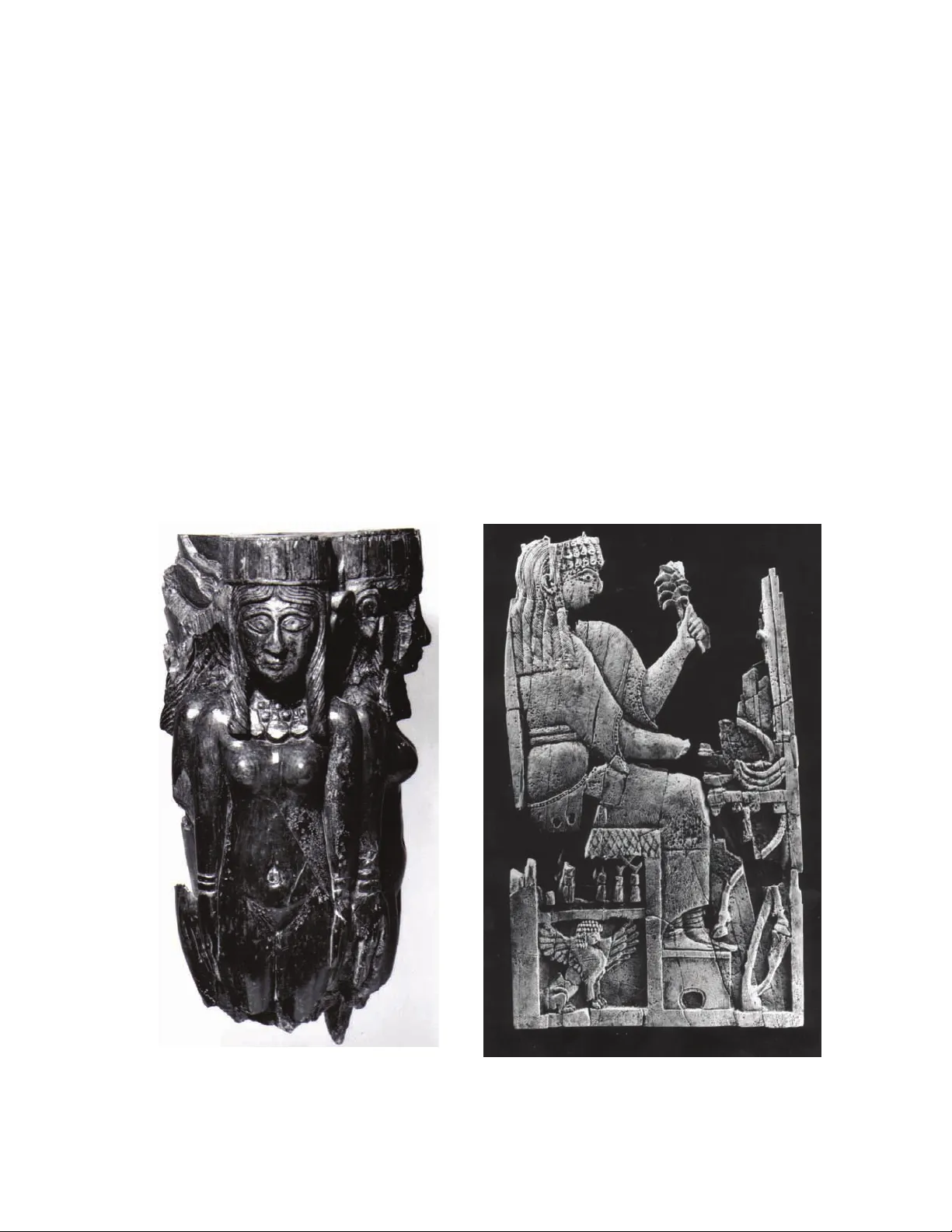
483 1 Introduction Thousands of ivory carvings have been excavated in the Near East over the past century and a half (Thureau-Dangin 1931; Loud and Altman 1938; Barnett 1957; Hrouda 1962; Mallowan and Herrmann 1974; Herrmann 1986; Safar and al-Iraqi 1987; Herrmann 1992b). It is commonly argued that this corpus of carvings can be summarized in terms of a few general styles, believed to be associated with varying regions. While scholars have made much collective head- way in the regional classi fi cation of ancient Near Eastern ivory sculpture using visual methods, it has been compel- lingly acknowledged that new , quantitative, and more rig- orous approaches are needed (W inter 1992; W inter 1998; W inter 2005). W e here respond to this need. Most of these artifacts are derived from fi rst millennium BC Neo-Assyrian royal contexts in northern Mesopotamia/ Iraq. Here, in palaces and temples, sculptured ivories embel- lished the surfaces of walls, furniture, vessels and contain- ers, and even equestrian gear . While some of the carvings fall into the Assyrian visual tradition (Herrmann 1997), the majority are unmistakably of Levantine origin. T exts and images indicate that Neo-Assyrian rulers col - lected and displayed such carved ivory as tribute and booty from the Levant (Thomason 1999:393-401; Herrmann 2000:269; Herrmann and Millard 2003). Knowledge of the more speci fi c origin of these artifacts could help de fi ne ancient economic and political dynamics. It could also be applied in the relative and absolute dating of historic fi rst millennium BC phases and events, from which, in turn, archaeologists and art historians could extrapolate re fi ned artifact chronologies and gain a better understanding of the temporal and geographic transmission of artistic motifs and styles (e.g., W inter 1976:20-2, 1983:185-7, 1989, 1998:150-1; Herrmann 2000:275-6). Of further cultural consequence, the elite collection and display of ivories may be interpreted to reveal ancient aesthetic appreciation and/ or ideological expression (for example, Herrmann 1989; Thomason 1999; Herrmann 2000:268-9), the nuances of which may be better understood once the origins of the works are more precisely identi fi ed. Additionally , the regional classi fi cation of ivory products concerns research - ers interested in ancient craft production, especially the organization of artisans and ateliers. Archaeologists have not yet located any ancient Near Eastern ivory workshops or production centers. Nonetheless, Levantine ivories are generally attributed to visually dis- tinct Phoenician and North Syrian carving traditions based primarily on stylistic and iconographic comparison to other art. A third possible regional classi fi cation, at times speci fi ed as an “Intermediate”’ or “South Syrian” tradition, has also been considered (e.g., W inter 1981, 1998:152; Herrmann 1986:6, 1992:3; W inter Herrmann 2000:271). However , the legitimacy of this third group is now in question, and the binary labels “Phoenician” and “North Syrian” are them- selves open to revision (W icke in press). Although one can visually organize Levantine ivories into groups of “most-Phoenician-like,” “most-North Syrian- Predicting Regional Classi fi cation of Levantine Ivory Sculptur es: A Machine Learning Approach Amy Rebecca Gansell 1 , Irene K.T amaru 2 , Aleks Jakulin 3 , and Chris H. W iggins 2 1 Department of the History of Art and Architecture Harvard University Cambridge, MA, USA 2 Department of Applied Physics and Applied Mathematics The Fu Foundation School of Engineering and Applied Science Columbia University New Y ork, NY , USA 3 Department of Statistics and Institute for Social and Economic Research and Policy Columbia University New Y ork, NY , USA. gansell@fas.harvard.edu Abstract Art historians and archaeologists have long grappled with the regional classi fi cation of ancient Near Eastern ivory carvings. Based on the visual similarity of sculptures, individuals within these fi elds have proposed object assemblages linked to hypothesized regional produc - tion centers. Using quantitative rather than visual methods, we here approach this classi fi cation task by exploiting computational meth - ods from machine learning currently used with success in a variety of statistical problems in science and engineering. W e fi rst construct a prediction function using 66 categorical features as inputs and regional style as output. The model assigns regional style gr oup (RSG), with 98 percent prediction accuracy . W e then rank these features by their mutual information with RSG, quantifying single-featu re pre- dictive power . Using the highest-ranking features in combination with nomographic visualization, we have found previously unkno wn relationships that may aid in the regional classi fi cation of these ivories and their interpretation in art historical context. 484 like,” “most-in-between,” and “anomalous,” this is a sub- jective process, based more on art historical conditioning than on the realities of ancient craftsmanship. Ranked and clustered characteristics de fi ning regional types and sub - types have not yet been established based on quantitative analyses of the data represented on the ivories. Instead, mul- tivariate classi fi cation criteria are derived from the (inher - ently biased) visual perception of the modern beholder (Suter 1992; W inter 1998; Herrmann 2000:271-2; W inter 2005:34). There are a number of drawbacks to relying exclusively on visual methods. Most notable is the dif fi culty or impos - sibility of revealing signi fi cant correlates among hundreds or thousands of possible pairs of features. Moreover , the ancient signi fi cance or insigni fi cance of attributes and their variations (i.e., the “weight” and taxonomic “rank” of a variable) may be misinterpreted when judged outside their original cultural contexts. Previous efforts to analyze patterns of visual and anthro- pometric variation in ancient Near Eastern fi gural art more objectively have employed cluster analysis and correspon- dence analysis (see, for example: Guralnick 1978; Roaf 1983; Azarpay 1990; Robins 1990). Simple ratio compari - sons have been conducted on a small but coherent sample of the ivories as well (W inter 1981:105). Due to the dimensionality of the data in our corpus, our approach favors the use of machine learning methods (for regional prediction via classi fi cation) in conjunction with information-theoretic approaches (for interpretation of sin- gle feature predictive power). This manuscript presents our methodology and cur - rent results. W e fi rst describe the corpus, the data, and the preprocessing of data used before training the classi fi er . Classi fi cation performance and object analysis are followed by feature analysis performed through the use of mutual information and a nomographic visualization technique for Naïve Bayesian classi fi cation results. W e conclude with future directions and a discussion of the prospective con- tributions of this project to the art historical fi eld of ancient Near Eastern ivory studies. Figur e 1. Ivory furniture support with four carved female fi gures, fr om Nimrud. Ht. 9.91 cm. [The Metropolitan Museum of Art, Rogers Fund, 1952, (52.23.2) Image © The Metr opolitan Museum of Art]. Figur e 2. Seated female at banquet, from Nimrud. Ht. 25 cm. [Iraq Museum, Baghdad, IM 60553]. 485 2 Materials, Data, and Methods Levantine ivories, derived from the tusks of African ele - phants, are carved both in relief and in the round. They display a somewhat constrained iconographic repertoire, primarily depicting vegetal designs and animal and human fi gures. In most cases, Levantine motifs transcend regional stylistic boundaries, indicating a standard cross-regional and cross-cultural visual range. The ivories shown below have been selected to best illustrate this phe- nomenon. (Figures 1-8, Note that to encourage more objective con- sideration art historical regional designation is not provided in the captions.) Our research focuses on images of women in particular . Female imagery is abundant and displays the greatest degree of individual variation and detail in the corpus. Still, there is only a standard assortment of female types depicted in a fi xed selection of iconographic formats, includ- ing full length fi gures, sphinxes, and “women at the window .” Full length female sculptures are portrayed nude (Figure 1), but clothed women are depicted as well, often in narrative contexts such as banquets (Figure 2) and mythological scenes. Some full length fi gures, both nude and clothed, have wings, and fantasti- cal creatures such as sphinxes with female heads are commonly rep- resented. (Figures 3, 4) Another iconographic format portrays a female head in a window frame; these works are referred to as the “woman at the window” plaques. (Figures 5, 6) Finally , many iso- lated and often fragmentary heads survive. (Figures 7, 8) Originally these may have belonged to full length fi gures, sphinxes, and women at the window . Although at fi rst it seems easy to reconsti - tute heads to fi gural types, one must proceed carefully in assign- ing (let alone mathematically pre- dicting) the type of fi gure a head may have belonged to, as there are several cases in which nearly identical heads have been discov- ered on intact sculptures of differ - ent types. Our study sample entails 210 whole and fragmentary sculptures portraying women in all known iconographic formats. V ery damaged works, heavily restored examples, and fi gures of ambiguous gender are not included. Nearly all relevant and reasonably accessible ivories in American, European, and Middle Eastern museum collections are represented. At the time of this research, however , hundreds of relevant ivories in Iraq were inaccessible, and their conservation conditions are unknown. Figur e 3. Sphinx, from Nimrud. Ht. 6.6 cm. [Iraq Museum, Baghdad, IM 65280]. Figur e 4. Sphinx, from Nimrud. Ht. 8.79 cm. [The Metr opolitan Museum of Art, Rogers Fund, 1964 (64.37.1) Image © The Metrpolitan Museum of Art]. 486 Figur e 5. W oman at the window plaque, fr om Nimrud. Ht. 8.2 cm. [Iraq Museum, Baghdad, IM 60500]. Figur e 6. W oman at the window plaque, fr om Nimrud. Ht. 7.9 cm. [Courtesy of The British Museum, BM 8015]. Figur e 7. Female head, from Nimrud. 4.19cm. [The Metr opolitan Museum of Art, Rogers Fund, 1954 (54.1 17.8) Image © The Metr opolitan Museum of Art]. 487 Figur e 8. Female head, from Nimrud. Ht. 4.3 cm. [Courtesy of The British Museum, BM 1 18234]. 2.1 Data All data were collected through fi rsthand examination. For reference purposes, objects were drawn and photographed. A standard record of iconographic and qualitative observa - tions was made for each ivory , and, using calipers, up to 75 point-to-point measurements were taken for each fi gure. The resulting dataset comprises nearly 32,000 numerical and categorical entries. The data were input into a spreadsheet fi le, then saved as a comma-separated fi le for handling and processing by various statistical and machine learning software programs. Before processing, the data was proofread manually and edited with custom-designed UNIX-based shell scripts, employing “sed,” “awk,” and “grep,” as well as editing tools available in Microsoft Excel. Hierarchical data were re fi ned by creating taxonomic typologies of general charac - teristics (such as types of dress). Proportional ratios (such as eye height to face height, or head height to full fi gure height) were generated from raw measurement values and combined with the categorical data to produce a single data- set. The portion of research presented here is strictly lim - ited to the analysis of the categorical data. 2.2 Methods The principal method employed in this paper is super - vised learning, a type of machine learning in which a high- dimensional (many-featured) input is used to predict an output variable (here, the categorical variable RSG). In the last decades, machine learning algorithms have advanced considerably in computational performance, ef fi ciency , and availability . In the hopes of encouraging broader use of such statistical analyses, we feature here two of the most intuitive, user-friendly , and freely available (open-source) machine learning software suites: W eka (W itten and Frank 2005) and Orange (Demsar et al. 2004). W eka consists of a set of machine learning algorithms which can be invoked from custom Java code or utilized directly through its graphical “Explorer mode.” It may be downloaded at http://www .cs.waikato.ac.nz/ml/wek a. W e have thus far used a W eka-based support vector machine (SVM) classi fi er on the current dataset. Of the SVM imple - mentations available in W eka, we found the Sequential Minimal Optimizer (SMO), a simple, fast algorithm which works well with sparse datasets (Platt 199:186), to be the most effective classi fi er of our fragmentary archaeological data. SVMs have been employed in a number of real-world applications, including handwriting recognition (Burges 1998:122-123). Aptly , unaware of what might be of fered by support vector machines, a recent art historical description of the complexities involved in ivory classi fi cation referred to the challenge as “not unlike that faced by forensic experts who deal with handwriting” (W inter 2005:30). Orange is a component-based data mining suite with similar functionality to that of W eka. Built on C++ compo- nents, it can be called via custom Python scripts or accessed through user-friendly GUI objects called Orange Widgets. It may be downloaded from http://www .ailab.si/orange/. Using single feature rankings obtained through mutual infor- mation, exploitation of Orange’ s nomographic visualization technique for Naïve Bayesian classi fi cation results proved effective in examining the contribution of the highest rank- ing features to RSG prediction (Mozina et al. 2004). 3 Classi fi cation Performance and Object Analysis Statistical model-building is a worthless exercise if we cannot test the model’ s predictive power , i.e., whether the classi fi er works. The sole quantitative measure of predic - tive performance is the empirical estimation of the gener- alization error , also termed the misclassi fi cation rate, error rate, or test loss . T o compute the test loss, we divide the objects into a training set (examples which are used to build the classi fi er) and the test set (examples not seen during the training). T raditionally this is done by breaking the full data - set into sets called “folds”—the training set is then all but one of these folds and the testing set is the remaining fold. For the resulting training loss and testing loss to be most meaningful, this is then averaged over the folds. Breaking the data into ten folds, as in the performance results reported in this section, is called “10-fold cross validation.” W e then evaluate the classi fi cation accuracy on these held-out or test sets. Ignoring this step, or merely minimizing the error on the data used to build the classi fi er , would be akin to merely assuming that the model works, or over- fi tting the data, 488 respectively . Cross-validation also allows us to perform outlier detec- tion. W e do this by constructing 1,000 separate classi fi ers, based on different partitions of the data into test and train- ing sets, and assigning an object-speci fi c misclassi fi cation rate over these trials. In addition to the overall classi fi ca - tion results, we describe below the highest-ranking of these features and suggest how these rates may be interpreted in terms of individual-object anomalies. Using “Regional Style Group” (RSG) as class label, the SMO assigns RSGs with a testing accuracy of 98% (i.e., test loss of 2% under 10-fold cross-validation) over a set of 1,000 runs. Upon visual examination of the misclassi fi ed instances, we fi nd it signi fi cant that the majority of these fi gures are outliers, that is, fi gures which are in some way anomalous to their labeled RSG. For example, object BM1 18264, an “Intermediate/ South Syrian” fi gure classi fi ed as “North Syrian” 918 times in 1,000 trials by the algorithm (error rate of 91.8%), is an unusually fi nely carved example of a winged female. Of similar fi gures, this is the only work of the “Intermediate/ South Syrian” type to have no Egyptian-style “pegwig.” Object 65.924Bost, labeled as “North Syrian” but classi - fi ed as “Intermediate/South Syrian” at an error rate of 74.9%, is a very sloppily carved “sphinx.” The lack of fi nesse in craftsmanship distorts some of the soft tissue features which could contribute to its misclassi fi cation: it shares a bulbous chin with its “North Syrian” counterparts but lacks the dou- ble-chin which usually accompanies such a feature. Its “lip- form” as well is more prototypically “Intermediate/South Syrian.” Object BM1 18186, labeled as “Intermediate/South Syrian” but classi fi ed as “Phoenician” with an error rate also 74.9%, is an unusual object with no equivalent in the entire sample. The visual classi fi cation of this piece is not immediately recognizable as it represents an amalgamation of regional styles. It is the only fi gure of the “Intermediate/ South Syrian” group with iconographic format “head” to be carved in the round, and the only fi gure whose eyes and eyebrows were once inlaid. The misclassi fi cation of this fi g - ure could be attributed to these particular features and to its hairline shape as well, features which are prototypically “Phoenician.” Object BM1 18208, of iconographic format “head,” is labeled “North Syrian” but is classi fi ed as “Intermediate/ SouthSyrian” with an error rate of 33.8%. Unlike 99% of its group (iconographic format “head” / RSG “North Syrian”), it is carved in relief, similar to fi gures of the same icono - graphic class in the “Intermediate/South Syrian” group. It is also the only “North Syrian” head to carry a headcharm. Though the headcharm in itself is unusual, what is of more signi fi cance is that the only other “North Syrian” fi gures which wear headcharms are full length fi gures. As such, we could hypothetically reconstitute this head to a full length fi gure. Upon similar examination of the classi fi cation of unla - beled instances, we again fi nd signi fi cance in the labels applied by the algorithm. Object BM 92233, a large-scale stone head carved in the round, was classi fi ed as “North Syrian” by the algorithm. While this sculpture is not a member of the ivory corpus, its features and proportions indicate a strong connection with the “North Syrian” RSG. Even a very fragmentary piece of a related stone sculpture (BM 139615) was classi fi ed by the machine as “North Syrian.” Far from being a repudiation of visual classi fi cation techniques, our results here highlight the accuracy and ef fi - cacy of computational techniques to augment what might be intuited by art historians and archaeologists and, thus, may be used to re fi ne, a posteriori, certain regional clas - si fi cations. For example, the assignation of “Intermediate/ South Syrian” to objects labeled either “North Syrian” or “Phoenician” could suggest that “Intermediate/South Syrian” is not a true category but instead represents the overlapping edges of larger Phoenician and North Syrian groupings. Further study will need to be made to elucidate this claim. 4 Feature Analysis The excellent performance in terms of prediction accuracy makes clear that there is structure to be learned within the data, but does little to elucidate which variables correlate and/or give predictive power . W e now turn to the feature analysis necessary to reveal and interpret this underlying structure. Through the use of mutual information and nomo - graphic visualization of classi fi er results, we have been able to reveal previously unknown relationships between the cat- egorical variables of the corpus. 4.1 Mutual Information Mutual information (MI) can be used to fi nd individual cat - egorical features that offer statistically signi fi cant power for predicting a given target class (here, RSG). Since we allow the data to decide—rather than appealing to human input—we can use this approach to reveal and render previ - ously unknown associations between RSG and individual features. (The results described in this section were obtained through the use of original MA TLAB source code freely available at ( http://www .artstat.sourcefor ge.ne t). Because different features will have a dif ferent numbers of possible values, e.g., “eyeform” contains fi ve possible “values,” while “nostrilmake” (i.e., method of carving nos- trils) contains only two (“excised” or “drilled”), our imple- mentation normalizes mutual information via the measure ( ), the mutual information divided by the minimum of the entropy of either X or Y : = I ( X ; Y ) / min [ H ( X ), H ( Y )]. (1) Since the amount of mutual information shared between two variables can be no larger than the minimum of the single- feature entropies, this quantity ranges between 0 and 1. T o illustrate, we considered the set of all (68) categori - cal features paired with the feature RSG. T o assess the sta - tistical signi fi cance of each pair ’ s mutual information, we 489 construct a background distribution by randomizing the attributes via permutation, i.e., we permuted over the cor- pus which objects exhibit which values for the feature being considered. This statistical test (sometimes called the “exact method”) preserves the distribution of values for each fea- ture and is a common method for assessing statistical sig- ni fi cance (Pitman 1937). In order to consider only those mutual information values that are statistically signi fi cant, we fi rst restrict our attention to only those for which all of 1,000 permutations exhibit values smaller than the MI value observed for the true cor- pus. This leaves 22 features. Of the signi fi cant features, we restrict ourselves to the top half in terms of the normalized MI ( ) as de fi ned in Eqn. 1. This leaves 1 1 features that, including the counts (the number of objects for which the feature was de fi ned) are: RegionalStyleSUBGroup (22), nostrilmake (48), posture (54), dress (80), eyeform (141), hairlineshape (145), curls (165), straight (173), pegwig (182), isIntermediate/SouthSyrian (210), isNorthSyrian (210). From an art historical perspective, the statistical signi fi - cance of categories relating to hair and eyes is noteworthy . It parallels an ancient emphasis of these features in ancient Near Eastern art; eyes and hair are consistently rendered in great detail, and often to outsized proportions. Moreover , contemporary ancient literary descriptions of beloved ones, praised rulers, and deities specify the attractiveness and allure of these features. Because “RegionalStyleSUBGroup,” “isIntermediate/ SouthSyrian,” and “isNorthSyrian” are obviously related to RSG, the high rankings of these categories, although reas- suring in terms of validating the method, are not signi fi - cant to our question. Of the remaining options, “posture,” “dress,” “pegwig,” “straight,” and “curls” are all commonly observed characteristics that have been previously used in visual classi fi cation. The remaining categories are “nos - trilmake” and “eyeform.” Both are of interest here because they are not generally considered by visual researchers as signi fi cant indicators of RSG. As “nostrilmake” is only a binary category (“excised” or “drilled”), we opt to discuss immediately the more complex category of “eyeform,” the entries of which include “sin- gle,” “doubletop,” “double,” and “inlayhole.” These designations refer to the articulation of eyelids on eyes carved in relief or (for “inlay- hole”) the presence of a hollow that would have held a composite inlaid eye (Figure 10). (The signi fi cance of “nostrilmake” and “eyeform” as a linked pair is considered below in the section on nomographic visualization.) Graph 1, showing nearly four times as many objects with “eyeform” “double” (versus “doubletop”) carry the “North Syrian” regional designation, suggests that a convention of carv- ing eyes with distinct upper and lower lids was likely associated with what is considered North Syrian craftsmanship. Looking at the manner in which eyes are carved on other artistic media of known North Syrian provenance, compared to those of known non-North Syrian provenance, may further strengthen the present hypothesis that “double eyeform” is a strong indicator of North Syrian production origin, or may even be part of a pure North Syrian prototype. It should be kept in mind, however , that some objects designated by art historians as “North Syrian,” have eyes carved in the “doubletop” manner (i.e., both an upper and lower lids are articulated). This does not necessarily mean that these objects could not belong to the North Syrian regional carving tradition; they may sim- ply be more peripheral (either geographically or artistically) from a “master” prototype. However , discrepancy in “eye- form” could indicate that objects have been misclassi fi ed by established visual methods. 4.2 Nomographic V isualization of Classi fi er Results Orange provides a means to produce nomographic visual - izations from Naïve Bayesian (NB) classi fi cation results (Mozina et al. 2004). The visualizations are particularly helpful because they allow us to see not only how much each attribute contributes to speci fi c regional style desig - nations, but also what exactly each value of each attribute implies. Also, by using the “attribute selection” widget in Orange, we can choose speci fi c features to analyze further based on the information provided by MI. Graph 2 is a nomogram of NB classi fi cation results based on the observation of “eyeform” alone. “Eyeform” “double” Figur e 10. Schematic illustration of carved “eyeforms.” Graph 1. Of all objects whose RSG is “North Syrian,” ther e are nearly four times as many objects with “eyeform” “double” than eyeform “doubletop.” The values of ( ) and the mutual information ar e found at the top of the graph. 490 was awarded a score of 100 points out of 1 10 available, i.e., given an object carries “eyeform” “double,” the probability of its being of North Syrian designation is 91%. Graph 2. Nomogram illustrating the pr obability of objects with “eyeform” = “double” being “North Syrian.” In Graph 3, the nomogram shows NB classi fi er results based on the observation of both “eyeform” and “nostril- make.” This tells us that when nostrils are “excised” rather than “drilled,” and the “eyeform” is “double,” the probabil- ity of the object being of North Syrian designation exceeds the 95% con fi dence interval mark. These results are of particular interest as they effectively demonstrate the contribution of quantitative analysis to ivory classi fi cation. Again, the entries “eyeform” and “nos - trilmake” are not generally considered by visual researchers as signi fi cant indicators of RSGs, but prove to be highly informative classi fi cation criteria. Graph 3. Nomogram illustrating the pr obability of objects with “eyeform” = “double” and “nostrilmake” = “excised” being “North Syrian.” 5 Future Outlook and Caveats Our investigation thus far has focused solely on the categori - cal features contained in our dataset. There remains much to be done with the real-valued features, particularly the ratios of feature measurements (as explored in W inter 1981:105). Promising future extensions of this work include the use of algorithms that use real-valued features, along with the cat- egorical features, as inputs. As a speci fi c promising direction for future statistical studies with real-valued features, we note that identifying informative features and feature-sets is the necessary pre- requisite to inferring multivariate feature subsets of anthro- pometric, iconographic, and qualitative features that are most faithfully indicative of regional prototypical forms. These quantitatively-established regional style group proto - types could then be compared with visually-established art historical regional classi fi cations, thereby testing conven - tionally-established boundaries. Based on results presented above, we expect Phoenician and North Syrian designations to remain distinct; nonetheless quantitative analysis is in progress to test this expectation and to demonstrate whether any additional distinct regional types might be revealed statistically . By producing new schemes for the regional classi fi - cation of ivory carving, we can contribute to the fi eld of ancient Near Eastern studies in a broad sense, including by revealing historical and political dynamics. Indeed, we may even bring the modern viewer closer to understanding the ancient craftsmen’ s and audiences’ visual and cognitive perceptions and cultural attributions of these artworks. As a corollary to this particular investigation, we hope to begin to decode conceptual templates of ancient Near Eastern feminine “beauty” (Gansell in press). Beyond the theoretic, our fi nal results may provide mod - els for both physical and computer-generated artifact resto- ration and could potentially be applied in forgery detection. These applications are of particular relevance today , con - sidering the conservation/restoration needs of Iraq’ s ivory collection and the potential dissemination of original ivory sculptures and forgeries on the antiquities market. 5.1 Caveats It is useful to consider possible future contexts in which machine learning approaches, or high-dimensional approaches more broadly , might or might not be of general applicability . W e note that in building a classi fi er—a model which takes as input high-dimensional features and as out- put one of a few possible class values—we require examples for which this output value is labeled. For deeper questions of art historical nature, for example, the extent to which one can quantify individual correlates with an object’ s “beauty ,” we face the daunting, but not impossible, task of obtaining such a label before commencing such an analysis. Second, in order to deal with high-dimensional prob- lems, we must necessarily have a large number of exam- ples. The low generalization error presented in our results suggests that we here have a suf fi ciently abundant corpus of examples to reveal the underlying correlation between features and regional style groups. The “test loss” provides an empirical estimate of the generalization error and there- fore the extent to which our learning problem is suf fi ciently sampled to reveal the underlying statistical structure. In considering additional sets of quantitative features (e.g., the myriad quantitative features such as lengths, diameters, and distances within objects), we may possibly require addi- tional example images. 491 Acknowledgements The following institutions made this project possible by gen - erously granting permission and access to study the ivories in their collections: the Aleppo National Museum (Syria), The Ashmolean Museum (Oxford, UK), Das Badisches Landesmuseum Karlsruhe (Germany), Birmingham Museums and Art Gallery (UK), The Boston Museum of Fine Arts (US), The British Museum (London), The Louvre (Paris), The Manchester Museum (UK), The Metropolitan Museum of Art (New Y ork), The Museum of Archaeology and Anthropology (Cambridge, UK), and The Oriental Institute of The University of Chicago (US). Funding sup - porting travel and museum research was provided by a Charles Elliot Norton Dissertation Research Fellowship, the Aga Khan Foundation, and Harvard University . This interdisciplinary collaboration was originally envisioned and encouraged by Alicia W alker , to whom we express our gratitude. Thanks also to Jake Hofman for his invaluable help with and expertise in W eka. In addition, the pioneering scholarly vigor and involvement in this project of Irene J. W inter has greatly motivated and sustained our endeavor . References Cited Azarpay , Guitty . 1990. A Photogrammetric study of three Gudea statues. Journal of the American Oriental Society 1 10:660-5. Barnett, Richard D. 1957. A Catalogue of the Nimrud Ivories with Other Examples of Ancient Near Eastern Ivories in the British Museum . London: T rustees of the British Museum. Burges, Christopher J. C. 1998. A Tutorial on support vector machines for pattern recognition. Data Mining and Knowledge Discovery 2:121-67. Demsar , Janez, Zupan, Blaz, Leban, Gregor . 2004. Orange: From experimental machine learning to interactive data mining. White Paper (www .ailab.si/orange). Faculty of Computer and Information Science, University of Ljubljana, Slovenia. Gansell, Amy Rebecca. In press. Measuring beauty: An anthropometric methodology for the assessment of ideal feminine beauty as embodied in fi rst millennium BCE ivory carvings. In, Syrian and Phoenician Ivories of the First Millennium BCE . Claudia E. Suter and Christoph Uehlinger , eds. Orbis Biblicus et Orientalis. Guralnick, Eleanor . 1976. The proportions of some archaic Greek sculptured fi gures: A computer analysis. Computers and the Humanities 10:153-69. Herrmann, Georgina. 1986. Ivories fr om Room SW 37 Fort Shalmaneser . Ivories from Nimrud IV . London: The British School of Archaeology in Iraq. Herrmann, Georgina. 1989. The Nimrud ivories, 1: The Flame and Frond School. Iraq 51:85-109. Herrmann, Georgina. 1992a. The Nimrud ivories, 2: A survey of the traditions. In, V on Uruk nach T uttul, eine Festschrift für Eva Str ommenger , Studien und Aufsätze von Kollegen und Fr eunden . B. Hrouda, S. Kroll, and P . Z. Spanos, eds., pp. 65-79. Munich: Münchener V orderasiatische Studien. Herrmann, Georgina. 1992b. The Small Collections fr om Fort Shalmaneser . Ivories from Nimrud V . London: The British School of Archaeology in Iraq. Herrmann, Georgina. 1997. The Nimrud Ivories 3: The Assyrian tradition. In, Assyrien im W andel der Zeiten . H. W aetzoldt and H. Hauptmann, eds., pp. 285-90. Heidelberg: Heidelberger Studien zum Alten Orient 6. Herrmann, Georgina. 2000. Ivory carving of fi rst millen - nium workshops, traditions and diffusion. In, Images as Media: Sour ces for the Cultural History of the Near East and the Eastern Mediterranean (1st Millennium BCE) . Christoph Uehlinger , ed., pp. 267-82. Orbis Biblicus et Orientalis 175. Fribourg: University Press. Herrmann, Georgina and Millard, Alan. 2003. Who used ivories in the early fi rst millennium BC? In, Cultur e thr ough Objects, Ancient Near Eastern Studies in Honour of P . R. S. Moor ey . T . Potts, M. Roaf, and D. Stein, eds., pp. 377-402. Oxford: Grif fi th Institute. Hrouda, Barthel. 1962. T ell Halaf IV , Die Kleinfunde aus Historischer Zeit . Berlin: W alter de Gruyter & Co. Loud, Gordon and Altman, Charles B. 1938. Khorsabad II: The Citadel and the T own . Oriental Institute Publications 40. Chicago: University of Chicago Press. Mallowan, Max and Herrmann, Georgina. 1974. Furnitur e fr om SW .7 Fort Shalmaneser . Ivories from Nimrud III. London: The British School of Archaeology in Iraq. Mozina, M., Demsar , J., Kattan, M., Zupan, B. 2004. Nomograms for visualization of Naïve Bayesian Classi fi er . In, Pr oceedings of the 8th Eur opean Conference on Principles and Practice of Knowledge Discovery in Databases, Pisa, Italy . Jean-François Boulicaut, et al., eds., pp. 337-48. New Y ork: Springer . Oates, Joan and Oates, David. 2001. Nimrud, An Assyrian Imperial City Revealed . London: The British School of Archaeology in Iraq. Pitman, Edwin J. G. 1937. Signi fi cance tests which may be applied to samples from any population (Parts I and II). Royal Statistical Society Supplement 4:1 19-30 and 225-32. 492 Platt, John C. 1999. Fast training of support vector machines using sequential minimal optimization. In, Advances in Kernel Methods: Support V ector Learning . Bernhard Schölkopf, Christopher J.C. Burges, and Alexander J. Smola, eds., pp. 185-208. Cambridge, MA: MIT Press. Roaf, Michael. 1983. Sculptures and sculptors at Persepolis. Iran 21:1-89. Robins, Gay . 1990. Proportions of standing fi gures in the North-west palace of A urnasirpal II at Nimrud. Iraq 52:107-19. Safar , Fu’ d and al-Iraqi, M. S. 1987. Ivories fr om Nimrud . Baghdad: Republic of Iraq. Suter , Claudia E. 1992. Die Frau am Fenster in der orienta - lischen Elfenbein-Schnitzkunst des frühen 1. Jahrtausends v . Chr . Jahrbuch der Staatlichen Kunstsammlungen in Baden- Württember g 29:7-28. Thomason, Allison Karmel. 1999. Capturing the Exotic: Royal Ivory Collecting and the Neo-Assyrian Imagining of North Syria . Ph.D. Dissertation, Department of the History of Art and Archaeology , Columbia University . Thureau-Dangin, F . 1931. Arslan-T ash . Paris: P . Geuthner . W icke, Dirk. In press. In, Syrian and Phoenician Ivories of the Early First Millennium BCE . Claudia E. Suter and Christoph Uehlinger , eds. Orbis Biblicus et Orientalis. W inter, Irene J. 1976. Phoenician and North Syrian ivory carving in historical context: Questions of style and distri - bution. Iraq 38:1-22. W inter, Irene J. 1981. Is there a South Syrian style of ivory carving in the early fi rst millennium B.C.? Iraq 43:101-30. W inter, Irene J. 1983. Carchemish A K I AD PURA TTI. Anatolian Studies 33:177-97. W inter, Irene J. 1989. North Syrian ivories and T ell Halaf reliefs: The impact of luxury goods upon “major” arts. In, Essays in Ancient Civilization Pr esented to Helene J. Kantor . A. Leonard, Jr . and B. B. W illiams, eds., pp. 321-32. Studies in Ancient Oriental Civilization 47. Chicago: University of Chicago Press. W inter, Irene J. 1992. Review of G. Herrmann, Ivories fr om Room SW37 Fort Shalmaneser , Ivories from Nimrud IV (1986). Journal of Near Eastern Studies 51:135-41. W inter, Irene J. 1998. Review of G. Herrmann, The Small Collections fr om Fort Shalmaneser , Ivories from Nimrud V (1992). Journal of Near Eastern Studies 57:150-3. W inter, Irene J. 2005. Establishing group boundaries: T oward methodological re fi nement in the determination of sets as a prior condition to the analysis of cultural con- tact and/or innovation in fi rst millennium BCE ivory carv - ing. In, Crafts and Images in Contact, Studies on Eastern Mediterranean Art of the First Millennium BCE . C. E. Suter and C. Uehlinger , eds., pp. 23-42. Orbis Biblicus et Orientalis 210. Fribourg: University Press. W itten, Ian H. and Frank, Eibe. 2005. Data Mining: Practical Machine Learning T ools and T echniques with Java Implementations . Second edition. San Francisco: Morgan Kaufmann.
Original Paper
Loading high-quality paper...
Comments & Academic Discussion
Loading comments...
Leave a Comment