Achieving Near-Capacity at Low SNR on a Multiple-Antenna Multiple-User Channel
We analyze the sensitivity of the capacity of a multi-antenna multi-user system to the number of users being served. We show analytically that, for a given desired sum-rate, the extra power needed to serve a subset of the users at low SNR (signal-to-…
Authors: Chau Yuen, Bertr, M. Hochwald
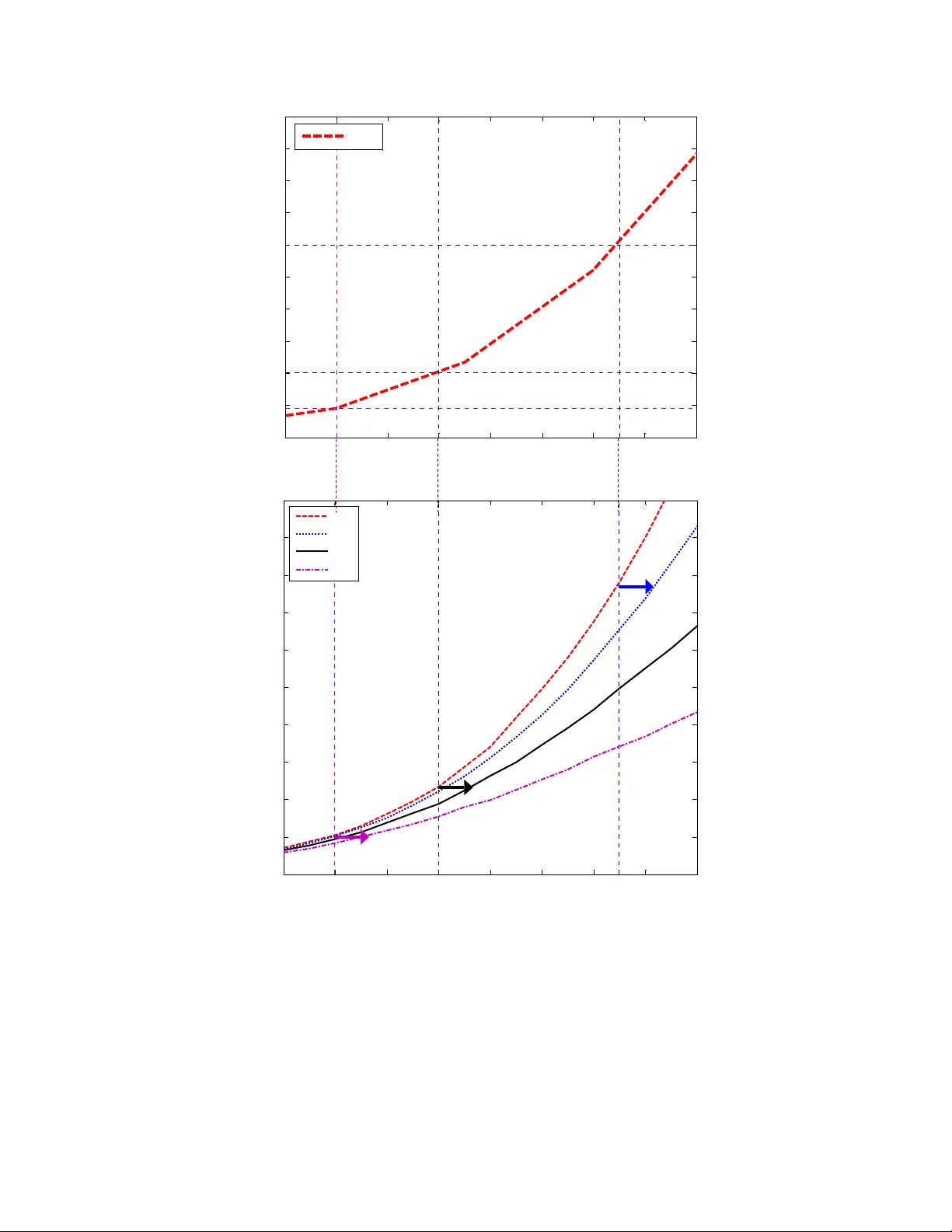
Accepted for IEEE Trans. Communications 1 Achieving Near-Capacity at Low S NR on a Multiple-Antenna Multiple-User Ch annel Chau Yuen Bertrand M. Hochwald cyuen@i2r.a-star.edu.sg hochwald@beceem .com Abstract We analyze the sensitivity of the capacity of a multi-antenna mul ti-user system to the number of users being served. We show an alytically that, for a given desir ed sum-rate, th e extra power needed to serve a subset of the users at low SNR (s ignal-to-noise ratio) can be very small, and is generally much smaller than the extr a power needed to serve th e same subset at high SNR. The advantages of serving only subsets of the user s are many: m ulti-user algorithms have lower complexity, reduced channel-state infor mation requi rements, a nd, often, better performance. We provide guidelines on how many users to serv e to get n ear-capacity perfor mance with low complexity. For example, we show how in an eight-antenna eight-user system we can serve only four users and still be approximately 2 dB from capacity at very low SNR. 1. INTRODUCTION Given a base-station or access-point with M transm it anten nas se rving a pool o f L autonomous single-antenna users who cannot cooperate with each other, we wish to approach the sum-capacity, especially at low SNR. This is a multi-antenn a multi-user communication sys tem, which is also someti mes referred to as a Gaus sian vector bro adcast chan nel. The s um-capacity of such a sy stem is investigat ed in [1-6], assu ming that channel stat e information (CS I) is available at the t ransmitter and receivers. Achieving capacity in this multi-antenn a multi-user channel os tensibly could i n theory require us to serve all L users s imultaneously w ith the M transmit antenn as. Generally, most systems have L ≥ M . For such a system, the sum-rate of serving K users (out of the L ) grows linearly with K for K ≤ M and sub-linearly for K > M [7]. Since system complexity can grow significantly with the numb er of users served, an advantag eous performance-co mplexity tradeoff can be attained by serving M users. In fact, we show that we may often serve fewer than M users with little rate p enalty, especially at low SNR. We quantify the p enalty in this paper. We focus on low SNR’s or low SINR’s (signa l to interference-plus-noise ratio) because many multi-user systems operate in an interference-dominated environ ment. Many algorithms Accepted for IEEE Trans. Communications 2 have been proposed for MIMO multi-user. However, some multi-user techniques, su ch as vector- perturbation described in [8], are able to approa ch the sum-capacity at high SNR but suffer some performance loss at low SNR. It is then important to improve the perform ance of these algorithms at low SNR. One simple way to reduce co mplexity and improve per-user performance is simply to serve fewer users. But serving fewer users is a viable strategy only if we do not suffer a large total throughput penalty in the process. We q uantify the penalty and show that it is small at low SNR’s . We define and use a quantity called sensitivi ty of the capac ity as follow s: Given that we are serving a certai n number of users at a certain SNR and total throughput, if we now serve fewer users (using the sa me number of trans mitter antennas), how much do we need to increase the SNR to obtain the same total throughput? The reduction in number of users is the equivalent of a complexity reduction (that comes from lower channel-state information requireme nts and simplified algorithms), while th e increase in th e SNR is the equivalent of a pow er penalty. For example, for eigh t trans mit antenna s, at ρ = 1 dB (which is defined as the ratio of total transmit power to per-user receive noise po wer), we suffer a penalty of onl y 1.1 dB in SNR (increase in ρ ) if we serve only four users chosen randomly, each at one-fourth the sum-rate, versus all eight users, each at one-eighth the ra te. The corresponding penalty at ρ = 10 dB is more tha n 2.55 dB, and the corresponding penalty at ρ = 20 dB is more than 7.63 dB. We so metimes call this power penalty a “loss” and this loss is clearly much lower at small ρ in this example. Other definitions of capacity sensitivity are also possible, such as in [11] where th e suboptimality of TDMA at low power is quantified. Thus, to obtain high rates at low SNR’s we may as well serve f ewer users with algorithms that have low co mplexity and good performance. Continuing the example of the previo us paragraph, we halve the number of users being served and suffer a 1.1 dB penalty in the SNR at ρ = 1 dB. In return, we obtain th e benefit of requiri ng the c hannel s tat e information (CSI) of only four users at the transmitter. Furthermore, we may obtain performance gains from any algorithm used to serve the users: for example, when serving four users, the vector-per turbation technique gains approximately 1.5 dB over the sa m e technique serving eight users (in the eight- Accepted for IEEE Trans. Communications 3 antenna system of this exa mple). Hence the algo rithmic gain of serving only four users exceeds the power penalty and we have a n et gain. The user selection process can be fair. Even if we choose to serve four u sers rather than eight at each trans mission in the abov e example, we requir e the total su m-rate to be th e same. Therefore, each user get s twice as mu ch data p er transmission as when all eight are served. A different set of four users m ay be chosen at each transmission, and all users can therefore be served in round-robin fashion with no loss in rate. Rather than work directly with the capacity, which is often intractable, we generally work with a tractable lower bound that gives us insight into the capacity . We formulate the problem in detail in the next section. 2. PROBL EM FORM ULATI ON Consider a multi-antenn a multi-user communi cation syste m with M transmit antennas and a pool of L users, each wit h one antenna. The su m-capacity is [1] ( ) * ,tr( )=1 E max log det LL LM L C ρ =+ DD IH D H (1) wher e I M is an M×M identi ty ma trix, H is the L×M is the channel matrix between every user and the transmitter, and D L is an L×L positive diagonal matrix whose trace is unity. The elements of H are Rayleigh fading (complex-Gaus sian) coefficients with zero mean and unit varian ce. Throughout this paper, log is base-two, and natu ral log is denoted ln. We ignore the numerical and algorithmic issues of optimizing D L in (1). The sum-capacity (1) requires full knowledge of th e CSI at the trans mitter and hence may be difficult to achieve if L is large. We consider the case of serving M users (with M an ten nas ) chosen randomly from the pool of L . In this case the achievabl e sum-rate is ( ) * ,tr( )=1 E max log det MM MM M I ρ =+ DD IH D H (2) wher e H is M×M complex-Gaussian channel matrix. A chieving this rate requires knowledge of the CSI of any M users at th e transmitter. Clearly C L ≥ I M . The focus of this paper is low SNR. Multiple transmit antennas can still be beneficial at low SNR when c hannel inform ation is available to the tran smitter. Thi s can be justified a s follows: when ρ is very small, I M can be lower bounded by Accepted for IEEE Trans. Communications 4 ( ) ( ) () () () *2 ,tr( )=1 * ,tr( )=1 log E max tr ( ) log E max tr log MM MM MM M Ie O ee M ρρ ρ ρ =+ ≈≥ DD DD HD H DH H (3) Equation (3) suggests that we s hould choose D M to have a one on its diagonal corresponding to the user whose diagonal entry of HH * is largest; i t is therefore best to serve only the user with th e largest channel gain. N evertheless, the inequality is obtained by setting D M = I M and we s ee that the sum-rate grows at least linearly with the number of antennas M at low SNR. We next investigate how closely we can achieve I M while reducing the number of users served K to a value less than M . This w ould allow us to enjoy the benefits of having M an ten na s without having to serve M users. The achievable rate of serving K users (with M antennas) is denoted I K . We measure our ability to achieve I M by computing, for a given ρ , how much we need to incr ease ρ to make I K = I M for K < M. We use differential analy sis to make the comp utation t ractabl e. 3. SENSITIVITY ANALYSIS OF SUM-RATE 3.1 Bounding the sum-rate We consider our abi lity to achieve I M in equation (2) as a functi on of the number of users served. To simplify the analysis, suppos e in (2) that we set 1 MM M = DI (4) (a diagonal matrix wit h 1/ M on the diagonals) and obtain the following lower bound: eq, M M II ≥ (5) where * eq, =E l og de t . MM I M ρ ⎛⎞ + ⎜⎟ ⎝⎠ IH H (6) The suffix “eq” denotes the fa ct that we are setting D M to have equal entries. We use I eq, K to denote serving K users where K can be less th an M . The diagonal elements of D M in (4) are related to the power assigned to different data streams of different users [1]. Rather su rprisingly, we show that the lo wer bound in (6) (whic h assigns equal power to the data stream s) is tight at both high and low ρ for large M . When M = 1, this lower bound is trivially tight. For large ρ it is shown in [2] that setting (1 / ) M M M = DI leads to a tight bound for any M . When ρ is small, we show in Appendix A that Accepted for IEEE Trans. Communications 5 () eq, eq, 1 M MM II I ζ +≥ ≥ (7) for large M and any ζ > 0. In fact, we have found that the rate I M in (2) and the lower bound I eq, M (6) are often nearly equal for all SNR’s. We determine the sensitivi ty of the achievable rate to the number of users served by decreasing the nu mber of users by a small am o unt and examining how much we must increase the SNR so as to keep the total rate constant. I nstead of working directly with I M (which does not have a closed-form), we use the lower bound (5) and the general relationship is as follows: eq, eq, M M K K II II ≥ ∨∨ ≥ (8) wher e K is the design variable representing the number of users we serve with M antennas. We would l ike to find the differen ce betwe en I M and I K as a function of K an d ρ . We examine this difference indirectly as shown in equation (8) by instead examining the differen ces in the two circled inequalities. As shown in equation (7), we kno w that I eq, M is a good approxi mation of I M . Thus, we only need to investigate the difference between I eq, M and I eq, K . If the difference between I eq, M and I eq, K is small, then the d ifference between I M and I K is also small. 3.2 Differential analysis of sum-rate When we reduce the number of users from K to K ′ , the ratio β increases to β′ , where β′ = M / K ′ . In order to achieve the same rate before this reduction, ρ must be increased to so me ρ′ . We define two quantities: ε the complexity reduct ion coeffic ient, and δ the power penalty coefficient . The quantity ε is defined as: d where d β ε ββ β β ′ == − (9) A large positive ε implies a large reduction in co mplexity . We are interested in i nfinitesima l changes, and an infin itesimal chang e in β is related to an infinitesimal change in K through dd K K β ε β == − . (10) Observe that ε divi des the c hange in β by β . Hence, if ε = 1 the number of users is halved ( β′ = 2 β ). This is a notational conveni ence since it turns out that our final results are insensitive to the absolute number of antennas and users but are strong function s of the ratio β . Accepted for IEEE Trans. Communications 6 The power penalty co efficie nt δ is defined as: d where d ρ δ ρρ ρ ρ ′ == − (11) A large positive δ implies a large incre ase in SNR. The p enalty δ is related to the dB-change in power through ( ) () ( ) 10 10 1 d 10 log 1 10 (log ) e ρ ρδ ρ δ δ ′ =+ ⇒ = + ≈ dB (12) We define the sensitivity as th e ra tio dd dd δ ρρ ρ β ε ββ β ρ ⎛⎞ == ⎜⎟ ⎝⎠ (13) where the chang es in ρ and β are infinitesimal and such that I eq, K is kept constant. A smal l value for this ratio suggests that the number of users can be changed (wh ile keeping the rate constant) with little pen alty in power. To obtain the sensitivity we solve () ( ) eq , eq , constant KK II ρρ ′ ′ == (14) for infinitesimal changes in β and ρ . 3.3 Formula for sensitivity The quantity I eq, K has the big advantage of an approximate closed-form formula: () * eq , E l og det El o g 1 F , KM I K KK K λ ρ ρ λβ ρ ⎛⎞ =+ ⎜⎟ ⎝⎠ ⎛⎞ =+ ≈ ⎜⎟ ⎝⎠ IH H (15) Where λ denotes any eigenvalues of HH * , and F( β , ρ ) is defined in [9] as: () () () () () () () () () () 2 2 1 2 1 2 1 11 F, l o g 1 1 4 11 log 1 1 1 log 2 11 1 log 1 log 11 1 d a a e aa β β β β β ρρ λ λ πλ λ ρβ β γ ββ γ + − − ⎛⎞ =+ − + ⎜⎟ ⎝⎠ ⎛⎞ +− =+ + + + ⎜⎟ ⎝⎠ ⎛⎞ −− + −+ − ⎜⎟ +− +− ⎝⎠ ∫ (16) wher e () 2 4 11 a ρβ ρβ = ++ , 1 1 β γ β − = + , and where H is of dimension K×M and / M K β = . Accepted for IEEE Trans. Communications 7 The approximation of I eq, K ≈ K F( β , ρ ) becomes an equality when we consider a fixed β but both K and M are allowed to become larg e [12]. This approximatio n makes the analy sis tractable and is accurate for even small values of M and K . Theorem 1 : For large M and K , the sensitivity is: ( ) ( ) () 2 1 F, , , c c β ρβ ρ δ εβ ρ − = (17) where c 1 and c 2 are () ( ) ( ) 2 1 1 ,l o g 4 ca e d β βρ β ⎡ ⎤ + ⎢ ⎥ = + ⎢ ⎥ ⎢ ⎥ ⎣ ⎦ (18) () () ( ) () () ( ) ( ) () () () () () 2 2 11 1 1 1 1 ,l o g l o g 21 21 log 2 12 1 4 11 aa ce aa ae d a γβ βρ β γγ β βρ β ρ ⎛⎞ ++ − − − − ⎜⎟ =− ⎜⎟ +− +− ⎝⎠ ⎡⎤ ⎢⎥ −− + + − − + ⎢⎥ +− ⎢⎥ ⎣⎦ (19) and () () () ( ) () () () () () () () 2 22 2 22 1 1 21 1 1 1 21 1 1 1 1 1 21 1 1 1 d aa a a a β β ρβ γ ρβ β ρβ + − =− −+ + + − −+ + + − + − ++ + − (20) and a and γ are define d in (16). Proof of Theorem 1 : We take the derivativ es of (14) with respect to β and ρ : ( ) () () () () () () () eq , constant F , constant F, F, dd 0 F, F, dd F, 0 K IK KK βρ βρ βρ βρ βρ βρ βρ βρ ββ ρ ρ ββ ρ ρ =⇒ = ∂∂ ⇒+= ∂∂ ∂∂ ⎛⎞ ⎛ ⎞ ⇒− + = ⎜⎟ ⎜ ⎟ ∂∂ ⎝⎠ ⎝ ⎠ (21) Using (13) and (21), we obtain () ( ) ( ) F, F, d F, d β ρβ ρ δρ ρ βρ β ρ βρ εβ β ∂∂ ⎛⎞ ⎛ ⎞ == − ⎜⎟ ⎜ ⎟ ∂∂ ⎝⎠ ⎝ ⎠ (22) Accepted for IEEE Trans. Communications 8 Therefore 2 (, ) (, ) F c β ρ βρ β β ∂ = ∂ and 1 (, ) (, ) F c β ρ βρ ρ ρ ∂ = ∂ and we omit the tedious derivative calculations. ■ We notice that sensi tivity δ / ε in (17) is a function of only ρ and β and is therefore “universal” in the sense that, on a complex Gaussian chann el, it does not depend on the specific valu es of the number of transmit anten nas M and the number of users K but only their ratio. The sensitivity is the ratio of in cremental power to user red uction while achieving constant rate. A low value of δ / ε implies that the r ate is insensitive to the number of users being served; there is only a s mall power penalty if we serve fewer users. On the othe r hand, a large value of δ / ε implies that the rate is highly sensitive to the nu mber of users being served. Since the expr ession of sensitivity in (17) is rather complex, w e look at some speci al cases and asymptotic res ults. For exa mple, when β = 1 we obtain γ = 0 and we may si mplify (17) to () 1 ln 1 1 b b bb δ ρ ερ ⎛⎞ ⎛⎞ =+ − + ⎜⎟ ⎜⎟ ⎝⎠ ⎝⎠ (23) wher e ( ) 11 4 2 b ρ =+ + . We plot the sensitivity for β = 1 as given in (23) in Figure 1. One can see that the sensitivity is never negative because the mutual informatio n is a non-decreasing function of the number of users being served. Furtherm ore, from Figure 1, the sensitivity for β = 1 can be separated into two regions, when ρ is below 0 dB, the sensitivity δ / ε is s mall ( δ / ε << 1 ), but after ρ = 0 dB, δ / ε grows quickly. Consequently, at low SNR’s the number of users can be de creased with only a small penalty ( ε large, δ small). However at high SNR a decrease in number of users can result in a large penalty in SNR ( ε small, δ large). In Figure 1, we also plo t the sensitivity (17) for β = 2, 4, 8. We observe from the figure that the sensitivity increases as β inc reases becau se a larger value of β means that we are already s erving fewer users than antennas. We present the following asy mptotics for the sensitivity. To a first-order approximation: ρ Æ 0: 2 δ βρ ε = ( 2 4 ) ρ Æ ∞ : ( ) () ( ) ln 2 1 if 1 if 1 ln ln 1 1 ρ δ β β ρβ ε − ⎧ = = ⎨ > +− − ⎩ (25) Accepted for IEEE Trans. Communications 9 From (24) one can s ee that, a t low ρ , the sensitivi ty is linear in ρ with slope β /2 and goes to zero as ρ g o e s t o z e r o . T h i s i s s e e n i n F i g u r e 1 . T h e e f f e c t o f β is to in crease the penalty multipli catively as β increases. When ρ is large, (25) shows that there are two cases: β = 1 and β > 1. Hence the sensitivity as a function of ln( ρ ) is significantly lower when β = 1 than otherwise. This suggests that we have much more freedom to reduce the number of users when we are serving the full K = M than otherwise. The effect of β > 1 is to shift the curve to the left by ln ( β – 1). This effect is also seen in Figure 1 in the cur ves for β = 2, 4, and 8 at high SNR. 3.4 Application of sensi tivity Lets assume that K = M ( β = 1) and we ask: A t what ρ we can reduce the number of users to be served by ½, ¼, or ⅛ (equivalently , make β′ = 2, 4, or 8), while only suffering only ≈ 1 dB power loss (keeping the achievable rate approximately constant)? The sensitivity δ / ε can be used to ans wer this question. Th e complexity reduction co efficients ε in (9) that correspond to chang ing β from 1 to 2, or from 1 to 4, or from 1 to 8 are ε = 1, 3, and 7 respectively . We choose the po wer penalty co efficient δ = 0.3 since we th en accept an estim ated pena lty of 10l og 10 (1+0.3) ≈ 1.1 dB. When β is changed from 1 to 2, we require a sensitivity of δ / ε = 0.3/1 = 0.3, however when β is change d from 1 to 8, we re quire a lowe r sensitivity of 0.3/8 = 0.043 . We can obtain the operating point ρ that yields these sens itivities by solving (23). Figure 2 is a plot of δ/ε versus ρ that shows our operating points. For example, the sensi tivity is 0.3 when ρ = 1 dB; this implies th at when β = 1, there will be a loss of 1.1 dB at ρ = 1 dB when β is increased to 2. A similar loss is obtained at ρ = - 6 d B w h e n β is increased to 4; at ρ = -10 dB when β is increased to 8. We may use these resul ts to conclude that with M = 8 transmit antenn as we can serve K = 4 users ( β = 2) at 1 dB, K = 2 users ( β = 4) at –6 dB, K = 1 user ( β = 8) at –10 dB and still come within approxi mately 1.1 dB of I 8 . We verify these predi cted operating po ints with th e mutual inf ormation curves that are displayed in Figure 3. For exa mple, Figure 3 shows that when ρ = -6 dB, in order to achieve the throughput of eight users ( β = 1) but using only two users ( β become s 4 and ε = 3), Accepted for IEEE Trans. Communications 10 approximately 1.30 dB of extra power is needed. Si milarly for the remaining two cases, it is found that they also require approximately 1.3 dB of extra power. Hence the (graphically) calculated pena lties in ρ are nearly the predicted 1.1 dB. 4. ALGO RITHM PERFORM ANCE WITH F EWER US ERS The previous sections show that we can redu ce the number of users at low SNR and ke ep the sum-rate constant with only a s mall power penalt y. We now show that reducing the number of users in some algorith ms improves their performance and lowers their co mplexity sufficiently to overcome this penalty. For example, we examine the coded performance of M = 8 transmit antennas with L = 8 users at a total throughput of 8 bps/Hz using the vector-perturbation techni que desc ribed i n [9]. The vector-perturbation technique fro m [9] is summarized as follows: () 1 ** 1 α τ ρ γ − ⎛⎞ =+ + + ⎜⎟ ⎝⎠ yH H H H I u n l (26) wher e ( ) max 2.5 / 2 c τ =+ ∆ , y is received signal vectors for all K users, H is channel matrix, u and n are the K -dimensional signal and noise vectors for K users, G is the re gularized-inverse precoding matrix, γ is a scalar such that tota l transmission power is normalized to one, α is the regularized-inverse parameter, | c | max is the absolute value of the constellation symbol with largest magnitude and ∆ is the spacing between constellation points. The integer perturbation vector l is obtained from the optimization () ( ) () { } * * arg m in ττ ′ ′ ′ =+ + uG G u l ll l (27) It is assumed that u consists of sy mbols coded with a rate-half turbo code from the UMTS standard with feedforward pol ynomial 1+ D + D 3 , feed back pol ynomi al 1+ D 2 + D 3 , block length 10000 bits, 20 inner iterations, and 8 outer loop iterations. The BER per formanc e of M = 8, L = 8, K = 4 and 8 users with a total thr oughput of 8 bps/Hz is shown i n Figu re 4. We observe that by se rvin g K = 4 rando m users (dashed line, each user with 16QAM, hence rate 2 bps/Hz per user) can be better than serving K = 8 use rs (dotted line, each user with QPSK, h ence rate 1 bps/Hz per us er) eve n though the total data rate is the same. In this particular example, the gain is about 1.5 dB despite the fact that serving 4 u sers has a Accepted for IEEE Trans. Communications 11 smalle r channel sum -rate ( I 4 = 8 bps/Hz at ρ = 2.65 dB versus I 8 = 8 bps/Hz at ρ = 1 dB). This illustrates the principl e that serving fewer users at low SNR may lead to an algorithmic performance improvement that outweighs the power penalty. Furthermore, to serve four users we require only the CSI of any four users at a time, instead of all eight users, and thus the algorith m complexity decreases. We are approximately 3.2 dB away from I 8 by choosing four users randomly. 5. CONCLUSION We provided a sensitivity study for a multiple-antenna multiple-user system of the number of users versus power while keeping the mutual inform ation constant. Our study gave an analy tical means for quantifying the power penalty for reducin g the number of user s served, especially at low SNR. We also showed that this loss can be compens ated by improved algorith m performance and lower CSI requirements, and the user selection process can be fair. Our results were universal in the sense that on a Gaussian channel they depended on only the ratio of the number of antennas to the number of users being served and could be applied to any number of antennas a nd users. One possible extensi on of this work would address users that have unequal SNR’s and data-rate requirem ents. In this realistic scenario, the complexity of choosing how many users to serve (and at what rate) would probably be more difficult. Perhaps som e combination of fairness and cap acity-sensitivity w ould be needed to establish a good procedure. APPEND IX A - Pr oof of ( 7 ) At low ρ , from (2) and (6) we know that: () eq , ** ,tr( )=1 E max log det E log det MM MM II M ρ ρ ≥ ⎛⎞ +≥ + ⎜⎟ ⎝⎠ DD IH D H I H H (28) wher e H is an M × M matrix. When ρ is small, the right hand side of (28) becomes: () () () ** eq , =E log det log Et r log MM Ie e M MM ρρ ρ ⎛⎞ +≈ = ⎜⎟ ⎝⎠ IH H H H (29) Simila rly when ρ is small, the left hand side of (28) beco mes: () () () *2 2 ,tr( ) =1 i.i.d . 1 =E ma x log det log E max log 2 MM M M Ce e ρρ χ ρ ⎛⎞ +≈ = ⎜⎟ ⎝⎠ DD IH D H M (30) Accepted for IEEE Trans. Communications 12 wher e 2 2 i.i.d . 1 =E max 2 M M χ ⎛⎞ ⎜⎟ ⎝⎠ M is the expected value of th e maximum of M i.i.d. chi-square random variables (normalized by ½), each with 2 M degrees of freedom. In fact, (30) suggests that at low ρ , the best strategy is to serve only the user with the maxim um channe l ga in M . We show that when M is large, M is bounded as follow s: () lim P r 1 1 M M ζ →∞ ⎧ ⎫ ≤ += ⎨ ⎬ ⎩⎭ M (31) for any ζ > 0. Then, by using (29), (30) and (31), we can bound (28) as ( ) ( ) ( ) () * ,tr( )=1 * lo g 1 E m ax l o g det E log det log M M eM eM M ρζ ρ ρ ρ +≈ + ≥ ⎛⎞ +≈ ⎜⎟ ⎝⎠ DD IH D H IH H (32) and we prove that lower bound in (6) and (28) are tight at low SNR. To verify the inequality in (31), we need to ex amine the distribution of the maximum value, M of M random independent 2 2 1 2 M χ variables. () () 1 0 1 P M x tM x et d t M −− ⎡ ⎤ ≤= ⎢ ⎥ Γ ⎣ ⎦ ∫ M (33) To find how M grows with M , it is suffices to find the s malle st x for which P( M ≤ x ) → 1 as M → ∞ . We write: () () 1 1 P1 M tM x x et d t M ∞ −− ⎡ ⎤ ≤= − ⎢ ⎥ Γ ⎣ ⎦ ∫ M (34) For this probability to become 1 as M → ∞ , we need the integral to go to zero faster than 1 O M ⎛⎞ ⎜⎟ ⎝⎠ . For example, if the integr al () 1 1 tM x et d t M ∞ −− Γ ∫ is 1 o M ⎛⎞ ⎜⎟ ⎝⎠ then ( ) ln P x ≤ M → 0 or P( M ≤ x ) → 1 as M → ∞ . We use () () () () () () () 1 1 1 0 1 0 11 1 wh ere 1 1 1 M xt tM x M xM x t e t dt e x x t dt t x t MM ex e t d t M ∞∞ − ′ −+ −− ∞ − ′ −− ′ ′′ =+ = + ⎡⎤ ⎣⎦ ΓΓ ′′ =+ ⎡⎤ ⎣⎦ Γ ∫∫ ∫ (35) Next, we use the approximation 1 t te +≤ to yield Accepted for IEEE Trans. Communications 13 () () () 1 11 1 xM tM x ex et d t MM x M − ∞ −− ≤ ΓΓ − − ∫ (36) under the assumption that x > M -1. So we need to solve for x > M -1 such that () () 11 1 xM ex o M xM M − ⎛⎞ = ⎜⎟ Γ− − ⎝⎠ (37) as M → ∞ . Using the Stirling approximation for large M [12] y ields () ( ) () () 1 1 12 1 M M MM e M π − −− Γ≈ − − (38) and taking the logarithm of (37) on both side, we obtain the re quirement () ( ) 11 ln ln ln 2 ln ln( 1 ) ln 22 M MM M x M x x M M π −− + + − + − + = Ω (39) Let x = M (1+ ζ ), which satisfies x > M -1 for ζ > 0. Then the left hand side of (39) beco mes () ( ) () () 0 11 ln ln 2 ln 1 ln 22 11 ln 1 ln ln 2 ln 22 MM M MM π ζζ ζ ζ ζπ ζ > ++ − + + ⎛⎞ ⎜⎟ =− + + + + ⎜⎟ ⎝⎠ (40) This satisfies the requirement because it is Ω (ln M ) for any ζ > 0. REFERENCES [1] P. Viswanath and D. N. C. Tse, “Sum capacity of the vector Gaussian broadcast channel and uplink-downlink duality ”, IEEE Trans. on Info. Theory , vol.49, pp . 1912-1921, Aug . 2003. [2] N. Jindal, “High SNR analysis of MIMO broadcast channels,” 2005 IEEE Inte rnationa l Symposium on Info. Theory, pp. 2310-2314, Sept. 2005 . [3] G. Caire and S. Shamai, “On t he achievable th roughput of a multiantenna Gaussian broadcas t channel”, IEEE Tr ans. on Info. Theory , vol. 49, pp . 1691-1706, Ju ly 2003. [4] S. Vishwanath, N. J indal, and A. Gol dsmith, “Duality, achie vable rates, and sum-rate capacit y of Gaussian MIMO br oadcast channels ”, IEEE Trans. on Info. Theory , vo l. 49, pp. 2658-2668, Oct. 2003. [5] W. Yu and J. M. Cioffi, “Sum capacit y of Gaussian vector br oadcast channels”, IEEE Trans. on Info. Theory , vol. 50, pp. 1875-189 2, Sept. 2004 . [6] H. Weingarten, Y. Steinberg, and S. Shamai, “The capacity region of the Gaussian MIM O broadcast channel”, IEEE Trans. on Info. Theo ry , vol. 52, pp. 3936-3 964, Sept. 2006. Accepted for IEEE Trans. Communications 14 [7] M. Sharif and B. Hassibi, “On t he capacity of MIMO broadcast c hannels with partial side information”, IEEE Trans. Info. Theory , vol. 51, pp. 506-522 , Feb 2005. [8] B. M. Hochwald, C. B. Peel, and A. L. Swindlehurs t, “A vector-perturbati on technique for near-capacity multi-anten na multi-user communicat ion – part II: pertur bation”, IEEE Trans. on Communicatio ns , vo l. 53, pp. 537-544, March 2005. [9] B. M. Hochwald, T. L. Marzetta, and B. Hassibi, “Space-time autocoding”, IEEE Trans. on Info. Theory , vol. 47, pp. 2761-2781, Nov 2001. [10] S. Verdu and S. Shamai (Shitz), “Spec tral e fficiency of CDMA with random spreading”, IEEE Trans. Info. Theory , vol. 45, pp. 622-64 0, Mar 1999. [11] G. Caire, D. Tuninetti, S. Verdu, “Suboptimality of TDMA in the low-power regime”, IEEE Trans. on Info. Th eory , vol. 50, pp 60 8- 620, April 2004. [12] M. Abramovich, and I. A. Stegun, eds., Handboo k of Mathematical F unctions with Formulas, Graphs, and Mathematical Tables, Applied Mat hematics Series, no. 55, Was hington, D.C. : National Bureau of Standa rds, p. 257, 1964. List of Figures -4 0 -30 -2 0 -10 0 10 20 30 40 0 1 2 3 4 5 6 7 8 9 10 ρ (d B) s e ns iti v ity δ / ε β =8 β =4 β =2 β =1 Figure 1: Sensitivity δ / ε for β = 1, 2, 4, 8. The curve β = 1, which is (23 ), can be separated in to two parts: from ρ = –40 dB to 0 dB, the sensitivity is small, but after ρ = 0 dB, δ / ε grows quickly. ( Recall that sm all sensitiv ity implies that users may droppe d while maintaining th e sum-rate with little penalty in ρ . ) The curves for β = 2, 4, 8 are given in (17). The curves grow rapidly as β increases because we are already serving fewer user s than antennas. The large- ρ slope of these cur ves is given in (25). Accepted for IEEE Trans. Communications 15 -1 2 -1 0 -8 -6 -4 -2 0 2 4 0 0.0 5 0. 1 0.1 5 0. 2 0.2 5 0. 3 0.3 5 0. 4 0.4 5 0. 5 ρ (d B) se nsi tvi t y δ / ε β =1 δ / ε = 0.3 δ / ε = 0.1 δ / ε = 0.0 43 -12 -10 -8 -6 -4 -2 0 2 4 0 1 2 3 4 5 6 7 8 9 10 ρ (d B ) I eq,K (bp s /Hz ) β f rom 1 t o 2 at ρ = 1 β f rom 1 t o 4 at ρ = - 6 β f rom 1 t o 8 at ρ = - 1 0 β =1 β =2 β =4 β =8 Figure 2: (upper figure ) Sensitivity δ / ε for β = 1 as a function of ρ ( equation (23)). The markings at ρ = 1 dB, -6 dB, and -10 dB correspond to sensit ivities of 0.3, 0.1 and 0.043. We ar e interested in δ = 0.3, cor responding to an acceptable po wer penalty of 1.1 dB. Figure 3: (lower figure) I eq, K for M = 8 transmit antennas with β = 8, 4, 2, 1 ( K = 1, 2, 4, 8 use rs). As shown by the arrow at ρ = 1 dB, the power penalty for halvi ng the numbe r of users (incr easing β from 1 to 2 while keeping the mutual information con stant) is approximately 1.4 dB, slightl y larger than the design-point of 1.1 dB. The remaining two ar rows show similar power penalties for increasing β to 4 and 8. Accepted for IEEE Trans. Communications 16 8 10 -6 10 -5 10 -4 10 -3 10 -2 10 -1 10 0 ρ (dB ) BE R I 8 = 8 b ps /H z at 1 dB I 4 = 8 b ps /H z at 2. 65 dB K=4 ( s e l) α =1 . 4 K=4(rand) α =1. 6 K=8(rand) α =0. 9 M = 8, L= 8, R e g- I nv Pe rt Figure 4: BER performance for M = 8 transmit antennas when servin g K = 4 (dashed line ) and 8 (dott ed line) users at a th roughput of 8 bps/Hz. The to tal pool of users is L = 8. -2 0 2 4 6 8 10 -2 0 2 4 6 8 10
Original Paper
Loading high-quality paper...
Comments & Academic Discussion
Loading comments...
Leave a Comment