On the Diversity-Multiplexing Tradeoff in Multiple-Relay Network
This paper studies the setup of a multiple-relay network in which $K$ half-duplex multiple-antenna relays assist in the transmission between a/several multiple-antenna transmitter(s) and a multiple-antenna receiver. Each two nodes are assumed to be e…
Authors: Shahab Oveis Gharan, Alireza Bayesteh, Amir K. Kh
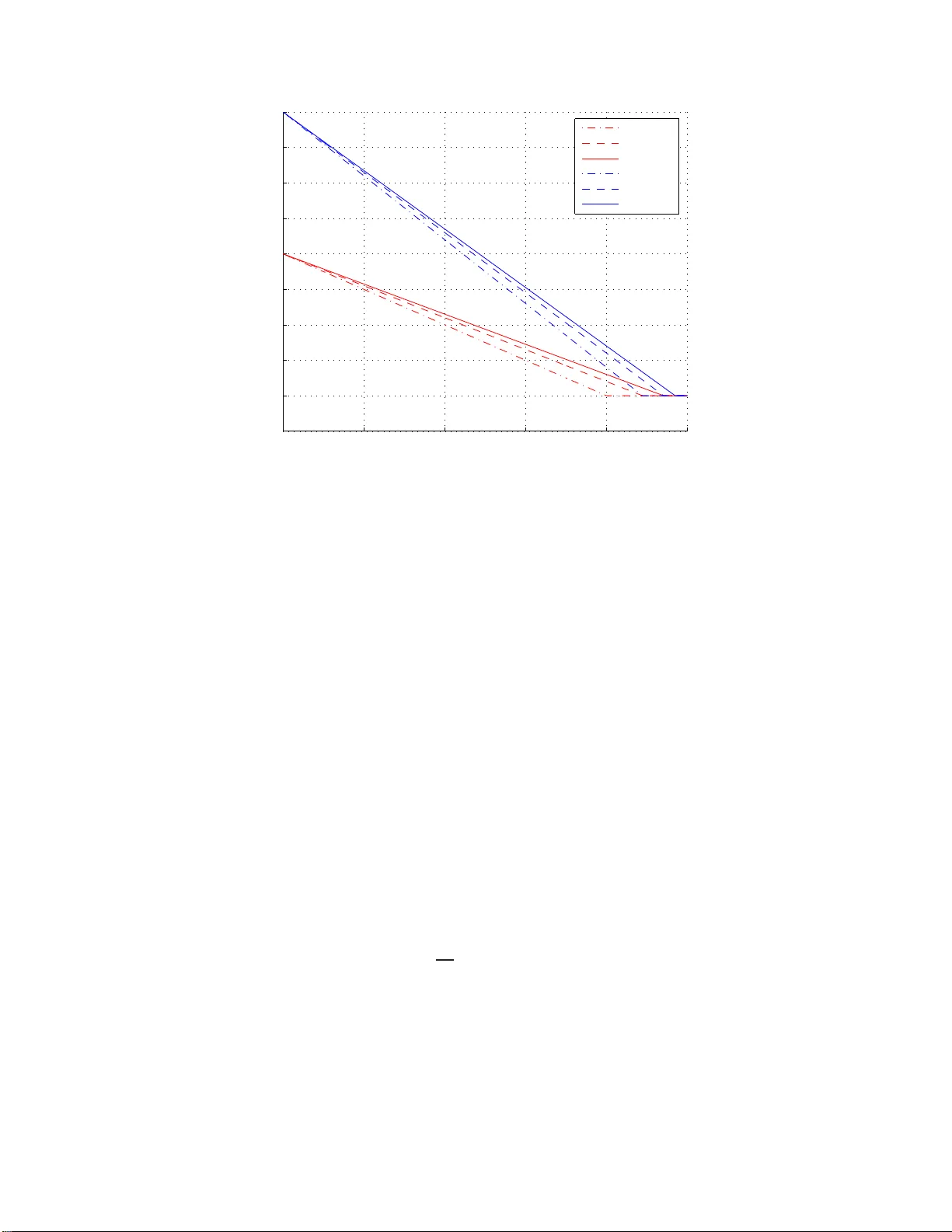
On the Di v ersity-Multiple xing T radeof f in Multiple-Re lay N etw ork Shahab Oveis Gharan, Alireza Bayesteh, and Amir K. Khandani Coding & Signal Transmission Laboratory Departmen t of Electrical & Compu ter Engineering University of W aterloo W aterloo, ON, N2L 3 G1 shahab, alireza, khan dani@cst.uwaterloo.c a Abstract This paper studies the setup of a multiple-r elay network in which K half-du plex mu ltiple-antenn a relays assist in the transmission between a/several mu ltiple-antenn a transmitter(s) and a multiple-an tenna receiver . Each two n odes are assumed to be either co nnected through a qua si-static Rayleigh fading ch annel, or disco nnected. W e p ropo se a new scheme, which we call random seque ntial (RS), based on the amp lify-an d-forward relaying. W e p rove that for g eneral m ultiple-ante nna multiple-relay networks, the proposed scheme achie ves the maximum div ersity gain. Furthermor e, we derive diversity-multiplexing tradeoff (DMT) of th e proposed RS scheme for general single-anten na mu ltiple-relay networks. It is shown that for sing le-antenn a two-hop multiple- access mu ltiple-relay ( K > 1 ) networks (without direct link between the transmitter(s) and the receiv er ), the pr oposed RS scheme achieves the op timum DM T . Howe ver , fo r th e ca se of mu ltiple ac cess single relay setup, we show that the RS scheme reduces to the nai ve am plify-an d-for ward relayin g an d is not o ptimum in terms o f DMT , while the dyn amic decode- and-fo rward sch eme is shown to b e optim um for this scenario 1 . I . I N T RO D U C T I O N A. Motivation In recent years, relay-assisted transmissi on has gained sign ificant attention as a powerful technique to enhance the performance of wireless netw orks , com bat the fading ef fect, extend the cove rage, a n d reduce the amou nt of interference d ue to frequency reuse. The main idea is to deploy s ome extra n odes i n the network t o facilitate the commu nication between th e end term inals. In this m anner , these supplementary nodes act as s patially dist ributed antennas for the end t erminals. More recently , coop erativ e diversity Financial supports provided by Nortel, an d the correspond i ng match i ng funds by the Federal gov ernment: Natural Sciences and Engineering Research Council of Canada (NSERC) and Province of Ontario: Ontario Centres of Excellence (O CE) are gratefully acknowled ged. 1 A Part of this paper , Theorem 2, is reported in Library and Ar chives Canada T echnical R eport [1]. Subsequently , [2] cov ers Theorems 2 and 3 and [3] cov ers Theorems 2, 3, 5 and 6. The materials of this paper are reported in [4]. 2 techniques ha ve b een proposed as candidates t o e xpl oit the spatial div ersity offered by the relay netw orks (for example, see [5]–[8]). A fundamental measure to e valuate th e performance of t he existing cooperative div ersit y schemes is the diversity-multiplexing tradeoff (DM T) whi ch was first introduced by Zheng and Tse in the context of poi nt-to-point MIMO fading channels [9]. Roughly speaking, the div ersi ty- multiplexing tradeof f i dentifies the optimal compromise betwee n the “transmission reliability” and the“data rate” i n the high-SNR regime. In spite of all the interest in relay networks, none of the existing coop erativ e dive rsi ty schemes is proved to achie ve the o ptimum DMT . The probl em has been open ev en for the sim ple case of hal f- duplex sing le-relay single-source single-destinati on singl e-antenna setup. Indeed, th e only existing DMT achie v ing s cheme for t he single-relay channel reported in [7] requires knowledge of CSI (channel state information) for all the channels at the relay node. B. Related W orks The DMT of relay networks was first stud ied by Laneman et al. in [5] for half-duplex relays. In this work, the authors prov e t hat the DMT of a network with sin gle-antenna nodes, com posed of a single source and a singl e destin ation assist ed wit h K half-duplex relays, is upper-bounded by 2 d ( r ) = ( K + 1)(1 − r ) + . (1) This result can be established by applying either t he mu ltiple-access o r the broadcast cut-set bound [10] on the achie vable rate of the system. In spite of its simplicity , this is st ill the tightest upper-bound on the DMT o f the relay networks. The aut hors in [5] als o su ggest two protocols based on decode-and-forward (DF) and ampl ify-and-forward (AF) strategies for a single-relay system wit h s ingle-antenna nodes. In bot h protocols, the relay l istens to the source during the first half of the frame, and transmits during the second half. T o improve the spectral ef ficiency , the aut hors propose an incremental relaying protocol in which the receiver sends a singl e bit feedback to the transmitter and to th e relay to clarify if it has decoded the transmitt er’ s message or needs help from t he relay for this purpose. Howe ver , none of the proposed schemes are able to achie ve t he DMT upp er -bou nd. The non-ortho gonal amplify-and-forward (N AF) scheme, first p roposed by Nabar et al. i n [11], has been further studied by Azarian at al. in [6]. In addition to analy zing the DMT of the N AF scheme, reference [6] sho ws that NAF is th e best in t he class of AF st rategies for s ingle-antenna singl e-relay system s. The dynamic decode-and-forw ard (DDF) scheme has been proposed i ndependently in [6], [12 ], [13] based on the DF strategy . In DDF , the relay node lis tens to the sender until it can d ecode t he message, and t hen 2 Throughout the paper , for any real valu e a , a + ≡ max { 0 , a } . 3 re-encodes and forwards i t to the recei ver in the remaini ng time. Reference [6] analyzes the DMT of the DDF scheme and shows that it i s opt imal for low rates in the sens e t hat i t achieves (1) for the multiplexing gains satisfying r ≤ 0 . 5 . Howe ver , for hig her rates, the relay shou ld l isten to t he transmitter for most of the ti me, reducing the spectral ef ficiency . Hence, the scheme is un able to follo w the upper- b ound for high multiplexing gains. More importantly , the generalizations of N AF and DDF for mult iple-relay system s fall far from the upper-bound, especially for high mul tiplexing gains. Y uksel et al. in [7] apply compress-and-forward (CF) strategy and show that CF achieves the DMT upper-bound for multi ple-antenna half-dup lex si ngle-relay systems. Howe ver , in their propos ed scheme, the relay no de needs to know the CSI of all the channels in the network which may n ot b e practical. Most recently , Y ang et al. in [14] propose a class o f AF relaying scheme called slotted ampl ify-and- forward (SAF) for t he case of half-duplex mul tiple-relay ( K > 1 ) and sing le so urce/destination setup. In SAF , the transmiss ion frame is di v ided into M equal length slot s. In each slot, each relay transmits a linear com bination of the pre vi ous slot s. Reference [14] presents an upper-bound on the DMT of SAF and shows that it is imposs ible to achiev e t he MISO upper -bound for finite values of M , e ven with the assumption of full-dupl ex relaying. Howe ver , as M goes to infinity , th e upper-bound meets the MISO upper-bound. Mot iv ated by this up per -bo und, the authors in [14] p ropose a half-duplex sequent ial SAF scheme. In the sequential SAF scheme, following t he first slot, in each subs equent slot, one and only one of the relays is permitt ed to transmit an ampl ified version of the sig nal it has receiv ed in the previous slot. By doing this, the different parts of the signal are transmitted through diffe rent paths by diffe rent relays, resulting in some form of spatial div ersity . Howe ver , [14] could only show that the sequential SAF achie ves the MISO upper-bound for the setup of non -interfering relays, i.e. when the consecuti ve relays (ordered b y transmission tim es) do not cause any interference on one another . Apart from inv estig ating the optimum diversity-multiplexing tradeoff for relay networks, recently , other aspects of the relay networks h as also been st udied (for example, see [15]–[27]). [15], [16] develop ne w coding schemes based on Decode-and-Forw ard and Compress-and-Forward relaying s trategies for relay networks. A vestimehr et al. i n [19] stud y the outage capacity of t he relay channel for l ow-S NR regime and sh ow th at in this regime, the bursty Amplify-and-Forward relaying protocol achiev es t he optim um outage. A vestimehr et al . in [20] present a linear determinis tic m odel for the wireless relay net work and characterize its exact capacity . Applying the capacity-achieving s cheme of t he corresponding deterministic model, the authors in [20] show that th e capacity of w ireless singl e-relay channel and t he diam ond relay channel can be characterized within 1 bit and 2 bits, respecti vely , re g ardless of the values of the channel gains. The scaling law capacity of large wireless networks is addressed in [21]–[27]. Gastpar et al. i n [23] prove that employing AF relaying achie ves the capacity of t he Gauss ian parallel single-antenna relay 4 network for asymp totically lar g e numb er of relays. Bolcskei et al. in [24] extend the work of [23] to the parallel multiple-antenna relay network and characterize the capacity of network within O (1) , for large number o f relays. Oveis Gharan et al. in [25] propose a new AF relaying scheme for parallel mult iple- antenna fading relay networks. Applying the proposed AF scheme, the authors in [25] characterize the capacity of parallel m ultiple-antenna relay netw orks for the scenario where eit her the number of relays is lar ge or th e po wer of each relay tends to i nfinity . Recently , in a parallel and independent w ork by Kumar et al [28] 3 the po ssibilit y of achieving the opti- mum DM T is shown in si ngle-antenna hal f-duplex relay networks with som e graph topologies including KPP , KPP (I), KPP(D) graphs for K ≥ 3 . A KP P gra p h is a directed graph consisted of K ver t ex-disjoint paths each with the length greater than one, connecting the transm itter to the receiver . KPP(I) is a directed graph consisted of K verte x-disjoint paths each with length greater than one, connecting the transm itter to the recei ver , and possib le edges between different paths. KPP(D) is a directed graph consist ed of K verte x-disjoint paths each wit h l ength gre ater than one, and a direct path connecting the transmi tter to the recei ver . It is worth ment ioning that in all the mentioned graph topolo gies, the upper -bound of DMT is achie ved by a cut-set of the MISO or SIMO form, i.e. all edges crossing the cut are originated from or destined to the same verte x. Also , they show that th e maximum div ersit y can b e achie ved in a general multiple-antenna multiple relays network. C. Contributions In th is paper , we p ropose a new scheme, which we call random sequential (RS), based on the SAF relaying for general multiple-antenna multi-hop networks. The key elements of the proposed scheme are: 1) signal transmissio n through sequential paths in the network, 2) path t iming such that no non-causal interference is caused from the transmitter of the future paths on the recei ver of the current path, 3) multipli cation by a random uni tary matrix at each relay node, and 4) no signal boosting in amplify- and-forward relaying at t he relay nodes, i.e. the recei ved sign al is amplified b y a coeffi cient with the absolute value of at m ost 1. Furthermore, each relay node knows the CSI of i ts corresponding backward channel, and the receiver knows the equiv alent end-to-end channel. W e prove that t his scheme achie ves the maximum di versity gain in a g eneral multipl e-antenna mul tiple-relay network (no restrict ion imposed on t he set of i nterfering node pairs). Furthermore, we deri ve the DMT of th e RS scheme for general single-antenna m ultiple-relay networks. Specifically , we deriv e: 1) the exact DMT of t he RS scheme under the con dition of “non-interfering relaying”, and 2) a lower -bound on the DMT of the RS scheme (no condi tions i mposed). Finally , we prove that for si ngle-antenna m ultiple-access multiple-relay networks 3 After the completion of this work, the authors became aw are of [28]. 5 (with K > 1 relays) when there is no direct link between the transmitters and the receiver and all the relays are connected to t he transm itter and to the receiv er , the RS scheme achie ves the optimum DMT . Howe ver , for two-hop multiple-access singl e-relay networks, we show that the proposed scheme is unabl e to achieve the optimum DMT , while the DDF scheme is sho w n to perform o ptimum in this scenario. It is worth mentioning that the optim ality results in this paper can easily be applied to the case of KPP and KPP(D) graphs introduced i n [28]. Howe ver , the proof approach w e use in this paper is entirely diffe rent from that of used in [28]; Our proofs are based on the matrix inequ alities while the proofs of [28] are based on in formation-theoretic inequaliti es. Furthermore, [28] sho ws the achie vability o f the maximum diversity gain in a general multiple-antenna multipl e-relay network by cons idering a multip le- antenna node as mult iple single-antenna nodes and using just one antenna at ea ch time, while in our proo f we show that the proposed RS scheme in general can achieve the maximum diversity also in the MIM O form and by using all t he antennas sim ultaneously . Finally , the achie vability of the linear DMT between the points (0 , d max ) and (1 , 0) in single-antenna layered network and directed acyclic g raph network with full-duplex relays is i ndependently shown as a remark of Theorems 1 and 4 in our paper , respecti vely . The rest o f the paper is orga nized as follo w s. In section II, the system model i s i ntroduced. In section III, the proposed random s equential scheme (RS) is described. Section IV is dedicated to the DMT analysis of the proposed RS scheme. Sec t ion V proves the optimali ty of the RS scheme in terms of div ersit y gain in g eneral m ultiple-antenna multiple-relay n etworks. Finally , section VI concludes t he paper . D. Notations Throughout the paper , the superscripts T and H stand for m atrix operations of transposition and conjugate transposition , respectively . Capital bold lett ers represent matrices, wh ile lowerc ase bold lett ers and regular letters represent vectors and scalars, respectiv ely . k v k denotes the norm of vec t or v while k A k represents the Frobenius norm of matrix A . | A | denotes the determinant of matrix A . log( . ) denotes the base-2 logarithm. The notati on A 4 B is equi valent to B − A is a positive semi-definit e matrix. Motiv ated by the definiti on in [9], we define the notati on f ( P ) . = g ( P ) as lim P →∞ f ( P ) log( P ) = lim P →∞ g ( P ) log( P ) . Similarly , f ( P ) ˙ ≤ g ( P ) and f ( P ) ˙ ≥ g ( P ) are equiv alent t o lim P →∞ f ( P ) log( P ) ≤ lim P →∞ g ( P ) log( P ) and lim P →∞ f ( P ) log( P ) ≥ lim P →∞ g ( P ) log( P ) , respecti vely . Finally , we use A ≈ B to denote the approximate equality between A and B , such that by su bstituti ng A by B the validity of the equations are n ot com promised. I I . S Y S T E M M O D E L Our setup consis ts of K relays assi sting the transmitter and the receiv er in the half-dupl ex mo de, i.e. at a given time, the relays can either t ransmit or receiv e. Each two nodes are ass umed either i) to be connected by a quasi-static flat Rayleigh-fading channel, i.e. the channel gains remain constant during a 6 block of transm ission and change i ndependently from blo ck to block; or ii) to be disconnected, i.e. there is no direct link between them. Hence, the undirected g raph G = ( V , E ) is used to show the connected pairs in th e netw ork 4 . The node set is denot ed by V = { 0 , 1 , . . . , K + 1 } where the i ’th node i s equipped with N i antennas. No des 0 and K + 1 correspond to the transmitter and the recei ver nodes, respectiv ely 5 . The recei ved and t he transm itted vectors at the k ’th node are shown by y k and x k , respectiv ely . Hence, at the receiv er side of t he a ’ th node, we ha ve y a = X { a,b }∈ E H a,b x b + n a , (2) where H a,b shows the N a × N b Rayleigh-distributed channel matrix b etween the a ’th and the b ’ th nodes and n a ∼ N ( 0 , I N a ) is the add itive white Gaussi an noise. W e assume reciprocal channels between each two nodes. Hence, H a,b = H T b,a . Howe ver , it can be easily verified that all the statement s of the paper are v alid under the non-reciprocity assum ption. In the scenario of single-antenna networks, the channel between nod es a and b is denoted by h { a,b } to em phasize bo th the SIS O and the reciprocally assumptions. As in [6] and [14 ], each relay is assumed to know the s tate of its backward channel, and m oreover , the recei ver k nows the equiv alent end-t o-end channel. Hence, unlike the CF scheme in [7], no CSI feedback is needed. All nod es ha ve the s ame power constraint, P . Finally , we assu me th at th e topology of the network is k nown by t he nodes such that they can perform a dist ributed AF strategy throughout the network. Throughout the section on diversity-multiplexing tradeof f, we make some further assumptions in order to prove our statements. First, we consider th e scenario in whi ch nodes with a single antenna are used. Moreover , in Theorems 2, 3, 5, and 6, where we address DMT optimali ty of the RS scheme, we assum e that there is no direct l ink between the transmitter(s) and the receiver . This assumption is reasonable when th e transm itter and the recei ver are far from each other and the relay nodes e stablish t he connecti on between the end nodes. Moreover , we assu me t hat all th e relay nodes are connected to t he transm itter and to t he recei ver t hrough quasi-st atic flat Rayleigh-fading channels. Hence, the n etwork graph is two-hop. In specific, we denote the output vector at the transmitter as x , the i nput vector and the output vector at the k ’th relay as r k and t k , respectively , and the inp ut at the receiv er as y . 4 Note that howe ver , in Remarks 2 and 6, the directed graph is considered . 5 Throughout the paper , i t is assumed that the netwo rk co nsists of one transmitter . Ho wev er , in Theorems 5 and 6, we study the case of two-hop multiple transmitters single receive r scenario. 7 I I I . P RO P O S E D R A N D O M S E Q U E N T I A L ( R S ) A M P L I F Y - A N D - F O RW A R D I N G S C H E M E In the proposed RS scheme, a sequence P ≡ (p 1 , p 2 , . . . , p L ) of L paths 6 originating from the transmitter and destinating t o the re cei ver with the length ( l 1 , l 2 , . . . , l L ) are in volved in connecting the t ransmitter to the receiver sequentially ( p i (0) = 0 , p i ( l i ) = K + 1 ). Note that any path p of G can be selected m ultiple times in the sequence. Furthermore, the entire block of transmissi on is divided into S slots, each consisting of T ′ symbols. Hence, the entire blo ck consists of T = S T ′ symbols. Let us assume the transmitter intends to send information t o the receiv er at a rate of r bit s per symbol. T o transmit a m essage w , the transmitter selects the correspond ing code word from a Gaussian rando m code-book consi sting of 2 S T ′ r elements each of with length LT ′ . Starting from the first slot, the transmitt er sequentially transmits the i ’ th portion ( 1 ≤ i ≤ L ) of the codeword through the sequence of relay nodes in p i . More p recisely , a ti ming s equence { s i,j } L,l i i =1 ,j =1 is associated with the path sequence. The transmit ter sends the i ’ t h portion of the codew ord in the s i, 1 ’ t h slot. Following the transmissio n of the i ’ th portion of the codew o rd by the transmit ter , in th e s i,j ’ t h s lot, 1 ≤ j ≤ l i , the nod e p i ( j ) recei ves the transmit ted signal from the node p i ( j − 1 ) . Assum ing p i ( j ) is not t he rece iv er node, i.e. j < l i , it multi plies the recei ved sign al in the s i,j ’ t h slot by a N p i ( j ) × N p i ( j ) random, uniformly distributed unit ary m atrix U i,j which is known at the recei ver side, amplifies the signal by the maxim um possible coef ficient α i,j considering the output power constraint P and α i,j ≤ 1 , and transmits the amplified s ignal in the s i,j +1 ’ t h slot. Furthermore, the tim ing s equence { s i,j } should ha ve the following properties (1) for all i, j , we hav e 1 ≤ s i,j ≤ S . (2) for i < i ′ , we have s i, 1 < s i ′ , 1 (the ordering assum ption on the paths) (3) for j < j ′ , we have s i,j < s i,j ′ (the causality assum ption) (4) for all i < i ′ and s i,j = s i ′ ,j ′ , we have { p i ( j ) , p i ′ ( j ′ − 1) } / ∈ E (no noncausal interference assumption ). This assumpt ion ensures that the sign al of the future p aths causes no int erference on th e outpu t signal of the current path. This assumption can be realized by designing th e tim ing of the paths such t hat in each time slot, t he current running paths are est ablished throug h disjoi nt hops. At the receiver side, ha v ing receiv ed th e signal of all paths, the receiv er decodes the transmitted message w based o n the si gnal recei ved in the time slot s { s i,l i } L i =1 . As we observe in the s equel, the fourth assumption on { s i,j } con verts the equiv alent end-to-end channel mat rix to lower -triangular i n the case of 6 Throughout the paper , a path p is defined as a sequence of the graph nodes ( v 0 , v 1 , v 2 , . . . , v l ) such t hat for any i , { v i , v i +1 } ∈ E , and for all i 6 = j , w e hav e v i 6 = v j . The length of the path is defined as t he total numbe r of edges on the path, l . Furthermore, p ( i ) denotes the i ’th node that p visits, i. e. p( i ) = v i . 8 5 3 4 1 2 0 Fig. 1. An example of a 3 hops network where N 0 = N 5 = 2 , N 1 = N 2 = N 3 = N 4 = 1 . single-antenna nodes, or to block lo wer -tri angular in the case o f mul tiple-antenna nodes. An example of a three-hop network consis ting of K = 4 relays is s hown in figure (1). It can easily be verifie d that there are exactly 12 p aths in the graph connecting the transmitter to the receiv er . Now , consider the four paths p 1 = (0 , 1 , 3 , 5) , p 2 = (0 , 2 , 4 , 5) , p 3 = (0 , 1 , 4 , 5) and p 4 = (0 , 2 , 3 , 5) connecting the t ransmitter to th e receiver . Assume t he RS scheme is performed with the path sequence P 1 ≡ (p 1 , p 2 , p 3 , p 4 ) . T able I shows one possi ble valid t iming sequence associated with RS scheme w ith the path sequence P 1 . As seen, the first portion of the transmitter’ s codew ord is sent in the 1 s t t ime s lot and is received by the receiver throug h the nodes of the path P 1 (1) ≡ (0 , 1 , 3 , 5) as follows: In the 1 st slot, the transmit ter’ s signal is recei ved by node 1 . Follo win g that, in the 2 nd slo t, node 1 sends the amplified signal to node 3 , and finally , in the 3 rd slot, t he receive r recei ves th e signal from node 3 . As observed, for e very 1 ≤ i ≤ 3 , signal of the i ’th path interferes on t he outp ut s ignal of the i + 1 ’th path. Ho w e ver , no interference is caused by the si gnal of future paths on the o utputs of the current path. The t iming sequence corre sponding t o T able I can be expressed as s i,j = i + ⌊ i 3 ⌋ + j − 1 and it results in the total number o f transmission s lots to be equal to 7 , i.e. S = 7 . As an another example, consider R S s cheme with the path sequence P 2 ≡ (p 1 , p 2 , p 1 , p 2 ) . T able II shows one pos sible valid timing-sequence for th e RS schem e with the path s equence P 2 . Here, we observe that the s ignal on e very path interferes on the output of the next two cons ecutiv e paths. Howe ver , like th e time-slot 1 2 3 4 5 6 7 P 1 (1) 0 → 1 1 → 3 3 → 5 — — — — P 1 (2) — 0 → 2 2 → 4 4 → 5 — — — P 1 (3) — — — 0 → 1 1 → 4 4 → 5 — P 1 (4) — — — — 0 → 2 2 → 3 3 → 5 T ABLE I O N E P O S S I B L E V A L I D T I M I N G F O R R S S C H E M E W I T H T H E PA T H S E Q U E N C E P 1 = (p 1 , p 2 , p 3 , p 4 ) . 9 time-slot 1 2 3 4 5 6 P 2 (1) 0 → 1 1 → 3 3 → 5 — — — P 2 (2) — 0 → 2 2 → 4 4 → 5 — — P 2 (3) — — 0 → 1 1 → 3 3 → 5 — P 2 (4) — — — 0 → 2 2 → 4 4 → 5 T ABLE II O N E P O S S I B L E V A L I D T I M I N G F O R R S S C H E M E W I T H T H E PA T H S E Q U E N C E P 2 = (p 1 , p 2 , p 1 , p 2 ) . scenario with P 1 , no interference is caused by the signal of future paths on the outp ut s ignal of the current path. The timing sequence corresponding to T able II can be expressed as s i,j = i + j − 1 and i t results in the total nu mber of transmi ssion slots equal to 6 , i.e. S = 6 . It is worth no ting that to achiev e higher spectral efficiencies (corresponding to lar ger m ultiplexing gains), i t i s desi rable to have larger values for L S . Indeed, L S → 1 is the highest possible value. Howe ver , this can not be achie ved in some graphs (an e xam ple is the case of t wo-hop single relay scenario studied in the next secti on where L S = 0 . 5 ). On the other hand, t o achieve higher reliabil ity (corresponding t o lar ger diversity gains between t he end nodes), it i s d esirable to uti lize m ore paths of the graph in the path sequence. It is not a lways possible to s atisfy both of these objectives s imultaneousl y . As an example, consider the singl e-antenna two-hop relay network where there is a direct li nk between the end nodes, i.e. G is the complete graph. Here, all the nodes of the graph interfere on each other , and consequently , in each time slot o nly one path can transmi t signal. Hence, in order to achiev e L S → 1 , only t he direct path (0 , K + 1 ) sho uld be utilized for alm ost all the time. As an another example, consider the 3-hop network in figure (1). As we w ill see in the fol lowing sections, the RS scheme corresponding to the p ath sequence P 1 achie ves the maxim um diversity gain of the network, d = 4 . Ho wever , it can easily be verified that no valid timing -sequence can achie ve fe wer number of transmission slots than the one s hown in T able I. Hence, L S = 4 7 is the best RS scheme can achie ve with P 1 . On the oth er hand, consider the RS s cheme with the p ath sequence P 2 . Althoug h, as seen in the sequel, the scheme achieves the diversity gain d = 2 which i s below th e maximum di versity gain of the network, it uti lizes fe wer num ber of slots compared to the case using the path sequence P 1 . Indeed, it achieves L S = 4 6 . In the two-hop scenario in vestigated in the next section, we will see th at for asympto tically large values of L , it is possibl e to utilize all the paths needed to achie ve the maximum diversity gain and, at t he same time, de vis e the timi ng sequence such that L S → 1 . Consequently , i t will b e sho w n that in this setup, t he proposed RS schem e achieve s th e optimum DM T . 10 I V . D I V E R S I T Y - M U LT I P L E X I N G T R A D E O FF In this section, we analyze the performance of the RS scheme in terms of the DMT for the si ngle-antenna multiple-relay n etworks. First, in su bsection A , we study the p erformance of the RS s cheme for the case of non-interfering relays where there exists neit her causal nor noncausal interference between t he s ignals sent through different path s. In this case, as there exists n o i nterference b etween d iffe rent paths, we can assume that the amp lification coef ficients take v alues greater than one, i.e. the c o nstraint α i,j ≤ 1 can b e omitted. Under the condition of n on-interfering relays, we derive the exact DM T of the RS s cheme. As a result , we show that the RS scheme achieves the optim um DMT for the setup of no n-interfering two-hop multiple- relay ( K > 1 ) si ngle-transmitt er single-receiv er , where there exists no direct li nk b etween the relay nodes and between the transmi tter and th e recei ver (more precisely , E = {{ 0 , k } , { k , K + 1 }} K k =1 ). T o prove this, we assu me th at the RS scheme relies on L = B K path s, S = B K + 1 slots, where B is an integer number , and the path sequence is Q ≡ (q 1 , . . . , q K , q 1 , . . . , q K , . . . , q 1 , . . . , q K ) where q k ≡ (0 , k , K + 1) . In other words, e very path q k is used B tim es in the sequence. Here, each K consecutive slots are called a sub-block. Hence, the entire block of transmis sion consis ts of B + 1 sub-blocks. Th e timing sequence is defined as s i,j = i + j − 1 . It is easy to verify that the timing sequence satisfies the requirements . Here, we observe that the spectral ef ficiency is L S = 1 − 1 S which con verges to 1 for asymptoticall y large v alues of S . By d eriving the exact DMT of t he RS scheme, we p rove that the RS scheme achie ves the o ptimum DMT for asympt otically l ar ge values of S . In subsection B , we study the performance of the RS scheme for general sing le-antenna multiple-relay networks. First, we st udy the performance of RS scheme for the setup of t wo-hop single-transmitt er single- recei ver multipl e-relay ( K > 1 ) networks where there exists no di rect l ink between the transmitter and the recei ver; Ho wever , no a d ditional restriction is imposed on the graph of the interfering relay pairs. W e apply the RS scheme with the same parameters used in the case of tw o-h op no n-interfering n etworks. W e deriv e a lower -bound for DM T of the RS scheme. Interestingl y , it turns out that t he deriv ed lower -bound merges to the upper -bou nd on the DMT for asy mptotic va lues of B . Next, we generalize our result and deriv e a l ower -bound on DMT of the RS scheme for g eneral single-antenna mu ltiple-relay networks. Finally , in subsection C , we generalize our results f or the scena rio of single-antenna two-hop mult iple- access m ultiple-relay ( K > 1 ) networks where there exists no direct l ink between the transm itters and the recei ver . Here, we apply the RS scheme with the same parameters as used in the case of singl e-transmitter single-receiv er t wo-hop relay networks. Howe ver , it sho uld be noted t hat h ere, inst ead of s ending data from the single transmitter , all the transmitters send data coherently . By d eriving a lowe r -bo und on t he DMT of the RS scheme, we s how t hat in this network t he RS scheme achi e ves the optim um DMT . Howe ver , as s tudied in subs ection D , for the setu p of single-antenna two-hop mult iple-access si ngle-relay 11 networks where there exists no di rect link between t he transmitt ers and the receiver , the propo sed RS scheme reduces to naive amplify-and-forward relayi ng and is not opti mum in terms of the DMT . In thi s setup, we show that the DDF s cheme achieves the optimum DMT . A. Non-Interfering Relays In thi s su bsection, we study the DM T behavior of the RS s cheme in general single-antenna m ulti-hop relay netw orks under the conditi on t hat t here e xists neit her causal nor noncausal in terference between the signals transmitted over different paths. More precisely , we assume the timin g sequence is designed such that if s i,j = s i ′ ,j ′ , th en we hav e { p i ( j ) , p i ′ ( j ′ − 1 ) } / ∈ E . This assumpt ion is strong er than the fourt h assumption on the timing sequence (here the condition i < i ′ is omit ted). W e c all t his the “no n-interfering relaying” condition. Under this condition, as there exists no interference between si gnals ov er d iffe rent paths, we can assume that the am plification coef ficients take values greater than one, i.e. th e constraint α i,j ≤ 1 can be omitted. First, we need the following definition. Definition 1 F or a network with th e connectivity gr a ph G = ( V , E ) , a cut-set on G is defined as a subset S ⊆ V such that 0 ∈ S , K + 1 ∈ S c . The weight o f the cut-set cor r esponding to S , denoted by w ( S ) , is defined as w G ( S ) = X a ∈S ,b ∈S c , { a,b }∈ E N a × N b . (3) Theor em 1 Consider a half -duplex single-ant enna multiple-r elay network with the connecti vity graph G = ( V , E ) . Assuming “non-interferin g r elaying”, the RS scheme with the path sequence ( p 1 , p 2 , . . . , p L ) achieve s the diversity gain corr esponding to t he following linear pr ogramming optimiza tion pr oblem d RS,N I ( r ) = min µ ∈ ˆ R X e ∈ E µ e , (4) wher e µ i s a vector defined on edge s of G and ˆ R is a r e gi on o f µ defined as ˆ R ≡ ( µ 0 ≤ µ ≤ 1 , L X i =1 max 1 ≤ j ≤ l i µ { p i ( j ) , p i ( j − 1) } ≥ L − S r ) . Furthermor e, the DMT of the RS scheme can be upper-bounded as d RS,N I ( r ) ≤ (1 − r ) + min S w G ( S ) , (5) wher e S is a cut-set on G . F inally , by pr operly selectin g th e path sequence, one can always achieve d RS,N I ( r ) ≥ (1 − l G r ) + min S w G ( S ) , (6) 12 wher e S is a cut-set on G and l G is the maximu m path lengt h bet ween th e transmitter and th e r eceiver . Pr oof: Since the relay nodes are non-interfering, the achiev abl e rate of the RS scheme for a realization of the channels is equal to R RS,N I { h e } e ∈ E = 1 S L X i =1 log 1 + P l i Y j =1 | α i,j | 2 h { p i ( j ) , p i ( j − 1) } 2 1 + l i − 1 X j =1 l i − 1 Y k = j | α i,k | 2 h { p i ( k ) , p i ( k +1) } 2 ! − 1 , (7) where ∀ j < l i : α i,j = r P 1+ ˛ ˛ ˛ h { p i ( j − 1) , p i ( j ) } ˛ ˛ ˛ 2 P and α i,l i = 1 (since p i ( l i ) = K + 1 ). In deriving the above equatio n, we hav e us ed the fact t hat as the paths are non-in terfering, the achiev able rate can be written as the sum of the rates over t he paths, no ting that the terms P Q l i j =1 | α i,j | 2 h { p i ( j ) , p i ( j − 1) } 2 and 1 + P l i − 1 j =1 Q l i − 1 k = j | α i,k | 2 h { p i ( k ) , p i ( k +1) } 2 represent the ef fective signal powe r and the noise power ov er the i th path, respectively . Hence, the p robability o f outage equals P {E } = P R RS,N I { h e } e ∈ E ≤ r log ( P ) ( a ) . = P L Y i =1 max P − 1 , min ( h { 0 , p i (1) } 2 j Y k =1 | α i,k | 2 h { p i ( k ) , p i ( k +1) } 2 ) l i − 1 j =0 ≤ P S r − L ( b ) . = max t 1 ,t 2 ,...,t L 1 ≤ t i ≤ l i P ( L Y i =1 max ( P − 1 , h { 0 , p i (1) } 2 t i − 1 Y k =1 | α i,k | 2 h { p i ( k ) , p i ( k +1) } 2 ) ≤ P S r − L ) ( c ) . = max S 1 , S 2 ,..., S L S i ⊆{ 1 , 2 ,...,l i − 1 } max t 1 ,t 2 ,...,t L max { x ∈S i } 1 . In this scenario, the right hand side of the inequality is equal to 1 and accordingly , (10 ) is v alid. According to (10), we hav e R ( S 1 , t ) ⊆ [ t ′ t ′ i ∈S i ∪{ t i } R 0 ( t ′ ) , which resul ts in ( b ) of (9). On the ot her hand, we kn ow that for µ 0 ≥ 0 , we have P { µ ≥ µ 0 } . = P − 1 · µ 0 . By taking deriv ative with respect to µ , we have f µ ( µ ) . = P − 1 · µ . Let us define l 0 , min µ ∈R 0 ( t ) 1 · µ and µ 0 , arg min µ ∈R 0 ( t ) 1 · µ , I , [0 , l 0 ] 2 K , I c 0 , [ µ 0 (1) , ∞ ) × [ µ 0 (2) , ∞ ) × · · · × [ µ 0 ( L ) , ∞ ) and for 1 ≤ i ≤ L , I c i , [0 , ∞ ) i − 1 × [ l 0 , ∞ ) × [0 , ∞ ) L − i . It is easy to verify that I c 0 ⊆ R 0 ( t ) . Hence, we hav e P {R 0 ( t ) } ( a ) . = P {I c 0 } + Z R 0 ( t ) T I f µ ( µ ) d µ + L X i =1 P {R 0 ( t ) ∩ I c i } ( b ) . = P − l 0 . (11) 14 Here, ( a ) follo w s from the facts that i) P n S M i =1 A i o . = P M i =1 P {A i } , and ii) I c 0 ⊆ R 0 ( t ) and R L + = I S S L i =1 I c i which imply that R 0 ( t ) can be written as I c 0 S ( R 0 ( t ) T I ) S h S M i =1 ( R 0 ( t ) T I c i ) i . ( b ) follows from the facts that P {I c 0 } = P { µ ≥ µ 0 } . = P − l 0 , R R 0 ( t ) T I f µ ( µ ) d µ ˙ ≤ vol ( R 0 ( t ) T I ) P − l 0 , noting that vol ( R 0 ( t ) T I ) is a constant number independent of P , and P {R 0 ( t ) ∩ I c i } ≤ P {I c i } = P − l 0 . Now , defining g t ( µ ) = P L i =1 min 1 , µ { p i ( t i ) , p i ( t i − 1) } and ˆ µ = [min { µ e , 1 } ] e ∈ E , i t is easy t o verify that g t ( ˆ µ ) = g t ( µ ) and at the same time 1 · ˆ µ < 1 · µ unl ess ˆ µ = µ . Hence, defining ˆ g t ( µ ) = P L i =1 µ { p i ( t i ) , p i ( t i − 1) } , we have d RS,N I ( r ) = min t 1 ≤ t i ≤ l i min µ ≥ 0 g t ( µ ) ≥ L − S r 1 · µ = min t 1 ≤ t i ≤ l i min 0 ≤ µ ≤ 1 ˆ g t ( µ ) ≥ L − S r 1 · µ = min µ ∈ ˆ R 1 · µ , (12) where ˆ R = ( µ 0 ≤ µ ≤ 1 , L X i =1 max 1 ≤ j ≤ l i µ { p i ( j ) , p i ( j − 1) } ≥ L − S r ) . This proves the first part of the theo- rem. Now , let us define G P = ( V , E P ) as the subgraph of G consist ing of the edges in the path sequence, i.e. E P = {{ p i ( j ) , p i ( j − 1) } , ∀ i, j : 1 ≤ i ≤ L, 1 ≤ j ≤ l i } . Ass ume ˆ S = ar gmin S w G P ( S ) , where S is a cut-set o n G P . W e define ˆ µ as ˆ µ e = ( L − S r ) + L for all e ∈ E P such that | e ∩ ˆ S | = | e ∩ ˆ S c | = 1 and ˆ µ e = 0 for the oth er edges e ∈ E . As all the paths cross the cutset ˆ S at least once, it follo ws that max 1 ≤ j ≤ l i µ { p i ( j ) , p i ( j − 1) } = ( L − S r ) + L , which im plies that ˆ µ ∈ ˆ R . Hence, we hav e d RS,N I ( r ) ≤ 1 · ˆ µ = ( L − S r ) + L min S w G P ( S ) ( a ) ≤ ( L − S r ) + L min S w G ( S ) ( b ) ≤ (1 − r ) + min S w G ( S ) , (13) where ( a ) follows from the fact that as G P is a sub-graph of G , we hav e min S w G P ( S ) ≤ min S w G ( S ) and ( b ) result s from S ≥ L . This prov es the s econd part of the Theorem. Finally , we prove th e lo wer-bound on the DMT of the RS scheme. Let us define d G = min S w G ( S ) . Consider the maximum flo w alg orithm [29] on G from the source node 0 to t he sink node K + 1 . According to the Ford-F ulkerson Theorem [29], one can achie ve the maximum flo w which is equal to the minimum cut of G b y the u nion of e lements of a sequence ( ˆ p 1 , ˆ p 2 , . . . , ˆ p d G ) of paths with the l engths ˆ l 1 , ˆ l 2 , . . . , ˆ l d G . Now , consider the RS scheme with L = L 0 d G paths and the path sequence (p 1 , p 2 , . . . , p L ) consisting of th e paths that achiev e th e maxim um flow of G such that any path ˆ p i occurs e xactly L 0 times in the sequence. Considering ( l 1 , l 2 , . . . , l L ) as the length sequence, we select the timing sequence as s i,j = P i − 1 k =1 l k + j . It is easy to v erify that, n ot only the timing sequence satisfies the 4 requirements needed for the RS scheme, but also the active relays with the timing sequence are non-interfering. Hence, the ass umptions of the first part of the theorem are valid. M oreover , we hav e S ≤ l G L . Acc o rding to (4), the di versity gain of the RS scheme equals d RS,N I ( r ) = min µ ∈ ˆ R X e ∈ E µ e . (14) 15 As µ ∈ ˆ R , we have ( L − S r ) + ≤ L X i =1 max 1 ≤ j ≤ l i µ { p i ( j ) , p i ( j − 1) } ( a ) ≤ L 0 X e ∈ E µ e , (15) where ( a ) results from th e f act that as ( ˆ p 1 , ˆ p 2 , . . . , ˆ p d G ) form a v alid flo w on G (they are non-intersecting over E ), e very e ∈ E occurs in at most one ˆ p i , or equi valently , i n at most L 0 number of p i ’ s. Combin ing (14) and (15), we ha ve d RS,N I ( r ) ≥ ( L − S r ) + L 0 ≥ (1 − l G r ) + d G = (1 − l G r ) + min S w G ( S ) . (16) This prov es the t hird part of the Theorem. Remark 1- In scenarios where the minimum-cut on G is achiev ed by a cut of the MISO or SIMO form, i.e., the edges that cross the cut are either o riginated from or dest ined to the sam e vertex, the upper -bound on the diversity gain of the RS scheme derive d in (5) meets the in formation-theoretic up per -bo und on the div ersit y gai n of the network. Hence, in this scenario, any RS scheme that achie ves (5) indeed achieve s the optimum DMT . Remark 2- In general, the upper -bo und (5) can be achieved for v arious certain graph topologi es by wisely designing the path s equence and the timing sequence. One example is the case of the layered network [20] in which all the paths from the source to th e destination have the same length l G . Let us assume that the relays are allowed to operate in t he full -duplex manner . In this case, it easily can be observed that the timing sequence corresponding t o the path s equence (p 1 , p 2 , . . . , p L ) used in t he proof of (6) can b e mod ified to s i,j = i + j − 1 . Ac cordingly , the number o f slot s is decreased to S = L + l G − 1 . Re writi ng (16), we have d RS,N I ( r ) = 1 − r − l G − 1 L r + min S w G ( S ) which achieves (1 − r ) + min S w G ( S ) for lar ge values of L . Next, using Theorem 1 , we show that the RS scheme achie ves the o ptimum DM T in the setup of singl e- antenna two-hop multipl e-relay networks where there e xis ts no direct link neither between the transmitter and the receiv er , nor between the relay nodes. Theor em 2 Assume a single-antenna half-duplex parallel r elay scenari o with K non-interferin g r elays. The p r oposed SM scheme with L = B K , S = B K + 1 , the path sequence Q ≡ (q 1 , . . . , q K , q 1 , . . . , q K , . . . , q 1 , . . . , q K ) wher e q k ≡ (0 , k , K + 1 ) and the timin g sequence s i,j = i + j − 1 achieves the diversity gain d RS,N I ( r ) = max n 0 , K (1 − r ) − r B o , (17) which achieves the optimum DMT curve d opt ( r ) = K (1 − r ) + as B → ∞ . 16 Pr oof: First, according to the cut-set bound theorem [10 ], the point-to-point capacity o f the u plink channel (the channel from the transmitter to the relays ) is an upper-bound on the achieva b le rate of the network. Accordingly , the diversity-multiplexing curve of a 1 × K SIMO syst em which is a straight line (from the multiplexing gain 1 to the diver sity gain K , i.e. d opt ( r ) = K (1 − r ) + ) is an upper -boun d on the DM T of the network. Now , we prove that t he propos ed RS scheme achie ves t he upp er -bou nd o n the DMT for asympt otically l ar ge values of S . As th e relay pairs are non-interfering ( 1 ≤ k ≤ K : { k , ( k mo d K ) + 1 } / ∈ E ), the result of Theorem 1 can be applied. As a result d RS,N I ( r ) = min µ ∈ ˆ R X e ∈ E µ e , (18) where ˆ R = ( µ 0 ≤ µ ≤ 1 , B K X i =1 max 1 ≤ j ≤ 2 µ { q ( i − 1) mo d K +1 ( j ) , q ( i − 1) mo d K +1 ( j − 1) } ≥ B K − ( B K + 1) r ) . Hence, we ha ve B K 1 − r − 1 B K r + ( a ) ≤ B K X k =1 max µ { 0 ,k } , µ { K +1 ,k } ≤ B X e ∈ E µ e , (19) where ( a ) results from the fact that ev ery path q k is used B times in the path sequence. Hence, DM T can be lower -bou nded as d RS,N I ( r ) ≥ K 1 − r − 1 B K r + . (20) On the other hand, considering the vec t or ˆ µ = [ ˆ µ e ] e ∈ E where ∀ 1 ≤ k ≤ K : ˆ µ { 0 ,k } = 1 − r − 1 B K r + and ∀ k , k ′ 6 = 0 : ˆ µ { k, k ′ } = 0 , it is easy to verify t hat ˆ µ ∈ ˆ R . Hence, d RS,N I ( r ) ≤ X e ∈ E ˆ µ e = K 1 − r − 1 B K r + . (21) Combining (20 ) and (21) complet es the proof. Remark 3- Note that as long as the complement 7 of th e induced sub-graph of G on the relay nodes { 1 , 2 , . . . , K } includ es a Hami ltonian cycle 8 , the result of Theorem 2 remains valid. Howe ver , the paths q 1 , q 2 , . . . , q K should be permuted in the p ath sequence according to thei r orderings in the correspon ding Hamiltonian cyc le. According to (17 ), we observe that the RS scheme achieves the maximum multiplexing gain 1 − 1 B K +1 and the m aximum di versity g ain K , respectiv ely , for the setup of non-int erfering relays. Hence, it achie ves the maximum diversity gain for any finite v alue of B . Also, kno wing that no signal is sent to the recei ver in the first sl ot, the RS scheme achieves the maxi mum possible multipl exing gain. Figure (2) shows th e DMT o f the s cheme for the case of non-i nterfering relays and various v alu es of K and B . 7 For eve r y undirected graph G = ( V , E ) , the complement of G is a graph H on the same vertices such that two vertices of H are adjacent if and only if they are non-adjacen t in G . [29] 8 A Hamiltonian cycle is a simple cyc le ( v 1 , v 2 , · · · , v K , v 1 ) that goes exactly one t ime through each v ertex of the graph [ 29]. 17 0 0.2 0.4 0.6 0.8 1 −0.5 0 0.5 1 1.5 2 2.5 3 3.5 4 Multiplexing Gain Diversity Gain K=2, B=2 K=2, B=4 K=2, B=8 K=4, B=2 K=4, B=4 K=4, B=8 Fig. 2. DMT of RS scheme in parallel relay network for both “interfering” and “non-interfering” relaying scenarios and for different v alues of K, B . B. General Case In this sectio n, we study the performance of the RS scheme in general si ngle-antenna multi -hop wireless networks and deri ve a lo wer bound on the corresponding DMT . First, we show that the RS scheme with the parameters d efined in Th eorem 2 achieve s the opti mum DM T for the si ngle-antenna parallel-relay networks when there is no direct link between t he transm itter and the recei ver . Then, we generalize the statement and provide a lower -boun d on the DMT of the RS scheme for the more general case. As st ated in the section “System Mo del”, throu ghout th e tw o-ho p network analys is, we slightl y modify our not ations to simplify the deri vations. Specifically , t he output vector at the transmitter , the input and the out put vectors at the k ’th relay , and the input ve cto r at the receiver are denoted as x , r k , t k and y , respective l y . h k and g k represent the channel gai n between the t ransmitter and the k ’th relay and the channel g ain between the k ’th relay and the destination, respective ly . ( k ) and ( b ) are defined as ( k ) ≡ (( k − 2) mo d K ) + 1 and ( b ) ≡ b − ⌊ ( k ) K ⌋ . Finally , i ( k ) , n k , z , and α k denote the channel gain between the k ’th and the ( k ) ’th relay nodes, the noise at the k ’ th relay and at the receiver , and the amplification coef ficient at t he k ’th relay . Figure ( 3 ) sho ws a realization of this setup with 4 relays. As observ ed, the relay set { 1 , 2 } is disconnected from the relay set { 3 , 4 } . In general, the outp ut signal of any relay node k ′ such that { k , k ′ } ∈ E can interfere o n the receiv ed sign al of relay node k . Howe ver , in Theorem 3, the RS scheme is applied w ith the sam e parameters as in Theorem 2. Hence, w hen the transmi tter is sending s ignal to the k ’th relay in 18 R 1 R 2 R 4 Rx T x R 3 Fig. 3. An example of the half-duplex parallel relay network setup, relay nodes { 1 , 2 } are disconnected f rom relay nodes { 3 , 4 } . a time-slot, just t he ( k ) ’th relay is s imultaneous ly transmit ting and int erferes at the k ’th relay s ide. As an example, for the scenario shown in figure (3), we hav e r 1 = h 1 x + i 4 t 4 + n 1 , r 2 = h 2 x + n 2 . Howe ver , for the sake of simpli city , in the p roof of the following theorem, we ass ume that all the relays interfere wi th each o ther . Hence, at th e k ’ th relay , we ha ve r k = h k x + i ( k ) t ( k ) + n k . (22) According t o the outpu t power constraint, the ampli fication coefficient is bounded as α k ≤ r P P “ | h k | 2 + | i ( k ) | 2 ” +1 . Howe ver , according to th e signal b oosting constraint impo sed on the RS schem e, we h a ve | α k | ≤ 1 . Hence, the amplification coefficient is equal to α k = min 1 , v u u t P P | h k | 2 + i ( k ) 2 + 1 . (23) In this manner , it is guaranteed that t he noise terms of the different re l ays are not bo osted throughout the network. T his is achiev ed at the cost of working with the output power less than P . On the ot her hand, we know that almost surely 9 | h k | 2 , i ( k ) 2 ˙ ≤ 1 . Hence, almost s urely , we ha ve α k . = 1 . This point will be elaborated further in the proof of the theorem. No w , we prove the DMT optim ality of t he RS scheme for general single-antenna parallel-relay networks. 9 By almost surely , we mean its probability is greater than 1 − P − δ , for any value of δ > 0 . 19 Theor em 3 Consider a single-antenna half-duplex parallel r elay network with K > 1 interfering r elays wher e ther e is no dir ect link between the transmitter an d the r eceiver . The d iversity gain of the RS scheme with the parameters defined in Theor em 2 is lower- bounded as d RS,I ( r ) ≥ max n 0 , K (1 − r ) − r B o . (24) Furthermor e, the RS scheme achieves the optimum DMT d opt ( r ) = K (1 − r ) + as B → ∞ . Pr oof: First, we show that the entire channel matrix is equ iv alent to a lower t riangular matrix. Let us define x b,k , n b,k , r b,k , t b,k , z b,k , y b,k as the po rtion of signals that is s ent or received i n the k ’th slot of the b ’ th sub-blo ck. At the recei ver si de, we have y b,k = g ( k ) t b,k + z b,k = g ( k ) α ( k ) X 1 ≤ b 1 ≤ b, 1 ≤ k 1 ≤ K b 1 K + k 1 0 . These two fac t s imply that | q i,j,m | ˙ ≤ 1 . This means there exists a constant c which depends ju st on the topol ogy of the graph G and the path sequence such that P n , QQ H 4 c I L (by a s imilar ar gum ent as in the proof of Theorem 3). Hence, similar to the arguments in the equation series (29), the outage probability can be bounded as P {E } = P I L + P H T H H T P − 1 n ≤ P S r ˙ ≤ P | H T | H H T ≤ P S r − L = P ( X e ∈ E β e µ e ≥ L − S r ) . = P ( µ ≥ 0 , X e ∈ E β e µ e ≥ ( L − S r ) + ) , (36) where β e is the num ber of paths in the path sequence that pass throug h e . Knowing that P { µ ≥ µ 0 } . = P − 1 · µ and comp uting th e deriv ative , we ha ve f µ ( µ ) = P − 1 · µ . Defi ni ng R = µ > 0 , P e ∈ E β e µ e ≥ ( L − S r ) + and applying the results of equation series (30), we obt ain P {E } ˙ ≤ P − min µ ∈R 1 · µ ( a ) = P − L max e ∈ E β e 1 − S L r + , (37) where ( a ) foll ows from the fact that for e very µ ∈ R , ( L − S r ) + ≤ P e ∈ E β e µ e ≤ max e ∈ E β e P e ∈ E µ e which impl ies that P e ∈ E µ e = 1 · µ ≥ ( L − S r ) + max e ∈ E β e , and on the other h and, defining µ ⋆ such th at µ ⋆ ( ˆ e ) = 10 More precisely , with probability greater than 1 − P − δ , for any δ > 0 . 23 ( L − S r ) + β ˆ e where ˆ e = argmax e ∈ E β e and otherwise µ ⋆ ( e ) = 0 , we hav e µ ⋆ ∈ R and 1 · µ ⋆ = L max e ∈ E β e 1 − S L r + . (37) completes th e proof of Theorem 4 . Remark 5- The lower -boun d of (6) can also be p roved by usin g the lower -bound of (31) obtain ed for DMT of the gener al RS scheme. In order to prove this , one nee ds to apply the RS scheme with the same path s equence and t iming s equence used in the proof of (6) in Theorem 1. Putti ng S = L 0 d G and S ≤ l G L in (31 ) and not ing that for all e ∈ E , we h a ve β e ∈ { 0 , L 0 } , (6) i s easily obt ained. Remark 6- It should be noted that (5) is yet an upper-bound for the DMT of the RS schem e, i.e., e ven for th e case of int erfering relays. This is due to the fact th at in the proof of (5) t he non-interfering relaying ass umption is not used. Howe ver , b y emp loying the RS scheme with causal-int erfering relaying and applying (31), one can find a bigger family of graph topologies that can achieve (5). Suc h an example is the two-hop relay network studied in Theorem 3. Anoth er e xam ple is the case that G is a di rected acyclic graph (D A G) 11 and the relays are operatin g in the full-duplex mode. Here, the argument is similar to that of Remark 2 . Assume that each ˆ p i is used L 0 times in the path sequence in the form that p ( i − 1) L 0 + j , ˆ p i , 1 ≤ j ≤ L 0 . Let us mod ify the timin g sequence as s i,j = i + j − 1 + ⌈ i L 0 ⌉− 1 X k =1 ˆ l k which results in S = L + P d G i =1 l i . Here, it is easy to verify that only non-causal interference exists b etween the signal s corresponding to diffe rent paths. Howe ver , by cons idering the p aths in t he rev erse order or equiv alently re versing the time axis, the path s can be observed with the causal interference. Hence, the resul t of Theorem 4 is still valid for such paths. Here, kno wing that for all e ∈ E , we have β e ∈ { 0 , L 0 } and applying (31), we have d RS ( r ) ≥ d G 1 − r − P d G i =1 l i L 0 d G + which achiev es (5) for asympto tically lar ge values of L 0 . This fact is also o bserved by [28]. C. Multiple-Access Mu ltiple-Relay Scenari o In thi s s ubsection, we generalize the resul t o f T heorem 3 to the multiple-access scenario aided by m ulti- ple relay nodes. Here, similar to Theorem 3, we assume that there is no direct link between ea ch transm itter and the rece iver . Ho weve r , no restrictio n is impos ed on the induced subgraph of G on the relay no des. Assuming having M transmitters, we show that for t he rate s equence r 1 log( P ) , r 2 log( P ) , . . . , r M log( P ) , in the asym ptotic case of B → ∞ ( B is the numb er of sub-blocks), the RS scheme achiev es the diversity gain d S M ,M AC ( r 1 , r 2 , . . . , r M ) = K 1 − P M m =1 r m + , which is shown to be optimum due to the cut-set bound on the cutset between the relays and the receiv er . Here, t he notations are sl ightly modified comp ared to the ones used in Theorem 3 to emphasi ze the fact th at multip le si gnals are transmitted from multipl e transmitters. Throughou t t his subsection and the next one, x m and h m,k denote the transmi tted vec t or at 11 A directed acyclic graph G is a directed graph that has no directed cycles. 24 the m ’th transmitter and th e R ayl eigh c h annel coefficient betw een the m ’ th transmitter and the k ’ th relay , respectiv ely . Hence, at t he received side of t he k ’ th relay , we ha ve r k = M X m =1 h m,k x m + i ( k ) t ( k ) + n k , (38) where x m is t he transm itted vector of th e m ’th sender . The amplification coef ficient at the k ’th relay is set to α k = min 1 , v u u t P P P M m =1 | h m,k | 2 + i ( k ) 2 + 1 . (39) Here, the RS scheme is appli ed with the same path s equence and timi ng sequ ence as in the case of Theorem 2 and 3. Howe ver , it s hould be mentioned that in th e current case, during the slots that t he transmitter is su pposed to transmit the si gnal, i.e. in th e s i, 1 ’ t h slot, all the transmitters send their sig nals coherently . Moreover , at the recei ver side, after recei vi ng the B K vectors corresponding to the outputs of the B K paths, th e destin ation node d ecodes the messages ω 1 , ω 2 , . . . , ω K by j oint-typical decoding of the recei ved vectors in the corresponding B K slots and the transmitted signal of all the transmitters, i.e., in the same way that joint-typi cal decoding works in t he multip le access setup [10]. Now , we prove the main result of this subsection. Theor em 5 Consider a mu ltiple-access channel consis ting o f M transmitt ing nodes aided by K > 1 half- duplex r elays. Assume ther e is no dir ect l ink between the transmi tters and the re ceiver . The RS sc h eme with the path sequence and ti ming sequence defined in Theor ems 2 a nd 3 achieves a diversity gain of d RS,M AC ( r 1 , r 2 , . . . , r M ) ≥ " K 1 − M X m =1 r m ! − P M m =1 r m B # + , (40) wher e r 1 , r 2 , . . . , r M ar e t he mul tiplexing gains cor r esponding to users 1 , 2 , . . . , M . Mo r eover , as B → ∞ , it a chiev es the optimu m DMT which is d opt,M AC ( r 1 , r 2 , . . . , r M ) = K 1 − P M m =1 r m + . Pr oof: At the receiver side, we have y b,k = g ( k ) t b,k + z b,k = g ( k ) α ( k ) X 1 ≤ b 1 ≤ b, 1 ≤ k 1 ≤ K b 1 K + k 1 1 ). Indeed, for th e single relay scenario, the RS scheme is reduced to t he sim ple ampli fy-and-forward relayi ng in which the relay listens to the transmitter in t he first half of t he frame and transmits the amplified version of the recei ved signal in the second half. Howe ver , li ke the case of non-interfering relays studied in [14], t he DMT optimali ty ar gu ments are no longer valid. On the ot her hand, we show that the DDF schem e achie ves the optimum DMT for this scenario. Theor em 6 Consider a multi ple-access channel consist ing of M transmitting nodes aided by a single half-duplex r elay . Assume that all the n etwork nodes ar e equipped wit h a single ant enna and th er e is no d ir ect link between the transmitters and t he re ceiver . The ampli fy-and-forwar d scheme achieves the following DMT d AF ,M A C ( r 1 , r 2 , . . . , r M ) = 1 − 2 M X m =1 r m ! + . (52) However , the optimum DMT of the network is d M AC ( r 1 , r 2 , . . . , r M ) = 1 − P M m =1 r m 1 − P M m =1 r m ! + , (53) which is achievable by the DDF scheme of [6]. Pr oof: First, we show th at the DMT of the AF scheme follows (52). At the recei ver side, we hav e y = g α M X m =1 h m x m + n ! + z , ( 5 4) where h m is the channel gain between the m ’th transmit ter and the relay , g is the down-link channel gain, and α = q P P P M m =1 | h m | 2 +1 is the am plification coefficient. Defining the outage eve n t E S for a set 28 S ⊆ { 1 , 2 , . . . , M } , similar to the case of Theorem 5, we ha ve P {E S } = P ( I ( x S ; y | x S c ) < 2 X m ∈S r m ! log( P ) ) = P ( log 1 + P X m ∈S | h m | 2 ! | g | 2 | α | 2 1 + | g | 2 | α | 2 − 1 ! < 2 X m ∈S r m ! log( P ) ) . = P ( X m ∈S | h m | 2 ! | g | 2 | α | 2 min 1 , 1 | g | 2 | α | 2 ≤ P − ( 1 − 2 P m ∈S r m ) ) ( a ) . = P ( X m ∈S | h m | 2 ≤ P − ( 1 − 2 P m ∈S r m ) ) + P ( X m ∈S | h m | 2 ! | g | 2 | α | 2 ≤ P − ( 1 − 2 P m ∈S r m ) ) ( b ) . = P ( X m ∈S | h m | 2 ≤ P − ( 1 − 2 P m ∈S r m ) ) + P ( | g | 2 X m ∈S | h m | 2 ! min ( P , 1 P M m =1 | h m | 2 ) ≤ P − ( 1 − 2 P m ∈S r m ) ) ( a ) . = P ( X m ∈S | h m | 2 ≤ P − ( 1 − 2 P m ∈S r m ) ) + P ( | g | 2 X m ∈S | h m | 2 ! ≤ P − 2 ( 1 − P m ∈S r m ) ) + P ( | g | 2 P m ∈S | h m | 2 P M m =1 | h m | 2 ≤ P − ( 1 − 2 P m ∈S r m ) ) . (55) In the abo ve equatio n, ( a ) comes from the fact t hat P { min( X , Y ) ≤ z } = P { ( X ≤ z ) S ( Y ≤ z ) } . = P { X ≤ z } + P { Y ≤ z } . ( b ) foll ows from t he f act that | α | 2 can be asymptotically written as min n P , 1 P M m =1 | h m | 2 o . Since {| h m | 2 } M m =1 are i.i.d. random v ariables with exponential distribution, it follo ws that P m ∈S | h m | 2 has Chi-square di stribution with 2 | S | degrees of freedom, which im plies that P ( X m ∈S | h m | 2 ≤ P − ( 1 − 2 P m ∈S r m ) ) . = P −|S | ( 1 − 2 P m ∈S r m ) . (56) T o compute the second term in (55), defining ǫ 1 , P − 2 ( 1 − P m ∈S r m ) , we hav e P ( | g | 2 X m ∈S | h m | 2 ! ≤ ǫ 1 ) ( a ) ˙ ≥ P | g | 2 ≤ ǫ 1 . = ǫ 1 , (57) where ( a ) foll ows from the f act that as P m ∈S | h m | 2 has Chi-square d istribution, we ha ve P m ∈S | h m | 2 ˙ ≤ 1 with probability one (more precisely , with a probability greater th an 1 − P − δ for e very δ > 0 ). On the 29 other hand, we hav e P ( | g | 2 X m ∈S | h m | 2 ! ≤ ǫ 1 ) ≤ P | g | 2 | h m | 2 ≤ ǫ 1 . = ǫ 1 . (58) Putting (57) and (58) together , we h a ve P ( | g | 2 X m ∈S | h m | 2 ! ≤ ǫ 1 ) . = ǫ 1 . (59) Now , t o compute t he thi rd term in (55), defining ǫ 2 , P − ( 1 − 2 P m ∈S r m ) , we obs erve ǫ 2 . = P | g | 2 ≤ ǫ 2 ≤ P ( | g | 2 P m ∈S | h m | 2 P M m =1 | h m | 2 ≤ ǫ 2 ) ( a ) ˙ ≤ P ( | g | 2 X m ∈S | h m | 2 ! ≤ ǫ 2 ) ( b ) . = ǫ 2 . Here, ( a ) follows from the fact that with probability one, we ha ve P M m =1 | h m | 2 ˙ ≤ 1 and ( b ) follows from (59). As a result P ( | g | 2 P m ∈S | h m | 2 P M m =1 | h m | 2 ≤ ǫ 2 ) . = ǫ 2 (60) From (56), (59), and (60), we have P {E S } . = P −|S | ( 1 − 2 P m ∈S r m ) + + P − 2 ( 1 − P m ∈S r m ) + + P − ( 1 − 2 P m ∈S r m ) + . = P − ( 1 − 2 P m ∈S r m ) + . (61) Observing (61) and applying the ar gument of (46), we have P {E } . = max S ⊆{ 1 , 2 ,...,M } P {E S } . = P − ( 1 − 2 P M m =1 r m ) + . (62) This completes the proof for the AF scheme. No w , to compute the DMT of the DDF scheme, l et us assume that the relay l istens to the t ransmitted signal for the l porti on of the ti me until it can d ecode it perfectly . Hence, we have l = min ( 1 , max S ⊆{ 1 , 2 ,...,M } P m ∈S r m log( P ) log 1 + P m ∈S | h m | 2 P ) . (63) The out age event occurs whenever the relay can n ot transmi t t he re-encoded information in the remaining portion of t he tim e. Hence, we ha ve P {E } . = P ( (1 − l ) log 1 + | g | 2 P < M X m =1 r m ! log( P ) ) . (64) Assuming | h m | 2 = P − µ m and | g | 2 = P − ν , at high SNR, we h a ve l ≈ min 1 , max S ⊆{ 1 , 2 ,...,M } P m ∈S r m 1 − min m ∈S µ m . (65) Equiv alently , an outage ev ent occurs whenev er 1 − max S ⊆{ 1 , 2 ,...,M } P m ∈S r m 1 − min m ∈S µ m (1 − ν ) < M X m =1 r m . (66) 30 In order to find the probability of the outage event, w e first find an upp er -bou nd o n the outage probability and then, we s how that this upper -bound is indeed tight. Defining R = P M m =1 r M and µ = P M m =1 µ m , we hav e R ( a ) > 1 − P m ∈S 0 r m 1 − min m ∈S 0 µ m (1 − ν ) > 1 − R 1 − µ (1 − ν ) . (67) Here, ( a ) follows from (66). Equiv alently , R ( a ) > (1 − µ )( 1 − ν ) (1 − µ ) + (1 − ν ) > 1 − µ − ν (1 − µ ) + (1 − ν ) , (68) where ( a ) follows from (67). It can be easil y checked that (68) is equiv alent to R > ( 1 − R )( 1 − µ − ν ) . (69) In other words, any vector point [ µ 1 , µ 2 , . . . , µ M , ν ] in the outage region R , i.e., the region that satisfies (66), also satis fies (69). As a result, defining R ′ as the region defined by (69), we ha ve P {E } ≤ P { π ∈ R ′ } , (70) where π , [ µ 1 , µ 2 , . . . , µ M , ν ] . Similar to the approach used in the proofs o f Theorems 3 and 5, P { π ∈ R ′ } can be compu ted as P { π ∈ R ′ } . = P − R 1 − R . (71) Hence, P {E } ˙ ≤ P − R 1 − R . (72) For l ower -bounding the out age probability , we note that all the vectors [ µ 1 , · · · , µ M , ν ] for which µ m > 0 , m = 1 , · · · , M and ν > R 1 − R , lie in the outage re g ion defined in (66). In ot her words, P {E } ≥ P π > 0 , · · · , 0 , R 1 − R . = P − R 1 − R . (73) Combining (72 ) and (73) yields P {E } . = P − R 1 − R = P − P M m =1 r m 1 − P M m =1 r m , (74 ) which com pletes the proo f for the DMT analy sis of th e DDF scheme. Next, we prov e that the DDF scheme achie ves the opti mum DMT . As the channel from the transmitt ers to the receiver is a degraded version of the channel between the transm itters and the relay , simil ar to the ar gu ment of [31] for the case of sing le-source single-relay , we can easily show that the decode-forward 31 strategy achieves the capacity of the network for each realization of the channels. Now , consider the realization in which for all m we ha ve, | h m | 2 ≤ 1 M . As we kno w , P ∀ m : | h m | 2 ≤ 1 M . = 1 . Let us assume in the opti mum decode-and-forward strategy , the relay spends l portion of the time for li stening to the transmitter . According t o the F ano’ s inequalit y [10], to make t he probabil ity of error in decoding the transmitters’ mess age at t he relay si de approach zero, we should ha ve l log 1 + P l P M m =1 | h m | 2 ≥ P M m =1 r m log( P ) . Accordingl y , we should hav e l ≥ P M m =1 r m . On the ot her hand, in order that the recei ver can decode th e relay’ s message with a vanishing probability of error in the remaini ng portion of the ti me, we should have (1 − l ) log 1 + P 1 − l | g | 2 ≥ P M m =1 r m log( P ) . Hence, we hav e P {E } ≥ P ( | g | 2 ≤ cP − „ 1 − P M m =1 r m 1 − P M m =1 r m « , ∀ m : | h m | 2 ≤ 1 M ) . = P − „ 1 − P M m =1 r m 1 − P M m =1 r m « + , for a constant c . This completes the proof. 0 0.05 0.1 0.15 0.2 0.25 0 0.1 0.2 0.3 0.4 0.5 0.6 0.7 0.8 0.9 1 Multiplexing Gain Diversity Gain AF scheme DDF scheme Fig. 4. Di versity-Multiplexing T radeof f of AF scheme versus the optimum and DDF scheme for multiple access single relay channel consisting of M = 2 transmitters assuming symmetric transmission, i.e. r 1 = r 2 = r . Figure 4 s hows DMT of the AF scheme and the DDF scheme for multiple access single relay setup consisting of M = 2 transmit ters assuming symmetric situ ation, i.e. r 1 = r 2 = r . As can be obs erved in this figure, although the AF scheme achieves the maximum m ultiplexing gain and maximum diversity gain, i t do es not achieve the optimum DMT in any other points of the tradeoff region. V . M A X I M U M D I V E R S I T Y A C H I E V A B I L I T Y P R O O F I N G E N E R A L M U LT I - H O P M U L T I P L E - A N T E N N A S C E N A R I O In this section, we consi der our proposed R S scheme and pro ve that it ac h iev es the m aximum d iv ersit y gain between two end -points in a general multiple-antenna mult i-hop network (no additional constraint s 32 imposed). Howe ver , in this general scenario, it can not achieve the optim um DMT . Indeed, we show that in order to achieve the optimum DMT , in so me scenarios, multiple int erfering nodes ha ve to transm it together d uring the sam e slot. Theor em 7 Consider a r elay network with the connectivity graph G = ( V , E ) and K relays, i n whic h each two adjacent nodes ar e connected thr ou gh a Rayleigh-fadin g channel. Assume that a ll the network nodes a r e equipped with multiple antennas. Then, by pr operly choosing th e path sequence, the pr oposed RS scheme achiev es the maximum d iversity gain of the net work whic h is equal to d G = min S w G ( S ) , (75) wher e S is a cut-set on G . Pr oof: First, we show that d G is indeed an up per -bo und on the diversity-gain of the network. T o show this, we do not consi der the half-dup lex nature of the relay nodes and assume that they operate in full-duplex mode. Consider a cut-set S on G . W e hav e P {E } ( a ) ˙ ≥ P { I ( X ( S ) ; Y ( S c ) | X ( S c )) < R } ( b ) = P ( X k ∈S c I ( X ( S ) ; Y k | Y ( S c / { 1 , 2 , . . . , k } ) , X ( S c )) < R ) ( c ) ≥ Y k ∈S c P I ( X ( S ) ; Y k | X ( S c )) < R |S c | ( d ) . = Y k ∈S c P −|{ e ∈ E | k ∈ e,e ∩S 6 = ⊘} | . = P − w G ( S ) , (76) where R is the target rate which does n ot scale wi th P (i.e., r = 0 ). Here, ( a ) follows from the cut -set bound theorem [10] and t he fact that for the rates above the capacity , th e error probabi lity approaches one (according to Fano’ s inequali ty [10]), ( b ) follows from t he chain rule on th e mutual informati on [10], ( c ) follo ws from the facts that i) ( Y k , X ( { 0 , 1 , . . . , K + 1 } ) , Y ( S c / { 1 , 2 , . . . , k } )) form a Markov chain [10] and as a result, I ( X ( S ) ; Y k | Y ( S c / { 1 , 2 , . . . , k } ) , X ( S c )) ≤ I ( X ( S ) ; Y k | X ( S c )) , and ii) I ( X ( S ) ; Y k | X ( S c )) depends on ly on the channel matrices between X ( S ) and Y k and as all the channels i n the network are i ndependent of each other , it follo w s that the e vents I ( X ( S ) ; Y k | X ( S c )) < R |S c | k ∈S c are mutually independent, and finally ( d ) follows from the dive rsi ty gain of t he MISO channel. Considering all po ssible cut-sets on G and using (76), we hav e P {E } ˙ ≥ P − min S w G ( S ) . (77) 33 Now , we prove that this bound is in deed achie vable by the RS schem e. First, we provide th e path sequence needed to achie ve t he maxi mum diversity gain. Consider the graph ˆ G = ( V , E , w ) wit h th e same set of vertices and edges as the graph G and the weight functi on w on the edges as w { a,b } = N a N b . Consider th e maxim um-flow a lgorithm [29] on ˆ G from the so urce node 0 to the s ink node K + 1 . Since the weight function is integer over the edges, according to the Ford-Fulkerson Theorem [29], o ne can achie ve the maximum flow whi ch is equal to the minimum cut of ˆ G or d G by the union of elements of a sequence (p 1 , p 2 , . . . , p d G ) of p aths ( L = d G ). W e show that this family of paths are sufficient to achiev e the op timum diversity . Here, we do n ot consider the problem of selecting the path timing sequence { s i,j } . W e just assume that a timing sequence { s i,j } with th e 4 requirements defined in the third sectio n exists. Howe ver , it sho uld be noted that as we consid er the maximum diversity throughout the theorem, we are not concerned with S L . Hence, we can select the path timi ng sequence s uch that no two paths cause interference on each other . Noting that the recei ved signal at each node is multiplied by a random isotropically distributed uni tary matrix, at th e receive r side we ha ve y K +1 ,i = H K +1 , p i ( l i − 1) α i,l i − 1 U i,l i − 1 H p i ( l i − 1) , p i ( l i − 2) α i,l i − 2 U i,l i − 2 · · · α i, 1 U i, 1 H p i (1) , 0 x 0 ,i + X j 0 . 35 for any matrices A , U and B . T o show this, w e write λ max ( A UB ) = m ax x k x k 2 =1 x H A UB 2 ≥ k v l, max ( A ) AUB k 2 = σ max ( A ) v H r, max ( A ) U X i v l,i ( B ) σ i ( B ) v H r,i ( B ) 2 ( a ) = X i σ max ( A ) v H r, max ( A ) Uv l,i ( B ) σ i ( B ) v H r,i ( B ) 2 ≥ σ max ( A ) v H r, max ( A ) Uv l, max ( B ) σ max ( B ) v H r, max ( B ) 2 ( b ) = λ max ( A ) λ max ( B ) v H r, max ( A ) Uv l, max ( B ) 2 , (86) where σ i ( A ) denotes the i ’th si ngular value of A , and σ max ( A ) denotes the singu lar value of A wi th the highest norm. Here, ( a ) follows from the fact that as { v r,i ( B ) } are orthogonal vectors, the square- norm of their s ummation is equal to the summation of their square-norms. ( b ) resul ts from th e fact that λ i ( A ) = | σ i ( A ) | 2 , ∀ i . By recursiv ely applying (85), it follows that λ max ( X i,i ) ≥ λ max H K +1 , p i ( l i − 1) γ i,l i − 1 λ max H p i ( l i − 1) , p i ( l i − 2) γ i,l i − 2 · · · γ i, 1 λ max H p i (1) , 0 = l i Y j =1 λ max H p i ( j ) , p i ( j − 1) l i − 1 Y j =1 γ i,j . (87) Noting the definiti ons of µ { i,j } and ν i,j , ( d ) easily fol lows. F i nally , ( e ) result s from the fact that as P → ∞ , the term log c ( 2 S R − 1 ) P can be igno red. Since the l eft and the right uni tary matrices resulting from t he SVD of an i.i.d. com plex Gaussian matrix are independent of its singular value matrix [ 3 2] and U i,j is an independent isotropically distributed unitary matrix, we conclude that all the random v ariables in the set n { µ e } e ∈ E , { ν i,j } 1 ≤ i ≤ L, 1 ≤ j
Original Paper
Loading high-quality paper...
Comments & Academic Discussion
Loading comments...
Leave a Comment