Replication via Invalidating the Applicability of the Fixed Point Theorem
We present a construction of a certain infinite complete partial order (CPO) that differs from the standard construction used in Scott's denotational semantics. In addition, we construct several other infinite CPO's. For some of those, we apply the u…
Authors: Genta Ito
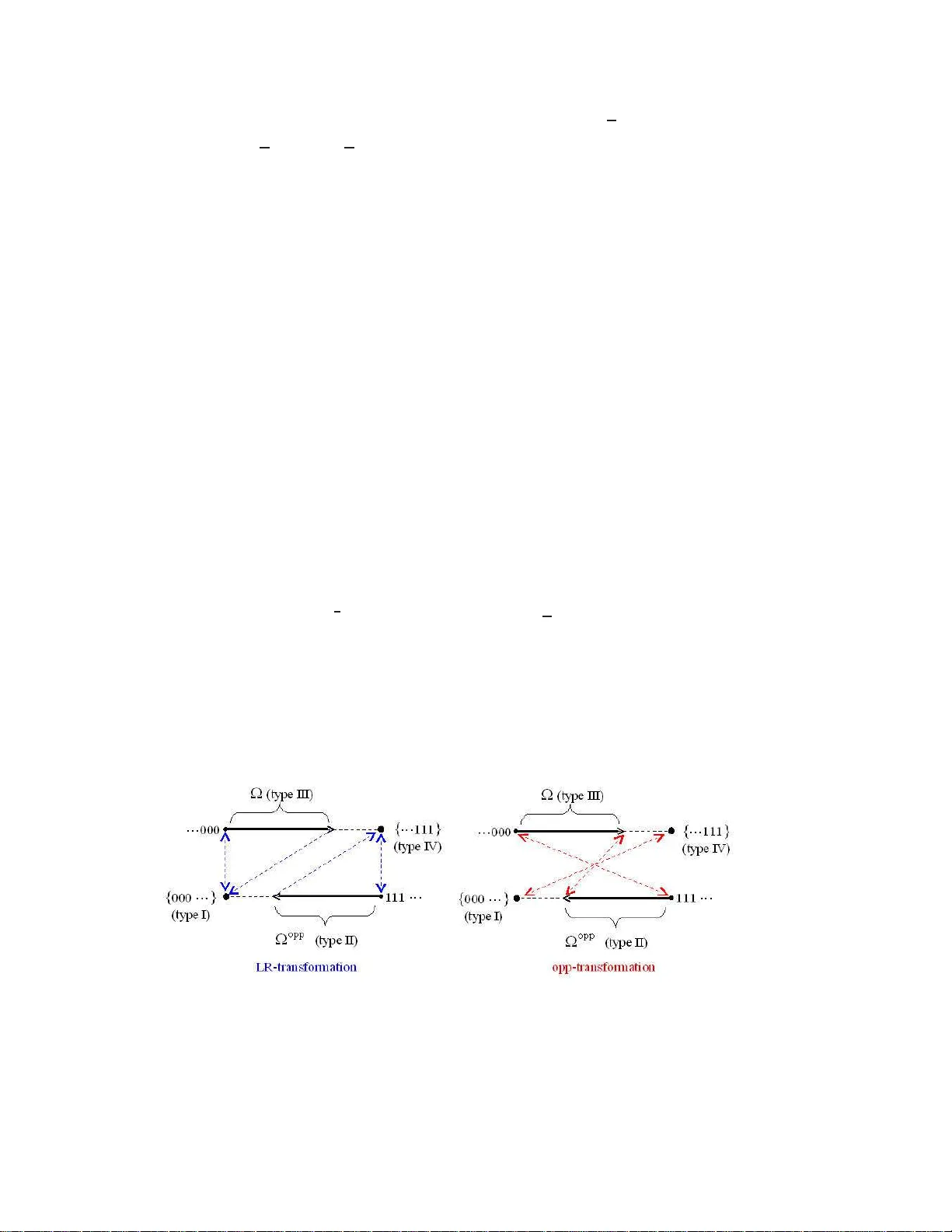
Replication via In v alidating the Applicability of the Fixed P oin t Theorem Gen taIto Maruo L ab., 50 0 El Camino R e al #30 2, Burlingame, CA 94 010, Unite d States. Abstract W e p resen t a construction of a certain in finite complete p artial order (CPO) th at differs from the stand ard construction used in Scott’s denotational seman tics. In addition, w e construct sev eral other infin ite CPO’s. F or some of those, w e apply the usu al Fixed Poi nt Theorem (FPT) to yield a fixed p oin t for ev ery con tin uous function µ : 2 → 2 (where 2 denotes the set { 0 , 1 } ), w hile for the other C PO’s w e cannot in v ok e that theorem to yield su ch fixed p oin ts. Ev ery elemen t of eac h of these CPO’s is a b inary string in the monot ypic form and we show that inv a lidation of the applicabilit y of the FPT to the CPO that Scott’ s constru cted yields the concept of replication. Key wor ds: Denotatio nal Seman tics, Fixed P oin t, Ad j unction, Boundary, LR-transformation, Inte rnal Measurement 1 In tro duction One of the most imp ortant differences b etw een ph ysics and biolo gy is the con tr a st betw een indistinguishable particles and replications. The former is a constrain t/ condition on calcu lations in statistical mec hanics, and there a re t w o t yp es of indistinguishable particles in the ph ysical w orld: b osons and fermions. Con vers ely , DNA replication is one example of the latter. It o ccurs in a cell and is follow ed b y a cell division. In the sense tha t DNA and a cell can b e in terpreted as a co de a nd its deco der, resp ectiv ely , there is a measuremen t pro cess b et w een them. In his theory of denotational sem an tics [15], Scott regards a computer program as an elemen t of a complete partial order (CPO). He constructs a CPO X suc h Email add r ess: cxq02 365@gmail .com (Gen taIto). Preprint s ubmitted to Acta Biotheoretica 27 No ve nber 2007 that X ≃ C( X, 2), whe re 2 denotes the set { 0 , 1 } a nd C( X, 2) is the set of all con tin uous functions f : X → 2. (Here, the t erm c ontinuous function is used in t he context of a CPO, whic h is defined later.) On one hand, he uses the isomorphism b etw een X and C( X, 2) to obtain a fixed p oin t for ev ery con tinuous f unction µ : 2 → 2. (F or a set Y , a function τ : Y → Y has a fixed p oin t if there is some y ∈ Y suc h that τ ( y ) = y .) On the other hand, he regar ds the relation X ≃ C( X , 2) as a domain equation, whic h he uses to find a new meaning for the progr a m as a lo op structure (self-similar lo op program). Gunji interprets the isomorphism as an “abstract” b oundary to whic h the Fixed P oin t Theorem (FPT) (Theorem 6) is applicable, and the domain equ a- tion as an inv a lida tion of the b oundary , that is, an inv alidation of the appli- cabilit y of the FPT, in order t o construct a dynamical system in the contex t of theoretical biology [1]. He argues that any solution to a problem will in- evitably b e a pseud o-solution, and that the pseudo-solution at an y given time step “alwa ys” tr iggers a pro blem to b e solved a t the next time step. This leads to a p erp etual ev olutionary pro cess that allow s fo r emergent prop erties. This p erp etual cy cle of problem and pseudo-solution is called a p erp etual e qui- libr ating m e chanism [9], whic h Matsuno prop osed in the field of researc h in theoretical biology kno wn as In ternal Measuremen t (IM) [9,10,1,2 ]. Recen tly , Matsuno and Gunji emphasized the imp ortance of a type of engine in theoret- ical biology b y whic h dynamical sy stems ev olv e and o ccurrences of distinction con tinue t o alternate with occurrences of in v alidation of the distinction [10,2]. W e may express an IM’s mo del o f living thing s in terms of a triad: t w o differen t logical la ye rs suc h as the Exten t (collection of fragmen ts/elemen ts/parts) and the In ten t (prop erty as a whole), and a mediator/in terface to adjust the t wo la y ers in an “inconsisten t” manner [10,2]. IM claims that the relationship b et w een the t w o lay ers is not consisten tly determined , a nd fo r this reason they are p erpetually changing relative to one another. In one of the mo dels in IM prop osed by Gunji et a l. [2 ], first, the Extent and In tent are regarded to hav e the structures of a la t t ice and a quotien t lattice, r espective ly . The op erations b etw een the t w o la y ers, σ : Exten t → Inten t and ρ : In tent → Exten t , can b e defined as a sheaf (that is, a type o f integration op eration) from a lat tice to a quotien t la ttice, and a r evers e sheaf (that is, a ty p e of differen tiatio n op eration) from a quotien t lat t ice to a lattice, resp ectiv ely , only when the Exten t and Inten t are consisten t with eac h other. Ho w eve r, IM claims a fundamen tal incons istency b et w een the Exten t and Inten t. Hence, second, an observ er who cannot lo ok out o v er the whole lattice (i.e., Ex ten t) is in tr o duced on the rev erse sheaf, ρ : In ten t → Exten t . T his rev eals a colla pse of the lattice structure itself in the Exten t. Third, a new mathematical op eration is in tro duced, called a sk eleton (repairing function), whic h is required to repair the broke n structure in the Exten t. By t he op eration of the sk eleton, the la t t ice structure is reco v ered and then a new quotien t lattice is constructe d b y the 2 sheaf, σ : Exte n t → In ten t . This pro cess (consisting of ρ a nd σ ) is going o n p erp etually . The sk eleton that mediates b etw een the t w o lev els is regarded as a particular expre ssion for the material cause and/or a clock as a particular expression for t ime itself. One of sev eral distinguishing features in Gunji’s mo del (in the conte xt of the curren t pap er) is the role of the observ er who cannot lo ok out o v er the whole lattice (i.e., Exten t). On one hand, IM claims that the t w o la y ers a r e incon- sisten t with eac h other a nd are therefore c hanging p erp etually . On the o t her hand, if w e supp ose that the defectiv e observ er can lo ok out o ver the whole lat- tice, t hen the operatio n betw een the t w o lay ers can be defined consisten tly ( a s sheaf a nd rev erse-sheaf ) and the p erp etual pro cess therefore stops. A ques- tion then arises: Are the tw o lay ers consisten t or inconsisten t? If they are consisten t, then the defectiv e observ er exists, unfort unat ely , just to destro y the structure of the Exten t. If they are inconsisten t, that is, if w e assume the consistency b et w een them and w e obtain a logical paradox suc h as Russel’s parado x [6], what the observ er destro ys is the presupp osition of the consis- tency . Whic h is correct in IM? How ev er, it do es not matter whether he is a destro yer or a life-sa ving s up er-prev en ter, b ecause he cannot lo ok out ov er the whole lattice in an y case. This must b e the essen tial treatmen t of the lo gical parado x in IM. Rosen also considers suc h a para dox in his mo del of a living thing as a metab olism-r ep air system ( M-R system ) [1 3]. The mo del consists of tw o sets: X , whic h is a set of raw materials, a nd Y , whic h is a set of b ehavio rs . It also includes t hree functions: f ∈ F = Hom( X , Y ), called a metab oli c function , g ∈ G = Hom( Y , F ), called a r ep air function , and h ∈ H = Hom ( F , G ), called a r eplic ation function , where he claims g ∈ G and h ∈ H are onto f unctions and Y ≃ H holds. One of t w o remark able features in Rosen’s mo del is that there are no suc h on to functions g ∈ G and h ∈ H . If we assume that they exist, then w e obtain a pa rado x suc h as Russel’s para do x [6 ]. A second re- mark able feature is that an y function in the system can b e b oth a function and an output of a different function. He claims that a cen tr al feature of living things is c omplex i ty . A system is called c omplex if its b eha vior cannot b e captured b y mo dels of that system; otherwise, that system is called simple [14]. The term “complex” for a system ma y b e r eplaced with “ inc omputable ” or “ not wel l-forme d ” for its mo dels. Therefore a system is called complex only if its mo dels are incomputable or not well-formed, and so on. A treatmen t o f the pa rado x is to in vok e hy p erset theory [5 ]. A h yp erse t is defined as a graphable set whic h is a digraph ( “ digraph” is short for directed graph) suc h that a no de can b e either a set or an elemen t of a set, and a directed edge → is the set membership ∋ . A ∋ A , whic h leads to R ussel’s 3 parado x [6], is inte rpreted as just a lo op structure in h yp erset theory . There- fore w e should r edefine the complexit y o f a system so that a system is called complex if it cannot b e we ll-formed in Rosen’s o riginal mo del but can b e w ell-fo rmed (as a lo op structure) in h yp erset theory . Let Π b e a collection of concepts/en tities, and let In t( π ) and Ext( π ) b e the in tension and exten sion of the conce pt π ∈ Π. The triad— In t ( π ) , Ext( π ), and π ∈ Π— is a use ful means to o rganize our though ts. There are at least t w o usages. One is when we assume that, giv en a pair of in tension I and ex tension E , w e try to find a concept π ∈ Π suc h that I = Int( π ) and E = Ext ( π ). Another is when, giv en a concept π ∈ Π, w e try to find its In t( π ) and Ext( π ). When Int( π ) is give n as Hom(Ext ( π ) , 2), where Hom( A, B ) denotes the set of all morphisms from A to B , and 2 denotes a set { 0 , 1 } , if w e assume that In t ( π ) ≃ Ext( π ), then we obtain the pa rado x. W e can regard the paradox in an M-R system a s this case. How ev er, w e hav e t o note t ha t there is not the asso ciated concept π ∈ Π in b oth cases of the original M-R system and its in t erpretatio n with h yp erset theory . Although it is still difficult to specify what the asso ciated π ∈ Π in IM is, w e ma y at least state that it is materia l causatic. In this pap er w e will b e consisten t and consider binary strings in the form of: 0 · · · 0 | {z } u 1 · · · 1 | {z } v , (1) where u is the n umber of 0 ’s and v is the num b er of 1’s, a nd u, v ∈ N = { 0 , 1 , 2 , . . . } . W e will regard (1) as the concept π ∈ Π that w e will cons isten tly consider in this pap er. Whe n w e insert a comma at the cen t er of a binary string to divide the string in to tw o parts, w e regard the left part as the Int( π ) and the righ t part as the Ext( π ). W e should note that the notat io n “0 · · · 01 · · · 1” means that the string consists of finitely man y 0’s, follow ed b y finitely many 1’s. Hence, we mus t explicitly define binary strings one-by -one, suc h as • finitely man y 0’s, follo w ed by finitely man y 1’s • infinitely many 0’s, follow ed b y finitely man y 1 ’s • finitely man y 0’s, follo w ed by infinitely man y 1’s · · · etc. W e designate these strings by (1) in this paper. In this sense, b o t h π ∈ Π and (1) are not strict mathematical statemen ts. W e will construct v arious infinite CPO’s. In each of the CPO’s an elemen t (i.e., a binary string) is in the form of ( 1 ). F or some of those CPO’s, w e can apply the FPT to yield a fixed p oint for ev ery con t in uous function µ : 2 → 2, while for the other CPO’s w e cannot in v oke that theorem to yield suc h fixed p oin ts. In section 2, we construct a countably infinite CPO S in the manner 4 of Scott’s denotat ional semantic s, and we define an isomorphism fro m S to C( S, 2) in the usual w ay . In section 3, w e construct a CPO whic h is isomorphic to S , b y using a completely differen t method. Then in section 4 , we in tro duce a transformation (called the LR-transformatio n) b et wee n certain types of in- finite binary strings that a re defined from differen t sp ecifications of certain finite binary strings. In section 5 w e sho w that the concep t of replication is deriv ed from inv a lidating the applicability of the FPT to the CPO that Scott constructed. 2 Construction of infinite CPO 2.1 Pr eliminaries In this pap er, w e construct a n um b er of linear orders, eac h of whic h is a complete partial o rder. Definition 1 A p artial or der ( D , ⊆ ) is a complete partial order (CPO) if D has a ⊆ -le ast element and every c ountable, monotone non-de cr e asing se quenc e d 0 ⊆ d 1 ⊆ d 2 ⊆ · · · of el e m ents o f D ha s a unique le ast upp er b ound ∪ d i in D . Definition 2 L et ( D , ⊆ D ) and ( E , ⊆ E ) b e C PO’s. A function g : D → E is con tinuous if it satisfies the fol lowing c onditions: (1) If d i ⊆ D d j , then g ( d i ) ⊆ E g ( d j ) . (2) If d 0 ⊆ d 1 ⊆ d 2 ⊆ · · · is a c o untable , m o notone non-d e cr e asing s e quenc e of ele m ents of D , then g ( ∪ d i ) = ∪ ( g ( d i )) . Definition 3 The r elation D ⊆ E holds of CPO’s D , E if ther e e xist c on tin- uous functions e : D → E and p : E → D such that e ◦ p ⊆ id E and p ◦ e = id D . The f unction s e and p ar e c al le d em b edding an d pro jection , r esp e ctively. I f e ◦ p = id E , then D is isomorphic to E , which is denote d by D ≃ E . Prop osition 4 [15] L et D and E b e CPO’s, and le t C( D , E ) b e the s et of al l c ontinuous functions fr om D to E . Then (C( D, E ) , ⊆ ) is also a CPO, the le ast element b eing the c onstant function which maps every d ∈ D to the le ast element of E , and the le ast upp er b ound of the c ountable, monotone non- de cr e asing se quenc e g 0 ⊆ g 1 ⊆ g 2 ⊆ · · · b eing the function ∪ g i define d b y ( ∪ g i )( d ) = ∪ ( g i ( d )) . Let 2 b e the set { 0 , 1 } . Clearly , the linear o r der (2 , ⊆ ) defined b y 0 ⊆ 1 is a CPO ( which we will denote b y 2), so the next result follow s immed iately from Prop osition 4. 5 Corollary 5 L et ( S 0 , ⊆ ) b e a CPO. T hen S 1 ≡ C( S 0 , 2) , S 2 ≡ C(C( S 0 , 2) , 2) , . . . ar e als o CPO’s. Theorem 6 (Fixe d Point The or em) [4 ,3] L et µ : 2 → 2 b e c ontinuous, let ( S, ⊆ ) b e a CPO which is isomorphic to C( S, 2) , and let ϕ b e an isom o rphism (a c on tinuous b ije ction) fr om S to C( S, 2) . F urthermor e, let g : S → 2 b e the c ontinuous function define d by g ( x ) = µ ( ˆ ϕ x ( x )) , wher e ˆ ϕ x denotes ϕ ( x ) . Then g ( ϕ − 1 ( g )) is a fix e d p oint of µ . Pro of By the definition of ϕ , w e ha v e tha t, for ev ery f ∈ C( S, 2) and ev ery x ∈ S , f ( x ) = ˆ ϕ ϕ − 1 ( f ) ( x ) Since g ∈ C( S, 2), we ha v e t ha t, for eve ry x ∈ S , g ( x ) = ˆ ϕ ϕ − 1 ( g ) ( x ) Setting x to ϕ − 1 ( g ) yields g ( ϕ − 1 ( g )) = ˆ ϕ ϕ − 1 ( g ) ( ϕ − 1 ( g )) Also, b y the definition of g , we hav e g ( ϕ − 1 ( g )) = µ ( ˆ ϕ ϕ − 1 ( g ) ( ϕ − 1 ( g ))) Th us µ ( ˆ ϕ ϕ − 1 ( g ) ( ϕ − 1 ( g ))) = g ( ϕ − 1 ( g )) = ˆ ϕ ϕ − 1 ( g ) ( ϕ − 1 ( g )) Hence ˆ ϕ ϕ − 1 ( g ) ( ϕ − 1 ( g )) (= g ( ϕ − 1 ( g ))) is a fixed p oin t of µ . Preparatory to constructing an infinite CPO, w e cons truct an infinite seq uence of finite CPO’s. W e do this in stages, whic h w e inde x with the natural n um b ers n ≥ 1. (Throughout this paper, the v ariable n denotes a natural num b er, i.e., an elemen t o f the set N = { 0 , 1 , 2 , . . . } . Except where n is sp ecifically res tricted in some w ay —suc h as in t he stages of this construction, where n is restricted to v alues greater than 0—it is to b e assumed that n is any nonnegativ e integer.) A t stage n , w e construc t a se t S n with n elemen ts, and w e de fine a linear order ⊆ n on S n . Since S n is finite, ( S n , ⊆ n ) is a CPO. W e represen t the elemen ts of S n as binary strings (strings of 0’s and 1’s) of length n − 1. La ter, w e will use infinite seq uences of elemen ts of S ∞ n =1 S n to construct t w o infinite sets S . In eac h case, w e will define a linear order ⊆ on S in suc h a wa y that ( S, ⊆ ) is a CPO. Stage 1 Let S 1 = { λ } , where λ is the empt y string (the binary string of length 0). Then ( S 1 , ⊆ 1 ) is trivially a CPO (where λ ⊆ 1 λ ). W e will denote ( S 1 , ⊆ 1 ) b y { λ } . 6 Stage 2 Let S 2 = C( S 1 , 2), and let ( S 2 , ⊆ 2 ) b e the CPO obtained f r om Prop o- sition 4 for D = C( S 1 , 2) and E = 2. Since S 2 is the set of con tin uous functions from { λ } to 2 (where 2 = { 0 , 1 } ), S 2 consists o f the functions ( λ → 0) a nd ( λ → 1). W e will denote those functions b y their outputs (0 and 1, resp ectiv ely). Recall that 0 ⊆ 1 (b y our definition of the CPO 2), so w e will denote ( S 2 , ⊆ 2 ) by { 0 ⊆ 1 } . Stage 3 Similarly , let S 3 = C( S 2 , 2), a nd let ( S 3 , ⊆ 3 ) b e the CPO obtained from Prop osition 4 f o r D = C( S 2 , 2) and E = 2. Since S 3 is the set of con- tin uo us functions fro m S 2 to 2 , S 3 consists of the f unctions (0 → 0; 1 → 0) , (0 → 0 ; 1 → 1), a nd (0 → 1; 1 → 1). The function (0 → 1; 1 → 0) is excluded, b ecause it is not con tinuous (the outputs do not preserv e the order of the inputs). W e will denote the three elemen ts of S 3 b y 00 , 01, and 11, respectiv ely (i.e., for each elemen t of S 3 —equiv alen tly , for eac h con tinuous function fro m S 2 in to 2— w e concatenate the o utputs that corresp ond to the t w o inputs, 0 and 1), so w e will denote ( S 3 , ⊆ 3 ) by { 00 ⊆ 01 ⊆ 1 1 } . . . . Stage n Let S n = C( S n − 1 , 2), and let ( S n , ⊆ n ) b e the CPO obtained fro m Prop o- sition 4 for D = C( S n − 1 , 2) and E = 2. ( S 1 , ⊆ 1 ) = { λ } ( S 2 , ⊆ 2 ) = { 0 ⊆ 2 1 } ( S 3 , ⊆ 3 ) = { 00 ⊆ 3 01 ⊆ 3 11 } ( S 4 , ⊆ 4 ) = { 000 ⊆ 4 001 ⊆ 4 011 ⊆ 4 111 } . . . ( S n , ⊆ n ) = { 0 · · · 000 0 | {z } n − 1 ⊆ n 0 · · · 0001 | {z } n − 1 ⊆ n 0 · · · 0011 | {z } n − 1 ⊆ n 0 · · · 0111 | {z } n − 1 ⊆ n · · · ⊆ n 0001 · · · 1 | {z } n − 1 ⊆ n 0011 · · · 1 | {z } n − 1 ⊆ n 0111 · · · 1 | {z } n − 1 ⊆ n 1111 · · · 1 | {z } n − 1 (2) F or fixed n , there ma y be se v era l w a ys to define the em b edding and pro jection functions e : S n → S n +1 and p : S n +1 → S n , and different em b edding and pro jection functions will lead to differen t infinite sets S . W e now review the standard definitions of em b edding and pro jection, as used b y Scott [15] and others [16,4,3]. 7 2.2 Standar d definition s of emb e dding and pr oje c tion Let S 1 , S 2 , S 3 , . . . be the finite sets defined in (2). W e no w presen t t w o differen t definitions of the em b edding a nd pro jection functions. F or each definition, w e use the pro jection functions to generate a coun tably infinite CPO. F or eve ry n ≥ 1 , define the embedding function e n : S n → S n +1 and the pro jection function p n : S n +1 → S n as sho wn in T able 1. ( No te that these functions satisfy D efinition 3.) 11111 ւր 1111 01111 ւր ւր 111 0111 00111 ւր ւր ւ 11 011 0011 ↔ 00 011 ւր ւ ւ 1 01 ↔ 00 1 ↔ 0001 ↔ 00001 ւ ւ λ ↔ 0 ↔ 00 ↔ 000 ↔ 0000 ↔ 00000 S 1 S 2 S 3 S 4 S 5 S 6 T able 1 Definition of embedd ing and pro jectio n for n = 1 , 2 , . . . , 5. F or example, e 2 : S 2 → S 3 is defined as e 2 (0) = 00 , e 2 (1) = 11, and p 2 : S 3 → S 2 is defined as p 2 (00) = p 2 (01) = 0 , p 2 (11) = 1. No w lab el all t he entrie s in T a ble 1 : Lab el en try s with the n um b er of 1’s in s (i.e., lab el λ , 0, 00, 0 0 0, . . . with 0; lab el 1, 01, 00 1, 00 0 1, . . . with 1; lab el 11, 011, 001 1, 00011, . . . with 2; etc.). This yields T able 2 . 5 ւր 4 4 ւր ւր 3 3 3 ւր ւր ւ 2 2 2 ↔ 2 ւր ւ ւ 1 1 ↔ 1 ↔ 1 ↔ 1 ւ ւ 0 ↔ 0 ↔ 0 ↔ 0 ↔ 0 ↔ 0 S 1 S 2 S 3 S 4 S 5 S 6 T able 2 T able 1 after labeling of the en tries . 8 Our coun tably infinite CPO will consist of all the infinite paths in T able 2 that ha v e t he 0 in S 1 as their in v erse (pro jectiv e) limit (i.e., ev ery elemen t o f our CPO is an infinite seque nce ( s 1 , s 2 , s 3 , . . . ) suc h t ha t, for ev ery i ≥ 1 , s i ∈ S i and s i = p i ( s i +1 )). Lab el ev ery suc h infinite path, either with n or n ′ for some n ∈ N , or with ∞ , as follo ws: 0 , 0 , 0 , 0 , 0 , 0 , 0 , 0 , 0 , 0 , . . . ↔ 0 0 , 0 , 1 , 1 , 1 , 1 , 1 , 1 , 1 , 1 , . . . ↔ 1 0 , 0 , 1 , 1 , 2 , 2 , 2 , 2 , 2 , 2 , . . . ↔ 2 . . . 0 , 0 |{z} 2 , 1 , 1 |{z} 2 , 2 , 2 |{z} 2 , 3 , 3 |{z} 2 , 4 , 4 |{z} 2 , . . . ↔ ∞ . . . 0 , 0 , 1 , 1 , 2 , 3 , 4 , 5 , 6 , 7 , . . . ↔ 2 ′ 0 , 0 , 1 , 2 , 3 , 4 , 5 , 6 , 7 , 8 , . . . ↔ 1 ′ 0 , 1 , 2 , 3 , 4 , 5 , 6 , 7 , 8 , 9 , . . . ↔ 0 ′ (3) The infinite path whic h is lab eled with ∞ is the least upp er b ound of the infinite paths lab eled with n for some n ∈ N . Th us w e ha v e a countably infinite CPO with the follo wing structure: Φ = { 0 ⊆ 1 ⊆ 2 ⊆ 3 ⊆ · · · ⊆ ∞ ⊆ · · · ⊆ 3 ′ ⊆ 2 ′ ⊆ 1 ′ ⊆ 0 ′ } (4) F or ev ery n , map the elemen t s of Φ which ar e lab eled with n and n ′ to the con tinuous functions ψ n and ψ n ′ , resp ectiv ely (and ma p the elemen t of Φ whic h is lab eled with ∞ to the con tin uous function ψ ∞ ), a s sho wn in T able 3. F rom the table, it is o bvious that the map ˆ ψ : Φ → C(Φ , 2) whic h consists of the union of the maps n 7→ ψ n , n ′ 7→ ψ n ′ , and ∞ 7→ ψ ∞ preserv es the ordering of Φ. Hence ˆ ψ is a con tin uous function and an isomorphism. This is the usual construction of a coun tably infinite CPO Φ (i.e., the con- struction used b y Scott). Moreo ve r, the usual deriv ation of a fixed p oin t for a contin uous function µ : 2 → 2 is that whic h is g iv en in the statemen t of Theorem 6 . W e obtain that fixed p oin t (namely , g ( ˆ ψ − 1 ( g )), where g is a s in the statemen t of Theorem 6) from T able 3: • if µ (0) = 0 = µ (1), then g is ψ 0 , so the fixed p oint is ψ 0 (0) (= 0) • if µ (0) = 1 = µ (1), then g is ψ 0 ′ , so the fixed p oint is ψ 0 ′ (0 ′ ) (= 1) • if µ (0) = 0 and µ ( 1 ) = 1, then g is ψ ∞ , so the fixed p oin t is ψ ∞ ( ∞ ) (= 0) 9 ψ \ x 0 1 · · · n − 1 n · · · ∞ · · · ( n − 1) ′ n ′ · · · 1 ′ 0 ′ ψ 0 0 0 · · · 0 0 · · · 0 · · · 0 0 · · · 0 0 ψ 1 0 0 · · · 0 0 · · · 0 · · · 0 0 · · · 0 1 . . . ψ n 0 0 · · · 0 0 · · · 0 · · · 0 1 · · · 1 1 . . . ψ ∞ 0 0 · · · 0 0 · · · 0 · · · 1 1 · · · 1 1 . . . ψ n ′ 0 0 · · · 0 1 · · · 1 · · · 1 1 · · · 1 1 . . . ψ 1 ′ 0 1 · · · 1 1 · · · 1 · · · 1 1 · · · 1 1 ψ 0 ′ 1 1 · · · 1 1 · · · 1 · · · 1 1 · · · 1 1 T able 3 The functions ψ in C(Φ , 2) and their v alues ( ψ ( x ) for x ∈ Φ) As an alt ernat iv e, we can define the embedding and pro jection functions as in T able 4, and w e can use those functions to define a countably infinite CPO whic h has a structure differen t from that of Φ. 11111 ւ 1111 ↔ 01111 ւ 111 ↔ 0111 ↔ 00111 ւ 11 ↔ 011 ↔ 0011 ↔ 00011 ւ 1 ↔ 01 ↔ 001 ↔ 0001 ↔ 00001 ւ λ ↔ 0 ↔ 00 ↔ 000 ↔ 0000 ↔ 00000 S 1 S 2 S 3 S 4 S 5 S 6 T able 4 Alternativ e definition of em b eddin g and pro jection for n = 1 , 2 , . . . , 5 . Using the same lab eling sc heme in T able 4 as that whic h w as used in T able 1 yields T able 5. No w lab el eve ry infinite path in T able 5 that has the 0 in S 1 as its inv erse 10 5 ւ 4 ↔ 4 ւ 3 ↔ 3 ↔ 3 ւ 2 ↔ 2 ↔ 2 ↔ 2 ւ 1 ↔ 1 ↔ 1 ↔ 1 ↔ 1 ւ 0 ↔ 0 ↔ 0 ↔ 0 ↔ 0 ↔ 0 S 1 S 2 S 3 S 4 S 5 S 6 T able 5 T able 4 after labeling of the en tries (pro jectiv e) limit, either with some n ∈ N or with ∞ , a s follo ws: 0 , 0 , 0 , 0 , 0 , 0 , 0 , 0 , 0 , 0 , . . . ↔ 0 0 , 1 , 1 , 1 , 1 , 1 , 1 , 1 , 1 , 1 , . . . ↔ 1 0 , 1 , 2 , 2 , 2 , 2 , 2 , 2 , 2 , 2 , . . . ↔ 2 0 , 1 , 2 , 3 , 3 , 3 , 3 , 3 , 3 , 3 , . . . ↔ 3 . . . 0 , 1 , 2 , · · · , n − 1 | {z } n , n, n, . . . ↔ n . . . 0 , 1 , 2 , 3 , 4 , 5 , 6 , 7 , 8 , 9 , . . . ↔ ∞ This yields a CPO with the fo llowing structure: Θ = { 0 ⊆ 1 ⊆ 2 ⊆ 3 ⊆ · · · ⊆ ∞} (5) Unfortunately , Θ is not isomorphic to C(Θ , 2). T o see this, we will examine the only t w o mappings from Θ t o C(Θ , 2 ) that could p ossibly b e isomorphisms. One p ossibilit y is that, for ev ery n ∈ N , the elemen t of Θ whic h is lab eled by n w ould b e mapp ed to the function ψ ′ n ∈ C( S, 2) defined by ψ ′ n ( x ) = 1 if x is one of the n great est elemen ts of Θ, and ψ ′ n ( x ) = 0 otherwise (and mapping the elemen t of Θ whic h is lab eled b y ∞ to the all-1 function ψ ′ ∞ ). Ho w ev er, the “ n g r eatest elem en ts of Θ” do not exist, so this mapping is imp ossible. Alternativ ely , w e could map the elemen t of Θ whic h is lab eled by n to the function ψ ′′ n ∈ C(Θ , 2) defined b y ψ ′′ n ( x ) = 1 for eve ry x ∈ Θ with n ⊆ x , 11 and ψ ′′ n ( x ) = 0 otherwise ( a nd mapping the elemen t whic h is lab eled b y ∞ to the all-0 f unction ψ ′′ ∞ ), a s sho wn in T able 6. Note, how ev er, that ψ ′′ y ⊆ ψ ′′ x for elemen ts x, y of Θ with x ⊆ y , so t his mapping do es not preserv e t he ordering of Θ; hence it is not an isomorphism. ψ ′′ \ x 0 1 2 · · · ψ ′′ 0 1 1 1 · · · ψ ′′ 1 0 1 1 · · · ψ ′′ 2 0 0 1 · · · . . . ψ ′′ ∞ 0 0 0 · · · T able 6 The functions ψ ′′ in C(Θ , 2) and their v alues ( ψ ′′ ( x ) for x ∈ Θ ) 3 Another represen tation of Φ and Θ , and beyond W e now use a differen t construction for an infinite CPO that has the same structure as Φ, and then w e go on to construct infinite CPO’s whose structure s differ from that of Φ. 3.1 Non-standar d r epr esen tations of Φ and Θ First, w e construct a coun tably infinite CPO Λ whic h is isomorphic to Φ. Eac h elemen t of Λ is a n infinite binar y string. W e do this directly , without first constructing a sequence of finite CPO’s . Denote the order type of the usual linear order on N (i.e., 0 ⊆ 1 ⊆ 2 ⊆ · · · ) b y ω , and denote the rev erse order (i.e., · · · ⊆ 2 ⊆ 1 ⊆ 0) by ω ∗ . T o construct Λ, w e first obtain one infinite set of infinite binary strings, Ω, b y starting with the a ll-0 string that has order t yp e ω ∗ (i.e., the all-0 string · · · 000), and g enerating the remaining strings in succession b y changing the righ tmost 0 to a 1: Ω = {· · · 000 , · · · 001 , · · · 001 1 , · · · 0011 1 , . . . } This giv es us a linear order that has or der t yp e ω : Ω = { · · · 000 ⊆ · · · 001 ⊆ · · · 0011 ⊆ · · · 00111 ⊆ · · · } (6) 12 Next, w e obtain another infinite set of binary strings, Ω opp , b y starting with the all-1 string that has order t yp e ω (i.e., the all-1 string 111 · · · ), and generating the remaining strings in success ion b y c hanging the leftmost 1 to a 0: Ω opp = { 1 11 · · · , 011 · · · , 0011 · · · , 00011 · · · , . . . } This giv es us a linear order that has or der t yp e ω ∗ : Ω opp = { · · · ⊆ 00011 · · · ⊆ 00 11 · · · ⊆ 01 1 · · · ⊆ 111 · · · } (7) Lab el x ∈ Ω with n , where n is the nu m b er of 1’s in x . Similarly , lab el y ∈ Ω opp with n ′ , where n is the n um b er of 0 ’s in y . Then w e hav e a linear order (Ω ∪ Ω opp , ⊆ ) of order ty p e ω + ω ∗ : 0 ⊆ 1 ⊆ 2 ⊆ · · · ⊆ n ⊆ · · · ⊆ · · · ⊆ n ′ ⊆ · · · ⊆ 2 ′ ⊆ 1 ′ ⊆ 0 ′ This is not a CP O, because Ω has no “sup” (suprem um, i.e., least upp er b ound). The most natural infinite binary string w e could use as t he sup of Ω is the a ll-1 string that has o rder ty p e ω ∗ (i.e., the string · · · 111). If w e place that all-1 string b et wee n t he elemen ts of Ω and t he elemen ts of Ω opp (and label it with ∞ ), we obt a in the following CPO: Λ = Ω ′ ∪ Ω opp = { 0 ⊆ 1 ⊆ 2 ⊆ 3 ⊆ · · · ⊆ ∞ ⊆ · · · ⊆ 3 ′ ⊆ 2 ′ ⊆ 1 ′ ⊆ 0 ′ } , (8) where Ω ′ = Ω ∪ {· · · 111 } . This CPO has order type ω + 1 + ω ∗ , as do es Φ in (4), so Λ ≃ Φ. W e can a ssign to x ∈ Λ the function ψ x in T able 3 . Hence the map x 7→ ψ x is a con tin uous function and an isomorphism from Λ to C(Λ , 2). F or ev ery con tinuous function µ : 2 → 2, we obtain the same fixed p oin t as t he one w e found earlier (where w e applied Theorem 6 to the isomorphism ˆ ψ : Φ → C(Φ , 2)). Definition 7 L et x b e an element of a line ar or der ( S, ⊆ ) . T hen x has an imme diate neighb or in ( S, ⊆ ) if x has an imme diate pr e de c esso r and/or an imme diate suc c essor in ( S, ⊆ ) . F or example, b oth · · · 000 a n d 111 · · · have an imm e diate neighb or in Λ ( · · · 000 has an imme diate suc c essor (namely, · · · 001 ), and 111 · · · has an imm e diate pr e de c esso r (namely, 011 · · · )), but · · · 111 has no imme diate neighb or in Λ . Clearly , Ω ′ ≃ Θ. How ev er, Ω ′ 6≃ Ω opp , b ecause Ω ′ has order type ω + 1 and 13 Ω opp has order type ω ∗ . Since Ω ′ ≃ Θ 6≃ C(Θ , 2) ≃ C(Ω ′ , 2) , w e hav e Ω ′ 6≃ C(Ω ′ , 2). Th us, for a contin uous function µ : 2 → 2, w e cannot apply Theorem 6 to yield a fixed p oint of µ . 3.2 CPO of or der typ e ω + 1 + 1 + ω ∗ ; adjunction In Λ, the infinite binary string · · · 1 11 is not only the sup of Ω but also the “inf ” (infim um, i.e., greatest low er bound) of Ω opp . How ev er, the most natural infinite binary string w e could use as t he inf of Ω opp is the all-0 string that has order ty p e ω (i.e., the string 000 · · · ). If w e place that all-0 string betw een the elemen ts of Ω ′ and the eleme n ts of Ω opp (and lab el it with ∞ ′ ), w e obta in the follo wing CPO: Λ ′ = Ω ′ ∪ Ω ′ (opp) = { 0 ⊆ 1 ⊆ 2 ⊆ 3 ⊆ · · · ⊆ ∞ ⊆ ∞ ′ ⊆ · · · ⊆ 3 ′ ⊆ 2 ′ ⊆ 1 ′ ⊆ 0 ′ , } (9) where Ω ′ (opp) = { 000 · · · } ∪ Ω opp . This CPO has or der t yp e ω + 1 + 1 + ω ∗ , so it is not isomorphic t o any of the linear orders discussed earlier in this pap er. W e can a ssign to x ∈ Λ ′ the contin uous function ψ x in T a ble 7 . Hence the map x 7→ ψ x is a con tinuous function and an isomorphism from Λ ′ to C(Λ ′ , 2). F or ev ery con tin uous function µ : 2 → 2, w e obtain a fixed p oin t (namely , g ( ˆ ψ − 1 ( g )), where g is as in the statement o f Theorem 6) from T able 7: • if µ (0) = 0 = µ (1), then g is ψ 0 , so the fixed p oint is ψ 0 (0) (= 0) • if µ (0) = 1 = µ (1), then g is ψ 0 ′ , so the fixed p oint is ψ 0 ′ (0 ′ ) (= 1) • if µ (0) = 0 a nd µ (1) = 1, then g is ψ ∞ ′ , so the fixed po in t is ψ ∞ ′ ( ∞ ′ ) (= 1) Just as in Λ, b oth · · · 000 a nd 111 · · · ha v e an immediate neighbor in Λ ′ . In addition, · · · 111 and 000 · · · are m utual immediate neigh b ors in Λ ′ . Definition 8 L et x b e an infinite binary string of or der typ e ω or ω ∗ . T h en x opp is the infinite binary s tring which i s gen e r ate d fr o m x by first r eplacing every 0 with a 1 and vic e versa, and then r eversing the or der typ e of the r esulting string. F or exampl e , if x = · · · 00011 , and if the 0’s and 1’s in x ar e r eplac e d with 1 ’s and 0 ’ s , r e s p e ctively, the r esulting s tring is · · · 11100 ; r eversing the or der typ e of · · · 11100 gives x opp = 00111 · · · . The relatio nship whic h consists of the follo wing three conditions ho lds b et w een Ω ′ and Ω ′ (opp) in Λ ′ : ∀ x ∈ Ω ′ h x opp ∈ Ω ′ (opp) i 14 ψ \ x 0 1 · · · n − 1 n · · · ∞ ∞ ′ · · · n ′ ( n − 1) ′ · · · 1 ′ 0 ′ ψ 0 0 0 · · · 0 0 · · · 0 0 · · · 0 0 · · · 0 0 ψ 1 0 0 · · · 0 0 · · · 0 0 · · · 0 0 · · · 0 1 . . . ψ n 0 0 · · · 0 0 · · · 0 0 · · · 0 1 · · · 1 1 . . . ψ ∞ 0 0 · · · 0 0 · · · 0 0 · · · 1 1 · · · 1 1 ψ ∞ ′ 0 0 · · · 0 0 · · · 0 1 · · · 1 1 · · · 1 1 . . . ψ n ′ 0 0 · · · 0 1 · · · 1 1 · · · 1 1 · · · 1 1 . . . ψ 1 ′ 0 1 · · · 1 1 · · · 1 1 · · · 1 1 · · · 1 1 ψ 0 ′ 1 1 · · · 1 1 · · · 1 1 · · · 1 1 · · · 1 1 T able 7 The functions ψ in C(Λ ′ , 2) and their v alues ( ψ ( x ) for x ∈ Λ ′ ) ∀ y ∈ Ω ′ (opp) [ y opp ∈ Ω ′ ] ∀ x ∈ Ω ′ ∀ y ∈ Ω ′ (opp) [ x ⊆ y opp ↔ x opp ⊇ y ] This relationship is an example of what is called adjunction in category the- ory [8]. Adjunction do es not hold b et w een Ω ′ and Ω opp in Λ = Ω ′ ∪ Ω opp . T o see this, let x = · · · 11 1, a nd note tha t x ∈ Ω ′ but x opp = 00 0 · · · 6∈ Ω opp . 3.3 CPO of or der typ e ω + 1 + ω ∗ ; b ounda ry element and adjunction No w w e construct a new CPO ˆ Λ ′ whic h is similar to Λ ′ but where the equiv- alen ts o f the elemen ts lab eled with ∞ and ∞ ′ are iden tical. Prop osition 9 F or a ∈ Ω ′ (opp) , let ˆ Ω ′ b e the line ar or der wi th underlying set { a } × Ω ′ and o r d e ring define d by ( a, x 1 ) ⊆ ( a, x 2 ) ↔ x 1 ⊆ Ω ′ x 2 F or b ∈ Ω ′ , let ˆ Ω ′ (opp) b e the line ar or der with underlying set Ω ′ (opp) × { b } an d or dering define d by ( y 1 , b ) ⊆ ( y 2 , b ) ↔ y 1 ⊆ Ω ′ (opp) y 2 Thus ˆ Ω ′ = { ( a, · · · 000) ⊆ ( a, · · · 00 1) ⊆ ( a, · · · 0011) ⊆ · · · ⊆ ( a, · · · 111) } ˆ Ω ′ (opp) = { ( 0 00 · · · , b ) ⊆ · · · ⊆ (0011 · · · , b ) ⊆ (011 · · · , b ) ⊆ (111 · · · , b ) } 15 Then ˆ Ω ′ ≃ Ω ′ and ˆ Ω ′ (opp) ≃ Ω ′ (opp) . Mor e over, the line ar or der ˆ Ω ′ ∪ ˆ Ω ′ (opp) that extends the or derings in ˆ Ω ′ and ˆ Ω ′ (opp) and s a tisfi e s ( a, · · · 111) ⊆ (000 · · · , b ) is a CPO in which ( a, · · · 111) is the s up of ˆ Ω ′ and (000 · · · , b ) is the inf of ˆ Ω ′ (opp) . Let ˆ Λ ′ b e the CPO ˆ Ω ′ ∪ ˆ Ω ′ (opp) obtained from Prop osition 9 fo r a = 000 · · · and b = · · · 111, and let m = ( a, b ) (= (000 · · · , · · · 1 11)). Then m is a b oundar y elemen t of ˆ Λ ′ in that m ∈ ˆ Ω ′ ∩ ˆ Ω ′ (opp) and m is bot h the sup of ˆ Ω ′ and the inf of ˆ Ω ′ (opp) . Also, m has no immediate neigh b or in ˆ Λ ′ , and ˆ Λ ′ has order t yp e ω + 1 + ω ∗ , so ˆ Λ ′ ≃ Λ = Ω ′ ∪ Ω opp (and ˆ Λ ′ ≃ C( ˆ Λ ′ , 2)) but ˆ Λ ′ 6≃ Λ ′ = Ω ′ ∪ Ω ′ (opp) . Definition 10 L et ( x, y ) b e an or der e d p air of infinite binary strings e ach o f which is of or der typ e ω or ω ∗ (though x is n ot ne c essarily o f the same or der typ e a s y ). Then ( x, y ) opp = ( y opp , x opp ) . F or exam ple, i f x = · · · 0001 1 and y = 1 1111 · · · , then x opp = 00 111 · · · and y opp = · · · 00000 , s o ( x, y ) opp = ( y opp , x opp ) = ( · · · 00 0 00 , 00111 · · · ) Note that m opp = (000 · · · , · · · 111) opp = (0 00 · · · , · · · 111) = m , and that the follo wing conditions are satisfied: ˆ Ω ′ = { ( x, y ) opp : ( x, y ) ∈ ˆ Ω ′ (opp) } ˆ Ω ′ (opp) = { ( x, y ) opp : ( x, y ) ∈ ˆ Ω ′ } Moreo ver, it can easily b e sho wn that adjunction holds b etw een ˆ Ω ′ and ˆ Ω ′ (opp) in ˆ Λ ′ . 3.4 CPO of or der typ e 1 + ω ∗ + ω + 1 No w w e construct a CPO V with order type 1 + ω ∗ + ω + 1, using the follow ing coun terpart of Prop osition 9: Prop osition 11 F or a ∈ Ω ′ , let Ξ b e the CPO with underl ying set { a } × Ω ′ (opp) and or dering define d by ( a, y 1 ) ⊆ ( a, y 2 ) ↔ y 1 ⊆ Ω ′ (opp) y 2 F or b ∈ Ω ′ (opp) , le t Ξ opp b e the CPO with underlying set Ω ′ × { b } and or dering define d by ( x 1 , b ) ⊆ ( x 2 , b ) ↔ x 1 ⊆ Ω ′ x 2 Thus Ξ = { ( a, 000 · · · ) ⊆ · · · ⊆ ( a, 00 11 · · · ) ⊆ ( a, 011 · · · ) ⊆ ( a, 1 11 · · · ) } Ξ opp = { ( · · · 000 , b ) ⊆ ( · · · 001 , b ) ⊆ ( · · · 0011 , b ) ⊆ · · · ⊆ ( · · · 111 , b ) } 16 Then Ξ ≃ Ω ′ (opp) and Ξ opp ≃ Ω ′ . Mor e over, the line ar or der Ξ ∪ Ξ opp that extends the or d e rings in Ξ and Ξ opp and s a tisfi e s ( a, · · · 111) ⊆ ( · · · 000 , b ) is a CPO in which ( a, · · · 111) is the sup of Ξ and ( · · · 000 , b ) is the inf of Ξ opp . Let V b e the CPO Ξ ∪ Ξ opp obtained from Prop osition 11 f o r a = · · · 000 and b = 111 · · · , and let m ′ = ( a, b ) (= ( · · · 000 , 111 · · · ) ) . W e can lab el the elemen ts of V as follo ws: ( · · · 0 00 , 000 · · · ) ↔ −∞ . . . ( · · · 0 00 , 001 · · · ) ↔ − 2 ( · · · 0 00 , 011 · · · ) ↔ − 1 m ′ = ( · · · 000 , 111 · · · ) ↔ 0 ( · · · 0 01 , 111 · · · ) ↔ +1 ( · · · 0 11 , 111 · · · ) ↔ +2 . . . ( · · · 1 11 , 111 · · · ) ↔ + ∞ (10) Then m ′ is a b o undary elemen t of V in that m ′ ∈ Ξ ∩ Ξ opp and m ′ is b o th the sup of Ξ and the inf of Ξ opp . Also, m ′ has immediate neigh b ors in V , and V ha s order t yp e 1 + ω ∗ + ω + 1. Therefore, V is not isomorphic to an y of the linear orders discussed earlier in this pap er. (See Figure 1 for a comparison of ˆ Λ ′ and V .) Note that m ′ (opp) = ( · · · 000 , 111 · · · ) opp = ( · · · 000 , 111 · · · ) = m ′ , hence that adjunction holds b etw een Ξ and Ξ opp in V . Fig. 1. CPO ’s ˆ Λ ′ and V . Th e b o xes indicate th e elemen ts that ha ve no immediate neigh b or. V is not isomorphic to C( V , 2). F or supp ose otherwise, and let f : V → C( V , 2) b e an isomorphism. Then f preserv es the ordering of V , so f maps the greatest elemen t of V (the elemen t lab eled with + ∞ , whic h is ( · · · 11 1 , 111 · · · )) to the greatest ele men t of C( V , 2), whic h is the all-1 function 1 . Now define a function 17 φ : V → 2 by φ ( x ) = 0 , x = ( · · · 000 , 000 · · · ) 1 , x ∈ V − { ( · · · 000 , 000 · · · ) } Note that ( · · · 000 , 0 00 · · · ) is the least ele men t of V (i.e., t he elemen t lab eled with −∞ ), so φ is con tin uous (hence φ ∈ C( V , 2)). Moreo v er, φ is the immedi- ate predecessor of 1 in C( V , 2 ) , so f − 1 ( φ ) mus t b e the immediate predeces sor of f − 1 ( 1 ) in V ; how ev er, f − 1 ( 1 ) = ( · · · 11 1 , 111 · · · ), whic h has no immediate predecess or. 4 The finite binary strings in S n and t heir infinite extensions; the LR-transformation In this section we in tro duce four w ays to specify the finite binary strings t ha t are elemen ts o f the finite CPO’s S n ( n ≥ 2). Then w e explore the extensions of those specifications to certain infinite binary strings that ar e of order t yp e ω o r ω ∗ , and we de fine an opera t io n (the LR-transformation) o n those infinite strings. 4.1 Sp e cific ations of the strings in S n F or ev ery n ≥ 2, there are four wa ys t o sp ecify the ele men ts of the finite linear order ( S n , ⊆ n ) in (2). Let i, j ∈ N suc h that 1 ≤ i ≤ n and 1 ≤ j ≤ n − 1. Sp ecification I s ( n ) i = l 1 · · · l j · · · l n − 1 , where l j = 0 j ≤ n − i 1 j > n − i (11) 18 Then s ( n ) 1 ⊆ n s ( n ) 2 ⊆ n . . . ⊆ n s ( n ) n , where s ( n ) 1 = 0 · · · 0 | {z } n − 1 s ( n ) 2 = 0 · · · 0 | {z } n − 2 1 s ( n ) 3 = 0 · · · 0 | {z } n − 3 11 . . . s ( n ) n − 1 = 0 1 · · · 1 | {z } n − 2 s ( n ) n = 1 · · · 1 | {z } n − 1 (12) Sp ecification I I s ( n ) i = l 1 · · · l j · · · l n − 1 , where l j = 0 j < i 1 j ≥ i (13) Then s ( n ) 1 ⊇ n s ( n ) 2 ⊇ n . . . ⊇ n s ( n ) n , where s ( n ) 1 = 1 · · · 1 | {z } n − 1 s ( n ) 2 = 0 1 · · · 1 | {z } n − 2 s ( n ) 3 = 00 1 · · · 1 | {z } n − 3 . . . s ( n ) n − 1 = 0 · · · 0 | {z } n − 2 1 s ( n ) n = 0 · · · 0 | {z } n − 1 (14) Sp ecification I I I s ( n ) i = r n − 1 · · · r j · · · r 1 , where r j = 1 j < i 0 j ≥ i (15) 19 Then s ( n ) 1 ⊆ n s ( n ) 2 ⊆ n . . . ⊆ n s ( n ) n , where s ( n ) 1 , s ( n ) 2 , . . . , s ( n ) n are as in Sp ecifica- tion I, that is, s ( n ) 1 = 0 · · · 0 | {z } n − 1 s ( n ) 2 = 0 · · · 0 | {z } n − 2 1 s ( n ) 3 = 0 · · · 0 | {z } n − 3 11 . . . s ( n ) n − 1 = 0 1 · · · 1 | {z } n − 2 s ( n ) n = 1 · · · 1 | {z } n − 1 (16) The only difference b etw een (16) and (12 ) is the order o f indexation of the 0’s and 1’s in each elemen t: from right to left in (16), and from left to rig h t in (12). Sp ecification IV s ( n ) i = r n − 1 · · · r j · · · r 1 , where r j = 1 j ≤ n − i 0 j > n − i (17) Then s ( n ) 1 ⊇ n s ( n ) 2 ⊇ n . . . ⊇ n s ( n ) n , where s ( n ) 1 , s ( n ) 2 , . . . , s ( n ) n are as in Sp ecifica- tion I I, tha t is, s ( n ) 1 = 1 · · · 1 | {z } n − 1 s ( n ) 2 = 0 1 · · · 1 | {z } n − 2 s ( n ) 3 = 00 1 · · · 1 | {z } n − 3 . . . s ( n ) n − 1 = 0 · · · 0 | {z } n − 2 1 s ( n ) n = 0 · · · 0 | {z } n − 1 (18) The only difference b etw een (18) and (14 ) is the order o f indexation of the 0’s and 1’s in each elemen t: from right to left in (18), and from left to rig h t in (14). 20 4.2 Sp e cific ations of the c orr esp onding infinite strings F or eve ry n ≥ 2, all four sp ecifications yield the same set of finite bina r y strings, S n . When n → ∞ , the four sp ecifications yield four differen t sets of infinite binary strings, whic h w e can define a s follows: T yp e I Let i ≥ 1, and let t i = ˘ l 1 ˘ l 2 ˘ l 3 · · · , where, for ev ery j ≥ 1, ˘ l j = lim n →∞ l ( n ) j and l ( n ) j is the j th bit (counting from the left) of the finite string s ( n ) i in Sp ecification I. Let j ≥ 1, and recall that l ( n ) j is defined for ev ery n suc h that i ≤ n and j ≤ n − 1, and t ha t l ( n ) j = 0 j ≤ n − i 1 j > n − i (19) The conditions i ≤ n and j ≤ n − 1 are equiv alent to n ≥ i and n ≥ j + 1, resp ectiv ely . Since i, j ≥ 1, w e ha ve j + i ≥ i and j + i ≥ j + 1. Th us f o r ev ery n ≥ j + i, l ( n ) j is defined; moreo v er, the condition j ≤ n − i is satisfied, so l ( n ) j = 0. F ro m this it follo ws that ˘ l j (= lim n →∞ l ( n ) j ) = 0. F or ev ery i ≥ 1 , t i = 000 · · · ; hence ( { t i : i ≥ 1 } , ⊆ ) is the trivial linear order { 000 · · · } . Recall tha t 000 · · · is the inf o f Ω opp in Λ ′ . T yp e I I Let i ≥ 1, a nd let t i = ˘ l 1 ˘ l 2 ˘ l 3 · · · , where, for ev ery j ≥ 1, ˘ l j = lim n →∞ l ( n ) j and l ( n ) j is the j th bit (counting from the left) of the finite string s ( n ) i in Sp ecification I I. Let j ≥ 1. F or ev ery n ≥ j + i, l ( n ) j is defined and l ( n ) j = 0 j < i 1 j ≥ i (20) Th us ˘ l j (= lim n →∞ l ( n ) j ) = 0 j < i 1 j ≥ i F or ev ery i ≥ 1 , t i is the infinite binary string of order t yp e ω that (from left to righ t) consists of ( i − 1) 0’s follo w ed b y infinitely man y 1’s. In the finite case, 21 the elemen ts of S n are ordered as s ( n ) n ⊆ · · · ⊆ s ( n ) 1 . Using the coun t erpar t o f that ordering sc heme in the infinite case, w e obtain t i +1 ⊆ t i for ev ery i ≥ 1, whic h yields the infinite linear order { · · · ⊆ 0011 · · · ⊆ 01 1 1 · · · ⊆ 111 1 · · · } This linear order, whic h has order type ω ∗ , is Ω opp . T yp e I I I Let i ≥ 1, and let t i = · · · ˘ r 3 ˘ r 2 ˘ r 1 , where, f or ev ery j ≥ 1, ˘ r j = lim n →∞ r ( n ) j and r ( n ) j is the j th bit (coun ting fr o m the rig h t) of the finite string s ( n ) i in Sp ecification I I I. Let j ≥ 1. F or ev ery n ≥ j + i, r ( n ) j is defined and r ( n ) j = 1 j < i 0 j ≥ i (21) Th us ˘ r j (= lim n →∞ r ( n ) j ) = 1 j < i 0 j ≥ i F or ev ery i ≥ 1 , t i is the infinite binary string of order t yp e ω ∗ that (from righ t to left) consists of ( i − 1) 1’s follow ed b y infinitely man y 0’s. In the finite case, the eleme n ts of S n are ordered as s ( n ) 1 ⊆ · · · ⊆ s ( n ) n . Using the coun terpart of that ordering sc heme in the infinite case, w e obtain t i ⊆ t i +1 for ev ery i ≥ 1 , whic h yields the infinite linear order { · · · 0000 ⊆ · · · 0001 ⊆ · · · 0011 ⊆ · · · } This linear order, whic h has order type ω , is Ω. T yp e I V Let i ≥ 1, and let t i = · · · ˘ r 3 ˘ r 2 ˘ r 1 , where, f or ev ery j ≥ 1, ˘ r j = lim n →∞ r ( n ) j and r ( n ) j is the j th bit (coun ting fr o m the rig h t) of the finite string s ( n ) i in Sp ecification IV. Let j ≥ 1. F or ev ery n ≥ j + i, r ( n ) j is defined and r ( n ) j = 1 j ≤ n − i 0 j > n − i (22) 22 F or ev ery n ≥ j + i , the condition j ≤ n − i is satisfie d, so r ( n ) j = 1. F rom this it follo ws t ha t ˘ r j (= lim n →∞ r ( n ) j ) = 1. F or ev ery i ≥ 1 , t i = · · · 111; hence ( { t i : i ≥ 1 } , ⊆ ) is the trivial linear order { · · · 1 11 } . Recall tha t · · · 111 is the sup of Ω in b oth Λ a nd Λ ′ . 4.3 LR-tr ansformation There is a natural relationship b etw een ty p es I and IV, in tha t the sole infinite string x of type I (namely , 000 · · · ) is y opp for the sole infinite string y of type IV (namely , · · · 11 1)—and, of course, y = x opp . Similarly , ev ery infinite string x of t yp e I I is y opp for some infinite string y of t yp e I I I, and ev ery infinite string y of t yp e I I I is x opp for some infinite string x of type I I. There is also a natural op eration that transforms an infinite string of t yp e I to an infinite string of t yp e I I I (and vice v ersa), and an infinite string of t yp e I I to an infinite string of type IV (and vice v ersa). F or an infinite string t i of an y of the four t yp es, this op eration consists of replacing j with n − j in the definition of l ( n ) j in (19), l ( n ) j in (20), r ( n ) j in (21), or r ( n ) j in (22), as appropriate, and rev ersing the order ty p e of t i . W e will refer to this op eration as the LR- transformation, b ecause it con v erts an infinite string whose bits are indexed starting from the left (L) to an infinite string whose bits are indexe d starting from the right (R). The LR- and opp-transformations for all fo ur t yp es of infinite strings are depicted in Fig. 2. Fig. 2. LR-transformation and opp-transf orm ation F or an ordered pair ( x, y ) where x and y are infinite binary strings of one of the four t yp es specified in section 4.2 (thoug h x is not ne cessarily o f the same t yp e as y ), define ( x, y ) LR as ( x LR , y LR ). 23 5 Replication T able 8 lists prop erties o f t he CPO’s Λ , Λ ′ , ˆ Λ ′ , and V . CPO Ad j unction FPT Bo undary Order t yp e Λ No Applicable N/A ω + 1 + ω ∗ Λ ′ Y es Applicable N/A ω + 1 + 1 + ω ∗ ˆ Λ ′ ( ≃ Λ) Y es Applicable m ω + 1 + ω ∗ V ( 6≃ Λ ′ ) Y es Not app licable m ′ 1 + ω ∗ + ω + 1 T able 8 CPO’s and their prop erties. FPT sta nds for “Fixed Poin t Theorem.” In contin uum mechanic s and thermo dynamics, the basic notion of a b o dy as a whole (i.e., In tent) and parts a s infinitesimal b o dy elemen ts (i.e., Exten t) has b een discusse d for sev eral decades. There arises the crucial problem of in- tegration, i.e., o f understanding how the bo dy can glue the infinitesimal ther- mo dynamical systems to o btain the global one. Ow en prop oses to appro a c h this problem through the notion of sheaf [12]. The theory of par t s a nd a bo dy natura lly deals with sub-bo dies (whic h mus t form a Bo olean alg ebra) [11]. Law v ere tak es particular note of b oundaries (whic h a re not sub-b o dies). He p oin ts to a cartesian closed part ia lly-ordered set a s a con v enien t algebraic structure whic h includes these features (i.e., sub- b o dies and bo undaries) [7], in whic h → is thought of as ⊇ and hence cartesian pro duct b ecomes ∪ while exponentiation b ecomes a binary op eratio n akin to subtraction, whic h is c haracterized b y A ⊇ C \ B ⇔ A ∪ B ⊇ C. Then w e can define ∼ A = 1 \ A where 1 denotes the whole b o dy; thus ∼ A is the smallest ob ject suc h that ∼ A ∪ A = 1. And w e can define the b oundary of A a s ∂ A = A ∩ ∼ A. Though L awv ere stated that the notion of b oundary is just that o f logical con tr a diction (within the realm of closed sets), how can w e distinguish t he b oundary elemen t m of the CPO ˆ Λ ′ (to whic h the FPT is applicable) from the one m ′ of the CPO V (to whic h the FPT is not a pplicable)? It mig ht b e consisten t for m to b e a logical con tradiction; how ev er it is not for m ′ . ˆ Λ ′ and V are transformed in to eac h other by the LR- t r ansformation. Since the FPT is applicable to ˆ Λ ′ but inapplicable to V , they are differen t en tities. 24 Therefore the LR-transformatio n transforms an entit y in to a different en tit y . F or example, the infinite binary string 0111 · · · is transformed in to a differ- en t infinite binar y string · · · 11 1 b y the L R -transformation. This means that 0111 · · · implies t ha t it is defined with T yp e I I and · · · 111 implies that it is defined with Type IV (see section 4 .2). That is, in this case, w e can state: (i) Ev ery existing infinite binary string remem b ers ho w it w as defined a nd constructed. On the con tr a ry , the LR - transformation can b e interpre ted a s replacing j with n − j in the definition of an“ existing” infinite binary string (and then “turn- ing t he string around”), t ha t is, w e ma y regard t w o differen t infinite binary strings which are transformed into each other by the LR-transformation as t w o differen t sides of the same coin. (Therefore, if there are t w o CPO’s suc h that the FPT is applicable to one but inapplicable to the other, and one of them is con verted to the o ther b y this interpretation of the LR-tra nsformation, then w e ma y in terpret the conv ersion as an in v alidation o f the applicability of the FPT.) That is, we can state that an observ er who stands at the right endpoint observ es 01 11 · · · as · · · 111. Therefore, the string 0111 · · · itself do es not im- ply that it is defined with T yp e I I . The LR-transformatio n is in terpreted as a tr a nsformation of the observ er’s p ositions (i.e., the left endp oint or the righ t endp oin t of an infinite binary string), and therefore the LR- t ransformation acts as if it did nothing to an existing bina r y string. (The coun terpart of the LR-transformation in the finite strings in S n (see section 4) is j ust an iden tit y transformation.) Th us we can in tro duce the concept π ∈ Π, corresp onding to the exis ting infinite binary string. So, in this case, w e state: (ii) No one, b esides the string, know s how it w as defined and constructed. Though ( x, y ) LR for suc h ordered pairs of infinite strings is w ell defined, the classification of suc h ordered pairs o f infinite strings according to the four t yp es is not. Consider ˆ Λ ′ , for example, whic h is of order t yp e ω + 1 + ω ∗ . There is a natural isomorphism ϕ 1 : ˆ Λ ′ → Ω ∪ Ω ′ opp = Ω ∪ { 000 · · · } ∪ Ω opp that pairs elemen t x of Ω with elemen t (000 · · · , x ) of ˆ Λ ′ (for ev ery x ∈ Ω); pairs elemen t y of Ω opp with eleme n t ( y , · · · 111) of ˆ Λ ′ (for ev ery y ∈ Ω opp ); and pairs 0 00 · · · with the b oundary elemen t m = (000 · · · , · · · 111 ) of ˆ Λ ′ . No w Ω is ty p e I I I, 000 · · · is type I, and Ω opp is t yp e I I, so w e could sa y tha t { (000 · · · , x ) : x ∈ Ω } is t yp e I II, m is t yp e I, and { ( y , · · · 111) : y ∈ Ω opp } is t yp e I I. Ho w ev er, there is also a natural isomorphism ϕ 2 : ˆ Λ ′ → Λ = Ω ′ ∪ Ω opp = Ω ∪ { · · · 11 1 } ∪ Ω opp that pair s · · · 111 with the b oundary elemen t m (and is otherwise iden tical 25 to ϕ 1 ). Since · · · 111 is t yp e IV, w e could just as well sa y that m is t yp e IV. No w conside r V , whic h has order t yp e 1 + ω ∗ + ω + 1. Th us V ≃ Ω ′ opp ∪ Ω ′ = { 000 · · · } ∪ Ω opp ∪ Ω ∪ {· · · 111 } , whic h has t he de comp osition I + I I + II I + IV. How ev er, there is no “natural” isomorphism in the se nse of ϕ 1 or ϕ 2 . An y isomorphism that pairs eleme n t x of Ω ′ with eleme n t ( x, 1 11 · · · ) o f V (fo r eve ry x ∈ Ω ′ ) cannot also pair elemen t y of Ω ′ opp with elemen t ( · · · 000 , y ) of V (for ev ery y ∈ Ω ′ opp ): If y = 111 · · · , then ( · · · 000 , y ) = m ′ , the b oundary elemen t of V , whic h w ould hav e b een paired with elemen t x = · · · 000 of Ω ′ b y suc h an isomorphism. Similarly , an y isomorphism that pairs elemen t y of Ω ′ opp with elemen t ( · · · 000 , y ) of V ( f or ev ery y ∈ Ω ′ opp ) cannot also pair elemen t x of Ω ′ with eleme n t ( x, 111 · · · ) of V ( f or ev ery x ∈ Ω ′ ). Th us there is no “natural” w ay t o assign types to the elemen ts of V . Th us ˆ Λ ′ and V a re transformed in to eac h ot her by the LR-transformat io n; ho w ev er the classific ation o f V according to the four t yp es is not w ell defined. ˆ Λ ′ is “ naturally” isomorphic to a linear order that can b e dec omp osed as either I I I + I + I I (corresp onding to ϕ 1 ) or I I I + IV + I I (corresp onding to ϕ 2 ), while V is isomorphic to a linear order that has the decomp o sition I + I I + I I I + IV; ho w ev er there is no “natura l” isomorphism (in the same sen se that ϕ 1 and ϕ 2 are natural). Th us, eve ry infinite binary string of ˆ Λ ′ is in terpreted b y (i) , while ev ery infinite binary string of V is in terpreted by (ii). Here is a crucial a m biguity where w e can debate whether the LR- transformation ˆ Λ ′ to V is a transformatio n b et w een differen t en tities or whether it acts as if it do es nothing to the existing binar y string, and therefore whe ther or not w e can in tro duce the concept π ∈ Π, corresp onding to the existing infinite binary string. Ho w ev er, w e do not stic k to the problem to determin e which is righ t , as IM do es not. R ecall that in G unji’s mo del of IM [2 ], it w as not es sen tia l to in- quire whethe r the defectiv e observ er destroy s the Ex ten t or simply in v alidates the pr esupp osition that leads to the para dox. In the same sense, we stated that bot h (1) and π ∈ Π are not strict mathematical statemen ts in section 1. In order for ˆ Λ ′ and V to b e transformed into eac h other by the interpretation (i) of the LR-tra nsfor ma t io n, the t w o exclus iv e decompositions “I I I + I + I I” and “I I I + IV + I I” hav e to b e com bined in to o ne pseud o-decomp osition “I I I + IV + I + I I”. So, con v ersely , we r a ther consider Λ ′ and V are transformed in to eac h other, where w e insert a comma at the cen ter of a binary string to divide the string in to tw o parts when Λ ′ is transformed in to V , and also w e ignore the comma a nd stand at either the left or rig ht endp oin t of the infinite binary string when V is transformed in to Λ ′ . W e will refer to this op eration (whic h inherits the properties (i) and (ii) of t he LR-transformat io n) as the LCR-transformation. That is, first, w e cop y the b oundary eleme n t m = 26 (000 · · · , · · · 11 1) o f ˆ Λ ′ , and, second, we pro ject it in to 000 · · · and · · · 111, b oth of whic h are elemen ts o f Λ ′ and ma y b e in terpreted as In t( m ) and Ext( m ), resp ectiv ely: m = (000 · · · , · · · 111) − − − → Cop y m In t( − ) − − − − − → Pro j ection 000 · · · m Ext( − ) − − − − − → Pro j ection · · · 111 (23) Since w e cannot p o ssess t wo iden tical elemen ts in a linear order, the t wo pro cesses that “ c opy and then pr oje ct ” hav e to segue as if they are just o ne pro cess. W e call it a r eplic ation . Th us the f o ur infinite CPO’s (i.e., Λ , ˆ Λ ′ , Λ ′ , and V ) constructed in this pap er are link ed as: Λ ∼ ← − − − − − → Dualization ˆ Λ ′ − − − − − − → Replication Λ ′ ← − → LCR V (24) The first CPO, Λ, (whic h is the one that Scott constructed) is isomorphic to the second one, ˆ Λ ′ . W e call the construction of ˆ Λ ′ from Λ (wh ic h w e discussed in subsection 3.1) a dualization in (24 ). The third one, Λ ′ , is transformed in to the fourth one, V , b y the LCR-tra nsforma t ion. Here is one imp orta n t p oin t. W e could construct a c omplemen tarity b et wee n an isomor phism ψ 1 : V → Ω ′ opp ∪ Ω ′ that pairs elemen t · · · 000 of Ω ′ with m ′ , and an isomorphism ψ 2 : V → Ω ′ opp ∪ Ω ′ that pairs elemen t 111 · · · o f Ω ′ opp with m ′ . Usually , for a b oundary elemen t b ∈ Υ ∩ Υ (opp) , where Υ is a linear o r der, we deem it just to be b ∈ Υ and b ∈ Υ (opp) (25) On the contrary , w e condemned it t o the complimen ta ry situation: either b ∈ Υ or b ∈ Υ (opp) (26) corresp onding to either ψ 1 or ψ 2 (eac h of whic h is a “natural” isomorphism in the same sense that ϕ 1 and ϕ 2 are nat ur a l), and then w e in terpreted (26) as: b 1 ∈ Υ a nd b 2 ∈ Υ (opp) (27) Here is the place where we can find the concept of replication a s the pro- cess from (26) to (2 7) (corresp onding to the pro cess fro m ˆ Λ ′ to Λ ′ ) b y an in v alidat io n of the applicabilit y of the FPT to the CPO, Λ; namely the pro - cess is kic ked b y the b oundary m and the iden tit y and/or indistinguishabilit y b et w een b 1 and b 2 is main tained by the b oundary m ′ . References [1] Gun ji, P .-Y., Ito, K., and Kusun oki, Y., “F ormal Mo del of Internal Measuremen t: Alternate Changing b et w een Recursiv e Definition and Domain 27 Equation,” Physica D 110 (1 997), 289–12. [2] Gun ji, P . -Y., Haruna, T., and Sa wa, K., “Principles of biologic al organizatio n: Lo cal-global negot iation based on material cause,” P h ysica D 219 (2006), Issue 2, 152–1 67. [3] Gunter, C.A., Semantics of Pr o gr amming L anguages — Structur es and T e chniques , MIT Press (1992). [4] Hasega wa, M. , “Jik o Genkyu no Suu ri to Keisan (Mathematics and logic of self-reference)” (W eb text in Japanese), http://www.kurims.ky oto- u.ac.jp/ f hassei/selfref2006 .p d f (retriev ed Ma y 20 06). [5] Ker cel, S.W., “Endogenous causes-bizarre effects,” Ev olution and Cognition 8 (2003 ), 130– 144. [6] Lawv ere, F.W., “Diago nal Argumen ts and Cartesian Closed Cate gories,” L e ctur e Notes in M athematics , No. 92 (1969 ), 134– 145, Springer V erlag. [7] Lawv ere, F.,W., “In tr o duction to Categories in Contin uum Physic s,” L e ctur e Note in Mathematics , No. 117 4 (1986), 1–1 6, Sp ringer V erlag. [8] MacLane, S ., Cate gories for Working Mathematicians , S pringer, Berlin, 1971. [9] Matsuno, K., Pr otobiolo g y : Physic al Basis of Biolo gy , CR C Press, Bo ca Raton, FL, 1989. [10] Ma tsuno, K., “F orming and mainta ining a heat engine for quant um biology ,” BioSystems 85 (2006) 23–29. [11] No ll, W., “Con tin uum Mec h an ics and Ge ometric Int egration Theory ,” in F.W. La w vere (ed.), “In tro duction to Categories in C ontin uu m Ph ysics,” L e ctur e Note in Mathematics , No. 1174 (1986 ), 17–2 1, Springer V erlag. [12] Ow en, D.R., “Global and Lo cal V ersions of the Second L o w of Thermo d y n amics,” in F.W. La wve re (ed.), “Introd uction to Catego ries in Con tin uum Ph ysics,” L e ctur e Note in Mathematics , No. 1174 (1986), 100–114, Springer V e rlag. [13] Rose n, R., “Some Relational Cell Mo dels: T h e Metabolism–Repair S ystems,” F oundation of Mathematic al Biolo gy , V ol. 2 (19 72) 217–253, Academic Press . [14] Rose n, R., Essays on Life Itself , Colum b ia Univ ersit y Press, NY, 20 00. [15] Scot t, D., “The Lattice of Flo w Diagrams,” Lecture Notes in Mat hematics, No . 274 (1972), Spr in ger V erlag. [16] Soto -Andrade, J. and V arela, F.J., “Self-reference an d fixed p oints: a discussion and an extension of La w v er e’s T heorem,” A CT A Applicandae Mathematicae 2(1) (1984) , 1–19. 28
Original Paper
Loading high-quality paper...
Comments & Academic Discussion
Loading comments...
Leave a Comment