Relay Subset Selection in Wireless Networks Using Partial Decode-and-Forward Transmission
This paper considers the problem of selecting a subset of nodes in a two-hop wireless network to act as relays in aiding the communication between the source-destination pair. Optimal relay subset selection with the objective of maximizing the overal…
Authors: ** *저자 정보가 논문 초안에 명시되지 않아 제공할 수 없습니다.* **
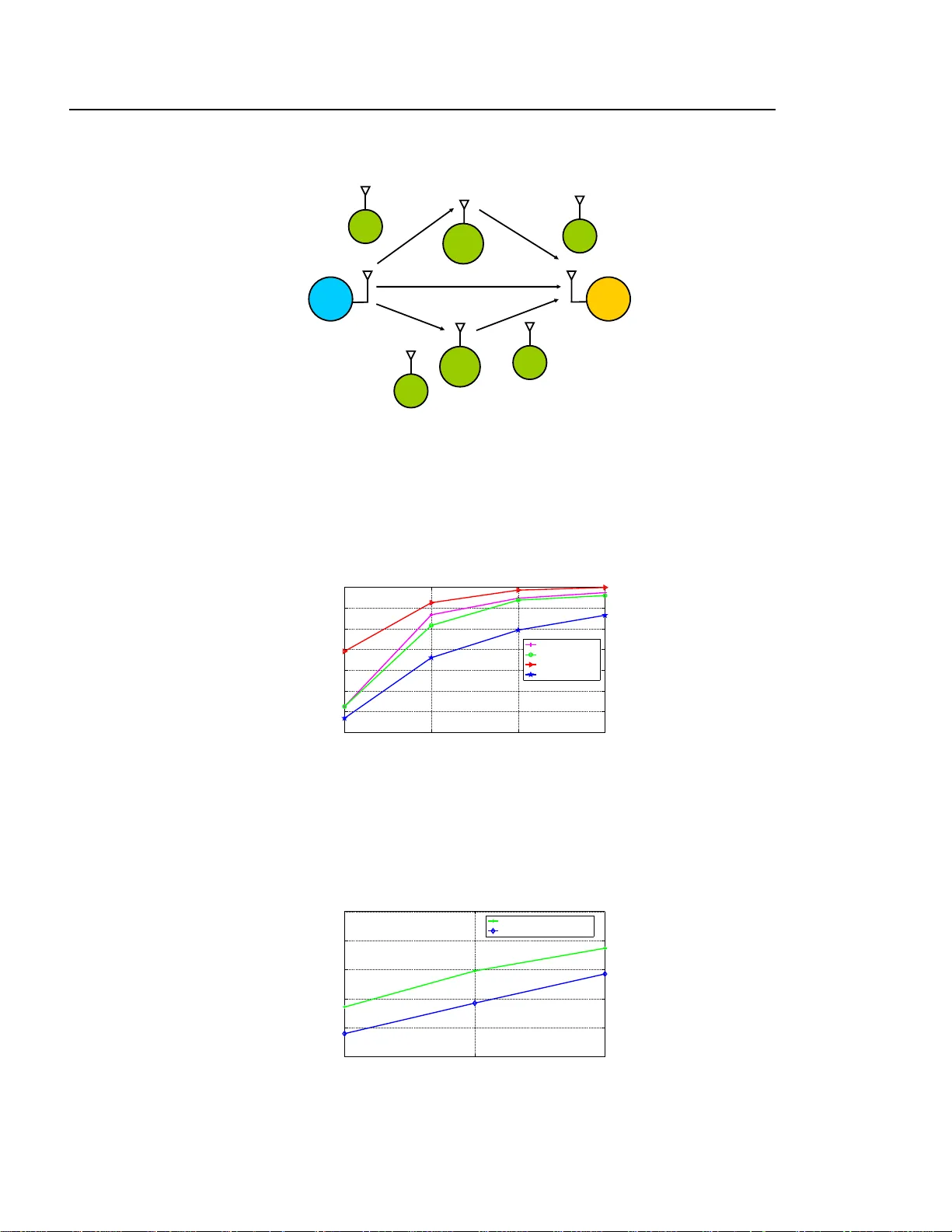
Rela y Subset Selection in Wireless Net w orks Using P artial Deco de-and-F orw ard T ransmiss ion Caleb K. Lo, Sriram Vish w anath and Rob ert W. Heath, Jr. Wireless Netw orking and Comm unications Gro up Departmen t of Electrical and Computer Engineering The Univers ity of T exas at Austin 1 Univ ersit y Stat ion C0803 Austin, TX 787 12-0240 Phone: (512) 4 71-1190 F ax: (512) 471-65 12 Email: { clo, sriram, rheath } @ ece .utexas.edu Abstract This paper conside r s the problem of selecting a subset of no des in a tw o-ho p wireless net work to act as relays in aiding the comm unication betw een the source- destination pair. Optimal relay subset selection with the ob jective of maximizing the overall throughput is a difficult problem that dep ends on multiple factors including no de lo cations, queue lengths and p ow er consumption. A partial deco de-and- fo rw ard strategy is a pplied in this pap er to improve the trac ta bilit y of the relay selection problem and p erformance of the ov e r all netw ork . Note tha t the num be r of relays selected ultimately determines the per formance of the netw or k. This pap er b enchm ark s this p erformance by deter mining the net diversity achiev ed us ing the re lays s elected and the partial dec o de-and- fo rw ard strategy . This framework is subseq uen tly used to further transform relay selection in to a simpler relay plac emen t problem, and tw o proximit y-base d approximation alg orithms are developed to determine the appro priate set o f relays to be sele c ted in the netw o rk. O ther selection strategies such as rando m relay selection and a greedy algor ithm that r elies on channel sta te information are also presented. This pap er concludes by showing that the prop osed proximit y-based relay sele ction strategies yield near-optimal exp ected rates for a small num b er of selected r ela ys. Keyw ords - Greedy algorithms, partial decod e-a nd-forward, su p erp ositio n codin g, rela ys. 1 P ap er: J3-TVT, First Revision, First Draft, Octob er 23, 2018 1 In tro d uction Rela y-assisted co mmunicati on is a promisin g strategy for b oth cen tralized and decentral ized communi- cation net w orks [1, 2]. Two-hop rela y-based comm unication is ha ving a considerable infl uence on emerging standards b oth in lo cal area net wo rks, IEEE 802.11s [1] and broadband wireless access n et w orks, IEEE 802.16 j [2]. Tw o-hop rela y systems consist of a source, a d estinatio n and one or more rela ys wh ere the rela y no des work together as a sin gle set of inte rmediaries b et w een the source and the destination [3]. Di rect trans- mission o ccur s b et w een the sour ce and the d estination, and the rela ys assist the source only if th e destination cannot deco de the dir ect transmission. T here are m ultiple concrete b enefits of int ro ducing these in termediate rela ys , whic h include impro v ed system through p ut and greater cov erage [2]. Multihop r ela ying [4, 5] is a k ey enabling tec hnology for net w orks o f t he fu ture, bu t b efore the p erforman ce tradeoffs of multihop rela ying can b e c haracterized, it is critical that the issues facing t wo -hop rela ying b e fully understo o d. Giv en that the sour ce can enlist m ultiple n o des to sim ultaneously act as relays, t w o questions naturally arise. First, ho w man y r elays m ust the sou r ce enlist to aid its transmission to gain the maximum adv ant age for the resources consumed? Second, whic h of the no des in the pre-existing n etw ork m ust b e enlisted to act a s rela ys? When m ultiple-rela y sele ction is allo we d, there are n umerous tradeoffs that go ve rn system p erformance [5–7]. While select ing a large n umber of r ela ys offers the b enefit of coherent com b ining, resulting in increased throughp ut and th u s higher ov erall qualit y of service, it suffers fr om d ra wb acks as w ell. Firstly , system resources are drained faster when m ultiple rela ys are selected. Second, there are complexit y and implemen tation issues - it is difficult to sync hronize the transmiss ions f rom multiple disparate rela ys [8–11], and receiv er complexit y increases with the num b er of rela ys. A single rela y can b e select ed to assist the source transmission [12–19], wh ic h offers low er gains in terms of total diversit y and rate but is simpler to implement and consumes le ss p o w er o v er the en tire net wo rk. This pap er h as t wo goals. One goal is to un derstand the f u ndamen tal limits of multiple-rel a y selection to b enc hmark v arious rela y selection algorithms. T o this end, w e fo cus on minimizing rela y p o wer consum p tion and tr eat implement ation issues and complexit y as a secondary concern. Regardless of the num b er of rela ys selected, it is difficult to determine wh ic h no de(s) in the net w ork must act as rela ys to aid the source transmiss ion. F or example, selecting the relay with the b est channel to the destination m ay not b e an optimal strategy , as this rela y ma y b e hea vily loaded with traffic and runn ing lo w on resources. Th u s, rela y selectio n is a v ery difficult pr ob lem, as selecting the “optimal” subset from the set of candidate r ela y no des is affected b y the presence of m ultiple parameters that go v ern system p erformance. In 2 P ap er: J3-TVT, First Revision, First Draft, Octob er 23, 2018 particular, rela y no de selection often translates to a com binatorial optimization pr oblem [31 ], w hic h curren tly do es not hav e an elegan t p olynomial-time algorithmic solution. The second goa l of this pap er is to p ro vide algorithms for rela y no de selecti on that serv e as a go o d appro ximation to the problem of optimal rela y selection from the p oint of view of throughp ut maximization with p o w er allo cat ion. Moreo v er, we desire the algorithms to h a ve lo w complexit y and b e highly intuitiv e in terms of d esig n. Note that an y selection algorithm is closely coup led with the transmission strategy employ ed in the n et wo rk (suc h as d ecode/amplify/compress-and-forward). Th us, w e discuss the transmission strategy emplo y ed in this pap er and then delv e in to the details of the algorithms. In our pap er, we use a partial deco de-and-forwa rd transmission strategy p r oposed in [21] 1 . P artial deco de-and-forw ard as d escribed in [21] relies on a t w o-lev el sup erp osition co ding strategy in tro duced b y T. Co v er f or broadcast c hannels [26 ] an d fu rther studied in [27–29]. Under this setting, the transmitter emplo ys a la y ered co ding s tr ate gy , a llo wing the receiv er to deco de th e transmitter’s message partially if it is incapable of d etermining it in its en tiret y . Note that the c onv en tional decode-and-forward strate gy as in [22] is a sp ecial case of the partial deco de-and-forwa rd strategy , and therefore, p artial decode-and-forward is a useful to ol that h as all the p r oper ties of deco de and forw ard incorp orated in to it. In particular, partial deco de-and-forw ard offers b oth the div ersit y adv an tages of amp lify-and-forw ard and the inherent robustness to noise of deco de-and-forw ard [20]. The other main adv antag e of p artia l deco de-and-forw ard is the tractabilit y it lends to the relay selection problem. While multiple-rela y selection based on partia l decode-and-forward transmission do es not read- ily lend itself to practica l implemen tation, the r esulting problem tract abilit y facilitates the determination of v aluable p erf ormance b enc h marks, especially in terms of diversit y gain. Our fir st con tribution is the deriv ation of b oth the div ersit y gain and the generalized dive rsity gain that is achiev ed b y allo w in g m of the candidate rela y s to assist the source. The resulting diversit y analysis extends the single-rela y result in [21] and f u rther highlights the p erformance b enefits of m ultiple-rela y selection. W e s tr ess that the derived diver- sit y gain is at most the d iv ersity ac hiev ed by selecting m r ela ys out of K r candidate rela ys. F or example, selecting the r ela y with the b est end -to-end p ath b et ween the source and the destination can yield a diversit y gain of K r + 1 [16]. W e men tion here that generalized diversit y , whic h arises from the notion of generalized degrees of freedom 1 Note that this notion of partial deco de-and-forw ard is distinct from the one in [22] as it is inspired by outage capacity . I t is based on the sup erposition co ding strategy for broadcast channels in [25], while the partial deco de-and-forward strategy in [22] is derived from blo c k-Marko v coding. 3 P ap er: J3-TVT, First Revision, First Draft, Octob er 23, 2018 [32, 33], refers to the div ersit y ac h iev ed wh en the candidate rela ys h a ve differen t transmit SNR v alues than that of the source. I n our p aper , w e consid er a sp ecific case of generalized div ersit y where the SNR f or eac h candidate rela y is an exp onential scaling of the source SNR, i.e. ( P i /σ 2 ) = ( P t /σ 2 ) k for rela y i . This allo ws for p erformance b enc hmarkin g of net works where the rela ys ma y b e op erating on a different p o w er budget than that of th e source, includ ing rela y-assisted cellular n et wo rks. F or example, the case w here k < 1 can b e mo deled b y a base station b eing assisted by mobile d evic es th at are not curr en tly hand ling their o wn v oice traffic. On the other hand, the case where k > 1 can b e mo deled b y a battery-p o we red mobile device b eing assisted b y fixed, dedicated r elay n od es that are conn ected to a con tin uous p o we r source. Our second con trib u tion entai ls u sing the partial decod e-a nd-forward fr amew ork as a platform to trans - form the r ela y selection pr oblem in to a rela y-placemen t problem, w hose solution suggests the “b est” set of rela ys to b e selecte d. T here are t w o appro ximation steps: w e fir st app ro ximate selection of m rela ys by th e problem of finding the m rela ys that are closest to a rate-maximizi ng location, and w e show that obtaining the rate-maximizing lo cation is equiv alent to maximizi ng a signomial function [30]. Since signomial pr o gr ams are, in general, not ea sy to solv e, we f u rther a ppr o ximate the rela y selection problem by the problem of finding the r ela ys that are closest to the r ate-maximizing lo catio n in a three-no de line net w ork. Ob tai ning this rate-maximizing lo cati on is equiv alen t to maximizing a p olynomial ov er a given range of v alues, w hic h can b e acco mplished usin g determin istic p olynomial-time algorithms. Th e ab ov e p olynomial appr oximati on motiv ates t wo pr oximity-b ase d algorithms (whic h we call Multiple F an Out and Single F an Out, d etai led in Section 5) that select rela ys based on their proxi mit y to on e of th e rate-maximizing lo cations. In addition, w e presen t a greedy selection algorithm (wh ic h we call Best Gains, also detailed in Section 5) that c ho oses rela ys based on their c hann el gains to the d estinat ion and the amoun t of the source message that they ha v e deco ded. Here, th e selected rela ys must ha v e deco ded at least one of the t wo m essag es from th e source. Finally , we presen t a selection algorithm that randomly selects rela y n od es (wh ic h we call Random Rela ys, also detailed in Section 5) and compare th e p erformance of all four algorithms - Mu ltiple F an O ut, Sin gle F an Out, Best Gains and Rand om Rela ys . This pap er is organized as follo ws. In Section I I we describ e the system mo del and introd uce the tw o-lev el sup erp osition co ding strategy that will b e used throughpu t the pap er. The div ersit y analysis is sh o wn in Section I I I. In Section IV, w e pr esen t the analytical form ulation of the rela y selection problem and obtain a closed-form expr ession for the rate-maximizing rela y p osition in a three-no de line n et wo rk. W e pr esen t our prop osed s ele ction algorithms in Section V. W e p resen t s im ulation results in Section VI and conclude the pap er in Section VI I. 4 P ap er: J3-TVT, First Revision, First Draft, Octob er 23, 2018 2 System Mo d el First, we introd uce the notation used thr oughout the p aper. E denotes the mathematical exp ectation op erator and ln( · ) r epresen ts the natural logarithm f u nction. exp( · ) represen ts the exp onenti al function and Γ( · ) is the gamma fun ction. SNR represents the transmit-side signal-to-noise ratio at the source no de. P ( A ) denotes the probabilit y that an even t A o ccurs. f ′ ( x ) denotes the deriv ativ e of a function f with resp ect to its argum en t x . kAk denotes the card in alit y of a set A . | z | 2 denotes the absolute square of a complex n umb er z . f ( x ) ∼ g ( x ) for large v alues of x represent s the fact that f ( x ) /g ( x ) → 1 as x → ∞ [20, Pg. 3067]. Consider the tw o-hop w ireless n et wo rk in Fig. 1. The net wo rk consists of a single source t , a sin gle destination r and K r rela ys inte rsp ersed throughout the region b et ween the sou r ce and the destination. L et d i,n denote the distance b etw een no des i and n . Let h i,n denote the c h an n el b et w een no des i and n . 2.1 Key Assumptions W e make the follo w ing critical assu mptions in this pap er: • E ach r elay op erates in a half-du plex mo de and emp lo ys a single an tenna. • Ad ditiv e wh ite circularly sym metric complex Gaussian noise n i,k with mean 0 and v ariance σ 2 is presen t at eac h r ece iving no de i during time slot k . • | h i,n | is a Ra yleigh-distributed r andom v ariable. Th us, the real and imaginary comp onen ts of h i,n are m utually indep endent Gauss ian-distributed random v ariables, eac h with mean 0 and v ariance (1 / 2) · E ( | h i,n | 2 ). This assumption simplifi es our analysis and is typically used in the literature to obtain insigh ts on the p erformance of real-w orld wireless systems. • O ur transmission strategy has arbitrarily long co dew ords that are generated u sing an i.i.d. Gaussian distribution of suitable v ariance to meet the o ve rall p o wer constrain t. Note th at the capacit y and th us, the capacit y ac hieving in put distribution (if an y) of the additiv e Gaussian noise rela y c hannel is in general unknown. Thus, we choose th is co ding str ategy for t w o reasons: 1) it has b een found to b e optimal in most of the sp ecial cases whose capacit y is kno wn (physica lly/rev ersely degraded [22], orthogonal c hannels [23] and uniform p h ase fading [24]) and 2) it yields explicit rate expressions and in tuitiv e co ding str ate gies. The destination and all p oten tial r ela y no des emplo y t ypical set d ecoding as defined in [34]. 5 P ap er: J3-TVT, First Revision, First Draft, Octob er 23, 2018 • T he sou r ce kno w s th e exact c hannel state for all of the c hannels in the net wo rk in Fig. 1. Eac h relay kno ws the exact s tat e of its c hannel from th e sour ce. The d estinati on knows the exact state of its c hannel from eac h of the r ela ys and from the sour ce. • T ime is slotted and th e channel is constan t in ev ery time slot. • E ach time slot is large enough to adm it an arb itrarily sm all pr obabilit y of error as long as the rate in that state is b elo w the maxim um ac hiev able for that state (this is also referred to as the blo c k fading assumption). • A log-distance path loss mo del is applied [35]. Let λ c , d 0 , and µ denote the carrier wa v elength, the reference distance, and the p ath loss exp onen t. Then, the c h annel gain b et ween no des i and n is E ( | h i,n | 2 ) = G 2 i,n = ( λ c / 4 π d 0 ) 2 ( d i,n /d 0 ) − µ . (1) 2.2 P artial Deco de-and-F orward All r elays p erform partial d ecode-and-forward op erations based on the tw o-lev el sup erp osition co ding strategy in [21] . The sou r ce transmits x t, 1 during the first time slot, where x t, 1 = x 1 + x 2 (2) and the source allocates p o w er β P t to x 1 and p ow er ¯ β P t to x 2 , where β ∈ [0 , 1] and ¯ β = 1 − β . Note that x 1 and x 2 are co dewo rds from co deb ooks with elemen ts that are generated i.i.d. according to zero-mean Gaussian distributions with v ariance β P t and ¯ β P t , resp ectiv ely . The d estinati on and all candidate rela y no des emplo y t ypical set d eco ding to d eco de x 1 and x 2 . The candidate rela ys and the d estination initially attempt to deco de x 1 . If n ode i can deco de x 1 then it attempts to d ecode x 2 . Tw o c hannel th r esholds, | h 1 | and | h 2 | , are c hosen to determine the set of receiv ed rates for this t wo-l ev el co ding strategy . T hen, x 1 can b e deco ded at th e rate R 1 [21], where R 1 = ln 1 + | h 1 | 2 β P t | h 1 | 2 ¯ β P t + σ 2 (3) while x 2 can b e deco ded at th e rate R 2 [21], where R 2 = ln 1 + | h 2 | 2 ¯ β P t σ 2 . (4) 6 P ap er: J3-TVT, First Revision, First Draft, Octob er 23, 2018 Note that if no de i attempts to d ecode x 1 or x 2 at a higher rate th an R 1 or R 2 , resp ectiv ely , the resulting probabilit y of error is b oun ded aw a y f rom zero. The receiv ed signals at the candidate rela y i and at the destination dur ing time slot 1 are, resp ectiv ely y i, 1 = h t,i x t, 1 + n i, 1 (5) y r, 1 = h t,r x t, 1 + n r, 1 . (6) If the d estinatio n can deco de b oth x 1 and x 2 , it b roadcasts this information to th e en tire net work and the source p repares to send x t, 2 during time slot 2. If the destination can only deco de x 1 , or if it cannot d eco de x 1 , it b r oadca sts this information to the entire netw ork. The source then selects a sub set of the candidate rela ys to assist its transmiss ion. F or rela y i , if | h t,i | < | h 1 | , then it cannot deco de x 1 and it do es not transmit durin g time slot 2. If | h 1 | ≤ | h t,i | < | h 2 | , then a selected rela y i can only d ecode x 1 and will forwa rd x 1 to the destination d uring time slot 2. If | h t,i | ≥ | h 2 | , then a selected r ela y i can deco de x t, 1 and will forwa rd x t, 1 to the destination. Th us, rela y i allocates p ow er P i to its transmission x r,i to the d estinatio n, where [21] x r,i = 0 if | h t,i | < | h 1 | q P i β P t x 1 if | h 1 | ≤ | h t,i | < | h 2 | q P i P t ( x 1 + x 2 ) if | h t,i | ≥ | h 2 | . (7) F or eac h rela y i , w e set β i = β for the ma jorit y of this p aper; in Section 6.1 we inv estigate the p erform ance impact of v arying β i with resp ect to β . Th us, if A d enotes the set of all rela ys that transmit du r ing time slot 2, the destination receiv es y r, 2 = X i ∈A h i,r x r,i + n r, 2 (8) during time slot 2. After time s lot 2, if the destination can deco de x t, 1 , the receiv ed rate is R 1 + R 2 . I f the destination can only deco de x 1 , the receiv ed r ate is R 1 , and if the d estinatio n cannot d ecode x 1 , th e receiv ed rate is 0. Note that this t w o-lev el co ding strategy can b e generalized to a multiple-le ve l appr oac h b ased on broadcast s trate gies in tro duced for the single u ser and MA C channels [25]. O nce the t wo -lev el strategies and algorithms are und erstoo d, their generalization to n > 2 leve ls is relativ ely straightfo rward but leads to extremely unwieldy expressions. Moreo v er, it is un clear if u sing a multiple-l ev el approac h will pro vide significan t gains in p erformance. Thus, we h a ve chosen to limit our s elv es to a t wo -lev el transmission strategy in this pap er. 7 P ap er: J3-TVT, First Revision, First Draft, Octob er 23, 2018 Our prop osed multiple-rela y selection algorithms c h oose A to maximize the exp ected rate sub ject to a sum p ow er constrain t o v er all r ela ys i ∈ A . In the next section w e d eriv e b oth th e diversit y gain and the generalized div ersit y gain via selecti ng m rela ys. 3 Div ersit y P erformance After m rela ys are selected to transmit to the d estinatio n dur ing time slot 2, w e consid er the resulting div ersit y gains κ 1 ( m ) and κ 2 ( m ) for R 1 and R 2 , resp ectiv ely . Let P out ( R 1 , A ) denote the probabilit y that the destination cannot d ecode x 1 after time slot 2, and let P out ( R 2 , A ) denote the probabilit y that the destination cannot decod e x 2 after time s lot 2. F or the div ersit y analysis, we set the rela y p o we rs P i = P t for i ∈ { 1 , 2 , . . . , m } , and so the SNR is P t /σ 2 . The diversit y gains are obtained b y observing that the outage prob ab ilities P out ( R 1 , A ) and P out ( R 2 , A ) are prop ortional to S N R − κ 1 ( m ) and S N R − κ 2 ( m ) , resp ectiv ely as the SNR P t /σ 2 approac hes infi nit y . W e reiterate that these dive rsity gains are at most the d iv ersity ac hieve d by select ing m rela ys out of K r candidate rela ys. Theorem 1. S ele cting m r elays to tr ansmit during time slot 2 yields a diversity gain of κ 1 ( m ) = m + 1 and κ 2 ( m ) = κ 1 ( m ) . Pr o of. S ee App endix A. W e n ote that obtaining the diversit y gain of m + 1 entail s a relativ ely straigh tforw ard extension of the single-rela y analysis for d ecode-and-forward relayi ng in [20, S ecti on IV.B]. In the t wo -lev el transmission strategy that we consider, the destination still attempts to deco de th e transmission from the sour ce ev en if at least one r ela y fails to deco de x 1 or x 2 . Note that the single-rela y analysis in [20, Section IV.B] ignores the direct link tran s mission if the rela y mak es a deco ding err or, and s o a d ir ect extension of the analysis in [20, S ecti on IV.B] w ould yield a div ersit y gain of m ins tea d. W e also p erform a generalized diversit y analysis where the rela y p ow ers are su c h th at ( P i /σ 2 ) = ( P t /σ 2 ) k for i ∈ { 1 , 2 , . . . , m } , where k is a r eal n umb er. The generalized div ersit y gains κ g 1 ( m ) and κ g 2 ( m ) are obtained b y observing th at the outage probabilities P out ( R 1 , A ) and P out ( R 2 , A ) are pr oportional to S N R − κ g 1 ( m ) and S N R − κ g 2 ( m ) , r esp ectiv ely as the transmit-side SNR P t /σ 2 approac hes infinity . 8 P ap er: J3-TVT, First Revision, First Draft, Octob er 23, 2018 Theorem 2. S ele cting m r elays to tr ansmit during time slot 2 yields a gener alize d diversity gain of κ g 1 ( m ) = k m + 1 if k ≤ 1 m + 1 if k > 1 and κ g 2 ( m ) = κ g 2 ( m ) . Pr o of. S ee App endix B. The generalized d iv ersity gain κ g 1 ( m ) = κ g 2 ( m ) has the f oll o wing in tuitiv e in terpretation. If k ≤ 1, eac h rela y is no b etter than the source in terms of transmit p o wer, so the w orst-case error ev en t is determined b y all of the rela y-to-destination channels. In particular, this ev ent o ccurs w hen all m sub optimal r ela ys attempt to f orw ard x 1 or x 2 to the d estinati on. On the other hand, if k > 1, eac h rela y is b etter than the source in terms of transmit p o wer, so the worst-c ase err or ev ent is determined b y all of the source-to-rela y c hannels. In particular, this ev en t o ccurs when all m sup erior rela ys cann ot deco de either x 1 or x 2 . 4 Rate-Maximizing Rela y P osition W e formulat e the r ela y selection prob lem for an arbitrary n umb er of selected rela ys, and then w e sho w ho w this problem can b e simplified by considering a three-no de line net work. 4.1 Optimal Rela y Placemen t in General Netw ork Consider th e case where a sub set A of the a v ailable rela y no des { 1 , 2 , . . . , K r } are selected to assist th e source. Let h d enote the channel b etw een a transmitting no de and a receiving no de. T he receiv ed rate at a receiving no de via deco ding x 1 is [21] C 1 ( | h | 2 ) , ln 1 + | h | 2 β P t | h | 2 ¯ β P t + σ 2 (9) and the receiv ed r ate at a receiving no de via decod ing x 2 after decod ing x 1 is [21] C 2 ( | h | 2 ) , ln 1 + | h | 2 ¯ β P t σ 2 . (10) The exp ecte d rate of the t wo-le ve l su p erp ositi on codin g strategy is ¯ R sc, 2 ( A ) = (1 − P out ( R 1 , A )) R 1 + (1 − P out ( R 1 , A ))(1 − P out ( R 2 , A )) R 2 (11) 9 P ap er: J3-TVT, First Revision, First Draft, Octob er 23, 2018 and so the rela y selection pr oblem can b e form ulated as follo ws max A⊆{ 1 , 2 ,...,K r } ¯ R sc, 2 ( A ) (12) sub ject to X i ∈A P i ≤ P max and 0 ≤ P i ≤ P i,max ∀ i ∈ A . It is app arent from (12) that the rela y selection problem is also a p o w er allo ca tion problem. In p articula r, if a rela y i is n ot selected, it is assigned a p o we r P i = 0. On the other hand , if a rela y i is selected, it is assigned a p ow er P i > 0 according to the solution to (12). Let ∆ denote the set of all rela ys that cannot deco d e x 1 , and let Θ d enote the set of all rela ys that can deco de x 1 but cannot deco de x 2 . Th e pr obabilit y that the destination cannot deco de x 1 after time s lot 2 can b e obtained b y generalizing [21, (13)] as P out ( R 1 , A ) = X (0 ≤ α,ξ ≤kAk ) ,α + ξ ≤kAk X ∆ ⊆A , Θ ⊆A , k ∆ k = α, k Θ k = ξ , ∆ T Θ= ∅ Y δ ∈ ∆ P ( C 1 ( | h t,δ | 2 ) < R 1 ) ! × Y θ ∈ Θ P ( C 1 ( | h t,θ | 2 ) ≥ R 1 , C 2 ( | h t,θ | 2 ) < R 2 ) ! Y η ∈ ( A\ (∆ S Θ)) P ( C 2 ( | h t,η | 2 ) ≥ R 2 ) !! × P ln 1 + | h t,r | 2 β P t + P η ∈ ( A\ (∆ S Θ)) | h η,r | 2 β P η | h t,r | 2 ¯ β P t + P η ∈ ( A\ (∆ S Θ)) | h η,r | 2 ¯ β P η + σ 2 + X θ ∈ Θ | h θ , r | 2 P θ σ 2 ! < R 1 !! . (13) Eac h term in the inn er sum in (13) r ep resen ts a scenario where α selected rela ys cann ot deco de x 1 , ξ select ed rela ys can decod e x 1 but cannot decod e x 2 , and the remaining kAk − α − ξ selected rela ys can d ecode x 2 . The expr essions in (13) are fairly inv olv ed, so we consider the h igh-SNR regime for ease of analysis. In App endix A, w e prov e that P ( C 1 ( | h t,δ | 2 ) < R 1 ) ∼ 1 G 2 t,δ × exp( R 1 ) − 1 ( P t /σ 2 ) × (1 − ¯ β exp( R 1 )) (14) P ( C 1 ( | h t,θ | 2 ) ≥ R 1 , C 2 ( | h t,θ | 2 ) < R 2 ) ∼ 1 (15) P ( C 2 ( | h t,η | 2 ) ≥ R 2 ) ∼ 1 (16) and P ln 1 + | h t,r | 2 β P t + P η ∈ ( A\ (∆ S Θ)) | h η,r | 2 β P η | h t,r | 2 ¯ β P t + P η ∈ ( A\ (∆ S Θ)) | h η,r | 2 ¯ β P η + σ 2 + X θ ∈ Θ | h θ , r | 2 P θ σ 2 ! < R 1 ! ∼ exp( R 1 ) − 1 ( P t /σ 2 ) × (1 − ¯ β exp( R 1 )) ! kAk− α +1 × 1 ( kAk − α + 1)! × 1 G 2 t,r Y ν ∈ ( A\ ∆) 1 ( P ν /P t ) G 2 ν,r . (17) 10 P ap er: J3-TVT, First Revision, First Draft, Octob er 23, 2018 The probabilit y that the destination cann ot deco de x 2 after time s lot 2 is P out ( R 2 , A ) = X 0 ≤ α ≤kAk X ∆ ⊆A , k ∆ k = α Y δ ∈ ∆ P ( C 2 ( | h t,δ | 2 ) < R 2 ) ! × Y θ ∈ ( A\ ∆) P ( C 2 ( | h t,θ | 2 ) ≥ R 2 ) ! × P C 2 | h t,r | 2 + X θ ∈ ( A\ ∆) | h θ , r | 2 ! < R 2 !!! . (18) Eac h term in the inner sum in (18) represents a scenario w here α selected rela ys cann ot deco de x 2 and the remaining kAk − α selected rela ys can deco de x 2 . The expressions in (18) are also fairly inv olv ed, so we again consider th e h igh-SNR r eg ime for ease of analysis. In App endix A, we prov e that P ( C 2 ( | h t,δ | 2 ) < R 2 ) ∼ 1 G 2 t,δ × exp( R 2 ) − 1 ¯ β ( P t /σ 2 ) (19) P ( C 2 ( | h t,θ | 2 ) ≥ R 2 ) ∼ 1 (20) and P C 2 | h t,r | 2 + X θ ∈ ( A\ ∆) | h θ , r | 2 ! < R 2 ! ∼ exp( R 2 ) − 1 ¯ β ( P t /σ 2 ) ! kAk− α +1 × 1 ( kAk − α + 1)! × 1 G 2 t,r Y θ ∈ ( A\ ∆) 1 ( P θ /P t ) G 2 θ , r . (21) It is apparent that (12) is an optimization p roblem with linear inequalit y constraint s. Also, from in- sp ecting (13)-(17) it is clear that P out ( R 1 , A ) is a nonlinear function of P i ∀ i ∈ A in the high-SNR regime. In add itio n, f r om in sp ecting (18)-(21) it is clear that P out ( R 2 , A ) is a nonlinear function of P i ∀ i ∈ A in the h igh-SNR regime. Then, the preceding analysis shows that in the h igh-SNR regime, ¯ R sc, 2 ( A ) is a nonlinear fun ction of P i for i ∈ A . Thus, nonlinear programming tec hniques suc h as sequentia l q u adratic programming [36] can b e applied to s olve (12) in the high-SNR regime. The rela y selection pr oblem (12) can also b e app ro ximated as a rela y placemen t problem w here m rela ys in Fig. 1 are c hosen to assist the source. The k ey idea b ehind th e rela y placemen t problem is to hypothetically place m rela ys in the lo cati ons that wo uld maximize ¯ R sc, 2 ( A ). Then, the m rela ys in Fig. 1 that are closest to the rate-maximizing lo cati ons are selected. It is also assum ed that eac h s ele cted rela y i employs the same p o wer P i = P max /m . 11 P ap er: J3-TVT, First Revision, First Draft, Octob er 23, 2018 T o s olv e for the rate-maximizing lo cations, r eca ll from (1) that G 2 i,n = ( λ c / 4 π d 0 ) 2 ( d i,n /d 0 ) − µ = ( d i,n ) − µ χ . Without loss of generalit y , assu me that the source is lo cate d at (0,0) and the destination is lo cated at ( d t,r , 0). If r elay i is lo cate d at ( a i , b i ), then d t,i = q a 2 i + b 2 i and d i,r = q ( d t,r − a i ) 2 + b 2 i . The rate-maximizing lo cat ions are { a ∗ 1 , b ∗ 1 , . . . , a ∗ m , b ∗ m } = arg max a 1 ,b 1 ,...,a m ,b m ¯ R sc, 2 ( A ) sub ject to kAk = m, X i ∈A P i ≤ P max and 0 ≤ P i ≤ P i,max ∀ i ∈ A . In particular, b y considering the bin omial series P ∞ k =0 ( a + b ) k where k is a real num b er, w e see th at d µ t,i = ( a 2 i + b 2 i ) µ/ 2 = ∞ X k =0 Γ( µ/ 2 + 1) k !Γ( µ/ 2 + 1 − k ) a 2 k i b µ − 2 k i (22) and d µ i,r = (( d t,r − a i ) 2 + b 2 i ) µ/ 2 = ∞ X k =0 Γ( µ/ 2 + 1) k !Γ( µ/ 2 + 1 − k ) ( d t,r − a i ) 2 k b µ − 2 k i . (23) W e assume th at 0 < a i < d t,r for eac h rela y i since the r elays are intersp ersed throughout the region b et ween the source and the destination. Also, assume without loss of generalit y that b i > 0 for eac h rela y i since d t,i and d i,r are fu nctions of b 2 i . Let the m selected r ela ys b e lo cated at ( a 1 , b 1 ) , ( a 2 , b 2 ) , . . . , ( a m , b m ). Recall from (1 3), (14), (17), (18), (19) and (21) that in the h igh-SNR regime, ¯ R sc, 2 ( A ) is a fun ctio n of G − 2 i,n = ( d i,n ) µ /χ . Then, from (22) and (23), w e see that ¯ R sc, 2 ( A ) is a fun ctio n of { a 1 , b 1 , . . . , a m , b m } . Since w e ha v e assumed that a i and b i are p ositive f or eac h rela y i , and the binomial co efficien ts in (22 ) and (23) are not n ecessa rily p ositiv e, ¯ R sc, 2 ( A ) is a signomial function [30] of { a 1 , b 1 , . . . , a m , b m } in the high-SNR regime. Signomial pr o gr ams usu all y do not admit efficien t solutions via geometric programming u nless the ob jec- tiv e function and the asso ciated inequalit y and equalit y constraints satisfy certain conditions [30]. Next, we sho w that giv en a three-no de line net wo rk, ¯ R sc, 2 ( A ) redu ces to a p olynomial f unction of the rela y p osition d . 4.2 Optimal Rela y Placemen t in Line Netw ork W e consider a lin e n et wo rk with K r = 1. The source is lo cated at (0,0), the destination is lo cated at ( d t,r , 0) and the rela y is lo cate d at ( d, 0) w here 0 < d < d t,r . T he outage p robabilit y P out ( R 1 , A ) can b e 12 P ap er: J3-TVT, First Revision, First Draft, Octob er 23, 2018 written as [21] P out ( R 1 , A ) = P ( C 1 ( | h t, 1 | 2 ) < R 1 ) P ( C 1 ( | h t,r | 2 ) < R 1 ) + P ( C 1 ( | h t, 1 | 2 ) ≥ R 1 , C 2 ( | h t, 1 | 2 ) < R 2 ) × P ln 1 + | h t,r | 2 β P t | h t,r | 2 ¯ β P t + σ 2 + | h 1 ,r | 2 P 1 σ 2 < R 1 + P ( C 2 ( | h t, 1 | 2 ) ≥ R 2 ) P C 1 | h t,r | 2 + | h 1 ,r | 2 P 1 P t < R 1 (24) and the outage probability P out ( R 2 , A ) can b e written as [21] P out ( R 2 , A ) = P ( C 2 ( | h t, 1 | 2 ) < R 2 ) P ( C 2 ( | h t,r | 2 ) < R 2 ) + P ( C 2 ( | h t, 1 | 2 ) ≥ R 2 ) P C 2 | h t,r | 2 + | h 1 ,r | 2 P 1 P t < R 2 . (25) As in Section 4.1, th e expressions in (24) an d (25) are fairly inv olv ed, so we again consider th e high-SNR regime for ease of analysis. In App endix A, w e pro ve that (24) simplifies to P out ( R 1 , A ) ∼ 1 G 2 t, 1 × exp( R 1 ) − 1 ( P t /σ 2 ) × (1 − ¯ β exp( R 1 )) ! 1 G 2 t,r × exp( R 1 ) − 1 ( P t /σ 2 ) × (1 − ¯ β exp( R 1 )) ! + 1 ( P 1 /P t ) G 2 1 ,r × exp( R 1 ) − 1 ( P t /σ 2 ) × (1 − ¯ β exp( R 1 )) ! 1 G 2 t,r × exp( R 1 ) − 1 ( P t /σ 2 ) × (1 − ¯ β exp( R 1 )) ! (26) and w e pro v e that (25) simplifies to P out ( R 2 , A ) ∼ 1 G 2 t, 1 × exp( R 2 ) − 1 ¯ β ( P t /σ 2 ) ! × 1 G 2 t,r × exp( R 2 ) − 1 ¯ β ( P t /σ 2 ) ! + 1 2 × 1 ( P 1 /P t ) G 2 1 ,r × exp( R 2 ) − 1 ¯ β ( P t /σ 2 ) ! × 1 G 2 t,r × exp( R 2 ) − 1 ¯ β ( P t /σ 2 ) ! . (27) Let G 1 = (exp( R 1 ) − 1) / ( ( P t /σ 2 ) × (1 − ¯ β exp( R 1 ))) and G 2 = (exp( R 2 ) − 1) / ( ¯ β ( P t /σ 2 )). Th en ¯ R sc, 2 ( A ) = (1 − P out ( R 1 , A )) R 1 + (1 − P out ( R 1 , A ))(1 − P out ( R 2 , A )) R 2 ∼ R 1 × (1 − G 2 1 χ 2 × d µ t,r ( d µ + ( P t /P 1 ) × ( d t,r − d ) µ )) + R 2 × (1 − G 2 1 χ 2 × d µ t,r ( d µ + ( P t /P 1 ) × ( d t,r − d ) µ )) × (1 − G 2 2 χ 2 × d µ t,r ( d µ + (1 / 2) × ( P t /P 1 ) × ( d t,r − d ) µ )) . (28) F or in tegral v alues of the path loss exp onen t µ , findin g the rate-maximizi ng rela y p osition ¯ d is equiv alen t to maximizing a p olynomial o v er 0 < d < d t,r . F or example, if µ = 2, ¯ R sc, 2 ( A ) is a fourth -degree p olynomial in d . Maximizing ¯ R sc, 2 ( A ) w ith resp ect to d is then equiv alen t to find ing th e ro ots of a cubic equation that lie in 0 < d < d t,r , assu m ing that at least one exists. 13 P ap er: J3-TVT, First Revision, First Draft, Octob er 23, 2018 5 Rela y Subset Selection A lgori thms The analysis in Section 4.1 sho ws that the com binatorial optimization problem (12) can b e app ro ximated b y considering a giv en v alue of m ∈ { 1 , 2 , . . . , K r } and maximizing a signomial function of th e r elay lo cations ( a 1 , b 1 ) , . . . , ( a m , b m ) in th e high-SNR regime, whic h yields th e rate-maximizing set (¯ a 1 , ¯ b 1 ) , . . . , (¯ a m , ¯ b m ). Note that since ¯ R sc, 2 ( A ) is a signomial fu nction in the high-SNR regime, rela ys th at are lo cated close to any of the p oin ts in the rate-maximizing set should still yield high exp ected rates due to the inh eren t smo othness of signomial functions. Th is motiv ates the follo wing pr oximity-b ase d algorithm for solving (12). Algorithm 1. Multiple F an Out Step 1: F or a giv en v alue of m ∈ { 1 , 2 , . . . , K r } , maximize ¯ R sc, 2 ( A ) o v er all relay locations ( a 1 , b 1 ) , . . . , ( a m , b m ) to fi nd the rate-maximizing set (¯ a 1 , ¯ b 1 ) , . . . , (¯ a m , ¯ b m ). Step 2: S et i = 1 and A = ∅ . Step 3: F or relay n , where 1 ≤ n ≤ K r , compu te d ( n ) wh ere d ( n ) is the distance from rela y n to (¯ a i , ¯ b i ). If rela y n is at lo cation ( a n , b n ), d ( n ) = p ( a n − ¯ a i ) 2 + ( b n − ¯ b i ) 2 . Step 4: Fin d the closest rela y n to (¯ a i , ¯ b i ) not in A and let A = A ∪ { n } and P n = P max /m . Step 5: I f kAk = m , s top. Oth erwise, let i = i + 1 and return to Step 3. W e call the ab o ve r ela y selection algorithm Multiple F an Out b ecause the pro cess of rela y selection is analogous to a searc h party fann ing out fr om its initial lo cation. Here, the ob jectiv e is to “fan out” from (¯ a 1 , ¯ b 1 ) , . . . , (¯ a m , ¯ b m ) un til m rela ys ha v e b een selected. Note that in Step 2, w e set i = 1 and in crease i in S tep 5. It turn s out th at ¯ a 1 = · · · = ¯ a m and ¯ b 1 = · · · = ¯ b m in S tep 1, so the initial assignmen t of i in S tep 2 and its iteration in Step 5 are irrelev ant. The Mu ltipl e F an Ou t algorithm, then, redu ces to find ing the m closest rela ys to the single rate-maximizing p oin t ( ¯ a 1 , ¯ b 1 ). Step 1 inv olv es maximizing a signomial fun ction, whic h usu ally do es not admit an efficien t solution. T o obtain a more tractable problem, the analysis in Section 4.2 sho ws that in the case of a three-no de lin e net w ork, ¯ R sc, 2 ( A ) is a p olynomial f unction of the rela y location d in the high-SNR r egi me. Maximizing ¯ R sc, 2 ( A ) yields th e rate-maximizing rela y lo cation ¯ d . Also, since ¯ R sc, 2 ( A ) is a p olynomial fu nction in the high-SNR regime for a three-no de line net w ork, rela ys that are lo cated close to the rate-maximizi ng rela y lo cat ion ¯ d s hould s till yield high exp ected rates du e to the 14 P ap er: J3-TVT, First Revision, First Draft, Octob er 23, 2018 inherent smo othness of p olynomial functions. This motiv ates another pr oximity-b ase d algorithm for solving (12). Again w e assume that the path loss exp onen t µ tak es on an integral v alue. W e also assume that exactly m r ela ys are to b e selected, which further simplifies the algorithm. Algorithm 2. Single F an Out Step 1: Maximize (28) to fi nd the rate-maximizing rela y lo cation ( ¯ d, 0). Step 2: F or relay n , where 1 ≤ n ≤ K r , compu te d ( n ) wh ere d ( n ) is the distance from rela y n to ( ¯ d, 0). If rela y n is at lo ca tion ( a n , b n ), d ( n ) = p ( a n − ¯ d ) 2 + b 2 n . Step 3: S ort the set of rela ys { 1 , 2 , . . . , K r } as { a 1 , a 2 , . . . , a K r } , where d ( a 1 ) ≤ d ( a 2 ) ≤ · · · ≤ d ( a K r ) . Step 4: Fin d the closest rela y n to ( ¯ d, 0) not in A and let A = A ∪ { n } and P n = P max /m . Step 5: I f kAk = m , s top. Oth erwise, retur n to Step 4. W e call the ab o ve rela y selection algorithm Single F an O ut b ecause ¯ d is computed via analysis of a single- rela y line net work. Note that b oth the Mu ltipl e F an Out and Single F an O ut alg orithms are greedy strategies in that the order of pro cession through the list of rela ys is b ased on their pr oximit y to ( ¯ x 1 , ¯ y 1 ) , . . . , ( ¯ x m , ¯ y m ) and ¯ d , resp ectiv ely . Greedy algorithms are useful for th e problem at hand in that they p ossess an inherent simplicit y , and their ru n-times are us ually simple to c h aracte rize. W e p rop ose another greedy approac h for s electing A . F or simp licit y , we assume that at m ost m r ela ys are to b e selected. Algorithm 3. Best Gains Step 1: F or rela y i , where 1 ≤ i ≤ K r , compute | h i,r | 2 . Step 2: S ort the set of rela ys { 1 , 2 , . . . , K r } as { a 1 , a 2 , . . . , a K r } , where | h a 1 ,r | 2 ≥ | h a 2 ,r | 2 ≥ · · · ≥ | h a K r ,r | 2 . Step 3: L et i = 1 and A = ∅ . Step 4: I f rela y a i has decod ed x 1 , then A = A ∪ { a i } and P i = P max /m . Step 5: I f kAk = m or i = K r , go to Step 6. Otherwise, let i = i + 1 and return to S tep 4. Step 6: I f kAk < m , let P i = P max / kAk f or eac h rela y a i ∈ A . 15 P ap er: J3-TVT, First Revision, First Draft, Octob er 23, 2018 W e call the ab o ve rela y selection algorithm Best Gains b ecause th e order of p rocession through the list of rela ys is based on their channel gains to the destination. Th e ob jectiv e is to c h oose r ela ys th at will b e able to reliably transm it to the destination du ring time slot 2. Note that a c hec k is p erformed on eac h s elected rela y in Step 4 to ensure that it w ill b e able to forwa rd at least x 1 to the destination. T o obtain a lo w er b ound on th e p erformance of the ab ov e greedy algorithms, we p rop ose the follo wing algorithm whereb y rela ys are r andomly selected to transmit durin g time slot 2. Algorithm 4. R andom R elays Step 1: L et A = ∅ . Step 2: Randomly s elect a rela y i ∈ { 1 , 2 , . . . , K r }\A and let A = A ∪{ i } along w ith P i = P max /m . Step 3: I f kAk = m , s top. Oth erwise, retur n to Step 2. Since the destination emplo ys a div ers it y com bining approac h to receiv e the signals from all of the selected rela ys , the p erformance of th e R andom R elays algorithm sh ou ld app roac h that of the other pr oposed rela y selection algorithms as m increases. 6 Sim ulation Results 6.1 P erformance of Rela y Selection Algor ithms W e place the source at (0 , 0) and the destination at (100 , 0). W e use the W orld wide I n terop erabilit y for Micro wa ve Access (WiMAX) signaling bandw idth of 9 MHz [38], and giv en a noise fl oor of -174dBm/Hz this yields a noise v alue σ 2 = − 104dBm. W e also ha v e a carrier f requency f c = 2.4GHz along with a reference distance d 0 = 1m and a path loss exp onent µ = 3. W e randomly place K r = 20 r ela ys in the region b et wee n the source and the destination. Fig. 2 sh o ws how th e exp ected rate ¯ R sc, 2 ( A ) v aries with the n umb er of selected rela ys kAk = m for the algorithms that we ha ve pr op osed. Here we fix the source’s p o w er P t = 6dBm and the r ela y su m p o w er constrain t P max = P t . The fr action of the source’s p o we r allo cated to x 1 is β = 0 . 75 and th e deco ding thresholds for x 1 and x 2 are | h 1 | = 7 . 4 · 10 − 11 and | h 2 | = 1 . 25 · 10 − 10 , resp ectiv ely . In the case of the Best Gains algorithm, we only consider cases where the num b er of selected rela ys kAk = m . W e obtain the rate-maximizing set ( ¯ a 1 , ¯ b 1 ) , . . . , (¯ a m , ¯ b m ) for the M ultiple F an Out algorithm via th e fm incon function from Matlab, whic h emplo y s a sequen tial quadratic p rogramming metho d. 16 P ap er: J3-TVT, First Revision, First Draft, Octob er 23, 2018 W e see that the greedy Best Gains algorithm yields the h ighest exp ected rate for all of the prop osed selection str ategies. This is due to the fact that the Best Gains algorithm b iases r elay selection to wards those rela y s that ha ve goo d c hannel gains to the destination and ca n also transm it du r ing time slot 2; this minimizes the chances of an outage ev ent o ccurring at the destination wher e it cannot deco de x 1 . On the other hand, the F an Ou t algorithms s elect rela ys th at are close to ergo dic rate-maximizing p oin ts without considering their decod ing status and their in s tan taneous channel gains to the destination. T h u s, the Best Gains algorithm attempts to optimize rela y selection for eac h sour ce transmission, th ough additional o verhead is incu rred relativ e to th e F an Out algorithms since the rela ys m us t in form the source of th eir deco ding status and their c h annels to the destination. Also, the Single F an Out algorithm offers vir tually the same p erform ance as the Multiple F an O ut al- gorithm, which demonstr ates the u tilit y of our simp lificati ons of the rela y selection p roblem. Here, the rela ys that are close to the rate-maximizing set for the Multiple F an Out algorithm are also close to the rate-maximizing p osition ( ¯ d, 0) f or the Single F an O ut algorithm. In add ition, as the num b er of selected rela ys kAk increases, eac h strategy y ields a higher exp ected rate w hic h approac hes the maximum exp ected rate. Finally , note that th e p erformance gap b etw een all of the prop osed strategies decreases as the num- b er of selected relays increases. This is due to the fact that selecting m ultiple rela ys yields an SNR gain at the d estinat ion that gradually ov ercomes the loss from selecting rela ys that migh t not b e close to the rate-maximizing p ositions that are computed b y the Multiple F an Ou t and Sing le F an Out algorithms. Fig. 3 sho ws ho w the exp ected rate ¯ R sc, 2 ( A ) v aries w ith the num b er of selected rela ys kAk = m for tw o rela y p ow er allo catio n strategie s. W e u se the s ame system p aramet ers as in Fig. 2, except that w e r andomly place m rela y s in the region b etw een the sour ce and the destination instead of K r = 20 r ela ys. Th e Optimal P o w er Allo catio n strategy en tails solving the rela y selection problem in (12 ), and th e Equal P o w er Allo catio n strategy assigns equal p o wer to all of the selected rela ys. W e also set P max = P t . W e observ e that the Equal Po wer Allo cation strategy offers comparable p erformance to the Optimal Po w er Allocation strategy . This illustrates the utilit y of lo w -complexit y strategies that redu ce the computation time inherent to interior-p oin t metho ds that are n eeded to solv e the optimization problem (12). Fig. 4 sh o ws h o w the exp ected rate ¯ R sc, 2 ( A ) v aries with the av erage receiv ed SNR at the destination for differen t r atio s b etw een the r ela ys’ and s ource’s p ow ers. When th e a ve rage receiv ed S NR v alues at the destination are 0dB, 2dB and 4dB, the source’s p o w er tak es on v alues P t = − 6dBm, P t = − 4dBm and P t = − 2dBm, resp ectiv ely . W e see that as the a verage receiv ed SNR at the destination in creases, the exp ecte d r ate increases for eac h 17 P ap er: J3-TVT, First Revision, First Draft, Octob er 23, 2018 v alue of P i /P t . Note that for a fixed v alue of P i /P t , increasing the a verag e receiv ed S NR at the destination en tails increasing P i and P t . F or a fix ed v alue of the a v erage r ece iv ed SNR at the destination, the exp ected rate decreases as P i /P t decreases, wh ic h corresp onds to a decrease in P i . Thus, ev en though the three selected rela ys yield an SNR gain at the destination in time slot 2, this gain d ecreases as the rela ys’ p o wer d ecrea ses. Fig. 5 sho ws how th e exp ected rate ¯ R sc, 2 ( A ) v aries w ith the a v erage receiv ed SNR at the destination for differen t v alues of the rela ys’ p ow er split β i . W e set β = 0 . 75. W e see that as the rela ys ’ p o w er split β i decreases, the exp ected r ate increases for all av erage receiv ed SNR v alues at the d estinatio n. Note that as β i decreases, ¯ β i increases, whic h leads to an increase in R 2 as seen in (4). On the other hand, as ¯ β i increases, (3) shows that R 1 decreases. Fig. 5 sho ws that the increase in R 2 o vercomes the decrease in R 1 . 7 Conclusion W e ha ve stud ied the p r oblem of selecting a set of rela y no des to forward data in a tw o-hop wireless net w ork. W e ha v e considered a scenario where all rela y no des p erform partial decode-and-forward op erati ons based on a sup erp osition co ding strategy . F or this setup , we ha ve sho wn that relay selection can b e initially appro ximated by the problem of find ing the r elays that are close to a rate-maximizing lo cati on. Find ing the rate-maximizing lo cati on is usually computationally in tensiv e, so w e further simplify the rela y selection problem b y solving for the rate-maximizing location in a three-no de line netw ork. These results motiv ate tw o pr oximity-b ase d rela y selection algo rithms, where rela ys are chosen to forw ard data based on their p ro ximit y to one of th e r ate-maximizing lo cations. W e also demonstrated that the pr oximity-b ase d algorithms outp erform a random rela y selection algorithm and yield rates close to those yielded b y a greedy strategy that is b ased on c hann el state information. In add itio n, w e d eriv ed the div ersit y gain achiev ed by h a ving multiple rela ys assist the source. W e also illus tr ate d the p erformance impact of v arying system p arameters suc h as the ratio b et ween th e rela ys’ and source’s p o w ers. As noted in the Int ro duction, selecting the optimal subset of candidate r ela y n odes to assist a source is a difficult problem, and the prop osed s election strategies are mainly intended to offer k ey in sigh ts. In particular, the pr oximity-b ase d algorithms motiv ate in telligen t rela y p lac ement in a general tw o-hop static net w ork with n on-Ra yleigh fading. System designers can exp eriment with different net w ork top ologie s and determine a throughpu t-maximiz ing configuration, where the ac hiev ed thr ou gh p ut w ould d ep en d on the leve l of inte rference b et w een th e transmissions from distinct rela ys. Also, the information-theoretic analysis in this 18 P ap er: J3-TVT, First Revision, First Draft, Octob er 23, 2018 pap er can b e mo dified to supp ort more practical transmission strategies. By applying cutting-edge co ding strategies such as p unctured lo w-density parit y-c hec k (LDPC) and turb o co des, th e sup erp osition co ding approac h th at is employ ed in this p aper can form the b asis of a hybrid-AR Q strategy in a m ultihop net w ork. A Pro of of Theorem 1 The probabilit y that the destination cann ot deco de x 1 after time s lot 2 is P out ( R 1 , A ) = X (0 ≤ α,ξ ≤ m ) ,α + ξ ≤ m X ∆ ⊆A , Θ ⊆A , k ∆ k = α, k Θ k = ξ , ∆ T Θ= ∅ Y δ ∈ ∆ P ( C 1 ( | h t,δ | 2 ) < R 1 ) ! × Y θ ∈ Θ P ( C 1 ( | h t,θ | 2 ) ≥ R 1 , C 2 ( | h t,θ | 2 ) < R 2 ) ! Y η ∈ ( A\ (∆ S Θ)) P ( C 2 ( | h t,η | 2 ) ≥ R 2 ) !! × P ln 1 + | h t,r | 2 β P t + P η ∈ ( A\ (∆ S Θ)) | h η,r | 2 β P t | h t,r | 2 ¯ β P t + P η ∈ ( A\ (∆ S Θ)) | h η,r | 2 ¯ β P t + σ 2 + X θ ∈ Θ | h θ , r | 2 P t σ 2 ! < R 1 !! . (29) Eac h term in the inn er sum in (29) r ep resen ts a scenario where α selected rela ys cann ot deco de x 1 , ξ select ed rela ys can decod e x 1 but cannot decod e x 2 , and the remaining m − α − ξ selected rela ys can decod e x 2 . Note that for a Ra yleigh fading c hannel h , P ( C 1 ( | h | 2 ) < R 1 ) = P ln 1 + | h | 2 β P t | h | 2 ¯ β P t + σ 2 < R 1 = P | h | 2 < exp( R 1 ) − 1 1 − ¯ β exp( R 1 ) × σ 2 P t ∼ 1 E ( | h | 2 ) × exp( R 1 ) − 1 (1 − ¯ β exp( R 1 )) P t /σ 2 (30) where (30) f ollo ws from [20, F act 1]. Also, f or a Ra yleigh fading c hannel h , P ( C 1 ( | h | 2 ) ≥ R 1 , C 2 ( | h | 2 ) < R 2 ) ≤ P ( C 1 ( | h | 2 ) ≥ R 1 ) ∼ 1 . (31) In addition, for ind ep enden t Ra yleigh fading c hannels h 1 and h 2 , n ote that P ln 1 + | h 1 | 2 β P t | h 1 | 2 ¯ β P t + σ 2 + | h 2 | 2 P t σ 2 < R 1 ≤ P ln 1 + | h 1 | 2 β P t + | h 2 | 2 β P t | h 1 | 2 ¯ β P t + | h 2 | 2 ¯ β P t + σ 2 < R 1 = P ( C 1 ( | h 1 | 2 + | h 2 | 2 ) < R 1 ) = P | h 1 | 2 + | h 2 | 2 < exp( R 1 ) − 1 1 − ¯ β exp( R 1 ) × σ 2 P t ∼ 1 2 E ( | h 1 | 2 ) E ( | h 2 | 2 ) exp( R 1 ) − 1 (1 − ¯ β exp( R 1 )) P t /σ 2 2 (32) 19 P ap er: J3-TVT, First Revision, First Draft, Octob er 23, 2018 where (32) f ollo ws from [20, F act 2]. Also, f or a Ra yleigh fading c hannel h , P ( C 2 ( | h | 2 ) ≥ R 2 ) ∼ 1 . (33) In addition, for ind ep enden t Ra yleigh fading c hannels h 1 , h 2 and h 3 , n ote that P ln 1 + | h 1 | 2 β P t | h 1 | 2 ¯ β P t + σ 2 + | h 2 | 2 P t σ 2 + | h 3 | 2 P t σ 2 < R 1 ≤ P ln 1 + | h 1 | 2 β P t + | h 2 | 2 β P t + | h 3 | 2 β P t | h 1 | 2 ¯ β P t + | h 2 | 2 ¯ β P t + | h 3 | 2 ¯ β P t + σ 2 < R 1 = P ( C 1 ( | h 1 | 2 + | h 2 | 2 + | h 3 | 2 ) < R 1 ) = P | h 1 | 2 + | h 2 | 2 + | h 3 | 2 < exp( R 1 ) − 1 1 − ¯ β exp( R 1 ) × σ 2 P t ∼ 1 6 E ( | h 1 | 2 ) E ( | h 2 | 2 ) E ( | h 3 | 2 ) exp( R 1 ) − 1 (1 − ¯ β exp( R 1 )) P t /σ 2 3 (34) where (34) f ollo ws from [6, Ap p endix B]. W e use (30), (31), (32) , (33) and (34) to see that P ln 1 + | h t,r | 2 β P t + P η ∈ ( A\ (∆ S Θ)) | h η,r | 2 β P t | h t,r | 2 ¯ β P t + P η ∈ ( A\ (∆ S Θ)) | h η,r | 2 ¯ β P t + σ 2 + X θ ∈ Θ | h θ , r | 2 P t σ 2 ! < R 1 ! (35) ≤ P ln 1 + | h t,r | 2 β P t + P ν ∈ ( A\ ∆) | h ν,r | 2 β P t | h t,r | 2 ¯ β P t + P ν ∈ ( A\ ∆) | h ν,r | 2 ¯ β P t + σ 2 ! < R 1 ! = P C 1 | h t,r | 2 + X ν ∈ ( A\ ∆) | h ν,r | 2 ! < R 1 ! ∼ 1 ( m − α + 1)! × 1 E ( | h t,r | 2 ) × exp( R 1 ) − 1 (1 − ¯ β exp( R 1 )) P t /σ 2 − ( m − α +1) Y ν ∈ ( A\ ∆) 1 E ( | h ν,r | 2 ) . Th us, the high-SNR b eh a vior of P out ( R 1 , A ) is P out ( R 1 , A ) ∼ P t σ 2 ! − 1 ! α × (1) β × (1) m − α − β × P t σ 2 ! − ( m − α +1) = P t σ 2 ! − ( m +1) (36) and so we obtain a div ersit y gain of κ 1 ( m ) = m + 1 for d ecoding x 1 at the d estinatio n. The probabilit y that the destination cann ot deco de x 2 after time s lot 2 is P out ( R 2 , A ) = X 0 ≤ α ≤ m X k ∆ k = α, ∆ ⊆A Y δ ∈ ∆ P ( C 2 ( | h t,δ | 2 ) < R 2 ) ! × Y θ ∈ ( A\ ∆) P ( C 2 ( | h t,θ | 2 ) ≥ R 2 ) ! × P C 2 | h t,r | 2 + X θ ∈ ( A\ ∆) | h θ , r | 2 ! < R 2 !! . (37) 20 P ap er: J3-TVT, First Revision, First Draft, Octob er 23, 2018 Eac h term in the inner sum in (37 ) represen ts a decod ing s cenario w here α selected relays cannot d eco de x 2 and the remaining m − α selected r elays can deco de x 2 . Note that for a Ra yleigh fading c hannel h , P ( C 2 ( | h | 2 ) < R 2 ) = P ln 1 + | h | 2 ¯ β P t σ 2 < R 2 = P | h | 2 < exp( R 2 ) − 1 ¯ β × σ 2 P t ∼ 1 E ( | h | 2 ) × exp( R 2 ) − 1 ¯ β P t /σ 2 (38) where (38) f ollo ws from [20, F act 1]. Also, f or ind ep enden t Ra yleigh fading c hannels h 1 and h 2 , note that P ( C 2 ( | h 1 | 2 + | h 2 | 2 ) < R 2 ) = P ln 1 + | h 1 | 2 ¯ β P t σ 2 + | h 2 | 2 ¯ β P t σ 2 < R 2 = P | h 1 | 2 + | h 2 | 2 < exp( R 2 ) − 1 ¯ β × σ 2 P t ∼ 1 2 E ( | h 1 | 2 ) E ( | h 2 | 2 ) exp( R 2 ) − 1 ¯ β P t /σ 2 2 (39) where (39) f ollo ws from [20, F act 2]. In addition, for ind ep enden t Ra yleigh fading c hannels h 1 , h 2 and h 3 , n ote that P ( C 2 ( | h 1 | 2 + | h 2 | 2 + | h 3 | 2 ) < R 2 ) = P ln 1 + | h 1 | 2 ¯ β P t σ 2 + | h 2 | 2 ¯ β P t σ 2 + | h 3 | 2 ¯ β P t σ 2 < R 2 = P | h 1 | 2 + | h 2 | 2 + | h 3 | 2 < exp( R 2 ) − 1 ¯ β × σ 2 P t ∼ 1 6 E ( | h 1 | 2 ) E ( | h 2 | 2 ) E ( | h 3 | 2 ) exp( R 2 ) − 1 ¯ β P t /σ 2 3 (40) where (40) f ollo ws from [6, Ap p endix B]. W e use (33), (38), (39) and (40) to see that P C 2 | h t,r | 2 + X θ ∈ ( A\ ∆) | h θ , r | 2 ! < R 2 ! (41) ∼ 1 ( m − α + 1)! × 1 E ( | h t,r | 2 ) × exp( R 2 ) − 1 ¯ β P t /σ 2 − ( m − α +1) Y ν ∈ ( A\ ∆) 1 E ( | h ν,r | 2 ) . Th us, the high-SNR b eh a vior of P out ( R 2 , A ) is P out ( R 2 , A ) ∼ P t σ 2 ! − 1 ! α × (1) m − α × P t σ 2 ! − ( m − α +1) = P t σ 2 ! − ( m +1) (42) 21 P ap er: J3-TVT, First Revision, First Draft, Octob er 23, 2018 and so we obtain a div ersit y gain of κ 2 ( m ) = m + 1 for d ecoding x 2 at the d estinatio n. Th us, we conclud e that selecting m rela ys allo w s us to reap a d iv ersity gain of m + 1 f or b oth R 1 and R 2 . B Pro of of Theorem 2 The pro of of Theorem 2 is similar to that of Theorem 1 in App endix A. First, we consider the d ecoding of x 1 at the d estination. Recalling that ( P i /σ 2 ) = ( P t /σ 2 ) k for eac h rela y i , w e can use (35) to see that P ln 1 + | h t,r | 2 β P t + P η ∈ ( A\ (∆ S Θ)) | h η,r | 2 β P η | h t,r | 2 ¯ β P t + P η ∈ ( A\ (∆ S Θ)) | h η,r | 2 ¯ β P η + σ 2 + X θ ∈ Θ | h θ , r | 2 P θ σ 2 ! < R 1 ! (43) ≤ P ln 1 + | h t,r | 2 β P t + P ν ∈ ( A\ ∆) | h ν,r | 2 β P ν | h t,r | 2 ¯ β P t + P ν ∈ ( A\ ∆) | h ν,r | 2 ¯ β P ν + σ 2 ! < R 1 ! ∼ 1 ( m − α + 1)! × 1 E (( P t /σ 2 ) | h t,r | 2 ) × exp( R 1 ) − 1 (1 − ¯ β exp( R 1 )) − ( m − α +1) Y ν ∈ ( A\ ∆) 1 E (( P ν /σ 2 ) | h ν,r | 2 ) = 1 ( m − α + 1)! × 1 E ( | h t,r | 2 ) × exp( R 1 ) − 1 (1 − ¯ β exp( R 1 )) − ( m − α +1) P t σ 2 ! − ( k ( m − α )+1) Y ν ∈ ( A\ ∆) 1 E ( | h ν,r | 2 ) . Th us, for a giv en integ er v alue of α ∈ { 0 , . . . , m } , the high-SNR b eha vior of P out ( R 1 , A ) is P out ( R 1 , A ) ∼ P t σ 2 ! − 1 ! α × (1) β × (1) m − α − β × P t σ 2 ! − ( k ( m − α )+1) = P t σ 2 ! − ( km +1+ α (1 − k )) . (44) W e then minimize k m + 1 + α (1 − k ) o v er all α ∈ { 0 , . . . , m } to obtain the generalized div ersit y gain κ g 1 ( m ) in Theorem 2 . W e then consider the deco ding of x 2 at the destination. Recalling th at ( P i /σ 2 ) = ( P t /σ 2 ) k for eac h r ela y i , w e can use (41) to see that P ln 1 + | h t,r | 2 ¯ β P t σ 2 + X θ ∈ ( A\ ∆) | h θ , r | 2 ¯ β P θ σ 2 < R 2 ∼ 1 ( m − α + 1)! × 1 E (( P t /σ 2 ) | h t,r | 2 ) × exp( R 2 ) − 1 ¯ β − ( m − α +1) Y ν ∈ ( A\ ∆) 1 E (( P ν /σ 2 ) | h ν,r | 2 ) = 1 ( m − α + 1)! × 1 E ( | h t,r | 2 ) × exp( R 2 ) − 1 ¯ β − ( m − α +1) P t σ 2 ! − ( k ( m − α )+1) Y ν ∈ ( A\ ∆) 1 E ( | h ν,r | 2 ) . 22 P ap er: J3-TVT, First Revision, First Draft, Octob er 23, 2018 Th us, for a giv en integ er v alue of α ∈ { 0 , . . . , m } , the high-SNR b eha vior of P out ( R 2 , A ) is P out ( R 2 , A ) ∼ P t σ 2 ! − 1 ! α × (1) m − α × P t σ 2 ! − k ( m − α ) +1) = P t σ 2 ! − ( km +1+ α (1 − k )) . (45) W e then minimize k m + 1 + α (1 − k ) o ver all α ∈ { 0 , . . . , m } to obtain the generalized diversit y gain κ g 2 ( m ) = κ g 1 ( m ) in T heorem 2. References [1] ESS Mesh Net working. http:// www .ieee802.org/1 1/Rep orts/tgs up date.h tm. [2] Rela y T ask Group. http://www.ieee 802.org/1 6/rela y/ind ex.h tml . [3] R. P abst et al. Rela y-based deploymen t concepts for wireless and mobile broadband radio. IEEE Commun. Mag. , 42(9):80–8 9, S eptem b er 2004. [4] J. Bo ye r, D.D. F alc oner and H. Y anikomerogl u. Multihop div ersit y in w ireless rela ying c hannels. IE EE T r ans. Commun. , 52(10):1820 –1830, Octob er 2004. [5] M. Dohler, A. Gk elias and A.H. Aghv ami. Capacit y of distrib uted PHY-la y er sensor netw orks. IEEE T r ans. V eh. T e chnol. , 55(2): 622–639 , Marc h 2006. [6] J.N. Laneman an d G.W. W ornell. Distributed space-time-coded protocols for exploiting co op erati ve div ersit y in wireless net w orks. IE EE T r ans. Inform. The ory , 49(10):241 5–2425, O ctob er 2003. [7] Y. Jing and B. Hassibi. Distributed space-time co ding in w ir ele ss r elay net w orks. IE EE T r ans. Wi r eless Commun. , 5(12):3524– 3536, Decem b er 2006. [8] A.S. Hu and S.D. S erv etto. On the scalabilit y of coop erativ e time sync hronization in pulse-connected net w orks. IE EE T r ans. Inform. The ory , 52(6):27 25–2748, Jun e 2006. [9] S. W ei, D.L. Go ec k el and M.C. V alen ti. Async hronous co operative diversit y . IEEE T r ans. Wir eless Commun. , 5(6):1547–1 557, Jun e 2006 . [10] K. Sun, P . Ning and C. W ang. Secure and resilien t clo c k synchronizat ion in wireless sensor netw orks. IEEE J. Sele ct. Ar e as Commun. , 24(2):395–4 08, F ebruary 2006. 23 P ap er: J3-TVT, First Revision, First Draft, Octob er 23, 2018 [11] W.C. Lin dsey , F. Ghazvinian, W.C. Hagmann and K. Dessouky . Net work synchronizatio n. Pr o c. of the IEEE , 73(10):144 5–1467, Octob er 1985. [12] D. Z hao and T.D. T od d. Cellular CDMA capacit y with out-of-band multihop rela ying. IEEE T r ans. Mobile Comput. , 5(2):170– 178, F ebr uary 2006 . [13] P . T arasak, H. Minn and V.K. Bharga v a. Differen tial mo dulation for tw o-user co op erativ e d iv ersity systems. IEEE J. Sele ct. Ar e as Commun. , 23(9):1 891–190 0, Sep tem b er 2005. [14] L. V enturino, X. W ang and M. Lops. Multiuser detection for co oper ative netw orks and p erformance analysis. IEEE T r ans. Signal Pr o c ess. , 54(9):33 15–3329 , S eptem b er 200 6. [15] M. Z orzi and R.R. Rao. Geographic random forw arding (GeRaF) for ad ho c and sensor net works: m ultihop p erformance. IE EE T r ans. M obile Comput. , 2(4): 337–348, Octob er-Decem b er 2003. [16] A. Bletsas, A. Khisti, D.P . Reed and A. Lippman. A simple co op erativ e diversit y metho d based on net w ork path selection. IEE E J . Sele ct. Ar e as Commun. , 24(3):659 –672, Marc h 2006. [17] X. Liu and W. Su. Optim um selection rela yin g proto cols in co op erativ e wireless netw orks. In Pr o c. of the IEE E Glob al T ele c ommun. Conf. , San F rancisco, CA, Nov em b er 2006. [18] D. Gunduz and E. Erk ip . Opp ortu nistic co op eration by dyn amic resource allocation. IEEE J. T r ans. Wir eless Commun. , 6(4):14 46–1454 , April 2007. [19] B. Zh ao and M.C. V alent i. Practical rela y n et w orks: a generalization of hybrid-AR Q . IEEE J. Sele ct. Ar e as Commun. , 23(1):7–18, January 2005. [20] J.N. Laneman, D.N .C. Tse and G.W. W ornell. C oop erativ e div ersit y in wir ele ss n etw orks: Efficien t proto cols and outage b eha vior. IEEE T r ans. Inform. The ory , 50(12 ):3062–3 080, Decem b er 2004. [21] M. Y uksel and E. Erkip. Broadcast strategies for th e fading rela y c hannel. In Pr o c. of the IEEE Mi litar y Commun. Conf. , 2:1060–1 065, Monterey , CA, Octob er 2004. [22] T.M. Co v er and A.A. El Gamal. Capacit y theorems for the rela y c h annel. IEEE T r ans. Inform. The ory , 25(5): 572–584, Septem b er 1979. [23] A.A. El Gamal and S . Zahedi. Capacit y of a class of rela y channels with orthogonal comp onent s. IEEE T r ans. Inform. The ory , 51(5): 1815–18 17, Ma y 2005. 24 P ap er: J3-TVT, First Revision, First Draft, Octob er 23, 2018 [24] G. Kramer, M. Gastpar and P . Gupta. C oop erativ e strategies and capacit y th eorems for rela y netw orks. IEEE T r ans. Inform. The ory , 51(9): 3037–306 3, Sep temb er 2005. [25] S. Shamai. A br oa dcast strategy for the Gaussian slo wly fadin g c h annel. I n Pr o c. of the Intl. Symp. on Inform. The ory , 1:150, Ulm, Germany , June 1997 . [26] T. Co ver. Broadcast c han n els. IE EE T r ans. Inform. The ory , 18(1):2–14 , January 1972. [27] S. Shamai and A. Steiner. A broadcast approac h for a single-user slo wly fading MIMO c hannel. IEEE T r ans. Inform. The ory , 49(10 ):2617–2 635, Octob er 200 3. [28] Y. Liu, K.N. Lau, O.Y. T ak eshita and M.P . Fitz. Optimal r ate allo cation for sup erp osition co ding in quasi-static fadin g c hann els. In Pr o c. of the Intl. Symp. on Inform. The ory , 1:111, Lausanne, Switzer- land, June 200 2. [29] J.R. Ro c he, R.W. Y eung and K.P . Hau. S y m metrica l multilev el diversit y co ding. IEEE T r ans. Inform. The ory , 43(3):1 059–106 4, Ma y 1997. [30] S. Bo yd and L. V andenb er gh e. Convex Optimization . Cam bridge Un iv ersit y Press, New Y ork, NY, 2004. [31] W.J. Co ok, W.H. Cunn ingham, W.R. Pulleybank and A. S c hrijver. Combinatorial O ptimiza tion . Wiley- In terscience, Hob ok en, NJ, 1997. [32] S.A. Jafar and S. Vish wanath. Generalized degrees of freedom of the symmetric Gaussian K u s er in terference c hannel. Pr eprin t. [33] R. Etkin, D. Tse and H. W ang. Gaussian in terference c hannel capacit y to within one bit. Sub mitted to the IE EE T r ans. Inform. The ory , F eb. 2007. [34] T.M. C o ve r and J.A. Th omas. Elements of Information The ory . Wiley-In terscience, Hob ok en, NJ, 2006. [35] T.S. Rappap ort. W ir eless Communic ations: Princi ples and Pr actic e . Pren tice Hall, Upp er Saddle Riv er, NJ, 2002. [36] S.G. Nash and A. Sofer. Line ar and Nonline ar Pr o gr amming . McGra w-Hill, New Y ork, NY, 1996 . [37] V.G. Kulk arni. Mo deling and Anal ysis of Sto chastic Systems . Ch ap m an & Hall/CR C, Bo ca Raton, FL, 1996. [38] Wireless MAN W orking Group. ht tp://www.wirelessman.org/. 25 P ap er: J3-TVT, First Revision, First Draft, Octob er 23, 2018 Relay i h t,i h i,r Relay Relay h t,r Source t Sink r h j,r h t,j Relay j Relay Relay Figure 1: Tw o-hop wireless net w ork. 1 2 3 4 1.8 1.9 2 2.1 2.2 2.3 2.4 2.5 Number of relays Expected rate 12dB rx SNR at sink, K r =20 relays, R 1 +R 2 =2.5008 Multiple Fan Out Single Fan Out Best Gains Random Relays Figure 2: Exp ected rate as a function of num b er of selected rela ys. 2 3 4 2.2 2.25 2.3 2.35 2.4 2.45 Number of relays Expected rate 12dB rx SNR at sink, R 1 +R 2 =2.5008 Optimal Power Allocation Equal Power Allocation Figure 3: Exp ected rate for t w o rela y p ow er allocation strategies. 26 P ap er: J3-TVT, First Revision, First Draft, Octob er 23, 2018 12 12.5 13 13.5 14 14.5 15 15.5 16 1.5 2 2.5 3 3.5 Average received SNR at sink (dB) Expected rate Single Fan Out algorithm, 3 relays selected R 1 +R 2 P i =P t P i =P t /20 P i =P t /40 Figure 4: Exp ected rate as a function of a ve rage receiv ed SNR at d estinati on. 12 12.5 13 13.5 14 14.5 15 15.5 16 2.6 2.8 3 3.2 3.4 3.6 3.8 Average received SNR at sink (dB) Expected rate Single Fan Out algorithm, 3 relays selected β r = 0.75 β r = 0.5 β r = 0.25 R 1 +R 2 Figure 5: Exp ected rate as a function of p o wer split at rela ys . 27
Original Paper
Loading high-quality paper...
Comments & Academic Discussion
Loading comments...
Leave a Comment