On Full Diversity Space-Time Block Codes with Partial Interference Cancellation Group Decoding
In this paper, we propose a partial interference cancellation (PIC) group decoding for linear dispersive space-time block codes (STBC) and a design criterion for the codes to achieve full diversity when the PIC group decoding is used at the receiver.…
Authors: Xiaoyong Guo, Xiang-Gen Xia
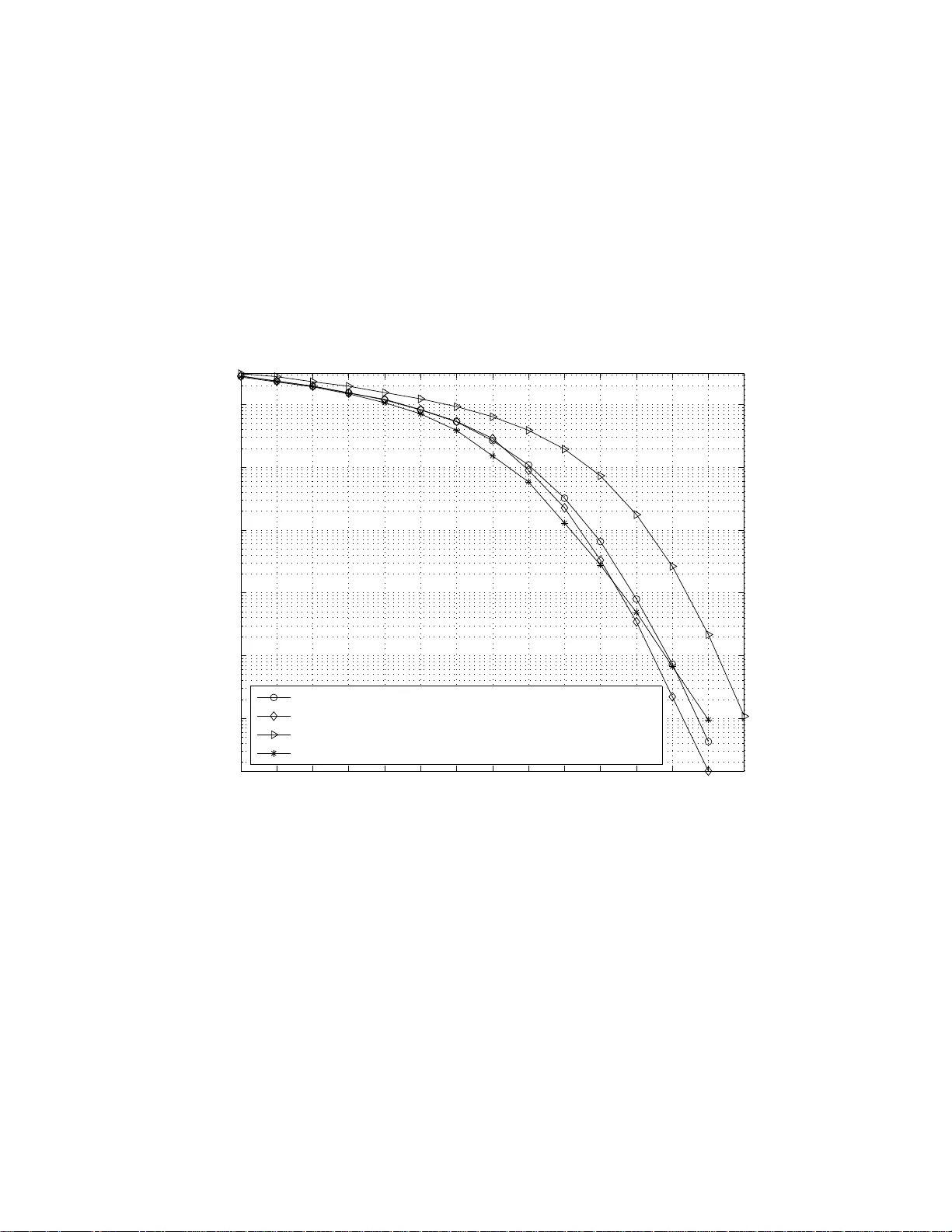
1 On Full Di v ersity Space-T ime Block Codes with P artial Interfer ence Cancella tion Grou p Decoding Xiaoyong Guo and Xiang-G en Xia Abstract In this pap er , we propose a partial inter ference cancellation (PIC) gr oup decoding for linear d isper- si ve sp ace-time block co des (STBC) and a design criterio n fo r the code s to achieve full diversity when the PIC group dec oding is used at the r eceiv er . A PIC group deco ding decode s the symbols embe dded in an STBC by dividing them into se veral groups and decoding each grou p separately after a linear PIC operation is implemented. It can be viewed as an intermed iate decoding between the maximum likelihood (ML) receiver th at decodes all the embedd ed symbols together, i.e., all the embedded symbols are in a sing le gro up, and th e zero- forcing (ZF) re cei ver that d ecodes all the embedd ed sy mbols separately and indepen dently , i.e., each grou p has an d only has one em bedded sym bol, after the ZF o peration is imple mented. The PIC group decoding provides a f ramework to adju st the com plexity-perfo rmance tradeoff by cho osing the sizes of the infor mation symb ol gr oups. Our pro posed d esign criter ion ( group indepen dence) for the PIC group deco ding to ach ie ve full diversity is an intermediate condition between the loo sest ML full ran k criter ion o f cod ew ords a nd th e strong est Z F line ar indepen dence co ndition of the colu mn vector s in the equiv alent ch annel matrix. W e also prop ose asymp totic optimal (A O) gro up decodin g algorithm wh ich is an interme diate decoding betwee n the MMSE decod ing algorithm and the ML deco ding algor ithm. The design cr iterion f or the PIC group decoding can be app lied to the A O group de coding algor ithm too. It is well-kn own that the symbo l rate fo r a fu ll rank lin ear STBC c an be full, i. e., n t for n t transmit an tennas. It has be en rece ntly shown th at its rate is upp er boun ded by 1 if a co de achiev es full d iv ersity with a linear receiver . The in termediate criterion prop osed in this pap er provides the possibility for cod es of rates between n t and 1 that ach iev e full di versity with a PIC group decodin g. T his theref ore provides a co mplexity-perf ormance-rate tr adeoff. Som e design examp les are giv en. The authors are with the Department of E lectrical and Computer Engineering, Univ ersity of Del aw are, Newark , DE 19716, USA (e-mail: { guo,xxia } @ee.ude l.edu). This wo rk was supported in part by the Air Force Office of Scientific Research (AFOSR) under Grant No. F A9550-0 8-1-0219 and the National Science Foundation under Grant CCR-0325180. Nov ember 3, 2021 DRAFT 2 Index T erms full d i versity , g roup decod ing, linear dispersion codes, par tial interfe rence cancellation, space- time block codes, zero-fo rcing, I . I N T R O D U C T I O N MIMO technolog y is an important advancement in wireless commun ications since i t offer s significant increase in channel capacity and communication reliabili ty withou t requiring addi- tional bandwidth or transmiss ion power . Space-time coding is an effecti ve way t o explore the promising potential of an MIMO system. In the coherent scenario, where the channel state information (CSI) is av ailable at t he receive r , the full rank design criterion is deriv ed in [13], [37] t o achieve the maximum diversity order in a quasi -static Rayleigh fading channel. Howev er , the deriv ation of the full rank crit erion is based on the assum ption of the o ptimal decoding at the receiver . In order to achiev e the maximum div ersity order , recei ved signals m ust be decoded using the maxim um li kelihood (ML) decoding . Unfort unately , the computat ional compl exity of the ML decoding grows exponentially with the number of the embedded informati on symbols in the codew ord. This often makes the ML decoding infeasible for codes with many i nformation symbols embedded in. Although near -optimal decoding algorit hms, such as sp here decoding or lattice-reduction-aided sphere decoding, exist in the literature, [4], [5], [26], [27], [42], their complexities m ay depend on a chann el condition. In o rder to significantly reduce th e decoding complexity , one m ay decode one symbol at a time and make t he decodi ng com plexity grow linearly wi th the num ber of the embedded information sym bols. This can be achiev ed by passing the receive d signals t hrough a l inear filter , which strengthens a main sym bol and suppresses al l t he oth er int erference symb ols and then one decodes the mai n sy mbol from the o utput of the filter . By passing the received signal through a filter bank, one can d ecode each symbol separately . There are diff erent crit eria to strengthen the main symbol and suppress the interference symbols . If the filter is designed to completely eliminate the interferences from the other symbols, we call such decodi ng method zer o-forc ing (ZF) or interfer ence nulling decodi ng. If the filt er is designed according t o the minimum mean square error (MM SE) criterion, we call the decoding m ethod MMSE decoding. The well known algorith ms with the abov e idea are BLAST -SI C algorithms [45]. Since these symbol-by-sym bol decoding methods may not be M L but only subopti mal, th e fu ll rank criterion Nov ember 3, 2021 DRAFT 3 can not guarantee the codes to achieve t he maximum dive rsity order . In some special cases, the symbol-by-sym bol decoding is equiv alent to t he M L decoding and t hus the full rank prop erty ensures th e codes achiev e full div ersity in t hese cases. The first such a code is the Alamouti code for t wo transmit antennas [1]. The orthogonal structure of the Al amouti code ensures that symbol-by-sym bol decoding i s equiv alent to the ML decoding. The Alamouti code has inspired many st udies on orthogonal STBC (OSTBC) [22], [23], [25], [36], [38], [44]. Howe ver , OSTBC suffe rs from a low sy mbol rate. In [44], i t has been proved that t he symbol rate of an OSTBC is u pper -bounded by 3 / 4 with or withou t linear p rocessing among the em bedded in formation symbols or their com plex conjugates for more than 2 transm it antennas and conjectured that i t is upper bounded by k +1 2 k for 2 k − 1 and 2 k transmit antennas, where k is a positive integer (this upper bound was shown in [22 ] when no linear processi ng is used among inform ation symbols). Explicit designs of OSTBCs with rates achieving the conjectured upper bou nd hav e been given in [22], [25], [36]. Not e that the rate only approaches to 1 / 2 when the nu mber o f transm it antennas goes large . For a general linear dispersio n STBC [14 ], [15 ] t hat has no orthogonal structure, the full div ersity criterion for STBC decoded with a symbo l-by-symbol decoding metho d has not been discovered unti l recently . In [48], Zhang-Liu-W on g propo sed a family of STBC called T oeplitz codes and proved that a T oeplitz cod e achieves ful l diversity wi th the ZF recei ver . The symbol rate of a T oeplitz code app roaches 1 as t he block length goes to infinity . Later in [32], Shang-Xia extended the result in [48 ] and proposed a d esign criterion for the codes achie ving full diversity with ZF and MMSE recei vers. They also proposed a new family of STBC called overlapped Alamouti codes (O A C) , which has better performance than T o eplitz codes for any number o f transmit antennas. The s ymbol rate o f an OA C also approaches to 1 as the block length go es to infinity . It has been proved in [32] that t he sy mbol rate of an STBC achieving full div ersity with a li near receiv er i s up per -bounded by 1 . Simul ation results in [32 ] show that O AC outperform O STBC for over 4 transmit antennas. Note th at it is shown i n [32] that for any OSTBC, its MMSE/ZF receiv er is the same as the ML receiv er . Although OSTBCs can be o ptimally d ecoded in a symbol-by-sy mbol way , the orthogonalit y condition is too restrictive as we mentioned above . From an information theoretical point of view , thi s can cause a significant loss of channel capacity [30 ]. By relaxing the orthogonality condition on the code matrix, q uasi-orthogonal STBC (QOSTBC) was introduced by Jafarkhani in [16], Tirkk onen-Boariu-Hottinen in [40] and Papadias-Foschini in [30] t o i mprove the sym bol Nov ember 3, 2021 DRAFT 4 rate at the tradeoff o f a higher decoding compl exity . The basic idea of QOSTBC is t o group the column vectors in the code mat rix into pairs and keep t he ortho gonality among t he group s of the column vectors while relax t he ort hogonality requirement wi thin each group. Because of this partial orthog onality structure, QOSTBC can be (ML) decoded pair-by-pair com plex symbols, which h as a hi gher decoding complexity com pared to the OSTBC. The original QOSTBCs d o not possess t he full diversity property . The idea of rotating information symbols in a QOSTBC to achie ve full dive rsity and maintain the complex sym bol pair-wise ML decodin g has appeared independently in [34], [35], [39], and t he opt imal rotation angles π / 4 and π / 6 of th e above mentioned informat ion s ymbols for any si gnal constellations on square lattices and equal-literal triangular lattices, respectively , hav e been obtained in Su-Xia [35] in the sense that the div ersity products (coding gains) are maxim ized. In [19], [43], [46], the authors furth er studi ed QOSTBC with minimu m decoding com plexity . The underlying cons tellation i s ass umed to be rectangular QAM, which can be viewe d as two P AM constell ations. The m inimum decoding compl exity means the code can b e opti mally decoded in a real-pair-wise way . Compared t o t he complex- pair- wise d ecodable QOSTBC, the decodi ng complexity of real-pair-wise decodable QOSTBC is lower . In [7], [17], [18], [21], [43], [47], the pair-by-pair decoding was generalized to a general group-by-group decodin g. The sym bols in a code mat rix are separated into sev eral groups and each group is decoded separately . W ith t he help of graph theory , a rate 5 4 code was obtained i n [47] that can be decoded in two groups, each group con tains 5 real sy mbols. In [17], [18], a Cliff ord algebra approach is appli ed for m ulti-group decodable STBCs. In this paper , we propose a general decoding scheme called partial in terference cancellati on (PIC) group decoding algorit hm for linear dispersion (complex conjugated symbols may be embedded) space-time block codes (STBC ) [14], [15]. A PIC group decoding decodes the symbols emb edded in an STBC by dividing them into sev eral groups and decoding each group separately after a linear PIC operation is im plemented. It can be viewed as an int ermediate decoding between the ML recei ver t hat decodes all the embedded symbo ls together , i .e., all embedded s ymbols are in a singl e group, and the ZF receiv er that decodes all the embedded symbols separately and independently , i.e., each group has and only has one embedded symbol , after the ZF operation is implemented. The PIC g roup decodi ng provides a framew ork to adjust the complexity-performance tradeoff by choos ing the sizes of th e information symbol groups. It contains the previously s tudied decodin g algorithms for codes such as OSTBC [1], [38], Nov ember 3, 2021 DRAFT 5 QOSTBC [16], [19], [34 ], [35], [40], [43], [46], and STBC achieving full diversity with linear recei vers [32], [48] as special cases. W e propose a design criterion for STBC achie ving full div ersity wit h the PIC decoding algo rithm. Our proposed design criterion is an intermediate criterion between the loosest M L full rank criterion [13], [37] of codewords and t he strongest ZF linear independence criterio n of the column vectors in the equiv alent channel matrix [32]. W e then propose asym ptotic opti mal (A O) group d ecoding algorithm which is an interm ediate decoding between th e MMSE decodi ng algorithm and the ML decoding algorithm. The design criterion for the PIC group decoding can be appl ied to th e A O grou p d ecoding algorit hm because of its asymptotic op timality . It is well-known that t he symbol rate for a full rank linear STBC can be ful l, i.e., n t for n t transmit antennas. It has been recently shown in [32] that its rate is upper bounded by 1 if a code achie ves full div ersity wit h a linear receiv er . The intermediate criterion proposed in this paper p rovides t he possibi lity for codes of rates between n t and 1 that achiev e full div ersity wit h the PIC group decoding . This t herefore provides a com plexity- performance-rate tradeoff. Design examples of STBC achie ving full d iv ersity with the PIC group decoding are finally presented. Our simul ations show that these codes can perform better than the Alamouti code for 2 transmit antennas and the QOSTBC with the optimal rot ation for 4 transmit ant ennas. Not e that a similar algorithm and an STBC design ha ve been proposed lately in [28] but they do not achiev e full diversity . This paper is organized as follows. In Section II, we describe the sy stem m odel; in Section III, we propo se the PIC group decodi ng algorit hm, its connection with ZF decoding algorithm and the correspondi ng successive i nterference cancellation (SIC) aided decoding algorithm o r PIC-SIC ; In Section IV, we s ystematically s tudy t he div ersity property of the codes decoded with the PIC group decoding and the PIC-SIC group d ecoding, and derive the design criterion. In Section V, we propose A O group decoding. In Section VI, we present two design examples. In Section VII, we present some sim ulation resul ts. Some no tations in this paper are defined as follows. • C : complex num ber field; • R : real number field; • A : a signal constellati on; • tr: trace of a matrix ; • Bold faced up per -case letters such as A A A represent matrices; Nov ember 3, 2021 DRAFT 6 • Bold faced lower- case letters such as x represent colum n vectors; • Superscripts T , H , ∗ : transpose, complex conjugate t ranspose, complex conj ugate, respec- tiv ely; • k·k : l 2 -norm for a vector; • k·k F : Frobenius norm for a matrix; • i : √ − 1 . I I . S Y S T E M M O D E L W e consider a quasi-static Rayleigh bl ock-fading channel wit h coherence time t . Assu me there are n t transmit and n r recei ve ant ennas. The channel model is written as follows, Y Y Y = r SNR n t H H H X X X + W W W , (1) where Y Y Y = ( y i,j ) ∈ C n r × t is the recei ved s ignal matrix that is recei ved in t t ime slots , H H H = ( h i,j ) ∈ C n r × n t is the channel m atrix, the ent ries of H H H are assumed i.i.d. with distribution C N (0 , 1) , X X X ∈ C n t × t is the codeword m atrix that is normalized so th at its avera ge energy is tn t , i.e., tr E X X X H X X X = tn t , W W W ∈ C n r × t is the additive whit e Gaussian noise matrix with i.i.d. entries w i,j ∼ C N (0 , 1) , SNR is the av erage signal-to-noise-ratio (SNR) at the receiv er . In thi s paper , we only consider l inear dispersi on STBC, whi ch covers most existing STBCs, [14]: X X X = n − 1 X i =0 x i A A A i + x ∗ i B B B i , (2) where x i ∈ A , i = 0 , 1 , . . . , n − 1 , are the embedded informat ion sym bols, A is a signal constellation, A A A i , B B B i ∈ C n t × t , i = 0 , 1 , . . . , n − 1 , are constant m atrices called dispersion matrices. W e use X t o denote the codebook, i.e., X = ( X X X = n − 1 X i =0 x i A A A i + x ∗ i B B B i , x i ∈ A , i = 0 , 1 , . . . , n − 1 ) . (3) For con venience, we also use X t o denote the coding scheme that is associated with the codebook. In order to apply a linear operation, the s ystem m odel i n (1) needs to be rewritten as y = √ SNR G G G x + w , (4) Nov ember 3, 2021 DRAFT 7 where y ∈ C tn r is the recei ved signal vector , G G G ∈ C tn r × n is an equivalent channel ma- trix [14], [15], [32]; x = [ x 0 , x 1 , . . . , x n − 1 ] T ∈ A n is the informatio n symbol vector; w = [ w 0 , w 1 , . . . , w tn r ] T ∈ C tn r is the additiv e white Gaussian noise, w i ∼ C N (0 , 1) . For many (if not all) existing linear dispersi on (or linear lattice) STBCs, such as those in [1], [2], [9]–[11], [15], [16], [20], [29], [31], [32], [35], th e channel m odel can be rewr itten in the form of (4). One simple observation is that for a lin ear d ispersion STBC that is defined as X X X = n − 1 X i =0 x i A A A i , (5) which is a s pecial case of th e linear dis persion STBC in (2), the channel model can always be written in the form of (4). All th e codes in [2], [9]–[11], [15], [20], [29], [31] fall into this category . Another case i n which the channel model can be re written in the form of (4) is that each col umn of X X X contains linear combi nations of eit her only x i , i = 0 , 1 , . . . , n − 1 or only x ∗ i , i = 0 , 1 , . . . , n − 1 . E xamples o f such codes include the Alamouti code [1] and QOSTBCs [16], [35] and OA C [32]. For instance, the channel m odel of the Alamouti code wi th one recei ve antenna is h y 0 , 0 y 0 , 1 i = r SNR 2 h h 0 , 0 h 0 , 1 i x 0 − x ∗ 1 x 1 x ∗ 0 + h w 0 , 0 w 0 , 1 i . By taki ng unitary linear operations and conjugations, which do not change the probabilistic property of the white Gaussian noise, we can extract t he embedded information sym bol vector and rewrite the above channel model as follows, y 0 , 0 y ∗ 0 , 1 = √ SNR 1 √ 2 h 0 , 0 h 0 , 1 h ∗ 0 , 1 − h ∗ 0 , 0 x 0 x 1 + w 0 , 0 w ∗ 0 , 1 . (6) It is shown in [32] that for any OSTBC (a column may include both x i and x ∗ j simultaneous ly), its equiv alent channel (4) exists. In t he case when there are multipl e receive antennas, an equiv alent channel matrix can be deriv ed by noting that at each recei ver antenna, the received sign al m odel is o f the same form as in (6). For example, if th ere are two receiv e antennas for the Al amouti code, then an equiv alent channel m odel i s y 0 , 0 y ∗ 0 , 1 y 1 , 0 y ∗ 1 , 1 = √ SNR 1 √ 2 h 0 , 0 h 0 , 1 h ∗ 0 , 1 − h ∗ 0 , 0 h 1 , 0 h 1 , 1 h ∗ 1 , 1 − h ∗ 1 , 0 x 0 x 1 + w 0 , 0 w ∗ 0 , 1 w 1 , 0 w ∗ 1 , 1 . Nov ember 3, 2021 DRAFT 8 It is no t hard to see that the original channel H H H and an equivalent channel G G G satisfy the following property , k H H H ( X X X 1 − X X X 2 ) k F = k G G G ( x 1 − x 2 ) k , (7) where X X X 1 , X X X 2 ∈ X , x 1 and x 2 are vectors of i nformation s ymbols embedded in X X X 1 and X X X 2 , respectiv ely . For a linear disp ersion code with a rectangular signal constellat ion A , which can be vi e wed as two P AM constellations , if it does not have its equivalent chann el model in (4), the channel model can always be wri tten in t he following form [6], [14], y = √ SNR G G G Re ( x ) Im ( x ) + w , (8) where y ∈ R 2 tn r is the recei ved si gnal vector , G G G ∈ R 2 tn r × 2 n is the equivalent channel matrix , w = [ w 0 , w 1 , . . . , w 2 tn r ] T ∈ R 2 tn r is the real white Gaussian n oise vector , w i ∼ N ( 0 , 1 2 ) . The entries of Re ( x ) Im ( x ) can be viewed as dra w n from a P AM constellation. Hence there is no essential difference between the models in (4) and (8) except that the nois e in (8) is real. Note that for both channel models in (4) and (8), the entries of the equiv alent channel matrix G G G are li near combinations of h i,j and h ∗ i,j , 0 ≤ i ≤ n r − 1 , 0 ≤ j ≤ n t − 1 . If we use the notation h = [ h 0 , h 1 , . . . , h l − 1 ] , v ec( H H H ) , then bot h (4) and (8) are special cases of the foll o wing model, y = √ SNR G G G ( h ) x + w , (9) where G G G ( h ) ∈ C m × n is an equi valent channel matrix, which is a function of h = [ h 0 , h 1 , . . . , h l − 1 ] , h i ∼ C N (0 , 1) , x = [ x 0 , x 1 , . . . , x n − 1 ] ∈ A n is the information symbo l vector , w = [ w 0 , . . . , w m − 1 ] is the add itiv e white Gaus sian noise vector . For con venience, we always assume that nois e w is complex Gaus sian, while for real Gaussian w , t he deriv ation is exactly the same. From the following di scussions, we shall see lat er that not onl y the channel mod el in (9) contains the equiv alent channel m odel d eri ved from transforming the original channel model of linear dispersion STBC in (1), but als o it is a resulted form after each PIC operation. Nov ember 3, 2021 DRAFT 9 I I I . P I C G RO U P D E C O D I N G A L G O R I T H M In this s ection, we p resent a PIC group decoding algorithm that is, as we mentioned before, an intermediate decoding algorit hm between the ML decodi ng algorithm and the ZF decoding algorithm, and has the ML decoding and the ZF d ecoding as two special cases. In the first subsection, we describe the PIC group decoding algorithm; in the s econd s ubsection, we discuss its conn ection with the ZF decoding algorit hm; in the third subsection, we discuss th e successive interference cancellati on aided PIC group d ecoding algorith m (PIC-SIC); some examples are giv en in t he last part of this section to illust rate the PIC group decoding algorithm. A. P artial Interf er ence Cancellation Gr oup Decoding Alg orithm W e n o w present a detailed descriptio n of the PIC group decoding algorithm . All the following discussions are based on the equiv alent channel model in (9). First let us introdu ce some notations. Define index set I as I = { 0 , 1 , 2 , . . . , n − 1 } , where n is the num ber of informat ion sym bols i n x . First we partition I into N group s: I 0 , I 1 , . . . , I N − 1 . Each index subset I k can be writt en as fol lows, I k = { i k , 0 , i k , 1 , . . . , i k ,n k − 1 } , k = 0 , 1 , . . . , N − 1 , where n k , |I k | is the cardinality of the subset I k . W e call I = {I 0 , I 1 , . . . , I N − 1 } a grouping scheme, where, for sim plicity , we still use I to denote a grouping scheme. For s uch a grouping scheme, the following two equations must hold, I = N − 1 [ i =0 I i and N − 1 X i =0 n i = n. Define x I k as the informati on symb ol vector that contains the symbols with indices in I k , i.e., x I k = h x i k, 0 , x i k, 1 , . . . , x i k,n k − 1 i T . Let t he column vectors of an equiv alent channel matrix G G G ( h ) be g g g 0 , g g g 1 , . . . , g g g n − 1 that have s ize m × 1 . Then, we can similarly define G G G I k as G G G I k = h g g g i k, 0 , g g g i k, 1 , . . . , g g g i k,n k − 1 i . (10) Nov ember 3, 2021 DRAFT 10 W ith these no tations, equ ation (9) can be written as y = √ SNR N − 1 X i =0 G G G I i x I i + w . (11) Suppose we want to decode the k -th symbol group x I k . Note that in the ZF decoding algorithm , to decode the k -th s ymbol, the interferences from the o ther symbols are completely eliminated by a li near filter (the k -th row of the pseudo-in verse matrix of the equiv alent channel). The same idea can be applied h ere. W e want to find a matrix (linear filter) P P P I k such t hat by multi plying y by P P P I k to the left (linear filtering), al l the interferences from the other symbol groups can be eliminated. Such a matrix P P P I k can be found as fol lows. Define Q Q Q I k ∈ C m × m as the projection matrix that projects a vector in C m to the subspace V I k that is defined as V I k = span { g g g i , 0 ≤ i < n, i 6∈ I k } . (12) Let G G G c I k ∈ C m × ( n − n k ) denote t he matrix that is obtain ed by removing the colum n vectors in G G G with indices in I k , i.e., G G G c I k = G G G I 0 , G G G I 1 , . . . , G G G I k − 1 , G G G I k +1 , . . . , G G G I N − 1 . (13) Then, the projection matrix Q Q Q I k can be expressed in terms of G G G c I k as follows, Q Q Q I k = G G G c I k G G G c I k H G G G c I k − 1 G G G c I k H , (14) where we ass ume G G G c I k is full column rank. If G G G c I k is not full column rank, then we need to pick a m aximal linear independent vector group from G G G c I k and furt hermore, in t his case the sym bols in group I k can not be solved, which is out off t he scope of t his paper . Thus, we alw ays assume that G G G c I k has full column rank. Define P P P I k as P P P I k = I I I m − Q Q Q I k , (15) then P P P I k is th e projection m atrix that projects a vector in C m onto the orthogonal com plementary subspace V ⊥ I k . Since the projection of any vector in V I k onto V ⊥ I k is a zero vector , we have P P P I k G G G I i = 0 , i = 0 , 1 , . . . , k − 1 , k + 1 , . . . , N − 1 , (16) which is due to P P P I k G G G c I k = 0 . Define z I k , P P P I k y . By applyi ng (16), we get z I k = √ SNR P P P I k N − 1 X i =0 G G G I i x I i + P P P I k w = √ SNR P P P I k G G G I k x I k + P P P I k w . (17) Nov ember 3, 2021 DRAFT 11 From (17), we can see that by passing the received signal vector y through the li near filt er P P P I k , the int erferences from the other symb ol groups are completely canceled and the output z I k only contain s the components of the sym bol group x I k . There may exist ot her matrices that can remove the components of the int erference symbol group s in y . Th e following lemma shows that the linear filter matri x P P P I k defined above is the best choice. Lemma 1. Consider the channel model in (11) and let SNR be the SNR of the system. Suppo se we want to detect the symbol g r oup x I k . Let P I k be the matr ix set that cont ains all the mat rices that can cancel the interf er ences fr om x I i , 0 ≤ i < N , i 6 = k , i. e., P I k = n ˜ P P P I k ˜ P P P I k G G G I i = 0 , 0 ≤ i < N , i 6 = k o . (18) The block err or pr obabi lity of the system ˜ z I k , ˜ P P P I k y = √ SNR ˜ P P P I k G G G I k x I k + ˜ P P P I k w (19) fr om ML decoding is denoted as P err ( ˜ P P P I k , SNR ) . Then for any given SNR , we always have P P P I k = arg min ˜ P P P I k ∈P I k P err ( ˜ P P P I k , SNR ) , wher e P P P I k is defined as in (15) . A pro of of this lemma is given in Appendix A. Notice that since i n our PIC g roup decoding, all the symbols in a group are decoded together , using highest SNR as the optim ality m ay not be prop er . This is the reason why in the above lemma, block error probability is used as the criterion for the opt imality of a filter . E quation (17) can be viewe d as a channel mo del in which x I k is the transmitted signal vector and z I k is the receiv ed signal vector . As we mention ed before i n Section II, t his channel model is derive d from the interference cancellation procedure, and fits into t he general channel mo del in (9). Note that in (17), the noise t erm P P P I k w is no long er a white Gauss ian n oise. Despite of the presence of this non-whi te Gaussi an noise term, the foll owing lem ma shows that the m inimum distance decision is still the ML decisi on in t his case. Lemma 2. Consider t he channel model y = √ SNR G G G x + ˜ w , (20) Nov ember 3, 2021 DRAFT 12 wher e G G G ∈ C m × n is the channel matrix that is known at the r eceiver , x ∈ A n is the info rmation symbol vector , ˜ w = P P P w ∈ C m , w is the whit e Gaussian noise vector and P P P ∈ C m × m is a pr ojectio n matrix that pr oj ects a vector in C m to a subspace V ⊂ C m . Assume the column vectors of G G G belong to V . Then, the decision made b y ˆ x = arg min ¯ x ∈A n y − √ SNR G G G ¯ x is the ML decision. An int uitive e xplanation for the above lemma i s that ˜ w is a degenerated white Gaussian no ise, which can be a wh ite G aussian noise by removing some extra dimensions. It s detai led proo f is giv en in Appendix B. According to Lemma 2, the optimal detectio n of x I k from z I k is made by ˆ x I k = arg min ¯ x ∈A n k z I k − √ SNR P P P I k G G G I k ¯ x , (21) which is th e PIC group decoding algor ithm we propose in this paper . The comp lexity o f the ML decoding of the di mension-reduced s ystem in (17) i s obviously lower t han that of the original system in (11). The PIC group decodin g alg orithm (21 ) can be viewed as a decompos ition of the origi nal hi gh-dimensional decoding problem with high com plexity into low-dimensional decoding problem wi th relatively low decoding com plexity . In the extreme case when al l the symbols are grouped together , i .e., the problem is not decomposed at all , t he PIC grou p d ecoding is the s ame as t he ML decodin g. In another extreme case when each sy mbol forms a group, i.e., the problem is com pletely decomposed, the PIC group decoding is equivalent to t he ZF decoding. The detailed description of the connection between these two is given in the following subsection. B. Connection Between PIC Gr oup Decoding and ZF Decoding In t his subsection we discuss the connection between the PIC grou p decodi ng al gorithm and the Z F decoding algorithm. In the case when t he decodin g problem is comp letely decompos ed, i.e., each sym bol group contains only one s ymbol, the PIC group decoding algorithm becomes a symbol-by-sy mbol decoding algorithm . The group ing scheme i n th is case is I = {I 0 , I 1 , . . . , I n − 1 } = {{ 0 } , { 1 } , . . . , { n − 1 }} , where I i = { i } , 0 ≤ i ≤ n − 1 . T o simplify the notations , we u se i to denote I i in this special case, hence P P P i = P P P I i . All t he other notations with I i as t he subscript can be si milarly defined. Nov ember 3, 2021 DRAFT 13 Furthermore, we hav e x i = x i = x I i , g g g i = G G G i = G G G I i . From the PIC g roup decoding algorithm (21), the ML decision of x k from z k is made by ˆ x k = arg min ¯ x k ∈A z k − √ SNR P P P k g g g k ¯ x k 2 (22) = arg min ¯ x k ∈A ( P P P k g g g k )( P P P k g g g k ) H k P P P k g g g k k 2 z k − √ SNR P P P k g g g k ¯ x k + I I I − ( P P P k g g g k )( P P P k g g g k ) H k P P P k g g g k k 2 z k 2 . (23) It i s easy to verify that in (23) the last term is orthogo nal to the first two terms , thus the above decision-making rule can be rewritten as ˆ x k = arg min ¯ x k ∈A ( P P P k g g g k )( P P P k g g g k ) H k P P P k g g g k k 2 z k − √ SNR P P P k g g g k ¯ x k 2 + I I I − ( P P P k g g g k )( P P P k g g g k ) H k P P P k g g g k k 2 z k 2 ! = arg min ¯ x k ∈A √ SNR P P P k g g g k ( P P P k g g g k ) H √ SNR k P P P k g g g k k 2 z k − ¯ x k ! 2 = arg min ¯ x k ∈A ( P P P k g g g k ) H √ SNR k P P P k g g g k k 2 z k − ¯ x k = arg min ¯ x k ∈A ( P P P k g g g k ) H P P P k √ SNR k P P P k g g g k k 2 y − ¯ x k = arg min ¯ x k ∈A ( P P P k g g g k ) H √ SNR k P P P k g g g k k 2 y − ¯ x k . The last equality is th e result of th e Hermitian p roperty and t he idempotent p roperty of the projection matrix, i.e., P P P H k = P P P k and P P P 2 k = P P P k . Note that ( P P P k g g g k ) H k P P P k g g g k k 2 ! g g g k = g g g H k P P P k g g g k g g g H k P P P k P P P H k g g g k = 1 , and by applying (16) we have ( P P P k g g g k ) H k P P P k g g g k k 2 ! g g g i = g g g H k ( P P P k g g g i ) g g g H k P P P k P P P H k g g g k = 0 . The above two equations im ply that ( P P P k g g g k ) H k P P P k g g g k k 2 is the k -t h row of G G G ( h ) H G G G ( h ) − 1 G G G ( h ) H . T hus, in the comp lete decompositi on case, the PIC group decoding algorit hm is equivalent to the Z F decoding algorithm. One negative ef fect of the int erference cancellation procedure is t hat i t may reduce the power gain of the symbol x k . Before t he interference cancellation, the power gain of x k is k g g g k k 2 , Nov ember 3, 2021 DRAFT 14 while after th e interference cancellation , the power gain of x k becomes k P P P k g g g k k 2 . Since P P P k is a projection matrix, we always have k P P P k g g g k k ≤ k g g g k k . The equality holds if and only if g g g k is orthogon al to the space spanned by g g g i , i = 0 , 1 , . . . , k − 1 , k + 1 , . . . , n − 1 . In the case of OSTBC, the colum ns of th e equiv alent channel are orth ogonal to each o ther , and therefore, there is no power gain loss during the interference cancellation. Hence t he performance of the ZF receiv er is the same as the ML receiv er for OSTBC. For all non-orthogonal STBC, an interference cancellation algorithm usually causes a power gain loss and therefore performance loss compared to the M L decodi ng. C. PIC-SIC G r oup Decoding Algori thm Notice that i n the ZF d ecoding algorithm , we may use s uccessive interfer ence cancell ation (SIC) strategy to aid the decoding process. W e call the SIC-aided ZF decoding alg orithm ZF- SIC decoding a lgorithm [41], [45]. T he basic idea of SIC is simple: remove th e already-decoded symbols from th e received signals t o reduce t he int erferences. When the SNR is relativ el y high, the symbol error rate (SER) of the already-decoded sym bols is low and there is a considerable SER performance gain by using the SIC strategy . The same strategy can also be used to aid the PIC group decodi ng process to im prove the SER performance. W e call th e SIC-aided PIC group decoding algorithm PIC-SIC gr ou p decoding a lgorithm . In the PIC group decoding algorithm , the d ecoding order has no ef fect on the SER performance. For the PIC-SIC g roup decodi ng algorithm, differ ent decodin g orders will result in different SER performances. W e can obtai n a better performance by choosing a proper decoding order . One si mple way to determine the decoding order is to use maximu m SNR as th e criterion t o arrange t he decoding order , sim ilar to BLAST ordered SIC algorit hm. Suppose the ordered s ymbol sets are as follows, x I i 0 , x I i 1 , . . . , x I i N − 1 . (24) The ordered PIC-SIC group decoding algorithm i s t hen: 1) Decode the first set of sym bols x I i 0 using the PIC group decodin g algo rithm (21); 2) Let k = 0 , y 0 = y , where y is defined as in (11); Nov ember 3, 2021 DRAFT 15 3) Remove the com ponents of the already-detected symbol set x I i k from (11), y k +1 , y k − √ SNR G G G I i k x I i k = √ SNR N − 1 X j = k +1 G G G I i j x I i j + w ; (25) 4) Decode x I i k +1 in (25) using the PIC group decodi ng al gorithm; 5) If k < N − 1 , then set k := k + 1 , go to Step 3; otherwise stop the algorithm . Remark 1. For the PIC g roup decoding algorithm, t he equiva lent channel matrix G G G ( h ) ∈ C m × n must sat isfy the condition V I k ( C m , ot herwise z I k = 0 , i .e., there is no information left in z I k about x I k . This requirement is generally weaker than that of the ZF decoding, which requires that m ≥ n . For example, consider an uncoded MIMO system with 5 transmit antennas and 4 recei ve antennas. In this case, the ZF receiv er can not decode the received signals, whil e the PIC group decoding with the grouping scheme I = {I 0 = { 0 , 1 , 2 } , I 1 = { 3 , 4 }} can do the decoding. Remark 2. For the PIC-SIC group decoding algo rithm, we require that at each decoding stage, V I k ( C m . This requi rement is even weaker than that of the PIC group decoding . Since we remove the interferences from t he already-decoded s ymbols, the subspace V I k shrinks each time when we finish decoding one symbol group. Consider the uncoded MIMO system in Remark 1. Let I = { I 0 = { 0 , 1 , 2 , 3 } , I 1 = { 4 }} be the groupi ng scheme. Then it is not possible t o decode the second group symbol x 4 with the PIC group decoding algorithm , because after we remove th e int erferences from x 0 , x 1 , x 2 , x 3 , t here is noth ing left ( z I 1 = 0 ) due to the lack of dimensionali ty . Howev er , we can decode x 4 with the PIC-SIC group decoding. D. Examples Next we give some examples to ill ustrate t he PIC g roup decoding algorithm . 1) Example 1: Consider the Al amouti code with one receive antenna. The equiva lent chann el matrix can be written as G G G = [ g g g 0 , g g g 1 ] , where g g g 0 = 1 √ 2 h 0 h ∗ 1 , g g g 1 = 1 √ 2 h 1 − h ∗ 0 . Nov ember 3, 2021 DRAFT 16 The grouping scheme is I = {I 0 , I 1 } = {{ 0 } , { 1 }} . By a direct comput ation, we get the projection matrix P P P 0 as fol lows, P P P 0 = 1 | h 0 | 2 + | h 1 | 2 | h 0 | 2 h 0 h 1 h ∗ 0 h ∗ 1 | h 1 | 2 . Then, the optimal detection of x 0 is ˆ x 0 = arg min ¯ x 0 ∈A P P P 0 y − √ SNR P P P 0 g g g 0 ¯ x 0 = arg min ¯ x 0 ∈A h ∗ 0 y 0 + h 1 y 1 − r SNR 2 | h 0 | 2 + | h 1 | 2 ¯ x 0 , which is the sam e as the optimal detection formula derived in [1]. Simi larly , the optimal detection for x 1 is ˆ x 1 = arg min ¯ x 1 ∈A h ∗ 1 y 0 − h 0 y 1 − r SNR 2 | h 0 | 2 + | h 1 | 2 ¯ x 1 . 2) Example 2: Consi der the quasi-orthogonal STBC prop osed i n [40]. The code has the following form, X X X = x 0 − x ∗ 1 x 2 − x ∗ 3 x 1 x ∗ 0 x 3 x ∗ 2 x 2 − x ∗ 3 x 0 − x ∗ 1 x 3 x ∗ 2 x 1 x ∗ 0 . Suppose we use one receiv e ant enna. The equiv alent channel matrix G G G ( h ) can be writ ten as G G G = [ g g g 0 , g g g 1 , g g g 2 , g g g 3 ] , where g g g 0 = 1 2 h 0 h ∗ 1 h 2 h ∗ 3 , g g g 1 = 1 2 h 1 − h ∗ 0 h 3 − h ∗ 2 , g g g 2 = 1 2 h 2 h ∗ 3 h 3 h ∗ 1 , g g g 3 = 1 2 h 3 − h ∗ 2 h 1 − h ∗ 0 . Let I 0 = { 0 , 2 } and I 1 = { 1 , 3 } . Then, the optim al detection of x I 0 is ˆ x I 0 = arg min ¯ x I 0 ∈A 2 P P P I 0 y − √ SNR P P P I 0 G G G I 0 ¯ x I 0 . (26) It is easy to verify that g g g 0 ⊥ g g g 1 , g g g 0 ⊥ g g g 3 , g g g 2 ⊥ g g g 1 , g g g 2 ⊥ g g g 3 , Nov ember 3, 2021 DRAFT 17 so V I 0 ⊥ V I 1 . This fact implies that P P P I 1 G G G I 0 = 0 . The decoding rule in (26) can be simplified as ˆ x I 0 = a r g min ¯ x I 0 ∈A 2 P P P I 0 y − √ SNR P P P I 0 G G G I 0 ¯ x I 0 + k P P P I 1 y k = a r g min ¯ x I 0 ∈A 2 P P P I 0 y − √ SNR P P P I 0 G G G I 0 ¯ x I 0 + P P P I 1 y − √ SNR P P P I 1 G G G I 0 ¯ x I 0 = a r g min ¯ x I 0 ∈A 2 y − √ SNR G G G I 0 ¯ x I 0 . The decoding rule of x I 1 can be simil arly deriv ed, ˆ x I 1 = arg min ¯ x I 1 ∈A 2 y − √ SNR G G G I 1 ¯ x I 1 . From the above equations, we can see that if the groups are orthogonal to each other , t hen the decompositio n of the syst em i s easy: just to pick up th e column vectors correspon ding to a group in G G G ( h ) and get a new equ iv alent channel matrix, t hen use this new channel matrix and the receiv ed sign al y to d o the M L decoding. In this case, no linear filt ering is needed in t he PIC group decoding and the M L decodi ng and the PIC group decoding are the same. 3) Example 3 : Consider the 3 by 8 overlapped Alamout i code in [32], X X X = x ∗ 0 0 x ∗ 2 x 1 x ∗ 4 x 3 0 x 5 0 x 0 − x ∗ 1 x 2 − x ∗ 3 x 4 − x ∗ 5 0 0 x ∗ 1 x 0 x ∗ 3 x 2 x ∗ 5 x 4 0 . An equiv alent channel matrix can be writt en as G G G = h g g g 0 g g g 1 g g g 2 g g g 3 g g g 4 g g g 5 i = 1 √ 3 h ∗ 0 0 0 0 0 0 h 1 h 2 0 0 0 0 h ∗ 2 − h ∗ 1 h ∗ 0 0 0 0 0 h 0 h 1 h 2 0 0 0 0 h ∗ 2 − h ∗ 1 h ∗ 0 0 0 0 0 h 0 h 1 h 2 0 0 0 0 h ∗ 2 − h ∗ 1 0 0 0 0 0 h 0 . Let the grouping scheme be I = { I 0 = { 0 , 2 , 4 } , I 1 = { 1 , 3 , 5 }} . It is easy to verify that g g g i ⊥ g g g j , i = 0 , 2 , 4 , j = 1 , 3 , 5 . Nov ember 3, 2021 DRAFT 18 Similar t o Example 2 , the syst em can be decomposed into two systems without performance degrading. For g eneral overlapped Alamouti codes, if we choose the grou ping scheme as I = {I 0 = { 0 , 2 , 4 , . . . , n − 2 } , I 1 = { 1 , 3 , 5 , . . . , n − 1 }} , n ev en , I = {I 0 = { 0 , 2 , 4 , . . . , n − 1 } , I 1 = { 1 , 3 , 5 , . . . , n − 2 }} , n odd . then the system can always be decomposed into two systems without performance degrading. This property i s the reason why ove rlapped Alamouti codes perform bet ter than T oeplitz codes, since the interference comes from onl y hal f of t he symbols. I V . F U L L D I V E R S I T Y C R I T E R I O N F O R P I C A N D P I C - S I C G RO U P D E C O D I N G S In this section, we propose a desi gn crit erion for linear dispersion STBC to achieve full div ersity wi th t he PIC and the PIC-SIC group decodings. A. Notations and Definiti ons For con venience, let us first int roduce so me notatio ns and definitions. Let S be a su bset of the complex num ber field C , we define the difference set ∆ S as fol lows, ∆ S = { a − ˜ a, a, ˜ a ∈ S } . W e also introduce the following definition, which can be viewe d as an extension of the con ven- tional linear independence concept. Definition 1. Let S be a subset of C and v i ∈ C m , i = 0 , 1 , . . . , n − 1 , be n complex vectors. V ectors v 0 , v 1 , . . . , v n − 1 ar e called linearly dependent over S if ther e e xist a 0 , a 1 , . . . , a n − 1 ∈ S so that a 0 v 0 + a 1 v 1 + · · · + a n − 1 v n − 1 = 0 , (27) wher e a 0 , a 1 , . . . , a n − 1 ar e not all zero; ot herwise, vectors v 0 , v 1 , . . . , v n − 1 ar e called l inear independent over S . For dive rsity order , the foll owing definiti on i s known. Definition 2. Consider a communication system as described in (9) . The s ystem is said to achieve diversity order m if the symbol err or rate P P P SER ( SNR ) decays as t he in verse of the m -th power of SNR , i.e., P P P SER ( SNR ) ≤ c · SNR − m , Nov ember 3, 2021 DRAFT 19 wher e c > 0 is a con stant in dependent of SNR . The con ventional concepts of linear independence and orthogonality are defined among ve ctors. Next, we define them amon g vector groups. Definition 3. Let V = { v i ∈ C n , i = 0 , 1 , 2 , . . . , k − 1 } be a s et of vectors. V ector v k is said to be independent of V i f f or a ny a i ∈ C , i = 0 , 1 , . . . , k − 1 , v k − k − 1 X i =0 a i v i 6 = 0 . V ector v k is said to be ortho gonal to V if v k ⊥ v i , i = 0 , 1 , . . . , k − 1 . Definition 4. Let V 0 , V 1 , . . . , V n − 1 , V n be n + 1 gr oup s of vectors. V ector gr oup V n is said t o be independent of V 0 , V 1 , . . . , V n − 1 if every vector in V n is independent of S n − 1 i =0 V i . V ector gr oup V n is sai d to be orth ogonal to V 0 , V 1 , . . . , V n − 1 if every vector in V n is orthogonal to S n − 1 i =0 V i . V ector gr oups V 0 , V 1 , . . . , V n ar e s aid to be li nearly independent if for 0 ≤ k ≤ n , V k is independent of the r emainin g vector groups V 0 , V 1 , . . . , V k − 1 , V k +1 , . . . , V n . V ector gr oup s V 0 , V 1 , . . . , V n ar e said to be ort hogonal if for 0 ≤ k ≤ n , V k is orthogonal to the r emai ning vector groups V 0 , V 1 , . . . , V k − 1 , V k +1 , . . . , V n . In the remaini ng of thi s paper , for conv enience, a m atrix no tation such as G G G is als o used to denote the vector group that is composed of all the column vectors of G G G . B. Design Criteri on of STBC with the P IC Gr ou p Decoding In this subsection, we deriv e a design criterion of codes decoded wit h the PIC group decodi ng. First we introduce the following l emma, which giv es a sufficient conditi on to achie ve full di versity for the general channel model in (9) with the M L receiv er . Lemma 3. Consider a communication system modeled as in (9) . A is a signal constella tion used in the system. If t he channel matrix G G G ( h ) satisfies the follo wing i nequality , k G G G ( h )∆ x k 2 ≥ c · l − 1 X i =0 | h i | 2 k ∆ x k 2 , ∀ ∆ x ∈ ∆ A n , for some positi ve consta nt c , th en the system achieves di versity or der l with the ML r eceiver . Nov ember 3, 2021 DRAFT 20 The p roof of this lemma i s simp ly a matter of com putation of some integrals, which i s qu ite similar to t hose deriv ations in [13], [37]. A detail ed proof i s giv en in Ap pendix C. T o understand the meaning of Lemma 3, let us first define t he power gain for the channel mod el in (9). Definition 5. Consider the commun ication system modeled as in (9) . A is a signal constellati on used in the system. The power gai n of th e system is defined as P = min ∆ x ∈ ∆ A n k G G G ( h )∆ x k 2 k ∆ x k 2 . If the power gain P s atisfies t he following inequality , P ≥ c · l − 1 X i =0 | h i | 2 , for some positi ve consta nt c , th en we say th at t he system achieve s power gain or der l . From Lemma 3, on e can see that the diversity order is ensured by the above power gain order and it can be further interpreted as foll ows. Suppose that t here are two d if ferent symbol vectors x 0 , x 1 ∈ A n . The distance b etween the t wo symbol vectors is k ∆ x k , k x 0 − x 1 k . Assu me there is no noise in the channel, i.e., w = 0 , then after the symbol vectors pass throug h the channel, we get G G G ( h ) x 0 and G G G ( h ) x 1 . Now the distance between receiv ed signals G G G ( h ) x 0 and G G G ( h ) x 1 is k G G G ( h )∆ x k , wh ich is greater than √ P k ∆ x k , i.e., the channel “expanded” the distance betw een x 0 and x 1 by a factor of at least √ P . The expansion factor √ P determines t he div ersity order that can b e achiev ed. Lemma 3 tells us t hat if th e expansion factor √ P of t he symbol vector i s greater than c · P l − 1 i =0 | h i | 2 1 2 for some c > 0 , then diversity order l can be achieved. Not e that the power gain order can be viewed as a count of how many path gains summ ed up i n P . W e can rephrase Lemm a 3 sim ply as: if the power gain is a sum of l path gains, then the diversity order of the comm unication system in (9) is l . Next, w e present the main result of t his paper , wh ich characterizes the power gain order of a linear dispersion STBC decoded with the PIC and t he PIC-SIC group decoding algorithms . Theor em 1 (Main Theorem) . Let X be a linear dispersion STBC. Ther e ar e n t transmit an d n r r eceive antenna s. The channel ma trix is H H H ∈ C n r × n t . The rec eived signa l is decoded using the PIC gr ou p decoding with a gr ouping scheme {I 0 , I 1 , . . . , I N − 1 } . The equivalent channel is G G G ( h ) , wher e h = v ec( H H H ) = { h 0 , h 1 , . . . , h n r · n t − 1 } ∈ C n r · n t . Then, each of the follo wing Nov ember 3, 2021 DRAFT 21 dimension-r educed syst ems (i. e., the STBC with th e PIC gr oup decoding), z I k = P P P I k G G G I k x I k + P P P I k w , k = 0 , 1 , . . . , N − 1 , (28) has power gain or d er n r · n t if and only if the following two cond itions ar e sati sfied: • for any two differ ent codewor ds X X X , ˜ X X X ∈ X , ∆ X X X , X X X − ˜ X X X has the f ull rank property , i.e., the cod e X a chie ves f ull diversity with the ML r eceiver; • G G G I 0 , G G G I 1 , . . . , G G G I N − 1 defined in (10) fr om G G G = G G G ( h ) a r e linearly independent vector groups as long as h 6 = 0 . When the r eceived signals ar e decoded using the PIC-SIC group decoding with th e or dering (24), each dimension-r educed syst em derived duri ng the decoding pr ocess (i.e., the STBC with the PIC-SIC gr oup decoding ) has power gai n o r der n r · n t if and only if • for any two differ ent codewor ds X X X , ˜ X X X ∈ X , ∆ X X X , X X X − ˜ X X X has the f ull rank property , i.e., the cod e X a chie ves f ull diversity with the ML r eceiver; • at each decoding stage , G G G I i k , which corr esponds to the curre nt t o-be decoded s ymbol gr ou p x i k , a nd [ G G G I i k +1 , . . . , G G G I i N − 1 ] ar e l inearly independent vector gr oups as lon g as h 6 = 0 . W ith the above th eorem and the preceding discussion s on the relations hip bet ween diversity order and power gain order , th e two conditions in t he above theorem provide a criterion for a linear dispersion code to achiev e full dive rsity with the PIC group decoding. Let us see an example to use the above main theorem. Cons ider the rotated quasi -orthogonal scheme propo sed in [35] for a QAM signal constellation, where the code X X X has th e following structure, X X X = x 0 − x ∗ 1 αx 2 − α ∗ x ∗ 3 x 1 x ∗ 0 αx 3 α ∗ x ∗ 2 αx 2 − α ∗ x ∗ 3 x 0 − x ∗ 1 αx 3 α ∗ x ∗ 2 x 1 x ∗ 0 , α = exp i π 4 . (29) Suppose we use one receiv e antenna, the column vectors of t he equ iv alent channel G G G are as follows, g g g 0 = 1 2 h 0 h ∗ 1 h 2 h ∗ 3 , g g g 1 = 1 2 h 1 − h ∗ 0 h 3 − h ∗ 2 , g g g 2 = 1 2 αh 2 αh ∗ 3 αh 0 αh ∗ 1 , g g g 3 = 1 2 αh 3 − αh ∗ 2 αh 1 − αh ∗ 0 . (30) Nov ember 3, 2021 DRAFT 22 It has also been proved in [35] th at this code achie ves full div ersity with the M L receiv er , hence the first condition is sati sfied. Let the groupi ng schem e be {I 0 = { 0 , 2 } , I 1 = { 1 , 3 }} , t hen G G G I 0 and G G G I 1 are linearly independent. Thus , bot h cond itions are satisfied. Note that t he two grou ps are actuall y orthog onal, which means t hat ever y vector in G G G I 0 is o rthogonal to G G G I 1 and vice versa. Hence after the i nterference cancellation, there i s no po wer gain loss. In this case, the PIC group decoding is exactly the same as the ML receiver . C. Proof of the Main Theor em In order to prove the main theorem, let us first introd uce the fol lowing lemma. Lemma 4. Consider a communication system modeled as in (9) . A is a signal constella tion used in the system. If the equivalent channel matri x G G G ( h ) sat isfies the f ollowing two conditions: • scaling i n variance: 1 k h k G G G ( h ) = G G G h k h k ; (31) • the col umn vectors of G G G ( h ) ar e linearly independent over ∆ A for any 0 6 = h ∈ C l , then the s ystem h as power gain order l and thus achieves diversity or der l with the ML r eceiver . A proof is given in Appendix D. Note that if each ent ry of G G G ( h ) is a l inear combin ation of h 0 , h 1 , . . . , h l − 1 and h ∗ 0 , h ∗ 1 , . . . , h ∗ l − 1 , t hen th e scaling in variance (31) alwa ys holds. So we hav e the following corollary . Corollary 1. Consider a communication system modeled as in (9) . Each ent ry of G G G ( h ) is a linear combination of h 0 , h 1 , . . . , h l − 1 and h ∗ 0 , h ∗ 1 , . . . , h ∗ l − 1 . A is a signal constell ation used in the syst em. If th e column vectors of G G G ( h ) ar e linearly ind ependent over ∆ A for any 0 6 = h = [ h 0 , h 1 , . . . , h l − 1 ] T ∈ C l , then the system has po wer gain or der l thus achieves diversity or der l with the ML r eceiver . One m ay wonder for linear disp ersion STBC, whether the above condition is an equiv alent condition of the ful l rank criterion. The following t heorem gives a positive answer to this question. Theor em 2. Let X be a lin ear dis persion STBC. Let A be a signal constellat ion for the coding scheme X . Let G G G ( h ) be the equivalent channel of X and h and h 6 = 0 . Then X has th e full rank pr op erty if and onl y if the col umn vectors of G G G ( h ) ar e linearly independent over ∆ A . Nov ember 3, 2021 DRAFT 23 Its proof is in Appendix E. Now we are ready to prove the main theorem. The main idea is to prove t hat the d imension- reduced systems in (28) satis fy the two condit ions in Lemm a 4. 1) Sufficiency part: First we prove that the two condit ions in th e main th eorem are suffi cient conditions for codes to achiev e the full po wer gain with the PIC grou p decodin g algori thm. According to Theorem 2, th e first conditio n i s equ iv alent to that the column vectors of G G G ( h ) are linearly independent over ∆ A . Thi s furth er i mplies t hat t he colu mn vectors of G G G I k are linearly independent over ∆ A , i.e., for any a 0 , a 1 , . . . , a n k − 1 ∈ ∆ A , a j , j = 0 , 1 , . . . , n k − 1 , not all zero, we hav e n k − 1 X j =0 a j g g g i k,j 6 = 0 . (32) Since G G G I 0 , G G G I 1 , . . . , G G G I N − 1 are linearly independent , the column vectors g g g i k,j , j = 0 , 1 , . . . , n k − 1 , in G G G I k do n ot b elong 1 to the vector s pace V I k defined in (12). From (32) and the fact that g g g i k,j 6∈ V I k , we hav e Q Q Q I k n k − 1 X j =0 a j g g g i k,j ! 6 = n k − 1 X j =0 a j g g g i k,j . By applying the above inequality , we g et the following inequality , n k − 1 X j =0 a j P P P I k g g g i k,j = P P P I k n k − 1 X j =0 a j g g g i k,j ! = ( I I I m − Q Q Q I k ) n k − 1 X j =0 a j g g g i k,j 6 = 0 , i.e., the column vectors o f P P P I k G G G I k are also linearly independent over ∆ A . Now we prove that P P P I k G G G I k satisfies the scaling in variance (31) in Lemm a 4. Since both P P P I k and G G G I k are determined by the parameter vector h , for a clear exposition, we temporarily use P P P I k ( h ) to denote P P P I k and use G G G I k ( h ) to denote G G G I k . Then we hav e 1 k h k P P P I k ( h ) G G G I k ( h ) = P P P I k ( h ) 1 k h k G G G I k ( h ) = P P P I k ( h ) G G G I k h k h k = P P P I k h k h k G G G I k h k h k , 1 Here the linear independence over the whole comple x fiel d of the vector sets is needed /used and the l inear independe nce ov er ∆ A is not sufficient. Nov ember 3, 2021 DRAFT 24 where the second e quality hol ds since the entries in G G G I k are all linear combi nations of h 0 , h 1 , . . . , h n r · n t and h ∗ 0 , h ∗ 1 , . . . , h ∗ n r · n t , and the last equali ty holds si nce P P P I k ( h ) = P P P I k h k h k , which is a direct result from the d efinition of Q Q Q I k in (14) and the fact that P P P I k = I I I m − Q Q Q I k . Thus, the two condi tions in Lemma 4 are all satisfied and therefore for any k , t he dim ension- reduced system z I k = √ SNR ( P P P I k G G G I k ) x I k + P P P I k w , has power gain order n r · n t . Now l et us consi der the case when the recei ved signals are decoded with t he PIC-SIC grou p decoding. W e use the con ventional ass umption that the previous decoded symbols are correct. Thus, there is no error int roduced when we use these decoded symb ols to reduce the interferences from the receiv ed signals. Under this assumptio n, the PIC-SIC group decoding algorithm is alwa ys bett er than the PIC group decoding algorithm. T hus, the t wo con ditions are sufficient for the PIC-SIC case. 2) Necessity part: W e next prove that these two conditi ons are also necessary conditio ns. If G G G I k and G G G c I k = [ G G G I 0 , . . . , G G G I k − 1 , G G G I k +1 , . . . , G G G I N − 1 ] are not l inearly independent, i.e., there exists a column vector in G G G I k such that this vector b elongs to the subsp ace V I k . W i thout loss of generality , we assume this vector is g g g i k, 0 . In this case, we have P P P I k G G G I k = h 0 , P P P I k g g g i k, 1 , P P P I k g g g i k, 2 , . . . , P P P I k g g g i k,n k − 1 i . T ake ∆ x I k = [ a, 0 , 0 , . . . , 0] T ∈ ∆ A n k , where a ∈ ∆ A , a 6 = 0 , then we ha ve k P P P I k G G G I k ∆ x I k k = 0 , which contradicts with the condi tion that the systems in (28) h a ve p o wer gain order n r · n t . Thus, we m ust have t hat G G G I k is linearly independent of G G G c I k . Since k is an arbitrary integer number in [0 , N − 1 ] , G G G I 0 , G G G I 1 , . . . , G G G I N − 1 are l inearly in dependent. This proves that t he second condition in the main theorem m ust hold . Let ∆ x 6 = 0 ∈ ∆ A n and ∆ x I k , k = 0 , 1 , . . . , N − 1 , be the corresponding sub-vectors of ∆ x to the groupin g scheme. T hus, there i s at least one ∆ x I k 6 = 0 . W ithout loss o f generality , we Nov ember 3, 2021 DRAFT 25 assume ∆ x I 0 6 = 0 . Then, k G G G ( h )∆ x k 2 = G G G I 0 ∆ x I 0 + N − 1 X i =1 G G G I k ∆ x I k 2 = P P P I 0 G G G I 0 ∆ x I 0 + Q Q Q I 0 G G G I 0 ∆ x I 0 + N − 1 X i =1 G G G I k ∆ x I k 2 . Since P P P I 0 G G G I 0 ∆ x I 0 ∈ V ⊥ I 0 and Q Q Q I 0 G G G I 0 ∆ x I 0 + P N − 1 i =1 G G G I k ∆ x I k ∈ V I 0 , we hav e k G G G ( h )∆ x k 2 = k P P P I 0 G G G I 0 ∆ x I 0 k 2 + Q Q Q I 0 G G G I 0 ∆ x I 0 + N − 1 X i =1 G G G I k ∆ x I k 2 ≥ k P P P I 0 G G G I 0 ∆ x I 0 k 2 ≥ c · n r · n t − 1 X i =0 | h i | 2 ! k ∆ x I 0 k 2 > 0 , h 6 = 0 . Using Theorem 2, the first conditi on i n t he theorem is proved. In the case that the recei ved signals are decoded with the PIC -SIC group decoding, we assume the decoding o rder is I i 0 , I i 1 , . . . , I i N − 1 . Similar t o the above argument, we must h a ve that G G G I i 0 is linearly ind ependent of G G G I i 1 , G G G I i 2 , . . . , G G G I i N − 1 ; G G G I i 1 is linearly ind ependent of G G G I i 2 , G G G I i 3 , . . . , G G G I i N − 1 ; G G G I i 2 is linearly ind ependent of G G G I i 3 , G G G I i 4 , . . . , G G G I i N − 1 etc. So we hav e that G G G I i 0 , G G G I i 1 , . . . , G G G I i N − 1 are linearly independent . The proof of the first condition to be necessary is the same as the PIC case. T his completes our proof of the mai n th eorem. D. Connection with the Ful l R ank Criterion and the Shang-Xia Criterion In the case wh en th ere is only one group, then th e PIC group decoding algorit hm becomes the ML decoding. In this case the second condi tion can always be satisfied. Thus, our proposed design criterion in Theorem 1 is equiva lent to that of [13], [37]. W e now consider the symb ol-by-symbol group ing case of the PIC group decoding algorithm , which i s equiva lent to the ZF decoding algo rithm. In this case when each group contains only one symb ol, the second condition can be rephrased as: G G G ( h ) is a column full rank matrix for h 6 = 0 . Corollary 2. In the case of symbo l-by-symbol PIC gr oup decoding, i.e., eac h gr oup only contains one s ymbol, the design criterion in the main theor em is equivalent to the Shang-Xia criteri on Nov ember 3, 2021 DRAFT 26 pr opos ed in [32] , i.e., det G G G ( h ) H G G G ( h ) ≥ c k h k 2 n , h ∈ C l , wher e c is a constant independent of the channel h . Pr oof: Since we hav e that G G G ( h ) is full column rank for h 6 = 0 , t he following inequality must hold, det G G G ( h ) H G G G ( h ) > 0 , h 6 = 0 , Let us restrict the parameter h to the unit sp here, i.e., k h k = 1 . Not e that t he unit sph ere is a compact set , det G G G ( h ) H G G G ( h ) is a continuo us function of h . T here m ust exist a pos itiv e constant c > 0 such at det G G G ( h ) H G G G ( h ) > c, h 6 = 0 , as what is used in [48]. Generally , for h ∈ C l \ { 0 } , we have that det G G G h k h k H G G G h k h k ! > c, h 6 = 0 . (33) Since the entries of G G G ( h ) are linear combinat ions of h 0 , h 1 , . . . , h l − 1 and h ∗ 0 , h ∗ 1 , . . . , h ∗ l − 1 , in- equality (33) can be rewritten as det G G G ( h ) H G G G ( h ) k h k 2 > c, h 6 = 0 . (34) Thus, det G G G ( h ) H G G G ( h ) ≥ c k h k 2 n , h ∈ C l , (35) which is the Shang-Xia condition give n i n [32]. Thi s prove s that the criterion in Theorem 1 implies the Shang-Xia criterion in the case when all symbol s are in separate grou ps, i.e., the ZF recei ver . Since th e criterion in Theorem 1 is necessary and suffic ient, i t can be deriv ed from the Shang- Xia criterion too. In oth er words, the criterion in T heorem 1 is equiv alent to the Shang-Xia criterion in the case when the ZF receiver is used. Nov ember 3, 2021 DRAFT 27 E. Some Discussi ons From Theorem 1 and Theorem 2, it is in teresting to s ee that for a linear dispersion STBC (complex conjugates of sym bols may be em bedded) to achie ve full diversity: (i) the weakest criterion i s that the column vectors of the equiv alent channel matrix are linearly independ ent over a signal constellation A when t he ML receiv er is used, which is equiv alent t o the code full rank criterion known i n the literature; (ii) the strongest criterion (in t he sense of the simplest complex-symbol-wise decoding) is t hat the column vectors of th e equ iv alent channel matrix are linearly independent over t he whol e complex field when the ZF receiv er is used, which i s, in fact, weaker t han the orthogonali ty in the OSTBC case that is not necessary for achieving full div ersity wi th a linear receive r . In the case of the weakest criterion but t he optimal and the mo st complicated receiv er , i .e., M L receiv er , the s ymbol rate can be n t for n t transmit antennas. In the case of the strongest criterion but the simplest recei ver , i.e., lin ear recei ver , the sy mbol rate can not be above 1 [32]. Note that the rates of OSTBC approaches to 1 / 2 as the number of transmit antennas goes to infinity and are upper bounded by 3 / 4 for more than 2 transmit antennas [44]. By increasing the decoding complexity and improving a receiver as increasing the group s izes in our proposed PIC grou p d ecoding, the criterion to achieve ful l div ersity becomes weaker . The criterion for the PIC group decoding serves as a bridge between the strongest and the weakest criteria for the ZF and the ML receivers, respectively , and th e corresponding sym bol rates are expected between 1 and n t . The examples to be presented later in Section VI are some simp le examples to show t his rate-complexity tradeoff. V . A S Y M P T O T I C O P T I M A L G RO U P D E C O D I N G In th is section, we p ropose an asympt otic optima l (A O) g roup decodi ng algorithm , which can be viewed as an intermediate decoding between the ML decodi ng and t he MMSE decoding algorithms [3], [41]. A. Asymptotic Optimal Group Decoding A lgorithm Consider the channel m odel in (9). Suppose t he signals are decoded u sing a group decoding algorithm, and the group ing s cheme is I = {I 0 , I 1 , I 2 , . . . , I N − 1 } . As sume the sym bols are taken from a signal constellation A according to the uni form dis tribution. The optimal way t o Nov ember 3, 2021 DRAFT 28 decode x I k from the recei ved sig nals i s t o find ˆ x I k ∈ A n k such that ˆ x I k = arg max ¯ x I k ∈A n k P ( y | ¯ x I k ) . T o derive the decoding rule, let us first write (11) in the following form, y = √ SNR G G G I k x I k + √ SNR X 0 ≤ i ≤ N − 1 i 6 = k G G G I i x I i + w . (36) Note that except for the sym bol group x I k , all the other symb ols can be viewed as noi ses that interfere with x I k . Define the noise term w I k as w I k = √ SNR X 0 ≤ i ≤ N − 1 i 6 = k G G G I i x I i + w = √ SNR X i 6∈I k g g g i x i + w . (37) Then, we can write (36) as y = √ SNR G G G I k x I k + w I k . (38) The optimal decoding of x I k from the recei ved s ignal vector y depends on the distribution of the noise w I k , which is difficult to analyze in general. T o simpli fy the discussion, we assume that the noise w I k is Gaussian. Thi s assumpt ion is asymptoti cally true wh en the num ber of the interference sy mbols is large. Simil ar assumpt ion has been u sed in [24]. W e call the optimal result deriv ed un der this assu mption asymptotically optimal. Under the above assumption , the probabil ity d ensity function P ( y | ¯ x I k ) can be explicitly expressed and the opt imal decoding rule can be easily deri ved. First let us c ompute the cova riance matrix of the noise vector w I k : K K K I k = E w I k w H I k = I I I m + SNR X i 6∈I k g g g i g g g H i . Hence the probabilit y density functio n P ( y | ¯ x I k ) is as follows, P ( y | ¯ x I k ) = 1 π m | K K K I k | exp − y − √ SNR G G G I k x I k H K K K − 1 I k y − √ SNR G G G I k x I k . For the above equation, we can see t hat maximizi ng P ( y | ¯ x I k ) is equiv alent to mini mizing y − √ SNR G G G I k x I k H K K K − 1 I k y − √ SNR G G G I k x I k = K K K − 1 2 I k y − √ SNR G G G I k x I k 2 , Nov ember 3, 2021 DRAFT 29 where K K K − 1 2 I k is the square root of the matrix K K K − 1 I k . So the asymptoti c optimal decoding rule is ˆ x I k = arg max ¯ x I k ∈A n k K K K − 1 2 I k y − √ SNR G G G I k ¯ x I k . (39) When I = { I 0 } = {{ 0 , 1 , 2 , . . . , n − 1 }} , we only have one symbol group x I 0 , which contains all the sym bols. The variance of th e noise is K K K I 0 = I m . In t his case, the above decodin g rule can be simpli fied as ˆ x = ˆ x I 0 = arg max ¯ x ∈A n y − √ SNR G G G ( h ) ¯ x , which is the ML decodin g. B. Connection with the MMSE Decoding Now let us consid er t he symbol -by-symbol case of the A O group decoding algorithm . In this case, I = I 0 , I 1 , . . . , I n − 1 = {{ 0 } , { 1 } , . . . , { n − 1 }} . In the following discussi on, we use the simplified notation con vention introduced in III-B. Thus, we use K K K k instead of K K K I k to denote K K K k = I I I m + SNR X i 6 = k g g g i g g g H i . So the decoding rule is ˆ x I k = a r g max ¯ x k ∈A K K K − 1 2 k y − √ SNR g g g k ¯ x k = a r g max ¯ x k ∈A g g g H k K K K − 1 k y √ SNR g g g H k K K K k g g g k − ¯ x k . The term g g g H k K K K − 1 k y √ SNR g g g H k K K K k g g g k is the unbiased estim ator of x k . In this case, the A O group decoding algorithm is equiv alent to the unbi ased M MSE decoding [41]. By a proper scaling, we can get the MMSE estimator from g g g H k K K K − 1 k y √ SNR g g g H k K K K k g g g k [41]. Although the MMSE est imator is o ptimal with respect to the mean squared error , it may not b e optimal with respect to the symbol error probability and the unbiased MM SE m ay have a better performance [3]. C. A O-SIC Gr oup Decoding Alg orithm Similar to the PIC case, we can use the SIC technique to aid the A O group decoding process. The decoding order can be simply determined according to t he m aximum SINR criterion, wh ich is similar to the PIC-SIC case. Suppose the ordered s ymbol sets are x I i 0 , x I i 1 , . . . , x I i n − 1 . (40) Nov ember 3, 2021 DRAFT 30 The following is the A O-SIC group decoding algorithm : 1) Decode the first set of sym bols x I i 0 using the A O group decoding algorithm ; 2) Let k = 0 , y 0 = y , where y is defined as in (11); 3) Remove the com ponents of the already-detected symbol set x I i k from the (11), y k +1 , y k − √ SNR G G G I k x I i k = √ SNR N − 1 X j = k +1 G G G I i j x I i j + w ; (41) 4) Decode x I i k +1 in (41) using the A O group decoding algorith m; 5) If k < N − 1 , then set k := k + 1 , go to Step 3; otherwise stop the algorithm . V I . D E S I G N E X A M P L E S In this section, we present two desi gn examples that achie ve th e full div ersity conditions wit h pair- by-pair PIC group decodin g. A. Example 1 Consider a code for 2 transmit antennas wit h 3 time slots of the following form, X X X = cx 0 + sx 1 cx 2 + sx 3 0 0 − sx 0 + cx 1 − sx 2 + cx 3 , (42) where c = cos θ , s = sin θ , θ ∈ [0 , 2 π ) . T he symbol rate of this code is 4 3 . In the following, we show that this code can be decoded with pair-by-pair PIC grou p decoding. Theor em 3. Let A ⊂ Z [ i ] be a QAM signal constellation. L et I = {{ 0 , 1 } , { 2 , 3 }} be a gr ouping scheme fo r the P IC gr ou p decodi ng algorit hm. If tan θ 6∈ Q , t hen code X X X in (42) achieves ful l diversity us ing the PIC gr oup decoding algori thm with t he grouping scheme I . Pr oof: Firstly , we prove t hat the code given in (42) has full rank property for any A ⊂ Z [ i ] . In order to prove this, we only need to prove t hat for any x i ∈ Z [ i ] , i = 0 , 1 , 2 , 3 , which satisfies that x i not all equal to zero, X X X is full rank. Since tan θ 6∈ Q , equatio n cx 0 + sx 1 = 0 holds for x 0 , x 1 ∈ ∆ A if and only if x 0 = x 1 = 0 . Simi larly , equation − sx 2 + cx 3 = 0 hol ds for x 2 , x 3 ∈ ∆ A if and onl y if x 2 = x 3 = 0 . Next, we discuss two d iff erent cases. i). When x 0 and x 1 are not all equal to zero and x 2 and x 3 not all equal to zero, then cx 0 + sx 1 6 = 0 , − sx 2 + cx 3 6 = 0 . In thi s case, X X X is full rank; Nov ember 3, 2021 DRAFT 31 ii). When x 0 and x 1 are not all equal to zero but x 2 = x 3 = 0 , then X X X = cx 0 + sx 1 0 0 0 − sx 0 + cx 1 0 is full rank; sim ilarly , in the case when x 2 and x 3 are not all equal to zero but x 0 = x 1 = 0 , X X X is full rank too. So the code in (42) has full rank property . Next, we prove that t he code X X X satisfies t he second condition in the m ain theorem. Suppose there is only one receiv e antenna, the equiv alent channel can be written as [ g 0 , g 1 , g 2 , g 3 ] = ch 0 sh 0 0 0 − sh 1 ch 1 ch 0 sh 0 0 0 − sh 1 ch 1 , obviously g 0 and g 1 can not be expressed as a linear combi nation of g 2 , g 3 , and vice versa, when h 6 = 0 . Thus, [ g 0 , g 1 ] and [ g 2 , g 3 ] are l inearly in dependent, wh en h 6 = 0 . According to the main th eorem, th e code achiev es full diversity wi th the PIC decoding al gorithm p rovided that the grouping scheme is I = {{ 0 , 1 } , { 2 , 3 }} . B. Example 2 The fol lowing code is designed for 4 transm it antennas wi th 6 time slots. X X X = cx 0 + sx 1 − cx ∗ 2 − sx ∗ 3 cx 4 + sx 5 − cx ∗ 6 − sx ∗ 7 0 0 0 0 cx 0 + sx 1 − cx ∗ 2 − sx ∗ 3 cx 4 + sx 5 − cx ∗ 6 + sx ∗ 7 cx 2 + sx 3 cx ∗ 0 + sx ∗ 1 cx 6 + sx 7 cx ∗ 4 + sx ∗ 5 0 0 0 0 cx 2 + sx ∗ 3 cx ∗ 0 + sx ∗ 1 cx 6 + sx 7 cx ∗ 4 + sx ∗ 5 , (43) where c = cos θ , s = sin θ , θ ∈ [0 , 2 π ) . It can be proved that thi s code satisfies the t wo conditions giv en in t he m ain t heorem if the grouping scheme is I = {{ 0 , 1 } , { 2 , 3 } , { 4 , 5 } , { 6 , 7 }} . Theor em 4. Let A ⊂ Z [ i ] be a QAM signa l constellat ion. Let I = {{ 0 , 1 } , { 2 , 3 } , { 4 , 5 } , { 6 , 7 }} be a gr ouping sc h eme for the PIC gr oup algorithm. I f tan θ 6∈ Q , then the c ode X X X in (43) ac hieves full diversity using the PIC gr oup decoding alg orithm with the gr oupin g scheme I . Pr oof: The p roof is similar t o the 2 -transmit-antenn a case. First we prov e th at this code satisfies the full rank criterion. Thi s is easy t o verify just by l ooking into the code case by case as the pre vious proof. Nov ember 3, 2021 DRAFT 32 Next we p rov e that the second con dition in the main theorem also holds. In the case when there is only one receiv e antenna, the equiv alent channel matrix can be writt en as fol lows, G G G = [ g 0 , g 1 , g 2 , g 3 , g 4 , g 5 , g 6 , g 7 ] = ch 0 sh 0 ch 1 sh 1 0 0 0 0 ch ∗ 1 sh ∗ 1 − ch ∗ 0 − sh ∗ 0 0 0 0 0 − sh 2 ch 2 − sh 3 ch 3 ch 0 sh 0 ch 1 ch 1 − sh ∗ 3 ch ∗ 3 sh ∗ 2 − ch ∗ 2 ch ∗ 1 sh ∗ 1 − ch ∗ 0 − sh ∗ 0 0 0 0 0 − sh 2 ch 2 − sh 3 ch 3 0 0 0 0 − sh ∗ 3 ch ∗ 3 sh ∗ 2 − ch ∗ 2 . (44) Let h 6 = 0 . W e can see t hat [ g 0 , g 1 ] i s orthogo nal to [ g 2 , g 3 ] . V ector group [ g 0 , g 1 ] i s also lin early independent of g 4 , g 5 , g 6 , g 7 . Thus, [ g 0 , g 1 ] can not be expressed by any linear combination of the rest column vectors in G G G . A similar d iscussion can be appl ied t o t he other vector groups. Therefore, the second condit ion in the m ain t heorem als o holds. This completes the proof. V I I . S I M U L A T I O N In t his section , we present s ome simulation results. In all the simulati ons, the channel i s assumed quasi-static Rayleigh flat fading. First we choos e the rot ation angle θ for the cod es in (42) and (43) by numericall y esti mating t he coding gains of the codes for a series of values of θ . Here the coding gain C g is defined as C g = arg max ¯ C g ¯ C g P P P blockerr ( SNR ) ≤ 1 ¯ C g SNR − D g , (45) where D g is the diversity order . W e use M onte Carlo sim ulations to est imate the coding gains for diffe rent θ ’ s. As we can see from Fig. 1, t he peak value of C g is reached at two points: θ = 0 . 55 and θ = 1 . 02 . Interesti ngly enough, these two values of θ are very clos e t o 1 2 arctan(2) and π 2 − 1 2 arctan(2) , wh ich maximi ze t he coding gain of t he 2 × 2 diagonal code [41]. An int uitive explanation is that the code in (42) can be viewed as two diagonal codes stacked togeth er and e ven after the interference cancellation, θ = 1 2 arctan(2) and θ = π 2 − 1 2 arctan(2) still maxim ize the coding gain. In Fig 2, we compare o ur new code i n (42 ) for 2 transmit antennas with the Al amouti code for 2 transm it antennas, Golden cod e [2] for 2 transmit antennas, and the QOSTBC for 4 transmit antennas with the optim al r otation [35] and the sym bol-pairwise decoding. The number of recei ve Nov ember 3, 2021 DRAFT 33 antennas is 3 . The constell ation for our new code is 6 4 QAM. The constellation for t he Alamout i code and for the QOSTBC i s 256 QAM and for Golden code i s 16 QAM. Thus, in all schemes, the transmiss ion rate is 8 bits /sec/Hz. Th e PIC group decoding with group si ze 2 , i .e., sy mbol- pair- wise decoding, is used for our ne w code and Golden code d ecodings. Fig. 2 shows that our prop osed coding scheme is about 1 . 5 dB better than the Alamouti code and out performs the QOSTBC before SNR reaches 27 dB, w hile the PIC group decodi ng has hig her complexity t han the symbol -wise decoding for the Alamouti code but has similar complexity as the QOSTBC ML symbol-pair-wise decoding. For Golden code, sin ce i t is only ful l rank (although wit h non- vanishing determinant ), it d oes not achieve full diver sity when the PIC g roup decoding is used, which can be seen from Fig. 2. For th e 4 by 6 code in (43) for 4 transmit antennas, we compare it with t he QOSTBC with the optimal rotation [35] and Nguyen-Choi code [28]. The number of receiv e antennas is also 3 for all these codes. Our ne w coding scheme u ses a 64-QAM constell ation and t he QOSTBC uses a 256-QAM con stellation so that the bit rates for bot h schemes are 8 bit s/sec/Hz. For Nguyen-Choi code, the constell ation is 32-QAM (it i s obtained by deleti ng t he four corner poi nts from the 6 by 6 square QAM as what is commonly used) so t hat the bit rate is 7 . 5 bi ts/sec/Hz. W e use the PIC and PIC-SIC group decoding s for the new code, respectiv ely , and t he ML decoding for the QOSTBC, and the PIC-SIC group decoding for Nguyen-Choi code. In this case, all these decodings are symbol-pair-wise based. The simu lation results show that our new code with the PIC group decoding and the PIC-S IC group decoding is 2 . 3 dB and 2 . 8 dB better than the QOSTBC, respectiv ely . From Fig. 3, one can see that our new code d oes achiev e full div ersity as compared with t he ful l diversity QOSTBC and the diversity gain o f N guyen-Choi code is smaller than that of our new code. Note that the ov erlapped Alamouti codes proposed in [32], [33] with linear receivers may outperform all the other existin g codes with linear recei vers in the literature inclu ding perfect codes [11], [29] but do not outperform OSTBC or QOSTBC for the num ber of transmit antennas below 5 . V I I I . C O N C L U S I O N In this paper , we first prop osed a PIC group decodin g algorithm and an A O group decoding algorithm th at fill the gaps b etween th e ML decoding alg orithm and the sy mbol-by-symbo l linear Nov ember 3, 2021 DRAFT 34 decoding algorithms namely the ZF and the MMSE decoding algorithms, respectiv ely . W e also studied th eir corresponding SIC-aided decoding algorithms: the PIC-SIC and the A O-SIC group decoding algorit hms. W e then derived a design criterion for codes to achieve full diversity when they are decoded with the PIC, A O, PIC-S IC and A O-SIC group decoding algorithm s. The new deriv ed criterion is a group independence criterion for an equiv alent channel matrix and fills the gap between the loo sest full rank criterion for the ML recei ver and the s trongest linear independence criterion of t he equivalent channel m atrix for linear receiver s. Note that the full rank criterion is equiv alent to the loosest l inear independence for the column vectors of the equiv alent channel m atrix over a difference s et of a finit e signal constell ation while the strongest linear independence criterion is t he li near independence for the column vectors of the equiv alent channel matrix over the whole com plex field. The relaxed conditi on in the new design criterion for STBC to achiev e ful l diversity with the PIC group decodin g provides an STBC rate bridge between n t and 1 , where rate n t is the full symb ol rate for the ML recei ver and rate 1 is the symbol rate upper bound for linear receivers. Thus, it provides a trade-off between decoding complexity and symb ol rate when full diversity is required. W e finally presented two desi gn examples for 2 and 4 transmit antenn as of rate 4 / 3 that satis fy t he new desig n crit erion and thus they achieve full diversity wi th the PIC gro up decoding of group si ze 2 , i.e., comp lex-pair -wi se decoding. It tu rns out that they may out perform the well-known Alam outi code, Golden code, and QOSTBC. A P P E N D I X A P RO O F O F L E M M A 1 Pr oof: Writi ng P P P I k defined in (15) and an arbitrary matrix ˜ P P P I k ∈ P I k in the following forms, P P P I k = p T 0 , p T 1 , . . . , p T m − 1 T , ˜ P P P I k = ˜ p T 0 , ˜ p T 1 , . . . , ˜ p T m − 1 T , according to the d efinition of P I k in (18), we must have that p ∗ i , ˜ p ∗ i ∈ V ⊥ I k , i = 0 , 1 , . . . , m − 1 . Note that rank P P P ∗ I k = rank ( P P P I k ) = dim V ⊥ I k , which im plies that all the vectors in V ⊥ I k can be expressed as linear comb inations of p ∗ i , i = 0 , 1 , . . . , m − 1 . So t here must exist f ∗ i,j , 0 ≤ i, j < m , Nov ember 3, 2021 DRAFT 35 such that ˜ p ∗ i = m − 1 X i =0 f ∗ i,j p ∗ j , or in the matrix form we have ˜ P P P I k = F F F P P P I k , where the ( i, j ) -th ent ry of F F F i s f i,j . So ˜ P P P I k can be viewed as a concatenation of th e lin ear filt ers P P P I k and F F F . Substitut ing the above equation into (19), we get ˜ z I k = F F F ( P P P I k G G G I k x I k + P P P I k w ) = F F F z I k , (46) where z I k = P P P I k G G G I k x I k + P P P I k w . For an SNR , the optim al decoding of x I k from z I k is as follows, ˆ x I k = arg min ¯ x I k ∈A n k P ( z I k | ¯ x I k ) , and the optimal decoding of x I k from ˜ z I k is as follows, ˆ x I k = arg min ¯ x I k ∈A n k P ( F F F z I k | ¯ x I k ) . (47) Notice that any filtering m ay not help an ML decision . Therefore, for an SNR , we hav e P err ( P P P I k , SNR ) ≤ P err ( ˜ P P P I k , SNR ) , which completes the proof. A P P E N D I X B P RO O F O F L E M M A 2 Pr oof: Since P P P is a projectio n m atrix, P P P can be decom posed as P P P = U U U H D D DU U U , (48) where U U U ∈ C m × m is an unit ary matri x and D D D = I I I r × r 0 r × m − r 0 m − r × r 0 m − r × m − r , r = rank( P P P ) . (49) By multipl ying both sides of (20) by U U U to the left, we ha ve U U U y = U U U G G G x + D D DU U U w . (50) Since the column vectors of G G G b elong to V , G G G = P P P G G G , (50) can be writt en as U U U y = U U U P P P G G G x + D D DU U U w = D D DU U U G G G x + D D DU U U w (51) Nov ember 3, 2021 DRAFT 36 Note that the ef fect of mult iplying D D D to the left of a vector i s picking up the first r ent ries and setting the rest n − r entries t o zero. Hence from (51), we can see t hat onl y the first r entries of U U U y matter and all other entries are zeros. W e also hav e that the first r entries of D D DU U U w are i.i.d. Gaussian noise si nce U U U is un itary , the rest n − r entries are all zeros. Use [ v ] r to d enote the vector that contain s t he first r entries of v ∈ C m . Then, (51) is equiv alent to [ U U U y ] r = [ D D DU U U G G G x ] r + [ D D DU U U w ] r . (52) Since [ D D DU U U w ] r is a white Gaus sian noise, the ML decision is the same as the m inimum di stance decision for (52), i.e., ˆ x = arg min ¯ x ∈A k [ U U U y ] r − [ D D DU U U G G G ¯ x ] r k = arg min ¯ x ∈A k U U U y − D D DU U U G G G ¯ x k , (53) where the second equali ty holds because t he last n − r entries have n o ef fect on th e distance. Noting that U U U is an unitary matrix and G G G = P P P G G G , the above detection is equiva lent to ˆ x = arg min ¯ x ∈A n U U U H U U U y − U U U H D D DU U U G G G ¯ x = arg min ¯ x ∈A n k y − G G G ¯ x k . (54) Thus, we conclude that th e m inimum di stance d ecision in this case is equiv alent to the maxim um likelihood decisi on. A P P E N D I X C P R O O F O F L E M M A 3 Pr oof: For a g iv en h = [ h 0 , h 1 , . . . , h l − 1 ] T , and two sym bol vectors x , e x ∈ A n with x 6 = e x , the pairwise error probability P h ( x → e x ) with ML receiv er is as follows, P h ( x → e x ) = Q √ SNR k G G G ( h )∆ x k ≤ Q c · √ SNR l − 1 X i =0 | h i | 2 ! 1 2 k ∆ x k ≤ 1 2 exp − c 2 · SNR 2 l − 1 X i =0 | h i | 2 k ∆ x k 2 ! , (55) where the last in equality is obtained by app lying the well-known upper -bound for the Q -function, Q ( x ) ≤ 1 2 exp − x 2 2 . Nov ember 3, 2021 DRAFT 37 By taking expectation over h at both sides of (55), we get P ( x → e x ) = E h { P h ( x → e x ) } ≤ E h ( exp − c 2 · SNR 2 l − 1 X i =0 | h i | 2 k ∆ x k 2 !) . T o ev aluat e the above expectation, we us e E h exp( − a | h | 2 = 1 1 + a , h ∼ C N (0 , 1) , a > 0 , and note that t he expectation can be taken separately to each h i , which leads to the following result, P ( x → ˜ x ) ≤ 1 2 2 2 + c 2 SNR k ∆ x k 2 l < 2 l − 1 c 2 l k ∆ x k 2 l SNR − l . Since ∆ x ∈ ∆ A n and ∆ A n is a finite set, there exists a ∆ x 0 such that d min = k ∆ x 0 k = min {k ∆ x k , 0 6 = ∆ x ∈ ∆ A n } . Hence for any x , e x ∈ A n with x 6 = e x , we always have P ( x → ˜ x ) < 2 l − 1 ( c · d min ) 2 l SNR − l . The symbol error probability P SER ( SNR ) is upper-bounded by P SER ( SNR ) < 2 l − 1 ( |A| n − 1) ( c · d min ) 2 l SNR − l , i.e., the system achieve s the div ersity order l . A P P E N D I X D P RO O F O F L E M M A 4 Pr oof: For a giv en 0 6 = h ∈ C l and 0 6 = ∆ x ∈ ∆ A n k , since the colum n vectors of G G G ( h ) are linearly independent over ∆ A , G G G ( h )∆ x 6 = 0 , or k G G G ( h )∆ x k > 0 . (56) Now let u s consider a fixed ∆ x ∈ ∆ A n and restrict the parameter h to the unit sphere, i.e., k h k = 1 . Since t he uni t sphere is a compact set, from (56), for this ∆ x there mu st exist a constant c ∆ x > 0 such th at k G G G ( h )∆ x k ≥ c ∆ x . (57) Nov ember 3, 2021 DRAFT 38 For 0 6 = h ∈ C l , we always h a ve 1 k h k G G G ( h )∆ x = G G G h k h k ∆ x ≥ c ∆ x , (58) or k G G G ( h )∆ x k ≥ c ∆ x k h k = c ∆ x l − 1 X i =0 | h i | 2 ! 1 2 . (59) Since ∆ A n is a finite set, we can define c min and d max so that 0 < c min = min { c ∆ x , 0 6 = ∆ x ∈ ∆ A n } , (60) 0 < d max = max {k ∆ x k , ∆ x ∈ ∆ A n } . (61) Then k G G G ( h )∆ x k ≥ c min d max l − 1 X i =0 | h i | 2 ! 1 2 k ∆ x k = c l − 1 X i =0 | h i | 2 ! 1 2 k ∆ x k , ∀ ∆ x ∈ ∆ A n , h ∈ C l , (62) where c , c min d max . This completes the proof. A P P E N D I X E P RO O F O F T H E O R E M 2 Pr oof: Let H H H = ( h i,j ) ∈ C n t × n r be t he channel m atrix as in (1) and h = v ec ( H H H ) . Suppose X is an STBC that satis fies the ful l rank criterion, i.e., any matrix 0 6 = ∆ X X X ∈ ∆ X is a ful l rank matrix. Write ∆ X X X ∆ X X X H into the following decompositi on ∆ X X X ∆ X X X H = U U U D D DU U U H , (63) where U U U ∈ C n t × n t is an unit ary mat rix and D D D = diag( λ 0 , λ 1 , . . . , λ n t − 1 ) . Since ∆ X X X is a full rank matrix , λ min (∆ X X X ) , min { λ 0 , λ 1 , . . . , λ n t − 1 } > 0 . Note that ∆ X X X is a finite set, we can define λ min such that λ min = min { λ min (∆ X X X ) , 0 6 = ∆ X X X ∈ ∆ X } > 0 . (64) Nov ember 3, 2021 DRAFT 39 Hence we hav e k H H H ∆ X X X k 2 = tr H H H ∆ X X X ∆ X X X H H H H H = tr H H H U U U D D D ( H H H U U U ) H ≥ tr λ min H H H U U U ( H H H U U U ) H = λ min n r − 1 X i =0 n t − 1 X j =0 | h ij | 2 , ∀ H H H ∈ C n r × n t . (65) As (7) mentio ned in Section II, k H H H ∆ X X X k 2 can also be written as k H H H ∆ X X X k 2 = k G G G ( h )∆ x k 2 . (66) where ∆ x ∈ ∆ A n . By (65) and (66 ), we can see that for h 6 = 0 , G G G ( h )∆ x = 0 if and onl y if ∆ x = 0 , i .e., the column vectors of G G G ( h ) are linearly independent over ∆ A . W e now prove the necessity . Since X is a linear dispersion code, the scalin g inv ariance (31) is satisfied. If the column vectors of G G G ( h ) are linearly independ ent over ∆ A , th en according to Lemma 4, there exists a con stant c > 0 s uch that k H H H ∆ X X X k 2 = tr H H H ∆ X X X ∆ X X X H H H H H ≥ c k ∆ x k 2 n r − 1 X i =0 n t − 1 X j =0 | h ij | 2 , ∀ H H H ∈ C n r × n t . (67) Next we prove that the above i nequality impli es t hat the eigen values of ∆ X X X ∆ X X X H are all g reater than zero for ∆ X X X 6 = 0 . The un iqueness from th e decodablity of the STBC X tells us that ∆ X X X 6 = 0 i mplies ∆ x 6 = 0 . Cons ider the decompo sition (63) for ∆ X X X . If there is an eigen value λ k = 0 , then we can find an H H H ∈ C n r × n t such that H H H U U U = [ 0 , 0 , . . . , v , . . . , 0 ] , (68) where the k -th column vector v ∈ C n r can be arbitrary non-zero vector . The existence of su ch H H H 6 = 0 is ensured since U U U is in vertible. For th e H H H that satisfies (68), tr H H H ∆ X X X ∆ X X X H H H H H = tr H H H U U U D D D ( H H H U U U ) H = 0 , (69) which contradicts with the inequality i n (67). So we ha ve proved that all the eigen values of ∆ X X X ∆ X X X H must satisfy λ i > 0 , i.e., ∆ X X X is a full rank matrix. Nov ember 3, 2021 DRAFT 40 R E F E R E N C E S [1] S . M. Alamouti, “ A simple transmit div ersity technique for wireless communications, ” IEEE J. Select. Areas Commun. , vol. 16, pp. 1451–14 58, Oct. 1998. [2] J. -C. Belfiore, G. R ekaya, and E. V iterbo, “The Golden code: a 2 × 2 full-rate space-time code wi th non vanishing determinants, ” IEEE T rans. Inform. Theory , vol. 51, no. 4, pp. 1432–14 36, Apr . 2005. [3] J. M. Cioffi, G. P . Dudev oir, M. V . E yuboglu, and J. G. D. Forney , “MMSE decision-feedback equalizers and coding – Part I: Equalization results, ” IE EE T rans . I nform. Theory , vol. 43, no. 10, pp. 2582–2594 , Oct. 1995. [4] M. O. Damen, K. Abed-Meraim, and M. S. Lemdani, “Further results on the sphere decoder , ” in P r oc. IEE E. Int. Symp. Information Theory(ISIT’01) , W ashington, D.C., USA, 24-29 Jun. 2001. [5] O. Damen, A. Chk eif, and J.-C. Belfiore, “Lattice code decoder for space-time codes, ” IEE E Commun. Lett. , v ol. 4, no. 5, pp. 161–163, May 2000. [6] — —, “Lattice code decod er for space-time codes, ” IEEE Communication s Let ters , v ol. 4, no. 5, pp. 161–1 63, May 2000. [7] D. N. Dao, C. Y uen, C. T ellambura, Y . L. Guan, and T . T . Tjhung, “Four -group decodable semi-orthogonal algebraic space-time block codes, ” in IEEE W ir eless Communications and Networking C onfer ence (WCNC’07) , Hong Kon g, 11-15 March 2007, pp. 588–593. [8] — —, “Four-group decodable space-time block codes, ” IEEE T rans. Signal Pr ocessing , vol. 5, pp. 345–355, Jan. 2008. [9] P . Dayal and M. K. V aranasi, “ An algebraic family of comple x lattices for fading channels with application to space-time codes, ” IEEE T rans. Inform. Theory , vol. 51, no. 12, pp. 4184–4202 , Dec. 2005. [10] P . Elia, K. R. Kumar , S. A. P awa r , P . V . Kumar , and H.-F . Lu, “Exp licit space-time co des achie ving the di versity-multiplexing gain tradeoff, ” IEEE Tr ans. Inform. Theory , vol. 52, no. 9, pp. 3869–38 84, S ept. 2006. [11] P . E lia, B. A. Sethuraman, and P . V . Kumar , “P erfect space -time codes for any number of antennas, ” IEEE T rans. Inform. Theory , vol. 53, no. 11, pp. 3853–386 8, Nov . 2007. [12] G. Ganesan and P . Stoica, “Space-time block codes: a maximum SNR approach, ” IEEE Tr ans. Inform. Theory , vol. 47, no. 4, pp. 1650–16 56, May 2001. [13] J.-C . Guey , M. P . Fitz, M. R. Bell, and W .-Y . Kuo, “Signal design for transmitter div ersi ty wireless communication systems ov er R ayleigh fading channels, ” i n Proc. V ehicular T ech. Conf. , Atlanta, GA, Apr . 1996. [14] B. Hassibi and B. M. Hochwald, “High-rate codes that are l inear i n space and time, ” IEEE T rans. Inform. Theory , vol. 48, no. 7, pp. 1804–18 24, Jul. 2002. [15] J. R. W . Heath and A. J. Paulraj, “Linear dispersion codes f or MIMO systems based on frame theo ry , ” IEEE T rans. Signal Pr ocess. , vol. 50, no. 10, pp. 2429–2441, Oct. 2002. [16] H. Jafarkhani, “ A quasi-orthogon al space-time block codes, ” IEEE T rans. Commun. , vol. 49, no. 1, pp. 1–4, Jan. 2001. [17] S. Karmakar and B. S. Rajan, “Multigroup-decoda ble S TBCs from Clifford algebra, ” in IE EE Inform. Theory W orkshop (ITW’06) , Chengdu, China, Oct. 22-26 2006, pp. 448–452. [18] S. Karmakar and B . S. Rajan, “High-rate, multi -symbol-deco dable STB Cs f rom Clifford algebras, ” IEEE Tr ans. Inform. Theory , to appear . [19] Z. A. Khan and B . S. Rajan, “Single-symbol maximum-likeliho od decodable linear STBCs, ” IE EE T rans. Inform. Theory , vol. 52, no. 5, pp. 2062–2091 , May 2006. [20] Kiran T . and B. S. R ajan, “STBC-scheme wi th non vanishing determinant for certain number of transmit antennas, ” IEEE T rans. Inform. Theory , vol. 51, no. 8, pp. 2984–2992 , Aug. 2005. Nov ember 3, 2021 DRAFT 41 [21] G. S. Rajan and B. S Rajan, “Fou r group decoda ble differential scaled unitary linear space-time codes, ” in Pr oceedings of IEEE GLOB ECOM 2007 , W ashington D.C., USA , Nov . 26-30, 2007. [22] X.- B. Liang, “Ort hogona l designs wi th maximal rates, ” I EEE T rans. Inform. T heory , v ol. 49, no. 10, pp. 246 8–2503, Oct. 2003. [23] X.- B. L iang and X.-G. Xia, “On the none xistence of rate-one generalized complex orthogonal designs, ” IEEE T rans. Inform. Theory , vol. 49, no. 11, pp. 2984–2988, 2003. [24] J. Liu, J.-K. Zhang, and K. M. W ong, “On the design of minimum BER linear space-time block codes for MIM O systems equipped with MMSE receiv ers, ” IEEE T rans. Signal Pr ocessing , vol. 54, pp. 3147–3158, Aug. 2006. [25] K. Lu, S . Fu, and X.-G. Xia, “Closed-form designs of complex orthogonal space-time block codes of r ate (2 k + 1) / 2 k for 2 k − 1 or 2 k transmit antennas, ” IEEE T rans. Inform. Theory , vol. 51, no. 10, pp. 4340–4347 , Oct. 2005. [26] W . H. Mo w , “Maximum likelihood sequence estimation from the lattice viewp oint, ” IEEE T rans. I nform. Theory , vo l. 40, no. 5, pp. 1591–16 00, 1994. [27] —— , “Un iv ersal lattice deco ding: Principle and rece nt adv ances, ” W ir eless Communications a nd Mobile Compu ting, Special Issue on Coding and Its Applications in W ireless CDMA Systems , vol. 3, no. 5, pp. 553–56 9, Aug. 2003. [28] X. H. Nguyen and J. Choi, “Joint design of groupwise STBC and S IC based receiv er, ” IEE E Commun. Lett. , vol. 12, no. 2, pp. 115–117, Feb . 2008. [29] F . Oggier , G. Rekaya, J.-C. Belfiore, and E. V iterbo, “Perfect space ti me block codes, ” IEEE T rans. Inform. T heory , vol. 52, no. 9, pp. 3885–39 02, Sept. 2006. [30] C. B. Papadias and G. J. Foschini, “Capacity-approaching space-time codes for systems employ ing four transmitter antennas, ” IEEE Tr ans. Inform. Theory , vol. 49, no. 3, pp. 726–733, Mar . 2003. [31] B. A. Sethuraman, B. S . Rajan, and V . Shashidhar , “Full-div ersity , high-rate space-time block codes from division algebras, ” IEEE T rans. Inform. Theory , vol. 49, no. 10, pp. 2596–2616, Oct. 2003. [32] Y . Shang and X.-G. Xia, “ A criterion and design for space-time block code s achie ving full di versity with linear recei vers, ” in IEEE Int. Symp. Inform. Theory (ISIT’07) , Nice, F rance, Jun. 24-29, 2007, pp. 2906–2910 . It s longer version has been submitted to IEEE Tr ans. Inform. Theory , Feb. 2007. [33] Y . Shang and X.-G. Xia, “Overlapped Alamouti codes, ” in P r oc. IEEE Global Commun. Conf. (Globecom’07) , W ashington, D.C., USA, Nov . 26-30, 2007, pp. 2927–293 1. [34] N. Sharma and C. B. Papadias, “Improved quasi-orthogonal codes through constellation rotation, ” Pr of. WCNC 2002 , vol. 1, pp. 169-171, Mar . 2002. Also IEEE T rans. Commun. vol. 51, No. 3, pp. 332-335, 2003. [35] W . Su and X.-G . Xia, “Signal constellations for quasi-orthogonal space-time block codes wi th full diversity , ” IEEE T rans. Inform. Theory , vol. 50, no. 10, pp. 2331–2347, Oct. 2004. [36] W . Su, X.- G. Xia, and K. J. R. Liu, “ A systematic design of high-rate complex orthog onal space-time block codes, ” IEEE T rans. Inform. Theory , vol. 8, no. 6, pp. 4340–43 47, Jun. 2004. [37] V . T arokh, N. Seshadri, and A. R. Calderbank, “Space-time codes for high data rate wireless communications: Performance criterion and code construction, ” IEEE T rans. Inform. Theory , vol. 44, no. 2, pp. 744–76 5, Mar . 1998. [38] V . T arokh, H. Jafarkhani, and A. R. Calderbank, “Space-time block codes from orthogonal designs, ” IEE E T rans. Inform. Theory , vol. 45, no. 5, pp. 1456–1467, Jul. 1999. [39] O. Tirkk onen, “Optimizing space-time block codes by constellation rotations, ” Pr oc. Finnish W ireless Commun. W orkshop FWCW’01 , F inland, pp.59-60, Oct. 2001. Nov ember 3, 2021 DRAFT 42 [40] O. Tirkk onen, A . Boariu, and A. Hottinen, “Minimal non-orthogonality rate 1 space-time block code for 3-Tx antennas, ” in P r oc. IE EE 6th Int. Symp. on sprea d-spectrum T ech . and Appl. , Sept. 2000, pp. 429–432. [41] D. Tse and P . V iswanath, Fundamentals of W ir eless Communication . Cambridge Univ ersity Press, 2005. [42] E. Viterbo and J. Boutros, “ A univ ersal lattice code decoder for fading channels, ” IEEE T rans. Inform. Theory , vol. 45, no. 5, pp. 1639–16 42, Jul. 1999. [43] H. W ang, D. W ang, and X.- G. Xia, “On optimal quasi-orthogon al space-time block codes with minimum decoding complex ity , ” in IEEE Int. Symp. Inform. Theory (ISIT’05) , Adelaide, Australia, 4-9 Sept. 2005, pp. 1168–1172 . It s longer version is ava ilable via http: //www.ece.udel. edu/ ˜ xxia/paper_wwx.pdf . [44] H. W ang and X.-G. Xia, “Upper bounds of rates of comple x orthogon al space-time block codes, ” IEEE T rans. Inform. Theory , vol. 49, no. 10, pp. 2788–279 6, 2003. [45] P . W . W olniansky , G. J. Foschini, G. D. Golden, and R. A. V al enzuela, “V -BLAST: A high capacity space-time architecture for the rich-scattering wireless channel, ” in Pro c. International Symposium on Signals, Systems, and E lectr onics, ISSSE’98 , Pisa, It aly , Sept. 29 1998. [46] C. Y uen, Y . L. Guan, and T . T . Tjhung, “Quasi-orthogonal STBC with minimum decoding decoding complex ity , ” IEEE T rans. W ireless Commum. , vol. 4, pp. 2089–2094, Sept., 2005. [47] —— , “On the search for high-rate quasi-orthogonal space-time block code, ” in IEEE P IMRC , vol. 3, Barcelona, Spain, Sept 2004, pp. 1647–1651. [48] J.-K. Z hang, J. Liu, and K. M. W ong, “Linear T oeplitz space time block codes, ” in IEE E Int. Symp. Inform. Theory (ISIT’05) , Adelaide, Australia, 4-9 Sept. 2005, pp. 1942–1946. Nov ember 3, 2021 DRAFT 43 0.00 0.55 1.02 1.57 −34 −32 −30 −28 −26 −24 (0.55,−23.63) (1.02,−23.63) Rotation angle θ Estimated Coding Gain, 10log 10 C g , dB Fig. 1. Coding gain estimation for θ ∈ [0 , π 2 ) Nov ember 3, 2021 DRAFT 44 2 4 6 8 10 12 14 16 18 20 22 24 26 28 30 10 −5 10 −4 10 −3 10 −2 10 −1 SNR (dB) BER New Design, 2Tx, 3Rx, PIC group decoding Alamouti Code, 2Tx, 3Rx, ML decoding Su−Xia QOSTBC, 4Tx, 3Rx, ML decoding Golden Code, 2Tx, 3Rx, PIC group decoding Fig. 2. Performance comparison of severa l coding scheme and their bandwidth efficiencies are all 8 bits/sec/Hz Nov ember 3, 2021 DRAFT 45 2 4 6 8 10 12 14 16 18 20 22 24 26 28 30 10 −6 10 −5 10 −4 10 −3 10 −2 10 −1 SNR (dB) BER New Design, 4Tx, 3Rx, PIC group decoding, 8 bits/sec/Hz New Design, 4Tx, 3Rx, PIC−SIC group decoding, 8 bits/sec/Hz Su−Xia QOSTBC, 4Tx, 3Rx, ML decoding, 8 bits/sec/Hz Nguyen−Choi Code, 4Tx, 3Rx, PIC−SIC group decoding, 7.5 bits/sec/Hz Fig. 3. Performance comparison of severa l coding schemes for 4 transmit and 3 receiv e antennas Nov ember 3, 2021 DRAFT
Original Paper
Loading high-quality paper...
Comments & Academic Discussion
Loading comments...
Leave a Comment