Rateless Coding for MIMO Block Fading Channels
In this paper the performance limits and design principles of rateless codes over fading channels are studied. The diversity-multiplexing tradeoff (DMT) is used to analyze the system performance for all possible transmission rates. It is revealed fro…
Authors: Yijia Fan, Lifeng Lai, Elza Erkip
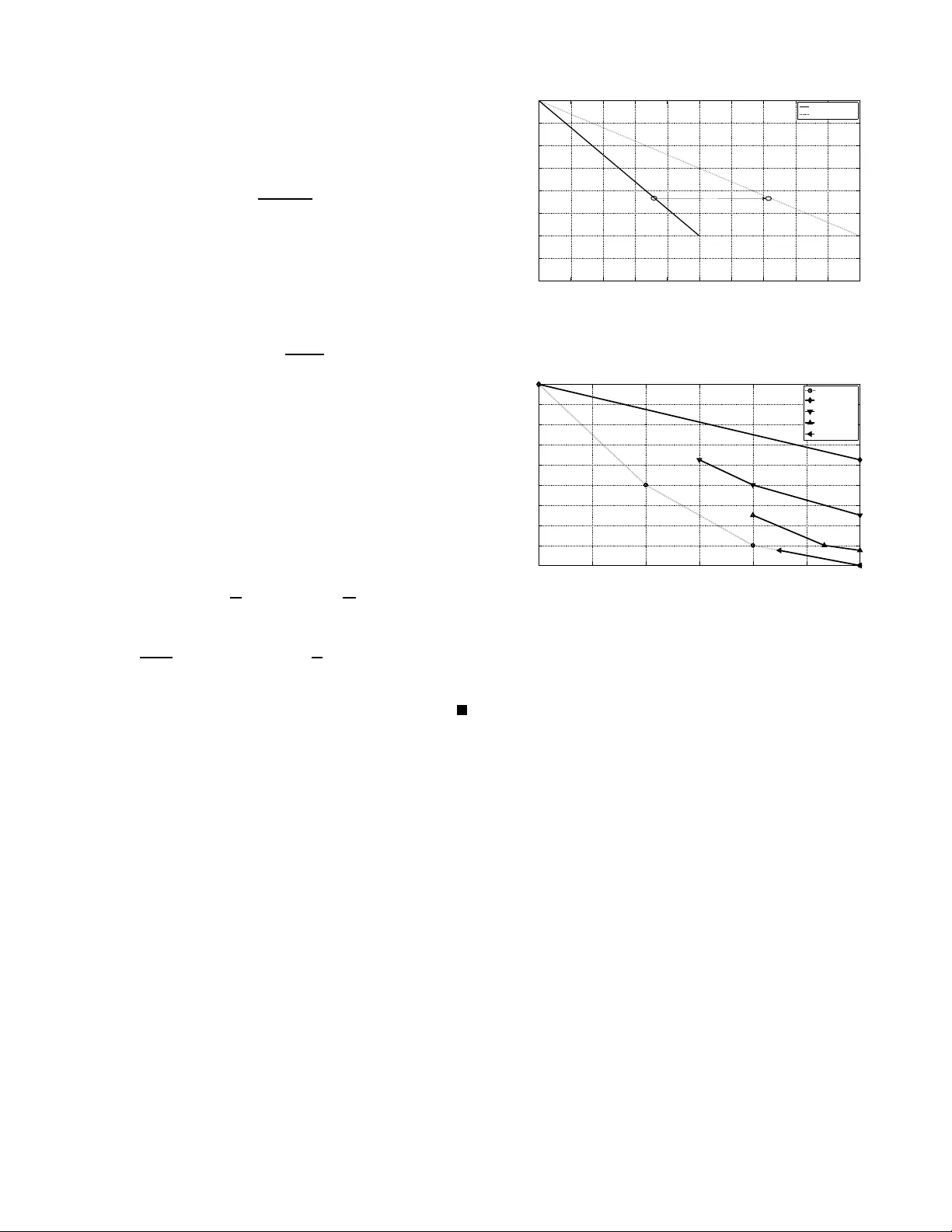
Ratele ss Coding for MIMO Block Fading Channels Y ijia Fan ∗ , Lifeng Lai ∗ , Elza Erkip ∗† , H. V incent Poor ∗ ∗ Departmen t of E lectrical En gineerin g, Princeton Un iv ersity , Princeton , NJ, 08544 , USA Email: { yijiafan,llai,po or } @prin ceton.edu † Departmen t of Electrical and Com puter En gineerin g, Polytechnic U niv ersity , Brooklyn, NY , 11201 , USA Email: elza@poly .ed u Abstract — In this paper the perfo rmance limits and design principles of rateless codes ov er f ading channels are studied. The diversity-multiplexing tradeoff (DMT) is used to analyze the system perfor mance for all possible transmission rates. It is re vea led from the analysis that the design of such rateless codes fo llows th e design principl e of app roximate ly un ive rsal codes fo r parallel multiple-i nput multiple-output (MIMO) channels, in which each sub-channel is a MIMO chan nel. More specifically , it is shown that f or a single-in put sin gle-output (SISO) channel, the prev iously dev eloped permutation codes of unit length fo r parallel channels ha ving rate LR can be transfor med directly in to rateless codes of len gth L having multip le rate lev els ( R, 2 R, . . . , LR ) , to achiev e th e DMT p erf ormance limit. I . I N T R O D U C T I O N A. Backgr ound Rateless codes present a class of codes that can be tr un- cated to a finite numb er o f lengths, each of which has a certain likelihood of being decod ed to r ecover th e entire message. Comp ared with co n ventional coding sche mes h aving a single rate R , such c odes can achieve multip le rate lev els ( R, 2 R, . . . , LR ) , d ependin g o n different ch annel co nditions. A rateless code is said to be perfect if ea ch part of its cod ew ord is capacity achieving. Compared with conventional codes, rateless co des offer a po tentially high er rate . Several resu lts have b een obtained on the de sign of perfect rateless cod es over erasure channels and additive white Gaussian noise (A WGN) channels (see [6 ] an d the re ferences the rein). Unlike in the fixed channel scena rio, non-ze ro err or proba - bility always exists in fading chan nels, when the instantaneous channel state info rmation (CSI) is no t av ailable at the trans- mitter and a co deword spans o nly one or a small numb er of fading blocks. In this scenario, it is well kn own that there is a fun damental tradeoff between the inf ormation rate and error probab ility over fading channe ls, which can be ch aracterized as th e div ersity-multiplexing tr adeoff (DMT) [1 ]. Definition 1 ( DMT): Conside r a multiple- input multiple- output (MI MO) system an d a family o f codes C η operating at av erage SNR η per receive antenna an d having rates R . The multiplexing gain and div ersity order are defined as r ∆ = lim η →∞ R log 2 η and d ∆ = − lim η →∞ log 2 P e ( R ) log 2 η , (1) where P e ( R ) is the average er ror prob ability at the transmis- sion ra te R . The DMT is an effecti ve perfo rmance measure for imp le- menting the rateless co ding principles in a fading channel. T wo main concern s na turally ar ise: (a) determ ining the DMT limit for ra teless c oding with finite nu mbers of blocks in a fading en vironmen t and discovering how it perfor ms with regard to conv entional schemes; and (b) determin ing DMT achieving codes that are simp le (in the sense of en coding and deco ding complexity). B. Contributions of the P ap er In this paper, we analyze the DMT perfo rmance o f r ateless codes. The results show that, compared with conv entional coding schemes ha ving multiplexing gain r n , rateless codes having multiple rates ( r n , 2 r n , . . . , Lr n ) offer an effective multiplexing gain r of Lr n , giv en the same diversity gain at ev ery rate, wh en r n is sma ll . As r n increases, the performa nce of rateless codes d egrades and ultima tely b ecomes the same as that of conventional schemes. Also while increasing L lifts up the overall system DMT cu rve, it does not ne cessarily improve the system mu ltiplexing gain for e very fix ed v alu e o f r n . It is then revealed that the design of such rateless co des follows the p rinciple of parallel ch annel codes that ar e ap pr oxima tely universal [3] over fading cha nnels. Mor e specifically , it is shown that for a single-input single-outpu t ( SISO) channel, the former ly developed unit leng th permutation codes for parallel channels [3] h aving rate L R can b e transfor med d ir ec tly into rateless codes of L -length h aving multiple rate levels ( R, 2 R, . . . , LR ) , to a chieve the DMT perf ormance limit. For multiple-inp ut multiple-o utput (MI MO) channels, the results in the pap er sugg est a type o f rateless codes th at m ay be viewed as a co mbination of co n ventional MIMO space-tim e codes and parallel chan nel codes, bo th of which have been designed for fading chan nels. C. Rela ted W o rk The p erforma nce of rateless co ding over fading channels has also been considere d in [4], in which the thro ughpu t an d error prob ability are discu ssed. Howe ver, the tradeoff between these two was n ot an alyzed exp licitly . For examp le, the r esults in [4] shows that increasing the value of L will decrease the system error prob ability in certain scenario and is theref ore desirable. In this p aper we sho w that while this d iscovery is true, the system throughpu t, i.e., multiplexing gain mig ht decrease when L b ecomes larger fo r every fixed value of r n . Overall, our results reveal that the optimal design of rateless codes r equires the co nsideration of both r n and L . Rateless c oding ma y be consider ed as a typ e of Hybrid- ARQ scheme [2]. Th e DMT f or ARQ has been revealed in [2]. Howe ver , it will b e shown in the paper that this DMT curve was incom plete and r epresents th e perf ormanc e o nly when r n < min( M , N ) /L in which M and N are th e number of transmit and receive antennas. The complete DMT curve for rateless coding includ ing those parts for hig her r n has never been revealed be fore, and will be shown in this paper . In a ddition to this, the results in this p aper also o ffer a relation ship between the d esign parame ter (i.e., r n and L ) and th e effecti ve multiplexing gain r of the system, thus offer further insights into system design and operational m eaning compare d to conventional coding schemes. Furthermor e, we suggest new design solu tions for rate less codes. Previous work on finite-rate feedback MIMO channels relies o n either p ower control or adaptiv e mo dulation and coding ( e.g., [5 ]), which are n ot necessary fo r ou r sch eme. The rest of this paper is organized as follows. The system model is p ropo sed in Section II. In Section I II, the DMT perfor mance o f r ateless codes is studied. In Section I V , d esign of specific rateless codes over fading chann els is discussed. Finally , c oncludin g remarks are ma de in Section V . I I . S Y S T E M M O D E L W e consider a fr equency-flat fading ch annel with M tr ans- mit an tennas and N receive an tennas. W e assume that the transmitter does no t k now the instantaneous CSI o n its cor- respond ing fo rward channe ls, wh ile CSI is av ailable at th e receiver . Each message is encoded into a c odeword o f L blocks. Each block takes T ch annel u ses. W e assume that the chan nel remain s static f or th e entire codeword length (i.e., L blo cks) 1 . The system input- output relation ship can be expressed as Y = r P M HX + N (2) where X ∈ C M × T L is the input signal matrix; H ∈ C N × M is the channel tra nsfer matrix whose elemen ts are inde penden t and identically distributed (i.i.d.) complex Gaussian rando m variables with zero means an d un it variances; N ∈ C N × T L is the A WGN matrix with zer o mean and covariance matrix I ; and Y ∈ C N × T L is the output signal matr ix. P is the total transmit power, whic h also c orrespon ds to the av erage SNR η (per receive antenn a) at the receiver . The in put signal matr ix X can be written as X = X 1 · · · X L (3) where X l ∈ C M × T is the cod ew ord matrix being sen t during the l th b lock, a nd its correspo nding receiv er noise matrix is denoted by N l ∈ C N × T . W e impose a power constrain t on 1 Note, howe ver , that the analysis in the paper can be extende d straightfor - wardl y to a faster fad ing scenari o in which the channel v aries from block to block during each code word transmission. each X l so that 2 E 1 T k X l k 2 F 6 M , (4) for l = 1 , ..., L . A. Con ventional Schemes Assume that the tr ansmitter send s th e codeword at a rate R bits p er chan nel use. A message o f size RT is encoded in to a codeword X l ( l = 1 , . . . , L ) and tran smitted in T chann el uses. An alternati ve method is to encode a m essage of s ize RLT into X . Both encoding meth ods will of f er the same perform ance provided that T is sufficiently large. B. Rateless Coding When ratele ss coding is applied, we wish to decode a message of size RLT with the codeword stru cture as shown in ( 3). Du ring th e tra nsmission, the receiver measures the total mutual info rmation I between the tr ansmitter and the receiver and comp ares it with R LT af ter it r eceiv es each codeword block X l . If I < RL T afte r the l th b lock, the r eceiv er remains silent and waits fo r the next block. I f I ≥ R LT after the l th block, it d ecodes the recei ved codeword X 1 · · · X l and send s one bit of positiv e feedbac k to the transmitter . Upo n receiving the feedb ack, the transmitter stops transmitting the remaining part of th e curren t co dew ord and starts transmitting the n ext message immediately . Unlike co n ventional schemes, this proce ss will br ing mul- tiple r ate lev els ( R, 2 R, . . . , L R ) . For example, if I ≥ RLT after th e first b lock is rece iv ed (i.e., l = 1 ) , the rece iv er will be able to deco de the entire message and the r ate becomes LR . Similar ob servations can be made for l = 2 . . . L . There - fore, compared with conventional schemes, th e co rrespon ding transmission rate achiev ed b y using rateless codes is always equal or h igher . Specifically , we d efine the multiplexing gain for each ra te level as ( r n , 2 r n , . . . , Lr n ) where r n ∆ = lim η →∞ R log 2 η . Later we will sh ow through the DMT analysis that ra teless coding can retain the same div ersity gain as conventional schemes, but with a mu ch hig her multiplexing gain esp ecially when the cor respond ing r n is low . I I I . P E R F O R M A N C E A N A LY S I S Denote by ε l the deco ding error when d ecoding is p er- formed after the l th bloc k ( 0 ≤ l ≤ L ) and b y Pr ( ε l , l ) the joint pro bability th at a decodin g erro r occur s an d decod ing is achieved af ter l th b lock. The system overall erro r probab ility can b e expressed as P e = L X l =1 Pr ( ε l , l ) . 2 Note that thi s is a more strict constrai nt than letting E h 1 T L k X k 2 F i 6 M , which offers at least the same performance . Define p ( l ) ( 0 ≤ l ≤ L ) to be th e prob ability with which I < R LT after the l th block , and note that p (0) = 1 . F ollowing th e steps in Section II.B in [2], the average transmission rate for each message in bits p er channe l use is g iv en by ¯ R = RL L − 1 P l =0 p ( l ) . (5) Note that this ¯ R describes the a verage rate with whic h the message is rem oved from the transmitter ; i.e., it quantifies how quickly the m essage is deco ded at the receiver . W e define the effecti ve mu ltiplexing gain of the system as r = lim η → + ∞ ¯ R log 2 η . Define f ( k ) to b e the piecewise linear f unction conn ect- ing the points ( k , ( M − k ) ( N − k ) ) for integral k = 0 , ..., min( M , N ) . Recall th at a conv entional scheme operating at multiplexing g ain r n ( 0 ≤ r n ≤ min( M , N ) ) would have the diversity gain f ( r n ) . Th e following theorem shows the perfor mance of rateless co ding f or 0 ≤ r n < + ∞ . Theor em 1: Assume a suf ficien tly large T . F or rateless codes h aving multip le mu ltiplexing gain levels ( r n , 2 r n , . . . , Lr n ) , th e co rrespon ding DMT can be expressed as ( r, d ) where r = r n · L l and d = f l r L for l − 1 L min ( M , N ) 6 r n < l L min ( M , N ) and l = 1 , 2 , ...L . Finally , d = 0 f or r n ≥ min( M , N ) . Pr oof: See Appen dix A. Note that for rateless codin g to ach iev e the p erforma nce in Theor em 1 , we do n ot necessarily requ ire T → + ∞ . As long as T is large enough such th at the error probability Pr ( ε l , l ) . 6 η f ( r n ) for each l , the DMT in Theorem 1 can be achieved. While the minimal T f or a general MIMO chann el when ap plying r ateless co ding is unknown to the auth ors, it will be shown later that for SISO chan nels, T = 1 is suf ficient to achieve the optimal DMT in Theo r em 1 . Comparing rateless co ding with conv entional sch emes, it can be shown that for 0 ≤ r n < min( M , N ) /L , r = L r n for d = f ( r n ) . In this scenario rateless co ding can impr ove the multiplexing gain u p to L times that of c onv entional schem es, giv en the same d iv ersity gain. Fig. 1 gives an example when M = N = 2 and L = 2 , a nd 0 ≤ r n ≤ 1 . Th e operating point A in th e curve for a conventional scheme fo r 0 ≤ r n ≤ 1 correspo nds to point B in the curve for rateless coding. An impo rtant observation from Theorem 1 is that the system perfor mance will not be imp roved after r n ( almost ) reaches min( M , N ) /L , as the optimal DMT is already achiev ed by using rateless coding. This is m ainly due to the fact that the first block can no lon ger support the message size when the message rate reach es min( M , N ) /L . Thus the system 0 0.2 0.4 0.6 0.8 1 1.2 1.4 1.6 1.8 2 0 0.5 1 1.5 2 2.5 3 3.5 4 r d Conv. scheme Rateless coding A B Fig. 1. The DMTs for con vention al schemes and ratel ess coding for 0 ≤ r n ≤ 1 . M = N = 2 , L = 2 . 0 0.5 1 1.5 2 2.5 3 0 1 2 3 4 5 6 7 8 9 r d Conv. scheme 0 ≤ r n <0.75 0.75 ≤ r n <1.5 1.5 ≤ r n <2.25 2.25 ≤ r n ≤ 3 Fig. 2. T he DMTs for differen t schemes for 0 ≤ r n ≤ 3 . M = N = 3 , L = 4 . multiplexing g ain decr eases f or the same d iv ersity g ain, and finally of fers the same DMT as co n ventional schemes w hen the first L − 1 b locks all fail to deco de the message. Fig. 2 shows an e xample when M = N = 3 , L = 4 . This observation also im plies that for any fixed v alue of r n , simply increasing the value o f L do es not necessarily imp rove the system DMT perform ance. Alth ough the overall system DMT will increase when L is larger, the multiplexing gain might decrease for ce rtain fixed values of r n . A co n venient choice for L would be i n the r egion of L < min( M , N ) /r n . Howe ver, note th at the maximal multip lexing gain min( M , N ) can be achieved only with zero diversity gain, and this hap pens whe n r n = min( M , N ) r egar dless of th e value o f L . I V . D E S I G N O F R AT E L E S S C O D E S Note th at codewords X i ( 1 ≤ i ≤ L ) in (3) are transmitted throug h different ch annels that ar e orthogon al in time. T his is analogo us to transmitting X i throug h d ifferent ch annels that are parallel in s pace . In the (space) p arallel channel model, elements in { X i } can be join tly (simultaneo usly) decoded. Howe ver, for the ch annel model considere d in th is paper, which we now call the rateless channel , the decoding p rocess needs to follow certain direction in time, i.e., we s tart decod ing from X 1 , then [ X 1 X 2 ] if X 1 is not decoded, etc. This compariso n implies that while goo d parallel channel codes can be used as the basis for rateless codin g, they m ight need modification s in order to of fer good p erform ance over the rateless channel. Specifically , for the rateless channel expressed in the form of (2), we consider the co rrespon ding parallel MIMO ch annel, in which each sub -chann el is a MIMO channel, having the following input-o utput relationship: Y = r P M H 0 . . . 0 H X 1 . . . X L + N 1 . . . N L (6) where H , X i and N i are the same as tho se in ( 2). It is easy to see that th e DMT for this system is d = f r L for 0 ≤ r ≤ L min( M , N ) . Assuming a cod e that achie ves this DMT , w hen we impleme nt its transform ation X 1 · · · X L into the rateless chann el h aving m ultiple rates ( r n , 2 r n , . . . , Lr n ) , it is not d ifficult to show that Pr ( ε L , L ) . 6 η − f ( r n ) . (7) In ord er to make th e overall P e . 6 η − f ( r n ) , we n eed to ensure that Pr ( ε l , l ) . 6 η − f ( r n ) for 1 ≤ l ≤ L − 1 . Ho we ver , th ose condition s are not essential in o rder to achiev e the optimal DMT for the para llel ch annel shown in (6), which only requires the condition (7). Thus stricter co de design criteria are required for th e r ateless chan nel. One examp le of such a criterion is th e ap pr oxima tely universal criterion [ 3]. Codes being ap pr oxima tely unive rsal fo r parallel chann els ensure that the highest error p robability wh en decoding any subset o f { X i } in th e set of all non -outag e events decays exponentially in SNR (i.e. , in the form of e − η δ for some δ > 0 ) und er an y fadin g distribution, and thus can be ignored compare d with the outage prob ability und er the same fading distribution, when th e SNR goes to in finity . Specifically , we consider the following par allel MI MO chann el which is m ore general th an th e one in (6): Y = r P M H 1 0 . . . 0 H L X 1 . . . X L + N 1 . . . N L (8) where each chan nel matrix in { H i } ( 1 ≤ i ≤ L ) fo llows an arbitr ary d istribution. In particular , wh en the matrices in { H i } are i.i.d. and o f the same distributions as the H in (2), following the same steps as those in [1] , it is not difficult to show that the o ptimal DMT for this system is d = Lf r L for 0 ≤ r ≤ L min( M , N ) . Now , we are ready to state the following the orem considerin g th e perform ance of rateless codes that ar e transfo rmed from the app roximately universal codes f or the par allel channel in (8). Theor em 2: Sup pose a code X T 1 · · · X T L T is ap - pr oxima tely u niversal for the parallel channel shown in (8) and can achiev e the DMT points ( L r n , Lf ( r n )) for 0 ≤ r n ≤ min( M , N ) when the channel m atrices have i.i.d. Ray leigh fading. T hen, its transform ation X 1 · · · X L , when applied to the rateless ch annel shown in (2) aiming at multiple multiplexing gain s ( r n , 2 r n , . . . , Lr n ) , can achieve the DM T shown in Th eor em 1 . Pr oof: See Appen dix B. While approx imately universal codes fo r th e general parallel MIMO chann el is un known to the auth ors, approx imately universal co des for parallel SISO channels do exist, an d can be tr ansform ed directly in to g ood rateless codes for SISO channels. In th e following, we apply permu tation codes for parallel channels [3] to the rateless ch annel. Permutation codes ar e a class of codes g enerated from QAM constellations. In th e en coding process, a message is mapp ed into dif ferent QAM constellation po ints across all su bchann els. The constellation over on e subchann el is a pe rmutation of the points in the constellation over any other subchan nel. The permutation is optimized such that the minimal codew ord difference is large enoug h to satisfy the approximate univer - sality criterion . Explicit p ermutatio n c odes can be co nstructed using un iversally d ecodab le matrices . W e refer th e read ers to [3] and the r eferences ther ein for details. It has bee n shown that perm utation co des achieve the optimal DMT for parallel channels and ha ve a particularly simple st ructure. For examp le, the co dew ords are of unit length . Assume the tran smission r ates ov er ra teless c hannel are ( R, 2 R, . . . , LR ) b its per chan nel use. T o impleme nt perm u- tation codes, we choose a codebook o f size 2 LR (messages) for the para llel ch annel in (8). Each m essage is mapped into a code X T 1 · · · X T L T , in which each X l is an 2 LR -point QAM con stellation. The message can be fu lly recovered as long as any subset of { X l } can be corr ectly decod ed. Now , we transfo rm this co de into the for m X 1 · · · X L for the rateless channel. Since Pr ( ε l , l ) decays expo nentially in SNR due to the approxim ate universality of such codes, the overall error pr obability is always domin ated by that u pon receiving all X l for infin itely h igh SNR. Mor e p recisely , we summarize th e above obser vations as the fo llowing co rollary . Cor ollary 1: Rateless codes that ar e tr ansforme d from per- mutation codes for parallel channels can offer exactly the same perfor mance as sho wn in Theorem 1 ov er th e SI SO rateless channel. Pr oof: T he proof is a direct e xtension o f the pr oof of Theor em 2 and is omitted. V . C O N C L U S I O N S The performance of rateless codes has been studied f or MIMO fading channels in term s of the DMT . Th e analysis shows th at design p rinciples for ra teless c odes can follow these of the ap proxim ately un iv ersal co des for parallel MI MO channels. Specifically , it has been sho wn that for a SISO channel, the form erly developed perm utation cod es of unit length for parallel channels ha ving rate LR can be transfo rmed dir e ctly in to rateless c odes of leng th L having multiple rate lev els ( R , 2 R , . . . , L R ) , to ach iev e th e desired optimal DMT perfor mance. A P P E N D I X A. Pr oof of Theor em 1 Define r L = Lr n . Follo wing the steps in [ 1], it is easy to show that p ( l ) . = η − f ( r L l ) for l 6 = 0 . W e write the error probab ility as P e = L − 1 X l =1 (1 − p ( l )) P r ( ε l ) + Pr ( ε L , L ) . (9) In (9), Pr ( ε l ) is error pr obability when l I b ≥ L T R , where I b is the m utual in formatio n of the channe l in each b lock. Usin g Fano’ s inequ ality we can ob tain the error probab ility lo wer bound [1]: P e ≥ P r ( ε L , L ) . > η − f ( r L L ) . Since r ≤ r L , we hav e η − f ( r L L ) ≥ η − f ( r L ) , and thus the desired perform ance u pper b ound is obtained. Now we pr ove the achiev ab ility par t. Consider Pr ( ε l ) . Follo wing the same argument as in th e p roof of Th eorem 10.1.1 in [8 ], we ge t Pr ( ε l ) 6 3 ǫ (10) for sufficiently large T . Note that a very similar argument has been m ade in Lemma 1 in [ 7], alth ough it is claimed th ere th at both T and L are req uired to be sufficiently large in o rder to satisfy (10). Now ( 9 ) can be further rewritten as P e 6 3( L − 1) ǫ + η − f ( r L L ) + (1 − p ( L )) Pr ( ε L ) . = η − f ( r L L ) . (11) Note th at ¯ R . = LR 1 + L − 1 P i =1 η − f ( r L l ) . = L R for 0 ≤ r L < min( M , N ) . Th us r = r L and di versity gain f r L is achiev ab le in the range 0 ≤ r < min( M , N ) . Note that r L = Lr n , and thus we have d = f ( r n ) f or r = r n L, 0 ≤ r n < min( M , N ) L . So far we have only con sidered the scenario in which r n < min( M ,N ) L . Now the q uestion to ask is what happen s if we increase the value of r n to min( M ,N ) L and beyond. In th is scenario, f r L 1 = 0 , and thus ¯ R . = LR 2 . The message rate r is decr eased to r L / 2 du e to the fact that after the first block the receiver has no chan ce o f decod ing the message co rrectly and it alw ays needs the second b lock. Ho we ver , the system error probability P e is not ch anged. T herefo re the message rate becomes r = r n · L 2 , min( M , N ) L ≤ r n < 2 min( M , N ) L , (12) and the system DMT beco mes d = f 2 r L , min( M , N ) 2 ≤ r < min( M , N ) . (13) Similarly , when r reaches min( M , N ) again, i.e., r n reaches 2 m in( M ,N ) L , f r L 2 = f 2 r 2 = 0 . Thus ¯ R . = LR 3 and r = r n · L 3 , 2 min( M , N ) L ≤ r n < 3 min( M , N ) L ; (14) the system DMT be comes d = f 3 r L , 2 min( M , N ) 3 ≤ r < min( M , N ) . (15) Continuing following the above until ¯ R . = R , we obtain the desired result and the pro of is completed . B. Pr oof of Theor em 2 Assume that the system in (6) transmits at a rate LR = r L log 2 η . The probab ility of any deco ding erro r can be upper bound ed by [ 1] P 6 P O + P e | O c where P O is the outage probab ility and P e | O c is the average error probab ility given that the channel is not in outag e. Approx imately u niversality mean s that for such codes P e | O c = e − η δ under any fading distribution. For the system in (8), these include the fading distributions in which H 1 = · · · = H l follow th e same d istribution as the H in (2) and H l +1 = · · · = H L ≡ 0 for all 1 ≤ l ≤ L − 1 . When such codes are transformed into the rateless chan nels sh own in (2), it is a simple matter to show that Pr ( ε l ) = P e | O c = e − η δ for any 1 ≤ l ≤ L , wh ere Pr ( ε l ) is gi ven in ( 9). Th us the system erro r proba bility for the rateless ch annel in ( 2) is always upper b ounde d by P e 6 L e − η δ + η − f ( r L L ) . = η − f ( r L L ) . The rest of the proof follows that of Theor em 1 a nd is o mitted. A C K N O W L E D G E M E N T This r esearch was suppor ted by the U. S. Natio nal Science Foundation und er Grants ANI-03-3 8807 and CNS-06-25 637. R E F E R E N C E S [1] L. Zheng and D. Tse, “Di versity and multiple xing: A fundamental trad eof f in multiple antenna channels, ” IE EE T rans. Inf. Theory , vol. 49, no. 5, pp. 1073-1096, May 2003. [2] H. El Gamal , G. Caire, M. O. Damen, “The MIMO ARQ cha nnel: Di ver sity-multi ple xing-delay trad eof f, ” IEEE. T rans. Inf. Theory . , vol. 52, no. 8, pp. 3601-3619, Aug. 2006. [3] S. T avildar and P . V iswana th, “ Approxima tely uni versal codes over slow fadi ng channe ls, ” IEEE T rans. Inf. Theory , vol. 52, no. 7, pp. 3233-3258 , Jul. 2006. [4] J. Castura, Y . Mao and S. Draper , “On ratele ss coding over fading channe ls with delay constraints, ” 2006 Int’ l Sym. Inf. Theory (ISIT 2006), Seattl e, USA, Jul., 2006. [5] T . T . Kim and M. Skoglund, “Div ersity-multiple xing tradeof f in MIMO channe ls with parti al CSIT , ” IE EE T rans. Inf. Theory , vol. 53, no.8, pp. 2743-2759, Aug. 2007. [6] U. Erez, M. Trott and G. W ornell, “Rateless Coding for Gaus- sian Channe ls, ” s ubmitted to IEEE T rans. Inf. Theory , av ailable on arxiv.org/PS_c ache/arxiv/pdf/ 0708/0708.2575v1.pdf [7] K. Azarian, H. El Gamal, and P . Schniter , “On the achie v able di ve rsity- multiple xing tradeof f in half-dupl ex cooperati ve channel s, ” IEEE T rans. Inf. Theory , vol 51, no. 12 pp. 4152-4172, Dec. 2005. [8] T . Cov er and J. A. Thomas, Elements of Informati on Theory , W iley: New Y ork, 1991.
Original Paper
Loading high-quality paper...
Comments & Academic Discussion
Loading comments...
Leave a Comment