Characterization of the Vertices and Extreme Directions of the Negative Cycles Polyhedron and Hardness of Generating Vertices of 0/1-Polyhedra
Given a graph $G=(V,E)$ and a weight function on the edges $w:E\mapsto\RR$, we consider the polyhedron $P(G,w)$ of negative-weight flows on $G$, and get a complete characterization of the vertices and extreme directions of $P(G,w)$. As a corollary, w…
Authors: Endre Boros, Khaled Elbassioni, Vladimir Gurvich
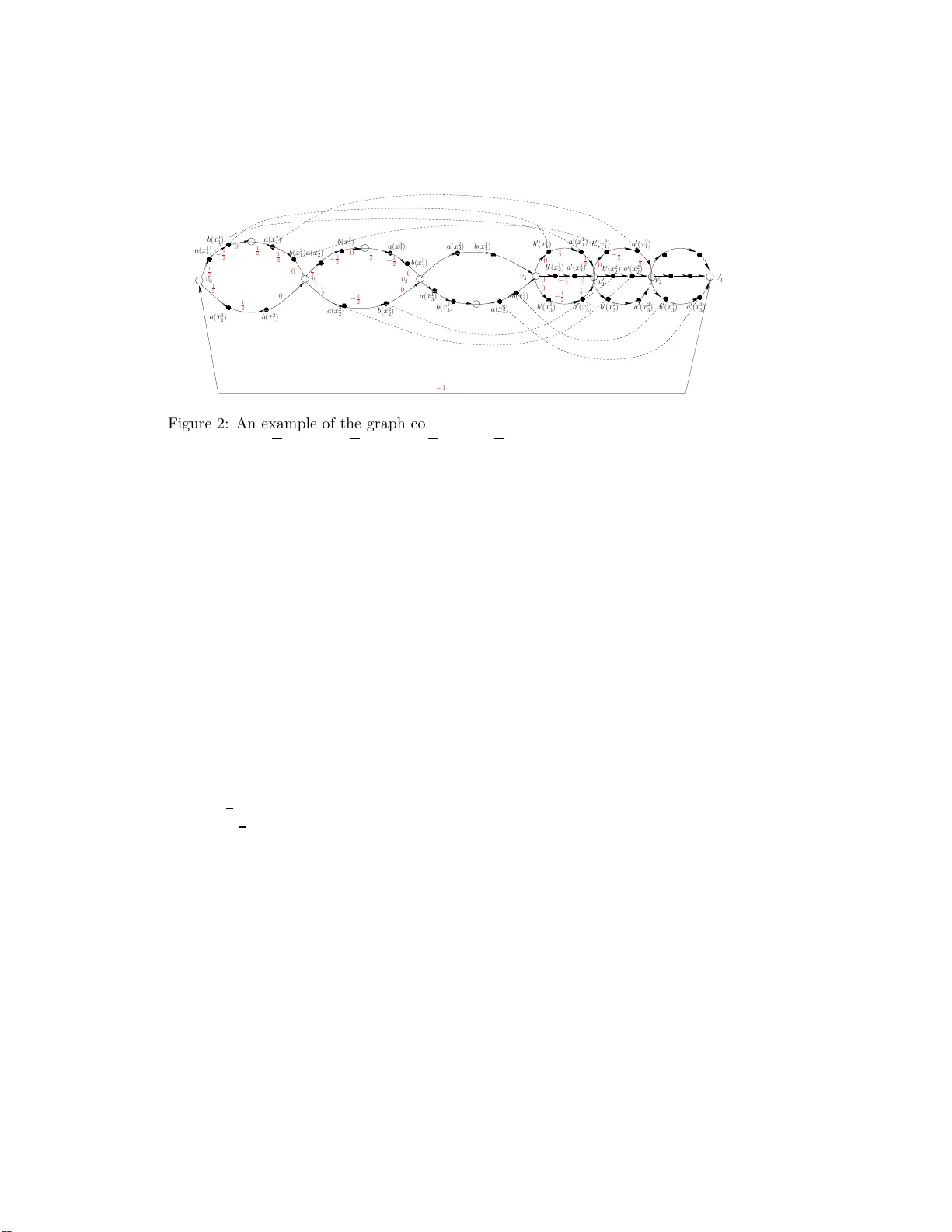
Characterization of the V ertices and Extreme Directions of the Negativ e Cycles P olyhedron and Hardness of Generating V ertices of 0 / 1-P olyhedra Endre Boros ∗ Khaled Elbassioni † Vladimir Gurvic h ‡ Hans Ra j Tiw ary § Abstract Give n a graph G = ( V , E ) and a w eight function on the edges w : E 7→ R , w e consider the p o lyhedron P ( G, w ) of negative-w eigh t fl o ws on G , and get a complete c haracteriza tion of the vertices and extreme directions of P ( G, w ) . As a corollary , we show that, u nless P = N P , there is no output p olynomial-time algorithm to generate all the vertices of a 0 / 1-polyhedron. This strengthens the NP-hardness result of [9] fo r non 0 / 1-p olyhedra, and comes in contrast w ith the p olynomialit y of vertex en umeration for 0 / 1-polytop es [7]. Keywords: Flo w p olytope, 0 / 1-p olyhedron, vertex, extreme direction, enu- meration problem, negativ e cy cles, directed graph . 1 In tro duction A convex po lyhedron P ⊆ R n is the the intersection of finitely ma n y halfspa ces, deter- mined by the fac ets of the polyhedr on. A vertex or a n extre me p o int of P is a p oint v ∈ R n which cannot b e repre sent ed as a co n vex combination of tw o other p oints of P , i.e., there exis ts no λ ∈ (0 , 1) a nd v 1 , v 2 ∈ P such that v = λv 1 + (1 − λ ) v 2 . A dir e ct ion of P is a vector d ∈ R n such that x 0 + µd ∈ P whenever x 0 ∈ P and µ ≥ 0. An extr eme dir e ction of P is a direction d that cannot be written as a conic comb ination of tw o other directions, i.e., there exist no non- ne g ative n umbers µ 1 , µ 2 ∈ R + and directions d 1 , d 2 of P s uch that d = µ 1 d 1 + µ 2 d 2 . Denote resp ectively by V ( P ) and D ( P ) the sets of extreme p oints and directio ns of p olyhedron P . A b ounded p olyhedr on, i.e., one for which D ( P ) = ∅ is ca lle d a p oly top e . The w ell-known Minko wski-W eyl theorem states that any con vex p olyhedron can be re presented as the Minko wski sum of the conv ex hull of the set of its extr e me p oints ∗ RUTCOR, Rutgers Unive rsity , 640 B artholomew R oad, Piscata w ay NJ 08854-8003; (boros@r utcor.rutgers.edu) † Max-Planck-In stitut f ¨ ur Informatik, Saarbr ¨ uck en, Germany; (elbassio@mpi-s b.mpg.de) ‡ RUTCOR, R utgers University , 640 Bartholomew Road, Piscata w a y NJ 0 8854-8003; (gur- vic h@rutcor.rutgers.edu) § Unive rsit¨ at des Saarlandes, Saarbr ¨ uck en, D-66125 German y; (hansra j@cs. uni-sb.de) 1 and the conic hull of the set o f its extreme dire ctions (see e.g. [13]). F urthermore, for po in ted p olyhedra , i.e., those that do not contain lines, this re pr esentation is unique. Given a po lyhedron P by its facets, obtaining the set V ( P ) ∪ D ( P ), requir ed by the o ther representation, is a well-kno wn problem, studied in the literatur e under differen t (but po lynomially equiv alen t) forms, e.g. the vertex enumer ation pro blem[6], the c onvex hul l problem [2] or the p olytop e-p oly he dr on pr oblem [10 ]. Clearly , the size of the extreme set V ( P ) ∪ D ( P ) can b e (a nd typically is) exp onential in n and the num b er o f facets m , and th us when we c onsider the computational complexity of the vertex enu meratio n problem, we are in terested in output-sen s itive algor ithms, i.e., whose r unning time depe nds not only on n, m , but a lso on |V ( P ) ∪ D ( P ) | . Alterna tively , w e may consider the following, po ly nomially equiv alent, decision v aria n t of the pro blem: Dec ( C ( P ) , X ) : Given a p olyhedro n P , r epresented by a sy stem of linear inequalities, and a subset X ⊆ C ( P ), is X = V ( P )? In this description, C ( P ) c o uld be e ither V ( P ), D ( P ), or V ( P ) ∪ V ( P ). It is well- known and also easy to s ee that the decision problems for D ( P ) or for V ( P ) ∪ D ( P ) are e quiv alent to that fo r V ( P ′ ) wher e P ′ is some p olytop e derived from P . It is also well-kno wn that if the decisio n proble m is NP-hard, then no output p olynomial- time algorithm can g enerate the elements of the set C ( P ) unless P=NP (see e.g . [5]). The complexity of s ome in teresting re strictions of these problems hav e alrea dy b een settled. Most no tably , it was s hown in [7], that in the case of 0 / 1-p olytop es, i.e., for which V ( P ) ⊆ { 0 , 1 } n , the problem of finding the vertices given the facets can b e solved with p olynomial delay (i.e. the time to pro duce each v ertex is b ounded b y a p olyno - mial in the input s ize) using a simple backtracking alg orithm. Output p olynomial-time algorithms also exist for enum erating the vertices of simple and simplicia l poly tope s [3, 4, 6], netw ork po lyhedra and their duals [1 1], a nd some other classes of p olyhedra [1]. More recently , it was shown in [9] that for gener a l un b ounded po lyhedra pr oblem Dec( V ( P ) , X ) of g enerating the vertices of a polyhedro n P is NP- hard. On the other hand, fo r sp ecial cla sses of 0 / 1- po lyhedra, e.g. the po lyhedron of s - t -cuts in general graphs [8], the p olyhedra a sso ciated with the incidence matr ix o f bipartite graphs, and the p olyhedra a sso ciated with 0 / 1- net work matr ices [5], the vertex enumeration prob- lem can b e solved in p olynomia l time using problem-sp ecific techniques. This natura lly raises the question whether there exists a g e neral poly nomial-time algor ithm for the vertex en umeratio n of such polyhedr a, extending the result of [7] for 0 / 1-p olytop es. Here, w e s how that this is only poss ible if P=NP . Our res ult strengthens tha t in [9], which did not a pply to 0 / 1- po lyhedra, and uses almost the same cons truction, but go es through the characterizatio n of the vertices of the p olyhedron o f negative weigh t-flows of a graph, defined in the next s ection. W e show tha t this p olyhedron could b e highly un b ounded, by also characterizing its extreme directions, and leav e op en the ha rdness of en umerating these directions, with its immediate co nsequences on the hardnes s of vertex enumeration for p o lytop es. 2 (b) (a) C 2 C 1 C 1 C 2 P 1 P 3 P 2 Figure 1: 2 -cycle. 2 The p olyhedron of neg ativ e-w eigh t flo ws Given a directed graph G = ( V , E ) and a weight function w : E → R on its arc s, consider the fo llowing p o lyhedron: P ( G, w ) = y ∈ R E ( F ) X v :( u,v ) ∈ E y uv − X v :( v,u ) ∈ E y vu = 0 ∀ u ∈ V ( N ) X ( u,v ) ∈ E w uv y uv = − 1 y uv ≥ 0 ∀ ( u, v ) ∈ E . If we think of w u,v as the co st/profit paid for edge ( u, v ) p er unit of flow, then each p oint of P ( G, w ) repr e sent s a ne gative-weight cir culation in G , i.e., a ssigns a no n- negative flow on the arcs, ob eying the c onservation of flow at each node of G , and such that total weigh t of the flow is strictly neg a tive. A negative- (resp ectively , p ositive-, or zero-) weight cycle in G is a dir ected cycle whose total weigh t is negative (resp ectively , p ositive, or zero). W e repres e n t a c ycle C b y the subset of arcs app earing on the cycle, and deno te b y V ( C ) the no des of G on the c y cle (we assume all cycles c onsidered to b e dir ected and simple). Let us denote the families of all negative, p ositive, a nd zero- w eight cyc les o f G by C − ( G, w ) , C + ( G, w ), and C 0 ( G, w ), resp ectively . Define a 2-cycle to b e a pa ir of cycles ( C 1 , C 2 ) such that C 1 ∈ C − ( G, w ) , C 2 ∈ C + ( G, w ) and C 1 ∪ C 2 do es not contain any o ther cycle of G . It is not difficult to see tha t a 2 -cycle is either the edge-disjoint union of a negative cycle C 1 and a p ositive cycle C 2 , o r the edge-disjoint union of 3 paths P 1 , P 2 and P 3 such that C 1 = P 1 ∪ P 2 is a negative cycle, and C 2 = P 1 ∪ P 3 is a po sitive cycle (see Figure 1). In the next s ection, we show that the s e t of vertices V ( P ( G, w )) are in one-to-o ne co r resp ondence with the s e t of neg a tive cycles C − ( G, w ) , while the set of extreme directions D ( P ( G, w )) is in one-to -one c o rresp ondence with the set C 0 ( G, w ) ∪ { ( C, C ′ ) : ( C , C ′ ) is a 2-cycle) } . 3 3 Characterization of ve rtices and extreme direc- tions of P ( G, w ) F or a subs e t X ⊆ E , and a weight function w : E 7→ R , w e denote b y w ( X ) = P e ∈ X w e , the total weigh t of X . F or X ⊆ E , we denote b y χ ( X ) ∈ { 0 , 1 } E the characteristic vector of X : χ e ( X ) = 1 if and only if e ∈ X , for e ∈ E . Theorem 1 L et G = ( V , E ) b e a dir e cte d gr aph and w : E → R b e a r e al weight on the ar cs. Then V ( P ( G, w )) = − 1 w ( C ) χ ( C ) : C ∈ C − ( G, w ) , (1) D ( P ( G, w )) = D 1 ∪ D 2 , (2) wher e D 1 = { 1 | C | χ ( C ) : C ∈ C 0 ( G, w ) } , D 2 = { µ C 1 ,C 2 χ ( C 1 ) + µ ′ C 1 ,C 2 χ ( C 2 ) : ( C 1 , C 2 ) is a 2-cycle } , and µ C 1 ,C 2 = w ( C 2 ) w ( C 2 ) | C 1 | − w ( C 1 ) | C 2 | , µ ′ C 1 ,C 2 = − w ( C 1 ) w ( C 2 ) | C 1 | − w ( C 1 ) | C 2 | . ar e non-ne gative numb ers c ompute d fr om cycles C 1 and C 2 . Pro of . Let m = | E | and n = | V | . W e first prove (1). It is easy to verify that any element y ∈ R E of the set on the r ight-hand side of (1) belo ngs to P ( G, w ). More ov er , any s uc h x = − χ ( C ) /w ( C ), for a cyc le C , is a vertex of P ( G, w ) since there ar e m linearly indep endent inequalities of P ( G, w ) tight at x , namely: the conserv ation of flow equations at | C | − 1 v ertices of C , the equation P e ∈ C w e y e = − 1, and m − | C | equations y e = 0, for e ∈ E \ C . T o pr ove the opp os ite direction, let y ∈ R E be a vertex of P ( G, w ). Let Y = { e ∈ E : y e > 0 } . The pro of follows fr om the following 3 claims. Claim 1 Th e gr aph ( V , Y ) is the disjoint u n ion of st r ongly c onne cte d c omp onents. Pro of . Consider a n arbitrar y s trongly connected c ompo nent X in this g raph, and let X − be the set of compo nen ts reachable fro m X (including X ). Summing the conserv a tion of flow equations corresp onding to all the nodes in X − implies that all arcs going o ut of X − hav e a flow of zero. Claim 2 Th er e exists n o cycle C ∈ C 0 ( G, w ) su ch that C ⊆ Y . Pro of . If such a C exists, we define tw o p oints y ′ and y ′′ as follows. y ′ e = y e + ǫ, if e ∈ C y e , otherwise, y ′′ e = y e − ǫ, if e ∈ C y e , otherwis e, 4 for some s ufficien tly small ǫ > 0 . Then y ′ , y ′′ clearly satisfy (F). Moreover, (N) is satisfied with y ′ since X e ∈ E w e y ′ e = X e 6∈ C w e y e + X e ∈ C w e ( y e + ǫ ) = X e ∈ E w e y e + w ( C ) ǫ = − 1 . Similarly for y ′′ . Thus y ′ , y ′′ ∈ P ( G, w ) and y = ( y ′ + y ′′ ) / 2 contradicting that y is a vertex. Claim 3 Th er e exist no distinct cycles C 1 , C 2 ∈ C − ( G, w ) ∪ C + ( G, w ) such that C 1 ∪ C 2 ⊆ Y . Pro of . If such C 1 and C 2 exist, we define tw o p oints y ′ and y ′′ as follows. y ′ e = y e + ǫ 1 , if e ∈ C 1 \ C 2 y e + ǫ 2 , if e ∈ C 2 \ C 1 y e + ǫ 1 + ǫ 2 , if e ∈ C 1 ∩ C 2 y e , otherwise, y ′ e = y e − ǫ 1 , if e ∈ C 1 \ C 2 y e − ǫ 2 , if e ∈ C 2 \ C 1 y e − ǫ 1 − ǫ 2 , if e ∈ C 1 ∩ C 2 y e , otherwise, where ǫ 1 = − w ( C 2 ) w ( C 1 ) ǫ 2 , for some sufficient ly small ǫ 2 > 0 (in particular, to insure non- negativity of y ′ , y ′′ , ǫ 2 m ust b e upp er b ounded by the minimu m of min { y e : e ∈ C 2 \ C 1 } , | w ( C 1 ) | | w ( C 2 ) | min { y e : e ∈ C 1 \ C 2 } , and | w ( C 1 ) | | w ( C 1 ) − w ( C 2 ) | min { y e : e ∈ C 1 ∩ C 2 } ). Then it is easy to verify that y ′ , y ′′ satisfy (F). Mo reov er, (N) is s atisfied with y ′ since X e ∈ E w e y ′ e = X e 6∈ C 1 ∪ C 2 w e y e + X e ∈ C 1 \ C 2 w e ( y e + ǫ 1 ) + X e ∈ C 2 \ C 1 w e ( y e + ǫ 2 ) + X e ∈ C 1 ∩ C 2 w e ( y e + ǫ 1 + ǫ 2 ) = X e ∈ E w e y e + w ( C 1 ) ǫ 1 + w ( C 2 ) ǫ 2 = − 1 . Similarly for y ′′ . Thus y ′ , y ′′ ∈ P ( G, w ) and y = ( y ′ + y ′′ ) / 2 contradicting that y is a vertex of P ( G, w ). The a bove 3 claims imply that the graph ( V , Y ) consists of a sing le cycle C and a set of isolated vertices V \ V ( C ). Thus y e = 0 for e 6∈ C . By (F) we get that y e is the same for all e ∈ C , and by (N) w e get that y e = − 1 / w ( C ) for all e ∈ C , and in particular that C ∈ C − ( G, w ). This completes the pro of of (1). W e next pr ov e (2). As is well-known, the extr e me directions of P ( G, w ) are in one-to-one corresp ondence with the v ertices of the poly tope P ′ ( G, w ), obtained from P ( G, w ) by setting the right-hand side o f (N) to 0 and a dding the normalizatio n con- straint ( N ′ ) : P e ∈ E y e = 1. W e first note as befo r e that every element of D 1 ∪ D 2 is a v ertex of P ′ ( G, w ). Indeed, if y ∈ D 2 is defined b y a 2-cycle ( C 1 , C 2 ), then there are m linearly independent inequalities tight at y . T o see this, we consider t wo cases: (i) When C 1 and C 2 are edge-disjoint, then there are | C 1 | − 1 and | C 2 | − 1 equations of type (F), nor malization equations ( N ) and ( N ′ ), and m − | C 1 | − | C 2 | non- negativity inequa lities for e ∈ E \ ( C 1 ∪ 5 C 2 ). (ii) Otherwise, C 1 ∪ C 2 consists o f 3 dis jo in t paths P 1 , P 2 , P 3 of, say m 1 , m 2 and m 3 arcs, resp ectively . Then C 1 ∪ C 2 has m 1 + m 2 + m 3 − 1 giving m 1 + m 2 + m 3 − 2 linearly independent equation o f type (F), which tog e ther with ( N ), ( N ′ ) and m − m 1 − m 2 − m 3 non-negativity constr aints fo r e ∈ E \ ( C 1 ∪ C 2 ) uniquely define y . Consider now a vertex y of P ′ ( G, w ). Let Y = { e ∈ E : y e > 0 } . Clear ly , Claim 1 is s till v a lid for Y . On the other ha nd, Claims 2 a nd 3 can b e replaced by the following t wo cla ims. Claim 4 Th er e exist no 3 distinct cycles C 1 , C 2 , C 3 such t hat C 1 ∈ C − ( G, w ) , C 2 ∈ C + ( G, w ) , and C 1 ∪ C 2 ∪ C 3 ⊆ Y . Pro of . If suc h C 1 , C 2 and C 3 exist, we define tw o points y ′ and y ′′ as follows: y ′ e = y e + P 3 i =1 ǫ i χ e ( C i ) and y ′′ e = y e − P 3 i =1 ǫ i χ e ( C i ), for e ∈ E , wher e ǫ 3 > 0 is sufficiently small, and ǫ 1 and ǫ 2 satisfy ǫ 1 w ( C 1 ) + ǫ 2 w ( C 2 ) = − ǫ 3 w ( C 3 ) ǫ 1 | C 1 | + ǫ 2 | C 2 | = − ǫ 3 | C 3 | . (3) Note that ǫ 1 and ǫ 2 exist sinc e α def = w ( C 1 ) | C 2 | − w ( C 2 ) | C 1 | < 0. F urthermore, since ǫ 1 = ( w ( C 2 ) | C 3 | − w ( C 3 ) | C 2 | ) ǫ 3 /α a nd ǫ 2 = ( w ( C 3 ) | C 1 | − w ( C 1 ) | C 3 | ) ǫ 3 /α , we c an se le c t ǫ 3 such that y ′ , y ′′ ≥ 0. By definition of y ′ and y ′′ , they both satisfy (F), and by (3) they also sa tisfy ( N ) and ( N ′ ). How ever, ( y ′ + y ′′ ) / 2 = y contradicts that y ∈ V ( P ′ ( G, w )). Claim 5 Th er e exist no 2 distinct cycle s C 1 , C 2 such t hat C 1 , C 2 ∈ C 0 ( G, w ) , and C 1 ∪ C 2 ⊆ Y . Pro of . If such C 1 and C 2 exist, w e define tw o po in ts y ′ and y ′′ as follows: y ′ e = y e + ǫ 1 χ e ( C 1 ) + ǫ 2 χ e ( C 2 ) and y ′′ e = y e − ǫ 1 χ e ( C 1 ) − ǫ 2 χ e ( C 2 ), for e ∈ E , where ǫ 2 > 0 is sufficiently sma ll, and ǫ 1 = − ǫ 2 | C 2 | / | C 1 | . Then y ′ , y ′′ ∈ P ′ ( G, w ) and y = ( y ′ + y ′′ ) / 2. As is w ell-known, we can decompo se y in to the sum of p ositive flows on cyc les, i.e., write y = P C ∈ C ′ λ C χ ( C ), where C ′ ⊆ C − ( G, w ) ∪ C + ( G, w ) ∪ C 0 ( G, w ), and λ C > 0 fo r c ∈ C ′ . It follo ws from Claim 4 that |C ′ | ≤ 2. Using ( N ), w e get P c ∈C ′ λ C w ( C ) = 0 , which implies by Claim 5 that either C ′ = { C } and w ( C ) = 0 or C ′ = { C 1 , C 2 } and w ( C 1 ) < 0, w ( C 1 ) > 0. In the former ca se, we g et that y ∈ D 1 , a nd in the latter cas e , we get by Claim 4 that ( C 1 , C 2 ) is a 2-c ycle, and hence, that y ∈ D 2 . In the nex t section w e c o nstruct a w eighted dire cted gra ph ( G, w ) in which all negative cycles have unit w eight. W e s how that genera ting all nega tive cyc le s o f G is NP-hard, thu s implying by Theorem 1 that ge ne r ating all vertices of P ( G, w ) is also hard. 6 4 Generating all v ertices of a 0 / 1 - p olyhedron is hard Let us now s how that the following problem is CoNP-complete: VE- 0 / 1 : Given a p olyhedro n P = { x ∈ R n | Ax ≤ b } , where A ∈ R m × n , b ∈ R m , a nd V ( P ) ⊆ { 0 , 1 } n , and a subset X ⊆ V ( P ), decide if X = V ( P ) . Then, no algo rithm can generate a ll elements of V ( P ) in incremental o r tota l p oly- nomial time, unless P=NP . Theorem 2 Pr oblem VE- 0 / 1 is NP-har d. Pro of . The construction is essentially the s ame a s in [9]; only the weigh ts change. W e include a sketc h here. W e reduce the pro blem from the CNF satisfiability problem: Is there a truth as- signment of N binary v aria bles s a tisfying a ll clauses of a given conjunctive normal form φ ( x 1 , . . . , x N ) = C 1 ∧ . . . ∧ C m , where each C j is a disjunction of so me literals in { x 1 , x 1 , . . . , x n , x n } ? Given a CNF φ , we co nstruct a weigh ted dir ected gra ph G = ( V , E ) on | V | = 5 P m j =1 | C j | + m − n + 1 vertices and | E | = 6 P m j =1 | C j | + 1 a rcs (where | C j | deno tes the nu mber of literals a ppea ring in clause C j ) as follows. F or each literal ℓ = ℓ j app earing in clause C j , we introduce tw o paths o f three ar cs each: P ( ℓ ) = ( p ( ℓ ) , a ( ℓ ) , b ( ℓ ) , q ( ℓ )), and P ′ ( ℓ ) = ( r ( ℓ ) , b ′ ( ℓ ) , a ′ ( ℓ ) , s ( ℓ )). The weights of these a rcs are set a s follows: w (( p ( ℓ ) , a ( ℓ ))) = 1 2 , w (( a ( ℓ ) , b ( ℓ ))) = − 1 2 , w (( b ( ℓ ) , q ( ℓ ))) = 0 , w (( r ( ℓ ) , b ′ ( ℓ ))) = 0 , w (( b ′ ( ℓ ) , a ′ ( ℓ ))) = − 1 2 , w (( b ′ ( ℓ ) , s ( ℓ ))) = 1 2 . These edges ar e connec ted in G a s follows (see Fig ur e 2 for an exa mple): G = v 0 G 1 v 1 G 2 v 2 . . . v n − 1 G n v n G ′ 1 v ′ 1 G ′ 2 v ′ 2 . . . v ′ m − 1 G ′ m v ′ m , where v 0 , v 1 , . . . , v n , v ′ 1 , . . . , v ′ m − 1 , v ′ m are distinct vertices, each G i = Y i ∨ Z i , for i = 1 , . . . , n , consists of tw o parallel chains Y i = ∧ j P ( x j i ) and Z i = ∧ j P ( x j i ) b etw een v i − 1 and v i , and each G ′ j = ∨ | C j | i =1 P ′ ( ℓ j i ), for j = 1 , . . . , m , wher e ℓ j 1 , ℓ j 2 , . . . are the liter a ls app earing in C j . Finally we add the ar c ( v ′ m , v 0 ) with weigh t − 1, a nd identify the pa irs of no des { a ( ℓ ) , a ′ ( ℓ ) } and { b ( ℓ ) , b ′ ( ℓ ) } for all ℓ , (i.e. a ( ℓ ) = a ( ℓ ′ ) and b ( ℓ ) = b ( ℓ ′ ) define the same no des). Let P ( G, w ) be the po lyhedron defined b y the g raph G a nd the a rc w eights w . W e shall argue now that all negative cycles of G hav e weigh t -1 . This implies by Theo rem 1 that all vertices of P ( G, w ) are 0 / 1 . Clearly the ar cs ( a ( ℓ ) , b ( ℓ )) and ( b ′ ( ℓ ) , a ′ ( ℓ )) form a directed cycle of to ta l w eig ht − 1, for every liter al o ccurr ence ℓ . There ar e P m j =1 | C j | such cycles, co rresp onding to a subset X ⊆ V ( P ( G, w )). Call a cycle of G long if it co ntains the vertices v 0 , v 1 , . . . , v n , v ′ 1 , . . . , v ′ m − 1 , v ′ m . Any long cycle has weight − 1. The crucial o bserv ation is the following. 7 00 00 00 11 11 11 0 0 0 1 1 1 00 00 11 11 0 0 1 1 00 00 11 11 00 00 00 11 11 11 00 00 11 11 00 00 11 11 0 0 1 1 0 0 1 1 0 0 1 1 0 0 0 1 1 1 00 00 11 11 0 0 1 1 00 00 00 11 11 11 0 0 1 1 00 00 00 11 11 11 0 0 1 1 00 00 00 11 11 11 00 00 00 11 11 11 0 0 1 1 00 00 00 11 11 11 00 00 00 11 11 11 00 00 00 11 11 11 00 00 00 11 11 11 00 00 00 11 11 11 0 0 1 1 00 00 00 11 11 11 00 00 00 11 11 11 00 00 00 11 11 11 00 00 00 11 11 11 00 00 00 11 11 11 00 00 00 11 11 11 00 00 00 11 11 11 00 00 00 11 11 11 00 00 00 11 11 11 v 3 v 2 v 1 v 0 a ′ ( x 1 1 ) a ′ ( x 2 1 ) b ′ ( x 2 1 ) a ( x 1 1 ) b ( ¯ x 3 1 ) a ( ¯ x 3 1 ) b ( x 2 1 ) a ( ¯ x 2 2 ) a ( ¯ x 1 3 ) b ( ¯ x 1 3 ) a ( ¯ x 3 3 ) a ′ ( ¯ x 1 3 ) b ′ ( x 2 3 ) a ( x 2 1 ) b ( x 1 1 ) 1 2 − 1 2 − 1 b ( x 2 3 ) b ( ¯ x 3 3 ) 0 − 1 2 0 − 1 2 − 1 2 0 1 2 − 1 2 − 1 2 0 0 v ′ 2 1 2 − 1 2 0 0 1 2 − 1 2 a ( x 3 2 ) b ( x 3 2 ) b ′ ( x 1 1 ) a ′ ( x 1 2 ) b ′ ( x 1 2 ) a ′ ( ¯ x 2 2 ) v ′ 3 b ′ ( ¯ x 1 3 ) 0 − 1 2 0 1 2 1 2 − 1 2 0 a ( x 1 2 ) b ( x 1 2 ) b ( ¯ x 2 2 ) a ( x 2 3 ) b ′ ( ¯ x 2 2 ) b ′ ( ¯ x 3 3 ) a ′ ( ¯ x 3 3 ) a ′ ( x 2 3 ) 1 2 1 2 1 2 v ′ 1 1 2 Figure 2 : An example o f the gr aph constr uction in the pro of of Theorem 2 with CNF C = ( x 1 ∨ x 2 ∨ x 3 ) ∧ ( x 1 ∨ x 2 ∨ x 3 ) ∧ ( x 1 ∨ x 2 ∨ x 3 ). Claim 6 A ny n e gative cycle C ∈ C − ( G, w ) \ X must b e long. Pro of . Co nsider any cycle C 6∈ X , a nd let us write the traces o f the no des v is ited on the cy cle (dro pping the literals, and considering a, a ′ and b, b ′ as different c o pies), without loss o f g enerality as follows: p a b p a b p · · · a a ′ s b ′ a ′ s b ′ · · · b ′ b p a b · · · p. Note that the sequences a ′ a and b b ′ are not a llowed since other w is e C contains a cycle from X . Let us compute the distance (i.e., the total weigh t) of each no de o n this se q uence starting from the initial p . Call the subsequence s a ′ a ′ and b b ′ , a - and b -jumps re- sp ectively . Then it is eas y to verify that each a -jump causes the dista nce to even tually increase by 1 while each b -jump keeps the distance at its v alue. Mo re precisely , the distance a t a no de x in the sequence is given b y d ( x ) = t + d 0 − δ ( x ), where t is the nu mber of a -jumps app earing upto x , and d 0 = 0 if x ∈ { p, s } , 1 2 if x = a, − 1 2 if x = a ′ , 0 if x = b = b ′ , δ ( x ) = 1 if ar c ( v ′ m , v 0 ) app ears on the pa th from p to x 0 otherwise . One also observes that, if the sequence has a b -jump, then it must also cont ain a n a -jump. Th us it fo llows from the definition of d ( x ) that an y cycle with a jump must be non-nega tive. So the only p os s ible negative cycle no t in X m ust be long. By Claim 6, chec king of V ( P ( G, w )) = X is equiv alent to chec king if G has a long cycle. It is easy to se e that the latter condition is equiv a lent to the non-sa tisfiability of the input CNF formula φ (s e e [9] for mor e details ). Thu s, it is NP - hard to gener ate a ll vertices o f a 0 / 1 -p olyhedron. Howev er , (2) shows tha t the ab ov e construction ca nnot b e used to imply the same ha r dness result 8 for p olytop es, since the num b ers of p ositive a nd negative cycles can b e exp onential and, he nc e , p olyhedr on P ( G, w ) can b e hig hly unbounded. In fact, for the negative cycle p olyhedron ar ising in the cons tr uction of Theorem 2, we hav e the following. Prop ositio n 1 F or the dir e cte d gr aph G = ( V , E ) and weight w : E → R use d in the pr o of of The or em 2, b oth sets D ( P ( G, w )) and V ( P ( G, w )) ∪ D ( P ( G, w )) c an b e gener ate d in incr emental p olynomial time. Pro of . This follows from t he f act t hat for every p ositive cycle in G there is a negative cycle, edg e -disjoint from it, and vice versa (as suming no cla use consists o f only o ne literal) as one can ea sily verify . Hence, the n umber o f 2-cycle s and thu s the num b er of ex treme directions of P ( G, w ) satisfy |D ( P ( G, w )) | ≥ max {|C + ( G, w ) | , |C − ( G, w ) |} + |C 0 ( G, w ) | . Thus D ( P ( G, w ) and V ( P ( G, w )) ∪ D ( P ( G, w )) can b e gen- erated by generating all cycles of G , whic h ca n b e do ne with p olynomia l delay [12]. How ever, it is o pen whether the same ho lds for genera l gr aphs. In fact, ther e exist weigh ted graphs in which the n umber o f p ositive cycles is exp onentially lar ger than the num b er of 2- cycles. Consider for instance, a graph G comp osed of a directed cycle ( x 1 , y 1 , . . . , x k , y k ) of length 2 k , all arcs with weigh t − 1, and 2 k additional paths P 1 , P ′ 1 , . . . , P k , P ′ k where P i = ( x i , z i , y i ) and P ′ i = ( x i , z ′ i , y i ), of t wo arcs each g oing the same direction pa rallel with every second arc alo ng the c ycle, each having a weight of 2 k (see Fig ur e 3 for a n ex a mple with k = 4). Then we hav e mo re than 2 k po sitive cycles, but only 2 k 2- cycles. Note that proving that enum era ting 2-cy cles of a given weigh ted graph is NP -hard, will imply the same for the vertex e n umeration problem for p olytop es, whose co mplexit y remains o pe n. References [1] S. D. Ab dullahi, M. E. Dy er, and L. G. Pr oll, List ing vertic es of simple p olyhe dr a asso ciate d with dual LI (2) systems , DMTCS: Discrete Mathematics and Theor et- ical Computer Science, 4th Int ernatio na l Conference, DMTCS 2 0 03, Pr o ceedings, 2003, pp. 89–9 6. [2] D. Avis, B. Bremner, and R. Seidel, How go o d ar e c onvex hul l algorithms , Com- putational Geometry: Theory and Applications 7 (1997 ), 265 –302. [3] D. Avis and K . F ukuda , A pivoting algorithm for c onvex hul ls and vertex enu- mer ation of arr angements and p olyhe dr a , Discrete and Computational Geo metry 8 (1992), no. 3 , 295–3 13. [4] , Re verse se ar ch for enu mer ation , Discrete Applied Mathematics 6 5 (1 9 96), no. 1-3, 21–4 6. [5] B. Boros , K. Elba ssioni, V. Gur vich, and K. Makino , Gener ating vertic es of p oly- he dr a and r elate d monotone gener ation pr oblems , DIMACS T echnical Rep ort 2007- 03, Rutgers Universit y , 200 7. 9 x 1 x 3 x 4 z ′ 4 z ′ 1 z ′ 2 y 4 z 2 z 3 z 4 − 1 − 1 − 1 − 1 − 1 − 1 − 1 − 1 k k k k k k y 1 x 2 y 2 y 3 z ′ 3 z 1 k k Figure 3: An example where there a re exp onentially more po sitive cycles than 2-c y cles ( k = 4). [6] D. Bremner, K. F ukuda, and A. Mar zetta, Primal-dual metho ds for vertex and fac et enumer ation , Discrete and Co mputatio nal Geometry 20 (199 8), 33 3–357 . [7] M. R. Bussieck a nd M. E. L¨ ubbecke, The vertex set of a 0/1 p olytop e is str ongly P - enumer able , Computational Geometry : Theory and Applications 11 (1 9 98), no. 2, 103–1 09. [8] N. Gar g and V. V. V a zirani, A p olyhe dr on with al l s-t cuts as vert ic es, and adja- c ency of cuts , Math. Progr am. 70 (199 5), no. 1, 17–2 5. [9] L. Khachiyan, E. Boro s, K. Borys , K . Elbassioni, a nd V. Gurvich, Gener ating al l vertic es of a p olyhe dr on is har d , P ro ceedings of the Seven teenth Annual A CM- SIAM Sympos ium on Discr ete Algorithms, SODA 2006, 2006, pp. 758 –765, Ex- tended version to a ppea r in Disc erte & Computational Ge ometry . [10] L. Lov´ asz, Combinatorial optimization: some pr oblems and tr ends , DIMA CS T ech- nical Rep ort 92-5 3, Rutge rs Universit y , 1992 . [11] J.S. Prov an, Efficient enumer ation of the vertic es of p olyhe dr a asso ciate d with network lp’s , Mathematical Progr a mming 63 (1 994), no. 1, 4 7 –64. [12] R. C. Read and R. E. T a rjan, Bounds on b acktr ack algorithms for listing cycles, p aths, and sp ann ing tr e es , Net works 5 (1975), 237 –252. [13] A. Schrijv er, The ory of line ar and inte ger pr o gr amming , Wiley , New Y ork, 1 9 86. 10
Original Paper
Loading high-quality paper...
Comments & Academic Discussion
Loading comments...
Leave a Comment