Self-Assembly of Discrete Self-Similar Fractals
In this paper, we search for {\it absolute} limitations of the Tile Assembly Model (TAM), along with techniques to work around such limitations. Specifically, we investigate the self-assembly of fractal shapes in the TAM. We prove that no self-simila…
Authors: Matthew J. Patitz, Scott M. Summers
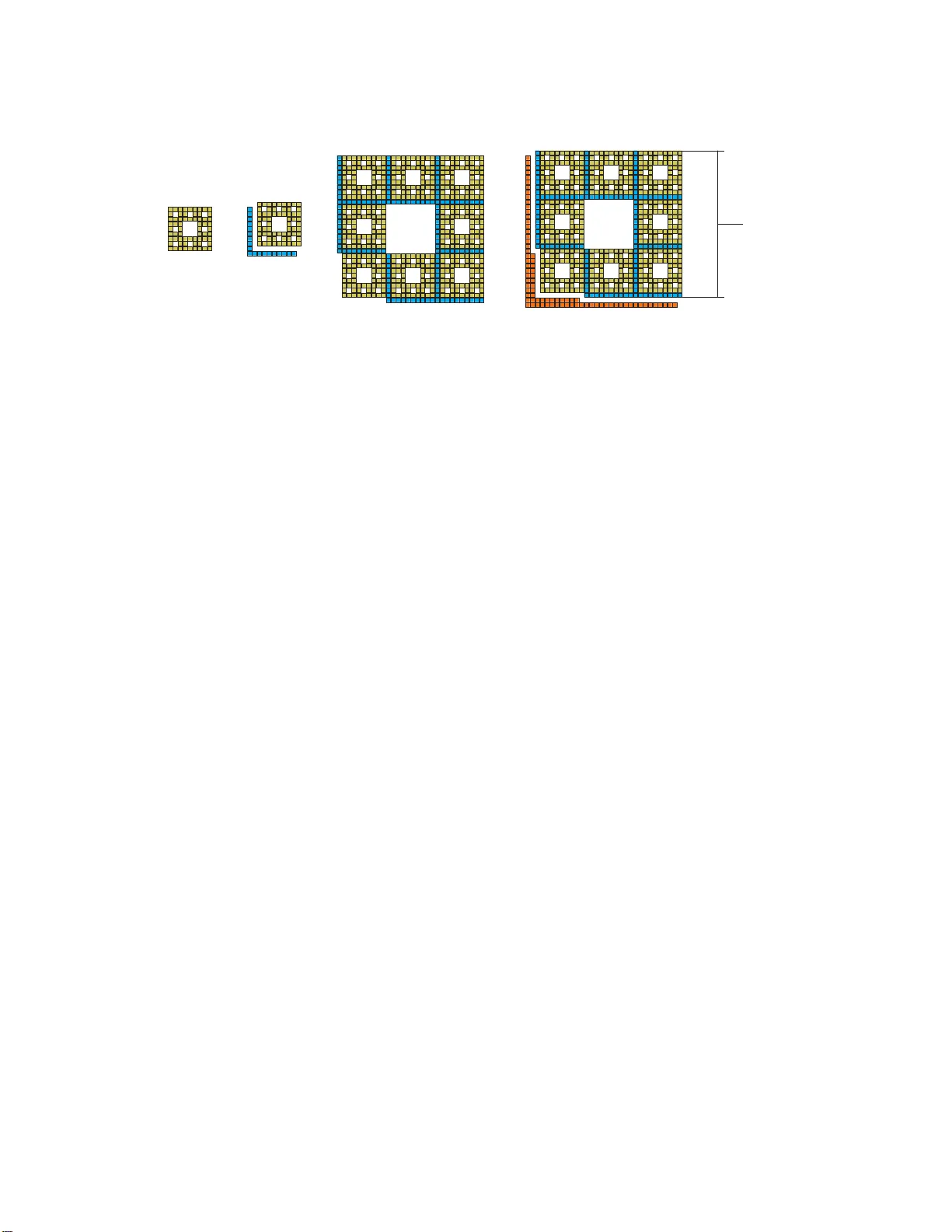
Self-Assembly of Discrete Self-Si mila r F racta ls (Ex tended Abstra ct) ∗ Matthew J. Patitz, and Scott M. Summers Iow a State Universit y , Ames, IA 5001 1, USA {mpati tz, summers} @cs.iastate.edu Abstract In this pap er, w e sea rch fo r absolute limitations of the Tile Assem bly Mo del (T AM), alo ng with tec hniques to work around suc h limitations. Spec ific a lly , w e inv estiga te the self-assembly of fractal shapes in the T AM. W e pr ov e that no self-similar fra ctal fully weakly self-a ssembles at temp eratur e 1, and tha t certain kinds of self-similar fr actals do not s trictly self-a ssemble at any temperature. Additionally , we extend the fiber constructio n from Lathrop et. al. (200 7) to show that any self-similar fractal b elo nging to a particular class of “ nic e ” self-similar fractals has a fib er ed version that strictly self-asse mbles in the T AM. 1 In tro duc tion Self-assem bly is a bottom-up pro cess b y whic h (usually a small num b er of ) fu ndamenta l comp onents automatica lly co alesce to form a target structure. In 1998, Winfree [18] introdu ced the (abstr act) Tile Assem bly Mo del (T AM) - an extension of W ang tiling [16, 17], and a mathematical mo d el of the DNA self-assem bly pioneered b y Seeman et. al. [ 14]. In t he T AM, the fun damen tal com- p onents are u n -rotatable, but trans latable “tile types” wh ose sides are lab eled with glue “colors” and “strengths.” Tw o tiles that are p laced next to eac h other inter act if the glue colors on their abutting sides matc h, and they bi nd if the s trength on their abutting sides matc hes, and is at least a certain “temp erature.” Rothemund and Winf ree [13, 12] later refin ed the mo del, and Lathrop et. al. [10] ga ve a treatmen t of the T AM in whic h equal status is b esto wed up on the self-assem bly of infinite and fin ite stru ctures. Th ere are also sev eral generalizations [2, 11, 8] of the T AM. Despite its delib erate o v er-simplification, th e T AM is a compu tationally and geomet rically ex- pressiv e m o del. F or instance, Wi nf r ee [18] pro v ed that the T AM is computationally un iv ersal, and th us can b e directed algorithmically . Winfree [18] also exhibited a sev en-tile-t yp e self-assem bly system, dir ected by a clev er X OR-lik e algorithm, that “pain ts” a picture of a well-kno wn shap e, the d iscrete Sierp in ski triangle S , on to the fi rst qu adran t. Note that the underlying shap es of eac h of the previous results are actually infi nite canv ases that completely co v er the first quadr an t, on to whic h computationally in teresting shap es are paint ed (i .e., full we ak self-assem b ly). Moreo v er, Lathrop et. al [9] recen tly ga v e a new c haracterization of the computably enumerable sets in terms of weak self-assem bly using a “ray constru ction.” It is n atur al to ask the question: Ho w exp r essiv e is the T AM with resp ect to the self-assem bly of a particular, p ossibly in finite sh ap e, and nothing else (i. e., strict self-assem bly)? ∗ This researc h was supported in part by National Science F ound ation Grants 065256 9 and 0728806 In the case of strict self-assem bly of fi nite sh ap es, the T AM certainly remains an inte resting mo del, so long as the size (tile complexit y) of the assem bly system is required to b e “small” relativ e to the shap e that it u ltimately pro duces. F or instance, Rothem un d and Winfree [13] p ro v ed that there are small tile sets in whic h large s quares self-assem ble. Moreo ve r, Solo v eic hik and Winfr ee [15] established the remark able fact that, if one is not concerned with the scale of an “algorithmically describable” finite shap e, th en there is alw a ys a sm all tile s et in w hic h the shap e self-assem bles. Note that if th e tile complexit y of an assem bly s y s tem is u n b ounded, then every fi nite sh ap e trivially (but p erhaps n ot feasibly) self-assem bles. When the tile co mplexity of an assem bly system is unboun ded (y et finite), only infinite sh ap es are of interest. In the case of strict self-assembly of infin ite shap es, the p o w er of th e T AM has only recen tly b een inv estigate d. Lathrop et. al. [1 0 ] established that self-similar tree shap es d o not strictly self-assem ble in th e T AM giv en any finite num b er of tile t yp es. A “fi b er construction” is also given in [10], whic h strictly self-assembles a non-trivial fractal structure. In th is pap er, we searc h for (1) absolute limitations of the T AM, with resp ect to th e s tr ict self-assem bly of shap es, and (2) tec hniques that a llo w one to “w ork around” su ch limitations. Sp ecifically , w e inv estigat e the s tr ict self-assem bly of fractal sh ap es in the T AM. W e pro ve th ree main results: tw o negativ e and one p ositiv e. Ou r first n egativ e (i.e., imp ossibilit y) result sa ys that no self-similar fractal fully wea kly self-assembles in the T AM (at temp erature 1). In our second imp ossibility r esult, w e exhibit a class of discrete self-similar fractals, to w hic h the standard discrete Sierpinski tr iangle b elongs, th at do not strictly self-assem ble in the T AM (at any temp erature). Finally , in ou r p ositiv e r esult, w e u se sim p le mo dified coun ters to extend the fib er construction from Lathrop et. al. [10] to a particular class of discrete self-similar fracta ls. 2 Preliminaries 2.1 Notation and T erminology W e work in the discrete Euclidean plane Z 2 = Z × Z . W e write U 2 for the set of all unit ve ctors , i.e., v ectors of length 1, in Z 2 . W e rega rd the four elemen ts of U 2 as (names of the cardinal) dir e ctions in Z 2 . W e w rite [ X ] 2 for the set of all 2-elemen t sub sets of a set X . All gr aphs her e are undir ected graphs, i.e., ordered pairs G = ( V , E ), where V is the set of vertic es and E ⊆ [ V ] 2 is the set of e dges . A c ut of a graph G = ( V , E ) is a partition C = ( C 0 , C 1 ) of V into t wo nonemp t y , disjoint subsets C 0 and C 1 . A binding function on a graph G = ( V , E ) is a function β : E → N . (Int uitivel y , if { u, v } ∈ E , then β ( { u, v } ) is the strength with whic h u is b ound to v b y { u, v } according to β . I f β is a bindin g function on a graph G = ( V , E ) and C = ( C 0 , C 1 ) is a cut of G , then the binding str ength of β on C is β C = { β ( e ) | e ∈ E , e ∩ C 0 6 = ∅ , and e ∩ C 1 6 = ∅ } . The binding str ength of β on the graph G is then β ( G ) = min { β C | C is a cut of G } . A binding gr aph is an ordered triple G = ( V , E , β ), where ( V , E ) is a graph and β is a bind in g function on ( V , E ). If τ ∈ N , then a binding graph G = ( V , E , β ) is τ - stable if β ( V , E ) ≥ τ . A g rid gr aph is a graph G = ( V , E ) in whic h V ⊆ Z 2 and every edge { ~ m, ~ n } ∈ E has the prop erty th at ~ m − ~ n ∈ U 2 . The ful l grid gr aph on a set V ⊆ Z 2 is th e graph G # V = ( V , E ) in wh ic h E contai ns every { ~ m, ~ n } ∈ [ V ] 2 suc h that ~ m − ~ n ∈ U 2 . W e sa y that f is a p artial function from a set X to a set Y , and we w rite f : X 99K Y , if f : D → Y for some set D ⊆ X . In this ca se, D is the domain of f , and w e write D = dom f . All log arithms here are b ase-2. 2.2 The Tile Assem bly Mo del W e r eview the basic ideas of the T ile Assem bly Mo del. Our d ev elopmen t largely follo ws that of [13, 12], but some of our terminology and notation are sp ecificall y tailored to our ob jectiv es. I n particular, our version of the mo del on ly uses n onnegativ e “glue stren gths”, and it b esto ws equal status on finite and infi nite assem blies. W e emp hasize that the r esults in this section h a v e b een kno wn for years, e.g., they app ear, with pro ofs, in [12]. Definition. A tile typ e ov er an alphab et Σ is a function t : U 2 → Σ ∗ × N . W e wr ite t = (col t , str t ), where col t : U 2 → Σ ∗ , and str t : U 2 → N are defined b y t ( ~ u ) = (col t ( ~ u ) , str t ( ~ u )) for all ~ u ∈ U 2 . In tuitiv ely , a tile of t yp e t is a unit squ are. It can b e tran s lated bu t not rotated, so it has a w ell-defined “side ~ u ” for eac h ~ u ∈ U 2 . Eac h sid e ~ u of the tile is co v ered with a “glue” of c olor col t ( ~ u ) and str ength s tr t ( ~ u ). If tiles of t yp es t and t ′ are placed with th eir cen ters at ~ m and ~ m + ~ u , resp ectiv ely , where ~ m ∈ Z 2 and ~ u ∈ U 2 , then they w ill bind with strength str t ( ~ u ) · [ [ t ( ~ u ) = t ′ ( − ~ u )] ] where [ [ φ ] ] is the Bo ole an v alue of the statemen t φ . Not e th at this binding strength is 0 unless the adjoining s ides ha v e glues of b oth the same color and the s ame strength. F or the remainder of this s ection, unless otherwise sp ecified, T is an arbitrary s et of tile t yp es, and τ ∈ N is the “temperatur e.” Definition. A T - c onfigur ation is a partial function α : Z 2 99K T . In tuitiv ely , a confi gu r ation is an assignment α in wh ic h a tile of t yp e α ( ~ m ) has b een p laced (with its cent er) at eac h p oint ~ m ∈ dom α . The follo wing d ata structur e c haracterizes h o w th ese tiles are b ound to one another. Definition. T he binding g r aph of a T -co nfigu r ation α : Z 2 99K T is the binding graph G α = ( V , E , β ), where ( V , E ) is the grid graph giv en by V = d om α , E = n { ~ m, ~ n } ∈ [ V ] 2 ~ m − ~ n ∈ U n , col α ( ~ m ) ( ~ n − ~ m ) = col α ( ~ n ) ( ~ m − ~ n ) , and str α ( ~ m ) ( ~ n − ~ m ) > 0 o , and the bindin g fu nction β : E → Z + is giv en by β ( { ~ m, ~ n } ) = str α ( ~ m ) ( ~ n − ~ m ) for al l { ~ m, ~ n } ∈ E . Definition. 1. A T -configuration α is τ - stable if its binding graph G α is τ -stable. 2. A τ - T - assembly is a T -c onfigur ation th at is τ -stable. W e w rite A τ T for the s et of all τ - T - assem blies. Definition. Let α and α ′ b e T -configurations. 1. α is a sub c onfigur ation of α ′ , and we write α ⊑ α ′ , if d om α ⊆ dom α ′ and, for all ~ m ∈ dom α , α ( ~ m ) = α ′ ( ~ m ) . 2. α ′ is a single-tile extension of α if α ⊑ α ′ and d om α ′ − dom α is a singleton set. In th is case, w e write α ′ = α + ( ~ m 7→ t ), w here { ~ m } = dom α ′ − dom α and t = α ′ ( ~ m ). Note that the expression α + ( ~ m 7→ t ) is only d efined when ~ m ∈ Z 2 − dom α . W e next define the “ τ - t -fron tier” of a τ - T -a ssembly α to b e the s et of all p ositions at whic h a tile of t yp e t can b e “ τ -stably added” to the assembly α . Definition. Let α ∈ A τ T . 1. F or eac h t ∈ T , th e τ - t - fr ontier of α is the set ∂ τ t α = ~ m ∈ Z 2 − dom α X ~ u ∈ U 2 str t ( ~ u ) · [ [ α ( ~ m + ~ u )( − ~ u ) = t ( ~ u )] ] ≥ τ . 2. The τ - fr ontier of α is the set ∂ τ α = [ t ∈ T ∂ τ t α. The follo wing lemma sho ws that th e d efi nition of ∂ τ t α ac hieves the desired effect. Lemma 1. Let α ∈ A τ T , ~ m ∈ Z 2 − d om α , and t ∈ T . Then α + ( ~ m 7→ t ) ∈ A τ T if and only if ~ m ∈ ∂ τ t α . Notation. W e wr ite α 1 − − → τ ,T α ′ (or, w hen τ and T are clear from con text, α 1 − → α ′ ) to indicate that α, α ′ ∈ A τ T and α ′ is a single-tile extension of α . In general, self-assem bly o ccurs with tiles adsorb ing nond eterministically and asynchronously to a gro wing assembly . W e now defin e assembly sequences, wh ic h are particular “execution traces” of ho w this migh t o ccur. Definition. A τ - T - assembly se quenc e is a sequence ~ α = ( α i | 0 ≤ i < k ) in A τ T , wher e k ∈ Z + ∪ {∞} and, for eac h i with 1 ≤ i + 1 < k , α i 1 − − → τ ,T α i +1 . Note that assembly s equ ences ma y b e finite or infi nite in length. Note also th at, in an y τ - T - assem bly sequence ~ α = ( α i | 0 ≤ i < k ), w e ha v e α i ⊑ α j for al l 0 ≤ i ≤ j < k . Definition. The r esult of a τ - T -assem bly sequ en ce ~ α = ( α i | 0 ≤ i < k ) is the un ique T - configuration α = res( ~ α ) s atisfying dom α = S 0 ≤ i 0 o . 2. OUT ~ α ( ~ m ) = n ~ u ∈ U 2 − ~ u ∈ I N ~ α ( ~ m + ~ u ) o . In tuitiv ely , IN ~ α ( ~ m ) is the set of sides on whic h th e tile at ~ m initially binds in the assembly sequence ~ α , and O UT ~ α ( ~ m ) is the set of sid es on whic h this tile p ropagates information to fu ture tiles. Note that IN ~ α ( ~ m ) = ∅ for all ~ m ∈ α 0 . Notation. If ~ α = ( α i | 0 ≤ i < k ) is a τ - T -assem bly sequence, α = res( ~ α ), and ~ m ∈ dom α − dom α 0 , then ~ α \ ~ m = α ↾ dom α − { ~ m } − ~ m + OUT ~ α ( ~ m ) . (Note that ~ α \ ~ m is a T - configuration that ma y or ma y not b e a τ - T -assembly . Definition. ( Solo ve ic hik and Winfr ee [15]). A τ - T -assem bly sequ ence ~ α = ( α i | 0 ≤ i < k ) w ith result α is lo c al ly deterministic if it has the follo wing thr ee prop erties. 1. F or all ~ m ∈ dom α − dom α 0 , X ~ u ∈ IN ~ α ( ~ m ) str α i ~ α ( ~ m ) ( ~ m, ~ u ) = τ . 2. F or all ~ m ∈ dom α − dom α 0 and all t ∈ T − { α ( ~ m ) } , ~ m 6∈ ∂ τ t ( ~ α \ ~ m ). 3. ∂ τ α = ∅ . That is, ~ α is lo cally deterministic if (1) eac h tile added in ~ α “just barely” binds to the assembly; (2) if a tile of type t 0 at a lo cation ~ m and its immediate “OUT-n eigh b ors” are deleted from the r esult of ~ α , then no tile of t yp e t 6 = t 0 can attac h itself to the th us-obtained configuration at lo cat ion ~ m ; and (3) the result of ~ α is terminal. Definition. A GT AS T = ( T , σ , τ ) is lo c al ly deterministic if there exists a lo cally d etermin s tic τ - T -a ssembly sequ ence ~ α = ( α i | 0 ≤ i < k ) with α 0 = σ . Theorem 1. (Solo v eic hik and Winfree [15]) Ev ery locally deterministic GT AS is directed. 2.4 Discrete Self-Similar F ractals In this sub section we introdu ce discrete self-similar fractals. Definition. Let 1 < c ∈ N , and X ( N 2 (w e do not consider N 2 to b e a self-similar f ractal). W e sa y that X is a c - discr ete self-similar fr actal , if there is a set { ( i, i ) | i ∈ { 0 , . . . , c − 1 }} 6 = V ⊆ { 0 , . . . , c − 1 } × { 0 , . . . , c − 1 } suc h that X = ∞ [ i =0 X i , where X i is the i th stage satisfying X 0 = { (0 , 0 ) } , and X i +1 = X i ∪ X i + c i V . In this case, we sa y that V gener ates X . X is a discr ete self-similar fr actal if it is a c -discrete s elf-similar fractal for some c ∈ N . In this pap er, we are concerned with the follo wing class of self-similar fractals. Definition. A nic e discr ete self- si milar fr actal is a discrete self-similar fractal suc h that ( { 0 , . . . , c − 1 } × { 0 } ) ∪ ( { 0 } × { 0 , . . . , c − 1 } ) ⊆ V , and G # V is conn ected. (a) Nice (b) Non-nice Figure 1: The first stage s of discrete self-similar fractals . The fra c ta ls in (a) are nice, whereas (b) shows t wo non-nice fractals. 2.5 Zeta-Dimension The most commonly used dimension for discrete fractals is zeta-dimension, which w e use in this pap er. Th e d iscrete-con tin uous corresp ondence men tioned in th e int ro d uction preserve s dimension somewhat generally . Thus, for example, the zeta-dimension of th e discrete Sierpin ski triangle is the same as the Hausdorff dimension of th e con tin uous Sierpins k i triangle. Zeta-dimension has b een re-disco v ered sev eral times by researc hers in v arious fields o ve r the past few decades, but its origins actually lie in Eu ler’s (real-v alued predecessor of the Riemann) zeta- function [6] and Dirichlet series. F or eac h set A ⊆ Z 2 , define the A-zeta-fu nc tion ζ A : [0 , ∞ ) → [0 , ∞ ] b y ζ A ( s ) = P (0 , 0) 6 =( m,n ) ∈ A ( | m | + | n | ) − s for all s ∈ [0 , ∞ ). Th en the zeta-dimension of A is Dim ζ ( A ) = in f { s | ζ A ( s ) < ∞} . It is clear that 0 ≤ D im ζ ( A ) ≤ 2 for all A ⊆ Z 2 . It is also easy to see (and w as pr o v en by Cahen in 18 94; see also [3, 7]) th at zet a-dimension admits the “en tropy c haracterizat ion” Dim ζ ( A ) = lim sup n →∞ log | A ≤ n | log n , (2.1) where A ≤ n = { ( k, l ) ∈ A | | k | + | l | ≤ n } . V arious prop erties of zeta-dimension, along with extensive historical citations, app ear in the recen t pap er [5], bu t our technical arguments here can b e follo wed without reference to this material. W e use th e fact, verifiable by routine calculation, that (2.1) can b e transformed by changes of v ariable up to exp onential , e.g., Dim ζ ( A ) = lim sup n →∞ log | A [0 , 2 n ] ∩ N | n also h olds. 3 Imp ossibili t y Results In this section, w e exp lore the theoretical limitations of the Tile Assem bly Mo del w ith resp ect to the self-assem bly of fractal shap es. First, w e establish that no discrete self-similar fractal fully w eakly self-assem bles at temp eratur e τ = 1. Second, w e exhibit a class C of discrete self-similar fractals, and prov e that if F ∈ C , then F d o es not strictly self-assem ble in the T AM. Definition. (Lathrop et. al. [10]) Let G = ( V , E ) b e a graph, and let D ⊆ V . F or eac h r ∈ V , the D - r - r o ote d sub gr aph of G is the graph G D ,r = ( V D ,r , E D ,r ), wh ere V D ,r = { v ∈ V | ev ery simple path f r om v to (any vertex in ) D in G go es through r } and E D ,r = E ∩ [ V D ,r ] 2 . B is a D - sub gr aph of G if it is a D - r -rooted subgraph of G for s ome r ∈ V . Definition. Let G = ( V , E ) b e a graph. Fix a s et D ⊆ V , and let r , r ′ ∈ V . 1. (Adleman et. al. [1]) G D ,r is isomor phic to G D ,r ′ , and w e write G D ,r ∼ G D ,r ′ if there exists a v ector ~ a ∈ Z 2 suc h that V D ,r = V D ,r ′ + ~ a . 2. W e sa y that G D ,r is u ni q ue if, for all r ′ ∈ V , G D ,r ∼ G D ,r ′ ⇒ r = r ′ . W e will use the fo llo wing tec hnical result to pro v e th at no self-similar fr actal w eakly self- assem bles at temp erature τ = 1. Lemma 2. (Adleman et. al. [ 1]) Let X ( N 2 suc h that G # X is a finite tree, and assume that X strictly self-assem bles in the T AS T = ( T , σ, τ ). Let α ∈ A [ T ]. If α ( ~ u ) = α ( ~ v ), then the G dom σ,~ u ∼ G dom σ, ~ v . The follo wing construction sa ys that if it is p ossible to self-assem ble a fin ite path P at temp era- ture 1 (not necessarily uniqu ely), then there is alw a ys a T AS T P in whic h P uniquely self-assembles at te mp erature 1. Construction 1. Let T b e a fi nite set of tile t yp es, and ~ α = ( α i | 0 ≤ i < k ) b e a 1- T -assem bly sequence, with α = res( ~ α ), satisfying 1. dom α 0 = { (0 , 0) } , and 2. G # α is a connected, finite path P . It is clear that for all ~ v ∈ P , IN ~ α ( ~ v ) = OUT ~ α ( ~ v ) = 1. No w define, for ea c h ~ v ∈ P , the (unique) v ectors ~ v in , ~ v out , satisfying ~ v in ∈ IN ~ α ( ~ v ), an d ~ v out ∈ OUT ~ α ( ~ v ). F o r eac h ~ v ∈ P , define the tile type t ~ v , wh ere f or all ~ u ∈ U 2 , t ~ v ( ~ u ) = col α ( ~ v ) ( ~ u ) · “in” , str α ( ~ v ) ( ~ u ) if ~ v + ~ u = ~ v in col α ( ~ v ) ( ~ u ) · “out” , str α ( ~ v ) ( ~ u ) if ~ v + ~ u = ~ v out ( λ, 0) otherwise. Let T P = { t ~ v | ~ v ∈ P } . Note that since P is finite, so to o is T P . No w defin e the T AS T P = ( T P , σ P , 1), w here for all ~ v ∈ N 2 , σ P is defined as σ P ( ~ v ) = t (0 , 0) if ~ v = (0 , 0) ↑ otherwise. It is routine to verify that T P is d irected (i.e. , P u niquely self-assem b les in T P ). W e n ow ha ve th e mac hinery to pro v e our fir st imp ossibilit y result. Theorem 2. If F ( N 2 is a discrete self-similar fractal, G # F is connected, and F fully weakly self-assem bles in the T AS T F = ( T , σ, τ ), where σ consists of a single tile p laced at the origin, then τ > 1. Pr o of. Supp ose that F is generated b y the set V ⊆ { 0 , . . . c − 1 } 2 , and assu me for the sake of obtaining a con tradiction that τ = 1. Let V ′ = { 0 , . . . c − 1 } 2 − V . There are t wo cases to consid er. Case 1 If there exists a path P = h ( x 0 , y 0 ) , . . . , ( x l − 1 , y l − 1 ) i in G # V ′ , with G # P connected, satisfying either of the follo w ing. 1. ( x 0 , y 0 ) ∈ ( { 0 } × { 0 , . . . c − 1 } ) and ( x l − 1 , y l − 1 ) ∈ ( { c − 1 } × { 0 , . . . c − 1 } ). 2. ( x 0 , y 0 ) ∈ ( { 0 . . . , c − 1 } × { 0 } ) and ( x l − 1 , y l − 1 ) ∈ ( { 0 , . . . , c − 1 } × { c − 1 } ). Without loss of generalit y , assume that P satisfies (1). Firs t n ote that there exists ~ a ∈ V , and there is no p ath f rom (0 , 0) to ~ a in G # V . Define, for al l i ∈ N , the p oints ~ a i = c i · ~ a. Since F is in finite, it is p ossible to choose k ∈ N large enough so that the path P = h ( x 0 , y 0 ) , ( x 1 , y 1 ) , . . . ( x k − 1 , y k − 1 ) i satisfies the follo wing p rop erties. 1. ( x 0 , y 0 ) = (0 , 0), 2. there exists l ∈ N suc h that ( x k − 1 , y k − 1 ) = ~ a l , 3. G # P is conn ected and simple (in fact a tree), and 4. there exists a sub-p ath P ′ ⊂ P , suc h that G # P ′ is connected, P ′ ⊆ N 2 − F , and | P ′ | > 12 | T | (b ecause F fully w eakly self-assem b les). Since τ = 1, there is an assembly sequence ~ α = ( α i | 0 ≤ i < k ), with α = res( ~ α ), satisfying α 0 = σ , and d om α = P . Then b y C on s truction 1 there exists a 1- T P -assem bly sequence ~ α P = ( α i | 0 ≤ i < k ), with result α P = res( ~ α P ) s atisfying d om α P = P , and α P ( x l − 1 , y l − 1 ) ∈ B . By (4), there exist ~ s , ~ t ∈ P ′ suc h that α P ( ~ s ) = α P ( ~ t ), and ~ s, ~ t 6∈ F . Let P dom σ, ~ s and P dom σ, ~ t b e dom σ -subgraph s of P . Then Lemma 2 tells us that P dom σ, ~ s ∼ P dom σ, ~ t , w hence there exists a lo cation ~ b ∈ P ′ suc h that α P ( ~ b ) ∈ B . T his con trad icts the definition of P . Case 2 If there is no such path in G # V ′ , then w e pr o ceed as follo ws. First note that there exists ~ a 6∈ V . It is cle ar that, for all i ∈ N , c i · ~ a + (1 , 1) 6∈ F . F or eac h i ∈ N , d efine the p oin t ~ a i = c i · ~ a + (1 , 1) . Since F is in finite, it is p ossible to choose k ∈ N large enough so that the path P = h ( x 0 , y 0 ) , ( x 1 , y 1 ) , . . . ( x k − 1 , y k − 1 ) i satisfies the follo wing p rop erties. 1. ( x 0 , y 0 ) = (0 , 0), 2. there exists l ∈ N suc h that ( x k − 1 , y k − 1 ) = ~ a l (b ecause F fully w eakly self-assembles), 3. G # P is conn ected and simple (in fact a tree), and 4. for all ~ u ∈ U 2 , min { i | i · ~ u + ~ a l ∈ F } > 12 | T | . Since τ = 1, there is an assembly sequence ~ α = ( α i | 0 ≤ i < k ), with α = res( ~ α ), satisfying α 0 = σ , and d om α = P . Then b y C on s truction 1 there exists a 1- T P -assem bly sequence ~ α P = ( α i | 0 ≤ i < k ), with result α P = res( ~ α P ) satisfying dom α P = P . By (4), there exist ~ s, ~ t ∈ P such that α P ( ~ s ) = α P ( ~ t ), and ~ s, ~ t 6∈ F . Let P dom σ, ~ s and P dom σ, ~ t b e dom σ - subgraphs of P . Then Lemm a 2 tells us th at P can b e extended to an infinite, p eriodic path P ′ consisting of all but fi nitely man y non-blac k tiles (i.e., tiles that are placed on the p oin ts in N 2 − F ). This contradict s the definition of F . Note that Theorem 3 s a ys that even if one is allo we d to place a tile at every lo ca tion in the firs t quadrant, it is still imp ossible for self-similar fractal s to w eakly self-assem b le at temp erature 1. Next, we exhibit a class C of (n on -tree) “pinc h-p oin t” discrete self-similar fr actals that do not strictly self-a ssemble. Before we do so, w e establish the follo wing low er b ound. Lemma 3. If X ⊆ Z 2 strictly self-assem bles in the T AS T = ( T , σ, τ ), where σ consists of a single tile placed at the origin, then | T | ≥ n B B is a u nique dom σ -su b graph of G # X o . Pr o of. Assume the hyp othesis, and let α ∈ A [ T ]. F or the purp ose of obtaining a con tradiction, supp ose that | T | < n B B is a u nique d om σ -su bgraph of G # X o . By the Pigeonhole Principle, there exists p oin ts ~ r , ~ r ′ ∈ X satisfying (1) α ( ~ r ) = α ( ~ r ′ ), and (2) G dom σ, ~ r 6∼ G dom σ, ~ r ′ . Let σ ′ b e the assem bly with dom σ ′ = { ~ r ′ } , and for all ~ u ∈ U 2 , define σ ′ ( ~ r ′ )( ~ u ) = col α ( ~ r ′ ) ( ~ u ) , str α ( ~ r ′ ) ( ~ u ) if ~ r ′ + ~ u ∈ G dom σ, ~ r ′ ( λ, 0) otherwise. Let σ ′′ b e the assem bly with dom σ ′′ = { ~ r ′′ } , and for all ~ u ∈ U 2 , define σ ′ ( ~ r ′′ )( ~ u ) = col α ( ~ r ′′ ) ( ~ u ) , str α ( ~ r ′′ ) ( ~ u ) if ~ r ′′ + ~ u ∈ G dom σ, ~ r ′′ ( λ, 0) otherwise. Then T ′ = ( T , σ, τ ) is a T AS in whic h G dom σ, ~ r ′ strictly self-assem bles, and T ′′ = ( T , σ ′′ , τ ) is a T AS in w hic h G dom σ, ~ r ′′ strictly s elf-assembles. But this is imp ossib le b ecause α ( ~ r ′ ) = α ( ~ r ′′ ) implies that, for all ~ u ∈ U 2 , σ ′ ( ~ r ′ ) ( ~ u ) = σ ′′ ( ~ r ′′ ) ( ~ u ) . Our lo wer b ound is not as tigh t as p ossible, bu t it app lies to a general class of fractals. Our second imp ossibilit y result is the follo w ing. Theorem 3. If X ( N 2 is a discr ete self-similar fractal satisfying (1) { (0 , 0) , (0 , c − 1) , ( c − 1 , 0) } ⊆ V , (2) V ∩ ( { 1 , . . . c − 1 } × { c − 1 } ) = ∅ , (3) V ∩ ( { c − 1 } × { 1 , . . . , c − 1 } ) = ∅ , and (4) G # V is connected, then X d o es not strictly self-assem ble in the Tile Assem bly Mod el. Pr o of. By Lemma 3, it su ffi ces to sho w that, for any m ∈ N , n B B is a u nique d om σ -su bgraph of G # F o ≥ m. Define the p oin ts, for all k ∈ N , ~ r k = c k ( c ( c − 1) , c − 1), and let B k = n ( a, b ) ∈ F ( a, b ) ∈ { 0 , . . . c k − 1 } 2 + ~ r k o . Conditions (1), (2), and (3) tell u s that G # B k is a d om σ -subgraph of G # F (ro oted at ~ r k ), and it is routine to v erify that, for all k , k ′ ∈ N su c h that k 6 = k ′ , G # B k 6∼ G # B k ′ . T h us, w e ha ve m = n G # B k 0 ≤ k < m o ≤ n B B is a u nique d om σ -su bgraph of G # F o . Corollary 1 (Lathrop , et. al. [1 0]) . The stand ard d iscrete Sierpinsk i triangle S do es not strictly self-assem ble in the Tile Assem bly Mod el. 4 Ev ery Ni ce Self-Similar F ractal Has a Fib ered V ersion In th is section, giv en a nice c -discrete self-similar fractal X ( N 2 (generated b y V ), we defin e its fib ered count erpart X . In tuitiv ely , X is nearly iden tical to X , b u t eac h successiv e s tage of X is sligh tly thic k er th an the equiv alen t stage of X (see Figure 2 for an example). Our ob jectiv e is to define s ets F 0 , F 1 , . . . ⊆ Z 2 , s ets T 0 , T 1 , . . . ⊆ Z 2 , and fun ctions l , f , t : N → N w ith the follo w ing meanings. 1. T i is th e i th stage of our construction of the fib er ed v ersion of X . 2. F i is th e fib er asso ciated with T i . It is the smallest set whose union w ith T i has a vertica l left edge and a horizon tal b ottom edge, together w ith one additional la y er added to these tw o no w-straigh t edges. 3. l ( i ) is the length (n umber of tiles in) the left (or bottom) edge of T i ∪ F i . 4. f ( i ) = | F i | . 5. t ( i ) = | T i | . These fiv e en tities are defined r ecursiv ely b y the equ ations T 0 = X 2 (the third stage of X ) , F 0 = {− 1 } × − 1 , . . . , c 2 ∪ − 1 , . . . , c 2 × {− 1 } , l (0) = c 2 + 1 , f (0) = 2 c 2 + 1 , t (0) = ( | V | + 1) 2 , T i +1 = T i ∪ ( ( T i ∪ F i ) + l ( i ) V ) , F i +1 = F i ∪ ( {− i − 2 } × {− i − 2 , − i − 1 , · · · , l ( i + 1) − i − 3 } ) ∪ ( {− i − 2 , − i − 1 , · · · , l ( i + 1) − i − 3 } × {− i − 2 } ) , l ( i + 1) = c · l ( i ) + 1 , f ( i + 1) = f ( i ) + c · l ( i + 1) − 1 , t ( i + 1) = | V | t ( i ) + f ( i ) . l (1) T 1 T 1 T 0 T 0 F 0 F 1 Figure 2: Construction of the fib ered Sierpinski carp et. The blue, and or ange tiles repres e nt (p ossibly translated copies of ) F 0 , and F 1 , r esp ectively . Note that this image should b e viewed in color . Finally , we let X = ∞ [ i =0 T i . Note that the set T i ∪ F i is the union of an “outer framewo rk,” w ith an “internal structure.” One can view the outer f r amew ork of T i ∪ F i as the union of a square S i (of size i + 2), a rectangle X i (of heigh t i + 2 and width l ( i ) − ( i + 2)), and a rectangle Y i (of width i + 2 and heigh t l ( i ) − ( i + 2)). Moreo v er, one can s h o w that the internal structur e of T i ∪ F i is simply the un ion of (appropriately- translated copies) of smaller and smaller X i and Y i -rectangles. W e h av e the follo w ing “similarit y” b et we en X and X . Lemma 4. If X ( N 2 is a n ice self-similar fractal, then Dim ζ ( X ) = Dim ζ ( X ). In th e n ext section we sk etc h a p ro of th at the fib ered v ersion of ev ery nice self-similar fractal strictly self-a ssembles. 5 Sk etc h of M ain Construction Our second m ain theorem sa ys that the fi b ered version of ev ery n ice self-similar fractal strictly self-assem bles in the T ile Assembly Mo del (regardless of wh ether the latter str ictly self-assem bles). Theorem 4. F or every nice self-similar f ractal X ⊂ N 2 , there is a directed T AS in whic h X strictly self-assem bles. W e n ow giv e a brief sk etc h of our constru ction of the singly-seeded T AS T X = ( X X , σ, 2) in whic h X strictly self-assem bles. The full constr u ction is implemented in C++, and is a v ailable at the follo wing URL: http://ww w.cs.ia state.edu/ ~ lnsa . Throughout our discus s ion, S ~ u , Y ~ u , an d X ~ u refer to the square, the v ertical r ectangle and th e horizon tal rectangle, resp ectiv ely , that form the “outer framework” of the set (( T i ∪ F i ) + l ( i ) · ~ u ) (See the right-most image in Fig ure 4). 5.1 Construction P hase 1 Here, directed graphs are considered. Let X b e a nice ( c -discrete) self-similar fractal generated b y V . W e first compu te a dir ected spanning tree B = ( V , E ) of G # V using a breadth-fir st searc h , and then co mpu te the graph B R = V , E R , where E R = { ( ~ v , ~ u ) | ( ~ u, ~ v ) ∈ E and ~ u 6 = (0 , 0) } ∪ { ((0 , 1) , (0 , c − 1)) , ((1 , 0) , ( c − 1) , 0) } . Figure 3 depicts phase 1 of our construction for a particular nice self-similar fr actal. Notation. F or all ~ 0 6 = ~ u ∈ V , ~ u in is the uniqu e lo ca tion ~ v satisfying ( ~ u, ~ v ) ∈ E R . (0,1) (0,2) (0,3) (0,4) (1,4) (0,0) (0,0) (1,0) (2,0) (3,0) (4,0) (4,1) (4,2) (4,3) (2,2) (2,3) (3,3) (0,1) (1,0) Figure 3: Pha se 1 of o ur constructio n. Notice the tw o sp ecial cases (r ight-most image) in whic h we define (0 , 1) in and (1 , 0 ) in . 5.2 Construction P hase 2 In th e second phase we constru ct, for eac h (0 , 0) 6 = ~ u ∈ V , a fi nite s et of tile types T ~ u that self-assem ble a particular subs et of X . Th ere are t wo cases to consid er. Case 1 In the first case, w e generate, for eac h ~ u ∈ V − { (0 , 0) , (0 , 1) , (1 , 0) } , three sets of tile t yp es T S ~ u , T X ~ u , and T Y ~ u that, wh en com b ined together, and assum in g the presence of (( T i ∪ F i ) + l ( i ) · ~ u in ), self-a ssemble the set (( T i ∪ F i ) + l ( i ) · ~ u ), for an y i ∈ N . Case 2 In the second case, we generate, f or eac h ~ u ∈ { (0 , 1) , (1 , 0) } , the same three sets of tile t yp es ( T S ~ u , T X ~ u , and T Y ~ u ) that self-assem ble the set (( T i ∪ F i ) + l ( i ) · ~ u ) “on top of ” the set (( T i − 1 ∪ F i − 1 ) + l ( i − 1) · ~ u in ), for any i ∈ N . Finally , w e let T X = S (0 , 0) 6 = ~ u ∈ V T ~ u , where T ~ u = T S ~ u ∪ T X ~ u ∪ T Y ~ u . Figure 4 giv es a visual in terpretation of the second ph ase of our construction. Our T AS is T X = ( T X , σ, 2), where σ consists of a single “seed” tile typ e p laced at the origin. Our fu ll construction yields a tile set of 5983 tile types for the fractal generate d by the p oints in the left-most image in Figure 4. 5.3 Details of Construction Note that in our construction, the self-a ssembly of the sub-structur es S ~ u , Y ~ u , and X ~ u can pro ceed either forwa r d (a w a y fr om the axes) or b ackwar d (to wa rd the axe s). (0,0) P S f r a g r e p l a c e m e n t s S ~ u X ~ u Y ~ u Figure 4: Let V b e the left-mo s t imag e. The first a rrow r epresents phas e 2 of the construction. The second a rrow shows a magnified v ie w o f a particular point in V . Each p oint (0 , 0) 6 = ~ u ∈ V can b e viewed conceptually as three comp o nents: the tile sets T S ~ u , T X ~ u and T Y ~ u that ultimately self-a ssemble the square S ~ u , a nd the horizo ntal a nd vertical rec ta ngles X ~ u and Y ~ u resp ectively . 5.3.1 F orward Growth W e no w discuss the self-assembly of the set (( T i ∪ F i ) + ~ u · l ( i )) f or ~ u ∈ V satisfying ~ u in ∈ ( ~ u + { ( − 1 , 0) , (0 , − 1) } ) . 2 0 0 1 2 0 0 1 2 1 1 2 2 0 0 0 0 1 1 1 1 2 2 2 2 0 0 1 2 0 0 0 0 1 1 1 1 0 0 0 0 1 2 1 2 1 2 1 2 2 1 2 1 2 2 2 2 1 1 2 1 2 1 1 2 2 1 1 2 2 0 1 1 2 0 0 0 2 0 0 0 0 0 0 Figure 5: Example of a base-3 mo dified binar y counter. The darker shaded rows are the spacing rows. If ~ u 6∈ { (0 , 0) , (0 , 1) , (1 , 0) } (i.e., case 1 of p hase 2), then the tile set T S ~ u self-assem bles the squ are S ~ u directly on top (or to the right ) of, and ha ving the same width (heigh t) as, the rectangle Y ~ u in ( X ~ u in ). If ~ u ∈ { (0 , 1) , (1 , 0) } (i.e., case 2 of p hase 2), then the tile set T S ~ u self- assem bles the square S ~ u on top (or to th e right) of the set Y ~ u in suc h that righ t (to p) edge of the former is flush w ith that of the lat ter. Note that in ca se 2, the width of Y ~ u in is alw a ys one less than that of S ~ u . In either case, it is straigh tforw ard to construct su c h a tile set T S ~ u . The tile set of T Y ~ u self-assem bles a fi x ed -width base- c counte r (based on the “optimal” binary counte r presen ted in [4]) that, assuming a width of i ∈ N , implemen ts the follo wing coun ting scheme: Count eac h p ositiv e in teger j , s atisfying 1 ≤ j ≤ c i − 1, in order but coun t eac h num b er exactly [ [ c divides j ] ] · ρ ( j ) + [ [ c do es not divide j ] ] · 1 times, where ρ ( j ) is the largest n umb er of consecutiv e least-significan t 0’s in the base- c r epresent ation of j , and [ [ φ ] ] is the Bo ole an v alue of the statemen t φ . The value of a ro w is the n umb er that it r epresent s. W e refer to an y row whose v alue is a multiple of c as a sp acing r ow . All other rows are c ount ro ws. The typ e of the coun ter that self-assembles Y ~ u is ~ u . Eac h counter self-assembles on top (or to the righ t) of the square S ~ u , with the width of the coun ter b eing determined b y that of the square. It is easy to v erify that if the width of S ~ u is i + 2, then T ~ Y ~ u self-assem bles a recta ngle havi ng a width of i + 2 an d a heigh t of c 2 + 1 c i + c i − 1 c − 1 = l ( i ) − ( i + 2) , whic h is exactly Y ~ u . Figure 5 sh o ws the coun ting sc heme of a b ase-3 coun ter of width 3. W e construct the set T X ~ u b y simply reflecting the tile t yp es in T Y ~ u ab out the line y = x , w h ence the three s ets of tile t yp es T S ~ u , T X ~ u , and T Y ~ u self-assem ble th e “outer framework” of the set (( T i ∪ F i ) + ~ u · l ( i )). The “int ernal structure” of the set (( T i ∪ F i ) + ~ u · l ( i )) self-assem bles as follo ws. O pp osite ly orien ted counters atta c h to the right side of eac h con tiguous group of sp acing ro ws in the coun ter (of typ e ~ u ) that self-assem b les Y ~ u . The num b er of suc h spacing r ows determines the heigh t of the horizon tal counter, and its t yp e is (0 , j /c mo d c ), where j is the v alue of the spacing ro ws to whic h it attac hes. W e also hard co de th e glues along the right sid e of eac h non-sp acing row to self-assem ble the internal structure of the p oin ts in the set T 0 . The situation for X ~ u is sim ilar (i.e., a reflection of its v ertical coun terpart), with the exception that the glues alo ng the top of eac h non-spacing ro w are configured different ly than they w ere for Y ~ u . This is b ecause n ice self-simila r fractals need not b e symmetric. One can p ro v e that, b y recursivel y attac hing smaller opp ositely-o riented coun ters (of the ap- propriate type) to larger coun ters in the ab o ve manner, the internal structure of (( T i ∪ F i ) + ~ u · l ( i )) self-assem bles. 5.3.2 Rev erse Gro wth W e no w d iscuss the self-assem bly of the set (( T i ∪ F i ) + ~ u · l ( i )), for all ~ u ∈ V satisfying ~ u in ∈ ( ~ u + { (1 , 0) , (0 , 1) } ) . In this case, the til e s et T Y ~ u ( T X ~ u ) self-assem bles the set Y ~ u ( X ~ u ) directly b elo w (or to the left of ) the square S ~ u in , and gro ws to ward the x -axis (or y -axis) according to the b ase- c counting sc heme outlined ab ov e. W e also configure T Y ~ u ( T X ~ u ) so that the r igh t (or top)-most edge of Y ~ u ( X ~ u ) is essen tially th e “mirr or” image of its forward growing coun terpart (See Figure 6). T his last step ensures that the in ternal s tructure of (( T i ∪ F i ) + ~ u · l ( i )) self-assembles correctly . Next, the squ are S ~ u attac hes to the b ott om (or left)-most edge of Y ~ u ( X ~ u ). Finally , the set X ~ u ( Y ~ u ) s elf-assembles via forw ard gro wth from the left (or top) of the square S ~ u . P S f r a g r e p l a c e m e n t s S ~ u X ~ u X ~ u S ~ u i n X ~ u S ~ u i n X ~ u (a) P S f r a g r e p l a c e m e n t s S ~ u X ~ u X ~ u S ~ u in X ~ u S ~ u i n X ~ u (b) P S f r a g r e p l a c e m e n t s S ~ u X ~ u X ~ u S ~ u i n X ~ u S ~ u in X ~ u (c) Figure 6: (a) depicts for ward growth, (b) shows what happ ens if the tile set T X ~ u were to simply “count in reverse,” and (c) is the desired result. 5.3.3 Pro of of Correctness T o pro ve the co rr ectness of our construction, w e use a lo cal determinism argument. The details of the pro of are tec hnical, and th er efore omitted from this ve rsion of the p ap er. 6 Conclusion In th is pap er , we (1) established tw o new absolute limitations of the T AM, and (2) sho w ed that fib ered v ersions of “n ice” self-similar fractals strictly self-assem ble. Our imp ossibilit y results moti- v ate the follo w ing question: Is there a discrete self-similar fractal X ( N 2 that strictly self-assem bles in the T AM? Moreo v er, our p ositive result leads us to ask: If X ( N 2 is a discrete self-similar frac- tal, then is it alw a ys th e case that X has a “fib ered” v ersion X that strictly self-assem bles, and that is similar to X in some r easonable s ense? Ac kno wledgmen t W e thank Da v e Dot y , Jim Lathrop, Jack L u tz, and Aaron Sterling for useful discussions. References [1] Leo nard M. Adleman, Qi C heng , Ashish Go el, Ming-Deh A. Huang, Da vid Kemp e , Pablo Moisset de Es- pan´ es, and Paul W. K. Rothemund, Combinatori al op timization pr oblems in self-assembly , Pro c e edings of the Thirty-F ourth Annual A CM Symp osium on Theory of Computing, 2 002, pp. 23 –32. [2] Gag an Aggar wal, Michael H. Go ldwasser, Ming -Y ang Ka u, and Rob er t T. Sc hw eller, Complexities for gener alize d mo dels of self-assembly , P ro ceeding s of A CM-SIAM Symp osium on Discrete Algor ithms, 2004. [3] T. M. Ap os to l, Mo dular functions and D irichlet series in n umb er the ory , Gra duate T exts in Mathemat- ics, vol. 41 , Springer -V erlag, 1997 . [4] Qi Cheng, Ashish Go el, a nd Pablo Moisset de Espan´ es , Optimal self-assembly of c ounters at temp er atur e two , P ro ceedings of the Fir st Conference on F oundations o f Nano science: Self-a ssembled Archit ectures and Devices, 2 004. [5] D. Doty , X. Gu, J.H. L utz, E. Mayordomo, a nd P . Mos er, Zeta-Dimension , Pro ceedings of the Thir tieth Int erna tional Symp osium on Ma thematical F oundatio ns of Computer Scie nce, Springer-V erlag , 20 05, pp. 2 83–2 9 4. [6] L. E uler, V ariae observationes cir c a series infinitas , Comment ar ii Academiae Scientiarum Imp erialis Petropolita nae 9 (173 7 ), 16 0 –188 . [7] G. Hardy and E. W right, An intr o duction to the the ory of num b ers , 5th ed., Clar endon P ress, 19 79. [8] Ming- Y ang K ao and Rob ert Sc hw eller, R e ducing tile c omplexity for self-assembly thr ough temp er atur e pr o gr amming , Pro ceedings of the 17th Ann ual A CM-SIAM Symp osium on Discrete Algo rithms (SOD A 2006), Mia mi, Florida , Jan. 2006 , pp. 571-5 80, 2007. [9] Ja mes I. La throp, Jack H. Lutz, Matthew J. P atitz, and Scott M. Summers, Computability and c om- plexity in self-assembly , P ro ceedings of The F ourth Conference on Co mputability in Europ e (Athens, Greece, J une 15 -20, 20 08). T o a ppe a r., 2 008. [10] J ames I. La throp, Jack H. Lutz, a nd Scott M. Summers, Strict self-assembly of discr ete Sierpinski triangles , Pro ce e dings o f The Thir d Co nference on Computability in Eur o p e (Siena, Italy , J une 18-23 , 2007), 2 007. [11] Ur mi Ma jumder, Thomas H LaBean, a nd Jo hn H Reif, A ct ivatable tiles for c omp act erro r-r esilient dir e ctional assembly , 13 th International Meeting on DNA Co mputing (DNA 1 3), Memphis, T ennes see, June 4- 8, 20 07. [12] Paul W. K. Rothemund, The ory and exp eriments in algorithmic self-assembly , Ph.D. thesis, Universit y of Southern Ca lifornia, December 2001 . [13] Paul W. K. Rothemund a nd Erik Winfree, The pr o gr am-s ize c omplexity of self-assemble d squar es (ex- tende d abstr act) , P ro ceedings of the Thirty-Second Annual ACM Symp osium on Theory of Computing, 2000, pp. 459 – 468. [14] N.C. Seema n, Nucleic-acid junctions and lattic es , Jo urnal of Theoretical Biolog y 99 (1982 ), 237– 2 47. [15] David Soloveic hik and Erik Winfree, Complexity of s elf-assemble d shap es , SIAM Journal on Computing 36, 200 7, pp. 1544 –156 9. [16] Ha o W ang, Pr oving the or ems by p attern r e c o gnition – II , The Bell Sy stem T echn ical Jo ur nal XL (19 61), no. 1, 1–4 1. [17] , Domino es and the AEA c ase of the de cision pr oblem , Pr o ceedings of the Symp o sium on Math- ematical Theor y of Automa ta (New Y ork, 19 62), Polytec hnic Press of Polytechnic Inst. of Br o oklyn, Bro okly n, N.Y., 19 63, pp. 23– 55. [18] E rik Winfree, Algorithmic self-assembly of DNA , P h.D. thesis, Califor nia Institute of T ech nolo gy , June 1998.
Original Paper
Loading high-quality paper...
Comments & Academic Discussion
Loading comments...
Leave a Comment