Trajectory Networks and Their Topological Changes Induced by Geographical Infiltration
In this article we investigate the topological changes undergone by trajectory networks as a consequence of progressive geographical infiltration. Trajectory networks, a type of knitted network, are obtained by establishing paths between geographical…
Authors: Luciano da Fontoura Costa
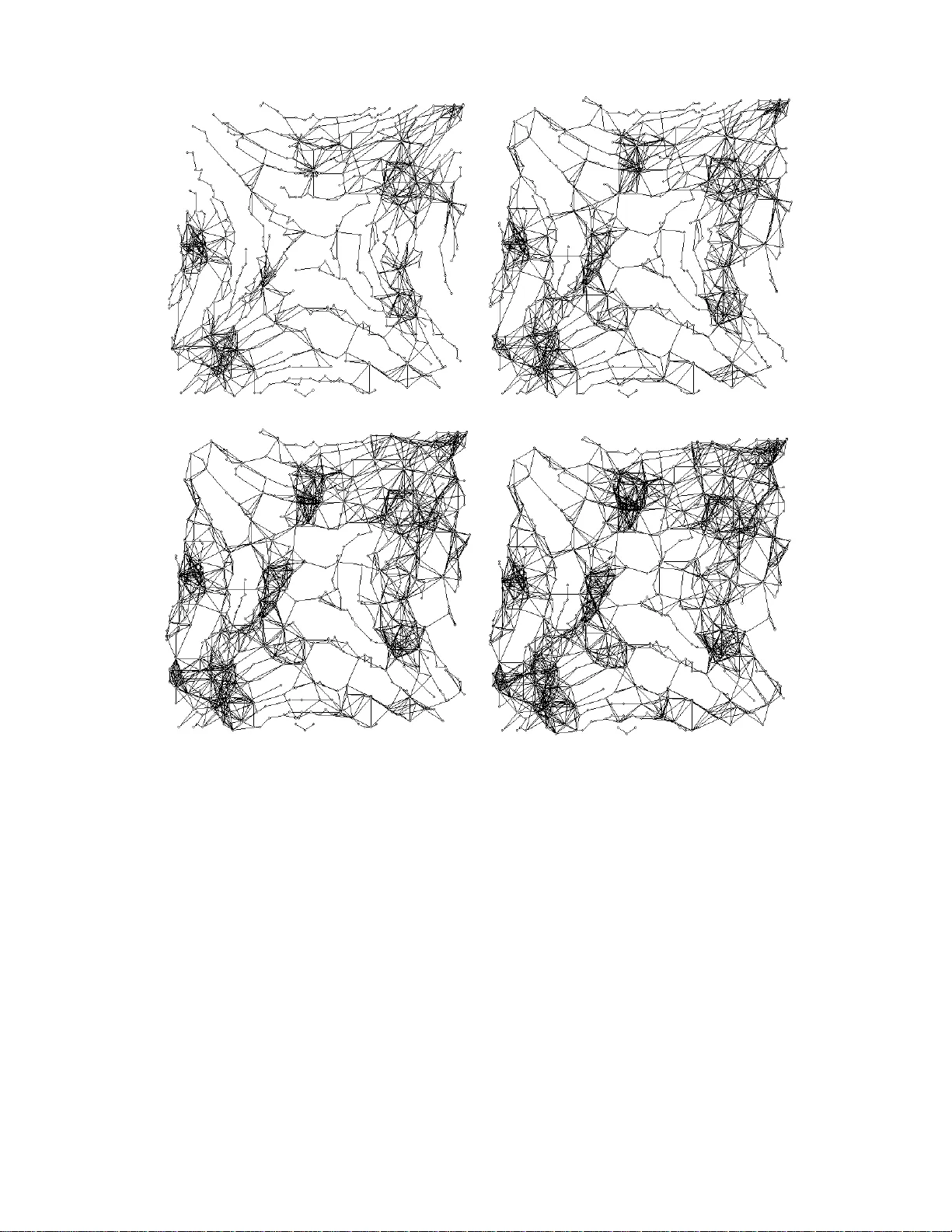
T ra jectory Net w orks and Their T op ological Changes Induced b y Geographical Infiltration Luciano da F ontoura Costa Instituto de F ´ ısic a de S˜ ao Carlos, University of S˜ ao Paulo, P.O. Box 369, S˜ ao Carlos, S˜ ao Paulo, 13560-970 Br azil and Konr ad L or enz Institute f or Evolution and Co gnition R ese ar ch, A dolf L or enz Gasse 2, A-3422 Altenb er g, Austria Cees v a n Leeuw en L ab or atory of Per c eptual Dynamics, R i ken, 2-1 Hir osava, Wako-shi, Saitama 351-019 8 Jap an (Dated: 14th Marc h 2008) W e inv estigate the effect of progressiv e geographical infiltration on the t opology of tra jectory net - w ork s. T ra jectory netw orks, a typ e of knitted n et work, are obtained by establishing paths b etw een geographically distributed no des while follow ing an associated v ector field. These systems offer tools for modeling adaptive gro wth, development, and pathology of biological, transp ortation, or comm unication netw orks. F or instance, the no des could corresp ond to neurons or axonal branching p oin ts along the cortical surface and the vector field could correspond to the gradien t of neurotrophic factors, or the n odes could represent to wns while the vector fi elds would b e given by economical and/or geographical gradien t s. The geographical infiltrations corresp ond to the add ition of new local connections b et ween nearby ex isti ng no des. As such, these infi ltratio ns could b e related to sever al real-world pro cesse s such as contami nations, diseases, attacks, parasites, etc. Com bin ed with a mechanism for elimination of no des and connections, infiltration can model gro wth, develo pment and adaptive plasticity in neuronal netw orks. The progressiv e geographical infiltration effect is ex- pressed in terms of the degree, clustering coefficient, size of t he largest comp onen t and the lengths of the ex isti ng chains measured along the infi ltrations. W e show th at the maximum infiltration distance pla y s a critical role in the in tensity of th e ind uced topological changes. F or large enough v alues of this parameter, the chai ns intrinsic to the tra jectory netw orks un d ergo a collapse which is unrelated to the p ercolation of th e netw ork also implied by the infiltrations. (Copyrigh t Luciano da F. Costa, 2008) P ACS num b ers: 89 .75.Hc, 89.75.Fb, 89.75.-k ‘No one r ememb ers what ne e d or c ommand or desir e dr ove Zenobia’s founders to give their city t hi s form, ..., which has p erhaps gr own thr ough suc c essive sup er- imp ositions fr om the fi rst, now u nde cipher able plan.’ (I. Calvino, In iv isible Cities) I. INTRO DUCTION Graphs and complex netw o rks can be classified in to t wo ma jor catego ries: ge o gr aphic al and non- ge o gr aphic al ones. Wherea s in the latter type of netw or ks, no des do not hav e sp ecific p ositions, in the former , each no de has a well-defined spatial p osition, expressible by resp ectiv e co- ordinates. Several real-world netw ork s ar e g eographical in nature, including p ow er distribution (e.g. [1]), tourism (e.g. [2]), tra nsportatio n (e.g. [3]), biolo g ical netw or ks (e.g. bo ne structure [4 ], gene expres sion ex pression [5, 6], and developing neurona l netw or ks [7, 8]). They all share the prop erty that, to v arious extents, spa tia l proximity betw een no des plays a ro le in s ha ping the connectivity structure. O ft en in these net works, spatially close no des hav e a larg er pro babilit y of b eing connected. Sometimes the role of spatial position is more in tricate. F o r in- stance, in neuronal netw o rk developmen t, a xonal path finding is directed b y the co o peratio n of multiple fac- tors. These include mechanical ones, such as the pres- ence o f a fissure, the expression gradie nt of molecules as pos itiv e, p ermissive, or negative g uidance factor s and the cell adhesion molecules in volv ed in fas c iculation [8]. In a ddition we need to consider [7 ] neurothro pic factors that regula te neuro nal surviv al, differentiation, and sig- naling [9, 10, 11], the gra dien ts of neurotransmis s ion [12], and the interactions amo ngst thes e factors [13, 14]. T o take these in to account, dynamica l vector repr e sen tations need to b e asso ciated with net work no des, vertices, or geogr a phical lo cations. W e wish to incorp orate these r e- quirements into geo graphical netw or k s. A v arie t y of geogra phical netw or ks have b een prop osed in the liter ature (e.g. [15, 16, 1 7, 1 8]) . A new family of net works, namely the knitte d net work s , was prop osed re- cently [19, 20] to include all netw orks defined a nd com- po sed by paths, i.e. sequences of edges without r epetition of nodes. 2 In this article, we ex pand the family of knitted net- works b y incor pora ting structur es generated by tra jecto- ries defining paths following a given vector field. More sp ecifically , a se t o f no des is distributed within a g iv en domain (a 2D space in this article, but the ex tension to higher dimensions is immediate); one no de is chosen as origin, and the resp ectiv e tra jector y (line of fo rce) is ob- tained while the no des which a re clo ser than a given max- im um distance to the current p oin t of the tra jector y are sequentially incorp orated into the path. This pro cedure is rep eated se veral times, yielding a netw ork with connec- tions a ligned to the vector field. In other w ords, the paths corres p ond to a ppro ximations of the solutions of the dy- namical s ystem repre sen ted by the vector field. Figure 1 illustrates t wo tra jectory netw o rks obtained from the vec- tor fields ~ φ ( x, y ) = ( y , x ) and ~ φ ( x, y ) = ( y , − x ) (b). T r a jectory net works represen t a natural putative mo del for several r eal-w orld struc tur es and phenomen, for instance neural g ro wth and development , includ- ing axonal navigation [8], the establishment of neurona l connections under the influence o f neurotrophic fields (e.g. [9, 10, 11]), neurotr ansmitter diffusion [12] a nd their relation with adaptive plasticity [1 4], the g ro wth of trans- po rtation systems under geo g raphical and eco nomical in- fluences (e.g. ‘every pa th lea ds to Rome’), the growth of trees and ro ots under influence of tro phic factor s [21], the developmen t of channel-based sys tems such as bo ne structure a nd the v ascula r system, amo ngst ma n y other impo rtan t systems. The fo c us o f attention in the curr en t w ork is to in ves- tigate ho w the to pology of tra jectory netw orks, a geo- graphical type of knitted netw o rk, is a ffected a s a con- sequence of progr essiv e ge o gr aphic al infiltr ation . By ge- ographica l infiltration (hence infiltration for sho r t), we mean any pr ocess which in terco nnec ts pa irs o f nodes. Infiltration affects several real-world sy s tems, e.g. the app earance of cr ac k s along channels, the establishment of new lo cal ro utes b et ween towns and cities, con ta mina- tions b et ween vessels of fiber s, gallery building by para- sites, inten tional attacks, internal spreading of disea ses, to cite just a few cases. In the curr en t w ork, the infil- tration pro cess is simu lated b y s e lecting no des at r an- dom a nd connecting this no de to all other no des which are closer than a maximum distance D p . Therefore, the adopted infiltration c orresp onds to the progr essiv e incor- po ration o f tufts of loca l connectivity . Here, we in vestigat the effects of pr o gressive infiltra tion on the topolo gy o f tra jector y netw o rks b y quan tifying the deg ree, clus tering co efficien t, size of the lar gest com- po nen t, a s well a s the num b er and length of the chains present in the netw ork. A recent study hig hligh ted chains as an imp ortan t category of netw o rk motifs [22]. Real- world netw o rks often contain several chains, in ways sp e- cific to their structure and function. Thu s, these net- works are po ssibly the first theoretical mo del to natu- rally incor pora te these motifs. Thes e mo tifs are a conse- quence o f the linking of spatially distributed no des alo ng the tra jectories defined by the given vector fields . The common tr a it in real-world netw ork structure that these mo dels repres e n t particular ly well is the prese nc e of in- depe ndent paths, with relatively few colla terals. There- fore, it b ecomes particularly impor tan t to characterize the structure o f tra jector y netw or ks b efore and after in- filtration by cons idering the n umber and length of the existing chains. In teres tingly , the effect of infiltra tions can be either bad or go od, depending on ea c h specific system. F or insta nc e , the incor poratio n o f additiona l lo- cal routes is in principle b eneficial for transp ortation and communication systems. On the other hand, the addition of lo cal connections in biologic al networks (e.g. bo ne or neuronal netw or k s) may hav e catastro phic consequences. Observe that in the latter situation the main purp ose o f the c hains/fib ers is actua lly to provide mutual isolation. In b oth cases, the quantification of the effects of the infil- tration ov er the top ology of the resp ectiv e netw orks can provide v aluable information to b e interpreted from the per spective o f ea ch pro blem. This article starts by pre sen ting the basic c o ncepts — including the generation of tra jector y net works and the geogr a phical infiltrations — and follows by de s cribing the exp erimen ts and discussing the r espectively obtained re- sults. II. BASIC CONCEPTS A c omplex n etwork is a gra ph exhibiting a particular ly int ricate structure. The connectivit y of a undir e cted, un weigh ted netw o rk can b e completely repr esen ted in terms of the re s pective adjac en cy m atrix K , such that each in ter connection b et ween t wo no des i and j implies K ( i, j ) = K ( j, i ) = 1, with K ( i, j ) = K ( j, i ) = 0 b eing otherwise imp osed. The imme diate neighb ors of a no de i are those no des which r eceiv e an edge from i . The de gr e e of a no de i is equal to the num ber o f its immediate neigh- bo rs. Two no des are said to be adja c ent if they share a n edge; tw o edges ar e a dja c en t if they share one no de. A sequence o f adjacent edg es is a walk . A p ath is a walk which nev er rep eats a no de or edge. The length of a walk (or path) is equal to the r espective num b er of in volv ed edges. The clustering c o efficient of no des i is ca lculated by dividing the n um ber of interconnections b et ween its immediate neighbors and the maximum p ossible num b er of connectio ns which could b e established betw e en those neighbors. A c onne cte d c omp onent of a net work is a subg raph such that each of its no des ca n b e reached from any of its o ther no des [3 8]. A chain is a subg raph of a netw or k such a s that each of its no des has deg ree 1 or 2 and not additional no des of degr ee 1 or 2 are connected to it [22]. The lengt h of a chain is given by its num b er of edg es. Two measure - men ts which can b e used to characterize the chains in a given netw o rk include the num b er of such chains a nd av- erage a nd standard de v iation of their r espective lengths. Chains are naturally rela ted to paths along the netw ork . 3 (a) (b) FIG. 1: T ra jectory n et works obtained for the fields ~ φ ( x, y ) = ( y , x ) (a) and ~ φ ( x, y ) = ( y , − x ) (b). II I. TRAJECT OR Y NETWOR KS A family of netw o r ks, namely the kn itte d c omplex net - works , was in tro duced recently [19, 20] incorp orating all net works orga nized a round the concept of p aths . Tw o main types of knitted netw or ks were initia lly identified: p ath-tr ansforme d and p ath-re gular . The former sub cate- gory o f knitted complex netw ork is obtained by p erform- ing the star t- path transformation [1 9] on a given netw ork (star and path connectivities can b e understo od as duals, e.g. thro ugh the line-graph transforma tio n). Ther efore, net works with p ow er-law distr ibution of pa th lengths ca n be obtained b y star-path transforming Bara b´ asi-Alb ert net works [23]. The seco nd t yp e of knitted complex net- works, namely the path-regular net works, is par ticularly simple and inv o lv es starting with a s e t of N isolated no des and per forming s e veral paths encompa s sing a ll no des. Path-regular net works hav e b een found to ex- hibit marked s imilar prop erties b et w een differen t config- urations or no des in the s a me configura tion (e.g. [20, 2 4]) . An even more regular version of the pa th-regular net- work, with all no des ex hibiting identical degrees, w as later rep orted in [25, 26]. Geographica l netw orks are characterized by the f act that each of their nodes has a w ell- defined spatia l po - sition. Geographica l netw o rks repr e sen t an impo rtan t category of complex netw or ks b ecause several r eal-w o rld structures are inhere n tly embedded into 2D or 3D spaces, and their connectivities are stro ngly affected b y prox- imit y and spatial adjacency . Given a s et o f spa tially distributed no des e mbedded in a co ntin uous space to which a vector field is a s sociated, it is p ossible to ob- tain geo graphical netw orks whose connections are a con- sequence not only of the proximit y betw e e n no des, but also o f the or ien tations implied by the r espectively as- so ciated vector field. Several r eal-w orld ca n b e thought as involving a geogra phical distribution of no des and as- so ciated vector fields. F or instance, the neur ons along the c o rtical surface can b e repr esen ted as a s et o f geo - graphically distributed no des, w hile their connections are established to a great extent as a conseq ue nc e of neu- rotrophic fields (e.g. electr ical or chemical gradients). Systems of streets, r oads and highw ays ca n also b e un- dersto od a s inv o lving a set of spa tially distributed nodes (the intersections b et ween routes), with the in terconnec- tions b eing established in terms of the spa tial proximit y betw een no des as w e ll as g eographical a nd economica l fields (e.g. the trend to connect to a big city , to av o id a geogr aphical o bstacle or to follow level-sets of height). Several other natural a nd human-made complex sy stems can b e mo deled by tra jectory netw or ks. T r a jectory net- works are related to g r adien t netw or k s (e.g. [2 7, 28, 29]), field in tera ctions [5, 6, 30], as well as dynamical systems (e.g. [3 1, 32]). In the present work, we understa nd tra- jectory netw orks a s a particular case of knitted netw or ks. The tr a jectory netw or ks considered in the pr esen t ar- ticle are obtained as follows. First, a t wo-dimensional workspace o f size L × L is defined, and a vector field ~ φ ( x, y ) is asso ciated to it. F or simplicity’s sake we as - sume tha t − L/ 2 ≤ x, y ≤ L/ 2. All netw or ks considered henceforth in this work are obtained for the vector field ~ φ ( x, y ) = ( y , x ). N po in ts ar e distr ibuted a long this space with uniform probability . A total of N p tra jecto ries are then per formed while obtaining each netw ork. A start- ing p oint is randomly s elected, and the resp ectiv e line of force (alwa ys para llel to the vector fie ld) is calculated by 4 using the Euler leapfrog numerical metho d (e.g. [3 3]). At each current time, if a new no de is found at a distance not excee ding D p , that no de is connected to the previ- ous no de, a nd so on. As it is clea r from the example of tra jecto ry netw or k shown in Figure 1, the combination of proximit y and orientation co nstrain ts while p erform- ing the connections yield netw or ks incor pora ting s ev era l chains, which close ly follow the vector field orientation. Different degre e s of in ter c o nnectivit y b et ween and alo ng the c ha ins can be obtained by v a rying the total n um ber of po in ts and the parameter D p . Obs e rv e that the num b er of chains is is r e duce d for lar ger v alues of D p / N . Once all tra jector ie s are pe r formed, the isola ted p oints can be remov ed (as adopted henceforth) or not (a llowing further connections). IV. GEOGRAPHICAL INFIL TRA T IONS Given a g eographical netw ork, several t yp es of pertur - bations of its str ucture ca n aris e as a sp ecific consequence of its geogr aphical nature, in the sense tha t no des which are spa tially closer may in terfer e o ne another. F o r in- stance, in a neuro nal system, unw anted c o nnections may app ear b etw een nearby neurons as a consequence of dis- eases. In tra nsportatio n s ystems, it is only to o natural to incorp orate new loc al connections to the netw or k. Sev- eral o ther types of g eographical interferences are p ossible, including those arising as a co nsequence o f con tamina- tions, attacks, infiltrations, amongs t many other. In this work we incor pora te pr ogressive infiltrations to a g iv en netw o rk g eographical netw ork by selecting one o f its no des a nd connecting to it all other no des which are not further than a ma xim um distance D i . V. RESUL TS AND DISCUSSION A set of 30 tra jectory netw or ks was obtained for the field ~ φ ( x, y ) = ( y , x ). A total o f 1000 no des was ini- tially distributed within a s qure region of side L = 100 centered a t (0 , 0), a nd N p = 100 tr a jectories w er e n u- merically calculated. Starting from a rando mly c hosen no de, each node at a ma xim um distanc e D p = 2 from the curr en t growing extremity of each tra jector y was suc- cessively connected. An e xample o f obtained tra jecto ry net work is s ho wn in Fig ure 1. Each of the 30 netw orks underwen t prog ressive infiltra tions as suming D i = 5 and D i = 10. Figure 2 shows four sta ges (100, 20 0, 300 and 400) along the succes siv e infiltrations for D i = 5. Ex- amples of the res ults o f infiltrations with D i = 10 are depicted in figure 3. In or der to characterize the altera tions in the top ology of the tr a jectory net works as th ey underwen t progres- sive infiltra tions, a set of measur emen ts (e.g. [34]) was taken alo ng the pro cess. These mea suremen ts included the av era ge and standard deviation of the no de degree , clustering co efficien t, size of the larg est connected c om- po nen t, and c hain lengths a long successive infiltration stages. Only c ha ins longer than 3 edges were co ns idered in the resp ectiv e measur emen ts. These chains were iden- tified by sta rting from ea ch of the netw or k no des with degree 1 or 2 and following along b oth sides (in case of degree 2) until the r e s pective extremities of the chains (no des with degree 1 o r larger than 2) were found (each detected chain was r e mo ved from the netw or k in order to accelerate the pro cessing of the remaining no des). The results obtained for D i = 5 and D i = 10 are shown in Figure 2 and 3, resp ectiv ely . Figure 6 and 7 show the ab o ve measur emen ts for al l the 30 considered net works. It is clear from Figures 4 to 7 that, as could b e ex- pec ted, the degree and cluster ing co efficient b oth in- creased as a co ns equence o f the addition of the infiltratio n tufts. Both such incr e a ses ar e sublinear, with a steep er decrease in the r ate of clustering c o efficient increase ob- served for D i = 10 (Fig. 7). The relative sizes of the max- im um connected comp onen ts suffer an abrupt transition befo re the 160 first infiltrations (most of the tra nsitions take place b efore that v a lue) for b oth settings of D i , but is more a brupt for D i = 10. This change is related to the per colation o f the chains in the original netw or k. Another relatively abrupt change is obser v ed for the path lengths, most of which sta bilizing themselves a t a v alue near 6 for D i = 5 and 4 for D i = 1 0. The int erv al fr om the s tart of the infiltrations until the av erag e length of the chains sta- bilizes (as obs erv e d ab ov e) is called the p erio d of c ol lapse of the chains. V ery few net w orks remained with la rge av era ge chain leng ths larger after 200 infiltratio ns . This confirms the fact, ev ide nt from Figure 8, that the tuft infiltrations tend to q uic kly eliminate most of the lo ng chains in the tra jecto ry netw or ks (the c hain collapse). F o r larg er v alues of D i , a fter the co llapse of the chains, the vector field influence on the netw ork connectivity can be har dly distinguished by visual insp ection, such as in Figures 3(b-d). It is imp ortant to keep in mind that the fact that small v alues of D i tend to imply little effect ov er the chain structure of the tra jectory netw o r ks is ul- timately r elated to the num b er N of initial no des and the maximal distance D p considered for chaining the no des during the construction of the netw o rks. The tw o in volv ed cr itical phenomena, na mely the p er- colation o f the net works and the collapse of the c hains, were inv estig a ted further in o r der to sear c h for p ossible relationship b et ween their resp ectiv e onsets. In orde r to do so, transitio n p oin ts alo ng the s uc c essiv e infiltrations were identified a utomatically . These points, resp ectiv ely T p and T c , corres pond to the first o ccurrence of the v alue 1 for the r elativ e size o f the la rgest connected comp onent and the first o ccurrence of the av era ge chain length whic h is smaller or e q ual than 5, resp ectively . Figure 8 shows the r espectively obtained distribution of T p and T c ob- tained for the 30 r ealizations of net works with D i = 10 . It is clear fr o m this figure that the tw o critica l phenom- ena taking place in the considered tra jector y netw orks seem to b e lar gely independent, in the se ns e that no co r - 5 (a) (b) (c) (d) FIG. 2: The n et work in Fig. 1 after 100 (a), 200 (b), 300 (c) and 400 (d) infiltrations with D i = 5. relation has b een obser ved b e t ween their c ritical v alues. Int erestingly , as shown in Figur e 8, the collapse of the chains can take place b efore the re s pective p ercolation. VI. CONCLUDING REMARKS Geographica l net works r e presen t an imp ortant cate- gory of complex netw orks beca use of their natura l po - ten tial for mo deling a large num b er of real-world and hu man-made co mplex structures and systems. A t the same time, the ca tegory o f co mplex netw orks built up by paths, namely the knitte d networks , constitutes a n im- po rtan t s uperclass of co mplex struc tur es b ecause of their int rinsic asso ciation with the co ncept of paths (as opp o- sited to star connectivity) and r andom walk dynamics (e.g. [1 9, 20, 2 4]). In this w or k, tra jectory netw o rks hav e bee n unders too d to b elong to the sup ercategory o f knit- ted netw o rks as a consequence of the fact that these struc- tures are the re sult of path g eneration pro cesses. T r a- jectory netw orks constitute a sp ecial case , in which the paths tend to follow an asso ciated vector field. Our main int erest in the present work, howev er , consis ted in in ves- tigating how the to p ology of tra jectory netw ork s changed as a conseq uence of geo g raphical infiltra tions. While sev- eral types of a ttac ks and p erturbations hav e b een consid- ered a nd inv estiga ted in co mplex netw or k res earc h, rela- tively less attention has b een devoted to perturba tions in- 6 (a) (b) (c) (d) FIG. 3: The netw ork in Fig. 1 after 100 (a), 200 (b), 300 ( c) and 400 (d) infiltrations with D i = 10. trinsically rela ted to g eographical constraints, es p ecially the adjacency and proximity b et ween no des. Y et, several impo rtan t real-world and h uman-made systems a re prone to this type of p erturbations, ra nging from the onset of un wan ted neuronal co nnec tions to the incorp oration of new lo cal ro utes to transp ortation s y stems. The main co n tributions r eported in this a rticle are listed and reviewed in the following: T r aje ctory net work s as a sp e cial c ase of knitte d c om- plex networks: W e have defined tra jector y netw o rks as a nov el sub-class of knitted netw ork s. This type o f geo- graphical knitted netw ork corre sponds to a n interesting case where the connectivity is the consequence of b o th the proximity b et ween no des and the orientation o f the underlying vector field. New typ e of p ertu r b ation of network structu r e: W e con- sidered, p ossibly for the first time, pertur ba tions (or ‘at- tacks’) to geog raphical net works which dep end on the proximit y b e tween the spatially dis tributed no des. W e fo cused attent ion o n ‘tuft’ infiltra tions, where a no de i is ra ndo mly chosen and a ll other no des which are closer than a maximum dista nc e D i are connected to no de i . This type of top ological c hang e ca n b e related to sev- eral re a l-w o r ld effects such as unwan ted neur onal tangles as a conseq uence of dise a ses, esta blishmen t o f lo cal con- nections in transp ortation netw orks, contaminations, and attacks. Qualitative changes r esulting fr om infiltr ations: The progre s siv e infiltration of a tra jecto ry net work was in- vestigated in a systema tic manner, considering 3 0 real- 7 FIG. 4: Measurements of degree, clustering co efficien t, size of the largest connected component and chain length s in terms of the num b er of infiltrations (identi fied as ‘time’) with D i = 5 for a netw ork obtained for the vector field ~ φ ( x, y ) = ( y , x ). izations of net works o btained for the same configuratio n with res p ect to the v ector field ~ φ ( x, y ) = ( y , x ). The changes in the netw o rks top ology was monitored by tak- ing several measurements including the degree , cluster- ing co efficient , size o f the la rgest connected co mponent, as well a s the pa rticularly relev ant lengths of the exist- ing chains. The latter measurements ar e esp ecially im- po rtan t because the tra jectory netw ork s are inher en tly comp osed b y chains. While the degr ee and clustering co efficien ts underwen t relatively smo oth increases, the size of the la rgest compo nen t and average c ha in leng ths were sub jected to relativ ely abrupt changes related to the p ercolatio n of the netw ork (in the case o f the largest connected co mponent) and to the collapse o f the chain structure (in the case of the av er age chain lengths). The v a lue of D i was found to be ha ve g reat influence o n such top ological changes induced by the infiltrations, with v al- ues muc h la r ger than D p implying particularly in tense changes, especially regarding the c hain s tructure. Af- ter the c ollapse of the chains, the effect of the original vector field on the netw o r k connectivity c ould ha rdly b e discerned. Such findings are par ticularly imp ortant for a large num b er of real-world s tr uctures under lain by tra- jectory net works and geogra phical infiltra tio ns. Indep endenc e of p er c olation and c ol lapse of chains: The progre s siv e infiltration of tra jectory netw o rks in- volv es tw o c r itical phenomena : its pe r colation and the collapse of its chain s tr ucture. Interestingly , no clear re- lationship b et ween these phenomena ha s b een iden tified by cons idering the critical times T p and T c . This implies that the colla ps e of the chains can not b e pr e dicted fro m the pe rcolation o f the resp ective net work, and vice- v ers a. As a matter o f fact, it has also b een observed that the col- lapse of the chains can take place befor e the p ercolation of the r espective netw o rk. Mo deling of Br ain Development The cur r en t s tudy il- lustrates that, in or der to a void patholog ical net work conditions, b esides growth, a mechanism for the selec- tive elimination of co nnections is also necess ary . Such a mechanism ca n be obser v ed at work in brain develop- men t. The formation of neurona l netw orks involv es the extensive growth, but also elimination of neurons and connections [35]. Isolated nerve cells undergo ap optosis; dendritic a rbor s a r e b eing built and retracted based o n signaling efficacy and electrical activit y in the pre a nd 8 FIG. 5: Measurements of degree, clustering co efficien t, size of the largest connected component and chain length s in terms of the num b er of infiltrations (identi fied as ‘time’) with D i = 10 for a net work obtained for the vector field ~ φ ( x, y ) = ( y , x ). po stsynaptic neur o ns. As a result, synapses undergo ex- tensive rewiring after their initial attachmen t [36]. These pro cesses work together to maintain a functional ne tw ork architecture for effective communication b et ween bra in cells [14]. The several p ossibilities of future work include but a re not limited to the following: Other t yp es of ve ctor field s: It w ould be in teresting to inv estigate how the patterns of top ologica l c hanges observed in this work extends to tra jectory netw orks ob- tained by c onsidering other vector fields , as well as other configuratio ns o f the inv olved para meter s. Ortho gonal infiltr ations: In this w ork w e foc us ed at- ten tion on tuft infiltratio ns . It would b e in teresting to study the top ological c ha ng es of tra jectory netw orks with resp ect o f other types of geog raphical p erturbations, such as c onnecting p oint s accor ding to pr o ximity a nd orie nta- tions ortho gonal to the vector field (p ossibly also through tra jecto ries). Infiltr ation by incr e asing distanc es: While the infiltra- tions implemen ted in this article co nsisted in selecting no des follow ed by tuft interconnection, it would b e par- ticularly interesting to inv estiga te the top ological alter - ations o f tra jector y netw o r ks while all pairs of no des are joined according to successive distances. Suc h a type of infiltration is g uaran teed to completely eliminate the chains after a critical in ter v al. Applic ation to r e al-world n etworks: It would be inter- esting to quantify the alter ations of rea l-w or ld netw or ks expressible by tra jectory net works, including trans- po rtation netw orks , p o wer distribution, communications, tourism and neuronal systems. Applic ation to Im ag e and Shap e Analysis: The analy- sis of images containing ob jects and s hapes has rema ined a gr eat challenge (e.g. [30, 37]). It w ould be par ticula rly int eresting to consider t he application of the concepts and methods rep orted in the current work to such prob- lems. More s pecifically , tra jectories can b e obtained in gray-level imag e s by considering their respec tiv e gra di- ent fields. So , by distributing po in ts thr o ugh the imag e and interconnecting them while taking in to a ccoun t tra - jectories dr iv en b y the gra dien t fields, it is p ossible to obtain resp ectiv e netw or k r epresen ta tions incorp orating a great deal of the int rinsic geo metr ic featur e s. Shapes represented b y their contour can also b e mapp ed into tra jecto ry net works by considering vector fields induced 9 FIG. 6: Avera ges of degree, clustering coefficient, size of the largest connected comp onen t and chain lengths in terms of th e num b er of infiltrations (identified as ‘time’) with D i = 5 for eac h of t he 30 netw orks obtained for the ve ctor field ~ φ ( x, y ) = ( y , x ). by their b orders (e.g. electrical or distance fields). The top ological pr operties of the resp ective measure ments ar e exp ected to provide v aluable fea tures fo r image and shap e analysis and cla ssification. Signa tures o btained by co n- sidering the ev o lution of several measurements o f the so - obtained netw or ks as the c onsequence of g eographical in- filtration can provide additional features for visual char- acterization and classification. Ackno wledgme n ts Luciano da F. Costa thanks CNPq (30130 3/06-1) and F APESP (05/0058 7 -5) for sp onsorship. [1] R. Alb ert, I. A lbert, and G. L. Nak arado, Phys. R ev. E 69 , 025103 (2004). [2] R. Baggio, Ph y s. A 379 , 727 (2007). [3] M. Barthelemy and A. Flammini, J. Stat. Mech. p . 07002 (2006). [4] L. da F. Costa, M. P . Viana, and M. E. Beletti, App l. Phys. Letts. 88 , 03390 3 (2006). [5] L. da F. Costa, B. A. N. T rav encolo, A. A zeredo, M. E. Beletti, G. B. Muller, D. R ass kin-Gutman, G. Sternik, M. Ibanes, and J. C. I. Belmonte, Appl. Phys. Letts. 86 , 3901 (2005). [6] L. Diam bra and L. da F. Costa, Bioinformatics 21 , 3846 (2005). [7] J. v an Pelt and A. Schierw agen, Math. Biosc. 188 , 147 (2004). [8] Z. Z. Bao, Brain Res. 1192 , 165 (2008). [9] E. J. Huang and L. F. Reichardt, Ann. Rev. Neurosc. 24 , 677 (2001). [10] M. V. Sofroniew, C. L. How e, and W. C. Mobley , Ann. Rev. N eu rosc . 24 , 1217 (2001 ). 10 FIG. 7: Avera ges of degree, clustering coefficient, size of the largest connected comp onen t and chain lengths in terms of th e num b er of infiltrations (identified as ‘time’) with D i = 10 for eac h of the 30 netw orks obtained for the vector field ~ φ ( x, y ) = ( y , x ). [11] L. R. Squire, F. E. Bloom, S . K. McConnell, J. L. Rob erts, N. S. Spitzer, and M. J. Zigmond, F undamental Neur oscienc e (A cademic Press, 2003 ). [12] A. V . Semy anov, N eurosc. and Beh. Phyisi ol. 35 , 25 3 (2005). [13] P . Gong and C. v an Leeuw en, Eur. Letts. 67 , 328 (2004). [14] H. F. Kwok, P . Jurica, A. Raffone, and C. va n Leeuw en, Neuro dyn. 1 , 39 (2007). [15] M. Kaiser and C. C. Hilgetag, Phys. R ev. E 69 , 036103 (2004). [16] L. d a F. Costa, Intl. J. Mo d. Phys. C 16 , 1001 (2005). [17] M. T. Gastner and M. E. J. Newman, Eur. Phys. J. B 49 , 247 (2006). [18] C. P . W arren, L. M. Sander, and I. M. Sokolo v, Phys. Rev. E 66 , 056105 (2002). [19] L. d a F. Costa (2007), arX iv:07 11.1271 . [20] L. d a F. Costa (2007), arX iv:07 11.2736 . [21] P . J. Gregory , Plant Ro ots: Gr owth, activity and i nte r ac- tions with the soil ( W iley- Bl ac kwe ll, 2006). [22] P . R. V. Boas, F. A. R o drigues, G. T ravies o, and L. da F. Costa, Phys. Rev. E 77 , 026106 (2008). [23] R. Alb ert and A. L. Barab´ asi, R ev. Mod . Phys. 74 , 47 (2002). [24] L. d a F. Costa (2007), arX iv:07 12.0415 . [25] L. da F. Costa (2008), [26] L. da F. Costa (2008), http://hal. arc h iv es- ouvertes. fr/hal-00258 893/fr/ . [27] Z. T oro czkai , B. K ozma, K. E. Bassler, N . W. Hengart- ner, and G. Korniss (2004), cond- mat/0 408262. [28] Z. T oro czk ai and K. E. Bassler, Natu re 428 , 716 (2004). [29] L. da F. Costa and G. T ra vieso, Intl. J. Mod. Phys. C 16 , 1097 (2005 ). [30] L. da F. Costa (2006), arXiv:physics/06030 25. [31] S. Thurner, Europhysics News 36 , 218 (2005). [32] E. P . Borges, D. O. Ca jueiro, and R. F. S. Andrade, Eur. Phys. J. B 58 , 469 (2007). [33] J. H. Mathews, Numeric al Metho ds f or Mathematics, Sci- enc e and Engine ering (Prentic e Hall, 1987 ). [34] L. da F. Costa, F. A. R odrigues, G. T ravieso, and P . R. V. Boas, Ad vs. in Phys. 56 , 167 ( 2007). [35] S. R. Qu artz, T rend s in Cogn. Sci. 3 , 48 (1999). [36] L. I. Zhang and M. Poo, N atu re Neurosc. 4 , 1207 (2001). [37] L. da F. Costa and R. M. Cesar, Shap e Analysis and Classific ation: The ory and Pr actic e (CRC Press, 2001). [38] Often a connected comp onent is understo od to b e maxi- mal, in the sense of incorporating all mutually reac hable nod es in that comp on ent. 11 FIG. 8: Scatterplot of the p ercolation ( T p ) and collapse ( T c ) critical times for D i = 10.
Original Paper
Loading high-quality paper...
Comments & Academic Discussion
Loading comments...
Leave a Comment