Impact of Spatial Correlation on the Finite-SNR Diversity-Multiplexing Tradeoff
The impact of spatial correlation on the performance limits of multielement antenna (MEA) channels is analyzed in terms of the diversity-multiplexing tradeoff (DMT) at finite signal-to-noise ratio (SNR) values. A lower bound on the outage probability…
Authors: Z. Rezki, David Haccoun, Franc{c}ois Gagnon
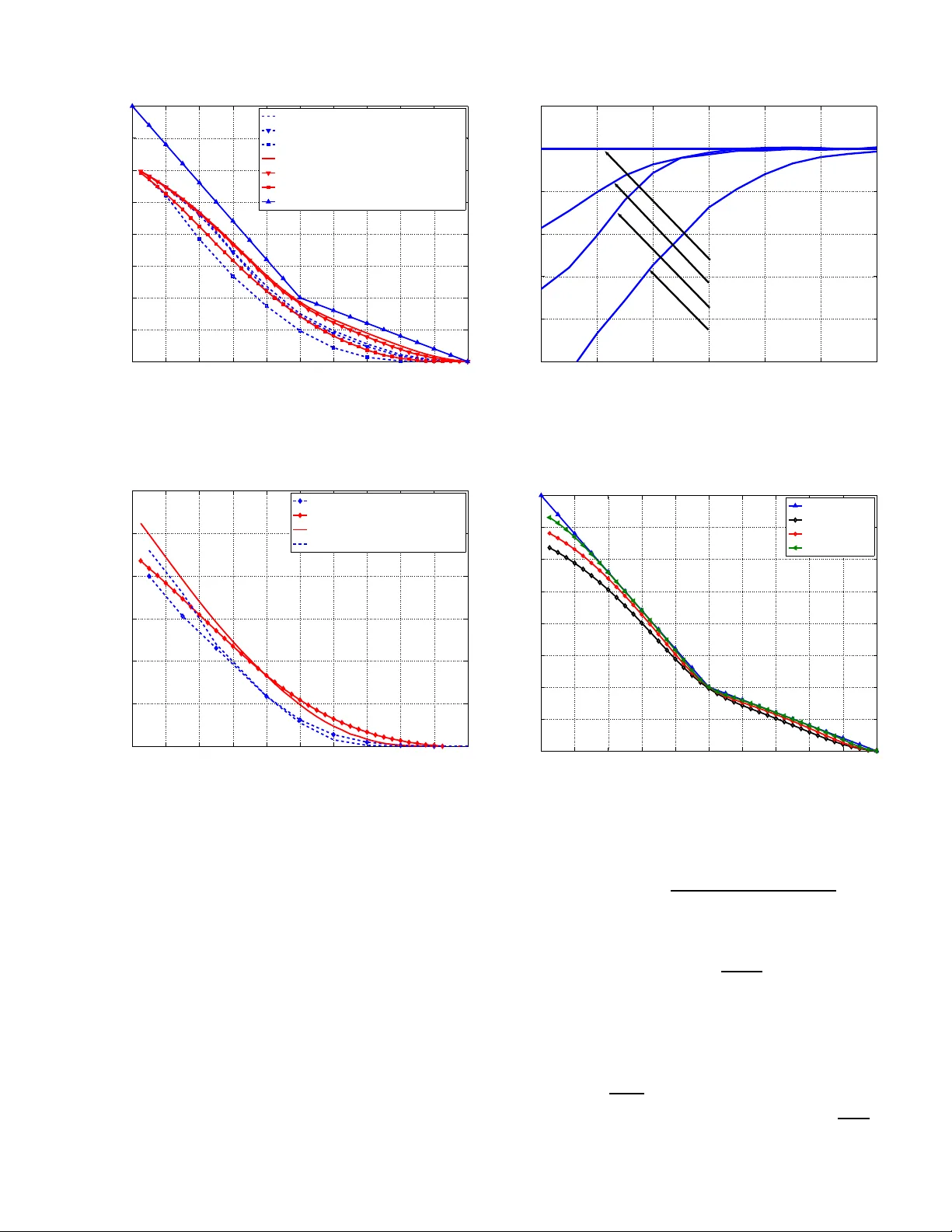
IEEE TRANSACTION ON WIRELESS COMMUNICA TIONS, VOL. X, NO. X, XXX 2007 1 Impact of Spatial Correlati on o n the Finite-SNR Di v ersity-Multiple xing T radeof f Z. Rezki, Student Member , IEEE, David Ha ccoun, Life-F ellow , IEEE , Fran c ¸ ois Gagnon, Senior Membe r , IEEE, and W essa m Ajib, Member , IEEE, Abstract — The impact of spatial correlation on the perfor - mance limits of multiel ement antenna (MEA) channels is an- alyzed in te rms of the divers ity-multiplexing tradeoff (DMT) at finite sign al-to-noise ratio (SNR) values. A lower bound on t he outage probability is first derived. Using this bound accurate finite-SNR estimate of the DMT is then d eriv ed . This esti mate allows to gain insight on the imp act of spatial correla tion on the DMT at fin ite SNR. As expected, the DM T is sever ely d egraded as the spatial correlation in crea ses. Moreo ver , u sing asymptotic analysis, we sh ow that our framewo rk en compasses well-known results concerning the asymptotic beha vior of the DMT . Index T erms — Dive rsity-Multiplexin g tradeoff (DMT), finite SNR, outage probability , spatial correlation. I . I N T RO D U C T I O N Multielement antenn a (MEA) systems ha ve been used either to inc rease the diversity gain in o rder to better combat channe l fading [1 ], or to increase the data rate b y mean s of spatial multiplexing gain [2] . Recently , Zheng and Tse showed th at both gains can be achiev ed with an asymptotic optimal tradeoff at hig h-SNR regime [3]. This tradeoff is a ch aracterization of the ma ximum diversity gain that can b e achieved at each multiplexing gain . At lo w to m oderate SNR values (typ ically 3 − 20 dB), this asy mptotic tra deoff is in fact an optimistic upper bo und on the finite-SNR diversity-multiplexing tradeoff. A fr amew o rk was introduced by Narasimhan to character ize the diversity per formance of rate- adaptive MIMO systems at finite SNR [4]. As expected, the achiev ab le di versity gains at realistic SNR values are significantly lo wer than for the as ymp- totic v alue s. In [3] and [4], the authors assume independen t and identically d istributed (i.i.d.) fading chann els. Howe ver, in rea l propag ation environments, the fades can be cor related which may be de trimental to the p erform ances o f MEA systems [5]. Recently , the impact of spatial correlation on the finite-SNR DMT was studied in [6]. In this pap er , we analyze the imp act of spatial correlation on the D MT at finite-SNR values using a new framework an d we extend to the high-SNR regimes, the results obtaine d for finite- SNR in [7 ]. W e p rove that our fram ew or k enco mpasses the Z. Rezki and D. Haccoun are with the Depart ment of Electric al Engineeri ng, ´ Ecole Polytec hnique de Montr´ eal, Email: { zouhei r .rezki,da vid.haccoun } @polymtl.ca, F . Gagnon is with the Department of Electrical Engineering, ´ Ecole de technol ogie sup ´ erie ure, Email: francois.gagnon@e tsmtl.ca W . Ajib is with the Depa rtment of Computer Sciences, Univ ersit ´ e du Qu ´ ebec ` a Montr ´ eal E mail: ajib . wessam@uqam.ca Manuscript recei ved Nov ember 06, 2006; re vised April 20, 2007; accepte d June 04, 2007. The editor coordinating the revi ew of this paper and approvi ng it for publication was Jitendra Tu gnait. Digital Object Identifier 10.1109/TWC.2008.060984 well-known asymp totic DMT for corr elated and uncor related channels [ 3], [8]. Thus, our f ramework m ay be seen as a generalizatio n of the asymptotic analysis. When capacity -achieving co des are used over a q uasi-static channel, the errors are mainly cau sed by a typical deep fades of the cha nnel, tha t is, the block-err or proba bility is e qual to th e o utage p robability of the chann el P out which will be formally d efined later in the pap er . Theref ore, P out is the key param eter fo r deriving the perform ance limits of MEA systems. Sin ce d eriv ation of an exact expression for P out is difficult, we alter nativ ely deriv e lower boun ds o n P out over both spatially corre lated and uncor related channels. These bound s are then used to obtain in sightful estimates of the related finite-SNR DMT . These estimates allow to char acterize the po tential limits o f MEA systems, in terms of DMT , in a more realistic propagatio n environment and fo r practical SNR values. Th e paper is organized as follows. Sectio n II pre sents the system model and introduces the related definitio ns. In section III, we derive lo wer bo unds on P out . Finite-SNR DMT estimates ar e g i ven in section IV. An asymp totic analy sis of the d i versity estimates is in vestigated in section V. Numerica l results are rep orted in Section VI and Section VII con cludes the pap er . I I . C H A N N E L M O D E L A N D R E L A T E D D E FI N I T I O N S Let an MEA system consist of N t transmit anten nas and N r receive an tennas. W e restrict ou r an alysis to a Rayleig h flat- fading channel, where th e entries of the N r × N t channel ma- trix H are c ircularly-sym metric zero mean complex Gaussian distributed and possibly cor related. The channel is assumed to b e quasi-static, unknown at the transmitter a nd com pletely tracked at the receiver . For the effect of spatial fading cor re- lation, we m odel H as: H = R 1 / 2 r H w R 1 / 2 t , wher e matrix H w represents the N r × N t spatially uncorrelated chan nel, and where m atrices R r , of dimension N r × N r and R t , of dimension N t × N t are positi ve-d efinite He rmitian m atrices that sp ecify the r eceiv e and transmit cor relations respe cti vely [9]. For an SNR-depen dent spectral efficiency R ( S N R ) in bps/Hz, P out is defined as [10]: P out = P r ob ( I < R ) (1) where I is the chann el m utual info rmation. Assum ing equ al power allo cation over the tran smit an tennas, I is g iv en by: I = log 2 det I N r + η N t H H H bps/H z (2) 2 IEEE TRANSACTION ON WIRELE SS COMMUNICA TIONS, VOL. X, NO. X, XXX 2007 where I N r is the N r × N r identity matrix an d wh ere th e superscript H indicates for conju gate transp osition. The mul- tiplexing and d iv er sity gains are respectively defin ed as [4 ]: r = R log 2 (1 + g · η ) (3) d ( r , η ) = − η ∂ ln P out ( r , η ) ∂ η (4) where g is the array gain wh ich is equal to N r , an d w here η is the mean SNR value at each receive antenna. As defined in ( 3) and (4), the multiplexing gain r provid es a n indicatio n of a rate ad aptation stra tegy as the SNR cha nges, while th e div ersity gain d ( r, η ) can be used to estimate the addition al SNR requ ired to decrease P out by a specific amount for a giv en r . I I I . L O W E R B O U N D O N T H E O U TAG E P RO BA B I L I T Y Let us den ote the ortho gonal-trian gular (QR) deco mposition of H w = QR , wh ere Q is an N r × N r unitary matrix and where R is an N r × N t upper triangular matrix with indepen dent entries. The square m agnitudes of the diago nal entries of R , | R l,l | 2 , a re chi-sq uare distributed with 2( N r − l + 1 ) d egrees of freedom , l = 1 , . . . , min ( N t , N r ) . The off- diagona l elements o f R ar e i.i.d. Gau ssian variables, with zero mean and un it variance. Let th e singu lar value decomp ositions (SVDs) of R 1 / 2 t = U D V H , and R 1 / 2 r = U ′ D ′ V ′ H , where U and V (o r U ′ , V ′ ) are N t × N t (or N r × N r ) that satisfy U H U = V H V = I N t (or U ′ H U ′ = V ′ H V ′ = I N r ), and where D (or D ′ ) is an N t × N t (or N r × N r ) diagon al matrix, whose diag onal elements are the singular values of R 1 / 2 t (or R 1 / 2 r ). W e assume, without loss of gene rality , that the elements o f D and D ′ are o rdered in d escending order of their mag nitudes alon g the diag onal. Usin g these SVDs, since det ( I + X Y ) = det ( I + Y X ) and since unitary tra nsfor- mations do no t ch ange th e statistics of random matrices, we have: I = lo g 2 det ( I N r + η N t R 1 / 2 r H w R t H H w R H/ 2 r ) d = log 2 det ( I N r + η N t RD 2 R H D ′ 2 ) (5) where the symbol d = m eans e quality in distributions. Fro m (5), it is clear that R t and R r contribute to the c hannel mu tual informa tion th rough their diagon al matrix rep resentatives D 2 and D ′ 2 respectively . Since D 2 and D ′ 2 have a similar role in (5) , without loss of generality , we can f ocus on the spatial correlation at the tran smitter , that is, we a ssume R 1 / 2 r = D ′ 2 = I N r . Let D k , k = 1 , . . . , N t , denote th e k th diagona l elemen t of D , and let R l,k represent the element of R at the l th row and the k th column, l = 1 , . . . , N r , k = 1 , . . . , N t . Using the fact that det( A ) ≤ Q l A l,l , for any non negativ e- definite m atrix A , we o btain from (5): I ≤ t X l =1 log 2 1 + η N t ∆ l , (6) where t = min( N t , N r ) and wher e ∆ l = P N t k = l D 2 k | R l,k 2 | , l = 1 , . . . , t , is the l th diagona l entr y of RD 2 R H . Since R l,k are indepe ndent, th en ∆ l are also ind ependen t. In order to derive a lower bou nd on P out , the distribution function of ∆ l is needed. When a ll D 2 k , k = 1 , .., N t are equ al which correspo nds to the uncorr elated case, the trace constraint trace ( R 1 / 2 t ) = N t imposes D 2 k = 1 , k = 1 , . . . , N t . That is, ∆ l is chi-squ are distributed with 2( N r + N t − 2 l + 1) degrees of freed om. Other wise, ∆ l may be viewed a s a generalized quadra tic form o f a Gaussian rand om vector . W e first deriv e the distribution f unction of ∆ l , l = 1 , . . . , t , in Lemma 1. Lemma 1: Assumin g th at all D 2 k ’ s, k = 1 , . . . , N t , are distinct, the distribution functio n of ∆ l , l = 1 , . . . , t , is giv en by: f ∆ l ( x ) = N r − l +1 X k =1 a ( l ) k f G ( k,D 2 l ) ( x ) + N t − l X k =1 a ( l + k ) 1 f G (1 ,D 2 l + k ) ( x ) , (7) where G ( α, β ) is a Gamma random variable with proba bility distribution fu nction g iv en b y: f G ( α,β ) ( x ) = x α − 1 Γ( α ) β α e − x β , x ≥ 0 , α > 0 , β > 0 . Th e c oefficients a ( l ) k and a ( l + k ) 1 are given by: a ( l ) k = ( − D 2 l ) − ( N r − l +1 − k ) ( N r − l + 1 − k )! · d ( N r − l +1 − k ) d ( j v ) ( N r − l +1 − k ) h 1 − j v D 2 l N r − l +1 Ψ ∆ l ( j v ) i j v = D − 2 l , a ( l + k ) 1 = 1 − j v D 2 l + k Ψ ∆ l ( j v ) j v = D − 2 l + k , where d ( k ) f ( x ) dx ( k ) is the k th deriv ative o f f ( x ) and where Ψ ∆ l ( j v ) is the momen t generating func tion of ∆ l giv en by: Ψ ∆ l ( j v ) = 1 − j v D 2 l − ( N r − l +1) N t − l Y k =1 1 − j v D 2 l + k − 1 . Pr oof: T he pro of can b e fo und in [ 7]. Note that whe n all D 2 k , k = 1 , . . . , N t , are not distinct, the distribution of ∆ l , l = 1 , .., t , can be derived using th e same mechanism. Using (1), ( 6) and Lemma 1, a lo wer boun d on P out may b e expressed in the f ollowing th eorem. Theor e m 1 (Lower Boun d): Lower bo unds on the o utage probab ility P out for the un correlated D 2 k = 1 , k = 1 , . . . , N t , and co rrelated sp atial fading channels are respectively given by: P uncor r out ≥ t Y l =1 Γ inc ( ξ l , N r + N t − 2 l + 1 ) , (8) P cor r out ≥ t Y l =1 N r − l +1 X k =1 a ( l ) k Γ inc ( ξ l D 2 l , k ) (9) + N t − l X k =1 a ( l + k ) 1 Γ inc ( ξ l D 2 l + k , 1) , where b l , l = 1 , . . . , t , are arbitrary po siti ve co efficients that satisfy r = P t l =1 b l , Γ inc is the incom plete Gamma fun ction REZKI e t al. : IMP ACT OF SP A TIAL CORRELA TION ON THE FINITE-SNR DIVERSITY -MUL T IPLEXING TRADEOFF 3 defined by Γ inc ( x, a ) = 1 ( a − 1)! R x 0 t a − 1 e − t dt and where ξ l is giv en by: ξ l = N t η (1 + g η ) b l − 1 . Pr oof: The p roof h as b een g iv en in [7] but follows alo ng similar lin es as [6, Th eorem 1]. In o rder to o btain tighter re sults, the lower bo unds given in T heorem 1 are maximized over the set of coefficients b l , l = 1 , . . . , t , for each m ultiplexing gain r and each SNR value η . Clearly , the computational ti me of t his optimization prob lem is much smaller th an that req uired by Monte Carlo simulatio ns for computing the exact P out . It is worth n oting that since ξ l ≥ α ρ,l , whe re α ρ,l was defined in [ 6, Theo rem 1], and since Γ inc ( x, a ) is an incr easing fu nction in x , th e lower bo unds giv en by (8) is tig hter than that g i ven b y [6, Theo rem 1] for the uncorr elated case. More over , (9) appears as a finite p roduct of a weig hted sum of Γ inc function s, w hich is more insigh tful and easier to com pute than the lower b ound deriv e d in [ 6, Theorem 1 ], which inv olves weig hted infin ite series of Γ inc function s. I V . F I N I T E - S N R D I V E R S I T Y A N D C O R R E L AT I O N Using Theorem 1 and (4), an estimate of the finite-SNR div ersity for a given multiplexing g ain is now d erived in the following corollary . Cor ollary 1 (Diversity estimate): An estimate o f the diver - sity fo r the corr elated and u ncorrelated spatial fadings ar e respectively given b y: ˆ d uncor r ( r , η ) = N t η t X l =1 (1 + g η ) b l − b l g η (1 + g η ) b l − 1 − 1 ξ N t + N r − 2 l l e − ξ l / ( N t + N r − 2 l )! Γ inc ( ξ l , N r + N t − 2 l + 1) (10) ˆ d cor r ( r , η ) = N t η t X l =1 (1 + g η ) b l − b l g η (1 + g η ) b l − 1 − 1 Q l ( ξ l ) P l ( ξ l ) , (11) where Q l ( ξ l ) and P l ( ξ l ) are given b y: Q l ( ξ l ) = N r − l +1 X k =1 a ( l ) k ( k − 1 )! ξ l D 2 l k − 1 e − ξ l D 2 l D − 2 l + N t − l X k =1 a ( l + k ) 1 e − ξ l D 2 l + k D − 2 l + k P l ( ξ l ) = N r − l +1 X k =1 a ( l ) k Γ inc ξ l D 2 l , k + N t − l X k =1 a ( l + k ) 1 Γ inc ξ l D 2 l + k , 1 . Note that (10) and (1 1) have similar clo sed form s. Clearly , (10) can be obtained fr om (11) by r eplacing P l ( ξ l ) and Q l ( ξ l ) by Γ inc ( ξ l , N r + N t − 2 l + 1 ) and ξ N t + N r − 2 l l e − ξ l / ( N t + N r − 2 l )! respectively . It shou ld b e po inted out that (10) and (11) a re simpler and m ore insightful th an the di versity estimates given in [6, Theo rem 3], which again inv o lve infinite series. V . A S Y M P T OT I C B E H A V I O R O F T H E D I V E R S I T Y E S T I M AT E S In or der to examine wheth er th e d i versity estimates given in Corollar y 1 match the well-k nown asymptotic DM T at high-SNR given in [3 ], we analyze the asymp totic b ehavior of the diversity estimates we derived, as η → ∞ or as r → 0 . First, we present the following lemma. Lemma 2: Assumin g full- rank transmit spatial correlatio n, we can write: lim η →∞ ˆ d uncor r ( r , η ) = lim η →∞ ˆ d cor r ( r , η ) . (12) Pr oof: For convenience, the p roof is presented in Ap- pendix I. The r esult in Le mma 2 is very insigh tful. It states that, at a high -SNR regime and at a given multiplexing gain r , the div ersity estimate is indepen dent of the spa tial cor relation. More interestingly , our asympto tic di versity estimates coincid e with the well-k nown asymptotic DMT ch aracterization as summarized in the following th eorem. Theor e m 2: Assuming full-ran k tran smit spatial correlation, the o ptimal DMT , f or the un correlated and corre lated cases, is giv en by th e asym ptotic diversity estimate, that is: lim η →∞ ˆ d uncor r ( r , η ) = lim η →∞ ˆ d cor r ( r , η ) = d asym , (13) where d asym = − lim η →∞ log 2 P out log 2 η . Pr oof: T he pro of is pr esented in Appendix I I. Theorem 2 states that o ur asymptotic diversity estimate is exactly the high-SNR DMT . T herefor e, it can be seen as a generalizatio n of the DMT for the spatially cor related and uncorr elated channels. Note that Lemma 2 and T heorem 2 agree with th e re sults in [6 , Coro llary 1] . On the other hand , Lemma 2 and Theo rem 2 co nfirm a rec ently established result concerning the asymptotic div e rsity [ 8]. Howev er , o ur result is b roader, since it allows under standing the impact of spatial co rrelation at finite- SNR which is no t discu ssed in [8]. Mo re impor tantly , the fr amew o rk presented her e provides some guidelin es on designing space-tim e co des at pr actical SNR values. As an example, the following co rollary define s the max imum ac hiev able diversity g ain b y any full di versity -based spa ce-time code. Cor ollary 2 (Maximum diversity): The maximum diversity gain is the same for b oth co rrelated a nd uncor related spatial fading chann els and is given by: ˆ d max ( η ) = lim r → 0 ˆ d uncor r ( r , η ) = lim r → 0 ˆ d cor r ( r , η ) = N t N r 1 − g η (1 + g η ) ln(1 + g η ) . (14) Pr oof: T he pro of is pr esented in [7]. Corollary 2 agrees with [6, Theor em 6] even though our div ersity estimates ar e d ifferent fro m those in [6 ]. Coro llary 4 IEEE TRANSACTION ON WIRELE SS COMMUNICA TIONS, VOL. X, NO. X, XXX 2007 0 5 10 15 20 10 −6 10 −5 10 −4 10 −3 10 −2 10 −1 10 0 SNR per receive antenna: η (dB) Outage Probability: P out Uncorrelated, Narasimhan’s lower bound [6] Uncorrelated, our lower bound Correlated, ρ =0.5, our lower bound Uncorrelated, exact (simulation) Correlated, ρ =0.5, exact (simulation) Correlated, ρ =0.9, our lower bound Correlated, ρ =0.9, exact (simulation) r=0.5 r=1 Fig. 1. Comparison of lo wer bounds on P out and the exact simulation in the uncorre lated ( ρ = 0 ), and correlat ed ( ρ = 0 . 5 , 0 . 9 ) spatial fadi ngs, for N t = N r = 2 . 2 also in dicates that th e estimated maxim um d iv er sity gain is unaffected b y th e spatial c orrelation. Th is has b een previously pointed out for a h igh-SNR regime in [9]. Cor ollary 2 is howe ver stron ger , since it ho lds f or all values of η , and in particular for η = + ∞ . It is to be remind ed that in establishing this last result, we have assumed that R t has full rank. Howe ver, should R t be ran k-deficient, then H would also be rank-deficien t and it m ay be expected that the ma ximum div ersity gain may be lower than that g iv en by (14). Mo reover , as suggested by (5), all the results given her e app ly wh en the receive spatial correlation is considered sep arately . V I . N U M E R I C A L R E S U LT S In this section, simulation resu lts for a n MEA system with N t = N r = 2 are presented. The transmit correlation matrix R t is cho sen accor ding to a sing le c oefficient spatial correlation m odel [9], [11], i.e., the entry of R t at the i th row and th e j th column is ( R t ) i,j = ρ ( i − j ) 2 . T he lo wer bou nd on P out giv en b y Theorem 1 is plo tted in Fig.1 together with the exact P out , given b y simulation, for r = 0 . 5 and r = 1 . Figure 1 also shows the lower bo und f ound by Narasimhan in [ 6] for the uncorr elated case. As was p roven in section III, ou r bound is tigh ter especially at low SNR values. More importan tly , our lower bo unds follow the same shape as the exact curves and the gap b etween th e exact P out and the lower bound is in depende nt of the cor relation coefficients, regardless of the SNR values. For comparison in the transmit sp atial correlation ca se, we h av e plotted in Fig. 2 the exact P out , our lower bo und given by (9) an d th e lower bound in [6], for r = 0 . 5 and r = 1 . All curves in Fig. 2 have b een obtained using the same transmit spatial co rrelation m atrix in [6] . As can be seen in Fig. 2, o ur lower boun d is aga in slightly tigh ter than Narasimhan ’ s lower bou nd at low SNR. Beyond SNR=30 d B, the lo wer bou nd cur ves are exactly the same. T he exact div e rsity g ain, o btained by Mon te-Carlo 0 5 10 15 20 10 −4 10 −2 10 0 SNR per receive antenna: η (dB) Outage Probability: P out Exact (simulation) Our lower bound Narasimhan’s lower bound [6] r=0.5 r=1 Fig. 2. Comparison of our lower bound and Narasimhan’ s lo wer bound, for the transmit spatial correla tion gi ven by (49) in [6] and for N t = N r = 2 . simulations using (4) and an est imated di versity gain computed using Coro llary 1 are plotted in Fig.3 for an SNR=15 d B. Figure 3 indicates that the DMT estimate is a goo d fit to the exact simulation trad eoff curve. T herefor e, the e stimated div ersity can be u sed to o btain an in sight on the DMT over spatially correlated and uncor related chann els while avoiding time con suming simulations. Interestingly , it can be noticed that with a corr elation coefficient ρ = 0 . 5 , the div ersity gain is only slightly degraded a nd on e may expe ct to achieve a q uasi- equal un correlated diversity g ain as sh own in Fig.3. However , the diversity is substantially degraded when ρ = 0 . 9 . For example, as illustrated in Fig.4, an MEA system operatin g at r ≥ 0 . 8 and an SNR of 5 dB in a mo derately corr elated channel ( ρ = 0 . 5 ), a chieves a better di versity g ain th an a system operating at the same r and an SNR of 10 d B in a high ly co rrelated channel ( ρ = 0 . 9 ). T hese observations are confirmed with the exact di versity curves. I n Fig . 5 , we have plotted the relative diversity-estimate gain, defined as ˆ d corr ˆ d uncorr for different SNR values. As pr edicted by Lemma 2, the re lati ve diversity-estimate gain co n verges toward 1 as η → ∞ regard less of the multip lexing gain values. Howev er, the convergence w ould b e faster f or small values of r . Finally , as pr edicted by Theo rem 2, Fig. 6 illustrates th e conver g ence of the un correlated diversity estimate to the asym ptotic D MT as η → ∞ . V I I . C O N C L U S I O N In this pap er , we have addressed th e finite- SNR div ersity- multiplexing tradeoff over spatially correlated MEA c hannels. W e first d erived lower bou nds on the outage pro bability for spatially cor related and unc orrelated MEA cha nnels. The n, using these bo unds, estimates of the cor respondin g DMT were determined . Th e diversity estimates provide an insight on the finite-SNR DMT of MEA systems. Fur thermore, extension s to the asympto tic b ehavior of the di versity-estimate gain, as either the SNR goe s to infinity or the m ultiplexing gain ten ds toward REZKI e t al. : IMP ACT OF SP A TIAL CORRELA TION ON THE FINITE-SNR DIVERSITY -MUL T IPLEXING TRADEOFF 5 0 0.2 0.4 0.6 0.8 1 1.2 1.4 1.6 1.8 2 0 0.5 1 1.5 2 2.5 3 3.5 4 Multiplexing Gain Diversity d exact (simulation), SNR=15dB, uncorrelated d exact (simulation), SNR=15dB, ρ =0.5 d exact (simulation), SNR=15dB, ρ =0.9 d est , SNR=15dB, uncorrelated d est , SNR=15dB, ρ =0.5 d est , SNR=15dB, ρ =0.9 d asym Fig. 3. The impact of spatial correlati on on the div ersity estimates for N t = N r = 2 and SNR=15 dB. 0 0.2 0.4 0.6 0.8 1 1.2 1.4 1.6 1.8 2 0 0.5 1 1.5 2 2.5 3 Multiplexing Gain Diversity d exact (simulation), SNR=5dB, ρ =0.5 d est , SNR=5dB, ρ =0.5 d est , SNR=10dB, ρ =0.9 d exact (simulation), SNR=10dB, ρ =0.9 Fig. 4. Comparison of our div ersity estimate and the exact (simulatio n) for ρ = 0 . 5 , S N R = 5 dB and ρ = 0 . 9 , S N R = 10 dB, when N t = N r = 2 . zero h a ve been derived. The asymptotic behavior provides some guidelines for the design of div e rsity-oriented space-time codes. More inter estingly , this asymptotic analy sis reveals that our fram e work includes well-kn own results ab out the asymp- totic DMT fo r correlated and u ncorrelated channels. Hence, the framework pre sented h ere ca n be seen as a g eneralization of the asy mptotic DMT . Finally , it is worth me ntioning tha t although we h av e focu sed on the transmit spatial correlation , we sho wed that all the results still hold when the receive spatial correlation is consider ed instead. A P P E N D I X I P R O O F O F L E M M A 2 First, no te that as η → ∞ , we have: ξ l ≈ N t g b l η b l − 1 . (15) 0 10 20 30 40 50 60 0 0.2 0.4 0.6 0.8 1 1.2 SNR per receive antenna: η (dB) ˆ d corr / ˆ d uncorr r=0 r=0.5 r=1 r=1.5 Fig. 5. Relati ve div ersity-e stimate gain versus SNR for differe nt multiplex ing gains r . 0 0.2 0.4 0.6 0.8 1 1.2 1.4 1.6 1.8 2 0 0.5 1 1.5 2 2.5 3 3.5 4 Multiplexing Gain Diversity d asym d est , SNR=20 dB d est , SNR=30 dB d est , SNR=60 dB Fig. 6. Con ver gence of the uncorrelated di versi ty estimate ˆ d uncor r ( r , η ) to the asymptotic div ersity d asy m , as S N R → ∞ . Let us d efine J l ( ξ l ) = ξ N t + N r − 2 l l e − ξ l / ( N t + N r − 2 l )! Γ inc ( ξ l ,N r + N t − 2 l +1) , and K l ( ξ l ) = (1 + g η ) b l − b l g η (1 + g η ) b l − 1 − 1 , for l = 1 , . . . , t . T o prove L emma 2, it suffices to prove th at: lim η →∞ J l ( ξ l ) K l ( ξ l ) = lim η →∞ Q l ( ξ l ) P l ( ξ l ) K l ( ξ l ) . (16) Indeed , to p rove ( 16) f or each l = 1 , . . . , t , we distingu ish three cases: • b l > 1 : In this case, ξ l → ∞ . Since Γ inc ( ξ l , N r + N t − 2 l + 1) → 1 as ξ l → ∞ , then J l ( ξ l ) K l ( ξ l ) → 0 , an d so does the term Q l ( ξ l ) P l ( ξ l ) K l ( ξ l ) . • b l < 1 : In th is case, ξ l → 0 . Note that J l ( ξ l ) = f ′ ( ξ l ) f ( ξ l ) , where f ( ξ l ) = Γ inc ( ξ l , N r + N t − 2 l + 1) , and f ′ ( ξ l ) denotes the der i vative of f ( ξ l ) . Using T ay lor expansion 6 IEEE TRANSACTION ON WIRELE SS COMMUNICA TIONS, VOL. X, NO. X, XXX 2007 of f ( ξ l ) and f ′ ( ξ l ) aro und 0 , we ob tain: J l ( ξ l ) ≈ 1 / ( N t + N r − 2 l )! ξ N t + N r − 2 l l 1 / ( N t + N r − 2 l + 1)! ξ N t + N r − 2 l +1 l = N t + N r − 2 l + 1 ξ l . (17) On the other h and, Q l ( ξ l ) = f ∆ l ( ξ l ) . Since the n th deriv ative of f ∆ l ( x ) can also be expressed by f ( n ) ∆ l ( x ) = 1 2 π j R + j ∞ − j ∞ ( − j v ) n e − j v x Ψ ∆ l ( j v ) d ( j v ) , n ≥ 0 , then it can be shown, using the Residue T heorem, that f ( n ) ∆ l (0) = 0 for n ≤ N t + N r − 2 l − 1 . This is because N t + N r − 2 l + 1 is the degree of Ψ ∆ l ( j v ) ’ s denomin ator . Observin g ag ain that Q l ( ξ l ) is the deriv ative of P l ( ξ l ) and using T aylo r expansion of Q l ( ξ l ) and P l ( ξ l ) to the ( N t + N r − 2 l ) th term, we also find that Q l ( ξ l ) P l ( ξ l ) ≈ N t + N r − 2 l +1 ξ l . • b l = 1 : In this case, ξ l = g N t . Since J l ( ξ l ) and Q l ( ξ l ) P l ( ξ l ) are finite, and K l ( ξ l ) = 0 , (16) still holds. A P P E N D I X I I P R O O F O F T H E O R E M 2 T o pr ove Theo rem 2, it is sufficient to pr ove th at lim η →∞ ˆ d uncor r ( r , η ) = d asym , since the other e quality follows fr om Lemma 2. In Appen dix I, it was shown that, if b l ≥ 1 , l = 1 , . . . , t , then J l ( ξ l ) K l ( ξ l ) → 0 as η → ∞ . Thus, only the case b l < 1 is of interest. Moreover , u sing (15), (1 7) and the fact th at K l ( ξ l ) can be approximated by K l ( ξ l ) ≈ g b l (1 − b l ) η b l , we obtain that J l ( ξ l ) K l ( ξ l ) ≈ N t + N r − 2 l +1 N t (1 − b l ) η . Hence, ˆ d uncor r ( r , η ) giv en b y (10) can be written as: ˆ d uncor r ( r , ∞ ) = t X l =1 ,b l < 1 ( N t + N r − 2 l + 1)(1 − b l ) = t X l =1 ( N t + N r − 2 l + 1)(1 − b l ) + = t X l =1 ( N t + N r − 2 l + 1) α l , (18) where α l = (1 − b l ) + and ( x ) + = max ( x, 0) for each real number x . Next, we show that the α l ’ s that satisfy (18) a re exactly the co efficients leadin g to th e asymptotic DMT given in [3] . First, r ecall that b = ( b 1 , ..., b t ) ∈ A = { ( b 1 , ..., b t ) ∈ R t + | P t l =1 b l = r } , and b maximizes the lower boun d (8). max b ∈A t Y l =1 Γ inc ( ξ l , N r + N t − 2 l + 1) . (19) As η → ∞ , Γ inc ( ξ l , N r + N t − 2 l + 1) is independ ent of b l , for b l ≥ 1 . This is bec ause when b l = 1 then ξ l = g N t , and when b l > 1 then ξ l → ∞ and Γ inc ( ξ l , N r + N t − 2 l + 1) → 1 . Indeed , if we let κ be the n umber of coefficients b l < 1 , the maximization p roblem (19) reduces to: K · ma x b ∈B κ Y l =1 Γ inc ( ξ l , N r + N t − 2 l + 1) , (20) where K is a constant factor and B is given b y: B = { ( b 1 , ..., b κ ) ∈ R κ + | κ X l =1 b l ≤ r } . Maximization (20) inv olves only b l < 1 , for which ξ l → 0 as η → ∞ . Using (15) and the fact that arou nd zer o, Γ inc ( x, m ) ca n be appr oximated by Γ inc ( x, m ) ≈ x m m ! , we have: Γ inc ( ξ l , N r + N t − 2 l + 1) ≈ C ( g η ) ( b l − 1)( N r + N t − 2 l +1) , where C = gN t ( N t + N r − 2 l +1)! is a co nstant indp endant of b l , l = 1 , . . . , t . T hen, (20) is equ iv alent to: min b ∈B κ X l =1 (1 − b l )( N r + N t − 2 l + 1 ) . Thus, the asym ptotic diversity estimate given b y (18) can be expressed as: ˆ d uncor r ( r , ∞ ) = min α ∈A ′ t X l =1 ( N r + N t − 2 l + 1 ) α l , where α = ( α 1 , ..., α t ) , an d A ′ is gi ven by: A ′ = { ( α 1 , ..., α t ) ∈ R t + | t X l =1 (1 − α l ) + ≤ r } , which is exactly the a symptotic DM T d asym established in [3]. This completes the proo f of The orem 2. R E F E R E N C E S [1] V . T arokh, N. Seshadri, and A. Calderbank, “Spa ce-time codes for high data rate wireless communicat ion: performance criterio n and code construct ion, ” IEEE T rans. Inform. Theory , vol. 44, no. 2, pp. 744–765, 1998. [2] G. Foschin i, “Layered space time archite cture for wireless communica- tion in a fading en vironment when using multi-element antennas, ” Bell Systems T echnic al Journ al , vol. 1, pp. 41–59, Autumn 1996. [3] L. Zheng and D. N. C. Tse, “Div ersity and multiple xing: A fundamental tradeof f in m ultipl e-antenna chan nels, ” IEEE Tr ans. Inform. Theory , vol. 49, no. 5, pp. 1073–1096, May 2003. [4] R. Narasimhan, “Finite-SNR di versity performanc e of rate -adapti ve MIMO systems, ” in Proc ., IEEE Global T eleco mm. Conf. , 28 Nov .-2 Dec. 2005, pp. 1461– 1465. [5] D.-S. Shiu, G. Foschini, M. Gans, and J. Kahn, “Fadi ng correlation and its effect on the capacity of multielemen t antenna systems, ” IEE E T rans. Commun. , vol. 48, no. 3, pp. 502–513, Mar . 2000. [6] R. Narasimhan, “Finite-SNR di versity-mult iplexing tradeof f for cor- relate d Rayleigh and Ricia n MIMO channels, ” IEEE T rans. Inform. Theory , vol. 52, no. 9, pp. 3965– 3979, Sep. 2006. [7] Z. Rezki, B. Cotruta, D. Haccoun, and F . Gagnon, “Finite div ersity- multiple xing tradeof f over a spatially correlated channel, ” in Proc., IEEE V eh. T echnol. Conf . , Montr ´ e al, Qc, Canada, 25-28 Sep. 2006. [8] W . Chang, S.-Y . Chung, and Y . H. L ee, “Div ersity-multiple xing tradeof f in rank-defici ent and spatially correlate d MIMO channels, ” in Interna- tional Symposium on Information Theory , Seatle, W ashington, 9-14 Jul. 2006. [9] A. Paulraj, R. Nabar , and D. Gore, Intr oduction to Space-T ime W irel ess Communicat ions . Cambridge Uni versity Press, 2003. [10] I. E. T elata r , “Capacit y of multi-antenna gaussian channels, ” Europe en T rans. On Communication , vol. 10, no. 6, pp. 585–5595, Nov . 1999. [11] A. V . Zelst and J. Hammerschmidt, “ A single coeffici ent spatial correla- tion model for multiple-i ntput multiple-out put (MIMO) radio channels, ” in 27th General Assembly of the International Union of Radio Science (URSI), Maastrich t, the Netherlands , Aug.2002., pp. 1461– 1465.
Original Paper
Loading high-quality paper...
Comments & Academic Discussion
Loading comments...
Leave a Comment