Distributed Space-Time Block Codes for the MIMO Multiple Access Channel
In this work, the Multiple transmit antennas Multiple Access Channel is considered. A construction of a family of distributed space-time codes for this channel is proposed. No Channel Side Information at the transmitters is assumed and users are not …
Authors: Maya Badr, Jean-Claude Belfiore
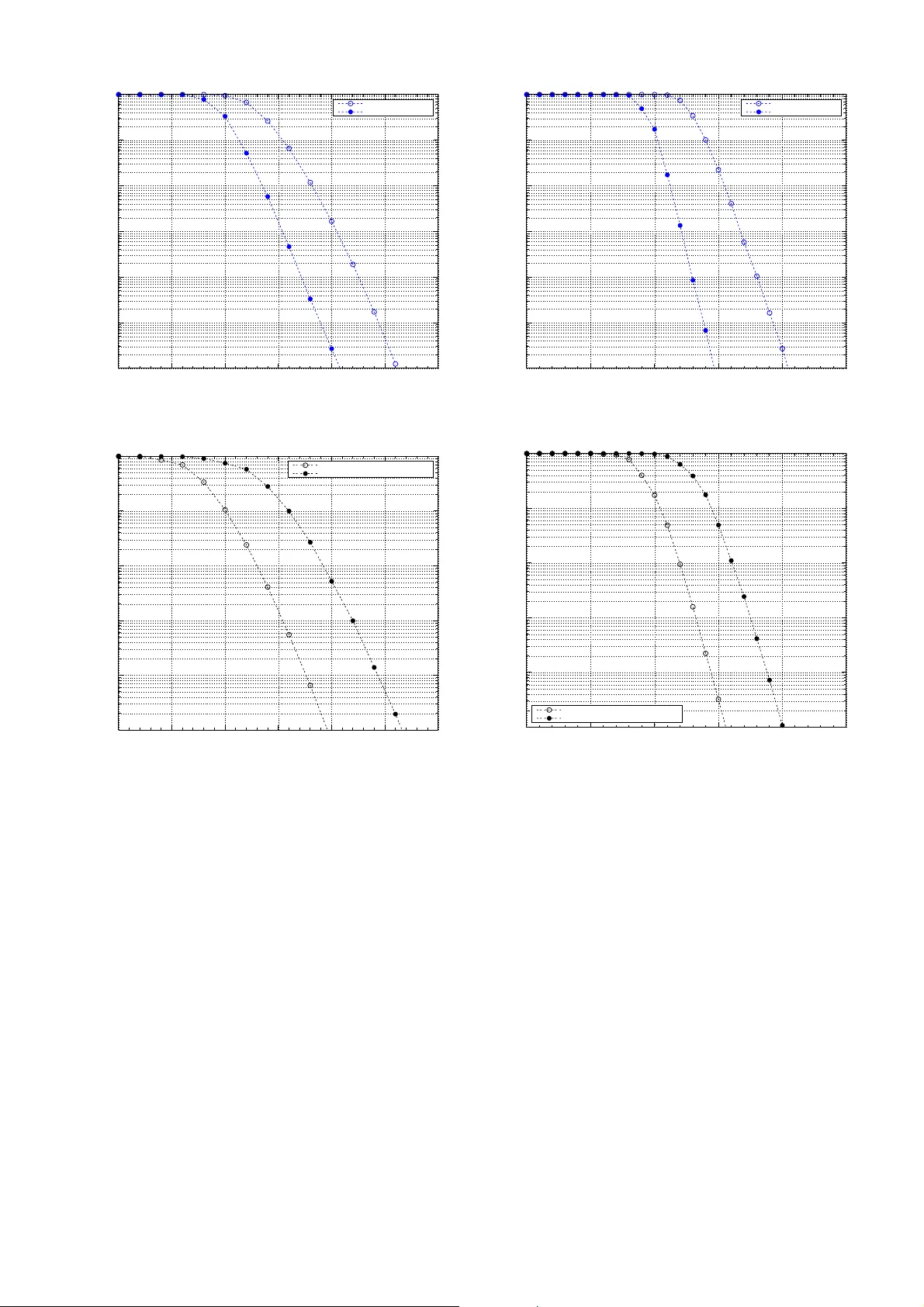
Distrib uted Space-T ime Block Codes for the MIMO Multiple Access Channel Maya Badr E.N.S.T . 46, rue Barrault 75013 Paris, France Email: mbadr@enst.fr Jean-Claud e Belfiore E.N.S.T . 46, rue Barrault 75013 Paris, France Email: belfiore@e nst.fr Abstract — In this work, the Multip le transmit antenn as Mu l- tiple Access Channel i s considered. A construction of a family of distributed space-time codes fo r th is channel is proposed. No Channel S ide Information at th e transmitters is assumed and users are not allowed to cooperate together . It is shown that th e proposed code achiev es the Div ersity Multi plexing T radeoff of th e channel. As an example, we consider the two-user MIMO-MAC channel. Simulation results show the significant gain offered b y the new coding scheme compared to an orthogonal transmission scheme, e.g. time sharing. I . I N T R O D U C T I O N Multiantenn a Multiple Acce ss Chann el (MIMO-MAC) has recently received a great interest but o ptimal and practical design of spac e-time codes fo r this channel is still missing. After intr oducing the div ersity-multiplexing trad eoff (DMT ) of a M IMO chann el in [1], Tse et al. introduc ed the DMT of the MAC in [2]. It is a fun damental limit of the channel at high SNR that c an be used to ev aluate the perform ance of different transmission schemes. Still in [2], they proved th at this DMT is achiev ab le for sufficiently long codes b y considering a family of Gaussian ran dom cod es. Howe ver , these Gaussian codes don’t have any struc ture which makes their efficient encod ing and decoding impractical. Nam and El Gama l p ropo sed in [3], a class of structur ed multiple access lattice space-time codes. They proved that their scheme, based on lattice decoding , ach iev es the optimal DMT of the MA C but they did not give any constru ctiv e example. This fact lets us think that, as it was the case for the MI MO channel [5], the constru ction of such lattice codes for the MAC should use large alphab ets with prime cardinality . In [6], Gär tner and Bölcskei presen ted a detailed anal- ysis of the MAC based on the d ifferent erro r type s that can be encoun tered in th is channel (see [ 9]). They derived a space-time cod e d esign criterio n for multianten na MA Cs and presen ted a struc tured coding scheme of length 4 for 2 transmit users with two transmit and two receive an tennas. This code results from a simple concatenation of two Alamouti codewords with a column s swapping for one user’ s codeword offering a minimum ran k of three. T his cod e highligh ts th e importan ce of the joint co de de sign in th e MAC, but does not achieve the outag e DMT o f the channel. Gärtner and Bölcskei further developped their work and presen ted in [7] important results motiv ating th e construction o f sp ace-time codes for th e MIMO-MAC. Th ey showed that their co de design criter ia ar e optimal with resp ect to the DMT of the chann el and proved that, for a MIMO- MA C, outa ge analysis allows a rigor ous characterizatio n of the domin ant er ror event regions. In other words, outage and error pro babilities hav e the same behaviors at high SNR . This fundamen tal result will be of a ma jor importan ce in o ur work . In this paper, we present a construction of a family of distributed space-time c odes for the MIMO-MA C with n o Channel Side Inf ormation at the tr ansmitters (n o CSIT) based on the fund amental results in [7]. By analy zing th e d ifferent regimes of the DMT of the MIMO-MAC, we show that the new code s achieve the o utage DMT of th e c hannel. Num erical results fin ally show that the prop osed codes ou tperfor m the time sharing scheme and that the error p robab ilities of such codes mimic the outage proba bility behavior o f the MIMO- MA C chan nel. In th e sequel, we first presen t a general co des construction , i.e. for the ( K , n t , n r ) MIMO-M A C. Then, as a detailed example, we consider the two-user MA C case w ith n t = 2 . I I . T H E M U LT I - A N T E N N A M U LT I P L E - A C C E S S C H A N N E L A. S ystem model In this paper, we use boldface capital letters M to denote matrices. C N represents th e complex Ga ussian rando m vari- able. [.] ⊤ ( r esp. [.] † ) denotes the m atrix transposition ( r e sp. conjuga ted tr ansposition) operation . W e consid er a K -user m ultiple-access ch annel with n t transmit antennas per user and n r receive antennas. W e assum e that the channel matrices have i.i.d. zer o-mean Gaussian entries, i.e. , h i,j ∼ C N (0 , 1) . W e denote T the tem poral codeleng th of the con sidered distributed space-time c ode C . Let X i be a ( n t × T ) matrix d enoting the codeword of user i w ith norm alized power , ind epende nt of codewords of the other users since we assume no c oopera tion between u sers. The r eceived signal is Y ( n r × T ) = K X i =1 H ( n r × n t ) i X ( n t × T ) i + W ( n r × T ) (1) where super scripts denote matr ices dimensions. W is the additive wh ite Gaussian noise matrix with i.i.d. Gaussian unit variance entries, i.e. , W ∼ C N (0 , 1) . B. Dive rsity-Multiple xin g tradeoff interpretation The diversity-multiplexing trad eoff (DMT) of multip le ac - cess channels was intr oduced and fu lly characterized in [ 2]. A scheme C ( SNR ) is said to ac hieve multiplexing gain r and div ersity ga in d if lim SNR →∞ R ( SNR ) log SNR = r and lim SNR →∞ log P e ( SNR ) log SNR = − d where R ( SNR ) and P e ( SNR ) den ote respectiv ely the d ata rate as a function of SNR , measured in bits pe r channel use (BPCU), and the block err or probab ility . Tse et al. gave in [2] the optimal achiev ab le tradeoff d ⋆ ( r ) of the MA C channel which co rrespon ds to the SNR exponent o f th e o utage probab ility . The network is assumed to be symmetric , i.e. , the diversity order s and the multiplexing gain s per user are identical ( r an d d ). T he authors d istinguished two load ing regimes: th e lightly lo aded regime, i.e. r ≤ min( n t , n r K +1 ) , and the heavily loaded regime, i.e. r ≥ min( n t , n r K +1 ) . In the first regime, single-user p erforma nce is a chieved, in other words, th e pr esence of other users doe s not influence th e channel perform ance, whereas in the second on e, the system is equivalent to a MIMO system as if the K users pooled up their transmit antennas together . Th e global DMT is shown to be the minimum DMT between these two regimes, that is, the largest achiev ab le symm etric diversity gain for fixed symmetric multiplexing gain, d ∗ sym ( r ) = min k =1 ,...,K d ∗ kn t ,n r ( k r ) (2) W e have the following result 1 illustrated in figure 1 d ∗ sym ( r ) = d ∗ n t ,n r ( r ) , r ≤ min ( n t , n r K +1 ) d ∗ K n t ,n r ( K r ) , r ≥ min( n t , n r K +1 ) (3) It is noteworthy , tho ugh, that while for n r ≥ ( K + 1) n t the use of a cod e design ed for the sing le-user MIMO chan nel is optimal, a jointly designed code will be of ma jor impor tance in the case o f n r ≤ ( K + 1) n t . I n fact, depen ding o n the number of receive antennas, the anten na poo ling r egime may or may not exist: if n r ≥ ( K + 1) n t , single-user perfor mance is achieved for all r and op timal space-time codes designed for the sin gle-user M IMO chan nel ach iev e the ou tage DMT , e lse, both the single user regime and the antenna pooling regime occur and should b e taken into accou nt in the code design. C. Code design criteria Gärtner and Bölcskei [6], [7] used an error event an alysis, which was first introd uced by Gallager in [9 ], to establish the spa ce-time cod e d esign criteria for th e MAC. Such an approa ch c onsists in defining different error events, say event 1 In the sequel , d ∗ n t ,n r ( r ) denotes the outage DMT of a n t × n r MIMO Raylei gh point-to-po int channe l. Spatial Multiplexing Gain r Diversity Gain d(r) single user performance antenna pooling ( 0 , n t n r ) ( 1 , ( n t − 1 )( n r − 1 )) ( min ( n t , n r K ) , 0 ) ( r , ( n t − r )( n r − r )) ( 2 , ( n t − 2 )( n r − 2 )) n r K + 1 Fig. 1. DMT of a multiple-a ccess channel with K users with n t transmit antenna s each and a single recei ver with n r antenna s . i , depending on th e numb er of users in error 2 . Different error regions ar e d efined b ased o n the user s’ tran smission rate. Rate regions where single-user err or events domin ate can b e treated by using well k nown s pace-time code s designed for the sing le- user case. Howe ver , the rate regions where the event of mo re than o ne user being in error d ominates, req uire a joint code design. It is interesting to recall the following result presented in [6]: increasing the nu mber of receive antennas results in a reduction of the size of th e region where all users ar e in error a nd thus, decreases th e importanc e o f th e joint co de design. In terestingly , this result confirms the p revious DMT interpretatio n. The code design criteria that we use are deri ved in [6], based on the domin ant err or regions, using a refined upp er bou nded expression of the pairwise erro r probab ility (PEP) and can be stated as f ollows 1) Ran k criterion : For every codeword pair ( X k , Y k ) with X k 6 = Y k the rank o f the co rrespon ding c odeword difference matrix sha ll b e maximized . 2) Eigenvalue c riterion : For e very codew o rd pair ( X k , Y k ) with X k 6 = Y k the product of the nonzer o eigen values o f the c orrespo nding c odeword difference matrix sha ll b e maximized . Authors fu rther showed that their space- time code design criteria a re optimal with respect to the entire DMT and conclud ed that, a r igorou s charac terization of the dom inant error event regions can be o btained b y analy sing the outage- DMT of the MAC. I I I . C O N S T R U C T I O N O F D I S T R I B U T E D S PAC E - T I M E C O D E S F O R T H E M I M O M AC The gener al ( K , n t , n r ) MIMO MAC is con sidered in this section. W e construct a new family of spa ce-time codes for this chann el fo llowing the sam e footsteps as the construction of pe rfect space-time co des for p arallel MIMO ch annels in 2 Event i mea ns i users in error [8]. W e assum e that the m odulatio n used by both users is a quadra ture amplitude m odulation (QAM). 3 Code construction Let F be a Galo is extension o f degree K on Q ( i ) with Galois group Gal( F / Q ( i )) = { τ 1 , τ 2 , . . . , τ K } . W e den ote K a cyclic extension of degree n t on F and σ the generato r of its Galois g roup, Gal( K / F ) . Let η be in F such that η , η 2 , . . . , η n t − 1 are not nor ms in K . A cyclic d ivision algebra of degree n t is constructed , A = ( K / F , σ, η ) . T o remind the mo st relev ant c oncepts about cyclic algebra s and how to use them to build space-time block co des, we let the reader refer to [ 12]. W e deno te Ξ the matrix repre sentation of elemen ts o f A wh ich is a n t × n t matrix and we construc t codewords as fo llows X k = τ 1 ( Ξ k ) τ 2 ( Ξ k ) . . . τ K ( Ξ k ) (4) Each user sends its informatio n by transmitting a matrix of the same type as in (4), say X k for user k . The equiv alent joint codeword ma trix can be wr itten as X = X 1 X 2 . . . X K (5) Such a code u ses K.n 2 t informa tion sym bols per user . In order to check the ra nk design cr iterion g iv en in [6], we need to insert in eq. ( 4) a car efully cho sen matr ix Γ so that the transmitted codeword of (5) b e of full rank. W e propose the new code C ( K,n t , Γ ) where each u ser codeword is X k = Γ τ 1 ( Ξ k ) Γ τ 2 ( Ξ k ) . . . τ K ( Ξ k ) (6) where Γ is a m ultiplication m atrix factor for the k − 1 first matrices of X k . W e choose Γ ∈ A with entr ies in Q ( i ) and such that det( X ) 6 = 0 for all Ξ k 6 = 0 . With such a code , we c an state, Theor em 1: C ( K,n t , Γ ) achieves th e outage DMT of the MIMO-MAC Pr oof: W e give here a sketch of proof, details are omitted for lenght constraint. The id ea is to p rove that by scalin g the size of the underlying QAM co nstellations by a factor of SNR r , the exponen t of SNR in the asymp totic expression of th e error varies as the op timal DMT . If only o ne user , say k , is in e rror the r eceiver can cancel signals it receives f rom the other K − 1 users and the system is equiv alen t to a single-user n t × n r MIMO system. In this case, the transmitted codeword X k is given in (6). T he cod e is equiv a lent to we ll-known co des constructed on cyclic di vision algebras and thus is D MT ach ieving, [13]. If all user s are in err or, the system is eq uiv alen t to an K n t × n r MIMO channel and the transmitted codewords are giv e n 3 General izati on to he xagonal (HEX) modulati on is strai ghtforw ard. in (5). In order to p reserve the shaping of th e cod e, matrix Γ should be unitary . T he DMT achiev ability is guar anteed by the carefull ch oice of Γ . For example, we can choo se Γ = γ I n t where γ is a tran scendantal n umber . In that case, the determinan t o f a codeword, wh ich is a poly nomial f unction of γ with coefficients in K , is non zero. As it is pr oven in [7], this result is sufficient to prove the outage DMT ach iev ability . I V . A N E X A M P L E : K = 2 , n t = 2 A. Op timal DMT As a n examp le, we consider a two-user MA C with two transmit antennas per user and three rece iv e antennas, i.e. , n t = 2 a nd n r = 3 . Based on (2), we can write the optimal DMT in th is scen ario as fo llows d ⋆ ( r ) = min d ∗ 2 , 3 ( r ) , d ∗ 4 , 3 (2 r ) (8) This o utage-DMT is illustrated in figure 2 . T wo ou tage events, leading to th e ach iev able region, are ob served: ev e nt 1 where only one u ser is in outage, the o ther one bein g perfectly decoded a t the receiver an d event 2 when b oth users are in outage. 000000000000 000000000000 000000000000 000000000000 000000000000 000000000000 000000000000 000000000000 000000000000 000000000000 111111111111 111111111111 111111111111 111111111111 111111111111 111111111111 111111111111 111111111111 111111111111 111111111111 0000 0000 0000 1111 1111 1111 2 r d 12 6 3 Achievable region 1 1 2 3 2 Event 2 Event 1 min { ( 2 − r )( 3 − r ) , ( 4 − 2 r )( 3 − 2 r ) } Fig. 2. DMT of the ( K = 2 , n t = 2 , n r = 3) MA C Our g oal is to design distributed space-time codes for this channel tha t are op timal in the sense of the DMT . In other words, the err or prob ability of the p roposed scheme sho uld behave asymptotically as the outage probability of the channel. B. Cod e co nstruction For th e two-u ser MAC with n t = 2 , w e propose the f ollow- ing code. Each user’ s codeword is an 2 × 2 m atrix constructed as f ollows. Let F = Q ( ζ 8 ) b e an extension of Q ( i ) of d egree K = 2 , with ζ 8 = e iπ 4 and K = F ( √ 5) = Q ( ζ 8 , √ 5) . As explained in [8], su ch a design lead s to construct the Golden code [ 11] on the base field Q ( ζ 8 ) instead of the base field Q ( i ) . η = ζ 8 has been pr oven in [8] no t to be a norm, which guaran tees that Ξ k has a non zer o de terminant. Let θ = 1+ √ 5 2 , σ : θ 7→ ¯ θ = 1 − √ 5 2 and the ring of in tegers of K O K = { a + bθ | a, b ∈ Z [ ζ 8 ] } . Le t α = 1 + i − iθ and ¯ α = 1 + i − i ¯ θ . U ser’ s k co dew ord X k is X k = Ξ k τ ( Ξ k ) (9) Ξ k = 1 √ 5 α. ( s k, 1 + s k, 2 ζ 8 + s k, 3 θ + s k, 4 ζ 8 θ ) α. ( s k, 5 + s k, 6 ζ 8 + s k, 7 θ + s k, 8 ζ 8 θ ) ζ 8 ¯ α. ( s k, 5 + s k, 6 ζ 8 + s k, 7 ¯ θ + s k, 8 ζ 8 ¯ θ ) ¯ α. ( s k, 1 + s k, 2 ζ 8 + s k, 3 ¯ θ + s k, 4 ζ 8 ¯ θ ) (7) where τ chan ges ζ 8 into − ζ 8 and Ξ k defined in ( 7) with s kj denoting the j th QAM inf ormation symbol o f user i . Finally , we get the eq uiv alen t codeword matr ix of C (2 , 2 , Γ ) X = Ξ 1 τ ( Ξ 1 ) ΓΞ 2 τ ( Ξ 2 ) (10) with Γ = 0 1 i 0 . (11) Theor em 2: C (2 , 2 , Γ ) achieves the outag e DMT of the K = 2 , n t = 2 , n r MIMO MAC chann el. Pr oof: (sketch) If on e of the u sers (say user 2 ) is n ot in error, then the receiv e r can cancel the signal it receives from this u ser and the system is equ iv alent to a single-u ser 2 × n r MIMO system. User 1 transmits X 1 giv en in (9 ) which is simply obtain ed by rotating Ξ 1 , hence, it is equivalent to the Golden Co de which is known to be a DMT a chiev ab le space- time block cod e fo r n t = 2 transmit an tennas and n r ≥ 2 receive an tennas [11]. If both user s are in er ror, the system is eq uiv alen t to a 4 × n r MIMO chann el and the transmitted codewords are given in (10). De terminant o f these co dew ords is det X = det τ ( Ξ 2 ) − ΓΞ 2 Ξ − 1 1 τ ( Ξ 1 ) det Ξ 1 Since τ ( Ξ 2 ) − ΓΞ 2 Ξ − 1 1 τ ( Ξ 1 ) is in a division algebra, we get det X = 0 iff τ ( Ξ 2 ) − ΓΞ 2 Ξ − 1 1 τ ( Ξ 1 ) = 0 which giv es Γ Θ = τ (Θ) (12) for som e Θ = Ξ 2 Ξ − 1 1 ∈ A . One solutio n that does no t verify equation (12) is to choose Γ to be a tran scendantal scalar as we explained in the general case. But we can easily check that eq . (12) is also no t verified for Γ given in eq. (11). This con dition is sufficient for ou r code to achieve the DMT [7]. V . S I M U L AT I O N S In this section, we p rovide numerical re sults ob tained by Monte-Carlo sim ulations. W e assume that the p ower is allo- cated e qually am ong all the users so that no a-pr iori advantage is g iv en to any transmitter-receiver link over another one. W e first pr esent th e outage perform ance of th e considered channel. The perf ormance o f the propo sed cod ing scheme is then measured by the word error rate (WER) vs receiv e d SN R and co mpared to the time sh aring schem e where th e chan nel is shared amo ng th e users in an or thogon al multiple-acce ss manner . A. Dec oding A lgorithm At the recei ver side, we u se a m inimum mean-square error decision feedback equalizer MMSE-DFE prepro cessing combined with lattice d ecoding as a way to tackle the pr oblem of the r ank deficiency resulting fro m n r being smaller th an K × n t . In [4], it is shown that an appr opriate combinatio n of left, right pre processing and lattice d ecoding , yields sign ificant sa ving in complexity with very small degredation with respect to the ML pe rforma nce. Mo re p recisely , left prep rocessing modifies the chann el m atrix an d the noise vector such th at the resulting closest lattice po int search has a mu ch better condition ed chann el matrix. Moreover , right prepro cessing is used to change th e lattice ba sis such that it become s mo re conv enient for th e search ing stage. B. Nume rical r esults W e consider th e two-user two-transmit an tennas MAC with n r = 3 receiv e anten nas. Outage performa nces for different spectral ef ficiencies are first illustrated in Figures 3 and 5 (4-BPCU and 8-BPCU, respecti vely). Coded schemes per- forman ces are shown in Figur es 4 and 6. Com pared to the time sh aring scheme , the prop osed c ode ach ieves the same div ersity order , 6, but of f ers a significant per forman ce gain that depend s on the spectral efficiency , R . In o rder to highlight this depend ence on R , user s info rmation sym bols are carved fro m different QAM con stellations, e.g. 4 -QAM and a 16-QAM for the coded scheme (16-QAM and 256- QAM, repectively for the time-sharin g scheme). At WER = 10 − 4 , a gain o f 6 dB is observed when a 4-QAM constellation is considered. When we increase the spectral efficiency (16-QAM), this g ain in creases to 9 d B. Interesting ly , c ompared to th e outag e perform ance of the cha nnel, the same be havior can be observed. This proves numerically the o ptimality of th e pr oposed co ding sch eme. V I . C O N C L U S I O N In this paper, the multiantenn a Multip le Access Channel with no Channel Side Info rmation at the transmitters is con- sidered. W e pro pose a new constru ction of distributed space- time block codes that achieve the o ptimal DM T of the K - user MIMO-MAC. As an examp le, we p resent the special case of a two-u ser MA C w ith two tran smit antenn as per user . In order to ov e rcome th e rank deficiency , source of inefficiency of the well-known classical d ecodin g appro ach, we u sed the MMSE-DFE pr eprocessing comb ined with the lattice decodin g. Simu lation r esults show that th e new codes offer a significant performa nce gain co mpared to the time sharing scheme. R E F E R E N C E S [1] L . Zheng and D. Tse, “Di versity and Multipl exi ng: A fundamental tradeof f in multiple-ante nna channe ls, ” IEEE T rans. Inform. Theory , vol. 49, pp. 1073–1096, May 2003. 10 -6 10 -5 10 -4 10 -3 10 -2 10 -1 10 0 0 5 10 15 20 25 30 Pout SNR(dB) Time-Sharing MAC Fig. 3. Outage performance of two-user MAC with 2 transmit antennas per user and three rece ive antenna s, R=4 BPCU. 10 -5 10 -4 10 -3 10 -2 10 -1 10 0 0 5 10 15 20 25 30 WER SNR(dB) DSTC (4-QAM) Time-Sharing (16-QAM) Fig. 4. Performance of the Spa ce-T ime Cod e designed for the t wo-user MA C with 2 transmit ante nnas per user , three recei ve ante nnas, 4-QAM. [2] D. N. Tse, P . V iswa nath, an d L. Zheng, “Div ersity and multip lex ing tr ade- of f in multiple-a ccess channels, ” IEE E T rans. Inform. Theory , vol. 50, pp. 1859–1874, September 2004. [3] Y . Nam and H. E l Gamal, “On the optimalit y of latti ce coding and decodin g in m ultipl e acce ss channels, ” in Pr oceedings of ISIT 2007 , June 2007, N ice. [4] A. D. Murugan, H. E l Gamal, M. O. Damen, and G. Caire, “ A unified frame work for tree search decodi ng: rediscov ering the sequent ial de- coder , ” IEEE T rans. Inform. Theory , vol. 52, pp. 933–953, March 2006. [5] H. E l Gamal, G. Caire, and M. O. Damen, “Latt ice coding and decodin g achie ve the optimal di versity-vs-mul tiple xing tradeof f of MIMO chan- nels, ” IE EE T rans. Inform. Theory , vol. 50, pp. 968–985, June 2004. [6] M. Gärtner and H. Bölcske i, “Multiuser space-t ime/freq uenc y code de- sign, ” in Proc eedings of ISIT 2006, Seattle , July 2006. [7] M. Gärtner and H. Bölcskei , “Multiuser space-time code design, ” Per- sonnal Comm unicat ion. [8] S. Y ang and J.C. Belfiore, “Perfect space-time block codes for parallel MIMO chan nels, ” in P r oceedings of ISIT 2006, Seattle , July 2006. [9] R. G. Gallage r , “ A perspecti ve on multiaccess channels, ” in IEEE T rans. Inform. Theory , vol. 31, pp. 124–142, March 1985. [10] M. Badr and J. -C Belfiore , “Distrib uted space -time codes for the non 10 -6 10 -5 10 -4 10 -3 10 -2 10 -1 10 0 0 10 20 30 40 50 Pout SNR(dB) Time-Sharing MAC Fig. 5. Outage performance of two-user MAC with 2 transmit antennas per user and three rece ive ante nnas, R=8 BPCU. 10 -5 10 -4 10 -3 10 -2 10 -1 10 0 0 10 20 30 40 50 WER SNR(dB) DSTC (16-QAM) Time-Sharing (256-QAM) Fig. 6. Performance of the Space-T ime Code designed for the two -user MAC with 2 transmit ante nnas per user , three recei ve antenna s, 16-QAM. coopera ti ve Mul tiple -Access Channel , ” in IEEE Internationa l Zurich Seminar on Communicat ions , ETH Zurich, Switz erland, March 2008. [11] J. -C. Belfiore, G. Rekaya, and E. V iterbo, “The Golden code: A 2 × 2 full-rat e s pace-t ime code with non-v anishing determinants, ” IEE E T rans. Inform. Theory , vol. 51, pp. 1432–1436, April 2005. [12] F . Oggier , J .-C. Belfiore and E. V iterbo (2007), “Cycl ic Divisi on Algebras: A T ool for Space-T ime Coding, ” F oundat ions and T rends in Communicat ions and Informat ion Theory , V o l. 4, No 1, pp 1-95, 2007. [13] P . Elia, B. A. Sethur aman, and P . Kumar , “Perfect space-time co des with minimum and non-minimum delay for any number of antenna s, ” IEEE T rans. Inform. Theory , vo l. 1, pp. 722–727, June 2005.
Original Paper
Loading high-quality paper...
Comments & Academic Discussion
Loading comments...
Leave a Comment