Channel State Feedback Schemes for Multiuser MIMO-OFDM Downlink
Channel state feedback schemes for the MIMO broadcast downlink have been widely studied in the frequency-flat case. This work focuses on the more relevant frequency selective case, where some important new aspects emerge. We consider a MIMO-OFDM broa…
Authors: Hooman Shirani-Mehr, Giuseppe Caire
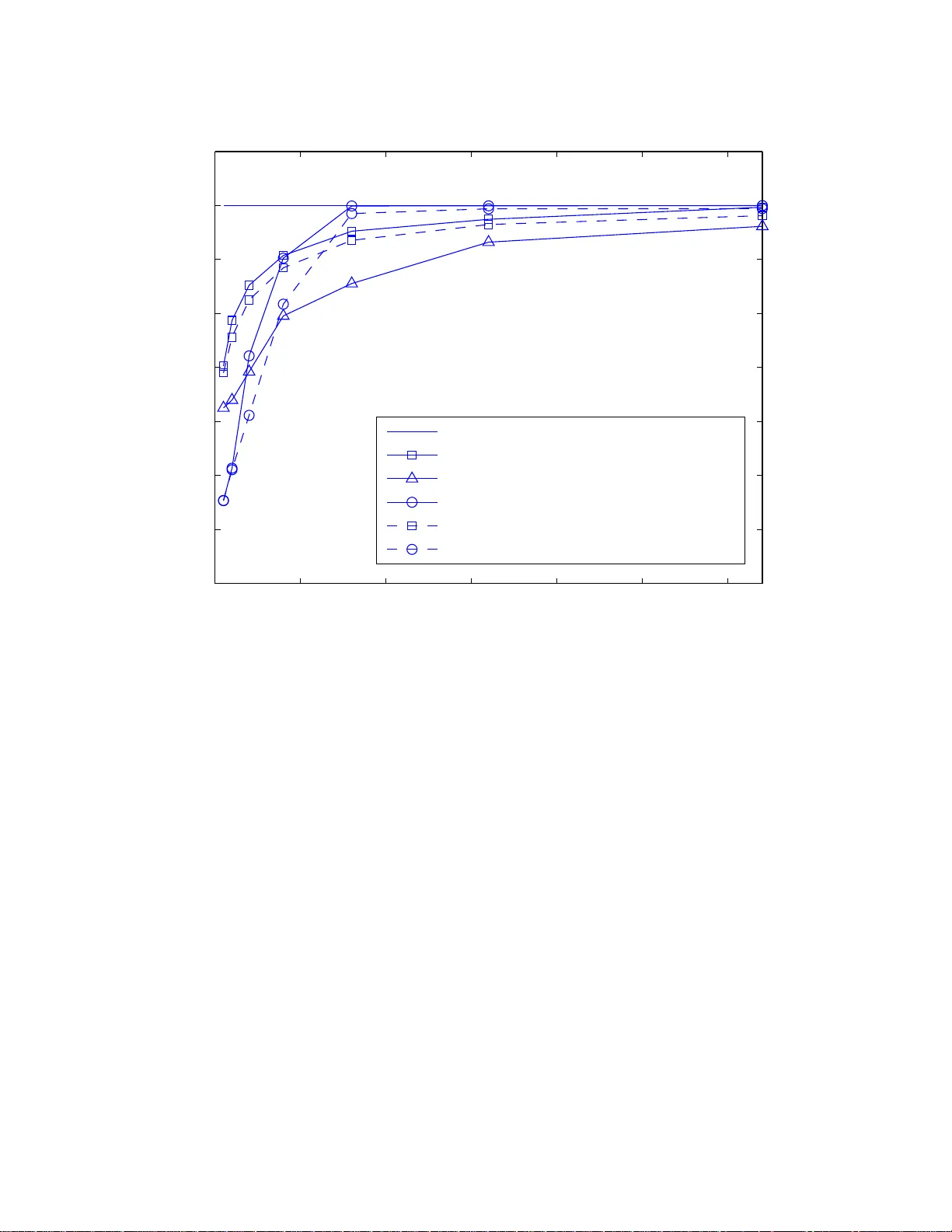
Channel State Feedback Schemes for Multi user MIMO-OFDM Do wnlink Hooman Shirani-Mehr and Giuseppe Caire Abstract Channel state feedb ack schemes for the MIMO broad cast downlink have been widely stud ied in the freque ncy-flat case. This work focuses on the more relev ant f requen cy selecti ve case, wh ere some importan t new aspects emerge. W e c onsider a MI MO-OFDM b roadca st channel an d c ompare achiev ab le ergodic rates u nder th ree chan nel state f eedback schem es: analo g feedb ack, direction q uantized feed back and “time-domain ” channel quantized feedback. The first two schemes are dire ct extensions of previously propo sed schemes. T he third scheme is novel, and it is directly inspired by rate-distortion theory of Gaussian correlated sources. For each schem e we der iv e the condition s under which the system achieves full mu ltiplexing gain. The key difference with r espect to the widely tr eated frequ ency-flat case is that in MIMO- OFDM the freq uency-do main chann el transfer fun ction is a Ga ussian corr elated source. Th e new time-d omain quantization scheme takes ad vantage of the channe l fr equency cor relation stru cture and outp erform s the other schemes. Fur thermor e, it is by far simpler to im plement than comp licated spherical vector quantizatio n. In p articular, we observe that no structured cod ebook d esign and vector quantization is actually needed for effi cient cha nnel state inform ation feedback. Index T erms MIMO Broad cast Chann el, OFDM, Ch annel State Feedback , Quantization. H. Shirani-Mehr and G. Caire a re with the M ing Hsieh Department of Electrical Engine ering, Univ ersity of Southern California, Los Ang eles, CA 900 89 USA. E-mail: shiranim@usc.edu, caire@usc.edu. 1 I . I N T RO D U C T I O N W e c onsider a MIMO-OFDM broadcast channel with one base station ( BS), equipped with M antennas, and K ≥ M single-antenna user terminals (UT). MIMO broadcast channels hav e been widely studied in the recent past (see for example [1], [2], [3], [4], [5]). Under perfect transmitter channel state information (CS IT) at the BS and rece iv er channel state information (CSIR) at the UTs, it s capacity w as fully c haracterized i n [5] and ef ficient resource allocation algorithms ha ve been proposed in order to operate at desired points in th e capacity region (e.g., [6], [7], [8]). In the current standardization of the 4-th Gener ation of wireless communicati on systems (e.g., IEEE802.16m), MIM O broadcast schemes are going to play a fun damental role in order to achieve high data rates i n the downlink. In practice, CSIT m ust be provided to the BS by some form of feedback. CSIT feedback schemes are a very active area of research (see for example [9] and the special issue [10] for a fairly com plete list of references). In brief, we may ident ify three broad families: 1) open-lo op schemes based on channel reciprocity and uplin k training sym bols, applicable to T i me-Division Duple xing (TDD); 2) clos ed-loop s chemes based on feeding back t he unquant ized channel coeffi cients (analog feedback); 3) closed-loop schemes based on explicit quantization of the channel vectors and on feeding back qu antization bits, sui tably channel-encoded (digit al feedback). Closed-loop schemes are suitable for Frequenc y -Division Duplexing (FDD), where channel reciprocity cannot be exploited. Mos t if not all present works deal with t he case of a frequency-flat channel. In particular , it was recognized that th e m ost im portant informati on about t he channel vectors con sists of th eir directions . Directional quantization i s obtained by using vector quantizati on codebooks formed b y unit v ectors distrib uted on the M dimensional complex sphere. In [11], ergodic achieva ble rates are analyzed ass uming l inear zero-forcing beamforming (ZFBF) and random ensembles of spherical quantizatio n codebooks , uniforml y distributed on the unit sphere. These results have been extended in [9] to a variety of cases including realistic feedback chann els with noise, fading and delay , and to non-perfect C SIR at the UTs o btained by explicit downlink training. In particular , these works show that the s um-rate scales optimally , as M log SNR + O (1 ) , provided that the num ber of quantization bits per UT increases with SNR as B = α ( M − 1) log 2 SNR for some α ≥ 1 . For example, at SNR of 10 dB a codebook of size 1024 is needed for M = 4 antennas, and a codebook of size 2 24 = 16777 216 2 is needed for M = 8 ant ennas. Clearly , such chann el vector quant izers in volve a n enormo us computational comp lexity un less som e special structu re is exploited. Structured s pherical vector quantizers for direction quantizati on have been studied, for example, in [12]. The frequenc y-selectiv e ( OFDM) case is more directly relev ant to 4-th Generation wireless systems. A t rivial solution consis ts of operating one ind ependent CSIT feedback p er carrier . This solution is suboptimal since it does not take a dvantage of the fact that t he channel v ectors at diffe rent carriers are correlated. In this paper we compare three channel state feedback schemes for the MIMO-OFDM downlink: a nalog feedback, digital direction quantized feedback and a new “time-domain” channel quantized feedback ins pired by rate-distortion theory . For each schem e we deriv e the con ditions under which the sys tem achie ves full multip lexing gain (i.e., the pre- log factor of the su m-rate is equal to M ). The new rate-distortion inspired scheme takes full adva ntage of th e channel frequency correlatio n structure and it is shown to outperform the first two. Furthermore, time-domain quantizati on is by far simpler to imp lement than com plicated spherical vector quanti zation. In particular , it is seen that no structured codeboo k design for vector quantization i s actually needed for ef ficient channel st ate information feedback. I I . S Y S T E M M O D E L For t he sake of analytical simplicit y , we do not cons ider users selectio n based on CSIT feedback informati on (e.g., as in [13], [14], [15]). Therefore, without loss of generality , we may assume that a s et of M out of K users is selected at each time slot according to some scheduling scheme independent of the channel realizations. Als o, we assume perfect CSIR at all UTs and focus solel y on th e CSIT feedback performance. Channels are identi cally distributed for all users, and spati ally independent (no antenna correlatio n). Therefore, we focus on the descripti on of the scalar channel between any BS antenna and a generic user , droppi ng antenna and user index for the sake of n otation simpli city . A standard assum ption in OFDM is that channels behave locally as linear time-inv ariant finite impulse respo nse filters of length L . W e assume bl ock- fading channels, constant on bl ocks of duration T ≫ L symbols , and changi ng according to some er godic stati stics from block to block. In this work we consider zero-delay CSIT feedback and block-by-blo ck estimati on. Therefore, we are not con cerned with t he ti me-correlation from block to b lock of the channel (the case of delayed feedback and e xplicit channel p rediction is considered in [9]). Using the standard cyclic-prefix method, blocks of N = T − L + 1 i nformation 3 symbols can be transmitt ed w ithout i nter-block interference at the cost o f a small dimensi onality loss factor of (1 − L − 1 T ) ≈ 1 , t hat s hall be ne g lected in the achie vable rate e xpressions of th is paper sin ce it applies to al l s uch OFDM schemes in the sam e way . After c ycli c prefi x insertion and remova l th e re sulting channel model is defined by a block transmissio n of N sym bols per transmit a ntenna, ov er the N OFDM subcarriers. Letti ng h = [ h [0] , h [1] , ..., h [ L − 1]] T denote the dis crete-time channel im pulse response, the channel in the DFT frequency domain is given by H = [ H [0] , . . . , H [ N − 1]] T , where H = √ N F h 0 and where F denot es a unitary N × N DFT matrix wi th elements [ F ] n,ℓ = 1 √ N e − j 2 πℓn/ N , with n = 0 , . . . , N − 1 , ℓ = 0 , . . . , N − 1 . A com mon assumption consists of modelin g the time-domain channel coeffi cients h [ l ] ’ s as independent Gaussian random variables ∼ CN (0 , σ 2 l ) , where the path variances { σ 2 0 , . . . , σ 2 L − 1 } form s t he Delay Intensi ty Profile (DIP) of the channel . W e follow this m odel here, and re-discuss it in Section VI wh ere we show how to take adv antage of a more physically mot iv ated channel m odel. The frequency-domain channel covariance matri x is giv en by Σ H = E [ HH H ] = F N Σ h 0 0 0 F H (1) where Σ h = di ag ( σ 2 0 , ..., σ 2 L − 1 ) . Furthermore, the diagonal elements of Σ H are equal to σ 2 H = E [ | H [ n ] | 2 ] = P L − 1 l =0 σ 2 l . In the MIMO ca se, the channel from the BS to UT k is defined by the vector discrete-tim e impulse response [ h k [0] , h k [1] , . . . , h k [ L − 1]] where h k ,i [ l ] is the channel coef ficient from t he BS antenna i to the UT k at discrete-time delay l . By applying OFDM mod ulation and demodulati on, the received signal at UT k on the n -th subcarrier can be written as y k [ n ] = H H k [ n ] x [ n ] + z k [ n ] (2) where k = 1 , ..., K , n = 0 , ..., N − 1 , x [ n ] ∈ C M is the transmitted vector of frequency-domain symbols on the M BS antennas, at subcarrier n , and H k [ n ] = [ H k , 1 [ n ] , ..., H k ,M [ n ]] T is the channel vector o f UT k at sub carrier n . The av erage transmit power constraint is given by 1 N P N − 1 n =0 E [ | x [ n ] | 2 ] ≤ P . For sim plicity of analysis, thi s p aper treats only th e case of linear Zero-Forcing Beamforming (ZFBF). It i s well-known that ZFBF performs at a fixed gap from th e opt imal capacity achieving 4 strategy under perfect CSIT . Hence, our goal is to find conditions under which ZFBF performs at a fixed rate gap from the perfect CSI T case, wh ich implies fixed rate gap from optimal. For perfect CSIT , the ZF BF transm itted si gnal at subcarrier n is given b y x [ n ] = V [ n ] u [ n ] where V [ n ] ∈ C M × K is a zero-forcing beamforming matrix wit h unit norm columns such that each k -th col umn v k [ n ] is orthogonal to the sub space spanned by { H j [ n ] : j 6 = k } , and u [ n ] ∈ C K denotes the vector of coded symbols, i ndependently generated for t he differ ent UTs. In high SNR the un iform po wer allocation yields a fixed rate gap from the optimal (waterfilling) power allocation. Therefore, following [11] and [9], we restrict to this case and let E [ u [ n ] u [ n ] H ] = P M I . Under these ass umptions , the achie vable rate at each UT k under ZFBF with perfect CSIT is giv en by R k , CSIT = 1 N N − 1 X n =0 E " log 1 + H H k [ n ] v k [ n ] 2 P N 0 M !# = exp N 0 M P σ 2 H E i 1 , N 0 M P σ 2 H (3) where E i ( n, x ) = R ∞ 1 e − xt t n dt, x > 0 , is the exponential-integral function. In the case of non-ideal CSIT , the BS uses t he av ail able channel informati on b H k [ n ] , k = 1 , . . . , K, n = 0 , . . . , N − 1 , and computes the ZFBF m atrix b V [ n ] by treating b H k [ n ] as if it was the t rue channel. The resultin g recei ved signal at the k -th UT i s y k [ n ] = H H k [ n ] b v k [ n ] u k [ n ] + X j 6 = k H H k [ n ] b v j [ n ] u j [ n ] + z k [ n ] = a k ,k [ n ] u k [ n ] + X j 6 = k a k ,j u j [ n ] + z k [ n ] (4) where a k ,j [ n ] denotes the coupli ng coeffi cient between the user channel h k [ n ] and the beam- forming vector b v j [ n ] . By fol lowing in t he footsteps of the achiev able rate bound in [9, Theorem 2] we obtain that the achiev able ergodic rate for us er k is lowe rbounded by R k ≥ R k , CSIT − ∆ R k , where the rate-gap is upperbounded by ∆ R k ≤ 1 N N − 1 X n =0 log 1 + E [ | I k [ n ] | 2 ] N 0 ! (5) with I k [ n ] = P j 6 = k a k ,j u j [ n ] indicating the multius er interference term. An upper bound on the rate R k achie vable with Gauss ian random coding i s also obtained in [9, Theorem 3] by ass uming that a genie provides each U T k wi th exact knowledge of the signal and interference coefficients a k ,j for j = 1 , . . . , M . Thi s upperbound is referred to as the ”genie-aided upp erbound” and takes 5 on the form R k ≤ 1 N N − 1 X n =0 E " log 1 + | a k ,k | 2 P / M N 0 + P j 6 = k | a k ,j | 2 P / M !# (6) By dividing both lower and upper bound t o the achiev able rate by lo g ( P / N 0 ) and letting P / N 0 → ∞ , it is clear that a suf ficient c ondition for achie v ing full m ultiplexing ga in is t hat ∆ R k is a bounded funct ion of the SNR P / N 0 . 1 W e sh all examine this condition u nder different CSIT feedback schemes in the following sections. I I I . A NA L O G F E E D BA C K Analog feedback consists of sending back the unquantized channel coef ficients, transm itted as real and imagi nary parts of a complex modulation symbol [16]. W e model th e feedback channel as A WGN, with the same SNR of the do wnl ink, equal to P / N 0 . The more in volved case of a fading MIMO multiple-access (u plink) feedback channel is treated, for t he frequency-fl at case, in [9], [16]. In order to take advantage of the channel frequenc y correlation, we partition t he N subcarriers into J clusters such that N ′ = N /J is an integer , and feed back only t he channel measured at frequencies n ′ = iN ′ for i = 0 , 1 , ..., J − 1 . Each UT transmit s its channel coeffic ients at frequency n ′ by using M ′ ≥ M feedback channel uses per channel coeffi cient, for a total of M ′ J channel uses. This is achiev ed by modul ating the channel vector H [ n ′ ] by a M ′ × M unit ary spreading matrix [9], [16]. After despreading, the noisy analog feedback observation for UT k at frequency n ′ = iN ′ is gi ven by g k [ i ] = p β P H k [ iN ′ ] + w k [ iN ′ ] (7) where β = M ′ / M ≥ 1 and wh ere w k [ n ′ ] ∈ C M × 1 is the A WGN in the feedback channel, with i.i.d. components ∼ CN (0 , N 0 ) ). The BS perf orms linear MMSE “int erpolation” based on the observation (7) for i = 0 , . . . , J − 1 and compute the beamforming b V [ n ] for each subcarrier based on the estimated channel. Since channels are spatially i.i.d., th e BS can estimate independently each antenna for each UT . Therefore, without loss of g enerality , we focus on th e s ide inform ation 1 This condition is actually stronger , since it r equires constant rate gap from optimal. Strictly speaking, full multiplexing gain is achie ved if ∆ R k is o (log( P / N 0 )) . Ho wever , in the cases analyzed in this wo rk either ∆ R k is bounde d, or it is O (log( P / N 0 )) , therefore this option is irrele v ant in this contex t. 6 and estimation of antenna m of UT k . By stacking th e feedback o bservations, we form the vector g k ,m = [ g k ,m [0] , . . . , g k ,m [ J − 1]] T giv en by g k ,m = p β P SH k ,m + w k ,m (8) where H k ,m = [ H k ,m [0] , H k ,m [1] , ..., H k ,m [ N − 1 ]] T , w k ,m contains the A WGN sampl es and S is a J × N sam pling matrix defined by [ S ] i,n = δ n = iN ′ , for i = 0 , . . . , J − 1 and n = 0 , . . . , N − 1 . By lett ing ρ = β P / N 0 , t he MM SE estimato r of H k ,m from g k ,m is given by b H k ,m = r ρ N 0 Σ H S H ρ SΣ H S H + I − 1 g k ,m (9) where Σ H is defined by (1). The correspondi ng MM SE cov ariance matrix is given by Σ e = Σ H − ρ Σ H S H I + ρ SΣ H S H − 1 SΣ H (10) Our m ain result on analog feedback is summarized by the following: Theor em 1: The achie vable rate gap of MIMO -OFDM ZFBF with analog CSIT feedback as described above is u pperbounded by ∆ R AF k = log 1 + M − 1 M P N 0 " L − z − 1 X i =0 σ 2 [ l ] + L − 1 X l = L − z σ 2 [ l ] 1 + N β P N 0 λ ( l − L + z ) #! (11) where { σ 2 [ l ] : l = 0 , . . . , L − 1 } are t he DIP components arranged i n decreasing order , z = min { J, L } and { λ ( i ) : i = 0 , . . . , z } are the non-zero eigen v alues of the matrix α Σ h α H arranged in increasing order , where α is the leftmost J × L bl ock of the mat rix SF . Pr oof: See App endix I. In particular , if z = min { J, L } = L , as P / N 0 → ∞ the rate gap is upper bounded by the constant ∆ R AF k = log 1 + M − 1 M N L − 1 X l =0 σ 2 [ l ] β λ ( l ) ! (12) A fair comparison of digital and analog CSIT feedback schemes is provided by the achie vable rate gap versus the nu mber of CSIT feedback channel uses. For example, the above analog feedback scheme makes use o f M ′ J feedback channel uses. W e generally express our results in terms of the normalized n umber of feedbac k channel uses per a ntenna, i.e., through the coef ficient α fb ≥ 1 such that α fb M is the total num ber of feedback channel uses per user per frame. 7 I V . D I R E C T I O N A L V E C T O R Q U A N T I Z A T I O N W e consider directional qu antization based on random vec tor quantization ( R VQ) codebook en- sembles, as in [11]. Each UT has a random ly generated quantization codebook C = { c 1 , ..., c 2 B } consisting of 2 B code words independently and isotropically distributed on the M -dimensional unit complex sphere. In o rder to reduce the nu mber of feedback bits, seve ral current s ystem proposals consider to c luster the subcarriers and feedback the quantized channel only for one representativ e frequency for each cluster , as do ne for t he analog feedback s cheme consi dered in Section III (see for e x ample [17] in the single-user MIMO-OFDM case). Since it is not clear how to interpolate the direction information ov er t he sub carriers, a comm on approach consists of as suming that the channel is constant ov er clusters spanni ng less that the channel coherence bandwidth, and use a piece-wise constant beamform ing matrix, computed from the CSIT at the center sub carrier in each cluster . W e analyze th is “piecewise cons tant” approach in terms of achie vable rate gap. W e consider again a grid of J equ ally spaced frequencies as before. On each such frequency n ′ , t he quantization of the channel vector H k [ n ′ ] ob eys the rul e b H k [ n ′ ] = arg max c ∈ C H H k [ n ′ ] c [ n ′ ] 2 | H k [ n ′ ] | 2 (13) The bin ary indi ces correspondin g the selected quantization codewords { b H k [ n ′ ] : n ′ = iN ′ , i = 0 , . . . , J − 1 } are fed back t o the BS ove r a perfect (error -free, delay free) digital feedback link, for a t otal of B tot feedback bits per UT . The total number of feedback bi ts per UT per frame is giv en by B tot = B J . Using the MMSE decomposit ion, the channel vector at a sub carrier n 6 = n ′ in the same cluster of n ′ can be written as H k [ n ] = ˇ H k [ n ] + ˇ e k [ n, n ′ ] (14) where ˇ H k [ n ] = c [ n, n ′ ] H k [ n ′ ] and where we define the c hannel correlation coeffic ient between subcarriers n and n ′ as c [ n, n ′ ] = E [ H k ,m [ n ] H k ,m [ n ′ ] ∗ ] E [ | H k ,m [ n ′ ] | 2 ] = P L − 1 l =0 σ 2 l e − j 2 πl ( n − n ′ ) / N σ 2 H The corresponding M MSE is given by σ 2 ˇ e [ n, n ′ ] = σ 2 H (1 − | c [ n, n ′ ] | 2 ) . The ZF BF m atrix b V [ n ′ ] computed from the quantized channels b H 1 [ n ′ ] , . . . , b H K [ n ′ ] is used for all subcarriers n in the cluster of adjacent frequency indices { n ′ − a, . . . , n ′ + b } , t aken modulo N because of the circulant 8 statistics of the frequency-domain channels, where a = N ′ / 2 − 1 , b = N ′ / 2 i f N ′ is even and a = b = ⌊ N ′ / 2 ⌋ if N ′ is odd. Our main resul t with this form of q uantized feedback is giv en by the fol lowing: Theor em 2: The achiev able rate gap of MIMO-OFDM ZFBF with digital channel state feed- back based on R VQ as described above is upperbounded by ∆ R R VQ k = J N b X δ = − a log 1 + σ 2 H P N 0 | c ( δ ) | 2 2 − B M − 1 + M − 1 M (1 − | c ( δ ) | 2 ) (15) where a, b hav e been defined abov e and wh ere we define c ( δ ) = P L − 1 l =0 σ 2 l e − j 2 πlδ / N σ 2 H Pr oof: See App endix II. In order to express the total nu mber of feedback bi ts B tot in terms of feedback channel uses, we make the optimistic assumption that the feedback link can operate error -free at capacity within the strict one-frame delay cons traint. This assumption is just ified in l ight of th e achiev abilit y results of [9], where it is shown that a rate gap very close to this case can b e achieved b y using very simple practical codes and taki ng into account the feedback error probabili ty . It follows that B tot bits can be transmitted in α fb ( M − 1) channel uses, 2 where α fb = B tot ( M − 1) log 2 (1+ P / N 0 ) . Expressing t he rate gap in t erms of α fb , we obtain ∆ R R VQ k = J N b X δ = − a log 1 + σ 2 H P N 0 | c ( δ ) | 2 (1 + P / N 0 ) α fb /J + M − 1 M (1 − | c ( δ ) | 2 ) (16) W e observe that t he rate gap g rows linearly wit h log ( P / N 0 ) unl ess we let J = N . Hence, providing only one direction quantized channel per subcarrier cluster do es not t ake adv antage of the channel frequency correlation in an efficient way , s ince the channel is no t e xactly piecewise constant i n frequency . Eventually , for su f ficiently large SNR, the channel frequenc y v ariations are such that the residual in terference will dominate on all frequencies n 6 = n ′ . Letting J = N and us ing B = B tot / N b its per carrier yi elds ∆ R R VQ k ≤ log 1 + σ 2 H P N 0 1 − α fb / N ! (17) 2 For simplicity , we normalize here by M − 1 instead of M . This is justified by the fact that directional quan tization does not include any information on the channel magnitude. Furthermore, our numerical results sho w that this slight bias against directional quan tization does n ot yield an y significant dif ference in the performance comparison s. 9 which is bounded (or even v anishing with increasing SNR) as long as α fb / N ≥ 1 . Howe ver , this choice may not be optimal for a given SNR. In practice, for given α fb and SNR, th e system performance can be optimized by cho osing th e num ber of clust ers J . The optimization of J is carried o ut n umerically and generally depends on the operating SNR and on t he channel DIP , that determin es the correlation coeffi cient c ( δ ) . V . T I M E - D O M A I N Q UA N T I Z A T I O N The frequency-domain channel vector H k ,m for a given BS ant enna m and UT k can be regarded as a correlated Gaussian source with covariance matrix Σ H . Letting H k ,m = √ N Fh k ,m , where h k ,m is the time-domain chann el impu lse response for UT k and BS antenna m , and noticing that F is an isom etry , i t fol lows th at E H k ,m − b H k ,m 2 = N E h k ,m − b h k ,m 2 (18) where we let b H k ,m = √ N F b h k ,m . It follows that the mean-square distortion for H k ,m is minimized by mini mizing the mean-square distorti on for h k ,m . A. Rate-Distorti on Limit Since the components of h k ,m are independent, we are in the presence of a set of L “parallel” Gaussian s ources. The rate-dist ortion function for parallel Gaussian sources and mean-square distortion is giv en by [18] R ( D ) = L − 1 X l =0 log 2 σ 2 l γ + (19) where γ is the solutio n of P L − 1 l =0 min { γ , σ 2 l } = D . The num ber of bits per sym bol allocated to the quantization of the l -th path is g iv en by B l = h log 2 σ 2 l γ i + . Notice that if γ ≥ σ 2 l , then B l = 0 . Th is corresponds to the appealing and intui tiv e fac t that more quantization bi ts should be al located to the dominant paths. The bit allocation is usually referred to as rev erse waterfilling (R WF). Under the (optim istic) assumption that the CSIT feedback can operate at the rate-distortio n limit, our main result with thi s form o f quant ized feedback is given by the follo wing: 10 Theor em 3: The achiev able rate gap of MIMO-OFDM ZFBF with digital channel state feed- back based on tim e-domain quantization described above is given by ∆ R KL,R WF ,L imit k = log 1 + M − 1 M P N 0 D (20) where D = E h | h k , 1 − b h k , 1 | 2 i and the number of qu antization bits per UT given by B tot = M R ( D ) and R ( D ) is given i n (19). Pr oof: See App endix III. The superscript “KL ” indicate the fact that the above approach correspon ds to quantizing the Karhunen-Loeve transformed channel which corresponds to quantizing the time-domain channel vector h k ,m , under the assumpti on o f ind ependent coef ficients. W e wish to s tudy the high-SNR beha vior of the rate g ap upperbound in Theorem 3, i n order to determin e condition s under which the ful l mul tiplexing gain can b e attain ed. W e ha ve the following result: Cor ollary 5.1: In high SNR regime, the rate gap (20) can be relax ed to : ∆ R KL,R WF ,L imit k = log 1 + σ 2 H P N 0 M − 1 M 2 − R ( D ) /L (21) Pr oof: See App endix IV. In order to relate the number of feedback bits to the number of feedback channel u ses, we make again th e assumpti on that the feedback link can operate error -free at capacity . W i th a total of α fb M = B tot log 2 (1+ P / N 0 ) feedback channel uses per UT per frame, we let R ( D ) = B tot / M in (21) and obtain ∆ R KL,R WF ,L imit k ≤ log 1 + σ 2 H M − 1 M P N 0 1 − α fb /L ! (22) It follows that the rate gap is bounded if α fb /L ≥ 1 and it vanishes when t he inequality is strict. B. Scalar Uni form Quantiz ation Achieving the rate-distorti on limit requires, in ge neral, grouping many s ource symbols into lar ge bl ocks and performing optimal vector quanti zation. On the other hand, the CSIT feedback must have very low delay , and the L channel path coefficients mus t be quantized and sent back on each s lot of T channel uses in order to enabl e the BS t o compute the do wnlink beamforming m atrix. Hence, optimal so urce coding and low feedback del ay are two contrasting issues. Fortunately , it is well-known that simple scalar quantization achieves essentially the same 11 distortion versus SNR behavior , within a constant factor . Here w e exploit thi s fact and consider a simple practical implementation of the abov e time-dom ain quantizatio n schem e, where each UT performs uniform scalar quantization on real and imaginary part of its channel coefficients. Real and imaginary parts of each channel coef ficient h k ,m [ l ] are quantized independent ly with ⌊ B l / 2 ⌋ bits, where B l is obtained, for example, b y R WF or by som e bit-allocation scheme aimed at minim izing th e total distortion. The uniform scalar quanti zer Q l has Q l = 2 ⌊ B l / 2 ⌋ quantization intervals of size ∆ l > 0 where Q l is an even integer , with thresholds 0 , ± ∆ l , ± 2∆ l , . . . , ± ( Q l − 2)∆ / 2 and midpoint reconstruction le vels ± ∆ l / 2 , ± 3∆ l / 2 , . . . , ± ( Q l − 1)∆ l / 2 . The l -th path quantizer i s obtained by choosing ∆ l in order to m inimize the quadratic distorti on D ( Q l , ∆ l ) = 2 Q l / 2 − 2 X i =0 Z ( i +1)∆ l i ∆ l η − i ∆ l − ∆ l 2 2 f ( η ) dη + 2 Z ∞ ( Q l − 2) ∆ l 2 η − ( Q l − 1) ∆ l 2 2 f ( η ) dη where f ( η ) = 1 √ π σ 2 l e − η 2 σ 2 l . Th e correspondi ng rate gap is upperboun ded by ∆ R KL,R WF ,S UQ k = 1 + M − 1 M P N 0 L − 1 X l =0 2 D SUQ l ! (23) where D SUQ l = min ∆ l > 0 D ( Q l , ∆ l ) . While for any finite B l the optimization o f ∆ l must be carried o ut numerically and am ounts to a simple line search, we can follow the analysis in [19] in order to capture the high-SNR behavior in clos ed form. If the t otal bit budget for quantization is lar ge, we can assume that B l ≫ 1 for all l = 0 , . . . , L − 1 . Then, our goal is to set ∆ l such that D ( Q l , ∆ l ) . = 2 − B l , in order to hav e t he same asymptoti c behavior of the rate-distorti on limit analyzed before. For a real Gaussian source with variance σ 2 l / 2 the following asymptotic upperbound ho lds [19] D ( Q l , ∆ l ) ≤ ∆ 2 l 12 + ( Q l ∆ l ) 2 P o v er + o (∆ 2 l ) (24) where th e first term accounts for the so-called “granular distortion” and the second term accounts for the overload dist ortion, where the overload probability is giv en by P o v er = Z ∞ ( Q l − 2) ∆ l 2 f ( η ) dη ≤ exp − (( Q l − 2)∆ l ) 2 4 σ 2 l By cho osing ∆ l = q 4 B l σ 2 l log 2 e 2 − B l / 2 we obtain t he desired m ean-square di stortion b eha vior that decreases as D SUQ l = σ 2 l 2 κB l 2 − B l + o ( B l 2 − B l ) where κ ≈ 6 is a constant independent of B l . In 12 particular , for uniform bit allocation B l = B tot / ( LM ) and letti ng B tot = α fb M log 2 (1 + P / N 0 ) we obt ain the upperbound ∆ R KL,R WF ,S UQ k = log 1 + κσ 2 H M − 1 M P N 0 2 − B tot / ( LM ) B tot LM ≤ log 1 + κ α fb σ 2 H L M − 1 M P N 0 1 − α fb /L log 2 1 + P N 0 ! (25) Hence, simp le scalar uniform quantization yields a vanishing rate gap as long as α fb /L > 1 , which coincides wi th the conditio n for the rate-distortion limit of Corollary 5.1. On the other hand, t his bound is not tight e nough to capture the behavior for α fb = 1 (indeed, for α fb = 1 the b ound yield s a log log ( P / N 0 ) i ncrease of the rate gap). In our num erical results we consi dered the optimi zation of the bit-allocatio n B l subject to the constraint P L − 1 l =0 B l = B tot . Th is is a classi cal in teger programming p roblem, for which greedy solutions ha ve been considered (e.g., see [20]). W e omit the d etails of t he allocation algorithm for the sake of space limitatio n here. Ho we ver , it is apparent from t he results of Section VII that R WF allo cation comes very close to the more computational intensiv e greedy bit-allocation, and therefore it can be safely us ed in p ractice. V I . E X P L O I T I N G T H E P H Y S I C A L C H A N N E L S T R U C T U R E While most analysi s of OFDM syst ems assumes that the di screte-time channel impu lse re- sponse h is formed by L ind ependent Gaussian coefficients, this does not generally hold ex- actly . The commonl y accepted W ide-Sense Stationary Uncorrelated Scattering (WSSUS) fading channel model [21] postu lates that multipath components at different delays are uncorrelated. Howe ver , the delays of the p hysical channel are not, in g eneral, integer multip les of the OFDM sampling frequency . In o ther words, while the conti nuous-time physical channel may obe y the WSSUS mo del, the corresponding discrete-time channel has correlated coeffic ients. In thi s secti on we rem ove this unrealist ic assu mption and take adva ntage of the phys ical channel m odel. The continuous-time baseband channel impul se response can be writ ten as c ( t ; τ ) = P − 1 X p =0 c p ( t ) δ ( τ − τ p ( t )) (26) where c p ( t ) is a stationary Gaussian proper process with first-order distribution CN (0 , µ 2 p ) and τ p ( t ) is the p -th path delay [21]. Under the slowly time-var ying assumpti on, τ p ( t ) is assumed to 13 be ind ependent of t for ti me intervals s e veral o rder of magnitudes larger than the OFDM symbol duration, while c p ( t ) is assum ed to be l ocally t ime-in variant over the channel coherence time, lar ger th an th e OFDM symbol duration. Let ψ ( t ) d enote t he con volution of the transm it and receiving front-end filters (included in the D/A and A/D con version). Then, the concatenation of filters and physical propagatio n channel around a reference tim e t is give n by the con volution h ( t ; τ ) = ψ ( τ ) ⊗ c ( t ; τ ) . By uni form sampling a t rate 1 /W , focusing on an arbitrary ref erence time t = 0 and neglecting the time- dependence because of the locally t ime-in variance assumpti on, we arriv e at the dis crete-time channel i mpulse response h [ l ] = P − 1 X p =0 c p ψ ([ l − τ p W ] / W ) (27) In matrix form, this can be writ ten as h = Ψc where Ψ ∈ C L × P , c , ( c 0 , ..., c P − 1 ) T and h , ( h [0] , ..., h [ L − 1]) T as defined before. It is clear that in t his case the cov ariance of h is not diagonal any lon ger , and it is give n by Σ h = ΨΣ c Ψ H where Σ c = diag ( µ 2 0 , . . . , µ 2 P − 1 ) . Next, we state our main results on the achiev able rate gap for analog feedback and “tim e- domain” quantized feedback by cons idering this more realistic channel statistics. W e omit the proofs since they follow almost trivially into th e footsteps of the pre vious results. It is howe ver interesting t o notice that the main effect of this more refined channel model is to replace L (the length of t he discrete-time channel impulse response) by P (th e numb er of physical mult ipath components). In practice, dependin g on the shape of ψ ( t ) , we may have P s ignificantly less than L . Hence, exploiting the knowledge of the ph ysical channel (in terms of coefficients { c p } and delays { τ p } ) yi elds a clear adv antage. In general, w e assume that the m ultipath delays { τ p } are known to the BS since they v ary at a much slower rate and can be reliably tracked by the UTs and fed back at m uch l ower duty cycle. Furthermore, the delays satisfy reciprocity even in FDD, and can be estimated by the BS using the uplink pilot symbols. For the case of analog feedback, we ha ve: Theor em 4: The achie vable rate g ap of MIMO-OFDM ZFBF with analog channel state feed- back as described in Section III is upperbound ed by ∆ R AF k = log 1 + M − 1 M P N 0 " P − z − 1 X p =0 δ 2 [ p ] + P − 1 X p = P − z δ 2 [ p ] 1 + N β P N 0 λ ( p − P + z ) #! (28) 14 where z = min { J, P } , { λ ( i ) : i = 0 , . . . , z } are the non-zero eigen v alues of α ΨΣ c Ψ H α H arranged in increasing order , and where { δ 2 [ p ] : p = 0 , . . . , P − 1 } are the eigen values of ΨΣ c Ψ H arranged in decreasing ord er . In p articular , t he rate gap is bounded as P / N 0 → ∞ if J ≥ P . In this case, i t is upper bounded by the const ant ∆ R AF k = log 1 + M − 1 M N P − 1 X p =0 δ 2 [ p ] β λ ( p ) ! (29) The directional R VQ quantization scheme, that opera tes in the frequency domain und er the assumption of piecewise con stant channel, cannot take advantage from the physi cal channel knowledge. As for the “time-domain” approach, s ince h is a correlated vector we n eed to project it onto th e appropriate Karhunen-Loev e basis in order t o t ransform it into a set of independent “parallel” Gaussian sources. As a low comp lexity practical alternative , we consider also the direct qu antization of the phys ical channel path coef ficients c . W e decompose Σ H as Σ H = UΦU H where U is a unitary matrix and Φ is t he diagon al matrix of ei gen values. It follows that Σ H has rank P < N , and we let φ 2 0 , . . . , φ 2 P − 1 denote its non-zero ei gen values. W ithout l oss of generality we can take U to be the tall N × P matrix of the eigen vectors of Σ H corresponding to th e non -zero eigen v alues. First , H k ,m is K-L transfo rmed resulting in ˜ c k ,m = U H H k ,m . Then, R WF bit allocation is applied to the quantization of ˜ c k ,m . From t he application of rate-distorti on theory we hav e: Theor em 5: The achiev abl e rate gap of MIMO-OFDM ZFBF with K-L quantization described above, op erating at the rate-distortion limit, is gi ven by ∆ R KL,R WF ,L imit k = log 1 + M − 1 N M P N 0 D (30) where D = E h | ˜ c k , 1 − b ˜ c k , 1 | 2 i , the number of qu antization bits per UT given b y B tot = M R ( D ) , and R ( D ) = P P − 1 p =0 h log φ 2 p γ i + such that γ is the solution of P P − 1 p =0 min { γ , φ 2 p } = D . In hi gh-SNR, using an approach similar to w hat was done in Section V -A and l etting B tot = α fb M log 2 (1 + P / N 0 ) , we find the rate gap upper bo und in the following sim ple and appealing form: ∆ R KL,R WF ,L imit k ≤ log 1 + σ 2 H M − 1 M P N 0 1 − α fb /P ! (31) 15 As already no ticed, thi s shows th at further performance improvement can be o btained b y exploit- ing the structure of the physical channel. In parti cular , this is the case where L is considerably lar ger th an P . Since the K-L transform requires an SVD of an N × N m atrix, which may be computationall y demanding for practical values of the OFDM symbol lengt h N , we also consi der quanti zing directly the time domain coef ficients , c k ,m = [ c k ,m [0] , . . . , c k ,m [ P − 1]] T . Letting b c k ,m denote the quantized version of c k ,m , we hav e ∆ R TQ,R WF ,L imit k ≤ log 1 + M − 1 M P N 0 E | Ψc k , 1 − Ψ b c k , 1 | 2 = log 1 + M − 1 M P N 0 D (32) where D = P P − 1 p =0 ψ p D p with D p = E [ | c k , 1 [ p ] − b c k , 1 [ p ] | 2 ] and ψ p is the p -th diagonal element of Ψ H Ψ . The optim al time-domain quantization shoul d consid er a modified R WF bit-allocation that minimizes the weighted su m of d istortions D = P P − 1 p =0 ψ p D p . T his can be straightforwardly done, and also a greedy bit-allo cation can be appl ied to the case of scalar quanti zation. W e omit the details for t he sake of space li mitation. It is int eresting to notice that b y applying the geometric-arithmeti c mean i nequality as in the proof of Corollary 5.1 and noti cing t hat σ 2 H = P P − 1 p =0 ψ p µ 2 p , the ra te gap achieved by time-domain quant ization is upperboun ded by the same expression (31) that holds for the K-L approach. This sh ows that the use of a K-L transform can only yield mar ginal improvements to the rate gap for high SNR. Therefore, we conclude that the t ime-domain quantization of the p hysical path coefficients provides a very attractiv e and low complexity solution for the CSIT feedback implement ation. V I I . N U M E R I C A L R E S U L T S A N D C O N C L U S I O N S W e considered a MIMO-OFDM system wit h M = 4 transmit antennas at t he BS, K = 4 single antenna UTs and N = 64 carriers. W e assumed a di screte-time channel model with 5 independent taps and DIP of { 0 . 5 , 0 . 2 4 , 0 . 17 , 0 . 06 , 0 . 0 3 } . Figs. 1 and 2 com pare the lowerbounds and upperbounds on th e sum rates for d iffe rent feedback schemes as a fun ction of α fb , that quan- tifies the am ount of tot al feedback channel us es per frame when SNR = 10 d B. The lowerbound on the sum rate is calculated by R ≥ K ( R k , CSIT − ∆ R k ) where upperbound on the rate gap 16 is computed from (11 ) for analog f eedback, (16) for R VQ, (20) for time-domain quant ization and (23) for scalar uniform quantization wit h bo th R WF and greedy bi t-allocation (GB A). The upperbounds are computed by Monte Carlo simul ation. The curve for R VQ corresponds to the optimal value of J obtained n umerically for a given α fb . W e notice that R VQ achie ves the worst performance. W e interpret this fact qualitativ ely by observing that with R VQ i t is not clear how to exploit frequency correlation in an efficient way sin ce the “int erpolation” of the direction information over the subcarriers is not easily accomplished. On th e other hand, if we augment direction information with (quanti zed) channel magnitude, we cannot o utperform t he rate-dist ortion ins pired t ime-domain quantizatio n, whi ch treats di rectly the corresponding parallel Gaussian s ource in terms of mean-square dist ortion. In terms of order of decay for high SNR, s calar quantization of the time domain channel coef ficients yields a very si mple scheme that performs very close to p erfect CSIT . Furthermore, time-dom ain scalar q uantization is very simple to imp lement, and requires no com plicated construction of spherical codeboo ks and vector quanti zation algorithm s. Overall, also analog feedback with frequency-domain MM SE interpolation yields very competi tive performance at low complexity , although i ts rate gap remains bo unded and does not vanish as SNR i ncreases. Next we considered the same system with SUI-4 channel m odel given in [22] and omnidirec- tional antennas where the continuo us-time channel model has 3 taps with path delays { 0 , 1 . 5 , 4 } µ s and path var iances { 1 , 0 . 3162 , 0 . 1 585 } . ψ ( t ) i s assumed to be a triangular pulse resulting from con volution of rectangular pulses corresponding t o D/A and A/D (sample-hold) with width 1 /W = 1 µ s. The lowerbounds and upperbounds on the sum rate can be computed similar to above. Figs . 3 and 4 com pare the lowerbounds and upperbounds o n t he sum rates for d iffe rent CSIT feedback schemes as a function of α fb when SNR = 10 dB. W e o bserve t hat time-domain quantization and K-L domain quantization perform very similar , in accordance wi th the rate-gap bound analys is done before. This sh ows that for any practical p urpose there is no need of K-L transform. Finally , we considered the same SUI-4 channel model and compare two cases: 1) the trans- mit/receive pu lse-shaping filter matrix Ψ is kno wn and 2) the matrix is unknown and the discrete- time channel coefficients are assumed to be independent while they are, indeed, correlated. Fig. 5 com pares th e upperbounds on the sum rates corresponding t o different feedback schem es for these two cases as a function of α fb when SNR = 10 dB. As it can be obs erved, knowledge 17 of masking matrix indeed im proves the performance, e ven for such sim ple channel model and pulse-shaping filter . A P P E N D I X I From (1) we have that SΣ H S H = N α Σ h α H where α is t he leftm ost J × L block of the J × N m atrix SF . Using t his in (10) we can write 1 N tr ( Σ e ) = tr Σ h − ρN Σ h α H I + ρN α Σ h α H − 1 α Σ h = tr Σ h h I + ρN Σ 1 / 2 h α H α Σ 1 / 2 h i − 1 (33) where the last lin e follows from the matrix in version lemm a. Notice t hat Σ h is diagonal. W e let { σ 2 [ l ] : l = 0 , . . . , L − 1 } denot e the sorted diagonal elements i n decreasing order . Then, we let { λ ( i ) : i = 0 , . . . , z − 1 } , wi th z = min { J, L } , denote the non-zero eigen values of α Σ h α H sorted in i ncreasing order . T he eigen va lues of the L × L matrix h I + ρN Σ 1 / 2 h α H α Σ 1 / 2 h i − 1 , sort ed in decreasing order , are gi ven by 1 , . . . , 1 | {z } L − z , 1 1 + N ρλ (0) , . . . , 1 1 + N ρλ ( z − 1) Now , we use result H.1.g i n [23, Ch. 9], stating that for any two n × n Hermitian positive semidefinite m atrices A and B , we hav e tr ( AB ) ≤ P n i =1 λ i ( A ) λ i ( B ) where λ i ( A ) and λ i ( B ) are ei gen values o f A and B sorted in the same order . It follows that 1 N tr ( Σ e ) ≤ L − z − 1 X l =0 σ 2 [ l ] + L − 1 X l = L − z σ 2 [ l ] 1 + N ρλ ( l − L + z ) (34) For each UT k the channel est imation error on subcarrier n is given by e k [ n ] = H k [ n ] − b H k [ n ] . Since the noise and the fading process are spatiall y uncorrelated, we have that E e k [ n ] e H k [ n ] = σ 2 e [ n ] I , where σ 2 e [ n ] is the n -th diagonal element of Σ e defined in (10). In particular , 1 N P N − 1 n =0 σ 2 e [ n ] = 1 N tr ( Σ e ) = σ 2 e . W e use the rate-gap expression (5), and find E | I k [ n ] | 2 = X j 6 = k E h H H k [ n ] b v j [ n ] 2 i P M = X j 6 = k E b H H k [ n ] b v j [ n ] + e H k [ n ] b v j [ n ] 2 P M = M − 1 M P σ 2 e [ n ] (35) 18 where t he last line follo ws from the fact that b H H k [ n ] b v j [ n ] = 0 for any j 6 = k from ZFBF , and that b v j [ n ] and e k [ n ] are in dependent, due to the fact that b v j [ n ] is a determinis tic function of b H i [ n ] for i 6 = j , and | b v j [ n ] | 2 = 1 . Us ing thi s in (5) and using Jensen’ s inequalit y we obtain ∆ R AF k ≤ 1 N N − 1 X n =0 log 1 + M − 1 M P N 0 σ 2 e [ n ] ≤ log 1 + M − 1 M P N 0 σ 2 e (36) The desi red expression (11) follows from (34). A P P E N D I X I I W e compute t he variance of the interference term at frequency n , where we assume that n, n ′ are in the same cluster . Using known results on the a verage distorti on of R VQ [11], we can write E | I k [ n ] | 2 = X j 6 = k E h H H k [ n ] b v j [ n ′ ] 2 i P M ( a ) = X j 6 = k E ( c [ n, n ′ ] H k [ n ′ ] + ˇ e k [ n, n ′ ]) H b v j [ n ′ ] 2 P M ( b ) = X j 6 = k | c [ n, n ′ ] | 2 E h | H k [ n ′ ] | 2 i E " H H k [ n ′ ] b v j [ n ′ ] 2 | H k [ n ′ ] | 2 # + σ 2 ˇ e [ n, n ′ ] ! P M ( c ) ≤ X j 6 = k | c [ n, n ′ ] | 2 M σ 2 H 2 − B / ( M − 1) M − 1 + σ 2 H (1 − | c [ n, n ′ ] | 2 ) P M = σ 2 H P | c [ n, n ′ ] | 2 2 − B M − 1 + (1 − | c [ n, n ′ ] | 2 ) M − 1 M (37) where (a) fol lows from (14), (b) f ollows from the f act ˇ e k [ n, n ′ ] is ze ro mean Gaussian independent of H H k [ n ′ ] and b v j [ n ′ ] and that norm and direction of H k [ n ′ ] and iondependent , and (c) from ( Lemma 2 in [11]), the expression o f the MMSE in terms o f the c orrelation coefficient c [ n, n ′ ] and t he fact t hat E | H k [ n ′ ] | 2 = M σ 2 H since channel s are spatially i.i.d.. The final result follows from (5) and from the fact that | c ( n, n ′ ) | 2 depends only on the diffe rence δ = n − n ′ and it is periodic of period N ′ . 19 A P P E N D I X I I I Let H k [ n ] denote the ve ctor c hannel of UT k at frequency n , and b H k [ n ] denote its reconstructed version obtain ed from the quantization of h k , 1 , h k , 2 , . . . , h k ,M . By replicating what was done for the analo g feedback case, we ha ve that E | I k [ n ] | 2 = ( M − 1 ) P M σ 2 e [ n ] (38) where σ 2 e [ n ] denot es the quantization error per antenna at frequency n . The rate gap for this case can be u pperbounded by ∆ R KL,R WF ,L imit k ≤ 1 N N − 1 X n =0 log 1 + M − 1 M P N 0 σ 2 e [ n ] ( a ) ≤ log 1 + M − 1 M P N 0 1 N N − 1 X n =0 σ 2 e [ n ] ! = log 1 + M − 1 M P N 0 1 N E h | H k , 1 − b H k , 1 | 2 i ( b ) = log 1 + M − 1 M P N 0 E h | h k , 1 − b h k , 1 | 2 i = log 1 + M − 1 M P N 0 D (39) where (a) follows from Jensen’ s inequalit y and (b) from (18 ). A P P E N D I X I V In hi gh SNR regime we have that a large number of quantizatio n bits per symbo l can be used, therefore γ becomes small so that, ev ent ually , γ < min l σ 2 l for all l = 0 , . . . , L − 1 . In thi s limit, all path coefficients are quantized with equal dist ortion γ . Therefore, D = Lγ and from (20) we get ∆ R KL,R WF ,L imit k ≤ log 1 + P N 0 M − 1 M Lγ (40) where γ can be obtained from (19) as γ = 2 − R ( D ) /L L − 1 Y l =0 σ 2 l ! 1 /L (41) 20 Next, w e use the geometric-arithmetic mean inequality and write the los er , but mo re appealing, upper bo und L − 1 Y l =0 σ 2 l ! 1 /L ≤ 1 L L − 1 X l =0 σ 2 l = 1 L σ 2 H Using th is int o (40), we arri ve at (21). 21 R E F E R E N C E S [1] G. Caire and S. S hamai, “On the achiev able t hroughpu t of a multiantenna Gaussian broadcast channel, ” IEEE Tr ans. on Inform. Theory , vol. 49, no. 7, pp. 16 91–170 6, 2003. [2] S. V ishwanath, N. Jindal, and A. Goldsmith, “Duality , achiev able rates, and sum-rate capacity of Gaussian MIMO broadcast channels, ” IEEE T ran s. on Inform. Theory , v ol. 49, no. 10 , pp. 2658–2668, 2003. [3] P . V iswanath and D. Tse, “Sum capacity of the vector Gaussian broadcast channel and uplink-do wnli nk duality, ” IEEE T rans. on Inform. Theory , v ol. 49, no. 8, pp. 1912–1921, 2003. [4] W . Y u and J. Ciof fi, “Sum capacity of Gaussian vector broad cast channels, ” IE EE Tr ans. on Inform. Theory , vol. 50, no. 9, pp. 1875 –1892, 2004. [5] H. W eingarten, Y . Steinberg, and S. Shamai, “The capacity region of the gaussian multi ple-input multiple-outpu t broadcast channel, ” IEE E Tr ans. on Inform. Theory , v ol. 52, no. 9, pp. 3936–39 64, 2006. [6] W . Y u, “S um-capacity computation for the gaussian vector broadca st channel via du al decomposition, ” IEEE T ransactions on Information Theory , vol. 5 2, no. 2, pp. 754–75 9, Feb . 20 06. [7] M. Koba yashi and G. Caire, “ An Iterative Water-Fill ing Algorithm for Maximum W eighted Sum-Rate of Gaussian MIMO- BC, ” IEEE J. Selec t. Ar eas Commun. , v ol. 24 , August 200 6. [8] ——, “Iterative W aterfill ing for W eighted Rate Sum Maximization in MIMO-OFDM B roadcast Channels, ” Submitted t o ICASSP’2006 , October 2006. [9] G. Cair e, N. Jindal, M. Kobay ashi, and N. Ravind ran, “Multiuser MIMO Down link Made Practical: Achiev able Rates with Simple Channel State Estimation and Feedback Schemes, ” Su bmitted to IEEE T rans. Information Theory , N ov . 2 007, Arxiv preprint cs.IT/0711.2642v1 . [10] IE EE J ournal on Selected Ar eas on Commu nications Special Issue on Limited F eedback , No v . 2007. [11] N. Jindal, “MIMO broadca st channels with fi nite rate feedback, ” IEEE T rans. on Inform. Theory , vol. 52, no. 11, pp. 5045–5 059, Novemb er 2006. [12] A. Ashikhmin and R. Gopalan, “Grassmannian Packings for Quantization in MIMO Broadcast Systems, ” in pr oceedings of IEEE Int. Symp. on Info rm. Theory , ISIT , Nice, France, 200 7. [13] G. Dimic and N. Sidiropoulos, “On Downlink Beamforming with Greedy User Selection: Performance Analysis and S imple Ne w Algorithm, ” I EEE T rans. on Sig. Proc. , vol. 53, no. 10, pp . 3857 –3868, October 200 5. [14] T . Y oo and A. Goldsmith, “On the optimality of Multiantenna Broadcast Scheduling using Zero-Forcing Beamforming, ” IEEE J . Select. Ar eas Commun. , vo l. 24, no. 3, pp. 528–541, 2006. [15] T . Y oo, N. Jindal, and A. Goldsmith, “Multi-Antenna Downlink Channels with Limited Feedback and User S election, ” IEEE J . Select. Ar eas Commun. , vo l. 25, pp. 1478–149 1, 2007. [16] T .L.Marzetta and B.M.Hochwald, “Fast Transfer of Channel St ate Information in Wireless Systems, ” Su bmitted to ”IEEE T ransactions o n Signal P r ocessing” , June 2004. [17] J. Choi and J. R. W . Heath, “Interpolation based transmit beamforming for MIMO-OFDM with limited feedback, ” I EEE T ransactions o n Signal P r ocessing , vol. 53, pp. 4125– 4135, Nov . 2005. [18] T . Cov er and J. Thomas, Elements of Information Theory . John W iley , Ne w Y ork, 20 05. [19] G. Caire and K. Narayanan, “On the Distorti on SNR Exponen t of Hybrid Digital-Analog Space-T ime Coding, ” IEEE T ransactions o n Information Theory , vol. 53, no. 8, pp. 2867–2878, August 2007. [20] A. Gersho and R. M. Gray , V ector Quantization and Signa l Compr ession . K luwer Acad emic Publishers, 199 2. [21] D. Tse and P . V iswanath, Fundame ntals of W ir eless Communication . Cambridge Uni versity Press, 2005. 22 [22] V . Erceg, K. V . S. Hari, M. Smith, and D. S. Baum, “Channel models f or fixed wireless applications, ” Contribution to IEEE 802 .16.3 , July 20 01. [23] M. A.W . and O. I. , I nequalities: T heory of Majorization and Its Applications . Academic P ress, New Y ork, NY , USA, 1979. 23 0 10 20 30 40 50 60 0 1 2 3 4 5 6 7 α fb Sum Rate(bps/Hz) SNR = 10 dB ZF Perfect CSIT Analog,UB Analog,LB RVQ,UB RVQ,LB Fig. 1. Comparison of lo werbounds and upperbounds on the sum rate for different feedback schemes with the discrete-time, uncorrelated path channel model when S NR is 10 dB. 24 0 10 20 30 40 50 60 0 1 2 3 4 5 6 7 α fb Sum Rate(bps/Hz) SNR = 10 dB ZF Perfect CSIT KL,RWF,SUQ,UB KL,RWF,SUQ,LB KL,RWF,Limit,LB KL,GBA,SUQ,UB KL,GBA,SUQ,LB Fig. 2. Comparison of lo werbounds and upperbounds on the sum rate for different feedback schemes with the discrete-time, uncorrelated path channel model when S NR is 10 dB. 25 0 10 20 30 40 50 60 0 1 2 3 4 5 6 7 8 α fb Sum Rate(bps/Hz) SNR = 10 dB ZF Perfect CSIT Analog,UB Analog,LB RVQ,UB RVQ,LB Fig. 3. Comparison of lowerbound s and uppe rbounds on the sum rate for different feedback schemes with the continuous-time, uncorrelated path channel model when S NR is 10 dB. 26 0 10 20 30 40 50 60 0 1 2 3 4 5 6 7 8 α fb Sum Rate(bps/Hz) SNR = 10 dB ZF Perfect CSIT KL,RWF,SUQ,UB KL,RWF,SUQ,LB KL,RWF,Limit,LB TQ,RWF,SUQ,UB TQ,RWF,SUQ,LB TQ,RWF,Limit,LB Fig. 4. Comparison of lowerbound s and uppe rbounds on the sum rate for different feedback schemes with the continuous-time, uncorrelated path channel model when S NR is 10 dB. 27 0 10 20 30 40 50 60 0 1 2 3 4 5 6 7 8 α fb Sum Rate(bps/Hz) SNR = 10 dB ZF Perfect CSIT Analog,Known masking matrix RVQ KL,RWF,SUQ,Known masking matrix Analog,Unknown masking matrix TQ,RWF,SUQ,Unknown masking matrix Fig. 5. Comparison of upperbounds on the sum rate for dif ferent feedback schemes with the continuous-time, uncorrelated path chan nel model for known masking matrix vs. un kno wn matrix when SNR is 10 dB.
Original Paper
Loading high-quality paper...
Comments & Academic Discussion
Loading comments...
Leave a Comment