Outage Probability of the Gaussian MIMO Free-Space Optical Channel with PPM
The free-space optical channel has the potential to facilitate inexpensive, wireless communication with fiber-like bandwidth under short deployment timelines. However, atmospheric effects can significantly degrade the reliability of a free-space opti…
Authors: Nick Letzepis, Albert Guillen i Fabregas
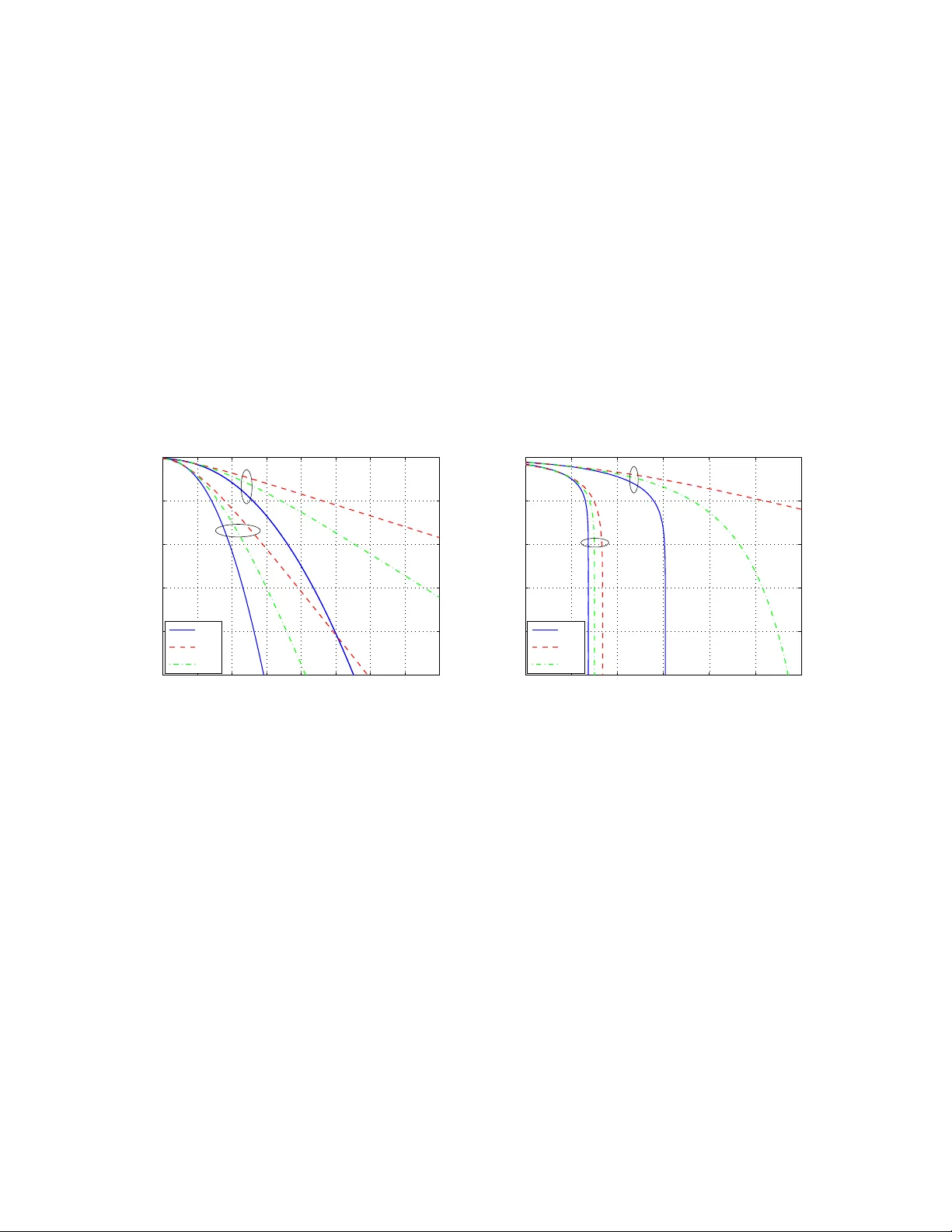
1 Outage Probability of the Gaussian MIMO Free-Space Optical Channel with PPM Nick Letzepis, Member , IEEE and Albert Guill ´ en i F ` abreg as, Member , IEEE Abstract The free-space optical channel has the potential to facilitate ine xpensiv e, wireless communication with fiber-lik e bandwidth under short deployment timelines. Ho we v er , atmospheric ef fects can signifi- cantly degrade the reliability of a free-space optical link. In particular , atmospheric turbulence causes random fluctuations in the irradiance of the receiv ed laser beam, commonly referred to as scintillation . The scintillation process is slow compared to the large data rates typical of optical transmission. As such, we adopt a quasi-static block fading model and study the outage probability of the channel under the assumption of orthogonal pulse-position modulation. W e inv estigate the mitigation of scintillation through the use of multiple lasers and multiple apertures, thereby creating a multiple-input multiple output (MIMO) channel. Non-ideal photodetection is also assumed such that the combined shot noise and thermal noise are considered as signal-independent additive Gaussian white noise. Assuming perfect receiv er channel state information (CSI), we compute the signal-to-noise ratio exponents for the cases when the scintillation is lognormal, exponential and gamma-gamma distrib uted, which cov er a wide range of atmospheric turbulence conditions. Furthermore, we illustrate very large gains, in some cases larger than 15 dB, when transmitter CSI is also av ailable by adapting the transmitted electrical power . I . I N T RO D U C T I O N Free-space optical (FSO) communication of fers an attracti ve alternativ e to the radio frequency (RF) channel for the purpose of transmitting data at very high rates. By utilising a high carrier frequency in the optical range, digital communication on the order of gigabits per second is N. Letzepis is with Institute for T elecommunications Research, Univ ersity of South Australia, SPRI Building - Mawson Lakes Blvd., Mawson Lakes SA 5095, Australia, e-mail: nick.letzepis@unisa.edu.au. A. Guill ´ en i F ` abregas is with the Department of Engineering, Uni versity of Cambridge, Cambridge CB2 1PZ, UK, e-mail: guillen@ieee.org . October 29, 2018 DRAFT 2 possible. In addition, FSO links are dif ficult to intercept, immune to interference or jamming from external sources, and are not subject to frequency spectrum regulations. FSO communications hav e recei ved recent attention in applications such as satellite communications, fiber-backup, RF-wireless back-haul and last-mile connectivity [1]. The main drawback of the FSO channel is the detrimental effect the atmosphere has on a propagating laser beam. The atmosphere is composed of gas molecules, water v apor , pollutants, dust, and other chemical particulates that are trapped by Earth’ s gra vitational field. Since the wa velength of a typical optical carrier is comparable to these molecule and particle sizes, the carrier wav e is subject to various propagation effects that are uncommon to RF systems. One such effect is scintillation , caused by atmospheric turbulence, and refers to random fluctuations in the irradiance of the received optical laser beam (analogous to fading in RF systems) [2–4]. Recent works on the mitigation of scintillation concentrate on the use of multiple-lasers and multiple-apertures to create a multiple-input-multiple-output (MIMO) channel [5–13]. Many of these works consider scintillation as an ergodic fading process, and analyse the channel in terms of its ergodic capacity . Ho we ver , compared to typical data rates, scintillation is a slow time- v arying process (with a coherence time on the order of milliseconds), and it is therefore more appropriate to analyse the outage probability of the channel. T o some extent, this has been done in the works of [6, 10, 12–14]. In [6, 13] the outage probability of the MIMO FSO channel is analysed under the assumption of ideal photodetection (i.e. a Poisson counting process) with no bandwidth constraints. W ilson et al. [10] also assume perfect photodetection, but with the further constraint of pulse-position modulation (PPM). Lee and Chan [12], study the outage probability under the assumption of on-of f ke ying (OOK) transmission and non-ideal photodetection, i.e. the combined shot noise and thermal noise process is modeled as zero mean signal independent additi ve white Gaussian noise (A WGN). Farid and Hranilovic [14] extend this analysis to include the effects of pointing errors. In this paper we study the outage probability of the MIMO FSO channel under the assumptions of PPM, non-ideal photodetection, and equal gain combining (EGC) at the receiv er . In particular , we model the channel as a quasi-static block fading channel whereby communication tak es place ov er a finite number of blocks and each block of transmitted symbols experiences an independent identically distributed (i.i.d.) fading realisation [15, 16]. W e consider two types of CSI kno wledge. First we assume perfect CSI is av ailable only at the receiv er (CSIR case), and the October 29, 2018 DRAFT 3 transmitter knows only the channel statistics. Then we consider the case when perfect CSI is also kno wn at the transmitter (CSIT case). 1 Under this frame work we study a number of scintillation distributions: lognormal, modelling weak turbulence; exponential, modelling strong turb ulence; and gamma-gamma [17], which models a wide range of turbulence conditions. For the CSIR case, we deriv e signal-to-noise ratio (SNR) exponents and sho w that they are the product of: a channel related parameter , dependent on the scintillation distribution; the number of lasers times the number of apertures, reflecting the spatial di versity; and the Singleton bound [18– 20], reflecting the block di versity . For the CSIT case, the transmitter finds the optimal po wer allocation that minimises the outage probability [21]. Using results from [22], we deriv e the optimal po wer allocation subject to short- and long-term po wer constraints. W e show that very large power savings are possible compared to the CSIR case. Interestingly , under a long-term po wer constraint, we show that delay-limited capacity [23] is zero for exponential and (in some cases) gamma-gamma scintillation, unless one codes ov er multiple blocks, and/or uses multiple lasers and apertures. The paper is organised as follows. In Section II, we define the channel model and assumptions. In Section III we revie w the lognormal, exponential and gamma-gamma models. Section IV defines the outage probability and presents results on the minimum-mean squared error (MMSE). Then in Sections V and VI we present the main results of our asymptotic outage probability analysis for the CSIR and CSIT cases, respectiv ely . Concluding remarks are then gi ven in Section VII. Proofs of the various results can be found in the Appendices. I I . S Y S T E M M O D E L W e consider an M × N MIMO FSO system with M transmit lasers an N aperture receiv er as sho wn in Fig. 1. Information data is first encoded by a binary code of rate R c . The encoded stream is modulated according to a Q -ary PPM scheme, resulting in rate R = R c log 2 Q (bits/channel use). Repetition transmission is employed such that the same PPM signal is transmitted in perfect synchronism by each of the M lasers through an atmospheric turbulent channel and collected by N receiv e apertures. W e assume the distance between the individual lasers and apertures is 1 Giv en the slow time-v arying scintillation process, CSI can be estimated at the receiv er and fed back to the transmitter via a dedicated feedback link. October 29, 2018 DRAFT 4 suf ficient so that spatial correlation is negligible. At each aperture, the receiv ed optical signal is con verted to an electrical signal via photodetection. Non-ideal photodetection is assumed such that the combined shot noise and thermal noise processes can be modeled as zero mean, signal independent A WGN (an assumption commonly used in the literature, see e.g. [3–5, 12, 14, 24–29]). In FSO communications, channel variations are typically much slo wer than the signaling period. As such, we model the channel as a non-er godic block-fading channel, for which a gi ven code word of length B L undergoes only a finite number B of scintillation realisations [15, 16]. The receiv ed signal at aperture n , n = 1 , . . . , N can be written as y n b [ ` ] = M X m =1 ˜ h m,n b ! p ˜ p b x b [ ` ] + ˜ z n b [ ` ] , (1) for b = 1 , . . . , B , ` = 1 , . . . , L , where y n b [ ` ] , ˜ z n b [ ` ] ∈ R Q are the receiv ed and noise signals at block b , time instant ` and aperture n , x b [ ` ] , ∈ R Q is the transmitted signal at block b and time instant ` , and ˜ h m,n b denotes the scintillation fading coefficient between laser m and aperture n . Each transmitted symbol is drawn from a PPM alphabet, x b [ ` ] ∈ X ppm ∆ = { e 1 , . . . , e Q } , where e q is the canonical basis vector , i.e., it has all zeros except for a one in position q , the time slot where the pulse is transmitted. The noise samples of ˜ z n b [ ` ] are independent realisations of a random variable Z ∼ N (0 , 1) , and ˜ p b denotes the recei ved electrical power of block b at each aperture in the absence of scintillation. The fading coef ficients ˜ h m,n b are independent realisations of a random variable ˜ H with probability density function (pdf) f ˜ H ( h ) . At the recei ver , we assume equal gain combining (EGC) is employed, such that the entire system is equi v alent to a single-input single-output (SISO) channel, i.e. y b [ ` ] = 1 √ N N X n =1 y n b [ ` ] = √ p b h b x b [ ` ] + z b [ ` ] , (2) where z b [ ` ] = 1 √ N P N n =1 ˜ z n b [ ` ] ∼ N (0 , 1) , and h b , a realisation of the random variable H , is defined as the normalised combined fading coef ficient, i.e. h b = c M N M X m =1 N X n =1 ˜ h m,n b , (3) October 29, 2018 DRAFT 5 where c = 1 / ( E [ ˜ H ] p 1 + σ 2 I / ( M N )) is a constant to ensure E [ H 2 ] = 1 . 2 Thus, the total instantaneous receiv ed electrical po wer at block b is p b = M 2 N ˜ p b /c , and the total a verage recei ved SNR is snr , E [ h b p b ] = E [ p b ] . For the CSIR case, we assume the electrical po wer is distrib uted uniformly ov er the blocks, i.e., p b = p = snr for b = 1 , . . . , B . Otherwise, for the CSIT case, we will allocate electrical power in order to improv e performance. In particular , we will consider the follo wing two electrical po wer constraints Short-term: 1 B B X b =1 p b ≤ P (4) Long-term: E " 1 B B X b =1 p b # ≤ P . (5) Throughout the paper , we will dev ote special attention to the case of B = 1 , i.e., the channel does not vary within a code word. This scenario is rele v ant for FSO, since, due to the large data-rates, one is able to transmit millions of bits ov er the same channel realisation. W e will see that most results admit very simple forms, and some cases, e ven closed form. This analysis allo ws for a system characterisation where the expressions highlight the roles of the key design parameters. I I I . S C I N T I L L A T I O N D I S T R I B U T I O N S The scintillation pdf, f ˜ H ( h ) , is parameterised by the scintillation index (SI), σ 2 I , V ar( ˜ H ) ( E [ ˜ H ]) 2 , (6) and can be considered as a measure of the strength of the optical turbulence under weak turbulence conditions [17, 30]. The distrib ution of the irradiance fluctuations is dependent on the strength of the optical turbulence. For the weak turbulence re gime, the fluctuations are generally considered to be 2 For optical channels with ideal photodetection, the normalisation E [ H ] = 1 is commonly used to keep optical power constant. W e assume non-ideal photodetection and work entirely in the electrical domain. Hence, we chose the normalisation E [ H 2 ] = 1 , used commonly in RF fading channels. Howe ver , since we consider only the asymptotic behaviour of the outage probability , the specific normalisation is irrelev ant and does not affect our results. October 29, 2018 DRAFT 6 lognormal distributed, and for very strong turbulence, e xponential distributed [2, 31]. For mod- erate turb ulence, the distribution of the fluctuations is not well understood, and a number of distributions hav e been proposed, such as the lognormal-Rice distribution [4, 17, 32–34] (also kno wn as the Beckmann distribution [35]) and K-distrib ution [32]. In [17], Al-Habash et al. proposed a gamma-gamma distribution as a general model for all le vels of atmospheric tur- bulence. Moreover , recent work in [34] has shown that the gamma-gamma model is in close agreement with experimental measurements under moderate-to-strong turbulence conditions. In this paper we focus on lognormal, e xponential, and g amma-gamma distributed scintillation, which are described as follows. For lognormal distributed scintillation, f ln ˜ H ( h ) = 1 hσ √ 2 π exp − (log h − µ ) 2 / (2 σ 2 ) , (7) where µ and σ are related to the SI via µ = − log (1 + σ 2 I ) and σ 2 = log(1 + σ 2 I ) . For exponential distributed scintillation f exp ˜ H ( h ) = λ exp( − λh ) (8) which corresponds to the super-saturated turbulence regime, where σ 2 I = 1 . The gamma-gamma distribution arises from the product of two independent Gamma distributed random variables and has the pdf [17], f gg ˜ H ( h ) = 2( αβ ) α + β 2 Γ( α )Γ( β ) h α + β 2 − 1 K α − β (2 p αβ h ) , (9) where K ν ( x ) denotes the modified Bessel function of the second kind [36, Ch. 10]. The param- eters α and β are related with the scintillation index via σ 2 I = α − 1 + β − 1 + ( αβ ) − 1 . I V . I N F O R M AT I O N T H E O R E T I C P R E L I M I N A R I E S The channel described by (2) under the quasi-static assumption is not information stable [37] and therefore, the channel capacity in the strict Shannon sense is zero. It can be shown that the code word error probability of any coding scheme is lower bounded by the information outage probability [15, 16], P out ( snr , R ) = Pr( I ( p , h ) < R ) , (10) October 29, 2018 DRAFT 7 where R is the transmission rate and I ( p , h ) is the instantaneous input-output mutual information for a giv en power allocation p , ( p 1 , . . . , p B ) , and vector channel realisation h , ( h 1 , . . . , h B ) . The instantaneous mutual information can be expressed as [38] I ( p , h ) = 1 B B X b =1 I awgn ( p b h 2 b ) , (11) where I awgn ( ρ ) is the input-output mutual information of an A WGN channel with SNR ρ . For PPM [24] I awgn ( ρ ) = log 2 Q − E " log 2 1 + Q X q =2 e − ρ + √ ρ ( Z q − Z 1 ) !# , (12) where Z q ∼ N (0 , 1) for q = 1 , . . . , Q . For the CSIT case we will use the recently discovered relationship between mutual information and the MMSE [39]. This relationship states that 3 d dρ I awgn ( ρ ) = mmse ( ρ ) log(2) (13) where mmse ( ρ ) is the MMSE in estimating the input from the output of a Gaussian channel as a function of the SNR ρ . For PPM, we hav e the follo wing result Theor em 4.1: The MMSE for PPM on the A WGN channel with SNR ρ is mmse ( ρ ) = 1 − E e 2 √ ρ ( √ ρ + Z 1 ) + ( Q − 1) e 2 √ ρZ 2 e ρ + √ ρZ 1 + P Q k =2 e √ ρZ k 2 , (14) where Z i ∼ N (0 , 1) for i = 1 , . . . , Q . Pr oof: See Appendix I. Note that both (12) and (14) can be ev aluated using standard Monte-Carlo methods. V . O U T AG E P R O B A B I L I T Y A N A LY S I S W I T H C S I R For the CSIR case, we employ uniform power allocation, i.e. p 1 = . . . = p B = snr . For code words transmitted over B blocks, obtaining a closed form analytic expression for the outage probability is intractable. Even for B = 1 , in some cases, for example the lognormal and gamma- gamma distributions, determining the e xact distribution of H can be a difficult task. Instead, as 3 The log(2) term arises because we have defined I awgn ( ρ ) in bits/channel usage. October 29, 2018 DRAFT 8 we shall see, obtaining the asymptotic behaviour of the outage probability is substantially simpler . T o wards this end, and following the footsteps of [20, 40], we deri ve the SNR e xponent . Theor em 5.1: The outage SNR exponents for a MIMO FSO communications system modeled by (2) are giv en as follo ws: d ln (log snr ) 2 = M N 8 log(1 + σ 2 I ) (1 + b B (1 − R c ) c ) (15) d exp (log snr ) = M N 2 (1 + b B (1 − R c ) c ) , (16) d gg (log snr ) = M N 2 min( α, β ) (1 + b B (1 − R c ) c ) , (17) for lognormal, exponential, and gamma-gamma cases respecti vely , where R c = R / log 2 ( Q ) is the rate of the binary code and d (log snr ) k ∆ = − lim snr →∞ log P out ( snr , R ) (log snr ) k k = 1 , 2 . (18) Pr oof: See Appendix II. Pr oposition 5.1: The outage SNR exponents gi ven in Theorem 5.1, are achie v able by random coding over PPM constellations whene ver B (1 − R c ) is not an integer . Pr oof: The proof follo ws from the proof of Theorem 5.1 and the proof of [20, Th. 1]. The abov e proposition implies that the outage exponents given in Theorem 5.1 are the optimal SNR exponents ov er the channel, i.e. the outage probability is a lower bound to the error probability of any coding scheme, its corresponding exponents (given in Theorem 5.1) are an upper bound to the exponent of coding schemes. From Proposition 5.1, we can achiev e the outage exponents with a particular coding scheme (random coding, in this case), and therefore, the exponents in Theorem 5.1 are optimal. From (15)-(17) we immediately see the benefits of spatial and block div ersity on the system. In particular , each exponent is proportional to: the number of lasers times the number of apertures, reflecting the spatial div ersity; a channel related parameter that is dependent on the scintillation distribution; and the Singleton bound, which is the optimal rate-div ersity tradeof f for Rayleigh- faded block fading channels [18–20]. Comparing the channel related parameters in (15)-(17) the ef fects of the scintillation distribu- tion on the outage probability are directly visible. For the lognormal case, the channel related parameter is 8 log(1 + σ 2 I ) and hence is directly linked to the SI. Moreover , for small σ 2 I < 1 , October 29, 2018 DRAFT 9 8 log(1 + σ 2 I ) ≈ 8 σ 2 I and the SNR exponent is in versely proportional to the SI. For the exponential case, the channel related parameter is a constant 1 / 2 as expected, since the SI is constant. For the gamma-gamma case the channel related parameter is min( α, β ) / 2 , which highlights an interesting connection between the outage probability and recent results in the theory of optical scintillation. For gamma-gamma distributed scintillation, the fading coef ficient results from the product of two independent random variables, i.e. ˜ H = X Y , where X and Y model fluctuations due to large scale and small scale cells. Large scale cells cause refractiv e effects that mainly distort the wa ve front of the propagating beam, and tend to steer the beam in a slightly different direction (i.e. beam wander). Small scale cells cause scattering by diffraction and therefore distort the amplitude of the wa ve through beam spreading and irradiance fluctuations [4, p. 160]. The parameters α, β are related to the large and small scale fluctuation v ariances via α = σ − 2 X and β = σ − 2 Y . For a plane wa ve (neglecting inner/outer scale effects) σ 2 Y > σ 2 X , and as the strength of the optical turb ulence increases, the small scale fluctuations dominate and σ 2 Y → 1 [4, p. 336]. This implies that the SNR exponent is exclusiv ely dependent on the small scale fluctuations. Moreov er, in the strong fluctuation regime, σ 2 Y → 1 , the gamma-gamma distribution reduces to a K-distribution [4, p. 368], and the system has the same SNR exponent as the exponential case typically used to model very strong fluctuation regimes. In comparing the lognormal exponent with the other cases, we observe a striking difference. For the lognormal case (15) implies the outage probability is dominated by a (log( snr )) 2 term, whereas for exponential and gamma-gamma scintillation it is dominated by a log ( snr ) term. Thus the outage probability decays much more rapidly with SNR for the lognormal case than it does for the exponential or gamma-gamma cases. Furthermore, for the lognormal case, the slope of the outage probability curve, when plotted on a log - log scale, will not con ver ge to a constant v alue. In fact, a constant slope curv e will only be observed when plotting the outage probability on a log - (log ) 2 scale. In deriving (15) (see Appendix II-A) we do not rely on the lognormal approximation 4 , which has been used on a number occasions in the analysis of FSO MIMO channels, e.g. [5, 12, 29]. Under this approximation, H is lognormal distributed (7) with parameters µ = − log(1 + 4 This refers to approximating the distribution of the sum of lognormal distributed random variables as lognormal [41–44]. October 29, 2018 DRAFT 10 σ 2 I / ( M N )) and σ 2 = − µ , and we obtain the approximated exponent d (log snr ) 2 ≈ 1 8 log(1 + σ 2 I M N ) (1 + b B (1 − R c ) c ) . (19) Comparing (15) and (19) we see that although the lognormal approximation also exhibits a (log( snr )) 2 term, it has a dif ferent slope than the true SNR exponent. The dif ference is due to the approximated and true pdfs having different behaviours in the limit as h → 0 . Howe ver , for very small σ 2 I < 1 , using log(1 + x ) ≈ x (for x < 1 ) in (15) and (19) we see that they are approximately equal. For the special case of single block transmission, B = 1 , it is straightforward to express the outage probability in terms of the cumulativ e distribution function (cdf) of the scintillation random variable, i.e. P out ( snr , R ) = F H r snr awgn R snr ! (20) where F H ( h ) denotes the cdf of H , and snr awgn R ∆ = I awgn , − 1 ( R ) denotes the SNR value at which the mutual information is equal to R . T able I reports these values for Q = 2 , 4 , 8 , 16 and R = R c log 2 Q , with R c = 1 4 , 1 2 , 3 4 . Therefore, for B = 1 , we can compute the outage probability analytically when the distrib ution of H is a v ailable, i.e., in the exponential case for M , N ≥ 1 or in the lognormal and gamma-gamma cases for M , N = 1 . In the case of exponential scintillation we have that P out ( snr , R ) = ¯ Γ M N , M N (1 + M N ) snr awgn R snr 1 2 ! , (21) where ¯ Γ( a, x ) , 1 Γ( a ) R x 0 t a − 1 exp( − t ) dt denotes the regularised (lower) incomplete gamma function [36, p.260]. For the lognormal and gamma-gamma scintillation with M N > 1 , we must resort to numerical methods. This in volv ed applying the fast Fourier transform (FFT) to f ˜ H to numerically compute its characteristic function, taking it to the M N th po wer , and then applying the in verse FFT to obtain f H . This method yields very accurate numerical computations of the outage probability in only a fe w seconds. Outage probability curves for the B = 1 case are shown on the left in Fig. 2. For the lognormal case, we see that the curves do not have constant slope for large SNR, while, for the exponential and gamma-gamma cases, a constant slope is clearly visible. W e also see the benefits of MIMO, particularly in the exponential and gamma-gamma cases, where the SNR exponent has increased from 1 / 2 and 1 to 2 and 4 respectiv ely . October 29, 2018 DRAFT 11 V I . O U T AG E P R O B A B I L I T Y A N A LY S I S W I T H C S I T In this section we consider the case where the transmitter and recei ver both ha ve perfect CSI kno wledge. In this case, the transmitter determines the optimal power allocation that minimises the outage probability for a fixed rate, subject to a po wer constraint [21]. The results of this section are based on the application of results from [22] to PPM and the scintillation distrib utions of interest. Using these results we uncov er ne w insight as to ho w key design parameters influence the performance of the system. Moreover , we show that large power savings are possible compared to the CSIR case. For the short-term po wer constraint giv en by (4), the optimal power allocation is giv en by mercury-waterfilling at each channel realisation [22, 45], p b = 1 h 2 b mmse − 1 min Q − 1 Q , η h 2 b , (22) for b = 1 , . . . , B where mmse − 1 ( u ) is the in verse-MMSE function and η is chosen to satisfy the po wer constraint. 5 From [22, Prop. 1] it is apparent that the SNR exponent for the CSIT case under short-term po wer constraints is the same as the CSIR case. For the long-term po wer constraint gi ven by (5) the optimal power allocation is [22] p = ℘ , P B b =1 ℘ b ≤ s 0 , otherwise , (23) where ℘ b = 1 h 2 b mmse − 1 min Q − 1 Q , 1 η h 2 b , b = 1 , . . . , B (24) and s is a threshold such that s = ∞ if lim s →∞ E R ( s ) h 1 B P B b =1 ℘ b i ≤ P , and R ( s ) , ( h ∈ R B + : 1 B B X b =1 ℘ b ≤ s ) , (25) otherwise, s is chosen such that P = E R ( s ) h 1 B P B b =1 ℘ b i . In (24), η is now chosen to satisfy the rate constraint 1 B B X b =1 I awgn mmse − 1 min Q − 1 Q , 1 η h 2 b = R (26) 5 Note that in [22, 45], the minimum in (22) is between 1 and η h 2 b . For Q PPM, mmse (0) = Q − 1 Q (see (14)). Hence we must replace 1 with Q − 1 Q . October 29, 2018 DRAFT 12 From [22], the long-term SNR exponent is giv en by d lt (log snr ) = d st (log snr ) 1 − d st (log snr ) d st (log snr ) < 1 ∞ d st (log snr ) > 1 , (27) where d st (log snr ) is the short-term SNR exponent, i.e., the SNR exponents (15)-(17). Note that d lt (log snr ) = ∞ implies the outage probability curve is vertical, i.e. the power allocation scheme (23) is able to maintain constant instantaneous mutual information (11). The maximum achiev able rate at which this occurs is defined as the delay-limited capacity [23]. From (27) and (15)-(17), we therefore hav e the following corollary . Cor ollary 6.1: The delay-limited capacity of the channel described by (2) with CSIT subject to long-term po wer constraint (5) is zero whenever M N ≤ 2 (1 + b B (1 − R c ) c ) − 1 exponential 2 min( α,β ) (1 + b B (1 − R c ) c ) − 1 gamma-gamma . (28) For lognormal scintillation, delay-limited capacity is always nonzero. Corollary 6.1 outlines fundamental design criteria for nonzero delay-limited capacity in FSO communications. Single block transmission ( B = 1 ) is of particular importance gi ven the slow time-v ary nature of scintillation. From (28), to obtain nonzero delay-limited capacity with B = 1 , one requires M N > 2 and M N > 2 / min( α, β ) for exponential and gamma-gamma cases respecti vely . Note that typically , α , β ≥ 1 . Thus a 3 × 1 , 1 × 3 or 2 × 2 MIMO system is suf ficient for most cases of interest. In addition, for the special case B = 1 , the solution (24) can be determined explicitly since η = h 2 mmse ( I awgn , − 1 ( R )) − 1 = h 2 mmse ( snr awgn R ) − 1 . (29) Therefore, ℘ opt = snr awgn R h 2 . (30) Intuiti vely , (30) implies that for single block transmission, whene ver snr awgn R /h 2 ≤ s , one simply transmits at the minimum po wer necessary so that the recei ved instantaneous SNR is equal to the SNR threshold ( snr awgn R ) of the code. Otherwise, transmission is turned off. Thus an outage occurs whenev er h < q snr awgn R s and hence P out ( snr , R ) = F H s snr awgn R γ − 1 ( snr ) ! (31) October 29, 2018 DRAFT 13 where γ − 1 ( snr ) is the solution to the equation γ ( s ) = snr , i.e., γ ( s ) , snr awgn R Z ∞ ν f H ( h ) h 2 dh, (32) where ν , q snr awgn R s . Moreover , the snr at which P out ( R, snr ) → 0 is precisely lim s →∞ γ ( s ) . In other words, the minimum long-term average SNR required to maintain a constant mutual information of R bits per channel use, denoted by snr , is snr awgn R = snr awgn R Z ∞ 0 f H ( h ) h 2 dh. (33) Hence, recalling that snr awgn R = I awgn , − 1 ( R ) , the delay-limited capacity (under the constraint of PPM) is 6 C d ( snr ) = I awgn snr R ∞ 0 f H ( h ) h 2 dh ! . (34) In the cases where the distribution of H is known in closed form, (32) can be solved explicitly , hence yielding the exact expressions for outage probability (31) and delay-limited capacity (34). For lognormal distributed scintillation with B = M = N = 1 , we have that γ ln ( s ) = 1 2 snr awgn R (1 + σ 2 I ) 4 erfc 3 log(1 + σ 2 I ) + 1 2 log snr awgn R − 1 2 log s p 2 log(1 + σ 2 I ) ! , (35) and C ln d ( snr ) = I awgn snr (1 + σ 2 I ) 4 , (36) where we hav e explicitly solved the integrals in (32) and (34) respecti vely . For the exponential case with B = 1 , we obtain, γ exp ( s ) = snr awgn R M N (1 + M N ) ( M N − 1)( M N − 2) ¯ Γ M N − 2 , r M N (1 + M N ) snr awgn R s ! , (37) and C exp d ( snr ) = I awgn ( M N − 1)( M N − 2) M N (1+ M N ) snr M N > 2 0 otherwise. (38) 6 Note that a similar expression was deriv ed in [23]. October 29, 2018 DRAFT 14 For the gamma-gamma case with B = M = N = 1 , γ gg ( s ) can be expressed in terms of hyper geometric functions, which are omitted for space reasons. The delay-limited capacity , ho we ver , reduces to a simpler expression 7 C gg d ( snr ) = I awgn ( α − 2)( α − 1)( β − 2)( β − 1) ( αβ )( α +1)( β +1) snr α, β > 2 0 otherwise. (39) Fig. 2 (right) compares the outage probability for the B = 1 CSIT case (with long-term po wer constraints) for each of the scintillation distrib utions. For M N = 1 we see that the outage curve is vertical only for the lognormal case, since C d = 0 for the exponential and gamma-gamma cases. In these cases one must code ov er multiple blocks for C d > 0 , i.e. from Corollary 6.1, B ≥ 6 and B ≥ 4 for the exponential and gamma-gamma cases respectiv ely (with R c = 1 / 2 ). Comparing the CSIR and CSIT cases in Fig. 2 we can see that very large power savings are possible when CSI is kno wn at the transmitter . These savings are further illustrated in T able II, which compares the SNR required to achiev e P out < 10 − 5 (denoted by snr ∗ ) for the CSIR case, and the long-term average SNR required for P out → 0 in the CSIT case (denoted by snr , which is giv en by (33)). Note that in the CSIT case, the v alues of snr gi ven in the parentheses’ is the minimum SNR required to achie ve P out < 10 − 5 , since C d = 0 for these cases (i.e. snr = ∞ ). From T able II we see that the po wer saving is at least around 15 dB, and in some cases as high as 50 dB. W e also see the combined benefits of MIMO and po wer control, e.g. at M N = 4 , the system is only 3.7 dB (lognormal) to 5.2 dB (exponential) from the capacity of nonfading PPM channel ( snr awgn 1 / 2 = 3 . 18 dB). V I I . C O N C L U S I O N In this paper we hav e analysed the outage probability of the MIMO Gaussian FSO channel under the assumption of PPM and non-ideal photodetection, for lognormal, exponential and gamma-gamma distributed scintillation. When CSI is kno wn only at the receiver , we ha ve shown that the SNR exponent is proportional to the number lasers and apertures, times a channel related parameter (dependent on the scintillation distribution), times the Singleton bound, e ven in the cases where a closed form expression of the equiv alent SISO channel distrib ution is not av ailable 7 Note that since we assume the normalisation E [ H 2 ] = 1 , then R ∞ 0 f H ( h ) h 2 dh = 1 c 2 R ∞ 0 f gg ˜ H ( u ) u 2 du , where c = 1 / p 1 + σ 2 I and f gg ˜ H ( h ) is defined as in (9) such that E [ ˜ H ] = 1 . October 29, 2018 DRAFT 15 in closed-form. When the scintillation is lognormal distributed, we hav e sho wn that the outage probability is dominated by a (log( snr )) 2 term, whereas for the exponential and gamma-gamma cases it is dominated by a log ( snr ) term. When CSI is also known at the transmitter , we applied the power control techniques of [22] to PPM to sho w that very significant po wer savings are possible. A P P E N D I X I P RO O F O F T H E O R E M 4 . 1 Suppose PPM symbols are transmitted over an A WGN channel, the non-fading equiv alent of (2). The receiv ed noisy symbols are gi ven by y = √ ρ x + z , where x ∈ X ppm (we have dropped the time index ` for brevity of notation). Using Bayes’ rule [46], the MMSE estimate is ˆ x = E [ x | y ] = Q X q =1 e q exp( √ ρy q ) P Q k =1 exp( √ ρy k ) . (40) From (40) the i th element of ˆ x is ˆ x i = exp( √ ρy i ) P Q k =1 exp( √ ρy k ) . (41) Using the orthogonality principle [47] mmse ( ρ ) = E [ k x − ˆ x k 2 ] = E [ k x k 2 ] − E[ k ˆ x k 2 ] . Since k e q k 2 = 1 for all q = 1 , . . . , Q , then E [ k x k 2 ] = 1 . Due to the symmetry of Q PPM we need only consider the case when x = e 1 was transmitted. Hence, mmse ( ρ ) = 1 − E [ ˆ x 2 1 ] + ( Q − 1) E [ ˆ x 2 2 ] . (42) No w y 1 = √ ρ + z 1 and y i = z i for i = 2 , . . . , Q , where z q is a realisation of a random v ariable Z q ∼ N (0 , 1) for q = 1 , . . . , Q . Hence, substituting these values in (41) and taking the expectation (42) yields the result giv en the theorem. A P P E N D I X I I P RO O F O F T H E O R E M 5 . 1 W e begin by defining a normalised (with respect to SNR) fading coefficient, ζ m,n b = − 2 log ˜ h m,n b log snr , which has a pdf f ζ m,n b ( ζ ) = log snr 2 e − 1 2 ζ log snr f ˜ H e − 1 2 ζ log snr . (43) October 29, 2018 DRAFT 16 Since we are only concerned with the asymptotic outage behaviour , the scaling of the coefficients is irrelev ant, and to simplify our analysis we assume E [ ˆ H 2 ] = 1 . Hence the instantaneous SNR for block b is giv en by ρ b = snr h 2 b = 1 M N M X m =1 N X n =1 snr 1 2 ( 1 − ζ m,n b ) ! 2 (44) for b = 1 , . . . , B . Therefore, lim snr →∞ I awgn ( ρ b ) = 0 if all ζ m,n b > 1 log 2 Q at least one ζ m,n b < 1 = log 2 Q (1 − 1 1 { ζ b 1 } ) where ζ b ∆ = ( ζ 1 , 1 b , . . . , ζ M ,N b ) , 1 1 {·} denotes the indicator function, 1 ∆ = (1 , . . . , 1) is a 1 × M N vector of 1’ s, and the notation a b for vectors a , b ∈ R k means that a i > b i for i = 1 , . . . , k . From the definition of outage probability (10), we hav e P out ( snr , R ) = Pr( I h ( snr ) < R ) = Z A f ( ζ ) d ζ (45) where ζ ∆ = ( ζ 1 , . . . , ζ B ) is a 1 × B M N v ector of normalised fading coefficients, f ( ζ ) denotes their joint pdf, and A = ( ζ ∈ R B M N : B X b =1 1 1 { ζ b 1 } > B (1 − R c ) ) (46) is the asymptotic outage set. W e no w compute the asymptotic behaviour of the outage probability , i.e. − lim snr →∞ log P out ( snr , R ) = − lim snr →∞ log Z A f ( ζ ) d ζ . (47) A. Lognormal case From (7) and (43) we obtain the joint pdf, f ( ζ ) . = exp − (log snr ) 2 8 σ 2 B X b =1 M X m =1 N X n =1 ( ζ m,n b ) 2 ! , (48) where we hav e ignored terms of order less than (log snr ) 2 in the exponent and constant terms inde- pendent of ζ in front of the exponential. Combining (47), (48), and using V aradhan’ s lemma [48], − lim snr →∞ log P out ( snr , R ) = (log snr ) 2 8 σ 2 inf A ( B X b =1 M X m =1 N X n =1 ( ζ m,n b ) 2 ) October 29, 2018 DRAFT 17 The abov e infimum occurs when any κ of the ζ b vectors are such that ζ b 1 and the other B − κ vectors are zero, where κ is a unique integer satisfying κ < B (1 − R c ) ≤ κ + 1 . (49) Hence, it follo ws that κ = 1 + b B (1 − R c ) c and thus, − lim snr →∞ log P out ( snr , R ) = (log snr ) 2 8 σ 2 M N (1 + b B (1 − R c ) c ) . (50) Di viding both sides of (50) by (log snr ) 2 the SNR exponent (15) is obtained. B. Exponential case From (8) and (43) we obtain the joint pdf, f ( ζ ) . = exp − log snr M N 2 B X b =1 M X m =1 N X n =1 ζ m,n b ! , (51) where we have ignored exponential terms in the exponent and constant terms independent of ζ in front of the exponential. Follo wing the same steps as the lognormal case i.e. the defining the same asymptotic outage set and application of V aradhan’ s lemma [48], the SNR exponent (16) is obtained. C. Gamma-gamma case Let us first assume α > β . From (9) and (43) we obtain the joint pdf, f ζ m,n b ( ζ ) . = exp − β 2 ζ log snr , ζ > 0 (52) for large snr , where we hav e used the approximation K ν ( x ) ≈ 1 2 Γ( ν )( 1 2 x ) − ν for small x and ν > 0 [36, p. 375]. The extra condition, ζ > 0 , is required to ensure the argument of the Bessel function approaches zero as snr → ∞ to satisfy the requirements of the aforementioned approximation. For the case β > α we need only swap α and β in (52). Hence we hav e the joint pdf f ( ζ ) . = exp − min( α, β ) log snr 2 B X b =1 M X m =1 N X n =1 ζ m,n b ! , ζ 0 . (53) No w , following the same steps as in the lognormal and exponential cases, with the additional constraint ζ b 0 , the SNR exponent (17) is obtained October 29, 2018 DRAFT 18 R E F E R E N C E S [1] H. W illebrand and B. S. Ghuman, F ree-Space Optics: Enabling Optical Connectivity in T oday’s Networks , Sams Publishing, Indianapolis, USA, 2002. [2] J. W . Strohbehn, Ed., Laser Beam Pr opagation in the Atmosphere , vol. 25, Springer -V erlag, Germany , 1978. [3] R. M. Gagliardi and S. Karp, Optical communications , John W iley & Sons, Inc., Canada, 1995. [4] L. C. Andrews and R. L. Phillips, Laser Beam Propagation thr ough Random Media , SPIE Press, USA, 2nd edition, 2005. [5] N. Letzepis, I. Holland, and W . Cowle y , “The Gaussian free space optical MIMO channel with Q -ary pulse position modulation, ” to appear IEEE T rans. W ir eless Commun. , 2008. [6] K. Chakraborty , S. Dey , and M. Franceschetti, “On outage capacity of MIMO Poisson fading channels, ” in Pr oc. IEEE Int. Symp. Inform. Theory , July 2007. [7] K. Chakraborty and P . Narayan, “The Poisson fading channel, ” IEEE T rans. Inform. Theory , vol. 53, no. 7, pp. 2349–2364, July 2007. [8] N. Cvijetic, S. G. Wilson, and M. Brandt-Pearce, “Receiv er optimization in turbulent free-space optical MIMO channels with APDs and Q -ary PPM, ” IEEE Photon. T ech. Let. , vol. 19, no. 2, pp. 103–105, Jan. 2007. [9] I. B. Djordjevic, B. V asic, and M. A. Neifeld, “Multilevel coding in free-space optical MIMO transmission with q-ary PPM over the atmospheric turbulence channel, ” IEEE Photon. T ech. Let. , vol. 18, no. 14, pp. 1491–1493, July 2006. [10] S. G. W ilson, M. Brandt-Pearce, Q. Cao, and J. H. Lev eque, “Free-space optical MIMO transmission with Q -ary PPM, ” IEEE T rans. on Commun. , vol. 53, no. 8, pp. 1402–1412, Aug. 2005. [11] K. Chakraborty , “Capacity of the MIMO optical fading channel, ” in Proc. IEEE Int. Symp. Inform. Theory , Adelaide, Sept. 2005, pp. 530–534. [12] E. J. Lee and V . W . S. Chan, “Part 1: optical communication ov er the clear turbulent atmospheric channel using diversity , ” J. Select. Ar eas Commun. , vol. 22, no. 9, pp. 1896–1906, Nov . 2005. [13] S. M. Haas and J. H. Shapiro, “Capacity of wireless optical communications, ” IEEE J. Select. Ar eas Commun. , vol. 21, no. 8, pp. 1346–1356, Oct. 2003. [14] A. A. Farid and S. Hranilovic, “Outage capacity optimization for free-space optical links with pointing errors, ” IEEE T rans. Light. T ech. , vol. 25, no. 7, pp. 1702–1710, July 2007. [15] L. H. Ozarow , S. Shamai and A. D. W yner, “Information theoretic considerations for cellular mobile radio, ” IEEE T rans. on V ehicular T ech. , vol. 43, no. 2, pp. 359–378, May 1994. [16] E. Biglieri, J. Proakis and S. Shamai, “Fading channels: information-theoretic and communications aspects, ” IEEE T rans. on Inform. Theory , vol. 44, no. 6, pp. 2619 –2692, Oct. 1998. [17] M. A. Al-Habash, L. C. Andrews, and R. L. Phillips, “Mathematical model for the irradiance probability density function of a laser beam propagating through turbulent media, ” SPIE Opt. Eng. , vol. 40, no. 8, pp. 1554–1562, 2001. [18] R. Knopp and P . Humblet, “On coding for block fading channels, ” IEEE T rans. on Inform. Theory , vol. 46, no. 1, pp. 1643–1646, July 1999. [19] E. Malkamaki and H. Leib, “Coded diversity on block-fading channels, ” IEEE T rans. on Inform. Theory , vol. 45, no. 2, pp. 771–781, March 1999. [20] A. Guill ´ en i F ` abregas and G. Caire, “Coded modulation in the block-fading channel: Coding theorems and code construction, ” IEEE T rans. on Information Theory , vol. 52, no. 1, pp. 262–271, Jan. 2006. [21] G. Caire, G. T aricco and E. Biglieri, “Optimum power control ov er fading channels, ” IEEE T rans. on Inform. Theory , vol. 45, no. 5, pp. 1468–1489, July 1999. October 29, 2018 DRAFT 19 [22] K. D. Nguyen, A. Guill ´ en i F ` abregas, and L. K. Rasmussen, “Power allocation for discrete-input delay-limied fading channels, ” submitted to IEEE T rans. Inf. Theory ., http://arxiv.org/abs/0706.2033 , Jun. 2007. [23] S. V . Hanly and D. N. C. Tse, “Multiaccess fading channels. II. delay-limited capacities, ” IEEE T rans. on Inform. Theory , vol. 44, no. 7, pp. 2816–2831, Nov . 1998. [24] S. Dolinar , D. Divsalar , J. Hamkins, and F . Pollara, “Capacity of pulse-position modulation (PPM) on Gaussian and Webb channels, ” JPL TMO Pr ogress Report 42-142 , Aug. 2000, URL: lasers.jpl.nasa.gov/P APERS/OSA/142h.pdf. [25] S. Dolinar, D. Divsalar , J. Hamkins, and F . Pollara, “Capacity of PPM on APD-detected optical channels, ” in 21st Cent. Millitary Commun. Conf. Pr oc. , Oct. 2000, vol. 2, pp. 876–880. [26] X. Zhu and J. M. Kahn, “Performance bounds for coded free-space optical communications through atmospheric turbulence channels, ” IEEE T rans. on Commun. , vol. 51, no. 8, pp. 1233–1239, Aug. 2003. [27] J. Li and M. Uyasl, “Optical wireless communications: system model, capacity and coding, ” in IEEE 58th V ehicular T ech. Conf. , Oct. 2003, vol. 1, pp. 168–172. [28] M. K. Simon and V . A. V ilnrotter , “ Alamouti-type space-time coding for free-space optical communication with direct detection, ” IEEE T rans. W ir eless Commun. , , no. 1, pp. 35–39, Jan 2005. [29] S. M. Navidpour , M. Uysal, and M. Kav ehrad, “BER performance of free-space optical transmission with spatial diversity , ” IEEE T rans. on W ir eless Commun. , vol. 6, no. 8, pp. 2813–2819, August 2007. [30] L. C. Andrews, R. L. Phillips, C. Y . Hopen, and M. A. Al-Habash, “Theory of optical scintillation, ” J . Opt. Soc. Am. A , vol. 16, no. 6, pp. 1417–1429, June 1999. [31] R. S. Lawrence and J. W . Strohbehn, “ A survey of clean-air propagation effects relev ant to optical communications, ” Pr oc. IEEE , vol. 58, no. 10, pp. 1523–1545, Oct. 1970. [32] J. H. Churnside and S. F . Clifford, “Log-normal Rician probability-density function of optical scintillations in the turbulent atmosphere, ” J. Opt. Soc. Am. A , vol. 4, no. 10, pp. 1923–1930, Oct. 1987. [33] R. J. Hill and R. G. Frehlich, “Probability distribution of irradiance for the onset of strong scintillation, ” J. Opt. Soc. Am. A , vol. 14, no. 7, pp. 1530–1540, July 1997. [34] F . S. V etelino, C. Y oung, L. Andrews, and J. Recolons, “ Aperture averaging effects on the probability density of irrandiance fluctuations in moderate-to-strong turbulence, ” Applied Optics , vol. 46, no. 11, pp. 2099–2108, April 2007. [35] P . Beckmann, Probability in Communication Engineering , Harcourt, Brace and W orld, New Y ork, 1967. [36] M. Abramowitz and I. A. Stegun, Handbook of Mathematical Functions with F ormulas, Graphs and Mathematical T ables , New Y ork: Dover Press, 1972. [37] S. V erd ´ u and T . S. Han, “ A general formula for channel capacity , ” IEEE T rans. on Inform. Theory , vol. 40, no. 4, pp. 1147–1157, Jul. 1994. [38] T . M. Cover and J. A. Thomas, Elements of Information Theory , Wile y Series in T elecommunications, 1991. [39] D. Guo, S. Shamai, and S. V erd ´ u, “Mutual information and minimum mean-square error in Gaussian channels, ” IEEE T rans. Inf. Theory , vol. 51, no. 4, pp. 1261–1282, Apr . 2005. [40] L. Zheng and D. Tse, “Div ersity and multiplexing: A fundamental tradeoff in multiple antenna channels, ” IEEE T rans. on Inform. Theory , vol. 49, no. 5, May 2003. [41] R. L. Mitchell, “Permanence of the log-normal distribution, ” J. Opt. Soc. Am. , 1968. [42] S. B. Slimane, “Bounds on the distribution of a sum of independent lognormal random variables, ” IEEE T rans. on Commun. , vol. 49, no. 6, pp. 975–978, June 2001. October 29, 2018 DRAFT 20 [43] N. C. Beaulieu and X. Qiong, “ An optimal lognormal approximation to lognormal sum distributions, ” IEEE T rans. V ehic. T ech. , vol. 53, no. 2, March 2004. [44] N. C. Beaulieu and F . Rajwani, “Highly accurate simple closed-form approximations to lognormal sum distributions and densities, ” IEEE Commun. Let. , vol. 8, no. 12, pp. 709–711, Dec. 2004. [45] A. Lozano, A. M. T ulino, and S. V erd ´ u, “Optimum power allocation for parallel Gaussian channels with arbitrary input distributions, ” IEEE T rans. Inform. Theory , vol. 52, no. 7, pp. 3033–3051, July 2006. [46] A. Papoulis, Pr obability , random variables, and stochastic pr ocesses , McGraw-Hill, 1991. [47] S. M. Kay , Fundamentals of Statistical Signal Pr ocessing: Estimation Theory , Prentice Hall Int. Inc., USA, 1993. [48] A. Dembo and O. Zeitouni, Lar ge Deviations T echniques and Applications , Number 38 in Applications of Mathematics. Springer V erlag, 2nd edition, April 1998. October 29, 2018 DRAFT FIGURES 21 Encoder PPM PPM Laser Laser Atmospheric T urbulence Aperture PD PD Decoder Aperture 1 M N 1 . . . . . . T ransmitter Receiver Fig. 1. Block diagram of an M × N MIMO FSO system. October 29, 2018 DRAFT FIGURES 22 0 10 20 30 40 50 60 70 80 10 −10 10 −8 10 −6 10 −4 10 −2 10 0 snr (dB) 1 P out ( snr , R ) 1 LN 1 Exp 1 GG 1 M N = 1 1 M N = 4 1 0 5 10 15 20 25 30 10 −10 10 −8 10 −6 10 −4 10 −2 10 0 snr (dB) 1 P out ( snr , R ) 1 LN 1 Exp 1 GG 1 M N = 4 1 M N = 1 1 Fig. 2. Outage probability curves for the CSIR (left) and CSIT (right) cases with σ 2 I = 1 , B = 1 , Q = 2 , R c = 1 / 2 , snr awgn 1 / 2 = 3 . 18 dB: lognormal (solid); exponential (dashed); and, gamma-gamma distributed scintillation (dot-dashed), α = 2 , β = 3 . October 29, 2018 DRAFT T ABLES 23 T ABLE I M I N I M U M S I G N A L - T O - N O I S E R A T I O snr awgn R ( I N D E C I B E L S ) F O R R E L I A B L E C O M M U N I C AT I O N F O R TAR G E T R A T E R = R c log 2 Q . Q R c = 1 4 R c = 1 2 R c = 3 4 2 − 0 . 7992 3 . 1821 6 . 4109 4 0 . 2169 4 . 0598 7 . 0773 8 1 . 1579 4 . 8382 7 . 7222 16 1 . 9881 5 . 5401 8 . 3107 October 29, 2018 DRAFT T ABLES 24 T ABLE II C O M PA R I S O N O F C S I R A N D C S I T C A S E S W I T H B = 1 , R = 1 / 2 , Q = 2 σ 2 I = 1 , α = 2 , β = 3 . B OT H snr ∗ A N D snr A R E M E A S U R E D I N D E C I B E L S . lognormal exponential gamma-gamma M N snr ∗ snr snr ∗ snr snr ∗ snr 1 40.1 15.2 106.2 (56.2) 65.6 (24.5) 2 29.2 9.9 57.9 (17.8) 40.7 12.2 3 24.4 7.9 42.0 11.0 31.7 9.0 4 21.5 6.9 34.1 8.4 26.9 7.5 October 29, 2018 DRAFT
Original Paper
Loading high-quality paper...
Comments & Academic Discussion
Loading comments...
Leave a Comment