Kolmogorov Complexity Theory over the Reals
Kolmogorov Complexity constitutes an integral part of computability theory, information theory, and computational complexity theory -- in the discrete setting of bits and Turing machines. Over real numbers, on the other hand, the BSS-machine (aka rea…
Authors: Martin Ziegler, Wouter M. Koolen
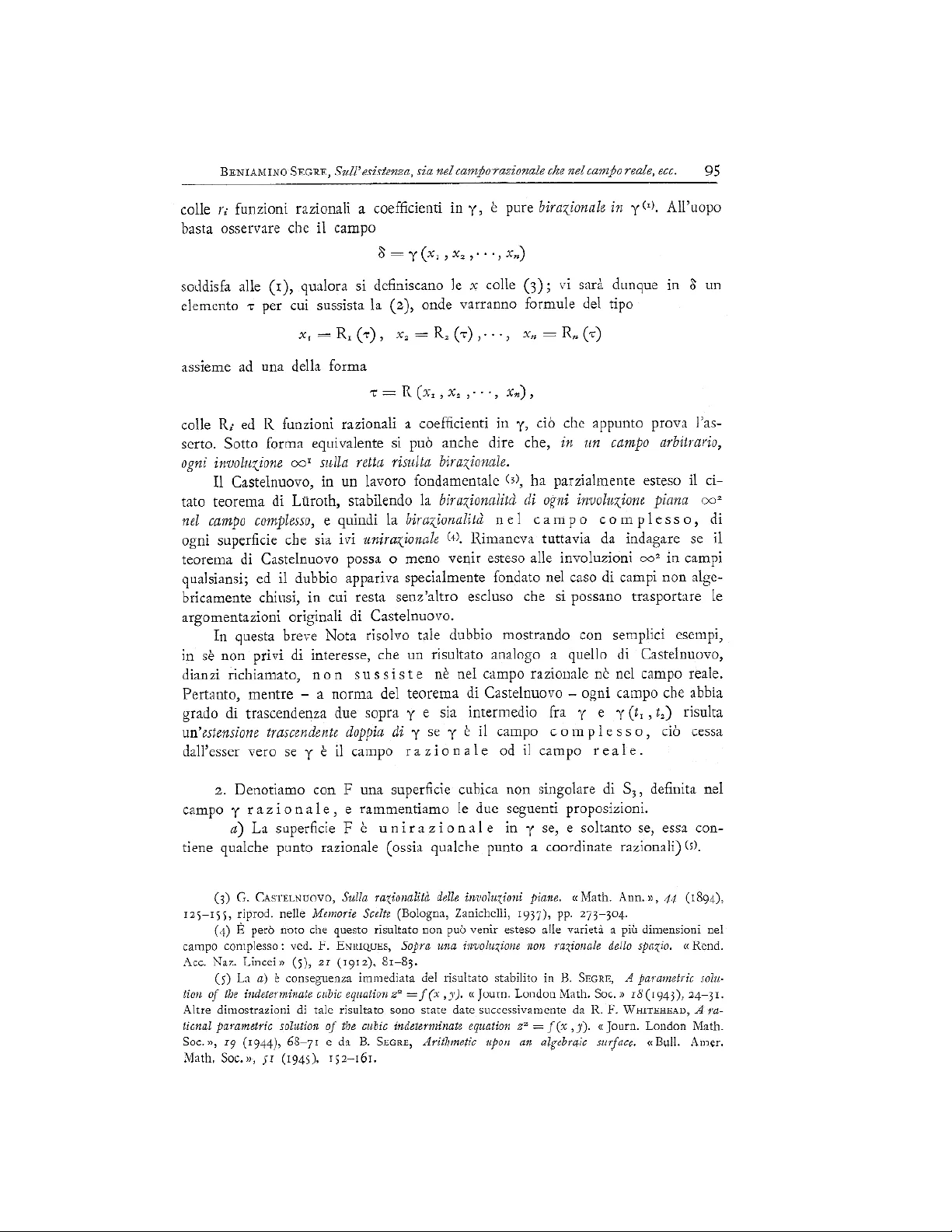
Kolmogoro v Complexit y Theory o v er the Reals Martin Ziegler 1 ? and W outer M. Ko olen 2 1 Univ ersity of Paderborn, Germany; ziegler@upb.de 2 CWI, Amsterdam, The Netherlands; wmkoolen@cwi.nl Abstract. Kolmogoro v Complexit y constitutes an integral part of com- putabilit y theory , information theory , and computational complexity theory— in the discrete setting of bits and T uring machines. Over real num b ers, on the other hand, the BSS-machine (ak a real-RAM) has b een established as a ma jor mo del of computation. This real realm has turned out to exhibit natural coun terparts to man y notions and results in classical complexit y and recursion theory; although usually with considerably different pro ofs. The presen t w ork inv estigates similarities and differences b et ween discrete and real Kolmogorov Complexit y as introduced b y Monta˜ na and Pardo (1998). 1 In tro duction It is fair to call Andrey Kolmogorov one of the founders of Algorithmic Information Theory . Central to this field is a formal notion of information conten t of a fixed finite binary string ¯ x ∈ { 0 , 1 } ∗ : F or a (not necessarily prefix) univ ersal machine U let K U ( ¯ x ) denote the minimum length( h M i ) of a binary encoded T uring mac hine M suc h that U ( h M i ), on empt y input, outputs ¯ x and terminates. Among the prop erties of this imp ortan t concept and the quan tity K U , w e mention [LiVi97]: F act 1. a) Its indep endenc e, up to additive c onstants, of the universal machine U under c onsider ation. b) The existenc e and even pr evalenc e of inc ompr essible instanc es ¯ x , that is with K U ( ¯ x ) ≈ length( ¯ x ) . c) The inc omputability (and even T uring-c ompleteness) of the function ¯ x 7→ K U ( ¯ x ) ; which is, however, appr oximable fr om ab ove. d) Applic ations in the analysis of algorithms and the pr o of of (lower and aver age) running time b ounds. W e are in terested in counterparts to these prop erties in the theory of 1.1 Real Number Computation Concerning problems ov er bits, the T uring mac hine is widely agreed to b e the ap- propriate mo del of computation: it has tap e cells to hold one bit each, receives as input and pro duces as output finite strings o ver { 0 , 1 } , can store finitely many of them in its ‘program co de’, and execution basically amoun ts to the application of a finite sequence of Bo olean op erations. A somewhat more conv enient mo del, yet equiv alen t with respect to computability , the Random Access Machine ( RAM ) op er- ates on in tegers as en tities. Both are thus examples of a model of computation on an algebra: ( { 0 , 1 } , ∨ , ∧ , ¬ ) in the first case and ( Z , + , − , × , < ) in the second. Among the natural class of such general machines [T uZu00], we are in terested in that cor- resp onding to the algebra of real num bers ( R , + , − , × , ÷ , < ): this is known as the real-RAM and p opular for instance in Computational Geometry [PrSh85,BK OS97]. In [BSS89,BCSS98], it has b een re-disco v ered and promoted as an idealized abstrac- tion of fixed-precision floating-p oin t computation. The latter publication(s) led to the name “BSS mo del” which we also adopt in the present w ork: ? supp orted b y the German Research F oundation (DFG) with pro ject Zi 1009/1-1 2 M. Ziegler and W.M. Koolen Definition 2. A BSS machine M c onsists of i) A n unb ounde d (input, work, and output) tap e c ap able of holding a r e al numb er in e ach c el l. ii) A r e ading and a writing he ad to move indep endently. iii) A finite set Q of states. iv) A finite, numb er e d se quenc e ( c 1 , . . . , c J ) of r e al c onstants. v) A nd a finite c ontr ol δ describing, when in state q and dep ending on the sign of the r e al x c ontaine d in the c el l at the r e ading he ad’s curr ent p osition, which of the fol lowing actions to take: – Copy, add, or multiply x to the r e al y under the writing he ad. – Subtr act x fr om y or divide y by x (the latter under the pr ovision that x 6 = 0 ). – Copy some c j to y . – Move the r e ading or writing he ad one c el l to the left or to the right. – Halt. L et R ∗ := S n ∈ N R n denote the set of finite se quenc es of r e al numb ers and size( ~ x ) = n for ~ x ∈ R n . M r e alizes a p artial r e al function on R ∗ (by abuse of notation also c al le d M : ⊆ R ∗ → R ∗ , ~ x 7→ M ( ~ x ) ) ac c or ding to the fol lowing semantics: F or ~ x ∈ R n , exe cution starts with the tap e c ontaining ( n, x 1 , . . . , x n ) . If M eventu- al ly terminates and the tap e c ontents is of the form ( m, y 1 , . . . ) with m ∈ N , then M ( ~ x ) := ( y 1 , . . . , y m ) ; otherwise M ( ~ x ) := ⊥ (i.e. ~ x 6∈ dom( M ) ). A subset L ⊆ R ∗ is c al le d a (r e al) language . It is (BSS) semi-decidable if L = dom( M ) for some BSS machine M . L is (BSS) decidable if its char acteristic function is r e alize d by some M . L b eing (BSS) en umerable me ans that L = range( M ) for some total (!) M . The ab o ve definition refers to the BSS equiv alen t of a one-tap e t wo-head T uring mac hine. It generalizes to k tapes: as usual without significan tly increasing the p o w er of this mo del. In [BSS89,BCSS98], the authors transfer several imp ortan t concepts and results from the classical (i.e. discrete) theory of computation to the real setting, suc h as • The existence of a universal BSS mac hine, capable of sim ulating any given mac hine and satisfying SMN and UTM-like prop erties. • The undecidabilit y of the termination of a given (enco ding of another) BSS mac hine, i.e. of the r e al Halting problem H . • A real language decidable in polynomial time by a non- deterministic BSS ma- c hine can also b e decided in exponential time b y a deterministic one: P R ⊆ NP R ⊆ EXP R . (1) • There exist decision problems c omplete for NP R ; and, relatedly , an imp ortan t op en question asks whether and whic h of the inclusions in Equation (1) are strict. Here, running times and asymptotics are considered in terms of the size n of the input ~ x = ( x 1 , . . . , x n ) ∈ R ∗ : a natural algebraic counterpart to the (bit-) length of binary T uring mac hine inputs ¯ x = ( x 1 , . . . , x n ) ∈ { 0 , 1 } ∗ . In fact the last tw o items ab o v e ha ve spurred the dev elopment of a ric h theory of computational complexity o ver the reals with classes like #P R [Meer00,BuCu06], PSP A CE R [CuKo95,KoP e07], BPP R [CKK*95], or PCP R [Meer05] and their relations to the discrete realm [Bue00a,Bue00b,F oKo00,Buer07]. It is in a certain sense quite surprising (and usually rather inv olved to establish) that this theory of real com- putation exhibits so many prop erties similar to its classical counterpart, b ecause pro ofs of the latter generally do not carry ov er. F or instance, Hilb ert’s T enth Prob- lem (i.e. the question whether a system of p olynomial equations ov er field F admits a solution in F ) is undecidable ov er F = { 0 , 1 } [Mati70] but for F = R b ecomes decidable due to Quantifier Elimination . Kolmogoro v Complexit y Theory o ver the Reals 3 1.2 Pure Algebra This section recalls some well-kno wn mathematical notions and facts; see for in- stance [Cohn91,Lang93]. Definition 3. L et E ⊆ F denote fields. a) Cal l x ∈ F algebraic ov er E if p ( x ) = 0 for some non-zer o p ∈ E [ X ] . Otherwise x is transcendental (over E ). b) We say that { x 1 , . . . , x n } ⊆ F is algebraically dependent ov er E if p ( x 1 , . . . , x n ) = 0 for some non-zer o p ∈ E [ X 1 , . . . , X n ] . A set X ⊆ F is algebraically dep enden t ov er E if some finite subset of it is. Otherwise X is c al le d algebr aic al ly in dep endent. c) The transcendence degree of X ⊆ F (over E ), trdeg E ( X ) , is the maximum c ar dinality of a subset Y of X algebr aic al ly indep endent (over E ). d) A transcendence basis of F (over E ) is a maximal algebr aic al ly indep endent subset of F . e) F is purely transcenden tal over E if F = E ( S ) for some S ⊆ F that is alge- br aic al ly indep endent over E . F act 4. a) L et a 1 , . . . , a n ∈ F b e algebr aic over E . Then ther e exists some a ∈ F , c al le d a primitive element, such that E ( a 1 , . . . , a n ) = E ( a ) . b) If Y ⊆ X is algebr aic al ly indep endent over E and Card( Y ) = trdeg E ( X ) , then every element of X is algebr aic over E ( Y ) . c) Two tr ansc endenc e b ases have e qual c ar dinality. d) F or a chain E ⊆ F ⊆ G of fields, it holds trdeg E ( G ) = trdeg E ( F ) + trdeg F ( G ) . e) In R , e and π ar e tr ansc endental over Q . f ) L et a 1 , . . . , a n b e algebr aic yet line arly indep endent over Q . Then e a 1 , . . . , e a n ar e algebr aic al ly indep endent over Q Claim f ) is the Lindemann-Weierstraß Theorem , cf. e.g. [Bak e75, Theorem 1.4 ]. 1.3 Real Kolmogorov Complexit y The similarities b et w een the discrete theory of T uring computation and the real one of BSS machines (Section 1.1) hav e led Mont a ˜ na and P ardo to in tro duce and study in [MoPa98] the following real coun terpart to classical Kolmogoro v com- plexit y: Definition 5. F or a universal BSS machine U and for ~ x ∈ R ∗ let K U ( ~ x ) ∈ N denote the minimum size( ~ p ) , ~ p ∈ R ∗ , such that U ( ~ p ) , on empty input, outputs ~ x and terminates. Based on Item a) in Section 1.1, they conclude in [MoPa98, Theorem 2 ] that F act 1a) carries o ver from the discrete to the real setting: Observ ation 6 F or another universal machine U 0 , K U ( ~ x ) differs fr om K U 0 ( ~ x ) only by an additive c onstant indep endent of ~ x . Moreo ver for the sp ecial case of the constant-free univ ersal BSS machine U 0 in- tro duced in [BSS89, Section 8 ], [MoP a98, Theorems 3 and 6] establish the real Kolmogoro v complexit y to b e b ounded from b elo w, and up to an additive constant from ab o v e, by the transcendence degree: F act 7. Ther e exists some c ∈ Z such that, for any ~ x ∈ R ∗ , it holds trdeg Q ( ~ x ) ≤ K U 0 ( ~ x ) ≤ trdeg Q ( ~ x ) + c . (2) 4 M. Ziegler and W.M. Koolen As an application, [MoP a98, Corollar y 4 ] presen ts an alternative pro of to a kno wn lo wer b ound in the algebraic complexity theory of p olynomials, th us exem- plifying the real incompressibility metho d as a natural counterpart to F act 1d). W e will giv e another application in Observ ation 28. A further consequence of F act 7: Since a ‘random’ n -element real v ector has tran- scendence degree equal to n , incompressible strings are prev alen t—a counterpart to F act 1b), ho wev er based on entirely different arguments; see also Corollary 13 b e- lo w. Moreo ver, as opp osed to the discrete case, one can explicitly write do wn suc h instances, compare [MoP a98, Theorem 8 ] and Example 14a) below. 1.4 Ov erview W e fo cus on a natural v arian t of t he universal mac hine U 0 whic h leads to particularly compact BSS programs: all discrete co de information (i.e. an ything except for the real constants) is enco ded into the first real n umber. F or this G¨ odelization, we extend the results in [MoP a98] in five directions. First, F act 7 can be impro ved in that the constant c may b e c hosen as 1; and w e show that this is generally b est p ossible. Second, in Section 2.3, we consider the mathematical question in which cases the first inequality of Equation (2) is tight and in which cases the second one; the answer turns out to b e related to deep issues in algebraic geometry . Then w e in vestigate the computational properties of the real Kolmogorov complexit y function K : The classical incomputability argumen t, b eing based on exhaustively searching for an incompressible string, do es not carry o ver to this contin uous setting. Our third contribution features an entirely different pro of establishing, as a partial analogue to F act 1c), the BSS incomputability of K (Section 3). F ourth, we sho w that K can (as in the discrete case but again b y differen t argumen ts) b e appro ximated from ab o ve. And finally in Section 3.2, K is pro ven not BSS- c omplete . 2 Compact BSS G¨ odelization While Observ ation 6 asserts a certain in v ariance of the Kolmogorov complexity of all strings, a fixed ~ x ’s complexity on the other hand may change dramatically when pro ceeding from U to U 0 : simply b y constructing U 0 to give this particular ~ x a special short co de treated separately . Nevertheless, and as opp osed to the classical case, we will now in tro duce a particular class of univ ersal real mac hines U and show them to giv e rise to relatively ‘minimal’ K U : Definition 8. Fix a finite choic e ~ z := ( z 1 , . . . , z D ) of r e als and let U ~ z denote a universal BSS machine with c onstants z 1 , . . . , z D to simulate, up on input of ‘pr o- gr am’ h M i ~ z and of ~ x ∈ R ∗ , M on ~ x . (The empty pr o gr am pr o duc es no output and terminates pr e cisely on the empty input.) Her e, h M i ~ z is define d as fol lows: Consider a BSS-c omputable inte ger/r e al p airing function h · , · i : N × R → R with c omputable inverse; for instanc e something like ( n, x ) 7→ sign( x ) · 2 n · (2 b| x |c + 1) + ( | x | − b| x |c ) . Enc o de some machine M , with c onstants c 1 , . . . , c J , z 1 , . . . , z D and c ontr ol δ ac c or d- ing to Definition 2, as h M i ~ z := ( h δ, c 1 i , c 2 , . . . , c J ) . Final ly abbr eviate K ~ z := K U ~ z and K 0 := K () . Here w e ha ve exploited that the c ontr ol of M con tains no real constan ts by itself but just r efer enc es to them: to c j b y virtue of an index j ∈ { 1 , . . . , J } ; or to z d pro vided by its ‘host’ mac hine U ~ z b y virtue of an index d ∈ { 1 , . . . , D } . That δ thus b eing a purely discrete ob ject permits to com bine it with one other real, th us sa ving 1 elemen t in size. Kolmogoro v Complexit y Theory o ver the Reals 5 R emark 9. More precisely , any finite information (like, e.g. the n umber J of real constan ts following or the length of the input ~ x to sim ulate M on) can b e incor- p orated in this wa y without increasing the size of the encoding. This simplifies sev eral putative pitfalls from classical Kolmogorov Complexit y like [LiVi97, Exam- ple 2.1.4 ] K ~ z ( ~ x, ~ y ) ≤ K ~ z ( ~ x ) + K ~ z ( ~ y ) and, for instance, lifts the need for a real coun terpart to classical pr efix complexit y [LiVi97, Section 3 ]. Also note that a fully real/real pairing function cannot b e BSS computable: F or instance it follows from the invarianc e of domain principle in Algebraic T op ology that a BSS computable function from R × R to R cannot b e injectiv e. Alternatively , Observ ation 28 b elo w shows that a BSS-computable function from R to R × R cannot b e surjective: with a simple pro of based on real Kolmogoro v Complexity Theory! 2.1 Real Kolmogorov Complexit y and T ranscendence Degree In tuitively , the enco ding in tro duced in Definition 8 is as ‘compact’ as possible. Indeed, w e hav e the following Observ ation 10 F or any universal r e al machine U 0 with c onstants ⊆ { z 1 , . . . , z D } , it holds K ( z 1 ,...,z D ) ≤ K U 0 . Pr o of. Since U ~ z already contains all real constants of U 0 , h U 0 i ~ z is purely discrete; no w apply Remark 9. u t Since w e are aiming for b ounds on BSS Kolmogorov Complexity that are as tight as p ossibly , it turns out b eneficial to refine Definition 5 to distinguish b et w een the follo wing closely related quantities corresp onding to enumerabilit y , decidabilit y , and semi-decidabilit y: Definition 11. a) F or ¯ x ∈ { 0 , 1 } ∗ let K o U ( ¯ x ) denote the minimum length( ¯ p ) , p ∈ { 0 , 1 } ∗ , such that U ( ¯ p ) , on empty input, outputs ¯ x and terminates. b) K s U ( ¯ x ) and K d U ( ¯ x ) ar e define d similarly by the c ondition that U ( ¯ p ) semi-/decides the single-wor d language { ~ x } . c) F or ~ x ∈ R ∗ let K o U ( ~ x ) denote the minimum size( ~ p ) , ~ p ∈ R ∗ , such that U ( ~ p ) , on empty input, outputs ~ x and terminates. d) K s U ( ~ x ) and K d U ( ~ x ) ar e define d similarly by the c ondition that U ( ~ p ) semi-/decides the single-wor d language { ¯ x } . One usually fo cuses on K o (and we on K o ). Indeed, K o U , K d U , and K s U differ at most b y an additive constan t indep enden t of ¯ x : a machine M outputting ¯ x can be turned (with a fixed increase in complexit y) into one which, given ¯ y , simulates M and compares its output to the input in order to semi-/decide { ¯ x } ; conv ersely , M semi- deciding { ¯ x } may b e used b y M 0 generating al l binary strings ¯ y to output the one that M terminates on. In the BSS realm, the inequality “ K s U ( ~ x ) ≤ K d U ( ~ x ) ≤ K o U ( ~ x ) + O (1)” can b e prov en similarly; whereas “ K o U ( ~ x ) ≤ K s U ( ~ x ) + O (1)” requires some more w ork, b ecause one cannot generate al l real strings. In fact, it is a consequence of Observ ation 6 and the following, already announced Theorem 12. F or every ~ x ∈ R + and ~ z ∈ R ∗ it holds a) K s ~ z ( ~ x ) = K d ~ z ( ~ x ) = max { 1 , trdeg Q ( ~ z ) ( ~ x ) } . b) max { 1 , trdeg Q ( ~ z ) ( ~ x ) } ≤ K o ~ z ( ~ x ) ≤ trdeg Q ( ~ z ) ( ~ x ) + 1 ; c) If Q ( ~ z , ~ x ) is pur ely tr ansc endental over Q ( ~ z ) , then K o ~ z ( ~ x ) = trdeg Q ( ~ z ) ( ~ x ) . 6 M. Ziegler and W.M. Koolen Section 2.2 con tains the pro of of this theorem. Corollary 13. Inc ompr essible strings exist; they ar e in fact pr evalent. Pr o of. F or fixed z 1 , . . . , z D , x 1 , . . . , x n ∈ R , the set { x ∈ R : x algebraic ov er Q ( ~ z , ~ x ) } is coun table. Therefore, guessing x 1 , . . . , x n ∈ [0 , 1] inductiv ely indep enden tly uni- formly at random yields with certain ty trdeg Q ( ~ z ) ( ~ x ) = n . u t Example 14. a) K o 0 ( e √ 2 , e √ 3 , e √ 5 , e √ 7 , e √ 11 , . . . , e √ p n ) = n , where p n ∈ N denotes the n -th prime n umber. b) F or t ∈ R , it holds K o 0 ( t, √ 2) = 1 in case t is algebraic and K o 0 ( t, √ 2) = 2 if t is transcenden tal. Pr o of. Indeed √ 2 , √ 3 , . . . , √ p n are square roots of distinct square-free num b ers and therefore [Rick00] linearly indep enden t ov er Q ; from whic h it follows by F act 4f ) that their exponentials are algebraically indep enden t o ver Q . Now apply Theorem 12c). The first part of Claim b) follows immediately from Theorem 12b); similarly for the inequality “ ≤ 2” of the second part. The rev erse inequality is a consequence of Prop osition 15a) b elo w since √ 2 6∈ Q ( t ) for t transcendental. Indeed the pre- sumption √ 2 = p ( t ) /q ( t ) with p olynomials p, q ∈ Q [ T ] w ould imply p 2 ( t ) = 2 q 2 ( t ), hence p 2 − 2 q 2 v anishes identically: in con tradiction to the (classical pro of of the) irrationalit y of √ 2. u t 2.2 Pro of of Theorem 12 a) A machine deciding L is easily turned in to one semi- deciding L without intro- ducing an y further constant: this shows K s ≤ K d . In [Mic h90] it has b een sho wn that a language L semi-decided b y some BSS ma- c hine M is a countable union of sets basic semi-algebraic (i.e. solutions of a sys- tem of p olynomial in-/equalities) o v er the rational field extension Q ( y 1 , . . . , y N ) generated b y the real constants y 1 , . . . , y N of M ; see also [Cuc k92, Theo- rem 2.4 ]. Since in our case L = { ~ x } is a singleton, it must even b e basic semi- algebraic. In fact, semi-algebraic sets b eing closed under pro jection [BPR03, Section 2.4 ], eac h single component x 1 , . . . , x n is a solution of some p olyno- mial in-/equalities ov er Q ( y 1 , . . . , y N ). It cannot b e inequalities only , otherwise the solution w ould be open. Th us x 1 , . . . , x n are all algebraic ov er Q ( y 1 , . . . , y N ). Applied to the BSS mac hine U ~ z ( ~ p ) with constan ts { y 1 , . . . , y N } = { ~ z , ~ p } sho ws that { ~ x } is algebraic ov er Q ( ~ z )( ~ p ). Therefore, according to F act 4, trdeg Q ( ~ z ) ( ~ x ) ≤ trdeg Q ( ~ z ) ( ~ p ) ≤ size( ~ p ) sho ws K s ~ z ( ~ x ) ≥ trdeg Q ( ~ z ) ( ~ x ). K s ~ z ( ~ x ) ≥ 1 holds because ~ x 6 = () requires some co ding. Finally to see K d ~ z ( ~ x ) ≤ max { 1 , trdeg Q ( ~ z ) ( ~ x ) } , first consider the case trdeg Q ( ~ z ) ( ~ x ) = 0. By F act 4b), x 1 , . . . , x n are all algebraic o ver Q ( ~ z ). F or eac h i = 1 , . . . , n let 0 6 = p i ( ~ z , X ) ∈ Q ( ~ z )[ X ] denote some polynomial ha ving x i as unique ro ot within the interv al ( a i , b i ), a i , b i ∈ Q . These finitely many rationals a i , b i constitute discrete information only; and so do the co efficien ts of p i describ ed in terms of rational functions ov er ~ z . Since ~ z itself is pro vided b y the univ ersal host machine U ~ z , the remaining data ab out p 1 , . . . , p n can b e combined into one num b er which admits an effective ev aluation of y i 7→ p i ( y i ) and tests “ p i ( y i ) = 0, a i < y i < b i ” to decide whether a giv en input ~ y b elongs to { ~ x } : K d ~ z ( ~ x ) ≤ 1. In remaining case d := trdeg Q ( ~ z ) ( ~ x ) > 0, let { p 1 , . . . , p d } denote some tran- scendence basis of Q ( ~ z , ~ x ) o ver Q ( ~ z ). Again by virtue of F act 4, all x i are algebraic o ver Q ( ~ z , ~ p ) and describable by rational b ounds and polynomials p i ( ~ z , ~ p, X ) ∈ Q ( ~ z , ~ p )[ X ]. By virtue of Remark 9, this data can b e combined with the d reals p 1 , . . . , p d to sho w K d ~ z ( ~ x ) ≤ d . Kolmogoro v Complexit y Theory o ver the Reals 7 b1) The first inequality of b) follows from a) by observing K d ~ z ≤ K o ~ z : a machine to output ~ x can b e transformed in to one deciding { ~ x } incurring only discrete additional cost; no w apply Remark 9. c) Let p 1 , . . . , p d denote a transcendence basis of Q ( ~ z , ~ x ) o ver Q ( ~ z ). By prerequisite, x 1 , . . . , x n are not only algebraic ov er (F act 4b), but ev en b elong to, Q ( ~ z , ~ p ). They can thus b e described and computed using, in addition to ~ z and ~ p , only discrete information. In view of Remark 9, this shows K o ~ z ( ~ x ) ≤ trdeg Q ( ~ z ) ( ~ x ). b2) F or the second inequality of b), we pro ceed similarly to the pro of of Claim c), ho wev er taking into accoun t that no w x 1 , . . . , x n need not b elong to, but are only algebraic ov er, Q ( ~ z , ~ p ). On the other hand, by F act 4a), there exists some primitiv e elemen t a ∈ R suc h that x 1 , . . . , x n ∈ Q ( ~ z , ~ p, a ). No w ~ x can b e de- scrib ed and computed as ab o ve, using ~ z , ~ p , and a . u t 2.3 Non-Purely T ranscenden tal Extensions Unless ~ x is purely transcendental, Theorem 12b) leav es a gap of 1 b et w een low er and upp er b ound. This turns out very difficult to close and leads to deep questions in algebraic geometry: Prop osition 15. a) L et t ∈ R b e tr ansc endent al over Q ( ~ z ) and a 6∈ Q ( ~ z , t ) alge- br aic over Q ( ~ z , t ) . Then K o ~ z ( t, a ) = 2 > 1 = trdeg Q ( ~ z ) ( t, a ) . b) T o any s, t ∈ R algebr aic al ly indep endent over Q ther e exist x, y , a ∈ R such that s, t, a ∈ Q ( x, y ) and a 6∈ Q ( s, t ) . In p articular, it holds K o 0 ( s, t, a ) = 2 = trdeg Q ( s, t, a ) although a is not algebr aic over Q ( s, t ) . The latter sho ws that there is no “only if ” in Theorem 12c). Pr o of (Pr op osition 15). a) Supp ose tow ard contradiction that some BSS machine M with one real con- stan ts ~ z , x can output t, a . By induction on the n umber of steps p erformed by M , it is easy to see that any intermediate result and in particular its output con- stitutes a rational function of ~ z , x , that is, b elongs to Q ( ~ z , x ). Since t ∈ Q ( ~ z , x ) is transcendental ov er Q ( ~ z ), so must b e x itself. L ¨ uroth’s Theorem asserts every subfield betw een Q ( ~ z ) and its simple transcenden tal extension Q ( ~ z , x ) to b e sim- ple again; cf. e.g. [Cohn91, Theorem 5.2.4 ]. How ever Q ( ~ z , t, a ) by prerequisite is not simple o ver Q ( ~ z ): a contradiction. b) L ¨ uroth’s Theorem has b een extended b y Castelnuov o to the case of transcen- dence degree 2—how ev er o ver algebraically close d fields. It is now kno wn to fail from transcendence degree 3 on, and also for 2 o ver an algebraically non- closed field. See for instance to [GiSz06, Remarks 6.6.2 ] for a historical accoun t of these results. In particular for the field Q , w e refer to a classical counter-example [Segr51] due to Beniamino Segre showing the Q -v ariety V defined by the cubic b 3 + 3 a 3 + 5 s 3 + 7 t 3 on the Q -sphere S 3 = { ( a, b, s, t ) ∈ Q 4 : a 2 + b 2 + s 2 + t 2 = q 2 } , q ∈ Q , to b e unirational but not rational. In other w ords (cmp. Lemma 26a b elo w): F or arbitrary s, t transcendental ov er Q and sufficien tly large q , a (thus real) solution a to q 2 − a 2 − s 2 − t 2 = (3 a 3 + 5 s 3 + 7 t 3 ) 2 is algebraic ov er (but not contained in) Q ( s, t ); whereas unirationality of V means that Q ( s, t, a ) b e in turn con tained in some purely transcendental extension Q ( x, y ). A BSS mac hine storing x, y can therefore output s, t, a as rational functions thereof, sho wing K o 0 ( s, t, a ) ≤ 2. u t 8 M. Ziegler and W.M. Koolen 3 Incomputabilit y A folklore property of classical Kolmogorov Complexity is its incomputability: No T uring mac hine can ev aluate the function { 0 , 1 } ∗ 3 ¯ x 7→ K ( ¯ x ). This follows from a formal argumen t related to the Richa rd-Berry Pa rado x which in v olves a contradiction arising from searching for some ¯ x ∈ { 0 , 1 } ∗ of minimum length n such that K ( ¯ x ) exceeds a giv en b ound; cf. e.g. [More98, Theorem 5.5 ]. R emark 16. Over the reals, as opp osed to { 0 , 1 } n , R n is to o ‘large’ to b e searched. As a consequence, concerning the simulation of a nondeterministic BSS machine b y deterministic one, based on T arski’s Quan tifier Elimination as in [BPR03, Sec- tion 2.5.1 ] the existenc e of a successful real guess can b e decided, but a witness can in general not b e found. More precisely , a BSS mac hine with constants c 1 , . . . , c J is limited to generate n umbers in Q ( c 1 , . . . , c J ) (compare the pro of of Proposition 15a) and thus cannot output , ev en with the help of oracle access to K o , any real vector of Kolmogorov Complexity exceeding J in order to raise a contradiction to the presumed computabilit y of K o . Similarly , the classical pro of do es not carry ov er to show the incomputabilit y of the de cision version K d , either: Given ~ x as input one can, relative to K d , detect (and terminate, pro vided) that ~ x has sufficiently high Kolmogorov Complexity; how ever this approac h accepts a large, not a one-element real language. u t Nev ertheless we succeed in establishing Theorem 17. F or e ach ~ z ∈ R ∗ , b oth K o ~ z and K d ~ z ar e BSS– in c omputable, even when r estricte d to R 2 . The pro of is based on Claim c) of the following Lemma 18. a) The set T ⊆ R of tr ansc endental r e als (over Q ) is not BSS semi- de cidable. b) T is not even semi-de cidable r elative to or acle Q . c) F or ~ y, ~ z ∈ R ∗ , the r e al language T ~ z := { x ∈ R : x tr ansc endental over Q ( ~ z ) } is not BSS semi-de cidable r elative to or acle Q ( ~ y ) . d) F or ~ z ∈ R ∗ , the r e al language R \ T ~ z = { x ∈ R : x algebr aic over Q ( ~ z ) } is BSS semi-de cidable. Claim a) is folklore. Its extension b) has b een established as [MeZi05, Theorem 4 ] and generalizes straight-forw ardly to yield Claim c). Here we implicitly refer to the concept of BSS or acle machines M O whose transition function δ may , in addition to Definition 2v), enter a query state corresp onding to the question whether the con tents of the dedicated query tap e b elongs to O ⊆ R ∗ , and pro ceed according to the (Bo olean) answer. Regarding Claim d) it suffices to en umerate all non-zero p ∈ Q ( ~ z )[ X ] and test “ p ( x ) = 0”. Pr o of (The or em 17). Concerning K d ~ z , fix some s ∈ R transcenden tal ov er Q ( ~ z ). Then, according to Theorem 12a), K d ~ z ( s, t ) = 2 if t ∈ T ~ z ,s , and K d ~ z ( s, t ) = 1 other- wise; that is BSS-computabilit y of K d ~ z ( s, · ) contrad icts Lemma 18c). Similarly , according to Example 14b), K o ~ z ( t, √ 2) = 2 if t ∈ T ~ z , and K o ~ z ( t, √ 2) = 1 otherwise. u t 3.1 Appro ximability Although the function ¯ x 7→ K ( ¯ x ) is not T uring-computable, it can be approximated [LiVi97, Theorem 2.3.3 ]: from ab o ve, in the p oin t-wise limit without error b ounds. Kolmogoro v Complexit y Theory o ver the Reals 9 F act 19. The set { ( ¯ x, k ) : K ( ¯ x ) ≤ k } ⊆ { 0 , 1 } ∗ × N is semi-de cidable. In particular K b ecomes computable given oracle access to the Halting problem H . F act 20 (Sho enfield’s Limit Lemma). A function f : ⊆ { 0 , 1 } ∗ → N is c om- putable relative to H iff f ( ¯ x ) = lim m →∞ g ( ¯ x, m ) for some ordinarily c omputable g : dom( f ) × N → N . See for instance [Soar87, § I II.3.3 ]. . . R emark 21. Concerning a real counterpart of F act 20, only the domain but not the range extends from discrete to R : a) A function f : R ∗ → N is BSS computable relative to the r e al Halting Problem H = h M i : M terminates on input () iff f ( ~ x ) = lim m →∞ g ( ~ x, m ) for some BSS computable g : dom( f ) × N → N . b) The function exp : R 3 x 7→ e x ∈ R is the p oin t-wise limit of BSS-computable g ( x, m ) := P m n =0 x n /n ! ∈ R ; exp is, how ever, not BSS-computable relativ e to an y oracle O ⊆ R ∗ . Computing real limits is the distinct feature of so-called Analytic Machines [ChHo99]. Pr o of. a1) Since g ( ~ x, · ) has discrete range, the sequence g ( ~ x, m ) m m ust ev entually stabilize to its limit f ( ~ x ). No w the real UTM and SMN theorems make it easy to construct from ~ x ∈ R ∗ and M ∈ N a BSS machine M whic h terminates iff g ( ~ x, m ) m ≥ M is not constant. Rep eatedly querying H thus allows to determine lim m →∞ g ( ~ x, m ) = f ( ~ x ). a2) Let f b e computable relative to H by BSS oracle machine M H . Given ~ x ∈ dom( f ), M H th us makes a finite n umber (say N ) of steps and oracle queries; let ~ u 1 , . . . , ~ u N ∈ H denote those answ ered p ositiv ely and ~ v 1 , . . . , ~ v N 6∈ H those answ ered negatively . Now define g ( ~ x, m ) as the output of the following compu- tation: Simulate M for at most m steps and, for each oracle query “ ~ w ∈ H ?”, p erform the first m steps of a semi-decision pro cedure: if it succeeds, answer p ositiv ely , otherwise negativ ely . No w although the latter answer may in general b e wrong, the finitely man y queries ~ u 1 , . . . , u N ∈ H admit a common M b ey ond which all are rep orted cor- rectly; and so are the negative ones ~ v j 6∈ H anyw a y . Hence for m ≥ M , N , g ( ~ x, m ) = f ( ~ x ). b) The pro of of Prop osition 15a) has already exploited that all intermediate re- sults (and in particular the output y ), computed b y a BSS machine with con- stan ts ~ c up on input ~ x , belong to Q ( ~ c, ~ x ) and in particular satisfy trdeg Q ( ~ y ) ≤ trdeg Q ( ~ c, ~ x ) ≤ size( ~ c ) + trdeg Q ( ~ c ) ( ~ x ) according to F act 4d); whereas, for ( x n ) := ( √ 2 , √ 3 , √ 5 , √ 7 , √ 11 , . . . ) denoting the sequence of square ro ots of prime inte- gers, the corresp onding v alues y n := exp( x n ) hav e according to F act 4f ) tran- scendence degree un b ounded compared to trdeg( x n ) = 0. u t W e no w establish a real version of F act 19. Prop osition 22. Fix ~ z ∈ R ∗ . a) The real Kolmogoro v set S d ~ z := { ( ~ x, k ) : K d ~ z ( ~ x ) ≤ k } ⊆ R ∗ × N is BSS semi- de cidable. b) K d ~ z : R ∗ → N is BSS-c omputable relativ e to H . By virtue of Remark 21a), Claim b) follows from a); which in turn is based on Lemma 18d) in com bination with Part b) of the following 10 M. Ziegler and W.M. Koolen Lemma 23. a) L et U denote a ve ctor sp ac e and V = lspan( y 1 , . . . , y n ) ⊆ U the subsp ac e sp anne d by y 1 , . . . , y n ∈ U . Then dim( V ) = n − max k ∃ 1 ≤ i 1 < . . . < i k ≤ n : ∀ j ∈ { 1 , . . . , n } \ { i 1 , . . . , i k } : y j ∈ lspan( y i 1 , . . . , y i k ) b) L et F = E ( y 1 , . . . , y n ) denote a finitely gener ate d field extension. Then trdeg E ( F ) = n − max k ∃ 1 ≤ i 1 < . . . < i k ≤ n : ∀ j ∈ { 1 , . . . , n } \ { i 1 , . . . , i k } : y j algebr aic over E ( y i 1 , . . . , y i k ) P art a) is of course the rank-n ullity theorem from highsc ho ol linear algebra and men tioned only in order to p oin t out the similarity to b). Pr o of. An y y j algebraic ov er E ( y i 1 , . . . , y i k ) cannot be part of a transcendence basis; hence trdeg E ( F ) ≤ n − k . Con versely , choosing ( y i 1 , . . . , y i k ) as a transcendence basis yields trdeg E ( F ) ≥ n − k according to F act 4. u t 3.2 (Lac k of ) Completeness Classically , undecidable problems are ‘usually’ also T uring-complete in the sense of admitting a (T uring-) reduction to the discrete Halting problem H . This holds in particular for the Kolmogorov Complexit y function; cf. e.g. [LiVi97, Exer- cise 2.7.7 ]. Ov er the reals on the other hand, Q has b een iden tified in [MeZi05] as a decision problem BSS undecidable but not complete. Similarly , BSS incomputability of K d according to Theorem 17 turns out to not extend to BSS completeness: Theorem 24. Fix ~ z ∈ R ∗ . a) L et I ~ z := ~ x ∈ R ∗ : ~ x algebr aic al ly indep endent over Q ( ~ z ) . Then S d ~ z is de cidable r elative to I ~ z and vic e versa. b) L et C ⊆ [0 , 1] denote Canto r’s Excluded Middle Third , that is the set of al l x = P ∞ n =1 t n 3 − n with t n ∈ { 0 , 2 } . Then C ’s c omplement is BSS semi-de cidable c) but C itself is not semi-de cidable even r elative to I ~ z . d) H is not de cidable r elative to S d ~ z or to K d ~ z . Lemma 25. Fix ~ w ∈ R ∗ . a) T o x ∈ C and > 0 , ther e exists y ∈ T ~ w \ C with | x − y | ≤ . b) The set C ∩ T ~ w is unc ountable and p erfe ct (i.e. to > 0 and x ∈ C ∩ T ~ w ther e exists y ∈ C ∩ T ~ w with 0 < | x − y | ≤ ). Pr o of. Notice that R \ T ~ w is only coun table. a) Let x = P ∞ n =1 t n 3 − n with t n ∈ { 0 , 2 } and = 3 − N . The op en in terv al I x,N := P N − 1 n =1 t n 3 − n + 3 − N · ( 1 3 , 2 3 ) is disjoint from C and uncoun table; hence so is I x,N \ ( R \ T ~ w ). F rom the latter, c ho ose an y y : done. b) Since C is uncountable, so must b e C \ ( R \ T ~ w ). Let x = P ∞ n =1 s n 3 − n with s n ∈ { 0 , 2 } and = 3 − N . Already knowing that C ∩ T ~ w is infinite, we conclude that there exists some y 0 = P ∞ n =1 t n 3 − n ∈ C ∩ T ~ w distinct from x with t n ∈ { 0 , 2 } . Now let y := P N n =1 s n 3 − n + P ∞ n = N +1 t n − N 3 − n : It satisfies | x − y | ≤ , belongs to C (having ternary expansion consisting only of 0s and 2s) and to T ~ w (since it differs from y ∈ T ~ w b y a rational scaling and rational offset). u t Kolmogoro v Complexit y Theory o ver the Reals 11 Pr o of (The or em 24). d) Since C is decidable relative to H (b), H cannot be decidable relative to I ~ z (b y b) or (b y a) to S d ~ z or to K d ~ z . a) By Theorem 12a) for ~ x ∈ R n , ~ x ∈ I ~ z ⇔ ( ~ x, n ) ∈ S d ~ z . Con versely , K d ~ z ( ~ x ) can b e computed (and “( ~ x, k ) ∈ S d ~ z ” thus decided) b y finding the maximal k suc h that there exist in tegers 1 ≤ n 1 < . . . < n k ≤ n with ( x n 1 , . . . , x n k ) ∈ I ~ z . b) [0 , 1] \ C is semi-decidable as the union of countably many op en interv als P N n =1 t n 3 − n + 3 − N · ( 1 3 , 2 3 ), N ∈ N , t 1 , . . . , t N ∈ { 0 , 2 } . c) Supp ose machine M with constants c 1 , . . . , c J and supp orted by oracle I ~ z semi- decides C . Unrolling its computations on all inputs x ∈ R leads to an infinite 6-ary tree whose no des u are lab elled with (vectors of ) rational functions f u ∈ Q ( ~ c, X ) meaning that M branches on the sign of f u ( ~ c, x ) and dep ending on whether ~ f u ( ~ c, x ) ∈ I ~ z . Moreo ver, by h yp othesis, the path in this tree taken by input x ends in a leaf iff x ∈ C . Fix some x ∈ C transcenden t ov er Q ( ~ c, ~ z ) according to Lemma 25b). Then f u ( ~ c, x ) 6 = 0 for all u on the finite path ( u 1 , . . . , u I ) taken by x . Therefore the set { y ∈ R : sign f u i ( ~ c, y ) = sign f u i ( ~ c, x ) , i = 1 , . . . , I } is op en (and non-empty). Hence, b y Lemma 25a), there are (plent y of ) y ∈ T ( ~ c,~ z ) \ C belonging to this set. Moreov er, for an y such y it holds ~ f u ( ~ c, x ) ∈ I ~ z ⇔ ~ f u ( ~ c, y ) ∈ I ~ z according to Lemma 26a) b elo w. W e conclude that y takes the v ery same path (i.e. follows the same computation of M ) as x : although x ∈ C and y 6∈ C , a contradiction. u t Lemma 26. L et E ⊆ F denote infinite fields. a) Fix x ∈ F tr ansc endental over E and p 1 , . . . , p n ∈ E [ X ] . Then the ve ctor of ‘numb ers’ p 1 ( x ) , . . . , p n ( x ) ∈ E ( x ) n is algebr aic al ly indep endent over E iff the ve ctor of ‘functions’ ( p 1 , . . . , p n ) ∈ E ( X ) n is. b) Fix X , Y ⊆ F , X algebr aic al ly indep endent over E . Then X ∪ Y is algebr aic al ly in-/dep endent over E iff Y is algebr aic al ly in-/dep endent over E ( X ) . c) L et p ∈ E [ X 1 , . . . , X n , Y 1 , . . . , Y m ] and x 1 , . . . , x n ∈ F b e algebr aic al ly indep en- dent over E . Then p is irr e ducible (in E [ X 1 , . . . , X n , Y 1 , . . . , Y m ] ) iff p ( x 1 , . . . , x n , · · · ) is irr e ducible in E ( x 1 , . . . , x n )[ Y 1 , . . . , Y m ] . d) L et p ∈ E [ X 1 , . . . , X n , Y 1 , . . . , Y m , Z ] b e irr e ducible and x 1 , . . . , x n , y 1 , . . . , y m ∈ F algebr aic al ly indep endent over E but y 1 , . . . , y m , z ∈ F algebr aic al ly dep en- dent over E and p ( x 1 , . . . , x n , y 1 , . . . , y m , z ) = 0 . Then p do es not ‘dep end’ on X 1 , . . . , X n , i.e. b elongs to E [ Y 1 , . . . , Y m , Z ] . Pr o of. a) If ( p 1 , . . . , p n ) are algebraically dep enden t, say q ( p 1 , . . . , p n ) = 0 for 0 6 = q ∈ E [ X 1 , . . . , X n ], then a fortiori q p 1 ( x ) , . . . , p n ( x ) = 0. Con versely let q p 1 ( x ) , . . . , p n ( x ) = 0 for some non-zero q ∈ E [ X 1 , . . . , X n ]. Then q ( p 1 , . . . , p n ) ∈ E [ X ] v anishes on x . Since x is by hypothesis transcenden- tal o ver E , this implies q ( p 1 , . . . , p n ) = 0. b) Let Y b e algebraically dep enden t ov er E ( X ), 0 = p ( y 1 , . . . , y m ) for 0 6 = p ∈ E ( X )[ Y 1 , . . . , Y m ] where n ∈ N , p = X ¯ ı q ¯ ı ( x 1 , . . . , x n ) r ¯ ı ( x 1 , . . . , x n ) · Y ¯ ı , x 1 , . . . , x n ∈ X , and q ¯ ı , r ¯ ı ∈ E [ X 1 , . . . , X n ] , r ¯ ı ( x 1 , . . . , x n ) 6 = 0 . Pro ceed to ˜ p := Q ¯ r ¯ · P ¯ ı q ¯ ı r ¯ ı · Y ¯ ı : This p olynomial in E [ X 1 , . . . , X n , Y 1 , . . . , Y m ] is non-zero (e.g. on x 1 , . . . , x n ) and v anishes on x 1 , . . . , x n , y 1 , . . . , y m ∈ X ∪ Y . 12 M. Ziegler and W.M. Koolen Con versely let X ∪Y b e algebraically dep enden t o ver E . Then it holds p ( x 1 , . . . , x n , y 1 , . . . , y m ) = 0 for some n, m ∈ N , x 1 , . . . , x n ∈ X , y 1 , . . . , y m ∈ Y , and non-zero p ∈ E [ X 1 , . . . , X n , Y 1 , . . . , Y m ]. A fortiori, q := p ( x 1 , . . . , x n , · · · ) ∈ E ( X )[ Y 1 , . . . , Y m ] satisfies q ( y 1 , . . . , y m ) = 0. T o conclude algebraic indep endence of y 1 , . . . , y m o ver E ( X ), it remains to sho w q 6 = 0. 0 6 = p ∈ E [ X 1 , . . . , X n , Y 1 , . . . , Y m ] im- plies that there exist z 1 , . . . , z m ∈ E such that 0 6 = p ( X 1 , . . . , X n , z 1 , . . . , z m ) = r ( X 1 , . . . , X n ) ∈ E [ X 1 , . . . , X n ]. Then q ( z 1 , . . . , z m ) = r ( x 1 , . . . , x n ) 6 = 0 holds b ecause x 1 , . . . , x n ∈ X are algebraically indep enden t b y hypothesis. c) T ak e some hypothetical non-trivial factorization p = q 1 · q 2 in E [ X 1 , . . . , X n , Y 1 , . . . , Y m ]. A fortiori, p ( ~ x, ~ Y ) = q 1 ( ~ x, ~ Y ) · q 2 ( ~ x, ~ Y ) constitutes a factorization in E ( ~ x )[ ~ Y ]; a non-trivial one: b ecause if for instance q 1 ( ~ x, ~ Y ) w ere the constan t p olynomial, sa y q 1 ( ~ x, ~ Y ) = c ∈ E , then q 1 ( ~ X , ~ y ) − c 6 = 0 for some y 1 , . . . , y m ∈ E (since q 1 is by presumption a non-trivial factor of p ) constitutes a non-zero polynomial in E [ ~ X ] v anishing on x 1 , . . . , x n : contradicting that the latter are algebraically indep enden t o ver E . Con versely supp ose p ( ~ x, ~ Y ) = q 1 ( ~ x, ~ Y ) · q 2 ( ~ x, ~ Y ) in E ( ~ x )[ ~ Y ] and consider the p olynomial r := p − q 1 · q 2 ∈ E [ ~ X , ~ Y ]. Although v anishing on ( ~ x, ~ Y ), it can- not b e identically zero b ecause that w ould mean a non-trivial factorization of irreducible p . On the other hand r ( ~ X , y 1 , . . . , y m ) 6 = 0 for some y 1 , . . . , y m ∈ E w ould constitute a non-zero p olynomial in E [ ~ X ] v anishing on x 1 , . . . , x n : con- tradicting that the latter are algebraically indep enden t o ver E . d) Since ( ~ x, ~ y ) are algebraically indep enden t o ver E , p ( ~ x, ~ y, Z ) is irreducible in E ( ~ x, ~ y )[ Z ] by c). Since ( ~ y , z ) are algebraically dependent ov er E , q ( ~ y , z ) = 0 for some non-zero q ∈ E [ ~ Y , Z ]; w.l.o.g., q is irreducible: and so is q ( ~ y , Z ) in E ( ~ x, ~ y )[ Z ], again by c). Eac h p ( ~ x, ~ y , Z ) and q ( ~ y , Z ) v anishes on z , hence they share a common factor r ∈ E ( ~ x, ~ y )[ Z ]; but b oth b eing irreducible requires that they all coincide. u t Prop osition 27. F or any fixe d ~ z ∈ R ∗ , T is BSS de cidable r elative to I ~ z ; which is in turn de cidable r elative to I := I () . In formula: T < I ~ z < I . Pr o of. Suppose we are given oracle access to I . Since ~ z is fixed, a BSS machine ma y store as constants a transcendence basis ~ y for Q ( ~ z ) o ver Q . Given ~ x ∈ R ∗ , it can then decide membership to I ~ z b y querying “( ~ y , ~ x ) ∈ I ?”: Since ~ y is algebraically indep enden t ov er Q by construction, ( ~ y , ~ x ) is iff ~ x is o ver Q ( ~ y ) (Lemma 26b) or, equiv alen tly , ov er Q ( ~ z ). Con versely given x , query membership to I ~ z ⊇ T and accept if the answer is p ositiv e. Otherwise ( ~ y, x ) is algebraically dep enden t ov er Q , hence there exists for some non-zero p olynomial p ∈ Z [ ~ Y , X ] irreducible o ver Q [ ~ Y , X ] and v anishing on ( ~ y , x ). Moreov er suc h p can b e sought for (and hence found): By the Gauß Lemma [Lang93, Theorem IV. § 2.3 ], p ∈ Z [ ~ Y , X ] is irreducible ov er Q [ ~ Y , X ] iff it is irreducible ov er Z [ ~ Y , X ]; and the latter property is decidable by testing the finitely many candidate divisors q ∈ Z [ ~ Y , X ] of deg i ( q ) ≤ deg i ( p ) whose co efficien ts q i ∈ Z divide p i for all i . Now once such p = p ( ~ Y , X ) is found, chec k whether it actually ‘depends’ on (i.e. has in dense representation a nonzero coefficient to) some Y i : According to Lemma 26d), this is the case iff x is transcendental ov er Q . u t 4 Real Incompressibility Metho d Discrete Kolmogorov Complexit y Theory is a useful to ol for establishing (lo wer and av erage) b ounds on running times of sp ecific algorithms as well as generally on the complexity of certain problems [LiVi97, Section 6 ]. The same can b e said ab out its BSS counterpart [MoPa98, Cor ollar y 4 ]. F or instance w e conclude from Example 14a) an en tirely new pro of of the follo wing Kolmogoro v Complexit y Theory o ver the Reals 13 Observ ation 28 Ther e exists no BSS-c omputable surje ctive (and in p articular no ful ly r e al p airing) function f : R → R × R . Pr o of. Suppose that f is computable by machine M with constan ts c 1 , . . . , c J . It- eration yields a surjection f ( n ) : R → R n for any fixed n , computable again by a mac hine with constants c 1 , . . . , c J . T ak e n ∈ N and ~ z ∈ R n of Kolmogoro v Com- plexit y muc h larger than J according to Example 14a). By surjectivity , there exists ζ ∈ R with f ( n ) ( ζ ) = ~ z . Thus, ~ z can b e output by storing the single constant ζ and in voking the machine ev aluating f ( n ) : con tradicting K ( ζ ) ≈ J K ( ~ z ). u t 5 Miscellaneous This section handles off few further, related topics from classical computabilit y theory [More98, Section 5.6 ] (see also [Moss06]) in the context of real num b er computation: Rad ´ o ’s Busy Beaver function, Quines , and Kleene ’s Recursion and Fixed P oint Theorems . 5.1 Busy Beav er Classically , the busy b ea ver function Σ ( n ) amounts to the length of a longest string ¯ x ∈ { 0 , 1 } ∗ output by a terminating, input-free T uring machine M of length( h M i ) ≤ n . It is well-kno wn, as is the Kolmogorov complexity function, incomputable, ap- pro ximable, and equiv alent to the Halting problem. No w every T uring machine M can b e simulated by a BSS machine M of size( h M i ) = 1 indep enden t of length( h M i ); hence it do es not make sense to ask the following Question 29 (unr e asonable). What is the maximum size of a string ~ x ∈ R ∗ output b y a terminating, input-free BSS machine M of size( h M i ) ≤ n ? The answ er is, of course: infinite. In view of Theorem 12, one migh t b e tempted to instead consider Question 30. What is the maximum transcendence degree of a string ~ x ∈ R ∗ output b y a terminating, input-free BSS machine M of size( h M i ) ≤ n ? Ho wev er, again, this question is easy to answer (namely “ n ”) and to compute. 5.2 Quines, Fixed-p oin t and Recursion Theorems A quine is a program p whic h (up on empt y input) outputs itself (e.g. its own source co de) and terminates. More generally , one ma y demand that p p erforms some prescribed computable op eration on its input x and on its own enco ding whic h, how ev er, is not passed as input. Solutions to b oth problems are well-kno wn to exist in the discrete realm and amount to Kleene’s first and second Recursion Theorem, respectively . Closely related is his Fixed P oint Theorem, asserting that ev ery recursive total function on G¨ odel indices has a (semantic) fixed point. All of them immediately carry ov er to the real setting: Since a BSS mac hine M accesses its constants b y reference, it suffices to consider only M ’s finite control δ — to which the discrete theorems apply . Alternatively , their classical pro ofs based on SMN and UTM prop erties translate literally to the real setting (recall Section 1.1a). Observ ation 31 Fix a universal BSS machine U . a) T o any BSS machine M (with c onstants c 1 , . . . , c J ), ther e exists another one M 0 (again with c onstants c 1 , . . . , c J ) such that M 0 on ~ x b ehaves like M on ( h M i , ~ x ) . 14 M. Ziegler and W.M. Koolen b) T o every total BSS-c omputable function f : R ∗ → R ∗ , ther e exists some ~ x ∈ R ∗ such that ∀ ~ y ∈ R ∗ : U ~ x, ~ y = U f ( ~ x ) , ~ y . (3) Mor e over, if f is r e alize d by M , the mapping h M i → ~ x is BSS-c omputable. The equality in (3) is meant in the extended sense that either side is undefined iff the other is. 6 Conclusion The present work has extended the w ork [MoPa98] and its real v ariant of Kol- mogoro v complexit y theory . Some imp ortan t prop erties ha ve turned out to carry o ver, how ever with considerably different pro ofs. Sp ecifically , ‘most’ real vectors ha ve complexity equal to their length; and the complexit y of a given string can b e computationally approximated from ab o ve but not determined exactly . How ever opp osed to the classical discrete case, real Kolmogorov Complexity is not reducible fr om the real Halting problem H . W e close with some op en Question 32. a) Do es Prop osition 22 extend to K o ~ z ? Do es Theorem 24 extend to S o ~ z := { ( ~ x, k ) : K o ~ z ( ~ x ) ≤ k } ⊆ R ∗ × N ? b) Theorem 17 is only concerned with BSS G¨ odelizations induced by machines of the form U ~ z . Do es it extend to all universal machines U ? c) Ho w ab out the complex case, i.e. w.r.t. BSS-machines ov er C p ermitted tests only for equalit y? A cknow le dgments: The first author is grateful to his colleagues Dennis Amelunxen , Peter Scheiblechner , and Thorsten Wedhorn for discussions ab out alge- braic v arieties and the rationality questions arisen in Section 2.3. Moreov er, Peter Scheiblechner has b een a great help in finding a pro of for Lemma 26c). Finally w e o we to Klaus Meer for p oin ting us to the seminal work of Mont a ˜ na and P ardo who first introduced real Kolmogorov Complexity . References Bak e75. A. Baker : “ T r ansc endental Numb er The ory ”, Cambridge Universit y Press (1975). BCS97. P. B ¨ urgisser, M. Clausen, M.A. Shokrollahi : “ A lgebr aic Complexity The- ory ”, Springer (1997). BCSS98. L. Blum, F. Cucker, M. Shub, S. Smale : “ Complexity and R e al Computa- tion ”, Springer (1998). BK OS97. de Berg, M., M. v an Kreveld, M. Overmars, O. Schw arzkopf : “Com- putational Geometry”, Springer (1997). BPR03. S. Basu, R. Pollack, M.-F. Ro y : “ Algorithms in R e al A lgebr aic Ge ometry ”, Springer (2003). BSS89. L. Blum, M. Shub, S. Smale : “On a Theory of Computation and Complexit y o ver the Real Numbers: N P -Completeness, Recursive F unctions, and Universal Mac hines”, pp.1–46 in Bul letin of the Americ an Mathematic al So ciety (AMS Bulletin) vol. 21 (1989). BuCu06. P. B ¨ urgisser, F. Cucker : “Counting Complexity Classes for Numeric Com- putations II: Algebraic and Semialgebraic Sets”, pp.147–191 in Journal of Com- plexity vol. 22 (2006). Bue00a. P. B ¨ urgisser : “Complexit y and Reduction in Algebraic Complexit y Theory”, v ol. 7 in Algorithms and Computation in Mathematics , Springer (2000). Kolmogoro v Complexit y Theory o ver the Reals 15 Bue00b. P. B ¨ urgisser : “Co ok’s versus V aliant’s Hyp othesis”, pp.71–88 in The or etic al Computer Scienc e vol. 235 (2000). Buer07. P. B ¨ urgisser : “On Defining Integers in the Counting Hierarc hy and Prov- ing Arithmetic Circuit Low er Bounds”, pp.133–144 in Pr o c. 24th Annual Sym- p osium on The or etic al Asp e cts of Computer Scienc e (ST A CS 2007), Springer LNCS vol. 4393 . ChHo99. T. Chadzelek, G. Hotz : “Analytic Machines”, pp.151–165 in The or etic al Computer Scienc e vol. 219 , Elsevier (1999). CKK*95. F. Cucker, M. Kar p inski, P. Koiran, T. Lickteig, W. Wer ther : “On Real T uring Machines that T oss Coins”, pp.335–342 in Pr o c. 27th ACM Symp osium on The ory of Computing (STOC 1995). Cohn91. P.M. Cohn : “ Algebr a ” 2nd Edition v ol. 3 (1991). Cuc k92. F. Cucker : “The arithmetical hierarch y ov er the reals”, pp.375–395 in Journal of L o gic and Computation v ol. 2:3 (1992). CuKo95. F. Cucker, P. Koiran : “Computing ov er the Real with Addition and Or- der: Higher Complexit y Classes”, pp.358–376 in Journal of Complexity vol. 11 (1995). F oKo00. H. F ournier, P. Koiran : “Lo wer Bounds are not Easier ov er the Reals: Inside PH ”, pp.832–843 in Pr o c. 27th International Col lo quium on Automata, L an- guages and Pr o gr amming (ICALP 2000), Springer LNCS vol. 1853 . GiSz06. P. Gille, T. Szamuel y : “ Centr al Simple Algebr as and Galois Cohomolo gy ”, Cam bridge (2006). KoP e07. P. Koiran, S. Perifel : “VPSP A CE and a T ransfer Theorem ov er the Reals”, pp.417–428 in Pr o c. 24th Annual Symp osium on The or etic al Asp e cts of Com- puter Scienc e (ST ACS 2007), Springer LNCS vol. 4393 . Lang93. S. Lang : “ Algebr a ”, 3rd Edition Addison-W esley (1993). LiVi97. M. Li, P. Vit ´ anyi : “ An Intr o duction to Kolmo gor ov Complexity and Its Appli- c ations ” (2nd Edition) Springer (1997). Mati70. Y. Ma tiy asevich : “Enumerable sets are Diophantine”, pp.354-358 Soviet Mathematics. Doklady vol. 11:2 (1970). Meer00. K. Meer : “Coun ting Problems o ver the Reals”, pp.41–58 in The or etic al Com- puter Scienc e vol. 242 (2000). Meer05. K. Meer : “T ransparen t Long Pro ofs: A first PCP Theorem for NP R ”, pp.231– 255 in F oundations of Computational Mathematics v ol. 5:3 (2005). MeZi05. K. Meer, M. Ziegler : “An Explicit Solution to P ost’s Problem ov er the Re- als”, pp.467–478 in Pr o c. 15th International Symp osium on F undamental so Computation The ory (FCT 2005), Springer LNCS vol. 3623 . Mic h90. C. Michaux : “Machines sur les r´ eels et probl` emes N P –complets”, S´ eminair e de Structur es Alg ´ ebriques Or donn´ ees , Pr´ epublications de l’equip e de logique math ´ ematique de P aris 7 (1990). MoP a98. J.L. Mont a ˜ na, L.M. P ardo : “On Kolmogorov complexity in the real T uring mac hine setting”, pp.81–86 in Information Pr o c essing L etters vol. 67 (1998). More98. B.M. Moret : “ The Theory of Computation ”, Addison W esley (1998). Moss06. L.S. Moss : “Recursion Theorems and Self-Replication via T ext Register Ma- c hine Programs”, pp.171–182 in Bul letin of the EA TCS no. 89 (2006). PrSh85. F.P. Prep ara t a, M.I. Shamos : “ Computational Ge ometry ”, Springer (1985). Ric k00. J. Rickard : “Re: The degree of this field”, Internet Usenet (2000); http://www.math.niu.edu/~rusin/known_math/00_incoming/sqrt_q Segr51. B. Segre : “Sull’esistenza, sia nel camp o razionale che nel camp o reale, di inv oluzioni piane non birazionali”, pp.94–97 in R endic onti del l’A c c ademia Nazionale dei Linc ei (Classe di Scienze fisiche, matematiche e naturali) serie VI II , vol. X , fasc. 2 (1951). Soar87. R.I. Soare : “ R e cursively Enumer able Sets and De gr e es ”, Springer (1987). T uZu00. J.V. Tucker, J.I. Zucker : “Computable functions and semicomputable sets on man y sorted algebras”, pp317–523 in (S. Abramskz, D. Gabba y , T. Maibaum Eds.) Handb o ok of L o gic for Computer Scienc e v ol. V (Logic and Algebraic Metho ds), Oxford Univ ersity Press (2000). 16 M. Ziegler and W.M. Koolen A F acsimile of [Segr51]
Original Paper
Loading high-quality paper...
Comments & Academic Discussion
Loading comments...
Leave a Comment