The Sizes of Optimal q-Ary Codes of Weight Three and Distance Four: A Complete Solution
This correspondence introduces two new constructive techniques to complete the determination of the sizes of optimal q-ary codes of constant weight three and distance four.
Authors: Yeow Meng Chee, Son Hoang Dau, Alan C. H. Ling
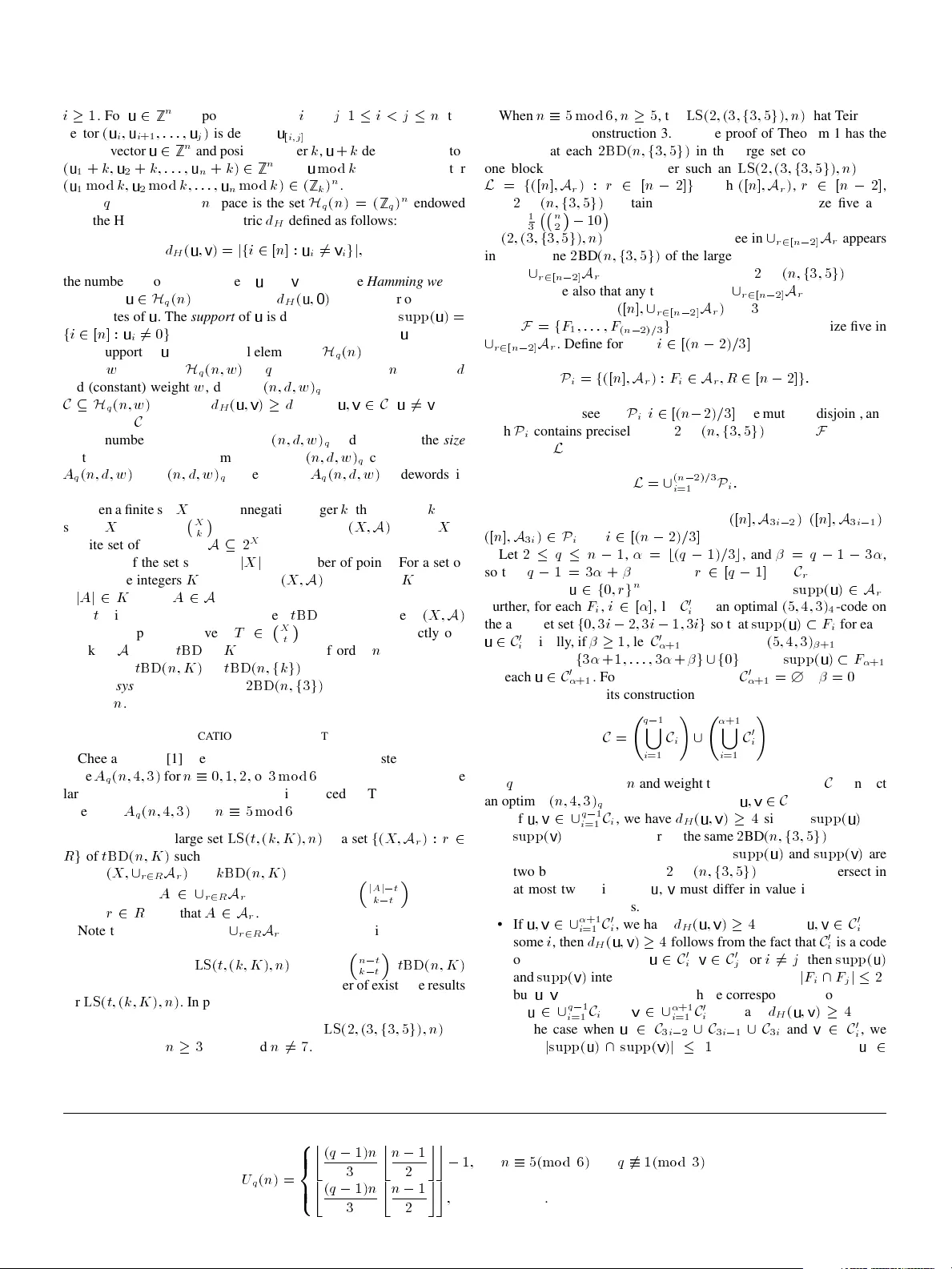
IEEE TRANSA CTIONS ON INFORMA TION THEOR Y, V OL. 54, NO. 3, MARCH 2008 1291 for coding. For example, for any integer i 0 and for any real number t> 0 , there exists a network such that C un i f o r m 0 = C uniform 1 = 111 = C uniform i C a v era ge 0 = C a v erage 1 = 11 1 = C a v erage i C uniform i +1 0C uniform i >t C a v erage i +1 0C a v erage i >t : In Theorem III.2, the existence of networks that achieve prescribed rational-valued node-limited capacity functions was established. It is known in general that not all networks necessarily achie ve their capac- ities [5]. It is presently unkno wn, ho we ver , whether a network coding capacity could be irrational. 5 Thus, we are not presently able to ex- tend Theorem III.2 to real-v alued functions. Nev ertheless, Theorem III.2 does immediately imply the following asymptotic achiev ability result for real-valued functions. Cor ollary III.5: Every monotonically nondecreasing, eventually constant function f : [f 0 g! + is the limit of the node-limited uniform and average capacity function of some sequence of directed acyclic networks. R EFERENCES [1] R. Ahlswede, N. Cai, S.-Y. R. Li, and R. W. Y eung, “Network infor- mation flow , ” IEEE T rans. Inf. Theory , vol. 46, no. 4, pp. 1204–1216, Jul. 2000. [2] K. Bhattad, N. Ratnakar, R. Koetter, and K. R. Narayanan, “Minimal network coding for multicast, ” in Proc. 2005 IEEE Int. Symp. Informa- tion Theory (ISIT) , Adelaide, Australia, Sep. 2005. [3] J. Cannons, R. Dougherty , C. Freiling, and K. Zeger, “Network routing capacity , ” IEEE T rans. Inf. Theory , vol. 52, no. 3, pp. 777–788, Mar. 2006. [4] R. Dougherty , C. Freiling, and K. Zeger, “Insuf ficiency of linear coding in network information flow , ” IEEE T rans. Inf. Theory , vol. 51, no. 8, pp. 2745–2759, Aug. 2005. [5] R. Dougherty , C. Freiling, and K. Zeger, “Unachie vability of net- work coding capacity , ” IEEE T rans. Inf. Theory , vol. 52, no. 6, pp. 2365–2372, Jun. 2006, Joint issue with IEEE/ACM T rans. Netw . [6] C. Fragouli and E. Soljanin, “Information flow decomposition for net- work coding, ” IEEE Tr ans. Inf. Theory , vol. 52, no. 3, pp. 829–848, Mar. 2006. [7] M. Langberg, A. Sprintson, and J. Bruck, “The encoding complexity of network coding, ” IEEE T rans. Inf. Theory , vol. 52, no. 6, pp. 2386–2397, Jun. 2006, Joint issue with IEEE/ACM T rans. Netw . [8] Z. Li and B. Li, “Network coding: The case of multiple unicast ses- sions, ” in Pr oc. 42nd Ann. Allerton Conf. Communication, Control, and Computing , Monticello, IL, Oct. 2004. [9] S.-Y. R. Li, R. W. Y eung, and N. Cai, “Linear network coding, ” IEEE T rans. Inf. Theory , vol. 49, no. 2, pp. 371–381, Feb. 2003. [10] P. Sanders, S. Egner, and L. T olhuizen, “Polynomial time algorithms for network information flo w , ” in Pr oc. 15th Ann. ACM Symp. P aral- lelism in Algorithms and Arc hitectur es (SP AA) , San Diego, CA, Jun. 2003, pp. 286–294. [11] A. T avory , M. Feder, and D. Ron, “Bounds on linear codes for network multicast, ” Pr oc. Electr onic Colloquium on Computational Complexity (ECCC) , pp. 1–28, 2003. [12] Y. W u, K. Jain, and S.-Y. K ung, “A unification of network coding and tree packing (routing) theorems, ” IEEE Tr ans. Inf. Theory , vol. 52, no. 6, pp. 2398–2409, Jun. 2006, Joint issue with IEEE/ACM T rans. Netw . [13] R. W. Y eung , A F irst Course in Information Theory . Amsterdam, The Netherlands: Kluwer , 2002. 5 It would be interesting to understand whether, for example, a node-limited capacity function of a network could take on some rational and some irrational values, and perhaps achie ve some v alues and not achiev e other values. W e leave this as an open question. The Sizes of Optimal -Ary Codes of W eight Three and Distance Four: A Complete Solution Y eo w Meng Chee, Son Hoang Dau, Alan C. H. Ling, and San Ling Abstract— This correspondence introduces two new constructive tech- niques to complete the determination of the sizes of optimal q -ary codes of constant weight three and distance four. Index T erms— Constant-weight codes, large sets with holes, sequences. I. I NTR ODUCTION The determination of A q ( n ; d; w ) , the size of an optimal q -ary code of length n , distance d , and constant weight w (all terms are defined in the next section), has been the subject of study [1]–[25] due to several important applications requiring nonbinary alphabets, such as coding for bandwidth-efficient channels and design of oligonucleotide se- quences for DNA computing. Recently , Chee and Ling [1] introduced an ef fectiv e technique for constructing optimal constant-weight q -ary codes, which allowed the determination of A 3 ( n; 4 ; 3) for all n .F o r q> 3 , the v alue of A q ( n; 4 ; 3) has also been determined, except when n q , n 4 or 5( mo d 6 ) [1, Th. 13]. Define the equation sho wn at the bottom of the next page. The upper bound A q ( n; 4 ; 3) min U q ( n ) ; n 3 (1) has been established in [1 Th. 12]. In each case where the value of A q ( n; 4 ; 3) has been determined, it is found to meet this upper bound [1, Ths. 13 and 14]. In this correspondence, we determine A q ( n; 4 ; 3) completely , showing that it meets the upper bound (1) in all cases. First, we e xtend the technique of [1] to work with large sets with holes. This allo ws the determination of A q ( n; 4 ; 3) when n 4m o d 6 and q n , or when n 5m o d 6 and q n 0 1 . A novel method based on sequences is then used to determine A q ( n; 4 ; 3) for the remaining cases when n = q . II. D EFINITIONS AND N O T A TIONS The set of integers f 1 ; .. . ;n g is denoted by [ n ] .F o r q a positive integer , we denote the ring =q by q . The set of all nonzero elements of q is denoted 3 q . The i th coordinate of a vector is denoted by i , Manuscript receiv ed September 10, 2007; revised November 11, 2007. The research of Y. M. Chee and S. Ling was supported in part by the Singapore Min- istry of Education under Research Grant T206B2204. This work of A. C. H. Ling was done while he was on sabbatical leav e at the Di vision of Mathematical Sci- ences, School of Physical and Mathematical Sciences, Nanyang T echnological Univ ersity , Singapore 637616, Singapore. Y. M. Chee is with the Interactive Digital Media R&D Program Office, Media Dev elopment Authority , Singapore 179369, Singapore. He is also with the Di- vision of Mathematical Sciences, School of Physical and Mathematical Sci- ences, Nanyang T echnological Univ ersity , Singapore 637616, Singapore, and the Department of Computer Science, School of Computing, National Univer - sity of Singapore, Singapore 117590, Singapore (e-mail: ymchee@alumni.uw a- terloo.ca). S. H. Dau and S. Ling are with the Di vision of Mathematical Sciences, School of Physical and Mathematical Sciences, Nan yang T echnological Univ ersity , Singapore 637616, Singapore (e-mail: lingsan@ntu.edu.sg). A. C. H. Ling is with the Department of Computer Science, University of V ermont, Burlington, VT 05405 USA (e-mail: aling@emba.uvm.edu). Communicated by L. M. G. M. T olhuizen, Associate Editor for Coding Theory. Digital Object Identifier 10.1109/TIT.2007.915885 0018-9448/$25.00 © 2008 IEEE 1292 IEEE TRANSA CTIONS ON INFORMA TION THEOR Y , VOL. 54, NO. 3, MARCH 2008 i 1 .F o r 2 n and positive integers i and j , 1 is : i 6 =0 g : Move ro w t of j to the position just before ro w s: Repeat : The resulting matrix is denoted 0 j . W e sho w belo w that the reorder operation puts the supports of the ro ws of j into lexicographic order. Lemma 2: If U; V 2 [ n ] k , U V , and x 2 U \ V , then U nf x g V nf x g . Pr oof: Since x 2 U \ V , x 6 = 2 U 1 V . Hence, min f i : i 2 ( U n f x g )1( V nf x g ) g = min f i : i 2 U 1 V g2 U , implying U nf x g V nf x g . Lemma 3: The supports of the rows of 0 j are in lexicographic order. Pr oof: Let and be rows i 1 and i 2 of 0 j , i 1
Original Paper
Loading high-quality paper...
Comments & Academic Discussion
Loading comments...
Leave a Comment