Lighweight Target Tracking Using Passive Traces in Sensor Networks
We study the important problem of tracking moving targets in wireless sensor networks. We try to overcome the limitations of standard state of the art tracking methods based on continuous location tracking, i.e. the high energy dissipation and commun…
Authors: Andrei Marculescu, Sotiris Nikoletseas, Olivier Powell
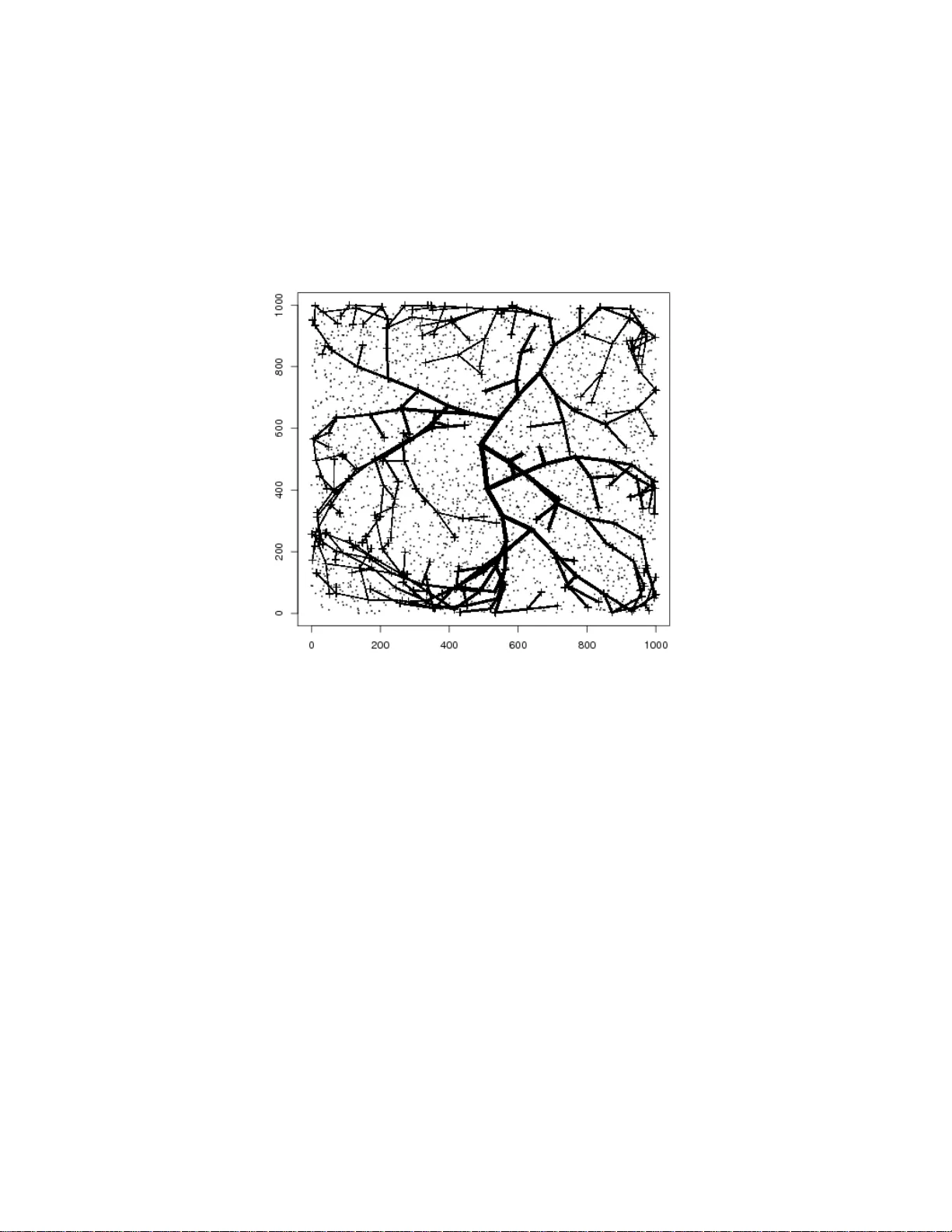
Ligh w eigh t T arget T rac king Using P assiv e T races in Sensor Net w orks ∗ Andrei Marculescu † Sotir is Nikoletseas ‡ Olivi er P ow ell † Jose Ro lim † August 2 0, 202 1 Abstract W e s tudy the imp ortan t problem of trac king moving targets in wireless sensor net- w orks. W e try to o v ercome the limitations of standard state of the art trac king metho ds based on cont inuous location trac king, i.e. the high energy dissipation and co mmunica- tion o v erhead imp osed b y the activ e participation of sensors in th e trac king process and the lo w scalabilit y , esp eciall y in sparse net wo rks. In stead, our appr oac h u ses sensors in a passiv e w a y: th ey just reco rd and jud iciously sp read information ab out observ ed target presence in their v icinity; th is information is then used by t he (p o we rf u l) trac king agen t to lo cate th e target b y just f ollo wing the traces left at sensors. Ou r proto col is greedy , local, distributed, energy efficien t and v ery successful, in th e sense that (as sho wn b y extensiv e sim ulations) the tracking agen t manages to quic kly lo cate and follo w the target; also, we ac hiev e go o d trade-offs b et w een the energy dissipation and latency . 1 In tro duction Recen t adv ances in micro-electromec hanical syste ms (MEMS) and wireless communic ations hav e enabled the dev elopmen t of v ery small, smart, low cost sensing devices ([8, 1]) with sensing, data-pro cess ing a nd wireles s transmission capabilities. They are mean t to b e p erv asiv ely de- plo y ed into forming ad-ho c wireless sensor netw orks that collect information from the a m bien t en vironmen t and mak e it a v ailable to t he user. Some applications imply deploym en t in remote or hostile env ironmen ts (battle- field, t sunami, ear t h- quak e, isolated wild-life island, space explo- ration) to assist in tasks such as target track ing, enem y in tr usion detection, forest fire detection, en vironmen tal or biolo gical monitoring . Some other applications imply deplo ymen t indo ors or in urban or con trolled env ironmen ts. Examples of suc h applications are industrial sup ervising, indo or micro-climate monitoring (e.g. to reduce heating cost by detecting p o or building thermal insulation), smart-home applications, patien t-do ctor health monitoring or blind a nd impaired ∗ This work was partially suppo r ted by the IST/FET/ Global Computing Pro gramme of the E urop ean Union, under contact num b er IST-2 005-1 5964 (AEOLUS). † CUI, Univ er s it y of Genev a, Switzerland. E-mails: { Andr ei.Mar culescu, O livier .Powel l, Jose.R olim } @cui.unige.ch ‡ Computer T echnology Institute and Department of Co mputer E ngineering & Infor matics, Universit y of Patras, Greece. E-mail: nikole@ cti.gr . 1 assisting. Sensor net works imply distributed and collab orativ e dat a -pro cessing, because of the small utilit y of each sensor individually and the sev ere resource constraints, mainly with resp ect to energy but also memory and computation capabilities. 1.1 T rac king Problems and Our Approac h W e wish to solv e the problem of trac king ob jects moving in a domain o ve r a certain p erio d of time i.e. w e w an t the wireless sensor net w ork to b e a ble to detect the p o sition of a ny mo ving ob ject in t he domain at a n y time in the monitoring p erio d. L o cation trac king is t he curren t standard approac h to the tracking problem in sensor net w orks. Lo cation tra c king includes sev eral phases : target detection, distance estimation, p osition ev aluation and tra jectory estimation. The target detection is p erformed individually by sen sor nodes in the netw ork and do es not need an y sync hronizatio n. The distance estimation uses either an empiric la w (e.g. based on signal atten uation estimations) translating the sensing in tensit y in to a real v alued distance, or uses a sp ecial har dware device p erforming this translatio n. The p osition estimation phase is typically addressed with t r ila teration. A t least three no des are p erio dically chos en among the sensors lo cated next to the target. Eac h of these three no des giv es an estimate of its distance t o the target. Finally , another no de (that can b e one of the t hree) p erforms trilateration based on the distance estimates a nd computes the p osition estimate. T he p osition ev a lua tion is t hen sen t to a base-station in order to estimate the tra jectory of the mo ving ob ject. While this metho d can giv e ve ry precise r esults when the netw ork is dense enough (at least 3 no des hav e to b e lo cated next to the target as it mov es), it has sev eral dra wbac ks. F irst, this tec hnique do es not scale to the case of trac king m ultiple ob jects, for instance a gr o up of ob jects mo ving in formatio n, or sev eral individual ob jects. Proto cols designed to compute in a precise manner the p osition of an individual ta rget are not able to cop e with the question “detect an y of the mem b ers of a g iv en gr o up”. Second, the proto col o v erhead is high in terms of communication. Each time a p osition is estimated, three no des are c hosen. Then, among these three no des another no de is c hosen to p erform the p osition ev aluation. This is done through exc hange of proto col messages a nd can b e quite energy consuming. While precision ma y b e needed in some applications, o ther applications need only rough informa t io n on the lo cation area. F or instance, if the target is represen ted b y a group of sev eral ob jects, w e ma y w an t to detect j ust an arbitrar y lo cation within this area. Finally , this tec hnique assumes the existence of a base station with p ow erful computational resources, g enerally supp osed to b e fixed. Although this is sometimes realistic, m any of the trac king applications do not resp ect this h yp othesis. F or instance , soldiers trac king an enem y w ould b e movin g to f o llo w it. Another example is habitat monitoring: a group o f biologists trac king an a n telop e herd also needs to mo v e t ow ar ds the detected herd. I n fact, man y natural trac king applications actually use a mobile sink. In order to cop e with these problems w e broa den the h yp othesis defining the tra cking prob- lem: a) The target can b e an individual ob ject (e.g. a patien t in a hospital) as w ell a s a large group of sev eral ob jects (e.g. an animal herd). b) The t r a c king precision b ecomes a para meter of the problem. W e are primarily concerning ourselv es with fuzzy trac king applicable to la r ge group o f ob jects, where the degree of precision needs not b e high. But our techniq ues can use an y sort of lo cation information att a c hed to sensors to enhance our solution’s qualit y (for instance, if in a hospital sensor no des a re aw are of their lo cation in terms of building wing and ro om n um b er, a nd w e can use this informatio n for the tra c king results). c ) The sink can b e 2 either fixed or mobile and there can be more than one sin k (for instance, tro op ers or a group of biologists). As the fixed sink case is rather w ell studied, we are concerning ourselv es mainly with the mobile sink problem, whic h is useful in applications but also more c hallenging to cop e with. 1.2 Our Con tribution The main idea of our approac h is to av oid actively in v olving sensors in the trac king pro cess. Instead, w e exploit “ t r aces” o f target presence that are an yw ay left around its moving tra jectory . The role of sensors in our proto col is rather passiv e: they just lo cally decrease tra ce in tensities with time (to tak e in t o accoun t the fact that the ta rget was detected but then mo v ed aw ay) and also propagate them appropriately , in order to spread then in a balanced w ay in the net w ork at a lo w energy cost. The activ e role in our track ing approac h is p erformed by t he tra c king agen t, that greedily follows trace gradien ts to lo cate the mo ving target. As sho wn b y the sim ulation findings, o ur approac h ac hiev es significan t improv emen ts ov er w ell kn own metho ds in the state of the ar t . First, our proto col is success ful ( i.e. the ta rget is indeed lo cated), ev en in the case o f m ultiple targets and mobile sinks. Also, our proto col is v ery efficien t, since it reduces energy a lot (b y a v oiding a ctiv e sensor participation) while k eeping latency low (b y spreading trace in tensities in a w ay that “co v ers” the net w ork in a balanced w a y). 1.3 Related W ork and Comparison A standar d ce ntralized approac h to trac king ([3]), is “sensor sp ecific”, in the sense that it uses some smart p ow erful sensors that hav e hig h pro cessing abilities. In particular, this alg o rithm assumes that eac h no de is aw are of its absolute lo cation (e.g. via a GPS) or of a relativ e lo cation. The sensors m ust b e capable of estimating the distance of the target from the sensor readings. The pro cess of tracking a target has three distinct steps: detecting the presence of the ta rget, determining the direction o f motion o f the targ et and alerting appropriate no des in the netw ork. Th us, in their approa c h a v ery large part of the net w ork is a ctiv ely inv olve d in the trackin g pro cess, a fact that may lead to increased energy dissipation. Also, in contrast to our metho d that can sim ultaneously handle m ultiple targets, their proto col can only trac k one ta rget in the net w ork at an y time. O verall, their metho d has sev eral stren gths (reasonable estimation error , precise lo cation of the tr a c k ed source, real time ta r g et track ing, but there ar e w eaknesses as well (inten siv e compu tatio ns, intens iv e radio transmissions). Our metho d is entire ly differen t to the net work arc hitecture design approac h for centralize d placemen t/ distributed trac king (see e.g. the b o o k [6] f or a nice o v erview). According to that approac h, optimal (o r as efficien t as p ossible) sensor deplo ymen t strat egies are prop osed to en- sure maxim um sensing co v erage with minimal nu mber o f sens ors, as w ell as p o w er conserv atio n in sensor net w orks. In one of the cen tralized metho ds ([2]), that fo cuses on deplo ymen t opti- mization, a grid manner discretization o f the space is p erformed. Their metho d tries to find the gridp oint closest to the target, instead of finding the exact coor dinates of the target. In suc h a setting, an optimized placemen t of sen sors will guaran tee tha t ev ery gridp oint in the area is co v ered b y a unique subset of sensors. Another net w ork design approach for track ing is provide d in [5], that tries to av oid an exp ensiv e massiv e deplo ymen t of sensors, taking adv an tag e of p ossible co v erage ov elaps ov er 3 space and time, by in tro ducing a nov el com binatoria l mo del (using set co v ers) that captures such o v erlaps. The authors then use this mo del to design and analyze an efficien t appro ximate metho d for sensor placemen t and op eration, that with high proba bilit y and in p o lynomial exp ected time ac hiev es a Θ(log n ) approximation ra t io to the optimal solution. Clearly , in con trast to our direct approach to t r a c king, suc h netw ork design solutions can pro vide full trac king only when combined with collab orativ e pro cessing metho ds, to pro cess and syn thesize individual target lo cation estimations. As opp osed to centralized pro cessing, in a distributed model sensor net works distribute the computation among sensor no des. Eac h sensor unit acquires lo cal, partial, and relat ively coarse information from its environme nt. The net w ork then collab orativ ely determines a fairly precise estimate based on its co ve rage and multiplicit y of sensing modalities. Sev eral suc h distributed approac hes ha v e b een prop osed. In [4], a cluster-based dis tributed tra cking sc heme is pro vided. The sensor netw ork is logically pa r t itioned into lo cal collab orat ive groups. Eac h group is resp onsible for pro viding information o n a target a nd t rac king it. Sensors that can join tly pr ovide the most accurate information on a targ et (in this case, those that are nearest to the target) form a group. As the ta rget mo v es, the lo cal regio n m ust mov e with it ; hence groups are dynamic with no des dropping out and o thers joining in. It is clear tha t time sync hronization is a ma jor prerequisite for this approac h to work. F urthermore, this alg orithm w orks w ell for merging m ultiple trac ks corresp onding to the same target. Ho w ev er, if t w o ta r gets come very close to eac h other, then the mec hanism described will b e unable to distinguish b et w een t hem. Another nice distributed approac h is the dynamic conv oy tree-based collab oration (DCTC) framew ork that has b een pro p osed in [9]. The con v oy tree includes sens or no des around the detected target, a nd the tree progressiv ely adapts itself to add more no des a nd prune some no des as the t a rget mo ve s. In particular, as the ta rget mo v es, some no des lying upstream of the mov ing path will drift farther a w ay from the target and will be pruned from the con v o y tree. On the other hand, some free no des lying on the pro jected moving path will so o n need to join the collab orativ e tr a c king. As the tree f urt her adapts itself according to the mov emen t of the target, the ro ot will b e to o far a w ay from the target, whic h introduces the need to relo cate a new ro ot and reconfigure the conv oy tree accordingly . If the mov ing target’s trail is kno wn a priori and each no de has kno wledge ab out the global net w ork top o logy , it is p ossible for the trac king no des to agree o n an o ptimal con v oy tree structure; these are at the same time the main w eaknesses of the proto col, since in man y real scenarios suc h assumptions are unrealistic. Finally , a “mobile” agen t appro ac h is follo w ed in [7], i.e. a master ag en t is tra ve ling through the net w ork, a nd tw o sla v e agen ts are assigned the task to participate to the trilateration. As opp osed to our metho d, their approa c h is quite complicated, including sev eral sub-proto cols (e.g. election prot o cols, trilateratio n, fusion and deliv ery of trac king results, maintaining a trac king history). Although by using mobile agents, the sensing, computing and comm unication ov er- heads can b e greatly reduced, their approach is not scalable in randomly scattered netw orks and also for w ell connected irregula r net w orks, since a big amoun t of offline compu tatio n is needed Finally , t he base that receiv es the tracking results is assumed fixed (in a track ing a pplication this can b e a pro blem). The in terested reader is referred to [10 ], the nice b o o k b y F. Zhao and L. Guibas, that ev en presen ts the trac king problem as a “canonical” problem for wireless sensor net works . Also, sev eral trac king approach es are presen ted in [6 ]. 4 A ttr ibutes P ossible v alues TYPE INITIAL or SPREAD . START TIME Time at whic h the trace was initialized. START INTENSIT Y Initial in tensit y of the tra ce. INTENSITY A p ositiv e real num b er s maller than 300. PATH A list of 1 to 3 paren t traces. MAX INTENSITY 300 TARGET ID Used f or the trac king multiple targets. T a ble 1: A ttributes of tr aces 2 Our T racing Handling T rac king Proto col (THTP) 2.1 Proto col Ov erview The intuitiv e idea b ehind o ur track ing proto col is inspired b y a natural mo del: the w ay a tiger trac ks an an t elop e in a Sa v annah. An telop e traces are initially stored into the en vironmen t as the an telop e mo ve s. The intens ity of these initial traces decreases with time. These traces a r e partially spread through the Sa v annah (e.g. due to the wind action) and the in tensit y of a spread trace decreases with the distance from the initial trace. Thus , the only role of the en vironmen t is to store and to rather passiv ely spread tr a ces. It represen ts a passiv e actor of the tra c king pro cess. The activ e actor of the trac king pro cess is the tiger, whic h sense s the traces stored in to the environme nt and tries to trac k t he antelope b y followin g the trace gradien t. The correspondence to our problem is the following: the sensor netw ork is the en vironmen t, the tiger is a tracking agent and the an telop e is the tracking ob ject. Using this natural mo del has the adv antage that as long as no tracking demand is issued, no (or few resources) ar e used into the netw ork, as opp osed to the lo cation t r a c king algorithms where the net work is con tinuously trac king the ob ject in a proa ctiv e manner, hence consuming v aluable energy . A passiv e net w ork is the key to o ur energy o ptimisation. On the other hand, when the trac king is (r eactiv ely) in progress, o nly lo cal computations and very ligh t computation resources are needed in o rder to follo w the t race gradien t. When the trac king is needed, a trac king agen t starts to walk through the net w ork. This agen t follo ws the trace gradient in a greedy manner. The agen t can be either a pure soft w are agen t originated by a mobile sink , or a human pro vided with a sp ecial device commun icating with the net w ork, o r ev en a mobile rob ot in teracting directly with the net w ork. The case of a softw are agent is someho w more complicated, b ecause it has to send the results bac k to the originator of the agen t, t ypically a mobile sink. That is the reason wh y w e fo cus on the case of a softw are agent in the presen t work. 2.2 Detailed Proto col Description 2.2.1 T race storage, spreading and atten uation. Eac h trace can b e represen ted b y the follo wing record: When a sensor no de detects a ta r get, it stores a trace with the giv en TARG ET ID ( o r gro up ID or b oth, depending on t he target b eing an individual o b ject or a group), maxim um in tensit y (in our sim ulations, MAX INTENSITY = 300) and o f t yp e INITIAL . If a trace of the corresponding 5 ID already exists, its in tensity is set to MAX INTENSITY . That means that a sens or con ta ining a trace with MAX INTENSITY is a ssumed by the proto col to b e next to the ta rget. After ha ving stored the trace, it spreads it according to the spreading strategy . W e prop ose a spreading stra t egy whic h aims at co v ering a large area of the net w ork, with a small amoun t o f energy cons umption. W e try t o build a tree of degree 2 across the net work, but in a distributed manner. The no de that detects the target sends a spreading message to t w o of its neighbours. If the receiving no de has no trace of ID sp ecified in the message it stores lo cally the trace a nd forwards the message to tw o of its neigh b o urs, and so on. These tw o neigh b ours are sele cted according to a subtle heuristic that w as designed to span the net w ork efficien tly . Supp ose the no de n 0 needs to spread its trace to t w o neigh b ours n 1 and n 2 . The first neigh b our, n 1 , is selected randomly amo ng the subset V r ep ( n 0 ) of neigh b ours of n 0 farther from a repulsion p oin t than n 0 . While the second no de is also selecte d in V r ep ( n 0 ), it is not selected rando mly but deterministically as b eing the further a w ay fro m the p o in t. A t the end of the pro cess, w e obtain a tree of degree t w o spanning the net w ork. This pro cess is illustrated in figure 2.2.1, where a trace is b eing pro pagated from the cen ter of a net work of 2500 no des randomly and uniformly distributed in a 1000 × 1000 square and the comm unication radius of the no des is 100 meters. The rationale b ehind this heuristic is that the random c hoice for n 1 will help ensuring that the tree do es not leav e an y unco v ered holes inside the g lo bal co v ered region, while the idea of c ho osing n 2 according to the p oint heuristic is to ensure that the tree indeed spans through the whole net w ork. Of course this implies choosing wisely the repulsion p oin t. Also, ev en though some ov erlapping of t he branc hes of the tree is p ossible b ecause of the random nat ure o f the tr ee construction, this unpleasant p ossibilit y is r educed b y in tro ducing an inhibition mec hanism that p ermits t o limit the propagation of traces that w ould induce a branc h o v erlap. As a conseque nce, only a small amoun t of messages is required to span the net w ork since the tree branc hes do not ov erlap. The repulsion p oint In order t o insure that the tree spreads the whole net w ork, traces car r y with them a PATH v ariable. When a tra ce is of type INITIAL , the path is empty . When a tra ce is of type SPREAD the path is not empt y . In fact, only the last tw o hops of a path need to be k ept in the PATH v a riable. When a no de n 0 tries to spread a trace, it sets it’s repulsion point to be its grand-paren t in the tree ro oted whe re the INITIAL trace was created. If the PATH is not o f size tw o but of size 1, it sets the repulsion p o in t t o b e its paren t in the tree. Finally , when a trace is of ty p e INITIAL , t he repulsion p oint is the no de n 0 itself. As a consequence , the no de n 0 tends to c ho o se n 2 in a w a y t ha t preserv es some kind of inertia with resp ect to the t w o previous hops: the trace tends to go far aw a y f rom where it comes. This is balanced b y the fact that the other no de, n 1 , is c hosen randomly . The Inhibition Mec hanism T he INITIAL INTENSITY if a trace of t yp e INITIAL is initia lised to MAX INTENSITY . F urthermore, we ass ume that eac h no de has a clo c k, a nd that whenev er a trace is b eing added to a no de, the INITIAL TIME at whic h the trace has b een star t ed is recorded. Please note that w e do not require t he clo ck s of different no des to b e sync hronized. A t an y giv en time t , the INTENSITY of a trace is de fined to b e max { 0 , INITIAL INTENSITY − ( t − INITIAL TIME ) } . When a no de n “spreads a trace” T to another node n ′ , what actually happ ens is that a new trace T ′ is initialised on the receivin g no de n ′ . The PATH of T ′ is up dated b y app ending n to it. If the spreading o ccurs at time t , the INITIAL TIME of T ′ is set to t , while the MAX INTENSITY of T ′ is set to b e the INTENSIT Y of T at time t minus a “spreading p enalt y”. In our exp eriment, 6 the p enalt y w as set to b e 1. The purpose of the spreading p enalty is to ensure that a tra cking agen t follow ing a gradien t of ev er more inte nse traces will actually end up at a t r a ce of ty p e INITIAL . The spreading inhibition mec ha nism is the following. F irst of all, eviden tly , a trace is only spread if its intens ity is greater than 0. Second, if a no de n is ab out to spread a trace of in tensit y INTENSITY but that there is at least one mem b er of V r ep ( n ), the spreading is inhibited. This is how branc h o v erlapping in the t ree is reduced. Figure 1: The efficien t spanning of a trace starting at the cen ter. F urthermore, eac h no de contin uously executes a (v ery simple and lo cal) in t ensity attenuation pro cess. W e used for our experimen ts a linear atten uation: at eac h step, the trace in tensit y is decremen ted b y o ne. If the tra ce reaches the minim um v alue, it is deleted. The attenu atio n frequency (time b etw een tw o consecutiv e steps of this algorithm) has to b e low er than t he time needed by the targ et to co ver the distance of one hop. If this condition is fulfilled, the assumption that a node with maxim um trace in tensit y is on trac k alwa ys holds. W e note t ha t other attenuation functions (e.g. faster) can b e used in our proto col to b etter fit differen t scenarios and ac hiev e different trade- o ffs. 2.2.2 T racking process. W e designed an agen t -orien ted t rac king. When the sink (e.g. a biologist) wishes to disco v er the target (e.g. an antelope), it initiates a trac king agent. The tracking agen t follo ws the trace gradien t in a greedy manner. This simple pro cess only r equires fo r eac h no de to b e a ware of the in tensities of its neighbours. The decision of the agen t t o go to a no de or to ano t her is guided b y a purely distributed criterion. During the initialisation phase, while the agen t finds itself into 7 a no de without any trace, it w alks randomly to an y of the neigh b o ur s. Although the pro cess is simple a nd distributed, there are t w o p oints w e should b e aw are of. First of all, the trac king applications g enerally need a rep orting pro t o col, with reasonable resp onse delay (la tency). The random walk fr o m the initialisation stage can b e quite inefficien t. That is wh y a go o d co v erage of the spreading tec hnique is vital for the p erforma nce of the algorithm. The b etter is the trace cov erage the higher is the probabilit y of a ra ndom w alk to cross a trace path and then follo w it. On the other hand we can use a biased random w alk in order to decrease the initialisation time. T he sim plest is the following. No des are recording a sp ecial trace for the trac king agen t(s). There is no spreading for these track s, they only atten uate and v anish with time. As opp osed to the an telop e track s, these trac ks are inhibitor y for ag en ts. This can b e view ed as a pa r t ia l self-a v oiding random w alk. The second problem comes from the hill clim bing tec hnique used. As an y o ther greedy tec hnique, o ur trace follo wing is sub ject to lo cal minim um traps. T o fix this problem, a sp ecial t yp e o f inhibitory tra ce is used. When the trac king agent comes to a no de with t he largest lo cal in tensit y , it has to mov e back . Before mov ing bac k, the agen t marks this no de as b eing bad. Because as long as the trace gra dien t do esn’t c hange suc h a maxim um is a cul-de-sac, and t he no de is then a v oided by this agen t and an y other agen ts. Care m ust b e tak en if sev eral types of targets a r e trac k ed. In this case, a distinct “ bad no de” trace should b e used f or eac h t yp e of target. In o r der to optimize the tra cking pro cess, sev eral agen ts can b e sent through the net work. Let us also note that in the classical case of a fixed base statio n and con tin uous monitoring of the target, the trac king agen t can b e initiated by the first no de ha ving detecte d the target. Sending bac k the results is an easy pro cess in this case. If t r a jectory estimation is needed, three agen ts are initia ted instead of one. 2.2.3 Sending bac k the results This part of the proto col b o ils dow n to routing a message to a mobile destination (e.g. biologist). The routing no des are not a w are of the curren t p o sition o f the destination. W e call this t yp e of routing p erv asiv e routing, b ecause its results hav e t o b e av a ilable “ev erywhere in the netw ork”. W e suggest tw o p ossible strategies for solving this problem. The first strategy is to consider the p erv asiv e routing as an inv erted track ing problem. As our proto col scales w ell for sev eral targets, w e can view the trac king data destination a s such an ob ject. The return message tra c ks its destination exactly in the same manner a t r ac king agen t w ould trac k its target. This tec hnique can b e v ery efficien t when the movin g pattern of the destination is ve ry dynamic ( i.e. the destination co v ers a la rge area). The second strategy is a h ybrid b et w een the g eog raphic routing and the tra c king problem. The trac king agen t kno ws its initia l p osition, so when it is sending a return message, it is routed with geogr a phic routing to the initial po sition, and from the initial po sition the des tinatio n is trac k ed. This tec hnique can b e v ery efficien t when the mov ing pattern of the destination is almost stationary (i.e. the destination cov er a v ery small area). 3 Exp e rimen ts F or sim ulation purp o ses, w e tak e the following parameters. The netw ork is comp osed of 300 no des. The comm unicatio n radius is 10 0 meters , the detection radius is 25 meters, the target 8 seman tic sym b ol default v alue n um b er of no des n 300 sensors comm unication radius d trx 100 meters sensing radius d dtx 25 meters target sp eed detection r adius 6 km/h message pro pagation f requency f r eq 1 MSG/second net w ork densit y dens 10 / (100 2 · 3 . 14)* Mag/second T a ble 2: Sim ulation parameters sp eed is 6 km/h. The message transmission frequency is of 1 message p er second ( this determines the sp eed at whic h traces can spread through the netw ork, as w ell as the delay b et w een tw o hops of the trac king a gen t). The dens ity of t he net w ork is the n umber of sensors per square meter. Since the n um b er of sensors is fixed (300), the nodes are spread in a square region w ith side l suc h that 300 /l 2 = density . While the targ et mov es inside the net work, no des detect it. A t any giv en time, the last whic h has detected the targ et is the one with the highest in tensit y t r a ce. Call this node n best . A t the same time, the trac k er agent v isits no des. At a ny g iven time, w e can consider the no de with highest in tensity it has visited so far. Call this no de b bestE s timation . In o ur sim ulations, w e measure the distance b etw een n best and n bestE s timation . W e consider that the trac k er’s b est estimation o f the target’s lo calization is correct, i.e. the target is lo calized by the trac k er, whenev er n best = n bestE s timation . F or sim ulation purp oses, w e let some parameters c hange in the following w a y . The results o f our simulations when sim ulating an execution time of 20 min utes are presen ted below. 3.1 V arying densit y The default v alue v a lue fo r the densit y is 10 / (100 2 · 3 . 14). In the first exp erimen t set, w e test the algorithm with the follow ing densities: 7 . 5 / (10 0 2 · 3 . 14 ), 10 / (100 2 · 3 . 14 ), 20 / (100 2 · 3 . 14 ) and 40 / (100 2 · 3 . 14), Whic h means that the exp ected n um b er o f neighbours in the comm unication graph is a b out 7 . 5 , 10, 2 0 and 40 resp ectiv ely , since w e use the dis c graph mo del f o r our sim ulations (c.f. section 4), whereas eac h p oint of the netw ork can b e roughly expected to be sensing cov ered b y 7 . 5(25 / 100) 2 = 0 . 46875 to 4 0(25 / 100) 2 = 2 . 5 se nsor no des. (I.e. w e c ho ose densit y parameters which alwa ys guara ntee that the net w ork is connected with high probability , ho w ev er the sensing co v erage go es from b eing partial to dense). The results are sho wn on figure 3.1. In figure 2(a), w e see that the track er frequen tly lo calizes the target (eac h time the distance is 0), whateve r the densit y tested except for the lo w er densit y . In figure 2( b) , w e see that the total n um b er of messages p er no de is v ery r easonable for all densities. It is also in ter sting to no t ice that the n um b er of spreading me ssages seems to b e correlated with densit y . The correlatio n is not extremely strong (in reticular ab ov e a p o ssible threshold densit y), b ecause other random factors are quite imp ortant to o (lik e t he motio n pa tern of the target). Ho w ev er, w e do observ e that the n umber of messages diminish es with the densit y . This is due to the wa y the heuristic spanning tree is constructed and is a desirable feature (sp ecifically the w a y one of the no des alw a ys tries to go the further p o ssible from the repulsion p oin t, c.f. section 2.2.1). 9 (a) Distance (b) Mess ages Figure 2: V arying densities 3.2 V arying Sp eed The default v alue v a lue fo r the target speed is 6 km/h. In the second exp erimen t set, w e test the algorithm with the fo llo wing sp eeds: 5, 15, 2 5, 35 km/h. The results are sho wn o n figure 3.2. Again, we notice that for all the tested t a rget sp eeds, the target is often lo calised b y t he trac k er. This is quite nice, since it could hav e b een f ear ed that for the highest target sp eeds the trac k er w ould nev er ha v e lo calized the target. Also, the n um b er of messages is k ept lo w. When the target’s sp eed increases , more detection o ccurs and thus more traces need to b e spread, whic h explains the increased n um b er of messages with increased sp eed from fig ure 3(b) . 3.3 V arying Sensing Radius The default v alue v alue for the sensing radius is 25 m. In the third experimen t set, w e test the algorithm with the following sens ing radii: 10, 40, 7 0 , 100. The results are sho wn on figure 3.3. W e observ e the same kind of fav orable behavior. The t a rget is b eing exactly lo calised prett y often, f o r all sensing radii. F o r increasing sensing radius t here a re more detections by the sensors and thus more messages are b eing generated, but in eve ry case the n um b er of messages is k ept v ery reasonable. 3.4 V arying Message F requency The default v alue v alue for the message f r equency is 1 second, i.e. the trac king agent mov es ev ery second and traces are spread ev ery second. In t he third exp erimen t set, w e test the algorithm with the follo wing message propagation frequ encies: 1, 3, 5, 10, 20. The results are sho wn on figure 3.4. 10 (a) Distance (b) Mess ages Figure 3: V arying sp eed The most imp o rtan t observ atio n is that, not surprisingly , is that for long propagation dela ys (e.g. when a message is only sen t ev ery 20 seconds), it is more difficult to lo calise t he target. This is so b ecause with increasing message propagation delay , the tracking agen t b ecomes slo w er and is thus less efficien t at trac king the target. Still, except fo r the longest propagation delays , the target is b eing lo calised regularly . A v ery nice result is t ha t the nu mber of messages sen t increases o nly slowly with reducing propagation dela ys. That is, if messages are sen t tw ice more often, the total n um b er of messages is fa r from doubling. This is due to t he inhibitio n mec ha nism: when messages a re sen t quic kly , the spreading of a trace is mo r e lik ely to b e inhibited by a previous tr a ce whic h has not ye t v anished with time. On the contrary , when propagation delay a re long, the spreading of a new tra ce is likely to span a larger p ortion of the net work, since previous trace in tensities will b e low due to the time-in tensit y dissipation implied b y our mo del. Therefore, precision can b e traded fo r increased traffic. 4 Sim u lation Implemen t ation D etails W e us ed a ruby implemen tatio n to mak e our sim ulations. In our sim ulations, we use the unit disc graph model for building a high lev el abstratcion of the comm unication graph asso ciated with the sensor netw ork. The target mov emen t is mo delled using the random w aypoint mo del. In this model, the target c ho oses a ra ndom p oin t and mo ves t o it at the chose n sp eed (whic h w as a fixed adjustable parameter in our sim ulations). As a consequenc e, the targ et mo ves along line segmen ts. If the target is mo ving fr om p oin t A to p oin t B , starting at time t 0 and arriving at time t 1 , we used the follow ing mo del for t a rget detection by the sensor no des: if a sensor no de n is at distance d ( AB , n ) of the segmen t AB a nd that d ( AB , n ) is smaller than than the sensing radius d dtx (c.f. table 3), then the no de detects the presence of the ta r g et at t ime t , where t = d ( x,A ) d ( A,B ) ( t 1 − t 0 ), where x is the only po in t of the segmen t AB suc h that d ( x, n ) = d ( AB , n ). 11 (a) Distance (b) Mess ages Figure 4: V arying sensing radius This means that an ev en t can o ccur at times ta king v alue in the real n umbers (or at least their floating p oint r epresen tation in the programming langua g e). W e feel that this fairly complicated sim ulation en vironmen t, when compared to an approac h that w ould discretize time in rounds, is m uc h more precise. A t the cost of complicating the implemen tat io n of the sim ulation platf orm and putting higher computation loads on its execution, we th us used a fairly detailed sim ulation en vironmen t. Although ev ents o ccur at real n umber v alued times, there is only a finite nu mber of even t during each t ime interv al. W e use this to store eve nts on a n sc heduled ev ents stac k ordered by time, and execute the even ts starting at the top of the stac k. F or example, when the target starts moving from p oin t A to B , w e first compute all detections b y sensor no des and put them on the sc heduled ev en ts stack , ordered b y time. W e then “execute” the first detection b y pic king the sc heduled ev en t at the top of the stac k. The top ev en t, ass uming it is an target detection b y a sensor no de, implies initia lizing a tr a ce on the detecting no de. Because this trace will ha v e to b e spread a few seconds la ter (dep ending on the sim ulation parameters), w e create a “spreading” ev ent and insert it on the sche duled ev en t stac k and sort the stac k according to t he sc heduled execution time of the ev en t (a full sorting is no t required, since the stac k is alwa ys k ept sorted, it in f act suffices to intro duce the new ev ent at the prop er place in the stac k). Summarizing, the executing flow o f the sim ulator is (1) Pic k the ev ent at the top of the stac k, (2) Execute the ev ent (e.g initialize a trace) (3) D etermine all future ev en ts implied b y the execution and insert them on the sc heduled ev en ts stack . Start at p oin t (1) ag ain. 5 Conclus ions W e ha v e proposed a lig ht weigh t target trac king pro t o col for wireless sensor netw orks. inspired b y an analogy with the w ay a lion trac ks do wn an a n telop e in the Sav annah by follo wing it’s smell. In our proto col, targets lea ve traces b ehind them. The intens ity of those traces (lik e the o dor of the an t elop e) decreases with time. The sensor netw ork propagat es those traces (lik e the 12 (a) Distance (b) Mess ages Figure 5: V arying Message F r equencies wind propa gates the smell of the an telop e) using an inno v ativ e propagating pro cess aiming at spanning the netw ork with a tree of degree 2 with non o v erlapping branc hes. The proto col w as ev aluate trough extensiv e sim ulations under represen tativ e net w ork op eration regimes. It w as sho wn that the proto col is successful at letting a tracking agent lo calize the targ et regularly , and that the message o v erhead w as ke pt low . Mor e precisely , it w as show n that the pro t o col scales pa rticularly w ell in terms of netw ork densit y since the lo calization pro cess is efficien t and the message ov erhead is low, for all tested densities . W e also sho w that the net w ork is capable of t rac king targets movin g at differen t speeds (from slow to quite fast). W e ha ve also tested differen t sensing co v erage regimes (from no t w ell co vere d to redundantly cov ered), and sho w ed that although traffic increase s with increased sensing range, target lo calisation is ac hiev ed for all regimes with reasonable message o v erhead. Fina lly , an imp o rtan t finding is that diminishing propagation delays (e.g. b y increasing the dut y cycle of sensor no des) do es not augment to o m uc h the message ov erhead b ecause of the tra ce spreading inhibition mec hanism. References [1] I. F. Akyildiz, W. Su, Y. Sank arasubramaniam, and E. Cayirc i. Wireles s s ensor netw orks: a surv ey . Computer Netw orks, 371 , 38:39 3 422, Marc h 2002. [2] K. Chakrabarty , S. S. Iy engar, H. Q i, and E. Cho, G rid cov erage for surv eillance a nd target lo cation in distributed sensor net w orks, IEEE T rans. Comput. 51(12) (2 0 02). [3] R. Gupta and S. R. Das, T rack ing mo ving targets in a smart sensor net w ork, Pro c VTC Symp., V o lume: 5, pp. 3035 - 3039, 20 03. 13 [4] J. Liu, J. Liu, J. Reich, P . Ch eung, and F. Z hao, Distributed group ma na gemen t for trac k initia tion and maintenance in tar g et lo calization applications, Pro c. In t. W orkshop on Information Pro cess ing in Sensor Net w orks (IPSN), 2003 . [5] S. Nik oletseas and P . Spirakis, Efficien t Sensor Net w ork Design for Con tin uous Monitoring of Moving Ob jects, CTI T ec hnical Rep ort, 2007. [6] Ra jeev Shorey , A. Ananda, Mun Cho on Chan, W ei Tsang Ooi, Mobile, Wireless, a nd Sensor Net w orks: T ec hnology , Applications, and F uture Directions, Wiley , 2006 . [7] Y u-Chee Tseng, Sheng-P o Kuo, Hung-W ei Lee and Chi-F u Huang, Lo cation T r ac king in a Wireless Sensor Netw ork b y Mobile Agents and Its Data F usion Strategies, in Pro c. of IPSN 2003,pp. 62 5 - 641, 2 003. [8] B.W arneke , M. La st, B. Lieb ow itz, and K.S.J. Pis ter, Smart dust: communicating with a cubic-millimeter computer, Computer, 36 9 34:445 1 , January 2001. [9] W. Zhang and G . Cao, Optimizing tree reconfiguratio n for mobile target track ing in sensor net w orks, Pro c. IEEE InfoCom, 2004. [10] F eng Zhao, Leonidas Guibas, Wireless Sensor Net w orks: An Information Pro cessin g Ap- proac h, Publisher: Morgan Kaufma nn, 2004 . 14
Original Paper
Loading high-quality paper...
Comments & Academic Discussion
Loading comments...
Leave a Comment