Ascending runs in dependent uniformly distributed random variables: Application to wireless networks
We analyze in this paper the longest increasing contiguous sequence or maximal ascending run of random variables with common uniform distribution but not independent. Their dependence is characterized by the fact that two successive random variables …
Authors: Nathalie Mitton (INRIA Futurs), Katy Paroux (LM-Besanc{c}on), Bruno Sericola (IRISA)
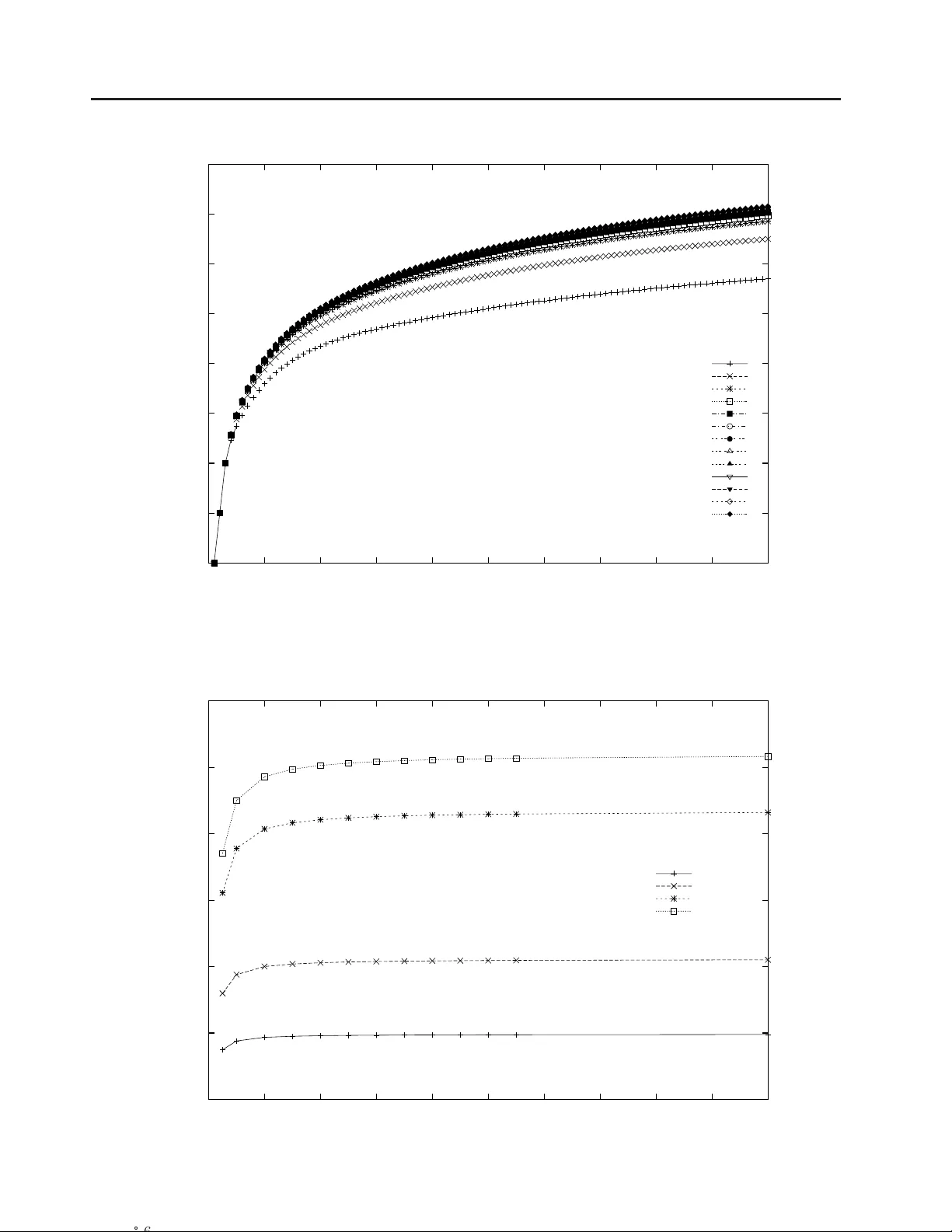
apport de recherche ISSN 0249-6399 ISRN INRIA/RR--6443--FR+ENG Thèmes COM et NUM INSTITUT N A TION AL DE RECHERCHE EN INFORMA TIQUE ET EN A UTOMA TIQUE Ascending runs in dependent uniformly distrib uted random variables: Application to wireless netw orks Nathalie Mitton , Katy Paroux , Bruno Sericola , Sébastien T ixeuil N° 6443 February 2008 Centre de recherche INRIA Rennes – Bretagne Atlantique IRISA, Campus universitaire de Beaulieu, 3504 2 Rennes Cedex Téléphone : +33 2 99 84 71 00 — Téléco pie : +33 2 99 84 71 71 Ascendi ng runs in dep enden t uniformly dis tribute d random v ariables: Applicatio n to wirel e ss net w orks Nathal ie Mitton ∗ , Ka ty Paroux † , Br uno Ser icola ‡ , S´ ebastien T i xeuil § Th ` emes COM et NUM — Syst ` emes comm unican ts et Sys t ` emes n um ´ eriques ´ Equipes-Pro jets D ion ysos, Grand Large et P ops Rapp ort de rec herc he n ° 6443 — F ebruary 200 8 — 12 pages Abstract: W e analyze in this pa p er the longest increasing con tiguous sequence or maximal ascending run of random v ariables with common uniform distribution but not inde p enden t. Their dep endence is c haracterized b y the fact that t w o success iv e random v aria bles cannot tak e the same v alue. Using a Mark o v c hain a ppro ac h, w e study the distribution o f the maximal ascending run and w e dev elop an algorithm to compute it. This problem comes from the analysis of sev eral self-organizing prot o cols designed for large-scale wireless sensor net w orks, and w e sho w how our results apply to this domain. Key-w ords: Mark o v ch ains, maximal ascending run, self-stabilization, con v ergence time. ∗ INRIA Lille - Nor d Eur op e/LIP6(USTL,CNRS), nathalie.mitton@ inria.fr † Univ ers it´ e de F r anche-Com t´ e, k at y .paroux@ univ-fcomte.fr ‡ INRIA Rennes - Br etagne Atlan tique, br uno .sericola @inria.fr § INRIA Saclay - ˆ Ile-de-F rance/LIP6 , sebastien.tixeuil@lri.fr Sous-s u ites croi ssan tes contigu ¨ es de v ariables al ´ eatoires d ´ ep end antes uniform ´ emen t dis tribu ´ ees: appli c ation aux r ´ ese aux sans fil R´ esum ´ e : Nous analysons dans cet article la plus longue sous-suite croissan te con tigu¨ e d’une suite de v a riables al ´ eato ires de m ˆ eme distribution uniforme mais non ind ´ ep endan tes. Leur d ´ ep endance est caract´ eris ´ ee par le fait que deux v ar ia bles successiv es ne p euve n t prendre la m ˆ eme v aleur. En utilisan t une a ppro c he mark ov ienne, nous ´ etudions la distribution de la plus longue sous-suite croissan te con tigu ¨ e et nous d´ ev elopp ons un a lg orithme p our la calculer. Ce probl ` eme provien t de l’analyse de plusieurs proto coles auto-organisan ts p our les r ´ eseaux de capteurs sans fil ` a grande ´ ec helle, et nous montrons commen t nos r ´ esultats s’appliquen t ` a ce domaine. Mots-cl ´ es : Cha ˆ ınes de Mark o v, sous-suites croissan tes contigu ¨ es, auto- stabilisation, temps de con v ergence. Asc ending runs in de p endent uniformly di stribute d r ando m vari a bles 3 1 In tro duction Let X = ( X n ) n > 1 b e a sequence of iden tically distributed random v a riables on the set S = { 1 , . . . , m } . As in [8], w e define an ascending run as a contiguous and increasing subse - quence in the pro cess X . F or instance, with m = 5, among the 20 first following v alues of X : 23124342 31345123 4341, there are 8 ascending runs and the length of maximal ascending run is 4. More fo rmally , an ascending run of length ℓ > 1, starting at p osition k > 1, is a subseque nce ( X k , X k +1 , . . . , X k + ℓ − 1 ) suc h that X k − 1 > X k < X k +1 < · · · < X k + ℓ − 1 > X k + ℓ , where w e set X 0 = ∞ in order to av oid sp ecial cases at the b oundary . U nder the assumption that the distribution is discrete and the random v ar ia bles are independen t, sev eral authors ha v e studied the b ehaviour of the maximal ascending run, as w ell as the longest non-decreasing con tiguous subsequence. The main results concern the asymptotic b eha viour of these quan tities when the num b er of random v ariables tends to infinity , see for example [6] and [4] and the references therein. Note that these t w o notions coincide when the common distribution is con tin uous. In this case, the asy mptotic b eha viour is kno wn and do es not depend on the distribution, as show n in [6]. W e denote b y M n the length of the max imal a scending run among the first n ra ndom v ariables. The asymptotic behav iour of M n hardly de p ends on the common distribution of the random v ariables X k , k > 1. Some results ha v e b een established for the g eometric distribution in [10] where an equiv alen t o f t he la w of M n is pro vided and previously in [1] where the almost- sure con v ergence is studied, a s w ell as for P oisson distribution. In [9], the case of the uniform distribution on the set { 1 , . . . , s } is inv estigated. The au- thor considers the problem of the longest non-decreasing con tiguous subseque nce and giv es an equiv alen t of its law when n is large and s is fixed. The asymptotic equiv alen t o f E ( M n ) is also conjectured. In t his pap er, w e consider a sequence X = ( X n ) n > 1 of integer r a ndom v ariables on the set S = { 1 , . . . , m } , with m > 2. The ra ndom v ar ia ble X 1 is uniformly distributed on S and, fo r n > 2, X n is uniformly distributed on S with the constrain t X n 6 = X n − 1 . This pro cess may b e seen as the dra wing of balls, n um b ered from 1 to m in an urn where at eac h step the last ball dra wn is k ept o utside the urn. Th us we hav e, for ev ery i, j ∈ S and n > 1, P ( X 1 = i ) = 1 m and P ( X n = j | X n − 1 = i ) = 1 { i 6 = j } m − 1 . By induction ov er n and unconditioning, w e get, for ev ery n > 1 and i ∈ S , P ( X n = i ) = 1 m . Hence the random v ariables X n are uniformly distributed on S but a re no t indep enden t. Using a Mark ov c hain approa c h, w e study t he distribution of the maximal ascending run and w e dev elop an algorithm to compute it. This problem comes from the analysis of self-o r g anizing proto cols designed for lar ge-scale wireless sensor net w orks, and w e sho w ho w our results apply to this domain. The remainder of the pap er is or g anized as follows . In the next section, w e use a Mark ov c hain approac h to study the b ehavior o f the sequence of a scending runs in the pro cess X . In Section 3, w e a nalyze the hitting times of a n ascending run of fixed length and w e obtain the RR n ° 6443 4 N. Mitton, K. Par oux, B. Se ric ola & S. Tixeuil distribution of the maximal ascending M n o v er the n first random v ariables X 1 , . . . , X n using a Mark o v renew al argumen t. An a lgorithm to compute this distribution is dev elop ed in Section 4 and Section 5 is dev oted to the practical implications of this w ork in large-scale wireless sensor net w orks. 2 Asso ciated Mark o v c hain The pro cess X is ob viously a Marko v c hain on S . As o bserv ed in [10 ], w e can see the ascending runs as a discrete-time pro cess having t w o comp onents: the v alue take n b y the first elemen t of the a scending run and its length. W e denote this pro cess b y Y = ( V k , L k ) k > 1 , where V k is the v alue of the first elemen t of the k th ascending run and L k is its length. The state space of Y is a subset S 2 w e shall pr ecise now . Only the first ascending run can start with the v alue m . Indeed, as so on as k > 2, the random v ariable V k tak es its v alues in { 1 , . . . , m − 1 } . Moreo v er V 1 = X 1 = m implies that L 1 = 1. Th us, for any ℓ > 2, ( m, ℓ ) is not a state of Y whereas ( m, 1) is only an initial state that Y will nev er visit aga in. W e observ e also that if V k = 1 then necess arily L k > 2, which implies that (1 , 1) is not a state of Y . Moreov er V k = i implies that L k 6 m − i + 1. According to t his b eha viour, we hav e Y 1 ∈ E ∪ { ( m, 1) } and for k > 2, Y k ∈ E , where E = { ( i, ℓ ) | 1 6 i 6 m − 1 a nd 1 6 ℓ 6 m − i + 1 } \ { (1 , 1) } . W e define the following useful quantities for any i, j, ℓ ∈ S and k > 1 : Φ ℓ ( i, j ) = P ( V k +1 = j, L k = ℓ | V k = i ) , (1) ϕ ℓ ( i ) = P ( L k = ℓ | V k = i ) , (2) ψ ℓ ( i ) = P ( L k > ℓ | V k = i ) . (3) Theorem 1. The pr o c ess Y is a homo gene ous Markov chain with tr ansition pr ob ability matrix P , which entries ar e given for any ( i, ℓ ) ∈ E ∪ { ( m, 1) } and ( j, λ ) ∈ E b y P ( i,ℓ ) , ( j,λ ) = Φ ℓ ( i, j ) ϕ λ ( j ) ϕ ℓ ( i ) . Pro of. W e exploit the Mark o v pro p ert y o f X , rewriting ev en ts for Y as ev en ts for X . F or ev ery ( j, λ ) ∈ E and taking k > 1 then fo r an y ( v k , ℓ k ) , . . . , ( v 1 , ℓ 1 ) ∈ E ∪ { ( m, 1) } , w e denote b y A k the ev en t : A k = { Y k = ( v k , ℓ k ) , . . . , Y 1 = ( v 1 , ℓ 1 ) } . W e ha v e to che c k that P ( Y k +1 = ( j, λ ) | A k ) = P ( Y 2 = ( j, λ ) | Y 1 = ( v k , ℓ k )) . First, w e observ e that A 1 = { Y 1 = ( v 1 , ℓ 1 ) } = { X 1 = v 1 < · · · < X ℓ 1 > X ℓ 1 +1 } , INRIA Asc ending runs in de p endent uniformly di stribute d r ando m vari a bles 5 and A 2 = { Y 2 = ( v 2 , ℓ 2 ) , Y 1 = ( v 1 , ℓ 1 ) } = { X 1 = v 1 < · · · < X ℓ 1 > X ℓ 1 +1 = v 2 < · · · < X ℓ 1 + ℓ 2 > X ℓ 1 + ℓ 2 +1 } = A 1 ∩ { X ℓ 1 +1 = v 2 < · · · < X ℓ 1 + ℓ 2 > X ℓ 1 + ℓ 2 +1 } . By induction, w e obta in A k = A k − 1 ∩ { X ℓ ( k − 1)+1 = v k < · · · < X ℓ ( k ) > X ℓ ( k )+1 } , where ℓ ( k ) = ℓ 1 + . . . + ℓ k . Using this remark a nd the fact that X is a homogeneous Mark o v c hain, w e get P ( Y k +1 = ( j, λ ) | A k ) = P ( V k +1 = j, L k +1 = λ | A k ) = P ( X ℓ ( k )+1 = j < · · · < X ℓ ( k )+ λ > X ℓ ( k )+ λ +1 | X ℓ ( k − 1)+1 = v k < · · · < X ℓ ( k ) > X ℓ ( k )+1 , A k − 1 ) = P ( X ℓ ( k )+1 = j < · · · < X ℓ ( k )+ λ > X ℓ ( k )+ λ +1 | X ℓ ( k − 1)+1 = v k < · · · < X ℓ ( k ) > X ℓ ( k )+1 ) = P ( X ℓ k +1 = j < · · · < X ℓ k + λ > X ℓ k + λ +1 | X 1 = v k < · · · < X ℓ k > X ℓ k +1 ) = P ( V 2 = j, L 2 = λ | V 1 = v k , L 1 = ℓ k ) = P ( Y 2 = ( j, λ ) | Y 1 = ( v k , ℓ k )) . W e no w hav e to sho w that P ( Y k +1 = ( j, λ ) | Y k = ( v k , ℓ k )) = P ( Y 2 = ( j, λ ) | Y 1 = ( v k , ℓ k )) . Using the previous result, w e hav e P ( Y k +1 = ( j, λ ) | Y k = ( v k , ℓ k )) = P ( Y k +1 = ( j, λ ) , Y k = ( v k , ℓ k )) P ( Y k = ( v k , ℓ k )) = k − 1 X i =1 X ( v i ,ℓ i ) ∈ E P ( Y k +1 = ( j, λ ) , Y k = ( v k , ℓ k ) , A k − 1 ) k − 1 X i =1 X ( v i ,ℓ i ) ∈ E P ( Y k = ( v k , ℓ k ) , A k − 1 ) = k − 1 X i =1 X ( v i ,ℓ i ) ∈ E P ( Y k +1 = ( j, λ ) | A k ) P ( A k ) k − 1 X i =1 X ( v i ,ℓ i ) ∈ E P ( A k ) = P ( Y 2 = ( j, λ ) | Y 1 = ( v k , ℓ k )) . W e hav e sho wn that Y is a ho mo g eneous Mark ov c hain ov er its state space. The en tries of matrix P are t hen given, fo r eve ry ( j, λ ) ∈ E and ( i, ℓ ) ∈ E ∪ { ( m, 1) } b y P ( i,ℓ ) , ( j,λ ) = P ( V k +1 = j, L k +1 = λ | V k = i, L k = ℓ ) = P ( V k +1 = j | V k = i, L k = ℓ ) P ( L k +1 = λ | V k +1 = j, V k = i, L k = ℓ ) = P ( V k +1 = j | V k = i, L k = ℓ ) P ( L k +1 = λ | V k +1 = j ) = P ( V k +1 = λ, L k = ℓ | V k = i ) P ( L k = ℓ | V k = i ) ϕ λ ( j ) = Φ ℓ ( i, j ) ϕ λ ( j ) ϕ ℓ ( i ) , RR n ° 6443 6 N. Mitton, K. Par oux, B. Se ric ola & S. Tixeuil where the third equalit y follows f r o m the Marko v prop erty . W e giv e the expressions of ϕ λ ( j ) and Φ ℓ ( i, j ) for ev ery i, i, ℓ ∈ S in the fo llo wing lemma. Lemma 2. F or every i, j, ℓ ∈ S , we h ave Φ ℓ ( i, j ) = m − i ℓ − 1 ( m − 1) ℓ 1 { m − i > ℓ − 1 } − j − i ℓ − 1 ( m − 1) ℓ 1 { j − i > ℓ − 1 } , ψ ℓ ( i ) = m − i ℓ − 1 ( m − 1) ℓ − 1 1 { m − i > ℓ − 1 } , ϕ ℓ ( i ) = m − i ℓ − 1 ( m − 1) ℓ − 1 1 { m − i > ℓ − 1 } − m − i ℓ ( m − 1) ℓ 1 { m − i > ℓ } . Pro of. F or ev ery i, j, ℓ ∈ S , it is easily c hec ked that Φ ℓ ( i, j ) = 0 if m < i + ℓ − 1. If m > i + ℓ − 1, w e hav e Φ ℓ ( i, j ) = P ( V 2 = j, L 1 = ℓ | V 1 = i ) = P ( i < X 2 < . . . < X ℓ > X ℓ +1 = j | X 1 = i ) = P ( i < X 2 < . . . < X ℓ , X ℓ +1 = j | X 1 = i ) − P ( i < X 2 < . . . < X ℓ < X ℓ +1 = j | X 1 = i )1 { j > i + ℓ − 1 } . (4) W e in tro duce the sets G 1 ( i, j, ℓ, m ), G 2 ( i, j, ℓ, m ), G ( i, ℓ, m ) and H ( ℓ, m ) defined b y G 1 ( i, j, ℓ, m ) = { ( x 2 , . . . , x ℓ +1 ) ∈ { i + 1 , . . . , m } ℓ ; x 2 < · · · < x ℓ 6 = x ℓ +1 = j } , G 2 ( i, j, ℓ, m ) = { ( x 2 , . . . , x ℓ +1 ) ∈ { i + 1 , . . . , m } ℓ ; x 2 < · · · < x ℓ = x ℓ +1 = j } , G ( i, ℓ, m ) = { ( x 2 , . . . , x ℓ ) ∈ { i + 1 , . . . , m } ℓ − 1 ; x 2 < · · · < x ℓ } , H ( ℓ, m ) = { ( x 2 , . . . , x ℓ +1 ) ∈ { 1 , . . . , m } ℓ ; i 6 = x 2 6 = · · · 6 = x ℓ +1 } . It is w ell-kno wn, see for instance [5], that | G ( i, ℓ, m ) | = m − i ℓ − 1 . Since | G 2 ( i, j, ℓ, m ) | = | G ( i, ℓ − 1 , j − 1) | , the first term in (4) can b e written as P ( i < X 2 < . . . < X ℓ , X ℓ +1 = j | X 1 = i ) = | G 1 ( i, j, ℓ, m ) | | H ( ℓ, m ) | = | G ( i, ℓ, m ) | − | G 2 ( i, j, ℓ, m ) | | H ( ℓ, m ) | = | G ( i, ℓ, m ) | − | G ( i, ℓ − 1 , j − 1) | | H ( ℓ, m ) | = m − i ℓ − 1 − j − i − 1 ℓ − 2 1 { j − i > ℓ − 1 } ( m − 1) ℓ , INRIA Asc ending runs in de p endent uniformly di stribute d r ando m vari a bles 7 The second term is giv en, fo r j > i + ℓ − 1, b y P ( i < X 2 < . . . < X ℓ < X ℓ +1 = j | X 1 = i ) = | G ( i, ℓ, j − 1) | | H ( ℓ, m ) | = j − i − 1 ℓ − 1 ( m − 1) ℓ . Adding these t w o terms, we get Φ ℓ ( i, j ) = m − i ℓ − 1 1 { m − i > ℓ − 1 } − j − i − 1 ℓ − 2 1 { j − i > ℓ − 1 } − j − i − 1 ℓ − 1 1 { j − i > ℓ } ( m − 1) ℓ = m − i ℓ − 1 1 { m − i > ℓ − 1 } − j − i ℓ − 1 1 { j − i > ℓ − 1 } ( m − 1) ℓ , whic h completes t he pro of of the first relation. The second r elat io n follow s from expression (3) b y writing ψ ℓ ( i ) = P ( L 1 > ℓ | V 1 = i ) = P ( i < X 2 < . . . < X ℓ | X 1 = i )1 { m − i > ℓ − 1 } = | G ( i, ℓ, m ) | | H ( ℓ − 1 , m ) | = m − i ℓ − 1 ( m − 1) ℓ − 1 1 { m − i > ℓ − 1 } . The third relation follows from definition (2 ) by writing ϕ ℓ ( i ) = ψ ℓ ( i ) − ψ ℓ +1 ( i ). Note that the matrix Φ defined b y Φ = m X ℓ =1 Φ ℓ is ob viously a sto chastic matrix, which means that, f or every i = 1 , . . . , m , w e hav e m X ℓ =1 ϕ ℓ ( i ) = 1 . m X ℓ =1 m X j =1 Φ ℓ ( i, j ) = m X ℓ =1 ϕ ℓ ( i ) = ψ ( i ) = 1 . 3 Hitting times and maximal asc e nding run F or ev ery r = 1 , . . . , m , we denote b y T r the hitting time of an ascending run of length at least equal to r . More formally , we hav e T r = inf { k > r ; X k − r +1 < · · · < X k } . It is easy to c hec k that w e ha ve T 1 = 1 and T r > r . The distribution of T r is giv en by t he follo wing theorem. RR n ° 6443 8 N. Mitton, K. Par oux, B. Se ric ola & S. Tixeuil Theorem 3. F or 2 6 r 6 m , we have P ( T r 6 n | V 1 = i ) = 0 if 1 6 n 6 r − 1 ψ r ( i ) + r − 1 X ℓ =1 m X j =1 Φ ℓ ( i, j ) P ( T r 6 n − ℓ | V 1 = j ) if n > r. (5) Pro of. Since T r > r , we hav e, for 1 6 n 6 r − 1 , P ( T r 6 n | V 1 = i ) = 0 Let us assume from now that n > r . Since L 1 > r implies that T r = r , w e get P ( T r 6 n, L 1 > r | V 1 = i ) = P ( L 1 > r | V 1 = i ) = ψ r ( i ) . (6) W e in tro duce the random v aria ble T ( p ) r defined by hitting time o f an ascending run length a t least equal to r when coun ting fro m p osition p . Thu s we hav e T ( p ) r = inf { k > r ; X p + k − r < · · · < X p + k − 1 } . W e then hav e T r = T (1) r . Moreo v er, L 1 = ℓ < r implies that T r = T ( L 1 +1) r + ℓ , which leads to P ( T r 6 n, L 1 < r | V 1 = i ) = r − 1 X ℓ =1 P ( T r 6 n, L 1 = ℓ | V 1 = i ) = r − 1 X ℓ =1 P ( T ( L 1 +1) r 6 n − ℓ, L 1 = ℓ | V 1 = i ) = r − 1 X ℓ =1 m X j =1 P ( T ( L 1 +1) r 6 n − ℓ, V 2 = j, L 1 = ℓ | V 1 = i ) = r − 1 X ℓ =1 m X j =1 Φ ℓ ( i, j ) P ( T ( L 1 +1) r 6 n − ℓ | V 2 = j, L 1 = ℓ, V 1 = i ) = r − 1 X ℓ =1 m X j =1 Φ ℓ ( i, j ) P ( T ( L 1 +1) r 6 n − ℓ | V 2 = j ) = r − 1 X ℓ =1 m X j =1 Φ ℓ ( i, j ) P ( T r 6 n − ℓ | V 1 = j ) , (7) where the fifth equality follo ws from the Mark ov prop erty and the last one fr o m the homogeneity of Y . Putting t o gether relations (6) and (7), w e obtain P ( T r 6 n | V 1 = i ) = ψ r ( i ) + r − 1 X ℓ =1 m X j =1 Φ ℓ ( i, j ) P ( T r 6 n − ℓ | V 1 = j ) . INRIA Asc ending runs in de p endent uniformly di stribute d r ando m vari a bles 9 F or ev ery n > 1, we define M n as the maximal ascending run length o v er the n first v alues X 1 , . . . , X n . W e hav e 1 6 M n 6 m ∧ n and M n > r ⇐ ⇒ T r 6 n, whic h implies E ( M n ) = m ∧ n X r =1 P ( M n > r ) = m ∧ n X r =1 P ( T r 6 n ) = 1 m m ∧ n X r =1 m X i =1 P ( T r 6 n | V 1 = i ) . 4 Algorith m F or r = 1 , . . . , m , we denote b y ψ r the column v ector o f dimension m whic h i th entry is ψ r ( i ). F or r = 1 , . . . , m , n > 1 and h = 1 , . . . , n , w e denote b y W r,h the column v ector of dimension m whic h i th en try is defined b y W h,r ( i ) = P ( T r 6 h | V 1 = i ) = P ( M h > r | V 1 = i ) , and w e denote by 1 the column v ector of dimension m with all en tries equal to 1. An algorithm for the computation of the distribution and the exp ectatio n of M n is giv en in T able 1. input : m , n output : E ( M h ) for h = 1 , . . . , n . for ℓ = 1 to m do Compute the matr ix Φ ℓ endfor for r = 1 t o m do Compute the column v ectors ψ r endfor for h = 1 t o n do W h, 1 = 1 endfor for r = 2 t o m ∧ n do for h = 1 to r − 1 do W h,r = 0 endfor for h = r to n do W h,r = ψ r + r − 1 X ℓ =1 Φ ℓ W h − ℓ,r endfor endfor for h = 1 t o n do E ( M h ) = 1 m m ∧ h X r =1 1 t W h,r endfor T able 1: Algorithm for the distribution and exp ectation computation o f M n . 5 Application to w ireless net w o rks : fa st self-or g anization Our analysis has imp ortant implications in forecast large-scale wireless net w orks. In those net w orks, the num b er of mac hines in v olv ed and the likeline ss of fault o ccurrences prev ents an y cen tralized planification. Instead, distributed self-org anization m ust b e designed to enable prop er functioning of the net w ork. A useful techniq ue to pro vide self-organizatio n is self- stabilization [2, 3]. Self-stabilization is a vers atile tec hnique that can make a wireless net w ork withstand an y kind of fault and reconfigurat io n. A common dra wbac k with self-stabilizing proto cols is that they w ere not designed to handle prop erly la rge-scale net w orks, as the stabilizing time ( t he maxim um a moun t of time needed to RR n ° 6443 10 N. Mitton, K. Par oux, B. Se ric ola & S. Tixeuil reco v er from any p ossible disaster) could b e related to the actual size of the netw ork. In many cases, this high complexit y w as due to the fact that net w ork-wide unique identifiers a re used to ar bit r a te symmetric situatio ns [13 ]. How ev er, t here exists a n um b er of problems app earing in wireless net w orks that need only lo cally unique identifiers . Mo deling the net w ork as a graph where no des represen t wireless entities and where edges represen t the abilit y to comm unicate b et w een t w o en tities ( b ecause eac h is within the tr a ns- mission range o f the other), a lo cal coloring of the no des at distance d ( i.e. ha ving t w o no des at distance d or less assigned a distinct color) can b e enough to solv e a wide range of problems. F or example, lo cal coloring at distance 3 can b e used to assign TDMA time slots in an adaptive manner [7], and lo cal coloring at distance 2 has succ essiv ely b een used to self-organize a wireles s net w ork into more manageable clusters [12]. In the p erfor ma nce analysis of b oth sc hemes, it app ears that the ov erall stabilization time is balanced b y a tradeoff b et w een the coloring time itself and the stabilization time of the proto col using the coloring (denoted in the following as the client proto col). In bo t h cases (TDMA assignmen t and clustering), the stabilization time of t he c lien t pro to col is related to the heigh t of the directed acyclic graph induced b y the colors. This DA G is obtained b y orien ting an edge fro m the no de with the highest colo r to t he neighbor with the lo w est color. As a result, t he ov erall heigh t of this DA G is equal to the long est strictly a scending c hain of colors across neighboring no des. Of course, a larger set o f colors leads to a shorter stabilization time for the coloring (due to the higher c hance of pick ing a fresh color), but yields to a p otential higher D A G, tha t could delay the stabilizatio n time of the clien t proto col. In [11], the stabilization time of the coloring proto col was theoretically analyzed while the stabilization time of a particular clien t proto col (the clustering sche me of [12]) w as only studied b y sim ula tion. The analysis p erformed in this pap er g ives a theoretical upp er b ound on the stabilization time of all clien t proto cols that use a coloring s c heme as an underlying basis. T ogether with the results of [11], our study constitutes a comprehensiv e analysis of the ov erall stabilization time of a class of self-stabilizing pro t o cols used for the self-organizatio n of wireless sensor net w orks. In the remaining of the section, w e provide quan titative results regarding the relativ e imp ort a nce o f the num b er of used colors with resp ect to other net w ork parameters. Figure 1 sho ws the exp ected length of the maximal a scending run ov er a n -no de chain for differen t v alues of m . Results sho w sev eral in teresting b eha viors. Indeed, self-organization pro to cols relying on a coloring pro cess achie v e b etter stabilizatio n time when the exp ected length of maximal as- cending run is short but a coloring pro cess stabilizes faster when the n um b er o f colors is high [11]. Figure 1 clearly sho ws that ev en if the num b er o f colors is high compared to n ( n << m ), the exp ected length of maximal ascending run remains short, whic h is a great adv a n tage. Moreov er, ev en if the num b er of no des increases, the exp ected length of the maximal a scending run remains short and increases very slow ly . This observ ation demonstrates the scalability prop erties of a proto col relying on a lo cal coloring pro cess since its stabilization t ime is directly link ed to the length of this ascending run [11]. Figure 2 sho ws the exp ected length of maximal as cending run ov er a n -node chain for differen t v alues of n . Results shows that for a fixed n umber of no des n , the exp ected length of the maximal ascending r un con v erges to a finite v alue, dep ending of n . This implies that using a large n um b er o f colors do es not impact the stabilization time of the clien t algorithm. INRIA Asc ending runs in de p endent uniformly di stribute d r ando m vari a bles 11 1 1.5 2 2.5 3 3.5 4 4.5 5 0 10 20 30 40 50 60 70 80 90 100 Maximal ascending run size Number of nodes n m = 5 m = 10 m = 20 m = 30 m = 40 m = 50 m = 60 m = 70 m = 80 m = 90 m = 100 m = 110 m = 200 Figure 1 : Exp ected length o f the maximal ascending run as a function of the n um b er o f no des. 2 2.5 3 3.5 4 4.5 5 0 20 40 60 80 100 120 140 160 180 200 Maximal ascending run size Number of colors m n = 5 n = 10 n = 50 n = 100 Figure 2 : Expected length of the maximal ascending run as a function of the n um b er of colors. RR n ° 6443 12 N. Mitton, K. Par oux, B. Se ric ola & S. Tixeuil References [1] E . Csaki and A. F o ldes. On the length of the longest monotone blo c k. Stud. Sci. Math. Hungarian , 3 1:35–46, 1996. [2] E . W. D ij kstra. Self-stabilizing systems in spite of distributed control. Commun. A CM , 17(11):643 –644, 1974. [3] S . Do lev. Self Stabilization . MIT Press, 2000. [4] S . Eryilmaz. A note on runs of geometrically distributed ra ndom v ariables. Discr ete Mathematics , 3 06:1765– 1 770, 2006. [5] D. F oat a and A. F uc hs. C alcul des pr ob abilit´ es . Mass on, 1996. [6] A . N. F rolo v and A. I. Martik ainen. On the length of the longest increasing run in Rd. Statistics and Pr ob ability L etters , 4 1(2):153–1 61, 1999. [7] T . Herman and S. Tixeuil. A distributed TDMA slot assignmen t a lgorithm for wireless sensor netw orks. In Pr o c e e ding s of the F irst Workshop on Algorithmic Asp e cts of Wir ele ss Sensor Networks (A lgoSen s ors’2004) , num b er 3121 in Lecture Notes in Computer Science, pages 45–58, T urku, Finland, July 2004. Springer-V erlag. [8] G. Louc hard. Runs o f geometrically distributed random v ariables: a probabilistic analysis. J. Comput. Appl. Math. , 142(1):13 7–153, 2002 . [9] G. Louc hard. Monotone runs of uniformly distributed integer random v ariables: a proba- bilistic analysis. The o r etic al Comp uter Sci e nc e , 3 46(2–3):3 5 8–387, 2005 . [10] G. Louchard and H. Pro dinger. Ascending runs of sequences of geometrically distributed random v ariables: a probabilistic a nalysis. The or etic al Computer Scienc e , 304:59–86, 2003. [11] N. Mitton, E. F leury , I. Gu ´ erin-Lassous, B. Sericola, and S. Tixeuil. F ast con v ergence in self-stabilizing wireless netw orks. In 12th In ternational Confer enc e on Par al lel and Distribute d Systems (ICP ADS’06) , Minneap olis, Minnesota, USA, July 200 6. [12] N. Mitton, E. Fleury , I. G u ´ erin-Lassous, a nd S. Tixeuil. Self- stabilization in self-org anized m ultihop wireless net w orks. In WW AN’05 , Colum bus, Ohio, USA, 2005 . [13] S. Tixeuil. Wir eless A d Ho c a n d Sensor Networks , c hapter F ault-tolerant distributed algorithms for scalable systems. ISTE, Octob er 2007. ISBN: 978 1 90520 9 86. INRIA Centre de recherche INRIA Rennes – Bretagne Atlantique IRISA, Campus universitaire de Beaulieu - 35042 Rennes Cedex (France) Centre de recherc he INRIA Bordeaux – Sud Ouest : Domaine Uni versit aire - 351, cours de la Libération - 33405 T alenc e Cedex Centre de recherc he INRIA Grenobl e – Rhône-Alpes : 655, ave nue de l’Europe - 38334 Montbonnot Saint-Ismier Centre de recherc he INRIA Lille – Nord Europe : Parc Scientifique de la Haute Borne - 40, ave nue Halley - 59650 V ille neuve d’Ascq Centre de recherc he INRIA Nanc y – Grand Est : L ORIA, T echnopôle de Nancy-Bra bois - Campus scientifique 615, rue du Jardin Botani que - BP 101 - 54602 V illers-lès-Na ncy Cede x Centre de recherc he INRIA Pari s – Rocquencourt : Domaine de V oluceau - Rocquencou rt - BP 105 - 78153 Le Chesnay Cedex Centre de recherc he INRIA Sacla y – Île-de-Franc e : Parc Orsay Uni ver sité - ZAC des V ignes : 4, rue Jacques Monod - 91893 Orsay Cede x Centre de recherc he INRIA Sophia Antipolis – Méditerranée : 2004, route des Lucioles - BP 93 - 06902 Sophia Antipolis Cedex Éditeur INRIA - Domaine de V olucea u - Rocquenc ourt, BP 105 - 78153 Le Chesnay Cede x (France) http://www.inria.fr ISSN 0249 -6399
Original Paper
Loading high-quality paper...
Comments & Academic Discussion
Loading comments...
Leave a Comment