A Simple Distributed Antenna Processing Scheme for Cooperative Diversity
In this letter the performance of multiple relay channels is analyzed for the situation in which multiple antennas are deployed only at the relays. The simple repetition-coded decodeand- forward protocol with two different antenna processing techniqu…
Authors: Yijia Fan, Abdulkareem Adinoyi, John S Thompson
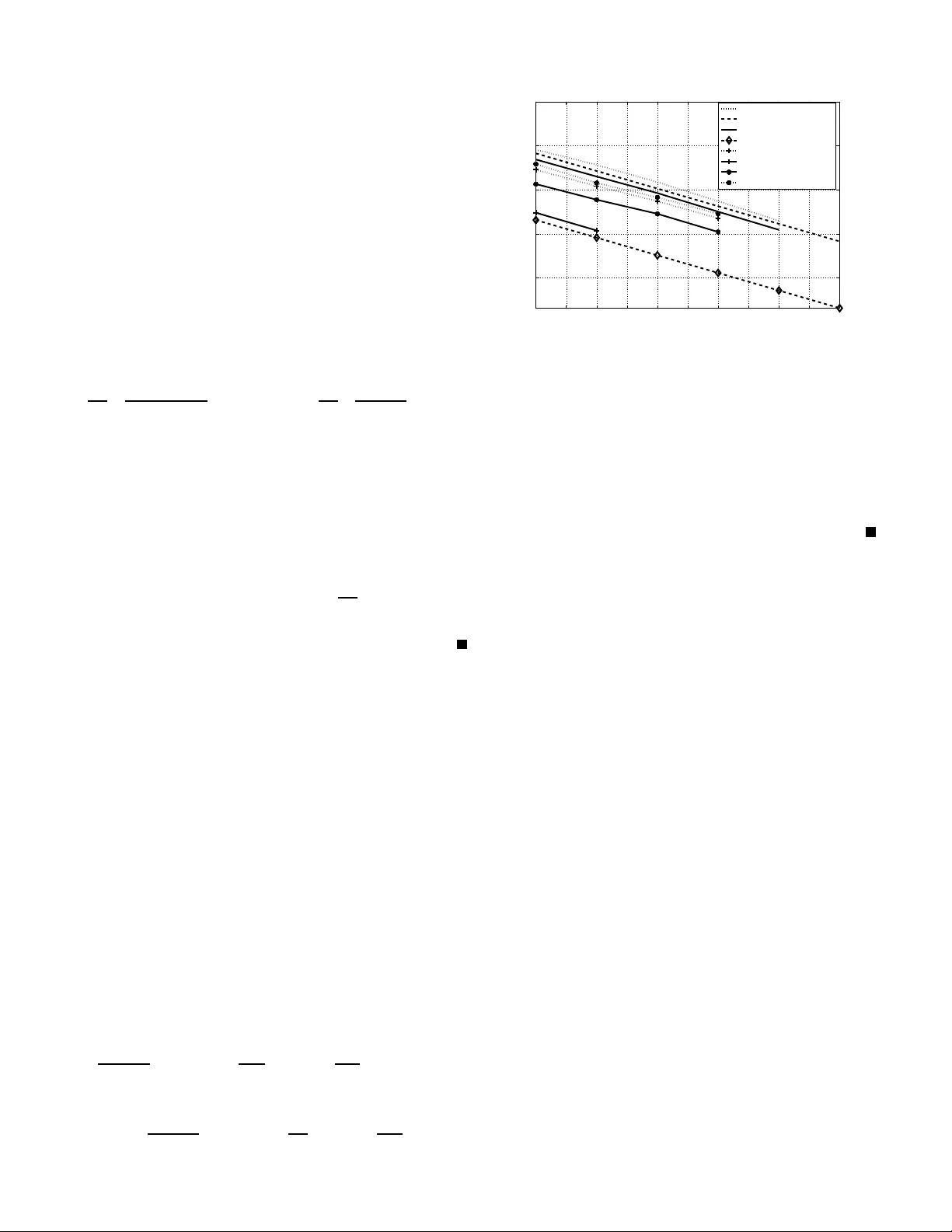
1 A Simple Distrib uted Antenna Processing Scheme for Cooperati v e Di v ersity Y ijia Fan, Abdulkareem Ad inoyi, John S Thomp son, Halim Y anikomeroglu, H. V incent Poor Abstract — In this letter the perfo rmance of multiple r elay chan- nels is analyzed for the situation in which multiple antennas are deployed only at the relays. The simple repetition-coded decode- and-forwar d protocol with tw o different antenna pr ocessing techniques at the r elays is in vestigated. The anten na combinin g techniques are maximum ratio combin ing (MRC) for reception and transmit beamfor ming (TB) for transmission. It is shown that th ese distributed antenna combining techniq ues can exploit the full sp atial divers ity of the relay channels regardless of the number of relays and antenn as at each relay , and offer significant power gain ov er distributed space-time coding techniqu es. I . I N T R O D U C T I O N The p erform ance limits of distributed space-time co des, which can e xploit cooperative diversity , ha ve been in vestigated in [1] and [2] for single-an tenna relay networks using rand om coding techniqu es. Howe ver, the design and implementation of practical cod es that a pproac h these limits are ch allenging op en research areas. On e approach to these p roblem s mig ht be to use known space -time cod es for the p oint-to-p oint multiple- input multiple-ou tput (MIMO) link (e.g . [13]) in relay net- works. Howev er , the processing complexity at each relay node for such an ap proach can increase significantly , as anten nas in relay networks are d istributed rath er than cen tralized. For example, each relay may need to k now all of the u ncoded data, bef ore sending only one pa rt of the codeword to th e destination. Similarly , the decod ing p rocess at the destination might also be very complex when the num ber of relays are large. Mo reover , a m ore complex p rotocol is required in order to assign different r elays to tra nsmit d ifferent parts of the codeword. T hese p oints lea d to additional tim e delay and energy co st, while they also present fundamental issues especially for large ad- hoc o r sensor networks [ 4], [10] , [12 ]. Simpler codes such as sp ace-time block codes [1 4] will result in a rate loss when the number o f re lays is more than two. Another r ecent scheme exploits the selection d iv ersity of the network by selecting the best relay among all the available Part of this work has appeared in European Wi reless Conference 2006, Athens, Greece and Internat ional Conferenc e on Communications, Glasgo w , UK, 2007. Y . Fan and H. V . Poor are with Department of Electri- cal Engineeri ng, Princet on Uni versity , Princ eton, NJ 08544 (email: { yijiaf an,poor } @princeton.edu). J. S. Thompson is with the Institute for Digital Communications, Univ ersity of Edinbur gh, E dinbur gh, EH9 3JL, UK (e-mail: john.thompson@ ed.ac.uk). A. Adinoyi and H. Y anikomeroglu are with Broadband Communicatio ns and Wi reless Systems (BCWS) Centre , Department of Systems and Com- puter Engineerin g, Carleton Univ ersity , Otta wa, K1S 5B6, Canada (Email: { halim.yani komerog lu, adino yi } @sce.ca rleton.ca ). This researc h was supported in part by the U. S. National Science Founda tion under Grants ANI-03-38807 and CNS-06-25637. relays [3 ]. Howev er , the power gain for th is schem e is limited due to the limited p ower at a sin gle r elay nod e; especially in a sensor network en viron ment. In this letter we exploit th e spatial div ersity of relay channels in an alternative way to the space-time cod es- based appro ach. W e apply two kinds of anten na processing technique s a t the relay , namely m aximum r atio com bining (MRC) [5] f or r eception and transmit beamf orming (TB) [6 ] for tra nsmission. These techniqu es are often used in p oint-to- point single-inp ut multiple-outpu t (SIMO) or mu ltiple-inpu t single-outp ut (MISO) wir eless links and h av e been shown to achieve the optima l diversity multiplexing trade off in these cases [7]. More specifically , for a MISO channel, beamformin g is often considered as a better approach than space- time coding due to its hig her power gain , pr ovided that th e chan nel state informa tion (CSI) can be fed b ack to the transmitter . In ou r model, we move the mu ltiple antennas to the re lays, while the source and the destination are equ ipped with only a single antenna . Unlike the point-to -point link, the an tennas are deployed in a distributed fashion, and MRC an d be amform ing can only be pe rforme d in a distributed rather than a centr alized fashion in this scenario. On e of the co ntributions of this letter is to in vestigate th e diversity an d power p erfor mance tr adeoff between the n umber of relay s and the numbe r of antennas a t each relay . W e will also compare distrib uted M RC-TB with space-time co ding in a mu lti-antenn a multi-relay environmen t. Some related work on single anten na relay networks has also considered b eamfor ming appr oach, altho ugh this earlier work focuses pr imarily o n the energy efficiency or capac ity scaling behavior o f such n etworks [10] , [ 11]. I I . S Y S T E M D E S C R I P T I O N W e con sider a two hop network mo del with o ne so urce, o ne destination an d K relays. For simplicity we ig nore th e dire ct link betwe en the sourc e and the destination. The extension of our results to include the direct link is straightfo rward. W e assume that the sourc e and destination are deployed with a single an tenna, while rela y k is dep loyed with m k antennas; the total numb er of antennas at all relays is fixed to N . W e restrict attention to the case in wh ich the ch annels exhibit slow and fre quency-flat fading. W e assume a coheren t relay chann el configur ation context in which th e k th relay can obtain full knowledge of both the backward channel v ector h k and the forward chann el vector g k . No te th at forward ch annel k nowl- edge can be o btained ea sily if the r elay-destinatio n link op- erates in a Time-Di vision-Duplex (TDD) m ode. On e exam ple where the r elays ob tain the requir ed chan nel infor mation can 2 be fo und in [1 1], but this m ight requ ire addition al signalling overhead. In a slow fading chann el, which is th e f ocus o f th is letter , this overhead is negligible. For fair c omparison , we also assume that for each ch annel realizatio n, a ll the b ackward a nd forward ch annel co efficients for all N antennas remain the same regardless of the numb er of relays K . Fig. 1 shows the system mo del. Data is transmitted over two time slots using two hop s. In the first transmission time slot, the sou rce b roadcasts its sign al to a ll relay terminals. The input/ou tput r elation fo r the source to the k th relay is g iv en by r k = √ η h k s + n k , (1) where r k is the m k × 1 received sign al vector, η is the transmit power at the sourc e, s is the u nit m ean power transmitted signal, a nd n k is m k × 1 complex circular ad- ditiv e white Gau ssian n oise at relay k with zero mean and identity covariance matrix I m k . Th e entries of the chann el vector h k are indepen dent and id entically distributed ( i.i.d.) complex Gaussian r andom variables with zero means and u nit variances. W e assume that each relay performs MRC o f th e received sign als, by multiplyin g the received signal vector by the vector h H k k h k k F , where k•k F denotes the Froben ius norm. The SNR at th e output of the receiver in this scena rio can be written as ρ ( m k ) k = η m k X i =1 | h i,k | 2 , (2) where h i,k denotes th e chann el coefficient from the sou rce to the i th antenna at relay k . Note that fo r space-time co ding, the same MRC sch eme is used a t the relays wh en compar ing with d istributed MRC-TB later in this letter . After the r elays deco de the signals, ea ch relay re-encodes the signal u sing the same co deboo k as used at th e source, th en perfor ms TB of the d ecoded wa veform. I f we denote the unit variance re-encoded signals as t k , the transmitted signal vector d k for relay k ca n be written as d k = r η m k N g H k k g k k F t k , (3) where the vector g k is the m k × 1 chan nel vecto r fr om the k th relay to the destination, wh ere com ponen ts are i. i.d. com plex Gaussian r andom variable with zero m eans and unit variances. The vector d k in (3) is designed to meet th e total transmit power con straint: E h k d k k 2 F i ≤ η m k N . (4) Here we assume that th e total tr ansmit power from all relays is fixed to be η , i.e., the same as th e so urce tr ansmit power . Howe ver , all the co nclusions in the p aper also hold wh en the total power from all r elays is fixed to an arbitrary constant . W e n ote that this power assum ption has a meaningful practical implication: in reality a transmitter having a larger number of a ntennas can often transmit with a higher power (in propo rtional to the number of tran smit antennas in this paper). T he destination receiver simply decode s the combin ed signals fro m all K relay s. I f the signals are c orrectly dec oded Source Relay 1 Relay 2 Relay K 1 2 3 N Destination Fig. 1. System model for a two hop network: T he source and destination are each deplo yed with one antenna. T otally N antennas are deplo yed at K relays. For each channel realizatio n, all the backw ard or forward channel coeffici ents for all N ant ennas remain the same regardless of the number of relays K . at all the relay s (i.e., t k = s for all k ) , the ou tput SNR at the destination receiver can be written as ρ { m k } d = K X k =1 v u u t η m k N m k X i =1 | g i,k | 2 2 . (5) When e ach of the relays is de ployed with a sing le antenna, there is no MRC ga in at the relays, no r is there any beam- forming gain at the destination . Howe ver , the destinatio n still observes a set of equal- gain-com bined [8] amplitude sig nals from all re lays. Since we assum e that th e backward and forward ch annel coefficients for each anten na are kept the same f or d ifferent values of K an d m i , the outp ut SNR at the destination can be re written as ρ (1) d = η N K P k =1 m i P i =1 | g i,k | 2 ; when all the antennas are deployed on on e relay (i.e., K = 1 and m 1 = N ), full div ersity gain is achiev ed am ong all th e N antenn as at the relay and also at th e d estination. The SNR for this case can be rewritten as ρ ( N ) d = η K P k =1 m i P i =1 | g i,k | 2 . I I I . P E R F O R M A N C E A N A LY S I S A. S NR Gain W e first co mpare ρ (1) d with the outpu t SNR at the destination when space- time coding [1] is u sed, which can be wr itten as ρ std = η N K X k =1 m i X i =1 | g i,k | 2 = ρ ( N ) d N . (6) Clearly we can see th at ρ (1) d ≥ ρ std . W e now introdu ce th e bound s on the value of ρ { m k } d , for m k = 1 . . . N . Lemma 1: For any { m k } , ρ ( N ) d ≥ ρ { m k } d ≥ ρ (1) d . The proof is o mitted due to space lim itations; please refer to [15] fo r details. T his lemma implies that, gen erally , th e increased “eq ual gain com bining ” g ain at th e d estination cannot compe nsate fo r th e loss of MRC gain a t the relay and TB gain at the destination when K is increased and 3 each m k is reduce d, given the power constraint (4). Becau se ρ (1) d ≥ ρ std , we can thus c onclude that MRC-TB leads to a hig her instantane ous recei ve SNR than space-time coding at the de stination, again gi ven the power constraint (4) and the assumption th at all relays can decode the sou rce message correctly . B. Ou tage A nalysis T o examine the outag e p roperties, we b egin with the fol- lowing r esult. Lemma 2: Assuming that all th e relays co rrectly decode the message, the outage probab ility P { m k } out for the r elay network is appr oximately boun ded b y 1 N ! N 2 2 R − 1 η ! N ≥ P { m k } out ≥ 1 N ! 2 2 R − 1 η N . (7) The righ t-hand -side (RHS) of (7) is the o utage p robability for MRC-TB when K = 1 , while the left-han d-side (LHS) expression is the ou tage prob ability for space-time codin g for any K . Pr oo f: The proof can be comp leted by using th e in equal- ity ρ ( N ) d ≥ ρ { m k } d ≥ ρ std , and the following approximation [7]: P K X k =1 m i X i =1 | g i,k | 2 ≤ ε ! ≈ 1 N ! ε N . (8) Further details are o mitted due to space limitations. Lemma 2 in dicates th at the f ull diversity of N ca n b e ach iev ed regardless of the nu mber of relay s K , provided that the sig nals are co rrectly d ecoded at the relays. Howe ver , th e d iv ersity of the network might d ecrease if deco ding o utages occur at the relays. T o av oid this event, we need to select only the relays that can decode the signal cor rectly . In fact, we can extend the an tenna selection pr otocol pro posed b y [ 1], which exploits f urther the selectio n diversity of the so urce to relay channels, to the mu lti-antenn a mu lti-relay scenario discussed in the letter , as follows. Pr oto col 1: (Selection D ecoding) In order to decod e and forward th e m essages, select ˜ K relays with a total numb er of ˜ N antenn as, de noted as a set ℜ ˜ N , ˜ K , that can succe ssfully decode the source message at a transmission rate R . W e can o btain the outage pr obability for selection decoding in the following the orem: Theor em 1: For large η , the outag e pro bability for the selection decodin g scheme for a ny K a nd { m k } is bound ed approx imately b y: 2 2 R − 1 η N X ℜ ( ˜ N , ˜ K ) ˜ N ˜ N ˜ N ! Y r / ∈ℜ ( ˜ N , ˜ K ) 1 m r ! ≥ P { m k } out ≥ 2 2 R − 1 η N X ℜ ( ˜ N , ˜ K ) 1 ˜ N ! Y r / ∈ℜ ( ˜ N , ˜ K ) 1 m r ! , (9) 10 11 12 13 14 15 16 17 18 19 20 10 −8 10 −6 10 −4 10 −2 10 0 SNR (dB) Outage probability (4,1) Space−time coding (4,1) Approx Lower bound (4,1) MRC−TB (1,4) Approx upper bound (4,1) Space−time coding (4,1) MRC−TB (2,2) MRC−TB (2,2) Space−time coding Fig. 2. Outage probability for differe nt pairs of ( K , M ) , where K is the number of relays and M is the number of antennas at each relay . Dashed lines are approximations for high SNR using (9). Dotted curves are simulations for space-t ime coding. Solid curve s are simulations for MRC-TB. where the RHS is achieved for MRC-TB when ˜ N antennas ar e co-located ( i.e., ˜ K relays coop erate like one relay 1 ), the L HS represents the ou tage prob ability for the space -time coding scheme. Pr oo f: See Append ix. It can b e seen f rom Theorem 1 th at fo r selectio n decod ing full diversity can always be ach ieved regardless of the choices of K and { m k } , and the per forman ce is lower bound ed by that of th e spac e-time c oding sch eme. Howev er , it can also be seen that different choices o f K and { m k } might result in different perfor mance, d ue to different power ga ins. Comp aring the RHS and LHS of (9), w e can see a factor of ˜ N ˜ N , where ˜ N can be any value fro m 0 to N . Th is implies that the perfor mance gap b etween MRC-TB a nd space-time coding can be extremely large whe n N is large. No te that in practice a large N (i.e, the nu mber of transmit an tennas) might not be r ealistic for point-to- point MISO link, and therefore the perfor mance advantage for TB is a lways limited. Howe ver , in a large ad- hoc or sensor n etwork, it is quite p ossible to h ave large values of N , an d thus the benefits of distributed MRC- TB can be significant. Furth ermore, the ben efits of deployin g multiple antennas at the r elays ( i.e., applying MRC at the relays) is small when d istributed space-time co ding is used, as the p erform ance is mainly co nstrained b y the limited po wer gain of u sing space-time co ding for the relay to destination link. TB in this scenario can offer significant perform ance advantages. Fig. 2 sh ows a simulation example fo r N = 4 . It can b e o bserved that the perfo rmance gap between MRC-TB and spac e-time coding b ecomes largest when all the antennas are dep loyed at a single relay (a 6 dB d ifference in this example). W e f urther note that, in practice , in order to achieve fu ll div ersity gain , the rela y selectio n proto col is easier to im- plement fo r d istributed MRC-TB than for space-time co ding. The reason is that fo r space-tim e coding , the codes ( e.g., block 1 This implies that the selecte d relays can alway s jointly decode and jointly transmit as if they were one relay . Therefore it is an ideal istic case and thus can be only considered as a performance upper bound 4 length or code p attern) must be changed whenever the number of selected r elays are chang ed, in order to obtain th e full div ersity . This will inv olves much more chann el feedb ack and signaling overhead. I V . C O N C L U S I O N S The perfo rmance o f the distributed MRC-TB scheme has been studied in a m ulti-antenn a multi-relay environment. W e have seen that this technique ach iev es full diversity r egardless of the numb er of r elays and antenn as at each relay , and offers a significan t power ga in over spac e-time cod ing. Note that two importan t issues abou t the MRC- Beamformin g app roach are syn chron ization an d frequ ency offset amo ng all th e relays ( [ 16]–[ 18]). The impac t of these two issues on the relay network is an interesting topic for future research . A P P E N D I X P R O O F O F T H E O R E M 3 Since ℜ ˜ N , ˜ K is a r andom set, we use the law o f total probab ility and write P out = X ℜ ( ˜ N , ˜ K ) P h ℜ ˜ N , ˜ K i P m k |ℜ ( ˜ N , ˜ K ) out , (10) where P m k |ℜ ( ˜ N , ˜ K ) out denotes the outage probability conditioned on the e vent that ℜ ˜ N , ˜ K is chosen , and can be b ound ed by (7) by replacing N with ˜ N . The p robability th at any relay is chosen can be expressed as P h r ∈ ℜ ˜ N , ˜ K i = P " m k X i =1 | h i,k | 2 ≥ 2 2 R − 1 η # =1 − P " m k X i =1 | h i,k | 2 ≤ 2 2 R − 1 η # . (11) Therefo re a set ℜ ˜ N , ˜ K exists with a p robab ility that can be written as P h ℜ ˜ N , ˜ K i = Y r ∈ℜ ( ˜ N , ˜ K ) 1 − P " m k X i =1 | h i,k | 2 ≤ 2 2 R − 1 η #! × Y r / ∈ℜ ( ˜ N , ˜ K ) P " m k X i =1 | h i,k | 2 ≤ 2 2 R − 1 η # . (1 2) Based on (8) , at hig h SNR, P h ℜ ˜ N , ˜ k i can be app roxi- mated as P h ℜ ˜ N , ˜ K i ≈ 2 2 R − 1 η N − ˜ N Y r / ∈ℜ ( ˜ N , ˜ K ) 1 m k ! . (13) Putting (13) an d (7) into (1 0), we obtain the boun d in (9) an d thus the proof is complete. R E F E R E N C E S [1] J. N. Laneman and G. W . W ornell, “Distrib uted space-t ime-coded pro- tocols for expl oiting cooperati ve div ersity in wireless networ ks, ” IEE E T rans. Inf. Theory , vol. 49, pp. 2415-2425, Oct. 2003. [2] K. Azarian, H. El Gamal, and P . Schnit er , “On the achie vable div ersity- multiple xing tradeoff in half-dupl ex cooperati ve channels, ” IEEE T rans. Inf. Theory , vol 51, no. 12 pp. 4152-4172, Dec. 2005. [3] A. Bletsas, A. Khisti, D. P . Reed, and A. Lippman, “ A simple cooperati ve di versi ty m ethod based on network path selection” , IEE E J. Sel. Areas Comm. , vol 24, no.3, pp. 659-672, Mar . 2006. [4] A. J. Goldsmith and S. B. Wick er , “Design challe nges for ene rgy- constrai ned ad hoc wireless networks, ” IEE E P ers. Commun. , V ol. 9, no. 4, pp. 8 - 27, Aug. 2002. [5] J. G. Proakis, Digital Communicati ons: F ourth Edition , McGraw-Hill, NY , 2001. [6] J. B. Andersen, “ Antenna arrays in mobile communicatio ns: Gain, dive r- sity , and channel capacity , ” IEE E A ntennas Propa gat. Mag . , vol. 42, no. 2, pp. 12 - 16, April 2000. [7] D. Tse and P . V iswanath, Fundamentals of W ireless Communications , Cambridge Unive rsity Press, Cambridge, UK, 2005. [8] Y . Chen and C. T ella mbura, “Performance analysis of L-branch equal gain combiners in equal ly correla ted Raylei gh fadi ng channel s, ” IEEE Commun. Letters , vol. 8, no. 3, pp. 150 - 152, March 2004. [9] L . Zheng and D. Tse, “Di versity and multiple xing: A fundamental tradeo ff in m ultipl e antenna channels, ” IEEE T rans. Inf. Theory , vol. 49, no. 5, pp. 1073-1096 , May 2003. [10] A. F . Dana and B. Hassibi, “On the power effici enc y of sensory and adhoc wireless netwo rks, ” IEEE T rans. Inf. Theory , vol. 52, no. 7, pp. 2890 - 2914, Jul. 2006. [11] B. W ang, J. Zhang and L. Zheng, “ Achie vable rates and scaling laws of wideband sensory relay networks, ” IEEE T rans. Inf. Theory , vol. 52, no. 9, pp. 4084- 4104, Sept. 2006. [12] C. Comanici u and H. V . Poor , “On the capa city of mobile ad hoc netw orks with delay constraints, ” IEE E Tr ans. W irel ess Comm. , vol. 5, no. 8, pp. 2061-2071, Aug. 2006. [13] H. E . Gamal, G. Cai re, and M. O. Damen, “Lattice coding and decodin g achie ve the optimal div ersity-vs-mul tiple xing tradeof f of MIMO channe ls, ” IE EE T rans. Inf . Theory , vol. 50 , no. 6, pp. 968-985, June 2004. [14] V . T arokh, H. Jafarkha ni, and A. Calderbank , “Space-t ime block coding for wireless communications: Performance results, ” IEE E J . Sel. A re as Comm. , vol. 17, no. 3, pp. 451-460, Mar . 1999. [15] Y . Fan, A. Adinoyi , J. S. T hompson, and H. Y anik omeroglu, “Space div ersity for multi-ant enna multi-relay channels, ” Europe an W irel ess Conferen ce , April 2 - 5, Athens, Greece, 2006. A v ailab le on www . sce . carleton . ca / facult y / yanik omeroglu / Pub / ew06 − yf . p df . [16] S. Berger and A. Witt neben, “Carrier phase synchronizati on of multiple distrib uted nodes in a wireless netw ork, ” Proc . 8th IEEE W orkshop on Signal Processi ng A dvance s for W ir eless Communicati ons (SP A WC), Helsinki , Finland, J une 2007. [17] J. Mietzner , J . E ick, and J. Hoeher , “On distribute d space-ti me coding techni ques for cooperati ve wireless networks and their s ensiti vity to frequenc y offsets, ” Proc . ITG W orkshop on Smart A ntennas , Munich, Germany , 2004. [18] S. W ei, D. Goeckel, and M. V alen ti, “ Asynchronous cooperati ve di ver - sity , ” Proc. Conf. Inform. Sci. and Sys. , Princet on, NJ, March, 2004.
Original Paper
Loading high-quality paper...
Comments & Academic Discussion
Loading comments...
Leave a Comment