The Stength of Weak cooperation: A Case Study on Flickr
Web 2.0 works with the principle of weak cooperation, where a huge amount of individual contributions build solid and structured sources of data. In this paper, we detail the main properties of this weak cooperation by illustrating them on the photo …
Authors: Christophe Prieur (LIAFA), Dominique Cardon, Jean-Samuel Beuscart
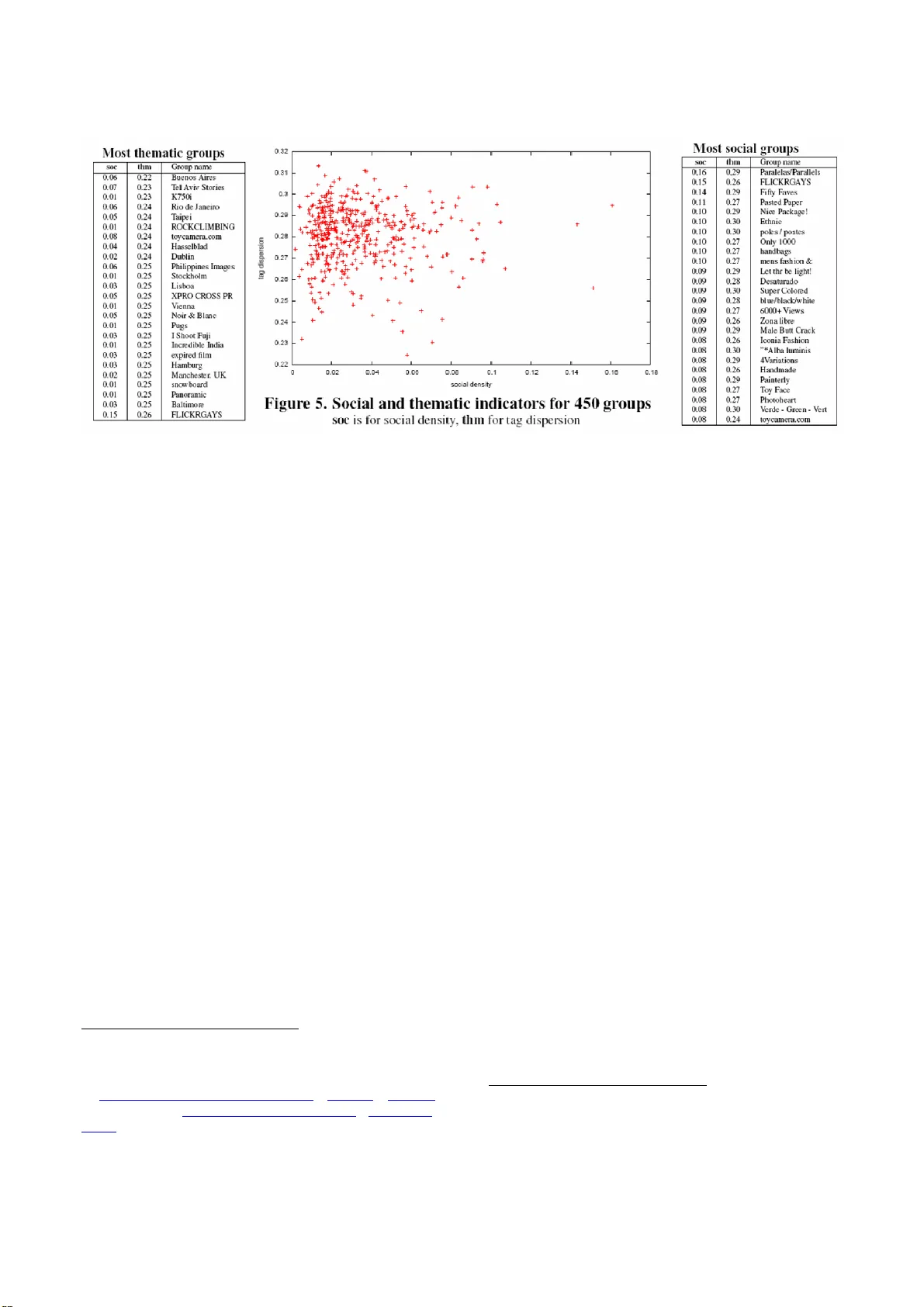
The Stength o f Weak cooperation: A Case Study on Flickr Ch risto phe Pri eur (a+ b) , Dominique Cardon (b) , Jean- Samuel Beus car t (b ) , Nic olas Pissar d (b) , Pasc al Pons (b ) (a ) L IAFA , Un iv ersi té Pari s-Di der ot Ca se 7014 75 205 Pari s Ced ex 13 prieur@liafa.jussieu.fr (b) S ENSE , Ora nge Labs 38 rue d u g énéra l Le cler c 92 131 Issy Mo ulin eaux 00 33 1 45 2 9 57 7 4 domi.cardon@orange-f tgroup.com ABSTRACT Web 2 .0 works with the pri nciple of weak co operation, where a huge am ount of individual contribut ions bu ild so lid and structured sour ces of da ta. In this paper, we detail the m a in properties of this weak coo peration by illustrating them on the photo publication w ebsite Flick r , showing the variety of us es produci ng a rich content and the v arious pr ocedures d evised by Flickr users themselves to select quality. We underlined t he interaction between small and heavy users as a specific form of collective productio n in large social networks comm un ities. We also g ive the main st atistics on the (5M-users, 150M-photos ) data basis we worked o n for this stud y, collected from Flickr website using the pu blic API. Keywords web2.0, social m edi a, flickr, folksonomies, self-organization, social networks. 1. INTRODUCTION Without trying (once ag ai n) t o define what li es (and what does not) b ehind the label “Web 2.0”, one can at least deal with t he articulation of individual self-production practices and cooperation between In ternet users, resulting in the coll ective construction , on the WWW , of big, structured sources of information made of a huge amount of individual contribut ions. The development of the ‘ good-old Web’ h ad alway s be en d riven by a community i deal, and it had b een built u p mainly t hrough organized cooperation between v o luntary participants. In this context, the cooperation b etwee n mem b ers has often been described as strong: mutual socializatio n and defined roles give mem ber s a fee ling of belongi ng to the community and a j oint, shared aim [ 1]. The successful gro wth of Web 2 .0 services (driven by Wikipedia, blo gs, Fli ckr, etc.) has led to t he definition o f a much weaker cooperation between In ternet users, detailed in [ 1] . As a result of t he spread of self-production t ools (image, video, blog platforms, wiki, etc.), Web 2 .0 services enable cooperation between Internet users as a sid e ef fect of their individual publicatio n activities. The ‘strength of weak cooperatio n ’ 1 lies in 1 The expression is of course coined in reference to Granovetter’s S trength o f Weak Ties [3] . the fa ct that it is not necessary for in dividuals to have a cooperative pla n of action or an altruis tic con cern beforehand. They discover cooperative opportu nities simply by making their individual produ ctions p ublic. P ubli c space i s seen as an oppo rtunity f or one’s visibil ity, leading to relation making and eventually act ual cooperation with differ en t levels of involvement. And this coo peration can work in a very large scale pr ecisely because it is non-demanding. This weak cooperation in a numeric s pace also allo ws co operation between small and heavy users which could be pro blematic in real life. As a website for pho to pub lication providin g tools that enable coordin ation, Flickr i s often showed as a t ypical example of t he Web 2.0 [4] . The aim of this paper is to detail the concept of weak cooper ation on th is example, showing the great variety of uses, from pl ain stockpiling of pho tos to complex combinations of all the f u nctionalit ies, and how these f unctional ities s e rve both individualistic purposes such as build ing o ne’s notoriety and altruist on es since they lead to a highly structured base of photos with many user-generated procedures to select quality from quantity. We first describe in Section 2 the functionalities of the w eb site and the database we used f o r ou r study, giving b asic figures on the uses of the website. Section 3 deals with individual aspects of these uses such as the variety of individual practices and the necessity of ‘playing the gam e’ to get acknowledged. This last point leads to Section 4 where collective i ssues are add ressed, studying the user-created groups, mixing a bo th thematic and social fun ctionality whose ro le in the weak cooperation i s crucial si nce i t enab les users to invent their o wn procedures of selection. 2. FLICKR, SYMBOL OF WEB 2.0 Although Fl ickr is among the original ‘o ff i cially’ Web 2.0 websites 2 , its founders had not anticipated that it would become a photo p ublication t ool. Stewart Butterfield and Caterina Fake (see [4] ) initially intended it as a multi-player game, then as a platform with chatrooms where people would share objects materialize d as pictu res. But uploadi ng of p ersonal pictu res to ok more and more importance i n the service launched by Ludicorp 2 in the exemplified d efinition semi n ally give n b y Tim O’Reilly [3 ]. in Februa ry 200 4. The functio nalities e volved to suppress chatrooms and p rovide p ersonal pages to users. Afte r a few months o f growing succe ss, Flick r w as acquired by Yahoo! for reportedly $30 million. The ability of th e creators of F lickr to follow t he actual uses of their service was a key to its original position ing and thus t o its success. It came at just the right time, co mbining the boom of the sales of digital ca me ras, the growth of social networks services and the suc cess of blogs, for which Fli ckr soon provided po sting tool s. Some studi es h ave already been done on Flickr. T he history o f the site and its emblematic importance in the w eb 2 .0 paradigm has been intr oduced b y Cox [ 4] and Va n Ho use [ 7] , while Marlow et a l. [8] present Flickr as a n example of F olksonomy system s. But few st udies are based on extrac t ions of F lickr database. To o ur knowledge, the onl y large statistical analysis of Flick data h as been done by Kumar et al. [9] at Yahoo . They present a series of measurem ent s of the evoluti on of the different components of Flickr’s relational structur e. In th is seminal work they have demonstrated t hat Flickr ( and Yaho o! 360) is composed of a growing giant connected component (59.7% of users at the end of the studi ed period) that represents t he large group of people who are connected t o each othe r throu gh path s in the social network. Beside this giant component, they describe a middle region o f less connected users, and t hen isolated sin gletons. Whi le this st ructure is characteristic o f large networks, they sho w that the propor tion of the m id dle region is constant over the time, taking 1/3 of th e u sers. In anot her context, Lerm an and Jones [1 0] extracted small sam pl es of d ata from Flickr in order to sh ow the role of contacts for browsing o n the site. The most important part of t he studies on Flickr deal with th e an aly sis of th e evolution of ph otographic p ractices [ 7]. In an examination of di gital phot ographers’ “ph otowork activities” [ 11 ], Miller and Edwards [12] have showed that for some people, Flickr suppo rts a diff er ent set of phot ography practices, s ocializing sty l es and perspective on privacy than traditional photo am ateurs. Ou r study comforts this idea th at in transforming amateur p ractices in a public activity , Flickr has propos ed a new paradigm for amateurs in which repu tation and visibility can be built by the intensity of the comm u nicative involvement with Flickr functionalities. Since Chal fen [13 ] early book ab out the “Kodak Cu lture” o f amate u r p hotograph y, the rise of Intern et-based pho to-sharing has s trongly affec ted domestic practices of photography. In Kodak Culture, a small group of persons (friends and family) share oral stories around image s with others. In the new cultu re of image – called "Snaprs" (a r eference to th e missing "e" in F lickr) b y the auth ors – phot os are used to tell st ories with im a ges, rather th an about image s as with the ho me mode [ see also 14, 20 ]. In this new context, photo is no t a story shared wi t h closed relatives, but a large-scaled conversation shared with people th at participants don’t know in real l ife. Our st udy shows that Kodak and S naprs cultures coexist on Fl ickr pla tform , but that Snapr users l ead the comm u nity. 2.1 Main functi onalities Pho tos are the center of Flickr’s activity. Users can index the m with tags (freely chosen key words), post them to thematic user- created groups , and put com ments to t hem. Only the owner of a photo can po st it to a group, while any user can t ag and comm en t other users’ photos. Users can also mark as f avorites other users’s pho tos. Users have to r egister to a group to be able to post ph otos to it and users can mark other users as contacts . Basic mem b ership i s free but has some limitations w ith res p ect to a paying s o-called “pro” account (o nly the last 200 uplo aded photos o f the user are displayed, th e user can on ly create three sets, and the per-month upload bandwidth limit is lower 3 .) 2.2 Harvesting the data During S umm e r 200 6, we have used the Flickr public API 4 to extract all public data concerning the five functionaliti es listed above (tags, groups, comments , favorites, contacts). For users, only the identifiers have been stored (no personal i nformation) and for pho tos, only identifiers and titles (of cour se not the photo itself). The extraction w a s d one (in Java) by iterating on each u ser id u , to get al l cont acts and ( public) gr oups o f u , and by iterating on each (public) ph oto p of u , to get all comm ents, tags and favorites of p . Ano ther iteration wa s th en done on each group g to get the list o f photos p osted in g . 2.3 Basic figu res By definition, p rivate p hotos are… private, thus unr eachable by the AP I. However we can give an u pper bo und for thei r quantity since the ids of Flickr photo s are numbered by up load order 5 . For instance, we have in o ur p hoto base the ids 2228 5118 3 and 2228 51185 b ut n ot the 22285 1184 . The latter is th us eith er private or has been del eted. By th is mean, one can claim tha t private photos are not m o re than 33 % 6 (since the ids that we have in our base cover 6 7% of the range). In the rest o f the paper, only publ ic ph otos will b e considered unless spe cifically mentioned. Figure 1 shows the d istributi on of p hoto s, which is of course highly heterogeneous (althou gh technically not in p ower law), 20% of the users owning more than 82 % of the ph otos. One counts 156 840 996 (public) photos for 4 788 438 u sers, which makes an aver age of 33 for all users or 87 for users having at least one photo. “Pro” accounts have naturally much more ph otos: they own 59.5% of p hoto s while they represent 3.7% of the use rs. 3 Since our data extraction , t hese r ules h ave changed and pro accounts do n’t have up load limit any more. 4 http://w ww .flickr.com/services/api/ 5 Let us ju st mention fo r the anecdote the first public pho to, numbered 74, http: //www . flickr.com/ p hot os/bees/74/ , uplo aded on Decem be r 15, 20 03 an d named big_test. 6 In an interview given in April 2 005, Stewa rt Butterfield even gave an 82% for p ubl ic phot os (see [ 12]). Note that our 67% is rather con stant in time (actually it goes between 65% and 70%), which does no t con tradict the 8 2% sin ce we don’t have a way to know the amount o f uploaded-th en-deleted pho tos. per user (hav ing at lea st 1) % of users hav ing 0 functionalities total all non-pro pro all non-pro pro photos 156 84 0 99 6 87 39 562 62 65 6 of a u ser 14 9 26 127 9 6 40 65 67 20 contacts incomin g - 9 6 41 65 66 16 given 46 6 46 865 76 26 254 87 90 25 comm ents received - 61 24 271 84 86 35 given 17 8 83 026 56 27 145 93 95 56 favor ites received - 52 15 131 93 95 39 groups 72 875 15 8 37 92 94 51 Table 1. Distribution o f Flickr Functiona lities One reads this table as follows: the average number of p hotos per user having at least 1 ph oto is 87 among all users, 3 9 am ong non-pro , 562 among pro users. Users with no photo make 6 2%, 65% and 6% resp ectively among all users, non-p ro users and pr o users. Figure 1. Public pho t os per us er Table 1 above sums up the average use of each functionality. The first obvious t hing to remark is the big diffe rence between pro and n on-pro users, w hi ch is not only a consequence of t he limitation in the n umber o f ph otos, since it can a lso b e observed on the average n umber of c ontacts (6 vs. 40). What can also be noticed i s th e different amount of u ses of th e various functionalities, e ven among pro users (only l ess th an half of pro users use groups or favorites). Before studying in detail Section 3 this diversity, let us focus on t he most active users. 2.4 Top sample base As we have j ust seen, the activity o f Flickr users is very heterogeneous in intensity. In ord er to stud y the particularities o f the social uses o f the site, we h ave extracted a sample base for some of the measures presented in the next section 7 . This ba se is made of the 5 0 000 m ore intensive users, where th e intensity of a user w as m ea sured by taking t he sum of the normalized r anks of a us er o n each of the fun ctionalities. In t his base, t he average 7 We alw ays mention w h ich mea sures are d one on the whole base and which o n this to p sample base. number of posted p hoto s i s 915 (with a maxim u m of 75 7 37), of contacts 181, of favorites 270 (received 30 7), o f pos ted comm en ts 775 (received 751). 3. BUILDING ONE’S REPUTATION 3.1 Various pub lic uses The or iginality o f Flickr was to mix pho to storage facilities w i th social activity. Figure 2 shows the repartitio n of the usage o f th e functionalities among all registered users. contacts 4% contacts + comm. 4% comments 3% Al l 3% others 5% Ph otos only 19% Act ive acco unt, n o public photo 23% Na ked Account (i n active or private ph otos only) 39% Pho tos and more 19% Figure 2 . Distribution of functionali ties among all registered user First, 39% o f the r egistered u sers seem to b e totally inactive. They don ’ t use any functionali ties of the site and th ey haven ’t upload ed pub lic pho tos. Second, 2 3% o f users haven ’ t u pload ed public phot os but h ave used comm uni cation functio nalities of the site. We could hypothesize that a small part of participants o f those two categories of users have upload ed private p hotos that we couldn’t catch in ou r data. Nevertheless, their par ticipation in general Flickr activities remain very small even if they represent 62% of all registered users. The s trong h eterogeneous distributi on of the inten sity of p articipation i s a com mon law o f all web (2.0 or no t) platforms. In th e following sections, we will only di scuss on the remaining 38% o f users. We could distinguish two g roup s of users: 19% of them upload public photos w i thout using comm uni cation functionalities and 19% have both uploaded pu blic photos and used various comm u nicative functionaliti es such as conta cts, comm ents or group part icipation. This opposi tion strength ens the main difference in Flickr practices between peop le us ing Flickr in o rder to store th eir o wn private or pu blic pi ctures and those w ho u se pho tographs as a way to communicate with o thers. As it has been d escribed in many o ther onlin e platforms such as Wikipedia [1 6] , Blo gs [ 17 ] or YouTube [ 18], a very sma ll minority of users p rod uce a large amount of the content but a ls o organize this content thro ugh their activities: cre at ing or animat i ng g ro up, tagg i ng pictures, organizing contests, defining reputation of others, etc. As soon a s we concentrate o ur o bservation on these users, we can ob serve two significant kind s o f social networking practices. Some are more i nterested in s ocial contacts, ot hers by socializing content. Those results can be ob served wi th the correlation matrix o f t he uses o f Flickr functiona lities (Table 3 on the next page , we discuss this more in detail below): social practices such as incoming and outgoin g cont acts are strongly correlated with each oth er, but not with the number of uplo aded pictures. On the cont rary, sharing comm ent s or fav orites are closely linked together and also stro ngly associated with the number of phot os. Com ponent 1 2 3 Nb pho tos - 0. 56 - 0. 238 0. 615 nb cont acts out 0.325 0.833 0.05 8 nb groups 0.196 0.058 -0.771 nb cont acts in 0.648 0.662 0.19 1 nb favo rites out 0.529 -0.211 -0.207 nb favo rites in 0.808 -0.058 0.097 nb com men ts out 0.894 -0.277 0.085 nb com men ts in 0.720 -0.443 -0.003 Table 2. Three dim ensional PCA: thre e type of use s 8 (top sam ple base) To be more precise, Table 2 summar izes the result, on the top sample base, of a principal component analysis in th ree dimensions showing three types of uses, the f i rst one opposing the n umber of pho tos to the r est of the functional ities ( social media use ), th e second o ne opp osing the functionaliti es attached to pho tos to t he function alities attached to the user ( MySpa ce- like ) and t he third where most o f the a ctivity is concentrated on upload ing photo s ( photo sto ckpiling ). A synthetic proj ection on the first t wo co mponents is given on Figure 3. I n the last type o f use (phot o storage), peopl e up load p hoto s bu t have no comm u nication p ractices with ot her users. I n this con text, Flickr appears only as a personal repo sitory. We coul d hypothe size that most of them bel ong to the “Kod ak culture” [ 13] that can be characterized b y holid ay and fam il y pi ctures. The second one is a kind of My S pace-like use of F lickr. People upl oad a small number of pictures but have a n intense u se of communication functions. They use Flickr as a social network site in order to find new friends, sometimes with no clear links with ( publi c) photograp hic activities. The first type of us e is the conversational use of photograph y which characterizes the 8 The three axis of th e analys is explain 68% of the variance , which means that it is rather reliable. “Snaprs Cultur e” [13] . In this con text, people s hare con tents, comm en ts and social relatio ns. This variety of uses shows t he flexibility of t he platform. But it also demonstrates that a minority of active u sers can l ead the who le community (see also [9] ). Figure 3. Tw o-dim ension project ion of the PCA 3.2 Reciprocity The core pr inciple of “social media” is tha t the individua l practices ju st described are driven by the recognition users give to each other. I t is n o surprise that a high part (6 4%) of the contacts are reciprocated. This reciprocity is 32% for comme n ts between users ( i.e. the fact that a user u has commented at least one ph oto of user v ), which is still very high since contrarily to contacts, retur ning a com ment requ ires more than clicki ng o n a link: you have to go to th e user’s p age, chose a ph oto and… find something to say . T able 3 sho ws th e correlations between the different f u nctionalities. The highest c orrelation value (0. 87) is precisely for rec ei ved c omme n ts vs. posted comments , w hi ch means that peop le po sting many comm ents also receive many comm en ts. correlation s nb ph otos nb groups nb outgoing contact s nb in coming contact s nb faves granted nb faves received nb comments posted nb comments received nb photos 1,00 nb groups 0,24 1,00 outgoi ng contacts 0,13 0,45 1, 00 incoming contacts 0,17 0,51 0, 76 1,00 nb faves g ranted 0,17 0,46 0, 30 0,39 1,00 nb faves recei ved 0,16 0,42 0,28 0,61 0,47 1,00 nb com. posted 0,20 0,52 0,36 0,60 0,53 0,78 1,00 nb com. received 0,17 0,49 0,29 0,47 0,53 0,55 0,87 1,00 Table 3. Correlation s betw een funct i onalities pe r user 1 , 0 0 , 8 0 , 6 0 , 4 0 , 2 0 , 0 - 0 , 2 D i m e n s i o n 1 1 , 0 0 0 , 7 5 0 , 5 0 0 , 2 5 0 , 0 0 - 0 , 2 5 D i m e n s i o n 2 n b c o m m e n t s i n n b c o m m e n t s o u t n b f a v o r i t e s i n n b f a v o r i t e s o u t n b c o n t a c t s i n n b c o n t a c t s o u t n b g r o u p s n b p h o t o s n b c o m m e n t s i n n b c o m m e n t s o u t n b f a v o r i t e s i n n b f a v o r i t e s o u t n b c o n t a c t s i n n b c o n t a c t s o u t n b g r o u p s n b p h o t o s M y S p a c e - l i k e S o c i a l m e d i a u s e P h o t o s t o c k p i l i n g 1 , 0 0 , 8 0 , 6 0 , 4 0 , 2 0 , 0 - 0 , 2 D i m e n s i o n 1 1 , 0 0 0 , 7 5 0 , 5 0 0 , 2 5 0 , 0 0 - 0 , 2 5 D i m e n s i o n 2 n b c o m m e n t s i n n b c o m m e n t s o u t n b f a v o r i t e s i n n b f a v o r i t e s o u t n b c o n t a c t s i n n b c o n t a c t s o u t n b g r o u p s n b p h o t o s n b c o m m e n t s i n n b c o m m e n t s o u t n b f a v o r i t e s i n n b f a v o r i t e s o u t n b c o n t a c t s i n n b c o n t a c t s o u t n b g r o u p s n b p h o t o s 1,0 0,8 0,6 0,4 0,2 0,0 -0,2 Dimension 1 1,00 0,75 0,50 0,25 0,00 -0,25 Dimension 2 nb comments in nb comments out nb favorites in nb favorites out nb contacts in nb contacts out nb groups nb photos nb comments in nb comments out nb favorites in nb favorites out nb contacts in nb contacts out nb groups nb photos MySpace- li k e Social media use Photo stockpil i ng Of course this d oesn’t mean any general rul e: m o re than 2 300 users h ave posted at least 1 00 comm en ts without having received only o ne, whereas on ly 317 users have received at least 100 comments w ith out having posted any. Posting is always easier tha n receiving… The difficulty is even greater for favorites since this functio nality is by definition a matter of taste: o nly 1 3% of fav orites between users ( user u has marked a t least one photo of user v as fav o rite) are reciprocated and the correlation between fav orites given and received is very low (0.47). Howeve r, an interesting clue for favorites, as w ill be detailed now, is the high correlation (0.78) between favorites received and comments posted, suggesting th at if you do n’t necessarily get “faved” by c omm e nting other peop le’s photo s, at least you will be much more likely t o. Note that t his is confirmed by the fact that for the users in our top sample base, the average n umber o f favorites received is even ( slightly) greater than the one of favorites gi ven. 3.3 Flickr’s star system Since the Flickr platform pro vides visible signs of recognit ion (views, faves, comme n ts), it generates a sub-po pulation of star photograp hers, characterized by very good audience figures (up to 1 million views, 100 comments per photo ) often combined with other forms of recognition. To have a n insight on how Flickr stars are made, we tested a simple regression model on our top sample b ase. The dependa nt variable is the number of favorites received. We explain it w i th the variables of activity on Flickr: phot os post ed, comme nts made, favorites grant ed, grou ps membership, co ntacts made. The regression analysis suggests (R²=0.5 1) t hat the best wa y to obtain gratific a tions is to post a l ot of comme n ts, then comes giving favorites and participatin g in grou ps. Social activity is a necessary con dition to reput ation: one of t he prominent Flickr stars is also the top commentator on the site (51 400 c omme n ts posted in 18 month of activity) . So ma king oneself visibl e by posting a l ot of co mm ents , and a lot o f phot os i nto groups, is on e of the keys to s uccess on Fl ickr. Fame and recognitio n can also be earned or maintained in t he editorial ecosystem d eveloped around Fl ickr: a large var i ety of blogs, groups, u ser-made algorithms, work at extr a cting t he crème de l a crème of Flickr, providin g selection of p hotos, interviews with Flickr artists, thematic selectio ns, etc. In return, stardom on Flickr leads the elected users to intensify their practice. For some users, Fli ckr fame is converted into real-life recognition and benefits, like publications in magazines , exhibition , and pro fessional opport unities. "I can honestly say I n ever, ever expected, when I first started using flickr to s imply keep my d rawings somewhere onl ine to easily be able to show them t o friends, that I w o uld end u p becoming one of the m o st popular peo ple on flickr […] I’m amazed a nd q uite touched a t ho w many p eople regularly visit my photostream, it’s gotten 875 0 00 views in less than a year, and th at’s ju st an absur d nu mber to me. I m ean, Iceland, wh ere I l ive, h as only 30 0 00 0 inh abi tants! So this h as been a very cool exper ience for m e, I’ve started getting attention here in Iceland as well, which ma kes t his all seem more real somehow. I’m very optimistic about the future. I am currently studying visual arts, prepa ring an exhibi tion, and I go t my fir st paying shoot" (Rebekka, http://flickr.com/people/rebba/ ). Even tho ugh R ebekka, quoted above, may have created her Flickr account with the idea of b eing a sto ckpiling-type user, her publicatio n activity was for her an o pport unity of i nteraction and as she started to “pla y the gam e” of the social media, she became so involved that she is now part of the lead users who operate this weak cooperation. 4. GROUPS, A COORDINATION TOOL The cont act functio nality is one-to-one. Fu nctional ities attached to photos (comme n ts, tags, favorites) are essenti ally o ne-to- many , even though s ome photos’ co mm ent s may be the occasion for d iscussion between comm entators. The place for many-to- many interactio ns is groups. In groups u sers can interact independ ently of a photo or a ph otograph, have discussion s or make decisions on p hotos, phot ographers, groups or even F lickr. The fact that onl y 8% of all Flickr users (49% of pro users) a re in groups is again a mark of the weak coo peration, where an active m inority operates the struct uring of the whole community. Figure 4 s hows th e distribution of the number of members and of photos among the 72 875 groups. Technically, a gr o up is made of a pool of ph otos posted by users who have p reviously joined the group, and of a discussio n forum where messages may include sm al l versions o f phot os (taken in the p ool or elsew he re on Fli ckr). What makes group s an importan t too l i s their flexibility: any user can create a group, decide the rul es governing the po sting o f photos to the p ool and of messag es to the forum, and name administrators who will be re sponsible for the application of these r ules 9 . There i s thus a great di versity in the types of groups, in their content as much as in their r ules and activity. Figure 4. Distribution of Flickr groups 4.1 Thematic and social tool Am o ng t he site’s function alities, tags, con tacts an d groups a re the three giving direct acces s to pho tos. The first two h ave very distinct functions: tags ar e essentially used f o r indexing — a photo with the t ag cat will app ear in glo bal searches made on this tag. As for contacts, they are the core materia l of the social media — Flickr shows you the recent p hotos of y our contacts 9 Unlike o ther m embers, the administrators of a gro up have the technical possibility to remove photos, forum posts or even members from the group. with t he idea that peop le do n’t only want t o see photo s of something but also someone’s p hoto s [ 10]. Now groups d raw on both aspects: they gather not only photos on on e t opic b ut also people, who cont ribute (o r not) to give a social identity to t he group by their activity. This wide range of group types partly explains their very high thematic red undancy (over 3 00 groups abou t ju st cats). The simplest are defined virtual ly around a tag (cat, P aris, etc.) with no pu blication restriction s or specific activity. Their interest l ies mainly in increasing the chances of ph otos being seen. Con versely , in some gro ups phot os are a p retext for abu ndant discussions o n the foru m or for playing gam e s with them. In the group Flick -O-System : ? degrees of separation , each discussion thread is a game with phot os 10 (not necessarily taken from the group’s p ool): a thread where each ph oto shares a s mall detail with the previous o ne, anoth er thread with characters looking alternately right and left (see picture on the… right). This sociability with in a group sometim es extends to physical meetings, like in the group flickr@paris , “Where the parisian and tourist flickrites m eet, p arty, an d ge t some pictures don e together... P laces cha nge oft en, dates to o, so keep an eye o n th e topics an noun cing events” . Of cour se many group s are so me where between mostly th ematic and m o stly social, since making social activity from a themat i c goal i s easy . To take an example, the group The M oon [*current* photos onl y] i s so specif ically t hematic ( “P lease do not post any pictures of th e Mo on tha t are o lder than three days old in this group, pictures older than that will be deleted. Pictures that don't con tain the Moon will also be del eted” ) that its admi n istration itsel f becom es social a ctivity, whose tracks can be seen in t he forum. 4.2 An analytic scheme In order to draw a map of the groups following the t wo aspects just described, namely tags and con tacts as resp ectively th ematic and social in dicators 11 , let us present briefly two m easures of these 12 . Given a group g , we will ca l l th e thematic graph (resp. socia l graph ) of g th e graph whose vertices ( i.e. nod es) are the mem ber s of g having po sted a t l east on e photo with at least one tag, and w her e an (undirected) edge ( i.e. li nk) betw ee n users u and v denot es the fact that they h ave at least one tag in comm on 10 One can see there the spirit of the initially intended Flickr as recalled earlier in thi s paper. 11 Of course these criteria are used as a proxy. In many circumstances, th e con tact functionality is used as a boo kmark to a user’s ph otos, w hi ch may thus also ind icate a thematic relation. As for tags, many are used precisely by grou ps as an identity (thu s social) mark ( deleteme1 , to p-f25 …). 12 See [13] for more details. (resp. one is a contact of t he other). Thema t ic edges will be weighted using a function w d efined as follows. - Given a tag t and a user u , n t a nd n t (u) den ote respectively the nu mber of all Fli ckr photo s and the n umber of photos of user u , b oth having tag t (inc luding ph otos o utside studied groups). T h e maxi mal v alue of n t is denoted by n max . - The rarity coef ficient ρ t of a tag t is defined by log(1+n max /n t ) . This coefficient ranges from 1 for the most used tag beach to approximately 10 for the rarest ones. - The tag weight w u,t of tag t on user u is defined by 0 if n t (u)=0 , by 1+log n t (u) oth erwise. The idea of the log is o f course to reduce the impact o f users posting t housand s of photos about th e same top ic (their wedding, baby, cat, holiday...) - Finally the edge weigh t between users u and v is: w u,v = w v,u = Σ t ( ρ t × min(w u,t , w v,t ) , which is meant to tell whether u and v share many t ags, tak i ng into account the rarity of these tags: the rarer are the tags, the closer the users are to each other. Let us now recall that a Lorentz c urve graphically sho ws a cumulative distribution function (the leftmost curves on Figure 1 in Section 2 are Lorentz curves) and th at the Gini coef ficient of a distributi on is the area b etwee n th e Lorentz curve an d the diagonal (which is th e Lorentz curve of th e uni form distributi on). This coef ficient is a measure of the heterogeneity of the distrib ution: in the case of the number of ph otos owned b y mem ber s (Fi gure 1 ), the Lorent z curve for pro users is closer to the diagonal than t he one for all users, thus the Gini coef ficient (thus th e heterogeneity of the distributio n) is lower. We will now label a group by its social density , def ined as the density of its social graph ( i.e. the ratio of existing edges among all possib le edges given the number of vertices) and its tag dispersion , def ine d as the Gin i coefficient of the d istribution o f edge weights in i ts thematic graph. Figure 5 shows t he r esults for a sample of the 450 groups having b etween 433 and 50 0 mem ber s (in ou r database, thus at th e time of the crawl) . What i s in teresting i s to look at the groups lying away from t he upper-left clou d of mainstream group s with low social d ensity and high tag d ispersion. The most th ema tic o nes, whose position is in the lo wer part of th e chart, are listed on t he l eft-hand sid e of th e chart. Three-quarters o f t hese group are in two categories: geographical, especially cities (Buenos Aires, Tel Avi v, Taipei etc.) and techni cal gro ups (K75 0i, XP RO, Fuj i etc.), who se social densi ties r ange from very low values (Vi enna, Stockholm for citi es, K750 i, expired films for techn ical) to quite high ones (Tel Aviv, Buenos Aires and to ycam era, X PR O). In the case of cities, the social d ensity m ay distingui sh between tourism groups (where people just po st pho tos o f the ir travels without having much contact w ith ot hers) and everyday -life group s, as suggested by the name of the group Tel Aviv Stories . As for groups with high social dens ity, listed on t he r ight-hand side of the chart, let us discuss on the first three easily distinguishabl e o n the far right on the chart. The group Paralelas/Paral lels is intended for photos with… parallel lines (wires, sky sc rapers etc.), which cou ld m ean any kind of phot os (the tag dispersion is high). But as s uggested by the title in Port uguese, many m e mbers are from B razil. This is an exam ple of a social group whose social activity comes from a geographical proximity of its mem bers (as was the case for T el Aviv Stories). The grou p FLICKRGAYS i s o ne o f the (qu ite few ) exam pl es of both thematic and social groups 13 and m ay have some re levance in terms of so cial cohe sion. Finally, Fifty Faves is for photo s having bee n marked as favorites by at least fifty us ers. Of cou rse n ot thematic, this grou p is for very experienced Flickr users, who kno w each other and have discussions a bout their p roduction s. Along with many similar groups ( top-f50 , G r eatPixGallery 100f aves+ , 100 club etc.), it can also be seen as a popularity enhancer and one of the numerous groups whose function is to select q uality. 4.3 What does quali ty me an? The editorial f u nction is a respo nse t o the need for qualit y in a context of decentralized self-production. Many group s a re created with this purpo se, with a gain various ways t o ach ieve it. Some highly prestigio us group s set themselves u p as very selective, “ heavily curated ” galleries, to quo te th e warning given in the description o f the group H ardco re St reet P hotograph y , which refers t o p rofessional photo agencies as models and rejects photo s without explanations ( “we d on't have a q uant ified set of rules. It' s just a feeling th at we have” ). There is a lso a large fam il y of voting grou ps, working on the following princ iple: each t ime someone po sts a ph oto, th ey must rate or comm en t on one or m ore photos of the group 14 . The administrators just delete the photos of members who do not play the game . Besides enabling an aut omatic feedback for one’s 13 in our two lists, t hese groups are FLICKR GAYS and toycam era.com . 14 http:// ww w.f lickr.com/groups/scoreme/ , /hi mom/ , /scoring/ etc. for scores, /commentscom mentscomments/ , /comm ent s/ , /1on1/ etc. for… comm ents. phot os, some of these gr oups also h ave a ‘select’ do uble, intended for pho tos having successfully gone thro ugh th e voting process. As an example, in the gr oup DeleteMe! , mem b ers are invited to tag ph oto s w it h either deleteme or saveme . Af t er ten deleteme , a ph oto is deleted from the po ol. After ten sav eme , it is in vited in the grou p TH E SAFE 15 , where it is voted on i n a weekl y thread o f the fo rum, along with all photos ‘sav e d’ durin g the same w eek. Even though this example is particular among the fa mily of voting groups, since it i s essentially d evised as a game ( “On flickr w e are a ll nice and sweet.. . always wi th a tender wo rd for a fl ickrbuddy... [In the Del eteMe! grou p,] time to be na sty, mean, selfish and arrogan t, time to dare to say w hat we th ink... and nob ody can complain because t hat' s the rules members accept. […] So just dare to p ut some o f your photos to see how we appreciate them and how q uick we will remove it from the group” ), it still illus trates th e kinds of soph istication that can b e reached by procedures devised by Flickr u sers to s elect quality, as was studied in [1 2] . What is most r ema r kable is th at all these proce dures might be seen as redundant with a built- in functionality of the service, namely the interestingnes s , a kin d of pagerank for Flickr photo s, taking into account elements such as the popularity of w h o has viewe d them, marked them as fav o rites e tc. This redun dancy shows that there is not on e unique measure of “interestingness” or of quality and peopl e appear to want some con trol on what kind of aesthetics they want. 5. CONCLUSION AND FUTURE WORK In this p aper, we have presented t he main result s of our extraction of a Flickr database. We've insisted on the heterogeneity of involvements, the diversity of users activities, the r ole of groups a nd so cial relation s in th e buildin g of reputation and structuring the c ommunity . We want to conclud e on the a rticulation between s ma ll a nd heavy u sers, which is o ne of the main features of larg e-scale social networking site. Even if the flexi bility o f Flickr platform brin gs together “Kodak” and “Snapr” Cultur es, the ma in originality of Flickr is the way it 15 There are actually also several concur rent group s int ended for phot os having been deleted in DeleteMe! . facilitates conversations between amateurs of photograph y, who doesn't kno w each other in real life an d who bot h play and gain reputation with pho tography. Our study shows that these users represent a small minority of Flickr registered account s and nevertheless, they appear as a kind of leadi ng group o f the comm u nity. They create and animate n ew group s, c omm e nt other u sers’ pho tos and tag with t he collective purp ose to crea te a specific space to share pho tos with others. A small minority of users, encouraging new activities (comments, grou ps discussion, tagging), has con tribut ed to transform a p hoto stora ge space into an organized and living space of communication. We shall s tep further in f utu re research b y i ncludin g the use profile and po pularity o f users while studying the various types of groups. Taking i nto account the role of th e t ags i n t he buildin g of communities is also an important issu e that was n ot investigated here. 6. ACKNOWLEDGMENTS This work is pa rt o f a research pro ject n ame d Au tograph , studying onlin e auto- organized collectives and partl y support ed by the French ANR-Telecom national r esearch program . The authors tha nk Bertil Hatt an d Maxime Crépel f o r many discussions on this work and Sébastien Bertrand for initially drawing their attention on Flickr. Of course nothin g could have been don e without Flickr’s API and we hop e this study wi ll bring some new insights to the Flickr team. 7. REFERENCES [1] Rheingold H . , Virtua l Communiti es , Secker & W arbu rg, London, 1994 . [2] Aguiton C., Cardon D., The Strength of Weak Cooperati on: an Attempt to Understand the Meaning of Web 2.0 , Communicat ion & Strategies , 65 , 2007 . [3] Granovetter M. S ., The Strength of Weak Ties, The American Journa l of S ociolog y , vol 78, n° 6, may 1973 . [4] Cox A. M., Flickr: What is new in Web2.0?, in Pro c. of Towards a social science o f web2.0, Worksho p "Tow ard s as social s cience of Web2.0", University of York, 2007, http://www.shef .ac.uk/content/1/ c6/04/7 7/66/ flickr%20pap er.pdf [5] O’Reilly T., What is Web 2.0: design pat terns and business models for the next generation of so ftwa re , 200 5 [ onli ne] Available at: http://www.oreilly net.com/pub/a/or eilly/tim/ n ews/2005/09 / 30/what-is-web-20.html (August 26 2007). [6] Fitzgerald M., « How We Did It: Stewart Butterfield and Caterina Fake, C o-founders, Flickr », December 2006. http://www.inc.com/m agazine/200 61201 /hidi -butterfield- fake.htm l [7] Van H o use N. A . , Exhibition and Publ ic I mag e- Sharing: Distant Closeness and Photo Exhibitio n, CHI 2007 , San Jose, mai 2007. [8] Came ron M., Naam an M., Boyd D., Davis M., HT06, Taggi ng P aper, Taxono my , F lickr, Adacem ic Article, ToRead, Proceedings of the S eventeenth ACM Conference on Hypertext a nd Hypermedia , ACM Press, Od ense, Denmark, August 200 6 : http://www.danah.org/papers/Hypertext2006.p df [9] Kumar R., Novak J., T omkins A., Structu re and E volution of Online Social Networks, KDD’06 , Ph iladelphia, A u gust 20–2 3, 200 6. [10] Lerma n K., Jon es L. A., So cial Browsing on Fl ickr, ICWSM’2007 , Boulder, Colorado, 2007 . [11] Kirk D., Sellen A ., R o ther C., Wood K., Understanding Pho towork, Proc eedings o f th e Conf erence on Human Factors in Computin g Systems , 2005 . http://r esearch.mic rosoft.com/sds/papers/Kirk_et_al_CHI06 .pdf [12] Miller A., Edwards K., Give and Take: A S tudy o f Consumer P hoto -Sharin g Cul ture and Practice, CHI 2007 , San Jose, m ay 2007 . http://www.cc.g atech.edu/~keith/pu bs/chi2 007- photos haring.pdfhttp: //www .o reillynet.com/pub/a/network/ 2005 /02/04 /sb_flckr.html [13] Chalfen R. Snap shot Versions of Li fe , Bowling Gr een, Ohio, Bo wling Green State University Pop ular P ress, 1987 . [14] Okabe D., It o M., Camera pho nes changing the definition of picture-worthy, Japan Media review , August 29, 20 03. [15] http://www.tom kinshome.com/papers/starpower/starpower. pdf [16] Anthony D., S mith S., Williams o n T., Explaining Q uality in Int ernet Co llective Goo ds: Zealot s and Good S am aritans in the Case of Wikipedia, 200 5. http://web.mit.edu/iandes em inar/Pa pers/Fall200 5/antho ny. pdf [17] Mishne G., Glance N., Leave a Reply: A n analysis of Weblog Comments, 3 rd ann ual wo rkshop on the Weblogging Ecosystem: aggregati on, An alysis and Dynamics , Edimburgh, WW W 06 2006 . http://www.blogpulse.com/ww w200 6- workshop/papers/wwe2006-discovery-lin-final.pdf [18] Lange Patricia G ., Pu blicly private and Privately Public: Social Networking on YouTube, Journa l of Compu ter- Mediated Communi cation , 13(1) , article 1 8, 2007 . http://j cmc . indian a.edu/vol13/ issue1/lange.html [19] Pissard N., Prieur P., Thematic vs. social network s in w eb 2.0 communities: A case study o n Flickr groups, Proc. o f Algotel Conference , 2007 . http:// hal.inria.fr/inria-001 7695 4/en [20] McDonald D. W., Visual Conversation Styles in Web Communities, Proceedings of the 4 0 th Hawai i Intern ationa l Conference on System Sciences , Kona, 2007 . http://p rojects.ischool .washington.edu/mcdonald/p apers/M cDonald.HICSS-40 .prepr int.pdf
Original Paper
Loading high-quality paper...
Comments & Academic Discussion
Loading comments...
Leave a Comment