First Observations on Prefab Posets Whitney Numbers
We introduce a natural partial order in structurally natural finite subsets of the cobweb prefabs sets recently constructed by the present author. Whitney numbers of the second kind of the corresponding subposet which constitute Stirling like numbers…
Authors: ** A. Krzysztof Kwaśniewski **
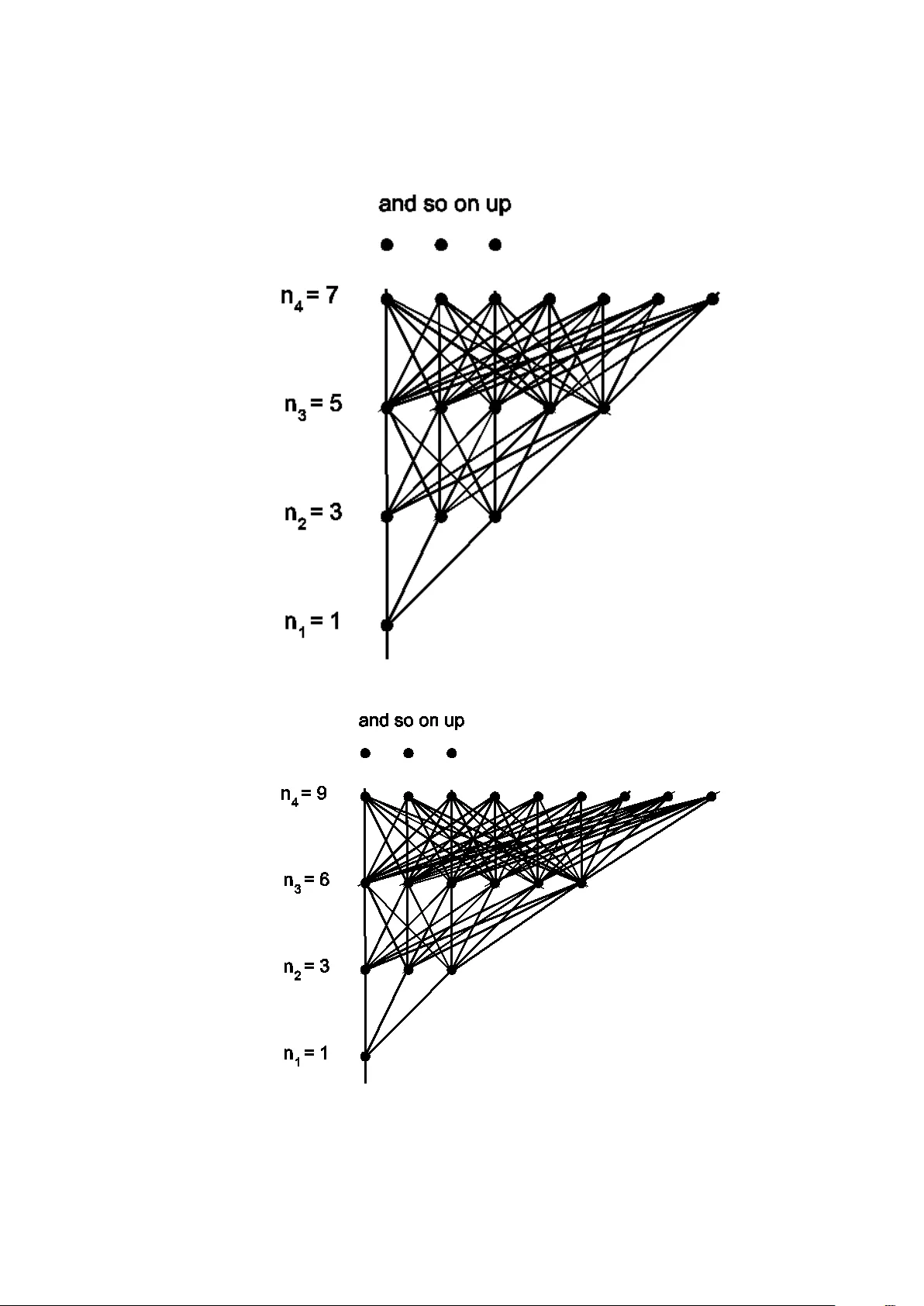
First observ ations on Prefab p osets‘ Whitney n um b ers A. Krzysztof Kwa ´ sniewski the Dissident - relegated by Bia lystok Universit y authorities from the Institute of Computer Science to F acult y of Physics ul. Lipow a 41, 15 424 Bia lystok, Poland e-mail: kw andr@gmail.com Summary W e in tro duce a natural partial order ≤ in structurally natural finite subsets of the cobw eb prefabs sets recently constructed by the present author. Whitney num- b ers of t he second kind of the corresp onding subposet which constitute Stirling-like n umbers‘ triangular array - are then calculated and the explicit formula for them is pro vided. Next - in the second construction - we endow the set sums of prefabiants with suc h an another partial order that their their Bell-lik e num b ers include Fib onacci triad sequences introduced recently b y the present author in order to extend famous relation betw een binomial Newton coefficients and Fibonacci num b ers on to the infin- it y of their relatives among which there are also the Fibonacci triad sequences and binomial-lik e co efficients (incidence co efficients included). The first partial order is F - sequence indep endent while the second partial order is F -sequence dep enden t where F is the so called admissible sequence determining cobw eb poset by construction. An F -determined cobw eb p oset‘s Hasse diagram b ecomes Fib onacci tree sheathed with sp ecific cobw eb if the sequence F is c hosen to b e just the Fib onacci sequence. AMS Classification Numbers: 05C20, 11C08, 17B56 . Key W ords: prefab, exp o- nen tial structure, cobw eb p oset, Whitney num b ers, Bell-like n umbers, Fib onacci-like sequences presen ted (No vem b er 2006) at the Gian-Carlo Rota P olish Seminar http://ii.uwb.e du.pl/akk/sem/sem rota.htm published: Adv ances in Applied Clifford Algebras V olume 18 , Number 1 / F ebruary , 2008 , 57-73 ONLINE F IRST, Springer Link Date, F riday , August 10, 2007 1 In tro duction The clue algebraic concept of combinatorics - the so called prefab (with asso ciative and commutativ e comp osition) was in tro duced in [1], see also [2,3]. The elements of prefabs are called since now on - prefabiants. In [4] the present author had con- structed a new broader class of prefab‘s extending combinatorial structure based on the so called cob web p osets (see Section 1. [4] for the definition of a cobw eb poset as w ell as a combinatorial interpretation of its c haracteristic binomial-t yp e co efficien ts - for example- fib onomial ones [5,6]). Here we in tro duce tw o natural partial orders: one ≤ in grading-natural subsets of cob- w eb‘s prefabs sets [4] and in the second prop osal we endow the set sums of prefabiants with such another partial order that one may extend the Bell num b ers to sequences of Bell-lik e num b ers encompasing among infinity of others the Fib onacci triad sequences in tro duced by the presen t author in [7]. 2 Prefab based p osets and their Whitney n um- b ers. Let the family S of combinatorial ob jects ( pr ef abiants ) consists of all lay ers h Φ k → Φ n i , k < n, k , n ∈ N = 0 , 1 , 2 , ... and an empt y prefabian t i . The set ℘ of prime ob jects consists of all sub-posets h Φ 0 → Φ m i i.e. all P m ‘s m ∈ N constitute from no w on a family of prime pr ef abiants whic h w e define after[4]in t w o steps. Namely accompanying the set E of edges to the set V of vertices - one obtains the Hasse diagram where here down p, q , s ∈ N . (Conv ention: Edges stay for arro ws directed - say - up wards - see examples below). Definition 1 P = h V , E i , V = [ 0 ≤ p Φ p , E = {hh j, p i , h q , ( p +1) ii} [ {hh 1 , 0 i , h 1 , 1 ii} , w her e 1 ≤ j ≤ p F , 1 ≤ q ≤ ( p + 1) F . . The finite cob w eb sub-poset P m is then defined accodingly . Definition 2 P m = h V m , E m i , wher e V m = S 0 ≤ s ≤ m Φ s and E m is define d as E r estricte d to V m by 1 ≤ p ≤ m − 1 is c al le d the prime c obweb poset. La yer h Φ k → Φ n i is considered here to b e the set of all max-disjoint isomorphic copies (iso-copies) of P m , m = n − k [4]. As a matter of illustration we quote after [4] examples of cobw eb p osets‘ Hasse Diagrams [9] so that the lay ers become visualized. 2 Fig.1. Displa y of Natural num b ers‘ cobw eb poset. Fig.2. Displa y of Ev en Natural num b ers ∪{ 1 } -cob web p oset. 3 Fig3. Displa y of Odd natural num b ers‘ cob web p oset. Fig.4. Displa y of divisible by 3 natural n umbers ∪{ 1 } - cob w eb poset. 4 Fig.5. Displa y of Fib onacci num bers‘ cob web p oset. 3 Cob w eb p osets‘ combinatorial in terpretation As seen ab o ve - for example the F ig . 5. displa ys the rule of the construction of the Fi- b onacci ”cobw eb” p oset. It is b eing visualized clearly while defining this [ non-lattic e! ] cob web p oset P with help of its incidence matrix [8]. The incidence ζ function matrix represen ting uniquely just this cobw eb poset P has the staircase structure corresp on- den t with ” cobwebed ” Fib onacci T ree i.e. a Hasse diagram [9] of the particular partial order relation under consideration. 5 2 6 6 6 6 6 6 6 6 6 6 6 6 6 6 6 6 6 6 6 6 6 6 6 6 6 6 6 6 4 1 1 1 1 1 1 1 1 1 1 1 1 1 1 1 1 · · · 0 1 1 1 1 1 1 1 1 1 1 1 1 1 1 1 · · · 0 0 1 1 1 1 1 1 1 1 1 1 1 1 1 1 · · · 0 0 0 1 0 1 1 1 1 1 1 1 1 1 1 1 · · · 0 0 0 0 1 1 1 1 1 1 1 1 1 1 1 1 · · · 0 0 0 0 0 1 0 0 1 1 1 1 1 1 1 1 · · · 0 0 0 0 0 0 1 0 1 1 1 1 1 1 1 1 · · · 0 0 0 0 0 0 0 1 1 1 1 1 1 1 1 1 · · · 0 0 0 0 0 0 0 0 1 0 0 0 0 1 1 1 · · · 0 0 0 0 0 0 0 0 0 1 0 0 0 1 1 1 · · · 0 0 0 0 0 0 0 0 0 0 1 0 0 0 1 1 · · · 0 0 0 0 0 0 0 0 0 0 0 1 0 1 1 1 · · · 0 0 0 0 0 0 0 0 0 0 0 0 1 1 1 1 · · · 0 0 0 0 0 0 0 0 0 0 0 0 0 1 0 0 · · · 0 0 0 0 0 0 0 0 0 0 0 0 0 0 1 0 · · · 0 0 0 0 0 0 0 0 0 0 0 0 0 0 0 1 · · · . . . . . . . . . . . . . . . . . · · · 3 7 7 7 7 7 7 7 7 7 7 7 7 7 7 7 7 7 7 7 7 7 7 7 7 7 7 7 7 5 Figure 6. The incidence matrix ζ for the Fib onacci cobw eb p oset Note The knowledge of ζ matrix explicit form enables one to construct (count) via standard algorithms [8] the M¨ obius matrix µ = ζ − 1 and other t ypical elements of incidence algebra perfectly suitable for calculating num b er of c hains, of maximal c hains etc. in finite sub-p osets of P . All elements of the corresponding incidence algebra are then giv en by a matrix of the Fig.6 with 1‘s replaced by an y reals ( or ring elemen ts in more general cases). W e ha ve a natural combinatorial ob ject characterizig the cob w eb posets Hasse directed graphs. Namely - in general ([4-7], [10], [12], [13]) - given an y sequence { F n } n ≥ 0 of nonzero reals one may define its corresp onding binomial-lik e F − nomial co efficients in the spirit of W ard‘s Calculus of sequences [13]s as follo ws Definition 3 „ n k « F = F n ! F k ! F n − k ! ≡ n k F k F ! , n F ≡ F n 6 = 0 , n ≥ 0 wher e we make an analo gy driven identific ations in the spirit of War d‘s Calculus of se quenc es (0 F ≡ 0) : n F ! ≡ n F ( n − 1) F ( n − 2) F ( n − 3) F . . . 2 F 1 F ; 0 F ! = 1; n k F = n F ( n − 1) F . . . ( n − k + 1) F . This is just the adaptation of the notation for the purpose Fib onomial Calculus case (see references in [4-7], [10], 12]). The crucial and elementary observ ation now is that the cobw eb p oset combinatorial in terpretation of F -binomial co efficients [4-7,10,12,14,16] makes sense not for arbi- trary F sequences as F − nomial co efficien ts should b e nonnegative integers. Definition 4 A se quenc e F = { n F } n ≥ 0 is c al le d c obweb-admissible iff „ n k « F ∈ N f or k , n ∈ N . 6 Righ t from the definition of P via its Hasse diagram here now follow quite obvious and imp ortan t observ ations. They lead us to a combinatorial interpretation of cob web p oset‘s c haracteristic binomial-like coefficients (for example - fib onomial ones [6,16]). Here they are with the first obvious observ ation at the start. 14, Observ ation 1 The numb er of maximal chains starting fr om The R o ot (level 0 F ) to r e ach any p oint at the n − th level with n F vertic es is e qual to n F !. Observ ation 2 ( k > 0) The numb er of al l maximal chains in-b etwe en ( k + 1) − th level Φ k +1 and the n − th level Φ n with n F vertic es is e qual to n m F , wher e m + k = n. Indeed. Denote the num b er of wa ys to get along maximal c hains from any fixed p oin t (the leftist for example) in Φ k to ⇒ Φ n , n > k with the symbol [Φ k → Φ n ] then ob viously w e hav e : [Φ 0 → Φ n ] = n F ! and [Φ 0 → Φ k ] × [Φ k → Φ n ] = [Φ 0 → Φ n ] . In order to formulate the combinatorial in terpretation of F − sequence − nomial coef- ficien ts ( F-nomial - in short) let us consider all finite ”max-disjoint” sub-p osets ro oted at the k − th lev el at an y fixed v ertex h r, k i , 1 ≤ r ≤ k F and ending at corresponding n umber of vertices at the n − th level ( n = k + m ) where the ”max-disjoint” sub-p osets are defined b elo w. Definition 5 Two families of maximal chains including two e quip otent c opies of P m ar e said to b e max-disjoint if c onsider e d as sets of maximal chains they ar e disjoint i.e they have no maximal chain in c ommon. (Al l P m ‘s c onstitute fr om now on a family of the so c al le d prime [4,10] pr ef abiants ). An e quip otent c opy of P m [‘ e quip-c opy ’] is define d as such a family of maximal chains e quinumer ous with P m set of maximal chains that the it c onstitues a sub-p oset with one minimal element. Definition 6 We denote the numb er of al l max-disjoint e quip otent c opies of P m r o ote d at any vertex h j, k i , 1 ≤ j ≤ k F of k − th level with the symb ol „ n k « F . One uses the customary conv ention: „ 0 0 « F = 1 . Naturally- let us recall- the ab ov e definition makes sense not for arbitrary F se- quences as F − nomial co efficients should b e nonnegative integers i.e. the sequence F = { n F } n ≥ 0 m ust be cob web-admissible. Problem 0. The partition or tiling problem. Supp ose no w that F is a cobw eb admissible sequence. Let us introduce σ P m = C m [ F ; σ < F 1 , F 2 , ..., F m > ] . 7 the equip oten t sub-p oset obtained from P m with help of a p ermutation σ of the se- quence < F 1 , F 2 , ..., F m > . Then P m = C m [ F ; < F 1 , F 2 , ..., F m > ] . Consider the lay er h Φ k → Φ n i , k < n, k , n ∈ N . La yer is considered here to b e the set of all max-disjoint equip otent copies of P n − k . The question then arises , whether and under which conditions the lay er may be partitioned with help of max- disjoin t blo cks of the form σ P m . At first - this main question answer is in affirmitav e. Some computer exp eriments done by student Maciej Dziemia ´ nczuk [17] are encourag- ing Ho wev er problems : ”how many?” or ”find it all” are still opened . Recall now that the n um b er of wa ys to reach an upper level from a low er one along an y of maximal chains i.e. the num b er of all maximal chains from the level Φ k +1 to ⇒ Φ n , n > k is equal to [Φ k → Φ n ] = n m F . Naturally then we ha ve „ n k « F × [Φ 0 → Φ m ] = [Φ k → Φ n ] = n m F (1) where [Φ 0 → Φ m ] = m F ! counts the n umber of maximal chains in any equip-cop y of P m . With this in mind w e see that the following holds. Observ ation 3 ( n,k ≥ 0 ) L et n = k + m . L et F b e any c obweb admissible se quenc e. Then the numb er of max-disjoint e quip-c opies i.e. sub-p osets e quip otent to P m , r oote d at the same fixe d vertex of k − th level and ending at the n-th level is e qual to n m F m F ! = „ n m « F = „ n k « F = n k F k F ! . Note The ab ov e Observ ation 3 pro vides us with the new combinatorial in terpre- tation of the class of all classical F − nomial co efficients including distinguished binomial or distinguished Gauss q - binomial ones or Konv alina generalized binomial co efficien ts of the first and of the second kind [11,12]- which include Stirling num- b ers to o. The v ast family of W ard-like [13] admissible by ψ = h 1 n F ! i n ≥ 0 -extensions F -sequences [12,14,16] includes also those desired here which shall be called ”GCD- morphic” sequences. This means that GC D [ F n , F m ] = F GC D [ n,m ] where GC D stays for Greatest Common Divisor op erator. The Fib onacci sequence is a muc h ontrivial [16,6] and guiding famous example of GCD-morphic sequence. Naturally incidence co efficien ts of any reduced incidence algebra of full binomial type [8] are GCD-morphic sequences therefore they are now indep endently given a new cob web com binatorial interpretation via Observ ation 3. More on that - see the next section where prefab com binatorial description is b eing serv ed. Before that - on the w ay - let us form ulate the following problem (opened?). Problem 1 Find effective char acterizations of the c obweb admissible se quence i.e. find al l examples. Note on admissibility . Observ ation 3 from [16] provides us with the new c ombina- torial interpretation of the class of all classical F − nomial coefficients including 8 distinguished binomial or distinguished Gauss q - binomial ones or Konv alina general- ized binomial coefficients of the first and of the second kind [11]- which include Stirling n umbers too. This v ast family of W ard-like [13] cob w eb admissible F -sequences - ad- missible at first by the so called ψ = h 1 n F ! i n ≥ 0 um bral extensions[9] - includes also those desired here whic h shall b e called ”GCD-morphic” sequences. Definition 7 The se quenc e of inte gers F = { n F } n ≥ 0 is c al le d the GCD-morphic se- quenc e if GC D [ F n , F m ] = F GC D [ n,m ] wher e GC D stays for Gre atest Common Divisor op er ator. Recall again : the Fib onacci sequence is a muc h nontrivial [6] and guiding example of GCD-morphic sequence . Naturally incidence co efficients of any reduced incidence algebra of full binomial type [8] are cobw eb-admissible. Question: which of these ab o v e are GCD-morphic sequences? In view of the Note on admissibilit y the following problems are apparently in ter- esting also on their own. Characterization Problem Find effe ctive characterizations of the c obweb admissi- ble se quenc e i.e. find al l examples. GCD-morphism Problem Find effe ctive char acterizations i.e. find al l examples. 4 Prefabs‘ Whitney n um b ers Consider then now the partially ordered family S of these lay ers considered to b e sets of all max-disjoint isomorphic copies (iso-copies) of prime prefabiants P m = P n − k as displa yed by Fig 1. - Fig.5. examples abov e. F or any F -sequence determining cobw eb p oset let us define in S the same partial order relation as follo ws. Definition 8 h Φ k → Φ n i ≤ h Φ k ♣ → Φ n ♣ i ≡ k ≤ k ♣ ∧ n ≤ n ♣ . F or con v enience reasons we shall also adopt and use the following notation: h Φ k → Φ n i = p k,n . The interv al [ p k,n , p k ♣ ,n ♣ ] is of course a subp oset of h S, ≤i . W e shall consider in what follo ws the subp oset h P k,n , ≤i where P k,n = [ p o,o , p k,n ] . Observ ation 1. The size | P k,n | of P k,n = |{h l , m i , 0 ≤ l ≤ k ∧ 0 ≤ m ≤ n ∧ k ≤ n }| = ( n − k )( k + 1) + k ( k +1) 2 . Pro of: Obvious. Just dra w the picture {h l, m i , 0 ≤ l ≤ k ∧ 0 ≤ m ≤ n ∧ k ≤ n } of P k,n ‘ grid. Observ ation 2. The n um b er of maximal chains in h P k,n , ≤i is equal to the n um b er d ( k , n ) of 0 - dominated strings of binary i.e. 0 0 s and 1 0 s sequences d ( k , n ) = n + 1 − k n „ k + n n « . Pro of. The num b er we are lo oking for equals to the num b er of minimal walk-paths in [ k × n ] Manhattan grid [15] - paths restricted by the condition k ≤ n i.e. it equals to the n umber of 0 - dominated strings of 0 0 s and 1 0 s sequences. 9 Recall that ( d ( k, n )) infinite matrix‘s diagonal elements are equal to the Catalan n umbers C ( n ) C ( n ) = 1 n „ 2 n n « . as the Catalan num b ers count the num ber of 0 - dominated strings of 0 0 s and 1 0 s with equal num b er of 0 0 s and 1 0 s . Recall that a 0 - dominated string of length n is such a string that the first k digits of the string contain at least as many 0 0 s as 1 0 s for k = 1 , ..., n i.e. 0‘ s prev ail in appearance, dominate 1‘ s from the left to the righ t end of the string. 0 - dominated strings corresp ond bijectively to minimal b ottom - left corner to the right upper corner paths in an integer grid Z ≥ × Z ≥ rectangle part called Manhattan [15] with the restriction imp osed on those minimal paths to ob ey the ”safet y” condition k ≤ n . Commen t 1. Observ ation 2. equips the p oset h P k,n , ≤i with clear cut combinatorial meaning. The poset h P k,n , ≤i is naturally graded. h P k,n , ≤i p oset‘s maximal c hains are all of equal size (Dedekind property) therefore the rang function is defined. Observ ation 3. The rang r ( P k,n ) of P k,n = num b er of elements in maximal c hains P k,n min us one = k + n − 1. The rang r ( p l,m ) of π = p l,m ∈ P k,n is defined accordingly: r ( p l,m ) = l + m − 1 . Pro of: obvious. Just draw the picture {h l, m i , 0 ≤ l ≤ k ∧ 0 ≤ m ≤ n ∧ k ≤ n } of P k,n ‘ grid and note that maximal means paths without at a slan t edges. Accordingly Whitney n um b ers W k ( P l,m ) of the second kind are defined as follows (asso ciation: n ↔ h l , m i ) Definition 9 W k ( P l,m ) = X π ∈ P l,m ,r ( π )= k 1 ≡ S ( k , h l , m i ) . Here no w and afterwords we identify W k ( P l,m ) with S ( k , h l, m i ) called and view ed at as Stirling - lik e n um b ers of the second kind of the naturally graded p oset h P k,n , ≤i - note the association: n ↔ h l , m i . Righ t no w challenge problems. I. I. Let us define now Whitney num b ers w k ( P l,m ) of the first kind as follo ws (association: n ↔ h l, m i . Note the text-bo ok notation for M¨ obius function µ ) Definition 10 w k ( P l,m ) = X π ∈ P l,m ,r ( π )= k µ (0 , π ) ≡ s ( k , h l, m i ) . Here now and afterwards w e identify w k ( P l,m ) with s ( k , h l, m i ) called and viewed at as Stirling - like n umbers of the first kind of the p oset h P k,n , ≤i - note the asso ciation: n ↔ h l, m i . Problem 1 Find an explicit expression for w k ( P l,m ) ≡ s ( k , h l , m i ) =? and W k ( P l,m ) ≡ S ( k , h l, m i ) =? 10 Occasionally note that S ( k , h l , m i ) equals to the num ber of the grid p oints counted at a slant (from the up-left to the right-do wn) accordingly to the l + m = k requiremen t. Problem 2 Find the recurrence relations for w k ( P l,m ) ≡ s ( k , h l , m i and W k ( P l,m ) ≡ S ( k , h l, m i ) . W e define now (note the asso ciation: n ↔ h l , m i ) the corresp onding B ell-lik e n umbers B ( h l , m i ) of the naturally graded p oset h P k,n , ≤i as follows. Definition 11 B ( h l , m i ) = l + m X k =0 S ( k , h l, m i ) . Observ ation 4. B ( h l , m i ) = | P l,m | = k ( k + 1) 2 + ( n − k )( k + 1) . Pro of: Just draw the picture {h l , m i , 0 ≤ l ≤ k ∧ 0 ≤ m ≤ n ∧ k ≤ n } of P k,n ‘ grid and note that S ( k , h l , m i ) equals to the n um b er of the grid p oints coun ted at a slant (from the up-left to the right-do wn) accordingly to the l + m = k requiremen t. Summing them up o ver all giv es the size of P k,n . Commen t 2. Observ ation 4. equips the p oset‘s h P k,n , ≤i Bell-like num b ers B ( h l , m i ) with clear cut com binatorial meaning. 5 Set Sums of prefabian ts‘ p osets and their Whit- ney n umbers. In this part we consider prefabiants‘ set sums with an appropriate another partial order so as to arrive at Bell-like num bers including Fib onacci triad sequences introduced recen tly b y the present author in [16] - see also [7,6]. Let F b e an y ”GCD-morphic” sequence. This means that GC D [ F n , F m ] = F GC D [ n,m ] where GC D stays for Greatest Common Divisor mapping. W e define the F - dep endent finite partial ordered set P ( n, F ) as the set of prime prefabiants P l giv en by the sum b elo w. Definition 12 P ( n, F ) = [ 0 ≤ p h Φ p → Φ n − p i = [ 0 ≤ l P n − l with the partial order relation defined for n − 2 l ≤ 0 according to Definition 13 P l ≤ P ˆ l ≡ l ≤ ˆ l, P ˆ l , P l ∈ h Φ l → Φ n − l i . Recall that rang of P l is l . Note that h Φ l → Φ n − l i = ∅ for n − 2 l ≤ 0. The Whitney n umbers of the second kind are introduce accordingly . Definition 14 W k ( P n,F ) = X π ∈ P n,F ,r ( π )= k ≡ S ( n, k , F ) . 11 Righ t from the definitions ab ov e w e infer that: (recall that rang of P l is l .) Observ ation 5. W k ( P n,F ) = X π ∈ P n,F ,r ( π )= k ≡ S ( k , n − k , F ) = „ n − k k « F . Here now and afterwords w e identify W k ( P n,F ) = S ( n, k , F ) viewed at and called as Stirling - like num bers of the second kind of the P defined in [10]. P by construction (see Figures abov e) displa ys self-similarity prop erty with respect to its prime prefabi- an ts sub- p osets P n = P ( n, F ). Righ t no w challenge problems. II. W e rep eat with obvious replacemen ts of corresp onding sym b ols, names and definitions the same problems as in ”Righ t no w challenge problems. I”. Here now consequen tly - for any GC D -morphic sequence F (see: [10]) we define the corresp onding Bell-like num bers B n ( F ) of the p oset P ( n, F ) as follo ws. Definition 15 B n ( F ) = X k ≥ 0 S ( n, k , F ) . Due to the inv estigation in [7,16] we hav e right now at our disp osal all corresp onding results of [16,7] as the following identification with sp ecial case of h α, β , γ i - Fib onacci sequence h F [ α,β ,γ ] n i n ≥ 0 defined in [7] holds. Observ ation 6. B n ( F ) ≡ F [ α =0 ,β =0 ,γ =0] . n +1 Pro of: See the Definition 2.2. from [7]. Compare also with the sp ecial case of formula (6) in [16]. Recurrence relations. Recurrence relations for h α, β , γ i - Fibonacci sequences F [ α,β = ,γ ] n are to b e found in [7] - formula (9). Compare also with the sp ecial case form ula (7) in [16]. Closing-Op ening Remark. The study of further prop erties of these Bell-like num- b ers as well as the study of consequences of these identifications for the domain of the widespread data t ypes [7] and p erhaps for ev en tual new dynamical data t yp es we lea ve for the p ossibly coming future. Examples of sp ecial cases - a bunch of them - one finds in [7] containing [16] as a sp ecial case. As seen from the identification Observ ation 6. the sp ecial cases of h α, β , γ i - Fib onacci sequences F [ α,β ,γ ] n gain additional with resp ect to [16,7] combinatorial interpretation in terms Bell-lik e n um b ers as sums ov er rang = k parts of the poset i.e. just sums of Whitney n umbers of the poset P ( n, F ). This adjectiv e ”additional” shines brigh tly o ver Newton binomial connection constants b et w een bases h ( x − 1) k i k ≥ 0 and h x n i n ≥ 0 as these are Whitney n umbers of the num- b ers from [ n ] c hain i.e. Whitney n umbers of the p oset h [ n ] , ≤i . F or other elementary ”shining brigh tly” examples see Joni , Rota and Sagan excellent presentation in [18]. 6 On applications of new cob w eb p osets‘ origi- nated Whitney n um b ers Applications of new cobw eb p osets‘ originated Whitney num b ers such as extended Stirling or Bell num b ers are exp ected to b e of at least such a significance in appli- cations to linear algebra of formal series [linear algebra of generating functions [19]] as Stirling and Bell num b ers or their q -extended corresp ondent already are in the so called coheren t ph ysics [20] ( see [20] also for abundan t references on the sub ject). Also 12 straigh tforward applications of prefabs to coherent physics [20] are on line. [Quan tum coheren t states ph ysics is of course a linear theory with its principle of states‘ sup er- p osition]. In order to say more on the sub ject of this section and give some examples let us remind the equiv alence of exp onential structures by Stanley [21] with corresp onding exp onen tial prefabs [1]. In this context the let us indicate the crucial ”W ard‘ian - prefab‘ian” example we ow e to Gessel [22] with his q -analog of the exponential formula as expressed b y the Theo- rem 5.2 from [22]. W e also recall that the q -analog of the Stirling num b ers of the second kind inv esti- gated by Morrison in Section 3 of [23] constitute the same example of W ard‘ian - prefab‘ian extension as in the Bender - Goldman - W agner W ard - prefab example. As noticed there b y Morrison the ( γ − e.g .f . ) prefab exp onential form ula may equally w ell b e derived from the corresponding Stanley‘s exp onen tial formula in [21]. Let us then now come o v er to these exp onential structures of Stanley with an exp ected im- pact on the current considerations ( for definitions, theorems etc. see [21]). In this connection we recall quoting (notation from [21]) an imp ortant class of Stanley‘s Stir- ling - like num b ers S nk M ( n ) of the second and those of the first kind Stanley‘s Stirling - like num bers s nk M ( n ) . Both kinds are characteristic immanent for counting of exp o- nen tial structures (or equiv alently - corresp onding exp onential prefabs) and inheriting from there their combinatorial meaning. This is due to the fact [21] that ”with each exp onen tial structure is asso ciated an ”exp onential form ula” and more generally a ”con volution formula” which is an analogue of the w ell kno wn exp onential formula of en umerative combinatorics” [21]. Consequently with each exp onen tial structure are asso ciated Stirling-like , Bell-like n umbers and Dobinski - like formulas are exp ected also, of crucial impotance for generalized coheren t states‘ physics. As for the another examples let us consider in more detail exp onential structures. Exp onen tial structures. Let { Q n } n ≥ 0 b e an y exponential structure and let { M ( n ) } n ≥ 0 b e its denominator sequence i.e. M ( n ) = n um b er of minimal elemen ts of Q n . Let | Q n | b e the n umber of elements of the p oset Q n | Q n | = X π ∈ Q n 1 . Example: F or Q = h Π n i n ≥ 1 where Π n is the partition lattice of [ n ] we ha ve M ( n ) = 1. Define ”Whitney-Stanley” num ber S n,k to b e the num ber of π ∈ Q n of degree equal to k ≥ 1 i.e. S n,k = X π ∈ Q n , | π | = k 1 . Define S n,k - generating characteristic p olynomials (vide exponential p olynomials) in standard wa y W n ( x ) = X π ∈ Q n x | π | = n X k =1 S n,k x k . Then the exp onen tial formula ( W 0 ( x ) = 1 = M (0)) b ecomes ∞ X n =0 W n ( x ) y n M ( n ) n ! = exp { xq − 1 ( y ) } , where q − 1 ( y ) = ∞ X n =1 y n M ( n ) n ! ≡ exp ψ − 1 , 13 with the obvious identification of ψ -extension choice here. Hence the p olynomial se- quence h p n ( x ) = W n ( x ) M ( n ) i n ≥ 0 constitutes the sequence of binomial p olynomials i.e. the basic sequence of the corresp onding delta operator ˆ Q = q ( D ). W e observ e then that p n ( x ) = n X k =0 S n,k x k M ( n ) ≡ n X k =0 [0 , 1 , 2 , ..., k ; b n ] x k are just exp onential p olynomials‘ sequence for the equidistan t no des case i.e. Newton- Stirling n umbers of the second kind S ∼ n,k ≡ S n,k M ( n ) . Both num b ers and the exp onential sequence are b eing bi-univocally determined by the exponential structure Q . This is a sp ecial case of the one considered in [20] and w e hav e the - what we call- Newton- Stirling-Dobinski f orm ula (notation, history and details- see [20]) p n ( x ) = 1 exp( x ) ∞ X k =0 b n ( k ) x k k ! = n X k =0 [0 , 1 , 2 , ..., k ; b n ] x k , ( N − S − D ob ) where h b n i n ≥ 0 is defined by b n ( x ) = n X k =0 S ∼ n,k x k . Note the iden tification b n ( x ) = w n ( x ) M ( n ) , where w n ( x ) = − X π ∈ Q n µ ( ˆ 0 , π ) λ | π | . µ is M¨ obius function and ˆ 0 is unique minimal element adjoined to Q n . Corresp onding Bell-like num bers [20] are then giv en b y p n (1) = 1 exp( x ) ∞ X k =0 b n ( k ) k ! = n X k =0 [0 , 1 , 2 , ..., k ; b n ] , ( N − S − B ell ) . Besides those ab o ve - in Stanley‘s paper [21] there are implicitly presen t also in verse- dual ”Whitney-Stanley” num b ers s n,k of the first kind i.e. s n,k = − X π ∈ Q n , | π | = k µ ( ˆ 0 , π ) . On this occasion and to the end of considerations on exponential structures and Stir- ling like num b ers let us make few remarks. q -extension of exp onen tial formula applied to en umeration of p ermutations b y inv ersions is to be find in Gessel‘s pap er [22] (see there Theorem 5.2.) where among others he naturally arrives at the q -Stirling num- b ers of the first kind giving to them combinatorial in terpretation. Recent extensions of the exp onen tial formula in the prefab language [1] are to b e find in [4]. Then note : exp onen tial structures, prefab exp onential structures (extended ones - included) i.e. sc hemas where exponential formula holds-imply the existence of Stirling like and Bell lik e num b ers. As for the Dobinski-lik e form ulas one needs binomial or extended bino- mial coefficients‘ conv olution as it is the case with ψ -extensions of umbral calculus in its operator form. Other Generalizations in brief. W e indicate here three kinds of extensions of Stirling and Bell n umbers - including those whic h appear in coheren t states‘ appli- cations in quan tum optics on one side or in the extended ro ok theory on the other side. In the supplemen t for this brief account to follo w on this topics let us note that apart from applications to extended coherent states‘ ph ysics of quantum oscillators or strings [6 - 11, 24, 25] and related F eymann diagrams‘ description [26] where we 14 face the sp ectacular and inevitable emergence of extended Stirling and Bell n umbers (consult also [27]) there exists a go od deal of work done on discretiz ation of space - time [28] and/or Sc hrodinger equation using umbral methods [29] and GHW algebra represen tations in particular (see: [28, 29] for references). Ac kno wledgemen ts Discussions with Participan ts of Gian-Carlo Rota Polish Seminar on all related topics http://ii.uwb.e du.pl/akk/sem/sem rota.htm - are appreciated with pleasure. References [1] E. Bender, J. Goldman Enumer ative uses of gener ating functions , Indiana Univ. Math.J. 20 1971), 753-765. [2] D. F oata and M. Sch¨ utzen b erger, Th’eorie g’eometrique des p olynomes euleriens, (Lecture Notes in Math., No. 138). Springer-V erlag, Berlin and New Y ork, 1970. [3] A. Nijenh uis and H. S. Wilf, Com binatorial Algorithms, 2nd ed., Academic Press, New Y ork, 1978. [4] A. K. Kwa ´ sniewski, Cobweb p osets as nonc ommutative prefabs Adv. Stud. Con- temp. Math. vol. 14 (1), 2007 pp. 37-47. [5] A. K. Kw a ´ sniewski, Information on c ombinatorial interpretation of Fib onomial c o efficients Bull. Soc. Sci. Lett. Lodz Ser. Rec h. Deform. 53, Ser. Rec h.Deform. 42 (2003), 39-41. ArXiv: math.CO/0402291 v1 18 F eb 2004 [6] A. K. Kwa ´ sniewski, The lo garithmic Fib-binomial formula Adv anced Stud. Con- temp. Math. 9 No 1 (2004), 19-26. ArXiv: math.CO/0406258 13 June 2004. [7] A. K. Kwa ´ sniewski, Fibonac ci-triad se quenc e s Adv an. Stud. Contemp. Math. 9 (2) (2004),109-118. [8] E. Spiegel, Ch. J. O‘Donnell Incidence algebras Marcel Dekk er, Inc. Basel 1997. [9] http : //mathw or ld.w ol f ram.com/H asseD iag r am.html [10] A. K. Kw a ´ sniewski, Pr efab p osets‘ Whitney numb ers Bull. Soc. Sci. Lett. Lo dz, v ol 55. 2005, pp. 17-25; ArXiv:math.CO/0510027 [11] J. Kon v alina , A Unifie d Interpr etation of the Binomial Co efficients, the Stirling Numb ers and the Gaussian Co efficients The American Mathematical Mon thly 107 (2000), 901-910. [12] A. K. Kwa ´ sniewski Main the or ems of extende d finite op er ator c alculus Integral T ransforms and Sp ecial F unctions, 14 No 6 (2003), 499-516. [13] M. W ard: A c alculus of se quenc es , Amer.J.Math. V ol.58, (1936), 255-266. [14] A. K. Kwa ´ sniewski, The lo garithmic Fib-binomial formula Adv anced Stud. Con- temp. Math. 9 No 1 (2004), 19-26 [15] Z. P alk a , A. Ruciski L e ctur es on Combinatorics .I. WNT W arsaw 1998 ( in p olish ) [16] A. K. Kw a ´ sniewski, Fib onac ci q-Gauss se quenc es Adv anced Studies in Contem- p orary Mathematics 8 No 2 (2004), 121-124. ArXive: math.CO/0405591 31 May 2004. [17] M. Dziemia ´ nczuk http:www.dejaview.c ad.pl/brudnopisnaukowy.php [18] S.A. Joni ,G. C. Rota, B. Sagan F r om sets to functions: thr e e elementary examples Discrete Mathematics 37 (1981), 193-2002. [19] H.S. Wilf, Gener atingfunctionolo gy Boston: Academic Press,1990. [20] A. K. Kw a ´ sniewski, On umbr al extensions of Stirling numb ers and Dobinski-like formulas ASCM 12 (2006) no. 1, pp.73-100. [21] R. Stanley , Exp onential structur es , Studies in Applied Math. 59 (1978), 73-82. [22] I.M. Gessel A q-analo g of the exp onential formula Discrete Math. 40 (1982), 69-80 15 [23] Ken t E. Morrison q-exp onential families The Electronic Journal of Combinatorics 11 (2004) , No R36 [24] M. A. Mendez, P . Blasiak , K. A. Penson Combinatorial appr o ach to gener alize d Bel l and Stirling numbers and b oson normal or dering pr oblem arXiv : quant- ph/0505180 May 2005 [25] A.I. Solomon , P . Blasiak , G. Duchamp , A. Horzela , K.A. P enson Combinatorial Physics, Normal Or der and Mo del F eynman Graphs Proceedings of Symp osium ’Symmetries in Science XI I I’, Bregenz, Austria, 2003 arXiv: quant-ph/0310174 v1 29 Oct 2003 [26] Bender, C.M, Bro dy , D.C, and Meister, BK Quantum field the ory of p artitions Journal of Mathematical Ph ysics, 40 , (1999), 3239-3245. [27] Bender, CM, Bro dy , DC, and Meister, BK (2000) Combinatorics and field the ory Twistor Newsletter 45, 36-39. [28] A Dimakis, F Mller-Hoissen and T Striker Umbr al c alculus, discr etization, and quantum me chanics on a lattic e J. Ph ys. A: Math. Gen. 29 , (1996) 6861-6876 [29] D. Levi, P . T emp esta and P . Winternitz Umbr al Calculus, Differ enc e Equations and the Discr ete Schr o e dinger Equation J.Math.Phys. 45 (2004) 4077-4105. 16
Original Paper
Loading high-quality paper...
Comments & Academic Discussion
Loading comments...
Leave a Comment