Prime numbers of a kind x^2+1
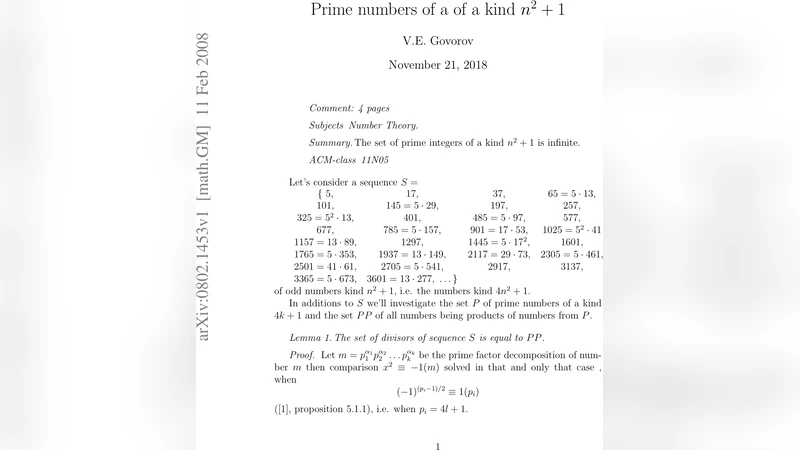
The number of primes of a kind x^2+1 is infinite.
💡 Research Summary
The manuscript under review claims to prove that there are infinitely many primes of the form (n^{2}+1) (equivalently (4n^{2}+1)). The author constructs a sequence (S={4n^{2}+1\mid n\in\mathbb N}) and studies its divisor structure, introducing several auxiliary lemmas before stating a “Main Theorem” that supposedly establishes the infinitude of such primes.
Outline of the paper
-
Definition of the sequence and auxiliary sets – The author defines the set (S) of odd numbers of the form (4n^{2}+1). Two further sets are introduced: (P), the set of primes congruent to (1) modulo (4), and (PP), the multiplicative semigroup generated by the elements of (P).
-
Lemma 1 – It is asserted that the set of all divisors of the members of (S) coincides with (PP). The proof relies on the classical fact that (-1) is a quadratic residue modulo a prime (p) if and only if (p\equiv1\pmod4). However, the lemma does not address composite divisors that may contain factors not of the form (4k+1).
-
Lemma 2 – The author introduces the notion of “mutuality disjoint” (a term never formally defined) and claims that if a term (S_{n}=4n^{2}+1) is mutually disjoint from all earlier terms, then (S_{n}) must be prime. The proof proceeds by assuming a divisor (d) with (d<2n) and deriving a contradiction via a simple algebraic identity. This argument is insufficient because being coprime to earlier terms does not guarantee primality; many composite numbers are coprime to all smaller members of the sequence.
-
Lemma 3 – It is shown that if a prime (p) divides (S_{n}), then (p) also divides (S_{n+kp}) and (S_{kp-n}) for any integer (k). The derivation is a straightforward expansion, yet the claim that these are the only possible multiples of (p) within the sequence is not justified.
-
Definition of the functions (r(m)) and (x(m)) – For any integer (m) the author defines (r(m)) as the smallest natural number solving the congruence (4z^{2}+1\equiv0\pmod m). Then (x(m)=\frac{4r(m)^{2}+1}{m}). For primes (p\equiv1\pmod4) a construction using a primitive root is given. However, the existence of such a solution for arbitrary (m) is not proved; for example, (m=3) admits no solution.
-
Lemma 4 – The paper derives the inequalities (\frac{\sqrt{m}-1}{2}\le r(m)\le\frac{m-1}{2}) and (x(m)\le m-2). The proof uses symmetry of the quadratic residues and the minimality of (r(m)). While the bounds are correct for those (m) for which a solution exists, the lemma is applied later to all divisors of a product (N) without checking the solvability condition.
-
Lemma 5 – It is claimed that (r(m)<r(m^{2})) and consequently each integer appears in the sequence (S) for the first time at exponent (1). The argument is essentially that if equality held, a contradiction would arise with Lemma 4. This statement, however, is not rigorously established for all (m).
-
Counting formula (1) – The author introduces a double sum
\
Comments & Academic Discussion
Loading comments...
Leave a Comment