Capacity of the Bosonic Wiretap Channel and the Entropy Photon-Number Inequality
Determining the ultimate classical information carrying capacity of electromagnetic waves requires quantum-mechanical analysis to properly account for the bosonic nature of these waves. Recent work has established capacity theorems for bosonic single…
Authors: Saikat Guha, Jeffrey H. Shapiro, Baris I. Erkmen
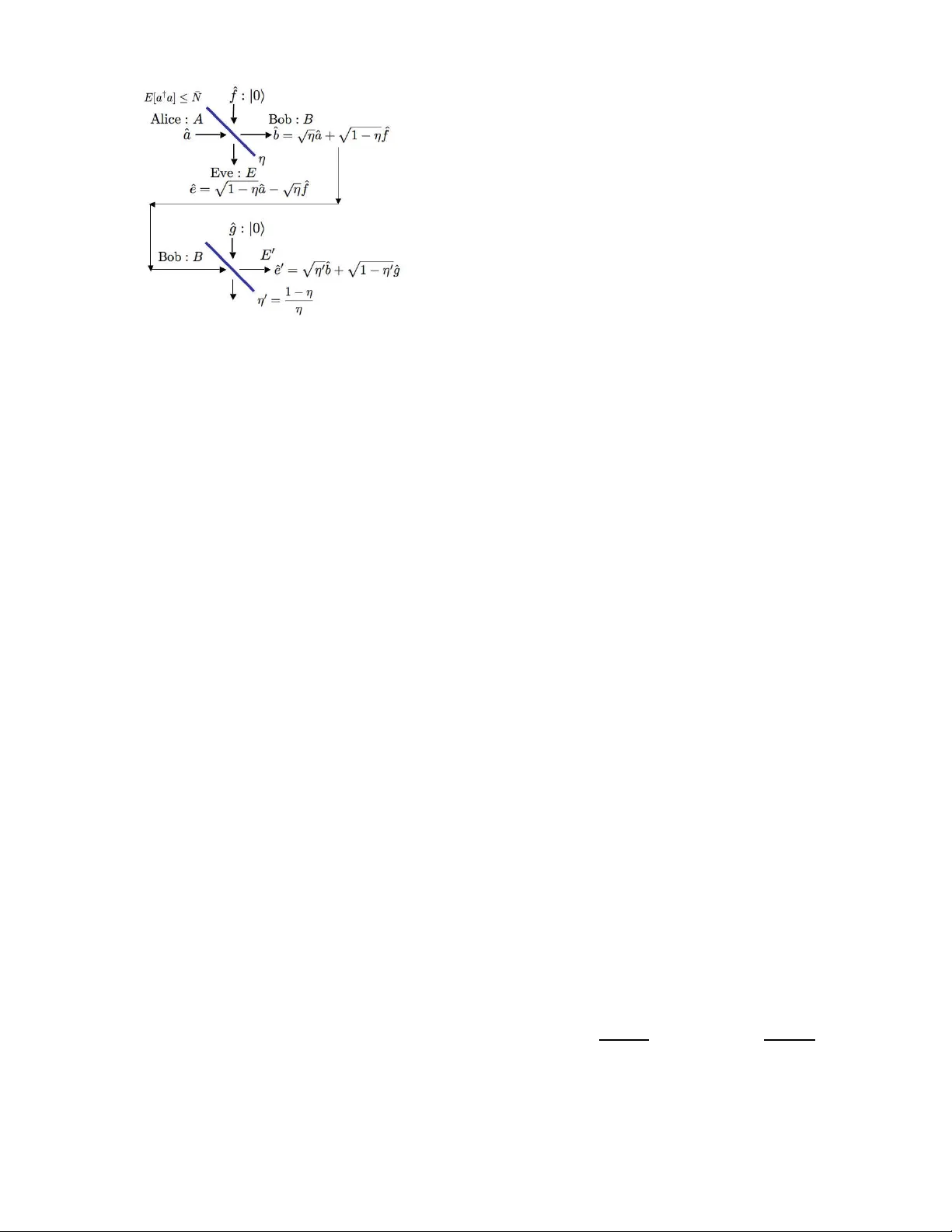
Capacity of the Bosonic W iretap Channel and the Entropy Photon-Number Inequali ty Saikat Guha Research Laborato ry of Electronics MIT , Cambridge, MA 02139 saikat@MIT .edu Jeffr ey H. Sh apiro Research Laborato ry of Electronics MIT , Cambridge, MA 02139 jhs@MIT .edu Baris I. Erkmen Research Laborato ry of Electronics MIT , Cambridge, MA 02139 erkmen@MI T .e du Abstract — Determining the ultimate classical information car - rying capacity of electro magnetic wav es requires quantum- mechanical analysis to properly account f or th e bosonic nature of these wav es. Recent work has established capacity theorems fo r bosonic sin gle-user and broadcast channels, un der the pre- sumption of two minimum outp ut entropy conjectu res. Despite considerable accumulated evidence th at supports the validity of these conjectures, they hav e yet to be prov en. In th is paper , it is shown that the second conjecture suffices to p ro ve the classical capacity of th e bosonic wi retap ch annel, which in turn would also pro ve the quantu m capacity of the lossy bosonic channel. The preceding minimum outpu t entropy conjectures ar e then shown to be simple consequen ces of an Entropy Photon-Number Inequality (EPn I), which is a conjectured quantu m-mechanical analog of the En tropy Power Ineq uality (EPI) form classical informa tion theory . I . M O T I V AT I O N A N D H I S T O RY The perfor mance of commun ication systems that rely on electr omagnetic wa ve prop agation are ultimately limited by no ise of q uantum- mechanica l origin. Moreover , high- sensiti vity photod etection system s hav e long been close to this noise limit. He nce determ ining the ultimate capacities of lasercom channels is of immediate relev ance. The most famous channel capacity formula is Shannon ’ s result for the classical additive white Gaussian noise chann el. F or a complex-valued channel m odel in which we transmit a and receive c = √ η a + √ 1 − η b , wh ere 0 < η < 1 is th e chan nel’ s transm issi vity and b is a zero-mean, isotr opic, co mplex-valued Gau ssian ra ndom variable that is in depend ent of a , Sh annon’ s capacity is C classical = ln[1 + η ¯ N / (1 − η ) N ] nats/use , (1) with E ( | a | 2 ) ≤ ¯ N and E ( | b | 2 ) = N . In the q uantum version of this ch annel model, we contro l the state of an electromag netic mode with photon annihilation operator ˆ a at the tr ansmitter, and receive another mode with photon annihilation operator ˆ c = √ η ˆ a + √ 1 − η ˆ b , where ˆ b is the annihilation op erator of a noise mo de that is in a zero-mean , isotropic, complex-valued Gaussian state. For lasercom , if quantum m easurements co rrespond ing to ideal optical homo - dyne or heterody ne detection are em ployed at the receiv er , this quantum cha nnel red uces to a real-valued (homod yne) or complex-valued (heterodyne) additive Gaussian noise ch annel, from which th e f ollowing capacity formu las (in n ats/use) follow: C homo dyne = 2 − 1 ln[1 + 4 η ¯ N / (2(1 − η ) N + 1)] ( 2) C hetero dyn e = ln[1 + η ¯ N / ((1 − η ) N + 1 )] . (3) The +1 terms in th e noise denominato rs are quantum contri- butions, so that e ven when the n oise m ode ˆ b is unexcited these capacities remain finite, unlike the situation in Eq. (1) . The classical capacity of the pure -loss bosonic channel— in which th e ˆ b mo de is unexcited ( N = 0 )—was shown in [1] to be C pure − loss = g ( η ¯ N ) nats/use, wher e g ( x ) ≡ ( x + 1) ln( x + 1) − x ln( x ) is the Sha nnon entro py of the Bo se- Einstein prob ability distribution with mean x . This capacity exceeds th e N = 0 version s of E qs. (2) and ( 3), as well as the best known bou nd on the capacity of ideal optical direct detection . T he ultimate capacity o f the thermal-n oise ( N > 0 ) version of this ch annel is bo unded below as follows, C thermal ≥ g ( η ¯ N + (1 − η ) N ) − g ((1 − η ) N ) , and this bound was shown to be the capacity if the ther mal channe l obeyed a certain minimum outp ut entropy conjectu re [2]. This con jecture states that the von Neumann entropy at the output of the thermal channel is minimized when the ˆ a mode is in its vacuum state. Consider able e vidence in support of this conjectu re has been ac cumulated [3], but it ha s yet to be proven. Ne vertheless, th e precedin g lower bou nd already exceeds Eqs. (2) and (3) as well as the best k nown b ounds on the capacity of direct detection . More r ecently , a capacity ana lysis of the bo sonic br oadcast channel led to an inner bound o n the capacity region, which was sho wn to be the capacity region un der the pr esumption of a second m inimum ou tput entro py co njecture [4]. Both conjecture s have been proven if the in put states are restricted to be Gaussian, and they hav e been sho wn to be equiv alen t under this input- state r estriction. In this pap er , we show that the second conjecture will establish the privac y capacity of the lossy bosonic ch annel, as well as its u ltimate quan tum informa tion carr ying capacity . The En tropy Power Inequality (EPI) from classical infor- mation theo ry is wid ely used in codin g theorem converse proof s for Gaussian ch annels. By analogy with the EPI, we conjecture its quantum version, viz., the En tropy Photon- number Inequality (E PnI). In this paper we show that the two minim um outpu t entropy conjec tures cited above are simple co rollaries of the EPnI. Hence, pr oving the EPnI would immediately establish key results for th e capacities of b osonic commun ication ch annels. I I . Q UA N T U M W I R E TA P C H A N N E L The ter m “wiretap channel” was coined b y W yner [5] to describe a co mmunic ation sy stem, in which Alice wishes to communicate classical in formation to Bob, over a poin t- to-poin t discrete memoryle ss channel that is subjected to a wiretap by an eavesdropper E ve. Alice’ s g oal is to r eliably and securely comm unicate classical data to Bob, in suc h a way that Eve g ets no inform ation whatsoever abo ut the message. W yn er u sed the con ditional en tropy r ate of th e signal rece i ved by Eve, given Alice’ s transmitted m essage, to measur e th e secrecy level guaranteed by the system. H e gave a single letter c haracterization of th e rate -equiv ocation region unde r a limiting assumption, that th e signal received by Eve is a degraded version of the on e received by Bob . Csisz ´ ar and K ¨ orner later generalized W yner ’ s results to the case in which the sign al rece i ved by Eve is no t a d egraded version of the o ne received by Bob [ 6]. The se classical-chan nel results were later extended by Devetak [7] to encompass classical tran smission over a qu antum wiretap channel. A q uantum ch annel N A - B from Alice to Bob is a trace- preserving com pletely positive map that transfo rms Alice’ s single-use density operator ˆ ρ A to Bob’ s, ˆ ρ B = N A - B ( ˆ ρ A ) . The quantum wiretap c hannel N A - B E is a quantum channel fro m Alice to an in tended receiver Bob and an eavesdropper Eve . The qu antum channel from Alice to Bob is o btained by tracin g out E from th e chan nel map, i.e., N A - B ≡ T r E ( N A - B E ) , and similarly for N A - E . A q uantum wiretap ch annel is degrad ed if there exists a degra ding ch annel N deg B - E such that N A - E = N deg B - E ◦ N A - B . The wiretap chan nel describes a physical scenario in which for eac h successive n uses of N A - B E Alice co mmunica tes a rando mly gener ated classical message m ∈ W to Bob, where m is a cla ssical index th at is uniformly d istributed over the set, W , of 2 nR possibilities. T o e ncode a nd transmit m , Alice gener ates a n instantiation k ∈ K of a discrete ran dom variable, and then prepares n -channel-u se states that af ter transmission through the channel, result i n bipartite conditio nal density operators { ˆ ρ B n E n m,k } . A (2 nR , n, ǫ ) cod e for this channel consists of an encoder, x n : ( W, K ) → A n , and a positive operator-valued measure (PO VM ) { Λ B n m } on B n such that the following co nditions are satisfied for ev ery m ∈ W . 1 1) Bob’ s pr obability of decoding error is at mo st ǫ , i.e., T r ˆ ρ B n m,k Λ B n m > 1 − ǫ, ∀ k , and (4) 2) For any PO VM { Λ E n m } on E n , n o more th an ǫ bits of info rmation is r ev ealed about th e secret m essage m . Using j ≡ ( m, k ) , this co ndition can b e expressed, in terms of the Holev o informatio n [8], as f ollows, χ p j , N ⊗ n A − E ( ρ A n j ) ≤ ǫ. (5) 1 A n , B n , and E n are the n -cha nnel-use alphabe ts of Alice, Bob and Eve. Here, χ ( p j , ˆ σ j ) ≡ S ( P j p j ˆ σ j ) − P j p j S ( ˆ σ j ) , is the Holev o inf ormation , where { p j } is a pr obability dis- tribution associated with the density operators ˆ σ j , and S ( ˆ ρ ) ≡ − T r( ˆ ρ log ˆ ρ ) is the von Neuman n entropy of the density operato r ˆ ρ . 2 Because Holev o infor mation m ay not be additiv e, the clas- sical priv acy capacity C p of the quan tum wireta p c hannel must be computed by m aximizing over su ccessi ve uses o f the channel, i.e., for n bein g the number of uses of the chann el, C p ( N A - B E ) = sup n max p T ( i ) p A | T ( j | i ) h χ ( p T ( i ) , P j p A | T ( j | i ) ˆ ρ B n j ) /n − χ ( p T ( i ) , P j p A | T ( j | i ) ˆ ρ E n j ) /n i . (6) The p robabilities { p i } form a distribution over an auxiliary classical alphabet T , of size |T | . The ultimate pr i vac y capacity is com puted by ma ximizing the expression sp ecified in ( 6) over { p T ( i ) } , { p A | T ( j | i ) } , { ˆ ρ A n j } , a nd n , sub ject to a cardi- nality constraint on |T | . For a degrad ed wiretap chan nel, the auxiliary ran dom variable is unnecessary , an d Eq. (6) redu ces to C p ( N A - B E ) = sup n max p A ( j ) [ χ ( p A ( j ) , ˆ ρ B n j ) /n − χ ( p A ( j ) , ˆ ρ E n j ) /n ] . (7) I I I . N O I S E L E S S B O S O N I C W I R E TA P C H A N N E L The no iseless b osonic wiretap channe l consists o f a collec- tion of spatial and temporal bo sonic modes at the tran smitter that in teract with a minimal-q uantum -noise en vironm ent an d split into two sets of spatio-tem poral modes en r oute to two indepen dent receivers, one being the intended recei ver and the other b eing the eavesdropper . The multi-mo de bosonic wiretap channel is g iv en by N s N A s - B s E s , where N A s - B s E s is the wiretap-cha nnel map for the s th mode, which can b e o btained from the Heisenberg e v olutions ˆ b s = √ η s ˆ a s + p 1 − η s ˆ f s , (8) ˆ e s = p 1 − η s ˆ a s − √ η s ˆ f s , (9) where the { ˆ a s } are Alice’ s modal annihilation oper ators, and { ˆ b s } , { ˆ e s } are th e cor respondin g modal annihilation op erators for Bob and Eve, respecti vely . The mo dal transmissi vities { η s } satisfy 0 ≤ η s ≤ 1 , and th e environment modes { ˆ f s } ar e in their vacuum states. W e will limit our treatment h ere to the single-mod e boson ic wiretap channel, as the privac y c apacity of the mu lti-mode chann el can in pr inciple be obtain ed by summing up capacities of all spatio-tem poral modes and maximizing the sum capa city subject to an overall input- power budget using Lagrange multipliers, cf. [2], where this was done for the multi-mo de single-user lossy bosonic channel. Theorem — Assuming the truth of minimum output entro py conjecture 2 (see Sec. V), th e ultimate priv acy cap acity of the 2 A density oper ator is Hermiti an, with eigen va lues that form a probab ility distrib ution. T hus, the v on Neumann entr opy of a den sity operat or ˆ ρ is the Shannon entropy of its eigen values. Fig. 1. Schematic dia gram of t he single -mode bosonic wire tap cha nnel. The transmitt er A lice ( A ) encodes her messages to Bob ( B ) in a cla ssical index j , and over n successiv e uses of the channel, thus prepari ng a bipartit e state ˆ ρ B n E n j where E n represent s n channel uses of an ea vesdrop per Eve ( E ). For η > 1 / 2 , this cha nnel is deg raded, as Eve’ s state can be recr eated by passing Bob’ s state thro ugh a beamspli tter of transmissivi ty (1 − η ) /η . single-mod e noiseless b osonic wiretap chann el (see Fig. 1) with mean inpu t p hoton- number constrain t h ˆ a † ˆ a i ≤ ¯ N is C p ( N A - B E ) = g ( η ¯ N ) − g ((1 − η ) ¯ N ) nats/use , (10) for η > 1 / 2 and C p = 0 for η ≤ 1 / 2 . This capacity is additive a nd achievable with single-channel-u se coheren t- state en coding with a zero -mean isotropic Gaussian prior distribution p A ( α ) = exp( −| α | 2 / ¯ N ) /π ¯ N . Proof — Devetak’ s result for the priv a cy capa city of the degraded qua ntum wiretap ch annel in Eq. (7) requ ires finite- dimensiona l Hilbert space s. Nev ertheless, we will u se this result for the bosonic wiretap channel, which has an infinite- dimensiona l state space, by extending it to infinite-dimensio nal state sp aces thro ugh a limiting argum ent. 3 Furthermo re, it w as recently shown that th e privac y capacity of a degraded wiretap channel is additive, and equal to th e single-le tter quan tum capacity of the chann el from Alice to Bob [9], i.e., C p ( N A - B E ) = C (1) p ( N A - B E ) = Q (1) ( N A - B ) , (11) where the superscr ipt (1) d enotes single-letter capacity . I t is straightfor ward to show that if η > 1 / 2 , the b osonic wire tap channel is a degraded channel, in which Bob’ s is the less-no isy receiver and Eve’ s is the more- noisy receiver . The degraded nature of the bosonic wireta p channel has been de picted in 3 When |T | and |A| are finite and we are using coherent states in Eq. (7) , there will be a finite number of possible transmitt ed states, leading to a finite number of possible states recei ved by Bob and Eve. Suppose we limit the auxiliary-inpu t alph abet ( T )—and hence the input ( A ) and the output alphabets ( B and E )—to trunc ated cohere nt state s within the finite - dimensiona l Hil bert space spa nned by the Fock states { | m i : 0 ≤ m ≤ M } , where M ≫ ¯ N . Applyin g De vetak’ s theorem to the Hilber t space spanned by the se trunca ted coherent state s then gi ves us a lower bou nd on th e pri vac y capac ity of the bosonic wiretap channel when the entire , infinite-dimensi onal Hilbert space is employe d. By ta king M sufficient ly large, while maintaining the cardina lity condition for T , the rate-regi on e xpressions gi ven by Dev eta k’ s theorem will con ver ge to Eq. (10). Fig. 1, where the q uantum states ˆ ρ E ′ of the constru cted system E ′ are identical to the qu antum states ˆ ρ E for a given inpu t quantum state ˆ ρ A . Using Eq . (11) for the bo sonic wiretap channel, we have C p ( N A - B E ) = max h ˆ a † ˆ a i≤ ¯ N S ˆ ρ B − S ˆ ρ E = max h ˆ a † ˆ a i≤ ¯ N [ S ( ˆ ρ B ) − S ( ˆ ρ E ′ )] = max 0 ≤ K ≤ g ( η ¯ N ) { max h ˆ a † ˆ a i≤ ¯ N ,S ( ˆ ρ B )= K [ S ( ˆ ρ B ) − S ( ˆ ρ E ′ )] } = max 0 ≤ K ≤ g ( η ¯ N ) { K − min h ˆ a † ˆ a i≤ ¯ N ,S ( ˆ ρ B )= K [ S ( ˆ ρ E ′ )] } = max 0 ≤ K ≤ g ( η ¯ N ) { K − g [(1 − η ) g − 1 ( K ) /η ] } = g ( η ¯ N ) − g ((1 − η ) ¯ N ) na ts/use = Q (1) ( N A - B ) . (12) The first equ ality above f ollows fro m Lemma 3 of [9] . The second equality f ollows from N A - B E being a degraded channel. The restrictio n to 0 ≤ K ≤ g ( η ¯ N ) in th e third equality is per missible because max h ˆ a † ˆ a i≤ ¯ N S ( ˆ ρ B ) = g ( η ¯ N ) . The fifth equality fo llows 4 from minimum output e ntropy conjecture 2 (see Sec. V). The ˆ ρ B that achieves this equality is a thermal state, which is realize d when Alice employs coheren t-state enco ding with a zero-mean isotropic Gaussian prior distribution p A ( α ) = (1 /π K ) exp( −| α | 2 /K ) . The sixth equality now follows from g ( x ) − g ( cx ) being a mo notonic ally increasing fun ction o f x ≥ 0 , f or c a constant satisfying 0 ≤ c < 1 , and the equ ality to the sing le-letter quantum capacity follows fro m Eq. ( 11). Note that the pri vac y capa city of this channel is zer o when η ≤ 1 / 2 . It is straig htforward to show that in th e limit of high inp ut p hoton numb er ¯ N , C p ( N A - B E ) = Q (1) ( N A - B ) = max { 0 , ln( η ) − ln(1 − η ) } , a result that W olf et. al. [10] independ ently derived by a different approach withou t use of an u nproven output entropy conjecture . I V . T H E E N T RO P Y P H O T O N - N U M B E R I N E Q UA L I T Y ( E P N I ) A. The Entr op y P ower Ineq uality Let X and Y b e statistically in depend ent, n -d imensional, real-valued rand om vectors that possess dif ferential (Sh annon ) entropies h ( X ) and h ( Y ) respecti vely . Becau se a real-valued, zero-mea n Gaussian rando m v ariable U has differential en - tropy g iv en b y h ( U ) = ln(2 π e h U 2 i ) , wh ere th e mea n-squared value, h U 2 i , is considered to be the power of U , th e entropy powers o f X and Y are taken to be P ( X ) ≡ e h ( X ) /n 2 π e and P ( Y ) ≡ e h ( Y ) /n 2 π e . (13) 4 Here, g − 1 ( S ) is the in verse of the funct ion g ( N ) . Because g ( N ) for N ≥ 0 is a non-n ega ti ve , monotonic ally increasing , concav e function of N , it has an in verse, g − 1 ( S ) for S ≥ 0 , that is non-negati ve, monotonical ly increa sing, and con ve x. In this way , an n -dimension al, real-valued, r andom vector ˜ X comprised of in depend ent, identically distrib uted (i.i.d.), r eal- valued, zer o-mean, v ariance- P ( X ) , Gaussian random v ariables has differential entr opy h ( ˜ X ) = h ( X ) . W e can similarly define an i.i.d. Gaussian ran dom vector ˜ Y with differential entro py h ( ˜ Y ) = h ( Y ) . W e d efine a n ew ran dom vector b y the co n vex combinatio n Z ≡ √ η X + p 1 − η Y , (14) where 0 ≤ η ≤ 1 . T his rand om vector has differential entropy h ( Z ) and entr opy power P ( Z ) . Furtherm ore, let ˜ Z ≡ √ η ˜ X + √ 1 − η ˜ Y . Three eq uiv a lent forms o f th e Entro py Power In equality (EPI), see, e.g., [11], are th en: P ( Z ) ≥ η P ( X ) + (1 − η ) P ( Y ) (15) h ( Z ) ≥ h ( ˜ Z ) (16) h ( Z ) ≥ η h ( X ) + (1 − η ) h ( Y ) . (17) B. The Entr opy Photon-Numb er Inequ ality Let ˆ a = [ ˆ a 1 ˆ a 2 · · · ˆ a n ] and ˆ b = [ ˆ b 1 ˆ b 2 · · · ˆ b n ] be vectors of pho ton an nihilation operator s for a collection of 2 n different electro magnetic field mod es of f requen cy ω [12]. The joint state of the modes associated with ˆ a and ˆ b is given by the produ ct-state den sity operator ˆ ρ ab = ˆ ρ a ⊗ ˆ ρ b , where ˆ ρ a and ˆ ρ b are the density operator s associated with th e ˆ a and ˆ b modes, respe cti vely . The von Neum ann e ntropies o f the ˆ a and ˆ b mo des are S ( ˆ ρ a ) = − tr[ ˆ ρ a ln( ˆ ρ a )] and S ( ˆ ρ b ) = − tr[ ˆ ρ b ln( ˆ ρ b )] . The therma l state o f a mode with annih ilation operator ˆ a has two equiv a lent d efinitions: ˆ ρ T = Z d 2 α e −| α | 2 / N π N | α ih α | , (18) and ˆ ρ T = ∞ X i =0 N i ( N + 1) i +1 | i ih i | , (19) where N = h ˆ a † ˆ a i is the average ph oton number . In Eq. (1 8), | α i is th e coheren t state of amp litude α , i.e. , it satisfies ˆ a | α i = α | α i , for α a complex n umber . In Eq. (19), | i i is the i -photo n state, i.e., it satisfies ˆ N | i i = i | i i , fo r i = 0 , 1 , 2 , . . . , with ˆ N ≡ ˆ a † ˆ a being th e photon numbe r operato r . Physically , Eq. (18) says th at the thermal state is an isotropic Gaussian mixture of coh erent states. Equation (19), on the other hand, says that the therm al state is a Bose-Einstein mixture of n umber states. From Eq. (1 9) we immedia tely h av e th at S ( ˆ ρ T ) = g ( N ) , because the photo n-num ber states are orthon ormal. 5 The entropy photo n-num bers of the density operator s ˆ ρ a and ˆ ρ b are defined as follows: N ( ˆ ρ a ) ≡ g − 1 ( S ( ˆ ρ a ) /n ) a nd N ( ˆ ρ b ) ≡ g − 1 ( S ( ˆ ρ b ) /n ) . (20) Thus, if ˆ ρ ˜ a ≡ N n i =1 ˆ ρ T a i and ˆ ρ ˜ b ≡ N n i =1 ˆ ρ T b i , where ˆ ρ T a i is the thermal state of av erage p hoton number N ( ˆ ρ a ) for 5 The cohere nt stat es, {| α i} , are not orthonormal, but rathe r over complete . the ˆ a i mode and ˆ ρ T b i is the therm al state of average pho ton number N ( ˆ ρ b ) for the ˆ b i mode, then we hav e S ( ˆ ρ ˜ a ) = S ( ˆ ρ a ) and S ( ˆ ρ ˜ b ) = S ( ˆ ρ b ) . W e d efine a ne w vector of p hoton annihilation o perators, ˆ c = [ ˆ c 1 ˆ c 2 · · · ˆ c n ] , by th e conv ex combina tion ˆ c ≡ √ η ˆ a + p 1 − η ˆ b , for 0 ≤ η ≤ 1 , (21) and use ˆ ρ c to denote its d ensity operator . This is equiv alen t to saying that ˆ c i is th e ou tput of a lo ssless beam splitter whose inputs, ˆ a i and ˆ b i , couple to that o utput with tran smissi vity η and reflectivity 1 − η , r espectiv ely . W e can now state two equiv a lent f orms of ou r conjectu red Entropy Photon-Nu mber Ineq uality (E PnI) [13]: N ( ˆ ρ c ) ≥ η N ( ˆ ρ a ) + (1 − η ) N ( ˆ ρ b ) (22) S ( ˆ ρ c ) ≥ S ( ˆ ρ ˜ c ) , (23) where ˆ ρ ˜ c ≡ N n i =1 ˆ ρ T c i with ˆ ρ T c i being th e ther mal state of av erage photon number η N ( ˆ ρ a ) + (1 − η ) N ( ˆ ρ b ) for ˆ c i . V . M I N I M U M O U T P U T E N T R O P Y C O N J E C T U R E S By ana logy with the classical EPI, we might expe ct there to be a third equ iv alen t form o f the quantu m EPnI, viz. , S ( ˆ ρ c ) ≥ ηS ( ˆ ρ a ) + (1 − η ) S ( ˆ ρ b ) . (24) It is easily sh own that (22) implies (24) [14], but we have no t been able to prove the converse. Indeed, we suspect that the conv erse m ight be false. More impo rtant than whether or no t (24) is eq uiv alent to (22) and (23), is the role o f th e EPnI in proving classical information capacity results for b osonic channels. In particu lar , th e EPn I provid es simple proo fs of the f ollowing two min imum ou tput entr opy conjectu res. These conjecture s are importan t be cause proving minimum output entropy conjectu re 1 also proves the conjectured capacity o f the thermal-no ise chan nel [2], a nd proving minimum output entropy conjecture 2 also proves th e conjectured capacity region of the bosonic broa dcast chann el [4]. Furthermore , as we have shown above, p roving minimum output entropy conjecture 2 also estab lishes the privac y capacity of the bosonic wiretap channel and the single-letter quantum capacity of the lossy boson ic channel. Minimum Output Entropy Conjecture 1 — Let a an d b be n -dimension al vectors of annih ilation opera tors, with joint density operato r ˆ ρ ab = ( | ψ i a a h ψ | ) ⊗ ˆ ρ b , where | ψ i a is an arbitrary zero-m ean-field pure state of the a modes and ˆ ρ b = N n i =1 ˆ ρ T b i with ˆ ρ T b i being th e ˆ b i mode’ s th ermal state of a verage photon nu mber K . Defin e a ne w vector of photon annihilation operators, ˆ c = [ ˆ c 1 ˆ c 2 · · · ˆ c n ] , by the conv ex combinatio n (21) and use ˆ ρ c to deno te its de nsity operator a nd S ( ˆ ρ c ) to denote its von Neum ann entro py . Then choosing | ψ i a to be the n -mode v acuum state minimizes S ( ˆ ρ c ) . Minimum Output Entropy Conjecture 2 — Let a an d b be n -dimension al vectors of annihilation operators with join t density operator ˆ ρ ab = ( | ψ i a a h ψ | ) ⊗ ˆ ρ b , where | ψ i a = N n i =1 | 0 i a i is the n -mod e vacuum state a nd ˆ ρ b has von Neumann en tropy S ( ˆ ρ b ) = ng ( K ) for som e K ≥ 0 . Define a n ew vector of photon annihilatio n operators, ˆ c = [ ˆ c 1 ˆ c 2 · · · ˆ c n ] , by the convex combination (21) an d use ˆ ρ c to deno te its density opera tor and S ( ˆ ρ c ) to deno te its v on Neumann en tropy . Then ch oosing ˆ ρ b = N n i =1 ˆ ρ T b i with ˆ ρ T b i being the ˆ b i mode’ s therm al state of average pho ton number K minimizes S ( ˆ ρ c ) . T o see tha t the EPnI encompasses both of the preceding minimum ou tput entropy conjectures is o ur final task in this paper . W e begin by u sing the pr emise of con jecture 1 in (22). Because the ˆ a modes are in a pu re state, we get S ( ˆ ρ a ) = 0 and hence the EPnI tells u s that N ( ˆ ρ c ) ≥ (1 − η ) N ( ˆ ρ b ) = (1 − η ) K . (25) T aking g ( · ) on both sides of this inequality , we get S ( ˆ ρ c ) /n ≥ g [(1 − η ) K ] . But, if | ψ i a is the n -mode v acuum state, we can easily show that ˆ ρ c = N n i =1 ˆ ρ T c i , with ˆ ρ T c i being the ˆ c i mode’ s thermal state of av erage p hoton number (1 − η ) K . Thus, when | ψ i a is the n - mode v acuum state we get S ( ˆ ρ c ) = ng [(1 − η ) K ] , which com pletes th e proo f. Next, we apply the premise of co njecture 2 in (22). Once again, the ˆ a modes are in a pu re state, so we get N ( ˆ ρ c ) ≥ (1 − η ) N ( ˆ ρ b ) = (1 − η ) K , (26) and hence S ( ˆ ρ c ) /n ≥ g [(1 − η ) K ] . But, taking ˆ ρ b = N n i =1 ˆ ρ T b i , with ˆ ρ T b i being the ˆ b i mode’ s ther mal state of av erage photo n n umber K , satisfies the premise o f minimum output entropy conjecture 2 an d implies that ˆ ρ c = N n i =1 ˆ ρ T c i , with ˆ ρ T c i being the ˆ c i mode’ s thermal state of a verage photon number (1 − η ) K . In this c ase we have S ( ˆ ρ c ) = ng [(1 − η ) K ] , which completes the pro of. V I . C O N C L U S I O N W e co njectured a q uantum version of the c lassical entro py power in equality , which subsumes two minimum output en- tropy c onjectures th at prior work has shown to be sufficient to p rove the capacity of the point-to -point th ermal-no ise lossy bosonic channel, and the b osonic broadcast ch annel respectively [2], [4]. Even th ough pr oving th is m ore gen eral inequality—th e Entropy Photon-nu mber Inequality (EPnI)— might seem h arder than th e two minimu m output entro py conjecture s, there is a possibility of drawing parallels from the proofs o f the classical entropy po wer inequ ality [1 1]. In this p aper, we have also shown that the EPnI also imp lies the proof o f the priv acy capacity of the boson ic wiretap channel. Furth ermore, using a r esult from [9], we ha ve that the degraded n ature of the boson ic wiretap cha nnel implies that its priv acy capacity equals the single-letterq uantum capacity of the lossy bosonic channel. M oreover . both of these capacities are ach iev ed b y coheren t-state encodin g using an isotro pic Gaussian prior . A C K N O W L E D G E M E N T S This resear ch was su pported by the W . M. Keck Found ation Center for Extreme Qua ntum Informatio n Theory . R E F E R E N C E S [1] V . Giov annetti, S. Guha, S. L loyd, L. Maccone, J. H. Shapiro, and H. P . Y uen, “Classical ca pacit y of lossy bosonic cha nnels: the exa ct solution, ” Phys. Re v . Lett. 92, 02790 2 (2004). [2] V . Gio v anne tti, S. Guh a, S. Llo yd, L. Mac cone, J. H. Shapir o, B. J. Y en, and H. P . Y uen, “Classica l ca pacit y of free-spac e opt ical communication, ” in O. Hirota, ed., Quantum Informat ion, Statist ics, Proba bility , (Rinton Press, New Jersey , 2004) pp. 90–101. [3] V . Giov annetti, S. Guha, S. Lloyd, L. Macc one, and J. H. Shapiro, “Minimum output entrop y of boson ic chan nels: a c onject ure, ” Phys. Rev . A 70, 0323 15 (2004). [4] S. Guha, J. H. S hapiro, and B. I. Erkmen, “Classica l capacity of bosonic broadca st communica tion and a minimum output entro py conjecture, ” Phys. Re v . A 76, 032303 (2007). [5] A. D. W yner , “The wiretap channel, ” Bell. Sys. T ech. Jour . 54, 1355–1387 (1975). [6] I. Csisz ´ ar and J. K ¨ orn er , “Broadcast channels with confidentia l messages, ” IEEE Trans. Inform. Theory 23, 339–348, (1978). [7] I. Deve tak, “The priv ate cla ssical capacit y and quantum capa city of a quantum channel, ” arXi v:quant-ph/ 0304127 v6. [8] A. S. Hole vo, “The capac ity of a quantu m channe l with general input states, ” IEEE Trans. Inform. Theory 44, 269–273 (1998); P . Hauslade n, R. Jozsa, B. Schumache r , M. W estmorel and, a nd W . K. W ootters, “Cla ssical informati on capacity of a quantum channe l, ” Phys. Rev . A 54, 1869– 1876 (1996); B. Schumache r and M. D. W estmoreland, “Sending classical informati on via noisy quantum cha nnels, ” Phys. Re v . A 56, 131–138 (1997). [9] G. Smith, “The pri v ate cla ssical cap acity with a symmetri c side chan nel and i ts app licat ion to quantum cryptog raphy , ” arXiv: quant-ph /0705.3838. [10] M. M. W olf, D. P ´ ere z-Garc ´ ıa, G. Giedk e, “Quantum capacitie s of bosonic channels, ” arXi v:quant-ph/0606 132 . [11] O. Rioul , “Informat ion theoreti c proofs of entropy powe r inequ aliti es, ” arXi v:cs.IT/070 4175 1. [12] L. Mandel and E. W olf, Optical Coher ence and Quantum Optics , (Cambridge Univ ersit y Press, Cambridge, 1995). [13] T o show that (22 ) implies (23), assume (22) is true: N ( ˆ ρ c ) ≥ η N ( ˆ ρ a ) + (1 − η ) N ( ˆ ρ b ) (27) = η N ( ˆ ρ ˜ a ) + (1 − η ) N ( ˆ ρ ˜ b ) (28) No w , if ˆ ρ ˜ a ˜ b = ˆ ρ ˜ a ⊗ ˆ ρ ˜ b is the joi nt densi ty operator of the ˆ a and ˆ b modes, we find that the state of the ˆ c modes is ˆ ρ ˜ c ≡ N n i =1 ˆ ρ T c i , where ˆ ρ T c i is a thermal stat e with a vera ge photon number gi ven by N ( ˆ ρ ˜ c ) = ηN ( ˆ ρ ˜ a ) + (1 − η ) N ( ˆ ρ ˜ b ) , s o that S ( ˆ ρ ˜ c ) = ng [ N ( ˆ ρ ˜ c )] . Thus, from (28) we get N ( ˆ ρ c ) ≥ N ( ˆ ρ ˜ c ) = g − 1 ( S ( ˆ ρ ˜ c ) /n ) . T aking g ( · ) of both sides of this inequality complet es the proof. T o show that (23 ) implies (22), assume (23) is true: N ( ˆ ρ c ) = g − 1 ( S ( ˆ ρ c ) /n ) ≥ g − 1 ( S ( ˆ ρ ˜ c ) /n ) = g − 1 [ g ( ηN ( ˆ ρ ˜ a ) + (1 − η ) N ( ˆ ρ ˜ b ))] = η N ( ˆ ρ ˜ a ) + (1 − η ) N ( ˆ ρ ˜ b ) = η N ( ˆ ρ a ) + (1 − η ) N ( ˆ ρ b ) , (29) where the inequa lity is due to g − 1 ( S ) being a monotonicall y increasi ng functio n of S , and the proof is complete . [14] Assume that (22) is true. W e then hav e that N ( ˆ ρ c ) ≥ ηN ( ˆ ρ a ) + (1 − η ) N ( ˆ ρ b ) , s o that S ( ˆ ρ c ) = ng [ N ( ˆ ρ c )] ≥ ng [ ηN ( ˆ ρ a ) + (1 − η ) N ( ˆ ρ b )] (30) ≥ η ng [ N ( ˆ ρ a )] + (1 − η ) ng [ N ( ˆ ρ b )] (31) = η S ( ˆ ρ a ) + (1 − η ) S ( ˆ ρ b ) , (32) where the second inequ ality follo ws from g ( N ) being con cav e, and the proof is complete.
Original Paper
Loading high-quality paper...
Comments & Academic Discussion
Loading comments...
Leave a Comment