On Reliability of Dynamic Addressing Routing Protocols in Mobile Ad Hoc Networks
In this paper, a reliability analysis is carried out to state a performance comparison between two recently proposed proactive routing algorithms. These protocols are able to scale in ad hoc and sensor networks by resorting to dynamic addressing, to …
Authors: Marcello Caleffi, Giancarlo Ferraiuolo, Luigi Paura
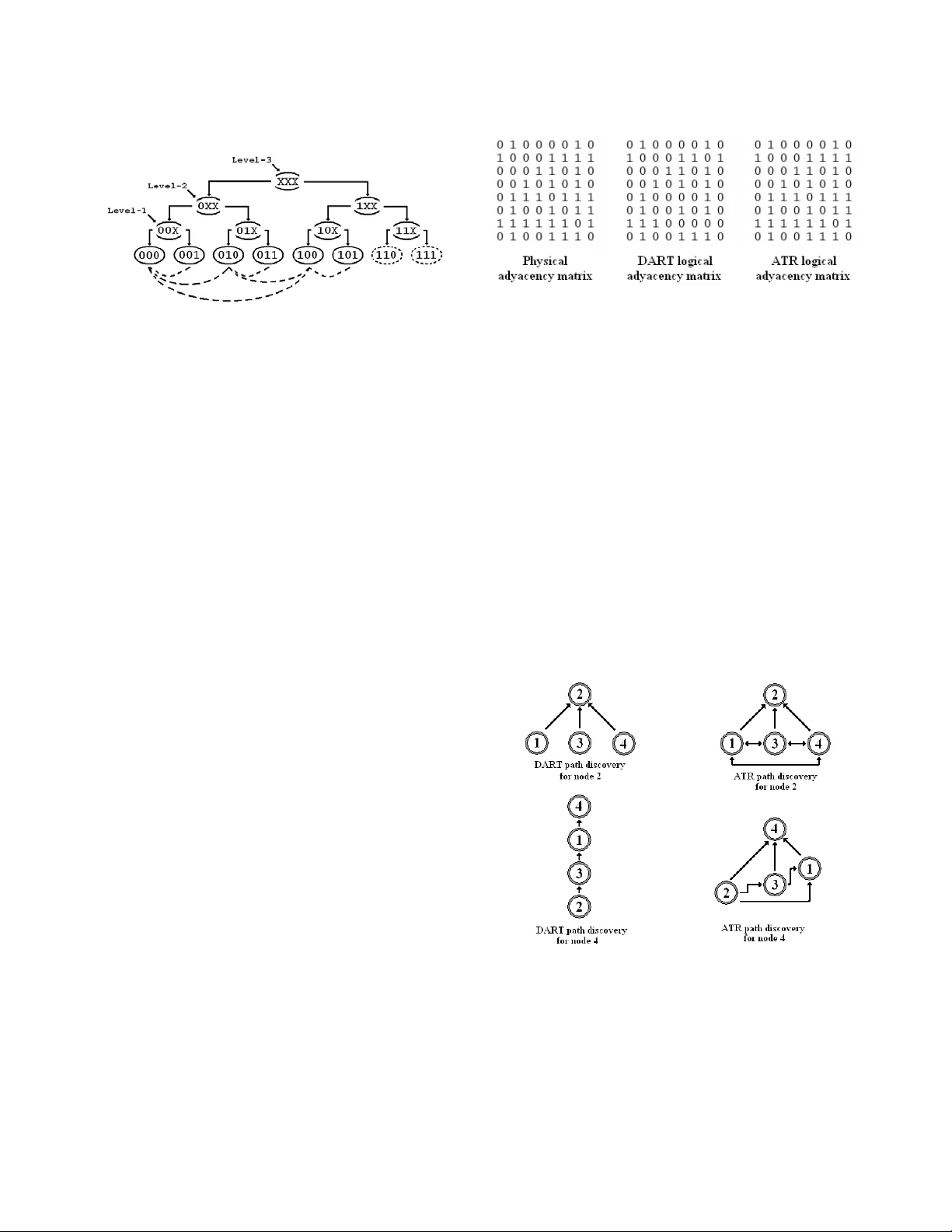
On Reliability of Dynamic Addr essing Routing Protocols in Mobile Ad Hoc Networks Marce llo Caleff i, Gia ncarlo Fe rraiuolo, L uigi Paur a Depa rtme n t of Elect roni c and Telecom municati on Engine ering (DIET) Un iver si ty of Nap l es “F ed eri co II ” via Claudi o 21, Naples , 80125, Ita ly Tel +39 (0)81 7683810 – Fa x +39 (0)81 7683149 {n ame .su r nam e} @u n in a. it Ab stra ct - In this paper , a rel i abi lity anal ysis i s c arr ied out to stat e a p erfo rma n c e com p ar iso n b etw een tw o re cen tly p ro po s ed proac ti ve r outing algor ithm s. These prot oc ols are able to sc ale in ad hoc and sens or net works by resorti ng to dynami c address ing, to f ace with t he topology var i ab ility, w h ich is ty pi ca l o f ad h oc , and se nsor net wor ks. Numeri c al si mulat ions are als o carr ied out to co rro bo ra t e the re sult s o f th e an a ly si s. I. I NTRODUCTION In Mobil e Ad hoc NETworks (MANETs) and sensor netw o rk s th e sc al abi li ty is a cr it ic al r eq uir e men t if th e se tec hnologi es have to reach thei r full potential. However, mo st of expe rime n te d routi ng protocol s have shown to wo rk sa tisf actoril y only up to few hundred nodes [1]. In fact , su ch protoc ol s, b as ed on t raditi onal routi ng proc edure s, assume t ha t node i de ntity e quals node routi ng address exploit i ng so static addre ssing s cheme s, regardle ss thei r belongi ng class (proac tive , reac tive or the hybri d one ). Such an a ssumption is ce rtai nly unacce p ta ble for ad hoc and sensor net works, due to the node mobili t y and/ or link i nstabilit y. The need of trac king each node positi on ( loc ation manage ment proble m) gives rise to a massi ve overhead proble m as the net work signi ficantl y grows. Rec entl y, se v era l works have sugge sted to separate the tim e-i nvariant node i d enti t y from the routing addre ss, which is tr ansie nt and reflect s the node topol ogi cal positi on insi de the net work. Si nce this approach, referre d to a s dynamic addre ssi ng , needs a mechani sm to provi de a scala ble ma pp ing bet ween node identi t y and rout i ng address , Distri bute d Hash Tabl es ( DH Ts) h av e b een u tili zed . Mo re s pe cif ic ally , in [2 - 3 ] a logi cal t ree struct ure, base d on the address spa ce and built on conne cti vit y am ong the node s, is int roduced. Although t h is st ructure all ows one t o p erform a sim ple a nd man age able routi ng procedure , it lac ks for robustness agai nst mobilit y and/ or li nk fail ures and, moreove r, exhi bits unsat is factory route sele cti on flexibil it y [5]. Ver y re cen tly , in or d er to bo th ma in ta in a l igh t m ech an is m for addre ss all ocation and t o fa ce with the a bove menti on ed lac k of c omple te t opol ogical inform ation, a routi ng prot ocol, refe rred to as the Augmented Tree-ba sed Routi ng (AT R) Thi s wor k is par tial ly suppor ted bot h by Nat ional proj ect Wirele ss 8O2. 16 Multi-a nte nn a m Esh Netw ork s (WO MEN ) under grant number 200509 32 48 and by the It ali an M ini str y of Uni versi ty (MI UR) project S.C o.P.E. . protoc ol , has bee n proposed [6]. T h e ATR protoc ol a ugmen ts the t ree-base d address allocat ion scheme of DA RT protocol [4], by s toring i n the node routi ng table s additi onal inform ati on, i.e. multi ple route s towards the same subset of nodes . E ach node ac quire s this i nformati on si mply by using the underl ying nei ghbor di scoveri ng procedure , w it hout inc reasing t he refore the protoc ol overhea d, wit h respect to DART one, and wit h limited cost s in te rms of memo ry requi rement s on the node . The advanta ge of thi s approa ch is tha t a ric her n et work-t opology knowl e dg e can be e xp loit e d to imp lem ent te mporal mul ti- p ath s tr a teg ies , w h ic h g u aran t e e bet ter pe rformance a nd a hi gher rel iabili ty [7]. Howeve r, with a lit tl e effort, ATR could be eas ily exte nded to s plit data tran sf ers on mu l tip le p ath s in the s pa tia l domain, in order to reduc e conge stion and end-to-e nd delay. This pape r presents a rel iab il ity asses s men t ana ly si s to sub s tan tiat e th e eff ec tiv ene s s of the multi -pa th approa ch of the AT R prot ocol and its supe riorit y wit h respect t o the shortes t-pat h one of DA RT. Th e ou t lin e o f the p ap er i s th e f ollo w in g : in S e ct ion I I, w e short ly pres ent the ATR and DART prot ocols under anal ysis. In Secti on III a framework for carrying out the relia bility ana lysi s is int roduced, whereas in Secti on IV numerical performa nce a nalysis a nd comparis on, using t he framework pres ented in Sect ion III and via si mulati ons, are pres ented. Fi nall y, in Secti on V conclusi ons are drawn. II. D YNAMIC A DDRESSING R OUTIN G P ROTO COLS We give here onl y essential i nformati on on DART and ATR protoc ol s, and remi nd to [4,6] for detai l s. In few words, ATR and DART are based on the same addre ss space structure whic h can be repre sente d by a binary tree of l+ 1 lev el s, wh ere l is the number of bits used for an addres s (Fig. 1) ATR and DART protocols di ffer from the packet forwardi ng proc ess and from t h e way in which the node routi ng ta bles are popula ted. More spec ifi call y, in DART each node m ainta ins onl y one pos sible next hop tow ar d th e fin a l des tinat ion, defining so a uni que route along t he tree st ructure of the addres s space, whereas i n ATR each node maintains and e xplores all the pos sible ways to reach the fi nal des tinat ion, t hrough i t s neighbors . T his is equi vale nt t o us e a n augment e d tree struc t ure to perform forwa rd ing, obtai ned wit hout a dd iti onal overhea d with res pect t o DART. The goal of th is p a per is to s ta te the ef f e ctiv en ess o f th e m u lt i- pa th approa ch, wit h respect t o c la ssic s hortest-pa t h one, by a theo r e tica l r el iab il ity ana ly s is. Fi g u re 1 - A d dr e s s sp a ce s t ru ctu re III. T HEORETICAL R ELIA BILI TY A NA LYSIS A. Defi nit ions and ass umptions Wit h reference to unica st routing, let us defi ne the te rm in a l pair routi ng reli abil ity a s the probabil ity that at least one route bet ween a coupl e of node s e xist s: R st ( G P ) = P (nodes s and t ar e connect ed) (1) wh ere s is the sourc e node , t is th e d est in a tio n o n e a nd G p =(V,E) is t h e proba bil istic di rect gra ph tha t repre sent s the net work t opology, in whi ch a verte x v i V denote s a node bel ongi ng to t he network, an edge e ij E denote s the com municat i on link bet ween nodes v i and v j th at o p er at es w i th probabi l ity p ij . The f ailu re ev ents of the ed ges e ij are a ssu m ed to be stati sti call y inde pende nt of eac h other with proba bilit y q ij =1-p ij , wh ile the v er tex es ar e con s id er ed to b e f law les s, i. e . opera tive with probabil it y one [8]. Alt hough in real networks, there may also be outage due to fini te capacit y effec ts cause d by physi cal -la y er a nd link-l a yer cons trai nt s, as well as routi ng rela ted one s, netw ork reli abilit y as sumes that there i s no routing or capa city c onstrai nt on the net work. If at least one route exi sts topol ogicall y bet ween s and t , tha n it is assumed t he packets will discove r and use it. More over, we suppos e tha t the network t opol ogy is static, nam e ly th e p acke t d e liv er y ti me in t erv al s ar e sma l ler th an th e topol ogy varia tion ones [12]. With s uch a n as sumpti on, we us e re li abi li ty m easur e as v alu ab le too l to an a lyze t h e tol e rance of routing prot oc ols agains t the route failure s. B. Exact algor ithm for rou ting re liability To e valuat e the net work re lia bility from a rout i ng point of vie w, we should disti ngui sh be tw een physical a nd o ver l ay gr ap hs rela ted to a n e tw or k . L et’s st art w ith an ex amp le . I n Fig . 2 w e h av e r ep res en ted the ad ja cency m atr ix es ass oc ia t ed wit h the physi cal and ove rlay graphs re ferring t o the same net work wit h 8 nodes. These matrixe s differ onl y from the numbe rs of ‘1’ (communicati on li nks). The mat rix on the left refe rs t o the phys ical gra ph, i.e . t he gra ph in whi ch t he e dge e ij is pre sent i f a physical comm unicati on link is prese nt between the nodes i and j . Th e oth er tw o ma tr ixe s r ep re s ent th e o v er l ay gr ap hs b uilt upon the physi cal n et work by DART a nd ATR route di scovery proc esse s. The absence of ten e dges (‘1’) in the DART matri x, with re spect t o the phys ical and ATR ones, evi dence s the ina bili ty of shortes t-pat h routing protoc ols to buil d a comple te topol ogica l view of the net work Figu re 2 - Adja cenc y ma tr ix fo r a 8 no d es net wor k. The ed ge s e t E of an overla y graph could be de fined as: E = E st s , t V (2) wh ere E st = e ij P st {} and P st is t he col lecti on of s-t paths dis cove red by the routi ng prot ocol. Fi g. 3 shows the overla y graphs as sociate d w it h the diffe rent route discove ry results for th e same full-mesh 4 nodes net work. M ore specif ical ly, t he gra phs show t he routes from eac h node towa rds two destina tions , say node ‘2’ a nd ‘4 ’. Thi s kind of re presenta ti on underli nes some nota ble as pect s of the r ou t e d is cov ery p ro c ess . Th e fir s t is th e pr esen ce ( o r n o t) of mu lt ip l e pa th s tow ard s th e s a m e d es tin at ion . F ur th er, it all ows one to rec ognize if the multi p le paths are di sjoi n t or part ia lly dis joint a nd how m any li nks are sha red by the routes. Fi nall y, it s hows that a hiera rchical s hortest -path routing protoc ol as DART one does not f ind eve ry time the shortest ro ute, du e to its hi er arch ic al na tu re ( in the ex a mp l e, t he short est route is the si ngle hop one). Figu r e 3 – G r a phs re f err in g to ro ute di sc over y pr oces s. Our approa ch to evaluate the routing reli abili t y is base d on enum erati ng all the mi n imal e dge cut s ets of the graph rep res en tin g the n e tw or k , wh er e a m in im al cu t s e t is d efin ed as a mi nimal s et of elem e nts whos e fai l ure im plie s that some nodes cannot c ommunicate . We have gene ralize d the al gorit hm prese nted in [9] i n order to obt ain a sym bolic expre ssion for the routi ng relia bilit y, which is function of the link fa ilu r e pr o ba bi l ity . T his al lo w s o ne to easy ev alu at e th e reli abili t y in diffe rent e nvironm ental c ondi tions . An aly tic a lly , th e m ean ter m in a l- pair ro u ting r el iab il ity is : R = z st R st t s s n ( n 1) (3) wh ere n = V , z st is the proba bilit y of a dat a flow bet ween { s,t } and R st is the termina l pair routi ng rel iabil ity de fine d as: R st ( G , p ) = 1 C i ( G , s , t ) p m i (1 p ) i i = c m (4) wh ere m = E , G=(V,E st ) is the overla y graph gene r ate d by the routi ng discove ry proces s, p p ij is the l in k su c ces s pr o ba bili ty ( a ssu m ed f o r s im p li ci ty the s a me f o r an y p air of nodes ), c is the mini mum cut of the gra ph b et ween { s , t } a nd C i is the num ber of { s , t } cu t s ets co mp o sed ex a ct ly b y i ed g e s. Li sti ng 1 shows our proposal to exact compute both symbol ic and nume rical relia bili ty (4). Furthe r detail can be found in [9]. Lis tin g 1 – R ecu rsiv e(G , HA S H,S S ,n,t ,no tR e l,sy mb) // Re li abilit y = 1 – Rec ursive (…) out put // G is th e ad jac e ncy ma tr ix re la ted to th e o ve rl ay gr ap h // H A SH is a col le c tio n of min im al cut s et in it ia lized to em p t y // S S is the under ana l y si s minimal cut set init iali zed to em pty // n i s in i ti al iz ed to s if ( n = = t) r etu rn ; merge (G, SS, n); // Me rging node n in SS abs orb(G, SS, t); // Abs orbing re dundant node s in SS if ( HA SH .is P res en t( SS )) r etu r n ; HASH.i nsert(SSt); find a cuts et C of S S; symbT emp = “(1-p)^” + C.si ze.toSt ring; te mp = 1.0; symbTe mp = symb + " + p * ( “ + symb Te mp; fo r each ed ge in C tem p = pFaile d * temp; end fo r each node a djace nt t o SS Re cur siv e(G ,HA SH ,SS ,n ,t ,tem p, s ymb ) ; tem p = pSucce ss * te mp; end symbTe mp = sy mb Temp + “)”; notRe l = no tRe l + tem p; C. C onside rati ons on comput a ti onal ti mes The problem of calc ulati ng the routi ng reli abili ty as te rminal-pai r reliabil ity is c omputati onally ha rd, even in spe cial ca ses, since it belongs to t he cla ss of #P co m ple t e pr ob lems [ 1 0] , wh ich ar e at le ast as d iff icu l t as th e o n es in t h e clas s of NP -complete proble ms. There fore, we are l ooking f or some useful bounds , whic h make easy to analyze the gai n of a mu lt i-p a th ap p ro ach w ith re sp ec t to the tr ad itio n a l sh or t es t- pat h one. Work is in progress t o prove that the reli abili ty of any s hortest -pat h routi ng protocol coul d be upper bound by a power of p , whe re the expone nt is relat ed to t he number of nodes in t he net work. Moreove r, we a re tryi ng to bound t he reli abili t y for a mult i-pat h rout ing prot ocol wit h a pol ynomial expre ssion. IV. R OUTING PER FORMANCE ANALY SIS In thi s s ec tion , w e an a ly ze th e p erf or man ce of D A R T an d ATR protocol s by ass essi ng the relia bilit y (3) a nd we ve rify that th e re su l ts o f su ch theo r e tica l an a lys is ag re e w i th th e on es bas ed o n a tr ad i tion a l me tr i c su ch as th e p ack et d eliv er y r a t io obta i ned via numeric al si mulati ons. A. Exact algor ithm for rou ting re liability The Listing 1 ta kes a s input t h e adja cenc y matrix as sociate d with th e ov erl ay g rap h , wh ich is, as i llu s tra ted in S ec tio n I II , the ove rlay graph is the result of the route di scovery process performe d by the routi ng prot o col . In order to ge n erate the overl ay graph, we have tested DART and AT R via ns -2 net work simulator [11] (see Section IV.B for further details ) wit h stat ic t opologie s. T h en we have ext racte d from each node the p ath s in fo r mat ion em bed d ed in th e rou ting tab le . Th is inform ati on has been exploite d to build the overla y gr aphs util iz ed to c o mput e the mea n network rel iabil ity as i n (3) and it s standa rd deviati on as functi on of p. Fi g. 4 c o mpar es the mea n network re liabil ity (3) of DAR T and ATR for a full-m esh topol ogy wit h four nodes. The res u lts con fir m th e cap abi li ties of A TR mul ti- path ap p ro ach to ta k e adva ntage of redundant rout e s als o in presence of a few nodes. The ef f e c tiv en ess o f th e mu lt i-p ath app r oach is p art icu lar ly marke d for values of p near ‘0 .5’ . F i gu r e 4 - Reliabili t y for 4 no des full m esh t opology In Fi g. 5 we present the relia bili ty (3) for a random topology wit h 16 node s and a densit y of 64 node s/ Km 2 . T h is fi gure shows t hat the ATR signi fica n tl y outperform s DA RT, thanks to th e av a il ab il ity o f m u lt ip l e p a th s. Mo r eo v er, w e o b ser ve tha t the reli abilit y of ATR for the 16 nodes topol ogy (Fig. 5) is highe r t han that obt aine d for a t opol ogy with 4 node s (Fi g. 4) for any va lue of p . T his fact cl ea rl y e vide nce s that t he m ulti - path ap pr oach b ecom es mo r e ad van tageo u s wh en th e n um b er of redunda nt pat hs scales . Figu re 5 – Re l i ab i l ity f o r hi g h dens ity 1 6 no de s to p o l o gy Fi g. 6 ill ustrates the relia b ili t y (3) for a random topol ogy wit h 64 node s and a de nsity of 25 node s/ Km 2 . In t his ca se, a lowe r numbe r of redunda nt pat hs, com p are d with t he 16 nodes topol ogy (Fi g. 5), give s rise to l ower values of ATR reli abilit y. Simila rly, the DA RT p erformance is low er then tha t as sociat ed w it h respect to the higher node densit y case (Fig. 5). F i gu r e 6 - Reliabilit y for low d e nsi t y 64 nod es to polo g y B. Simulation r esults In this sub-secti on, we present result s of a performanc e ana lysi s of the propose d routing prot oc o ls , ac hieve d by nume rical expe rime n ts carrie d out by resorting to ns-2 (vers ion 2. 30) network simula t or [11]. W e adopt t he standard val ues for bot h the physica l and t he li nk layer t o simulate an IEEE 802. 11a Lucent network inte rface with Two-Ray Ground as channel m odel (whe re the li nk success probabili ty is ‘1’ in the tr an s mis s ion r ang e) . Here , we prese nt only sim ulati on res ults to veri fy that t he res ul ts o f th e th eor et ic al r e li abi li ty an aly s is p rev io u s ly report ed agree with the one s based on traditi ona l routing metr ic , s uch as p acke t d e l iver y ra tio . A m or e d eta il ed performa nce compa rison of the two prot ocols can be found in [6]. For all t he simula tions , we a dopt the Random Waypoi nt mobi lit y model, with the speed val ues randomly taken in the [0.5m/ s; 5m/s ] range, and the pa use time in [0s ; 100s]. Alt hough much more reali stic mode ls are availa ble in lit e rature, w e have adopte d t h e Random Waypoi nt one si nce, due t o it s sim plici t y, it ha s bec ome a st anda rd choice . Each tria l is 750 sec onds long, with t he first 450 free of mobilit y and da ta t ra ffic, dedica ted t o t h e a ddres s a lloca tion process. The size of sim u lat ion area is chosen in orde r to keep steady the node density. Sim ulati on result s r efer to a density of 64 nodes /km 2 , which corres ponds to a node connecti vit y degree of 12; this value guara ntees for most of the cases a conne cted topol ogy. The data tra ffic is model ed as CBR flows over UDP protoc ol and t he global t hroughput is kept cons tant a t 250Kb it/s . The s tar t and th e en d t im e of ea ch f lo w a r e randoml y selecte d in the i n te rval [450s; 730s] acc ording to a uniform dist ributi on, and t he number of flows grows wit h the number of node s N . Since we do not de al wit h DHT laye r, this is replac ed in the sim ulati ons by a globa l known table . Here we compare DART and ATR using the packet del i v ery rati o. Fig. 7 shows the rati o of correctl y delive red pack e ts w ith r esp e ct to th e to ta l nu m b er o f se n t p a ck ets f o r both DART and ATR, normali zed t o the ATR value s, versus the number of node s. The experiment al res ults show that AT R sc ale s always bette r than DART in terms of packet del i v ery rati o, due to it s multi -pat h charact eris tic. Let us underli ne that , as the number of nodes grows, the link failures , due to mo bil ity an d/o r col li sio n effe c ts, m ak e the mu lt i- p a th approa ch more effe cti v e with respect to the shortest -path one, confi rmi ng so the reli abili t y anal ysis res ults of Sec tion 4. A. Fi g u re 7 - N o r m a l ized p a ck et de l iv e ry ra t i o V. C ONCLUSIONS AND F UTURE W ORKS In th is p ap e r, a th eo r et ic al r e liab il ity an a ly sis o f rec en t ly propose d DART and ATR rout ing protoc ols for MANETs and se nsor networks is pre sented. An effective met hod t o eval uate routi ng re lia bility i s proposed, a nd it is used t o compare the two c onside re d protoc ols. The result s of the t heoreti cal ana lysi s are also in agreeme nt with thos e based on a trad i tion al m etr ic, s uch as th e p ack e t de liv ery r a tio o b t ain ed by n u mer ic al s im u la tio n s . Mo r e s pe cif ic al ly, th e r esu lts sh ow that A T R mu lt i-p a th app r oach is s u it ab l e fo r fea s ibl e r o ut i n g and works alwa ys significa ntly bett er tha n DA RT shortest - pat h one in la rge net works. L et us unde rli n e tha t the propose d met hod for reliabil it y eval uati on c an be consi dered as a mo re gene ral fra mework to a nalyze routi ng prot ocols , and current work is in progre ss in such dire ction. R EFER ENCE S [1] Broc h, J., Maltz, D.A., Johns on, D.B., Hu, Y. and Jet cheva, J., “A perf ormance compa ri son of m ulti- hop wi rele ss ad hoc net wor k routi ng pr otocol s” , in MobiCom ' 98: Proce e dings of the 4th annual ACM/ IEEE i nternat i onal conf erence on Mobi le com puti ng and ne twork i ng , 1998, pp. 85-97. [2] Ge rla, M., Hong, X. and Pei , G. , “Landmar k r outing i n ad hoc net wor ks wit h mobile bac kbones”, i n Jour nal of Par alle l and Dist ri bute d Comput i ng , vol. 63, no. 2, pp. 110- 122, F ebr uar y 2003. [3] Vian a, A . C ., d e Am o rim , M . D ., F d ida , S . and d e R ez end e , J. F., “Indir ec t rout ing usi ng distr i buted l ocati on i nformat i on”, in PERCOM '03: Pr o cee di ngs of the First I EEE Int ernat i onal Confe re nce on Perv asi ve Com puti ng and Communi cati ons , 2003, pp. 224. [4] J. Eri ksson, M. Fal outsos a nd S. Kri shnamur t hy. “DA RT: Dyna mic A ddress RouTi ng for Sca la ble Ad Hoc and Me sh Netwo rk s”. in I EEE- ACM Transact i ons on Net worki ng , vol . 15, no. 1, Apr il 2007, pp. 119- 132. [5] Alvarez- Ham el in, J.I., Viana , A.C .; De Amorim, M.D ., “A rchi tect ura l Consi dera tions for a Self -C onfigur ing Rout i ng Sche me for Sponta neous Netw o rks” , in Tec hnic al Repor t , vol . 1, Oct obe r 2005, pp. 1. [6] Cale ff i, M., Ferr aiuol o, G., and Pa ura, L., “A ugme nted Tree - base d Rout ing Pr ot o col for S cala bl e Ad Hoc Net works”, in MHWM N '07: Pr oceedi ngs of the Third I EEE Inter nati onal Wor kshop on He ter ogene ous Mul ti- Hop Wirel es s and Mobile Net works , 2007. [7] Lee, S.J. , and Ger la, M. , “Spl i t Multi path Rout ing wit h Ma xima lly Dis joint Pat hs in A d Hoc Networks” , in ICC '01: Proce e dings of the IEEE Int ernat i onal Confe rence on Communi cat ions , pp. 3201-3205, 2001 [8] Ball ., M.O ., “Co mp l ex ity o f n etwo rk r eli ab i lity co m pu t at io ns” , in Networks , vol . 10, no. 2, 1980, pp. 153- 165. [9] Lin, H., K uo, S., and Yeh, F., “Mi n im al cuts et enume ra tion a nd net wor k relia bi lit y ev aluat ion by rec ur sive m erge a nd BDD”, i n ISCC ' 03: Pr oceedi ngs of the 8t h IEEE inte rnat i onal Sympos ium on Compute r s and Communi c ati ons , 2003, pp. 1341-1346. [10] Va lia nt, L. G., ”T h e com ple xity of e numera t ion and re lia bil ity probl e ms”, i n SIAM Jour nal of Comput ing , vol . 9, 1979, pp. 410-421. [11] The V INT Proje ct. “ The ns Manua l (f ormer ly ns Notes and Doc ume ntati on)”. [12] Bai , F., Sa dagopan, N., Kris hna machari , B., a nd Helmy, A., “M odeli ng pat h durat ion dis tri but ions i n MANETs and the ir im pact on reac tive r outi ng prot ocols ”, in I EEE J ourna l on Sele ct ed Areas in Communi ca tions , vol. 22, no. 7, 2004, pp. 1357-137 2.
Original Paper
Loading high-quality paper...
Comments & Academic Discussion
Loading comments...
Leave a Comment