Asymptotic cones, bi-Lipschitz ultraflats, and the geometric rank of geodesics
Given a geodesic inside a simply-connected, complete, non-positively curved Riemannian (NPCR) manifold M, we get an associated geodesic inside the asymptotic cone Cone(M). Under mild hypotheses, we show that if the latter is contained inside a bi-Lip…
Authors: S. Francaviglia, J.-F. Lafont
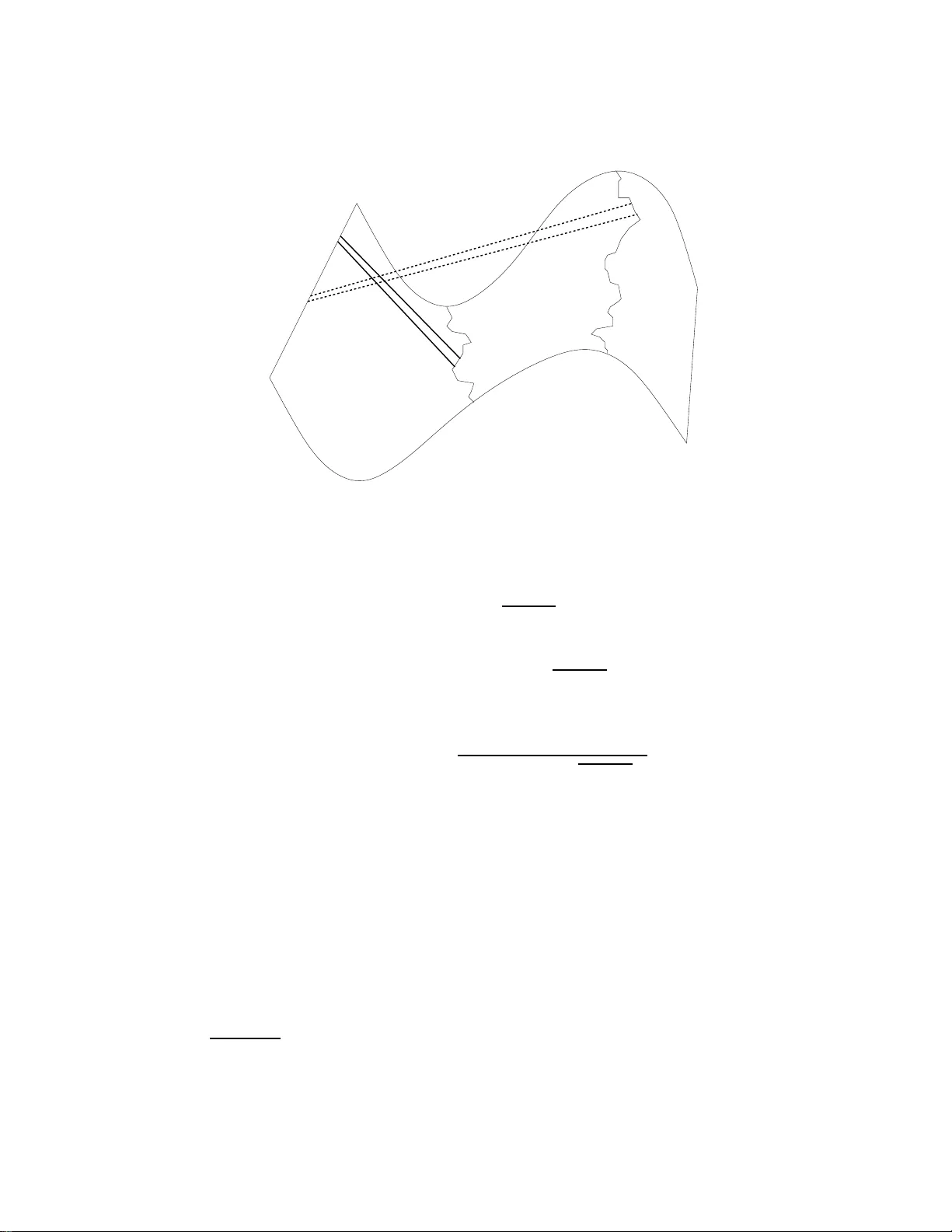
ASYMPTOTIC CONES, BI-LIPSCHITZ UL TRAFLA TS, AND THE GEOMETRIC RANK OF GEODESICS. STEF ANO FRANCA VIGLIA AND JEAN-FRANC ¸ OIS LAF ONT Abstract. Let M be a closed non- po sitively curved Riemannian (NPCR) mani- fold, ˜ M its universal cov er, and X a n ultra limit o f ˜ M . F or γ ⊂ ˜ M a geo desic, let γ ω be a geo desic in X o btained as a n ultra limit of γ . W e show that if γ ω is con tained in a flat in X , then the original g e o desic γ supp orts a non-trivia l, normal, parallel Jacobi field. In particular, the rank of a geo des ic can be detected from the ultra- limit of the univ ersa l co ver. W e strengthen this r e sult b y allowing for bi-Lipschitz flats satisfying certain additional h yp otheses. As a pplications we obtain (1) constraints on the b ehavior of quasi- isometries betw een complete, s imply connected, NPCR manifolds, and (2) c o nstraints on the NP CR metr ics supp or ted by certa in ma nifolds, and (3) a corr e s po ndence b e- t ween metric s plittings of complete, simply connected NPCR manifolds , and met- ric splittings of its a symptotic cones. F urthermore, com bining our r e sults with the Ba llma nn-Burns-Spatzier rigidity theorem a nd the cla ssic Mos tow rigidity , we also obtain (4) a new pro o f of Gro mov’s rigidity theorem for higher rank lo ca lly symmetric spaces. 1. Intr oduction. Ultralimits ha v e rev ealed them selv es to b e a par ticularly useful to ol in g eometric group theory . Indeed, a n um b er of sp ectacular results ha v e b een obtained via the use of ultralimits, including: • Gro mo v’s p o lynomial g r o wth theorem [G], [VW] • Kleiner and L eeb’s quasi-isometric rigidit y theorem for lattices in higher ra nk semi-simple Lie g r oups [KlL] • Kap o vic h, Kleiner, and Lee b’s theorem on detecting de R ham decomp ositions for unive rsal cov ers of Hadamard manifolds [KKL] • Kap o vic h and Leeb’s pro of that quasi-isometries preserv e the JSJ decomp o- sition o f Hak en 3-ma nif o lds [KaL] • Drut u and Sapir’s c haracterization of (strongly) relatively h yp erb olic groups in terms of ultralimits [DS] In the prese n t note, w e show that ultralimits of simply connected R iemannian manifolds M of non-p ositive sectional curv ature can b e used to detect the geometric rank o f geo desics in M . More precisely , w e establish the following: 1 Theorem 1.1. L et M b e a simpl y c onne c te d, c omplete, Riemannian manifold of non-p ositive se ctional curvatur e, and let C one ( M ) b e an asymptotic c one of M . F or γ ⊂ M an arbitr ary ge o desic, let γ ω ⊂ C one ( M ) b e the c orr esp onding ge o desic in the asymptotic c one. If ther e exists a flat plane F ⊂ C one ( M ) with γ ω ⊂ F , then ther e ex ists a non-trivial p ar al lel Jac obi field J along γ satisfying h J ( t ) , ˙ γ ( t ) i = 0 . I n p articular, the ge o desic γ has higher r ank. Let us briefly explain the lay o ut of the presen t pap er. In Section 2, w e pro vide a quic k review of the requisite notions concerning asymptotic cones, v ar ia tion o f arclength for mulas for geo desic v a r ia tions, and other bac kground material. In Section 3, we pro vide conditions ensuring existence of a no n- trivial, orthogo nal, Jacobi field along a g eo desic γ . The conditions in v olv e exis tence of what w e call p oin te d flattening se quenc es of 4-t uples for the geo desic γ . The argumen ts in this section ar e purely differen tial geometric in nature. In Section 4, w e sho w that if γ ω ⊂ C one ( M ) is con tained in a flat, then p oin ted flattening sequences of 4- tuples can b e constructed along γ (completing the proo f of Theorem 1.1). The argumen ts here rely on some elemen tary argumen ts conce rning asymptotic cones a nd the “la rge-scale geometry” of the manifold M . In Section 5, we establish some impro v emen ts b y allo wing for γ ω ⊂ C one ( M ) to b e con tained in a bi-Lips c hitz flat . The pr ecise result is con tained in: Theorem 1.2. L et M b e a simpl y c onne c te d, c omplete, Riemannian manifold of non-p ositive se ctional curvatur e, and let C one ( M ) b e an asymptotic c one of M . F or γ ⊂ M an a rbitr a ry ge o desic, let γ ω ⊂ C one ( M ) b e the c orr esp onding ge o d e sic in the asymptotic c one. Assume that: • ther e exists g ∈ I som ( M ) w h i ch stabilizes and acts c o c omp actly on γ , and • ther e exists a bi-Lipschitzly emb e dde d flat φ : R 2 ֒ → C one ( M ) ma p ping the x -axis o nto γ ω . Then the original ge o desic γ has highe r r ank. Finally , in Section 6 , w e apply our Theorem 1.2 to obtain v arious geometrical corollaries. These include: • constraints on the p ossible quasi-isometries b etw ee n certain non-p ositiv ely curv ed Riemannian manifolds. • restrictions on the p ossible non-p ositive ly curv ed R iemannian metrics that are supp o rted by certain manifolds. • a pro of that splittings of simply connected non-p ositive ly curv ed Riemannian manifolds corr esp o nd exactly with metric splittings of the asymptotic cones. • a new pro of of Gromov ’s rigidity theorem [BGS]: a closed higher rank lo cally symmetric space supp orts a unique metric o f non-p ositiv e curv ature (up to homothet y). 2 Finally , w e po in t out tha t v a rious authors ha v e studied geometric prop erties en- co ded in the a symptotic cone of non-p ositive ly curv ed manifolds. Pe rhaps the view- p oin t closest to ours is that of Kap ovic h- Kleiner-Leeb pap er [KKL], whic h fo cus o n studying the (lo cal homological) top ology of the asymptotic cone to reco v er geometric information on the original space. W e should also men tion the recen t preprin t of Bestvina-F ujiw ara [BeF u], whic h giv es a b ounded cohomological c haracterization of higher rank symme tric spaces. Although they do not sp ecifically disc uss ultralimits, their discussion of rank 1 isome- tries seems to b ear some philo sophical similarities to o ur w ork. Ac kno wledgemen ts The author’s w ould like to thank V. Guirardel, J. Heinonen, T. Janus zkiewicz, B. Kleiner, R. Spatzier, a nd S. W enger for their helpful commen ts. This w ork w as part ly carried o ut during a visit of the fir st author to the Ohio State Univ ersit y (suppo r ted in part b y the MRI), and a vis it of the second author to the Univ ersit` a di Pisa. The w ork of the first autho r w as partly supp orted b y the Europ ean Researc h Council – MEIF-CT-2005- 010975 and MER G-CT-200 7-04655 7 . The w ork of the second author w as par t ly supp orted b y NSF grant DMS-060600 2 . 2. Back gr ound Ma te rial 2.1. In tro duction to asymptotic cones. In t his section, w e pro vide s ome bac k- ground on ultralimits a nd asymptotic cones of metric spaces. Let us start with some basic reminders on ultra filters. Definition. A non-princip al ultr afilter on the natur al n umb ers N is a c ol le ction U of subsets of N , sa tisfying the fol low i n g four axiom s: (1) if S ∈ U , and S ′ ⊃ S , then S ′ ∈ U , (2) if S ⊂ N is a fini te subset, then S / ∈ U , (3) if S, S ′ ∈ U , then S ∩ S ′ ∈ U , (4) giv e n any finite p a rtition N = S 1 ∪ . . . ∪ S k into p airwise disjoint sets, ther e is a unique S i satisfying S i ∈ U . Zorn’s L emma guarantee s the existence of non-principal ultrafilters. Now giv en a compact Hausdorff space X and a map f : N → X , there is a unique p oin t f ω ∈ X suc h that ev ery neigh b orho o d U of f ω satisfies f − 1 ( U ) ∈ U . This p o in t is called the ω − limit of the sequence { f ( i ) } ; we write ω lim f ( i ) = f ω . In particular, if the target space X is the compact space [0 , ∞ ], w e ha v e that f ω is a we ll-defined real num ber (or ∞ ). Definition. L et ( X , d, ∗ ) b e a p ointe d metric sp ac e, X N the c ol le ction of X -value d se quenc es, and λ : N → (0 , ∞ ) ⊂ [0 , ∞ ] a se quenc e o f r e al n umb ers satisfying λ ω = ∞ . Given any p air of p oints { x i } , { y i } in X N , we define the pseudo-distanc e d ω ( { x i } , { y i } ) 3 b etwe en them to b e f ω , wher e f : N → [0 , ∞ ) is the function f ( k ) = d ( x k , y k ) /λ ( k ) . Observe that this p seudo-distanc e takes on values in [0 , ∞ ] . Next, note that X N has a d istinguishe d p oint, c orr e s p onding to the c onstant se- quenc e {∗} . R estricting to the subset of X N c onsisting of se quenc es { x i } satisfying d ω ( { x i } , { ∗} ) < ∞ , an d ide ntifying se quenc es whose d ω distanc e is zer o, one obtains a genuine p ointe d metric sp ac e ( X ω , d ω , ∗ ω ) , which we c al l an asymp totic c o ne of the p ointe d metric sp ac e ( X , d, ∗ ) . W e will usually denote an asymptotic cone by C o ne ( X ). The reader should k eep in mind that the construction of C one ( X ) inv olv es a n um b er of c hoices (basep oin ts, sequence λ i , c hoice of non-principal ultrafilters) and that differen t c hoices could giv e differen t (non-homeomorphic) asymptotic cone s (see the pap ers [TV], [KSTT], [OS]). W e will require the following facts concerning asymptotic cones of no n-p ositiv ely curv ed spaces: • if ( X , d ) is a CA T(0) space, then C one ( X ) is likew ise a CA T(0) space, • if φ : X → Y is a ( C , K )- quasi-isometric map, then φ induces a bi-Lipsc hitz map φ ω : C one ( X ) → C one ( Y ), • if γ ⊂ X is a geo desic, then γ ω := C one ( γ ) ⊂ C one ( X ) is a geo desic, • if { a i } , { b i } ∈ C one ( X ) a re an a r bit r a ry pair of p oints , t hen the ultra limit of the geo desic segmen ts a i b i giv es a geo desic segmen t { a i }{ b i } joining { a i } to { b i } . Concerning the second p o in t ab o v e, w e r emind the reader that a ( C, K )-quasi-isometric map φ : ( X , d X ) → ( Y , d Y ) b etw ee n metric spaces is a (not necessarily con tin uous) map having the prop ert y tha t : 1 C · d X ( p, q ) − K ≤ d Y ( φ ( p ) , φ ( q )) ≤ C · d X ( p, q ) + K . W e now pro ceed to establish tw o Lemmas whic h will b e used in some of o ur pro ofs. Lemma 2.1 (Cho osing go o d sequences) . L et X b e a CA T(0) sp ac e, C one ( X ) an asymptotic c one of X , γ ⊂ X a ge o desic, and γ ω ⊂ C one ( X ) the c orr esp onding ge o desic in the asymptotic c one. Assume that { A, B , C , D } ⊂ C one ( X ) is a 4 -tuple of p oints having the pr op erty that A, B ∈ γ ω ar e the closest p oints on γ ω to the p oints D , C (r esp e ctively). L e t { C i } , { D i } ⊂ X b e two se quenc e s r epr esenting the p oints C , D ∈ C one ( X ) r esp e ctively. T h en (1) if A i , B i ∈ γ ar e the clos e s t p oints to D i , C i (r esp e ctively), then { A i } , { B i } r epr esent A, B ∈ C one ( X ) r esp e ctively. (2) if { r i } ⊂ R + is a se quenc e of r e al numb e rs satisfying ω lim { r i /λ ( i ) } = d ω ( A, D ) , and D ′ i ∈ − − − → A i D i satisfies d ( A i , D ′ i ) = r i , then the se quenc e { D ′ i } r epr esen ts D ∈ C one ( X ) . 4 Lemma 2.1 allo ws us to replace, in certain circumstances , a g iv en se quence of 4- tuples represen ting { A, B , C , D } ⊂ C one ( X ) by a new sequence of 4-tuples that are geometrically b etter b eha v ed (i.e. hav e b etter metric prop erties). Pr o of (Lemma 2.1) . T o establish (1), we assume without loss of generalit y that the constan t sequence {∗} of basepoints used to define ∗ ∈ C one ( X ) is chose n to lie on γ . Then the triangle inequalit y , comb ined with the fact that A i is the closest p oin t to D i on γ , immediately implies: d ( ∗ , A i ) ≤ d ( A i , D i ) + d ( D i , ∗ ) ≤ 2 d ( D i , ∗ ) This in turns implies that d ω ( { A i } , ∗ ) ≤ 2 d ω ( { D i } , ∗ ) < ∞ , i.e. { A i } do es define a p oint A ω ∈ C one ( X ). An iden tical a r g umen t show s that { B i } defines a p o in t B ω ∈ C one ( X ) . F urthermore, since all the p o in ts A i , B i are o n γ , w e hav e that A ω , B ω ∈ γ ω ⊂ C one ( X ). W e now claim that A ω = A and B ω = B . T o see this, we note that the sequence of geo desic segmen ts { D i A i } giv es rise to a geo desic segmen t D A ω joining D ∈ C one ( X ) to the p oint A ω ∈ γ ω ⊂ C one ( X ). Since each D i A i w as a minimal length segmen t joining D i to γ , the segmen t D A ω is lik ew ise a minimal length segmen t joining D to γ ω . But w e know that the closest point on γ ω to D is A ( a nd t his is the unique suc h p oint, as C one ( X ) is CA T(0)). W e conclude that A ω = A , as desired. An iden tical argumen t applies to sho w B ω = B , completing the argumen t for (1). T o establish (2), w e first note that the sequence of geo desic rays { − − − → A i D i } define some geo desic ra y ~ η ⊂ C one ( X ). F urthermore, by construction, we hav e that ~ η originates at A , and passes through D . No w ag ain, an easy a pplication of the tria ngle inequalit y implies that the sequence { D ′ i } represen ts a p oint D ω ∈ C one ( X ), which w e are claiming coincides with the p oint D . Since eac h D ′ i is c hosen to lie on the corresp onding geo desic ray − − − → A i D i , we immediately get D ω ∈ ~ η . Finally , let us calculate the distance b et w een D ω and the p oint A : d ω ( A, D ω ) = ω lim { d ( A i , D ′ i ) /λ ( i ) } = ω lim { r i /λ ( i ) } = d ω ( A, D ) . So w e see that D ω , D are a pair of p oin ts on the geo desic ra y ~ η , ha ving the property that they are b oth at the exact same distance from the basep oin t A of the geo desic ra y . This immediately imp lies that they hav e t o coincide, completing the a rgumen t for (2), and hence the pro of of Lemma 2.1. Lemma 2.2 (T ranslations on asymptotic cone) . L et X b e a ge o desic sp ac e, γ ⊂ X a ge o desic, and γ ω ⊂ C one ( X ) the c orr esp onding ge o desic in an asymptotic c one C one ( X ) of X . Assume that ther e exists an eleme n t g ∈ I som ( X ) with the pr op erty that g le aves γ invariant, and a c ts c o c omp actly on γ . Then for any p air of p oints p, q ∈ γ ω , ther e is an isome try Φ : C one ( X ) → C o ne ( X ) satisfying Φ( p ) = q . Pr o of (Lemma 2.2) . Let { p i } , { q i } ⊂ γ ⊂ X b e sequences defining the p oints p, q resp ectiv ely . Since g leav es γ in v a rian t, and acts co compactly on γ , there exists a 5 real n um ber R > 0 and a sequence of exponents k i ∈ Z with the prop ert y that for ev ery index i , we ha v e d ( g k i ( p i ) , q i ) ≤ R . No w observ e that the sequence { g k i } of isometries o f X defines a self-map (defined comp onen t wise) of the space X N of sequences of points in X . Let us denote b y g ω this self-map, whic h we now pro ceed to show induces the desired isometry on C one ( X ). First note that it is immediate that g ω preserv es the pseudo-distance d ω on X N , and has the prop ert y that d ω ( { g k i ( p i ) } , { q i } ) = 0. So to see that g ω descends to a n isometry of C one ( X ), all w e ha v e to establish is tha t for { x i } a sequence satisfying d ω ( { x i } , ∗ ) < ∞ , the image seq uence also satisfies d ω ( { g k i ( x i ) } , ∗ ) < ∞ . But w e ha v e the series o f equiv a lences: d ω ( { x i } , ∗ ) < ∞ ⇐ ⇒ d ω ( { x i } , { p i } ) < ∞ ⇐ ⇒ d ω ( { g k i ( x i ) } , { g k i ( p i ) } ) < ∞ ⇐ ⇒ d ω ( { g k i ( x i ) } , { q i } ) < ∞ ⇐ ⇒ d ω ( { g k i ( x i ) } , ∗ ) < ∞ where the first and last equiv alences come from applying the triangle inequalit y in the pseudo-metric space ( X N , d ω ), and the second and t hird equiv alence s follow from our earlier comments . W e conc lude that t he induce d isometry g ω on the pseudo-metric space X N of seq uences lea v es inv arian t the subset of sequences at finite distance from the distinguished constant seq uence, and hence descends t o a n isometry of C one ( X ). Finally , it is immediate from the definition of the isometry g ω that it will lea v e γ ω in v a rian t, as eac h g k i lea v es γ in v ariant. This concludes the pro of of Lemma 2.2. Observ e that the elemen t g ∈ I som ( X ) used in Lemma 2.2 giv es rise to a Z -action on X leav ing γ in v arian t. It is w orth pointing out that Lemma 2.2 do es not state that g ∈ I som ( X ) induces an R -action on C one ( X ). The issue is that for each r ∈ R , there is indeed a corresp onding isometry of C o ne ( X ), but these will not in general v ar y contin uously with resp ect to r (as can already b e seen in the case X = H 2 ). 2.2. V ariation of arclength form ulas. The classical v a riation fo rm ulas deal with the energy of curve s within a v ariation. This is primarily due to the fact that the energy functional is “easier” to differen tiate than the length functional. In the sit- uation w e are in terested in, the asymptotic cones pic k up (asymptotic) distances, and hence w e need to actually work with v ariat io ns for the arclength rather than the energy . W e no w pro ceed to remind the reader of the (p erhaps less fa miliar) v ariation form ulas for arclength. A pro of of the presen t formulas can b e found in Jost’s b o o k [Jo, pgs. 165 -169]. Let us start o ut b y setting up some notatio n. W e consider ge o desi c variations , whic h are maps σ : [0 , 1 ] × ( − ǫ, ǫ ) → M into a Riemannian manif o ld ( s ∈ [0 , 1] will b e the first parameter, t ∈ ( − ǫ, ǫ ) the second pa rameter), satisfying the following three prop erties: 6 t S γ 0 Figure 1. Geo desic v aria tion. • the curv es s 7→ γ t ( s ) = σ ( s, t ) is a geo desic for all t , • the curv es γ t are parametrised with constan t sp eed: || ˙ γ t || = L ( t ) where L ( t ) is the length of the geo desic γ t , • the “lateral curv es” t 7→ σ (0 , t ) and t 7→ σ (1 , t ) are geo desics. W e now denote b y S, X the following v ector fields: S = D σ h ∂ ∂ s i X = D σ h ∂ ∂ t i Finally , w e denote b y ˆ X the vec tor field obta ined by taking the pro jection of X orthogonal to S . Figure 1 provide s an illustration of a geo desic v aria t ion. W e hav e included the base geo desic (at the b ottom of the picture) corresp onding to t = 0, and ha v e drawn the p ortio n o f σ corresp onding to t ∈ [0 , ǫ ]. The horizon tal curve s represen t geo desic curv es γ t , while the tw o v ertical curv es are the “lateral curv es”. Along the geo desic γ , we ha v e also illustrated a few v alues of the Jacobi v ector field X (p ointing straigh t up). The v aria tion formulas w e will need are: angl First v ariation of arclength: F or t 0 ∈ ( − ǫ, ǫ ), the first deriv ative of the length L ( t ) at t 0 is given b y (see [Jo, pg. 167, equation 4.1.4]): dL dt ( t 0 ) = h S, X i (1 ,t 0 ) − h S, X i (0 ,t 0 ) L ( t 0 ) 7 Second v ariation of arclength: F or t 0 ∈ ( − ǫ, ǫ ), t he second deriv ativ e of the length L ( t ) at t 0 is given b y (see [Jo, pg. 167, equation 4.1.7]): d 2 L dt 2 ( t 0 ) = 1 L ( t 0 ) Z 1 0 ||∇ S ˆ X || 2 − K ( S ∧ ˆ X ) L ( t 0 ) 2 || ˆ X || 2 ds where K ( S ∧ ˆ X ) denotes the sectional curv a ture of the 2-plane spanned b y S and ˆ X . No w observ e that the actual arclength function L i (and hence, its v arious deriv a- tiv es) is in fact indep endent of the parametrization of the “horizon tal geo desics” γ t . P erforming a c hange of v ariable, w e can rew rite the second v a r iation formula in terms of the unit sp eed parametrization: (1) d 2 L dt 2 ( t ) = Z L ( t ) 0 ||∇ ¯ S ˆ X || 2 − K ( ¯ S ∧ ˆ X ) || ˆ X || 2 ds. where now ¯ S denotes the unit v ector in the direction of S , i.e. ¯ S = S/ | | S | | . Notice that b oth X and t he pro jection ˆ X of X orthogonal to S are Jacobi v ector fields, as they arise from v aria tions by g eo desics (see Section 2.3). W e p oint out an imp ortant conse quence of the second v ariation form ula in the context of non-p ositiv e curv ature. In this setting, equation (1) immediately forces d 2 L dt 2 ( t 0 ) ≥ 0 (since the expression inside the integral is ≥ 0). 2.3. Jacobi fields, rank of geo desics, and rigidity . F or the conv enience of the reader, w e briefly recall some basic definitions f r o m Riemannian geometry , referring the reader to [Jo] for more details. Given a geo desic γ in a Riemannian manifold M n of dimension n , a v ector field J along γ is said to b e a Jac obi field if it satisfies the follo wing second order differen tial equation: J ′′ + R ( J, γ ′ ) γ ′ ≡ 0 where J ′′ refer to the second co v ariant deriv ativ e of J along γ , and R denotes the curv ature op erator . W e will require the follo wing classical results concerning Ja cobi fields: • Jacobi fields along γ form a finite dimensional v ector space (of dimension 2 n ), • a Jacobi field is uniquely determined by its v alue (initial conditions) at an y t w o giv en p oints on γ , • give n a geodesic v ariation σ of γ as in the previous section, the “vertical v ector field” X is a Jacobi field a lo ng γ , • conv ersely , giv en a geo desic segmen t γ in a Riemannian manifold, and a Jacobi field J along γ , there exists a geo desic v ariation whose “v ertical v ector field” X coincides with J a long γ . Note in particular that the last t w o prop erties ab ov e tell us that Jacobi fields exactly enc o de the infinitesimal b ehav ior o f geo desic v ariations. A Ja cobi field J tha t additionally satisfies J ′ ≡ 0 will be called a p ar al lel Jac obi fields along γ . The r ank of 8 a geodesic γ is defined to b e the dimension of the v ector space o f parallel Jacobi fie lds along γ . Sinc e a conc rete example of a parallel Jacobi field is giv en b y t he tangen t v ector field V = γ ′ to the geo desic γ , we note tha t r k ( γ ) ≥ 1 for ev ery geo desic γ . A celebrated result in the geometry of non-p ositive ly curv ed Riemannian manifolds is the ra nk rigidity theorem o f Ballman-Burns-Spat zier [Ba2], [BuSp ]: Theorem 2.3 (Ra nk rigidity t heorem) . L et M b e a close d non-p ositively curve d Riemannian manifold, and ˜ M the universal c over of M with the induc e d R iemannian structur e. Assume that ˜ M has higher geometric rank , in the sense that every ge o desi c γ ⊂ ˜ M satisfies r k ( γ ) ≥ 2 . Then either: • ˜ M splits isometric al ly as a pr o duct of two simply c onne cte d Riemannian man- ifolds of non-p ositive curvatur e, or • ˜ M is an irr e ducible h i g her r ank symmetric sp ac e of non-c omp act typ e. In Section 6, w e will make extens iv e use of this rigidit y result to obtain the v ario us corollaries men tioned in the in tro duction. 2.4. Distorted subspaces in metric spaces. Let ( X , ρ ), ( Y , d ) b e a pair of metric spaces, and φ : Y → X an injectiv e map. W e define the distortion of the map φ to b e the suprem um, o v er all tr iples of distinct p oints x, y , z ∈ Y , of the quan tity : ρ ( φ ( x ) , φ ( y )) ρ ( φ ( y ) , φ ( z )) − d ( x, y ) d ( y , z ) W e denote the distortion of φ b y δ ( φ ). Observ e t hat the distortion δ ( φ ) measures the difference b et w een relativ e distances in Y , and relative distances in φ ( Y ) ⊂ X . W e say that a metric space ( X , ρ ) con tains an undistorte d c opy of a metric space ( Y , d ) provide d t here exists an injectiv e map φ : ( Y , d ) ֒ → ( X , ρ ) with δ ( φ ) = 0. W e sa y that X contains almost undistorte d c opies if for an y ǫ > 0, one can find a map φ ǫ : ( Y , d ) → ( X , ρ ) with δ ( φ ǫ ) < ǫ . Finally , give n a sequence of maps φ i : Y → X , w e sa y that t he sequence is undistorte d in the li m it , prov ided w e hav e lim δ ( φ i ) = 0. Let denote the 4-p oin t metric space, consisting of the vertex set of the standard unit square in R 2 , with the induced distance, i.e. consists of four p oints, with the four “side” distances equal to one, and the t w o “ dia g onal” distances equal to √ 2. W e call pairs of points at distance one a side pair of ve rtices. A large part of t his pap er will fo cus on finding and using ( almost) undistorted copies of inside sim- ply connected complete Riemannian manifolds of non-p ositive curv ature (and inside their a symptotic cones). Giv en a (cyclicly ordered) 4-tuple of p o in ts { A, B , C , D } inside a space X , we will frequen tly iden tify the 4-tuple with a cop y of , with the understanding that the ordered 4 -tuple o f p o ints corresp ond to the cyclicly ordered p oin ts in the square. W e no w p oin t out an easy lemma that allows us to o ccasionally “ignore diagonals.” 9 Lemma 2.4. L et { A j , B j , C j , D j } b e a se quen c e of 4 -tuples inside a CA T(0) sp ac e X . Assume that e a c h of the 4 -tuples satisfies the c onditions: • the p oint B j is the closest p oin t to C j on the ge o desic se gment A j B j , • the p oint A j is the closest p oin t to D j on the ge o desic se gment A j B j , • we have e quality of the side lengths d ( D j , A j ) = d ( A j , B j ) = d ( B j , C j ) = K j , • d ( C j , D j ) = K j (1 + ǫ j ) , with ǫ j → 0 . Then we have that d ( A j , C j ) /K j → √ 2 a n d d ( B j , D j ) /K j → √ 2 . Pr o of. Let us temp orarily ignore the indices j , and for a 4-tuple { A, B , C , D } of p oin ts as ab o v e, w e let d 1 , d 2 denote the lengths of the tw o diagonals AC , B D . W e no w w an t to con trol the tw o ratios d i /K in terms of ǫ , and in fact, show tha t the ratios tend to √ 2 as ǫ → 0. But this is relativ ely easy to do: consider a comparison triangle ¯ A ¯ B ¯ C ⊂ R 2 for the t r iangle AB C . The fact that t he p oin t B is the closest p oin t to C on the geo desic segmen t AB immediately implies that, in the comparison triangle, w e ha v e ∠ ¯ B ≥ π / 2. This in turn fo rces the inequalit y: d 2 1 = d ( ¯ A, ¯ C ) 2 ≥ d ( ¯ A, ¯ B ) 2 + d ( ¯ B , ¯ C ) 2 = 2 K 2 = ⇒ d 1 ≥ K √ 2 An identical argument establishes d 2 ≥ K √ 2. But on the other hand, we know that CA T(0) spaces satisfy , fo r any 4-tuples of p oin ts { A, B , C , D } the inequalit y: d ( A, C ) 2 + d ( B , D ) 2 ≤ d ( A, B ) 2 + d ( B , C ) 2 + d ( C , D ) 2 + d ( D , A ) 2 . Substituting the kno wn quan tities in to our expression, w e o btain: 2 · ( K √ 2) 2 ≤ d 2 1 + d 2 2 ≤ 3 · K 2 + [ K (1 + ǫ )] 2 Dividing out b y K 2 , w e see that the ratios d 1 /K , d 2 /K are a pair of real num bers ≥ √ 2 whic h satisfy the inequalit y: 4 ≤ ( d 1 /K ) 2 + ( d 2 /K ) 2 ≤ 3 + (1 + ǫ ) 2 . No w taking the indices j back into accoun t, it is no w immediate that as ǫ j → 0, the ratios d 1 /K j → √ 2 and d 2 /K j → √ 2, as desired. This conclude s the pro of of Lemma 2.4. 3. Fro m fla tte ning 4- tuples to p arallel Ja cobi fields. In this se ction, w e fo cus on establishing ho w certain seq uences o f 4-tuples of p o ints can b e used to construct para llel Jacobi fields along geo desics. More precisely , w e in tro duce the notion of: Definition (Go o d 4-tuple) . L et ˜ M b e a c omplete, simply c onne cte d, Riemmanian manifold of non-p ositive se ctional curvatur e, and let γ ⊂ ˜ M b e an arbitr ary ge o desic. We say that that a 4-tuple of p oints { A, B , C, D } in the sp ac e ˜ M is go o d (r elative to γ ) pr ovide d that A, B ∈ γ , AD ⊥ γ , B C ⊥ γ , and d ( D , A ) = d ( A, B ) = d ( B , C ) . 10 P B B B C C C D D D 1 1 1 2 3 2 2 3 3 γ Figure 2. Poin ted flattening sequence along a geo desic. In effect, a go o d 4-tuple is a g eo desic quadrilateral in ˜ M , with one side on the geo desic γ , the tw o adjacen t sides p erp endicular t o γ , and with tho se three sides ha ving exactly the same length. Definition (P ointe d flattening sequence s) . We say that γ has p oin ted flattening 4- tuples if given any p oint P ∈ γ , ther e exists a s e quenc e of { P , B i , C i , D i } of 4-tuples, e ach of which is go o d (r elative to γ ), satisfies lim B i = γ ( ∞ ) , and i s undistorte d in the lim i t. Figure 2 ab o v e illustrates t he first three 4-tuples of a p oin ted flattening sequence. The sides o f eac h quadrilateral are p erp endicular to the b ot tom geo desic, and the length of the top edge approach es (as a ratio in the limit) the length of the remaining three edges of the quadrilaterals. While the definition of p ointe d flatt ening sequences of 4 -tuples migh t seem some- what artificial, the reader will see in Sections 4 and 5 that these are relativ ely easy to detect from the asymptotic cone. The main goal o f this section is to prov e: Theorem 3.1 (P ointed flattening sequence ⇒ higher rank) . L et ˜ M b e a c omplete, simply c onne cte d, Riemmanian manifold of non - p ositive se ctional curvatur e, and let γ ⊂ ˜ M b e an a rb i tr ary ge o desic . If γ has p ointe d flattening 4- tuples, then γ supp o rts a no n-trivial, ortho gonal, p ar al lel Jac o bi field. In p articular, r k ( γ ) ≥ 2 . So let us star t with some P ∈ γ , and let { P , B i , C i , D i } b e the sequence of 4-tuples whose existenc e is ensured b y the hypothesis that γ has p oin ted flattening sequences. Observ e that the point P = γ ( r ) divides the geo desic γ in to t w o geodesic rays, and we denote b y ~ γ P the geo desic ra y obtained b y restricting γ to [ r , ∞ ). Our approac h will b e to first construct a non-trivial, orthogonal, parallel Jacobi field along the geo desic ra y ~ γ P , and then let P tend to γ ( −∞ ). 11 In or der to cons truct the desired Jacobi field alo ng the geo desic ra y ~ γ P , w e con- sider geo desic v ariations σ i in the space ˜ M , eac h of whic h is constructed from the corresp onding 4-tuple { P , B i , C i , D i } as fo llows: • α i : [0 , T i ] → ˜ M denotes the unit sp eed geo desic from P to D i , and β i denotes the one from B i to C i . W e set L i ( t ) = d ( α i ( t ) , β i ( t )), so in particular w e ha v e L i (0) = T i . • σ i is para metrised by { ( s, t ) : t ∈ [0 , T i ] , s ∈ [0 , T i ] } . • σ i , when restricted to the in terv a l { 0 } × [0 , T i ], coincides with α i , and when restricted t o the in terv al { 1 } × [0 , T i ], with β i . • for ev ery t ∈ [0 , T i ], the restriction of σ i to the interv al [0 , T i ] × { t } is the constan t sp eed geo desic from α i ( t ) t o β i ( t ). Note t ha t these maps are precis ely v ariations b y geo desics of the t ype discuss ed in section 2.2. Our go al will no w b e to analyze prop erties of the functions L i . W e start with the easy: F act 1: F or an y fixed v alue of i , t he function L i is twic e differen tiable a nd conv ex . Twice differen tiabilit y follow s immediately from the formulas for the first and sec- ond v ar iation o f ar clength. Con v exit y is immediate from the fact that L ′′ i ( t ) ≥ 0 (see the commen t immediately after equation (1) ) . F act 2: F or an y i a nd an y 0 ≤ x ≤ t ≤ T i , w e hav e L i ( t ) = L i ( x ) + ( t − x ) L ′ i ( x ) + Z t x Z y x L ′′ i ( τ ) d τ dy This is nothing but the F undamen tal Theorem of Calculus applied twice . F act 3: F or an y i a nd an y 0 ≤ t ≤ T i , w e hav e the following expression for L i ( t ): (2) L i ( t ) = L i (0) + Z t 0 Z y 0 L ′′ i ( τ ) d τ dy By F act 2, it is sufficien t to argue that eac h of the deriv ativ es L ′ i (0) is equal t o zero. No w r ecall that the ma ps σ i are geo desic v ar ia tions with the prop ert y that each of the “la teral curv es” α i ( t ) = P D i and β i ( t ) = B i C i are geo desics. F urthermore, since the 4-tuple { P , B i , C i , D i } is go o d (relative to γ ) , w e hav e tha t the “lateral curv es” are p erp endicular to the geo desic γ . Now applying the first v ariation of arclength form ula (section 2.2), w e immediately see that L ′ i (0) = 0, as desired. Note that a conseq uence of F act 3 is that eac h L i is monotone non- decreasing. Now recall that the v ariations w e are considering come fr om a p o in ted flattening sequen ce of 4-tuples, which in particular means that the corresp onding maps → ˜ M are 12 undistorted in the limit. In our curren t notatio n, we hav e that d ( C i , D i ) = L i ( T i ) and d ( P , B i ) = T i , hence w e obtain: lim i →∞ L i ( T i ) T i = lim i →∞ d ( C i , D i ) d ( P , B i ) = 1 , F urthermore, recall that L i (0) = d ( P , B i ) = T i , and in particular w e hav e L i (0) /T i = 1 (for all i ). Combin ing this with o ur equation ( 2) in F act 3 (a pplied to t = T i ), w e see tha t : (3) lim i →∞ Z T i 0 Z y 0 L ′′ i ( τ ) T i dτ dy = 0 . The next step is to get rid of the T i factor inside the in tegral. F act 4: W e ha v e that: lim i →∞ Z T i / 2 0 L ′′ i ( τ ) dτ = 0 . T o see this, w e first observ e that w e hav e the obvious series of equalities: 1 2 Z T i / 2 0 L ′′ i ( τ ) dτ = T i 2 Z T i / 2 0 L ′′ i ( τ ) T i dτ = Z T i T i / 2 Z T i / 2 0 L ′′ i ( τ ) T i dτ dy No w recall from F act 1 that L ′′ i ( τ ) ≥ 0 (b y conv ex ity ), a nd hence the expression inside eac h of the in tegrands ab o v e is ≥ 0 . But no w, b y p ositivity of each of the functions L ′′ i ( τ ) / T i , containmen t of the do mains of integrations yields the follo wing inequalit y: Z T i T i / 2 Z T i / 2 0 L ′′ i ( τ ) T i dτ dy ≤ Z T i 0 Z y 0 L ′′ i ( τ ) T i dτ d y . Com bining this upp er estimate with equation (3) ab ov e, w e immediately obtain: 0 ≤ lim i →∞ Z T i / 2 0 L ′′ i ( τ ) dτ ≤ 2 · lim i →∞ Z T i 0 Z y 0 L ′′ i ( τ ) T i dτ dy = 0 completing the pro of of F act 4 . Next w e note that a consequence of F act 4 is that the sequenc e of functions L ′′ i ( t ) tends to zero for almo st all t ∈ [0 , T i / 2]. In particular, we can find a seq uence { t i } satisfying the fo llo wing t w o conditions: (1) t i ∈ [0 , T i ] a nd lim i →∞ t i = 0 (2) lim i →∞ L ′′ i ( t i ) = 0. Let us denote b y γ i : [0 , 1] → ˜ M the geo desic joining α i ( t i ) to β i ( t i ). Note that these geo desics ar e precisely the curv es σ i ( − , t i ) : [0 , L i ( t i )] → ˜ M , where σ i is our sequence of v a r iations of geo desics. W e next observ e that: 13 F act 5: The geo desic segmen ts γ i tend to the geo desic ra y ~ γ P ⊂ γ . T o see this, w e first note since the “lateral curv es” for the v ariat io n σ i are geo desics p erp endicular to γ (and since w e hav e K ≤ 0), w e hav e d ( α i ( t i ) , γ ) = t i = d ( β i ( t i ) , γ ) In particular, w e see that the geo desic segmen ts γ i join a pair of p o in ts whose distance from γ tends to zero. Since geo desic neigh b orho o ds o f γ are con v ex (by the no n- p ositiv e curv at ur e h yp othesis), w e conclude that the distance of any p oint on γ i is at most t i a w a y fro m the g eo desic γ , where t i w as c hosen to tend to 0. F urthermore, w e clearly hav e that lim α i ( t i ) = P , and lim β i ( t i ) = γ ( ∞ ), and hence w e o bta in lim γ i = ~ γ P , as desired. No w alo ng eac h of the geo desic segmen ts γ i , we hav e that the corresp onding geo- desic v ariation σ i giv es r ise to a Jacobi vec tor field X i . W e no w fo cus our atten tion to this sequence of Jacobi fields. F act 6: The Jacobi field X i along γ i satisfies || X i ( p ) || ≤ 1 for all p ∈ γ i . T o see this, fir st observ e that X i (0) = α ′ i ( t i ) and X i ( L i ( t i )) = β ′ i ( t i ). Since α i and β i are unit sp eed para metrized, this implies that || X i (0) || = || X i ( L i ( t i )) || = 1 . But from the non- p ositiv e curv ature a ssumption and t he Jacobi differen tial equation, it follo ws that the square-norm of a Jacobi field along a geo desic is a con v ex function. Since || X i || = 1 at the endp oin ts of the geo desic γ i , F act 6 follows. F act 7: Up to possibly passing to subsequences , the Jacobi fields X i along γ i con v erge (uniformly on compact sets), to a Jacobi field X along ~ γ P . This follow s from the general fa ct that a Ja cobi field is determined by an y tw o of its v alues. T ak e p oints p i , q i in γ i that con v erge to p oin ts p 6 = q of ~ γ P . F rom F act 6, we see that up to p ossibly pa ssing to subsequences , b oth X i ( p i ) and X i ( q i ) hav e a limit. Moreo v er, Jacobi fields a re solution o f ordinary differential equations with smo oth co efficien ts (in f a ct with the regularit y of the curv ature tensor) and therefore dep end con tin uously on the initial dat a (the v alues a t p i and q i .) It follows that X i con v erge to a Jacobi field X along γ uniformly on compact sets, and in particular p oin t-wise. F act 8: The sequence { t i } can b e c hosen so that the limiting v ector field X is p erp endicular to the g eo desic ra y ~ γ P . T o see this, we note that fo r each of the v ar iations σ i , we hav e the tw o asso ciat ed con tin uous v ector fields S i , X i (see section 2.2) . F urthermore, note that these tw o v ector fields are o rtho gonal along the base geo desic γ i . Indeed, the v ector field S i 14 is just γ ′ i , while the v ector field X i is orthogonal to γ i at the t w o endpoints of t he v ar ia tion (recall that α i , β i are ⊥ to γ i ). But from the Jacobi equation, a Jacobi field that is orthogo nal to a geo desic at a pair of p oints is orthogonal to the geo desic at every p oin t. Next observ e that the inner pro duct b etw een the v ectors X i and S i v ar ies contin- uously along the domain of σ i . Since we ha v e h X i , S i i ≡ 0 along the g eo desic γ , b y c ho osing t i close enough to zero, one can ensure that lim i →∞ sup x ∈ γ i h X i , S i i x = 0 . In particular, for any sequence of p oin ts { p i } ⊂ ˜ M satisfying p i ∈ γ i and lim p i = p ∈ γ , w e hav e t hat: h X ( p ) , γ ′ ( p ) i = h lim i →∞ X i ( p i ) , lim i →∞ γ ′ i ( p i ) i = lim i →∞ h X i ( p i ) , S i ( p i ) i = 0 Applying this to the t w o sequences of p oints w ith distinct limits, we see that the lim- iting vec tor field X is o rthogonal to ~ γ P at tw o distinct p o in ts, and hence is orthogonal to ~ γ P at ev ery p oint. In fact, the discussion a b o v e also show s that the Jacobi field X defined o n ~ γ P extends to a p erp endicular Jacobi field along the entire geo desic γ . F act 9: The Jacobi v ector field X along ~ γ P satisfies: (4) Z ~ γ P − K ( X ∧ ˙ γ ) | | X || 2 + || ∇ ˙ γ X || 2 ds = 0 . This follo ws imm ediately from F acts 5, 7, condition (2) in our c hoice of the seq uence { t i } (see the discuss ion preceding F act 5), and the second v ar ia tion form ula for L ′′ i ( t i ) (see section 2.2, equation (1 )). Indeed, this is just an application o f the Leb esgue dominated con v ergence theorem (the in tegrand is p ositiv e, b ounded on compact se ts, and we hav e p oint-wise con v ergence.) Observ e that at this p oin t, w e are a lmost done. Since ˜ M has non-p ositiv e sectional curv ature, we see tha t the expression inside the in tegral in equation (4 ) consists of a sum of t w o terms that are ≥ 0 ( p oin tw ise). Since t he o v erall inte gral is zero, and the expression inside t he in tegral v aries con tinuous ly , this tells us that at every p oin t along ~ γ P , w e hav e that: − K ( X ∧ ˙ γ ) || X || 2 = 0 and ||∇ ˙ γ X || 2 = 0 . F urthermore, at the p o in t P w e see that the v ector field X is the limit of v ectors of norm =1 (see F act 6), and whose angle with γ ′ tends to π / 2 (see F act 8). In particular this gives : F act 10: The Jacobi field X is not the zero v ector field, since we ha v e X ( P ) 6 = 0. 15 Finally , let us complete the pro of of t he theorem. Let { P k } b e a seque nce of p oin ts o n γ , with P k = γ ( t k ) for a strictly decreasing sequence of r eal n um b ers t k with lim t k = −∞ (so in part icular, lim P k = γ ( −∞ )) . Let J denote the (2 n − 2)- dimensional vector space of ortho g onal Jacobi fields along the geo desic γ . Corre- sp onding to eac h P k , w e let J k ⊂ J denote the collec tion of all orthogonal Ja cobi fields on γ hav ing the prop erty that they are parallel along the geo desic ray ~ γ P k (with no constrain ts on the b eha vior on the rest of γ ). It is obv ious that each J k is actually a v ector subspace of J , and our pro of ensures that each J k con tains a non-zero ve ctor field, and in particular, satisfies dim J k ≥ 1. F urthermore, whenev er k ≥ k ′ , w e hav e a con tainmen t of geo desic rays ~ γ P k ′ ⊂ ~ γ P k , whic h immediately yields con tainmen ts J k ⊂ J k ′ . Since w e hav e a sequence of nested, non- trivial, v ector sub- spaces of the finite dimen s i o nal v ector space J , w e conclude that their inte rsection is non-zero. This implies the existence of a globa lly defined, non-trivial, para llel, orthogonal Jacobi field along γ , completing the pro o f of the t heorem. 4. From fla ts in the ul tralimit to fla tte ning sequences. In this section, w e fo cus exclusiv ely on finding conditions o n the ultralimit C one ( ˜ M ) that can b e used to construct p oin ted fla t tening sequences along a geo desic γ . This en tire section will b e devoted to establishing the following: Theorem 4.1 (Undistorted in ultr alimit ⇒ P oin ted flattening sequence) . L et ˜ M b e a simply c onne cte d, c omplete, R iemmanian manifold of non-p ositive se ctional curvatur e, and let C one ( ˜ M ) b e an asymptotic c one of ˜ M . Given a ge o desic γ ⊂ ˜ M , let γ ω ⊂ C one ( ˜ M ) b e the c orr esp onding ge o de sic in the ultr alimit. Assume that ther e exists a 4-tuple of p oints { A, B , C, D } ⊂ C one ( ˜ M ) , satisfying A, B ∈ γ ω , with ∗ ∈ I nt ( AB ) , an d so that the asso ciate d map → C one ( ˜ M ) is undistorte d. Then the origi n al ge o d e s ic γ has p ointe d flattening se quenc e s . In the next section, we will establish a strengthening of this result, b y considering the case where γ ω is contained in a bi-Lipsc hitz flat (i.e. a bi- Lipsc hitz ima g e of R 2 equipped with the standard metric). In t his more general con text, and under the presence of some additional constraints w e will see t ha t γ s till has p ointed fla t t ening sequence s. Before starting the pro of of t he t heorem, let us first in tro duce an auxiliary notion. Definition (Flattening sequences) . We say that γ has flattening 4-tuples if ther e exists a se quenc e { A i , B i , C i , D i } of 4-tuples of p o ints e ach of whi ch is go o d (r elative to γ ), has lim A i = γ ( −∞ ) and lim B i = γ (+ ∞ ) , and viewing the 4-tuples as a se quenc e of maps → ˜ M , we also r e quir e the se quenc e to b e undis torte d in the limit. An illustratio n of a flattening sequence is prov ided in Figure 3. All the quadrilat- erals are p erp endicular along the base geo desic, ha v e three sides of equal length, and 16 Figure 3. Fla t t ening sequence along a geo desic. ha v e t he length of the top edge tending (asymptotically , in the ratio) to the length of the remaining three edges. W e now b egin the pro of o f theorem 4.1, b y establishing: Step 1: The geo desic γ ha s a flattening sequence . Pr o of (Step 1) . In the ultr a limit C one ( ˜ M ), let us pic k out p oin ts { A, B , C, D } to b e the v ertices of an undistorted square, with the pro p ert y that AB ⊂ γ ω , and ∗ ∈ I nt ( AB ). W e now intend to sho w that a suitable appro ximating sequence of 4-tuples in ˜ M will giv e us the desired flattening sequence. Let us start out by pic king a n arbitrary pa ir of approximating sequences { C ′ i } and { D ′ i } for the p oin ts C, D ∈ C one ( ˜ M ). No w obse rv e that corres p o nding to the geo desic γ ⊂ ˜ M , w e hav e a well-define d pro jection map ρ : ˜ M → γ , where ρ ( x ) is defined to b e the unique p oin t on γ closest to the p oint x . W e now define the sequence { A i } (resp ectiv ely { B i } ) b y setting A i := ρ ( D ′ i ) (resp ectiv ely B i := ρ ( C ′ i )). Note that eac h of the 4-tuples of p oin ts { A i , B i , C ′ i , D ′ i } clearly satisfie s the first three prop erties of b eing go o d for the geo desic γ (the p oin ts A i , B i are on γ , and the sides A i D ′ i and B i C ′ i are ⊥ to γ ). T o ensure the last condition, w e pic k p o ints C i ∈ − − → B i C ′ i , D i ∈ − − − → A i D ′ i satisfying d ( D i , A i ) = d ( A i , B i ) = d ( B i , C i ). Note that this construction is exactly the sort considered in Lemma 2.1. In particular, statemen t (1) in Lemma 2.1 tells us that { A i } = A ∈ C one ( ˜ M ) and { B i } = B ∈ C o ne ( ˜ M ), while statemen t (2) in Lemma 2.1 ensures t ha t { C i } = C ∈ C one ( ˜ M ) and { D i } = D ∈ C one ( ˜ M ). Up to this p oin t, we ha v e constructed a sequence { A i , B i , C i , D i } of 4- tuples, eac h of whic h is go o d for the geo desic γ , and additionally having the prop ert y tha t the sequence (ultra) - con v erges to the 4 -tuple { A, B , C, D } ⊂ C one ( ˜ M ). T o conclude, w e simply need to ensure that our sequence also satisfies the t w o conditions for a flattening sequence , namely , w e need (1 ) that lim A i = γ ( −∞ ) and lim B i = γ (+ ∞ ), 17 and (2) that lim i →∞ { d ( C i , D i ) /d ( A i , B i ) } = 1 . W e will ensure t hat these additional conditions are satisfied b y passing to suitable subseque nces of our original sequenc e. Let us ex plain the argumen t for (2); the argument for (1 ) is analogous (after a p ossible p erm utation o f lab els on the 4-t uples of p oints). Giv en an y k ∈ N , the f act that ω lim { d ( C i , D i ) /λ ( i ) } = d ω ( C , D ) implies t hat the set of indices i for which the follow ing relation holds (5) d ( C i , D i ) λ ( i ) − d ω ( C , D ) < 1 k forms a subset I k ∈ U . Similarly , t he fact that ω lim { d ( A i , B i ) /λ ( i ) } = d ω ( A, B ) implies that t he set of indices i for whic h the fo llo wing relation holds (6) d ( A i , B i ) λ ( i ) − d ω ( A, B ) < 1 k lik ewise forms a subset I ′ k ∈ U . Since the ultrafilter U is closed under in tersections, w e conclude that I k ∩ I ′ k ∈ U . But ev ery elemen t in U is a n infinite subset of N , and in particular, non-empt y . Hence there is an index i k for whic h b ot h equations (5) and (6) hold. Now conside r the subsequenc e { A i k , B i k , C i k , D i k } of 4-tuples in ˜ M , and o bserv e that f r om (5) and (6), we ha v e that the k th 4-tuple satisfies: d ω ( C , D ) − 1 /k d ω ( A, B ) + 1 /k ≤ d ( C i k , D i k ) d ( A i k , B i k ) ≤ d ω ( C , D ) + 1 /k d ω ( A, B ) − 1 /k No w it is immediate that for this subsequence, we obtain: lim k →∞ d ( C i k , D i k ) d ( A i k , B i k ) = d ω ( C , D ) d ω ( A, B ) = 1 where the la st equalit y comes from the fact that the quadrilateral { A, B , C, D } ⊂ C one ( ˜ M ) is an undistorted copy of . But this is precisely the desired prop ert y (2). So w e no w know t hat the geo desic γ w e w ere in terested in has a flattening sequence. The second step in the pro o f of theorem 4.1 lies in impr oving the choice of our subseque nce, obtaining: Step 2: The geo desic γ ha s p ointe d flattening sequences. Pr o of (Step 2) . In the pro of of Step 1, w e started out b y constructing a sequence of 4-tuples { A i , B i , C i , D i } , eac h of whic h w as go o d for γ . The flattening sequence along γ was then obtained b y pic king a suitable subsequence of this sequence of 4- tuples. W e no w pro ceed to explain ho w, by b eing a bit more careful with our c hoice of subseque nce, w e can construct p oin ted fla ttening sequences. T o this end, let { A i , B i , C i , D i } b e the sequence of go o d 4-tuples for γ obtained in Step 1, a nd let P ∈ γ b e a n arbitrary c hosen p oint. Since ω lim { A i } = A , ω lim { B i } = B , ω lim { P } = ∗ , and w e ha v e a con tainmen t ∗ ∈ I nt ( AB ) ⊂ C one ( ˜ M ), 18 w e immediately see that the set of indices J 1 ⊂ N fo r whic h the corresp onding 4- tuples has the prop erty that P ∈ I nt ( A i B i ) consists of a set in our ultrafilter: J 1 ∈ U . No w consider the nearest p oint pro jection ρ : ˜ M → γ , a nd let us first consider indices i ∈ J 1 . Since eac h of the 4-tuples in our se quence is go o d, w e clearly ha v e ρ ( D i ) = A i and ρ ( C i ) = B i . Observ e that P disconnects the geo desic γ into t w o comp onen ts (since i ∈ J ), and the p oin ts A i , B i lie in distinct componen ts of γ − { P } . Since ρ ( D i C i ) giv es a path in γ jo ining A i to B i , we conclude that there m ust exist a p oin t E i ∈ D i C i satisfying ρ ( E i ) = P . Observ e that this immediately implies that P E i ⊥ γ ′ . F or t he remaining indice s i / ∈ J 1 , w e set E i = C i . In particular, we now ha v e a sequence of p o in ts { E i } , with E i ∈ D i C i . No w it is easy to v erify that the sequenc e { E i } defines a p oin t E ∈ C one ( ˜ M ), and since each E i ∈ D i C i , we ha v e that E ∈ D C . F urthermore, the fa ct that ρ ( E i ) = P fo r a collection of indices i ∈ J 1 con tained in our ultrafilter U implies that ρ ω ( E ) = ω lim { P } = ∗ ∈ C one ( ˜ M ), where ρ ω : C one ( ˜ M ) → γ ω is the pro jection map f r om C one ( ˜ M ) to γ ω . Observ e that the 4-t uple of p oin ts { A, B , C, D } ⊂ C one ( ˜ M ), corresp o nding to an undistorted , satisfies t he equality : (7) 1 = d ω ( A, C ) 2 + d ω ( B , D ) 2 − d ω ( C , D ) 2 − d ω ( A, B ) 2 2 · d ω ( A, D ) · d ω ( B , C ) But inside a geo desic space, a 4-tuple of (distinct, non-colinear) p oin ts satisfies the equalit y in equation (7) if and only if the 4-tuple o f p oin ts a re the v ertices of a flat pa r a llelogram (see Berg-Nik olaev [BeNi, Theorem 15 ]). Applying this to the giv en 4-tuple of p oin ts in C o ne ( ˜ M ), we see that there exists an isometric em b edding P ֒ → C one ( ˜ M ) from a square P ⊂ R 2 , with the prop erty that the v ertices map precisely t o t he p oints { A, B , C , D } . But no w w e immediately see that the p oin t E ∈ C D must be the po int satisfy ing d ω ( E , C ) = d ω ( P , B ), and in particular, that the 4-tuple { P , B , C , E } are the v ertices of a flat rectangle in C one ( ˜ M ), with d ω ( C , E ) = d ω ( P , B ) < d ω ( P , E ) = d ω ( B , C ). So w e can find a collection of indices J 2 ∈ U with the prop erty that for all i ∈ J 2 , d ( P , B i ) < d ( P , E i ) a nd d ( P , B i ) < d ( B i , C i ). F or eac h of the indices i ∈ J 2 , w e can no w c ho ose points F i ∈ P E i , G i ∈ B i C i to satisfy d ( P , F i ) = d ( P , B i ) = d ( B i , G i ). F or indices i / ∈ J 2 , we set F i = E i , G i = C i . It is again easy to verit y that the sequence s { F i } , { G i } define p oints F , G ∈ C o ne ( ˜ M ). F urthermore one can v erify that the 4 - tuple { P , B , G, F } define an undistorted in C one ( ˜ M ). Figure 4 con tains an illustration of where the v ario us p oints E i , F i , G i are chose n from the original 4 - tuple { A i , B i , C i , D i } (for indices i ∈ J 1 ∩ J 2 ). W e observ e that for our sequence of 4-tuples we now ha v e: • the sequence of 4-tuples { P , B i , G i , F i } ultra-con v erges to the v ertices o f an undistorted square in C one ( ˜ M ), and 19 A P B F E C i i i i G i i γ D i Figure 4. Constructing p oin ted flattening sequences. • for eac h index i ∈ J 1 ∩ J 2 , the corresp onding 4- t uple { P , B i , G i , F i } is go o d. W e now w an t to pic k a subseque nce of 4-tuples, within the index set J 1 ∩ J 2 , whic h satisfies the additional prop ert y that lim k →∞ { d ( F i k , G i k ) /d ( P , B i k ) } = 1. So define, for k ∈ N , the sets I k , I ′ k ∈ U t o b e the set of indices satisfying the ob vious analogues of equ ations (5 ) and (6) from Step 1. Then w e se e that, from the closure of ultrafilters under finite intersec tions, we hav e for eac h k ∈ N the set I k ∩ I ′ k ∩ J 1 ∩ J 2 lies in our ultrafilter U , a nd hence is non-empty . In pa r ticular, we can select indices i k ∈ I k ∩ I ′ k ∩ J 1 ∩ J 2 , and the argumen t giv en at the end of Step 1 extends ve rbatim to see that the subsequenc e { P , B i k , G i k , F i k } s atisfies the desired additional prop erty . This completes the pro of of Step 2, and hence of Theorem 4.1. Finally , w e conclude this section b y p o in ting out that if the geodesic γ ω ⊂ C one ( ˜ M ) is con tained in a flat , then the com bination of Theorem 4.1 and Theorem 3.1 imme- diately tells us that γ must b e of higher rank. In particular, this completes the pro of of Theorem 1.1. 5. Fro m bi-Lipschitz fla ts to fla ttening sequences. In the previous section, w e sa w that w e can use the presence of flats in the asymp- totic cone C one ( ˜ M ) to construct flattening sequences (whic h in turn could b e used to construct p ointe d flattening sequences). F or our a pplications, it will b e imp ortant for us to b e able to use bi-Lipschitz flats instead of gen uine flats. The reason for this is that bi-Lipsc hitz flats in C one ( M ) app ear naturally as ultralimits of quasi-flats in the or ig inal M . T o establish the result, w e will first sho w (Lemma 5.1) that w e can use suitable sequence s of maps → C one ( ˜ M ) that are undistorted in the limit t o construct flattening sequences along γ . W e will then sho w (Theorem 5.2) that in the presence 20 of certain bi-Lipsc hitz flats, one can construct the desired sequence of maps → C one ( ˜ M ) that are undistorted in the limit. Lemma 5.1 (Almost undistorted metric squares ⇒ flattening sequence) . L et ˜ M b e a c omplete, simply-c onne cte d, Riemannian manifo ld of non-p ositive se ctional curva- tur e, and C one ( ˜ M ) an asymptotic c one of ˜ M . F or γ ⊂ ˜ M a ge o desic, let γ ω ⊂ C one ( ˜ M ) b e the c orr esp onding ge o desic in the asymptotic c one of ˜ M . Assume that for e ach ǫ > 0 , on e c an find an ǫ -undistorte d c opy { A, B , C , D } of in C one ( ˜ M ) satisfying the pr op erties: • A, B ∈ γ ω with ∗ ∈ I nt ( AB ) , • A, B ar e the closest p oints to D , C (r esp e ctively) on the ge o desic γ ω . Then γ has a flattening se quenc e of 4 - tuples. Pr o of. W e w an t to build a sequenc e of g o o d 4-tuples in ˜ M whic h are undistorted in the limit. W e will explain how to find, fo r a giv en ǫ > 0, a go o d 4 -tuple in ˜ M with distortion < ǫ . Cho osing such 4-tuples for a sequence of error terms ǫ k → 0 will yield the desired flattening sequence. F rom the h yp otheses in our Lemma, w e can find a 4-tuple { A, B , C , D } ⊂ C one ( ˜ M ) satisfying ∗ ∈ I nt ( AB ) ⊂ γ ω , with distortion < ǫ/ 3. Now this 4-tuple in the as- ymptotic cone correspo nds to a sequence { A i , B i , C i , D i } ⊂ ˜ M of 4-tuples satisfying { A i } = A, { B i } = B , { C i } = C , { D i } = D . Applying Lemma 2.1, w e can replace this sequence of 4 - tuples b y ano ther sequence { A ′ i , B ′ i , C ′ i , D ′ i } ⊂ ˜ M satisfying the additional prop ert y that: A ′ i , B ′ i are the closest p o ints on γ to the p oin ts D ′ i , C ′ i resp ectiv ely . Since the distortion of { A, B , C , D } ⊂ C one ( ˜ M ) is < ǫ/ 3, we hav e that for some index i , the distortion of { A ′ i , B ′ i , C ′ i , D ′ i } ⊂ ˜ M is lik ewise < ǫ/ 3 (in fact, the set of suc h indices i has to lie in the ultrafilter U ). No w the problem is that there is no guara n tee that this 4-tuple { A ′ i , B ′ i , C ′ i , D ′ i } is go o d for the geo desic γ : while it satisfies the orthog onalit y conditions D ′ i A ′ i ⊥ γ a nd C ′ i B ′ i ⊥ γ , the 4- tuple do es not necessarily ha v e the r equisite prop erty that d ( D ′ i , A ′ i ) = d ( A ′ i , B ′ i ) = d ( B ′ i , C ′ i ). So w e mo dify the 4-tuple in the o b vious manner, b y replacing the p oints C ′ i , D ′ i ∈ ˜ M by the p oin ts C ′′ i ∈ − − → B ′ i C ′ i , D ′′ i ∈ − − − → A ′ i D ′ i c hosen so that d ( D ′′ i , A ′ i ) = d ( A ′ i , B ′ i ) = d ( B ′ i , C ′′ i ). This new sequence of 4-tuples now do es hav e the prop erty of b eing go o d for γ . So in order to complete the Lemma, w e just need t o ma ke sure that this new 4-tuple { A ′ i , B ′ i , C ′′ i , D ′′ i } has distortion < ǫ . Note that b y Lemma 2.2 , it is sufficien t to sho w that the distance d ( C ′′ i , D ′′ i ) is not to o m uc h larger than d ( A ′ i , B ′ i ). Letting K := d ( A ′ i , B ′ i ), w e first o bserv e that f rom the fact that t he (unmo dified) 4-tuple { A ′ i , B ′ i , C ′ i , D ′ i } has distortion < ǫ/ 3 implies that: 1 − ǫ/ 3 < d ( A ′ i , D ′ i ) /K < 1 + ǫ/ 3 21 whic h translates to the estimate: d ( D ′ i , D ′′ i ) = | d ( A ′ i , D ′ i ) − K | < K · ǫ/ 3 An iden tical argumen t give s the estimate d ( C ′ i , C ′′ i ) < K · ǫ/ 3. Now the t r iangle inequalit y give s us the estimate: | d ( C ′′ i , D ′′ i ) − d ( C ′ i , D ′ i ) | ≤ d ( C ′ i , C ′′ i ) + d ( D ′ i , D ′′ i ) < 2 K · ǫ/ 3 Dividing b y K , w e obta in: d ( C ′′ i , D ′′ i ) K − d ( C ′ i , D ′ i ) K < 2 ǫ/ 3 But since the original 4-tuple w as ǫ/ 3-undistorted, w e hav e that d ( C ′ i , D ′ i ) /K is within ǫ/ 3 of 1. Hence a pplying the triangle inequalit y o ne last time giv es: 1 − ǫ < d ( C ′′ i , D ′′ i ) K < 1 + ǫ precisely as desired. This concludes the pro of o f Lemma 5.1. No w assume tha t we ha v e a bi- Lipsc hitz map φ : R 2 ֒ → C one ( ˜ M ). W e will call the image φ ( R 2 ) a bi-Lipschitz ultr aflat . The primary application of almost undistorted metric squares lies in establishing the follow ing: Theorem 5.2 (Bi-L ipschitz ultraflat ⇒ flattening s equences.) . L e t ˜ M b e a c omplete, simply-c onne c te d, Riemannian m anifold of non-p ositive se ctional curvatur e, and let C one ( ˜ M ) a n asymptotic c one of ˜ M . F o r γ ⊂ ˜ M a ge o des i c , let γ ω ⊂ C one ( ˜ M ) b e the c orr esp onding ge o desic in the asymptotic c one of ˜ M . Assume that: • the se ctional curvatur e of ˜ M is b ounde d b elow, • ther e exists g ∈ I som ( M ) which stabilizes γ , a nd acts c o c omp actly on g , and • ther e is a bi-Lipschitz ultr aflat φ : R 2 ֒ → C one ( M ) mapping the x -axis to γ ω . Then γ has a flattening se quenc e of 4 - tuples. Pr o of. Our approac h is to reduce the problem to one whic h can b e dealt with b y meth- o ds similar to those in the previous Lemma 5.1. Let φ : ( R 2 , | | · || ) ֒ → ( C one ( ˜ M ) , d ) b e the giv en bi-Lipsch itz ultraflat, and let C b e the bi-Lipsc hitz constant. F or r ∈ R , let us denote b y L r ⊂ R 2 the horizontal line at heigh t r . Note that L 0 coincides with the x -axis in R 2 , and hence, by h yp othesis, m ust map to γ ω under φ . Note that to mak e our v arious express ions more readable, w e are using d to denote distance in C one ( ˜ M ) (as opp o sed to d ω ), and the norm notation t o denote distance inside R 2 . W e no w define, for eac h r ∈ [0 , ∞ ) a map ψ r : L r → L 0 as follows: giv en p ∈ L r , w e ha v e φ ( p ) ∈ C one ( ˜ M ). Since γ ω ⊂ C one ( ˜ M ) is a geo desic inside the CA T(0) space C one ( ˜ M ), there is a well defined, distance non-increasing, pro jection map π : C one ( ˜ M ) → γ ω , whic h sends any giv en p o in t in C o ne ( ˜ M ) to the (unique) closest 22 X X X X X X 0 1 2 3 k−1 k y 0 y k L r L 0 ψ ψ r r ( ( X 0 X k ) ) Figure 5. Illustration of the pro of of our Assertion . p oin t o n γ ω . Hence give n p ∈ L r , w e hav e the comp osite map π ◦ φ : L r → γ ω . But recall that, b y hypothesis φ maps L 0 homeomorphically to γ ω . W e can now set ψ r : L r → L 0 to b e the comp osite map φ − 1 ◦ π ◦ φ . W e no w ha v e the following: Assertion: F or ev ery r ∈ [0 , ∞ ), there exist a pair of p oints p, q ∈ L r ⊂ R 2 ha ving the prop ert y that || p − q || = 1, and || ψ r ( p ) − ψ r ( q ) | | > 1 / 2. Let us explain ho w to obtain the Assertion . W e firs t obse rve that for ar bit r a ry x ∈ L r , w e hav e that the distance from x to L 0 is exactly r , and hence fro m the bi-Lipsc hitz estimate, w e ha v e d ( φ ( x ) , γ ω ) = d ( φ ( x ) , φ ( L 0 )) ≤ C r Since π is the ne arest p oint pro jection on to γ ω , this implies that d φ ( x ) , ( π ◦ φ ) ( x ) ≤ C r . Since ( π ◦ φ )( x ) = φ ( ψ r ( x )), w e can again use the bi- Lipsc hitz estimate to conclude t ha t : C r ≥ d φ ( x ) , ( π ◦ φ )( x ) = d ( φ ( x ) , φ ( ψ r ( x )) ≥ 1 C · | | x − ψ r ( x ) || Whic h giv es us the estimate: || x − ψ r ( x ) || ≤ C 2 r . Finally , t o establish t he Assertion , let us argue b y con tradiction (w e will ulti- mately con tradict the upp er b ound on || x − ψ r ( x ) || obtained in the previous par a- graph). Consider, for in tegers k ≥ 0, the p oint x k := ( k , r ) ∈ L r , and y k := ( k , 0) ∈ L 0 . Observ e that w e clearly ha v e || x i − x i +1 || = 1, and let us assume, by w ay of con tradiction, that every pair { x i , x i +1 } satisfies || ψ r ( x i ) − ψ r ( x i +1 ) || ≤ 1 / 2. W e then observ e that we can easily estimate from ab o v e the distance b et w een ψ r ( x k ) and the origin y 0 : || y 0 − ψ r ( x k ) || ≤ || y 0 − ψ r ( x 0 ) || + k X i =1 || ψ r ( x i − 1 ) − ψ r ( x i ) || Note that since the three p oin ts x 0 , y 0 , a nd ψ r ( x 0 ) form a righ t triangle, tw o of whose sides are con trolled, we can estimate from a b o v e || y 0 − ψ r ( x 0 ) || ≤ r √ C 4 − 1 . 23 P Q B Q P A B A 1 1 1 1 2 2 2 2 γ ω φ (L 1 ) φ (L 2 ) Figure 6. Cho o sing the p oints { A j , B j , Q j , P j } . Com bined with our a ssumption that all the || ψ r ( x k ) − ψ r ( x k +1 ) || ≤ 1 / 2, this yields the estimate: || y 0 − ψ r ( x k ) || ≤ r √ C 4 − 1 + k / 2 Since || y 0 − y k || = k , t he estimate ab ov e immediately giv es us the lo w er b ound: || y k − ψ r ( x k ) || ≥ k/ 2 − r √ C 4 − 1 But now, using the fa ct that the three p oin ts x k , y k , ψ r ( x k ) form a righ t tr iangle, we obtain the low er b ound: || x k − ψ r ( x k ) || ≥ q r 2 + ( k / 2 − r √ C 4 − 1) 2 Note that the low er b ound ab o v e tends to infinity as k → ∞ , and hence for k suffi- cien tly large, yields | | x k − ψ r ( x k ) || > C 2 r , whic h con tradicts the previously obta ined upp er b ound || x k − ψ r ( x k ) || ≤ C 2 r . Hence our initial assumption m ust ha v e b een wrong, i.e. there exist a pair { x k , x k +1 } satisfying | | ψ r ( x k ) − ψ r ( x k +1 ) || > 1 / 2, com- pleting the pro of of the Assertion . F or a n illustration of this argument, w e refer the reader to Figure 5. The parallel lines are L 0 at the bottom, L r at the top. The p oin ts x i are represen ted along the line L r , with pairwise distance = 1. The p oints along L 0 represen t the corresp o nding ψ r ( x i ), with a straigh t line segmen t joining eac h x i to t he corresp onding ψ r ( x i ). Our argumen t is merely making fo r mal the fact that if all the success iv e distances along L r are = 1, while all the suc cessiv e distances along L 0 are < 1 / 2, then eve n tually the b old segmen t x k ψ r ( x k ) has arbitr a ry large length (in particular > C 2 r , a contradiction). 24 Let us now use the Assertion to construct almost undistorted metric squares of the ty p e app ear ing in L emma 5.1. F or each index j ∈ N , let us tak e a pair of p oin ts p j , q j ∈ L j whose existenc e is ensured by the Assertion. Consider now the 4-tuple of p o in ts { A j , B j , Q j , P j } in C one ( ˜ M ), defined b y P j = φ ( p j ), Q j = φ ( q j ), A j = ( π ◦ φ )( p j ) , and B j = ( π ◦ φ ) ( q j ). An illus tratio n of a few of these 4-tuples is giv en in Figure 6 ab ov e. The slan ted surface represen ts the bi-Lipsc hitz flat in C one ( ˜ M ), along with the imag e of the horizontal lines L 1 , L 2 ⊂ R 2 under the map φ , and the corresp onding 4- tuples of p oints . No w for eac h intege r j , w e observ e that the corresp onding 4-tuple of p oints in C one ( ˜ M ) satisfies the follo wing nice prop erties: (1) d ( P j , Q j ) = d ( φ ( p j ) , φ ( q j )) ≤ C · | | p j − q j || = C , (2) d ( A j , B j ) = d φ ( ψ j ( p j )) , φ ( ψ j ( q j )) ≥ 1 C · | | ψ j ( p j ) − ψ j ( q j ) || > 1 / 2 C , (3) A j , B j are t he closest p oints on γ ω to P j , Q j resp ectiv ely , (4) d ( P j , A j ) = d ( P j , γ ω ) = d ( φ ( p j ) , φ ( L 0 )) ≥ j /C , and similarly for d ( Q j , B j ). W e no w pro ceed to explain how we can use this sequence of 4-tuples to construct a seque nce of almost undis torted metric squares along γ ω . This will b e done via a t w o step pro cess, and the mo dification at each step is illustrated in Figure 7. The first step is to replace the original sequence b y a new sequence { A j , B j , P ′ j , Q ′ j } c hosen as follo ws: if d ( P j , A j ) ≤ d ( Q j , B j ), let P ′ j = P j , but pic k Q ′ j to b e the unique p oin t on the geo desic segmen t B j Q j at distance d ( P j , A j ) from the p o in t B j (and p erform t he symmetric pro cedure if d ( P j , A j ) ≥ d ( Q j , B j )). This new seque nce of 4-tuples satisfies the same prop erties and estimates (2)-(4) from ab ov e, but o f course, the distance d ( P ′ j , Q ′ j ) no longer satisfies estimate (1). W e no w pro ceed to use the triangle inequality to give a new estimate (1 ′ ) for the analogous distance for our new 4-tuple. Assuming that w e are in the case where P ′ j = P j (the o ther case is symmetric), w e a r e truncating the segmen t B j Q j to ha v e the same length a s A j P j ; the amount b eing truncated can b e estimated by the triangle inequalit y: d ( Q ′ j , Q j ) = d ( Q j , B j ) − d ( P j , A j ) ≤ d ( P j , Q j ) + d ( A j , B j ) ≤ 2 C This in turn allows us to estimate from ab ov e the distance: d ( P ′ j , Q ′ j ) = d ( P j , Q ′ j ) ≤ d ( P j , Q j ) + d ( Q j , Q ′ j ) ≤ C + 2 C = 3 C In part icular, our new sequence satisfies the follo wing prop ert y: (1 ′ ) for eac h j , w e ha v e the unifo rm estimate d ( P ′ j , Q ′ j ) ≤ 3 C . In addition, our new sequenc e satisfies the additio nal pr o p ert y (5) for each j , d ( A j , P ′ j ) = d ( B j , Q ′ j ). Our second step is to furt her mo dify the sequence as follo ws: start ing from the index j ≥ C 2 , consider the new sequence of 4-tuples { A j , B j , Q ′′ j , P ′′ j } c hosen by pic king the p oin ts P ′′ j ∈ A j P ′ j and Q ′′ j ∈ B j Q ′ j to satisfy the following stronger 25 B j A j j A A j B j j P ,, Q j ,, j P j , Q j P , j B Q j Q j , Figure 7. Changing { A j , B j , Q j , P j } to an almost undistorted . v ersion of (5): d ( A j , P ′′ j ) = d ( A j , B j ) = d ( B j , Q ′′ j ) Note that this new sequence of 4-tuples still satisfies prop erties (2) and (3). W e no w mak e the: Claim: The sequence of 4-tuples { A j , B j , Q ′′ j , P ′′ j } , a s a sequence o f maps → C one ( ˜ M ), is undistorted in the limit. T o establish this, w e need to sho w that the limit (as j → ∞ ) of the ratios of all distances tend to the corresp onding distances in (i.e. tend to 1 or √ 2 according to whic h ra tio o f distances is considered). W e first observ e t hat, for all j ≥ C 2 , w e ha v e b y construction the equalities: d ( A j , P ′′ j ) d ( A j , B j ) = d ( B j , Q ′′ j ) d ( A j , B j ) = 1 whic h accoun ts for the relative distances of three of the four sides. Now let us consider the ratio o f the fourth side to the first, i.e. the ratio d ( P ′′ j , Q ′′ j ) /d ( A j , B j ). In order t o estimate this, w e first observ e that the p oints P ′′ j , Q ′′ j pro ject to A j , B j under the pro jection map π : C one ( ˜ M ) → γ ω , and hence since this map is distance non-increasing, we o bt a in the estimate d ( A j , B j ) ≤ d ( P ′′ j , Q ′′ j ). T o giv e an upp er b ound, w e make use o f the fact that C one ( ˜ M ) is a CA T(0) space, and hence w e ha v e con v exit y of the distance function. Recall that this t ells us that given a n y t w o geo desic segmen ts α , β : [0 , 1] → C one ( ˜ M ), with pa rametrization prop ortional to 26 arclength, and given any t ∈ [0 , 1], we hav e the estimate: (8) d ( α ( t ) , β ( t )) ≤ (1 − t ) · d ( α (0) , β (0)) + t · d ( α (1) , β (1)) Let us apply this to the t w o geo desic segmen ts α = A j P ′ j and β = B j Q ′ j . In this sit- uation, we see t hat d ( α (0) , β (0)) = d ( A j , B j ). F urthermore, w e ha v e from prop erties (1 ′ ) and (2 ) the estimate: d ( α (1) , β (1)) = d ( P ′ j , Q ′ j ) ≤ 3 C ≤ 6 C 2 · d ( A j , B j ) Substituting these estimates into the conv exit y equation (8), we obtain the follo wing inequalit y: (9) d ( α ( t ) , β ( t )) d ( A j , B j ) ≤ (1 − t ) + 6 C 2 · t Finally , w e recall that d ( A j , P ′′ j ) = d ( A j , B j ) ≤ C , while from prop ert y (4) , w e ha v e that d ( A j , P ′ j ) ≥ j /C . In particular, the parameter t corresp onding t o the p oin t P ′′ j is at most C 2 /j . Now from prop ert y (3), we also kno w that the function d ( α ( t ) , β ( t )) is strictly increasing, giving us the f ollo wing estimate: (10) d ( P ′′ j , Q ′′ j ) d ( A j , B j ) ≤ d ( α ( C 2 /j ) , β ( C 2 /j )) d ( A j , B j ) ≤ (1 − C 2 /j ) + 6 C 2 · C 2 /j ≤ 1 + 6 C 4 /j It is now immediate that this ratio tends to one a s j → ∞ . Applying Lemma 2.4, w e conclude t ha t the sequence of 4 -tuples is undistorted in the limit. T o complete the pro of of Theorem 5.2 , w e would like to apply Lemma 5.1. Lo oking at t he statemen t of the prop osition, w e see that we ha v e one mor e condition w e need to ensure, namely w e require the sequence of ǫ -undistorted squares ֒ → C one ( ˜ M ) to all satisfy ∗ ∈ I nt ( A j B j ). Note that this is not a priori satisfied b y the se quence of 4-tuples we constructed ab ov e. In order to ensure this additional conditio n, w e mak e use of the fact that inside ˜ M , w e assumed that there was a g ∈ I som ( ˜ M ) acting co compactly on the geo desic γ . This allows us to mak e use of Lemma 2 .2 , whic h implies that giv en any pair of p oin ts p, q on γ ω , w e ha v e an isometry of C one ( ˜ M ) lea ving γ ω in v a rian t and taking p to q . T o finish, w e pic k, for eac h of our previously constructed 4-tuples { A j , B j , Q ′′ j , P ′′ j } , a p oint p j ∈ I nt ( A j B j ) ⊂ γ ω . Then our Lemma 2.2 ensures the existence of a corresp onding isometry Φ j , lea ving γ ω in v a rian t, and mapping p j to the distinguished basep oin t ∗ ∈ C one ( ˜ M ). The seque nce of image 4-tuples Φ j ( { A j , B j , Q ′′ j , P ′′ j } ) no w satisfy all the h yp otheses of Lemma 5.1. Applying the lemma no w completes the pro of of Theorem 5.2. 27 Finally , w e conclude this section by p o in ting out that combining Theorem 5.2, Theorem 4.1 (Step 2), and The orem 3.1 completes the pro of of Theorem 1.2 from the in tro duction. 6. Some applica tions Finally , let us discuss some consequences of o ur main results. Corollary 6.1 ( Constraints on quasi-isometries) . L et ˜ M 1 , ˜ M 2 b e two simply c on - ne cte d, c omplete, Riemannian manifolds of non-p ositive se ctional curvatur e, and as- sume that φ : ˜ M 1 → ˜ M 2 is a quasi-isometry. L et γ ⊂ ˜ M 1 b e a ge o desic, γ ω ⊂ C one ( ˜ M 1 ) the c orr esp onding ge o d esic in the asymptotic c one, and assume that ther e exists a bi-Lipschitz flat F ⊂ C one ( ˜ M 1 ) c ontaining the ge o desic γ ω . T h en the fol l o w- ing dichotomy holds: (1) eve ry ge o desic η at b ounde d distanc e fr om φ ( γ ) satisfies η /S tab G ( η ) non- c omp act, w her e G = I som ( ˜ M 2 ) , o r (2) eve ry ge o desic η at b ounde d d istanc e fr om φ ( γ ) ha s r k ( η ) ≥ 2 . Pr o of. This fo llo ws readily f r o m our Theorem 1.2. Assume that the first p ossibilit y do es not o ccur, i.e. there exists a geo desic η at b ounded distance from φ ( γ ) with the prop ert y that S tab G ( η ) ⊂ G = I som ( ˜ M 2 ) acts co compactly on η . Then w e w ould lik e to establish that ev ery geo desic η ′ at finite distance from φ ( γ ) has higher r ank. W e first observ e that if there were more than one s uc h g eo desic, then the flat strip theorem w ould imply that an y tw o of them arise as the b oundary of a flat strip, and hence tha t they w ould all ha v e higher rank. So w e only need to deal with the case where there is a unique suc h geo desic, i.e. show that t he geo desic η has r k ( η ) ≥ 2. No w recall that the quasi-isometry φ : ˜ M 1 → ˜ M 2 induces a bi-Lipsc hitz homeomorphism φ ω : C one ( ˜ M 1 ) → C one ( ˜ M 2 ). Since η ⊂ ˜ M 2 w as a geo desic at finite distance from φ ( γ ), we hav e the containme nt: φ ω ( γ ω ) ⊆ η ω ⊂ C one ( ˜ M 2 ) . Since φ ω ( γ ω ) is a bi-Lipsc hitz copy o f R inside the g eo desic η ω , we conclude that φ maps γ ω homeomorphically on to η ω . But recall that w e a ssumed that γ ω w as con tained inside a bi-L ipschitz flat γ ω ⊂ F ⊂ C one ( ˜ M 1 ), and hence w e see that η ω ⊂ φ ω ( F ) is like wise contained inside a bi-Lipsc hitz flat. F urthermore, since S tab G ( η ) a cts co compactly on η , we see that there exists an elemen t g ∈ G = I som ( ˜ M 2 ) whic h stabilizes and acts cocompactly on η . Hence η satisfies the hypotheses of Theorem 1.2, and m ust ha v e r k ( η ) ≥ 2, as desired. This concludes the pro of of Corollary 6.1. The statemen t of o ur first corollary migh t seem somewhat complicated. W e now pro ceed to isola t e the sp ecial case whic h is of most in terest: 28 Corollary 6.2 (Constraints o n p erturbations of metrics) . Assume that ( M , g 0 ) is a close d Riemannian manifold of non-p ositive s e ctional curvatur e, and assume that γ 0 ⊂ M is a close d ge o desic. L et ˜ γ 0 ⊂ ˜ M b e a l i f t of γ 0 , and ass ume that ˜ γ 0 ⊂ F is c ontaine d in a flat F . Then if ( M , g ) is any other R iemannian metric on M with non-p ositive se ctional curvatur e, and γ ⊂ M is a ge o desi c (in the g -metric) fr e ely homotopic to γ 0 , then the lift ˜ γ ⊂ ( ˜ M , ˜ g ) satisfies r k ( ˜ γ ) ≥ 2 . W e can think of Corollary 6.2 as a “no n-p erio dic” v ersion o f the Flat T or us theorem. Indeed, in t he case where F is π 1 ( M )-p erio dic, the Flat T orus theorem applied to ( M , g ) implies that ˜ γ is lik ewise con tained in a p erio dic flat ( a nd in particular has rank ≥ 2 ). Pr o of. Since M is compact, the iden tit y map provides a quasi-isometry φ : ( ˜ M , ˜ g 0 ) → ( ˜ M , ˜ g ). The flat F con taining ˜ γ 0 giv es rise to a flat F ω ⊂ C one ( ˜ M , ˜ g 0 ) con taining ( ˜ γ 0 ) ω . In particular, w e can apply the previous Corollary 6.1. Next note that, since γ 0 , γ are freely homoto pic to each other, there is a lift ˜ γ of γ whic h is at finite distance (in the g -metric) fro m the given ˜ γ 0 ⊂ ( ˜ M , ˜ g ). Indeed, taking the free homotop y H : S 1 × [0 , 1 ] → M b et w een H 0 = γ 0 and H 1 = γ , w e can then ta k e a lift ˜ H : R × [0 , 1] → ˜ M satisfying the initial condition ˜ H 0 = ˜ γ 0 (the giv en lift of γ 0 ). The time one map ˜ H 1 : R → ˜ M will be a lift of H 1 = γ , hence a geo desic in ( ˜ M , ˜ g ). F urthermore, the dis tance (in the g - metric) b etw ee n ˜ γ 0 and ˜ γ will clearly b e b ounded ab ov e b y the suprem um of the g -lengths of the (compact) family of curv es H p : [0 , 1] → ( M , g ), p ∈ S 1 , defined by H p ( t ) = H ( p , t ). No w observ e that by construction, the ˜ γ ⊂ ( ˜ M , ˜ g ) from the previous para graph has S tab G ( ˜ γ ) acting co compactly on ˜ γ , where G = I som ( ˜ M , ˜ g ). Hence the first p ossibilit y in the conclusion of Corollary 6.1 cannot o ccur, and w e conclude that ˜ γ has r k ( ˜ γ ) ≥ 2, as desired. This concludes the pro of o f Corollary 6.2. Next w e recall t ha t the classic de Rham theorem [dR] states that a n y simply connnected, c omplete Riemannian manifold admits a dec omp osition as a metric pro d- uct ˜ M = R k × M 1 × . . . × M k , where R k is a Euclid ean space equipp ed with the standard metric, and each M i is metrically irr educible (and not R or a p oin t). F urthermore, this decompo sition is unique up to permutation of the factors. This resu lt was re- cen tly generalized b y F o ertsc h-Lytc hak to cov er finite dimensional geo desic metric spaces [FL]. Our next corollary sho ws that, in the presenc e of non-p ositiv e Riemann- ian curv ature, t here is a strong relationship b et w een splittings of ˜ M and splittings of C one ( ˜ M ). Corollary 6.3 (Asymptotic cones detect splittings) . L et M b e a close d Riemann- ian manifold of non-p ositive curvatur e, ˜ M the universal c over of M with ind uc e d 29 Riemannian metric, and X = C one ( ˜ M ) an arbitr ary asymptotic c one of ˜ M . If ˜ M = R k × M 1 × . . . × M n is the de Rham splitting of ˜ M into irr e ducible factors, and X = R l × X 1 × . . . × X m is the F o ertsch-Lytchak splitting of X into irr e ducible factors, then k = l , n = m , and up to a r elab eli n g of the i n dex set, we have that e ac h X i = C one ( M i ) . Pr o of. Let us first assume t ha t ˜ M is irreducible (i.e. k=0, n=1), and sho w that C one ( ˜ M ) is also irreducible ( i.e. l=0, m=1) . By w a y o f contradiction, let us assume that X splits as a metric pro duct, and observ e that this clearly implies that ev ery geo desic γ ⊂ X is con tained inside a flat. In par t icular, from our Theorem 1.1, w e see that every geo desic inside ˜ M m ust ha v e higher rank. Applying the Ballmann-Burns- Spatzier ra nk rigidity result, a nd recalling that ˜ M w as irreducible, we conclude that ˜ M is in fact an irreducible higher rank symmetric space. But no w Kleiner-Leeb ha v e sho wn that f o r suc h spaces, t he asymptotic cone is irreducible (see [KlL, Section 6]), giving us the desired con tradiction. Let us no w pro ceed t o the general case: from the metric splitting o f ˜ M , we get a corresponding metric splitting C one ( ˜ M ) = R k × Y 1 × . . . × Y n , where eac h Y i = C one ( M i ). Since eac h M i is irreducible, the previous par a graph tells us that eac h Y i is lik ewise irreducible. So w e no w ha v e tw o pro duct decomp ositions of C one ( ˜ M ) in to irreducible factors. So assuming that eac h Y i is distinct fro m a p oin t and is not isometric to R , w e could app eal to the uniquenes s p ortion of F o ertsc h-Lytc hak [FL, Theorem 1.1] to conclude that, up to relab eling of the index set, each X i = Y i = C one ( M i ), and that the Euclidean factors ha v e t o hav e the same dimension k = l . T o conclude the pr o of of our Corollary , w e establish that if M is a simply connected, complete, Riemannian manifold of non-p ositiv e sec tional cu rv ature, and dim( M ) ≥ 2, then C one ( M ) is distinct from a p oint or R . First, recall that taking an arbitrary geo desic γ ⊂ M (whic h w e ma y assume pass es throug h the basep oin t ∗ ∈ M ), we get a corresp onding geo desic γ ω ⊂ C one ( M ), i.e. an isometric em b edding o f R in to C one ( M ). In particular, w e see that dim( C one ( M )) > 0. T o see that C o ne ( M ) is distinct from R , it is enough to establish the existence of three p o ints p 1 , p 2 , p 3 ∈ C one ( M ) suc h that for eac h index j we hav e: (11) d ω ( p j , p j +2 ) 6 = d ω ( p j , p j +1 ) + d ω ( p j +1 , p j +2 ) But this is easy t o do: tak e p 1 , p 2 to b e the tw o distinct p oin ts on the geo desic γ ω at distance one from the basep oint ∗ ∈ C one ( M ), so t ha t d ω ( p 1 , p 2 ) = 2. Observ e that one can represen t the p oints p 1 , p 2 via the sequen ces of p oin ts { x i } , { y i } along γ ha v- ing the prop ert y that ∗ ∈ x i y i , and d ( x i , ∗ ) = λ i = d ( ∗ , y i ), where λ i is the sequence of scales used in forming the asymptotic cone C one ( M ). No w since dim( M ) ≥ 2, we can find another geo desic η thro ugh the basepoint ∗ ∈ M , with the prop erty that η ⊥ γ . T aking t he sequence { z i } to lie on η , and satisfy d ( z i , ∗ ) = λ i , it is easy to see that this sequence defines a third p oint p 3 ∈ C one ( M ) satisfying d ω ( p 3 , ∗ ) = 1. F rom 30 the triangle inequalit y , w e immediately ha v e that d ω ( p 1 , p 3 ) ≤ 2 and d ω ( p 2 , p 3 ) ≤ 2. On the other hand, since the Riemannian manifold M has non-p ositiv e sectional curv ature, w e can apply T op onogov ’s theorem to eac h of the triangles {∗ , x i , z i } : since w e hav e a right angle at the v ertex ∗ , and w e ha v e d ( ∗ , x i ) = d ( ∗ , z i ) = λ i , T op onogov tells us that d ( x i , z i ) ≥ √ 2 · λ i . Pass ing to the asymptotic cone, this giv es the low er b o und d ( p 1 , p 3 ) ≥ √ 2, a nd an iden tical argumen t giv es t he estimate d ( p 2 , p 3 ) ≥ √ 2. It is now easy to v erify that the three p oin ts p 1 , p 2 , p 3 satisfy (11), and hence C one ( M ) 6 = R , as desired. This concludes the pro of of Corollary 6.3. Before stating o ur next result, w e recall that the celebrated ra nk rigidit y theorem of Ba llmann-Burns-Spatzier (se e Section 2.3) w as motiv a t ed b y Gro mo v’s w ell-known rigidit y theorem, the pro of of whic h a pp ears in the b o ok [BGS]. Our next corollary sho ws how in fact Gromov’s r igidit y theorem can directly b e deduced from the rank rigidit y theorem. This is our last: Corollary 6.4 (Gromo v’s higher rank rig idity [BGS]) . L et M ∗ b e a c omp ac t lo c al ly symmetric sp a c e of R -r a n k ≥ 2 , with unive rs a l c over ˜ M ∗ irr e ducible, a nd let M b e a c omp act Riemannian m a nifold with se ctional curvatur e K ≤ 0 . If π 1 ( M ) ∼ = π 1 ( M ∗ ) , then M is isome tric to M ∗ , pr ovide d V ol ( M ) = V ol ( M ∗ ) . Pr o of. Since b oth M and M ∗ are compact with isomorphic fundamental groups, the Milnor- ˇ Sv arc theorem gives us quasi-isometries: ˜ M ∗ ≃ π 1 ( M ∗ ) ≃ π 1 ( M ) ≃ ˜ M whic h induce a bi- L ipschitz homeomorphism φ : C one ( ˜ M ∗ ) → C one ( ˜ M ). Now in order to apply the rank rig idity theorem, w e need to establish that ev ery geo desic in ˜ M has rank ≥ 2. W e first observ e that the pro of of Corollary 6.2 extends almost v erbatim to the presen t setting. Indeed, in Coro llary 6.2, we used the iden tit y ma p to induce a bi-Lipsc hitz homeomorphism b et w een the asymptotic cones, and then app ealed to Corollary 6.1. The sole difference in our prese n t contex t is tha t , rather than using the iden tity map, w e use the quasi-isometry b et w een ˜ M and ˜ M ∗ induced b y the isomorphism π 1 ( M ) ∼ = π 1 ( M ∗ ). This in turn induces a bi-Lipsc hitz homeomorphism b et w een asymptotic cones (see Section 2.1). The reader can easily verify that the rest of t he argument in Corollary 6.2 extends to o ur pres en t setting, establishing that ev ery lift t o ˜ M of a p erio dic geo desic in M ha s rank ≥ 2. So w e no w mo v e to the general case, a nd explain wh y every geo desic in ˜ M has higher r a nk. T o see this, assume by w a y of con tradiction that there is a geo desic η ⊂ ˜ M with r k ( η ) = 1. No t e that the geo desic η cannot b ound a half-plane. But once we ha v e the existence of suc h an η , w e can app eal to results of Ballmann [Ba1, Theorem 2.13], whic h imply that η can b e a pproximated (uniformly on compacts) 31 b y lifts of p erio dic geo desics in M ; let { ˜ γ i } → η b e suc h an approxim ating sequence. Since eac h ˜ γ i has r k ( ˜ γ i ) ≥ 2, it s upp ort s a parallel Jacobi fie ld J i , whic h can be tak en to satisfy || J i || ≡ 1 and h J i , ˜ γ ′ i i ≡ 0 . No w we see that: • the limiting v ector field J defined a lo ng η exists, due to the control on | | J i || , • the v ector field J along η is a parallel Jacobi field, since b oth the “parallel” and “Jacobi” condition can b e enco ded by differen tial equations with smo oth co efficien ts, solutions to whic h will v ary contin uously with respect to initial conditions, and • J will hav e unit length and will b e ortho gonal to η ′ , from the corresp onding condition o n the J i . But this contradicts our a ssumption that r k ( η ) = 1. So w e conclude that ev ery geo desic η ⊂ ˜ M m ust satisy r k ( η ) ≥ 2, as desired. F rom the rank rigidit y theorem, we can now conclude that ˜ M either splits as a pro duct, or is isometric to an ir r educible higher rank symmetric space. Since the asymptotic cone of the irreducible higher rank symmetric space is top olo g ically irreducible (see [KlL, Section 6]) , and C one ( ˜ M ) is homeomorphic to C one ( ˜ M ∗ ), w e hav e that ˜ M cannot split as a pro duct. Finally , we see that π 1 ( M ) ∼ = π 1 ( M ∗ ) acts co compactly , isometrically on tw o ir r educible higher rank symmetric spaces ˜ M and ˜ M ∗ . By Mosto w rigidity [Mo], we hav e that the quotien t spaces are, after suitably rescaling, isometric. This completes our pro of of Gromov ’s higher rank rigidit y theorem. Finally , let us conclude our pap er with a few commen ts on this last corollary . Remarks: (1) The actual statemen t of Gro mo v’s t heorem in [BGS, pg. (i)] do es no t assume ˜ M ∗ to b e ir r educible, but ra ther M ∗ to b e ir r educible (i.e. there is no finite co v er o f M ∗ that splits isometrically as a pro duct). This lea v es the p ossibilit y that the univ ers al co v er ˜ M ∗ splits isometrically as a pro duct, but no finite cov er of M ∗ splits isometric ally as a pro duct. Ho w ev er, in this sp ecific case, the desired result w as already pro v ed b y Eb erlein (see [Eb ]). And in fact, in the original pro of of Gromov’s rigidit y theorem, the v ery first step (see [BGS, pg. 154]) consists of app ealing to Eb erlein’s result to reduce to the case where ˜ M ∗ is irreducible. (2) In the course of writing this pap er, the author s learn t of the existenc e of another pro of of Gromov’s rig idit y result, whic h bears some similarity to our reasoning. As the reader has surmised from the pro of of Corollary 6.3, the k ey is t o someho w sho w that M also has to ha v e higher rank. But a sophisticated r esult of Ballma nn- Eb erlein [BaEb] establishes tha t the rank of a non-p ositiv ely curv ed Riemannian manifold M can in f a ct be detected directly from algebraic prop erties of π 1 ( M ), a nd hence the prop ert y of ha ving “higher rank” is in fact algebraic (see a lso the recen t preprin t 32 of Bestvina-F ujiwara [BeF u]). The main adv an tage of our approach is that one can deduce Gromov’s r ig idit y r esult d i r e ctly f r o m ra nk rigidity . (3) W e p oint out that v ario us other mathematicians ha v e obta ined results extending Gromov ’s theorem (a nd whic h do not seem tractable using our metho ds). A v aria- tion cons idered b y Davis-Okun-Zheng ([DOZ], requires ˜ M ∗ to b e r e ducible and M ∗ to b e an irreducible (t he same hypothesis as in Eberlein’s rigidity r esult). How eve r, Da vis-Okun-Zheng allow the metric on M to b e lo cally CA T(0) (rather than Rie- mannian non-p ositive ly curv ed), and are s till able to conclude t ha t M is isometric (after rescaling) to M ∗ . The optimal result in this direction is due to Leeb [L ], giving a c haracterization of certain hig her rank symmetric spaces and Euclidean buildings within the broadest p o ssible class o f metric spaces, the Ha da mard spaces ( complete geo desic spaces for whic h the distance function b et w een pairs of geo desics is alw a ys con v ex). It is w orth mentioning that Leeb’s result relies heav ily on the viewp oint dev elop ed in the Kleiner-Leeb pap er [KlL ]. (4) W e note that our metho d of pro of can also b e used to establish a non-c omp act, finite volume analogue of the previous corollary . Three of the k ey ingr edients g o- ing into our pro of w ere (i) Ballmann’s result on the densit y of p erio dic geo desics in the tangen t bundle, (ii) Ballmann-Burns-Spatzier’s rank rigidity theorem, and (iii) Mosto w’s stro ng rigidit y t heorem. A finite volume vers ion of (i) w as obtained by Crok e-Eb erlein-Kleiner (see [CEK, App endix]), under the assumption tha t the fun- damen tal group is finitely generated. A finite volume v ersion of (ii) w as obtained b y Eb erlein-Heb er (see [EbH]). The finite v olume v ersions of Mosto w’s strong rigidit y w ere obtained b y Prasad in the Q -ra nk one case [Pr] and Marg ulis in the Q -ra nk ≥ 2 case [Ma] (se e also [R]). O ne tec hnicalit y in the non-compact case is that iso- morphisms o f fundamen tal g roups no longer induce quasi-isometries of the unive rsal co v er. In particular, it is no longer sufficien t to just assume π 1 ( M ) ∼ = π 1 ( M ∗ ), but rather o ne needs a ho mo t op y equiv alence f : M → M ∗ with the prop erty that f lifts to a quasi-isometry ˜ f : ˜ M → ˜ M ∗ . W e leav e the details to the in terested r eader. Reference s [Ba1] W. Ballmann. Axial isometries of manifolds of nonpositive curv ature. Math. A nn. 25 9 (1982 ), 131-1 44. [Ba2] W. Ballma nn. Nonp ositively curved manifolds of higher ra nk. Ann. of Math. (2) 122 (19 85), 597-6 09. [BaEb] W. Ballmann & P . Eb erlein. F undamen tal groups of manifolds of nonp ositive curv ature. J. Diff. Ge om. 25 (1987), 1 -22. [BGS] W. Ballmann, M. Gromov, & V. Sc hro eder. Manifolds of nonp os itive curv ature. Progress in Mathematics 61 , Birkhuser, Boston, 1985. [BeNi] I.D. Berg & I.G. Nikolaev. On a distance b etw een directions in an Alek s androv spac e o f curv ature ≤ K . Michi gan Math. J. 45 (1998), 257-289. [BeF u] M. Bes tvina & K. F ujiwara. A c haracter ization o f higher rank s y mmetric spa ces via bounded cohomolog y . P reprint, av aila ble o n the arXiv, math.GR/070 2274 33 [BuSp] K. Burns & R. Spatzier. Ma nifolds of nonp ositive curv ature and their buildings. Inst. Hautes ´ Etudes Sci. Publ. Math. No. 65 (1987), 35-59. [CEK] C. Croke, P . Eb e r lein, & B. Kleiner. Conjugacy and rig idit y for nonpositively curv ed mani- folds of higher rank. T op olo gy 35 (1996), 273-286. [DOZ] M. Davis, B. Okun, & F. Zheng. P iecewise Euclidean structures and Eber lein’s rigidity theorem in the singular cas e. Ge om. T op ol. 3 (1999), 303-330. [dR] G. de Rham. Sur la reductibilit´ e d’un espace de Riema nn. Co mment. Math. Helv. , 26 (1952), 328-3 44. [DS] C. Drut ¸u & M. Sapir. T re e -graded spaces a nd asymptotic c o nes of g roups. T op olo gy 44 (2005), 959-1 058. With an app endix b y D. Osin and M. Sapir . [Eb] P . Eb erlein. Rigidity of lattices o f nonpo sitive c urv ature. Er go dic The ory Dynam. S yst ems 3 (1983), 47-85. [EbH] P . Eb erlein & J. Heb er . A differential geometric c haracteriza tion of symmetric spaces of higher rank. Inst. Hautes ´ Etudes Sci. Publ. Math. , No. 71 (1990), 33-44. [FL] T. F o er tsch & A. Lytchak. The de Rham dec o mpo sition theor e m for metric spaces. T o appear in Ge om. F un ct . Anal. [G] M. Gromov. Groups of polynomial growth a nd expanding maps. Inst. Hautes ´ Etudes Sci. Publ. Math. , No. 53 (1981), 53 - 73. [Jo] J . Jost. Riemannian geometry and geo metric analysis. Spring er-V erlag , Ber lin, 2002. [KKL] M. Kap ovic h, B. Kleiner & B. Leeb. Quasi-isometr ies and the de Rham deco mp os ition. T op olo gy 37 (1998), 1 193-1 211. [KaL] M. Ka p ovich & B. Leeb. Qua si-isometries pr eserve the geometric decomp osition of Ha ken manifolds. Invent. Math. 128 (1997), 393-416. [KlL] B. Kleiner & B. Leeb. Rigidit y of quasi-isometries for sy mmetric spaces and Euclidean build- ings. Inst. Haut es ´ Etudes Sci. Publ. Math. No. 86 (1997), 115-197. [KSTT] L. Kramer, S. Shelah, K. T ent, & S. Thomas. Asymptotic cones o f finitely presented gr oups. A dv. Math. 193 (2005), 142-173 . [L] B. Leeb. A characteriza tion of irreducible symmetric spaces and Euclidean buildings o f higher rank by their a symptotic geometry . Bonner Mathematische Schriften , 326 . Universitt Bonn, Mathematisches Institut, Bonn, 200 0. ii+ 42 pp. [Ma] G. Marg ulis. Non-uniform lattices in semisimple a lgebraic groups. In “Lie gr o ups and their representations (Pro c. Summer School on Gro up Repr esentations of the Bolyai Jnos Math. So c., Budap est, 1971),” pp. 3 71-55 3. Halsted, New Y ork, 1975. [Mo] G. D. Mostow. Strong r igidity of lo cally symmetric spaces. Annals of Mathematics S t udies , 78 . Princ e ton Universit y Pr ess, Princeton, N.J.; Univ ersity of T oky o Pres s, T o kyo, 1973. v+1 9 5 pp. [OS] A.Ol ′ shanskii & M. Sapir. A finitely presen ted gro up with tw o non-homeomor phic asymptotic cones. Internat. J. Al gebr a Comput. 17 (2007), 421-426 . [Pr] G. Prasad. Strong r igidity of Q -ra nk 1 lattices. Invent. Math. 21 (1973 ), 255-28 6 . [R] M. S. Ragh unathan. Discrete gr oups and Q -structures o n semi-simple Lie gro ups . In “Discrete subgroups of Lie groups a nd applications to mo duli (Internat. Co llo q., Bomba y , 1 973),” pp. 225-3 21. Ox ford Univ. Pr ess, Bom bay , 197 5 . [TV] S. Thomas & B. V elic ko vic. Asymptotic cones o f finitely genera ted g roups. Bul l. L ondon Math. So c. 32 (200 0), 203-208 . [VW] L. V an den Drie s & A.J. Wilkie. On Gromov’s theorem concerning gr oups of polyno mial growth and elementary log ic. J. Algeb r a. 89 (1984), 349-374. 34 Dep ar timento d i Ma tema tica Applica t a “U. Dini”, Universit ` a di Pisa, Via Buona r- roti 1/c, 56127, Pisa, It a l y. E-mail addr ess : s .fran cavigl ia@sns.it Dep ar tment of Ma thema tics, The Ohio St a te University, Columbus, OH 43210 E-mail addr ess : j lafon t@math .ohio-state.edu 35
Original Paper
Loading high-quality paper...
Comments & Academic Discussion
Loading comments...
Leave a Comment