The Asymptotic Bit Error Probability of LDPC Codes for the Binary Erasure Channel with Finite Iteration Number
We consider communication over the binary erasure channel (BEC) using low-density parity-check (LDPC) code and belief propagation (BP) decoding. The bit error probability for infinite block length is known by density evolution and it is well known th…
Authors: Ryuhei Mori, Kenta Kasai, Tomoharu Shibuya
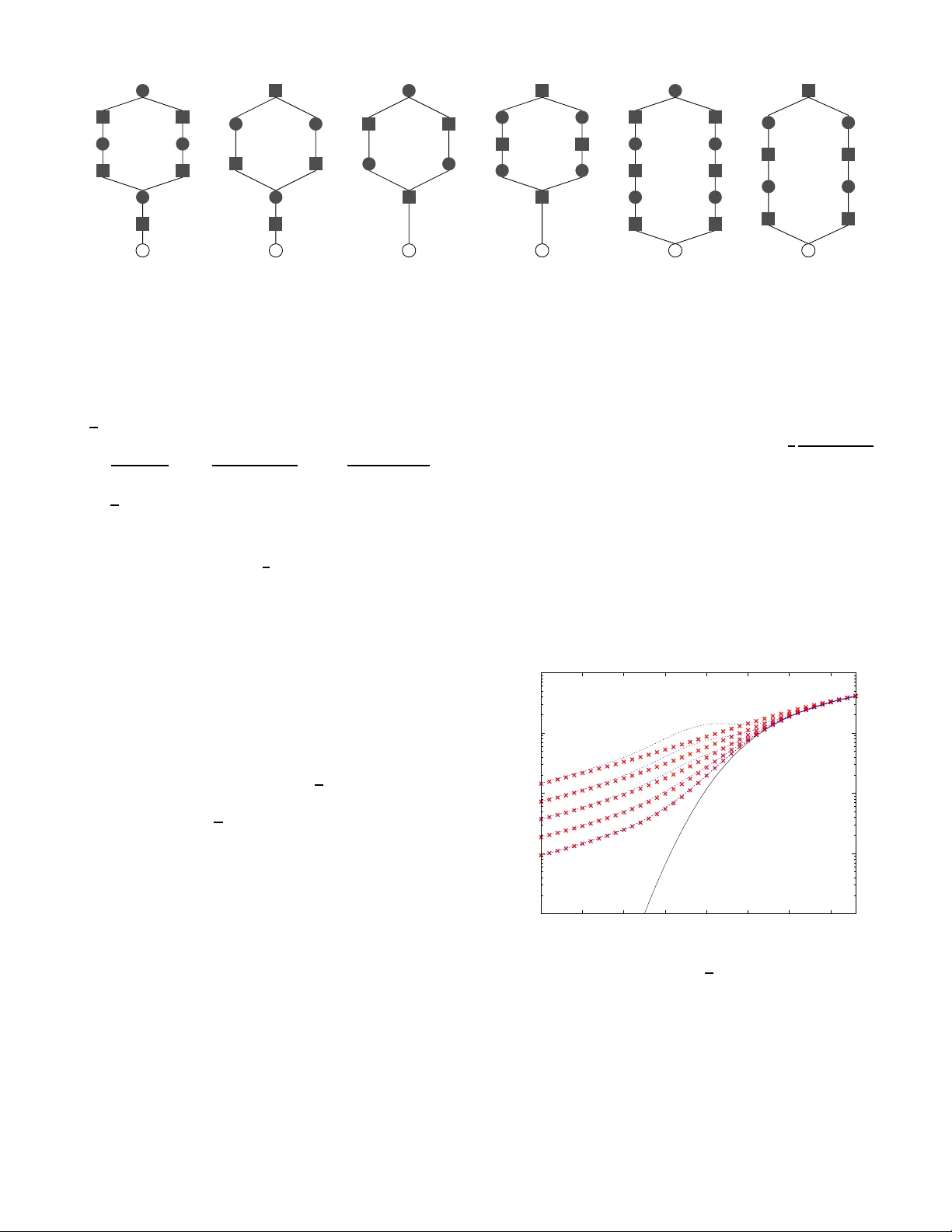
The Asymptotic Bit Error Probabili ty of LDPC Codes for the Binar y Erasure Channel with Finite Iterat ion Nu mber Ryuhei Mori ∗ , Kenta Kasai † , T omoharu Shib uya ‡ , and K ohichi Saka niwa † ∗ Dept. of Compu ter Science, T okyo Institute of T echn ology Email: m ori@comm.ss.titech .ac.jp † Dept. of Commu nications and Integrated System s, T okyo In stitute of T echnolo gy Email: { kenta, sak aniwa } @comm.ss.titech.ac. jp ‡ R & D Departmen t, National Institute of Multimed ia Edu cation Email: tshibuya@nime.ac.jp Abstract —W e consider communication ov er th e binary erasure channel (BEC) using lo w-density parity-check (LDPC) code and belief propaga tion (BP) decoding. T he b it err or probability for infinite block length is k nown b y density evolution [3] and it is well known that a difference between the bit err or probability at finite iteration number for finite block length n and fo r infinite block length is asymptotically α/n , where α is a specific constant dependin g on th e d egre e distribution, the iteration number and th e erasure probability . Our main result is to derive an efficient algorithm f or calculating α for regular ensembles. The approximation using α is accurate fo r (2 , r ) -regular ensembl es ev en in small block length. I . I N T R O D U C T I O N In th is pap er , we consider irregular low-density p arity- check (LDPC) cod es [1] with a d egree distribution p air ( λ, ρ ) [2]. The bit error p robability of LDPC codes over the binary erasure channel (BEC) under belief propagation (BP) decoding is determined by three qu antities; the block length n , th e erasure pr obability ǫ and the iteration num ber t . L et P b ( n, ǫ, t ) d enote the bit error p robability of LDPC codes with block length n over the BEC with er asure prob - ability ǫ at iteration number t . For infin ite block length, P b ( ∞ , ǫ, t ) , lim n →∞ P b ( n, ǫ, t ) can be calcu lated easily by d ensity evolution [3] and there exists threshold parameter ǫ BP such that lim t →∞ P b ( ∞ , ǫ, t ) = 0 for ǫ < ǫ BP and lim t →∞ P b ( ∞ , ǫ, t ) > 0 fo r ǫ > ǫ BP . Despite the ease of analysis for infinite blo ck leng th, finite-length analysis is more complex. For finite b lock length and infinite iteration number, P b ( n, ǫ, ∞ ) , lim t →∞ P b ( n, ǫ, t ) can be calculated exactly by stoppin g sets analysis [6]. For finite block leng th and finite iteration numb er , P b ( n, ǫ, t ) can also be calcu lated exactly in a combin atorial way [ 4]. Th e exact finite-length analysis become s co mputationa lly challengin g as blo ck len gth increasing. An alternativ e approach which approximate s the bit erro r probability is the refore employed. For asymptotic analysis of the bit error pr obability , two r egions o f ǫ can b e distinguished in the error probability; the high error probability region c alled waterfall and the low er ror probability region called e rr o r fl oor . I n ter ms o f b lock length , they co rrespond to the small block leng th region and the lar ge block length region. This p aper deals with th e bit error pro bability for large b lock length bo th below a nd above threshold with finite iteration number . For infinite iteration n umber, the asymptotic analy sis for error floor was shown by Amraoui a s following [8]: P b ( n, ǫ, ∞ ) = 1 2 λ ′ (0) ρ ′ (1) ǫ 1 − λ ′ (0) ρ ′ (1) ǫ 1 n + o 1 n , for ǫ < ǫ BP , as n → ∞ . This eq uation m eans that for ensemb les with λ 2 > 0 , 1 2 λ ′ (0) ρ ′ (1) ǫ 1 − λ ′ (0) ρ ′ (1) ǫ 1 n is a good ap proxima tion of P b ( n, ǫ, ∞ ) where n is sufficiently large. Our main result is following. F or r e gu lar LDPC cod es with fin ite iteration numbe r P b ( n, ǫ, t ) = P b ( ∞ , ǫ, t ) + α ( ǫ, t ) 1 n + o 1 n , for any ǫ , as n → ∞ , wher e α ( ǫ, t ) = β ( ǫ, t ) + γ ( ǫ, t ) and β ( ǫ, t ) an d γ ( ǫ, t ) are given by Theo r em 2 and Theorem 1. This analysis is the first asymptotic analysis for finite iteration numb er . I I . M A I N R E S U LT The er ror p robability o f a bit in fixed tanne r grap h at the t - th itera tion is deter mined by neig hborho od graph of dep th t of the bit [5], [9]. Sin ce the pro bability of neighborh ood graphs which have k cycles is Θ( n − k ) we focu s on the neighb orhood graphs with no cycle and single cycle f or calculating the coefficient o f n − 1 in the bit er ror probab ility . Let β ( ǫ, t ) denote the co efficient of n − 1 in the b it error p robability due to cycle-free ne ighborh ood grap hs and γ ( ǫ, t ) de note the co efficient of n − 1 in the b it error p robability due to single-cycle neig hborho od graphs. Then th e coe ffi cient of n − 1 in the bit er ror prob ability can be expressed as following: α ( ǫ, t ) = β ( ǫ , t ) + γ ( ǫ, t ) . γ ( ǫ, t ) can be calcu lated efficiently for irregular ensembles and β ( ǫ, t ) can be expressed simply for regular en sembles. The expected p robability of er asure message for infinite block length can be calculated by den sity ev o lution. Proposition 1 ( Density e volution [3]) . Let Q ( t ) deno te era- sur e pr obab ility of messa ges into chec k n ode a t the t -th iteration and P ( t ) denote erasur e pr o bability of m essages into variable node at the t -th iteration for infin ite b lock len gth. Then Q ( t ) = ǫλ ( P ( t − 1)) P ( t ) = ( 1 , if t = 0 1 − ρ (1 − Q ( t )) , otherwise The coefficient of n − 1 in the b it error prob ability due to single- cycle neighbor hood grap hs can be calculated usin g density ev olu tion. Theorem 1 (T he co efficient of n − 1 in the bit error p robability due to sin gle-cycle neighbo rhood graphs) . γ ( ǫ, t ) for irr e gu lar LDPC ensembles with a d e g r ee distribution pair ( λ, ρ ) ar e calculated as following γ ( ǫ, t ) = t − 1 X s 1 =1 2 t X s 2 =2 s 1 +1 F 12 ( t, s 1 , s 2 )+ t − 1 X s 1 =0 2 t X s 2 =2 s 1 +2 F 34 ( t, s 1 , s 2 ) + 2 t X s =1 F 56 ( t, s ) wher e F 12 , F 34 and F 56 is Eq. (1), (2) and (3), r e spectively . The comp lexity of the computation of γ ( ǫ, t ) is O ( t 3 ) in time an d O ( t 2 ) in space. β ( ǫ, t ) can be expr essed simply f or regular en sembles since of uniquen ess of the cycle-free neig hborho od g raph. Theorem 2 ( The co efficient of n − 1 in the bit error p robability due to cycle-free ne ighborh ood graphs for regular ensem bles) . β ( ǫ, t ) for the ( l , r ) -r e g ular LDPC ensemble is expr essed a s following β ( ǫ, t ) = − 1 2 l ( r − 1) 1 − { ( l − 1)( r − 1) } t 1 − ( l − 1)( r − 1) { ( l − 1)( r − 1) } t ǫP ( t ) l . Outline of th e pr oof: The probab ility of the unique cycle- free neighbo rhood graph of depth t is Q l 1 −{ ( l − 1)( r − 1) } t 1 − ( l − 1)( r − 1) − 1 i =0 ( E − ir ) Q l ( r − 1) 1 −{ ( l − 1)( r − 1) } t 1 − ( l − 1)( r − 1) i =1 ( E − il ) Q lr 1 −{ ( l − 1)( r − 1) } t 1 − ( l − 1)( r − 1) − 1 i =0 ( E − i ) , where E , nl . Th e coefficient of n − 1 in the probab ility is − 1 2 l ( r − 1) 1 − { ( l − 1)( r − 1) } t 1 − ( l − 1)( r − 1) { ( l − 1 )( r − 1) } t and the error p robability o f the roo t no de is ǫ P ( t ) l . Then we obtain th e statement of the theorem . Due to the above theo rems, α ( ǫ, t ) fo r regular ensembles can be ca lculated efficiently . f ( t, s, p ) , ( ǫ, if t = 0 ǫ λ ′ ( P ( t )) λ ′ (1) g ( t, s − 1 , p ) , otherwise , g ( t, s, p ) , ( p, if s = 0 1 − ρ ′ (1 − Q ( t )) ρ ′ (1) (1 − f ( t − 1 , s, p )) , otherwise H ( u, t, s ) , ( ǫ λ ′ ( P ( t )) λ ′ (1) G 2 ( t, u ) , if s = 0 ǫ λ ′ ( P ( t )) λ ′ (1) G 1 ( u, t, s − 1 ) , otherwise G 1 ( u, t, s ) , ( G ′ 2 ( t, u ) , if s = 0 1 − ρ ′ (1 − Q ( t )) ρ ′ (1) g ( u, u − t + s, 1) + ρ ′ (1 − Q ( t )) ρ ′ (1) H ( u, t − 1 , s − 1 ) , otherwise G 2 ( u, t ) , ( 1 , if t = u + 1 1 − ρ ′ (1 − Q ( t )) ρ ′ (1) g ( u, t − u − 1 , 1) + ρ ′ (1 − Q ( t )) ρ ′ (1) ǫ λ ′ ( P ( t − 1))) λ ′ (1) G 2 ( u, t − 1) , otherwise G ′ 2 ( u, t ) , ( 1 , if t = u 1 − ρ ′ (1 − Q ( t )) ρ ′ (1) g ( u, t − u, 1) + ρ ′ (1 − Q ( t )) ρ ′ (1) ǫ λ ′ ( P ( t − 1))) λ ′ (1) G ′ 2 ( u, t − 1) , other wise H 2 ( t, s ) , 1 − ρ ′′ (1 − Q ( t )) ρ ′′ (1) (1 − ǫ λ ′ ( P ( t − 1)) λ ′ (1) ) , if s = 1 1 − ρ ′′ (1 − Q ( t )) ρ ′′ (1) 1 − 2 f ( t − 1 , s , 1 ) + ǫ λ ′ ( P ( t − 1)) λ ′ (1) H ( t − 1 , t − 1 , s − 1) , othe rwise F 12 ( t, s 1 , s 2 ) , 1 2 λ ′′ (1) ρ ′ (1) 2 ( λ ′ (1) ρ ′ (1)) s 2 − s 1 − 2 Q ( t + 1) g t, s 1 − 1 , 1 − ρ ′ (1 − Q ( t − s 1 + 1)) ρ ′ (1) 1 − ǫ λ ′′ ( P ( t − s 1 )) λ ′′ (1) G 1 ( t − s 1 , t − s 1 , s 2 − 2 s 1 − 1) (1) F 34 ( t, s 1 , s 2 ) , 1 2 ρ ′′ (1) λ ′ (1)( λ ′ (1) ρ ′ (1)) s 2 − s 1 − 2 Q ( t + 1 ) g ( t, s 1 , H 2 ( t − s 1 , s 2 − 2 s 1 − 1)) (2) F 56 ( t, s ) , 1 2 ( λ ′ (1) ρ ′ (1)) s H ( t, t, s ) (3) P S f r a g r e p l a c e m e n t s marginalized l 1 l 2 l 3 l 4 l 5 l 6 l 7 l 8 Fig. 1. The left figure is the neighborhood graph of depth 1. White v ariabl e node is the root node. The varia ble nodes in depth 1 hav e degree l 1 to l 8 . W e consider summing up the probabilit y of all nodes and the type of marginal ized graph in the right figure. Proposition 2 (T he bit error prob ability d ecays exponentially [9]) . Assume ǫ < ǫ BP . Then for an y δ > 0 , there exists some iteration nu mber T > 0 such tha t for a ny t ≥ T P ( t ) ≤ P ( T )( λ ′ (0) ρ ′ (1) ǫ + δ ) t − T P ( t ) ≥ P ( T )( λ ′ (0) ρ ′ (1) ǫ − δ ) t − T . Although if λ ′ (0) λ ′ (1) ρ ′ (1) 2 ǫ < 1 then β ( ǫ, t ) con verges to 0 and γ ( ǫ, t ) con verges to 1 2 λ ′ (0) ρ ′ (1) ǫ 1 − λ ′ (0) ρ ′ (1) ǫ as t → ∞ , if λ ′ (0) λ ′ (1) ρ ′ (1) 2 ǫ > 1 then β ( ǫ, t ) and γ ( ǫ, t ) grow expo- nentially as t → ∞ du e to the above pro position. Thus conv ergence of α ( ǫ, t ) is non-trivial. In p ractice it is necessary to use high pr ecision floating p oint tools for calculating α ( ǫ, t ) . I I I . O U T L I N E O F T H E P RO O F O F T H E O R E M 1 The bit erro r pr obability o f an ensemble with iteration number t is defined as following: P b ( n, ǫ , t ) , X G ∈G t P n ( G )P b ( G ) , where G t denotes a set of all neigh borho od g raphs of dep th t , P n ( G ) denotes the p robability of the neighbo rhood gr aph G and P b ( G ) den otes the err or probability of the roo t node in the neighbor hood graph G . Th e coefficient o f n − 1 in the b it error probab ility with iteratio n nu mber t due to single- cycle neighbo rhood graphs is defined as following: γ ( ǫ, t ) , lim n →∞ n X G ∈S t P n ( G )P b ( G ) , where S t denotes a set o f all single-cycle neighbo rhood graphs of depth t . First we c onsider the bit error probab ility of the root node of the neighb orhoo d gr aph G in Fig. 1. The variable no des in depth 1 have degree l 1 to l 8 . Then the co efficient of n − 1 in P n ( G ) is given as lim n →∞ n P n ( G ) = 1 L ′ (1) L 3 ρ 3 ρ 5 ρ 4 λ l 1 λ l 2 λ l 3 λ l 4 λ l 5 λ l 6 λ l 7 λ l 8 ( l 4 − 1) . The erro r p robability of the message from the cha nnel to the root node is ǫ . The error prob abilities of th e message fr om the left check n ode, th e r ight check n ode an d the m iddle ch eck node to the ro ot no de are (1 − (1 − ǫ ) 2 ) , (1 − (1 − ǫ ) 3 ) an d (1 − (1 − ǫ ) 3 ) , respectively . Then the error pr obability of the root node is giv en as P b ( G ) = ǫ (1 − (1 − ǫ ) 2 )(1 − (1 − ǫ ) 3 )(1 − (1 − ǫ ) 3 ) . The co efficient o f n − 1 term of th e bit error probab ility du e to G is given as lim n →∞ n P n ( G )P b ( G ) = 1 L ′ (1) L 3 ρ 3 ρ 5 ρ 4 λ l 1 λ l 2 λ l 3 λ l 4 λ l 5 λ l 6 λ l 7 λ l 8 ( l 4 − 1) ǫ (1 − (1 − ǫ ) 2 )(1 − (1 − ǫ ) 3 )(1 − (1 − ǫ ) 3 ) . After summing out the left and right subgrap hs, 1 L ′ (1) L 3 ρ 5 λ l 3 λ l 4 λ l 5 ( l 4 − 1) ǫ (1 − (1 − ǫ ) 3 ) P (1) 2 . After summing out degrees l 3 , l 4 and l 5 , 1 L ′ (1) L 3 ρ 5 λ ′ (1) ǫ (1 − (1 − ǫ )(1 − Q (1 )) 2 ) P (1) 2 . At last, af ter sum ming ou t th e ro ot no de an d the m iddle check node, X l,r λ ′ (1) L ′ (1) L l ρ r ǫ (1 − (1 − Q (1)) r − 3 (1 − ǫ )) P (1) l − 1 l r − 1 2 = λ ′ (1) 2 L ′ (1) L ′ ( P (1)) ǫ ( ρ ′′ (1) − ρ ′′ (1 − Q (1))(1 − ǫ )) = 1 2 λ ′ (1) ρ ′′ (1) ǫ L ′ ( P (1)) L ′ (1) 1 − ρ ′′ (1 − Q (1)) ρ ′′ (1) (1 − ǫ ) . The coefficient of n − 1 in the bit err or p robability for iter ation number t due to neigh borho od graphs with the right graph P S f r a g r e p l a c e m e n t s s 1 = 1 , s 2 = 6 s 1 = 1 , s 2 = 5 s 1 = 0 , s 2 = 4 s 1 = 0 , s 2 = 5 s = 6 s = 5 Fig. 2. Six types of marginal ized single-c ycle neighborhood graphs. These are distinguishe d in which va riable node, chec k node or root node are bifurc ation node and which vari able node or check node are confluence node. Depth of the bifurcat ion node corresponds to s 1 . The number of nodes in the minimum path from root node to confluence node corresponds to s 2 and s . type in Fig. 1 is given as 1 2 λ ′ (1) ρ ′′ (1) ǫ L ′ ( P ( t )) L ′ (1) 1 − ρ ′′ (1 − Q ( t )) ρ ′′ (1) 1 − ǫ λ ′ ( P ( t − 1 )) λ ′ (1) = 1 2 λ ′ (1) ρ ′′ (1) Q ( t + 1) g ( t, 0 , H 2 ( t, 1 )) = F 34 ( t, 0 , 2 ) in the same way . Notice that 1 2 λ ′ (1) ρ ′′ (1) is the coefficient of n − 1 of the p robability of neighb orhood graphs w ith the right graph type in Fig. 1. Single-cycle n eighbor hood graph s can be classified to six types in Fig. 2. Summing up the bit error probability due to all these types, we o btain γ ( ǫ, t ) . Left two types c orrespon d to F 12 , m iddle two ty pes co rrespond to F 34 and rig ht two types correspo nd to F 56 . I V . N U M E R I C A L C A L C U L A T I O N S A N D S I M U L A T I O N S There is a qu estion that how larg e block length is n eces- sary for using P b ( ∞ , ǫ , t ) + α ( ǫ, t ) 1 n for a good a ppr oxi- mation of P b ( n, ǫ , t ) . It is therefore inte resting to compare P b ( ∞ , ǫ , t ) + α ( ǫ, t ) 1 n with numerical simulations. In the proof , we c ount only the err or probability due to cycle- free neighbo rhood graphs and single-cycle neighbo rhood g raphs. Thus it is expe cted that the app roximation is accura te o nly at large block leng th whe re the p robability o f the multicycle neighbo rhood g raphs is sufficiently small. Contr ary to the expectation, the app roximation is accu rate a lready a t small block length in Fig. 3. Althou gh there is a large difference in small block length near the thresho ld, the ap proximatio n is accurate at block length 801 which is no t large en ough. For the ensembles with λ 2 = 0 , the approx imation is no t accurate at ǫ far b elow the thresho ld in Fig. 4. Since | α ( ǫ, t ) | decreases to 0 as t → ∞ for the ensemb les th e higher order terms ca used by multicycle stopping sets h as a large contribution to the bit er ror p robability . It is expected th at the approx imation is ev en accu rate for th e en sembles from which stopping sets with small numb er of cycles are expurgated. The limitin g value of α ( ǫ, t ) , α ( ǫ, ∞ ) , lim t →∞ α ( ǫ, t ) is also interesting. For α ( ǫ, ∞ ) , calcu late α ( ǫ, t ) where suf- ficiently large t in Fig . 5 and Fig. 6. F or the (2 , 3 ) -regular ensemble b elow the thr eshold, α ( ǫ, ∞ ) and 1 2 λ ′ (0) ρ ′ (1) ǫ 1 − λ ′ (0) ρ ′ (1) ǫ take almost the same value. It implies th at below thresh old n (P b ( n, ǫ , t ) − P b ( ∞ , ǫ , t )) takes the same value at two limits; n → ∞ then t → ∞ and t → ∞ then n → ∞ . For the ensembles with λ 2 = 0 , α ( ǫ, ∞ ) is almo st 0 wh ere ǫ is smaller than threshold . At last, notice that α ( ǫ , t ) takes non -trivial values slightly below thresh old. For the (3 , 6) -regular en semble, α (0 . 425 , t ) is negative at t ≤ 39 , positi ve at 40 ≤ t ≤ 5 2 and has absolute v alue which is to o small to b e m easured at t = 53 . max 1 ≤ t ≤ 53 | α (0 . 425 , t ) | = 357 10 . 34 at t = 4 2 . 10 -4 10 -3 10 -2 10 -1 10 0 0.3 0.35 0.4 0.45 0.5 0.55 0.6 0.65 bit error rate P S f r a g r e p l a c e m e n t s ǫ Fig. 3. Comparing P b ( ∞ , ǫ, t ) + α ( ǫ, t ) 1 n with numerical simulations for the (2 , 3) -reg ular ensemble with itera tion number 20. The dotted curves are approximat ion and the solid curve is densi ty ev olution . Block lengt hs are 51, 102, 201, 402 and 801. T he threshold is 0. 5. V . O U T L O O K Although the asym ptotic analysis of the bit err or pro bability for finite block leng th an d finite itera tion numb er given in this paper is very accurate at (2 , r ) -regular, much work remains 10 -9 10 -8 10 -7 10 -6 10 -5 10 -4 10 -3 10 -2 10 -1 10 0 0.15 0.2 0.25 0.3 0.35 0.4 0.45 bit error rate P S f r a g r e p l a c e m e n t s ǫ Fig. 4. Comparing P b ( ∞ , ǫ, t ) + α ( ǫ, t ) 1 n with numerica l simulations for the (3 , 6) -regul ar ensemble with iteration number 5. The dotted curves are approximat ion and the solid curve is density ev olutio n. Block lengths are 512, 2048 and 8192. T he threshold is 0.42944. to b e done . First ther e remains the problem to compu ting β ( ǫ, t ) for irregular ensemb les. I t would also be interesting to g eneralize this algorithm to o ther ensemb les and other channels. In the binary memoryless symmetric channel (BMS) parametrize d by ǫ ∈ [0 , ∞ ) , W e conside r inf t P b ( n, ǫ , t ) instead of lim t →∞ P b ( n, ǫ , t ) since of lack of monoto nicity . The asympto tic analysis of th e bit erro r probability with the best iteration n umber t ∗ ( n, ǫ ) , arg inf t P b ( n, ǫ , t ) u nder BP decodin g was shown by Mon tanari fo r small ǫ as fo llowing [5]: P b ( n, ǫ , t ∗ ( n, ǫ )) = 1 2 ∞ X i =0 ( λ ′ (0) ρ ′ (1)) i p i 1 n + o 1 n as n → ∞ , whe re p i , P r( Z i < 0 ) + 1 2 Pr( Z i = 0 ) and Z i is a random variable correspo nding to the sum of the i i.i.d. channel log -likelihood ratio. It implies that if λ 2 > 0 , th e asymptotic bit erro r probability under BP d ecoding is equal to that o f max imum likelihood (ML) d ecoding . Althoug h th e condition of the p roof in [5] imp lies th e convergence of values correspo nding to β ( ǫ, t ) an d γ ( ǫ, t ) in th is pap er , in ge neral if λ ′ (0) λ ′ (1) ρ ′ (1) 2 B ( ǫ ) > 1 , they d o no t conver ge, where B ( ǫ ) is Bhattacharyy a constan t. Althou gh th e condition of ǫ is strong, th e app roximatio n is very acc urate for all ǫ smaller than threshold. W e have the prob lem to prove the conv ergence of α ( ǫ, t ) for the BEC and th e BMS for any ǫ < ǫ BP . A iteration nu mber is also impor tant. The ap proximatio n is not a ccurate f or to o large itera tion nu mber . A sufficient (an d necessary) iteration numb er for a giv en b lock length and a ensemble is very imp ortant to improve th e an alysis in this paper . R E F E R E N C E S [1] R. G. Gallager , Low-Density P arity-c hec k Codes , MIT Press, 1963 -1 0 1 2 3 4 5 6 7 0 0.1 0.2 0.3 0.4 0.5 0.6 0.7 0.8 0.9 1 P S f r a g r e p l a c e m e n t s ǫ the c oefficient of n − 1 Fig. 5. Comparing α ( ǫ, ∞ ) wi th 1 2 λ ′ (0) ρ ′ (1) ǫ 1 − λ ′ (0) ρ ′ (1) ǫ for the (2 , 3) -re gular ensemble. Belo w the threshold 0.5, they take almost the same value. -25 -20 -15 -10 -5 0 0.42 0.44 0.46 0.48 0.5 0.52 0.54 0.56 0.58 0.6 P S f r a g r e p l a c e m e n t s ǫ the c oefficient of n − 1 Fig. 6. α ( ǫ, ∞ ) plotted for the (3 , 6) -re gular ensemble abov e the threshold 0.42944. [2] M. Luby , M. Mitzenmacher , A. Shokrolla hi, D. A. Spiel man, and V . Stemann, ”Practic al loss-resili ent codes, ” In Proc eedings of the 29th annual ACM Symposium on Theory of Computing, page s 150-159 , 1997 [3] T . Richardson and R. Urbanke, ”The capac ity of low-d ensity parity check codes under message-passing dec oding, ” IEEE Tr ans. Info rm. Theory , vol. 47, no. 2, pp.599-618, Feb . 2001 [4] T . Richa rdson and R. Urbanke, ”Finite -lengt h density evol ution and the distrib ution of the number of iteration s for the binary erasure channel ” [5] A. Montanari ”The asymptot ic error floor of LDPC ensembles under BP decodin g, ” 44th Allerton Confer ence on Communications, Contr ol and Computing , Montice llo , October 2006 [6] C. Di, D. Proietti, T . Richardson, E. T elatar and R. Urbank e, ”Finite length analysis of low- density parit y-chec k codes, ” IEEE T rans. Inform, Theory , vol. 48, no. 6, pp.1570-1579, Jun. 2002 [7] A. Orlitsky , K. V iswanathan , and J. Z hang, ”Stopping set distribu tion of LDPC code ensembles, ” IEEE T rans. Inform, Theory , vol. 51, no. 3, pp.929-953, Mar . 2005 [8] A. Amraoui ” Asymptotic and finit e-leng th optimization of LDPC code s, ” Ph.D. Thesis Lausanne 2006 [9] T . Richardson and R. Urbanke, Modern Coding Theory , draft ava ilabl e at http://lt hcwww . epfl.ch/in dex.php
Original Paper
Loading high-quality paper...
Comments & Academic Discussion
Loading comments...
Leave a Comment