Sum Rate Maximization using Linear Precoding and Decoding in the Multiuser MIMO Downlink
We propose an algorithm to maximize the instantaneous sum data rate transmitted by a base station in the downlink of a multiuser multiple-input, multiple-output system. The transmitter and the receivers may each be equipped with multiple antennas and…
Authors: Adam J. Tenenbaum, Raviraj S. Adve
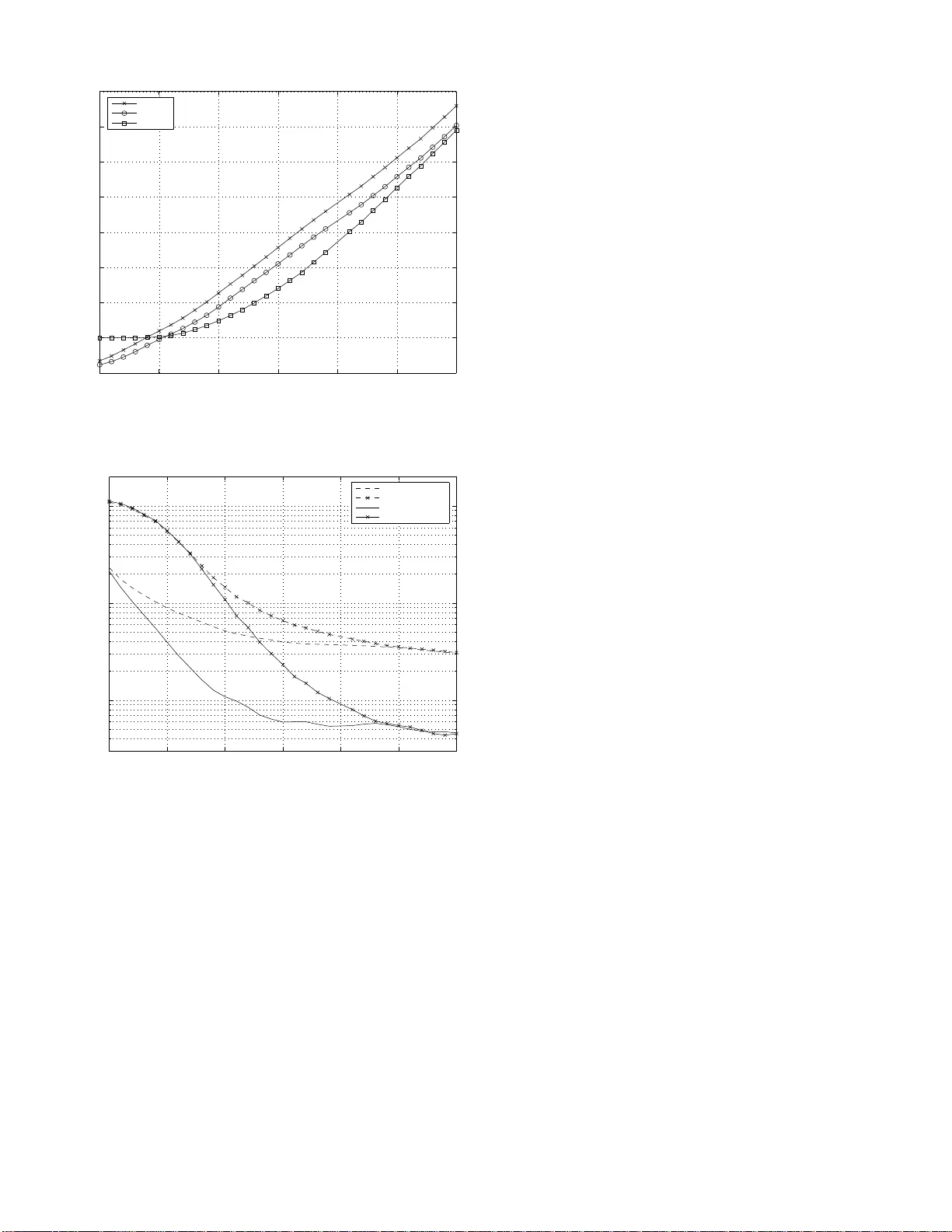
Sum Rate Maximiz ation using Linear Prec oding and Dec oding in the Mult iuser MIMO Do wnlink Adam J. T enenbaum and Raviraj S. Adve Dept. of Electrical an d Comp uter Engin eering, University of T oronto 10 King ’ s College Road, T oron to, Ontario, M5 S 3G4, Canada Email: { ada m,rsadve } @ comm.utoron to.ca Abstract —W e p ropose an algorithm to maximize t he in stan- taneous sum data rate tra nsmitted by a base station in the downlink of a multiuser multipl e-input, multiple-outpu t system. The transmitter and the recei ver s may each b e equi pped with multiple antennas and each user may receiv e more than one data stream. W e sho w that ma ximizing the sum ra te is closely linked to minimizing the product of mean squared errors (P MSE). The a lgorithm employs an upli nk/downlink d uality to iteratively design transmit-recei ve l inear precoders, decoders, and power allocations that minimize the PM SE for all data streams under a sum power constraint. Numerical simulations ill ustrate the effectiv eness of the algorithm and supp ort the use of the PMSE criterion in maximizing th e ove rall in stantaneous data rate. I . I N T RO D U C T I O N Multiple-inp ut multiple-ou tput (MIMO) systems continue to be an important them e in wireless comm unication s resear ch. MIMO techn ology improves reliability an d/or increa ses the data rate of wireless tran smission. These perfo rmance im- provements are achieved by exploiting th e spatial dimension using an antenna a rray at the transmitter and/or at the r eceiver . A relatively recent theme has been MIMO systems enab ling multiuser commun ications in the downlink – a single base station com municating with multiple u sers. Much of the existing work on multiuser MIMO systems fo- cuses on minimizing the sum of m ean squared erro rs (SMSE) between th e tra nsmitted an d received signals under a sum power constraint [1] –[5]. A common them e to most o f this work is the use of an MSE up link-downlink duality intr oduced in [5]. Th e work in [6] provid es a compreh ensiv e revie w of the av ailable work in this area including an alternative algorithmic approa ch to th is p roblem. W ith its focus on SMSE, this b ody of work deals exclusi vely with maximizing reliability at a fixed data rate. In particular, when on e conside rs the behaviour of the power allocation step in the SMSE solu tions, an “inverse waterfilling” type of solu tion may arise. When starting at an optimum po int for a fixed p ower allocation where data stream s have uneq ual powers, incremental power th at is allocated to the sy stem will be assigned to the worst o f th e active data streams. This is requ ired under the SMSE criterion , as the worst data stream ’ s MSE dominates th e a verage ( and th us, the sum) MSE. This exclu si ve focus on minimizing er ror r ate ap pears to hold contrary to an impor tant motivation in d eploying MIMO systems: increasing data ra te. The prob lem of maximizin g data rate has been stud ied in dep th in informatio n theor y , wh ere sum capacity is attained by maxim izing mutual info rmation. In contr ast to SMSE minim ization, inform ation theoretical approa ches apply a waterfilling strategy to assign a vailable incrementa l power to the best data stream [7]–[ 10]. Unfor- tunately , the sum-capacity precod ing strategy [11] can n ot be realized practica lly , an d even subo ptimal appro ximations (e.g. those em ploying T omlinso n-Harashim a p recodin g [12]) require nonlinear pr ecoding , user orderin g, an d incur ad- ditional comp lexity . Orth ogon alization based metho ds using zero-fo rcing and block diagonalizatio n allo w for a simple f or- mulation of the sum capa city [13], but the resulting constraint on the numb er of receiv e antenn as can se verely restrict the possibility o f receiv e div ersity and /or th e associated increa se in sum capacity . Sev eral papers have looked at the g eneral problem of maximizin g sum capacity using linear p recoding for th e m ultiuser d ownlink with single antenna receivers [14] – [16], but on ly r ecently has work been performed on th e case of mu ltiple receive an tennas [1 7]. One important co nnection th at w e formulate in this paper is the relation ship between the sum capacity and the product of mean squa red err ors (PMSE). I n the single-user m ulticarrier case, minimizing the PMSE is equ iv alent to minim izing the determinan t of th e MSE m atrix and thus is also eq uiv alent to maximizing the mutual info rmation [18]. Th is equ iv alence can also b e seen in the relationsh ip developed b etween m inimum MSE (MMSE) and m utual informatio n in [19]. The existence of these re lationships motiv ates u s to consid er a PMSE min- imizing solution for the multiuser downlink to maximize the sum d ata rate over multiple users, possibly with multiple data streams p er user, giv en a maximum allowable transmission power an d con straints on the er ror rate of eac h stream. Inform ation theoretica l results for achieving sum capa city provide a n upp er bound for achiev able p erform ance; however , a prac tical system c annot use Gaussian codeb ooks in the design of its transmit con stellations. Wit h this in mind, we ev aluate the p erform ance of o ur PMSE m inimizing linear precod er u nder adaptive PSK m odulation . The resulting al- gorithm attem pts to ma ximize the sum data rate, u nder PSK modulatio n, with a constraint on th e b it error r ate o f each data stream. T o o ur kn owledge, this form of sum rate m aximization (as opposed to that perfo rmed in a pur ely information theoretic sense) has not b een attemp ted befor e. The rema inder of this p aper is organ ized as follows. Sec- tion II states th e assumptions made and d escribes the system Fig. 1. Processing for user k in downlin k and virtu al uplin k. model used. Section II I invest igates the motiv ation for u sing the pro duct of MSEs as an op timization criterion, and Sec - tion I V propo ses an o ptimization a lgorithm to minim ize the PMSE u nder a sum power constraint. Results of simula tions testing the efficacy of the p roposed approac h are presented in Section V. Finally , we draw con clusions in Section VI. I I . S Y S T E M M O D E L The system unde r consideratio n, illustrated in Fig. 1, com- prises a base station with M a ntennas tran smitting to K decentralized u sers. User k is equipped with N k antennas and receives L k data streams from the base station. Thus, we hav e M tran smit an tennas tran smitting a total of L = P K k =1 L k symbols to K users, who to gether have a total of N = P K k =1 N k receive antenn as. The data symbols f or user k are collected in the data vector x k = [ x k 1 , x k 2 , . . . , x kL k ] T and the overall data vector is x = x T 1 , x T 2 , . . . , x T K T . W e focu s her e on linear proc essing at the tr ansmitter an d receiver . Hence, to en sure resolvability we requir e L ≤ M and L k ≤ N k , ∀ k . User k ’ s data stream s are processed b y th e M × L k transmit filter U k = [ u k 1 , . . . , u kL k ] be fore being transmitted over the M anten nas. Each u kj is the prec oder for stream j o f user k , an d ha s un it power ( k u kj k 2 = 1 , where k · k 2 is the Euclidean no rm operato r). These ind ividual precode rs together form the M × L global transmitter precod er matrix U = [ U 1 , U 2 , . . . , U K ] . Let p kj be the power allocated to stream j of user k and the d ownlink transm it power vector fo r user k be p k = [ p k 1 , p k 2 , . . . , p kL k ] T , with p = p T 1 , . . . , p T K T . Define P k = diag { p k } a nd P = diag { p } . Th e chann el between the transmitter and user k is assume d flat and is represented by the N k × M matrix H H k , where ( · ) H indicates the conjugate transpose operator . The resulting N × M ch annel matrix is H H , with H = [ H 1 , H 2 , . . . , H K ] . The tra nsmitter is assumed to k now the chan nel perfec tly . Based o n this model, user k receiv es a length N k vector y k = H H k U √ Px + n k , (1) where n k consists o f the add itiv e white Gaussian noise (A WGN) at the user’ s receive an tennas with power σ 2 ; that is, E n k n H k = σ 2 I N k , wher e E [ · ] repr esents the expectation operator . T o estimate its L k symbols x k , user k p rocesses y k with its L k × N k decoder m atrix V H k resulting in ˆ x DL k = V H k H H k U √ Px + V H k n k , (2) where th e superscr ipt DL indicates the downlink. The global r eceive filter V H is a block diagonal decoder matrix o f dimen sion L × N , V = diag [ V 1 , V 2 , · · · , V K ] , where eac h V k = [ v k 1 , . . . , v kL k ] . W e make use of the dual virtual up link, also illustrated in Fig . 1, with the same channels between user s and base station. Let the uplink tran smit power vector f or user k b e q k = [ q k 1 , q k 2 , . . . , q kL k ] T , with q = [ q T 1 , . . . , q T K ] T , and define Q k = diag { q k } and Q = diag { q } . The tran smit and receive filters fo r user k beco me V k and U H k respectively . As in the downlink, the pr ecoder for th e virtual uplin k co ntains columns with unit no rm; that is, k v kj k 2 = 1 . The received vector at the b ase station an d the estimated symbol vecto r for user k are y = K X i =1 H i V i p Q i x i + n , (3) ˆ x U L k = K X i =1 U H k H i V i p Q i x i + U H k n . (4) The no ise term, n , is again A WGN with E nn H = σ 2 I M . W e a ssume th at the m odulated d ata symbols x are d rawn from a PSK constellation wh ere each data symbo l x i has power | x i | 2 = 1 . Further more, the data symbols a re in de- penden t so that E xx H = I L . Also, noise and data ar e indepen dent such th at E x i n H = 0 . Finally , we d efine a useful v irtual up link receive covariance matrix as J = E yy H = K X k =1 H k V k Q k V H k H H k + σ 2 I M = HVQV H H H + σ 2 I M . (5) I I I . P R O D U C T O F M E A N S Q UA R E D E R RO R S Inform ation the oretical approaches c haracterize the sum ca- pacity of the multiuser MIMO downlink or broadcast ch annel (BC) by solving the sum capacity of the equi valent uplink mul- tiple access ch annel (MA C) an d applyin g a duality result [8] , [20]. The resulting expression fo r the maximu m sum rate in the K user MA C is R sum = ma x Σ k log 2 det I + 1 σ 2 K X k =1 H k Σ k H H k ! s . t . Σ k 0 k = 1 , . . . , K K X k =1 tr [ Σ k ] ≤ P max , (6) where Σ k 0 indicates Σ k is a positive semi-defin ite transmit covariance matrix for mob ile user k in the u plink. In this section, we approx imate this sum rate in terms of each individual user’ s data rate. Consider the sig nal to inter ference plus n oise r atio (SINR) for stream j belon ging to u ser k und er the multiuser virtual uplink mo del defined in Section II. Using (4) an d find ing the av erage receiv ed sig nal power ( E | ˆ x kj | 2 ) and interfer ence- plus-noise power corresp onding to all other data streams and A WGN, this strea m achieves an SINR of γ U L kj = u H kj H k v kj q kj v H kj H H k u kj u H kj J kj u kj , (7) where J kj . = J − H k v kj q kj v H kj H H k is the virtu al uplin k interferen ce-plus-n oise receive cov ariance matrix. W e approx - imate the maximu m rate fo r this stream a s R kj ≈ log 2 1 + γ U L kj . (8) Under th e centra l limit th eorem, the interfer ence-plu s-noise becomes Gaussian as the number of interfering streams in- creases, mak ing the approx imation p rogressively better . The goal of this work is to max imize the sum data ra te subject to constraints on the to tal available power . Using the appr oximation in (8), we for mally state the op timization problem as: ( V , q ) = ar g max V , q K X k =1 L k X j =1 log 2 1 + γ U L kj s . t . k v kj k 2 = 1 , k = 1 , . . . , K q kj ≥ 0 , j = 1 , . . . , L k k q k 1 = K X k =1 L k X j =1 q kj ≤ P max , (9) where k q k 1 is the 1-no rm or the sum of all en tries in q . W e can see from (7) that the optim um linear receiver u kj does not depend on any other colu mns of U ; furtherm ore, it is the solution to the generalized eigenp roblem u opt kj = ˆ e max H k v kj q kj v H kj H H k , J kj , (10) where ˆ e max ( A , B ) is th e unit n orm eigen vector x correspond - ing to the largest eigenv alue λ in th e gener alized eigenprob lem Ax = λ Bx . W ithin a n ormalizin g factor, this solutio n is equiv alent to the MMSE rece iv er: u opt kj = J − 1 H k v kj √ q kj . (11) When using linear decoding with this MMSE receiver , the MSE m atrix fo r the virtual up link is E = E h ( ˆ x − x ) ( ˆ x − x ) H i = I L − p QV H H H J − 1 HV p Q , (12) which fo llows from (1 1) and the system model assump tions stated in Sectio n II. T hus, the m ean squar ed error for u ser k ’ s j th stream is ǫ kj = 1 − q kj v H kj H H k J − 1 H k v kj . (13) Now consider another optimization problem, minimizing the produ ct of mean squared errors (PMSE) und er a sum p ower constraint, ( V , q ) = arg min V , q K Y k =1 L k Y j =1 ǫ kj s . t . k v kj k 2 = 1 , k = 1 , . . . , K q kj ≥ 0 , j = 1 , . . . , L k k q k 1 = K X k =1 L k X j =1 q kj ≤ P max . (14) Theor em 1: Und er linear MMSE deco ding at th e base sta- tion, the o ptimization prob lems defined by (9) and (14) ar e equiv alent problem s. Pr oo f: Define the argument of the log term from (8) as α kj . = 1 + γ U L kj . Using (7), we can rewrite α kj as α kj = u H kj Ju kj u H kj Ju kj − u H kj H k v kj q kj v H kj H H k u kj . (15) It f ollows th at by using the MMSE rec eiv er from (11), 1 α kj = 1 − u H kj H k v kj q kj v H kj H H k u kj u H kj Ju kj = 1 − q kj v H kj H H k J − 1 H k v kj 2 q kj v H kj H H k J − 1 H k v kj = 1 − q kj v H kj H H k J − 1 H k v kj = ǫ kj . (16) Thus, und er linear MMSE decod ing, the MSE and SI NR for stream j belongin g to user k are related a s ǫ kj = 1 1 + γ U L kj . (17) This relationship is similar to o ne shown fo r MMSE detection in CDMA systems [21]. By applying (17) to (9), we see that K X k =1 L k X j =1 log 2 1 + γ U L kj = − lo g 2 K Y k =1 L k Y j =1 ǫ kj . (18) Since the co nstraints on v kj and q kj are iden tical in (9) a nd (14), the pro blem of maximizin g sum rate in (9) is therefore equiv alent to minim izing the PMSE in (14). I V . P M S E M I N I M I Z AT I O N A L G O R I T H M W ith the motiv ation of Section I II in m ind, we now develop an algor ithm to min imize the produ ct of mean squ ared err ors. The algorithm d raws on p revious work in minimizing the sum MSE [ 3], [4]. It op erates by itera ti vely ob taining the d ownlink precod er m atrix U and p ower allocations p and th e v irtual uplink p recoder matr ix V and power allocations q . Eac h step minimizes the ob jectiv e functio n by m odifyin g one of these four variables while lea ving th e r emaining three fixed. A. Downlink Precoder For a fixed set of v irtual uplin k preco ders V k and power allocation q , the op timum virtual uplink decoder U is d efined by (11). Each ǫ kj is minimized individually by th is MMSE receiver , thereby also m inimizing the pro duct of MSEs. This U is norm alized and used as the downlink precod er . B. Downlink P ower Allocation The MSE duality der iv ed in [3], [4] states that all achiev able MSEs in the uplink for a given U , V , and q (with sum power constraint k q k 1 ≤ P max ), can also be ach iev ed by a p ower allocation p in th e d ownlink where k p k 1 ≤ P max . In or der to calculate the power allocation p , we app ly the following result from [4]: p = σ 2 ( D − 1 − Ψ ) − 1 1 , (19) where Ψ is the L × L cross coup ling matrix defined as [ Ψ ] ij = | ˜ h H i u j | 2 = | u H j ˜ h i | 2 i 6 = j 0 i = j , (20) D = diag ( γ U L 11 | v H 11 H H 1 u 11 | 2 , . . . , γ U L K L K | v H K L K H H K u K L K | 2 ) , (21) where ˜ H = HV = [ ˜ h 1 , . . . , ˜ h L ] , U = [ u 1 , . . . , u L ] , and 1 is the all-ones vector of the requ ired dimen sion. C. V irtual Uplin k Pr ecoder Giv en a fixed U and p , the optim al decod ers V k are th e MMSE recei vers: V k = J − 1 k H H k U k p P k . (22) In th is e quation, J k . = H H k UPU H H k + σ 2 I N k is th e receive covariance matrix for user k . Th e optimum vir tual uplink precod ers are then the n ormalized colum ns of V k . D. V irtua l Uplink P ower Allocation The power allocation pro blem on the v irtual uplin k solves (14) with a fixed ma trix V . In the minim ization of sum MSE, the correspo nding step is a conve x optimization problem [4]. Unfortu nately , it is well accepted that the power allocation subprob lem in PMSE minimization (o r equiv alently , in sum rate maximization) is n on-co n vex [1 4], [16], [17 ]. W e thus employ numerical tech niques to solve the power allocation subpro blem, and use sequ ential q uadratic prog ram- ming ( SQP) [2 2] to minimize the PMSE. SQP solves suc- cessi ve approx imations o f a co nstrained optimization prob lem and is gu aranteed to conver ge to the optimum value for con vex problem s; howe ver, in the ca se of this non -conve x op timization problem , SQP can only g uarante e convergence to a local minimum. W e note that a similar a pproac h was pr oposed in [ 17], where iteration s of the the sum rate maximization problem are solved by lo cal ap prox imations of the non-conve x sum-rate function as a (conve x) g eometric pr ogram [23] . In summary , the PMSE minimiza tion algo rithm, motiv ated by a need to maximize sum data rate, follows th e same steps T ABLE I I T E R AT I V E P M S E M I N I M I Z ATI O N A L G O R I T H M Iteration: 1- Downli nk Prec oder ˜ U k = J − 1 H H k V k √ Q k , u kj = ˜ u kj k ˜ u kj k 2 2- Downli nk P ower Allo cation via MSE dualit y p = σ 2 ( D − 1 − Ψ ) − 1 1 3- V irtual Upli nk Pr ecoder ˜ V k = J − 1 k H H k U k √ P k , v kj = ˜ v kj k ˜ v kj k 2 4- V irtual Upli nk P ower Allocation q = arg min q Q K k =1 Q L k j =1 ǫ kj , s.t. q kj ≥ 0 , k q k 1 ≤ P max 5- Repeat 1–4 until [PMSE old − PMSE new ] / PMSE old < ǫ as the m inimization of the SMSE. The iterative algorithm keeps three of fo ur par ameters ( U , p , V , q ) fixed at each step and obtains the optimal value of the fourth. Con vergence of the overall algor ithm to a local minimu m is guaranteed since the PMSE objec tiv e f unction is non -increasin g at each of the four parameter u pdate step s. T er mination of the algo rithm is determined by the selectio n of the c onv ergence threshold ǫ . While neith er th e overall pro blem (14) n or the p ower allocation subpro blem are believed to be conve x, simulations suggest that chang ing the initializatio n po int has a min imal impact on the final solutio n; howev er , initializatio n with the U and p found u sing the SMSE algorithm in [4] a ppears to reduce the n umber of iteration s require d fo r conver gence. A summary of our prop osed algorithm can be found in T able I. V . N U M E R I C A L E X A M P L E S In this section, we p resent simu lation results to illustrate th e perfor mance of the prop osed algorithm s. In all cases, the fad- ing ch annel is mod elled as flat an d Rayleigh using a ch annel matrix H compo sed o f in depend ent and identically d istributed samples of a comp lex Gaussian p rocess with zero mean a nd unit variance. The example s use a maximu m transmit power of P max = 1 ; SNR is co ntrolled by varying the receiver noise power σ 2 . The tran smitter is assumed to have perf ect knowledge o f the chann el matrix H . A. Theor etical P erformance First, we exam ine the info rmation theor etical perf ormanc e of the PMSE algorithm prop osed in Section IV. That is, we consider the sp ectral efficiency (measured in bp s/Hz) that could be ach iev ed u nder ideal transmission by d rawing tra ns- mit symb ols f rom a Gaussian c odebo ok. Fig ure 2 illustrates how the pr oposed schem e perf orms when compar ed to the sum capacity for th e broadc ast chan nel (i.e. using dir ty paper coding (DPC) [11 ]) and to traditional linear pr ecoding methods based on channel orthog onalization ( i.e. block diago nalization (BD) and zero forcin g (ZF) [1 3]). This simu lation mod els a K = 2 user system with M = 4 transmit antennas and N k = 2 or N k = 4 receive an tennas per user . The plot is 0 5 10 15 20 25 0 5 10 15 20 25 30 SNR=P max / σ 2 (dB) Spectral Efficiency (bps/Hz) DPC PMSE BD ZF N k =4 N k =2 Fig. 2. PMSE vs. DPC and orthogonaliz ation–b ased methods generated using 30000 channel realizations, with 50 00 data symbols per channel realization, and th e con vergence thresho ld for th e PMSE algorithm is set as ǫ = 10 − 6 . In Fig. 2, we see a slight divergence in the perfor mance o f the PMSE alg orithm fro m the theoretica l DPC bou nd at high er SNR. This drop in spectral effi ciency may be caused by the non-co n vexity o f the optimizatio n p roblem, or it may sugg est a fund amental gap betwee n the o ptimal DPC bou nd and the achiev able sum capacity under linear p recodin g. None theless, the PMSE algo rithm still mainta ins a high er spectral efficiency than the orthog onalization b ased schemes for N k = 2 . Further- more, the gap between the DPC b ound and the PMSE precoder is only 0.6 dB for N k = 4 , where BD and ZF schemes can not be app lied due to constraints on the n umber o f anten nas. B. P erformanc e Using Practical Modulation The precod er and d ecoder design algorith m in Sectio n IV is der iv ed independ ently o f mod ulation depth, based on the assumption that transmitted sy mbols originate from a u nit- energy PSK constellation. In this sectio n, we con sider two approa ches in selecting the modu lation schem e to maximize data rate. The na ive approac h selec ts the largest PSK constellation of b kj bits per stream that satisfies a maximu m bit err or rate (BER) requirem ent of β kj . The satisfaction o f this constraint is deter mined using a clo sed for m BER approxim ation [2 4], BER PSK ( γ ) ≈ c 1 exp − c 2 γ 2 c 3 b − c 4 . (23) W e apply th e least agg ressiv e of th e bou nds p ropo sed in [2 4] by using the values c 1 = 0 . 25 , c 2 = 8 , c 3 = 1 . 94 , and c 4 = 0 . W e note th at th is approximatio n only holds for b ≥ 2 ; a s su ch, the following exact expression sho uld be used fo r BPSK: BER BPSK ( γ ) ≈ 1 2 erfc ( √ γ ) . (24) The BPSK expression can be used as a test o f fe asibility f or the specified BER target; if the resulting BER und er BPSK modulatio n is higher than β kj , then we h ave two options: either d eclare the BER target infe asible, o r transmit u sing the lowest m odulation dep th av ailable (i.e. BPSK). In this work, we hav e elected to transmit using BPSK whenever th e PMSE stage has allocated power to the data stream. Future work may consider eith er par tial or co mplete non -transmission to implement power saving while strictly achieving the desired BER target. The naive approach is quite c onservati ve in that there may be a large gap between the BER requir ement and BER achieved for each ch annel r ealization. W e suggest a pr o ba- bilistic bit allocation schem e that switches between b kj bits (as determ ined by the naive appro ach) an d b kj + 1 bits with probab ility p kj = β kj − BER b kj / BER b kj +1 − BER b kj . This m odulatio n strategy m ay not b e appropr iate for systems requirin g instantaneou s satisfaction of BER co nstraints; how- ev er , the pr obabilistic m ethod will still achiev e the desired BER in the lon g-term average over ch annel r ealizations. Figure 3 shows the sum r ate a chieved in the same system configur ation as describ ed abov e ( K = 2 , M = 4 , N k = 2 ) with th e ad ditional requ ired specification of L k = 2 data streams p er u ser a nd a target bit error rate of β kj = 10 − 2 . T he plot illustrates th e a verage n umber of bits p er transmission f or user 1; due to symmetry , th e corr espondin g plot for user 2 is identical. No te that in contrast to Fig. 2 (which shows th e su m capacity und er id eal Gaussian coding), the sum rate in Fig. 3 is the average numbe r of bits transmitted in each re alization using sym bols fr om a PSK constellation . In Fig. 3, we also co nsider using the nai ve PSK m odulation scheme for the PMSE precode r and the SMSE pr ecoder designed in [4]. Examination of this plot r ev eals that using th e PMSE cr iterion is justified at practical SNR values w ith im - provements o f approx imately on e bit per transmission near 15 dB. Furthermo re, using th e probab ilistic mod ulation sche me (designated “PMSE-P”) yields an add itional im provement of more than half a b it p er tran smission across all SNR values. In Fig. 4, we plot av erage BER versus SNR fo r the sam e system configuratio n as in Fig. 3. This plot illustrates how the naive bit allocatio n algorithm attem pts to ac hieve th e target BER of 10 − 2 for all data stream s und er PMSE, but also overshoots the target, conv erging to a BER of app roximately 5 × 10 − 4 . This ca n be attributed to th e loosene ss of the BER bound , as discu ssed ab ove. In con trast, the probabilistic r ate allocation a lgorithm not only increases the rate, as shown in Fig. 3 , but also converges to a BER that is much closer to the desired target BER. The remaining gap between the actual BER ach iev ed and th e target BER can be attributed to looseness in the ap proxim ations o f (2 3) and (24). V I . C O N C L U S I O N S In this paper, we have co nsidered the prob lem of d esigning an iterative metho d for maximizing bit rates in the multiuser MIMO downlink. Pre vious work in the mu ltiuser downlink has focused largely on added reliability (minim izing SMSE) , 0 5 10 15 20 25 30 1 2 3 4 5 6 7 8 9 SNR = P max / σ 2 (dB) Average Sum Rate (bits/transmission) PMSE−P PMSE SMSE Fig. 3. Sum rate vs. SNR for user 1 0 5 10 15 20 25 30 10 −3 10 −2 10 −1 SNR = P max / σ 2 (dB) Average BER PMSE−P Stream 1 PMSE−P Stream 2 PMSE Stream 1 PMSE Stream 2 Fig. 4. BER vs. SNR for user 1 and not on maximizin g the data rate. W e have designed a solution f or a general MIM O system, wh ere the number of users, base station anten nas, mob ile antenn as, and streams transmitted are o nly constrained b y resolvability of the data symbols. Ou r pr oposed solutio n uses th e SINR duality results from previous work in min imizing SMSE. The p rodu ct o f the M SEs fo r all streams is min imized und er a sum p ower constraint; this is ach iev ed by employing a known up link- downlink d uality of MSE s. W e also p resented an adap tiv e modulatio n scheme to realize these g ains in rate in a prac tical system. The resulting SINR on each da ta stream is then u sed to select an approp riate PSK constellation. Simulations verif y that sign ificantly increased data rates can be ach iev ed while meeting gi ven BER constrain ts. R E F E R E N C E S [1] A. J. T enenb aum and R. S. Adve, “Joint multiuser transmit-rec ei ve optimiza tion using linear proce ssing, ” in Proc. IE EE Internat. Conf . on Communicat ions (ICC 04) , vol. 1, Pa ris, France, Jun. 2004, pp. 588–592. [2] S. Shi and M. Schubert, “MMSE transmit optimizat ion for multi-user multi-an tenna systems, ” in Pr oc. IEEE Internat. Conf. on A coustics, Speec h, and Signal Pr oc. (ICASSP 05) , Philadelph ia, P A, Mar . 2005. [3] M. Schubert, S. Shi, E. A. Jorswieck, and H. Boche, “Do wnlink sum- MSE tra nscei ver optimiz ation for linear multi-user MIMO systems, ” in Pr oc. Asilomar Conf . on Signals, Systems and Computers , Montere y , CA, Sep. 2005, pp. 1424–1428. [4] A. M. Khachan, A. J. T enenbaum, and R. S. Adv e, “Line ar processin g for the downli nk in multiuser MIMO systems with multipl e data streams, ” in Proc. IEEE Internat . Conf. on Communications (ICC 06) , Istanb ul, T urkey , Jun. 2006. [5] M. Schubert and H. Boche, “Sol ution of the multiuse r do wnlin k beam- forming proble m with indi vidual SINR constraint s, ” IEEE T rans. V eh. T echnol. , v ol. 53, no. 1, pp. 18–28, Jan. 2004. [6] A. Mezgha ni, M. Joham, R. Hunger , and W . Utschick, “T ranscei ver design for multi-user MIMO systems, ” in Pr oc. ITG/IEEE W orkshop on Smart A ntennas , Ulm, Germany , Mar . 2006. [7] H. Boche, M. Schubert, and E . A. Jorswieck, “Throughput maximization for the multiuser MIMO broadcast channe l, ” in Pr oc. IEE E Internat. Conf . on Acoustics, Speech, and Signal Proc. (ICASSP 03) , vol. 4, Hong Ko ng, Apr . 2003, pp. 808– 811. [8] P . V iswanath and D. N. C. Ts e, “Sum cap acity of the vector Gaussian broadca st channel and upli nk-do wnlink duali ty , ” IE EE T rans. Inf. The- ory , vol. 49, no. 8, pp. 1912–1921, Aug. 2003. [9] W . Y u and J . M. Ciof fi, “Sum capacit y of Gaussian vector broadcast channe ls, ” IEEE T rans. Inf. Theory , vol. 50, no. 9, pp. 1875–1892, Sep. 2004. [10] N. Jindal, W . Rhee, S. V ishw anath, S. A. Jafar , and A. Goldsmith, “Sum po wer itera ti ve water -filling for multiple -anten na Gaussian broadca st channe ls, ” IEEE T rans. Inf. Theory , vol. 51, no. 4, pp. 1570–1580, Apr . 2005. [11] M. Costa, “Writing on dirty paper , ” IEEE T rans. Inf. Theory , vol. 29, no. 3, pp. 439–44 1, May 1983. [12] C. Wi ndpassinger , R. F . H. Fischer , T . V encel, and J. B. Huber , “Pre- coding in multiante nna and multiuser communications, ” IEE E T rans. W irele ss Commun. , vol. 3, no. 4, pp. 1305–133 6, Jul. 2004. [13] J. Lee and N. J indal, “Dirty paper coding vs. linear precoding for MIMO broadca st channels, ” in Proc . Asilomar IEEE Conf. on Signals, Systems, and Computers , Asilomar , CA, Oct. 2006, pp. 779–783. [14] D. A. Schmidt, M. Joham, R. Hunger , and W . Utschick, “Near maxi- mum sum-rate non-zero-forci ng linea r precod ing with successi v e user select ion, ” in Proc . As ilomar Conf. on Signals, Systems and Computers , October 2006, pp. 2092 –2096. [15] M. Stojnic, H. V ikal o, and B. Hassibi, “Rate maximiza tion in multi- antenna broadca st chane ls with linear preprocessing, ” IEE E T rans. W irele ss Commun. , vol. 5, no. 9, pp. 2338–234 2, September 200 6. [16] F . Bocc ardi, F . T osato, and G. Ca ire, “Precod ing schemes for the MIMO– GBC, ” in Proc. Int. Zuric h Seminar on Communications , February 2006, pp. 10–13. [17] M. Codrean u, A. T ¨ olli, M. Juntti, and M. Latv a-aho , “Joint design of Tx-Rx beamformers in MIMO do wnlink channel , ” IEEE T ra ns. Signal Pr ocess. , vol. 55, no. 9, pp. 4639– 4655, Septembe r 2007. [18] D. P . Palomar , J. M. Ciof fi, and M. A. Lagunas, “Joint T x-Rx beam- forming design for multicarri er MIMO channels: A unified framewo rk for con v ex optimiza tion, ” IEEE T rans. Signal Proc ess. , vol. 51, no. 9, pp. 2381–2401, Sep. 2003. [19] D. Guo, S. Shamai, and S. V erdu, “Mutual informatio n and minimum mean-square error in Gaussian channel s, ” IEEE T rans. Inf. Theory , vol. 51, no. 4, pp. 1261–1282, Apr . 2005. [20] S. V ishwanath, N. Jinda l, and A. Goldsmit h, “Duality , achi e v able rates, and sum-rate capac ity of Gaussian MIMO broadca st channel s, ” IEEE T rans. Inf . Theory , vol. 49, no. 10, pp. 2658–2668, Oct. 2003. [21] U. Madho w and M. L. Honig, “MMSE interfere nce suppression for direct- sequence spread-spec trum CDMA, ” IEEE T ra ns. Commun. , vol. 42, no. 12, pp. 3178–3188, Dec. 1994. [22] P . T . Boggs and J. W . T olle, “Seque ntial quadratic programming, ” in Acta Numerica . Cambridge Uni ver sity Press, 1995 , pp. 1–51. [23] S. Boyd and L. V andenbe rghe, Con vex Optimization . Cambridge Uni ver sity Press, 2004 . [24] S. T . Chung and A. J. Goldsmith, “Degrees of freedom in adapti ve modulati on: a unified view , ” IEEE Tr ans. Commun. , vol . 49, no. 9, pp. 1561–1571, Sep. 2001.
Original Paper
Loading high-quality paper...
Comments & Academic Discussion
Loading comments...
Leave a Comment