Constructions for Difference Triangle Sets
Difference triangle sets are useful in many practical problems of information transmission. This correspondence studies combinatorial and computational constructions for difference triangle sets having small scopes. Our algorithms have been used to p…
Authors: ** 논문에 명시된 저자는 **Chen, Fan, Jin** (및 공동 연구자들)이며
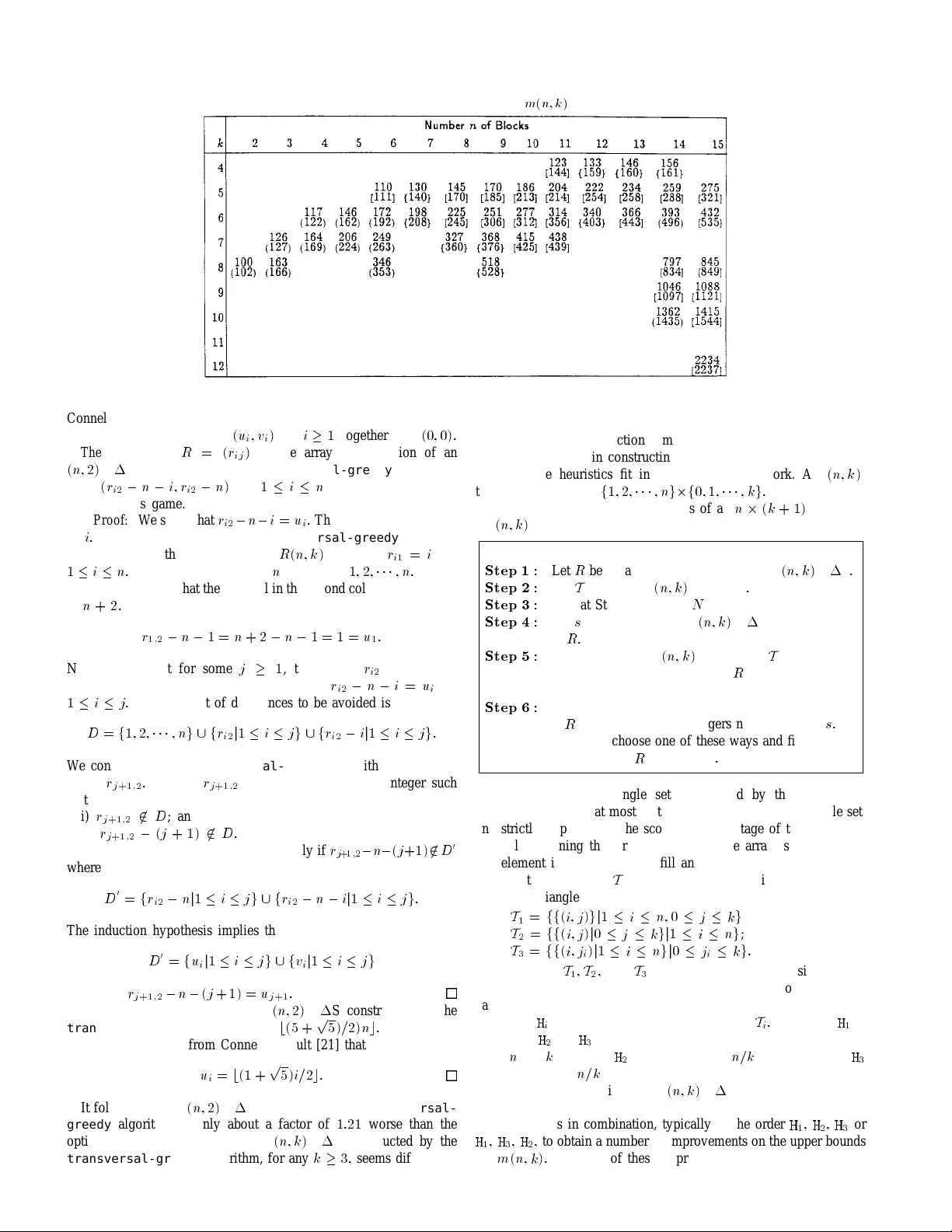
1346 IEEE TRANSACTIONS ON INFORMA TION THEOR Y, VOL. 43, NO. 4, JUL Y 1997 Constructions for Difference T riangle Sets Y eow Meng Chee and Charles J. Colbourn Abstract — Difference triangle sets ar e useful in many practical pr oblems of information transmission. This correspondence studies combinatorial and computational constructions for difference triangle sets having small scopes. Our algorithms have been used to produce difference triangle sets whose scopes are the best currently known. Index T erms — Algorithms, difference packings, difference triangle sets. I. I NTRODUCTION An ( n; k ) - differ ence triangle set ,o r ( n; k ) -D 1 S, is a set X = f X i j 1 i n g , where X i = f a i j j 0 j k g ; for 1 i n; are sets of integers called blocks , such that the differences a ij 0 a ij for 1 i n and 0 j 6 = j 0 k , are all distinct and nonzero. An ( n; k ) -D 1 Si s normalized if for 1 i n , we have 0= a i 0 q , there exists an n -DP ( n ( q 2 + q +1 ) ;q +1 ) : It is known [1, Theorem 6] that for any fixed k li m n !1 m ( n; k ) =nk 2 exists and equals one. Here, we show that the same conclusion holds even if one allows k to grow with n , provided that it does not grow too fast. The following result of Heath-Brown and Iwaniec [19] on differences between consecutive primes is useful. Theor em 4 (Heath-Br own and Iwaniec): Let p n denote the n th prime. Then p n +1 0 p n p 11 = 20 + n for any > 0 : Theor em 5: Let n and k be positive integers such that n> k or n =1 : Then there exists an ( n; k ) -D 1 S whose scope is at most (1 + o (1)) nk 2 , where the o (1) is with respect to k: Pr oof: Suppose n>k : Let p and q be the smallest prime at least n and k , respectively, such that p> q : Then Theorem 3 assures us of the existence of a p -DP ( p ( q 2 + q +1 ) ;q +1 ) : This difference packing is a ( p; q ) -D 1 S by Lemma 1. Hence, by repeated shortening and reduction (if necessary), we obtain an ( n; k ) -D 1 S whose scope m is upper-bounded by p ( q 2 + q +1 ) : However, Theorem 4 implies that p ( q 2 + q +1 ) (1 + o (1)) nk 2 : (1) For n =1 , we use Singer’s 1 -DP ( q 2 + q +1 ;q +1 ) and follow the same argument above. Cor ollary 1: Let k = f ( n ) , where f is an increasing function such that lim s u p n !1 f ( n ) =n < 1 : Then lim n !1 m ( n; k ) nk 2 =1 : Pr oof: For n large enough, we have k< n and Theorem 5 can be used to give an ( n; k ) -D 1 S of scope at most (1 + o (1)) nk 2 : This, together with Theorem 1 yields the desired result. III. E XHAUSTIVE S EARCH In principle, to construct an ( n; k ) -D 1 S of scope m , we must consider all possible sets of n subsets from a universe of size m k : This is only feasible for small values of n and k: Nevertheless, the main advantage of exhaustive search is that it allows us to prove the nonexistence of ( n; k ) -D 1 S of certain scopes. The existing results on difference triangle sets present few un- known values of m ( n; k ) that can be determined exactly with today’s technology. The determination of m (2 ; 7) is one of these possibilities. It is known that 61 m (2 ; 7) 73 (see [1]). W e proved that m (2 ; 7) = 7 0 by employing a backtracking algorithm that ran for about a week on a network of 30 machines for undergraduate mathematics students at the University of W aterloo. The blocks of a (2 ; 7) -D 1 S of scope 70 are given below: X 1 = f 0 ; 1 ; 4 ; 24 ; 40 ; 54 ; 67 ; 69 g and X 2 = f 0 ; 6 ; 11 ; 18 ; 28 ; 37 ; 62 ; 70 g : W e did not attempt to find all (2, 7)-D 1 S of scope 70 . In the following sections, we turn to faster heuristics for construct- ing difference triangle sets. IV. G REEDY A LGORITHMS W e define a partial ( n; k ) -D 1 S to be a set X = f X i j 1 i s g satisfying all of the following conditions: 1) s n: 2) j X i j = k i +1 k +1 , for 1 i s: 3) X i = f a ij j 0 j k i g is such that 0= a i 0
Original Paper
Loading high-quality paper...
Comments & Academic Discussion
Loading comments...
Leave a Comment