Towards Persistence-Based Reconstruction in Euclidean Spaces
Manifold reconstruction has been extensively studied for the last decade or so, especially in two and three dimensions. Recently, significant improvements were made in higher dimensions, leading to new methods to reconstruct large classes of compact …
Authors: Frédéric Chazal, Steve Oudot
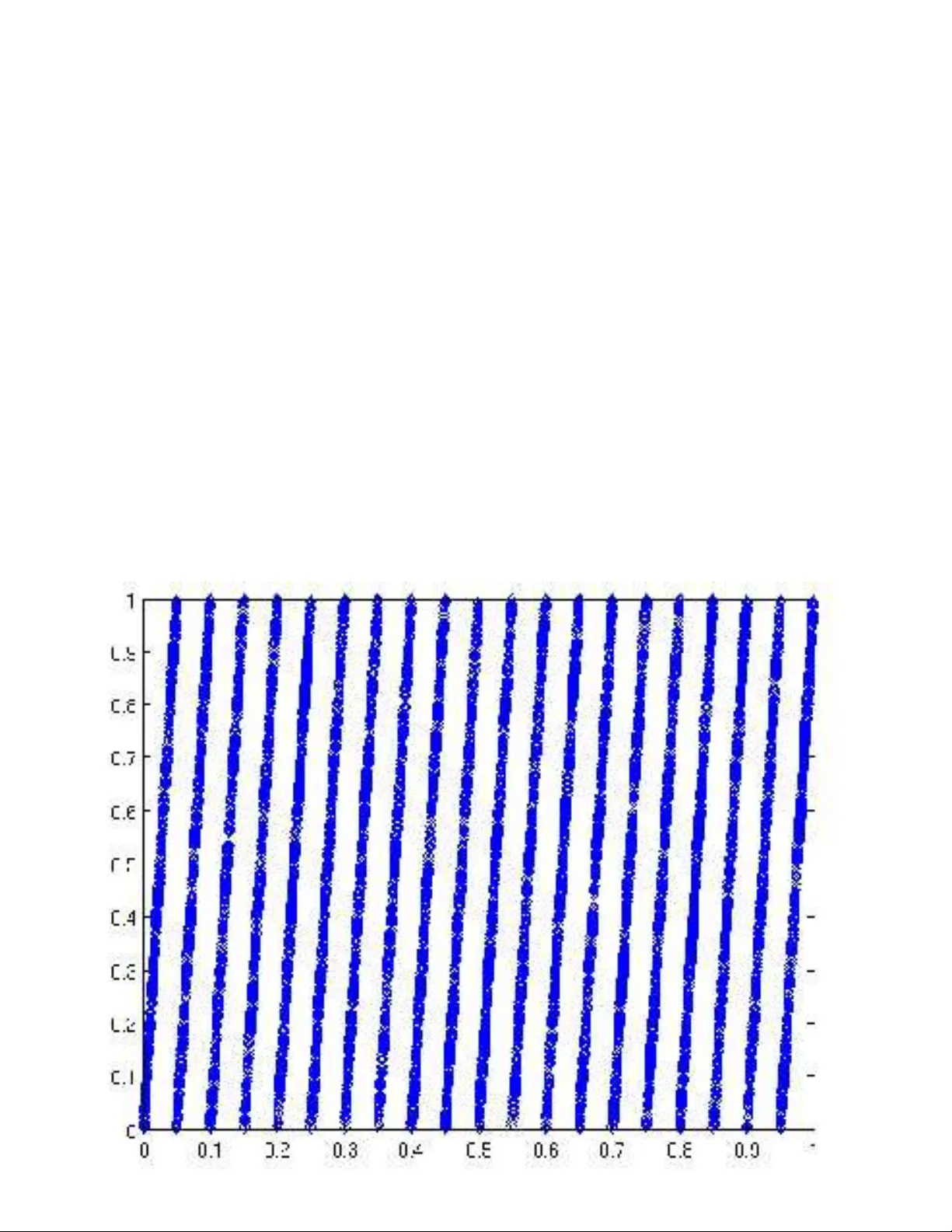
apport de recherche ISSN 0249-6399 ISRN INRIA/RR--6391--FR+ENG Thème SYM INSTITUT N A TION AL DE RECHERCHE EN INFORMA TIQUE ET EN A UTOMA TIQUE T o wards P ersistence- Based Reconstruction in Euclidean Spaces Frédéric Chazal — Ste ve Y . Ou dot N° 6391 December 2007 Centre de recher che INRIA S aclay – Î le-de-Fran ce Parc Orsay Uni versité 4, rue Jacques Monod, 91893 ORSA Y Cedex Téléphone : +33 1 72 92 59 00 T o w ards P ersistence-Based Reconstruction in Euclidean Spaces F r´ ed ´ eric Chazal ∗ , Stev e Y. Oudot ∗ Th ` eme SYM — Syst ` emes sym b oliques ´ Equip e-Pro jet G ´ eometrica Rapp ort de rec herc he n ° 6391 — Dece mber 200 7 — 23 pages Abstract: Manifold reco nstru ction has b een extensiv ely studied among the computational geometry com- m unity for the last decade or so, esp ecially i n t wo and th r ee dimensions. Recen tly , significan t impro ve ments w ere made in higher dimen sions, leading to new metho ds to r econstruct large classes of compact subsets of Eu clidean space R d . Ho wev er, the complexities of these method s scale u p ex- p onentia lly with d, w hic h mak es them impractical in medium or high dimensions, eve n for handling lo w-dimensional su b manifolds. In this pap er, we introduce a nov el approac h that s tand s in -b et we en reconstruction and top o- logica l estimation, and whose complexit y scales up with the in trinsic dimension of the data. Our algorithm com bines tw o paradigms: greedy refinement, and top ological p ersistence. Sp ecifically , giv en a p oint cloud in R d , the algorithm builds a set of landmarks iterativ ely , while main taining nested pairs of complexes, w h ose images in R d lie clo se to the data, and whose p ersistent homology ev en tually coincides with the one of the u nderlying sh ap e. When the data p oin ts are su fficien tly densely samp led from a smo oth m -sub manifold of R d , our metho d retriev es th e homology of the submanifold in time a t most c ( m ) n 5 , where n is th e size of the i np u t and c ( m ) is a constan t d ep end- ing solely on m . It can also prov ably w ell handle a wide range of compact subsets of R d , though with w orse complexities. Along the w a y to pro ving the correctness of our algorithm, we obtain new r esults on ˇ Cec h, Rips, and witness complex filtrations in Euclidean s p aces. Sp ecifically , we show h ow previous r esults on unions of balls can b e transp osed to ˇ Cec h filtrations. Moreo ve r, we p rop ose a simple framew ork for studying the prop erties of fi ltrations that are in tert wined with th e ˇ Cec h filtration, among whic h are the Rips and witness complex fi ltrations. Finally , we in v estigate f urther on witness complexes and quan tify a conjecture of Carlsson and de Silv a, whic h states that witness complex fi ltrations sh ould ha v e cleaner p ersistence b arco des than ˇ Cec h or Rip s filtrations, at least on s mo oth subm anifolds of Euclidean spaces. Key-w ords: Reconstruction, Pe rsistent Homolog y , Fi ltration, ˇ Cec h complex, Rip s complex, Witness complex, T op ologica l estimation ∗ INRIA F uturs, Pa rc Orsay Un iversi t´ e, 4, ru e Jacques Monod - Bˆ at. P , 91893 O RSA Y Ce dex, F rance. { frederic .chazal, steve.oudot } @inria .fr V ers une reconstruction bas ´ ee sur la p ersistance d ans les espaces euclidiens R ´ esum ´ e : La r econstruction de v ari ´ et ´ es a ´ et ´ e fortemen t ´ etudi ´ ee durant cette d er n i ` ere d´ ecennie, en particulier dans le cas des p etites dimensions. Des a v anc ´ ees r ´ ecen tes d ans le cas des p lus grandes dimensions on t p ermis l’ ´ emergence de nou velles m ´ etho des de reconstru ction qui p euven t traiter des n uages de p oin ts issus de sous-v ari ´ et ´ es li sses de R d de dimensions arbitraires. T outefois, la complexit ´ e de ces appr o c hes cro ˆ ıt exp onen tiellemen t a v ec la dim en sion d de l’espace am bian t, ce qui les rend impraticables en dimensions mo y ennes ou grandes, meme p our reconstruire des sous- v ari ´ et ´ es de p etite dimension telles qu e des courb es ou d es su rfaces. Dans cet article, nous in tro duison une nouvell e appr o c he qui se situe ` a la front i ` ere entre la reconstruction classique et l’inf´ erence top ologique, et dont la complexit ´ e cro ˆ ıt a v ec la dimension in trins` eque des donn´ ees. Notre algorithme com bine deux paradigmes : le raffinement glouton type maxmin et la p ersistence top ologique. Plus pr ´ ecis´ emen t, ´ etan t donn´ e un nuage de p oints dans R d , l’algorithme construit un sous -ensem ble de landmarks it´ erative ment, tout en main tenan t une paire de complexes simp liciaux im briqu´ es, dont les images dans R d son t pr o c hes des donn´ ees, et dont l’homologie p ersistan te coincide a vec l’homologie de l’espace sous-jacen t aux d onn ´ ees. Quand le n uage de p oin t est suffisammen t d ens ´ emen t ´ ec h an tillonn ´ e ` a partir d ’une sous-v ari ´ et´ e lisse de R d , notre m ´ etho de r etrouve l’homologie d e la v ari ´ et ´ e en temps c ( m ) n 5 , o ` u n est la taill e d e l’en tr ´ ee et c ( m ) est u ne constante d´ ep endant uniquement de la dimen sion int rins` eque m de la v ari ´ et´ e. Notre appro che p eut aussi r econstru ire a v ec garan ties un e large classe d’ob jets compacts dans R d , av ec de m oins b ons temps de calcul toutefois. Afin d e donner d es ga ranti es th ´ eoriques ` a not re alg orithme, nous ´ etudions l es filtratio ns de ˇ Cec h, de Rips, et de complexes d e t ´ emoins dans R d , p our lesquels nous p r ´ esen tons un ensem ble de r´ esultats nouv eaux. Plus pr´ ecis ´ ement, nous mon trons commen t d es r ´ esu ltats existan ts su r les unions de b oules p euven t ˆ etre transf´ er ´ es aux filtrations de ˇ Cec h, p uis de l` a aux filtrations de Rips et de complexes de t´ emoins. Nous prop osons ´ egaleme nt u ne pr emi ` ere quantifica tion d’un e conjecture de Carlss on et de Silv a, selon laquelle les filtrations de complexes de t´ emoins fourn issen t de meilleurs r ´ esultats que les fi ltrations de ˇ Cec h et de Rip s dans le cadre d e l’inf ´ erence top ologique, en tout cas p our le cas des sous-v ari ´ et ´ es lisses de R d . Mots-cl ´ es : Rec onstruction, Homologie p ersistante , Filtration, Complexe d e ˇ Cec h, C omplexe de Rips, Complex d e t ´ emoins, Inf ´ erence top ologique T owar ds P ersistenc e-Base d R e c onstruction in Euclide an Sp ac es 3 1 Int ro duction The problem of reconstructing u n kno wn structures fr om finite collect ions of data samples is ubiqui- tous in the Sciences, where it has man y differen t v arian ts, dep ending on the nature of the data and on the targeted application. In the last decade or so, the compu tational geometry communit y has gained a lot of interest in manifold reconstruction, where the goal is to reconstruct subm anifolds of Euclidean spaces from p oin t clouds. In particular, efficien t solutions hav e b een prop osed in d imen- sions t wo and three, based on the use of the Delauna y triangulation – see [8] f or a survey . In these metho ds, th e u nknown manifold is app ro ximated by a simplicial complex that is extracted from the full-dimensional Delauna y triangulation of the input p oin t cloud. The s uccess of this app roac h is explained by th e f act that, not only do es it b ehav e w ell on pr actical examples, but the qualit y of its output is guarante ed by a sound theoretical framew ork. I ndeed, the extracted complex is usually sho wn to b e equal, or at least close, to the so-called r estricte d D elaunay triangulation , a particular subset of the Dela unay triangulation whose appro ximation p ow er is wel l-und ersto o d on smo oth or Lipschitz curve s an d surfaces [1, 2, 6]. Unfortu nately , the s ize of the Delauna y triangulation gro ws to o fast with the dimension of the am b ien t space for the approac h to b e still tractable in high-dimensional spaces [33]. Recen tly , significan t steps were made tow ards a full und erstanding of the p otenti al and lim- itations of the restricted Delauna y triangulation on smo oth manifolds [14, 35]. In parallel, new sampling theories were devel opp ed, s uc h as t he critic al p oin t theory for distance functions [9], whic h pro vides s ufficien t conditions for the topology of a shap e X ⊂ R d to b e captured b y the offsets of a p oin t cloud L lyin g at small Hausd orff distance. These adv ances la y the foun d ations of a new theoretical fr amew ork for the reconstruction of smo oth submanifolds [11, 34], and more generally of large classes of compact subsets of R d [9, 10, 12]. Com bined with the in tro du ction of more ligh t w eigh t data structures, such as th e witness c omplex [16], they ha v e lead to new re- construction tec hniques in arbitrary Euclidean s p aces [4], wh ose outputs can b e guarante ed un der mild sampling conditions, and whose complexities can b e orders of magnitude b elo w the one of the classical Delauna y-based approac h. F or instance, on a data set with n p oints in R d , the algorithm of [4] runs in time 2 O ( d 2 ) n 2 , whereas the size of th e Delauna y triangulatio n can b e of the ord er of n ⌈ d 2 ⌉ . Unfortunately , 2 O ( d 2 ) n 2 still remains too large for these new metho ds to b e p ractical, ev en when the data p oin ts lie on or near a v ery lo w-dimensional submanifold. A we ak er yet similarly difficult v ersion of the r econstruction p aradigm is top ological estimation, where the goal is not to exhibit a data structure that faithfully appro ximates the underlyin g sh ap e X , bu t simp ly to infer the topological in v arian ts of X f rom an input p oin t cloud L . This pr oblem has receiv ed a lot of atten tion in the recen t y ears, and it finds applications in a num b er of areas of Science, suc h as sensor netw orks [19 ], statistical analysis [7], or dyn amical systems [32, 36]. A classical approac h to learning the homology of X consists in building a nested sequence of spaces K 0 ⊆ K 1 ⊆ · · · ⊆ K m , and in studyin g the p ersistence of h omology classes throughou t this sequence. In particular, it has b een indep en den tly pr o v ed in [12] and [15] that the p ersistent homology of the sequence defined by the α -offsets of a p oin t cloud L coincides with the homology of the un derlying shap e X , under samp ling conditions that are milder than the ones of [9]. Sp ecifically , if the Hausdorff distance b et w een L and X is less than ε , for some small enough ε , then, for all α ≥ ε , the canonical inclusion map L α ֒ → L α +2 ε induces homomorphisms b et we en homology groups, whose images are isomorphic to the h omology groups of X . Combined with the structure th eorem of [38], whic h states that the p ersistent homology of the sequence { L α } α ≥ 0 is f u lly d escrib ed by a finite set of in terv als, called a p ersistenc e b ar c o de or a p ersistenc e diagr am — see Figure 1 (left), the ab o v e result means that th e h omology of X can b e d educed from this barcod e, simply b y remo ving the in terv als of length less than 2 ε , wh ic h are therefore viewed as top ological noise. RR n ° 6391 4 Chazal & Oudot F rom an algorithmic p oin t of v iew, th e p ersistent homology of a nested sequence of simplicial complexes (called a filtr ation ) can b e efficient ly computed using the p ersistence algorithm [22, 38]. Among the many filtrations that can b e b uilt on top of a p oin t set L , the α -shap e enables to reliably reco v er the homology of the und erlying sp ace X , sin ce it is kno wn to b e a deformation retract of L α [21]. Ho wev er, th is prop erty is u seless in high d imensions, since computing the α -shap e requires to build the full-dimensional Delauna y triangulation. It is th er efore app ealing to consider other filtrations that are easy to compute in arbitrary dimensions, su ch as the Rip s and witness complex filtrations. Nev ertheless, to the b est of our knowledge , th ere curren tly exists no equiv alen t of the result of [12, 15] for suc h filtrations. In this p ap er, we pro d uce suc h a result, not only for Rip s and witness complexes, bu t more generally for an y filtration that is intert wined with the ˇ Cec h filtration. Recall that, for all α > 0, the ˇ Cec h complex C α ( L ) is the nerve of the union of the op en balls of same radius α ab out the p oin ts of L , i.e. the nerve of L α . It follo ws fr om the nerv e theorem [31, Cor. 4G.3] that C α ( L ) and L α are h omotop y equ iv alen t. Ho wev er, despite the result of [12, 15], this is not suffi cien t to pro ve that the p ersistent h omology of C α ( L ) ֒ → C α +2 ε ( L ) coincides with the homology of X , mainly b ecause it is not clear whether the homotop y equiv alences C α ( L ) → L α and C α +2 ε ( L ) → L α +2 ε pro vided b y the n erv e th eorem commute w ith the ca nonical inclusions C α ( L ) ֒ → C α +2 ε ( L ) and L α ֒ → L α +2 ε . Using standard arguments of algebraic top ology , w e prov e that there exist some homotop y equ iv alences th at do comm ute with the canonical inclus ions , at least at homology and h omotop y lev els. T his enables us to extend the r esult of [12, 15] to the ˇ Cec h filtration, and from there to the Rip s and w itness complex fi ltrations. Figure 1: Results obtained from a set W of 10 , 000 p oin ts sampled un iformly at r andom f rom a helical curve dr awn on the 2d torus ( u, v ) 7→ 1 2 (cos 2 π u, sin 2 π u, cos 2 π v , sin 2 π v ) in R 4 — see [30]. Left: p ers istence barco de of the Rips filtration, built o v er a set of 900 carefully-c hosen landmarks. Righ t: result of our algorithm, applied blindly to th e input W . Bot h metho ds h ighligh t the t wo underlying structures: curve and torus. Another common concern in top ological data analysis is th e size of the vertex s et on top of wh ic h a filtration is bu ilt. In many practical situations ind eed, the p oint cloud W gi ve n as input samples the underlyin g sh ap e v ery finely . In su c h situations, it mak es sense to b uild the filtration on top of a small subset L of landmarks, to a v oid a waste of computational resources. Ho w ev er, building a filtration on top of the spars e landmark set L instead of the den se p oin t cloud W can result in a s ignifican t degradation in th e qualit y of the p ersistence barco d e. Th is is true in particular with the ˇ Cec h and Rips filtrations, whose barco des can ha ve top ological noise of amplitude dep endin g directly on the d ensit y of L . The introdu ction of the witness complex filtration app eared as an elengan t wa y of solving this issue [18]. The witness complex of L relativ e to W , or C W ( L ) for INRIA T owar ds P ersistenc e-Base d R e c onstruction in Euclide an Sp ac es 5 short, can b e view ed as a relaxed v ersion of the Delauna y triangulation of L , in whic h the p oints of W \ L are used to driv e the construction of the complex [16]. Due to its sp ecial n atur e, wh ic h tak es adv ant age of the p oint s of W \ L , and due to its close relationship with the restricted Dela un ay triangulation, th e witness complex fi ltration is lik ely to giv e p ersistence b arco des whose top ological noise dep ends on the densit y of W rather than on the one of L , as conjectured in [18]. W e pro v e in the p ap er that th is statemen t is only tru e to some exten t, namely: whenever the p oints of W are sufficien tly densely sampled from some smo oth su bmanifold of R d , the top ological noise in the barco de can b e arbitrarily small compared to the density of L . Nev ertheless, it cannot dep end solely on the den s it y of W . This sho ws that the witness complex fi ltration do es pro vide cleaner p ersistence barco des than ˇ Cec h or Rips filtrations, b ut ma yb e not as clea n as exp ected. T aking adv antage of th e ab o v e th eoretical r esults on Rips and w itn ess complexes, w e prop ose a nov el approac h to reconstruction that stands somewhere in -b et we en the classical reconstruction and top ological estimatio n paradigms. Ou r algorithm is a v ariant of th e metho d of [4, 30] th at com bines greedy refinement and top ological p ersistence. Sp ecifically , giv en an input p oint cloud W , the algorithm bu ilds a su bset L of landmarks iterativ ely , and in the mean time it main tains a nested pair of simplicial complexes (which happ en to b e Rips or witness complexes) and computes its p ersistent Betti num b ers. The outcome of the algorithm is the sequence of nested pairs main tained throughout the pr o cess, or r ather the d iagram of ev olution of their p ersistent Betti num b ers . Using this diagram, a user or softw are agen t can determine a relev an t scale at wh ic h to pro cess the data. It is then easy to rebu ild the corresp ond ing set of land marks, as w ell as its nested pair of complexes. Note that our metho d do es not completely solv e the classical reconstruction problem, since it d o es not exhibit an em b edd ed complex that is close to X top ologically and geometrically . Nev ertheless, it comes w ith theoretical guaran tees, it is easily implementa ble, and ab o v e all it has reasonable complexit y . In d eed, in the case wh ere the input p oin t cloud is sampled from a smo oth s u bmanifold X of R d , we s ho w that the complexit y of our algorithm is b ound ed by c ( m ) n 5 , w here c ( m ) is a quan tit y dep ending solely on the in trinsic dimension m of X , w hile n is the size of the input. T o the b est of our kn owledge, this is the first pro v ably-go o d top ological estimation or reconstruction metho d w hose complexit y scales up with the intrinsic dimension of the m anifold. In the case w here X is a more general compact set in R d , our complexit y b ound b ecomes c ( d ) n 5 . The pap er is organized as follo w s: after introdu cing the ˇ Cec h, Rips, and witness complex filtrations in S ection 2, we pro v e our stru ctural results in S ections 3 and 4, fo cusing on the general case of compact su bsets of R d in Section 3, and more sp ecifically on the case of smo oth subm anifolds of R d in S ection 4 . Finally , we pr esen t our algorithm and its analysis in Section 5. 2 V arious complexes and their relationships The d efi nitions, results and pro ofs of this section hold in an y arbitrary metric space. Ho wev er, for the sak e of consistency with the rest of the pap er, w e state them in the particular case of R d , endo w ed with the Euclidean norm k p k = q P d i =1 p 2 i . As a consequence, our b ounds are n ot the tigh test p ossible for the Eu clidean case, but they are for the general metric case. Using sp ecific prop erties of Euclidean spaces, it is ind eed p ossible to w ork out somewhat tigh ter b ounds, b ut at the price of a loss of sim p licit y in the statement s. F or any compact s et X ⊂ R d , we call diam( X ) the diameter of X , and d iam CC ( X ) th e c omp onent-wise diameter of X , defin ed b y: d iam CC ( X ) = inf i diam( X i ), where the X i are the path-connected comp onen ts of X . Finall y , giv en t w o compact sets X , Y in R d , we call d H ( X, Y ) their Hausd orff d istance. RR n ° 6391 6 Chazal & Oudot ˇ Cec h c omplex. Giv en a finite set L of p oin ts of R d and a p ositiv e num b er α , w e call L α the union of the op en b alls of radius α cen tered at the p oin ts of L : L α = S x ∈ L B ( x, α ). This definition mak es sense only for α > 0, since for α = 0 we get L α = ∅ . W e also denote b y { L α } the op en co ver of L α formed b y the op en balls of r ad iu s α cen tered at the p oin ts of L . The ˇ Cec h complex of L of parameter α , or C α ( L ) for short, is the nerve of this cov er, i.e. it is th e abstract simplicial complex w hose vertex set is L , and suc h that, for all k ∈ N and all x 0 , · · · , x k ∈ L , [ x 0 , · · · , x k ] is a k -simplex of C α ( L ) if and only if B ( x 0 , α ) ∩ · · · ∩ B ( x k , α ) 6 = ∅ . Rips complex. Giv en a finite set L ⊂ R d and a p ositive num b er α , the Rips complex of L of parameter α , or R α ( L ) for short, is the abstract simp licial complex wh ose k -simp lices corresp ond to unord er ed ( k + 1)-tuples of p oin ts of L which are p airwise within Euclidean d istance α of one another. The Rips complex is closely relat ed to the ˇ Cec h complex, as stated in the follo w in g standard lemma, whose pro of is recalled for completeness: Lemma 2.1 F or al l finite se t L ⊂ R d and al l α > 0 , we have: C α 2 ( L ) ⊆ R α ( L ) ⊆ C α ( L ) . Pro of. The p ro of is standard. Let [ x 0 , · · · , x k ] b e an arbitrary k -simplex of C α 2 ( L ). Th e Euclidean balls of same radiu s α 2 cen tered at the x i ha v e a n on-empt y common intersectio n in R d . Let p b e a p oint in the intersectio n. W e then ha v e: ∀ 0 ≤ i, j ≤ k , k x i − x j k ≤ k x i − p k + k p − x j k ≤ α . T his implies that [ x 0 , · · · , x k ] is a s im p lex of R α ( L ), whic h prov es the fi r st in clusion of the lemma. Let no w [ x 0 , · · · , x k ] b e an arbitrary k -simplex of R α ( L ). W e ha v e k x 0 − x i k ≤ α for all i = 0 , · · · , k . This means th at x 0 b elongs to all the Eu clidean balls B ( x i , α ), wh ic h therefore hav e a n on-empt y common in tersection in R d . It follo ws th at [ x 0 , · · · , x k ] is a simplex of C α ( L ), whic h pro v es the second inclusion of the lemma. Witness complex. Let L b e a fin ite su b set of R d , referred to as the landmark set, and let W b e another (p ossibly infinite) sub set of R d , iden tified as the witness set. Let also α ∈ [0 , ∞ ). – Giv en a p oint w ∈ W and a k -simp lex σ with v ertices in L , w is an α -witness o f σ (or, equiv alen tly , w α -witnesses σ ) if the v ertices of σ lie within Euclidean d istance (d k ( w ) + α ) of w , wh ere d k ( w ) denotes the Euclidean distance b et w een w and its ( k + 1)th nearest landmark in th e Eu clidean m etric. – The α -witness c omplex of L r elative to W , or C α W ( L ) for short, is the maximum abstract simplicial complex, w ith vertic es in L , wh ose faces are α -witnessed by p oin ts of W . When α = 0, the α -witness complex coincides w ith the standard witness complex C W ( L ), int ro d uced in [17]. The α -witness complex is also closely related to the ˇ Cec h complex, though the relationship is a b it more su btle than in the case of the Rip s complex: Lemma 2.2 L et L , W ⊆ R d b e su c h that L i s finite. If every p oint o f L lie s within E uclide an distanc e l of W , then for al l α > l we h ave: C α − l 2 ( L ) ⊆ C α W ( L ) . In ad dition, if the Euclide an distanc e fr om any p oint of W to its se c ond ne ar est neighb or in L is at most l ′ , then f or al l α > 0 we have: C α W ( L ) ⊆ C 2( α + l ′ ) ( L ) . Pro of. Let [ x 0 , · · · , x k ] b e a k -simplex of C α − l 2 ( L ). Th is means that T k i =0 B ( x i , α − l 2 ) 6 = ∅ , and as a r esu lt, th at k x 0 − x i k ≤ α − l for all i = 0 , · · · , k . Let w b e a p oin t of W closest to x 0 in the Euclidean metric. By the h yp othesis of the lemma, w e ha ve k w − x 0 k ≤ l , therefore x 0 , · · · , x k lie within Euclidean distance α of w . Since the Euclidean d istances f rom w to its nearest p oin ts of L are non-negativ e, w is an α -witness of [ x 0 , · · · , x k ] and of all its faces. As a result, [ x 0 , · · · , x k ] is a simplex of C α W ( L ). INRIA T owar ds P ersistenc e-Base d R e c onstruction in Euclide an Sp ac es 7 Consider n o w a k -simplex [ x 0 , · · · , x k ] of C α W ( L ). If k = 0, then the simplex is a v ertex [ x 0 ], and therefore it b elongs to C α ′ ( L ) for all α ′ > 0. Assu me no w that k ≥ 1. Edges [ x 0 , x 1 ] , · · · , [ x 0 , x k ] b elong also to C α W ( L ), hence they are α -witnessed by p oin ts of W . Let w i ∈ W be an α -witness of [ x 0 , x i ]. Distances k w i − x 0 k and k w i − x i k are b oun ded f rom ab o v e b y d 2 ( w i ) + α , w here d 2 ( w i ) is the Euclidean distance from w i to its second nearest p oin t of L , whic h b y assumption is at most l ′ . It follo ws that k x 0 − x i k ≤ k x 0 − w i k + k w i − x i k ≤ 2 α + 2 l ′ . Since this is tru e for all i = 0 , · · · , k , w e conclude that x 0 b elongs to the inte rsection T k i =0 B ( x i , 2( α + l ′ )), whic h is therefore non-empt y . As a r esu lt, [ x 0 , · · · , x k ] is a s im p lex of C 2( α + l ′ ) ( L ). Corollary 2.3 L et X b e a c omp act subset of R d , and let L ⊆ W ⊆ R d b e such that L i s finite. Assume that d H ( X, W ) ≤ δ and that d H ( W , L ) ≤ ε , with ε + δ < 1 4 diam CC ( X ) . Then, fo r al l α > ε , we have: C α − ε 2 ( L ) ⊆ C α W ( L ) ⊆ C 2 α +6( ε + δ ) ( L ) . In p articular, if δ ≤ ε < 1 8 diam CC ( X ) , then, for al l α ≥ 2 ε we have: C α 4 ( L ) ⊆ C α W ( L ) ⊆ C 8 α ( L ) . Pro of. S ince d H ( W , L ) ≤ ε , ev ery p oin t of L lies within Euclidean distance ε of W . As a r esult, the first in clusion of Lemma 2.2 holds with l = ε , th at is: C α − ε 2 ( L ) ⊆ C α W ( L ). No w, for ev ery p oin t w ∈ W , there is a p oint p ∈ L suc h that k w − p k ≤ ε . More- o v er, there is a p oin t x ∈ X suc h that k w − x k ≤ δ , since we assumed that d H ( X, W ) ≤ δ . Let X x b e th e path-connected comp onen t o f X that c ont ains x . T ake an arbitrary v alue λ ∈ 0 , 1 2 diam CC ( X ) − 2( ε + δ ) , and consider the op en ball B ( w , 2( ε + δ ) + λ ). This ball clearly in tersects X x , since it con tains x . F u r thermore, X x is not cont ained en tirely in the ball, since otherwise w e wo uld ha v e: d iam CC ( X ) ≤ diam( X x ) ≤ 4( ε + δ ) + 2 λ , hereby contradicti ng the fact that λ < 1 2 diam CC ( X ) − 2( ε + δ ). Hence, there is a p oint y ∈ X lyin g on the b ound in g sp here of B ( w , 2( ε + δ ) + λ ). Let q ∈ L b e closest to y . W e ha ve k y − q k ≤ ε + δ , since our hypothesis implies that d H ( X, L ) ≤ d H ( X, W ) + d H ( W , L ) ≤ δ + ε . It follo ws then from the triangle inequalit y that k p − q k ≥ k w − y k − k w − p k − k y − q k ≥ 2( ε + δ ) + λ − ( ε + δ ) − ( ε + δ ) = λ > 0. Thus, q is differen t from p , and therefore the b all B ( w, 3( ε + δ ) + λ ) con tains at least tw o p oin ts of L . Since this is true for arbitrarily small v alues of λ , th e Euclidean distance from w to its second n earest neigh b or in L is at most 3( ε + δ ). It follo ws that the second inclusion of Lemma 2.2 holds with l ′ = 3( ε + δ ), that is: C α W ( L ) ⊆ C 2( α +3( ε + δ )) ( L ). As mentio ned at the head of the section, sligh tly tight er b ound s can b e wo rked out usin g sp ecific prop erties of Euclidean s p aces. F or the case of the Rips complex, this w as d one by de Silv a and Ghrist [19, 27]. Their ap p roac h can b e combined with ours in the case of the witness complex. 3 S tru c tural prop erties of filtrations o v er compact subsets of R d Throughout th is sectio n, w e use classical concepts of algebraic topology , such as homotop y equiv- alences, deformation r etracts, or singu lar homology . W e r efer the reader to [31] for a go o d intro- duction to these concepts. Giv en a compact set X ⊂ R d , w e den ote b y d X the distanc e function defined b y d X ( x ) = inf {k x − y k : y ∈ X } . Alt hough d X is n ot d ifferen tiable, it is p ossible to define a notion of critical p oint for distance fu nctions and we denote b y wfs( X ) the we ak f e atur e size of X , d efined as the smallest p ositiv e critica l v alue of the distance fu nction to X [10]. W e do not exp licitly u se the notion of critical v alue in the follo wing, but only its relationship with th e top ology of the offsets X α = { x ∈ R d : d X ( x ) ≤ α } , stressed in the follo wing resu lt from [29]: RR n ° 6391 8 Chazal & Oudot Lemma 3.1 ( Isotop y Lemma) If 0 < α < α ′ ar e such that ther e is no critic al value of d X in the close d interval [ α, α ′ ] , then X α and X α ′ ar e home omorphic (and even isotopic), and X α ′ deformation r etr acts onto X α . In p articular the h yp othesis of th e lemma is satisfied when 0 < α 1 < α 2 < wfs( X ). In other w ords, all the offsets of X ha v e th e same top ology in the in terv al (0 , wfs ( X )). 3.1 Results on homology W e use sin gular h omology with co efficients in an arbitrary fi eld – omitted in our notations. In the follo w ing, we rep eatedly m ak e use of the follo wing standard r esult of linear algebra: Lemma 3.2 ( Sandwic h L e mma) Consider th e fol lowing se q uenc e of homomorphisms b etwe en finite-dimensional ve ctor sp ac es over a same field: A → B → C → D → E → F. Assu me that rank ( A → F ) = r ank ( C → D ) . Then, this quantity also e quals the r ank of B → E . In the same way, if A → B → C → E → F is a se quenc e of homomorp hisms such that r ank ( A → F ) = dim C , then r ank ( B → E ) = dim C . Pro of. Ob serv e that, f or an y sequence of homomorphisms F f → G g → H , w e ha v e rank ( g ◦ f ) ≤ min { rank f , r ank g } . Applying this fact to maps A → F , B → E , and C → D , which are nested in the sequ ence of the lemma, w e get: rank ( A → F ) ≤ ran k ( B → E ) ≤ r ank ( C → D ), whic h pro v es the fi r st statement of the lemma. As for the s econd statement , it is obtained from the first one by letting D = C and taking C → D to b e th e identit y map. 3.1.1 ˇ Cec h filtra t ion Since the ˇ Cec h complex is the nerv e of a union of balls, its top ological inv arian ts can b e read from the s tr ucture of its dual union. It turn s out that unions of balls ha ve b een extensivel y stu died in the past [9, 12, 15]. Our analysis relies particularly on the follo wing result, wh ic h is an easy extension of Theorem 4.7 of [12]: Lemma 3.3 L et X b e a c omp act set and L a finite set in R d , such that d H ( X, L ) < ε for some ε < 1 4 wfs( X ) . Then, for al l α, α ′ ∈ [ ε, wfs( X ) − ε ] such that α ′ − α ≥ 2 ε , and for al l λ ∈ (0 , wf s ( X )) , we have: ∀ k ∈ N , H k ( X λ ) ∼ = im i ∗ , wher e i ∗ : H k ( L α ) → H k ( L α ′ ) is the homomorphism b e twe en homolo gy gr oups induc e d by the c anonic al inclusion i : L α ֒ → L α ′ . Given an arbitr ary p oint x 0 ∈ X , the same c onclusion holds for homo topy gr oups with b ase-p oint x 0 . Pro of. W e can assume without loss of generalit y that ε < α < α ′ − 2 ε < wfs( X ) − 3 ε , since otherwise w e can r eplace ε b y an y ε ′ ∈ ( d H ( X, L ) , ε ). F r om the h yp othesis w e deduce the follo wing sequence of in clusions: X α − ε ֒ → L α ֒ → X α + ε ֒ → L α ′ ֒ → X α ′ + ε (1) By the Isotop y Lemma 3.1, for all 0 < β < β ′ < wfs( X ), the canonical inclusion X β ֒ → X β ′ is a homotop y equiv alence. As a consequen ce, Eq. ( 1) ind uces a sequence of homomorphisms b et we en homology groups, suc h that all homomorphisms b et wee n homology groups of X α − ε , X α + ε , X α ′ + ε are isomorphism s. It follo ws then from the Sandwich Lemma 3.2 that i ∗ : H k ( L α ) → H k ( L α ′ ) has same r ank as these isomorp hisms. No w, this rank is equal to the dimension of H k ( X λ ), sin ce th e X β are homotop y equiv alen t to X λ for all 0 < β < wfs( X ). It follo ws that im i ∗ ∼ = dim H k ( X λ ), since our ring of coefficien ts is a fi eld. The case of h omotop y group s is a little tric kier, since replacing INRIA T owar ds P ersistenc e-Base d R e c onstruction in Euclide an Sp ac es 9 homology groups by homotop y group s do es n ot allo w u s to u s e th e ab ov e rank argument. Ho w ev er, w e can use the same pro of as in T heorem 4.7 of [12] to conclude. Observe that Lemma 3.3 d o es not guaran tee the retriev al of the homology of X . I n stead, it deals with sufficiently small offsets of X , w hic h are homotop y equiv alen t to one another but p ossibly not to X itself. In the sp ecial case where X is a smo oth submanifold of R d ho w ev er, X λ and X are homotop y equiv alent, and therefore the theorem guaran tees the retriev al of the h omology of X . F rom an algorithmic p oin t of view, the main drawbac k of Lemma 3.3 is that compu tin g the homology of a union of balls or the image of the h omomorphism i ∗ is usually a wkwa rd. As men tionned in [12, 15] this can b e d one b y computing th e p ersistence of the α -shap e or λ -medial axis fi ltrations asso ciated to L but there do not exist efficient algorithms to compute these fi ltrations in dimension more than 3. In the follo wing we sho w th at w e can still reliably obtain the homology of X from easier to compute filtrations, namely the Rip s and Witness complexes filtrations. Consider now the ˇ Cec h complex C α ( L ), for any v alue α > 0. By d efinition, C α ( L ) is the n erv e of the op en co ver { L α } of L α . Since the elements of { L α } are op en E u clidean b alls, they are con v ex, and therefore their inte rsections are either e mpty or c on ve x. It follo ws that { L α } satisfies the h yp otheses of the nerve the or em , wh ic h implies that C α ( L ) and L α are homotop y equiv alen t – see e.g. [31, Corollary 4G.3]. W e thus get the follo wing diagram, where horizonta l arro ws are canonical inclusions, and v ertical arrows are homotop y equiv alences pro vided by the nerve theorem: L α ֒ → L α ′ ↑ ↑ C α ( L ) ֒ → C α ′ ( L ) (2) Determining whether this diagram comm utes is not straigh tforwa rd. The follo wing r esult, based on standard argum en ts of algebraic top ology , sho ws th at ther e exist homotop y equ iv alences b etw een the un ion of b alls and the ˇ Cec h complex that make the ab o v e diagram commutativ e at homology and homotop y lev els: Lemma 3.4 L et L b e a finite set of p oints in R d and let 0 < α < α ′ . Then, ther e exist homotop y e quivalenc es C α ( L ) → L α and C α ′ ( L ) → L α ′ such that, for al l k ∈ N , the diagr am of E q. (2) induc es the f ol lowing c ommutative diagr ams: H k ( L α ) → H k ( L α ′ ) π k ( L α ) → π k ( L α ′ ) ↑ ↑ and ↑ ↑ H k ( C α ( L )) → H k ( C α ′ ( L )) π k ( C α ( L )) → π k ( C α ′ ( L )) wher e vertic al arr ows ar e isomorphisms . Pro of. Our app r oac h consists in a quic k review of the pro of of the nerv e theorem pro vided in Section 4G of [31], and in a simple extension of the main argumen ts to our con text. As mentio ned earlier, the op en co v er { L α } satisfies the conditions of the nerve theorem, namely: for all p oint s x 0 , · · · , x k ∈ L , T k l =0 B ( x l , α ) is either empt y , or con ve x and therefore contract ible. F rom this co v er w e construct a top ologica l sp ace ∆ L α as follo ws: let ∆ n denote the stand ard n - simplex, where n = # L − 1. T o eac h non-empty subset S of L w e asso ciate the face [ S ] of ∆ n spanned by the elemen ts of S , as w ell as the space B S ( α ) = T s ∈ S B ( s, α ) ⊆ L α . ∆ L α is then the subspace of L α × ∆ n defined b y: ∆ L α = [ ∅6 = S ⊆ L B S ( α ) × [ S ] RR n ° 6391 10 Chazal & Oudot The space ∆ L α ′ is built similarly . The pro du ct s tructures of ∆ L α and ∆ L α ′ imply the existence of canonica l p ro jections p α : ∆ L α → L α and p α ′ : ∆ L α ′ → L α ′ . These pr o jections comm ute with the canonical inclusions ∆ L α ֒ → ∆ L α ′ and L α ֒ → L α ′ , whic h implies that the follo wing d iagram: L α ֒ → L α ′ p α ↑ ↑ p α ′ ∆ L α ֒ → ∆ L α ′ (3) induces commutati ve d iagrams at homology and homotopy lev els. Moreo v er, sin ce { L α } is an op en co ver of L α , wh ic h is paracompact, p α is a homotop y equiv alence [31, Pr op. 4G.2 ]. Th e same holds for p α ′ , and therefore p α and p α ′ induce isomorphisms at h omology and homotop y lev els. W e no w sho w that, similarly , there exist homotopy equiv alences ∆ L α → C α ( L ) and ∆ L α ′ → C α ′ ( L ) that co mmute with the c anonical inclusions ∆ L α ֒ → ∆ L α ′ and C α ( L ) ֒ → C α ′ ( L ). This follo w s in fact from the p ro of of Corollary 4G.3 of [31]. Indeed, using the notion of c omplex of sp ac es int ro d uced in [31 , S ection 4G], it can b e sho wn that ∆ L α is the realization of the complex of spaces asso ciated with the cov er { L α } — see the p r o of of [31, Prop. 4G.2]. Its base is the barycen tric sub division Γ α of C α ( L ), where eac h v ertex corresp on d s to a non-empty fin ite in tersection B S ( α ) for s ome S ⊆ L , and where eac h edge connecting t w o vertice s S ⊂ S ′ corresp onds to the canonical inclusion B S ′ ( α ) ֒ → B S ( α ). In the same wa y , ∆ L α ′ is the realization of a complex of sp aces b uilt o v er th e b arycen tric sub division Γ α ′ of C α ′ ( L ). No w, since the n on-empt y fin ite intersecti ons B S ( α ) (resp. B S ( α ′ )) are con tractible, th e map q α : ∆ L α → Γ α (resp. q α ′ : ∆ L α ′ → Γ α ′ ) indu ced b y sending eac h op en set B S ( α ) (resp. B S ( α ′ )) to a p oint is a h omotop y equiv alence [31 , Prop. 4 G.1 and Corol. 4G.3]. F ur th ermore, by construction, q α is the r estriction of q α ′ to ∆ L α . Therefore, ∆ L α ֒ → ∆ L α ′ q α ↓ ↓ q α ′ Γ α ֒ → Γ α ′ (4) is a comm utativ e diagram where vertica l arrows are h omotop y equiv alences. No w, it is w ell-kno wn that Γ α and Γ α ′ are h omeomorphic to C α ( L ) an d C α ′ ( L ) r esp ectiv ely , and that the h omeomorphisms comm ute with the inclusion. Combined with (3) and (4), this fact prov es Lemma 3.4. Com bining Lemmas 3.3 and 3.4, we obtain th e follo wing k ey result: Theorem 3.5 L et X b e a c omp act set and L a finite set in R d , such that d H ( X, L ) < ε for some ε < 1 4 wfs( X ) . Then, for al l α, α ′ ∈ [ ε, wfs( X ) − ε ] such that α ′ − α > 2 ε , and for al l λ ∈ (0 , wfs( X )) , we have: ∀ k ∈ N , H k ( X λ ) ∼ = im j ∗ , wher e j ∗ : H k ( C α ( L )) → H k ( C α ′ ( L )) is the homomo rphism b etwe e n homol o gy gr oups induc e d by the c anonic al inclusion j : C α ( L ) ֒ → C α ′ ( L ) . Given an arbitr ary p oint x 0 ∈ X , the same r esult holds for homotopy gr oups with b ase-p oint x 0 . Using the terminology of [38], this result means that the homology of X λ can b e dedu ced f r om the p ersistent homology of the filtration {C α ( L ) } α ≥ 0 b y remo ving the cycles of p ersistence less than 2 ε . Equiv alen tly , the amplitude of the top olo gic al noise in the p ersistence barco de of {C α ( L ) } α ≥ 0 is b ound ed by 2 ε , i.e . th e in terv als of length at least 2 ε in the barco d e giv e the homology of X λ . 3.1.2 Filtrations intert wined with t he ˇ Cec h filtra t ion Using Lemma 2.1 and Theorem 3.5, w e get the follo wing guarantee s on the Rips filtration: Theorem 3.6 L et X ⊂ R d b e a c omp act set, and L ⊂ R d a finite set such that d H ( X, L ) < ε for some ε < 1 9 wfs( X ) . Then, for al l α ∈ 2 ε, 1 4 (wfs( X ) − ε ) and al l λ ∈ (0 , wfs( X )) , we have: ∀ k ∈ N , H k ( X λ ) ∼ = im j ∗ , wher e j ∗ : H k ( R α ( L )) → H k ( R 4 α ( L )) is the homomorp hism b etwe en homolo gy gr oups induc e d by the c anonic al inclusion j : R α ( L ) ֒ → R 4 α ( L ) . INRIA T owar ds P ersistenc e-Base d R e c onstruction in Euclide an Sp ac es 11 Pro of. F rom Lemma 2.1 w e d educe th e follo wing sequence of inclusions: C α 2 ( L ) ֒ → R α ( L ) ֒ → C α ( L ) ֒ → C 2 α ( L ) ֒ → R 4 α ( L ) ֒ → C 4 α ( L ) (5) Since α ≥ 2 ε , Theorem 3.5 implies that Eq. (5) induces a sequence of homomorphisms b et w een homology groups, suc h that H k ( C α 2 ( L )) → H k ( C 4 α ( L )) and H k ( C α ( L )) → H k ( C 2 α ( L )) ha v e ranks equal to d im H k ( X λ ). Therefore, by the Sandwich Lemma 3.2, rank j ∗ is also equal to d im H k ( X λ ). It follo ws that im j ∗ ∼ = dim H k ( X λ ), since our ring of co efficient s is a field. Similarly , Corollary 2.3 p ro vides the follo wing sequen ce of inclusions: C α 4 ( L ) ֒ → C α W ( L ) ֒ → C 8 α ( L ) ֒ → C 9 α ( L ) ֒ → C 36 α W ( L ) ֒ → C 288 α ( L ) , from whic h follo ws a result similar to Theorem 3.6 on the witness complex, by the same pro of: Theorem 3.7 L et X b e a c omp act subset of R d , and let L ⊆ W ⊆ R d b e such that L is finite. As- sume that d H ( X, W ) ≤ δ and that d H ( W , L ) ≤ ε , with δ ≤ ε < min 1 8 diam CC ( X ) , 1 1153 wfs( X ) . Then, for al l α ∈ 4 ε, 1 288 (wfs( X ) − ε ) and al l λ ∈ (0 , wfs( X )) , we have: ∀ k ∈ N , H k ( X λ ) ∼ = im j ∗ , wher e j ∗ : H k ( C α W ( L )) → H k ( C 36 α W ( L )) is the homomor phism b etwe en homolo gy g r oups induc e d by the c anonic al inclusion j : C α W ( L ) ֒ → C 36 α W ( L ) . More generally , the ab o v e argumen ts s ho w th at the homology of X λ can b e reco v ered from the p ersistence b arco de of any filtration { F α } α ≥ 0 that is in tert wined with the ˇ Cec h filtration in the sense of Lemmas 2.1 and 2.2. Note ho we ve r th at Th eorems 3.6 and 3.7 suggest a differen t b eha vior of the barco de in this case, since its top ologica l noise might scale up w ith α (sp ecifically , it might b e up to linear in α ), whereas it is un iformly b ounded b y a constan t in the case of the ˇ Cec h filtration. This difference of b ehavi or is easily explained by the w a y { F α } α ≥ 0 is in tert wined with th e ˇ Cec h filtration. A tric k to get a u niformly-b ounded noise is to repr esen t the barco de of { F α } α ≥ 0 on a logarithmic scale, that is, with log 2 α ins tead of α in ab cissa. 3.2 Results on homotop y The results on homology obtained in S ection 3.1 follo w from sim p le algebraic argumen ts. Using a more geometric approac h, w e can get similar results on homotop y . F rom n o w on, x 0 ∈ X is a fixed p oint and all the homotop y group s π k ( X ) = π k ( X, x 0 ) are assumed to b e with base-p oint x 0 . Theorems 3.6 and 3.7 can b e extended to homotopy in the f ollo w in g wa y: Theorem 3.8 Under the same hyp otheses as in The or em 3.6, we have: ∀ k ∈ N , π k ( X λ ) ∼ = im j ∗ , wher e j ∗ : π k ( R α ( L )) → π k ( R 4 α ( L )) is the homomorphism b e twe en homotopy gr oups induc e d by the c anonic al inclusion j : R α ( L ) ֒ → R 4 α ( L ) . Theorem 3.9 Under the same hyp otheses as in The or em 3.7, we have: ∀ k ∈ N , π k ( X λ ) ∼ = im j ∗ , wher e j ∗ : π k ( C α W ( L )) → π k ( C 36 α W ( L )) is the homomo rphism b etwe en hom otopy gr oups induc e d by the c anonic al inclusion j : C α W ( L ) ֒ → C 36 α W ( L ) . The p ro ofs of these t wo results b eing m ostly identi cal, we fo cus exclusiv ely on the Rips complex. W e will use the follo wing lemma, w hic h is an immediate generalization of Pr op osition 4.1 of [12]: Lemma 3.10 L et X b e a c omp act set and L a finite set in R d , such that d H ( X, L ) < ε for some ε < 1 4 wfs( X ) . L et α, α ′ ∈ [ ε, wfs( X ) − ε ] b e such that α ′ − α ≥ 2 ε . Given k ∈ N , two k-lo ops σ 1 , σ 2 : S k → ( L α , x 0 ) in L α ar e homotop ic in X α ′ + ε if and only if they ar e homotop ic in L α ′ . RR n ° 6391 12 Chazal & Oudot Pro of of Theorem 3.8 . As men tionned at th e b egining of the pro of of Lemma 3.3, we can assume without loss of generalit y that 2 ε < α < 1 4 (wfs( X ) − ε ). Consider the follo wing sequence of inclusions: C α 2 ( L ) ⊂ R α ( L ) ⊂ C α ( L ) ⊂ C 2 α ( L ) ⊂ R 4 α ( L ) ⊂ C 4 α ( L ) W e use the homotop y equiv alences h β : L β → C β ( L ) pro vided by Lemma 3.4 for all v alues β > 0, whic h comm ute with inclusions at homotopy lev el. Note that, for an y elemen t σ of π k ( C β ( L )), there exists a k -lo op in L β that is mapp ed through h β to a k -lo op representing th e homotop y class σ . In the follo wing, we denote b y σ g suc h a k -lo op. Let E , F a nd G b e the images of π k ( C α 2 ( L )) in π k ( C α ( L )), π k ( C 2 α ( L )) and π k ( C 4 α ( L )) resp ectiv ely , th r ough the homomorphisms induced by inclusion. W e thus hav e a sequence of sur jectiv e homomorphisms: π k ( C α 2 ( L )) → E → F → G Note that, b y Theorem 3.5, F and G are isomorph ic to π k ( X λ ). Let σ ∈ F b e a homotopy class. Since F is the image of π k ( C α 2 ( L )), we can assume without loss of generali t y that σ g ⊂ L α 2 . Assume that the image of σ in G is equal to 0. This means that σ g is null-homot opic in L 4 α and, sin ce L 4 α ⊂ X 4 α + ε , σ g is also null- homotopic in X 4 α + ε . But σ g ⊂ L α 2 ⊂ X α 2 + ε , and X 2 α + ε deformation retracts onto X α 2 + ε , by the Isotop y Lemma 3.1. As a consequen ce, σ g is n ull-homotopic in X α 2 + ε , wh ic h is con tained in L 2 α since α 2 + 2 ε < 2 α . Hence, σ g is null-homotopic in L 2 α , n amely: σ = 0 in F . So, the homomorph ism F → G is injectiv e, and th us it is an isomorphism. As a consequence, F → π k ( R 4 α ( L )) is injectiv e, and it is n o w sufficient to pro v e that the image of φ ∗ : π k ( R α ( L )) → π k ( C 2 α ( L )) in duced by th e inclusion is equal to F . Ob viously , F is con tained in the image of φ ∗ . No w, let σ ∈ π k ( R α ( L )) and let φ ∗ ( σ ) g b e a k -lo op in L 2 α that is mapp ed through h 2 α to a k -lo op r epresent ing the homotop y class φ ∗ ( σ ). Since φ ∗ ( σ ) is in th e image of φ ∗ , and since R α ( L ) ⊂ C α ( L ), we can assum e that φ ∗ ( σ ) g is cont ained in L α . Let ˜ σ g b e the image of φ ∗ ( σ ) g through a d eformation retraction of X 2 α + ε on to X α 0 , where 0 < α 0 < α 2 is su c h that α 2 − α 0 > ε . Obvio usly , ˜ σ g and φ ∗ ( σ ) g are homotopic in X 2 α + ε . It follo w s then from Lemma 3.1 0 that ˜ σ g and φ ∗ ( σ ) g are homotopic in L 2 α . An d since ˜ σ g is con tained in X α 0 ⊂ L α 2 , the equiv alence class of h α 2 ( ˜ σ g ) in π k ( C α 2 ( L )) is mapp ed to φ ∗ ( σ ) ∈ π k ( C 2 α ( L )) through the homomorphism induced by C α 2 ( L ) ֒ → C 2 α ( L ), w h ic h comm utes with the homotopy equiv alences. As a r esu lt, φ ∗ ( σ ) b elongs to F , which is therefore equal to im φ ∗ . 4 T he c ase of smo oth submanifolds of R d In this section, we consider the case of su bmanifolds X of R d that hav e p ositiv e r e ach . Recall that the reac h of X , or rc h( X ) for short, is the m inim um d istance b et w een the p oin ts of X and the p oints of its m edial axis [1]. A p oin t cloud L ⊂ X is an ε -samp le of X if ev ery p oint of X lies within distance ε of L . In ad d ition, L is ε -sp arse if its p oints lie at least ε a w a y from one another. Our main result is a first att empt at quantifying a conjecture of C arlsson and de Silv a [18], according to whic h the witness complex filtration sh ould ha v e cle aner p ersistence barco des than the ˇ Cec h and Rips fi ltrations, at least on smo oth sub m anifolds of R d . By cle aner is mean t that the amp litude of the top ologica l noise in the barco des should b e smaller, and also that the long in terv als shou ld app ear earlier. W e p ro v e this latter statemen t correct, at least to some exten t: Theorem 4.1 Ther e exist a c onstant > 0 and a c ontinuous, non-de cr e asing map ¯ ω : [0 , ) → [0 , 1 2 ) , such that, for any submanifold X of R d , for al l ε, δ satisfying 0 < δ ≤ ε < rch( X ) , for any δ - sample W of X and any ε -sp arse ε -sample L of W , C α W ( L ) c ontains a sub c omplex D home omorph ic INRIA T owar ds P ersistenc e-Base d R e c onstruction in Euclide an Sp ac es 13 to X and such that the c anonic al inclusion D ֒ → C α W ( L ) induc es an i nje ctive homomorhism b etwe en homolo gy gr oups, pr ovide d that α satisfies: 8 3 ( δ + ¯ ω ( ε rch( X ) ) 2 ε ) ≤ α < 1 2 rc h( X ) − (3 + √ 2 2 )( ε + δ ) . This theorem guarante es that, f or v alues of α ranging from O ( δ + ¯ ω ( ε rch( X ) ) 2 ε ) to Ω(rc h ( X )), the top ology of X is captured by a sub complex D that injects itself suitably in C α W ( L ). As a result, long in terv als sho wing the h omology of X app ear around α = O ( δ + ¯ ω ( ε rch( X ) ) 2 ε ) in the p ersistence barco de of the witness complex filtration. Th is can b e muc h so oner than the time α = 2 ε prescrib ed b y Theorem 3.7, since ¯ ω ( ε rch( X ) ) can b e arbitrarily s m all. Sp ecifically , the denser the landmark set L , the smaller the ratio ε rch( X ) , and therefore the smaller δ + ¯ ω ( ε rch( X ) ) 2 ε compared to 2 ε . W e ha ve reasons to b eliev e that this u pp er b ound on the app earance time of long bars is tigh t. In particular, the b ound cannot dep end solely on δ , since otherwise, in the limit case where δ = 0, we w ould get that the homology grou p s of X can b e injected into the ones of th e standard witn ess complex C W ( L ), which is known to b e f alse [30, 35]. The same argument implies th at th e amplitude of the top ological n oise in the b arco de cannot dep end solely on δ either. How ev er, whether the upp er b ound O ( ε ) on the amplitude of the noise can b e improv ed or not is still an op en question. Our pro of of Theorem 4.1 generalizes and argument u sed in [26] for the planar case, whic h stresses th e close relatio nsh ip that exists b et w een the α -witness complex and the so-called weighte d r estricte d Delaunay triangulation D X ω ( L ). Giv en a su bmanifold X of R d , a fi nite land mark set L ⊂ R d , and an assignment of non-n egativ e we igh ts to the landmarks, sp ecified through a map ω : L → [0 , ∞ ), D X ω ( L ) is the n erv e of the r estriction to X of the p ower diagr am 1 of the w eigh ted set L . Under the hyp otheses of the theorem, we show that C α W ( L ) con tains D X ω ( L ), whic h, b y a result of Cheng et al. [14] (see Th eorem 4.2 b elo w), is homeomorphic to X . The main p oint of the pro of is then to s h o w that D X ω ( L ) injects itself nic ely into C α W ( L ). The rest of th e section is devot ed to the p ro of of T heorem 4.1. After introd ucing th e w eigh ted restricted Delaunay triangulation in Section 4.1 and stressing its r elationship with the α -witness complex in S ection 4.2, w e detail the pro of of Theorem 4.1 in Section 4.3. 4.1 The w eigh ted r estricted Delauna y triangulation Giv en a fin ite p oin t set L ⊂ R d , an assignment of weights over L is a non-negativ e real-v alued function ω : L → [0 , ∞ ). The quantit y max u ∈ L,v ∈ L \{ u } ω ( u ) k u − v k is calle d the r elative amplitude of ω . Giv en p ∈ R d , the weighte d distanc e from p to some w eigh ted p oin t v ∈ L is k p − v k 2 − ω ( v ) 2 . This is actually n ot a metric, since it is not sy m metric. Giv en a fi nite p oin t set L and an assignment of w eigh ts ω o v er L , w e d enote by V ω ( L ) the p o w er diagram of th e w eigh ted set L , and by D ω ( L ) its nerv e, also known as the we ight ed Delauna y triangulation. If the relativ e amplitude of ω is at most 1 2 , then the p oin ts of L hav e non-empty cells in V ω ( L ), and in fact eac h p oint of L b elongs to its o wn cell [13]. F or an y simplex σ of D ω ( L ), V ω ( σ ) d enotes the face of V ω ( L ) dual to σ . Giv en a subset X of R d , w e call V X ω ( L ) the restriction of V ω ( L ) to X , and w e denote b y D X ω ( L ) its nerv e, also kno wn as the wei ghte d Delauna y triangulation of L restricted to X . Ob serv e that D X ω ( L ) is a sub complex of D ω ( L ). In the sp ecial case wh ere all the w eigh ts are equal, V ω ( L ) and D ω ( L ) coincide with their standard Eu clidean ve rsions, V ( L ) and D ( L ). Similarly , V ω ( σ ) b ecomes V( σ ), and V X ω ( L ) and D X ω ( L ) b ecome r esp ectiv ely V X ( L ) and D X ( L ). Theorem 4.2 ( Lemmas 13, 14, 18 of [14], see also Theorem 2.5 of [4]) Ther e exist 2 a c on- stant > 0 and a non-de cr e asing c ontinuous map ¯ ω : [0 , ) → [0 , 1 2 ) , such that, for any manifold 1 More on p ow er diagrams an d on restricted triangulations can be found in [3] and [23] respectively . 2 Note that and ¯ ω are the same as in Theorem 4.1. In fact, these quantiti es come from Theorem 4.2. RR n ° 6391 14 Chazal & Oudot X and any ε -sp arse 2 ε -samp le L of X , with ε < rc h( X ) , ther e is an assignment of weights ω of r elative amplitude at most ¯ ω ε rch( X ) such that D X ω ( L ) is home omorphic to X . This theorem guaran tees that the top ology of X is captured by D X ω ( L ) p ro vided that the landmarks are sufficien tly densely sampled on X , and that they are assigned suitable w eigh ts. Observe that the denser the landmark set, the sm aller the weigh ts are requir ed to b e, as sp ecified by the map ¯ ω . In th e particular case w here X is a curve or a su rface, ¯ ω can b e tak en to b e the constan t zero map, since D X ( L ) is homeomorphic to X [1, 2]. On higher-dimensional manifolds though, p ositiv e w eigh ts are r equired, since D X ( L ) ma y fail to capture the top ological inv ariants of X [35]. The pr o of of the theorem give n in [14] sh o ws th at V X ω ( L ) satisfies the so-called close d b al l pr op erty , whic h states that ev ery face of the w eigh ted V oronoi d iagram V ω ( L ) inte rsects the manifold X along a top ological ball of prop er d imension, if at all. Under th is condition, there exists a homeomorphism h 0 b et wee n the ner ve D X ω ( L ) and X , as pro v ed b y Edelsbr unner and Shah [23]. F urtherm ore, h 0 sends ev ery simplex of D X ω ( L ) to a subset of the union of the restricted V oronoi cells of its v ertices, that is: ∀ σ ∈ D X ω ( L ), h 0 ( σ ) ⊆ S v v ertex of σ V ω ( v ) ∩ X . This f act will b e instrumental in the p ro of of T heorem 4.1 . 4.2 Relationship b etw een D X ω ( L ) and C α W ( L ) As men tioned in in tro d u ction, the use of the witness complex fi ltration for top ological data analysis is motiv ated b y its close relationship w ith th e weig hte d restricted Delauna y triangulation: Lemma 4.3 L et X b e a c omp act subset of R d , W ⊆ X a δ -sample of X , and L ⊆ W an ε -sp arse ε -sample of W . Then, f or al l assignment of weights ω of r elative amplitude ¯ ω ≤ 1 2 , D X ω ( L ) is include d in C α W ( L ) whenever α ≥ 2 1 − ¯ ω 2 δ + ¯ ω 2 ε . This resu lt im p lies in particular that D X ( L ) is included in C α W ( L ) when ev er α ≥ 2 δ , since D X ( L ) is n othing but D X ω ( L ) for an assignmen t of weig hts of relativ e amp litude zero. Pro of. Let σ b e a simp lex of D X ω ( L ). If σ is a vertex, then it clearly b elongs to C α W ( L ) for all α ≥ 0, since L ⊆ W . Assume no w that σ has p ositiv e dimension, and consider a p oin t c ∈ V ω ( σ ) ∩ X . F or any vertex v of σ and any p oint p of L (p ossib ly equal to v ), we h a v e: k v − c k 2 − ω ( v ) 2 ≤ k p − c k 2 − ω ( p ) 2 , whic h yields: k v − c k 2 ≤ k p − c k 2 + ω ( v ) 2 − ω ( p ) 2 . No w , ω ( p ) 2 is n on-negativ e, while ω ( v ) 2 is at most ¯ ω 2 k v − p k 2 , wh ic h giv es: k v − c k 2 ≤ k p − c k 2 + ¯ ω 2 k v − p k 2 . Replacing k v − p k by k v − c k + k p − c k , w e get a semi-algebraic expression of degree 2 in k v − c k , n amely: (1 − ¯ ω 2 ) k v − c k 2 − 2 ¯ ω 2 k p − c kk v − c k − (1 + ¯ ω 2 ) k p − c k 2 ≤ 0 . It follo ws that k v − c k ≤ 1+ ¯ ω 2 1 − ¯ ω 2 k p − c k . Let no w w b e a p oin t of W closest to c in th e Eu clidean metric. Using the triangle inequalit y and the fact that k w − c k ≤ δ , w e get: k v − w k ≤ k v − c k + k w − c k ≤ 1+ ¯ ω 2 1 − ¯ ω 2 k p − c k + δ . This holds for an y p oint p ∈ L , and in particular for the nearest neigh b or p w of w in L . Th erefore, w e ha v e k v − w k ≤ 1+ ¯ ω 2 1 − ¯ ω 2 k p w − c k + δ , whic h is at most 1+ ¯ ω 2 1 − ¯ ω 2 ( k p w − w k + δ ) + δ ≤ k p w − w k + 2 1 − ¯ ω 2 δ + ¯ ω 2 ε b ecause k w − c k ≤ δ and k w − p w k ≤ ε . Since this inequalit y holds for an y vertex v of σ , and since the Eu clidean distances from w to all the landmarks are at least k p w − w k , w is an α -witness of σ and of all its f aces as so on as α ≥ 2 1 − ¯ ω 2 δ + ¯ ω 2 ε . Since this holds for ev ery simplex σ of D X ω ( L ), the lemma follo ws. 4.3 Pro of of Theorem 4.1 The pro of is mostly algebraic, but it relies on t w o tec hnical results. The first one is Dugundj i’s extension theorem [20], w h ic h states that, give n an abstract simplex σ and a con tinuous map INRIA T owar ds P ersistenc e-Base d R e c onstruction in Euclide an Sp ac es 15 f : ∂ σ → R d , f can b e extend ed to a conti nuous map f : σ → R d suc h that f ( σ ) is includ ed in the Eu clidean conv ex h ull of f ( ∂ σ ), noted CH( f ( ∂ σ )). This conv exit y p rop erty of f is used in th e pro of of the second technical resu lt, stated as Lemma 4.5 an d p ro v ed at the end of the section. Pro of of Theorem 4.1. Since δ ≤ ε , L is an ε -spars e 2 ε -sample of X , with ε < rc h( X ). Therefore, by Theorem 4.2, there exists an assignmen t of w eigh ts ω o v er L , of relativ e amplitude at most ¯ ω ε rch( X ) , suc h that D X ω ( L ) is homeomorphic to X . T aking D = D X ω ( L ), we then ha v e: ∀ k ∈ N , H k ( X ) ∼ = H k ( D ). Moreo ve r, by Lemma 4.3, w e k n o w that D = D X ω ( L ) is included in C α W ( L ), since α ≥ 8 3 ¯ ω ε rch( X ) 2 ε + δ ≥ 2 1 − ¯ ω “ ε rc h ( X ) ” 2 ¯ ω ε rch( X ) 2 ε + δ . There remains to sho w that the inclusion map j : D X ω ( L ) ֒ → C α W ( L ) ind uces injectiv e homomorph isms j ∗ b et wee n the homology groups of D X ω ( L ) and C α W ( L ), whic h will conclude the pro of of the theorem. Our approac h to sh owing the in j ectivit y of j ∗ consists in build ing a conti nuous m ap 3 h : C α W ( L ) → D X ω ( L ) suc h that h ◦ j is homoto pic to the identit y in D X ω ( L ). T his implies th at h ∗ ◦ j ∗ : H k ( D X ω ( L )) → H k ( D X ω ( L )) is an isomorphism (in fact, it is the identit y map), and thus that j ∗ is injectiv e. W e b egin our construction with th e h omeomorphism h 0 : D X ω ( L ) → X pro vided by the theorem of Edelsbr unner and Shah [23]. T aking h 0 as a map D X ω ( L ) → R d , w e extend it to a cont inuous map ˜ h 0 : C α W ( L ) → R d b y the follo wing iterativ e p ro cess: while there exists a simp lex σ ∈ C α W ( L ) suc h that ˜ h 0 is d efined ov er the b ound ary of σ bu t not o ver its inte rior, app ly Dugund ji’s extension theorem, whic h extends ˜ h 0 to th e entire simp lex σ . Lemma 4.4 The ab ove iter ative pr o c ess e xtends h 0 to a map ˜ h 0 : C α W ( L ) → R d . Pro of. W e only need to p ro v e that the p ro cess visits ev ery s implex of C α W ( L ). Assum e for a con trad iction that the pro cess termin ates while there still remain some un visited simplices of C α W ( L ). Consider one suc h simplex σ of minimal dimension. Either σ is a v er tex, or there is at least one p rop er face of σ that has n ot y et b een visited – sin ce otherwise the pro cess could visit σ . In the form er case, σ is a p oin t of L , and as such it is a ve rtex 4 of D X ω ( L ), whic h means that h 0 is already defined o v er σ (con tradiction). In the latter case, w e get a con tradiction w ith the fact that σ is of minimal d imension. No w that we h a v e built a map ˜ h 0 : C α W ( L ) → R d , our next step is to turn it into a map C α W ( L ) → X . T o do so, w e comp ose it with th e pro jection p X that m aps ev ery p oint of R d to its nearest n eigh b or on X , if the latte r is unique. This pro jection is k n o wn to b e w ell-defined and con tin uous ov er R d \ M, where M den otes the medial axis of X [24]. Lemma 4.5 L et X, W, L, δ , ε satisfy the hyp otheses of The or em 4.1. Then, ˜ h 0 ( C α W ( L )) ∩ M = ∅ as long as α < 1 2 rc h( X ) − 3 + √ 2 2 ( ε + δ ) . Since by L emm a 4.5 w e ha v e ˜ h 0 ( C α W ( L )) ∩ M = ∅ , the map p X ◦ ˜ h 0 : C α W ( L ) → X is w ell-defined and con tin uous. Ou r final step is to comp ose it with h − 1 0 , to get a cont inuous map h = h − 1 0 ◦ p X ◦ ˜ h 0 : C α W ( L ) → D X ω ( L ). The restriction of h to D X ω ( L ) is simp ly h − 1 0 ◦ p X ◦ h 0 , which coincides with h − 1 0 ◦ h 0 = id since h 0 ( D X ω ( L )) = X . It follo w s that h ◦ j is h omotopic to the iden tit y in D X ω ( L ) (in fact, it is the iden tit y), and therefore that the induced map h ∗ ◦ j ∗ is the identit y . Th is implies that j ∗ : H k ( D X ω ( L )) → H k ( C α W ( L )) is inj ectiv e, whic h concludes th e pro of of Theorem 4.1. 3 Note that this map does not n eed to b e simplicial, since w e are using singular homology . 4 Indeed, every p oint p ∈ L lies on X and b elongs to its own cell, since ω has relativ e amp litu d e less th an 1 2 . Therefore, V ω ( p ) ∩ X 6 = ∅ , which means that p is a vertex of D X ω ( L ). RR n ° 6391 16 Chazal & Oudot W e end the section by providing the pro of of Lemma 4.5: Pro of of Lemma 4.5. First, we claim that the image through ˜ h 0 of any simp lex of C α W ( L ) is included in the Euclidean con v ex h ull of the restricted V oronoi cells of its simplices, that is: ∀ σ ∈ C α W ( L ), ˜ h 0 ( σ ) ⊆ CH ( S v v ertex of σ V ω ( v ) ∩ X ). This is clearly true if σ b elongs to D X ω ( L ), since in this case we ha v e ˜ h 0 ( σ ) = h 0 ( σ ) ⊆ S v v ertex of σ V ω ( v ) ∩ X , as menti oned after Th eorem 4.2. No w, if the prop ert y holds f or all th e prop er faces of a simplex σ ∈ C α W ( L ), then by in- duction it also holds for the simplex itself. In deed, for eac h pr op er face τ ⊂ σ , w e hav e ˜ h 0 ( τ ) ⊆ CH ( S v v ertex of τ V ω ( v ) ∩ X ) ⊆ CH ( S v v ertex of σ V ω ( v ) ∩ X ). Th erefore, CH ( S v v ertex of σ V ω ( v ) ∩ X ) con tains C H ˜ h 0 ( ∂ σ ) , whic h, b y Dugundji’s extension theorem, con tains ˜ h 0 ( σ ). Therefore, th e prop erty holds for ev ery simplex of C α W ( L ). W e can now p ro v e that the image through ˜ h 0 of an y arbitrary simplex σ of C α W ( L ) do es not in tersect the medial axis of X . This is clea rly true if σ is a s implex of D X ω ( L ), since in this case ˜ h 0 ( σ ) = h 0 ( σ ) is included in X . Assu m e no w that σ / ∈ D X ω ( L ). In p articular, σ is not a verte x. Let v b e an arbirtary v er tex of σ . Consid er any other vertex u of σ . Edge [ u, v ] is α -witnessed b y some p oint w uv ∈ W . W e then ha v e k v − u k ≤ k v − w uv k + k w uv − u k ≤ 2d 2 ( w uv )+ 2 α , wh ere d 2 ( w uv ) stands for the Euclidean distance from w uv to its second nearest landmark. Acco rdin g to Lemma 3.4 of [4], w e ha v e d 2 ( w ) ≤ 3( ε + δ ), since L is an ( ε + δ )-sample of X . Thus, all th e v ertices of σ are included in the Euclidean ball B ( v , 2 α + 6( ε + δ )). Moreo v er, for any v ertex u of σ and any p oin t p ∈ V ω ( u ) ∩ X , w e hav e k p − u ′ k ≤ ε + δ , where u ′ is a landmark closest to p in the Eu clidean metric. Combined with the fact that k p − u k 2 − ω ( u ) 2 ≤ k p − u ′ k 2 − ω ( u ′ ) 2 , we get: k p − u k 2 ≤ k p − u ′ k 2 + ω ( u ) 2 ≤ 2( ε + δ ) 2 , since b y Lemma 3.3 of [4] w e ha v e ω ( u ) ≤ 2 ¯ ω ε rch( X ) ( ε + δ ) ≤ ε + δ . Hence, V ω ( u ) ∩ X is included in B ( u, √ 2( ε + δ )) ⊂ B ( v , 2 α + (6 + √ 2)( ε + δ )). S ince this is true for ev ery v er tex u of σ , w e get: ˜ h 0 ( σ ) ⊆ CH ( S u vertex of σ V ω ( u ) ∩ X ) ⊆ B ( v , 2 α + (6 + √ 2)( ε + δ )). No w, v b elongs to L ⊆ W ⊆ X , and b y assu m ption we ha v e 2 α + (6 + √ 2)( ε + δ ) < rc h( X ), therefore ˜ h 0 ( σ ) do es not in tersect the medial axis of X . 5 A pplication to reconstruction T aking adv an tage of the str u ctural r esults of Section 3, we devise a very simple y et p ro v ably-go o d algorithm for constructing n ested pairs of complexes that can capture the h omology of a large class of compact su bsets of R d . This algorithm is a v arian t of the greedy refinement tec hnique of [30], whic h b u ilds a set L of landmark s iterativ ely , and in the meantime maintai ns a suitable data structure. In our case, the d ata stru cture is comp osed of a nested p air of simplicial complexes, wh ic h can b e either R α ( L ) ֒ → R α ′ ( L ) or C α W ( L ) ֒ → C α ′ W ( L ), for s p ecific v alues α < α ′ . Both v arian ts of the algorithm can b e used in arbitrary metric sp aces, with similar theoretica l guaran tees, although the v arian t u sing witness complexes is lik ely to b e more effectiv e in practice. In the sequ el we fo cus on the v arian t using Rips complexes b ecause its analysis is somewhat simpler. 5.1 The algorithm The input is a fi nite p oint set W d ra wn from an arbitrary metric space, toge ther with the pairwise distances l ( w, w ′ ) b etw een the p oin ts of W . In the sequel, W is iden tified as the set of witnesses. Initially , L = ∅ and ε = + ∞ . A t eac h iteratio n, the p oint of W lying f urthest a wa y 5 from L in the metric l is inserted in L , and ε is set to max w ∈ W min v ∈ L l ( w , v ). Th en, R 4 ε ( L ) and R 16 ε ( L ) are up dated, and the p ersistent homology of R 4 ε ( L ) ֒ → R 16 ε ( L ) is computed u sing the p ersistence 5 At the first iteration, since L is empty , an arbitrary p oint of W is chosen. INRIA T owar ds P ersistenc e-Base d R e c onstruction in Euclide an Sp ac es 17 algorithm [38]. The algorithm terminates when L = W . T he output is the diagram sho wing the ev olution of the p ersisten t Betti n umb er s v ers u s ε , which ha v e b een mainta ined throughout th e pro cess. As we will see in Section 5.2 b elo w, with the help of th is diagram the user can determine a relev an t scale at which to pro cess the data: it is th en easy to generate the corresp onding sub set L of landmarks (the p oin ts of W ha v e b een sorted according to their order of insertion in L du ring the pro cess), and to rebuild R 4 ε ( L ) and R 16 ε ( L ). Th e pseudo-co d e of the algorithm is giv en in Figure 2. Input: W fin ite, together with distances l ( w , w ′ ) for all w , w ′ ∈ W . Init: Let L := ∅ , ε := + ∞ ; While L ( W do Let p := argmax w ∈ W min v ∈ L l ( w , v ); // p chosen arbitr arily in W if L = ∅ L := L ∪ { p } ; ε := max w ∈ W min v ∈ L l ( w , v ); Up date R 4 ε ( L ) and R 16 ε ( L ); Compute p ersistent homology of R 4 ε ( L ) ֒ → R 16 ε ( L ); End while Output: diagram sho wing the ev olution of p ersistent Betti n umber s v ersus ε . Figure 2: Pseudo-co de of the algorithm. 5.2 Guaran t ees on the output F or any i > 0, let L ( i ) and ε ( i ) denote resp ectiv ely L and ε at th e end of th e i th iteratio n of the main loop of the algorithm. S ince L ( i ) kee ps gro wing w ith i , ε ( i ) is a decreasing fu nction of i . In addition, L ( i ) is an ε ( i )-sample of W , by definition of ε ( i ). Hence, if W is a δ -sample of some compact set X ⊂ R d , then L ( i ) is a ( δ + ε ( i ))-sample of X . Th is quantit y is less than 2 ε ( i ) whenev er ε ( i ) > δ . Therefore, Th eorem 3.6 provides us with the follo wing theoretical gu arantee: Theorem 5.1 Assume that the input p oint set W is a δ - sample of some c omp act set X ⊂ R d , with δ < 1 18 wfs( X ) . Then, at e ach iter ation i such that δ < ε ( i ) < 1 18 wfs( X ) , the p ersistent homolo gy gr oups of R 4 ε ( i ) ( L ( i )) ֒ → R 16 ε ( i ) ( L ( i )) ar e isomorphic to the homo lo gy gr oups of X λ , for al l λ ∈ (0 , wfs ( X )) . This theorem ensures that, when the input p oin t cloud W is su fficien tly densely sampled fr om a compact s et X , there exists a r an ge of v alues of ε ( i ) suc h that the p ersistent Betti n um b ers of R 4 ε ( i ) ( L ( i )) ֒ → R 16 ε ( i ) ( L ( i )) coincide with the ones of sufficien tly small offsets X λ . This means that a plateau app ears in the diagram of p ersistent Betti num b ers, sho wing th e Bet ti num b ers of X λ . In view of Theorem 5.1, th e width of th e plateau is at least 1 18 wfs( X ) − δ . The theorem also tells where the plateau is lo cated in the diagram, b ut in practice this do es not help since neither δ nor wfs( X ) are kno w n. How eve r, w hen δ is small enough compared to wfs( X ), the plateau is large enough to b e detected (and th us the homolog y of small offsets of X inferred ) b y the user or a soft w are agent. In cases where W samples s everal compact sets with different weak feature sizes, Theorem 5.1 ensures th at sev eral plateaus app ear in the diagram, showing p lausible reconstructions at v arious scales – see Figure 1 (r igh t). These guarante es are similar to the ones pr ovided w ith the lo w-dimensional version of the algorithm [30]. Once one or m ore p lateaus ha v e b een detected, the user can choose a relev ant scale at which to pro cess the data: as mentio ned in S ection 5.1 ab o v e, it is then easy to generate the corresp onding RR n ° 6391 18 Chazal & Oudot set of landmarks and to rebuild R 4 ε ( L ) and R 16 ε ( L ). Differen tly from the algorithm of [30], the outcome is not a single emb edded simp licial complex, but a nested pair of abstract complexes whose images in R d lie at Hausdorff distance 6 O ( ε ) of X , su ch th at the p ersistent homology of the nested pair coincides w ith the homology of X λ . 5.3 Up date of R 4 ε ( L ) and R 16 ε ( L ) W e will no w describ e h ow to main tain R 4 ε ( L ) and R 16 ε ( L ). I n fact, we will settle for describing ho w to rebu ild R 16 ε ( L ) completely at eac h iteration, w hic h is suffi cient for ac hieving our complexity b ound s. In p ractice, it w ould b e m uc h p referable to use more lo cal rules to u p d ate the simplicial complexes, in order to a v oid a complete rebu ild ing at eac h iteration. Consider the one-sk eleton graph G of R 16 ε ( L ). The v ertices of G are the p oin ts of L , and its edges are the sets { p, q } ⊆ L suc h that k p − q k ≤ 16 ε . No w, b y d efinition, a simplex that is not a ve rtex b elongs to R 16 ε ( L ) if and only if all its edges are in R 16 ε ( L ). Therefore, the simplices of R 16 ε ( L ) are precisely the cliques of G . The simplicial complex can then b e built as follo ws: 1. b uild graph G , 2. fi nd all maximal cliques in G , 3. r ep ort the maximal cliques and all their su b cliques. Step 1. is p erformed w ithin O ( | L | 2 ) time b y c hecking the d istances b et we en all pairs of landm arks. Here, | G | d enotes the size of G and | L | the size of L . T o p er f orm Step 2., we u se the output-sensitiv e algorithm of [37], whic h fin ds all the maximal cliques of G in O ( k | L | 3 ) time, where k is the size of the an s w er. Finally , r ep orting all the sub cliques of the maximal cliques is d one in time linear in the total n umb er of cliques, wh ich is also th e size of R 16 ε ( L ). Therefore, Corollary 5.2 At e ach iter ation of the algorithm, R 4 ε ( L ) and R 16 ε ( L ) ar e r ebuilt within O ( |R 16 ε ( L ) | | L | 3 ) time, wher e |R 16 ε ( L ) | i s the size of R 16 ε ( L ) and | L | the size of L . 5.4 Running time of the algorithm Let | W | , | L | , |R 16 ε ( L ) | denote the sizes of W, L, R 16 ε ( L ) resp ectiv ely . A t eac h iteration, p oin t p and parameter ε are computed naively b y iterating ov er the witnesses, and for eac h witness, b y reviewing its distances to all th e landmarks. This pro cedure tak es O ( | W || L | ) time. According to Corollary 5.2, R 4 ε ( L ) and R 16 ε ( L ) are up dated (in fact, rebuilt) in O ( |R 16 ε ( L ) || L | 3 ) time. Finally , the p ersistence algorithm runs in O ( |R 16 ε ( L ) | 3 ) time [22, 38]. Hence, Lemma 5.3 The running time of one iter ation of the algorithm is O ( | W || L | + |R 16 ε ( L ) || L | 3 + |R 16 ε ( L ) | 3 ) . There remains to fi nd a r easonable b ou n d on the size of R 16 ε ( L ), which can b e done in Eu clidean space R d , esp ecially when the landmarks lie on a smo oth submanifold: Lemma 5.4 L et L b e a finite ε -sp arse p oint se t in R d . Then, R 16 ε ( L ) has at most 2 33 d | L | simplic es. If in addition the p oints of L lie on a smo oth m -submanifold X of R d with r e ach rc h( X ) > 16 ε , then R 16 ε ( L ) has at most 2 35 m | L | simplic es. Pro of. Giv en an arbitrary p oin t v ∈ L , we w ill sho w that the n umber of vertice s in the star of v in R 16 ε ( L ) is at most 33 d . F rom this follo ws that the num b er of simp lices in the s tar of v is b oun ded b y 2 33 d , which pro v es the fir st part of the lemma. Let Λ b e the set of vertice s in the 6 Indeed, every simplex of R 16 ε ( L ) has all its vertices in X ε + δ ⊆ X 2 ε , and th e lengths of its edges are at most 16 ε . INRIA T owar ds P ersistenc e-Base d R e c onstruction in Euclide an Sp ac es 19 star of v . Th ese v ertices lie w ithin Euclidean distance 16 ε of v , and at least ε a w a y from one another. It follo ws that they are cen ters of pairwise-disjoint Euclidean d -balls of same radius ε 2 , included in the d -ball of cente r v and radiu s (16 + 1 2 ) ε . Therefore, their num b er is b ounded by v ol B ( v , (16+ 1 / 2 ) ε ) v ol B ( v , ε / 2 ) = 16+ 1 / 2 1 / 2 d = 33 d . Assume n o w that v and the p oin ts of Λ lie on a smo oth m -su bmanifold X of R d , suc h that 16 ε < rc h( X ). It follo ws then fr om Lemma 6 of [28] that, for all u ∈ Λ, we hav e k u − u ′ k ≤ k u − v k 2 2rc h( X ) ≤ ε 2 2rc h( X ) < ε 32 , where u ′ is the orthogonal p ro jection of u on to the tangen t sp ace of X at v , T ( v ). As a consequence, the orthogonal p ro jections of the p oint s of Λ on to T ( v ) lie at lea st 31 ε 32 a w a y fr om one another, and still at most 16 ε a w a y from v . As a result, th ey are cen ters of pairwise-disjoin t op en m -balls of same radius 31 ε 64 , in cluded in the op en m -ball of cen ter v and radiu s 16 + 31 64 ε inside T ( v ). Therefore, their num b er is b oun ded by 16+ 31 / 64 31 / 64 m ≤ 35 m , which pr o v es the second part of the lemma, by the same argumen t as ab o v e. In cases where the in put p oin t cloud W lies on a sm o oth m -su bmanifold X of R d , th e ab o v e result 7 suggests that the course of the algorithm goes through t wo phases: first, a transition p hase, in whic h the landmark set L is too coarse f or the dim en sionalit y of X to ha v e an infl uence on the s hap es and sizes of the s tars of th e vertices of R 16 ε ( L ); second, a stable phase, in whic h the landmark set is d ense enough for the dimensionalit y of X to p la y a r ole. Th is f act is quite intuitiv e: imagine X to b e a simp le clo sed cur v e, embedd ed in R d in suc h a wa y th at it roughly fills in the space within the unit d -ball. T h en, for large v alues of ε , the landmark set L is nothing but a sampling of the d -ball, and therefore the stars of its p oin ts in R 16 ε ( L ) are d -dimensional. Let i 0 b e the last iteration of the transition phase, i. e . the last iteration suc h that ε ( i 0 ) ≥ 1 16 rc h( X ). Then, Lemmas 5.3 and 5.4 imply that the time complexit y of the transition phase is O ( | W || L ( i 0 ) | 2 + 8 33 d | L ( i 0 ) | 5 ), wh ile th e one of of the s table phase is O (8 35 m | W | 5 ). W e can get r id of the terms d ep ending on d in at least tw o w a ys: • The first approac h has a rather theoretical flav or: it consists in amortizing the cost of the transition phase by assuming that W is sufficien tly large. Sp ecifically , since L ( i 0 ) is an ε ( i 0 )-sparse sample of X , with ε ( i 0 ) ≥ 1 16 rc h( X ), the size of L ( i 0 ) is b ound ed from ab o v e b y some quantit y c 0 ( X ) that dep ends solely on the (smo oth) manifold X – see e.g. [5] for a pro of in the sp ecial case of smo oth surf aces. As a result, we h a v e 8 33 d | L ( i 0 ) | k ≤ 8 35 m | W | k for all k ≥ 1 w henev er | W | ≥ 8 33 d − 35 m c 0 ( X ). Th is condition on the size of W translates into a condition on δ , b y a similar argumen t to the one inv ok ed ab ov e. • T he second app roac h has a more algorithmic flav or, and it is based on a bac ktrac king strategy . Sp ecifically , w e fi r st r u n the algorithm without maintai ning R 4 ε ( L ) and R 16 ε ( L ), whic h simply sorts the p oints of W according to their order of insertion in L . Then, we run the algorithm bac kw ards, starting with L = L ( | W | ) = W and considering at eac h iteration j th e landmark set L ( | W | − j ). During this second p hase, we do maint ain R 4 ε ( L ) and R 16 ε ( L ) and compu te their p ers istent Betti n umb er s . If W samples X densely en ough, then T h eorem 5.1 ensures that the relev an t plateaus will b e computed b efore the transition p hase starts, and thus b efore the size of the d ata stru cture b ecomes indep en d en t of the dimension of X . It is then u p to the user to stop the pro cess wh en the space complexit y b ecomes to o large. In b oth cases, w e get the f ollo wing complexit y b ound s : 7 Note th at, at every iteration i of th e algorithm, L ( i ) is an ε ( i )-sparse p oint set, since the algorithm alwa ys inserts in L the p oin t of W lying furthest a w ay from L — see e.g. [30, Lemma 4.1]. RR n ° 6391 20 Chazal & Oudot Theorem 5.5 If W is a p oint cloud in Euc lide an sp ac e R d , then the running time of the algorithm is O (8 33 d | W | 5 ) , wher e | W | denotes the size of W . If in addition W is a δ - sample of some smo oth m -submanifold of R d , with δ smal l enough, then the running time b e c omes O (8 35 m | W | 5 ) . 6 Conclus ion This pap er mak es effectiv e th e approac h d ev elopp ed in [12, 15] by pro viding an efficien t, prov- ably go o d and easy-to-implemen t algorithm for top ological estimation of general shap es in any dimensions. Our theoretical framew ork can also b e u sed for the an alysis of other p ersistence-based metho ds. Addressing a weak er version of the classical reconstruction problem, w e in tro du ce an algorithm that ultimately outputs a nested pair of complexes at a user-defin ed scale, from which the homology of the un derlying sh ap e X are inferred. When X is a smo oth submanifold of R d , the complexit y scales up w ith the intrinsic dimension of X . These results p ro vide a new step to w ards reconstructing (lo w-d imensional) manifolds in high-dimensional spaces in reasonnable time with top ological guaran tees. It is now tempting to tac kle the more c hallenging problem of constructing an em b edd ed simplicial complex that is top ologica lly and geometrically close to the sampled sh ap e. As a fi rst step, w e in tend to adapt our metho d to pro vide a s in gle output complex that has the same homology as X , using for instance the se aling technique of [25]. References [1] N. Amen ta and M. Bern. Su rface reconstruction by V oronoi filtering. Disc r ete Comput. Ge om. , 22(4): 481–504, 1999. [2] N. Amen ta, M. Bern, and D. Epp stein. T h e crus t and the β -ske leton: Com binatorial curv e reconstruction. Gr aphic al Mo dels and Image Pr o c essing , 60:125–1 35, 1998. [3] F. Aurenhammer. V oronoi d iagrams: A s urve y of a fund amen tal geometric d ata structure. ACM Comput. Surv. , 23(3):3 45–405, Septem b er 1991. [4] J .-D. Boissonnat, L. J. Guibas, and S. Y. Oudot. Manifold reconstruction in arbitrary di- mensions u sing witness complexes. In Pr o c. 23r d ACM Symp os. on Comput. Ge om. , pages 194–2 03, 2007. [5] J .-D. Boissonnat and S. Oudot. Pro v ably go o d samp lin g and meshing of surfaces. Gr aphic al Mo dels , 67(5):40 5–451, S ep tem b er 2005. [6] J .-D. Boissonnat and S. Oudot. Prov ably go o d sampling and meshin g of Lipsc hitz surfaces. In Pr o c. 22nd Annu. Symp os. Comput. Ge om. , p ages 337–346, 2006. [7] G. Carlsson, T. Ishkh ano v, V. de Silv a, and A. Zomoro dian. O n the lo cal b ehavio r of sp aces of natur al images. International Journal of Computer Vision , J u ne 2007. [8] F. Cazals and J. Giesen. Delauna y triangulation based surface reconstruction. In J.D. Bois- sonnat and M. T eillaud, editors, Effe ctive Computationa l Ge ometry for Curves and Surfac es , pages 231–2 73. Springer, 2006. [9] F. Chazal, D. C ohen-Steiner, and A. Lieutier. A sampling theory for compact sets in Eu clidean space. In Pr o c. 22nd Annu. ACM Symp os. Comput. Ge om. , pages 319–326, 2006. INRIA T owar ds P ersistenc e-Base d R e c onstruction in Euclide an Sp ac es 21 [10] F. Ch azal and A. Lieutier. The λ -medial axis. Gr aphic al Mo dels , 67(4):304– 331, Ju ly 2005. [11] F. Ch azal and A. Lieutier. T op ology guaran teeing manifold reconstruction using distance function to noisy data. In P r o c. 22nd Annu. Symp os. on Comput. Ge om. , p ages 112–118 , 2006. [12] F. Chazal and A. Lieutier. Stabilit y and computation of top ological in v ariant s of solids in R n . Discr ete Comput. Ge om. , 37(4):6 01–617, 2007. [13] S.-W. C heng, T. K. Dey , H. Edelsb runn er , M. A. F acello, and S.-H. T eng. Sliv er exudation. Journal of the A CM , 47(5):88 3–904, 2000. [14] S.-W. Chen g, T. K. Dey , and E. A. Ramos. Ma nifold reconstru ction from p oin t samples. In Pr o c. 16th Symp os. Discr ete Algo rithms , pages 1018–10 27, 2005. [15] D. Cohen-Steiner, H. Edelsbr unner, and J. Harer. Stabilit y of p ersistence diagrams. In Pr o c. 21st A CM Symp os. Comput. Ge om. , pages 263–271 , 2005. [16] V. de Silv a. A w eak definition of Delauna y triangulation. T ec hnical r ep ort, S tanford Universit y , Octob er 2003. [17] V. d e Silv a. A w eak c haracterisation of th e Delauna y triangulation. Su bmitted to Ge ometriae De dic ata , 2007. [18] V. de Silv a and G. Carlsson. T op ological estimation using witness complexes. In Pr o c. Symp os. Point-Base d Gr aphics , pages 157–166 , 2004. [19] V. de S ilv a and R. Ghr ist. Co v erage in sensor n et w orks via p ersistent homology . Algebr aic & Ge ometric T op olo gy , 7:339–35 8, 2007. [20] J. Dugund ji. An extension of Tietze’s theorem. Pacific J. Math. , 1:353–36 7, 1951. [21] H. Edelsbrunn er. The union of balls and its dual shap e. Discr ete Comput. Ge om. , 13:415– 440, 1995. [22] H. Edelsbru nner, D. Letsc her, and A. Z omoro dian. T op ological p ersistence and sim p lification. Discr ete Comput. Ge om. , 28:511 –533, 2002. [23] H. Ed elsb runn er and N. R . Shah. T riangulating top ological spaces. Int. J. on Comp. Ge om. , 7:365– 378, 1997 . [24] H. F ederer. Curv ature measures. T r ans. Amer. Math. So c. , 93:418–491 , 1959. [25] D. F reedman and C. Chen. Measuring and lo calizing homology classes. T ec hn ical Rep ort, Rensselaer P olytec h nic In stitute, Ma y 2007. [26] J. Gao, L. J . Gu ib as, S. Y. Oud ot, and Y. W ang. Geo desic Delauna y triangulations and witness complexes in the plane. In Pr o c. ACM-SIAM Symp os. Discr ete Algorith ms , 2008. [27] R Ghrist. Barco d es: The p ers istent top ology of data. Bul l. Amer. Math. So c. , Octob er 2007. [28] J. Giesen and U. W agner. S hap e dimension and in trinsic m etric from samples of manifolds with high co-dimension. Discr ete and Comp utational Ge ometry , 32:245 –267, 2004. RR n ° 6391 22 Chazal & Oudot [29] K. Gro v e. Critical p oin t theory for d istance fu nctions. In Pr o c. of Symp osia in Pu r e M athe- matics , volume 54, 1993. Part 3. [30] L. G. Gu ibas and S. Y. Oudot. Reconstru ction u sing witness complexes. In Pr o c. 18th Symp os. on D iscr ete Algorith ms , pages 1076–1 085, 2007. [31] A. Hatc her. Algebr aic T op olo gy . Cam brid ge Universit y Press, 2001. [32] T. Kaczynski, K. Mischai ko w, and M. Mrozek. Computational Homolo gy . Num b er 157 in Applied Mathematica l Sciences. Springer-V er lag, 200 4. [33] P . McMullen. T h e maximal num b er of faces of a conv ex p olytop e. Mathematika , 17:179–1 84, 1970. [34] P . Niy ogi, S. Smale, and S. W ein b erger. Find ing the homology of su bmanifolds with high confidence f rom r andom samples. Discr ete Comput. Ge om. , to app ear. [35] S. Y. Oudot. On the top ology of the r estricted Delauna y triangulation and witness complex in higher dimensions. Man uscript. Preprint a v ailable at http://g eometry. stanford.edu/member/oudot/drafts/Delaunay_hd.pdf , No v em b er 2006. [36] V. Robins . T o w ards computing homology fr om appr o ximations. T op olo gy , 24:503–5 32, 1999. [37] S. Tsukiy ama, M. Id e, H. Ariyoshi, and I. Sh irak a wa . A n ew algorithm for generati ng all the maximal in dep end en t sets. SIAM J. on Computing , 6:505–517 , 1977. [38] A. Zomoro dian and G. Carlsson. Computing p ersistent homology . Discr ete Comput. Ge om. , 33(2): 249–274, 2005. INRIA T owar ds P ersistenc e-Base d R e c onstruction in Euclide an Sp ac es 23 Con ten ts 1 I n tro duction 3 2 V arious complexes and their relat ionships 5 3 St ructural prop ert ies of filtrations o v er compact subsets of R d 7 3.1 Results on homology . . . . . . . . . . . . . . . . . . . . . . . . . . . . . . . . . . . . 8 3.1.1 ˇ Cec h filtration . . . . . . . . . . . . . . . . . . . . . . . . . . . . . . . . . . . 8 3.1.2 Filtrations in tert wined with the ˇ Cec h filtration . . . . . . . . . . . . . . . . . 10 3.2 Results on homotop y . . . . . . . . . . . . . . . . . . . . . . . . . . . . . . . . . . . . 11 4 T he case of smo oth submanifolds of R d 12 4.1 The w eigh ted restricted Delauna y triangulatio n . . . . . . . . . . . . . . . . . . . . . 13 4.2 Relationship b et w een D X ω ( L ) and C α W ( L ) . . . . . . . . . . . . . . . . . . . . . . . . . 14 4.3 Pro of of Theorem 4.1 . . . . . . . . . . . . . . . . . . . . . . . . . . . . . . . . . . . . 14 5 Application to re construction 16 5.1 The algorithm . . . . . . . . . . . . . . . . . . . . . . . . . . . . . . . . . . . . . . . . 16 5.2 Guaran tees on the outpu t . . . . . . . . . . . . . . . . . . . . . . . . . . . . . . . . . 17 5.3 Up d ate of R 4 ε ( L ) and R 16 ε ( L ) . . . . . . . . . . . . . . . . . . . . . . . . . . . . . . 18 5.4 Runn ing time of the algorithm . . . . . . . . . . . . . . . . . . . . . . . . . . . . . . 18 6 C onclusion 20 RR n ° 6391 Centre de recherche INRIA Saclay – Île-de-Fran ce Parc Orsay Uni versité - ZA C des V ignes 4, rue Jacques Monod - 9189 3 Orsay Cedex (France) Centre de recherc he INRIA Bordeaux – Sud Ouest : Domaine Univ ersitaire - 351, cours de la Libération - 33405 T alenc e Cedex Centre de recherc he INRIA Grenobl e – Rhône-Alpes : 655, avenu e de l’Europ e - 38334 Montbonnot Saint-Ismier Centre de recherc he INRIA Lille – Nord Europe : Pa rc Scientifique de la Haute Borne - 40, avenu e Hall ey - 59650 V illene uve d’Ascq Centre de recherc he INRIA Nanc y – Grand Est : L ORIA, T echnopôle de Nancy-Bra bois - Campus scientifique 615, rue du Jardin Botani que - BP 101 - 54602 V illers-lès-Na ncy Cede x Centre de recherc he INRIA Pari s – Rocquencourt : Domaine de V oluceau - Rocquencourt - BP 105 - 78153 L e Chesna y Ced ex Centre de recherc he INRIA Renne s – Bretagne Atlantique : IRISA, Campus univ ersitaire de Beaulieu - 35042 Rennes Cedex Centre de recherc he INRIA Sophia Antipolis – Méditerranée : 2004, route des Lucioles - BP 93 - 06902 Sophia Antipolis Cedex Éditeur INRIA - Domaine de V olucea u - Rocquenc ourt, BP 105 - 78153 Le Chesnay Cede x (France) http://www.inria.fr ISSN 0249 -6399
Original Paper
Loading high-quality paper...
Comments & Academic Discussion
Loading comments...
Leave a Comment