Cardinal sequences of LCS spaces under GCH
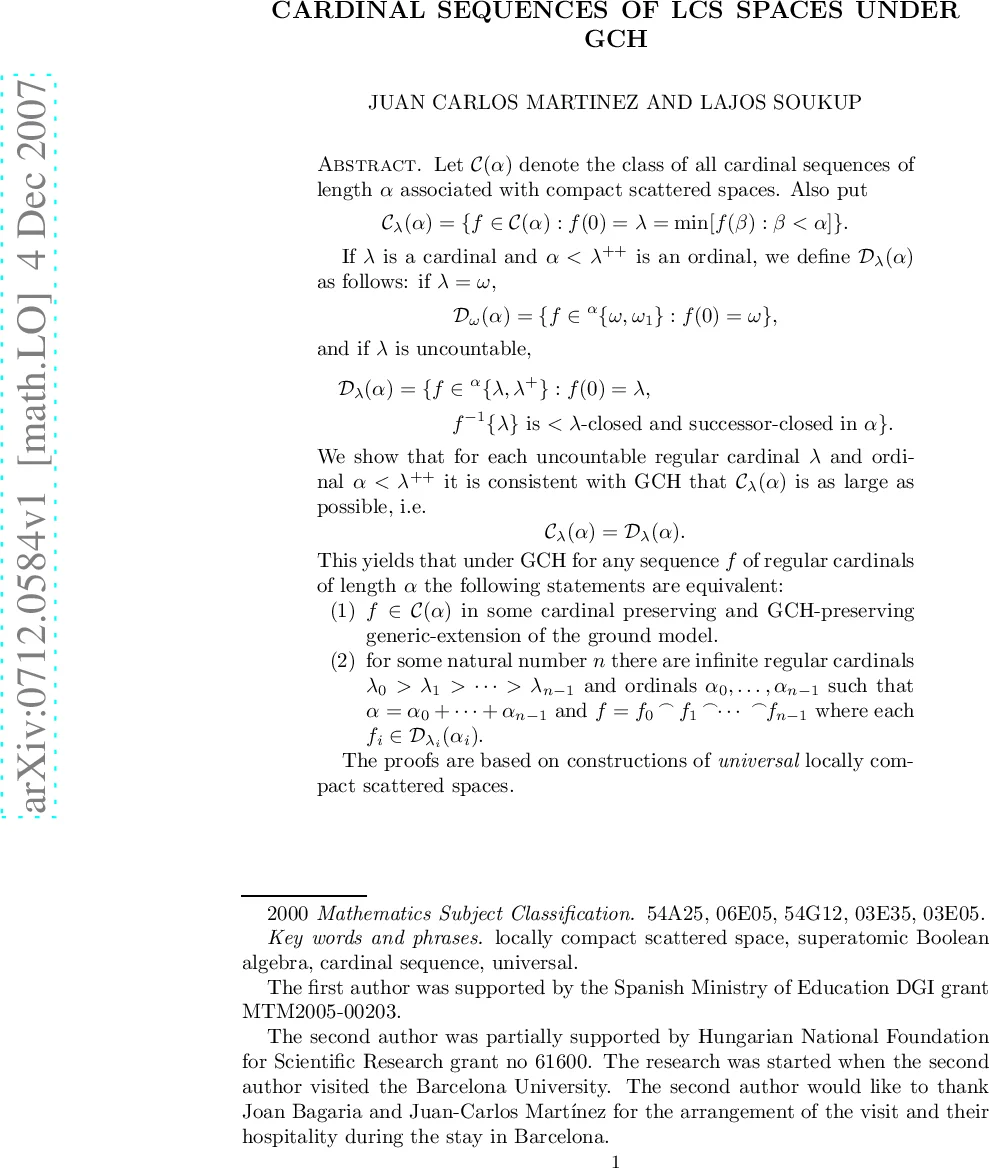
We give full characterization of the sequences of regular cardinals that may arise as cardinal sequences of locally compact scattered spaces under GCH. The proofs are based on constructions of universal locally compact scattered spaces.
💡 Research Summary
The paper investigates the possible cardinal sequences of locally compact scattered (LCS) spaces under the Generalized Continuum Hypothesis (GCH). For an ordinal α, let C(α) denote the class of all sequences of regular cardinals that arise as the sequence of infinite Cantor–Bendixson levels of an LCS space of height α. The subclass C_λ(α) consists of those sequences whose first term is a fixed regular cardinal λ and whose entries never drop below λ. The authors introduce a combinatorial description D_λ(α) of the “largest possible” such sequences: when λ=ω, D_ω(α) contains only functions taking values ω or ω₁ with f(0)=ω; for uncountable λ, D_λ(α) contains functions taking values λ or λ⁺ with f(0)=λ, and the set of indices where the value λ appears must be both < λ‑closed and successor‑closed in α.
The central result (Theorem 1.3) states that for every uncountable regular cardinal λ and every ordinal α<λ⁺⁺, it is consistent with GCH that C_λ(α)=D_λ(α). In other words, under GCH the only restrictions on a cardinal sequence are exactly those encoded in the definition of D_λ(α). The proof proceeds by constructing, for each such λ and α, a λ‑complete, λ⁺‑c.c. forcing notion P of size λ⁺ that adds a C_λ(α)-universal LCS space. A space X is called C_λ(α)-universal if SEQ(X)∈C_λ(α) and every sequence s∈C_λ(α) appears as the cardinal sequence of some open subspace of X. Once such a universal space exists in the ground model, forcing with P preserves GCH (because |P|=λ⁺) and does not add new subsets of λ, yet the generic extension contains open subspaces realizing every function in D_λ(α). Hence the equality of the two classes follows.
To build the universal space the authors introduce the notion of an L_δ^κ‑good space (Definition 1.5). For a regular uncountable κ and δ<κ⁺⁺, an L_δ^κ‑good space X is partitioned into an open part Y with SEQ(Y)=h_κ^δ and, for each ordinal ζ in a certain club L_δ^κ, a further open piece Y_ζ such that SEQ(Y∪Y_ζ)=h_κ^ζ⌢h_{κ⁺}^{δ−ζ}. Proposition 1.7 shows that any L_δ^κ‑good space is C_κ(δ)-universal, and therefore any sequence in D_κ(δ) is realized as the cardinal sequence of an open subspace.
The construction of an L_δ^κ‑good space is carried out via a sophisticated forcing P. The underlying set X is a union of “blocks” indexed by a tree of intervals I_n (defined recursively) and by pairs (ζ,η) where ζ<δ has cofinality κ or κ⁺ and η<κ⁺. Each block carries a “orbit” – a set of ordinals derived from the interval tree – which controls how elements can be ordered and how new points can be inserted without violating the κ‑completeness or the κ⁺‑c.c. Conditions in P consist of a finite set A⊂X, a partial order ≺ on A respecting the projection map π:A→δ, and a function i assigning to each unordered pair {x,y}⊂A a “middle” point (or undefined). The axioms (P1)–(P6) ensure that (i) the order respects the block structure, (ii) comparable points share the same block label, (iii) incomparable but compatible points have their middle point’s projection lying in the intersection of their orbits, and (iv) whenever a point x is below a point y, one can insert a new point z at any intermediate level prescribed by an “isolating” interval Λ.
Lemma 2.4 proves κ‑completeness: any decreasing chain of conditions of length <κ has a lower bound obtained by taking unions of the underlying sets and orders. Lemma 2.5 establishes the κ⁺‑c.c. by a Δ‑system argument using the fact that each condition involves only <κ many blocks and that the orbits are <κ‑closed. Lemma 2.6 shows the density of conditions that add a new point at any prescribed level α below a given point x, which is crucial for ensuring that the generic space has the required height and that the block orbits are sufficiently rich.
With these lemmas, Theorem 1.6 follows: for each δ<κ⁺⁺ there is a κ‑complete, κ⁺‑c.c. forcing P of size κ⁺ such that V^P contains an L_δ^κ‑good space. Consequently, by Proposition 1.7, V^P also contains a C_κ(δ)-universal LCS space, and therefore C_κ(δ)=D_κ(δ).
The paper then derives a full characterization (Theorem 1.8): under GCH, a regular cardinal sequence f of length α appears in some cardinal‑preserving, GCH‑preserving generic extension iff f can be decomposed as a finite concatenation f_0⌢…⌢f_{n−1} where each f_i belongs to D_{λ_i}(α_i) for a strictly decreasing sequence of regular cardinals λ_0>…>λ_{n−1}. The forward direction follows from earlier work (
Comments & Academic Discussion
Loading comments...
Leave a Comment