Some Nonlinear Equations with Double Solutions: Soliton and Chaos
The fundamental characteristics of soliton and chaos in nonlinear equation are completely different. But all nonlinear equations with a soliton solution may derive chaos. While only some equations with a chaos solution have a soliton. The conditions …
Authors: 제시되지 않음 (원고에 저자 정보가 포함되어 있지 않음)
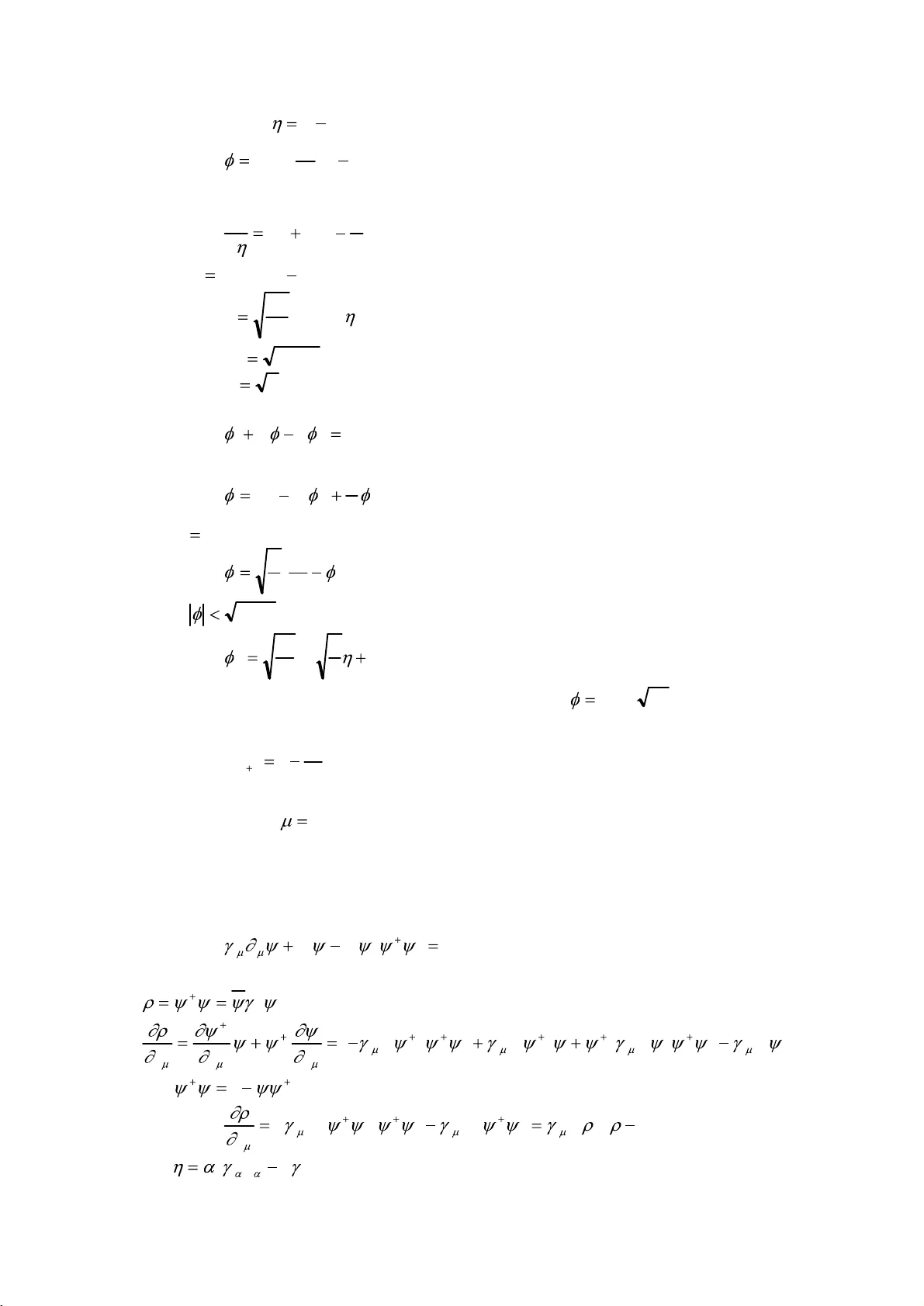
1 Some Nonlinear Equations with Double Solutions : Soliton and Chaos Yi - Fang Chang Department of Physics, Yunnan University, Kunming, 650091, China (E - mail: yifangchang1030@hotmail.com ) Abstract The fundamental characteristics of soliton and chaos in nonlinear equation are completely different. But all nonlinear equations with a soliton solut ion may derive chaos. While only some equations with a chaos solution have a soliton. The conditions of the two solution s are different. When some parameters are certain constants, the soliton is derived; while these parameters vary in a ce rtain region, the b ifurcation-chao s a ppears. It connects a c haotic contro l probably. The dou ble solutions correspond possibly to the w ave -particle duality in quan tum theory, and connect the double solution theory o f the nonlinear wave mechanics. Some no nlinear equations p ossess soliton and c haos, whose new meaning s are discussed brie fly in mathematics, physics and particle theory . Key wo rds: nonlinear equation; soliton; chaos; duality; physical meaning. MSC: 35Q51; 65P20; 34A34; 37D45 1. Introduction It i s wel l known that some nonlinear equ ations have the solito n solutions [1 ], while all nonlinear equatio ns have the chaos solutions. The soliton and chaos possess many different characteristic: a soliton has the same shapes and velocities in a travelling process and even if through a colli sion, it has a definit e trace which is analogous to a cla ssical partic le; t he ch aos is a universal phen omenon for v arious nonlin ear systems, it describ es an order and intrin sic stochastic motion which appea rs to be irregular and confu sed. Therefore, th ey f orm usua lly two remarkable aspects, respectively. But the both relations are being noticed increasingly. Abdullaev summarized th e dynamical chaos of so litons and breathers for the sine -Gordon equ ation, the nonlinear Schrodinger equatio n and the Toda chain, etc[2]. Recently, some di scussed the relations among chaos and the KdV equation [3], the perturbed si ne -Gordon equation [4], the complex Ginzburg -Landau equation [5], which ha ve the soliton so lution. Warbos has even su ggested an idea: chaotic solitons (chaoitons) in the conservative systems [6]. We proved that some equations have soliton solutions and chaos solu tions, and their conditions are different [7] . The possible meanings of th e double solutions are discussed here . 2. From Soliton to Chaos 2.1.The nonlinear Schrodinger equation xx t i k 2 0 , (1) has a soliton solution [1] s e e c h k x u t i u x u t 0 0 2 2 sec [ ( )] exp[ ( )( )] , (2) 2 where the variable x u t e . Let exp[ ( )] i u x u t v e c 2 , (3) the equation (1) may become dv d C av k v [ ] / 2 4 1 2 2 , (4) where a u u u e e c ( / ) ( / ) 2 2 2 . When C=0, the soliton solution is v a k h 2 1 2 sec / . (5) From this let v a k x 2 / sin , the equation is x a x ' sin , (6) which has the chaos solution. For a stable state whose energy is H, if k= - b<0 , the equation will be ' ' H b 3 0 , (7) whose integral is ' ( ) / C H b 2 4 1 2 2 . (8) Let C H b 2 2 / , so ' ( ) b H b 2 2 . (9) When H b / , s H b th b C ( ) 2 0 . (10) It is the simplest soli ton with a bell shape. Usin g a sub st itution Hx b / 2 for Eq. (9), and it become a difference equation X H X n n 1 2 1 2 . (11) It is a known equati on, which has the chaos so lution, and its parameter det ermined th e bifurcation - chaos is H / 2 . Moreover, this equation may include the Higgs equation and the Ginzburg - Landau equation. 2.2.The Dirac equ ation has sho wn the existenc e of a nondegenerate, isolated, zero- energy, c-number solut ion. Its solution s may be monopoles, dyons and solitons [8,9 ,10 ]. Th e nonlinear Dirac equation is m l 0 2 0 ( ) . (12) It is the Heisenbe rg unifie d equ ation [1 1] when m=0 . The probability density 4 , x x x l m l m [ ( ) ] [ ( ) ] 0 2 0 2 and 1 , so x l l l 2 2 1 0 2 0 2 0 2 ( )( ) ( ) ( ) . (13) Let ( ) x u t 0 , the equation is 3 d d l 0 2 2 1 ( ) , (14) whose solution is 1 2 0 2 exp( ) l c . (15) It is analogo us to a soli ton since ( ) ( ) 2 0 1 e c and 1 2 / ( ) . Using a substitution ( ) / 2 8 0 2 l x for E q. (14), then the corresponding difference equation is X l X n n 1 0 4 2 1 1 4 , (16) whi ch has the chaos solution and the parameter l 0 4 4 / . 2.3.For the Korteweg - de Vries equation t x xxx 0 , (17) let x ut , using two order integrals, then ' ( ) / 1 3 3 2 0 1 1 2 u C C . (18) For the soliton solution, the integral constants should be C C 0 1 0 , so E q. (18) is ' ( ) / u 1 3 1 2 , (19) whose soliton solution is 3 2 2 u h u sec ( ) . (20) Using a substitution 3 1 4 2 u u x [ ( / )( ) ] / , the difference equation is X uX n n 1 2 1 1 4 . (21) In a 0 8 u region, the values of bifur cation- chaos are u= 3,5,..., 5.6046207... 2.4.For the cubic Klein - Gordon equation m a 2 3 0 , (22) let ( ) / x ut u 1 2 , so d d a m C ( ) / 1 2 4 2 2 1 2 , (23) If C=0, a>0 , 2 0 a m h m C sec ( ) . (24) It is the simplest soliton with a kink shape. Moreover, d d m a m ( ) / 1 2 2 2 1 2 (25) is the same with E q. (4), so it has the chaos solution. Further, all nonlinear equ ations have chaos. 3. From Chaos to Soliton 3.1. The simplest difference equation with the chaos solution is X X n n 1 2 1 . (26) It may correspond to a differential equation of first order 4 x x ' 1 2 , (27) and a partial differential equation of second order xx tt a b 3 0 . (28) It becomes to an ordinary differential equation by a way o n solit on solu tion, i.e., Eq. (7). When x 1 / for E q. (26), x th C 1 ( ) (29) is namely a soliton solution. A bifurcation -chaos region 2 0 1 1 , [ , ] x corresponds to 1 2 1 2 0 7071 / / . ... For sin gle stable sol ution 0.75 0 0 ,i.e., 0 1 2 / 1.154, so the conditio n on x 1 2 / is satisfied necessarily in the region, the soliton can exist. While for two-branch region , 1.2 5 1 0.75, i.e., 1.154 1 1 2 / 0.894; for a region from four -braches to chaos, 1.401 152 1.25, i.e. , 0.894 2 / 1 0.845. Since x 1 , the necessary conditi on in which the soliton appears is 1 , it c orresponds to the reg ion of single solution and a part of two - branch region. For the rest x 1 2 / does not hol d generally. 3.2.The logistic equation dF dt F E F ( ) (30) corresponds to a difference e quation X E X n n 1 2 2 2 1 1 4 , (31) whose p arameter is ( ) / E 2 4 . In the 0 2 regi on, two branches appear for E 3 , four branches appear for E 5 , etc., there is the chaos for E ( . ) / 5 6046207 1 2 2.37. The equation (30) has the solution F E C Et 1 exp( ) . (32) When t 0 , Eq. (32) is analogous t o a soliton since F E C / ( ) 1 for t=0 and F E for t . It shows that the state will reach to stable at last as time increases continuously. 3.3.The difference equation with a chaos solution X X n n 1 sin( ) (33) correspon ds to a partial differential equation of second order xx tt 1 2 2 2 sin( ) , (34) namely, the sine - Gordon equation. It has the soliton solution 2 1 1 2 tg x ut u [exp( )] . (35 ) Only some chaos e quations have the soliton solutions. 4.Discussion Further, we discu ss some possible m eanings of the double solutions possesse d by these equations briefly. In the m athematical aspect, when some parameters are a certai n constant, the soliton is derived; while these parameters vary in a ce rtain region, the bifurcation-chao s appears. Therefore, 5 the former corresponds to a stable state, and the latter is a changeable process. In the physical aspect, Szebehely and McKenzie d iscussed that the three-body p roblem in gravitational field po ssesses chaot ic beha viors [1 2]. We proved that the gravi tational wave is a type of nonlinear wave, and should be different to electromagnetic wave and have new characteristics, for example, as solitons [1 3]. Perhaps, the doubl e sol utions are two d ifferent states. These parameters are the order parameters. These st ates often depen d on the integral constan ts, the boundary conditions and the ini tial condition s. It exp lains again that the solutio ns of th e nonlinear equations depend on the initial values sensitively. It c onnects the chaos control by a method of parameter -control. When we control the order pa rameter in the nonlin ear system, chaos appear, disap pear, synchroniz e [1 4], even a dete rminational soliton is produced , for differ ent parameteric values. For example, th e soliton can be derived in a propagation o f shallow water waves, bu t if the flow rate reaches a certain value, there will form the tu rbulence. Moreove r, th e soliton solution corresponds to part icle even it may be a deg enerate doublet with Fermi number ( / ) 1 2 [7,8]. The chaos solution seems to correspond to the field, in cluding the stoc hastic field. It will probably connect the double solution theory of the de Broglie-Bohm nonline ar wave mechanics. In this case the wave-partic le d uality is a wave-pa rticle synthesis, where the particle is described by the mobile singularity of soliton of the wave equation [1 5 ]. The doubl e solution s show a simultaneo us existence on determinism and probabilism quantitatively from an aspect in some nonlinear systems. The solit on equ ations a nd the chaos equations have t he wid ely app lied domains, in which above double solutions will show many meaning results or a good deal of enlightenment. References 1.A.C.Scott,et al., Proc. of IEEE.61,1443(1973). 2.F.Kh.Abdullaev, Phys.Rep.179,1(1989). 3.Yu.N.Zaiko, Sov.Tech.Phys.Lett.18,787(1992). 4.G.Filatrella,et al., Phys.Lett.A178,81(1993). 5.S.Popp,et al., Phys.Rev.Lett.70,3880(1993). 6.P.J.Werbos, Chaos, Soliton, Fractals,3,321(1993). 7.Yi - Fang Chang, Journal of Yunnan University. 26,338(2004). 8. R.Jackiw and C.Rebbi, Phys.Rev.D13,3398(1976). 9 .R.Jackiw and J.R.Schrieffer, Nucl.Phys.B190,253(1981). 10 .H.Grosse, Phys.Rep.134,297(1986). 11 .W.Heisenberg, Rev.Mod.Phys.29,269(1957). 12. V.Sze behely & R.McKenzie, Celestial Mech. 23,131(1981). 13.Yi- Fang Chang, Apeiron, 3,30(1996). 14. C.K.Duan, S.S.Yang, Wanli Min, et al., Chaos,Soliton,Fractals. 9,921(1998). 15. L.de Broglie, Non - linear Wave Mechanics. Elsevier, 1960.
Original Paper
Loading high-quality paper...
Comments & Academic Discussion
Loading comments...
Leave a Comment