Translating OWL and Semantic Web Rules into Prolog: Moving Toward Description Logic Programs
To appear in Theory and Practice of Logic Programming (TPLP), 2008. We are researching the interaction between the rule and the ontology layers of the Semantic Web, by comparing two options: 1) using OWL and its rule extension SWRL to develop an in…
Authors: Ken Samuel, Leo Obrst, Suzette Stoutenberg
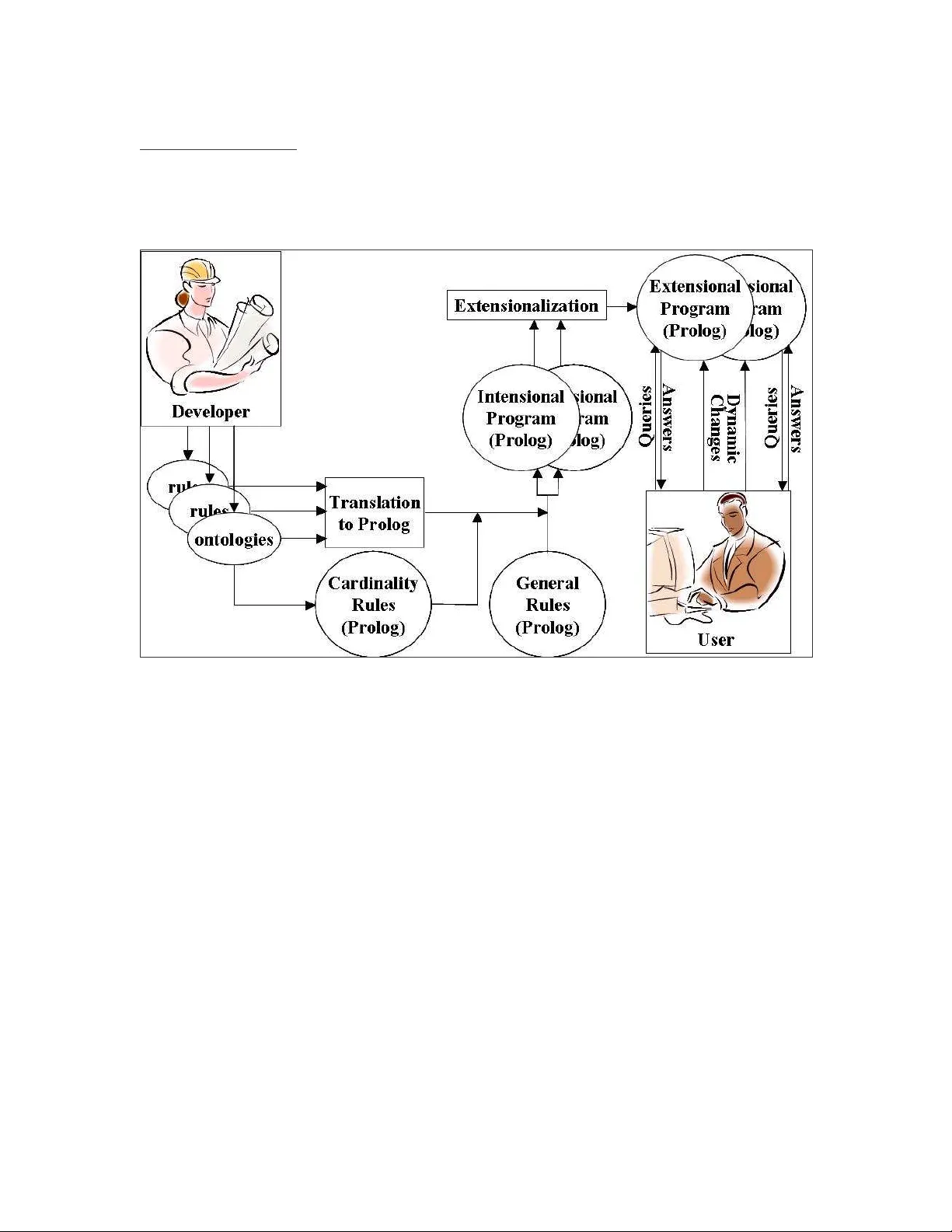
1 Translati ng OW L and Sema ntic W eb Rules int o Prolog: Mo v ing T oward De scriptio n Logic P rograms Ken Sa muel 1 , Le o Obrst 1 , Suzette S toutenbe rg 2 , Karen Fox 2 , Pau l Frank lin 2 , Adria n John so n 2 , Ken La ske y 1 , Debora h Nichols 1 , Ste v e Lo pez 2 , Jaso n Pe terso n 2 {sa muel, l obrs t, s uzette, kfo x, p f rank lin, abjohn so n, klaskey, d lnicho ls, slopez, jaso np}@mitre.org The MITRE Co rpora tion 1 7525 Co lshi re Drive , McLe an, VA 2 2102 -7508 2 1155 A cade m y Par k Lo op, Co l orado Spr i ngs, C O 80910-37 16 Submi tted 12 May 2006; revised 24 Sep 200 7; acc e pted 18 Octo ber 2007 Abstract . We are res earc hing the interac tio n betwe en the rule and the o ntolo gy la y er s of the Sema ntic W eb, by c o mparing two options: 1) usi ng OWL a nd i ts rule extension SWR L to develop an int eg rated onto logy /rul e language, and 2) layering rules on t op of an onto l ogy with Ru leML and OWL . To ward thi s end, we a re dev e loping the SWO RI ER sy stem, whic h enabl es effic ient au t o mated rea sonin g o n onto l ogies and rules, by translat ing a ll o f them into P rolo g and adding a se t o f g eneral rules t hat proper ly capture t he seman t ics of OW L . We have also enab l ed the user to make dy namic c ha ng es on the fly , a t run time. Thi s work addresses sev eral of the co ncerns expres sed in previous wo rk, such as neg at ion , c om plementary classes, disjunc tiv e head s, and car dinality , and it d iscusses altern ative appro a ches fo r dealing with inco nsi stencie s in the know ledg e base. I n additio n, fo r efficienc y , we i mp l eme nted t echni que s called extens ionaliz ation, av oiding rean aly s is, and co de minimiz ation. Keywo rds: S ema ntic W eb, lo gic prog r amming , kno wledge co m pilatio n, o ntolo g ies, rules 1. In troduction The we dding of S em a ntic Web t echnology a nd L o gic Pr og r amming h a s cr eated a new te chnical par adigm called de scription log ic programming . Recen t ly, re se ar che r s h a ve b egun focusing on the q u estion of how to utilize logi ca l rule s fr om a pa rtic ular dom a i n in order to im pr ove t he S em a n tic Web (Bechhofer et al. 2004; Hirtle et al. 2004; Horrocks et al . 2004). It is well established t hat the knowle dge developme nt language and t he knowledge runtime languag e m a y not be the sa me , s o the f o r me r should b e t ra n sformed to t he latte r fo r gre at er ef fi ciency a t run time (Cadoli & Donini 1997; D ar w iche & Mar q uis 2001). We have develo p ed SWORIER (S em a ntic Web O ntologie s a nd Rules for I ntero p e r abi li t y with Efficient R easoni ng), wh ich is a syste m t hat use s Logic P rog ra mming to r e ason a bout and answe r queries about ontolog ies and r ule s (Grosof et al. 2003; Hitz ler et al. 2005; V olz et al. 2003). OWL (We b On tol o gy Language) ontologie s ( Bechho fer et al. 2004), a long with r ule s in the S em a n tic Web R ule Language (SWRL) (Horrocks et al. 2004) or the R ul e Mar kup La n guage (Rule ML) (Hirtle et al. 2004) ar e a ll t ransl a ted into Pr olog using XS LTs (Exten s ible Style s heet Lang ua ge Transfo r m a tions). I n a ddition , we h a ve w ritt e n a se t of General Rules in Prolog in orde r to enforce t he s eman t ic s of OWL primitives. T o do this, i t w as nece ssar y to addr e ss a num b er of i ssu e s r el at ed t o negation, t he open wo r ld a ssum ption, c ompleme ntar y a nd disjoint cl asses, disjunctive con clusions, enume r ated classes, eq ui v alent individuals, e r ror me ss age s, e xist en tial quan tification , car d inality constraints, d uplicate facts, cy clical hie r ar ch i e s , and anonym ous c lasse s. R ecen t work has suggest ed that some of these pr o b lem s a re unsolvable (Volz et al. 2003), but w e b elieve we h a ve found s o lution s f or the m. 2 We h ave imposed str ong efficiency req u irem ents, dem a nding t hat que r ie s a re answe r e d in a matte r of s econds. And, unlike pr evious wo rk, SWORIER can assimil at e dynamic changes that ar e provided at r un time, in cluding a dding new facts, remov ing facts, a n d s wapping r ule s ets, which als o m ust be done in s econd s. T o achieve this level o f e fficiency, we establi s hed t hree te chniques: e xt en si on alization, a vo iding r e analysis, a n d code min imization. This paper is or gani zed as follow s : First, Sec t ion 2 pr ovide s t he r e ader with bac kgro u nd info r m ation. Then, Section 3 descri b e s SWORIER's sy st em de s ign. Sec t ion 4 add resses th e ch allenges f ound in pr evio us r esearch. Sec t ion 5 adds a capabili ty t o handle dyna mi c changes. Sec t ion 6 a n alyz e s and a ddre ss e s the e fficien cy of t he s ystem , and then S ection 7 di scuss e s rel a t ed work. Finally, Sec t ion 8 summ a riz e s the paper, offe rs concl usions, a n d discusses future wo rk. 2. Back gro und We are i n vestigating the inte ra ction between rules and ontologies i n t he Sem a ntic Web to de t e r mine how a sta n dard l anguage should be st e x press them ( Stoutenburg e t al. 2006). In particul a r, to determ ine whe t her an ontology and the c orresponding r ules should be int eg r at ed or laye r ed , we s pecified , tr ansl ated, and exe cuted information in: 1) S WRL, which i n t eg ra te s OWL with rules (Horr o ck s et al. 2004), and 2 ) RuleML layered on top of OWL. T he ontologie s a nd instance s we r e developed in t he Cerebra OWL on t ology developmen t environme nt, 1 t he S WRL and Rule ML rules were cr eated in a te xt edi t o r, and AMZI! (2006) P rolog w a s used as the infe r en ce engine . W e tr anslated t he con structs fo r both the int eg r at e d and laye r ed a pproache s into Pr o log code, g auging e ac h approach in t e r m s o f e ff e cti vene ss, e fficien cy, di fficulty, restrictivene ss, transl ata bil ity, and sui tability fo r de pl oyme nt in an ope ra tion al s e tting. Figu re 1. A Mil itary T ask 1 http://cereb ra.com/inde x.h tml 3 Our initi al e xper ime nts wer e s e t in a mili tar y comm a nd a nd con t rol dom a in wi t h a supply convoy moving t hrough a n unsecured area. Figure 1 pr e s en t s an exam p le situat ion , where a convoy is moving north al ong t he pr im a r y route, appr oach ing t he location whe r e intelligence has repo r t ed a n enemy sni per is sta tioned . New information can becom e available at a ny time , suc h a s the discovery of a the a t e r o bject or the beginning of a sand st or m . The s y st em h as rules that trigge r ale r ts an d r ecomm end a t ions to r e p o rt to the c on voy comm a nde r. For exam p le, in the s ituation shown in Figur e 1, a n enem y u nit is within the c onv oy's region of inte r est (the c ircle surr ound ing the c onvoy ), so the s ystem m i gh t t ell the convoy c omm a nde r, "ALERT: In t ellige nce r e port o f enem y sniper in the vicini t y." and "RECOMMENDA T ION: T ake alt e rnate r oute ." Most know ledge representation language s a nd knowledge -based syst em s utilize a restricte d ve rsi on of First Order Logic (FOL). FOL, howeve r , is s emi- decidable . It is dec idable in that if a t heo r em is logically en tailed by a FOL theo r y, a pr o of will even tual ly b e fo und, but it is unde cidable in t hat if a t heo r em is not logically entailed, a pr oo f of t hat m a y neve r b e f ound. But decid a bility he r e does not mea n t ra ctabil ity , a nd in gene ra l even inferenc e i n t he simple r propo sitional ca lcul us is NP -com p lete (Ca d oli et al. 1999), i.e . , usua ll y u nable t o b e pr oce ss ed in le ss than e xp onenti al time. Figu re 2. System Des ign To m ake inference tr acta ble , vario us appr o ache s i n t he field of know ledge compilation , which involve s c onve rting a knowledge bas e into a more concise or tr actable r e presen tati on, have been devised (Cadoli & Donini 1997; Darw iche & Mar q uis 2001). On e approach is to syntacti cally restric t the know ledge r e presen tat ion l a nguage , sacr if icing e xpressivene ss fo r tractabili t y and efficiency (de Bruijn et al. 2004). Logi c pr ogramm ing (LP), de scription logi c (DL), a nd de scr iption logic pr ogra mm i ng (an eme r ging f ield t hat wed s DL a nd LP ) t ake thi s approach (Ait-Kaci 1991; Grosof et al. 2003; Hi tzle r et al . 200 5; V a n R oy 1990; V olz et al. 2003). F o r e xa m pl e , OWL is a DL that de fines a tra ctable subs e t of F irst-Or d e r Logic (B echhofe r et al. 20 04; Daco nta et al. 2003) . A n a lternative i s to employ t heory a pproxim a tion (Kaut z & 4 Selm a n 1994; Kautz & S e lm a n 1991) , i n which the querie s th a t are logi cally en ta iled by a knowledge base (a “t heo ry”) can b e c orre ctly a n s we r ed , while , for the rest o f t he quer ie s, t he respon s e i s “u nknow n”. Some researche rs preproce ss the knowledge in v ar io us w a ys t o rel ax ei t he r the c om p letene ss o r the s oundne ss r eq u ir eme nts, pe r haps by gene rat ing c e rta in defaul t concl us ions (Cadoli & Don ini 1997). Anothe r p o ssible optimiz ation is to e xt en s ionalize t he rul e base, as di scussed in Se ction 6.1. 3. System Desig n Fig ur e 2 s hows t he s yste m design of S WORIER. A de velope r cr e ates ontologies, knowledge bas e s, and / o r rules in the for m a li s m(s) of OWL, Rule ML, and/ o r SWRL. Ex ample s of OWL, Rule ML, a nd S WRL are in Ta ble 1a , 1b, a nd . 1c, respec ti vely . T hi s i nfo r m ation is transl ated into Pr o log code using XS LTs, resul t ing i n the code s hown in T able 2a, 2b, and 2c. (We include wo rds like "is" a nd " of" in our pr e dic ate na me s to avoid am b igui t y. Otherwi s e , there is the danger of misin t e r pr e t ing t he r ole s of the a rguments. For exam p le, member(X, Y ) co ul d be interpreted a s "X is a mem b er of Y " or "X has a me mbe r, Y", while isme mberof( X, Y) is mo r e clear. ) Final ly, a s e t of General Rules (defined in S e ction 3. 2) is app ended t o t he XSLT output to fo r m a com p le t e Pr olog prog ra m , which can b e que ri ed by the user . Tabl e 1. Exam ples o f OWL , Rul eML, and S WRL a. b. redFo r ceT h eat erOb ject < /op r> X redFo r ceT h eat erOb ject < /op r> X c. < rule ml:v ar>T < rule ml:v ar>G < rule ml:v ar>G < rule ml:v ar>S < rule ml:v ar>T < rule ml:v ar>S 5 3.1. Translating F acts SWORIER use s a syntax diffe r en t fr om t h at t y p ic ally found in previous work . F o r e xa m p le, Volz et al. (2003) would pr od uce the tra nsl ation of T a ble 2 d, in st e a d of t he tra nsl a tion in T able 2a. But we note that the s yntax used by Volz et al. (2003) ca nno t r epre s en t "eve r y class that smith is a me mbe r o f " with X (smith) , because m os t P rolog im p lem entations disallow predi ca t e variables. I n c on tra st, by m aking the class n a me s and pro perty na me s b e ar gumen ts instead of pr edi cate s, S WORIER has the f lexibili ty to gene r alize on t hem with, for e xa m ple, ismemberof(s mith, X) . Tabl e 2. Tran sl ati o n s a. ismemb erof(s mith, sniper) . haspro pertyw ith(sm ith, ha sComba tInten t, fri endlyIn tent). b. ismemb erof(X , redF orceThe aterOb ject) :- isMem berOf( X, red ForceTh eaterO bject) . c. ismemb erof(s mith, sniper) . haspro pertyw ith(T, hasSpe ed, S) :- hasPr operty With(T , isDes cribed By, G) , hasPr operty With(G , hasSp eedObs ervati on, S) . d. sniper (smith ). hasCom batInt ent(sm ith, fr iendly Intent ). 3.2. Gene r al Rule s The Gene ra l R ules ar e m ea n t t o c aptur e the s em a n t ics o f the pri mi t ives in OWL. For e xa m p le, t he rule s in T able 3a enforce t he tr ansitivi ty of subclass. No t e th a t the r e a re t wo dif fer en t predi cat e s : iss ubclassof and isSubClassOf . One predicat e wo uld b e insuffi cient, bec aus e Table 3b has lef t r e cursion, r e sulting in an infini te loo p. Tabl e 3. Th e Tran s itive Clos u re o f S ub class a. isSubC lassOf (C, D) :- iss ubclas sof(C, D). isSubC lassOf (C, E) :- iss ubclas sof(C, D), i sSubCla ssOf(D , E). b. isSubC lassOf (C, E) :- isS ubClas sOf(C, D), i sSubCla ssOf(D , E). Wi t h two differen t subclass pr e dicat e s, some q u estion s m ust be a nswe r ed . Should t he use r sub mi t queries with iss ubcla ssof or isSubC lassOf ? Al so, which for m s hould th e input from t he XSLTs be? If the input us ed is SubClas sOf , t h en neither of t he r ules in T able 3a wo u ld eve r s ucceed , thus the in put m ust use i ssubclassof . O n the othe r h a nd, querie s should us e is SubClassOf be cause the iss ubclassof se t of facts is inc om p lete none of the subclass relation s hips t hat ar e derived b y tra nsi ti v ity ar e ca ptured b y issubclassof . Note that the is subclassof set of facts is a subse t of t he is SubCl assOf set of facts, be caus e of the first r ule in Ta ble 3a , w hich is called the conversion rule for subcl a ss. For consi st en cy, we creat ed two cas e s of each predicat e , a ll -lowe r cas e a nd ca mel cas e . 2 Also, e ac h pr edi cat e has a co nve rsion r ule . T he XSLT f acts alw a y s use t he al l-lowe r case f orm s of predi ca t e s , while t he us er que ries a re a lway s in ca melcas e . (Howeve r , the develo per decides how to spell the na me s of c on stants, such as hasSpee d in T a ble 2c.) And any rules, othe r tha n rec ursi ve rul e s and c onve rsion rule s, follow the convention: 2 A ny predicates t ha t ar e n ot used fo r input or outpu t ar e written in an unde r sco re case, suc h a s is_sub _class _of_bu t_not_e qual_t o . Also , for some pr edicates, th e r e ar e two sources of recursio n, r equiri n g thr ee case s of t he predicate. A n examp le of th is is the membe r r elation, f or w h ic h th e three c ases are ismem berof , is_membe r_of , a n d isMe mberOf . 6 All predicates in the body of the rule are camelcase, and the predicate in its head is all-low ercase . A s a n example , s ee t he s econd r ule in T able 2c. Using ca mel cas e pr edi cates in the rule's body guarantee s t hat the r ule is tr igge r ed b y eve r y thing t hat can b e de r ived f o r that pr edic ate in eithe r case . And usi n g t he a ll-lowe rcas e pr edi cat e f o r t he rule's head insures that any facts gene r at ed b y the r ule will hold f o r both case s of the predicat e . 3.3. Transl ating Rul e s Some of t he in puts pr ovide d t o SWORIER are RuleML or S WRL rule s that we r e cr eated by the develo p e r . It is not difficul t t o tra nsl a te these r ule s into Pr o log, b e ca use t hey ar e w ritten in Ho rn Clause f o r m . H oweve r , we cannot con tr ol w hic h rules a re pr ovide d no r h ow t hey ar e w ritt en . Pr oblem s ca n eme r ge , suc h as the infini t e loop in T able 2b, whi ch was gene r at ed b y t he RuleML r ule in T able 1b. I n a ddi t ion, the o r der in which r ules a re li st ed and the order of t he te r m s in the r ules' bodie s can have significant effe cts , m uc h li ke orde r of join eval uati o n in database language s such a s SQL. Another conce r n is that the input c ould incl u de r ules t hat prod uce duplicate c opie s of a fa ct. (Se e S e ction 4.9.) And the rules migh t b e inefficien t. The r e a re ways t o c orrec t o r a t le ast mitig at e s ome of these pr oblem s. F or exa m p le, w e co ul d appl y tr ansfo r m a tions as for logic querie s in t he form of rewrite rules such a s “ magic s e ts ” optim ization (Ca doli et al. 1999; Sippu & Soi s alon-Soininen 1996) . B ut c urr e ntly, we m us t im p ose st rong r e quiremen ts on t he deve lope r, who m a y need t o b e very f a mili a r with Pr olog prog ra mm i ng t echniq ues, the logical cons eq u ence s o f t he facts in t he ont o logies, and the Gene ra l Rules. 4. Chal l en ges We ar e following t he gro undbreaking work of Volz et al. (2003), who we r e a mon g t h e fi rst rese ar che rs to i nve stigat e OWL-t o -Prolog tr ansl ation. T hey discussed a n u m b e r of pr oblems that the y encounte red in t he c ours e of their work . N ow we a re pr o p o sing s ol ut ions for seve r al of the s e problem s, some of which ar e curr e n tly implemented in SWORIER. 4.1. Neg ati o n Neg a tion in Prolog is not the sa me as neg ation in OWL, Rule ML, and SWRL. Prolog has finite-failure negation , whi c h me a n s t hat not(T) is t rue if it is no t p ossible to prove t hat T is true. Alte rnatively, with the logi cal negation of OWL, RuleML, and SWRL, no t(T) is true if it can b e proven t hat T is false . (I n both cas e s, no t(T) is false if T ca n be proven tr ue .) I n order to close t his gap, we h ave cr e ated a Pr olog pr edi cat e called lo gicNot , and w e a re develo ping r ules t o capture t he s em a ntics of logical neg ati on . T he l ogicNot pr e dicate ta kes one a rgumen t , which must be a term : logicNot( ) . Three exa m ples ar e pr e s ented in T able 4. Tabl e 4. logi cNot logicN ot(isM emberO f(jones , snip er)). logicN ot(iss ubclas sof(the aterOb ject, convoy )). logicN ot(log icNot( isclass (theat erObje ct))). 7 4.2. The Ope n World A ss umption In Prol og, the closed world assumption holds, which me a ns t hat a nything t h at ca nno t b e proven true m ust b e fals e . Al t e r native ly, OWL has an open w orld ass umption , me a ning that a te r m is fa lse only if it can b e pr oven fals e . S o, in Pr olog, a term can only b e true or false, whil e OWL also allow s for the p ossi b ility t hat its truth value ca nnot be determined from t he available info r m ation. Thi s distinc ti on is addr e ss e d wi t h the l ogicNot predi cat e, which w as presen t ed in Sec t ion 4.1. If the us er wants to a sk a true / false question, Q, then it is necessary t o s ubmi t tw o que ries t o S WORIER: Q and lo gicNot(Q) . Table 5 s how s how the s y st em' s r e spons e s to t he s e que ries should be inte rpr e t ed . Tabl e 5. A Tru e/Fal se Q u ery ?- Q. ?- logic Not(Q) . Is Q true ? yes no yes no yes no no no unknow n yes yes err or 4.3. Comple men tar y and Disjoint Classes Volz e t al. (2003) claime d t hat "OWL f e atur e s t he c o mplemen tOf pr im itive , whi c h canno t b e i mpleme nt ed in H orn L ogic s due t o the fact, that th e re m ay b e no negation in th e he a d..." With t he introd u ction o f t he log icNot pre dicate, this is no longe r a probl em. We ca n handle the c ompleme ntar y cl asses as well a s the disjoint classe s with the rules in Table 6. Tabl e 6. Com plem entary and Disj o int Cla sses disjoi ntClas ses(C, D) :- comple mentar yClass es(C, D ). logicN ot(isM emberO f(I, C) ) :- disjo intCla sses(C , D), i s_memb er_of( I, D). isMemb erOf(I , C) : - compl ementa ryClas ses(C, D), lo gicNot (is_me mber_of (I, D) ). 4.4. Multiple Terms in the Head One no t able lim itat ion of H orn rules is t h at t he he ad ( concl us ion) of a r ule cannot have mo r e than one t e r m . T hi s m ea n s, i f t he c oncl usion of a r ule i s t he c onjunc tion of t er m s, i t i s nece ssar y to cr eate m u ltiple rules. For e xa m p le, the logic al sta teme nt i n T able 7a r eq u ires t wo rule s in Pr o log, as shown in Ta ble 7b. But for the logical rul e i n Ta ble 7c, "... no Hor n cl aus e can be sta ted, since di s ju n ction in the head wo uld occ ur. .." (Volz e t al, 2003). We propo s e t o add r e ss this pr oble m b y cr eating a new Pr o log pr edic at e that can be put in the head. S o Ta ble 7c can then b e tr ansl ated into Table 7 d b y using this new or pr e dic at e, whi ch takes two argum ents, each o f whi ch must be a ter m . Of co urs e , we must supplemen t G ene ra l Rul es in orde r to prope r ly establish t he corr ect sem a ntics of disj unction. Some e xa m pl es of t h ose rul e s ar e shown in Ta ble 7 e. No t e that the last rule requir e s the lo gicNot pre dicat e . Un fortunately, t he hea d of t he last r ule in Ta ble 7 e is a variable , which is not a llowe d in Pr o log . Howeve r , a lth ough it m ay not b e p ossible t o solve this problem in gene r al, because w e ar e lim iting o ur a naly s is to OWL, the r e ar e a fi ni t e number of pr edi cates wi t h wh ich that variable can be instantiated , and t his s e t of pr edicate s doe s not req u ire a ny knowledge of the par ticul a r ontologie s or rule s that are pr ovide d b y the develope r . So we can cr eate one r ule for e ac h predi ca t e , a nd some e xa m pl e s ar e pr e sen t ed in Ta ble 7f . 8 Tabl e 7. Con j uncti on and Disjun ct ion in t h e H ead a. IF I is in C, THEN I is an indiv idual , AND C is a class. b. isindi vidual (I) :- isMemb erOf(I , C). isclas s(C) : - isMe mberOf( I, C). c. IF C and D are co mpleme n tary classe s, AND I i s an indiv idual, TH EN I is in C, OR I is in D . d. or(ism embero f(I, C ), isme mberof (I, D) ):- compl ementa ryClas ses(C, D), is Indivi dual(I ). e. or(P, Q) :- P. or(P, Q) :- or(Q, P). or(or( P, Q), R) :- or(P, or(Q, R)). Q :- o r(P, Q ), log icNot(P ). f . isMemb erOf(I , C) : - or(P, isMem berOf( I, C)) , logic Not(P) . isSubC lassOf (I, C) :- or( P, isS ubClas sOf(I, C)), l ogicNo t(P). logicN ot(Q) :- or( P, logi cNot(T )), lo gicNot (Q). or(Q, R) :- or(P, or(Q, R )), lo gicNot (P). 4.5.En u me ra ted Classe s "The owl :oneO f prim itive can be partially supported." ( Volz e t al, 2003) Thi s primi t ive, which corresponds to our P rol og pr e dic at e, isset , defines a class, C, exte nsionally b y provid ing a set o f all and only the individuals in the class, a 0 , ..., a n . For e xa mple , Ta ble 8a decl a res that there ar e e xactly three me mbers of the class c ombat Intent : friendlyInte nt , hostileInt ent , and u nkno w nIntent . Tabl e 8. Enum er ated Cla ss a. isset( combat Intent , [frie ndlyIn tent, hostil eIntent , unkn ownInt ent]). b. isMemb erOf(a i , C). for a ll i c. or(=(I , frie ndlyIn tent), or( =(I, h ostile Intent) , =(I, unkno wnInte nt))) : - isMe mberOf (I, com batInt ent). Volz et al. (2003) observed t hat Ho r n L ogic r ules could b e develo p ed th at would draw the conclusions in T a ble 8b. But the y als o sa y that, "to support the othe r d ir e ct ion ... whi ch s tates that eve r y i n sta n ce o f C is one of t he list ed a i . .. r e quir e s a disjunction in t he consequent of th e rule , whi ch ca n not b e provided b y .. . Ho rn Clauses." (Vol z et al. 2003) Howeve r, wi th t he o r predi ca t e , i n troduced in S ection 4.4, this should no longer be a pr oble m . T able 8c pr e s en ts th e rule that capt u res the s em a n tics of the e xa m p le in Ta ble 8a. 4.6.Err or Messag e s It is desirable for S WORIER t o t est the data fo r consi st en cy. For this purpose, we foll ow Volz et al. (2003) by impleme nting rul e s t o ca tch inconsi st encie s, suc h as tho s e in T able 9. (In orde r to c he ck f or errors, the develo per m ust submi t the query: er ror(X).) In e ac h of the s e e xa m p les, the inconsi st ency i s a dd ressed by sending a n e r ror me ssa ge t o t he develope r. H oweve r, the r e ar e ot he r w ays to handle most inconsistencies. Examples w ill b e pr esen t ed i n S e cti on s 4.7 and 4.8. Tabl e 9. Error Me ssage s error( ['A te rm can not be both t rue an d fals e.', P] ) :- l ogicNo t(P), P . error( ['The empty class c annot contai n anyt hing.', I]) : - isM emberOf (I, no thing) . 4.7. Existen tial Quan t ific ation 9 Pr o log impli citly assume s t hat a ll variable s in any r ule ar e u nive rsa lly q uantifi ed . Howeve r, OWL c an sp ecify existenti a lly quantified va riable s . F or e xa m ple , t he OWL code i n Table 10a s tates that eve ry t heater obje ct is de scr ibed by a t least one observation a rt if act. T here ar e three w a ys to enfo rc e this r e str ic t ion . The simplest is to r epo rt a n error me ssa ge if i t is viol a t ed , a s in Section 4. 6. Volz et al . (2003) us es t he techniq u e of s kolem i zation. And t he t hird approach is to add new facts to the knowledge ba se , whi ch is disc uss ed in S e ction 4.8. Skolem i zation s olve s t he probl em o f a vi olated exist enti al restriction b y le tting a sp ecifi c te r m r epre s ent t he missing individual. This t erm m ust be una m b iguous, so its a rgumen t variables ar e se lected t o m a ke it distin ct. Fo r e xa m p le, give n the r e s triction in Table 10a , if ther e is a the ater obj e ct, I, t h at is no t de scribed b y a ny obse rvation artifacts, then the t er m unnamedIndiv idual(I, describ edBy, observationArtifa ct) i s used to repre sent the r equi r ed obs e r vation ar tifact. In gene ra l, the two r ule s i n Ta ble 10b a re applied in orde r to insure th at thi s t e r m sa tisfie s the e xistential restr ic tion . Tabl e 10. An Exi ste ntial Constraint a. b. haspro pertyw ith(I, P, unn amedIn dividu al(I, P, C2)) :- hasso mevalu esofpr opertyf rom(C1 , P, C 2), is MemberO f(I, C 1). ismemb erof(u nnamed Individ ual(I, P, C2 ), C2) :- hasso mevalu esofpr opertyf rom(C1 , P, C 2), is MemberO f(I, C 1). 4.8. Car d in a lity In OWL, the r e are th r ee cardinality pri mi ti ve s: ( 1) minCardi nality , ( 2) max- Cardinality , and ( 3) cardinality . Each of t hese primitive s ta ke s t hree ar gume nts: a cl ass, a prope r ty, a nd a num b er. The pr imi t i ve s ' me a nings a re t hat e a ch individual in the given cl ass partici pates i n the gi ven property wit h (1) at least, ( 2) a t m ost, o r (3) e xa ctly the given num b er of unique individ ua ls. Tabl e 11. Ca rdinalit y R ul es a. < owl: onPr operty rdf : res ourc e="# desc ribe dBy " /> < owl: card inalit y rd f :da taty pe=" &xsd ;non Neg ativ eInt eger "> 1 < /owl :car dinali t y> b. equi vale ntin dividu a ls( I 1, I2) :- i sMem berO f(I , th eate robj ect) , h asPr oper tyW ith( I, d escr ibed by, I1), h asPr oper tyW ith( I, d escr ibed by, I2). c. enfo rceC onst raints :- i sMe mber Of(I 1, t heat ero bjec t), n ot( hasP rope rtyW ith( I1, des crib edby , I2 )), g ens ym(n ewIn divi dual , I 3), a sse rt(h asPr oper tyWi th( I1, desc ribe dby, I3) ). 10 Volz et al. (2003) c laim s t hat, "the u nr e s tricted us e of cardinality con str ain ts cannot b e supported e fficien t ly in L ogic P rog ra mming envi ronments... " It is true that, in theor y , the r e a re an unlim ited num ber of cardin alit y c onstraints that the develo p er coul d imp ose . Howeve r, we can e xt end SWORIER's syst em design (from F igure 2) by introduci ng a new modul e , a s shown i n Fig ur e 3. Any cardinality constra in ts found in t he ontologie s a re s en t t o this Cardinal ity Rules mod u le, w hich produces one or two Pr olog rules fo r each constra in t. Since ther e ar e a fi ni t e num b er of car din a lity constra in t s in any ontologie s, it i s po ss ible to de velop all a nd only th e nece ssar y cardi nality rule s, a n d th us, the pr o blem i s tr actable . An e xa mple cardin ality c onstraint is e xpr e ss ed by the OWL code i n Ta ble 11a , whi ch says th a t eve r y theate r object is de scrib ed by e xa ctly one individ ua l. Fo r this con stra in t , i t is nece ssar y to gene ra te t wo r ules, one t e sting t o make sur e that there is no more t han on e individ ual, and t he othe r checking that t he r e is at l e a st one i n dividual t h at satisfie s the r estriction . We have t wo option s for the first rule: 1) If two diffe r en t individual s a re found that both desc rib e the sa me theat e r object, we c o u ld r e port an e rr or to the develop e r , as in S ec t ion 4.6, or 2) w e co ul d enforce t he constra in t wi t h t he rule in which sa ys that if any t he at e r obj e ct is described by two individual s, the n those t wo individuals m ust b e e quivalen t. F or the s e cond rul e , t here ar e three options: 1 ) If a t he a t e r object e xists t h at is no t described by a ny indivi d uals, we c ould r eport an error to the develo per, a s in S ection 4.6, 2) the c on s train t coul d b e en forced b y skol em ization , which was e xp lained i n S e cti o n 4.7, or 3) the pr oblem could b e fi x ed b y a dding new facts to t he knowledge bas e . The last o pt ion i s demonstra te d in T able 11c, whe r e t he P rolog pr edic ate, gensym , sets I3 t o a new u n ique c onstant, a nd the a ssert predi ca t e a dds t he r equi r ed fa ct t o the knowledge ba se. (T he que ry, enforceConstr aints , w ould b e run o f fline in orde r to cre ate all of the r equi r ed facts. ) Figu re 3. Th e Cardinal ity R u les Modul e 11 4.9.Duplic ate Facts It is desi ra ble t o pr even t S WORIER from generating the sa me fa ct mo r e t h a n once . T o dem onstr ate the r ation a l e , c on sider t he pr ogram in t he Table 12a. The q u e r y, fac t(X, c, 1) wo u ld cause the system to return two co p ie s of fact(a, c, 1) ; o ne b e ca use of rule 1, and th e othe r through the interaction b e t ween rules 2 and 3. Al though i t is no t difficult to r em ov e repe titive facts in a po st -processing procedure , a signific ant co st in efficien cy can st ill r esul t. Con s ider, fo r example , t he que r y fact 3(a, c, 3) . To det e r mi ne t he a nswer, the s y st em tests the f irst ter m in t he b ody of li ne 3, fac t(a, c, 1) , and it succeeds t wice . T hen t he s yste m runs two t ests on the s econd t erm, f act (a, c, 1) , each t i me f inding two r e sults. T hus, t h e thi r d te r m , s low(c) , must be tested four time s, unnece ssar il y q uadrupling t he time sp en t proce ssing t hat term. And f or t he query fac t3(a, c, 5) , the slo w(c) te s t is r un 16 t imes. So it s hould b e c lear that, w hen d up lic ate fa cts are gene r ated, they can p otenti all y s low down th e prog ra m signific antl y . To block duplicate facts, we can add the t e r m , not(Y=c) to rule 2, a s shown in T able 12b. T hi s pr even ts fa ct(a, c, 1) f rom b eing ge ne ra ted via rule 2. But gi ven t he q u e r y fact(a, Y, 2 ) , the system fails to r e t urn fa ct(a, b, 2 ) , whi ch should be proven b y rule s 2 and 3. This is because , in orde r to t e s t not(Y=c ) , Prolog tr ie s t o prove Y= c . But this is e asy, s ince Y is a n un b o u n d var iable , so it can be s et to c . T h is causes Y=c to succee d , and s o not(Y=c) fail s, a nd the r ule is incorre ctl y blocked. By c hang ing rule 2 as shown in T able 12c, we c a n in sur e th a t Y is bo u nd before not(Y=c) is teste d. Now t he pr og ra m works correctly, and t he dupli cat e s ar e blocked . But unfo rtunately, the s y st em must inve st ig a t e the fact(X, Y, N-1) te rm , even i f t he bl ock, not(Y=c) , i s doomed t o fai l. In a dd ition, rul e 2 is no longe r t ail recursive , s o t he Prolo g com p ile r cannot utilize a s igni f ican t e fficiency improveme nt. Tabl e 12. Du p licate Fa cts a. 1. fact (a, c, N ) :- N>= 0. 2. fact (X, Y, N ) :- N>0 , fa ct(X , Y, N-1). 3. fact 3(X, Y, N) : - fa ct(a , Y, N-2 ), fac t (X, c, N-2 ) , s low( Y). b. 1. fact (a, c, N ) :- N>= 0. 2. fact (X, Y, N ) :- not (Y=c ), f act( X, Y, N -1) . 3. fact (X, b, 1 ). c. 1. fact (a, c, N ) :- N>= 0. 2. fact (X, Y, N ) :- N>0 , fa ct(X , Y, N-1), not (Y=c). d. 1. fact (a, c, N ) :- N>= 0. 2. fact (X, Y, N ) :- isL ette r(Y) , no t(Y=c) , N> 0, fact ( X, Y, N -1). We believe we ca n m a ke t hese r ule s b oth correct and e fficien t. T he key is that we r equi r e all c on sta n ts t o b e de clar ed wi t h predicat e s like i sclass , isindividual , i s property , and is datatype . The n , by specifying the r equi r ed type of Y a t th e b eginning of the rule 's body, as in rule 2 in Ta ble 12 d, t his has the desi r ed e ff e ct of binding Y , enabling t he b locke r not(Y=c) to be te st ed . 4.10.Cyclic Hierar ch i e s Cyclic cl ass hie ra rchie s and cyclic property hie r ar ch ies can be problem a t ic . Suppose t he given OWL ontology incl udes the facts shown in Ta ble 13a. T hen the computation of the transi tive c losure of subclass, using t he rul e s f rom T able 13b, pr od u c e s an infini t e number o f respon s es t o t he q u e ry, is SubClassOf(X , Y) , as the s ystem loops ar ound and a round th e cycle . Even though we m a y claim that a c y clic hie r arch y is e rr oneo us, we c annot prevent t h e develo p er from creating one . S o S WORIER sho u ld be able to h andle it. 12 We pr opo s e changing the subclass transi tive cl o sure rule s ( Ta ble 3a) in to t he r ule s in Table 13b. T he i de a is t o st op t he c ycle when it r e ac hes the beginning again, which occurs when the t wo pa ra me t e rs of isS ubClassOf are eq ual. For thi s purpose, we cr eate a new pr edicate is_sub_class_of_b ut_not_equal _to that incl u des all of t he subc lass rel ations, exce pt fo r the r efle x ive ones. (The first r ule catches t hem .) N o t e that we us e the t echniq u e discuss ed i n Sec t ion 4.9, by including isclass pre dic at es to i nsure that the variable s a re bound b efore running a ny n ot tests on them. Tabl e 13. Cycl ic Hierarchies a. issubc lassof (armed Force, coalit ion). issubc lassof (coali tion, p olitic alGrou p). issubc lassof (polit icalGro up, ar medFor ce). b. isSubC lassOf (C, C) . isSubC lassOf (C, D) :- is_ sub_cl ass_of _but_n ot_equa l_to(C , D). is_sub _class _of_bu t_not_e qual_t o(C, D ) :- i ssubcla ssof(C , D). is_sub _class _of_bu t_not_e qual_t o(C, E ) :- iscla ss(C), iscla ss(E), not(C= E), issub classo f(C, D ), is_s ub_cla ss_of_ but_no t_equal _to(D, E). 4.11. Anonym ous Classes OWL can define classes call ed a nonymo us c lasse s without actua ll y na min g t hem . T a ble 14a has a n example of an anonymous class, a nd Table 14b has our sugge st ion of how t o tra nsl ate it. An anonym ous class, unnamedCl ass(hasComb a tIntent, frien dly-Intent) , is gene r ated like anonymo us individ uals that were presented in S ec tion 4.7. Tabl e 14. An o nym ous Classes and Prop erties a.
Original Paper
Loading high-quality paper...
Comments & Academic Discussion
Loading comments...
Leave a Comment