Advanced topology on the multiscale sequence spaces S^nu
We pursue the study of the multiscale spaces $S^\nu$ introduced by Jaffard in the context of multifractal analysis. We give the necessary and sufficient condition for $S^\nu$ to be locally p-convex, and exhibit a sequence of $p$-norms that defines it…
Authors: Jean-Marie Aubry, Françoise Bastin
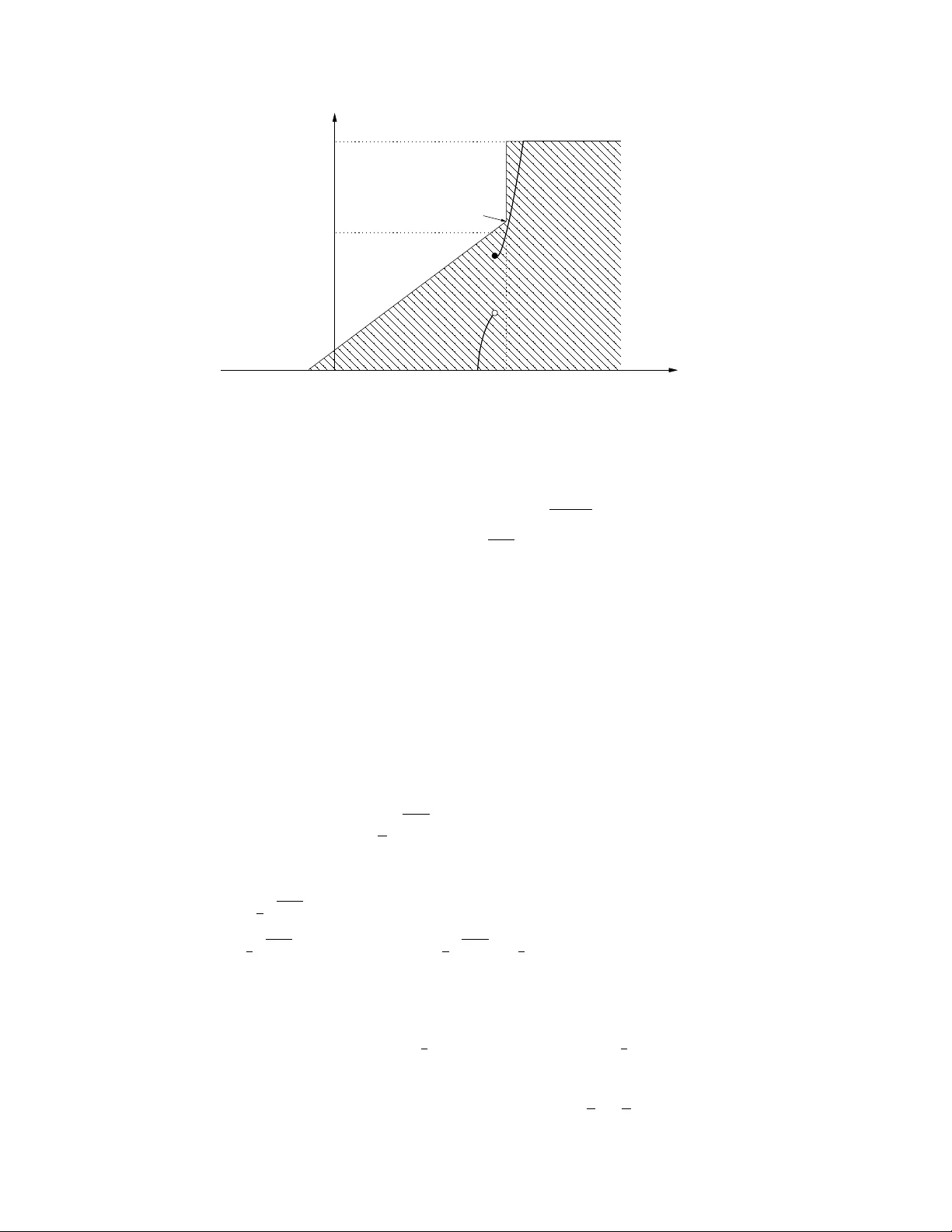
Adv anced top ology on the m ultiscale sequence spaces S ν Jean-Marie Aubry Universit ´ e de Paris-Est, L ab or atoir e d’A nalyse et de Math´ ematiques Appliqu ´ ees, UMR CNRS 8050, 61 av. du G ´ en ´ er al de Gaul le, F-94010 Cr ´ eteil, France F ran¸ coise Bastin Universit ´ e de Li ` ege, D ´ ep artement de Math ´ ematiques (B37), Gr ande T r averse, 12, B-4000 Li ` ege, Belgique Abstract W e pursue the study of the m ultiscale spaces S ν in tro duced by Jaffard in the context of m ultifractal analysis. W e giv e the necessary and sufficient condition for S ν to b e lo cally p -conv ex, and exhib it a sequence of p -norms that defines its natural topology . The strong top ological dual of S ν is identified to another sequence space dep ending on ν , endow ed with an inductive limit top ology . As a particular case, w e describ e the dual of a countable in tersection of Beso v spaces. Key wor ds: sequence space, lo cal con vexit y, F r ´ echet space, strong top ological dual 2000 MSC: 46A45 (primary), 46A16, 46A20 Email addr esses: jmaubry@math.cnrs.fr (Jean-Marie Aubry), f.bastin@ulg.ac.be (F ran¸ coise Bastin). Preprin t submitted to Elsevier 27 Octob er 2021 1 In tro duction The adv ent of m ultiscale analysis, for instance w av elet tec hniques, has sho wn the need for a new, hierarchical wa y of organizing information. Instead of a sequen tial data set ( u n ) n ∈ N , one has often to work with a tree-indexed data set ( x t ) t ∈ T , where T : = S j ∈ N 0 ( Z /δ Z ) j , δ ≥ 2 (without loss of generality , in all this pap er we assume that δ = 2). In the long tradition of studying sequence spaces [6,11], no sp ecial in terest w as giv en to a hierarchical structure of the index set. But practical applications, suc h as multifractal analysis, rely heavily on this structure: coefficients at dif- feren t scales j do not ha v e the same imp ortance, but within a same scale, they are often in terchangeable. Sequence spaces emphasizing this sp ecific feature ha ve b een in tro duced: for instance the classical Besov spaces, translated via the wa velet transform in to Beso v sequence spaces [14], and the in tersections of Besov spaces [8]. How ever these spaces and their topologies (Beso v-normed or pro jective limits thereof ) pro vide only an indirect control, via w eigh ted l p sums, on the asymptotic repartition of the sizes of the co efficients. Direct con- trol, suc h as asking that the n um b er of co efficients ha ving a certain size b e b ounded ab ov e, was the motiv ation whic h resulted in the more general class of top ological v ector spaces called S ν . Notations. In this pap er we consider topological vector spaces (tvs) on the field C of complex n um b ers. The set of strictly p ositiv e natural num b ers is N , and N 0 : = { 0 } ∪ N . W e write a ∧ b and a ∨ b respectively for the minimum and the maxim um of a and b . The integer parts are b x c : = max { z ∈ Z : z ≤ x } and d x e : = min { z ∈ Z : z ≥ x } . The tree T is canonically identified to the set 2 of indices Λ : = S j ∈ N 0 { j } × { 0 , . . . , 2 j − 1 } ; finally we define Ω : = C Λ furnished with the p oin t wise conv ergence top ology . 1.1 S ν sp ac es Inspired by the w a v elet analysis of multifractal functions, Jaffard [9] intro- duced spaces S ν of functions defined by conditions on their w a velet coeffi- cien ts. It w as shown that these spaces are r obust , that is, they do not depend on the choice of the wa velet basis (pro vided the mother w a v elet is sufficien tly regular, lo calized, and has enough zero moments). So w e can view them, and study their top ology , as sequence spaces of w av elet co efficien ts; the set of in- dices Λ corresponds to taking the dyadic wa velet co efficients of a 1-p erio dic function. In this con text, ν is a non-decreasing right-con tin uous function of a real v ari- able α , with v alues in {−∞} ∪ [0 , 1], that is not identically equal to −∞ (an admissible pr ofile ). W e define α min : = inf { α : ν ( α ) ≥ 0 } (1) and α max : = inf { α : ν ( α ) = 1 } (2) with the habitual con ven tion that inf ∅ = + ∞ . It will b e conv enient to re- 3 mem b er that this definition implies ν ( α ) = −∞ if α < α min ν ( α ) ∈ [0 , 1) if α min ≤ α < α max ν ( α ) = 1 if α ≥ α max (p ossibly this nev er happ ens) . Definition 1 The asymptotic profile of a se quenc e x ∈ Ω is ν x ( α ) : = lim ε → 0 + lim sup j →∞ log # n k : | x j,k | ≥ 2 − ( α + ε ) j o log(2 j ) (3) It is easily seen that ν x is alw ays admissible. Definition 2 Given an admissible pr ofile ν , we c onsider the ve ctor sp ac e S ν : = x ∈ Ω : ν x ( α ) ≤ ν ( α ) ∀ α ∈ R . (4) Heuristically , a sequence x belongs to S ν if at eac h scale j , the n umber of k suc h that | x j,k | ≥ 2 − αj is of order ≤ 2 ν ( α ) j . Finally let us define the c onc ave c onjugate of ν is for p > 0 η ( p ) : = inf α ≥ α min ( αp − ν ( α ) + 1) . (5) This function appears in the con text of m ultifractal analysis in the so-called thermo dynamic formalism [1,8]. 1.2 Basic top olo gy Here we summarize the first prop erties of S ν established in [3]: There exists a unique metrizable top ology τ that is stronger than the p oint wise conv ergence 4 and that mak es S ν a complete tvs. This top ology is separable. If w e define, for α ∈ R and β ∈ {−∞} ∪ [0 , + ∞ ), the distance d α,β ( x, y ) : = d α,β ( x − y ) : = inf n C ≥ 0 : ∀ j, # n | x j,k − y j,k | ≥ C 2 − αj o ≤ C 2 β j o (6) (agreeing that 2 j β : = 0 when β = −∞ ) and the ancillary metric space E ( α, β ) : = { x ∈ Ω : d α,β ( x ) < ∞} (7) then for an y sequence α n dense in R and an y sequence ε m & 0 w e ha v e S ν = \ n,m E ( α n , ν ( α n ) + ε m ) (8) and τ coincides with the pro jectiv e limit top ology (the coarsest top ology whic h makes eac h inclusion S ν ⊂ E ( α n , ν ( α n ) + ε m ) contin uous). Remark that E ( α, β ) is never a tvs when 0 ≤ β < 1, b ecause the scalar m ultiplication is not con tinuous in E ( α, β ); how ev er it is con tinuous in S ν . When β = −∞ , the space E ( α, β ) consists in the set of sequences x suc h that there exists C , for all ( j, k ) ∈ Λ, | x j,k | < C 2 − αj . This space corresp onds to the space of wa velet coefficients of functions in the H¨ older-Zygm und class C α , as it w as shown b y Meyer [13]. Let us also recall the connexion with Besov spaces (Definition 5 in § 2.3 below). If η is the concav e conjugate of ν , then S ν ⊂ \ ε> 0 \ p> 0 b η ( p ) /p − ε p, ∞ (9) with equalit y if and only if ν is concav e. 5 1.3 Pr evalent pr op erties Some measure-related prop erties of S ν : Giv en ( ψ j,k ) an L ∞ -normalized or- thogonal w av elet basis of L 2 ( R / Z ) and assuming that α min > 0, let f x : = P j,k x j,k ψ j,k and let d f x : α 7→ dim H ( { t : h f x ( t ) = α } ) b e its Hausdorff spec- trum of H¨ older singularities. Then for x in a prev alen t [7] subset of S ν , for all α ∈ R , w e hav e ν x ( α ) = ν ( α ) and d f x ( α ) = α sup α 0 ∈ (0 ,α ] ν ( α 0 ) α 0 if α ≤ h max , d f x ( α ) = −∞ else (here h max : = inf α>α min α ν ( α ) ). W e refer to [2] for the details. 1.4 Outline of the r esults Our goal in this paper is to establish adv anced topological prop erties suc h as lo cal con vexit y and dualit y for the spaces S ν . W e shall see that these prop er- ties, unlike those w e recalled in § 1.2, dep end in a subtle wa y on the profile ν . In § 2 we giv e some definitions and preliminary results. In § 3 w e study lo cal con vexit y . Having sho wn that S ν is never p -normable ( § 3.1), we giv e the necessary and sufficient condition for lo cal p -con v exity in § 3.2. A set of p - norms inducing the top ology is presen ted in § 3.3. The last section ( § 4) of this article addresses the iden tification of the top ological dual of S ν . This dual ( S ν ) 0 turns out ( § 4.2) to b e a union of sequence spaces just smaller than another space S ν 0 , where ν 0 can b e deriv ed from ν in a w ay shown in § 4.1. In § 4.3 w e pro v e that the strong top ology on ( S ν ) 0 is the same as the inductive limit top ology on this union and deduce the condition for reflexivity . The particular case where S ν is an intersection of Besov spaces is detailed in § 4.4. 6 2 Preliminaries 2.1 R ight-inf derivative W e shall see that the lo cal conv exit y of S ν dep ends on ν , and more precisely on its righ t-inf deriv ative defined, whenever ν ( α ) > −∞ , as ∂ + ν ( α ) : = lim inf h → 0 + ν ( α + h ) − ν ( α ) h (10) for whic h holds an equiv alent of the mean v alue inequality . Lemma 2.1 L et ν b e an admissible pr ofile and p > 0 . The fol lowing assertions ar e e quivalent. (1) F or al l α min ≤ α < α max , ∂ + ν ( α ) ≥ p ; (2) F or al l α min ≤ α 0 ≤ α < α max , ν ( α ) − ν ( α 0 ) ≥ p ( α − α 0 ) . Pr o of. The 2 ⇒ 1 part is obvious. Con versely , let f n ( x ) : = n ( ν ( x + 1 n ) − ν ( x )). Note that lim inf n f n ( x ) ≥ ∂ + ν ( x ) ≥ p when α 0 ≤ x ≤ α . So p ( α − α 0 ) ≤ Z α α 0 lim inf n f n ( x ) dx By F atou’s lemma, ≤ lim inf n Z α α 0 f n ( x ) dx ≤ lim inf n n Z α + 1 n α ν ( x ) dx − Z α 0 + 1 n α 0 ν ( x ) dx ! ≤ ν ( α ) − ν ( α 0 ) b ecause ν is righ t-contin uous. 7 2.2 p -norm and lo c al p -c onvexity Let us recall a couple of definitions from Jarcho w [10], whic h generalize the notions of norm and lo cal con vexit y (these corresp onding to the case p = 1). Definition 3 L et X b e a ve ctor sp ac e and 0 < p ≤ 1 . A map q : X → [0 , + ∞ ) is a p -seminorm if q ( λx ) = | λ | q ( x ) for al l λ ∈ C , x ∈ X and if q ( x + y ) p ≤ q ( x ) p + q ( y ) p for al l x, y ∈ X . If in addition q ( x ) = 0 only if x = 0 then q is c al le d a p -norm . Definition 4 L et 0 < p ≤ 1 . A subset K of a ve ctor sp ac e X is p -conv ex if for al l x 1 , . . . , x N ∈ K and θ 1 , . . . , θ N such that P n θ p n = 1 , the p -con v ex com bination P n θ n x n b elongs to K . We say that K is absolutely p -con v ex if in addition it is circled (or balanced ), that is, λx ∈ K whenever x ∈ K and | λ | ≤ 1 . The tvs X is locally p -conv ex if it has a b asis of absolutely p -c onvex neigh- b ourho o ds of 0. Clearly , a p -normed space is lo cally p -con v ex. F or instance the sequence space l p , p > 0, is 1 ∧ p -normed th us 1 ∧ p -lo cally conv ex. When X = T n X n endo wed with the pro jective limit top ology , X is lo cally p con v ex if and only if for eac h n , for each 0-neighbourho o d V in X n , there exist n 1 , . . . , n L and 0-neigh b ourho o ds U 1 , . . . , U L in X n 1 , . . . , X n L suc h that an y p -conv ex combination of elements of U : = T l U l sta ys in V . 8 2.3 Besov sp ac es T o end this section, and to prepare the results of the next one, w e elucidate the link b et w een (sequence) Besov spaces and the ancillary spaces E ( α, β ). Definition 5 F or α ∈ R , 0 < p < ∞ , the b α p, ∞ Besov 1 ∧ p -norm of a se quenc e x is given by k x k b α p, ∞ : = sup j ∈ N 0 2 ( α − 1 p ) j 2 j − 1 X k =0 | x j,k | p 1 p (11) and if p = ∞ , k x k b α ∞ , ∞ : = sup j ∈ N 0 sup 0 ≤ k< 2 j 2 αj | x j,k | . (12) It is easy to c hec k that, b eing mo delled on l p , the space b α p, ∞ is 1 ∧ p -normed, th us 1 ∧ p -conv ex (and not b etter). Note that b α ∞ , ∞ = E ( α , −∞ ). Lemma 2.2 L et 0 < p < ∞ and s ∈ R . If β ≥ αp + 1 − s , then for al l x ∈ b s/p p, ∞ , d α,β ( x ) ≤ k x k p p +1 b s/p p, ∞ . (13) Pr o of. Let C : = k x k b s/p p, ∞ . If there exists a j suc h that # n k : | x j,k | ≥ C p p +1 2 − αj o > C p p +1 2 β j then C ≥ 2 s − 1 p j ( P k | x j,k | p ) 1 p > C 2 β + s − 1 − αp p j ≥ C , a flagrant con tradiction. So it m ust be that for all j , # n k : | x j,k | ≥ C p p +1 2 − αj o ≤ C p p +1 2 β j . This shows that d α,β ( x ) ≤ C p p +1 . It follo ws that b s/p p, ∞ ⊂ E ( α, β ) con tinuously , but the conv erse inclusion is nev er true. Another Beso v embedding will b e useful. 9 Lemma 2.3 If 0 < p ≤ p 0 and α ∈ R , then for al l x ∈ b α p 0 , ∞ , k x k b α p, ∞ ≤ k x k b α p 0 , ∞ . (14) Pr o of. By H¨ older’s inequality , if p ≤ p 0 , k x k b α p, ∞ = 2 ( α − 1 p ) j 2 j − 1 X k =0 | x j,k | p 1 p ≤ 2 ( α − 1 p ) j 2 ( 1 p − 1 p 0 ) j 2 j − 1 X k =0 | x j,k | p 0 1 p 0 = k x k b α p 0 , ∞ . Remark. This embedding uses sp ecifically the fact that 0 ≤ k 2 − j < 1 (Beso v space on a compact domain). It can b e compared to Lemma 8.2 of [3], whic h is v alid on any domain (e.g. k ∈ Z ): When p 0 ≤ p and α − 1 p ≤ α 0 − 1 p 0 w e also hav e k x k b α p, ∞ ≤ k x k b α 0 p 0 , ∞ . 3 Lo cal geometry of S ν Here w e apply the definitions of § 2.2 to S ν spaces. W e shall see that S ν is nev er p -normable, but that it is lo cally p -conv ex for p dep ending on ν . 3.1 Non normability Prop osition 3.1 The tvs S ν is not p -normable for any p > 0 . Pr o of. Supp ose that q is a p -norm defining the top ology of S ν . Then there are α l ∈ R , ε l > 0 ( l = 1 , . . . , L ) and δ 0 > 0 suc h that L \ l =1 U l ⊂ B 10 where B : = { x ∈ S ν : q ( x ) ≤ 1 } and U l : = n x ∈ S ν : d α l ,ν ( α l )+ ε l ( x ) ≤ δ 0 o . W e assume α 1 < · · · < α L and δ 0 < 1. First case: There is l suc h that α l < α min . Let n b e the largest integer satisfying this. F or all l ≤ n , ν ( α l ) = −∞ and thus d α l ,ν ( α l )+ ε l ( x ) = sup ( j,k ) ∈ Λ 2 α l j | x j,k | . F or m ∈ N 0 w e define the sequence x m ∈ S ν b y setting at scale m exactly one co efficien t equal to 2 − α n m δ 0 . W e claim that x m ∈ B for sufficiently large m . Indeed, if l ≤ n then d α l ,ν ( α l )+ ε l ( x m ) ≤ δ 0 for all m ; if l > n w e ha ve ν ( α l ) + ε l > 0 hence d α l ,ν ( α l )+ ε l ( x m ) ≤ δ 0 as so on as m ≥ − log 2 ( δ 0 ) ν ( α l )+ ε l . So x m ∈ T L l =1 U l ⊂ B . Let us now consider α n < α 0 < α min . If B 0 denotes the unit ball in E ( α 0 , −∞ ), our h yp othesis that the top ology of S ν stems from the p -norm q implies that there exists λ > 0 suc h that λB ⊂ B 0 . This w ould imply that λx m ∈ B 0 for all m , a con tradiction b ecause d α 0 , −∞ ( x m ) = 2 ( α 0 − α n ) m → ∞ . Second case: α l ≥ α min for all l . W e c hose α 00 < α 0 < α min and define the se- quence x m ∈ S ν b y setting at scale m exactly one co efficient equal to 2 − α 00 m δ 0 ; the rest of the pro of is iden tical to the sub-case l > n ab o v e. 3.2 L o c al c onvexity The con vexit y index will b e p 0 : = 1 ∧ inf 0 ≤ ν ( α ) < 1 ∂ + ν ( α ) (15) (w e recall that 0 ≤ ν ( α ) < 1 is equiv alen t to α min ≤ α < α max ). Ho w do es this n umber come in to pla y? When ν is concav e, w e kno w from (9) that S ν is an intersection of (sequence) Beso v spaces b η ( p ) /p − ε p, ∞ for ε > 0 and 11 p > 0, η b eing the con v ex conjugate (5) of ν . Supp ose that 0 < p ≤ p 0 , and observ e that by Lemma 2.1, η ( p ) p = η ( p 0 ) p 0 (= α max ) < ∞ . Then Lemma 2.3 leads to b η ( p ) /p − ε p, ∞ ⊃ b η ( p 0 ) /p 0 − ε p 0 , ∞ . So in fact S ν = \ ε> 0 \ p ≥ p 0 b η ( p ) /p − ε p, ∞ an in tersection of spaces at least p 0 -con vex. This idea leads to the general case. Theorem 1 L et p 0 b e define d by (15) • If p 0 > 0 , then S ν is lo c al ly p 0 -c onvex. • If p 0 < 1 , then S ν is not lo c al ly p -c onvex for any p > p 0 . Pr o of. W e first pro ve the second p oint. Supp ose that p 0 < p < 1. Our purp ose is to find a neighbourho o d V in S ν , for instance the unit ball in some E ( α 0 , ν ( α 0 ) + ε ), such that it cannot con tain the p -conv ex h ull of any 0-neigh b ourho o d U . By definition of p 0 , there exist ε > 0 and α min ≤ α < α 0 suc h that ν ( α 0 ) + ε < 1 and ν ( α 0 ) − ν ( α ) + ε < p ( α 0 − α ). F or short we shall write s : = α 0 − α and t : = ν ( α 0 ) − ν ( α ) + ε. Thanks to the righ t-contin uit y of ν , ε and s can b e taken small enough so that p p + 1 ( s + t ) < 1 − ν ( α ) . (16) Assume that U is a p -conv ex 0-neighbourho o d in S ν suc h that U ⊂ V = x ∈ S ν : d α 0 ,ν ( α 0 )+ ε ( x ) < 1 12 and let z ∈ S ν b e such that z j,k = 2 − αj for b 2 ν ( α ) j c v alues of k at each scale j . Since S ν is a tvs, there is λ > 0 suc h that λz ∈ U ; moreo v er, the special structure of the topology of S ν allo ws to say that this remains true if some co efficien ts ha ve been set to 0 or mov ed within the scale. No w, let N ∈ N b e fixed. If j 0 is the smallest integer such that 2 j 0 ≥ N 2 ν ( α ) j 0 , w e construct x 1 , . . . , x N ha ving, at eac h scale j ≥ j 0 disjoin t sets of cardinal b 2 ν ( α ) j c of coefficients equal to λ 2 − αj (and the others are 0). These sequences all b elong to U . W e then form the p -conv ex combination x : = N − 1 p N X n =1 x n . Note that, at each scale j ≥ j 0 , the sequence x has N b 2 ν ( α ) j c = C 0 ( N , j )2 ν ( α 0 )+ ε ) j co efficien ts of size equal to N − 1 p λ 2 − αj = C ( N , j )2 − α 0 j , with C ( N , j ) : = λN − 1 p 2 sj and C 0 ( N , j ) : = N 2 − tj b 2 ν ( α ) j c 2 ν ( α ) j . Let us fo cus on the scale j : = p +1 p log 2 ( N ) − log 2 ( λ ) s + t . Because of (16), we c hec k that this j ≥ j 0 . F urthermore since j ≥ p +1 p log 2 ( N ) − log 2 ( λ ) s + t , C ( N , j ) ≥ λN − 1 p 2 s s + t ( p +1 p log 2 ( N ) − log 2 ( λ ) ) ≥ λ t s + t N ps − t p ( s + t ) and since j < 1 + p +1 p log 2 ( N ) − log 2 ( λ ) s + t , C 0 ( N , j ) > N 2 2 − t − t s + t ( p +1 p log 2 ( N ) − log 2 ( λ ) ) > 2 − t − 1 λ t s + t N ps − t p ( s + t ) . By the h yp othesis on p , the exp onent of N is strictly p ositiv e and this sho ws that d α 0 ,ν ( α 0 )+ ε ( x ) can b e arbitrarily large with N . In particular, no matter ho w small the neigh b ourho o d U is, there exists a p -conv ex com bination of elemen ts of U which do es not b elong to V , meaning the unit ball in E ( α 0 , ν ( α 0 ) + ε ). 13 So S ν is not lo cally p -con v ex. The pro of of the first p oin t b oils down to this: Let M > 0, ε > 0 and α b e fixed, w e wan t to find a 0-neighbourho o d U in S ν suc h that any p 0 -con vex combina- tion of elem en ts x 1 , . . . , x N ∈ U will sta y in V : = n x ∈ S ν : d α,ν ( α )+ ε ( x ) ≤ M o . The t wo cases ν ( α ) = −∞ and ν ( α ) = 1 are b oth trivial b ecause E ( α, −∞ ) = b α ∞ , ∞ and E ( α , 1 + ε ) = Ω (the set of all sequences with the top ology of p oin t wise conv ergence, see [4]) are lo cally conv ex. F rom no w on w e assume that 0 ≤ ν ( α ) < 1. Let L : = l ( α − α min ) 2 p 0 ε m , λ : = M L +2 and for − 1 ≤ l ≤ L let α l : = α min + ε 2 p 0 l and ν l : = ν ( α l ) + ε 2 . Note that α L ≥ α . W e construct U : = L \ l = − 1 U l (17) where U l : = { x ∈ S ν : d α l ,ν l ( x ) < λ } (in particular, since ν − 1 = −∞ , U − 1 ⊂ { x : ∀ j, k , | x j,k | < λ 2 − α − 1 j } ). F or an arbitrary N ∈ N , let x 1 , . . . , x N ∈ U and θ 1 , . . . , θ N b e the co efficien ts of a p 0 -con vex combination x : = P N n =1 θ n x n . W e split eac h x n as x n = P L +1 l =0 x l n , where for 0 ≤ l ≤ L , x l n receiv es the co efficien ts λ 2 − α l j < | x j,k | ≤ λ 2 − α l − 1 j (the others are set to 0) and x L +1 n receiv es the co efficien ts | x j,k | ≤ λ 2 − α L j ; since x n ∈ U − 1 it has no co efficients | x j,k | > λ 2 − α − 1 j . Once this is done, we do the p 0 -con vex com binations x l : = N X n =1 θ n x l n . Remark that x n ∈ U implies that eac h x l n ∈ U and a fortiori x l n ∈ U l . Let us con template tw o cases. When 0 ≤ l ≤ L : Since x l n is in U l and has only co efficients | x j,k | > λ 2 − α l j , 14 the cardinal of the set of non-zero co efficien ts at scale j in x l n is smaller than λ 2 ν l j , and these co efficien ts are all b ounded from ab o v e by λ 2 − α l − 1 j . It follows that if s − 1 + ν l − α l − 1 p ≤ 0, then x l n b s/p p, ∞ ≤ λ p +1 p . Actually we tak e p = p 0 and s = s l : = 1 + α l − 1 p 0 − ν l . Since b s l /p 0 p 0 , ∞ is p 0 -con vex, x l b s l /p 0 p 0 , ∞ ≤ λ p 0 +1 p 0 as w ell. Thanks to Lemma 2.1 and the definition of p 0 , αp 0 + 1 − s l − ν ( α ) − ε = p 0 ( α − α l − 1 ) + ν l − ν ( α ) − ε = p 0 ( α − α l + ε 2 p 0 ) + ν ( α l ) + ε 2 − ν ( α ) − ε = p 0 ( α − α l ) + ν ( α l ) − ν ( α ) ≤ 0 . Th us Lemma 2.2 is applicable with β = ν ( α ) + ε , and we get that d α,ν ( α )+ ε ( x l ) ≤ x l p 0 p 0 +1 b s l /p 0 p 0 , ∞ ≤ λ. When l = L + 1, simply notice that what remains in each x L +1 n are co efficien ts | x j,k | ≤ λ 2 − αj . The p 0 -con vex combination x L +1 will ha v e a fortiori only co ef- ficien ts | x j,k | ≤ λ 2 − αj and this sho ws that d α,ν ( α )+ ε ( x ) ≤ λ (indeed an y C > λ satisfies the condition in (6), so their infim um is ≤ λ ). Finally , d α,ν ( α )+ ε ( x ) ≤ L +1 X l =0 d α,ν ( α )+ ε ( x l ) ≤ ( L + 2) λ = M . W e hav e pro ved that S ν is lo cally p 0 -con vex. Corollary 3.2 The sp ac e S ν is a F r´ echet sp ac e if and only if ∂ + ν ( α ) ≥ 1 for al l α ∈ [ α min , α max ) . 15 Pr o of. W e already kno w that S ν is a metrizable and complete tvs [3]. W e apply the previous theorem with p 0 = 1. 3.3 A nother description of the top olo gy The top ology of a F r ´ ec het space can alwa ys b e defined b y a sequence of semi- norms. When the space is only p 0 -con vex, the seminorms are naturally to b e replaced b y p 0 -seminorms. The interesting feature in the case of S ν is that they can b e made explicit as p 0 -norms in terp olating t wo Beso v spaces. Theorem 2 If p 0 > 0 , the top olo gy of S ν is induc e d by the family of norms k x k b α min − ε ∞ , ∞ to gether with the p 0 -norms k x k α,ε : = inf k x 0 k b s p 0 , ∞ + k x 00 k b α ∞ , ∞ : x 0 + x 00 = x (18) wher e α ∈ [ α min , α max ) , ε > 0 and s : = α + 1 − ν ( α ) p 0 − ε . This family of p 0 -norms c an b e made c ountable by taking se quenc es ( α n ) dense in [ α min , α max ) and ( ε m ) → 0 + . T o illustrate this theorem, notice (Figure 1) that the h yp ograph of ν is the in tersection of the sets (parameters domains) of ( ˜ α, β ) suc h that a sequence ha ving 2 β j co efficien ts = 2 − ˜ αj b elongs to b s p 0 , ∞ + b α ∞ , ∞ . Pr o of. Let α ∈ [ α min , α max ) and ε > 0. As in the pro of of the first p oin t of Theorem 1, we define L , α l and ν l for − 1 ≤ l ≤ L − 1 and α L : = α, ν L : = ν ( α L ) + ε 2 . Let 0 < δ < 1 b e fixed and let λ : = δ L +2 . The neighbourho o ds U l and, for x ∈ T L l = − 1 U l , the splitting x = P L +1 l =0 x l are unc hanged. 16 0 0 p min max slope = p 0 α α α 1 (α,ν(α)+ ε) ν(α) Fig. 1. ν ( α ) and the parameters domain of b s p 0 , ∞ + b α ∞ , ∞ It is clear that, since α L ≥ α , x 00 : = x L +1 b elongs to b α ∞ , ∞ and moreov er k x 00 k b α ∞ , ∞ ≤ λ . On the other hand, with s : = α + 1 − ν ( α ) p 0 − ε , for 0 ≤ l ≤ L , eac h x l b elongs to b s p 0 , ∞ and x l b s p 0 , ∞ ≤ λ p 0 +1 p 0 ≤ λ . So finally x 0 : = P L l =0 x l satisfies k x 0 k b s p 0 , ∞ ≤ ( L + 1) λ . W e hav e pro ved that b y our c hoice of λ , L \ l = − 1 U l ⊂ n x ∈ S ν : k x k α,ε ≤ δ o in other w ords, that x 7→ k x k α,ε is a con tinuous p 0 -norm on S ν . No w, let us show that giv en α ∈ [ α min , α max ) , ε > 0 and 0 < δ < 1, w e ha ve x ∈ S ν : k x k α,ε < δ 2 ! p 0 +1 p 0 ⊂ x ∈ S ν : d α,ν ( α )+ ε ( x ) ≤ δ . If k x k α,ε < δ 2 p 0 +1 p 0 , then there exist x 0 , x 00 ∈ S ν suc h that x = x 0 + x 00 , k x 0 k b s p 0 , ∞ < δ 2 p 0 +1 p 0 and k x 00 k b α ∞ , ∞ < δ 2 p 0 +1 p 0 ≤ δ 2 . Using the inequality b et ween distances d α,β and Besov p -norms (Lemma 2.2) and the fact that sup j,k 2 αj | x 00 j,k | ≤ δ 2 implies d α,ν ( α )+ ε ( x 00 ) ≤ δ 2 , w e get d α,ν ( α )+ ε ( x ) ≤ d α,ν ( α )+ ε ( x 0 ) + d α,ν ( α )+ ε ( x 00 ) ≤ δ 2 + δ 2 = δ 17 and we are done. Thanks to (8) we see that if α ∈ ( α n ) describ es a dense set in [ α min , α max ) and if ε ∈ ( ε m ) has limit 0, together with the b α min − ε ∞ , ∞ norms, these p 0 -norms completely define the top ology of S ν . 4 Dualit y W e employ the usual scalar pro duct on the sequence space Ω h x, y i : = X ( j,k ) ∈ Λ x j,k y j,k (19) to iden tify the topological dual ( S ν ) 0 of S ν to a sequence space that will be rev ealed b y Theorem 3. This identification is made as follo ws: for all ( j, k ) ∈ Λ, let e j,k b e the sequence whose only non-zero comp onent is e j,k j,k = 1. Giv en u ∈ ( S ν ) 0 , let us define y : = X j,k ∈ Λ u ( e j,k ) e j,k . This sequence y indeed satisfies u ( x ) = h x, y i b ecause for all x ∈ S ν , the sum P j,k ∈ Λ x j,k e j,k con verges to x in S ν (see [3]). Remark. If we k eep in mind that ( x j,k ) represents the w a velet co efficien ts of a function, the ab ov e scalar pro duct corresp onds to the L 2 scalar pro duct if and only if the said w a velets form an orthonormal basis of L 2 ([0 , 1]). In [2,4,5], w e use L ∞ -normalized orthogonal w av elets instead (which is more con v enient when one uses wa v elets to study the p oin t wise regularit y of functions); in that setting, the L 2 pro duct of functions corresp onds to the co efficients pro duct h h x, y i i : = X ( j,k ) ∈ Λ 2 − j x j,k y j,k . (20) 18 The results in this section translate easily in terms of the dualit y h h· , ·i i by shifting the symmetry axis in Figure 2 b y 1 / 2 to the left. 4.1 Dual pr ofile Let us fix a few notations. W e shall write T β U : = −∞ if β < 0 β if 0 ≤ β ≤ 1 1 if β ≥ 1 . (21) Definition 6 The dual profile of ν is the function ν 0 : α 0 7→ T α 0 + inf { α : ν ( α ) − α > α 0 } U . (22) As in (1) and (2) we define the c orr esp onding α 0 min and α 0 max . It is easily seen that α 0 min = − α min and that 1 − α max ≤ α 0 max ≤ 1 − α min . Graphically , except for the discon tin uities and the part where the v alue 1 is attained, the graph of ν 0 is obtained b y horizontal symmetry , with resp ect to the axis β = 2 α , of the graph of ν (Figure 2). Discon tinuities in ν corresp ond to zones with slop e 1 in ν 0 ; zones with slop e ≤ 1 in ν corresp ond to righ t- con tinuous discon tinuities in ν 0 (see Prop osition 4.1 b elow). In the next prop osition w e state the less obvious prop erties that will b e useful to us. Prop osition 4.1 The dual pr ofile ν 0 of ν verifies (i) ν 0 is right-c ontinuous; 19 min max α max min α α ν(α) 1 0 1/2 ’ ν (α) ’ ’ ’ α Fig. 2. The symmetry b etw een ν and ν 0 (ii) for al l α , α 0 , α + α 0 ≥ ν ( α ) ∧ ν 0 ( α 0 ) ; (iii) if ν 0 ( α 0 ) = α + α 0 then ν 0 ( α 0 ) ≤ ν ( α ) ; (iv) ν 0 is non-de cr e asing; furthermor e for al l α 0 ≤ α 0 max and ε ≥ 0 , ν 0 ( α 0 − ε ) ≤ ν 0 ( α 0 ) − ε . Pr o of. W e can supp ose α 0 ∈ [ α 0 min , α 0 max ], as the other cases are trivial. (i): Let α 0 b e fixed. F or all ε > 0, there exists an α suc h that α 0 < ν ( α ) − α and ν 0 ( α 0 ) + ε ≥ α + α 0 . Then with η : = ε ∧ ( ν ( α ) − ( α + α 0 )) > 0, ζ 0 < α 0 + η implies that ζ 0 < ν ( α ) − α as w ell, so ν 0 ( ζ 0 ) ≤ ζ 0 + α < α 0 + α + η ≤ ν 0 ( α 0 ) + 2 ε . This pro ves righ t-contin uit y at α 0 . (ii): Giv en α and α 0 , if ν ( α ) > α + α 0 then α ≥ inf { ˜ α : ν ( ˜ α ) > ˜ α + α 0 } hence α + α 0 ≥ ν 0 ( α 0 ); otherwise α + α 0 ≥ ν ( α ). (iii): If ν 0 ( α 0 ) = α + α 0 then α = inf { ˜ α : ν ( ˜ α ) > ˜ α + α 0 } thus b y right- con tinuit y ν ( α ) ≥ α + α 0 = ν 0 ( α 0 ). (iv) is trivial. 20 4.2 T op olo gic al dual of S ν F or ε > 0 we write ν 0 ε ( α 0 ) : = ν 0 ( α 0 − ε ). Theorem 3 The top olo gic al dual of S ν is ( S ν ) 0 = [ ε> 0 S ν 0 ε . (23) Pr o of. Supp ose first that y 6∈ S ν 0 ε for an y ε > 0 and let us construct an x ∈ S ν suc h that h x, y i = ∞ . The h yp othesis on y implies that, for every ε > 0, there exist α 0 ∈ R , δ > 0 suc h that y 6∈ E ( α 0 , ν 0 ε ( α 0 ) + δ ); in particular, y does not b elong to an y of the balls of this space. So, given an y strictly p ositiv e sequence ε n → 0, w e thus construct sequences of reals ( α 0 n ) n ∈ N and in tegers ( j n ) n ∈ N (the latter w e can make strictly increasing) suc h that for all n ∈ N , # n k : | y j n ,k | ≥ 2 − α 0 n j n o > 2 ν 0 ( α 0 n − ε n ) j n . (24) Remark that it is v ery p ossible that for some n , ν 0 ( α 0 n − ε n ) = −∞ , whic h is equiv alent to α 0 n − ε n < α 0 min = − α min ; (25) w e denote b y I the set of such indices and b y J : = N \ I its complement. When n ∈ J , we remark that we ha ve ν 0 ( α 0 n − ε n ) = α 0 n − ε n + inf { α : ν ( α ) − α > α 0 n − ε n } ≥ α 0 n − ε n + α min . (26) T o construct x we put • for all n ∈ J , at l 2 ν 0 ( α 0 n − ε n ) j n m of the p ositions where | y j n ,k | ≥ 2 − α 0 n j n , x j n ,k : = 2 − α n j n y j n ,k | y j n ,k | 21 with α n : = ν 0 ( α 0 n − ε n ) − α 0 n ; • for all n ∈ I , at exactly one p osition where | y j n ,k | ≥ 2 − α 0 n j n w e put x j n ,k ha ving the same expression as ab o ve, but with α n : = − α 0 n ; and naturally all the other co efficien ts of x are set equal to 0. The scalar pro duct h x, y i is div ergen t b ecause for all n ∈ N \ I = J X 0 ≤ k< 2 j n x j n ,k y j n ,k ≥ 2 ν 0 ( α 0 n − ε n ) j n 2 ( α 0 n − ν 0 ( α 0 n − ε n )) j n 2 − α 0 n j n = 1 whereas if n ∈ I , X 0 ≤ k< 2 j n x j n ,k y j n ,k = 2 α 0 n j n 2 − α 0 n j n = 1 . It remains to prov e that x belongs to S ν = T α ∈ R ,ε> 0 E ( α, ν ( α ) + ε ). F or this w e consider t wo cases. Firstly , if α < α min : In this situation, we hav e to show that sup j,k 2 αj | x j,k | < ∞ or, equiv alently , that ( i ) sup n ∈ I 2 αj n 2 α 0 n j n < ∞ and ( i i ) sup n ∈ J 2 αj n 2 ( α 0 n − ν 0 ( α 0 n − ε n )) j n < ∞ . When n ∈ I , b y (25) w e hav e α 0 n + α < ε n + α − α min , whereas when n ∈ J , b y (26) we get α + α 0 n − ν 0 ( α 0 n − ε n ) ≤ ε n + α − α min . Since ε n → 0 this quan tit y b ecomes negativ e when n is large enough, so b oth (i) and (ii) hold. Secondly , if α ≥ α min : In that case, let β : = ν ( α ) + ε . W e hav e to sho w that there exists C > 0 such that for all n , # n k : | x j n ,k | ≥ C 2 − αj n o ≤ C 2 β j n . When n ∈ I this is trivial, since β > 0 and there is only one non-zero co efficient in x at scale j n . When n ∈ J , either α n = ν 0 ( α 0 n − ε n ) − α 0 n > α , and the ab ov e 22 cardinal is zero, or ν 0 ( α 0 n − ε n ) − α 0 n ≤ α . In that last case, using the righ t- con tinuit y of ν we get that ν ( α n + ε n ) ≤ β for n large enough; using (iii) of Prop osition 4.1 we hav e ν 0 ( α 0 n − ε n ) ≤ ν ( α n + ε n ) ≤ β and the conclusion follo ws. W e ha v e prov ed that y 6∈ S ε> 0 S ν 0 ε cannot b elong to the dual of S ν . Con versely , let ε > 0 and y ∈ S ν 0 2 ε . W e construct L : = l 4 ε m and for − 1 ≤ l ≤ L , α l : = α min + ε 4 l and ν l : = ν ( α l ) + ε 4 . Similarly , for − 1 ≤ l 0 ≤ L , α 0 l 0 : = α 0 min + 2 ε + ε 4 l 0 and µ l 0 : = ν 0 ( α 0 l 0 − 2 ε ) + ε 4 . Let U : = T L l = − 1 U l , where U l is the op en unit ball in E ( α l , ν l ) and fix an A > max − 1 ≤ l 0 ≤ L d α 0 l 0 ,µ l 0 ( y ). W e split an y x ∈ U as x = P L +1 l =0 x l , where for 0 ≤ l ≤ L , x l receiv es the co efficien ts 2 − α l j < | x j,k | ≤ 2 − α l − 1 j and x L +1 receiv es the co efficien ts | x j,k | ≤ 2 − α L j (since ν ( α − 1 ) = −∞ and x ∈ U − 1 , there is no co efficien t | x j,k | > 2 − α − 1 j ). W e do the same to y , writing y = P L +1 l 0 =0 y l 0 , where for 0 ≤ l 0 ≤ L , y l 0 receiv es the co efficients A 2 − α 0 l 0 j < | y j,k | ≤ A 2 − α 0 l 0 − 1 j and y L +1 receiv es the co efficien ts | y j,k | ≤ A 2 − α 0 L j (same remark as abov e ab out the co efficients | y j,k | > A 2 − α 0 − 1 j : there are none b ecause µ − 1 = ν 0 ( α 0 min − ε 4 ) = −∞ ). The pro of no w b oils do wn to studying eac h term of h x, y i = L +1 X l =0 L +1 X l 0 =0 h x l , y l 0 i . (27) F our cases can b e distinguished. Firstly , if 0 ≤ l ≤ L , 0 ≤ l 0 ≤ L and ν ( α l ) ≤ ν 0 ( α 0 l 0 − ε ): Then by Prop osition 4.1 (ii) applied to α l and α 0 l 0 − ε , this means that α l + α 0 l 0 ≥ ν ( α l ) + ε = ν l + 3 ε 4 . A t scale j in x l , there are less than 2 ν l j non-zero co efficien ts which are b ounded 23 b y 2 − α l − 1 j , so |h x l , y l 0 i| ≤ A X j ∈ N 0 2 ( ν l − α l − 1 − α 0 l 0 − 1 ) j ≤ A X j ∈ N 0 2 − ε 4 j . Secondly , if 0 ≤ l ≤ L , 0 ≤ l 0 ≤ L and ν ( α l ) ≥ ν 0 ( α 0 l 0 − ε ): Then b y Proposi- tion 4.1 (ii) once again we get α l + α 0 l 0 ≥ ν ( α l ) ∧ ν 0 ( α 0 l 0 ) ≥ ν 0 ( α 0 l 0 − ε ) ≥ ν 0 ( α 0 l 0 − 2 ε ) + ε = µ l 0 + 3 ε 4 . At scale j , in y l 0 there are less than A 2 µ l 0 j non-zero co efficien ts whic h are b ounded b y A 2 − α 0 l 0 − 1 j , so |h x l , y l 0 i| ≤ A 2 X j ∈ N 0 2 ( µ l 0 − α l − 1 − α 0 l 0 − 1 ) j ≤ A 2 X j ∈ N 0 2 − ε 4 j . Thirdly , if l = L + 1 and 0 ≤ l 0 ≤ L + 1: Since α 0 l 0 − 1 ≥ − α min + 7 ε 4 and α L ≥ α min + 1, we get b y a direct computation |h x L +1 , y l 0 i| ≤ A X j ∈ N 0 2 (1 − α L − α 0 l 0 − 1 ) j ≤ A X j ∈ N 0 2 − 7 ε 4 j . Finally , if 0 ≤ l ≤ L and l 0 = L + 1: Since α l − 1 ≥ α min − ε 4 and α 0 L ≥ α 0 min + 1 + 2 ε , we obtain |h x l , y L +1 i| ≤ A 2 X j ∈ N 0 2 (1 − α l − 1 − α 0 L ) j ≤ A 2 X j ∈ N 0 2 − 7 ε 4 j . In the end, h x, y i is b ounded on U , the bound dep ending only on A and ε (that is, only on y ). This prov es that the linear form x 7→ h x, y i is con tinuous. 4.3 Str ong top olo gy on ( S ν ) 0 In the previous theorem, the dual of S ν has b een algebraically identified to a union of spaces S ν 0 ε , for ε > 0, or equiv alen tly to a countable union of spaces 24 S ν 0 m for ν 0 m : = ν 0 ε m , ε m & 0. As suc h, it can be endow ed with the inductiv e limit top ology on this union, now written ind m S ν 0 m . W e shall now see that, at least when the conv exity index (15) p 0 = 1, this top ology is actually the same as the strong top ology on the dual (then written ( S ν ) 0 b in the standard notation), that is, the top ology of uniform con vergence on the b ounded sets of S ν . Before that, recalling that a Mon tel space is a barrelled tvs in which ev ery b ounded set is relativ ely compact, we giv e another remark able prop erty of S ν . Prop osition 4.2 If p 0 = 1 , then S ν is a F r´ echet-Montel sp ac e. Pr o of. In [3, Proposition 6.2] w e obtained the following characterization: A subset K of S ν is compact if and only if it is closed and b ounded for eac h of the distances d α n ,ν ( α n )+ ε m (cf. (6), (8)). The sp ecial structure of the top ology of S ν sho w that the latter condition is in fact equiv alen t to sa ying that K is b ounded in S ν . So, when p 0 = 1, the tvs S ν is a F r ´ ec het space in whic h the b ounded sets are relativ ely compact. Corollary 4.3 S ν is r eflexive if and only if p 0 = 1 . Pr o of. Every F r´ echet-Mon tel space is reflexiv e; con versely a reflexiv e space is b y definition necessarily lo cally con vex. Theorem 4 If p 0 = 1 , then top olo gic al ly ( S ν ) 0 b = ind m S ν 0 m . Pr o of. The fact that the canonical injection S ν 0 m → ( S ν ) 0 b is contin uous for ev ery m is obtained using the characterization of the b ounded sets of S ν and a part of the pro of leading to the algebraic description of the dual. Indeed, if m is fixed and if B is a b ounded set of S ν , w e replace the unit balls U l b y 25 balls of radius R > 0 so that B ⊂ U : = T L l = − 1 U l (with L dep ending on m ). The same pro of then shows that h x, y i → 0 when y → 0 in S ν 0 m , uniformly on B . This pro ves that the inductiv e limit top ology is stronger than the strong top ology (and as a consequence, the inductiv e limit is Hausdorff ). T o pro ve that the top ologies are in fact equiv alen t, w e use the closed graph theorem of De Wilde (see [10] or [12]) for the iden tit y map from the strong dual into the inductive limit: the strong dual is ultrab ornological (since it is the strong dual of a F r ´ ec het-Mon tel space) and the inductiv e limit is a w ebb ed space. Since the iden tity has a closed graph, it is con tinuous. So far the case p 0 < 1 remains an op en problem (the missing point is to show that the strong dual is ultrab ornological or Baire, in order to b e able to apply the closed graph theorem). 4.4 Dual of an interse ction of Besov sp ac es W e conclude with an application to a particular case. As w e recalled earlier, when ν is conca ve w e hav e S ν = \ ε> 0 ,p> 0 b η ( p ) /p − ε p, ∞ with (5) η ( p ) : = inf α ≥ α min ( αp − ν ( α ) + 1). If we in vert this F enc hel-Legendre transform w e obtain ν ( α ) = inf p> 0 ( αp − η ( p ) + 1) . (28) In that case the dual profile ν 0 is conv ex on [ α 0 min , α 0 max ) and can b e directly computed from η as shown in Prop osition 4.5 b elow. Then b y Theorems 3 and 4 we know all about the strong top ological dual of this intersection of Beso v spaces. 26 W e shall k eep in mind that the concavit y of ν implies that it is no w contin uous and that the righ t deriv ative ∂ + ν ( α ) exists for all α ≥ α min . Lemma 4.4 If ν ( α ) = αp − η ( p ) + 1 for some p > 0 , then ∂ + ν ( α ) ≤ p . Pr o of. Let h > 0, and observe that ν ( α + h ) = inf ˜ p> 0 (( α + h ) ˜ p − η ( ˜ p ) + 1) ≤ ( α + h ) p − η ( p ) + 1 = ν ( α ) + hp and the conclusion follo ws readily . Prop osition 4.5 If ν is c onc ave and η is its c onjugate, then the function η 0 define d for p 0 > 1 by η 0 ( p 0 ) : = ( p 0 − 1) 1 − η p 0 p 0 − 1 !! + 1 (29) is c onvex and for α 0 ∈ [ α 0 min , α 0 max ) we have ν 0 ( α 0 ) = sup p 0 > 1 ( α 0 p 0 − η 0 ( p 0 ) + 1) . (30) The app earance of (29) should not b e surprising if one notices, as an easy consequence of (11) and H¨ older’s inequality , that when p > 1 the dual of b η ( p ) /p p, 1 is just b η 0 ( p 0 ) /p 0 p 0 , ∞ , with 1 p + 1 p 0 = 1. Pr o of. Let p 1 , p 2 > 1 and let p 0 1 : = p 1 p 1 − 1 , p 0 2 : = p 2 p 2 − 1 . Let p 0 : = p 0 1 + p 0 2 2 , and p 00 : = p 0 p 0 − 1 = p 2 − 1 p 1 + p 2 − 2 p 1 + p 1 − 1 p 1 + p 2 − 2 p 2 . W e hav e η 0 ( p 0 ) = ( p 0 − 1)(1 − η ( p 00 )) + 1 27 using the conca vity of η , ≤ ( p 0 − 1) 1 − p 2 − 1 p 1 + p 2 − 2 η ( p 1 ) − p 1 − 1 p 1 + p 2 − 2 η ( p 2 ) ! + 1 ≤ p 0 − 1 p 1 + p 2 − 2 (( p 2 − 1)(1 − η ( p 1 )) + ( p 1 − 1)(1 − η ( p 2 ))) + 1 ≤ p 0 1 − 1 2 (1 − η ( p 1 )) + p 0 2 − 1 2 (1 − η ( p 2 )) + 1 ≤ η 0 ( p 0 1 ) + η 0 ( p 0 2 ) 2 so η 0 is indeed con vex. Let us no w prov e (30). W e start from the definition (22) of ν 0 ( α 0 ), ha ving fixed an α 0 ∈ [ α 0 min , α 0 max ). Then { α : ν ( α ) − α > α 0 } 6 = ∅ (b ecause its infim um is finite). Let us write ˜ α : = inf { α : ν ( α ) − α > α 0 } and consider t wo cases. If ν ( ˜ α ) − ˜ α > α 0 : Necessarily ˜ α = α min (otherwise a con tradiction is easily reac hed using the con tin uity of ν ) and ν 0 ( α 0 ) = α 0 − α 0 min = α 0 + ˜ α . The conca vity of ν implies that as so on as p ≥ ∂ + ν ( ˜ α ), α 7→ αp − ν ( α ) + 1 is increasing on [ ˜ α, ∞ ) and (5) b ecomes η ( p ) = ˜ αp − ν ( ˜ α ) + 1. This means that if p 0 = p p − 1 is close enough to 1, η 0 ( p 0 ) = ( p 0 − 1) ν ( ˜ α ) − ˜ αp 0 + 1 and α 0 p 0 − η 0 ( p 0 ) + 1 = p 0 ( α 0 + ˜ α − ν ( ˜ α )) + ν ( ˜ α ). The function p 0 7→ α 0 p 0 − η 0 ( p 0 ) + 1, b eing conca v e, is th us strictly decreasing on (1 , ∞ ) and the suprem um on the righ t-hand side of (30) can b e computed as sup p 0 > 1 ( α 0 p 0 − η 0 ( p 0 ) + 1) = lim p 0 → 1 α 0 p 0 − η 0 ( p 0 ) + 1 = α 0 + ˜ α. If ν ( ˜ α ) − ˜ α = α 0 : Pick an y α 00 suc h that ν ( α 00 ) − α 00 > α 0 and observe that ν ( α 00 ) − ν ( ˜ α ) > α 00 − ˜ α ; b y conca vit y again this implies that ∂ + ν ( α ) > 1 when α > ˜ α is close enough. Thus b y Lemma 4.4, for these α , the infim um 28 in (28) is reac hed for a p > 1. Another consequence is that ν 0 ( α 0 ) = α 0 + inf { α : ν ( α ) − α ≥ α 0 } . It follo ws that ν 0 ( α 0 ) = α 0 + inf α : inf p> 1 ( αp − η ( p ) + 1) − α ≥ α 0 = α 0 + inf { α : ∀ p > 1 , α ( p − 1) − η ( p ) + 1 ≥ α 0 } = α 0 + inf ( α : ∀ p > 1 , α ≥ α 0 + η ( p ) − 1 p − 1 ) = α 0 + sup p> 1 α 0 + η ( p ) − 1 p − 1 ! . On the other hand, c hanging the v ariable p 0 in to p : = p 0 p 0 − 1 yields sup p 0 > 1 ( α 0 p 0 − η 0 ( p 0 ) + 1) = sup p> 1 α 0 p p − 1 − 1 − η ( p ) p − 1 ! = α 0 + sup p> 1 α 0 + η ( p ) − 1 p − 1 ! and the prop osition is pro v ed. References [1] Arneodo, A., Bacr y, E., and Muzy, J. F. The thermo dynamics of fractals revisited with w a v elets. In Wavelets in physics . Cam bridge Univ. Press, Cam bridge, 1999, pp. 339–390. [2] Aubr y, J.-M., Bastin, F., and Disp a, S. Prev alence of m ultifractal functions in S ν spaces. J. F ourier Anal. Appl. 13 , 2 (2007), 175–185. [3] Aubr y, J.-M., Bastin, F., Disp a, S., and Jaff ard, S. T op ological prop erties of the sequence spaces S ν . J. Math. A nal. Appl. 321 , 1 (Sept. 2006), 364–387. 29 [4] Aubr y, J.-M., Bastin, F., Disp a, S., and Jaff ard, S. The spaces S ν : new spaces defined with wa v elet coefficients and related to mu ltifractal analysis. Int. J. Appl. Math. Stat. 7 (F eb. 2007). [5] Aubr y, J.-M., and Jaff ard, S. Random wa velet series. Comm. Math. Phys. 227 , 3 (2002), 483–514. [6] Bierstedt, K. D., and Bonet, J. Some asp ects of the mo dern theory of F r´ ec het spaces. R ev. R. A c ad. Cienc. Exactas F ´ ıs. Nat., Ser. A Mat. 97 , 2 (2003), 159–188. [7] Hunt, B. R., Sauer, T., and Yorke, J. A. Prev alence: a translation- in v ariant “almost ev ery” on infinite-dimensional spaces. Bul l. A mer. Math. So c. (N.S.) 27 , 2 (Oct. 1992), 217–238. [8] Jaff ard, S. Multifractal formalism for functions Part I : results v alid for all functions. SIAM J. Math. Anal. 28 , 4 (July 1997), 944–970. [9] Jaff ard, S. Bey ond Besov spaces, part I: Distributions of wa velet co efficien ts. J. F ourier Anal. Appl. 10 , 3 (2004), 221–246. [10] Jar chow, H. L o c al ly Convex Sp ac es . T eubner, Stuttgart, 1981. [11] K ¨ othe, G. T op olo gic al ve ctor sp ac es I , vol. 159 of Die Grund lehr en der mathematischen Wissenschaften . Springer, New-Y ork, 1969. [12] Meise, R., and Vogt, D. Intr o duction to functional analysis , v ol. 2 of Oxfor d Gr aduate T exts in Mathematics . Clarendon Press, 1997. [13] Meyer, Y. Ondelettes et Op´ er ateurs I : Ondelettes . Actualit´ es Math´ ematiques. Hermann, 1990. [14] Triebel, H. A note on wa v elet bases in function spaces. In Orlicz c entenary volume , vol. 64 of Banach Center Publ. Polish Acad. Sci., W arsaw, 2004, pp. 193–206. 30
Original Paper
Loading high-quality paper...
Comments & Academic Discussion
Loading comments...
Leave a Comment