Finite index subgroups of R. Thompsons group F
The authors classify the finite index subgroups of R. Thompson's group $F$. All such groups that are not isomorphic to $F$ are non-split extensions of finite cyclic groups by $F$. The classification describes precisely which finite index subgroups …
Authors: Collin Bleak, Bronlyn Wassink
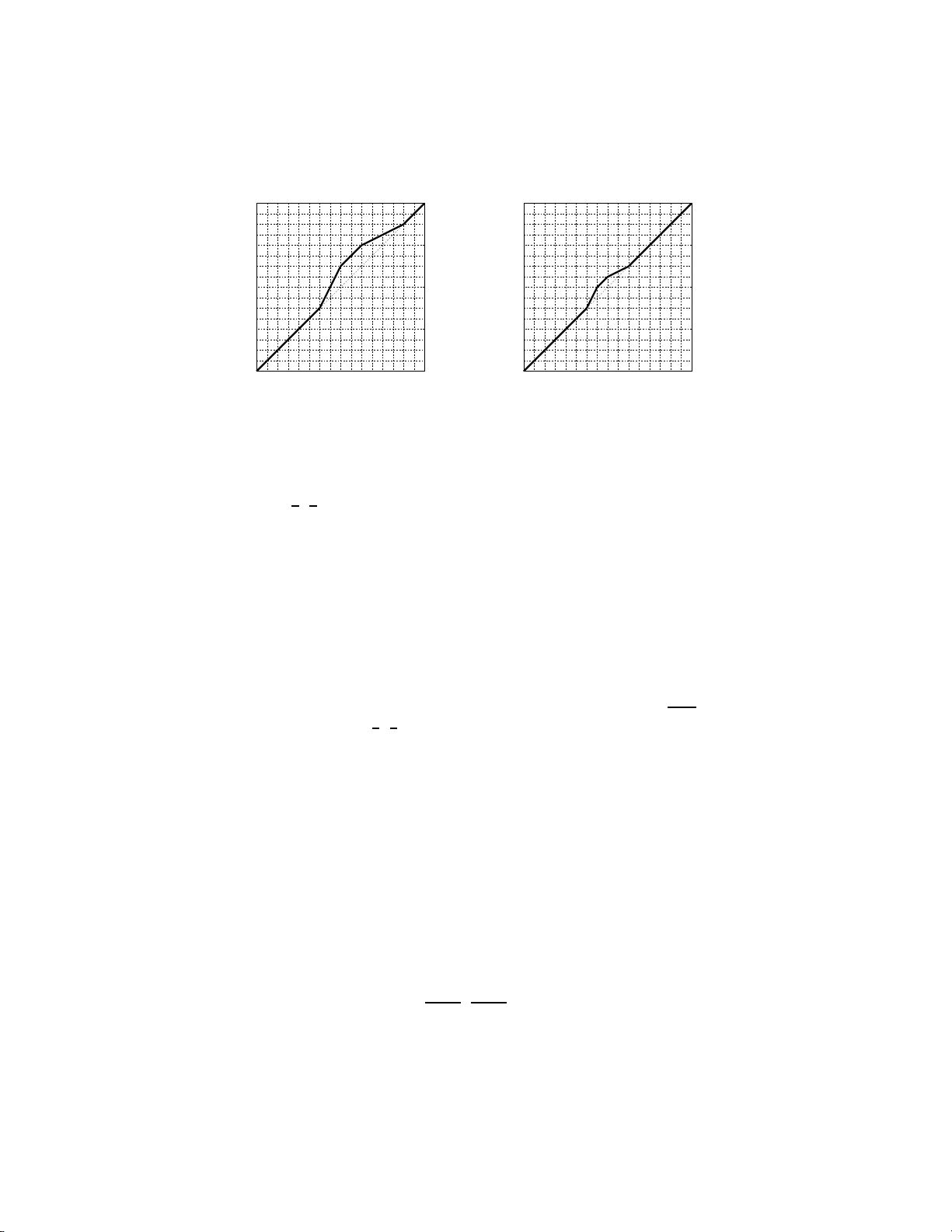
Finite Index Subgroups of R. Thompson’s Group F Collin Bleak and Bronlyn W assink ABST A CT: The a uthors classify the finite ind ex su bgroups of R . Thomp- son’s g roup F . All suc h group s that are not isomorphic to F are n on-split extensions of finite c yclic groups by F . Th e classification describ es p recisely whic h finite index s u bgroups of F are isomorphic t o F , and also separates the isomorphism classes of the fin ite index subgroups of F whic h are not iso- morphic to F from eac h other; c haracterizing th e structure of the extensions using the structure of the finite in dex subgroups of Z × Z . 1 In tro duction In this p ap e r, w e classify the finite index s ubgroups of R. Thompson’s group F . By this c lassification, we are able to answ er Vic tor Guba’s Question 4.5 in the problems rep ort [7]. The group F w as in tro du ced b y R. Thompson in the late 1960’s as part of a family of groups F ≤ T ≤ V . It has b een the ob ject of m uc h study , and it’s theory has imp acted v a rious fields of mathematics, including not only the theory of infinite group s, but also lo w-dimensional top ology , simple homot opy theory , measure th eory , and ev en catego ry theory . An in tro ductory reference to the theory of F , T , and V is t he surv ey pap er [6]. The main c haract erization of F that w e will use is that it is the group of all piecewise-linear, orien tatio n-pr eservin g homeomorphism s of the un it in terv al whic h admit fi nitely m any br eaks in slop e, w here these breaks are restricted to o ccur ov er the d iadic rationals Z [1 / 2], and wh ere all slop es of affine segmen ts of the graphs of these elements are integral p ow ers of t w o. W e will also use some of the standard pr esentati ons for F in our analysis, whic h present ations will b e giv en in the next section. W e will use the n otatio n F I F to represent the set of all fin ite index subgroups of F . In ord er to state our results in full, we will need to b uild a s p ecific homomorphism. Giv en f ∈ F , we will d enote the deriv ativ e of f at x b y f ′ ( x ), if it exists. W e will also defi ne f ′ (0) to b e the deriv ativ e from the righ t at 0, and f ′ (1) 1 to b e the deriv ativ e from the left at 1. Note that these last t w o deriv ativ es alw a ys exist as elemen ts of F are affine near 0 a nd 1 in (0 , 1). W e no w define a w ell kno wn homomorphism φ : F → Z 2 b y the rule φ ( f ) = (log 2 ( f ′ (0)) , log 2 ( f ′ (1))) for all f ∈ F . By a standard fact in the literature of F (Theorem 4.1 from [6]), the group commutato r subgroup F ′ of F consists of pr ecisely the eleme nts in F with leading and trailing slop es one, that is, F ′ is the k ernel of the map φ . Giv en tw o p osit iv e in tegers a and b , we define ˜ K ( a,b ) = h ( a, 0) , (0 , b ) i ≤ Z 2 . W e no w define K ( a,b ) = φ − 1 ( ˜ K ( a,b ) ) . In particular, K ( a,b ) can b e though t of as the group of all elemen ts in F with graphs h a ving slop es n ear zero as in tegral p o we rs of 2 a while at th e same time h aving slop es near one as in tegral p ow ers of 2 b . W e w ill call an y su c h K ( a,b ) ≤ F a r e ctangular sub gr oup of F , or simply a r e ctangular gr oup . W e will also r efer to th e groups ˜ K ( a,b ) ≤ Z 2 as rectangular grou p s, wher e the con text will mak e clear whic h sort of rectangular groups we are r efering to. W e are no w r eady to giv e an explicit list of our results. Our fir s t theorem is a corollary of our last th eorem, but as w e will prov e it earlier in the pap er in a direct fashion, w e will list it here as a s tand -alone result. Theorem 1.1 L et H ∈ F I F . H is isomor phic to F i f and only if H = K ( a,b ) for some p ositive i nte gers a and b . Giv en p ositiv e integ ers a and b , it is immediate that F /K ( a,b ) ∼ = Z a × Z b , in particular w e ha v e the follo win g theorem. Theorem 1.2 Given any p ositive inte gers a and b , F c an b e r e gar de d as a non-split extension of Z a × Z b by F . In p articular, ther e ar e maps ι and τ so that the fol lowing se qu e nc e is exact. 1 / / F ι / / F τ / / Z a × Z b / / 1 . W e w ill pro ve tw o fur ther theorems. Before stating them, we mentio n some key lemmas, and build some language that will help w ith th e state- men ts of the theorems. Lemma 1.3 If H ∈ F I F then F ′ ≤ H . 2 Once the pr evious lemma is established, it is not hard to come to the follo win g lemma. Lemma 1.4 If H ∈ F I F then H P F . No w , the ab ov e lemmas assure us that we can analyze all of the fin ite index subgroups of F by c onsiderin g the finite index subgroups of Z 2 . W e h a ve one fu rther lemma, whic h will assist us in our statemen ts b elo w. Lemma 1.5 Supp ose H ∈ F I F . Ther e exist r e ctangular gr oups Inner( H ) and Outer( H ) so that Inner( H ) is a unique maximal r e ctangular sub gr oup in H and O uter( H ) a unique minimal r e ctangular gr oup c ontaining H . In p articular, if H ∈ F I F , then we hav e the follo wing list of con tainment s (where the first t wo are equalitie s in the case that H is a rectangular group). Inner( H ) P H P O uter( H ) P F W e are no w in a p osition to stat e our next theorem. Theorem 1.6 1. The map φ induc es a one-one c orr esp ondenc e b etwe en the finite index sub gr oups of F and the finite index sub gr oups of Z 2 . 2. Supp ose H is a finite index sub gr oup of F , with image ˜ H = φ ( H ) ≤ Z 2 , and that a and b ar e p ositive inte gers so that Inner H = K ( a,b ) ≤ H . If Q = ˜ H / ˜ K ( a,b ) , then Q is finite cyclic , and ther e ar e maps ι , ρ , ˜ ι and ˜ ρ so that the diagr am b elow c ommutes with the two r ows b eing exact: F ∼ = 1 / / K ( a,b ) ι / / φ | K ( a,b ) H ρ / / φ | H Q / / 1 1 / / ˜ K ( a,b ) ˜ ι / / ˜ H ˜ ρ / / Q / / 1 . The essence of the ab o v e theorem is that in Z 2 , eac h finite index su b- group ˜ H is a finite cyclic extension (b y Q ab ov e) of th e m aximal rectangular subgroup of ˜ H . The extension p ulls bac k, so that the finite index subgroup H of F can b e seen as a finite cyclic extension of the maximal rectangular group K ( a,b ) in H b y the same group Q . Whenev er Q is non-trivial, the 3 resulting extension is non-split and results in a group that is n ot isomorph ic with F . W e will giv e sev eral examples at the end of the pap er where Q ab o v e is non-trivial, that is, examples of fi nite in dex sub groups of F wh ic h are not isomorphic to F . W e defi ne Res: F I F → N , where w e u se th e r u le H 7→ n , where n is the cardinalit y of H / I nner( H ). W e will call the v alue n in the last sentence the r esidue of H . It tu rns out the relationship b et w een a fin ite index su bgroup of F and its maximal rectangular su bgroup is very sp ecial. W e sho w th e follo wing lemma. Lemma 1.7 Supp ose H , H ′ ∈ F I F , K = Inner( H ) , K ′ = In ner( H ′ ) , and ξ : H → H ′ is an isomorphism. Then 1. ξ ( K ) = K ′ 2. K is char acteristic in H and K ′ is char acteristic in H ′ , and 3. Res( H ) = Res( H ′ ) . Note that in the ab o v e, the second t wo p oint s follo w easily from the first. F or conv enience, giv en a , b p ositiv e intege rs, let us fix a p articular iso- morphism τ ( a,b ) : K ( a,b ) → F , so that if f ∈ K ( a,b ) with φ ( f ) = ( as, bt ) then φ ( τ ( a,b ) ( f )) = ( s, t ). (W e note that these are the p r ecise s orts of iso- morphisms w hic h w e build in the p ro of of Th eorem 1.1.) W e also need to name the isomorp h ism Rev: F → F whic h is obtained if w e conjugate th e elemen ts of F b y the orien tation-rev ersing m ap rev: [0 , 1] → [0 , 1] defined b y the equation rev( x ) = 1 − x . W e are no w ready to state our final theorem. Theorem 1.8 Supp ose H , H ′ ar e finite index sub gr oups of F . L et a , b , c , d b e p ositive inte gers so that K ( a,b ) = O uter( H ) , K ( c,d ) = Outer( H ′ ) . H is isomorph ic with H ′ if and only if τ ( a,b ) ( H ) = τ ( c,d ) ( H ′ ) or τ ( a,b ) ( H ) = Rev( τ ( c,d ) ( H ′ )) . These inv estigations were started when J im Belk ask ed the fir st author if he knew whether or not [the group we call K (2 , 2) ] is isomorphic to F . The app r oac h tak en in this p ap er wa s motiv ated by the pro of of Brin’s ubiquity result (see [2]), wh er e Brin sho ws that a sub group of th e full group of p iecewise-linea r, orienta tion-preserving homeomorphisms of [0 , 1] con tains a copy of R. Thompson’s grou p F if certain w eak geometric conditions are satisfied. 4 W e are una w are of an y pub lished r esults relating to our o wn wo rk here. Ho wev er, Bur illo, Cleary and R¨ ov er, in the course of their in v estigations int o the abs tract commensurator of F , and usin g tec hniques different from our o w n, ha v e also u ndersto o d the one-one corresp ondence b etw een the fi nite index su bgroups of Z 2 and the finite index su bgroups of F . Also, th ey h a ve the result that the rect angular subgroups of F are isomorp hic to F . See [5]. The authors wo uld lik e to thank Matt Brin for interesting discussions of these results, and also for some ob s erv ations and questions whic h h elp ed us to refine the resu lts. Also, the fir st author w ould like to thank J im Belk for asking the initial question that lead to this w ork, and to thank Mark Brittenham, Ken Brown, Ross Geoghegan, S usan Hermiller, and Joh n Meakin for in teresting con versations ab out these results. 2 Definitions and Notation Ric h ard T hompson’s Group F can also describ ed by the follo win g p resen ta- tions. F ∼ = h x 0 , x 1 , x 2 , ... | x x i j = x j +1 for i < j i F ∼ = h x 0 , x 1 | [ x 0 x − 1 1 , x x 0 1 ] = [ x 0 x − 1 1 , x x 2 0 1 ] = 1 i where a b = b − 1 ab and [ a, b ] = aba − 1 b − 1 . In these presentat ions, th e generators x 0 and x 1 can b e realized as piecewise-linear homeomorphisms of the u n it interv al w ith b reaks in slop e o ccurring ov er the d iadic r ationals, and with all slop es b eing in tegral p ow- ers of t w o (that is, as elemen ts of F using the defin ition of F as a group of homeomorphisms of the unit int erv al). W e establish the mechanism of sp ecifying an y such f unction by listing the p oint s in its graph wh ere slop e c hanges. W e will call suc h p oints br e aks , so that w e will sp ecify an elemen t of F by listing its set of br eaks. Let f 0 b e the eleme nt with breaks { (1 / 4 , 1 / 2) , (1 / 2 , 3 / 4) } and let f 1 b e the element with b r eaks { (1 / 2 , 1 / 2) , (5 / 8 , 3 / 4) , (3 / 4 , 7 / 8) } . The functions f 0 and f 1 pla y the roles of x 0 and x 1 in the pr esen tations ab o v e. Here are the graphs of these functions. 5 f 0 f 1 Note that in the ab ov e, comp osition and ev aluation of functions in F will b e w ritten in wo rd order. In other words, if f , g ∈ F and t ∈ [0 , 1] , then, tf = f ( t ), f g = g ◦ f , and f g = g − 1 f g = g ◦ f ◦ g − 1 . One can c h ec k, using the con ven tion ab o v e, that f 0 ∼ x 0 and f 1 ∼ x 1 satisfy the relev ant relations from the second pr esentati on. It is w ell kno wn that the second presen tation is derived from the fir st (see [6] Theorem 3.4). The fact that f 0 and f 1 generate all of the claimed functions in F (as a group of h omeomorphisms) is Corollary 2.6 in [6]. (Note that our functions f 0 and f 1 are the in verses of the h omeomorphisms they use.) Giv en a homeomorphism f : [0 , 1] → [0 , 1], we will denote by Su pp( f ) the supp ort of f , wehre we take th is set to b e the set of all p oints in [0 , 1] whic h are mo v ed by t he action of f . That is Supp( f ) = { x ∈ [0 , 1] | xf 6 = f } . (Note that this is different from the defi nition used in analysis, wh ere a closure is tak en.) The fact that elemen ts of F hav e piecewise-linear graphs that admit only finitely many breaks in slop e immediately implies that if f ∈ F , then Supp( f ) is a finite union of disj oint op en in terv als. W e will call eac h o f these disjoin t op en int erv als an orbital of f . 3 Previous Results Here w e ment ion sev eral lemmas necessary for our p ro of wh ose statemen ts and p r o ofs are spread throughout the literature. (If we do not giv e an indication of where a lemma may b e foun d in the literature, th en the lemma is s tand ard and s imple, and its pro of ma y b e taken as an exercise for the reader.) 6 Lemma 3.1 If f and g ar e set func tions wher e the supp ort of f is disjoint fr om the supp ort of g , then f and g c ommute. Lemma 3.2 L et g , f ∈ F . L et H b e the sub gr oup of F that is gener ate d by f and g and define Supp( H ) = { x ∈ [0 , 1] | xh 6 = x for some h ∈ H } . Then, S upp( H ) = S u pp( g ) ∪ Supp( f ) . The first p oint in the follo wing lemma is essentia lly standard from th e theory of p ermuta tion group s. It is stated (basic f act (1.1.a)) in a general form in [4]). The seco nd p oin t is Remark 2.3 i n [1]. Lemma 3.3 L et f ∈ F and let g ∈ Home o ([0 , 1]) b e any home omorphism of the unit interval. F urther supp ose that ( a 1 , b 1 ) , ( a 2 , b 2 ) , . . . , ( a n , b n ) ar e the orbitals of f . Under these assumptions 1. the orbitals of f g ar e exactly ( a 1 g , b 1 g ) , ( a 2 g , b 2 g ) , . . . , ( a n g , b n g ) , and 2. if g is orientation-pr eserving and pie c ewise-line ar then for every i , the derivative fr om the right of f at a i e quals the derivative fr om the right of f g at a i g and the derivative fr om the left of f at b i e quals the derivative fr om the left of f g at b i g . The first part of th e follo wing lemma is immediate from th e definitions, while the second part is essentiall y a restatemen t of Lemma 3.4 in [4]. Lemma 3.4 If ( a, b ) i s an orbital of f ∈ F and if c ∈ ( a, b ) , then 1. for al l m ∈ Z , cf m ∈ ( a, b ) and 2. for any ε > 0 , ther e is an n ∈ Z so that b oth a < cf n < a + ε and b − ε < cf − n < b . Giv en a group G of orienta tion preserving homeomorphisms of [0 , 1], a set X ⊂ [0 , 1], and a p ositiv e intege r k , w e s a y that G acts k -tr ansitively over X if giv en an y t wo sets x 1 < x 2 < . . . < x k and y 1 < y 2 < . . . < y k of p oint s in X , there is a g ∈ G so that x i g = y i for all indices i . The follo wing are restatemen ts of Lemma 4. 2 and Theorem 4.3 f rom [6]. 7 Lemma 3.5 R. Thompson ’s gr oup F acts k -tr ansitively over the diadic r a- tionals in (0 , 1) , for al l p ositive i nte gers k . Lemma 3.6 F has no pr op er non-ab elian quotients. In particular, if w e can fin d an f and g where [ f g − 1 , g f ] = [ f g − 1 , g f 2 ] = 1 and f and g do not comm ute, then f and g generate a group that is isomor- phic to F . W e need t wo m ore stand ard f acts ab out F (this is a com bination of Theorems 4.1 and 4 .5 in [6]). Lemma 3.7 The g r oup F ′ = [ F , F ] , the c ommutato r sub gr oup of F , is sim- ple. F urthermor e, F ′ c onsists of al l of the functions f ∈ F such that b oth f ′ (0) = 1 and f ′ (1) = 1 . The final lemma is con tained in the second author’s thesis [9]. Lemma 3.8 If G ≤ F and G ∼ = F , then ther e ar e gener ators g 0 , g 1 ∈ G such that h g 0 , g 1 i = G , and for every orbital A of g 0 , if B is an orbital of g 1 , then ei ther A ∩ B = ∅ or B ⊆ A . F urthermor e, for the same functions g 0 and g 1 as describ e d ab ove, if A = ( a 1 , a 2 ) is an orbital of g 0 but not g 1 and A is not disjoint fr om the supp ort of g 1 , then ther e is an ε > 0 such that either 1. g 0 and g 1 ar e e qual in the i nterval ( a 1 , a 1 + ε ) and ( a 2 − ε, a 2 ) is disjoint fr om the supp ort of g 1 , or 2. g 0 and g 1 ar e e qu al in the interval ( a 2 − ε, a 2 ) and ( a 1 , a 1 + ε ) is disjoint fr om the supp ort of g 1 . 4 Prop erties of the finite index subgroups of F Here w e derive some nice prop erties of the fin ite index subgrou p s of F . In particular, w e explore their relati onship s with F ′ , and we examine th e extent of their supp orts. W e b egin with a simple lemma a b out infinite simple groups. Lemma 4.1 Infinite simple gr oups do not admit pr op er sub gr oups of finite index. 8 Pr o of: Let G b e an infinite sim p le group and let H b e a fin ite index subgroup of G . The righ t cosets { H e, H g 2 , ..., H g n } form a set that G act s on b y m ultiplication on the righ t (here w e are denoting the iden tit y of G b y e ). The actio n indu ces a homomorphism from G to the symmetric group on n letters. Since the co domain of this homomorphism is a fin ite group, the ke rnel m ust b e non-trivial. Since G is simp le the kernel must b e all of G . No w, if n 6 = 1, then w e can assu me that H g 2 6 = H e = H . But no w H = H e = H · ( g 2 g − 1 2 ) = ( H g 2 ) · g − 1 2 = H g 2 (the last equalit y follo ws as the action is trivial). Th us, n = 1 and G = H . ⋄ Here w e ha v e the first lemma from the in tro d uction. Lemma 1.3 If H ≤ F is a finite index sub gr oup of F , then F ′ ≤ H . Pr o of: Let H b e a fi nite index su bgroup of F . The group H ∩ F ′ m ust b e finite ind ex in F ′ , which is an infi n ite simple group b y Lemma 3.7. No w, b y Lemma 4.1, F ′ ⊆ H . ⋄ W e can no w pro v e Lemma 1.4. Lemma 1.4 Supp ose H is a finite index sub gr oup of F , then H P F . Pr o of: Supp ose that H is not normal in F . Then there is an f ∈ F so that f − 1 H f 6 = H . In particular, there is an h ∈ H s o that f − 1 hf / ∈ H . Th is last implies that h − 1 ( f − 1 hf ) / ∈ H . But h − 1 f − 1 hf = [ h − 1 , f − 1 ] ∈ F ′ . Since Lemma 1.3 assures us that F ′ ⊆ H , we ha v e a con tradiction. ⋄ Also, w e are in a g o o d p osition to pro ve the follo wing. Lemma 1.5 Supp ose H is a finite index sub gr oup of F . Then ther e exists a unique maximal r e ctangular sub gr oup Inn er( H ) of H and a unique minimal r e ctan- gular gr oup Outer( H ) c ontaining H . Pr o of: Let H b e a finite index subgroup F and supp ose K ( a,b ) ≤ H and K ( c,d ) ≤ H . Le t r = gcd( a, c ) and s = gcd( b, d ). W e can u se a fin ite pro d uct of elemen ts fr om K ( a,b ) anf K ( c,d ) to bu ild an elemen t f w ith φf = ( r , 0), and lik ewise, we can build an elemen t g w ith φ ( g ) = (0 , s ). No w, usin g Lemma 1.3 it is immediate that K ( r ,s ) ≤ H . In particular, any finite in dex su bgroup of F h as a unique, maximal rectangular subgroup. 9 F = K (1 , 1) is a rectangular su bgroup of F whic h con tains H , and it is easy to see that the in tersection of any t wo r ectangular s u bgroups of F is again a rectangular su bgroup of H , in particular, the in tersection of all of the rectangular s u bgroups of F w hic h con tain H pro du ces a unique minimal rectangular group con taining H . ⋄ W e now pass to some further us efu l lemmas not mentioned in the intro- duction. Lemma 4.2 If H is finite index i n F , then 1. Sup p( H ) = (0 , 1) , and 2. ther e ar e h 1 , h 2 ∈ H so that Sup p( h 1 ) = ( b, 1) and Sup p( h 2 ) = (0 , a ) , for some 0 < a ≤ 1 and 0 ≤ b < 1 . Pr o of: (1) By the pro of of Lemm a 1.4, F ′ ≤ H , and Supp( F ′ ) = (0 , 1). (2) Supp ose that for all h ∈ H , h ′ (1) = 1. Then, for all g k ∈ H f k 0 , ( g k ) ′ (1) = 1 2 k . In particular, w e ha v e just found infi n itely many distinct righ t cosets of H in F . A similar argumen t sho ws there is an h ∈ H with Supp( h ) = (0 , a ). ⋄ 5 Finite Index Subgroups of F that are Isomorph ic to F Consider t he functions g 0 and g 1 sp ecified b y their s ets of b r eaks as follo ws: g 0 has breaks 3 8 , 3 8 , 1 2 , 5 8 , 5 8 , 3 4 , 7 8 , 7 8 g 1 has breaks 3 8 , 3 8 , 7 16 , 1 2 , 1 2 , 9 16 , 5 8 , 5 8 These functions ha ve graphs as below. 10 g 0 g 1 Lemma 5.1 L et g 0 and g 1 b e the functions in F that ar e define d ab ove. Then h g 0 , g 1 i 1. c onsists of e very element of F whose su pp ort is c ontaine d in the in- terval [ 3 8 , 7 8 ] , and 2. is isomorphic with F . Pr o of: W e only need sh o w the firs t p oint . Th e second p oint will th en follo w since b y Lemma 4.4 in [6] the subset of elemen ts of F with supp ort in [ a, b ] where a and b are diadic rationals with b − a an int egral p o w er of tw o is conjugate b y a linear homeomorphism of R to prod uce exactly F . W e explicitly build the linear conjugator of Le mma 4.4 in [6]. Consider the homeomorphism ω : R → R defined by t 7→ 8 t − 3 4 . Th is homeomorphism sends [ 3 8 , 7 8 ] linearly to [0 , 1], and it induces an isomorp hism ψ : h g 0 , g 1 i → H for some subgroup H ≤ H omeo ( R ). (Here, w e are con- sidering element s of F to b e homeomorphism s from R to R , by us ing the unique extension of an y el ement of F by the identit y map a w a y from [0 , 1]). The fun ction ψ can b e though t of as a r estriction of the inner automorph ism of H omeo ( R ) pro d uced b y conjugation b y ω . F r om here out, w e will refer to h g 0 , g 1 i as Γ. If we restrict ψ less (p oten tially , dep ending on th e size of Γ), and take the preimage of F under ψ − 1 , then Lemma 4.4 in [6] tells u s that ψ − 1 ( F ) = Υ ∼ = F , where Υ consists of all graphs of F with supp ort in [3 / 8 , 7 / 8]. Since ω is linear, we can un derstand ψ by consid ering how the map ω mo v es th e breaks of any element in h g 0 , g 1 i . If ( p i , q i ), 1 ≤ i ≤ n , are the breaks of g ∈ h g 0 , g 1 i , then g ψ is the u nique p iecewise-li near elemen t of H omeo ( R ) w h ose breaks are ( 8 p i − 3 4 , 8 q i − 3 4 ) w h ic h acts as the identi t y n ear ±∞ . 11 No w , one can c hec k dir ectly that g 0 ψ = f 0 and g 1 ψ = f 2 0 f − 1 1 f − 1 0 . S o h g 0 ψ , g 1 ψ i = h f 0 , f 2 0 f − 1 1 f − 1 0 i = h f 0 , f − 2 0 ( f 2 0 f − 1 1 f − 1 0 ) f 0 i = h f 0 , f − 1 1 i = h f 0 , f 1 i = F . In particular, ψ (Γ) = F , hence Υ = Γ, and Γ ∼ = F . ⋄ g 0 ψ g 1 ψ W e are no w ready to prov e the fir st of our main theorems. F or the follo win g, w e need to recall the K ( a,b ) groups: K ( a,b ) = n h ∈ F | ∃ m, n ∈ Z s.t. h ′ (0) = (2 a ) n and h ′ (1) = (2 b ) m o where b oth a and b are non-zero inte gers. Theorem 1.1 L et H b e a finite i ndex sub gr oup of F . H is isomorphic to F if and only if H = K ( a,b ) for some a, b ∈ N . Pr o of: ( ⇐ =): Fix a and b in N . W e will build generators y 0 and y 1 for for K ( a,b ) . First, we will define y 0 ∈ K ( a,b ) o ver a fi nite collection of p oin ts as follo ws: If a = 1, then let ( a 1 , b 1 ) = ( 1 16 , 1 8 ). If a 6 = 1, then let ( a 1 , b 1 ) = ( 1 2 2 a , 1 2 a ). Let ( a 2 , b 2 ) = ( 1 8 , 3 8 ). Let ( a 3 , b 3 ) = ( 5 8 , 7 8 ). If b = 1, then let ( a 4 , b 4 ) = ( 7 8 , 15 16 ). If b 6 = 1, then let ( a 4 , b 4 ) = (1 − 1 2 b , 1 − 1 2 2 b ). Filling in the definition of y 0 . Extend the definition of y 0 b y making it linear from (0 , 0) to ( a 1 , b 1 ), affine and with slop e one fr om ( a 2 , b 2 ) to ( a 3 , b 3 ), an d affin e from ( a 4 , b 4 ) to (1 , 1). All slop es inv olv ed so f ar are integ ral p ow ers of tw o, and the set os a i ’s and b i ’s are all diadic r ationals, so y 0 still has the p oten tial to b e extended to an elemen t of F . W e can now pic k some diadic rational pairs ( c 1 , d 1 ) and ( c 2 , d 2 ) with a 1 < c 1 < c 2 < a 2 and b 1 < d 1 < d 2 < b 2 so that the ratio s d 1 − b 1 c 1 − a 1 and b 2 − d 2 a 2 − c 2 12 b oth pro d uce integral p o w ers of 2 (not equal to the v alues of the slop e of y 0 near zero, or to th e v alue 1, the slop e of y 0 o ver ( a 2 , a 3 )), and where the line segmen ts from ( a 1 , b 1 ) to ( c 1 , d 1 ) and f rom ( c 2 , d 2 ) to ( a 2 , b 2 ) (whic h w e will b e adding to th e defi nition of y 0 ) d o not cross th e line y = x . W e can no w extend the d efinition of y 0 from 0 to c 1 and from c 2 to a 3 so that ov er eac h in terv al, y 0 admits pr ecisely one br eakp oin t (o ve r a 1 and a 2 resp ectiv ely), and the graph of y 0 determined so far sta ys well ab o v e the line y = x . By Lemma 3.5, there is an element ζ of F which sen ds the list of p oint s (0 , a 1 , c 1 , c 2 , a 2 , a 3 , a 4 , 1) to the list (0 , b 1 , d 1 , d 2 , b 2 , b 3 , b 4 , 1). Assume w e hav e previously expanded these lists as necessary with many diadic p oint s im b et wee n c 1 and c 2 and corresp ond ingly man y diadic p oin ts b etw een d 1 and d 2 , (all new p oints roughly eve nly spaced out) so that the graph of ζ cannot in tersect the line y = x . W e can no w d efine y 0 o ver the inte rv al ( c 1 , c 2 ) to agree w ith ζ . The elemen t y 0 is now defined ov er th e interv als (0 , a 3 ) and ( a 4 , 1). W e can fill in the definition of y 0 with similar care o ver the region ( a 3 , a 4 ) (c h o ose diadics c 3 and c 4 with a 3 < c 3 < c 4 < a 4 in a fashion similar to our c hoices of c 1 and c 2 , then connect ov er the region ( c 3 , c 4 ) by some random appropriate element of F which do es not touc h the line y = x ) to finally get an elemen t y 0 in F which 1. is linear o v er (0 , a 1 ), ( a 2 , a 3 ), and ( a 4 , 1), and 2. has breakp oints in cluding ( a 1 , b 1 ), ( a 2 , b 2 ), ( a 3 , b 3 ), and ( a 4 , b 4 ), and 3. do es not in tersect the line y = x . Note that while y 0 is defined ev erywh ere, it is not complete ly determined o ver ( c 1 , c 2 ), and it is not completely determined o ve r the similar interv al ( c 3 , c 4 ) in ( a 3 , a 4 ) (although it is roughly controll ed in b oth lo cations). Construct y 1 as follo ws : ty 1 = t : t ≤ 3 / 8 2 t − (3 / 8) : 3 / 8 ≤ t ≤ 5 / 8 ty 0 : 5 / 8 ≤ t ≤ 1 sub-claim 1.1.1: K ( a,b ) E F . Pr o of of 1.1.1: Let g , h ∈ K ( a,b ) . S u pp ose g ′ (0) = (2 a ) m and h ′ (0) = (2 a ) n . Since all elements of F are linear in a neigh b orh o o d of 0, then the c hain r ule for deriv ative s from the right app lies. I n particular ( g h ) ′ (0) = 13 (2 a ) m + n . S im ilarly , ( g h ) ′ (1) = (2 b ) p + q , where g ′ (1) = (2 b ) p and h ′ (1) = (2 b ) q . So K ( a,b ) is a subgroup of F . Let f ∈ F . F rom Lemma 3.3, it m ust b e the case that ( g f ) ′ (0) = (2 a ) m and ( g f ) ′ (1) = (2 b ) p . So g f ∈ K ( a,b ) . Th us K ( a,b ) E F . sub-claim 1.1.2: K ( a,b ) is a finite i nd ex subgroup of F. Pr o of of 1.1.2: Let f ∈ F . The slop e of f n ear 0 is 2 p and the slopes of elemen ts of K ( a,b ) near 0 is 2 an for n ∈ Z . Then the s lop es of elemen ts of f K ( a,b ) near 0 is 2 an + p . The division algorithm gives us that since n ∈ Z , there are exactly a different cosets of K ( a, 1) . Similarly , ther e are exactly b differen t co sets for K (1 ,b ) . Since K ( a,b ) = K ( a, 1) ∩ K (1 ,b ) , th en are at most ab distinct cosets for K ( a,b ) in F . sub-claim 1.1.3: Y = h y 0 , y 1 i ∼ = F . Pr o of of 1.1.3: y 0 and y 1 ha v e b een constru cted sp ecifically to h a ve orbitals of certain pro du cts of these functions to b e disjoint. Since y 0 | [ 5 8 , 1] = y 1 | [ 5 8 , 1] , and as b oth fun ctions ha v e graphs ab o ve the line y = x in this region, it must b e the case that Sup p( y 0 y − 1 1 ) = (0 , 5 8 ). By Lemma 3.3, Supp( y y 0 1 ) = ( 5 8 , 1) and Su pp( y y 2 0 1 ) = ( 7 8 , 1). By Lemma 3.1, [ y 0 y − 1 1 , y y 0 1 ] = 1 and [ y 0 y − 1 1 , y y 2 0 1 ] = 1. y 0 and y 1 do not comm ute b ecause 1 4 y 0 y 1 y − 1 0 y − 1 1 = 1 2 y 1 y − 1 0 y − 1 1 = 5 8 y − 1 0 y − 1 1 = 3 8 y − 1 1 = 3 8 6 = 1 4 . So then b y Lemma 3.6, Y ∼ = F . sub-claim 1.1.4: Y = h y 0 , y 1 i = K ( a,b ) . Pr o of of 1.1.4 : Note that y ′ 1 (0) = 1, y ′ 1 (1) = y ′ 0 (1), y ′ 0 (0) = ( (1 / 8) (1 / 16) = 2 1 if a = 1 (1 / 2 a ) (1 / 2 2 a ) = 2 a if a > 1 and y ′ 0 (1) = ( (1 / 16) (1 / 8) = 2 − 1 if b = 1 (1 / 2 2 b ) (1 / 2 b ) = 2 − b if b > 1 . So y 0 and y 1 are b oth in K ( a,b ) and Y = h y 0 , y 1 i ⊆ K ( a,b ) . W e ha v e carefully co nstru cted y 0 and y 1 in suc h a w a y that even though there are t wo in terv als o ve r whic h y 0 is not explicitly kno wn , th e commutat or function [ y 0 , y 1 ] is complete ly d etermined. Let us demonstrate this p oint . Since y 0 | [5 / 8 , 1] = y 1 | [5 / 8 , 1] , then y 0 y 1 y − 1 0 y − 1 1 | [5 / 8 , 1] = 1. Since y 1 | [0 , 3 / 8] = 1 and 1 8 y 0 = 3 8 , then y 0 y 1 y − 1 0 y − 1 1 | [0 , 1 / 8] = 1. The follo wing line segmen ts are tak en linearly to eac h other. 1 8 , 1 4 y 0 7− → 3 8 , 1 2 y 1 7− → 3 8 , 5 8 y − 1 0 7− → 1 8 , 3 8 y − 1 1 7− → 1 8 , 3 8 . 14 1 4 , 3 8 y 0 7− → 1 2 , 5 8 y 1 7− → 5 8 , 7 8 y − 1 0 7− → 3 8 , 5 8 y − 1 1 7− → 3 8 , 1 2 . 3 8 , 5 8 y 0 7− → 5 8 , 7 8 Since y 1 y − 1 0 | [5 / 8 , 1] = 1, then y 0 y 1 y − 1 0 linearly maps 3 8 , 5 8 to 5 8 , 7 8 , whic h is tak en linearly b y y − 1 1 to [ 1 2 , 5 8 ]. No w y 0 y 1 y − 1 0 y − 1 1 con tains the straight line segmen ts from (0 , 0) to ( 1 8 , 1 8 ), from ( 1 8 , 1 8 ) to ( 1 4 , 3 8 ), fr om ( 1 4 , 3 8 ) to ( 3 8 , 1 2 ), fr om ( 3 8 , 1 2 ) to ( 5 8 , 5 8 ), and from ( 5 8 , 5 8 ) to (1 , 1). Since S upp([ y 0 , y 1 ]) = ( 1 8 , 5 8 ) and y 0 is explicitely known in the in terv al ( 1 8 , 5 8 ), then we can explicitely fin d [ y 0 , y 1 ] y 0 . Also, since Su p p([ y 0 , y 1 ] y 0 ) = ( 3 8 , 7 8 ) and y − 1 1 is explicitely kn o w n on ( 3 8 , 7 8 ), then [ y 0 , y 1 ] y 0 y − 1 1 can also b e computed. This computatio n giv es that [ y 0 , y 1 ] y 0 = g 0 and [ y 0 , y 1 ] y 0 y − 1 1 = g 1 , where g 0 and g 1 are the functions defined in the b eginning of Sectio n 5. So then by Lemma 5.1, h g 0 , g 1 i conta ins ev ery element of F that has supp ort inside the in terv al ( 3 8 , 7 8 ). Since g 0 and g 1 are pro d ucts of the funtio ns y 0 , y 1 ∈ K ( a,b ) , then Y and K ( a,b ) b oth conta in every element of F w hose su pp ort is con tained in the in terv al ( 3 8 , 7 8 ). Let h ∈ F ′ . By Lemma 3.7, th ere exists a c, d ∈ (0 , 1) so that Sup p( h ) ⊆ ( c, d ). By Lemma 3.4 , since Sup p( y 0 ) = (0 , 1), there is an n ∈ Z so that Supp( h y n 0 ) ⊆ ( 3 8 , dy n 0 ), where 3 8 < cy n 0 < dy n 0 < 1. By Lemma 3.4, s ince Supp( y 1 ) = ( 3 8 , 1), then there is an m ∈ Z so that 3 8 = 3 8 y m 1 < cy n 0 y m 1 < dy n 0 y m 1 < 7 8 and Sup p(( h y n 0 ) y m 1 ) ⊆ ( 3 8 , 7 8 ). By the previous argum ent, it must b e the case that h y n 0 y m 1 ∈ Y . So then h = ( h y n 0 y m 1 ) y − m 1 y − n 0 ∈ Y . So F ′ ⊆ Y . Let w ∈ K ( a,b ) . T here is an n, m ∈ Z s o that w ′ (0) = 2 an and w ′ (1) = 2 bm . Sin ce w , y 0 , and y 1 are all li near fu n ctions in a n eigh b orho o d s of 0 and 1, then the chain r ule giv es ( wy − n 0 ) ′ (0) = (2 an )(2 a ) − n = 1, ( wy − n 0 ) ′ (1) = (2 bm )(2 − b ) − n = 2 b ( m + n ) , ( w y − n 0 y m + n 1 ) ′ (0) = (1)(1) m + n = 1, and ( w y − n 0 y m + n 1 ) ′ (1) = 2 b ( m + n ) (2 − b ) m + n = 1. So wy − n 0 y m + n 1 ∈ F ′ ⊆ Y ⇒ w ∈ Y . Th us K ( a,b ) = Y ∼ = F . (= ⇒ ): Assume that H is a fin ite index subgroup o f F and H ∼ = F . By Lemm a 1.4, H E F . By Lemma 1.3, F ′ ≤ H so Sup p( H ) = (0 , 1). There exists f unctions h 0 and h 1 so that H = h h 0 , h 1 i that satisfy the conditions listed in Lemm a 3.8. One condition in Lemma 3.8 is if A is an orbital of h 0 and B is an orb ital of h 1 , then either B ⊆ A or B ∩ A = ∅ . This gu arantees that if p is a fixed p oint of h 0 , then p is also a fixed p oint 15 of h 1 . So then the p oin t p will b e a fixed p oint of th e group H . So p / ∈ supp( H ) = (0 , 1). So either p = 0 or p = 1 and Supp( h 0 ) = (0 , 1). Since h 0 is not th e identi t y near either 0 or 1, th en there exist non- zero inte gers a and b so that h ′ 0 (0) = 2 a and h ′ 0 (1) = 2 b . Lemma 3.8 also guaran tees that either h ′ 1 (0) = 1 and h ′ 1 (1) = 2 b or h ′ 1 (0) = 2 a and h ′ 1 (1) = 1. Without loss of generalit y , assume h ′ 1 (0) = 1 an d h ′ 1 (1) = 2 b . W e w an t to sho w that H = K ( a,b ) . ( ⊆ ) : h 0 ∈ K ( a,b ) and h 1 ∈ K ( a,b ) , so H = h h 0 , h 1 i ⊆ K ( a,b ) . ( ⊇ ) : Let f ∈ K ( a,b ) . So f ′ (0) = 2 an and f ′ (1) = 2 bm for some n, m ∈ Z . Then, by the c hain rule, ( f h − n 0 ) ′ (0) = (2 an )(2 a ) − n = 1 and ( f h − n 0 ) ′ (1) = (2 bm )(2 b ) − n = 2 b ( m − n ) . Also, ( f h − n 0 h n − m 1 ) ′ (1) = 1(1) n − m = 1 and ( f h − n 0 h n − m 1 ) ′ (1) = 2 b ( m − n ) (2 b ) n − m = 1. So then by Lemma 3.7, f h − n 0 h n − m 1 ∈ F ′ . S ince H E F , then F ′ ⊆ H . So f h − n 0 h n − m 1 ∈ H . So then f = f h − n 0 h n − m 1 h m − n 1 h n 0 ∈ H . So H = K ( a,b ) . ⋄ Theorem 1.2 Given any p ositive inte gers a and b , F c an b e r e gar de d as a non-split ex- tension of Z a × Z b by F . In p articular, ther e ar e maps ι and τ so that the fol lowing se quenc e is exact. 1 / / F ι / / F τ / / Z a × Z b / / 1 . Pr o of : Th is theorem is actually an immed iate corollary to Theorem 1.1; simply tak e ι to b e the comp osition of the isomorph ism from F to K ( a,b ) with the inclusion map of K ( a,b ) in to F . ⋄ T o pro ve Th eorem 1.6, we will need to pro duce s ome analysis of the finite index subgroups of Z 2 . 6 Finite index subgroups of Z 2 In this sect ion we will pro ve t w o statemen ts ab out the finite index subgroups of Z 2 . While b oth of these state ments could b e take n as straigh tforwa rd exercises in an entry lev el graduate course in group theory , we will include the pro ofs for completeness. Lemma 6.1 Supp ose H is a finite index sub gr oup of Z 2 . Then ther e ar e minimal p ositive inte gers a a nd b so that ˜ K ( a,b ) ≤ H . F urther, if ˜ K ( c,d ) ≤ H then ˜ K ( c,d ) ≤ ˜ K ( a,b ) . 16 Pr o of: H is n ormal in Z 2 since Z 2 is ab elian. In particular, since H has finite index in Z 2 , the group T = Z 2 /H is fi nite. T h erefore, there is a m in imal p ositv e in teger a so that ( a, 0) ∈ H and a minimal p ositiv e integ er b so that (0 , b ) ∈ H . It is no w immediate that ˜ K ( a,b ) ≤ H . Supp ose ˜ K ( c,d ) ∈ H . Then ( c, 0) ∈ H . The Eu clidean Algorithm no w sho ws that ( j, 0) ∈ H , w here j = gcd( a, c ). If a ∤ c w e must h a v e that j < a , wh ic h con tradicts our c h oice of a . In particular, a | c and ( c, 0) ∈ h ( a, 0) i ≤ ˜ K ( a,b ) . A similar argument sho ws that (0 , d ) ∈ ˜ K ( a,b ) . Since ˜ K ( c,d ) is generated b y ( c, 0) and (0 , d ), w e ha v e that ˜ K ( c,d ) ≤ ˜ K ( a,b ) . ⋄ In the ab ov e lemma, we will call the group ˜ K ( a,b ) the maximal ˜ K gr oup in H . Lemma 6.2 Supp ose H is a finite index su b gr oup in Z 2 with maximal ˜ K gr oup ˜ K ( a,b ) . The gr oup Q ∼ = H / ˜ K ( a,b ) is finite cyclic. Pr o of: Thinking of Z 2 as a planar lattice, the p oints in H not in ˜ K ( a,b ) are the p oin ts which will surviv e under m o dding H out b y ˜ K ( a,b ) to b ecome non-trivial element s of Q . T hus, we can fi nd Q as a subgroup of p oints in the finite rectangular lattice L = Z a × Z b . F ur thermore, as a and b are minimal p ositiv e so that ( a, 0) ∈ H and (0 , b ) ∈ H , we must ha v e that the only intersectio n Q will ha v e with the v ertical axis in L (the p oint s of the form (0 , r )) or with the horizont al axis in L (the p oin ts of the form ( r , 0)) is at the point (0 , 0). In particular, supp ose ( r , s ) and ( t, u ) are p oint s in Q . If j ≡ gcd( r , t ), then w e can ag ain exp loit the Eu clidean Algorithm to find integ ers p and q so that p ( r , s ) + q ( t, u ) = ( j, m ) so that j divides b oth r and t . In Z a × Z b the p oint ( j, m ) ∈ Z 2 b ecomes ( j, m b ). No w there are p ositiv e intege rs x and y s o that x ( j, m b ) = ( r, xm b ) and y ( j, m b ) = ( t, y m b ). If xm b 6≡ s mo d b then Q h as an in tersection with the vertic al a xis in Z a × Z b a wa y from (0 , 0) and if y m b 6≡ u mo d b then Q has an intersect ion w ith the v ertical axis of Z a × Z b a wa y fr om (0 , 0). S ince neither of th ese intersect ions can exist, by the defin itions of a and b , we see that ( r , s ) and ( t, u ) ∈ h ( j, m b ) i in Q . In particular, after a finite induction w e see that Q is cyclic. ⋄ 7 The structure of the extension W e ha v e no w done enough w ork so that Theorem 1.6 is tr an s paren t. 17 Theorem 1.6 1. The map φ induc es a one-one c orr esp ondenc e b etwe en the finite i ndex sub gr oups of F and the finite index sub g r oups of Z 2 . 2. L et H b e a finite index sub g r oup H of F , with image ˜ H = φ ( H ) ≤ Z × Z . Ther e e xist smal lest p ositive inte gers a and b with K ( a,b ) ≤ H . F urthermor e, if Q = ˜ H / ˜ K ( a,b ) , then Q is finite cyclic, and ther e ar e maps ι , ρ , ˜ ι and ˜ ρ so that the diagr am b elow c ommutes with the two r ows b eing exact: F ∼ = 1 / / K ι / / φ | K H ρ / / φ | H Q / / 1 1 / / ˜ K ˜ ι / / ˜ H ˜ ρ / / Q / / 1 . Pr o of: The first p oin t follo ws f rom Lemma 1.3 and the fact that the k ernel of φ is F ′ . The second p oin t follo ws from a conglo meration of lemmas. The existence of minimal p ositiv e in tegers a and b (so that K ( a,b ) is maximal in H ) follo ws from the existence of a maximal ˜ K ( a,b ) in ˜ H , whic h is lemma 6.1. The fact that Q is fi nite cycli c comes from Lemma 6.2. The isomorphism from F to K = K ( a,b ) comes from Theorem 1. 1. The map ι is the inclusion map of K ( a,b ) in to H . The map ˜ ι is indu ced from the pro jection φ . the map ˜ ρ is the natural quotien t onto Q of the image of ˜ ι in ˜ H . T h e b ottom ro w is thus exact. ρ is the comp osition of the natur al quotien t of H b y the image of ι follo wed by the isomorphism from H /ι ( K ) to ˜ H / ˜ ι ( ˜ K ) = Q , th us, the top ro w is exact , and the diagram comm u tes. ⋄ T o p ro v e L emm a 1.7 we will make use of Rubin’s Theorem. The ve rsion w e will quote is T heorem 2 in Brin’s pap er [3]. That v ersion is itself deriv ed from Th eorem 3.1 in the pap er [8] of Rubin , where in th e statemen t of the theorem, a tec hnical hyp othesis is inadv ertently missing (see th e discussion of this in [3]). In order to state Rub in’s Th eorem, w e will need to d efine some ter- minology . In this, w e generalize the language of the defin ition of lo c al ly 18 dense give n in Brin’s [3]. Ou r generalization will ha v e no imp act on the con ten t of our s tatement of Rubin’s theorem. Su pp ose X is a top ologica l space and H ( X ) is its full group of homeomorphisms. Sup p ose f urther that K ≤ H ( X ). Giv en W ⊂ X , w e will say K acts lo c al ly densely over W if for ev ery w ∈ W and ev ery op en U ⊂ W w ith w ∈ U , the closure of wκ | κ ∈ K, κ | ( W − U ) = 1 ( W − U ) con tains some op en set in W . In particular, for eac h op en U in Z , the subgroup of eleme nts fi xed a w a y from U has ev ery orbit in U d ense in some op en set of W in U . W e are now r eady to state Rubin’s theorem. W e giv e essential ly the statemen t giv en in [3], although we recast it in th e language of r igh t actions. Theorem 7.1 (Rubin) L et X and Y b e lo c al ly c omp act, Hausdorff top o- lo g ic al sp ac es without isolate d p oints, L e t H ( X ) and H ( Y ) b e the self home- omorph ism gr oups of X and Y , r esp e ctively, and let G ⊆ H ( X ) and H ⊆ H ( Y ) b e sub gr oups. If G and H ar e isomorphic and b oth act lo c al ly densely over X and Y , r esp e ctively, then for e ach isomo rphism ϕ : G → H ther e is a unique home omorph ism γ : X → Y so that for e ach g ∈ G , we have g ϕ = γ − 1 g γ . In our case, an d to app ly Rubin’s theorem to F or sub groups of F , w e need to consider these groups to b e groups of homeomorphisms of (0 , 1), instead of [0 , 1]. This comes f rom the simple fact th at F do es not mo v e 0 or 1 to pro duce a dense image in any open set! Ha vin g made that (temp orary) change to our definition of F and its subgroups , we are ready to apply Rubin’s theorem to an y such sub grou p , as long as it is lo cally d ense in its ac tion on (0 , 1). In the d iscussion whic h follo w s , giv en X ⊂ R , we will use the notation D X to denote the set Z [1 / 2] ∩ X of d iadic ratio nals in X . Lemma 7.2 Finite index su b gr oups of F act lo c al ly densely on (0 , 1) . Pr o of: Supp ose H is fin ite index in F , and x ∈ (0 , 1) and U an op en neigh- b orho o d of x in (0 , 1). Let d 1 and d 2 b e t w o diadic rationals in U w ith d 1 < x < d 2 . let K b e the s u bgroup of F consisting of all the elemen ts of F with sup p ort in ( d 1 , d 2 ). Let α : R → R b e any piecewise-linear homeo- morphism which is the identit y n ear ± ∞ an d whic h has all slop es integ ral p o we rs of 2, and with all b reaks o ccuring o v er the diadic rationals, and that 19 maps d 1 to 0 and d 2 to 1. It is easy to build such a map, and the r eader ma y c hec k th at the inner automorphism of Homeo( R ) generated by conjugatio n b y α will tak e K isomorp hically to F . No w by an induction argum en t (for instance, as carried out in the first paragraph of Section § 1. in [6]), it is easy to see that α take s D ( d 1 ,d 2 ) to D (0 , 1) in an ord er pr eservin g fashion. In particular, as F is k -transitiv e on D (0 , 1) for an y p ositiv e int eger k (recall Lemma 3.5), we see that K is k -transitiv e on D ( d 1 ,d 2 ) for an y p ositiv e in teger k . No w , if x is a diadic rational, then the orbit of x und er K is d ense in ( d 1 , d 2 ), as K acts transitiv ely o ve r D ( d 1 ,d 2 ) , and D ( d 1 ,d 2 ) is dens e in ( d 1 , d 2 ). If x is not diadic r ational, then give n any ǫ > 0, and an y y in ( d 1 , d 2 ), w e c an find four diadic rational s x 1 , x 2 , y 1 , y 2 ∈ ( d 1 , d 2 ) so that x 1 < x < x 2 and y 1 < y < y 2 , and where the y i are c h osen epsilon-close to y . No w there is some elemen t κ in K whic h thro ws x 1 to y 1 and x 2 to y 2 (since K is 2-transitiv e o v er D ( d 1 ,d 2 ) ). In particular, | y − xκ | < ǫ . Hence, the orb it of x is dense in ( d 1 , d 2 ). No w , as K ≤ F ′ ≤ H , H is lo cally dense o ver (0 , 1). ⋄ W e w ill use Rubin’s theorem to prov e the fi n al lemma f rom the in tro- duction. Lemma 1.7 Supp ose H , H ′ ∈ F I F , K = In ner( H ) , K ′ = Inner( H ′ ) , and ξ : H → H ′ is an isomorphism. Then 1. ξ ( K ) = K ′ 2. K is char acteristic in H and K ′ is char acteristic in H ′ , and 3. Res( H ) = Res( H ′ ) . Pr o of: First, let us supp ose ϑ : H → H ′ is an iso morph ism. By Lemma 7.2, H and H ′ b oth act lo cally d ensely on (0 , 1). I n particular, Rubin’s theorem tells us that th er e is a homeomorphism γ : (0 , 1) → (0 , 1) so that for an y h ∈ H , ϑ ( h ) = γ − 1 hγ ∈ H ′ . No w by Lemma 3.3, we see that the collection of orbitals of h ′ = ϑ ( h ) i s in bijectiv e corresp ondence with the orbitals of h . F u rther, if γ is orien tation-preserving, any orbital of h whic h has end e ∈ { 0 , 1 } b ecomes (und er the actio n of γ ) an orbital of h ′ with end e . If γ is orient ation-rev ersing, then an y orbital of h with end e ∈ { 0 , 1 } b ecomes an orbital of h ′ with end f 6 = e , where f ∈ { 0 , 1 } . 20 Since ϑ is a homomorphism, a consequence of the ab o v e paragraph is if K = K ( a,b ) for some p ositiv e int egers a and b , then there are p ositiv e in tegers c and d with ϑ ( K ) = K ( c,d ) ≤ K ′ ≤ H ′ . The corresp ondence theorem no w tells us that the maximal rectangular groups of H and H ′ are mapp ed precisely to eac h other by ϑ , and w e hav e p oint (1). The second t wo p oin ts follo w immediately . Note that this argument pro vides a second pr o of that amongst the fin ite index subgroup s of F , only the rectangular groups are actually isomorphic to F . ⋄ The lemma ab o ve pro vid es the key ingredien ts f or the p ro of of our fin al theorem. Recall the isomorph isms τ ( a,b ) : K ( a,b ) → F from the in tro du ction (ele- men ts of K ( a,b ) with slop e (2 a ) s near zero are tak en to elemen ts of F with slop e 2 s near z ero, and elemen ts of F with s lop e ( 2 b ) t near one are tak en to elemen ts of F with s lop e 2 t near one), and the map Ou ter w hic h, giv en a finite index su bgroup H of F , pro d u ces the smallest rectangular sub group of F th at cont ains H . With th ese maps in mind, and with t he ab ov e lemma in hand, w e are finally ready to p ro v e our last theorem. Theorem 1.8: Supp ose H , H ′ ar e finite index sub gr oups of F . L e t a , b , c , d b e p ositive inte gers so that K ( a,b ) = Ou ter( H ) , K ( c,d ) = Outer( H ′ ) . H is isomorphic with H ′ if and only if τ ( a,b ) ( H ) = τ ( c,d ) ( H ′ ) or τ ( a,b ) ( H ) = Rev ( τ ( c,d ) ( H ′ )) . Pr o of: Supp ose that ϑ : H → H ′ is an isomorph ism. Lemma 1.7 assures u s that there is a we ll defined p ositiv e in teger n so that Res( H ) = Res( H ′ ) = n , and ϑ ( K ) = K ′ . Let us fur ther supp ose that K ( r ,s ) = Inner( H ) and K ( t,u ) = Inner( H ′ ). Let ˜ H = φ ( H ), and ˜ H ′ = φ ( H ′ ). C onsider the translations of Z 2 gen- erated by ( r , 0) and (0 , s ). Since ˜ H is a group, the sets ˜ H , ˜ H + ( r , 0), and ˜ H + (0 , s ) are the s ame. In particular, w e can co nsider the image in the lat- tice Z 2 of ˜ H , restricting our view to the r ectangle R of p oin ts with integ er co ordinates where the h orizonta l co ord inates range from 0 to r − 1 and the v ertical co ordinates range from 0 to s − 1, and un derstand eve rythin g ab out the group ˜ H . ˜ K ( r ,s ) only inte rsects R at (0 , 0), while there a re n total in ter- sections of ˜ H with R , all obtained by translating different p o we rs of some particular vec tor ( p, q ) into R (using ( r , 0) and (0 , s )). Let j = gcd( p, r ). So, the lo w est column num b er that th e image of the tran s lated p o wers of 21 ( p, q ) in R will app ear in is col umn j . Since ˜ H in tersects R exactly n time s, it m ust b e that case that n j = r and the images of the translated p o w ers of ( p, q ) in R will o ccur in columns 0, r /n , 2 r /n , ... ,( n − 1) r /n . Similarly , gcd( q , s ) = s/n and the images of th e translated p ow ers of ( p, q ) in R w ill o ccur in ro ws 0, s/n , 2 s/n , ... ,( n − 1) s/n . No w, as ˜ K ( a,b ) is th e smallest rectangular group to con tain ˜ H , w e see that a = r /n and b = s/n . A similar discussion sho ws that c = t/n and d = u/n . Stated another w a y , we h a v e r a = s b = t c = u d = n. No w , consider the image of H and H ′ under the resp ectiv e maps τ ( a,b ) and τ ( c,d ) . The subgrou p s K ( r ,s ) = Inner( H ) and K ( t,u ) = Inner( H ′ ) are b oth tak en to K ( n,n ) . W e will no w assume that this is h o w H and H ′ started out, and do all remaining w ork in these scaled v ersions of H and H ′ . The isomorphism ϑ w hic h is carry in g H to H ′ m ust no w pr eserv e th e maximal rect angular sub group K ( n,n ) , by Lemma 1.7. By Lemma 7.2, b oth H and H ′ act locally densely on (0 , 1), so b y Rub in’s theorem there is a homeomorphism γ so that for an y h ∈ H , ϑ ( h ) = γ − 1 hγ ∈ H ′ . Note that as γ n eed not b e piecewise-linear, w e sh ould b e concerned that conjugating by γ might c h ange slop es, as we ll as p otent ially swapping co ordinates. By Lemma 1.7 we kno w that K ( n,n ) = Inn er( H ) = Inn er( H ′ ) is b eing brought isomorphically to itself b y ϑ . Supp ose h ∈ H has an orbital A . Denote by E A the set of ends of A wh ic h are in the set { 0 , 1 } . No w consider h ′ = ϑ ( h ). T h e elemen t h ′ has an orbital B = γ ( A ) by p oin t (1) of Lemma 3.3. Denot e by E B the ends of B that are actually in the set { 0 , 1 } . Th en as γ preserves the set { 0 , 1 } w e see that the cardinalities of E A and E B m ust b e the same. No w , b y the result of the previous paragraph, and usin g the f act that the ϑ tak es K ( n,n ) isomorphically to itself, w e see that if γ is orientati on- preserving, we must hav e that γ will s end ( n, 0) to ( n, 0) and (0 , n ) to (0 , n ) in the induced map from φ ( H ) → φ ( H ′ ) (note that ( n, 0) will not b e tak en to ( − n, 0), as conjugation b y an orien tation-preserving γ will p reserv e the lo cal directions th at p oints near zero and one mo v e und er the action of h ). Similarly , if γ is orien tation-rev ersing, then the reader can c h ec k that the action of γ will send ( n, 0) to (0 , n ) and (0 , n ) to ( n, 0), again consid ering the induced map from φ ( H ) → φ ( H ′ ). If γ is orienta tion-rev ersing, then replace H ′ b y the isomorph ic copy Rev ( H ′ ), so that fr om h ere out we only need to argue the case wher e our 22 isomorphism ϑ ap p ears to b e the id entit y after passing through the quotien t map φ . Supp ose f ∈ H . φ ( f ) = ( v , w ), if an d only if φ ( ϑ ( f )) = ( v , w ). But no w as H and H ′ b oth contai n the comm utator subgroup F ′ , and as they eac h con tain an elemen t which h as slop es 2 v and 2 w near zero and one resp ectiv ely , we see that b oth H and H ′ con tain all of th e elemen ts of F with φ ( k ) = ( v , w ). It is no w immediate that H = H ′ . No w let us supp ose that H and H ′ are finite index sub grou p s of F , and that K ( a,b ) = Outer( H ) and K ( c,d ) = Outer( H ′ ). Let us fu rther supp ose that the scaling maps τ ( a,b ) and τ ( c,d ) ha v e the prop ert y that τ ( a, b ) ( H ) = τ ( c, d ) ( H ′ ) or τ ( a,b ) ( H ) = Rev( τ ( c, d )( H ′ )). S ince the τ ( ∗ , ∗ ) maps are iso- morphisms, and the map Rev is an isomophism , we immediately see that H and H ′ are isomorphic. ⋄ 8 Some examples In this section, we giv e some examples of fin ite ind ex su bgroups of F , an d consider them from the pers p ectiv e of this pap er. Example 1: Let H = { f ∈ F | f ′ (0) = 2 3 n +5 m and f ′ (1) = 2 7 n +11 m for some m, n ∈ Z } . H is a finite index subgroup of F but H is not isomorphic to F . Let ˜ H = φ ( H ). Since 3 , 5 , 7 , and 11 are all o d d, the only p ossible elemen ts of ˜ H are (ev en , even) and (od d , o dd). If n = 5 and m = − 3, then (15 − 15 , 35 − 33) = (0 , 2) ∈ ˜ H . If n = − 11 and m = 7, then ( − 33 + 35 , − 77 + 77) = (2 , 0) ∈ ˜ H . So then every (eve n , even) is in ˜ H . If n = − 3 and m = 2, t hen (1 , 1) ∈ ˜ H . Since (1 , 1) a nd a ll (ev en , even) are in ˜ H , then all (od d , o d d) are also in ˜ H . So ˜ H is index 2 in Z ⊕ Z and H is index 2 in F . T o sho w that H is not isomorp hic to F , it is enough to show that H 6 = K ( a,b ) for an y non-zero in tegers a and b . Assume that for some non-zero inte gers a and b , H = K ( a,b ) . If h ∈ H , there are in tegers p and q such that φ ( h ) = ( ap, bq ). There is an f ∈ H so that φ ( f ) = (3 , 7). Th ere is a g ∈ H so th at φ ( g ) = (5 , 11). Now, there m ust b e in tegers p 1 and p 2 so that ap 1 = 3 and ap 2 = 5. Th us a = 1. Also, there must b e intege rs q 1 and q 2 so that bq 1 = 7 and bq 2 = 11. So b = 1. But K (1 , 1) = F 6 = H , so H can not b e isomorphic to F . ⋄ In the ab o v e example, note that the maximal ˜ K ( a,b ) group was ˜ K (2 , 2) , 23 whic h w as prop er in ˜ H , and that the quotien t ˜ H / ˜ K (2 , 2) ∼ = Z 2 . In particular, H is isomorphic to a non-split ext ension of F b y Z 2 , where the structure of the extension is describ ed by the structure of ˜ H as an extension of ˜ K (2 , 2) b y Z 2 . Example 2: Let l , r , f , f ′ ∈ F , so that φ ( l ) = (15 , 0), φ ( r ) = (0 , 15), φ ( f ) = (3 , 3), and φ ( f ′ ) = (3 , 6). Supp ose that H = h F ′ , l, r, f i while H ′ = h F ′ , l, r, f ′ i . W e see imm ed iately that th e maximal r ectangular subgroups of H and H ′ are K (15 , 15) . The minimal r ectangular s u bgroups of F conta ining H and H ′ are the same, namely K (3 , 3) . The residues of H and H ′ are b oth 5, but H and H ′ are not isomorphic, as τ (3 , 3) ( H ) 6 = τ (3 , 3) ( H ′ ) and τ (3 , 3) ( H ) 6 = Rev( τ (3 , 3) ( H ′ )). Belo w is included a diagram of the rectangle R in Z 2 whic h demonstrates this non-equalit y . 0 1 2 3 4 1 2 3 4 0 H H’ Example 3: Let l 1 , l 2 , r 1 and r 2 ∈ F so that φ ( l 1 ) = (10 , 0), φ ( l 2 ) = (35 , 0), φ ( r 1 ) = (0 , 15), and φ ( r 2 ) = (0 , 20). F u rther, let g 1 , g 2 ∈ F so that φ ( g 1 ) = (2 , 6) and φ ( g 2 ) = (14 , 4). Let H = h F ′ , l 1 , r 1 , g 1 i and let H ′ = h F ′ , l 2 , r 2 , g 2 i . It is immediate th at Inner H = K (10 , 15) , O u ter H = K (2 , 3) , In ner H ′ = K (35 , 20) , and Ou ter H ′ = K (7 , 4) . Bot h H and H ′ ha v e residue 5. If we apply τ (2 , 3) to Outer H and τ (7 , 4) to Outer H ′ , and dr a w our f u ndamenta l 5 × 5 rectangle in Z 2 , we get the follo wing d iagram. (Belo w, we are considering H and H ′ after the rescali ng.) 24 0 1 2 3 4 1 2 3 4 0 H H’ The scaled version of H is Rev of the scaled version of H ′ , so that H ∼ = H ′ . 25 References [1] Collin Bleak, A ge ometric c lassific ation of some solvable gr oups of home- omorph isms , preprint ( 2006), 1–26. [2] Matthew G. Brin , The ubiqu i ty of Thompson ’s g r oup F in gr oups of pie c ewise line ar home omorphisms of the unit interval , J . London Math. So c. (2) 60 (1999), no. 2, 44 9–460. [3] , H igher dimensional Thompso n gr oups , Geom. Dedicata 108 (2004 ), 163–19 2. [4] Matthew G. Brin and Craig C. Squier, Gr oups of pie c ewise line ar home- omorph isms of the r e al line , Inv ent. Math. 79 (1985 ), no. 3, 485 –498. [5] Jos´ e Burillo, Sean Cleary , and Claas R¨ ov er, Comm ensur ations and Sub- gr oups of Finite Index of Thompso n ’ s Gr oup F , arXiv:0711.0919 (2007 ), 1–12. [6] J. W. Cannon, W. J. Flo yd, and W. R. P arry , Intr o ductory notes on Richar d Thompson ’s gr oups , E n seign. Math. (2) 42 (1996) , no. 3-4, 215– 256. [7] Sean Cleary and Jen nifer T abac k, Thompson ’s gr oup a t f orty ye ars , AIM W orksh op (preliminary problem list) (200 4), 1–11. [8] Matat yah u Rubin, L o c al ly moving gr oups and r e c onstruction pr oblems , Ordered Groups and p er mutation groups (1996), 121–157. [9] Bronlyn W assink, Sub g r oups of R. Thompson ’s gr oup F , Dissertation, Bingham ton Univ ersit y , New Y ork, 2007, In Preparation. 26
Original Paper
Loading high-quality paper...
Comments & Academic Discussion
Loading comments...
Leave a Comment