The Lonely Vertex Problem
In a locally finite tiling of n-dim Euclidean space by convex polytopes, each point of the space is either a vertex of at least two tiles, or no vertex at all.
Authors: D. Frettl"oh, A. Glazyrin
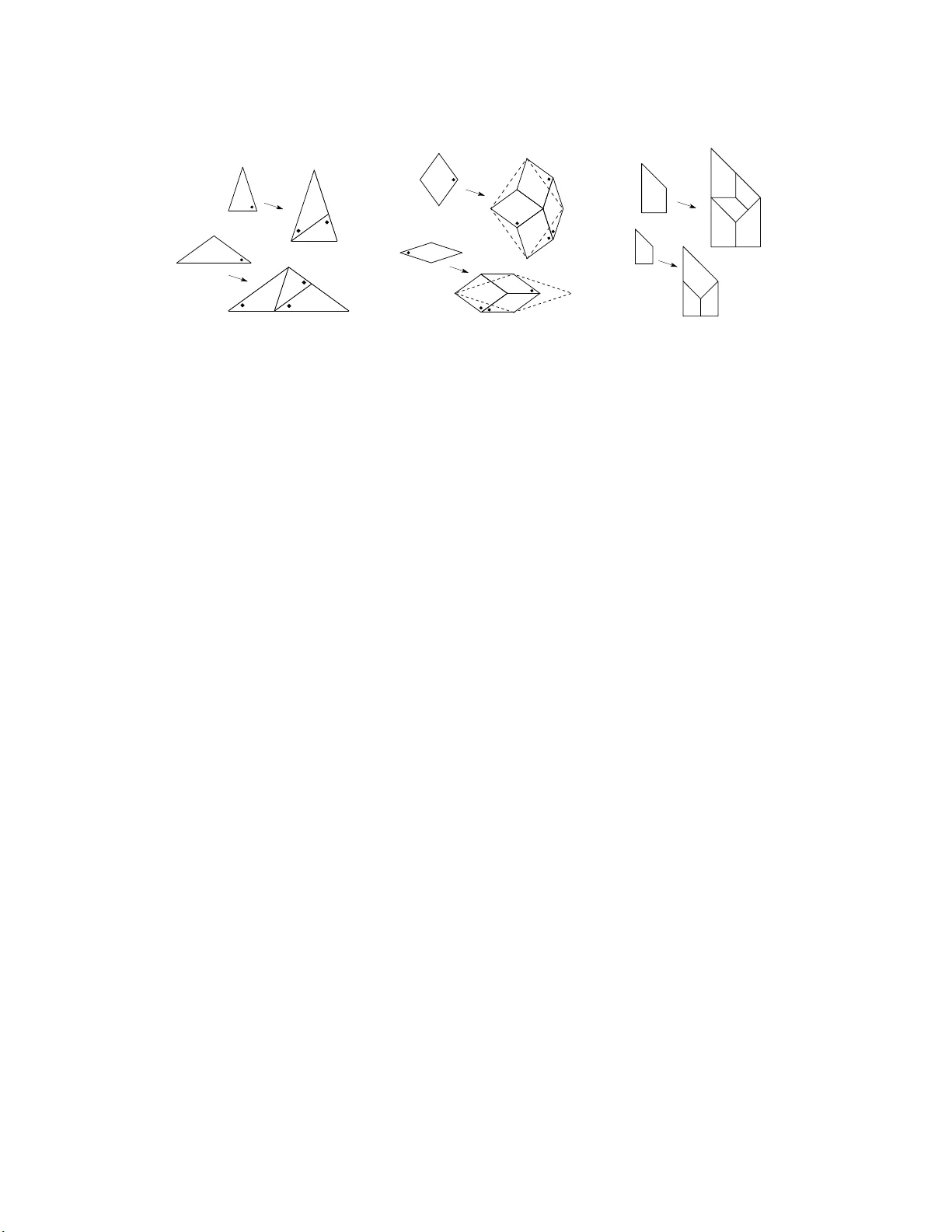
THE LONEL Y VER TEX PR OBLEM D. FRETTL ¨ OH AND A. GLAZYRIN Abstra ct. In a lo cally fin ite tiling of R n by conv ex p olytop es, eac h p oint x ∈ R n is either a vertex of at least tw o tiles, or n o vertex at all. 1. Introduction In [ F ], the follo wing problem was stated in the cont ext of finite lo cal complexit y of s elf-similar substitution tilings, see Section 3 for d etails. Throughout the text, ’verte x’ alw a ys means the v ertex of a conv ex p olytop e in the usual geometric sense, see for ins tance [ Z ]. It means n either a com binatorial v ertex of a tile, nor the v ertex of a tiling in the sense of [ GS ] (that is, an isolated p oin t of the intersec tion of finitely man y tiles of a tiling). Question 1: In a lo cally finite tiling T of R n , where all tiles are con v ex p olytop es, is there a p oin t x wh ic h is the ve r tex of exactly one tile? In other words: Is ther e a ’lonely v ertex’ in a lo cally finite p olytopal tiling? F or tilings in dimension n = 1 and n = 2, it is easy to see that the ans wer is negativ e. In the sequel we sho w that the answer is n egati ve for all dimensions n . In the r emainder of this section we will fix the notation and d iscu ss the n ecessit y of the requiremen t ’lo cally finite’. In Section 2 w e obtain the main results, n amely , Theorem 2.1, Theorem 2.4, and the answ er to Question 1 in Theorem 2.5. In Section 3 we apply these results to pro ve a condition for lo cal finite complexit y of self-similar subs titution tilings with intege r factor. Section 4 con tains some further r emarks. Let R n denote the n -dimensional Eu clidean space. The n -dim en sional u nit sphere is d en oted b y S n . F or tw o p oints x, y ∈ R n , th e line s egment with endp oin ts x and y is denoted by xy . A (con v ex) p olyhe dr on is the inte rs ectio n of fi nitely many closed halfspaces. A (con ve x) p olytop e is a b ounded p olyhedr on. In the follo win g, only con vex p olytop es are considered. Thus we drop the word ’con ve x’ in the sequel, the term ’p olytop e’ alw a ys means con ve x p olytop e. A spherical p olytop e is the intersect ion of a s p here with cen tre x with finitely many halfspaces H i , wh ere x ∈ T i H i . Let X b e either a Euclidean or a spher ical space. A collection of p olytop es T = { T n } n ≥ 0 whic h is a co vering of X — that is, the union of all p olytop es T i equals X — as well as a pac king of X — that is, the in teriors of the p olytop es are pairwise d isjoin t — is called a (p olytopal) tiling . A tiling T is called lo c al ly finite if eac h b ounded set U ∈ X in tersects only finitely man y tiles of T . If we do not require the tiling to b e lo cally fi nite, lonely ve r tices are p ossible. F or ins tance, consider a tiling in R 2 whic h contai n s th e follo wing tiles (see Figure 1): A r ectangle R w ith v er- tices (1 , 0) , ( − 1 , 0) , ( − 1 , − 1) , (1 , − 1), a square S with vertices (0 , 0) , (0 , 1) , ( − 1 , 1) , ( − 1 , 0), 1 2 D. FRETTL ¨ OH AND A. GLAZYRIN S T 0 T T 1 2 R (0,0) Figure 1. A lonely vertex at (0 , 0) in a tiling which is n ot lo cally finite. and rectangles T k with vertic es ( 1 2 k , 0) , ( 1 2 k , 1) , ( 1 2 k +1 , 1) ( 1 2 k +1 , 0) , , wh ere k ≥ 0. Suc h a tiling is ob viously not lo cally fi nite: eac h sphere with cen tre (0 , 0) in tersects infinitely man y tiles. The tile S has (0 , 0) as a vertex, an d (0 , 0) is vertex of no other tile. That means, suc h a tiling con tains a lonely vertex at (0 , 0). The requirement of lo cal finiteness is therefore necessary . 2. The main res ul t W e sa y that a p olytop e P and a hyp erplane H are just touching if P ∩ H 6 = ∅ , but int( P ) ∩ H = ∅ , wh ere int( P ) denotes the in terior of P . W e d efi ne the indicator I P for th e con vex n - dimensional spherical p olytop e P as th e fu nction th at equals 1 in all in ternal p oin ts of P and 0 else. In wh at follo w s we s a y that tw o functions are equal if they are equal in all p oints except in a set of L eb esgue measure zero. W e call a con ve x n -dimensional sp herical p olytop e a B-typ e p olyto p e if it con tains t wo ends of some diameter of the sphere, and an A-typ e p olytop e else. Theorem 2.1. The indic ator of any A-typ e p olytop e c annot b e e qual to the line ar c ombination of indic ators of a finite numb er of B-typ e p olytop es. Pr o of. W e will prov e this theorem by induction on the dimension n of the emb edding space R n ⊃ S n − 1 . Base of in duction: n = 1. This case is ob vious b ecause the unit sp here in R 1 , namely , S 0 = {− 1 , 1 } , is th e only B-t yp e p olytop e in S 0 . The step of indu ction is muc h more demand ing. Let Th eorem 2.1 b e true for all dimensions less than n . W e assume th at it’s f alse for n . So there is one A-type p olytop e P and k B-t yp e p olytop es Q 1 , . . . , Q k suc h that I P − k X 1 α i I Q i = 0 for some α i ∈ R . Consider an y ( n − 1)-dimensional h yp erplane con taining th e cent r e x of the sphere, for ins tance { x 1 = 0 } . F or f : R n → R w e defin e f + 0 and f − 0 : f + 0 ( x 2 , . . . , x n ) = lim m →∞ f ( 1 2 m , x 2 , . . . , x n ) f − 0 ( x 2 , . . . , x n ) = lim m →∞ f ( − 1 2 m , x 2 , . . . , x n ) if these limits exist. Let T b e an n -dimensional s p herical p olytop e, and let T 0 = T ∩ { x 1 = 0 } . T 0 is a sph erical p olytop e of lesser dimens ion. THE LONEL Y VER TEX P R OBLEM 3 Lemma 2.2. F or f = I T , the function f + 0 exists in al l p oints of R n − 1 . Mor e over, f + 0 = I T 0 holds if not al l the internal p oints of T ar e lying in ne gative semisp ac e , and f + 0 = 0 else. Pr o of. There are three cases: the in terior of T in tersects { x 1 = 0 } , or T ju s t touc hes this h yp erplane and lies in the p ositive semisp ace, or T just touches this hyp erplane and lies in the negativ e semispace. All th ese cases are rather ob vious. The same lemma is true f or f − 0 . Let us consider no w f = I P − P k 1 α i I Q i . Without loss of generalit y , let one of the ( n − 1)- dimensional faces of P b e conta ined in { x 1 = 0 } , and let P lie in th e p ositiv e semispace. Then f + 0 exists, an d f + 0 = I P 0 − P k 1 α i I Q + i , wh ere Q + i = Q i ∩ { x 1 = 0 } if not all the in ternal p oin ts of Q i are lying in negativ e semispace, and Q + i = ∅ else. Lik ewise, f − 0 = − P k 1 α i I Q − i , where Q − i are defined an alogously . Obvio u s ly f + 0 = 0 and f − 0 = 0 holds, b ecause they are limits of sequences whic h are equal to 0. W e define g = f + 0 − f − 0 . It follo ws that g = 0 and g = I P 0 − P k 1 α i ( I Q + i − I Q − i ). I f th e in terior of Q i in tersects { x 1 = 0 } , then Q + i = Q − i , and the corresp onding brac ke ts in the sum are equal to 0. (A t this p oint conv exit y is required.) If Q i just touc h es this hyp erplane, then one of the memb ers in the corresp ondin g term in brac ket s is equal to 0. So 0 = I P 0 − k X 1 β i I S i , where S i = ∅ if the inte r ior of Q i in tersects the hyp erplane, S i = Q + i and β i = α i if Q i just touc hes the hyp erplane and lies in the p ositiv e semispace, S i = Q − i and β i = − α i if it just touc hes the hyperp lane an d lies in the negativ e semispace. Lemma 2.3. If a B-typ e p olytop e Q just touches a hyp erplane H thr ough the c entr e x of a spher e, then the p olytop e Q ∩ H is also a B-typ e p olytop e. Pr o of. An y B-t yp e p olytop e con tains tw o ends of some diameter of the n -sp here, sa y , p oints k , ℓ . If k ℓ ∩ H = { x } , then H int ers ects the inte r ior of the p olytop e Q . This is imp ossible, since Q and H are just touc h ing. Therefore k ℓ ⊂ H . Hence the p olytop e Q ∩ H conta in s t wo ends of some diameter of the sp h ere and is a B-t yp e p olytop e. So all S i are B-t yp e p olytop es, and P 0 is an A-t yp e p olytop e. W e h av e a con tradiction with the prop osition of the induction. T h is completes the pro of of Theorem 2.1. Theorem 2.4. Any spher e S in R n c annot b e p artitione d in B-typ e p olyto p es and exactly one A-typ e p olytop e. Pr o of. W e assume there is suc h a decomp osition. P is an A-t yp e p olytop e and Q 1 , . . . , Q k are B-t yp e p olytop es. Let M 1 and M 2 are t w o hemisph eres su ch that M 1 ∪ M 2 = S . Then I P + k X 1 I Q i − I M 1 − I M 2 = 0 . This con tradicts Theorem 2.1. 4 D. FRETTL ¨ OH AND A. GLAZYRIN Theorem 2.5. L et T b e a lo c al ly finite p olytop al tiling in R n . Ther e is no p oint x ∈ R n such that x is a vertex of exactly one p olyt op e of T . Pr o of. W e choose a sphere S with cen tre x suc h that all faces of the p olytop es of T in tersecting S con tain x . W e can find such a sphere since T is lo cally finite. If x is a vertex of a tile T in T , then its in tersection with S is an A-t yp e p olytop e. If x ∈ T is not a vertex, then the in tersection T ∩ S is a B-t yp e p olytop e. Because of Theorem 2.4 there can’t b e exactly one A-t yp e p olytop e. So x can’t b e a vertex of exactly one p olytop e of the tiling T . Remark: The last result generalizes immediately to sph erical and hyp erb olic tilings: E ven though no t wo of Euclidean space R n , hyp erb olic sp ace H n and spherical space S n are con- formal to eac h other, th ey are lo c al ly c onform al : T here is a map f x : X → X ′ (where X , X ′ ∈ { R n , H n , S n } ), su c h that, for a given p oin t x ∈ X , lines through x are mapp ed to lines through f x ( x ), and their orientat ions and the angles b et w een suc h lines are pr eserved. This is all w e need to generalize the resu lt. Corollary 2.6. E ach k - fac e of some tile in a lo c al ly finite T tiling of R n by p olytop es is c over e d by finitely many k -fac es of some other tiles. Pr o of. W e u se induction on k . The case k = 0 is Theorem 2.5 : Any v ertex is co vered by a v ertex of some other tile. Let the statemen t b e true for k − 1. Let F b e a k -face of some tile T ∈ T . Let x b e a p oin t in th e r elativ e in terior of F . As ab ov e, let S b e a s p here with cen tr e x suc h that (A) All f aces of p olytop es in T in tersecting S conta in x . Since F is a k -face, F ′ = F ∩ S is a ( k − 1)-face of T ∩ S (in the spherical tiling T ∩ S ). By the prop osition of induction, F ′ is co vered b y ( k − 1)-faces F i . Because of (A), the con v ex h u ll con v ( x, F ′ ) of x and F ′ in R n is cov ered by con v ( x, F i ), which are sub sets of k -faces in T . This is true for any x in the relativ e interior of F , thus ev erywher e. Because of lo cal finiteness, F is co v ered by fi nitely man y k -faces. The follo wing theorem is u sed in the next section. Theorem 2.7. Given a p olytop al tiling T , let G = ( V , E ) b e the fol lowing undir e cte d gr aph: V is the se t of al l vertic es of tiles in T . V ertic es ar e identifie d if they ar e e qual as e lements of R n . E is the se t of e dges in G , wher e ( x, y ) ∈ E iff the line se gment xy is an entir e e dge of some tile in T . Then, al l c onne cte d c omp onents of G ar e infinite. Pr o of. Obvio u sly , an y tw o vertices of some p olytopal tile T are connected by a fi nite path of edges of T , so they are in the same connected comp onen t of G . Th erefore, eac h tile b elongs either en tirely to a connected comp onent of G or not. Assume there is a finite connected comp onen t C in G . Let F b e the set of all tiles b elonging to C . Being finite, the union sup p( F ) (wh ic h is a p olytop e, though n ot n ecessarily conv ex) has some outer ve r tex x . The ve r tex x corresp onds to an A-t yp e p olytop e as ab ov e. By Th eorem 2.4, ther e is at least one further A-t yp e p olytop e, b elonging to a tile T / ∈ F . Because T con tributes an A -t yp e p olytop e, x is a v ertex of T . Th is con trad icts T / ∈ F , pro ving the claim. THE LONEL Y VER TEX P R OBLEM 5 Figure 2. Three examples of tile-substitutions: The P enrose substitution rule f or triangular tiles (left), the substitution rule for b inary tilings (centre), the semi-detac hed house substitution rule (right). 3. Ap plica tion to substitution tilings The disco very of nonp erio dic str u ctures w ith long range order (for instance, Penrose tilings and quasicrystals) h ad a large impact to many fields in mathematics, see for instance [ Lag ]. Tile-substitutions are a simple and p o werful to ol to generate int eresting nonp erio dic structures with long r ange ord er, n amely: sub stitution tilings. Th e basic idea is to give a fin ite set of pr ototiles T 1 , . . . , T m , together with a r ule how to enlarge eac h prototile by a common inflation factor λ and th en dissect it into — or more general, replace it by — copies of the original prototiles. Figure 2 sho ws some examples of sub stitution ru les. Note , that a substitution σ maps tiles to fin ite sets of tiles, finite sets of tiles to (larger) finite sets of tiles, and tilings to tilings. By iterating the sub stitution ru le, in creasingly larger p ortions of space are filled, yielding a tiling of the en tire space in the limit. F or a more precise definition of sub stitution tilings, see f or instance [ F2 ]. F or a collection of s ubstitution tilings, and a glossary of related terminology , see [ FH ]. A tile-substitution r ule with a prop er dissection, that is, where (1) λT i = [ T ∈ σ ( T i ) T (1 ≤ i ≤ m ) (where the union is non-o v erlapping) is called self- similar tile- su bstitution. If (1) do es not hold, as in Figure 2 (cen tre), one m ay still sp eak of a substitution tiling, b ut n ot of a self- similar tiling. The follo wing d efi nition turn ed out to b e usefu l in the theory of nonp er io d ic tilings. It rules out certain pathologic al cases and is consisten t with other concepts within this theory , for instance the tiling sp ac e , or the hul l of a tiling [ So ], [ KP ]. Definition 3.1. L et σ b e a tile- substitution with pr ototiles T 1 , . . . , T m . The sets σ k ( T i ) ar e c al le d ( k -th order) su p ertiles . A tiling T is c al le d substitution tiling (with tile-substitution σ ) if for e ach finite subset F ⊂ T ther e ar e i, k such that F is c ongruent to a subset of some sup ertile σ k ( T i ) . The family of al l substitution tilings with tile- substitution σ is denote d by X σ . Man y results in the theory of substitution tilings require the tilings under consideration to b e of finite lo cal complexit y , compare for instance [ So ], [ S o2 ], [ LMS ]. 6 D. FRETTL ¨ OH AND A. GLAZYRIN Definition 3.2. A tiling T has finite lo cal complexit y (FLC) if for e ach r > 0 ther e ar e only finitely many differ ent c onstel lations of diameter less than r in T , up to tr anslat ion. Usually , if a certain s u bstitution tiling has FLC, this is easy to see. F or instance, eac h v ertex- to-v ertex tiling with finitely many prototiles has FLC. More general, th e follo win g condition is fr equen tly used [ F ]. Lemma 3.3. A tiling is FLC iff ther e ar e only finitely many differ ent c onstel lations of two interse cting tiles, up to tr anslation . On the other hand, if a tiling do es not ha ve FLC, this can b e hard to prov e, see [ D , FrR ]. The follo wing theorem co v ers a br oad class of su bstitution tilings w h ere the in flation factor λ is an integ er num b er. An example of su ch a tile-substitution is sho wn in Figure 2 (righ t), where the infl ation factor is 2. A weak er version of this theorem was prov ed in [ F ], and it wa s realized that a negativ e answe r to Qu estion 1 w ould yield a stronger result. Thus Question 1 w as stated in [ F ] as an op en p roblem. Theorem 3.4. L et T b e a self- similar substitution tiling with p olytop al pr ototiles and i nte g e r inflation factor. Without loss of gener ality, let 0 b e a vertex of e ach pr ototile. If the Z - sp an of al l vertic es of the pr ototiles i s a discr ete lattic e, then T is of finite lo c al c omplexity. It is remark able that a requirement on the shap e of the prototiles, without any wo r d ab out the tile-substitution itself, suffices to guaran tee FLC. Note , that we do n ot r equ ire the tiles to b e con v ex at this p oin t. It suffices that they are un ions of fin itely many conv ex p olytop es. Pr o of. W e b egin by sh owing that all vertice s contai n ed in some sup ertile S = σ k ( T i ) = { T , T ′ , T ′′ , . . . } b elong to the same conn ected comp onen t of the graph G , with G as in Theorem 2.7. First w e consider vertice s on the edge of the supp ort of a su p ertile. A (su p er-)edge of the sup ertile S consists of entire edges of some tiles. Thus, all vertice s in a s in gle (su p er-)edge of S b elong to the s ame comp onen t C of G . C onsequen tly , all vertice s in the union of the edges of the sup ertile S b elong to C . No w, consid er a k -face F of S , wh ere k ≥ 2. Let all vertice s on th e b oun dary of F (of dimension k − 1) b e in th e same comp onent C of G . If there is a v ertex x in F with x / ∈ C , it b elongs to a finite comp onent of G in F which is disjoint with th e b ou n dary of F . Thus, F can b e extended to a k -dimensional p olytopal tiling with the fi nite comp onen t C in the corresp onding graph G . But this con tradicts Th eorem 2.7. Consequen tly , all v ertices in F b elong to C . Indu ctiv ely — by fin ite in duction on k — all v ertices con tained in the sup ertile S b elong to C . No w, let Γ b e the lattice spann ed by the v ertices of the prototiles. Since the inflation factor is an in teger, the vertic es of eac h sup ertile S are elemen ts of Γ. All tile-v ertices con tained in S b elong to the same connected comp onent of G , th us — b y definition of G — they are connected b y a finite path of entire tile edges xy with some v ertex of S . By the condition in the theorem, x − y ∈ Γ for all suc h edges xy . Therefore, all v ertices in th e sup ertile are con tained in Γ. Consequ en tly , all v ertices of T are elemen ts of Γ. In particular, if t wo tiles in T ha ve nonempty in tersection, ther e is only a finite num b er of p ossible p osition of the vertices of these tiles, by the discreteness of Γ. By Lemma 3.3, T has FLC. THE LONEL Y VER TEX P R OBLEM 7 4. Re marks W e ha v e established th e imp ossibilit y of a lonely v ertex in a lo cally finite p olytopal tiling in Euclidean, spherical and hyp erb olic sp ace of any dimension. Some consequences are discussed in this pap er. Naturally , further questions arise. F or instance, what can b e said ab out lonely v ertices in lo cally finite tilings w ith non-conv ex tiles? Another natural question is: Wh at can b e said ab out exactl y tw o v ertices? Since a lonely v ertex is imp ossible, ther e ma y b e restrictions f or constellatio ns arou n d a p oin t wh ic h is a v ertex of exactly t wo tiles T , T ′ . Indeed, one obtains th e follo wing r esu lt. Roughly sp oke n , it means that edges of T and T ′ either are coinciden t or opp osite. In particular, the num b er of edges of T con taining x equals the num b er of edges of T ′ con taining x . F or clarit y , we state the result in terms of A-t yp e and B-t yp e p olytop es. Theorem 4.1. L et a lo c al ly finite tiling of the u ni t spher e S n by p olytop es c ontain exactly two A -typ e p olyto p es P , P ′ . L et x b e a vertex of P . Then either x or − x i s a vertex of P ′ . Pr o of. The cases n = 0 and n = 1 are ob vious. So, let n > 1. W e pro ceed b y considering p ossible sh ap es of B-type p olytop es. An y B-t yp e p olytop e is cut out of the unit sphere S n , emb ed ded in R n +1 , by halfspaces H + 1 , . . . , H + m , where x ∈ T i H + i . Eac h suc h halfspace H + i can b e represented b y a ve ctor c i whic h is norm al to th e b oun ding h yp erplane H i = ∂ H + i : H + i = { x : c i x ≥ 0 } . W e can assume the set of hyp erplanes to b e minimal. That is, the n ormal vec tors of these hyp erplanes are linearly in dep endent (otherwise there w ould b e a sup erfluous defin ing inequalit y c i x ≥ 0; th at m eans, a s up erfluou s halfsp ace). Therefore, th e intersectio n M := T i H i is an ( n + 1 − m )-dimensional linear subspace. Sin ce the considered p olytop e is B-t yp e, it con tains tw o end p oin ts of some diameter of th e sph er e. Th u s M has to b e at least of dimension one. It follo ws m ≤ n , and the in tersection S n ∩ M (whic h is the b oun dary of the considered B-t yp e p olytop e), is an ( n − m )-dimensional unit sphere. In particular, a B-t yp e p olytop e has a v ertex x if and only if it is defined b y exactly n h alfspaces. Then, − x is also a v ertex of this B-type p olytop e. By Theorem 2.5, the verte x x of P is a v ertex of some fur ther p olytop e. Either A-t yp e (then P ′ ), or B-t yp e, say , P ′′ . In the latter case, b y th e reasoning ab o ve , − x is a v ertex of P ′′ , to o. If − x w ould b e s u rrounded ent ir ely by B-t yp e p olytop es, x also wo uld , wh ic h is imp ossib le. Th u s, − x is a vertex of an A-t yp e p olytop e. Th e only p ossibilit y is that − x is a ve r tex of P ′ . A cknowledgment s It is a pleasure to thank Nik olai Dolbilin, Alexey T araso v and in particular Alexey Garb er for v aluable discussions. D.F. ac kn o wledges supp ort by the German Researc h Council (DF G) within the Collab orativ e Researc h Centre 701. Referen ces [ D ] L. D anzer: In flation sp ecies of planar tilings which are n ot of lo cally finite complexity , Pr o c. Steklov Inst. M ath. 239 (2002) 118-126. [ FrR ] N.P . F rank, E.A. Robinson, Jr.: Generalized b eta-exp ansions, sub stitution tilings, and lo cal finiteness, to app ear in T rans. Amer. Math. Soc. 8 D. FRETTL ¨ OH AND A. GLAZYRIN [ F ] D. F rettl¨ oh: Nich tp erio d isc he Pfl asterungen mit ganzzahligem Inflationsfaktor, Ph .D. Thesis, Dort- mund (2002); http://hdl .handle.net/2003/ 230 9 . [ F2] D. F rettl¨ oh: Duality of mo del sets generated by substitutions, R ev. R oumaine M ath. Pur es Appl. 50 (2005) 619-639; math.MG/06 01064 . [ FH] D. F rettl¨ oh, E. Harriss: Tilings Encyclop ed ia, av aila b le online at: http://til ings.math.uni-bie l efeld.de. [ GS] B. Gr ¨ un b aum, G.C. Shephard: Tili ngs and Patterns , F reeman, New Y ork (1987). [ KP ] J . K ellendonk and I.F. Put nam: Tilings, C ∗ -algebras and K -th eory , in: Dir e ctions in Mathematic al Quasicrystals , M. Baake and R.V. Moo dy (eds.), CRM Monograph Series, vo l. 13 , A MS, Providence, RI ( 2000) p p. 177-206. [ La g ] J. C. Lagarias: The impact of ap eriodic order on mathematics, Materials Scienc e & Engine ering A , 294–296 (2000) 186-191. [ LMS ] J.-Y. Lee, R.V. Moo dy and B. Solom yak: Consequ ences of pure point d iffraction spectra for multiset substitution systems, Discr ete Com put. Ge om. 29 ( 2003) 525-560. [ So ] B. Solomy ak: Dynamics of self-similar tilings, Er go dic The ory Dynam. Systems 17 ( 1997) 695-738. B. Solomy ak: Corrections to ‘Dynamics of self-similar tilings’, Er go dic The ory Dynam. Systems 1 9 (1999) 1685. [ So2] B. S olom yak: Non-p eriodicity implies uniqu e composition prop ert y for self-simi lar translationally finite tilings, Discr ete Com put. Ge om. 20 ( 1998) 265-279. [ Z] G. Ziegler: L e ctur es on Polytop es , Springer, New Y ork (1995). F akul t ¨ at f ¨ ur Ma thema tik, Univ ersit ¨ at Bie lefeld, Postf a ch 100131, 33501 Bi elefeld, Ge rmany E-mail addr ess : dirk.frettloeh@ math.uni-bielefeld.de URL : http://www.math.un i-bielefeld.de/baake/frettloe Mosco w St a te Uni versity, Leni nskie Gor y, 119992 Mosco w GSP-2, Russia E-mail addr ess : xoled@rambler.r u
Original Paper
Loading high-quality paper...
Comments & Academic Discussion
Loading comments...
Leave a Comment