Bit-interleaved coded modulation in the wideband regime
The wideband regime of bit-interleaved coded modulation (BICM) in Gaussian channels is studied. The Taylor expansion of the coded modulation capacity for generic signal constellations at low signal-to-noise ratio (SNR) is derived and used to determin…
Authors: ** 제공된 원문에 저자 정보가 명시되어 있지 않음. (일반적으로 Zehavi, Caire 등 BICM 관련 연구자들이 언급됨) **
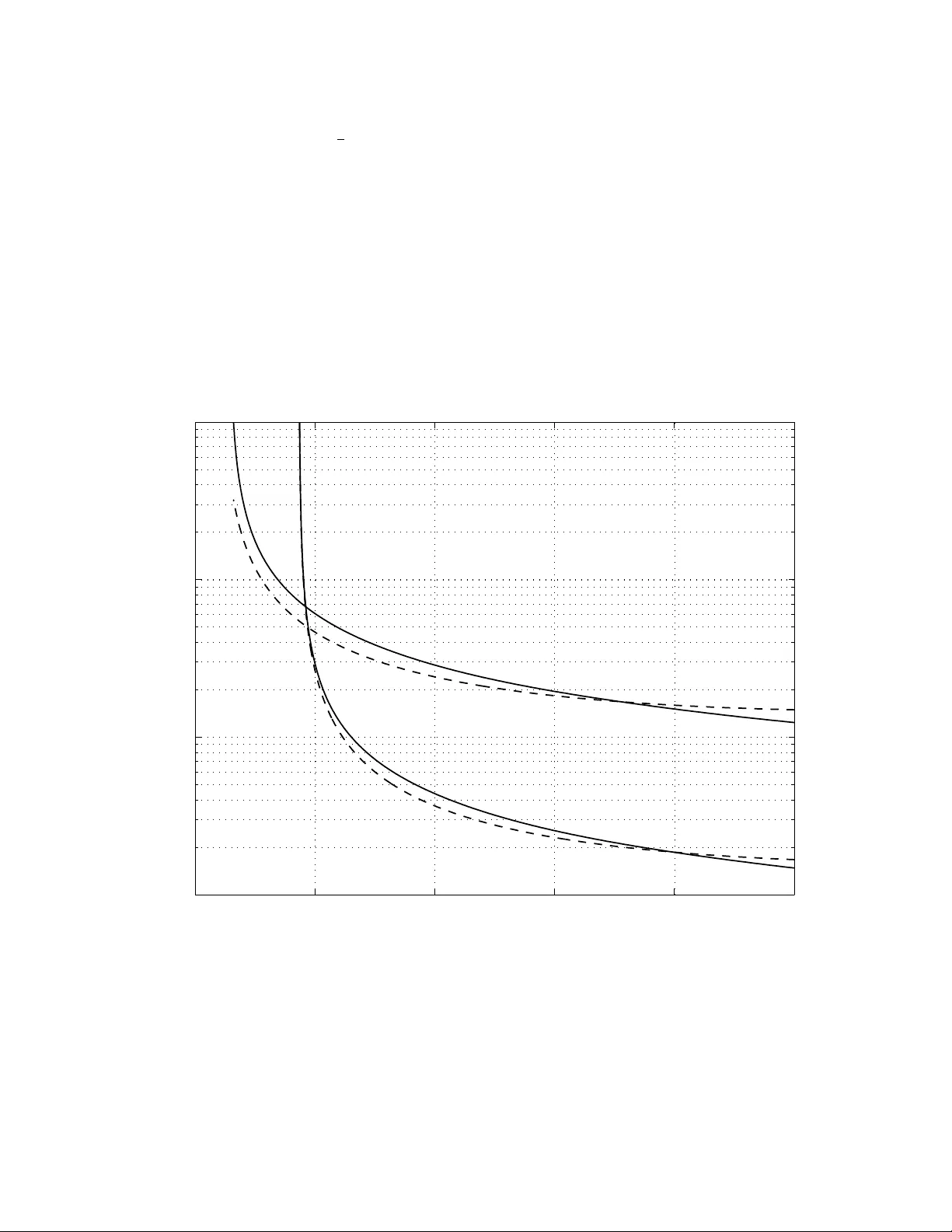
1 Bit-Interlea v ed Coded Modulation in the W ideband Regime Alfonso Martinez, Albert Guill ´ en i F ` abreg as, Giuseppe Caire and Frans W illems Abstract The wideband regime of bit-interlea ved coded modulation (BICM) in Gaussian channels is studied. The T aylor e xpansion of the coded modulation capacity for generic signal constellations at low signal-to- noise ratio (SNR) is deri ved and used to determine the corresponding e xpansion for the BICM capacity . Simple formulas for the minimum energy per bit and the wideband slope are giv en. BICM is found to be suboptimal in the sense that its minimum ener gy per bit can be larger than the corresponding v alue for coded modulation schemes. The minimum energy per bit using standard Gray mapping on M -P AM or M 2 -QAM is gi ven by a simple formula and sho wn to approach -0.34 dB as M increases. Using the low SNR expansion, a general trade-of f between po wer and bandwidth in the wideband regime is used to show ho w a power loss can be traded off against a bandwidth gain. A. Martinez and F . W illems are with the Department of Electrical Engineering, T echnische Universiteit Eindhoven, Postbus 513, 5600 MB Eindhov en, The Netherlands, e-mail: alfonso.martinez@ieee.org, f.m.j.willems@tue.nl. A. Guill ´ en i F ` abregas is with the Department of Engineering, Uni versity of Cambridge, Cambridge, CB2 1PZ, UK, e-mail: guillen@ieee.org. G. Caire is with the Electrical Engineering Department, University of Southern California, 3740 McClintock A ve., Los Angeles, CA 90080, USA, e-mail: caire@usc.edu. This work has been presented in part at the 2007 International Symposium on Information Theory and Applications, ISIT 2007, Nice (France), June 2007. This work has been partly supported by the International Incoming Short V isits Scheme 2007/R2 of the Royal Society and by the Australian Research Council under ARC grant DP0558861. October 31, 2018 DRAFT 2 I . I N T RO D U C T I O N A N D M O T I V A T I O N Bit-interleav ed coded modulation (BICM) was originally proposed by Zehavi [1] and further elaborated by Caire et al. [2] as a practical way of constructing efficient coded modulation schemes over non-binary signal constellations. Reference [2] defined and computed the channel capacity of BICM under a sub-optimal non-iterative decoder , and compared it to the coded modulation capacity , assuming equiprobable signalling over the constellation. When natural reflected Gray mapping w as used, the BICM capacity was found to be near optimal at high signal-to-noise ratio (see Figure 1(a)). Nev ertheless, plots of the BICM capacity as a function of the energy per bit for reliable communication (see Figure 1(b)) rev eal the suboptimality of BICM with the non-iterati ve decoder of [1], [2] for lo w rates, that is in the power -limited or wideband regime. Recent work by V erd ´ u [3] presents a detailed treatment of the wideband re gime. He studied the minimum bit ener gy-to-noise ratio E b N 0 min for reliable communication and the wideband slope, i.e., the first-order expansion of the capacity for low E b N 0 min , under a variety of channel models and channel state information (CSI) assumptions. These results are obtained by using a second-order expansion of the channel capacity at zero signal-to-noise ratio (SNR). Furthermore, using these results, he obtained a general tradeoff between data rate, power and bandwidth in the wideband regime. In particular , V erd ´ u[3] studied the bandwidth penalty incurred by using suboptimal signal constellations in the low-po wer regime. An implicit assumption of this tradeoff was that the power cannot change together with the bandwidth. Moti vated by the results of Figure 1(b) and by V erd ´ u’ s analysis [3], in this paper , we giv e an analytical characterization of the beha viour of BICM in the low-po wer regime. Studying the behaviour of BICM at low rates may prove useful in the design of multi-rate communication systems where rate adaptation is carried out by modifying the binary code, while keeping the modulation unchanged. In the process, we deriv e a number of results of independent interest for coded modulation over the Gaussian channel. In particular , the first two coefficients of the T aylor expansion of the coded modulation capacity for arbitrary signal constellations at zero SNR are deri ved, and used to obtain the corresponding coef ficients for BICM. W e also obtain a closed form expression for the minimum E b N 0 for BICM using QAM constellations with natural reflected Gray mapping, and we sho w that for large constellations it approaches -0.34 dB, resulting in a October 31, 2018 DRAFT 3 −20 −15 −10 −5 0 5 10 15 20 25 30 0 0.5 1 1.5 2 2.5 3 3.5 4 4.5 5 SNR (dB) C (bits/channel use) 16−QAM 8−PSK QPSK (a) Capacity as a function of SNR . −2 0 2 4 6 8 10 12 14 16 18 20 0 0.5 1 1.5 2 2.5 3 3.5 4 4.5 5 E b N 0 ( d B ) C (bits/channel use) 16−QAM 8−PSK QPSK (b) Capacity as a function of E b N 0 . Fig. 1. Channel capacity (in bits per channel use) with memoryless binary labeling and BICM-ML decoding for multiple signal constellations with uniform inputs in the A WGN channel. Gray and set partitioning labeling rules correspond to thin dotted and dashed-dotted lines respectiv ely . For reference, the capacity with Gaussian inputs is shown in thick solid lines and the CM channel capacity with uniform inputs (3) with thin solid lines. October 31, 2018 DRAFT 4 1.25 dB power loss with respect to coded modulation. Using these results, we deri ve the trade- of f between po wer and bandwidth in the wideband regime that generalizes the results of [3] to capture the effects of changing both po wer and bandwidth. This paper is organized as follows. Section II introduces the system model, basic assumptions and notation. Section III defines the wideband regime, and presents the low-SNR expansion for both coded modulation and BICM. Section IV introduces the general trade-of f between po wer and bandwidth. Concluding remarks appear in Section V. Proofs of various results are in the Appendices. I I . M O D E L A N D A S S U M P T I O N S W e consider a complex-v alued, discrete-time additiv e Gaussian noise channel with fading. The k -th channel output y k is giv en by y k = h k √ SNR x k + z k , (1) where x k is the k -th channel input, h k a fading coefficient, and z k an independent sample of circularly symmetric complex-v alued Gaussian noise of unit v ariance; SNR denotes the average signal-to-noise ratio at the receiv er . The transmitted, receiv ed, noise and fading samples, are realizations of the random variables X , Y , Z and H . The fading coef ficients h k are independently drawn from a density p H ( h k ) and are assumed kno wn at the recei ver . For future use we define the squared magnitudes of the fading coefficients by χ k = | h k | 2 . For a giv en fading realization h k , the conditional output probability density is given by p Y | X,H ( y k | x k , h k ) = 1 π e −| y k − h k √ SNR x k | 2 . (2) The channel inputs are modulation symbols drawn from a constellation set X with probabilities P X ( x ) . W e denote the cardinality of the constellation set by M = |X | and by m = log 2 M the number of bits required to index a modulation symbol. W e define the constrained capacity C X (or coded modulation capacity) as the corresponding mutual information between channel input and output, namely C X (SNR) = − E " log X x 0 ∈X P X ( x 0 ) e −| H √ SNR( X − x 0 )+ Z | 2 + | Z | 2 !# (3) October 31, 2018 DRAFT 5 where the expectation is performed over X , Z and H . If the symbols are used with equal probabilities, i. e. P X ( x ) = M − 1 , we refer to the constrained capacity as uniform capacity , and denote it by C u X . As we will see later , it proves con venient to consider general constellation sets with arbitrary first and second moments, respectiv ely denoted by µ 1 ( X ) and µ 2 ( X ) , and gi ven by µ 1 ( X ) , E[ X ] = X x ∈X xP X ( x ) , µ 2 ( X ) , E[ | X | 2 ] = X x ∈X | x | 2 P X ( x ) . Practical constellations hav e zero mean, i. e. µ 1 ( X ) = 0 , and unit energy , that is µ 2 ( X ) = 1 . In order to transmit at rates close to the coded modulation capacity , multi-lev el coding or non-binary codes are needed [4], [5]. Alternativ ely , in bit-interleaved coded modulation (BICM) binary codes are mapped with a binary mapping rule γ onto non-binary modulations [1], [2]. Caire et al. found that BICM with natural reflected Gray mapping and low-comple xity non- iterati ve demodulation attains very good performance, close to that of coded modulation with equiprobable signalling [2]. For infinite interleaving, the channel is separated into a set of m parallel independent subchannels, and one defines the so-called BICM capacity , denoted by C X ,γ , gi ven by C X ,γ (SNR) = m X i =1 I ( B i ; Y ) (4) = m X i =1 E " log P x 0 ∈X i b e −| H √ SNR( X − x 0 )+ Z | 2 1 2 P x 0 ∈X e −| H √ SNR( X − x 0 )+ Z | 2 # (5) where B i denotes the binary input random v ariable corresponding to the i -th parallel channel (see [2] for details), X i b are the sets of constellation symbols with bit b in the i -th position of the binary label and the expectation is performed ov er all input symbols x in X i b for b = 0 , 1 , and ov er all possible noise and fading realizations, respectiv ely Z and H . An equiv alent, yet alternati ve, definition is gi ven by the follo wing. Pr oposition 1: The BICM capacity can be expressed as C X ,γ = m X i =1 1 2 X b =0 , 1 (C u X − C u X i b ) , (6) where C u X and C u X i b are, respectiv ely , the constrained capacities for equiprobable signalling in X and X i b . October 31, 2018 DRAFT 6 Pr oof: The proof is giv en in Appendix I 1 . In general, the sets X i b hav e non-zero mean and non-unit av erage energy . This result reduces the analysis of the BICM capacity to that of coded modulation over constellation sets with arbitrary first and second moments. I I I . W I D E BA N D R E G I M E In the wideband regime, as defined by V erd ´ u in [3], the energy of a single bit is spread ov er many channel degrees of freedom, resulting in a lo w signal-to-noise ratio SNR . It is then con venient to study the asymptotic behavior of the channel capacity as SNR → 0 . In general, the capacity 2 (in nats per channel use) admits an expansion in terms of SNR , C(SNR) = c 1 SNR + c 2 SNR 2 + o SNR 2 , (7) where c 1 and c 2 depend on the modulation format, the recei ver design, and the f ading distribution. Among the sev eral uses for the coef ficients c 1 and c 2 , V erd ´ u [3] studied the transformation of expansion (7) into a function of the bit-energy to noise ratio E b N 0 , E b N 0 = SNR C log 2 e . (8) In linear scale for E b N 0 , one obtains C E b N 0 = ζ 0 E b N 0 − E b N 0 lim + O ∆ E b N 0 2 ! (9) where ∆ E b N 0 ∆ = E b N 0 − E b N 0 lim and ζ 0 ∆ = − c 3 1 c 2 log 2 2 , E b N 0 lim ∆ = log 2 c 1 . (10) The parameter ζ 0 is V erd ´ u’ s wideband slope in linear scale [3]. W e a void using the w ord minimum for E b N 0 lim , since there exist communication schemes with a negati ve slope ζ 0 , for which the absolute minimum value of E b N 0 is achiev ed at non-zero rates. In these cases, the expansion at lo w power is still giv en by Eq. (9). The deriv ation of Eq. (9) can be found in Appendix II. A second important use of the coefficients c 1 and c 2 was the analysis of the bandwidth penalty incurred by using suboptimal constellations in the lo w-power regime [3]. An implicit assumption 1 This expression has been independently derived in [6]. 2 This capacity may be the coded modulation capacity , or the BICM capacity . October 31, 2018 DRAFT 7 in [3] was the po wer cannot change together with the bandwidth. In Section IV we relax this assumption and gi ve a formula for the trade-off between power penalty and bandwidth penalty and apply it to compare BICM with standard coded modulation. In the follo wing, we determine the coef ficients c 1 and c 2 in the expansion (7) for generic constellations, and use them to derive the corresponding results for BICM. Before proceeding along this line, we note that Theorem 12 of [3] cov ers the effect of fading. The coeffici ents c 1 and c 2 for a general fading distribution are c 1 = E[ χ ] c A WGN 1 , c 2 = E[ χ 2 ] c A WGN 2 , (11) where the coefficients c A WGN 1 and c A WGN 2 are in absence of fading. Hence, e ven though we focus only on the A WGN channel, all results are v alid for general fading distrib utions. A. Coded Modulation For the unconstrained case, where the capacity is log (1 + SNR) , then c 1 = 1 and c 2 = − 1 2 . In [7], Prelov and V erd ´ u determined the coefficients c 1 and c 2 for the so-called proper-complex constellations introduced by Neeser and Massey [8], which satisfy µ 0 2 ( X ) , E[ X 2 ] = X x ∈X x 2 P X ( x ) = 0 , where µ 0 2 ( X ) is a second-order pseudo-moment, borro wing notation from the paper [8]. The coef ficients for coded modulation formats with arbitrary first and second moments are given by the following result. Theor em 1: Consider coded modulation schemes over a signal set X used with probabilities P X ( x ) in the Gaussian channel. Then, the first two coefficients of the T aylor expansion of the constrained capacity C X (SNR) around SNR = 0 are giv en by c 1 = µ 2 ( X ) − µ 1 ( X ) 2 (12) c 2 = − 1 2 µ 2 ( X ) − µ 1 ( X ) | 2 2 + µ 0 2 ( X ) − µ 2 1 ( X ) 2 . (13) When µ 1 ( X ) = 0 (zero mean) and µ 2 ( X ) = 1 (unit energy), c 1 = 1 , c 2 = − 1 2 1 + µ 0 2 ( X ) 2 , (14) and the bit-energy-to-noise ratio at zero SNR is E b N 0 lim = log 2 . October 31, 2018 DRAFT 8 Pr oof: See Appendix III. The formula for c 1 is known, and can be found as Theorem 4 of [3]. Also, for proper-comple x constellations c 2 = − 1 2 , as found in [7]. The second-order coefficient is bounded by − 1 ≤ c 2 ≤ − 1 2 , the maximum ( c 2 = − 1 / 2 ) being attained when the constellation has uncorrelated real and imaginary parts and the energy is equally distributed among the real and imaginary parts. Applied to some practical signal constellations with equiprobable symbols, Theorem 1 gi ves the following corollaries, whose respective proofs are straightforward. Cor ollary 1: For uniform M -PSK, c 2 = − 1 if M = 2 and c 2 = − 1 2 if M > 2 . This result extends Theorem 11.1 of [3], where the result held for QPSK, a simple example of proper-complex constellation. Cor ollary 2: When X represents a mixture of N uniform M n − PSK constellations for n = 1 , . . . , N , c 2 = − 1 2 if and only if M n > 2 for all rings/sub-constellations n = 1 , . . . , N . This applies to APSK modulations, for instance. In [3] Theorem 11.2 stated the result for mixtures of QPSK constellations. B. Bit-Interleaved Coded Modulation First, for fixed label index, i , and bit value b , let us respectiv ely define the quantities µ 1 ( X i b ) , µ 2 ( X i b ) , and µ 0 2 ( X i b ) , as the mean, the second moment, and the average of the squared symbols in the set X i b . Then, we hav e the following. Theor em 2: Assume a constellation set X with zero mean and unit a verage energy . The coef ficients c 1 and c 2 for the BICM capacity C X ,γ are giv en by c 1 = m X i =1 1 2 X b | µ 1 ( X i b ) | 2 , (15) c 2 = m X i =1 1 4 X b =0 , 1 µ 2 ( X i b ) − | µ 1 ( X i b ) | 2 2 − 1 + | µ 0 2 ( X ) | 2 + µ 0 2 ( X i b ) − µ 2 1 ( X i b ) 2 . (16) Pr oof: See Appendix IV. T able I reports the numerical v alues for the coef ficients c 1 and c 2 , as well as the bit signal-to- noise ratio E b N 0 lim and wideband slope ζ 0 for various cases, namely QPSK, 8-PSK and 16-QAM modulations and Gray and Set Partitioning (anti-Gray for QPSK) mappings. In Figure 2, the approximation in Eq. (9) is compared with the capacity curves. As expected, a good match for lo w rates is observed. W e use labels to identify the specific cases: labels 1 October 31, 2018 DRAFT 9 T ABLE I E b N 0 lim A N D W I D E BA N D S L O P E C O E FFI C I E N T S c 1 , c 2 F O R B I C M I N A W G N . Modulation and Mapping QPSK 8-PSK 16-QAM GR A-GR GR SP GR SP c 1 1.000 0.500 0.854 0.427 0.800 0.500 E b N 0 lim 0.693 1.386 0.812 1.624 0.866 1.386 E b N 0 lim (dB) -1.592 1.419 -0.904 2.106 -0.627 1.419 c 2 -0.500 0.250 -0.239 0.005 -0.160 -0.310 ζ 0 4.163 -1.041 5.410 -29.966 6.660 0.839 and 2 are QPSK, 3 and 4 are 8-PSK and 5 and 6 are 16-QAM. Also depicted is the linear approximation to the capacity around E b N 0 lim , given by Eq. (9). T wo cases with Nakagami fading are also included in Figure 2, which also sho w good match with the estimate, taking into account that E[ χ ] = 1 and E[ χ 2 ] = 1 + 1 /ν for Nakagami- ν fading. An exception is 8-PSK with set- partitioning, for which the approximation is valid for a very small range of rates, since c 2 is positi ve and very small, which implies a very large slope. In general, it seems difficult to draw general conclusions for arbitrary mappings from The- orem 2. A notable e xception, ho wev er , is the analysis under natural reflected Gray mapping. Theor em 3: For M -P AM and M 2 -QAM and natural, binary-reflected Gray mapping, the coef ficient c 1 in the T aylor expansion of the BICM capacity C X ,γ at low SNR is c 1 = 3 · M 2 4( M 2 − 1) , (17) and the minimum E b N 0 lim is E b N 0 lim = 4( M 2 − 1) 3 · M 2 log 2 . (18) As M → ∞ , E b N 0 lim approaches 4 3 log 2 ' − 0 . 3424 dB from belo w . Pr oof: The proof can be found in Appendix V. The results for BPSK, QPSK (2-P AM × 2-P AM), and 16-QAM (4-P AM × 4-P AM), as presented in T able I, match with the Theorem. October 31, 2018 DRAFT 10 −2 −1 0 1 2 3 4 5 6 7 8 0 0.5 1 1.5 2 2.5 3 E b N 0 ( d B ) C (bits/channel use) 1 1f 2 3 4 5 6 6f Fig. 2. BICM capacity (in bits per channel use). Labels 1 and 2 are QPSK, 3 and 4 are 8-PSK and 5 and 6 are 16-QAM. Gray and set partitioning labeling rules correspond to dashed (and odd labels) and dashed-dotted lines (and ev en labels) respectively . Dotted lines are cases 1 and 6 with Nakagami- 0 . 3 and Nakagami- 1 (Rayleigh) fading (an ‘f ’ is appended to the label index). Solid lines are linear approximation around E b N 0 lim . It is somewhat surprising that the loss with respect to coded modulation at lo w SNR is bounded. The loss represents about 1 . 25 dB with respect to the classical CM limit, namely E b N 0 lim = − 1 . 59 dB. In the ne xt section, we examine in detail the precise e xtent to which this loss translates into an equi valent loss in po wer . W e will do so by allowing for simultaneous v ariations in po wer and bandwidth and conclude that using BICM over a fixed modulation for a large range of signal-to-noise ratio values, where the transmission rate is adjusted by changing the code rate, needs not result in a large loss with respect to more optimal schemes, where both the rate and modulation change. Additionally , this loss can be traded off against a large October 31, 2018 DRAFT 11 bandwidth reduction. I V . B A N D W I D T H A N D P O W E R T R A D E - O FF In the previous section we computed the first coef ficients of the T aylor expansion of the CM and BICM capacities around SNR = 0 . In this section we use these coefficients to determine the trade-off between power and bandwidth in the lo w-power regime. W e will see ho w part of the power loss incurred by BICM can be traded of f against a large bandwidth reduction. The data rate transmitted across a Gaussian channel is determined by two physical v ariables: the power P , or energy per unit time, and the bandwidth W , or number of channel uses per unit time. In this case, the signal-to-noise ratio SNR is giv en by SNR = P / ( N 0 W ) , where N 0 is the noise spectral density . Then, the capacity measured in bits per unit time is the natural figure of merit for a communications system. W ith only a constraint on SNR , this capacity is giv en by W log (1 + SNR) . For low SNR , we hav e that W log 1 + P N 0 W = P N 0 − P 2 2 N 2 0 W + O P 3 N 3 0 W 2 . (19) Similarly , for coded modulation systems with capacity C X , we hav e C X W = c 1 P N 0 + c 2 P 2 N 2 0 W + O P 5 / 2 N 5 / 2 0 W 3 / 2 ! . (20) Follo wing V erd ´ u [3], we consider the following scenario. Let two alternativ e transmission systems with respectiv e po wers P i and bandwidths W i , i = 1 , 2 , achiev e respectiv e capacities per channel use C i . The corresponding first- and second-order expansion coefficients are denoted by c 11 , c 21 for the first system, and c 12 , c 22 for the second. A natural comparison is to fix a po wer ratio ∆ P = P 2 /P 1 and then solve for the corresponding bandwidth ratio ∆ W = W 2 /W 1 so that the data rate is the same, that is C 1 W 1 = C 2 W 2 . For instance, option 1 can be QPSK modulation and option 2 use of a high-order modulation with BICM. A. An Appr oximation to the T r ade-off When the capacities C 1 and C 2 can be ev aluated, the exact trade-off curve ∆ W (∆ P ) can be computed. For low power , a good approximation is obtained by keeping the first two terms in the T aylor series. Under this approximation, we have the following result. October 31, 2018 DRAFT 12 Theor em 4: In a neighbourhood of SNR 1 = 0 the capacities in bits per second, C 1 W 1 and C 2 W 2 are equal when the expansion factors ∆ P and ∆ W are related as ∆ W = c 22 SNR 1 + o(SNR 1 ) (∆ P ) 2 c 11 + c 21 SNR 1 + o(SNR 1 ) − c 12 ∆ P , (21) for ∆ W as a function of ∆ P and, if c 12 6 = 0 , ∆ P = c 11 c 12 + c 21 c 12 − c 22 c 2 11 c 3 12 ∆ W SNR 1 + o(SNR 1 ) , (22) for ∆ P as a function of ∆ W . Pr oof: The proof can be found in Appendix VI. Remark that we assume SNR 1 → 0 . As a consequence, replacing the v alue of ∆ P from Eq. (22) into Eq. (21) giv es ∆ W = ∆ W 1 + o(SNR 1 ) , which is not exact, but valid within the approximation order . The previous theorem leads to the follo wing deriv ed results. For simplicity , we drop the terms o(SNR 1 ) and replace the equality signs by approximate equalities. Cor ollary 3: For ∆ P = 1 , we obtain ∆ W ' c 22 SNR 1 c 11 + c 21 SNR 1 − c 12 , (23) and for the specific case c 11 = c 12 , ∆ W ' c 22 /c 21 . The latter formula has also been obtained by V erd ´ u [3] as a ratio of wideband slopes. As noticed in [3], the loss in bandwidth may be significant when ∆ P = 1 . But this point is just one of a curve relating ∆ P and ∆ W . For instance, with no bandwidth expansion we hav e Cor ollary 4: For c 11 = c 12 = 1 , and choosing ∆ W = 1 , ∆ P ' 1 + c 21 − c 22 SNR 1 . For signal-to-noise ratios belo w -10 dB, the approximation in Theorem 4 seems to be v ery accurate for “reasonable” power or bandwidth expansion ratios. A quantitativ e definition would lead to the problem of the extent to which the second order approximation to the capacity is correct, a question on which we do not dwell further . Another example concerns the effect of fully-interleav ed fading. Let us consider a Nakagami- ν fading model, such that the squared fading coefficient χ k = | h k | 2 follo ws a gamma distrib ution. The parameter ν is a real positiv e number , 0 < ν < ∞ . Using the v alues of the moments of the gamma distribution, E[ χ ] = 1 , and E[ χ 2 ] = 1 + 1 /ν , we hav e that c 1 = c A WGN 1 and c 2 = 1 + 1 ν c A WGN 2 . Therefore October 31, 2018 DRAFT 13 Cor ollary 5: Consider a modulation set X with av erage unit energy and used with po wer P , bandwidth W , and signal-to-noise ratio SNR ; its capacity in absence of fading is characterized at lo w SNR by the coef ficients c 1 = 1 and c 2 . When used in the Nakagami- ν channel with power P ν and bandwidth W ν , if P ν = P , W ν = W 1 + 1 ν , and if W ν = W , P ν = P 1 − c 2 ν SNR . As expected, for unfaded A WGN, when ν → ∞ , there is no loss. Rayleigh fading ( ν = 1 ) incurs in a bandwidth expansion of a factor 2 if the po wer is to be fixed. On the other hand, if bandwidth is kept unchanged, there is a power penalty in dB of about 10 log 10 (1 − c 2 SNR) ' − 10 c 2 SNR / log 10 ' − 4 . 343 c 2 SNR dB, a negligible amount to all practical ef fects since SNR → 0 . The worst possible fading is ν → 0 , which requires an unbounded bandwidth expansion or an unlimited power penalty . B. T rade-of f for BICM The trade-off between power and bandwidth can also be applied to determine the expansion factors when BICM with a non-binary modulation is used rather than, say , QPSK modulation. Fig. 3 shows the trade-off between power and bandwidth expansion factors when BICM ov er 16-QAM with Gray mapping is used, having taken QPSK as the reference transmission method. Results are presented for two values of the signal-to-noise ratio for the QPSK baseline. The exact result, obtained by using the exact formulas for C X and C X ,γ , respecti vely Eqs. (3) and (6), is plotted along the result by using Theorem 4. As expected, for very low values of SNR , the curve for ∆ W diver ges as ∆ P approaches the v alue c 11 c 12 = 1 0 . 8 , or 0.97 dB. This is in line with the fact that the minimum ener gy per bit required for 16-QAM/BICM is -0.63 dB, as giv en in T able I. Close to this limit, small improvements in po wer efficiency are extremely costly in bandwidth resources. On the other hand, this loss may be accompanied by a significant reduction in bandwidth, which might be of interest in some applications. For instance, a loss of 2.4 dB from the baseline at -18 dB requires a tiny fraction of the original bandwidth, about 2%. Concerning the last point, the results are exclusi ve to BICM and the same analysis can be applied to a single transmission method with coefficients c 1 and c 2 , trading off power against bandwidth. In this case, for a gi ven ∆ P we would have ∆ W ' c 2 SNR 1 (∆ P ) 2 c 1 (1 − ∆ P ) + c 2 SNR 1 . (24) October 31, 2018 DRAFT 14 Using QPSK ( c 1 = 1 , c 2 = − 1 2 ) and for SNR = − 18 dB a loss of 2.4 dB is linked to using only 3% of the original bandwidth. W e see that QPSK is slightly more inef ficient than BICM/16- QAM in using the bandwidth, the reason being that it has a lower coef ficient c 2 , − 0 . 5 instead of − 0 . 16 . T o any extent, it should not be surprising that communication in the wideband regime can be inef ficient in using the bandwidth, since we are working in a regime where the main limitation is in po wer . For signal-to-noise ratios larger than those reported in the figure, the assumption of low SNR loses its validity and the results deri ved from the T aylor expansion are no longer accurate. 0.5 1 1.5 2 2.5 3 10 −2 10 −1 10 0 10 1 ∆ P ( d B ) ∆ W S N R 1 = − 8 d B S N R 1 = − 1 8 d B Fig. 3. Trade-of f between ∆ P and ∆ W between QPSK and 16-QAM with Gray mapping. Solid lines correspond to the exact tradeoff, while dashed lines correspond to the lo w-SNR tradeof f. October 31, 2018 DRAFT 15 V . C O N C L U S I O N S In this paper , we ha ve computed the first two deriv ativ es of the constrained capacity at zero SNR for rather general modulation sets, and used the result to characterize analytically the bahaviour of BICM in the low-po wer regime. For binary reflected Gray mapping, the capacity loss at low SNR with respect to coded modulation is sho wn to be bounded by approximately 1 . 25 dB. This fact may be useful for the design of systems operating at lo w signal-to-noise ratios. Moreov er , we hav e determined the trade-of f at lo w SNR between po wer penalty and bandwidth expansion between two alternativ e systems. The trade-off presented here generalizes V erd ´ u’ s analysis of the wideband re gime, where the bandwidth expansion for a fix ed power was estimated. W e hav e sho wn that no bandwidth expansion may be achie ved at a negligible (but non-zero) cost in power . A similar trade-off between power penalty and bandwidth expansion for general Nakagami- ν fading has been computed, with similar conclusions as in the point abo ve: bandwidth expansion may be lar ge at no power cost, but absent at a tiny power penalty . W e ha ve applied the trade-off to a comparison between QPSK and 16-QAM. October 31, 2018 DRAFT 16 A P P E N D I X I P RO O F O F P RO P O S I T I O N 1 By definition, the BICM capacity is the sum ov er i = 1 , . . . , m of the mutual informations I ( B i ; Y ) . W e re write this mutual information as I ( B i ; Y ) = 1 2 X b ∈{ 0 , 1 } E " log P x 0 ∈X i b p Y | X,H ( y | x 0 , h ) 1 2 P x 0 ∈X p Y | X,H ( y | x 0 , h ) # (25) = 1 2 X b ∈{ 0 , 1 } E " log P x 0 ∈X i b 2 |X | p Y | X,H ( y | x 0 , h ) p Y | X,H ( y | x, h ) p Y | X,H ( y | x, h ) 1 2 P x 0 ∈X 2 |X | p Y | X,H ( y | x 0 , h ) !# , (26) where we hav e modified the variable in the logarithm by including a factor 2 |X | p Y | X,H ( y | x, h ) in both numerator and denominator . Splitting the logarithm, I ( B i ; Y ) = 1 2 X b ∈{ 0 , 1 } E " log P x 0 ∈X i b 2 |X | p Y | X,H ( y | x 0 , h ) p Y | X,H ( y | x, h ) # + 1 2 X b ∈{ 0 , 1 } E " log p Y | X,H ( y | x, h ) 1 |X | P x 0 ∈X p Y | X,H ( y | x 0 , h ) # . (27) For fixed b , the quantity − E " log P x 0 ∈X i b 2 |X | p Y | X,H ( y | x 0 , h ) p Y | X,H ( y | x, h ) # (28) is the mutual information achiev able by using equiprobable signalling in the set X i b , C u X i b , and, similarly , the quantity E " log p Y | X,H ( y | x, h ) 1 |X | P x 0 ∈X p Y | X,H ( y | x 0 , h ) # (29) is the mutual information achiev ed by equiprobable signalling in X , C u X . October 31, 2018 DRAFT 17 A P P E N D I X I I L I N E A R E X PA N S I O N C A PAC I T Y W e start with (7) and use Lagrange’ s in version formula. The inv ersion formula transforms a function C = f 1 (SNR) (30) into its in verse SNR = f 2 (C) . (31) W e do an expansion around SNR = 0 , which is also C = 0 . Applied to our case, the in version formula becomes SNR = SNR f 1 (SNR) SNR → 0 C + 1 2 d d SNR SNR f 1 (SNR) 2 SNR → 0 C 2 + O(C 3 ) . (32) Using the expansion in (7), after some simplifications we get SNR = log 2 c 1 C − c 2 log 2 2 c 3 1 C 2 + O(C 3 ) . (33) Letting SNR = C E b N 0 and rearranging we obtain E b N 0 = log 2 c 1 − c 2 log 2 2 c 3 1 C + O(C 2 ) , (34) which leads to C = − log 2 2 c 2 c 3 1 E b N 0 − log 2 c 1 + O E b N 0 − log 2 c 1 2 ! , and hence the desired result. October 31, 2018 DRAFT 18 A P P E N D I X I I I C M C A PAC I T Y E X PA N S I O N A T L O W S N R The assumption that the constellation moments are finite implies that E | X | 2+ α < ∞ for α > 0 . Therefore, as SNR → 0 , for µ > 0 the technical condition SNR 2+ α E | X | 2+ α ≤ ( − log √ SNR) µ , (35) necessary to apply Theorem 5 of [7] holds. Let us define a 2 × 1 vector x ( r ) = ( x r x i ) T , with components the real and imaginary parts of symbol x , respecti vely denoted by x r and x i . The cov ariance matrix of x ( r ) , denoted by cov ( X ) , is giv en by cov ( X ) = E[( X r − ˆ x r ) 2 ] E ( X r − ˆ x r )( X i − ˆ x i ) E ( X r − ˆ x r )( X i − ˆ x i ) E[( X i − ˆ x i ) 2 ] , (36) where ˆ x r and ˆ x i are the mean v alues of the real and imaginary parts of the constellation. Theorem 5 of [7] giv es c 1 = T r( cov ( X )) and c 2 = − T r( cov 2 ( X )) , or c 1 = E[( X r − ˆ x r ) 2 ] + E[( X i − ˆ x i ) 2 ] (37) c 2 = − E 2 [( X r − ˆ x r ) 2 ] + E 2 [( X i − ˆ x i ) 2 ] + 2 E 2 ( X r − ˆ x r )( X i − ˆ x i ) . (38) The coefficient c 1 coincides with that in Eq. (12). As for c 2 , let us add a subtract a term E[( X r − ˆ x r ) 2 ] E[( X i − ˆ x i ) 2 ] to Eq. (38). Then, c 2 = − 1 2 E 2 [( X r − ˆ x r ) 2 ] + 1 2 E 2 [( X i − ˆ x i ) 2 ] + E[( X r − ˆ x r ) 2 ] E[( X i − ˆ x i ) 2 ] + 1 2 E 2 [( X r − ˆ x r ) 2 ] + 1 2 E 2 [( X i − ˆ x i ) 2 ] − E[( X r − ˆ x r ) 2 ] E[( X i − ˆ x i ) 2 ] + 2 E 2 ( X r − ˆ x r )( X i − ˆ x i ) , (39) which in turn can be written as c 2 = − 1 2 E 2 | X − ˆ x | 2 + E[( X − ˆ x ) 2 ] 2 , (40) a form which coincides with Eq. (13), by noting that E | X − ˆ x | 2 = E | X | 2 − | ˆ x | 2 = µ 2 ( X ) − µ 1 ( X ) 2 (41) E[( X − ˆ x ) 2 ] = E[ X 2 ] − ˆ x 2 = µ 0 2 ( X ) − µ 2 1 ( X ) . (42) October 31, 2018 DRAFT 19 A P P E N D I X I V P RO O F O F T H E O R E M 2 In Eq. (6) for the BICM capacity , the summands C X and C X i b admit each a T aylor expansion gi ven in Theorem 1. Hence, c 1 = m X i =1 1 2 X b =0 , 1 1 − µ 2 ( X i b ) − | µ 1 ( X i b ) | 2 (43) = m X i =1 1 − 1 2 X b =0 , 1 µ 2 ( X i b ) + 1 2 X b =0 , 1 | µ 1 ( X i b ) | 2 ! (44) = m X i =1 X s ∈X 1 |X | | s | 2 − X s ∈X 1 |X | | s | 2 + 1 2 X b =0 , 1 X s ∈X i b 2 |X | | µ 1 ( X i b ) | 2 ! (45) = m X i =1 1 2 X b =0 , 1 | µ 1 ( X i b ) | 2 , (46) since 1 2 P b =0 , 1 µ 2 ( X i b ) = µ 2 ( X ) = 1 by construction. As for c 2 , it follows from a similar application of Theorem 1. October 31, 2018 DRAFT 20 A P P E N D I X V F I R S T - O R D E R C O E FFI C I E N T F O R B I C M W I T H G R A Y M A P P I N G For M -P AM, the Gray mapping construction makes µ 1 ( X i b ) = 0 , for b = 0 , 1 and all bit positions except one, which we take with no loss of generality to be i = 1 . Therefore, c 1 = 1 2 µ 1 ( X 0 1 ) 2 + 1 2 µ 1 ( X 1 1 ) 2 = µ 1 ( X 0 1 ) 2 = µ 1 ( X 1 1 ) 2 . (47) The last equalities follo w from the symmetry between 0 and 1. Symbols lie on a line in the complex plane with v alues ± β 1 , 3 , 5 , . . . , M − 1) , with β a normalization factor β 2 = 3 / ( M 2 − 1) . This factor follows by setting 2 n = M in the formula 1 n P n i =1 (2 i − 1) 2 = 1 3 ((2 n ) 2 − 1) , The av erage symbol has modulus | µ 1 ( X 0 1 ) | = β M 2 , and therefore c 1 = µ 1 ( X 0 1 ) 2 = 3 · M 2 4( M 2 − 1) . (48) Extension to M 2 -QAM is clear, by taking the Cartesian product along real and imaginary parts. Now , two indices i contribute, each with an identical form to that of P AM. As the energy along each axis of half that of P AM, the normalization factor β 2 QAM also halves and overall c 1 does not change. October 31, 2018 DRAFT 21 A P P E N D I X V I D E T E R M I N A T I O N O F T H E P O W E R A N D B A N D W I D T H T R A D E - O FF In order to hav e the same capacities bandwidth and/or power must change to account for the dif ference in capacity , so that c 11 P 1 N 0 + c 21 P 2 1 W 1 N 2 0 + o( W 1 SNR 2 1 ) = c 12 P 2 N 0 + c 22 P 2 2 W 2 N 2 0 + o( W 2 SNR 2 2 ) . (49) Simplifying common factors, we obtain c 11 + c 21 SNR 1 + o(SNR 1 ) = c 12 P 2 P 1 + c 22 + o(SNR 1 ) P 2 2 P 2 1 W 1 W 2 SNR 1 . (50) Or , with the definitions ∆ P = P 2 /P 1 , and ∆ W = W 2 /W 1 , c 11 + c 21 SNR 1 + o(SNR 1 ) = c 12 ∆ P + c 22 SNR 1 + o(SNR 1 ) (∆ P ) 2 ∆ W , (51) and ∆ W = c 22 SNR 1 + o(SNR 1 ) (∆ P ) 2 c 11 + c 21 SNR 1 + o(SNR 1 ) − c 12 ∆ P . (52) This equation gi ves the trade-off between ∆ P and ∆ W , for a fixed (small) SNR 1 , so that the capacities of scenarios 1 and 2 coincide. Next we solve for the in verse, i. e. for ∆ P as a function of ∆ P . First, let us define the quantities a = c 22 SNR 1 + o(SNR 1 ) and b = c 11 + c 21 SNR 1 + o(SNR 1 ) . Then, rearranging Eq. (52) we hav e a (∆ P ) 2 + c 12 ∆ W ∆ P − b ∆ W = 0 and therefore ∆ P = − c 12 ∆ W ± p ( c 12 ∆ W ) 2 + 4 ab ∆ W 2 a (53) = c 12 ∆ W 2 a − 1 ± s 1 + 4 ab c 2 12 ∆ W . (54) Often we hav e c 22 < 0 , and then the negati ve root is a spurious solution. W e choose then the positi ve root. Since ab is of order SNR 1 , we can use the T aylor expansion (1 + 4 t ) 1 / 2 = 1 + 2 t − 2 t 2 + o( t 2 ) , to write ∆ P = c 12 ∆ W 2 a 2 ab c 2 12 ∆ W − 2 a 2 b 2 c 4 12 (∆ W ) 2 (55) = b c 12 − ab 2 c 3 12 ∆ W . (56) October 31, 2018 DRAFT 22 Since SNR 1 → 0 , we group the non-linear terms in SNR 1 and so get ∆ P = c 11 + c 21 SNR 1 c 12 − c 22 c 2 11 SNR 1 c 3 12 ∆ W + o(SNR 1 ) (57) = c 11 c 12 + c 21 c 12 − c 22 c 2 11 c 3 12 ∆ W SNR 1 + o(SNR 1 ) . (58) October 31, 2018 DRAFT 23 R E F E R E N C E S [1] E. Zeha vi, “8-PSK trellis codes for a Rayleigh channel, ” IEEE T rans. Commun. , vol. 40, no. 5, pp. 873–884, May 1992. [2] G. Caire, G. T aricco, and E. Biglieri, “Bit-interleaved coded modulation, ” IEEE T rans. Inf. Theory , vol. 44, no. 3, pp. 927–946, May 1998. [3] S. V erd ´ u, “Spectral ef ficiency in the wideband regime, ” IEEE T r ans. Inf. Theory , v ol. 48, no. 6, pp. 1319–1343, Jun. 2002. [4] G. D. Forney Jr and G. Ungerboeck, “Modulation and coding for linear Gaussian channels, ” IEEE T rans. Inf. Theory , vol. 44, no. 6, pp. 2384–2415, Oct. 1998. [5] U. W achsmann, R. F . H. Fischer , and J. B. Huber, “Multilev el codes: theoretical concepts and practical design rules, ” IEEE T rans. Inf. Theory , vol. 45, no. 5, pp. 1361–1391, Jul. 1999. [6] F . Br ¨ annstr ¨ om and L. K. Rasmussen, “Classification of 8PSK mappings for BICM, ” in 2007 IEEE Int. Symp. Inf. Theory , Nice, F rance, J une , 2007. [7] V . Prelov and S. V erd ´ u, “Second order asymptotics of mutual information, ” IEEE T rans. Inf. Theory , vol. 50, no. 8, pp. 1567–1580, Aug. 2004. [8] F . D. Neeser and J. L. Massey , “Proper complex random processes with applications to information theory , ” vol. 39, no. 4, pp. 1293–1302, July 1993. October 31, 2018 DRAFT
Original Paper
Loading high-quality paper...
Comments & Academic Discussion
Loading comments...
Leave a Comment