Classes de Wadge potentielles des boreliens `a coupes denombrables
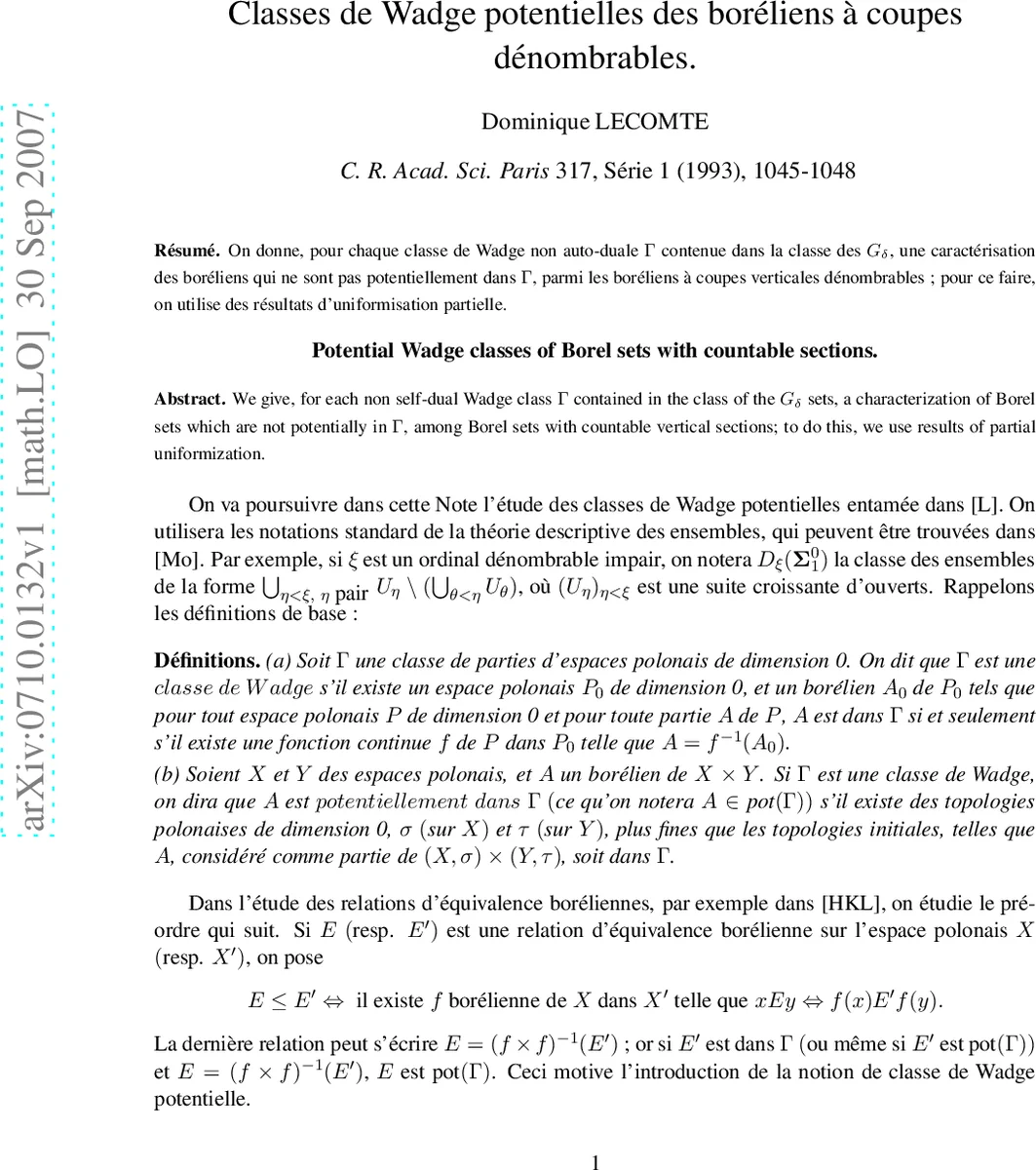
We give, for each non self-dual Wadge class C contained in the class of the Gdelta sets, a characterization of Borel sets which are not potentially in C, among Borel sets with countable vertical sections; to do this, we use results of partial uniformization.
💡 Research Summary
The paper investigates the interaction between Wadge theory and partial uniformization, focusing on Borel subsets of product spaces whose vertical sections are countable. The central goal is to give a complete characterization, for each non‑self‑dual Wadge class Γ contained in the class of Gδ sets, of those Borel sets that are not potentially in Γ (i.e., not in pot(Γ)) when the vertical sections are countable. “Potentially in Γ” means that by refining the Polish zero‑dimensional topologies on the two factors one can make the set belong to Γ.
The author first recalls the definition of a Wadge class: a class Γ of subsets of zero‑dimensional Polish spaces is a Wadge class if there exists a fixed zero‑dimensional Polish space P₀ and a Borel set A₀⊆P₀ such that for every zero‑dimensional Polish space P and every A⊆P, we have A∈Γ iff there is a continuous map f:P→P₀ with A=f⁻¹(A₀). The potential version pot(Γ) allows one to replace the original topologies on X and Y by finer zero‑dimensional Polish topologies σ and τ and ask that A, viewed as a subset of (X,σ)×(Y,τ), belong to Γ.
The paper then turns to partial uniformization results, beginning with Mauldin’s theorem (measure‑theoretic uniformization) and showing that an analogous statement fails for category (meager sets). To handle the category side the author introduces two notions:
- Pre‑open (p.o.) Gδ sets: a Gδ set U is p.o. if U⊆int(‾U), i.e. it is dense in an open set.
- Locally projection‑open (l.p.o.) subsets of a product: A⊆X×Y is l.p.o. if for every open rectangle U⊆X×Y the projections of A∩U are open.
A key example is the closed set
A₀ = { (x,K)∈2^ω×K(2^ω){∅} | x∈K },
which is l.p.o., has uncountable vertical sections, and whose horizontal sections are uncountable on a co‑meager set. The author shows that, despite the symmetry of the situation, one cannot in general obtain a uniformizing function whose graph lies in both directions of A₀.
The main uniformization theorem (Theorem 1.5) states: if X and Y are perfect zero‑dimensional Polish spaces and A⊆X×Y is a non‑empty Gδ l.p.o. set, then there exist non‑empty p.o. subsets F⊆X and G⊆Y and a continuous open surjection f:F→G such that the graph of f is contained either in A or in the transpose A* = { (y,x) | (x,y)∈A }. This result is the engine behind the later Wadge‑theoretic applications.
Next, the author introduces a hierarchy of trees T_ξ and T′_ξ built from a recursive function f on finite sequences, where ξ is a non‑zero countable ordinal. From these trees one defines families of graphs G_s (for each node s) that encode increasingly complex combinatorial patterns. Using these, the author formulates precise criteria for a Borel set A (assumed to be pot(Σ⁰₃)∩pot(Π⁰₃)) to fail to be pot(D_ξ(Σ⁰₁)) when ξ is even, and to fail to be pot(ˇD_ξ(Σ⁰₁)) when ξ is odd (Theorem 2.1). The condition involves the existence of perfect zero‑dimensional spaces Z and T, clopen non‑empty sets A_s⊆Z and B_s⊆T indexed by nodes s∈T_ξ, continuous open surjections f_s:A_s→B_s, and continuous injections u,v such that the unions of the associated graphs B_p (even‑level nodes) and B_i (odd‑level nodes) sit inside the preimages of A and its complement under u×v, respectively. Moreover, for nodes s in T′_ξ the graphs must satisfy a “difference” condition G_s = ⋃n G{s⌢n} \ ⋃n G{s⌢n}.
Theorem 2.2 specializes to Borel sets with countable vertical sections. It shows that such a set A is not pot(Π⁰₁) precisely when there exist perfect zero‑dimensional spaces Z′,T′, sequences of clopen sets (A_n)⊆Z′ and (B_n)⊆T′, continuous open surjections f_n:A_n→B_n, and continuous injections U,V such that the union of the graphs of the f_n’s (excluding possibly f_0) equals (U×V)⁻¹(A) (or its complement). A symmetric version with dense open sets and open maps g_n is also given.
Proposition 2.3 translates these results into the language of the Wadge hierarchy: for Borel sets with countable vertical sections, non‑pot(Δ⁰₁) is equivalent to non‑pot(Σ⁰₁) and to the vertical projection being uncountable; similarly, non‑pot(ˇD_{2k−1}(Σ⁰₁)) ⇔ non‑pot(ˇD_{2k}(Σ⁰₁)) ⇔ non‑pot(D_{2k−1}(Σ⁰₁)+), and analogous statements for D_{2k+1}.
Finally, the paper revisits a classical theorem of Hurewicz (Theorem 2.4) stating that a Borel set A⊆X is not Π⁰₂ iff there exists a countable, perfect, nowhere‑isolated set E⊆X with E\E≈ω^ω and E=A∩E. Using this, Theorem 2.5 extends the characterization to product spaces: a Borel set A⊆X×Y with countable vertical sections is not pot(Π⁰₂) iff there are perfect zero‑dimensional spaces Z,T, continuous injections u,v, dense open sets (A_n)⊆Z, and continuous open surjections f_n:A_n→T such that for each x∈⋃_n A_n the set E_x={f_n(x) | n∈ω} is countable, has no isolated points, satisfies E_x\E_x≈ω^ω, and coincides with the vertical section of (u×v)⁻¹(A) at x.
In summary, the paper achieves a thorough classification of Borel sets with countable vertical sections relative to potential Wadge classes. By leveraging sophisticated partial uniformization theorems, it translates the combinatorial complexity of Wadge hierarchies (via the D_ξ(Σ⁰₁) families) into concrete structural conditions involving continuous open maps between perfect zero‑dimensional Polish spaces. This bridges descriptive set theory, topology, and uniformization, providing tools that are likely to be useful for further investigations of Borel equivalence relations and the fine structure of the Wadge hierarchy.
Comments & Academic Discussion
Loading comments...
Leave a Comment