On the Lusternik-Schnirelmann category of spaces with 2-dimensional fundamental group
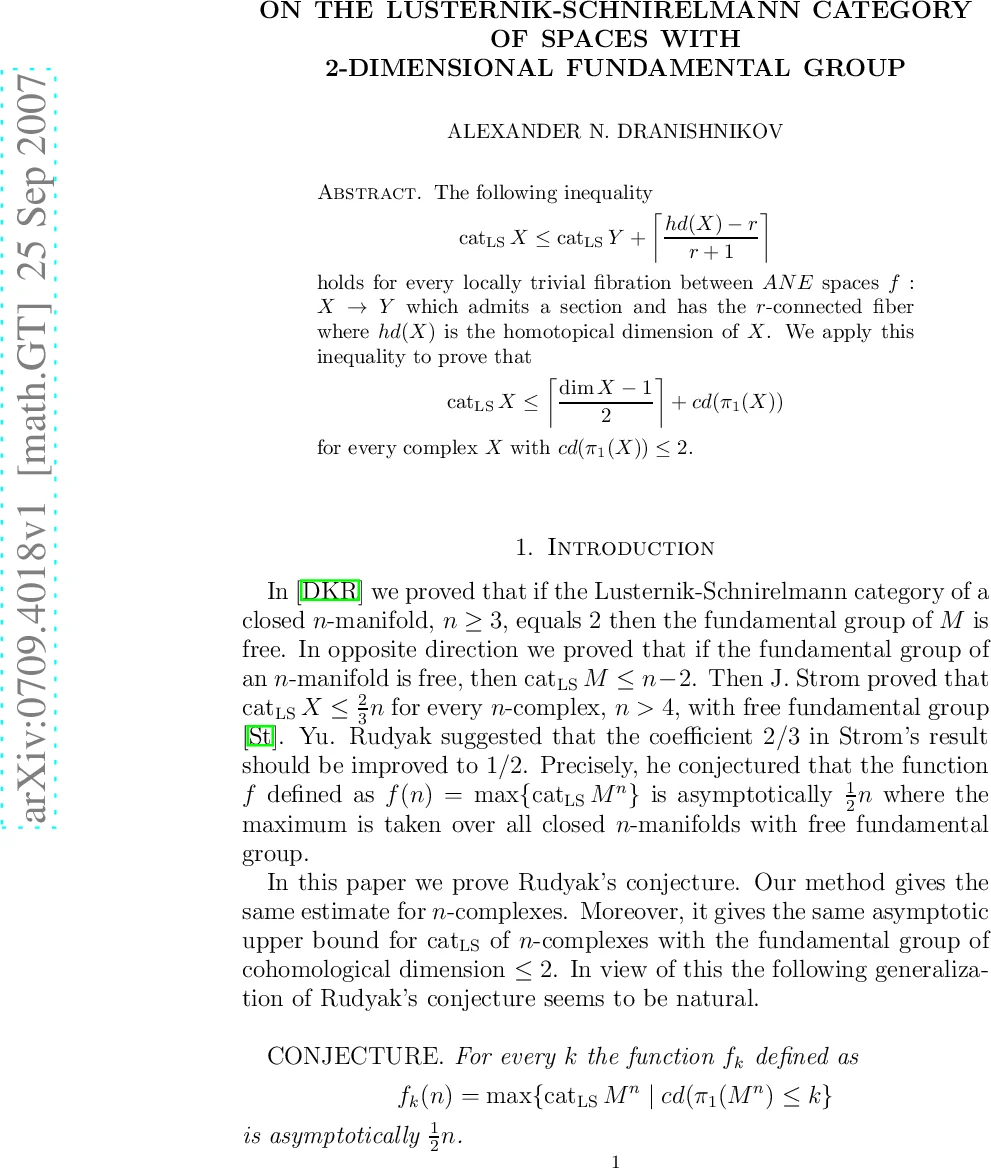
The following inequality \cat X\le \cat Y+\lceil\frac{hd(X)-r}{r+1}\rceil holds for every locally trivial fibration between $ANE$ spaces $f:X\to Y$ which admits a section and has the $r$-connected fiber where $hd(X)$ is the homotopical dimension of $X$. We apply this inequality to prove that \cat X\le \lceil\frac{\dim X-1}{2}\rceil+cd(\pi_1(X)) for every complex $X$ with $cd(\pi_1(X))\le 2$.
💡 Research Summary
The paper establishes a new general inequality for the Lusternik‑Schnirelmann (LS) category of a space that fibers over another space with a section. Let f : X → Y be a locally trivial fibration between ANE spaces whose fiber is r‑connected and admits a section. Denote by hd(X) the homotopical dimension (the minimal dimension of a CW‑complex homotopy equivalent to X). The author proves
cat X ≤ cat Y + ⌈(hd X − r)/(r + 1)⌉.
The proof combines several ideas. First, the author revisits the Kolmogorov‑Ostrand characterization of covering dimension and translates it into the language of LS‑category: an X‑contractible open cover of multiplicity ≤ n + 1 exists exactly when cat X ≤ n. This “dimension‑category” analogy is formalized in Section 2.
Next, a notion of “∗‑category” of a map f, cat* f, is introduced as the minimal number of sets in a uniformly f‑contractible open cover. Using Ostrand’s theorem for the base Y and a construction that extends a given uniformly f‑contractible cover to an (n + m)‑cover (Theorem 2.5), the author shows that cat X ≤ dim Y + cat* f for any continuous map (Theorem 3.2).
The core of the argument is a fiberwise Ganea construction. For the given fibration with r‑connected fiber, one builds a sequence of fibrations ξ_k : E_k → X whose fibers are iterated joins of ΩF, the loop space of the fiber. The fiber of ξ_k is (k + (k + 1)r − 1)‑connected. By a standard obstruction‑theoretic result (Proposition 3.4), ξ_k admits a section as soon as k(r + 1) + r ≥ hd X. The smallest such k is precisely ⌈(hd X − r)/(r + 1)⌉, which yields cat* f ≤ ⌈(hd X − r)/(r + 1)⌉ and consequently the main inequality.
Having this general bound, the author applies it to spaces whose fundamental group has cohomological dimension ≤ 2. Let π = π₁(X) and assume cd(π) ≤ 2. The Borel construction produces a fibration ˜X ×_π Eπ → Bπ with simply‑connected fiber. Since cd(π) ≤ 2, Bπ can be taken to be a 3‑dimensional CW‑complex, and the fibration admits a section (no obstruction in H³). Applying the previous theorem with r = 0 (the fiber is 0‑connected) gives
cat X ≤ cd(π) + ⌈(hd X − 1)/2⌉.
Because hd X equals the ordinary dimension for finite complexes, this becomes
cat X ≤ ⌈(dim X − 1)/2⌉ + cd(π₁(X)).
In particular, if π₁(X) is free (cd = 1) we obtain
cat X ≤ 1 + ⌈(dim X − 1)/2⌉,
which is sharp for spaces such as S¹ × ℂPⁿ. For 3‑dimensional complexes with free fundamental group the bound reduces to cat X ≤ 2, a result that also follows from known homotopy classifications of 2‑complexes with free π₁.
The paper concludes with an open question: does there exist a 4‑dimensional complex K with free π₁ such that cat (K × S¹) = 4? A positive answer would show that the estimate cat X ≤ cd(π₁) + ⌈(dim X − 1)/2⌉ is sharp for cd = 2 as well. This question is linked to a problem about LS‑category of closed 4‑manifolds with free fundamental group.
Overall, the work provides a powerful new tool linking LS‑category, homotopical dimension, and the connectivity of fibers, and it successfully extends Rudyak’s conjecture on spaces with free fundamental group to the broader class of spaces whose fundamental group has cohomological dimension at most two.
Comments & Academic Discussion
Loading comments...
Leave a Comment