Molecular Spiders with Memory
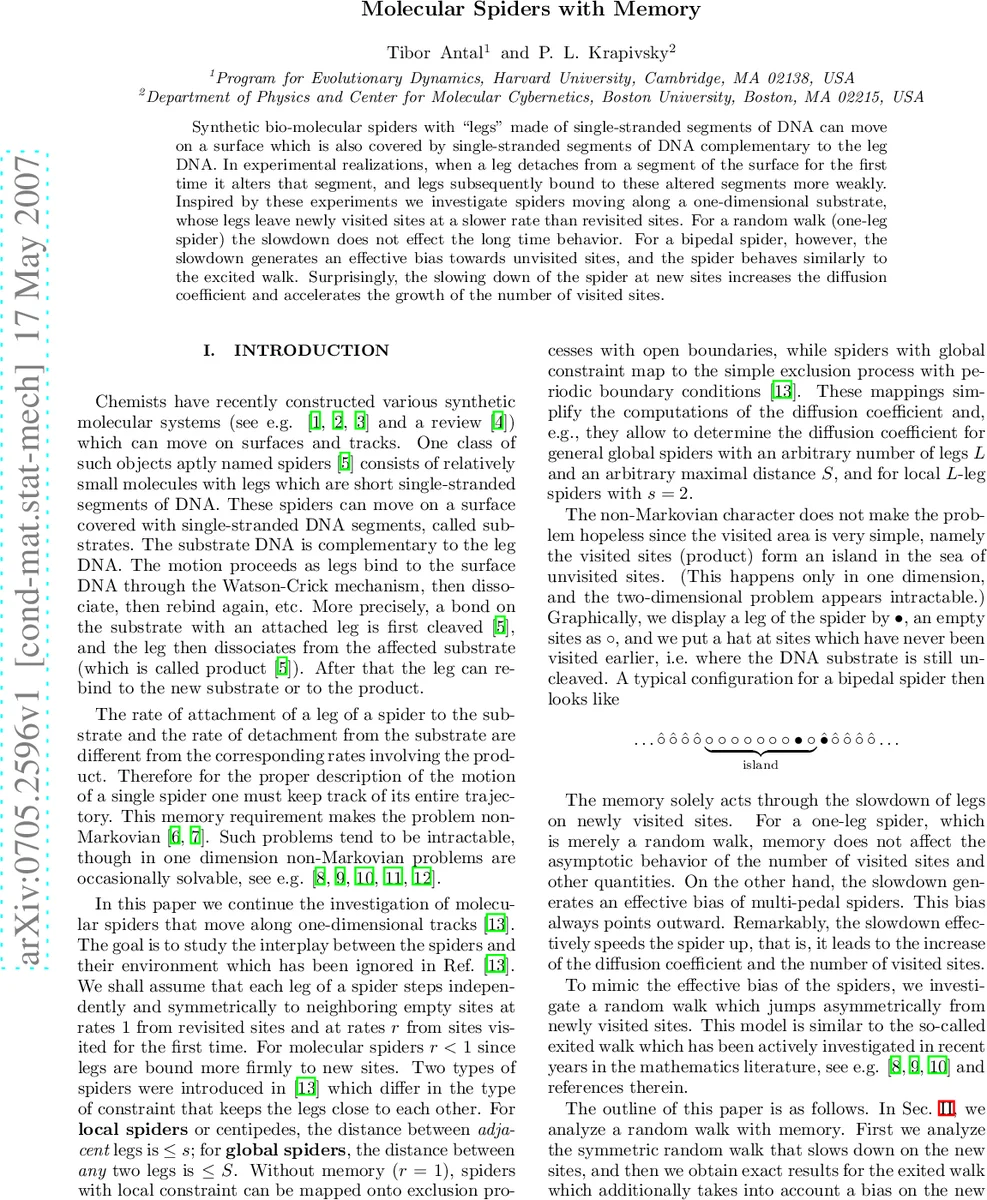
Synthetic bio-molecular spiders with “legs” made of single-stranded segments of DNA can move on a surface which is also covered by single-stranded segments of DNA complementary to the leg DNA. In experimental realizations, when a leg detaches from a segment of the surface for the first time it alters that segment, and legs subsequently bound to these altered segments more weakly. Inspired by these experiments we investigate spiders moving along a one-dimensional substrate, whose legs leave newly visited sites at a slower rate than revisited sites. For a random walk (one-leg spider) the slowdown does not effect the long time behavior. For a bipedal spider, however, the slowdown generates an effective bias towards unvisited sites, and the spider behaves similarly to the excited walk. Surprisingly, the slowing down of the spider at new sites increases the diffusion coefficient and accelerates the growth of the number of visited sites.
💡 Research Summary
The paper investigates the dynamics of synthetic DNA‑based molecular spiders moving on a one‑dimensional substrate, focusing on the effect of a memory mechanism whereby a leg that detaches from a site for the first time leaves that site in a modified state that weakens subsequent binding. The authors model the substrate as a lattice whose sites are either “new” (never visited) or “visited”. When a spider steps onto a new site, the hopping rate away from that site is reduced to r < 1, whereas from visited sites the hopping rate is unity.
First, the authors consider the simplest case of a one‑leg spider, which reduces to a random walk with site‑dependent rates. By calculating the mean time ⟨T_N⟩ required to visit N distinct sites, they obtain ⟨T_N⟩ = N(N‑1)/4 + N²/(2r). The leading N² term is independent of r, showing that the slowdown at new sites only changes sub‑leading linear corrections. Consequently, the long‑time diffusion exponent and the scaling of the number of visited sites remain those of an ordinary random walk; the memory is asymptotically irrelevant for a single leg.
To capture the bias introduced by the slowdown, the authors turn to the “excited random walk” (ERW) framework. In an ERW, the first departure from a site occurs with forward rate f and backward rate b, while subsequent departures are symmetric (rate 1). By solving the associated first‑passage problem using Laplace transforms, they derive exact expressions for the average cover time, its variance, and the full distribution of the number of visited sites. The key result is that the average number of visited sites grows as ⟨n(t)⟩ = A(a) √t, where a = 2/(1 + f/b) and A(a) = 2 Γ(a) Γ(a + ½)/√π. For the unbiased case a = 1, A = 4/√π, reproducing the classic result. When a ≠ 1 (i.e., when there is a forward or backward bias), A decreases monotonically, yet the diffusion coefficient D ∝ A² actually increases for strong forward bias—a counter‑intuitive acceleration caused by the effective outward drift.
The core of the paper examines a bipedal spider with a maximal leg separation s = 2. When one leg steps onto a new site, that site becomes a “product” and the leg’s detachment rate drops to r. The spider’s center of mass then performs a biased walk: the leg on the newly visited site moves slowly (rate r) while the other leg moves at rate 1. This asymmetry creates an effective outward bias whenever the spider is at the edge of the visited “island”. By mapping the spider’s dynamics onto a random walk with reflecting boundaries, the authors compute the mean time to enlarge the visited region and find that the slowdown at new sites leads to a larger effective diffusion constant and a faster √t growth of visited sites, exactly as predicted by the ERW analogy.
Finally, the analysis is extended to global spiders with L legs and a global distance constraint S = L. The same mechanism—slow departure from freshly visited sites—generates an outward bias for the whole assembly. Using known results for exclusion processes with periodic boundaries, the authors obtain diffusion coefficients for arbitrary L, confirming that the memory‑induced bias persists and even amplifies with more legs.
In summary, the paper demonstrates that a simple memory rule—slower hopping from newly visited sites—does not affect a single‑leg random walk but dramatically changes the behavior of multi‑leg spiders. The slowdown produces an effective outward bias, increasing both the diffusion coefficient and the rate at which new sites are explored. These findings provide quantitative guidance for designing DNA‑spider nanomachines with tunable exploration speeds and illustrate how non‑Markovian effects can be treated exactly in one dimension.
Comments & Academic Discussion
Loading comments...
Leave a Comment