Cooperative game theory and the Gaussian interference channel
In this paper we discuss the use of cooperative game theory for analyzing interference channels. We extend our previous work, to games with N players as well as frequency selective channels and joint TDM/FDM strategies. We show that the Nash bargai…
Authors: ** - Amir Leshem (Bar‑Ilan University) - 기타 공동 저자 (논문에 명시되지 않았으나, ISIT 2006 발표와 Intel 지원을 고려하면 **Y. C. Eldar**, **M. A. Maddah‑Ali** 등 가능) **
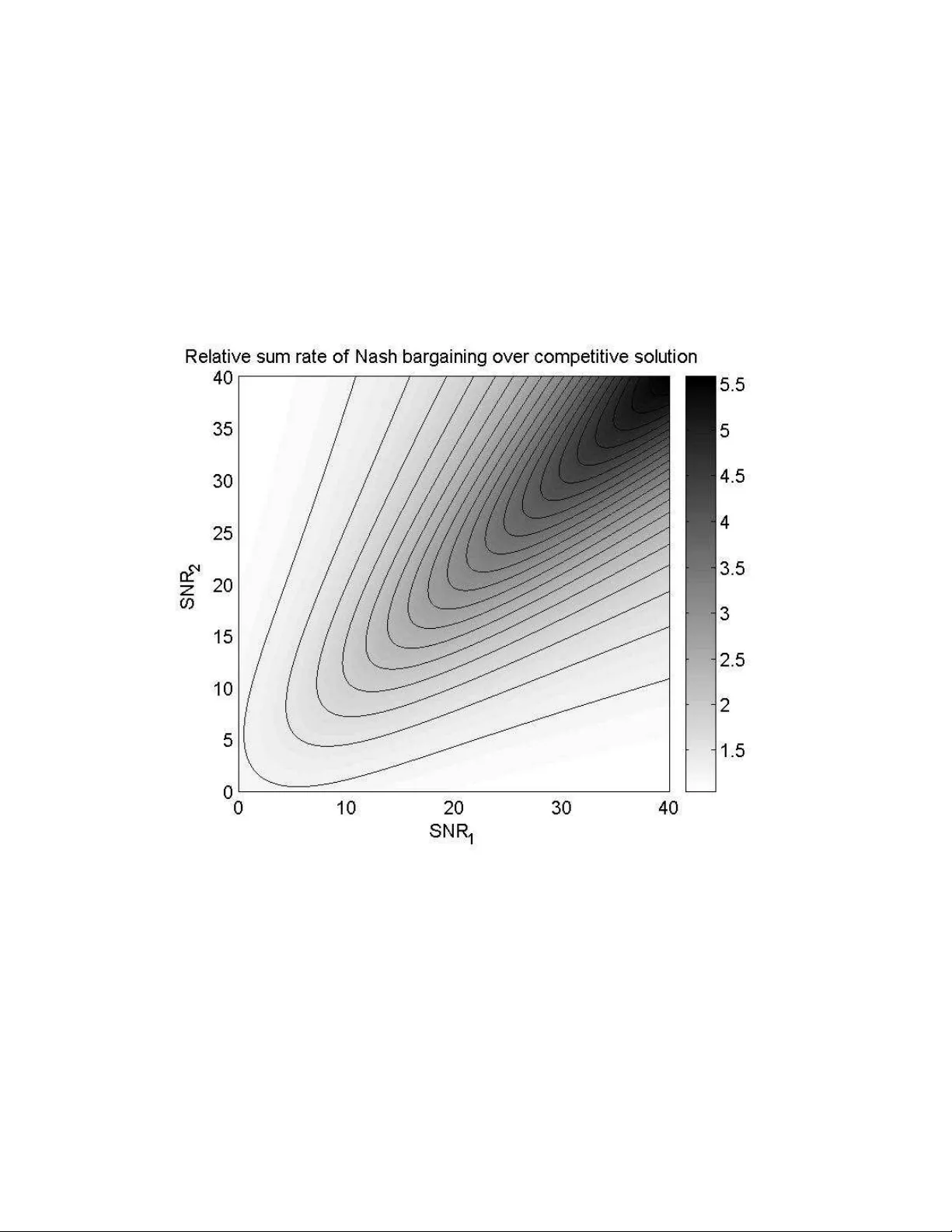
1 Cooperati v e game theory and the Gaussian interfer ence channel Amir Leshem ( Senior member ) and Ephraim Zehavi ( Senior member ) Abstract In this paper w e discuss the use of cooperative game theo ry for analyzing in terferen ce chann els. W e extend our previous work, to games with N players as we ll as frequ ency selecti ve chann els and jo int TDM/FDM strategies. W e show that the Nash b argaining solu tion can b e compu ted u sing conve x o ptimization techniq ues. W e also show that the same r esults are applicable to inter ference channels whe re only statistical k nowledge of the chann el is available. Moreover , for th e special case of two player s 2 × K frequency selective cha nnel (with K freq uency bins) we provide an O ( K log 2 K ) complexity algorithm for co mputing the Na sh bargaining solution und er mask constraint and u sing join t FDM/TDM strategies. Simulatio n results are also provide d. Ke ywords: Spectrum optimization, distrib uted coordination , game theory , Nash bargaining s olution, interfer ence channel, m ultiple a ccess ch annel. I . I N T R O D U C T I O N Computing the capacity region of the interference channel is an open problem in in formation theory [2]. A good overvie w of the result s unt il 198 5 is given by van der Meulen [3] and the references therein. The capacity region of general in terference case is not k nown yet. Howe ve r , i n the last forty five years of research some progress has been made. Ahslsw ede [4], d eri ved a general formu la for the capacity region of a discrete memoryless Interference Channel (IC) using a lim iting expression which is comput ationally infeasible. Cheng, and V erdu [5] prov ed that the limiting expre ssion cannot be written in general by a single-letter formula and the restriction to Gaussian inputs provides only an i nner bound t o the capacity region of the IC. The best kno wn achi e vable region for the g eneral interference channel is d ue to Han and Kobayashi [6]. Howe ver the computati on of the Han and K obayashi formula for a general discrete memoryless channel is in general too complex. Sason [7] describes certain i mprovement over the Han K obayashi rate re gion in certain cases. A 2x2 Ga ussian interference channel in standard form (after suitable School of Engineering, Bar-Ilan Unive rsity , Ramat-Gan, 52900, Israel. Part of this work has been presented at ISIT 2006 [1]. This wo rk was supported by Intel Corporation. e-mail: leshema@eng.biu.ac.il . 2 normalization) is giv en by: x = H s + n , H = 1 α β 1 (1) where, s = [ s 1 , s 2 ] T , and x = [ x 1 , x 2 ] T are sampled va lues of the input and output signals, respectively . The noise vector n represents t he additive Gaussian no ises with zero mean and unit variance. The powe rs of the input signals are constrained to be less than P 1 , P 2 respectiv ely . The off -diagonal elements of H , α, β represent the degree of interference p resent. The capacity region of the Gaussain interference channel with very strong interference (i.e., α ≥ 1 + P 1 , β ≥ 1 + P 2 ) was found by Carleial give n by R i ≤ log 2 (1 + P i ) , i = 1 , 2 . (2) This surprising result sho ws that very strong interference d ose not reduce the capacity . A Gaussian interference channel is said to have s trong i nterference if min { α, β } > 1 . Sato [8] d eri ved an achieva ble capacity region (in ner bound) of Gaussian interference channel as i ntersection of two m ultiple access gaussian capacity regions embedded in the in terference channel. The achiev able region is the i ntersection of the rate p air of the rectangular region of t he very strong interference (2) and the region R 1 + R 2 ≤ log 2 (min { 1 + P 1 + αP 2 , 1 + P 2 + β P 1 } ) . (3) A recent progress for the case o f Gaus sian interference is described by Sason [7 ]. Sa son deri ved an achie vable rate region based on a modified time- (or frequency-) division multipl exing approach which was originated by Sato for the degraded Gaussian IC. The achie vable rate region in cludes the rate region which is achiev ed by tim e/frequency division multiplexing (TDM / FDM), and it also includes th e rate region which is obtained by time sharing between the two rate pairs where one of the transm itters sends its data reliably at the maximal possib le rate (i.e., the maximum rate it can achiev e in t he absence of interference), and the other transmitt er decreases its data rate to the point where both recei vers can reliably decode t heir mess ages. While the two u sers fixed channel interference channel is a w ell st udied problem, much l ess is known in the frequency selectiv e case. An N × N frequency selecti ve Gaussian interference channel is given by : x k = H k s k + n k k = 1 , ..., K H k = h 11 ( k ) . . . h 1 N ( k ) . . . . . . . . . h N 1 ( k ) . . . h N N ( k ) . (4) where, s k , and x k are samp led values of the input and out put signal vectors at frequency k , respectiv ely . The noise vector n k represents the additive Gaussi an noises with zero mean and u nit va riance. The power 3 spectral density (PSD) of the input signals are constrained to be less than p 1 ( k ) , p 2 ( k ) respecti vely . The off- diagonal elements of H k , represent the degree of i nterference present at frequency k . The main difference between interference channel and a multiple access channel (MA C) is that in the interference channel, each component of s k is coded independently , and each receiv er has acce ss to a single element of x k . Therefore iterative decoding schemes are much m ore limited, and typically im practical. One of the sim plest ways to deal wi th interference channel is through orthogon al signaling . T wo extremely si mple orthogonal s chemes are using FDM or TDM strategies. For frequency selective channels (also known as ISI channels) we can combin e both strategies by allowing time varying allocation of the frequency bin s to t he dif ferent users. In t his paper we l imit ourselves to joint FDM and TDM scheme where an assignm ent o f disjoint portions of the frequency band to th e sev eral t ransmitters is made at each ti me in stance. This techniqu e is widely used i n practice b ecause s imple filtering can be used at t he recei vers to elim inate interference. In this paper we will assu me a PSD mask l imitatio n (peak power at each frequency) since this constraint is typically enforced b y regulators. While information theoretical considerations allow all points in the rate re gion, we ar gue that the interference channel i s a conflict situ ation between the interfering li nks [1]. Each link is considered a player in a general interference game. As such it has been shown that non -cooperativ e solut ions such as the iterative water-filling, which l eads t o good soluti ons for th e m ultiple access channel (MA C) and t he broadcast channel [9] can be highly s uboptimal in interference channel scenarios [10], [11]. T o solve this problem there are severa l p ossible approaches. One that has g ained popu larity in recent years is through the use of comp etitive strategies in repeated games [12]. Our approach i s significantly differe nt and is based o n general bargaining theory originally dev eloped by Nash [13]. Our approach is also di ff erent than that of [14] wh ere Nash bar gaining sol ution for interference channel s is studied under the ass umption of recei ver coop eration. This translates the channel into a MA C, and is not rele vant to dist ributed receiver topologies. In our analysis of the interference channel we claim that whil e all points o n the boundary of the interference channel are achiev able from the st rict information al p oint of vi ew , many of them will nev er be achieved since one of the pl ayers will refuse to use coding strategies leading to these points. The rate vec tors of interest are only rate vectors that do minate com ponent-wise the rates t hat each user can achie ve, independ ently of the other users coding s trategy . The best rate pairs that can be achie ved independently of the other users strategies form a Nash equilib rium [13]. T his im plies that not all th e rates are ind eed achiev able from game theoretic prespectiv e. Hence we define the game t heoretic rate region. Definition 1.1 : Let R be an achiev able inform ation theoretic rate region. The gam e theoretic rate region R G is given by R G = { ( R 1 , ..., R N ) ∈ R : R c i ≤ R i , for all i = 1 , ..., N } (5) 4 where R c i is th e rate achiev able by user i in a non-cooperative int erference gam e [11]. T o see what are t he pair rates that can be achieved by negotiation and cooperation of the users we resort to a well known so lution termed t he Nash bar gaining solut ion. In his seminal papers, Nash proposed four axioms required that any solut ion to the b ar gaining probl em should sat isfy . He then proved that there exists a unique so lution satisfying these axioms. W e will analyze the application of Nash bar gaining solution (NBS) t o the int erference game, and show t hat there exists a un ique point on the boundary of t he capacity region which is the solution t o the bargaining prob lem as po sed by Nash. The fact that th e N ash solution can be computed independentl y by us ers, using only channel state information, provides a good meth od for managi ng multi-user ad-hoc networks operating in an unregulated en vi ronment. Application of Nash bargaining to OFDMA has b een proposed by [15]. Howe ver in that paper the solution was used only as a measure of fairness. T herefore, R c i was not taken as the Nash equi librium for the competit iv e game, b ut an arbitrary R min i . Th is can resul t in non-feasible problem, and the proposed algorithm m ight be unstable. The algorith m in [15] is subopti mal e ven in the two users case, and according to the authors can lead t o an un stable situati on, where the Nash bargaining solu tion is not achieved even when it exists . In contrast, in this paper we show that the NBS for the N palyers game can b e computed using con ve x optimi zation techniques. W e also p rovide detail ed analysis o f t he two users case and provide an O ( K log 2 K ) complexity algorithm which provably achieve s t he joi nt FDM/ TDM Nash bargaining solution. Our analysis provides ensured con ver gence for higher num ber o f users and bou nds th e loss in applying OFDMA compared to joint FDM/T DM strategies. In the two users case we can s how t hat the Nash bargaining sol ution requires TDM over no more than a s ingle tone, so we can achiev e a very good approximation to t he opti mal FDM based Nash bargaining solution. W e also provide simil ar analysis for higher num ber of us ers, showing that for the Nash bargaining solution with N players, over a frequency selectiv e channel with K frequency b ins, only N 2 frequency bi ns has to be s hared by TDM , whil e all other frequencies are allocated to a single user . When N 2 << K , this provides a near optimal s olution to th e g ame usi ng FDM st rategies, as well . The structure of the paper is as follows: In section II we discuss competitive and cooperative s olutions to in terference games and provides an overvie w of t he Nash bargaining theory . In section III we discuss the existence of the NBS for N players FDM cooperative g ame over slow , flat fading channels. In s ection IV we discus s the Nash bar gaining ov er general frequency selective in terference channel, wit h mask constraint. W e show that compu ting the NBS under mask constraint and joint FDM/TDM strategies can be posed as a con ve x o ptimization problem . This shows that e ven for lar ge num ber of palyers, com puting the sol ution wit h many tones is feasibl e. W e also sh ow that in this case the N users will share only few 5 frequencies, dividing all the oth ers. In section V we specialize to the two players case, b ut with frequency selectiv e channel s. W e provide an algorith m for computing the NBS in complexity O ( K log 2 ( K ) . Finally , we demonstrate in simul ations the gains compared to to the competi tive solution bo th in the flat fading and the frequency selectiv e cases. W e end up with some conclusions. I I . N A S H E Q U I L I B R I U M V S . N A S H B A R G A I N I N G S O L U T I O N In this section we describe two solution concept s for N players games. The first n otion is that of Nash equilibrium. The second i s th e Nash bargaining sol ution (NBS). In order to sim plify the notation we specifically concentrate on the Gauss ian int erference game. A. The Gaussi an interfer ence game In t his section we define the Gaussian interference game, and provide som e s implifications for dealing with di screte frequencies. For a general b ackground on non-cooperativ e games we refer the reader to [13 ]. The Gaussian interference game was defined in [16]. In thi s paper we use the di screte approximation game. Let f 0 < · · · < f K be an increasing sequence of frequencies. Let I k be the clos ed interval be giv en by I k = [ f k − 1 , f k ] . W e now define the approxi mate Gauss ian in terference g ame denoted by GI { I 1 ,...,I K } . Let the players 1 , . . . , N op erate over K parallel channel s. Assume that the N channels have t ransfer functions h ij ( k ) . Assume that user i ’ t h is a llowed to transmit a total power of P i . Each player can transmit a power vector p i = ( p i (1) , . . . , p i ( K )) ∈ [0 , P i ] K such that p i ( k ) is the po wer transmit ted in the interval I k . Therefore we hav e P K k =1 p i ( k ) = P i . The equality foll ows from the fact that in non-cooperative scenario all users wi ll us e the maximal p ower they can use. This im plies that t he set of power distri butions for all users is a clos ed con vex subset of the cube Q N i =1 [0 , P i ] K giv en by: B = N Y i =1 B i (6) where B i is th e set of admi ssible power distributions for player i given by: B i = [0 , P i ] K ∩ ( ( p (1) , . . . , p ( K )) : K X k =1 p ( k ) = P i ) . (7) Each p layer chooses a PSD p i = h p i ( k ) : 1 ≤ k ≤ N i ∈ B i . Let the payoff for user i be giv en by: C i ( p 1 , . . . , p N ) = P K k =1 log 2 1 + | h i ( k ) | 2 p i ( k ) P | h ij ( k ) | 2 p j ( k )+ σ 2 i ( k ) (8) where C i is the capacity a vailable to player i given power dist ributions p 1 , . . . , p N , channel responses h i ( f ) , crosstalk coupling fun ctions h ij ( k ) and σ 2 i ( k ) > 0 is external nois e present at t he i ’th receiv er at frequency k . In cases where σ 2 i ( k ) = 0 capacities might become infinite u sing FDM s trategies, h owe ver 6 this is non-physical situat ion due to the receive r noise th at is always present, even if smal l. Each C i is continuous o n all variables. Definition 2.1 : The Gaussian Interference game GI { I 1 ,...,I k } = { C , B } is the N players non-cooperative game with payoff vector C = C 1 , . . . , C N where C i are defined in (28) and B is the s trategy set defined by (6). The interference game is a special case of con ve x non-cooperative N-perso ns game. B. Nash equilibr ium in non-cooperative games An im portant notion in game theory is that of a Nash equi librium. Definition 2.2 : An N -tuple of st rategies h p 1 , . . . , p N i for players 1 , . . . , N respectively is called a Nash equilibrium iff for all n and for all p ( p a strategy for player n ) C n p 1 , ..., p n − 1 , p , p n +1 , . . . , p N < C n ( p 1 , ..., p N ) i.e., give n that all other p layers i 6 = n use strategies p i , player n b est respons e is p n . The proof of existence of Nash equilib rium in the general interference game follows from an easy adaptation of the proof of the t his result for con ve x games [1]. A much harder p roblem is the uniqueness of Nash equili brium points in the water -filling game. This is very im portant to the stability of the waterfilling strategies. A first resul t in this di rection has been given in [17], [18]. A more general analysis of t he con vergence has been given in [19]. C. Nash bar gaining solution f or t he interfer ence game Nash equili bria are in e vitable whenev er a non -cooperativ e zero sum game is played. Howe ver they can lead to sub stantial loss to all players, compared to a cooperati ve strategy in the no n-zero sum case, where players can cooperate. Such a situation is called the prisoner’ s dilem ma. The m ain iss ue in this case is how to achieve the coop eration in a st able manner and what rates can be achiev ed through cooperation. In this section we present the Nash bargaining solu tion [13]. The underlying structure for a Nash bar gaining in an N players game i s a set of out comes o f the bargaining p rocess S whi ch is compact and con ve x. S can be considered as a s et of po ssible joint strategies or states, a desi gnated disagreement outcome d (whi ch represents the agreement t o disagree and solve the problem competi tive ly) and a multiuser ut ility function U : S ∪ { d }→ R N . The Nash bargaining is a function F which assign s to each pair ( S ∪ { d } , U ) as above an element of S ∪ { d } . Furthermore, the N ash sol ution is uniqu e. In order to obtain the solution, Nash assum ed four axiom s: Linearity . This means that if we perform the same linear transformation on t he utilities of all players than th e s olution i s transform ed accordingly . 7 Independence of irr elevant alternati ves . This axio m states t hat if the bargaining solut ion of a large game T ∪ { d } is obtained i n a small set S . Then the bargaining solutio n assigns the same solut ion to the smaller game, i.e., The irrelev ant alternative s in T \ S do no t affect the outcome of th e bargaining. Symmetry . If two p layers are identical t han renaming them will not change the outcome and both will get the sam e utili ty . P ar eto optimal ity . If s is the outcome of the bargaining then n o other st ate t exists such that U ( s ) < U ( t ) (coordinate wise). A good discus sion o f these axio ms can be found i n [13]. Nash proved th at there exists a unique soluti on to th e b ar gaining problem satisfying these 4 axiom s. Th e s olution i s obt ained by maxim izing s = arg max s ∈ S ∪{ d } N Y n =1 ( U n ( s ) − U n ( d )) . (9) T ypically one assumes that there exist at least one feasible s ∈ S such that U ( d ) < U ( s ) coordinatewise, but otherwise we can assume t hat th e b ar gaining so lution is d . W e also define the Nash functi on F ( s ) : S ∪ { d }→ R F ( s ) = N Y n =1 ( U n ( s ) − U n ( d )) . (10) The Nash bar gaining solut ion is obt ained by m aximizing the Nash function over all possib le states. Since the set of possible o utcomes U ( S ∪ { d } ) i s conv ex F ( s ) has a unique maximum on t he boundary of U ( S ∪ { d } ) . Whene ver the dis agreement situation can be d ecided by a comp etitive g ame, it i s reasonable to assume that the disagreement state is giv en by a Nash equili brium of t he relev ant compet itive game. When t he utility for user n is gi ven by the rate R n , and U n ( d ) is the competitive Nash equilibrium, it is obtained b y iterativ e waterfilling for general ISI channels. For the case of mask constraints the competitiv e solut ion is si mply given by al l users us ing t he maximal PSD at all tones. I I I . N A S H BA R G A I N I N G S O L U T I O N F O R T H E FL A T F A D I N G N P L A Y E R S I N T E R F E R E N C E G A M E In this section we provide conditions for the e xistence of the Nash bargaining solutio n (NBS) for the N × N flat frequency in terference game. In general, the rate region for the interference channel is unknown. Howe ver , by a simple ti me sharing argument we know that the rate region is always a con vex set R , i.e. R = { r : r = ( R 1 , R 2 , ..., R N ) is in the rate region } . (11) is a con vex set. T y pically we will use the utility defined by the rate, i.e., for e very rate vector r = ( R 1 , ..., R N ) T we have U n ( r ) = R n . L ater we will show how the results can be generalized to other utility functions such as U L n ( t ) = log ( R n ) 8 For some specific o perational st rategies one can define an achieva ble rate region explicitl y . This allows for explicit determination of the strategies leading to the NBS. On e s uch example i s the use of FDM or TDM strategies i n the i nterference channel. In the s equel we analyze t he N players i nterference g ame, with FDM or TDM strategies. W e provide condition s under which th e bargaining sol ution exists, i.e., FDM strategies provide im provement ov er t he competitive soluti on. Thi s extends the work of [10] where we characterized when does FDM solu tion outperforms the com petitive IWF solution for sym metric 2x2 interference game. W e ha ve shown there that indeed in certain conditi ons the competit iv e g ame is su bject to the prisoner’ s dilemma wh ere the competitive so lution is suboptim al for both players. Let the utility of player n i s given by U n = R n . The receive d si gnal vector x is giv en by x = H s + n (12) where x = [ x 1 , ..., x N ] T is the receiv ed signal, and H = { h ij } , 0 ≤ i, j ≤ N , is t he interference coupling matrix, s = [ s 1 , s 2 , ..., s N ] T is th e vector of transmitt ed signals. W e will assume that for all i, j | h ij | < 1 . Moreover , we wil l assume that the matrix H is i n ve rtible. Thi s assumpt ion is reasonabl e since typical wireless communication channels are random, and the probability of obtaining a singular channel is 0. Note that in our case bot h transmission and reception are performed independently , and the vector formulation is us ed for n otational si mplicity . First observe: Lemma 3 .1: The competit iv e strategies in the Gaussian interference game are giv en b y flat powe r allocation. The resulti ng rates are: R c n = W 2 log 2 1 + | h nn | 2 P n W N 0 / 2 + P N j =1 ,j 6 = n | h nj | 2 P ij ! (13) Pr oof: T o see that t he flat power allocations form a Nash equilibri um for a flat channel, we first not e that when all pl ayers j 6 = n use flat power spectrum , the total interference plus nois e sp ectrum is also flat. Hence waterfilling by player n against flat power allocatio n results i n flat p ower spectrum. Th is im plies that the flat power spectrum i s indeed a Nash equi librium point. T o obtain the uniqueness, assume that the total power limit of the users is given by p = [ P 1 , ..., P N ] T and t hat the spectrum is divided into K identical band s. Assum e that user n strategy at the equil ibrium is given by ρ = [ ρ n (1) , ..., ρ n ( K )] T . W e note th at the mu tual waterfilling equations can be written for all k 6 = k ′ H Λ k p + N 0 I = H Λ k ′ p + N 0 I (14) where Λ k = diag { ρ 1 ( k ) , . . . , ρ N ( k ) } . By our ass umption H is in vertible and Λ k is diago nal for each k so we must have for all n, k , ρ n ( k ) = ρ n (1) , obtaining the uniq ueness. Finall y we n ote that when interference is very stron g there are other Nash equilibrium poin ts on the bo undary of the strategy s pace, where not all frequencies are us ed by all u sers. 9 T o simp lify the expression for the com petitive rates we divide the expression inside the lo g in (13) by the noise power W N 0 / 2 obtaining : R c n = W 2 log 2 1 + SNR n 1 + P N j 6 = n α nj SNR j ! (15) where SNR j = | h j j | 2 P j W N 0 / 2 , α nj = | h nj | 2 | h j j | 2 . Since the rates R c n are achiev ed b y competitive strategy , player n would no t cooperate unless he will obtain a rate higher t han R c n . T herefore, the game th eoretic rate region is defined by set o f rates higher that R c n of equation (15 ). W e are interested in FDM coopera tive st rategies. A strategy is a vec tor [ ρ 1 , ..., ρ N ] T such that P N n =1 ρ n ≤ 1 . W e assume that player n uses a fraction ρ n (0 ≤ ρ n ≤ 1) of the band (or equiv alently uses the channel for a fraction ρ n of the tim e in t he TDM case). The rate obtained by the n th player is given by R n ( ρ ) = R n ( ρ n ) = ρ n W 2 log 2 1 + SNR n ρ n . (16) First we note that the FDM rate region R F D M = { ( R 1 , ..., R N ) | R n = R n ( ρ n ) } is indeed con ve x. Th e Pareto opt imal point s mu st satisfy P N n =1 ρ n = 1 , since by dividing t he unused part of th e b and between users, all of them increase their uti lity . Also not e that b y strict monotonicity of R n ( ρ ) as a function of ρ each pareto opti mal point is on the boundary of R F D M . It is achiev ed by a single strategy vector ρ . Player n benefits from FDM coop eration as lo ng as R c n < R n ( ρ n ) . (17) The Nash functio n is g iv en by F ( ρ ) = N Y n =1 ( R n ( ρ n ) − R c n ) . (18) T o bett er und erstand the gain in FDM s trategies we define a function f ( x, y ) that is fund amental to the analysis. Definition 3.1 : For each 0 < x, y let f ( x, y ) be defined by f ( x, y ) = min ρ : 1 + x ρ ρ = 1 + x 1 + y . (19) Claim 3.1 : 1. f ( x, y ) is a wel l defined function fo r x, y ∈ R + . 2. For all x, y ∈ R + , 0 < f ( x, y ) < 1 . 3. f ( x, y ) is m onotonically decreasing in y . Pr oof: Let g ( x, y , ρ ) be defined by: g ( x, y , ρ ) = 1 + x ρ ρ − 1 − x 1 + y For e very x, y , g ( x, y , ρ ) is a con tinuous and mo notonic function in ρ . Furtherm ore, for any 0 < x, y , g ( x, y , 1) > 0 , and lim ρ → 0 g ( x, y , ρ ) < 0 . Hence, there is a uniqu e solution to (19). Furth ermore, the 10 value of f ( x, y ) is strictly between 0 , 1 . Finally f ( x, y ) is monotoni cally decreasing in y sin ce g ( x, y , ρ ) is in creasing in y , so if we increase y we n eed t o decreas ρ to m aintain a fixed value. Using the function f ( x, y ) we can completely characterize the cases where N B S is preferable to the Nash equilibrium . Theor em 3.2 : Nash bargaining solutio n exists if and only if t he following inequality hol ds N X n =1 f SNR n , X j 6 = n α nj SNR j ! ≤ 1 . (20) Proof: In one direction, assume that a Nash bargaining solution exists. The next two conditions must hold 1. There i s a partiti on of th e band between the players such that player n gets a fraction ρ n > 0 . 2. Each p layer gets by cooperation hig her rate then the competitive rate, i.e, R n ( ρ n ) ≥ R c n . Therefore, using equation (21) and inequality (17) we obtai n that equation (20) must be satisfied. On the o ther direction by definitio n of f player n has at least the rate that it can g et by competition if he can use a fraction ρ n , of the bandwidt h. Since (20) imp lies t hat P N n =1 ρ n ≤ 1 , FDM is preferable to t he competitive sol ution for the utility fun ction U n = R n . By the con vexity of t he FDM rate region the Nash function has a u nique m aximum t hat is Pareto op timal and out performs th e com petitive solutio n. Interestingly , as l ong as the utilit y function U n ( ρ ) depends only on ρ n and U n ( ρ ) is monot onically increasing in ρ th e same conclusion holds. This imp lies that the NBS when th e utility is U L n ( ρ ) = log ( R n ( ρ n )) there is a u nique frequency division vector ρ that achieves the NBS. Furthermore the optimizatio n problem, of comp uting the op timal ρ is stil l con vex. W e n ow examine t he simple case of two pl ayers. Assum e that player I uses a fraction ρ ( 0 ≤ ρ ≤ 1) of the band and us er II uses a fraction 1 − ρ . T he rates obtained by the two users are given by R 1 ( ρ ) = ρW 2 log 2 1 + SNR 1 ρ R 2 (1 − ρ ) = (1 − ρ ) W 2 log 2 1 + SNR 2 1 − ρ (21) The two users will benefit from FDM cooperation as l ong as R c i ≤ R i ( ρ i ) , i = 1 , 2 ρ 1 + ρ 2 ≤ 1 (22) Condition (20) can now be simpl ified: f ( SNR 1 , α SNR 2 ) + f ( SNR 2 , β SNR 1 ) ≤ 1 , (23) where SNR i = | h ii | 2 P i W N 0 / 2 , α = | h 12 | 2 | h 22 | 2 , β = | h 21 | 2 | h 11 | 2 . 11 The NBS is g iv en by s olving the prob lem ρ N B S = arg max ρ F ( ρ ) (24) where t he Nash functio n is n ow giv en by: F ( ρ ) = ( R 1 ( ρ ) − R c 1 ) ( R 2 (1 − ρ ) − R c 2 ) (25) and R i ( ρ ) are defined by (21). A special case can now be deriv ed: Claim 3.2 : Assum e that SNR 1 ≥ 1 2 ( α 2 β 4 ) − 1 / 3 and SNR 2 ≥ 1 2 ( β 2 α 4 ) − 1 / 3 . Then t here is a Nash bar gaining sol ution that is better than the competitive solution. When the channel is s ymmetric ( α = β ) the solution exists as long as S N R ≥ 1 2 α 2 . Pr oof: The proof of the claim follows directly by substit uting solving the equation for ρ 1 = ρ 2 = 1 / 2 . Finally we not e that as SNR i increases to infini ty th e NBS is always better than the NE. Claim 3.3 : If S N R 1 and S N R 2 are joi ntly increasing, while keeping th e ratio S N R 1 S N R 2 = z fixed. Then, there i s a const ant g such t hat for S N R 1 > g , an FDM Nash Bargaining solut ion exists. Proof: Define a function h ( x, z ) h ( x, z ) = min ρ : 1 + x ρ ρ = 1 + z . (26) z represents the constant ratio x/y . The function h ( x, z ) is monoto nically decreasing to zero as a function of x fo r any fixed v alue of z . Therefore, there is a constant g , such that for x > g th e inequality , h x, z α + h x z , 1 β z < 1 is satisfied. Since by definition of f ( x, y ) we ha ve h ( x, z ) > f ( x, y ) , the equation f x, x αy + f y , y β x < 1 also h olds for al l x > g and y = z x . Claim 3.4 : If S N R 1 + S N R 2 ≤ 1 − α − β αβ there i s no N ash bargaining sol ution. Proof: Nash Bar gaining solution d oes not exists if 1 + S N R 1 ρ ρ 1 + S N R 2 1 − ρ 1 − ρ < 1 + S N R 1 1 + α S N R 2 1 + S N R 2 1 + β S N R 1 . (27) Pr oof: The claim foll ows easily by applying the inequality x ρ y 1 − ρ ≤ ρx + (1 − ρ ) y on the left hand side of th e above inequali ty and using the assumptio n. The following example provides th e intui tion for the d efinitions of the game theoretic rate region, and the u niqueness o f the NBS using FDM strategies. It also clearly d emonstrates t he relati on between the competitive solution, th e NBS and the game t heoretic rate region R G . W e have chosen SNR 1 = 20 dB, SNR 2 = 15 dB, and α = 0 . 4 , β = 0 . 7 . Figure 1 presents the FDM rate region, the Nash equilibrium point denoted by , and a cont our plot of F ( ρ ) . It can be seen that the concavity of N F ( ρ ) together with the conv exity of the achie v able rate region implies that at there is a u nique contour tangent to t he rate 12 region. The tangent point is the Nash bargaining s olution. W e can see that the NBS achie ves rates that are 1.6 and 4 times higher than the rates of th e competitive Nash equilibri um rates for player I and player II respectively . The game theoretic rate region is the i ntersection of the inform ation theoretic rate region with t he quadrant above the dotted lines. I V . B A R G A I N I N G OV E R F R E Q U E N C Y S E L E C T I V E C H A N N E L S U N D E R M A S K C O N S T R A I N T In thi s section we define a new cooperative g ame correspondin g to the j oint FDM/TDM achiev able rate region for the frequency selective N users interference channel. W e limit ourselves t o the PSD mask constrained case since this case is actually the more practical one. In real applications, the re gulator limits the PSD mask and not onl y the tot al power constraint. Let th e K channel matrices at frequencies k = 1 , ..., K be giv en by h H k : k = 1 , ..., K i . Each pl ayer is allowe d to transmi t at maximum power p ( k ) in the k ’th frequency bin. In non-cooperative scenario, under mask const raint, all players transm it at t he maximal power they can use. Thus, all players choose the PSD, p = h p i ( k ) : 1 ≤ k ≤ K i . The payof f for user i i n the non -cooperativ e game is t herefore given by: R iC ( p 1 ) = K X k =1 log 2 1 + | h i ( k ) | 2 p i ( k ) P j 6 = i | h ij ( k ) | 2 p j ( k ) + σ 2 i ( k ) ! . (28) Here, R iC is the capacity av ailable to player i given a PSD mask constraint distributions p . σ 2 i ( k ) > 0 is th e noise presents at the i ’th receiv er at frequenc y k . Note that withou t loss of g enerality , and i n order to simpl ify not ation, we assum e t hat the width of each bin is normalized to 1. W e k now define the cooperativ e game G T F ( N , K , p ) . Definition 4.1 : The FDM/TDM game G T F ( N , K , p ) is a game between N pl ayers transm itting ov er K frequency bins under common PSD mask constraint . Each user has ful l knowledge o f the channel matrices H k . The following conditi ons hold: 1) Player i transmi ts using a PSD lim ited by h p i ( k ) : k = 1 , ..., K i satisfyi ng p i ( k ) ≤ p ( k ) . 2) Strategies for player i are vectors α = [ α i 1 , ..., α iK ] T where α k is the p roportion of time the player uses the k ’th frequency channel. This is th e TDM part of the strategy . 3) The util ity of the i ’th pl ayer is given b y R i = K X k =1 R i ( k ) = K X k =1 α ik log 2 1 + | h ii ( k ) | 2 p i ( k ) σ 2 i ( k ) (29) Note that interference is a voided by t ime sh aring at each frequency band, i.e o nly on e pl ayer t ransmits at a g iv en frequency bin at any time. Furthermore, sin ce at each time instance each frequency is us ed by a single user , each user can transmit using maximal power . 13 The Nash bargaining can be posed as an optimi zation problem max Q N n =1 ( R i ( α i ) − R iC ) subject to: P N i =1 α i ( k ) = 1 , ∀ i, k α i ( k ) ≥ 0 , ∀ i R iC ≤ R i ( α i ) , (30) where, R i ( α i ) = K X k =1 α i ( k ) log 2 1 + | h i ( k ) | 2 P max ( k ) σ 2 i ( k ) = K X k =1 α i ( k ) R i ( k )) . (31) This problem is con vex and therefore can be solved ef ficiently using con vex optimi zation techniques. T o that end we explore the KKT condi tions for the p roblem. The Lagrangian of th e problem f ( α ) is g iv en by f ( α ) = − P N i =1 log ( R i ( α i ) − R iC ) + P K k =1 λ k P N i =1 α i ( k ) − 1 − P K k =1 P N i =1 µ i ( k ) α i ( k ) − P N i =1 δ i P K k =1 α i ( k ) R i ( k ) − R iC . (32) T aking the deriv ati ve with respect to the variable α i ( k ) and comparing the result to zero, we get R i ( k ) R i ( α i ) − R iC = λ k − µ i ( k ) − δ i (33) with t he constraints N X i =1 α i ( k ) = 1 , δ i ( R i ( α i ) − R iC ) ≥ 0 , µ i ( k ) α i ( k ) = 0 , λ k ≥ 0 . (34) Based on (33 , 34) one can easily come to the following conclusions: 1) If t here is a feasible solut ion then for all i , δ i = 0 . 2) Assum e that a feasible solut ion exists. Then for all players sharing the frequency bin k ( α i ( k ) > 0 ) we h a ve µ i ( k ) = 0 , and R i ( k ) R i ( α i ) − R iC = λ k , ∀ k satisfying α i ( k ) > 0 . (35) 3) For al l players th at are no t sharing the frequency bin k ,( α i ( k ) = 0 ), µ i ( k ) ≥ 0 . Therefore, R i ( k ) R i ( α i ) − R iC ≤ λ k , ∀ k with α i ( k ) = 0 . (36) Clause (2) i s very int eresting. let L ij ( k ) = R i ( k ) /R j ( k ) . Assu me th at for users i , j the values L ij ( k ) are all dis tinct. Then th e t wo users can share at most a single frequency . T o s ee t his n ote that i n th is case R i ( k ) R i ( α i ) − R iC = R j ( k ) R j ( α j ) − R j C (37) and therefore L ij ( k ) = R i ( k ) R j ( k ) = R i ( α i ) − R iC R j ( α j ) − R j C (38) 14 Since t he right hand side is i ndependent of the frequency k and L ij ( k ) are dist inct, at most a sing le frequency can satisfy this condition. This proves the following theorem: Theor em 4.1 : Assume that for all i 6 = j the va lues { L ij ( k ) : k = 1 , ..., K } are all di stinct. Then i n the optimal so lution at m ost N 2 frequencies are shared between different users. This theorem suggests, t hat when N 2 << K the optimal FDM NBS is very close to the joint FDM /TDM solution. It is ob tained by allocating the comm on frequencies to one of the users. While general conv ex optim ization t echniques are useful for comput ing the NBS, in the next s ection we wil l demonstrate that for the two pl ayers case the s olution can be computed much more efficiently . Furthermore, we will show th at in the optimal solution only a single frequenc y is actually shared between the users even if the L ij ( k ) are not dist inct. Finally we com ment on the applicability of the m ethod to the case where onl y fading statis tics i s known. In this case the coding strategy will change, and th e achiev able rate in th e competit iv e case and the cooperativ e case are giv en by ˜ R iC ( p i ) = P K k =1 E h log 2 1 + | h i ( k ) | 2 p i ( k ) P j 6 = i | h ij ( k ) | 2 p j ( k )+ σ 2 i ( k ) i ˜ R i ( α i ) = P K k =1 α ik E h log 2 1 + | h ii ( k ) | 2 p i ( k ) σ 2 i ( k ) i (39) respectiv ely . All the rest of the d iscussion i s unchanged, replacing R iC and R i ( α i ) by ˜ R iC , ˜ R i ( α i ) respectiv ely . V . C O M P U T I N G T H E N A S H BA R G A I N I N G S O L U T I O N F O R T W O P L A Y E R S For the t wo players case the optim ization problem can be dramati cally sim plified. In this s ection we wil l provide an O ( K log 2 K ) complexity algorit hm (in the number of tones) for computing t he NBS optimal solution in a 2 users frequency selective channel. Furthermo re, we will s how that the two players will sh are at most a single frequency , no matter what th e rati os between the users are. T o t hat end let, α 1 ( k ) = α ( k ) , and α 2 ( k ) = 1 − α ( k ) . W e also d efine the surpl us of players I and II when us ing Nash bargaining so lution as A = P K m =1 α ( m ) R 1 ( m ) − R 1 C and B = P K , =1 (1 − α ( m )) R 2 ( m ) − R 2 C , respectiv ely . The ratio, Γ = A/B is a threshol d which is ind ependent of the frequency and is s et by the optim al assignment. While Γ is a-priori unk nown, i t exists. Let L ( k ) = R 1 ( k ) /R 2 ( k ) . W ithout loss of generalit y , assume t hat the rate ratios L ( k ) , 1 ≤ k ≤ K are sorted in decreasing ord er i.e. L ( k ) ≥ L ( k ′ ) , ∀ k ≤ k ′ . (Thi s can b e achie ved by sorting the frequencies according to L ( k ) . W e are now ready to define optimal assignm ent the α ’ s. D efine three sets: S 1 = { m : L ( m ) > Γ , A > 0 , B > 0 } , S 2 = { m : L ( m ) < Γ , A > 0 , B > 0 } , S c = { m : L ( m ) = Γ , A > 0 , B > 0 } . For all m ∈ S 1 α ( m ) = 1 . For all m ∈ S 2 α ( m ) = 0 . and for m ∈ S c 0 ≤ α ( m ) ≤ 1 . Thus if the s et S c is empt y , pure FDM is a Nash bargaining soluti on. 15 Let Γ k be a m oving threshold d efined by Γ k = A k /B k . where A k = k X m =1 R 1 ( m ) − R 1 C , B k = K X m = k + 1 R 2 ( m ) − R 2 C . (40) A k is a mo notonically i ncreasing sequence, whi le B k is monoto nically decreasing. Hence, Γ k is also monotonicall y increasing. A k is the surplus of user I respectively when frequencies 1 , ..., k are all ocated to user I. Similarly B k is the s urplus of user II when frequencies k + 1 , ..., K are all ocated to user II. Let k min = min k { k : A k ≥ 0 } ; k max = min k { k : B k < 0 } . (41) Since we are interested in feasibl e NBS, we m ust have positive surplus for both us ers. Therefore, by the KKT equations, we obtain k min ≤ k max and L ( k min ) ≤ Γ ≤ L ( k max ) . The sequence { Γ m : k min ≤ m ≤ k max − 1 } is strictly increasing, and always po sitive. W e first state t wo lemmas that are essential for finding t he optimal parti tion. Lemma 5 .1: Assume that there is an NBS to t he game. Then there is always a NBS satisfying that at most a single bin k s is partitioned b etween the players, and α ( k ) = 1 k < k s 0 k > k s . (42) Pr oof: By our assum ption the sequence { L ( k ) : k = 1 , ..., K } i s monoton ically d ecreasing (no t necessarily strictly decreasing). If there is a k s uch that L ( k − 1 ) < Γ < L ( k ) then the solut ion must be FDM t ype b y the KKT equations and we finish. Otherwise assum e th at L ( k ) = Γ . Since Γ k is strictly increasing and L ( k ) is non-increasing th ere is at mo st a unique k such that Γ k − 1 ≤ L ( k ) = Γ < Γ k . If no such k exists then the us ers can on ly sh are k max since for all k ≤ k max A k B k ≤ Γ and t he only way to get something allocated to user II is by sharing k max . Ot herwise such a k ≤ k max exists. By definition of Γ k we h a ve A k − 1 B k − 1 ≤ L ( k ) < A k B k . Simple s ubstituti on yields A k − 1 B k − 1 ≤ L ( k ) < A k − 1 + R 1 ( k ) B k − 1 − R 2 ( k ) = A k B k . Since k min ≤ k < k max the denominator o n the RHS is posit iv e. Since for a, b, c, d > 0 t he functio n a + xb c − xd is increasing wit h 0 ≤ x as long as the deno minator is posi tiv e, we obtain th at by continu ity t here is a unique ζ su ch that L ( k ) = A k − 1 + ζ R 1 ( k ) B k − 1 − ζ R 2 ( k ) . 16 But B k − 1 − ζ R 2 ( k ) = B k + (1 − ζ ) R 2 ( k ) so that ζ satisfies Γ = L ( k ) = A k − 1 + ζ R 1 ( k ) B k + (1 − ζ ) R 2 ( k ) . Setting α ( m ) = 1 for m < k , α ( k ) = ζ and α ( m ) = 0 for m > k we obtain a solu tion of the KKT equations. Note that when there are m ultiple values of k such that L ( k ) = Γ , w e o nly showed that there is an NBS so lution wh ere a sing le frequency is sh ared. While th e threshold Γ is un known, o ne can u se the sequences Γ k and L ( k ) . If t here i s a Nash bar gaining soluti on, let k s be the frequency bin th at is sh ared by the players. Th en, k min ≤ k s ≤ k max . Since, bot h players m ust h a ve a posit iv e gain in the game ( A > A k min − 1 , B > B k max ). Let k s be the smallest in teger such that L ( k s ) < Γ k s , if such k s exists. Otherwis e let k s = k max . Lemma 5 .2: The following two statement s provide the sol ution 1 If a Nash bargaining soluti on exists for k min ≤ k s < k max , then α ( k s ) is giv en by α ( k s ) = max { 0 , g } , where g = 1 + B k s 2 R 2 ( k s ) 1 − Γ k s L ( k s ) . (43) 2 If a Nash bargaining solut ion exists and there is no such k s , then k s = k max and α ( k s ) = g . Pr oof: T o prove 1 note t hat si nce Γ k s − 1 ≤ L ( k s ) ≤ Γ k s , α ( k s ) is the solution to the equation L ( k s ) = A k s − (1 − α ( k s )) R 1 ( k s ) B k s +(1 − α ) R 2 ( k s ) . By s imple mathematical mani pulation, we get α ( k s ) = g . Since, L ( k ) ≤ Γ k s , g ≤ 1 . If g is negativ e, we s et α ( k s ) = 0 , si nce k s is the smallest in teger such that L ( k s ) < Γ k s . N ote, that in this case t he Nash bargaining sol ution is given by p ure FDM strategies. T o prov e 2 note that since k s = k max and Γ k is increasing for k min ≤ k < k max , we must hav e t hat Γ k max − 1 ≤ Γ = L ( k max ) . Therefore, the only poss ibility that t here is a sol ution is if k s = k max , and α ( k s ) = g ≥ 0 . Based on the pervious lemmas the algorithm is described in table I. In the first stage the algo rithm computes L ( k ) and sorts them in a no n increasing order . Then k min , k max , A k , and B k are computed. In the second stage th e algorith m comput es k s and α . Fig ure 2 demonstrates the situatio n when S N R = 30 dB and SIR is 10 dB. In this case k max = 10 since B 11 becomes negative. Also Γ 8 < L (9) < Γ 9 . Therefore, only frequency 9 might be sh ared between the users. The algorithm comput es a Nash bargaining solution if it exists, ev en in the case that L ( k ) is not a strictl y decreasing sequence. Ho wev er , reordering the bins with identical ratio may provides a di f ferent solution, with the same capacity gain for each player . V I . S I M U L A T I O N S In this section we compare in s imulation s the Bargaining solut ion to the competitive solution for var ious situations with medium interference. The simu lations are don e both for flat slow fading and for frequency 17 selectiv e fading. First, we dem onstrate the ef fect of the channel matrix and the signal t o noise ratio on the gain of the NBS for flat fading channel. Then we performed extensive simulati ons t hat demonstrate the advantage of the NBS over the comp etitive app roach for t he frequency selective fading channel, as a function of the mean int erference power . A. Fla t fa ding W e h a ve tested th e gai n of t he N ash bar gaining solution relativ e to the Nash equili brium competi tiv e rate pair as a function of channel coef ficients as well as signal to noise ratio for the flat fading chann el. T o that end we define th e m inimum relative improvement describ ing t he individual price of anarchy b y: ∆ min = min R N B S 1 R c 1 , R N B S 2 R c 2 (44) and the usu al price of anarchy [20], describing total loss due to lack of cooperation by ∆ sum = R N B S 1 + R N B S 2 R c 1 + R c 2 . (45) In t he first set of experiments we ha ve fixed α , β and var ied SNR 1 , SNR 2 from 0 to 40 dB in steps of 0.25dB. Figure 3 presents ∆ min for an in terference chann el with α = β = 0 . 7 . W e can see that for high SNR we obtain significant improvement. Fig ure 4 presents t he relativ e sum rate improvement ∆ sum for the same channel. W e can see that the achieved rates are 5.5 t imes those of the com petitive solu tion. W e hav e now s tudied the effect of the interference coefficients on t he Nash Bar gaining solution. W e ha ve set the s ignal to additive white Gaussian noise ratio for both users to 20 dB, and varied α and β between 0 and 1 . Similarly t o the pre vious case we present the minimal price of anarchy per us er ∆ min and the sum rate price of anarchy ∆ sum . The results are shown in figures 5,6. W e can clearly see t hat even with SINR of 10 dB we obtain 50 percent capacity gain per user . B. F r equency selective Gaussian channel In this experiment W e demonstrate th e advantage of th e Nash bargaining sol ution over competit iv e approaches for a frequency selectiv e interference channel. W e assumed t hat two us ers having direct channels that are standard Rayleigh fading channels ( σ 2 = 1 ), with SNR=30 dB, suffe r from in terference, with SINR of each user in to the o ther channel ( h ij ) was varied from 10 dB to 0 dB ( σ h ij = 0 . 1 , ... 1 ). W e have used 32 frequency bin s. At each pair o f variances σ 2 1 = σ 2 h 21 , σ 2 2 = σ 2 h 12 we randomly picked 25 channels (each comprisi ng of 32 2x2 m atrices). The result s of the minimal relative improvement (44) are depicted in figure 7. W e can clearly see that t he relative gain of the Nash bargaining solut ion over the competitive soluti on is 1.5 to 3.5 times, whi ch clearly demonstrates the m errits of the m ethod. 18 V I I . C O N C L U S I O N S In t his paper we h a ve defined the t ic rate region for the interference channel. T he region is a subset of the rate region of the interference channel. W e have shown that a specific point in the rate region given by the Nash bargaining so lution is b etter than other poin ts i n the context of bargaining t heory . W e have shown conditions for the existence of such a point i n the case of the FDM rate region. W e hav e s hown that computing the Nash bargaining solut ion over a frequency selective channel can be described as a con ve x optimizatio n problem . Moreover , we h a ve provided a very s imple algorithm for solving the problem in th e 2xK case t hat is O ( K log 2 K ) , where K is t he number of tones. Finally , we hav e d emonstrated through simulatio ns the signi ficant improvement of the cooperative solution over the competitive Nash equ ilibrium. The adaptation of game theory approach for rate allocation in existi ng wireless and wireli ne system is very appealing. In many wireless LAN systems there is a central access point with full knowledge on the channel transfer functions. Moreover , it has been recognized by the 802.11 committee that radio resource management i s importnat, especiall y when multi ple networks are interfering with other . Knowledge of the transfer functions all ows th e access poi nt to allocate the band for the subscribers on t he u plink. Moreove r , the results here can be extended t o MIM O systems as well as for networks wi th m ultiple access poin ts. R E F E R E N C E S [1] A. Leshem and E. Zehavi, “Bargaining ov er the interference channel, ” in P r oc. IEE E ISIT , pp. 2225–2 229. [2] T .M. Cove r and J. A. Thomas, Elements of Information Theory . New Y ork, NY : John Wiley and Sons, 1991. [3] E.C. van der Meulen, “Some reflections on the interference channel, ” in Communications and Cryptogra phy: T wo Sides of One T apestry (R.E. Blahut, D. J. Costell, and T . Mittelholzer , eds.), pp. 409–421 , Kluwer , 1994. [4] R. Ahlswede, “Multi-way communication channels, ” i n P r oceedings of 2nd International Symposium on Information Theory , pp. 23–52, Sept. 1973. [5] R.S . Cheng and S . V erdu, “On limiting characterizations of memoryless multiuser capacity regions, ” IEEE Tr ans. on Information Theory , vo l. 39, pp. 609–612, Mar . 1993. [6] T .S . Han and K. K obayashi, “ A ne w achiev able rate region f or the interference chan nel, ” IEEE T rans. on Information Theory , vol. 27, pp. 49–60 , Jan. 1981. [7] I. Sason, “On achie v able rate regions for the Gaussian in terference channel, ” IEEE T rans. on Information Theory , vol. 50 , pp. 1345–1 356, June 200 4. [8] H. Sato, “T he capacity of the Gaussian interference channel under strong interference, ” IEEE T ran s. on Information T heory , vol. 27, pp. 786–7 88, nov 1981. [9] W . Y u, W . Rhee, S. Boyd, and J.M. Cioffi, “Iterative waterfilling for Gaussian vector multiple-access channels, ” IEEE T ransaction s on Information Theory , vol. 50, no. 1, pp. 145– 152, 2004. [10] A. Laufer and A. Leshem, “Distributed coordination of spectrum and t he prisoner’ s dil emma, ” in Pr oc. of the F irst IEEE International Symposium on N ew F r ontiers in Dynamic Spectrum Access Networks - DySP A N 2005 , pp. 94 – 100, 2005. [11] A. Laufer , A. Leshem, and H. Messer, “Game theoretic aspects of distributed spectral coordination wit h application to DSL networks. ” arXiv :cs/0602014, 2005. [12] R. Etkin, A. Parekh , and D. Tse, “Spectrum sharing for unlicensed bands, ” in Pro c. of the Fir st IEEE International Symposium on New F r ontiers in Dynamic Spectrum Access Networks - DySP AN 2005 , pp. 251 – 258, 2005. 19 [13] G. Owen, Game theory . Academic Press, third ed., 1995. [14] S. Mathur , L. S ankaranaraya nan, and N. B. Mandayam, “Coalitional games in gaussian interference channels, ” in Pr oc. IEEE ISIT , pp. 2210 – 2214, 2006. [15] Z. Han, Z. Ji, and K.J.R. Liu, “Fair multi user channel allocation for OFDMA networks using the Nash bargaining solutions and coalitions, ” IEEE T rans. on Communications , vol. 53, pp. 1366– 1376, Aug. 2005. [16] W . Y u, G. Ginis, and J.M. Ci of fi, “Distributed multiuser po wer control for digital subscriber lines, ” IEEE Journ al on Selected areas in Communications , vol. 20, pp. 1105–1115 , june 2002. [17] W ei Y u and J.M. Cioffi, “Competitive equilibrium in the Gaussian interference chann el”,, ” in Pr oc. of ISIT , p. 431, June 2000. [18] S.T . Chung, J. Lee, S.J. Kim, and J.M. Cioffi, “On the con ver gence of iterative waterfilling in the frequency selective Gaussian interference chann el, ” Preprin t , 2002. [19] Z.-Q. Luo and J. -S. Pang, “ Analysis of iterativ e waterfilling algorithm for multiuser po wer control in digital subscriber lines, ” EUR ASIP J ournal on Applied Signal Pro cessing on Advanced Signal Pr ocessing T echniqu es for Digital Subscriber Lines . [20] C. Papadimitriou, “ Algorithms, games and the internet, ” in Pr oc. of 34’th ACM symposium on theory of computing , pp. 749–753, 2001. 20 0 1 2 3 4 5 6 7 0 0.5 1 1.5 2 2.5 3 3.5 4 4.5 5 FDM rate region, NE and NBS Rate 1 Rate 2 FDM boundary Nash Equilibrium Nash bargaining solution Fig. 1. FDM rate region (thick line), Nash equilibrium ∗ , Nash bargain ing solution and the contours of F ( ρ ) . SNR 1 = 20 dB, SNR 2 = 15 dB, and α = 0 . 4 , β = 0 . 7 T ABL E I A L G O R I T H M F O R C O M P U T I N G T H E 2 X 2 F R E Q U E N C Y S E L E C T I V E N B S : Initialization: Sort the ratios L ( k ) in decreasing order . Calculate t he values of A k , B k and Γ k , k min , k max , If k min > k max no NBS exists. Use competitiv e solution. Else For k = k min to k max − 1 if L ( k ) ≤ Γ k . Set k s = k and α ′ s accord ing to the lemmas-This is NBS. Stop End End If no such k exists, set k s = k max and calculate g . If g ≥ 0 set α k s = g , α ( k ) = 1 , for k < k max . Stop. Else ( g < 0 ) There i s no NBS. Use competiti ve solution. End. End 21 5 6 7 8 9 10 11 12 −0.5 0 0.5 1 1.5 2 Sorted Frequencies (k) Ratio The evolution of L k and Γ k along the frequency bins (SIR=10 dB, SNR=30 dB). L k Γ k Fig. 2. Sorted L ( k ) and Γ k . 22 Fig. 3. Per user price of anarchy (relative improv ement of NBS sum rate over NE), as a function of SNR. α = β = 0 . 7 . 23 Fig. 4. Price of anarchy , as a function of S NR. α = β = 0 . 7 . 24 0 0.2 0.4 0.6 0.8 1 0 0.1 0.2 0.3 0.4 0.5 0.6 0.7 0.8 0.9 1 Minimal improvement of NBS realtive to NE α β 1 1.5 2 2.5 3 3.5 Fig. 5. Per user price of anarchy . SNR=20 dB. 25 Fig. 6. Sum rate price of anarchy as a function of interference po wer . SNR=20 dB. 26 Fig. 7. Per user price of anarchy for frequenc y selectiv e Rayleigh fading chan nel. SNR=30 dB.
Original Paper
Loading high-quality paper...
Comments & Academic Discussion
Loading comments...
Leave a Comment