On the Information Rate of MIMO Systems with Finite Rate Channel State Feedback and Power On/Off Strategy
This paper quantifies the information rate of multiple-input multiple-output (MIMO) systems with finite rate channel state feedback and power on/off strategy. In power on/off strategy, a beamforming vector (beam) is either turned on (denoted by on-be…
Authors: Wei Dai, Youjian Liu, Brian Rider
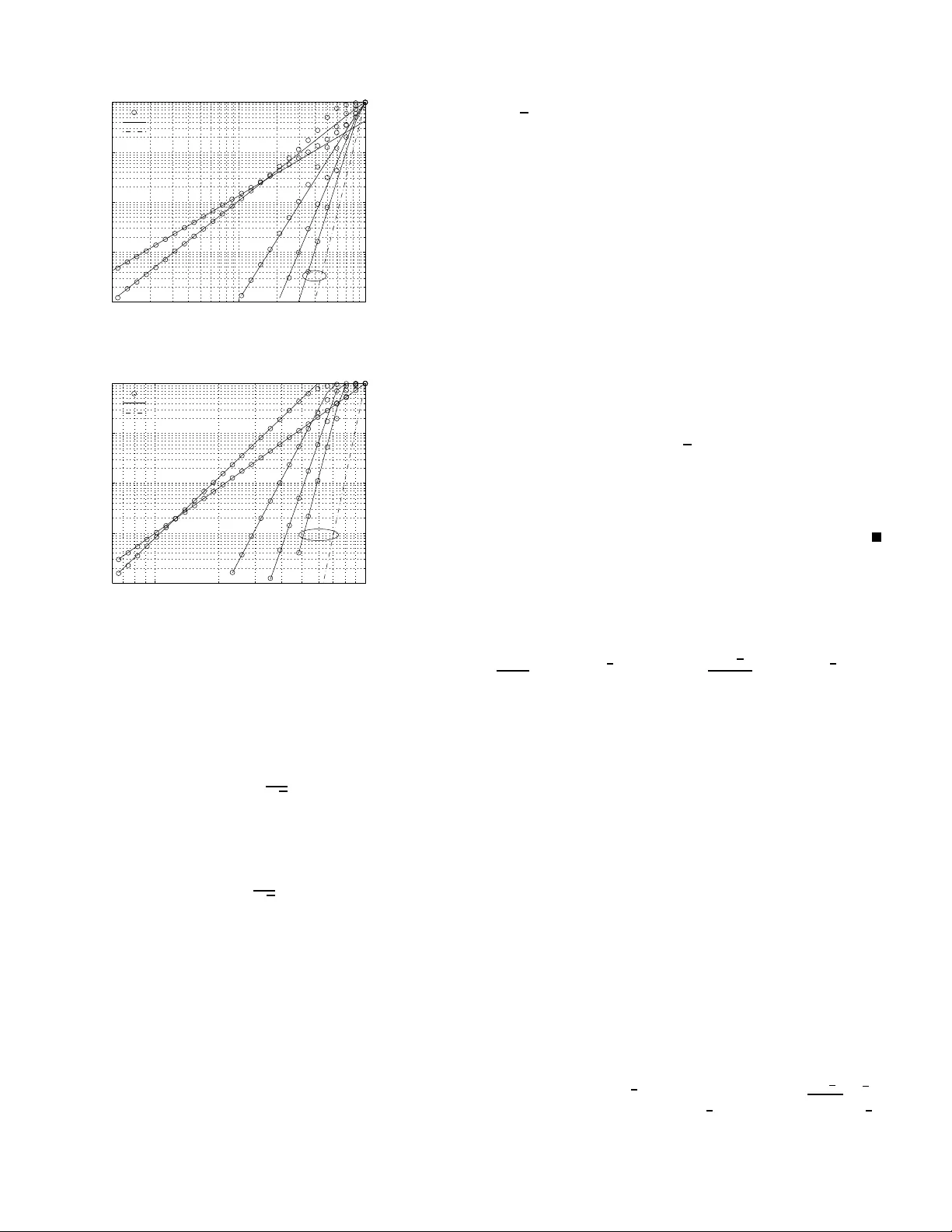
Quantizati on Bounds on Grassmann Manifolds of Arbitrary Dimensions and MIMO Communicati ons with Feedback ∗ W ei Dai, Y oujian Liu Dept. of Electrical and Comp uter Eng. University of Colorad o at Boulder Boulder CO 80303, USA Email: dai@colorado .edu, eug eneliu@ieee.org Brian Rider Math Departm ent University of Colorado at Boulder Boulder CO 8030 3, USA Email: bride r@euclid.colo rado.ed u Abstract — This paper considers the quantization problem o n the Grassmann manifold with dimension n and p . The uniqu e contribution is the d eriv ation of a closed-form fo rmula fo r t he v ol- ume of a metric ball in the Grassmann manifold wh en th e radius is sufficiently small. This volume formula h olds for Grassmann manifo lds with arbitrary dimension n and p , while prev ious results are only valid for either p = 1 or a fixed p with asymptotically large n . Based on the volume f ormula, th e Gilbert-V arshamo v and Hamming bounds for sphere packi ngs are obtained. Assuming a uniformly distributed source and a d istortion metric based on the squ ared chordal distance, tight lower and upp er bounds are established fo r the d istortion rate tradeoff. Simulation results match the deriv ed results. As a n application of the derived quantization bounds, the inf ormation rate o f a Multip le-Input Multipl e-Output (MIMO) system with finite-rate channel-state feedback is accurately quantifi ed f or arbitrary fini te number of antennas, while p re vious r esults ar e only v alid f or either Mu ltiple- Input Single-Outp ut (M ISO) systems or those with asym ptotically large number of transmit antennas but fixed number of receiv e antennas. I . I N T RO D U C T I O N The Grassmann manifold G n,p ( L ) is the set of all p - dimensiona l planes (throu gh the o rigin) of th e n -dimen sional Euclidean space L n , where L is either R or C . It f orms a compact Riemann m anifold of real dimension β p ( n − p ) , where β = 1 / 2 when L = R / C respectiv ely . The Grassmann manifold pr ovides a useful analy sis tool f or multi-antenn a com- munication s (also known as Multiple-In put Multiple-Outpu t (MIMO) comm unication systems. For n on-coh erent M IMO systems, sphere packin gs on the G n,p ( L ) can be viewed as a generalizatio n of spherical codes [1 ]–[3]. For M IMO systems with finite r ate channel state f eedback, the qua ntization of beamfor ming matric es is r elated to the quan tization on the Grassmann manifo ld [4] –[6]. The basic quantizatio n prob lems add ressed in this p aper are the sp here pack ing bound s an d distortion rate trad eoff. A quantization is a mapp ing fro m the G n,p ( L ) into a subset of the G n,p ( L ) , known as th e co de C . Define δ , δ ( C ) as the minimum distance b etween any two elements in C . The spher e ∗ This work is partially supported by the J unior Faculty De vel opment A ward, Uni ve rsity of Colorado at Boulde r . packing bound s re late the size of a cod e and a giv en minimum distance δ . Assuming a rando mly distributed source on the G n,p ( L ) and a d istortion metr ic, the distortion rate tradeoff is described by either the min imum expected distortion achie v able for a given cod e size (distortion rate function) or the minimum code size r equired to achieve a particular expected distortion (rate distortion function ). For the sake of applicatio ns [4]–[ 6], the pro jection Frob enius metric ( i.e. chordal d istance ) is employed th rough out the paper although the c orrespon ding analysis is also applicab le to the geodesic metric [3]. For any two p lanes P , Q ∈ G n,p ( L ) , the principle angles and the chorda l d istance between P an d Q are defined as follows. L et u 1 ∈ P an d v 1 ∈ Q be the unit vectors such that u † 1 v 1 is maximal. Ind uctively , let u i ∈ P and v i ∈ Q be the unit vectors such that u † i u j = 0 and v † i v j = 0 for all 1 ≤ j < i an d u † i v i is maxim al. Th e princip le an gles are defined as θ i = ar ccos u † i v i for i = 1 , · · · , n [7], [8] . T he chorda l distance betwe en P and Q is d efined as d c ( P, Q ) , v u u t p X i =1 sin 2 θ i . The inv ariant mea sure on the G n,p ( L ) is defined as fol- lows. Let O ( n ) /U ( n ) b e the group o f n × n o rthogo - nal/unitary matr ices respectively . Let A ∈ O ( n ) / U ( n ) an d B ∈ O ( n ) /U ( n ) when L = R / C r espectively . An in variant measure µ on the G n,p ( L ) satisfies, for any m easurable set M ⊂ G n,p ( L ) and arbitrarily chosen A and B , µ ( A M ) = µ ( M ) = µ ( M B ) . The in v ariant measure defines the unifor m d istribution o n the G n,p ( L ) [7]. W ith a metric and a measure define d on the G n,p ( L ) , th ere are sev eral bounds well kn own for sph ere packings. Let δ be the m inimum distance b etween any two elem ents of a code C and B ( δ ) be the me tric ball o f radius δ in the G n,p ( L ) . If K is any numb er such that K µ ( B ( δ )) < 1 , then there exists a code C of size K + 1 and minimum distance δ . This principle is called as the Gilbert-V a rshamov lower bound [3], i.e. |C | > 1 µ ( B ( δ )) . (1) On the other hand, |C | µ ( B ( δ / 2)) ≤ 1 for any code C . The Hamming upper bou nd cap tures this fact as [3] |C | ≤ 1 µ ( B ( δ / 2)) . (2) These two bou nds relate the co de size an d a given minimum distance δ . Distortion rate function gives another important p roperty of quan tization. Assume that Q is a ran dom plan e un iformly distributed o n the G n,p ( L ) and a distor tion m etric defined by the squared chor dal distanc e d 2 c . The average distortion of a giv en C is D ( C ) , E Q min P ∈C d 2 c ( P, Q ) . (3) The distortion ra te functio n gi ves th e minimum average distor - tion for a given codeb ook size K , i.e. D ∗ ( K ) = inf C : |C | = K D ( C ) . (4) There ar e several papers ad dressing q uantization pro blems in the Grassmann man ifold. The exact volume formu la for a B ( δ ) in the G n,p ( C ) where p = 1 is derived in [4 ]. An asymptotic volume f ormula for a B ( δ ) in the G n,p ( L ) , wher e p ≥ 1 is fixed and n approache s infinity , is der i ved in [3]. Based on those volume fo rmulas, the co rrespond ing sphere pack ing bound s are developed in [3], [5]. Besides the sphere p acking bound s, the rate distortion tradeoff is also treated in [9], where approx imations to the distortion rate functio n are deri ved by the sphere packing boun ds. Howe ver, the d eriv ed appro ximations are based on the volume fo rmulas [3 ], [4] o nly v alid fo r so me special cho ices o f n and p , i.e. either p = 1 or fixed p ≥ 1 with asympto tic large n . This paper derives qu antization bo unds for th e Grassmann manifold with arbitrary n a nd p whe n the code size is large. An explicit volume fo rmula for a metric b all in the G n,p ( L ) is de- riv ed when the radiu s is suf ficiently small. Based on th e derived volume formula, the sphere packin g bound s are o btained. The distortion rate tradeoff is also character ized by establishment of tight lower and upper bounds. Simulation results match the derived bounds. As an app lication o f the derived qu antization bound s, the info rmation r ate of a MIMO system with finite rate channel state feedback is accurately quantified for abitrary finite number of antennas for the first time, while previous results are only valid f or either Multiple- Input Single-Output ( MISO) systems or tho se with asymptotically large number o f tr ansmit antennas but fixed nu mber of receiv e anten nas. I I . M E T R I C B A L L S I N T H E G n,p ( L ) In th is section , an explicit volume f ormula fo r a metric ball B ( δ ) in the G n,p ( L ) is de riv ed. The volume form ula is essential for the quantizatio n b ound s in Section I II. The v olume calculation depends on the r elationship between the measure a nd the metric de fined o n the G n,p ( L ) . For the in variant measur e µ and the chord al distanc e d c , the v olume of a metric ball B ( δ ) can be ca lculated by µ ( B ( δ )) = Z · · · Z √ P p i =1 sin 2 θ i ≤ δ π 2 ≥ θ 1 ≥···≥ θ p ≥ 0 dµ θ , (5) where θ 1 , · · · , θ p are the prin ciple an gles and the differential form dµ θ is given in [7], [10 ]. The following theo rem expresses the volume formula as an exponentiation o f the radius δ . Theor em 1: L et B ( δ ) be a ball of radius δ in G n,p ( L ) . When δ ≤ 1 , µ ( B ( δ )) = c n,p,β δ p ( n − p ) (1 + o ( δ )) if L = R c n,p,β δ 2 p ( n − p ) if L = C , (6 ) where β = 1 / 2 when L = R / C r espectively and c n,p,β is a constant determine d by n , p an d β . When L = C , c n,p, 2 can be explicitly calculated c n,p, 2 = ( 1 ( np − p 2 )! Q p i =1 ( n − i )! ( p − i )! if 0 < p ≤ n 2 1 ( np − p 2 )! Q n − p i =1 ( n − i )! ( n − p − i )! if n 2 ≤ p ≤ n . (7) When L = R , c n,p, 1 is giv en by c n,p, 1 = V n,p, 1 2 p R · · · R P p i =1 x i ≤ 1 x 1 ≥···≥ x p ≥ 0 h Q p i ? @ A B C D E F G H I J K L M N O P Q R S T U V W X X Y T Fig. 3. System model propo sed in [14] by letting th e nu mbers of transmit and receive antennas and f eedback rate app roach infinity simultaneo usly . But this formu la overestimates the performan ce in gen eral. The system model of a wir eless commun ication system with L T transmit anten nas, L R receive antennas and fin ite rate channel state feedb ack is given in Fig. 3. The in formatio n bit stream is enco ded into the Gaussian signal vector X ∈ C s × 1 and then m ultiplied by the beam formin g matrix P ∈ C L T × s to gener ate th e transmitted signal T = PX , wh ere s is the dimension of the sign al X satisfying 1 ≤ s ≤ L T and the beamfor ming matrix P satisfies P † P = I s . I n power on /off strategy , E XX † = P on I s where P on is a positi ve con stant to denote the on-power . Assume th at the channel H is Ray leigh flat fading, i.e. , the entr ies of H are independ ent and iden ti- cally distributed (i.i.d .) cir cularly symm etric co mplex Gau ssian variables with zero m ean and u nit variance ( C N (0 , 1) ) and H is i.i.d. for each channel use. Let Y ∈ C L R × 1 be the rec ei ved signal and W ∈ C L R × 1 be the Gaussian no ise, then Y = H PX + W , where E WW † = I L R . W e also assume that there is a beamfor ming codebo ok B = P i ∈ C L T × s : P † i P i = I s o declared to both the tr ansmitter a nd th e receiver befo re the transmission. At th e beginning of each ch annel use, the ch annel state H is perfectly estimated at th e rece i ver . A me ssage, which is a function o f the channel state, is sen t b ack to the tra nsmitter throug h a f eedback cha nnel. Th e feed back is error-free and rate limited. According to the channel state feedback , the transmitter chooses an ap propria te b eamfor ming matrix P i ∈ B . Let the feedback rate b e R fb bits/channel use. T hen the size of th e beamfor ming co debook |B | ≤ 2 R fb . The f eedback function is a mapping from th e set of channel state into the beam formin g matrix index set, ϕ : { H } → { i : 1 ≤ i ≤ |B |} . This section will quantify the correspo nding inf ormation rate I = max B : |B |≤ 2 R fb max ϕ E h log I L R + P on HP ϕ ( H ) P † ϕ ( H ) H i , where P on = ρ/ s and ρ is the a verage re ceiv ed SNR. Before discussing the finite rate feed back ca se, we consider the c ase that the transmitter has full knowledge of the channel state H . In th is setting, the optimal beamf orming matrix is giv en by P opt = V s where V s ∈ C L T × s is the ma trix composed by the right sin gular vectors of H co rrespond ing to the largest s singular values [6]. The co rrespond ing information rate is I opt = E H " s X i =1 ln (1 + P on λ i ) # , (11) 0.5 0.6 0.7 0.8 0.9 1 1.1 1.2 1.3 0 1 2 3 4 5 6 Bits/Channel Use R fb /m 2 4 × 2 MIMO Water filling and perfect beamforming By the upper bd of the distortion rate fn By the lower bd of the distortion rate fn Asymptotic analysis by Gaussian approx. Simulation SNR=6dB SNR=3dB SNR=0dB Fig. 4. Performanc e of finite size bea mforming code book. where λ i is the i th largest eigen value of HH † . In [6 ], we derive an asym ptotic formula to appro ximate a qua ntity of the form E H [ P s i =1 ln (1 + cλ i )] where c > 0 is a co nstant. Apply the asymptotic formula in [6]. I opt can be well approx imated. The e ffect of finite rate f eedback can be charac terized by the quantization bound s in th e Grassmann manifold. For finite rate feedback , we defin e a suboptimal feedback function i = ϕ ( H ) , arg min 1 ≤ i ≤|B| d 2 c ( P ( P i ) , P ( V s )) , (12) where P ( P i ) and P ( V s ) are the p lanes in the G L T ,s ( C ) generated by P i and V s respectively . In [6], we show tha t this feedback fu nction is asymptotically optimal as R fb → + ∞ an d near optimal when R fb < + ∞ . With this feedback function and assuming that the feedba ck r ate R fb is large, it has been shown in [6] that I ≈ E H " s X i =1 ln (1 + η sup P on λ i ) # , (13) where η sup , 1 − 1 s inf B : |B |≤ 2 R fb E V s min 1 ≤ i ≤|B| d 2 c ( P ( P i ) , P ( V s )) = 1 − 1 s D ∗ 2 R fb . (14) Thus, the difference between per fect beamfor ming c ase (11) and finite rate feedba ck c ase (13) is quantified by η sup , which depend s on the distortion rate function on the G L T ,s ( C ) . Substi- tute quantization bound s (10) into (14) and ap ply the asym ptotic formu la in [6 ] fo r E H [ P s i =1 ln (1 + cλ i )] . Approximatio ns to the info rmation rate I are derived as fu nctions of the feed back rate R fb . Simulations verify the ab ove appro ximations. Let m = min ( L T , L R ) . Fig. 4 compares th e simulated in formatio n rate (circles) and approx imations as function s of R fb /m 2 . The infor- mation rate approxim ated b y the lo wer boun d (solid lines) and the upper bou nd (d otted lines) in (10) a re pr esented. As a com- parison, w e also inclu de ano ther perf ormance appro ximation (dash-do t lines) pro posed in [14], which is b ased o n asym ptotic analysis an d Gau ssian app roximatio n. The simulation results show that the perf ormances appr oximated by the bo unds (10) match the actua l perfo rmance almost perfectly and are much more accurate than the one in [14 ]. V . C O N C L U S I O N This paper con siders the quantization problem on the Grass- mann manif old. Based o n the explicit volume formula for a metric ball in th e G n,p ( L ) , the corr espondin g Gilbert- V arshamov and Hamm ing boun ds are obtain ed. Assuming the uniform source d istribution and th e distortion defined by the squared cho rdal d istance, the distortion rate f unction is characterized by establishing tight lo we r and upper bounds. As an ap plication of these results, the inform ation rate of a MIMO system with finite rate channel state feedb ack is accu rately quantified f or ab itrary fin ite n umber o f anten nas for the first time. R E F E R E N C E S [1] D. Agrawal, T . J . Richard son, and R. L. Urbanke , “Mult iple-a ntenna signal conste llati ons for fadin g channels, ” IEEE T rans. Info. Theory , vol. 47, no. 6, pp. 2618 – 2626, 2001. [2] Z. Lizhong and D. N. C. Tse, “Communication on the grassmann manifold: a geometric approach to the noncohere nt multiple-an tenna channe l, ” IEEE T rans. Info. Theory , vol. 48, no. 2, pp. 359 – 383, 2002. [3] A. Barg and D. Y . Nogin, “Bounds on packings of spheres in the Grassmann manifold, ” IEEE T rans. Info. Theory , vol. 48, no. 9, pp. 2450– 2454, 2002. [4] K. K. Mukkavil li, A. Sabharw al, E. Erkip, and B. Aazhang, “On beam- forming with finite rate feedback in multiple-ante nna systems, ” IEEE T rans. Info. Theory , vol. 49, no. 10, pp. 2562–25 79, 2003. [5] D. J. Lo ve , J. Heath, R. W ., and T . Strohmer , “Grassmannian beamfor ming for multipl e-input multiple-ou tput wirele ss systems, ” IEEE T rans. Info. Theory , vol. 49, no. 10, pp. 2735–2 747, 2003. [6] W . Dai , Y . Liu, V . K. N. Lau, and B. Rider , “On the information rat e of MIMO systems with finite rate channel state feedback using beamforming and power on/off strategy , ” IEEE T rans. Info. Theory , submitte d. [7] A. T . James, “Normal multi variat e analysis and the orthogonal group, ” Ann. Math. Stat ist. , vol. 25, no. 1, pp. 40 – 75, 1954. [8] J. H. Conway , R. H. Hardin, and N. J . A. Sloane, “P acki ng lines, planes, etc., packing in Grassmannian s paces, ” Exper . Math. , vol. 5, pp. 139–159, 1996. [9] B. Mondal, R. W . H. Jr ., and L. W . Hanlen, “Quantiz ation on the Grassmann manifold: Applications to precoded MIMO wireless systems, ” in Proc . IEE E International Confere nce on A coustic s, Speech, and Signal Pr ocessing (ICASSP) , 2005, pp. 1025–1028. [10] M. Adler and P . v . Moerbeke, “Int egra ls ov er Grassmannia ns and random permutat ions, ” A rXiv Mathematics e-prin ts , 2001. [11] D. J. Love and J. Heath, R. W ., “Limited feedback unita ry preco ding for orthogonal space-ti me block code s, ” IEEE T rans. Signal Pr ocessing , vol. 53, no. 1, pp. 64 – 73, 2005. [12] ——, “Limited feedback precoding for spatial multiple xing systems, ” in IEEE G lobal T elecommu nicati ons Confer ence (GLOB ECOM) , v ol. 4, 2003, pp. 1857– 1861. [13] J. C. Roh and B. D. Rao, “MIMO spatial multiple xing systems with limited fee dback, ” in Proc . IEE E Internationa l Confere nce on Communi - cations (ICC) , 2005. [14] W . Santipach and M. L. Honig, “ Asymptotic performan ce of MIMO wireless chann els with limit ed feedback, ” in P r oc. IEEE Mil itary Comm. Conf . , vo l. 1, 2003 , pp. 141– 146.
Original Paper
Loading high-quality paper...
Comments & Academic Discussion
Loading comments...
Leave a Comment