Non-cooperative games for spreading code optimization, power control and receiver design in wireless data networks
This paper focuses on the issue of energy efficiency in wireless data networks through a game theoretic approach. The case considered is that in which each user is allowed to vary its transmit power, spreading code, and uplink receiver in order to ma…
Authors: Stefano Buzzi, H. Vincent Poor
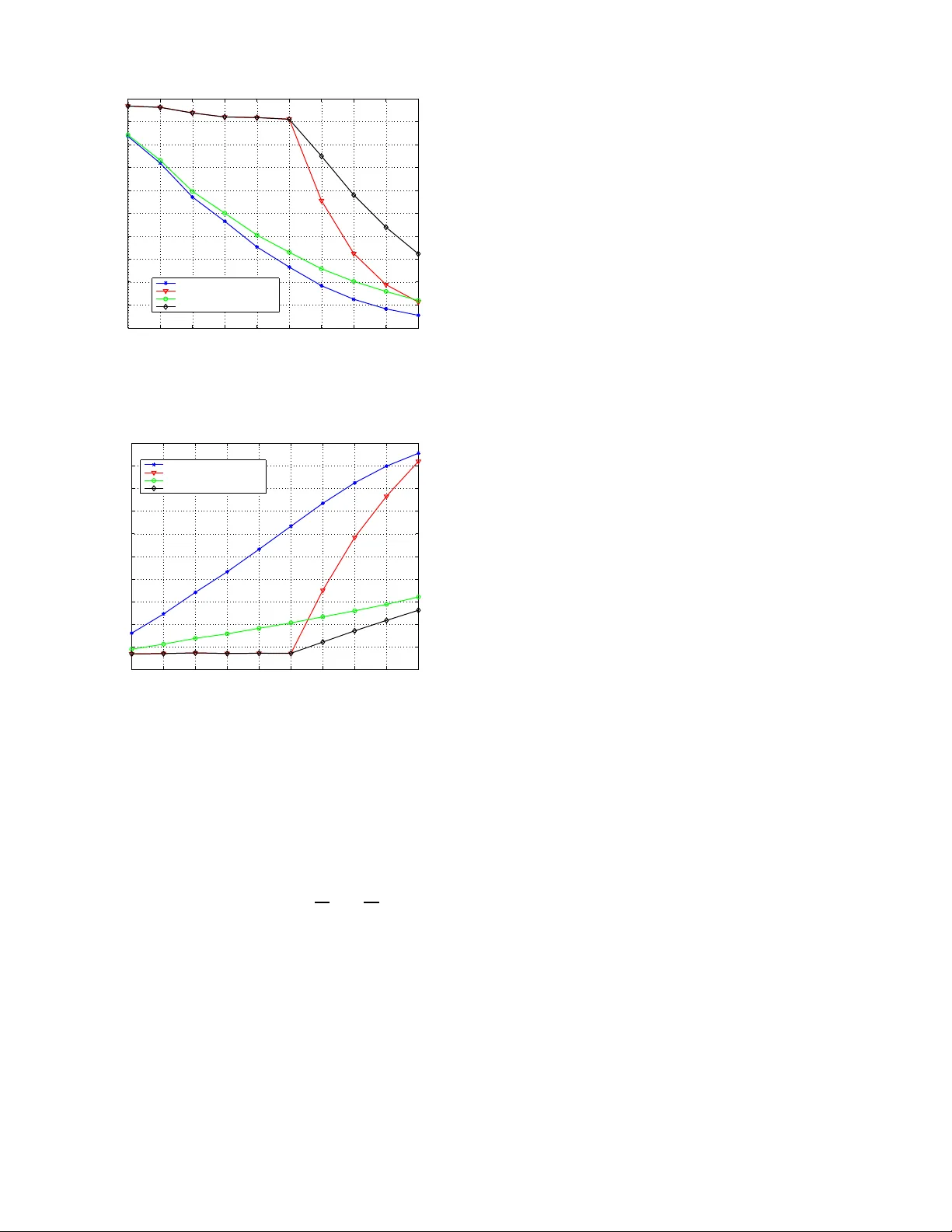
Non-cooperati v e Games for Sprea ding Code Optimizati on, Po wer Control a nd Recei v er Design in W ireless Data Netw o rks Stefano Buzzi Universit ` a degli Studi di Cassino D AEIMI - V ia G. Di Biasio, 43 I-030 43 Cass ino (FR), Italy Email: buzzi@unicas.it H. V incent Poor School of E ngineerin g and Applied Science Princeton Un i versity Princeton, NJ, 08544 , USA Email: po or@princeto n.edu Abstract — This paper focuses on the issue of energy efficiency in wireless data networks th rough a game t heoretic appro ach. The case considered is that in which each user is all owed to vary its transmit power , spreading code, and uplin k rec eive r in order to max imize its own utility , which is h ere defi ned as the ratio of d ata throughput to transmit power . In particular , the case in which lin ear multiuser detectors are employed at the recei ver is treated first, and, th en, the more challenging case in which non-linear decision feedback multiuser receiv ers are adopted is addressed. It is sho wn that, for both receiv ers, th e problem at hand of util ity maximization can b e regarded as a n on-cooperativ e game, and it is prov ed th at a unique Nash equilibriu m point exists. Simulation results show that significant perfo rmance gains can be obtained through both non-linear processing and sprea ding code optimization; in p articular , for systems with a number of users not larg er than th e processing gain, remarkable gains come from spreading code optimization, while, fo r ov erloaded systems, the largest gains come from the use of non-l inear processing. In every case, howev er , the non-cooperativ e games proposed here are sh own to outperform competing alternati ves. I . I N T RO D U C T I O N Game theory [1] is a branch of math ematics that has b een applied p rimarily in economics a nd other social scien ces to study the interactions among se veral autonomou s subjects with contrasting interests. More recently , it has been discov ered that it can also be used fo r the d esign and a nalysis of c ommun i- cation systems, mo stly with applicatio n to resource allo cation algorithm s [2], a nd, in par ticular , to power control [3]. As examples, th e reader is referr ed to [4], [5 ], [6]. Here, for a multiple acce ss wireless data network, n oncoop erative and cooper ati ve games are introd uced, whe rein each user chooses its tra nsmit power in order to maximize its o wn utility , defined as the ratio of the thro ughpu t to tr ansmit p ower . While the above pap ers consider the i ssue of po wer control assuming that a con ventional match ed filter is available at th e receiver , the recent paper [7] considers the problem of joint linear r eceiv er design and p ower contro l so as to maximize the u tility of each user . It is shown here that the inclu sion of receiver de sign in the c onsidered g ame brings remar kable advantages, and, also, resu lts based on the powerful large-system a nalysis are presented. This pap er is the first in this area that conside rs the cross- layer issue of utility maximization with respect to the choice of receiver , spr eading code and transmit power . First of all, we gen eralize the game co nsidered in [7] b y co nsidering also spreading code o ptimization. W e show that iterative algorithm s, of the same kin d propo sed in [8], can be ap plied to our scenario in order to improve the achieved Signal-to -Noise plus In terference (SINR) of each u ser . W e will show th at the newly considere d noncoo perative game a dmits a uniqu e Nash equilibriu m and achie ves remarkab le gains with respect to the perfor mance levels attained by the solution propo sed in [7]. Then, we consider the pro blem o f utility maximization with respect to tran smit power and spreading code, for th e case in which a non-linea r decision f eedback receiver is used. W e thus pro pose tw o no ncooper ativ e games wherein first transmit power is chosen so a s to m aximize utility , and, then, join t spreading cod e optimiz ation and p ower control is undertaken for utility max imization. Our results will sho w that r emarkable gains ar e g ranted by th e use of spreading code o ptimization when the nu mber o f users do es not exceed the pro cessing gain (undersaturated region) , while, for saturated systems, non- linear interfe rence cancellation, eventually cou pled with cod e optimization , pr ovides the most significant g ains. The rest of this paper is o rganized as follows. The next section co ntains some p reliminaries an d the system mod el of interest. Section III introduces a non-c ooperative game f or the case in which linea r recei vers are employed , while in Section IV we intro duce two non-coo perative utility m aximization games for the case that a non -linear interferen ce cancellation receiver is adopted . In Section V we present an d discuss the results of some comp uter simulations that show th e mer its of th e pr oposed g ames and their ad vantages with respect to competing alternatives. Finally , we gi ve some concluding remarks in Sectio n VI. I I . P R E L I M I NA R I E S A N D P RO B L E M S TA T E M E N T Consider the uplink of a K -user synchrono us, single-cell, direct-sequ ence c ode d i vision multiple acce ss (DS/CDMA) network with processing g ain N a nd subject to flat fadin g. After chip-match ed filter ing and sampling at the chip-rate , the N -dim ensional received data vector, say r , corresponding to one symbo l interval, ca n be written as r = K X k =1 √ p k h k b k s k + n , (1) wherein p k is th e transmit power of the k -th user 1 , b k ∈ {− 1 , 1 } is the information sy mbol of the k -th user, and h k is the r eal 2 channel g ain b etween the k -th user’ s transmitter an d the access p oint (AP); th e actua l value of h k depend s on both the distance of the k -th user’ s term inal from the AP and the channel fadin g fluctuation s. The N -dimensional vector s k is the spr eading co de o f th e k - th user ; we assume that the entries of s k are real and that s T k s k = k s k k 2 = 1 , with ( · ) T denoting transpose. Finally , n is the amb ient noise vector, which we assume to be a zero- mean white Gaussian random process with covariance matrix ( N 0 / 2) I N , with I N the identity ma trix of order N . An alternative and compact representation of (1) is giv en by r = S P 1 / 2 H b + n , (2) wherein S = [ s 1 , . . . , s K ] is the N × K -dimension al spreading code m atrix, P and H are K × K -d imensional diagon al matrices, whose dia gonals are [ p 1 , . . . , p K ] and [ h 1 , . . . , h K ] , respectively , and, finally , b = [ b 1 , . . . , b K ] T is the K - dimensiona l vecto r of the data sym bols. Assume now that each mobile termin al sends its data in packets of M bits, and th at it is interested bo th in having its data received with as small a s possible error p robability at the AP , and in ma king caref ul use of the en ergy stored in its battery . Obviou sly , these are conflicting goals, since erro r-free reception may be achie ved by incr easing the recei ved SNR, i.e. by increasing the transmit power , wh ich of course comes at the expense of battery life 3 . A useful app roach to q uantify these conflicting g oals is to define the utility o f th e k -th user as the ratio of its th rough put, defined as the numbe r of informatio n bits that are received with no er ror in unit time, to its transmit power [ 4], [5], i. e. u k = T k p k . (3) Note that u k is measured in bit/Joule, i.e. it repr esents the number of successful b it transmissions that can b e made for each Joule of en ergy dr ained f rom the battery . Denoting by R the common rate of the network (extension to the case in which each user tran smits with its own rate R k is quite simple) and assuming tha t each packet of M symbols 1 T o s implify subsequent notation, we assume that the transmit ted po wer p k subsumes a lso the gain of the transmit and recei v e antennas. 2 W e assume here, for simplicit y , a real channel model; generali zation to practi cal channels, with I and Q components, is straightforwa rd. 3 Of course there are many other strateg ies to lo wer the data error prob- abili ty , such as for example the use of error corr ecting codes, di versity expl oitati on, and implement ation of optimal recepti on technique s at the recei ver . Here, howe v er , we are mainl y inte rested to energy efficie nt data transmission and po wer usage, so we consid er only the ef fects of varying the transmit powe r , the recei ve r and the spreading code on energy ef ficienc y . contains L information symbo ls and M − L overhead symbols, reserved, e.g., for ch annel estimation an d/or parity checks, th e throug hput T k can be expressed as T k = R L M P k (4) wherein P k denotes the the prob ability th at a packet f rom the k -th user is received error-free. In the considered DS/CDMA setting, the term P k depend s formally on a n umber of p a- rameters such as the spreading cod es of all the users and the diagona l entries of the matrices P and H , as well as on the strength of the used er ror correcting code s. Howe ver , a cu stom- ary app roach is to model the multiple access interference as a Gaussian r andom process, an d assum e that P k is an increasing function of the k -th u ser’ s Signa l-to-Interf erence plus Noise- Ratio (SINR) γ k , which is naturally th e case in m any practical situations. Recall that, for the case in wh ich a linear re ceiv er is used to detect the data sy mbol b k , according, i.e., to th e decision rule b b k = sign h d T k r i , (5) with b b k the estimate of b k and d k the N -d imensional vector representin g the receive filter for the user k , it is easily seen that the SINR γ k can be written as γ k = p k h k 2( d T k s k )2 N 0 2 k d k k 2 + X i 6 = k p i h i 2( d T k s i )2 . (6) Of related interest is also the mean sq uare error (MSE) for the user k , which, for a linea r receiver , is defin ed as MSE k = E n b k − d T k r 2 o = 1+ d T k M d k − 2 √ p k h k d T k s k , (7) wherein E {·} de notes statistical expectation an d M = S H P H T S T + N 0 2 I N is th e cov ariance matrix of the data. The exact shape of P k ( γ k ) depends on factors such as the modulatio n and coding typ e. Howe ver , in all cases of relev ant interest, it is an increasing fun ction of γ k with a sigmoidal shape, and converges to unity as γ k → + ∞ ; as an examp le, for binary phase-shif t-keying (BPSK) m odulation cou pled with no chan nel coding, it is easily shown that P k ( γ k ) = h 1 − Q ( p 2 γ k ) i M , (8) with Q ( · ) the complem entary cu mulative distribution fu nction of a zero-mean random Gaussian v ariate with unit variance. A plot o f (8) is shown in Fig. 1 for the case M = 100 . It should be no ted th at substituting (8) into ( 4), and, in turn, into ( 3), leads to a strong incon gruen ce. I ndeed, for p k → 0 , we hav e γ k → 0 , but P k conv erges to a small but non-ze ro value (i.e. 2 − M ), th us implyin g that an unb ounde dly large utility can be achie ved by transmitting with zer o p ower , i.e. not transmitting at all and making blind gue sses at th e receiver on wha t data were transmitted . T o circumvent this problem , a customary ap proach [5], [7] is to repla ce P k with an efficiency function , say f k ( γ k ) , who se be havior sho uld approx imate as clo se as possible that of P k , except that for γ k → 0 it is r equired that f k ( γ k ) = o ( γ k ) . The functio n f ( γ k ) = (1 − e − γ k ) M is a widely accepted substitute for the true probab ility of correct p acket receptio n, and in the following we will ad opt this mo del 4 . This efficiency fun ction is increasing a nd S- shaped, conver ges to u nity as γ k approa ches infinity , a nd h as a continuo us first or der derivati ve. Note that we have o mitted the subscr ipt “ k ′′ , i.e. we h av e used the notation f ( γ k ) in place of f k ( γ k ) since we assume that the efficiency fun ction is the same f or all the users. Summing up, substitutin g (4) into (3) an d r eplacing th e probab ility P k with the above d efined ef ficiency function, we obtain the fo llowing expr ession for the k -th u ser’ s u tility: u k = R L M f ( γ k ) p k , ∀ k = 1 , . . . , K . (9) Now , based on the utility definition (9), many in teresting questions arise concerning ho w each user may maximize its utility , and how this maximization affects utilities achieved by other users. Likewis e, it is n atural to question what happen s in a non-coo perative setting wherein ea ch user au tonomo usly and selfishly tr ies to maximize its own utility , w ith no car e for other users u tilities. In par ticular , in this latter situation, is the system able to reach an eq uilibrium wherein no user is interested in varying its parameters since each actio n it would take would lead to a decrea se in its own utility? Game th eory provides means to study these interactions and to provid e some useful and in sightful answers to th ese question s. Initially , game theory was app lied in this co ntext mainly as a tool to stud y non- cooper ati ve scenarios wher ein mobile user s are allo wed to vary th eir tr ansmit po wer only (see [4], [5], [6], for examp le) to maximize u tility , and wher e conventional matched filterin g is used at the r eceiv er . Recen tly , instead , in [7] such an approa ch h as been extended to th e cross layer scenario in which each user may vary its power and its uplink linear r eceiv er , i.e. the pro blem of join t linear mu ltiuser detec- tion o ptimization an d power con trol for utility ma ximization has been tackled. In the fo llowing, we will go further b y considerin g the case of spreading code ch oice, power control and linear receiver design fo r u tility maximizatio n. Mor eover , the case in wh ich a param etric no n-linear d ecision feedback receiver is used will be c onsidered, and new games wherein optimization of th is receiver , spreading code choice and power control is perfo rmed jointly in orde r to max imize utility will be prop osed. I I I . N O N - C O O P E R A T I V E G A M E S W I T H L I N E A R R E C E I V E R S W e begin b y conside ring a n oncoo perative game wherein each user aims to maximizing its o wn u tility by varying its spreading code, its transmit power , and its linear uplink receiver . Formally , the pro posed game G can be described as the trip let G = [ K , {S k } , { u k } ] , wh erein K = { 1 , 2 , . . . , K } 4 See Fig. 1 for a comparison between the Probabili ty P k and the efficie ncy functio n. 0 1 2 3 4 5 6 7 8 9 10 0 0.1 0.2 0.3 0.4 0.5 0.6 0.7 0.8 0.9 1 γ k P k and efficiency function, M=100 Prob. of error−free reception efficiency function Fig. 1. Comparison of probability of error-fre e packet recept ion and ef ficienc y function versus recei ve SINR and for packet s ize M = 100 . Note the S-shape of both functions. is the set of active users p articipating in the game, u k is the k -th user’ s utility defined in (9), and S k = [0 , P k, max ] × R N × R N 1 , (10) is the set of possible actions (strategies) that user k can take. It is seen that S k is written as th e Car tesian pro duct of three different sets, and in deed [0 , P k, max ] is the rang e of available transmit powers f or the k -th u ser (note that P k, max is the maximum allowed transmit power for user k ) , R N , with R the real line, defines the set of all po ssible lin ear rec eiv e filters, and, finally , R N 1 = n d ∈ R N : d T d = 1 o , defines the set of the allowed spreading cod es 5 for user k . Before proce eding furth er , it is also conv enient to defin e the concept of Nash equilibrium . Let ( s 1 , s 2 , . . . , s K ) ∈ S 1 × S 2 × . . . S K denote a cer tain strategy K -tuple for the activ e users. The point ( s 1 , s 2 , . . . , s K ) is a Na sh equ ilibrium if for any user k , we have u k ( s 1 , . . . , s k , . . . , s K ) ≥ u k ( s 1 , . . . , s ∗ k , . . . , s K ) , ∀ s ∗ k 6 = s k . Otherwise stated, at a Nash equ ilibrium, n o user can unilate rally improve its own u tility by taking a dif ferent strategy . A fast read ing of this definition might lead to think that at Nash equilibrium users’ utilities ach iev e their max imum values. Actually , th is is no t the case, since the existence of a Nash equ ilibrium point does n ot imp ly that no other strategy K -tup le d oes exist that can lead to an impr ovement of the utilities of som e users wh ile no t decreasing the utilities of the remaining o nes. These latter strategies are usually 5 Here we assume that the s preadi ng codes have real entr ies; the problem of utility maximization with reasonabl e comple xity for the case of discrete- v alued entries is a challengi ng issue that will be considered in the future. said to be Pareto-optimal [1]. Otherwise stated, at a Nash equilibriu m, each user , provided that the other u sers’ strategies do n ot chan ge, is no t interested in chan ging its own strategy . Howe ver , if so me sort of coo peration would be av ailable, users might ag ree to simultan eously switch to a different strategy K -tuple, so as to imp rove the utility o f some, if no t all, activ e user s. In this p aper, we will focus on Nash equilibrium points only , since they are the result of non- cooperative games. Moreover , it c an be shown, altho ugh this is not discussed here due to lack of space, that, for the considered pro blem, the utilities achieved by Nash-equilibriu m po ints are on ly slightly smaller than tho se ach iev ed on the Pareto-optimal fron tier of the gam e. Summing up, the proposed nonco operative game ca n be cast as the following ma ximization problem max S k u k = max p k , d k , s k u k ( p k , d k , s k ) , ∀ k = 1 , . . . , K . (11 ) Giv en (9), the above max imization can be also written as max p k , d k , s k f ( γ k ( p k , d k , s k )) p k , ∀ k = 1 , . . . , K . (12) Moreover , since the effi ciency fun ction is mon otone and non- decreasing, we also hav e max p k , d k , s k f ( γ k ( p k , d k , s k )) p k = max p k f max d k , s k γ k ( p k , d k , s k ) ! p k , (13) i.e. we ca n first take care of SINR maximization with re spect to sp reading cod es an d linear receivers, and then fo cus on maximization of the r esulting utility with respect to tran smit power . W ith regard to this latter point, recall that, if a linear Min- imum MSE (MMSE) receiver is used, the follo wing relation can be shown to h old [9] TMSE = K X i =1 MSE i = K X i =1 1 1 + γ i , (14) wherein TMSE is th e total MSE. Otherwise stated, a mong linear receivers, the M MSE receiver is the o ne th at maxi- mizes th e SINR vecto r ( γ 1 , . . . , γ K ) . Now assum e that we wish to minimize th e M SE for each user by varying not only the receiver , but also the sp reading co de. T his pro blem has been con sidered in [8], [1 0], [ 11]; in particu lar , if we let D = [ d 1 , . . . , d K ] and den ote by ( · ) + Moore-Pen rose pseudoinversion, it has been therein sho wn that the sum of the MSE’ s of all the users ad mits a unique globa l optimu m, and that the iterations d i = √ p i h i S H P H T S T + N 0 2 I N − 1 s i ∀ i = 1 , . . . , K s i = √ p i h i p i h i 2 D D T + µ i I N + d i ∀ i = 1 , . . . , K (15) admit a unique stable fixed p oint that is the global minimizer of the total MSE. In the above relations, µ i should be set so that k s i k = 1 . No details are given in [8] on how this cou ld be do ne in an efficient way , so in the Ap pendix we outline a proced ure for efficiently findin g the value of µ i ensuring the constraint k s i k = 1 . Now , it is n atural to ask if minim ization o f the total MSE with respect to both linear rece i vers and spreading codes still maximizes the user’ s SINR’ s. W e can thus state the following result. Lemma 1: Let ¯ S a nd ¯ D be the spr eading cod e matrix and the linear r eceiver matrix tha t jointly achieve the glob al minimu m of the total MSE . Then, no strate g y of spr eading codes and decoder can be found to incr ease the S INR of on e or more users without decr easing the SINR of at least on e oth er user . Proof: If ¯ S and ¯ D are the global minimizer s of th e MSE, then ¯ D contain s the MMSE receivers resulting fr om th e spreading co des of ¯ S . Denote by γ i ( ¯ S , ¯ D ) K i =1 the SIN R values achieved b y the matrices ¯ S and ¯ D . Assume n ow that there exists a spre ading code matrix S ∗ 6 = ¯ S s uch that γ i ( S ∗ , ¯ D ) > γ i ( ¯ S , ¯ D ) , for at least on e i ∈ { 1 , . . . , K } and γ j ( S ∗ , ¯ D ) ≥ γ j ( ¯ S , ¯ D ) for j 6 = i . If this is the case, we can make an MMSE u pdate and o btain the m atrix D ∗ of the MMSE re ceiv ers correspon ding to the codes in S ∗ . For a giv en set o f spreading codes, using the MMSE receiver always yields a max imization of the SINR an d a min imization of the MSE. W e thus h av e γ i ( S ∗ , D ∗ ) > γ i ( ¯ S , ¯ D ) , an d γ j ( S ∗ , D ∗ ) ≥ γ j ( ¯ S , ¯ D ) , ∀ j 6 = i . Con sequently , g i ven relation (14), we h av e TMSE( S ∗ , D ∗ ) < TMSE( ¯ S , ¯ D ) , which c ontradicts the startin g assumptions tha t ¯ S and ¯ D are the global m inimizers of the MSE. W e are now ready to express our result o n the no n- cooper ati ve g ame for spreading cod e optimizatio n, linear re- ceiv er design and p ower control. Proposition 1: Th e n on-coo perative ga me defin ed in (11) admits a unique Nash equilibrium point ( p ∗ k , d ∗ k , s ∗ k ) , for k = 1 , . . . , K , wh er ein - s ∗ k and d ∗ k ar e the uniqu e k - th user spr eading co de and r eceive filter 6 r esulting fr om iterations (15). Denote by γ ∗ k the corresponding SINR. - p ∗ k = min { ¯ p k , P k, max } , with ¯ p k the k - th u ser transmit power such that th e k -th user maximum SINR γ ∗ k equals ¯ γ , i.e. the uniqu e solution of the equa tion f ( γ ) = γ f ′ ( γ ) , with f ′ ( γ ) the derivative of f ( γ ) . Proof: The proo f is a generaliza tion of th e on e pr ovided in [ 7] and so is only br iefly sketched he re. Since ∂ γ k /∂ p k = γ k /p k , it is easily seen that each user’ s utility is maximized if ea ch user is able to a chieve the SINR ¯ γ , that is the u nique 7 solution of the eq uation f ( γ ) = γ f ′ ( γ ) . By Lemma 1, runn ing iterations (1 5) until convergence is rea ched provides the set of spreading code s and MMSE recei vers that maximize the SINRs for all th e users. As a consequen ce, the utility of 6 Actuall y the linear recei v e filter is unique up to a positi ve scaling factor . 7 Uniquene ss of ¯ γ is ensure d by the fa ct th at the ef ficienc y function is S-shaped [12]. each user is max imized b y adjusting transmit powers so that the optimized (with respe ct to spreading codes and line ar receivers) SINRs equ al ¯ γ . So far , we h av e shown how to set the transmit p ower , spreading c ode an d receiver design to max imize utility at the Nash equilibr ium. It remains to be shown that a Na sh equilibriu m exists. Luck ily , we can use the same argum ents of [5] and state th at a uniqu e Nash equilibrium poin t exists since each user’ s utility function is quasi-concave 8 in the transmit power p k and since the efficiency func tion is S-shape d. I V . N O N - C O O P E R AT I V E G A M E S W I T H N O N L I N E A R D E C I S I O N - F E E D BAC K R E C E I V E R S Consider now the case in wh ich a no n-linear decision feedback receiv er is u sed at the receiver . W e a ssume that the users ar e indexed a ccording to a non-incr easing sorting of their chann el gains, i.e. we assume that h 1 > h 2 > . . . , h K . W e consider a serial interfer ence ca ncellation (SIC) recei ver wherein de tection o f the symbol f rom th e k -th user is made accordin g to the fo llowing rule b b k = sign d T k r − X j k p j h j 2( d T k s j )2 . (17) A consider able amo unt o f literature exists on d ecision feed- back receivers, and many detecto rs of this kind h av e been propo sed an d analyzed. Here, our goal is ju st to show that no n- linear receivers co upled with spreading co de optimization and power contro l can bring r emarkable p erform ance advantages with respect to linear receiv ers. As a consequenc e, we consid er only the de cision ru le (16) and introdu ce nonco operative games built on th at, with no furth er optimizatio n. As an example, receiver (16) might be optimized with respect to the users’ detection order, or by using properly distorted versions of the signal to be subtracted; these issues will not be consider ed here due to lack of space. Now , given receiver (16) an d the SI NR expression (1 7), we co nsider the pro blems of utility maxim ization with respect to the tr ansmit p ower , spreading cod e cho ice, an d r eceiv ers d 1 , . . . , d K . T o begin with, let u s neglect sp reading code optimization and c onsider the p roblem max p k , d k f ( γ k ( p k , d k )) p k , ∀ k = 1 , . . . , K . (18) 8 A functi on is quasi-conca ve if there e xists a point be lo w which the functi on is nondecreasi ng, and abov e which the function is nonincreasing. The following result can b e shown to hold. Proposition 2: Define S k = [ s k , . . . , s K ] , P k = diag ( p k , . . . , p K ) and H k = diag ( h k , . . . , h K ) . The n on- cooperative g ame defin ed in (18) ad mits a u nique Nash equilibrium point ( p ∗ k , d ∗ k ) , for k = 1 , . . . , K , wher ein - d ∗ k = √ p k h k ( S k H k P k H T k S T k + N 0 2 I N ) − 1 s k is the unique k -th user r eceive filter 9 that maximize the user k SINR γ k given in (1 7). Denote γ ∗ k = max d k γ k . - p ∗ k = min { ¯ p k , P k, max } , with ¯ p k the k - th u ser transmit power such that th e k -th user maximum SINR γ ∗ k equals ¯ γ , i.e. the uniqu e solution of the equa tion f ( γ ) = γ f ′ ( γ ) , with f ′ ( γ ) the derivative of f ( γ ) . Proof: The proof is omitted here du e to lack of space . It can be constructed along the same lines as that of Proposition 1. Consider, finally , the maximization max p k , d k , s k f ( γ k ( p k , d k , s k )) p k , ∀ k = 1 , . . . , K . (19) The existence and u niquen ess of a Nash equ ilibrium for th is game is gu aranteed by the following result. Proposition 3: Define D k = [ d 1 , . . . , d k ] . The no n- cooperative g ame defin ed in (19) ad mits a u nique Nash equilibrium point ( p ∗ k , s ∗ k , d ∗ k ) , for k = 1 , . . . , K , wher ein - d ∗ k and s ∗ k ar e the unique stable fi xed points of the iter - ations d k = √ p k h k S k H k P k H T k S T k + N 0 2 I N − 1 s k and s k = √ p k h k p k h k 2 D k D T k + µ k I N + d k , ∀ k = 1 , . . . , K and with µ k such that k s k k = 1 . Denote by γ ∗ k the k -th user’ s SINR r esulting fr om the choices s k = s ∗ k and d k = d ∗ k . - p ∗ k = min { ¯ p k , P k, max } , with ¯ p k the k - th u ser transmit power such that th e k -th user maximum SINR γ ∗ k equals ¯ γ , i.e. the uniqu e solution of the equa tion f ( γ ) = γ f ′ ( γ ) , with f ′ ( γ ) the derivative of f ( γ ) . Proof: The proof is omitted here due to lack of space. V . N U M E R I C A L R E S U LT S In this section we illu strate some simulation results that giv e in sight in to th e performan ce of the prop osed non - cooper ati ve g ames. W e contr ast he re the perfor mance of the nonco operative gam e discussed in [ 7] with that of the games propo sed here. W e con sider an u plink DS/CDMA system with processing g ain N = 7 , and assume that th e p acket length is M = 120 . for this value of M the equation f ( γ ) = γ f ′ ( γ ) can be shown to admit the solu tion ¯ γ = 6 . 689 = 8 . 25 d B. A single-cell system is considered, wherein user s may have random positions with a distance from the AP ranging fro m 10m to 500m. The channel c oefficient h k for the generic k -th user is assumed to be Rayleigh distributed with mean eq ual to d − 2 k , with d k being the distance of user k fr om the AP 10 . W e 9 Uniquene ss here m eans up to a positiv e scaling factor . 10 Note that we a re here assuming th at the po wer path losses are proport ional to the fourth power of the path length, which is reasonable in urban cellul ar en viron ments. 2 3 4 5 6 7 8 9 10 11 0 0.2 0.4 0.6 0.8 1 1.2 1.4 1.6 1.8 2 x 10 7 UTILITY (bit/Joule) USERS NUMBER Non−cooperative game in [7] Linear receiver + code optimization SIC/MMSE SIC/MMSE + code optimization Fig. 2. Achi e ved ave rage utilit y v ersus number of acti ve users for the proposed noncooperat i ve games and for the game in reference [7]. The system processing gain is N = 7 . 2 3 4 5 6 7 8 9 10 11 18.5 19 19.5 20 20.5 21 21.5 22 22.5 23 23.5 REQUIRED TRANSMIT POWER (dB) USERS NUMBER Non−cooperative game in [7] Linear receiver + code optimization SIC/MMSE SIC/MMSE + code optimization Fig. 3. A verage transmit power versus number of acti v e users for the proposed noncooperat i ve games and for the game in reference [7]. The system processing gain is N = 7 . take the ambient noise level to b e N 0 = 1 0 − 9 W/Hz, while the maximu m allowed power P k, max is 2 5 dB. W e present the results of av eraging over 104 indepen dent realiza tions for the users location s, fading chan nel coefficients and starting set of spreadin g cod es. M ore precisely , for each iteration we random ly g enerate an N × K -dime nsional spreading code matrix with en tries in the set n − 1 / √ N , 1 / √ N o ; this m atrix is then u sed as the starting point for the gam es that includ e spreading code op timization, an d as th e spreadin g code matrix for the games that do not perform spreading code optimization. Figures 2 - 4 report the achieved average utility (measured in bits/Joule), the av erage user transmit power a nd the average achieved SINR at th e receiver o utput for the g ame in [7] and for the three non- cooper ati ve games consid ered in this paper . Inspecting the curves, the following conclusions can be drawn. First of all, it is seen that all of the pro posed games outperform the o ne p roposed in [7]: o f co urse this result can be ea sily justified b y noting tha t the pro posed games can take ad vantage of the o ptimization of the spr eading code s and of the superio r perfor mance that non-linear receivers p rovide over linear o nes. As an example, it is seen that for a system with K = N = 7 the ga me with SIC/MMSE plus sp reading co de optimiza tion achieves a utility th at is more than 3 times larger th an that achieved by the game in [7] and with a simultan eous a verage transmit power sa ving o f almost 3dB. For K ≤ N , a very substantial p erform ance gain can be obtained by resortin g to spr eading code optimizatio n; in deed, when K ≤ N , users can be given orthogo nal spread ing codes, so that the m ultiaccess chan nel reduces to a superpo- sition of K sep arate single-user A WGN ch annels. Obviously , in this situation th e spreading code o ptimization algorithms conv erge to a set of orthog onal cod es, and this explains the perfor mance ga ins reported in the figures. In terestingly , for K ≤ N the per forman ce of the linear MM SE an d of the SIC/MMSE receivers with spreadin g co de optimization coincide: this is an indirect c onfirmation that in this c ase the steady-state sprea ding codes are orthogon al, since in this case no distinc tion occu rs between the SIC/MMSE receiver and the linear on e. In the oversatura ted region (i.e. for K > N ), instead, the m erits of the non- linear SIC/MMSE can be clea rly seen. Indeed, in this situation th e spreading codes, whether optimized or no t, ar e linearly depe ndent, and this lead s to a severe perfo rmance degradation for any linear pro cessing. In this region SIC/MMSE plus spr eading co de optim ization is th us the b est optio n, followed by SIC/MMSE with n o spreading code optim ization. Note that there is a crossing around K = 11 between the perfor mance of the MMSE receiver with spre ading code o ptimization and tha t of the SIC/MMSE with no sp reading code optimization , re vealing that for lightly loaded systems much can be gained throug h spreading code op timization, wh ile f or heavily load ed system s the most significant gains come from the u se of non-line ar processing. It is also seen fro m Fig. 4 that receivers ac hiev e on the average an output SINR that is smaller than the target SINR ¯ γ : in deed, due to fadin g and d istance path losses, ac hieving the target SINR would requ ire for some users a tr ansmit power larger th an th e maximu m allowed power P k, max , and so these users are not able to achie ve th e optimal target SINR. As a confirmatio n of this, in Fig. 5 we report the fraction of u sers transmitting at the maxim um power: it is seen here th at even for the SIC/MMSE recei ver with spreading code optimizatio n this fractio n is larger than 0 . 1 . V I . C O N C L U S I O N In this pa per the cross-lay er issue of joint power c ontrol, spreading code op timization and rec ei ver design for wireless data networks has b een ad dressed using a gam e-theoretic framework. Building on [7], we h a ve pr oposed a more general framework wherein also spreadin g code optimization an d n on- linear decision feedback multiuser recei vers can b e used to further increase the energy efficiency of CDMA-based wireless networks. It has been sho wn that spreading code optimization in non -overloaded system, an d non- linear reception techniq ues in overloaded systems, bring rema rkable performan ce ga ins. 2 3 4 5 6 7 8 9 10 11 5.5 6 6.5 7 7.5 8 8.5 ACHIEVED SINR (dB) USERS NUMBER Non−cooperative game in [7] Linear receiver + code optimization SIC/MMSE SIC/MMSE + code optimization Fig. 4. Achie ved av erage output SINR ve rsus number of acti ve users for the proposed noncooperati ve games and for the game in referenc e [7]. The system processing gain is N = 7 . 2 3 4 5 6 7 8 9 10 11 0.1 0.15 0.2 0.25 0.3 0.35 0.4 0.45 0.5 0.55 0.6 FRACTION OF USERS TRANSMITTING AT MAXIMUM POWER USERS NUMBER Non−cooperative game in [7] Linear receiver + code optimization SIC/MMSE SIC/MMSE + code optimization Fig. 5. A v erage fraction of users transmitting at their maximum allo wed po wer versus number of acti ve users for the proposed noncooperati ve games and for the game in reference [7]. The system processing gain is N = 7 . The auth ors’ current research is fo cused on the development and the analysis of adap tiv e algorith ms able to imp lement the said games without prio r knowledge of the fading channel coefficients. A C K N OW L E D G M E N T This r esearch in this paper was su pported b y the Italian National Research Coun cil (CNR), by the U. S. Air Force Re- search Labor atory under Cooper ati ve Agreement No . F A87 50- 06-1- 0252, and b y the U. S. Defense Advanced Research Projects Agency under Grant No. HR00 11-06 -1-00 52. The authors wish to than k Dr . Husheng Li for insigh tful commen ts on a p reliminary version of this p aper . A P P E N D I X Giv en the relation s k = √ p k h k p k h k 2 D D T + µ k I N + d k (20) we show here how to choo se the constant µ k so that k s k k = 1 . Let U Λ U T be the eigend ecompo sition of th e matrix p k h k 2 D D T . Obviously , U is an orthonorm al m atrix whose columns a re the eigenvectors of p k h k 2 D D T , and Λ is th e correspo nding diagonal eigenv alue matrix. No te that some o f these eig en value will b e zer o f or K < N . N ow , letting u i and λ i denote the i -th colum n o f U and the i -th diagonal element of Λ , r espectively , and z ( λ i , µ k ) = 1 λ i + µ k if λ i + µ k 6 = 0 0 if λ i + µ k = 0 , (21) it is easy to show that (20) can b e rewritten as s k = √ p k N X i =1 z ( λ i , µ k ) u i u T i d k . (22) From (22) it is seen that, as µ k → + ∞ , k s k k → 0 , thus implying that there exists a finite constant Q u such that k s k k < 1 fo r any µ k ≥ Q u . Now , let λ m = min i λ i (note that λ m may be 0 if K < N or in g eneral if D D T is no t of full rank ). It is easy to sho w that, as µ k → λ + m , k s k k → + ∞ . According ly , th ere exists a finite constant Q l > λ m such that k s k k > 1 fo r µ k ∈ ] λ m , Q l ] . Since k s k k is mono tonically decreasing for µ k ∈ [ Q l , Q u ] and sinc e k s k k > 1 fo r µ k = Q l and k s k k < 1 for µ k = Q u , there exists just on e value o f µ k , say µ ∗ k , such that k s k k = 1 for µ k = µ ∗ k . Th e value of µ ∗ k can be foun d using standard metho ds. R E F E R E N C E S [1] D. Fudenber g and J. Tirol e, Game Theory , Cambri dge, MA: MIT P ress, 1991. [2] A. B. MacKe nzie and S. B. W ick er , “Game theory in communica tions: Moti v ation, explanat ions, and applic ations to power control, ” Proc. IEE E Global T elecommun. Confer ence , San Antonio, TX, 2001. [3] R. D. Y ate s, “ A framewo rk for uplink powe r control in cellula r radio systems, ” IEEE J. Sel. Are as Comm. , V ol. 13, pp. 1341-1347, Sep. 1995. [4] D. J. Goodman and N. B. Mandayam, “Power control for wireless data, ” IEEE P ers. Commun. , vol. 7, pp. 48-54, Apr . 2000. [5] C. U. Saray dar , N. B. Mandayam and D. J. Goodman, “Ef ficient po wer control via pric ing in wireless dat a netw orks, ” IEEE T rans. Commun. , vol. 50, pp. 291-303, Feb. 2002. [6] C. U. Saraydar , “Pricing and power control in wireless data networks, ” Ph.D. dissertat ion, Dept. Elect. Comput. Eng., Rutgers Univ ersity , Pis- cata way , NJ, 2001. [7] F . Meshkati, H. V . Poor , S. C. Schwartz and N. B. Mandayam, “ An ener gy-ef ficient approac h to po wer control and recei ve r design in wire- less data netw orks, ” IEEE T ra ns. Comm. , V ol. 53, pp. 1885-1894, Nov . 2005. [8] S. Ulukus and A. Y ener , “Itera ti ve transmitt er and recei ver optimiz ation for CDMA networks, ” IEEE T rans. W ir eless Commun. , V ol. 3, pp. 1879- 1884, Nov . 2004. [9] X. W ang and H. V . Poor , W irel ess Communication Syste ms: Advanced T ech niques for Signal Reception . Upper Saddle Ri ve r , NJ: Prentic e-Hall, 2004. [10] P . Anigste in and V . Anantharam, “Ensuring con v ergen ce of the MMSE iterat ion for interfere nce avoida nce to the global optimum, ” IEE E T rans. Inform. Th. , V ol. 46, pp. 873-885, Sept. 2000. [11] C. Rose, “CDMA code word optimization: Interfe rence av oidance and con vergenc e via class warf are, ” IEEE T rans. Inf. Th. , vol. 47, pp. 2368- 2382, Sept. 2001. [12] V . Rodriguez, “ An analytica l foundatio n for resource management in wireless communication, ” Proc . IEEE Global T elec ommun. Confer ence , San Francisco, CA, Dec. 2003.
Original Paper
Loading high-quality paper...
Comments & Academic Discussion
Loading comments...
Leave a Comment