Power Allocation for Discrete-Input Non-Ergodic Block-Fading Channels
We consider power allocation algorithms for fixed-rate transmission over Nakagami-m non-ergodic block-fading channels with perfect transmitter and receiver channel state information and discrete input signal constellations under both short- and long-…
Authors: Khoa D. Nguyen, Albert Guillen i Fabregas, Lars K. Rasmussen
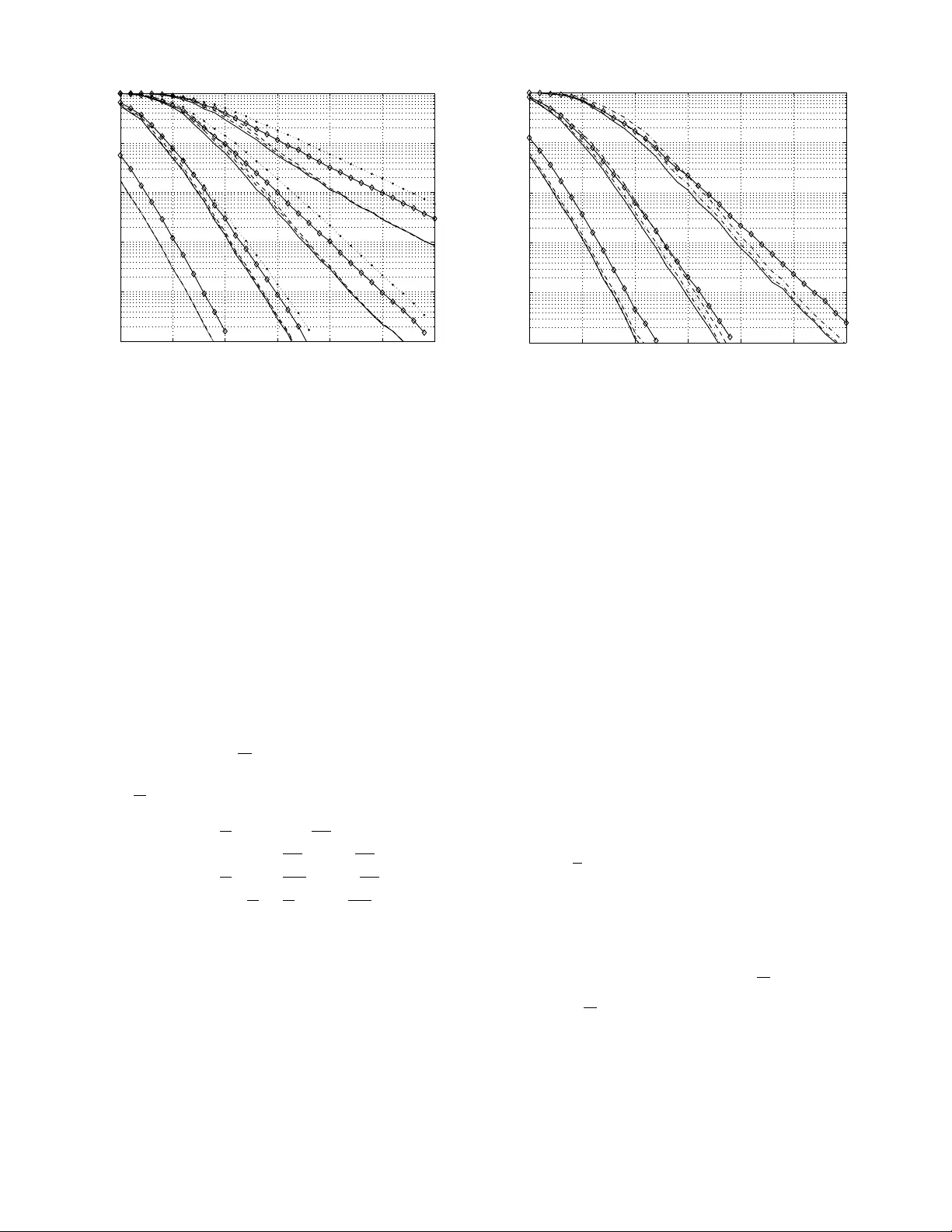
Po wer Allocation for Discrete-Input Non-Er godic Block-F ading Channels Khoa D. Nguyen Institute for T elecommunications Research Univ ersity of South Australia dangkhoa.nguyen@postgrads.unisa.edu.au Albert Guill ´ en i F ` abregas Engineering Department Univ ersity of Cambridge guillen@ieee.org Lars K. Rasmussen Institute for T elecommunications Research Univ ersity of South Australia lars.rasmussen@unisa.edu.au Abstract — W e consider power allocation algorithms for fixed- rate transmission over Nakagami- m non-er godic block-fading channels with perfect transmitter and receiver channel state information and discrete input signal constellations under short- and long-term power constraints. Optimal power allocation schemes are shown to be direct applications of previous results in the literature. W e show that the SNR exponent of the optimal short-term scheme is given by the Singleton bound. W e also illustrate the significant gains available by employing long-term power constraints. Due to the natur e of the expr essions in volved, the complexity of optimal schemes may be pr ohibitive f or system implementation. W e propose simple sub-optimal po wer allocation schemes whose outage probability performance is very close to the minimum outage probability obtained by optimal schemes. I . I N T RO D U C T I O N The non-ergodic block-fading channel introduced in [1] and [2] models communication scenarios where each codeword spans a fixed number of independently faded blocks. The block-fading channel is an accurate model for slo wly-varying fading scenarios encountered with slow time-frequency hop- ping or orthogonal frequency division multiplexing (OFDM). Since each codew ord experiences a finite number of degrees of freedom, the channel is non-ergodic. Therefore, the channel has zero capacity under most common fading statistics. A useful measure for the channel reliability in non-ergodic channels is the outage probability , which is the probability that a given communication rate is not supported by the channel [1], [2]. The outage probability is the lowest possible word error probability for sufficiently long codes. When kno wledge of channel parameters, referred to as chan- nel state information (CSI), is not av ailable at the transmitter , transmit power is allocated uniformly ov er the blocks. When CSI is av ailable at the transmitter, power allocation techniques can be used to increase the instantaneous mutual informa- tion, thus improving the outage performance. Optimal po wer allocation schemes, minimizing the outage probability , hav e been studied under various po wer constraints. F or systems with short-term power constraints (per-code word power constraint), water -filling is the optimal power allocation scheme [3]. In [4] the po wer allocation problem is solved under long-term power constraint, showing that remarkable gains are possible with respect to short-term power allocation. For channels with 1 This work has been partly supported by the Australian Research Council under ARC grants RN0459498 and DP0558861. two or more fading blocks, zero outage can be obtained under long-term power constraint. In both cases, the optimal input distribution is Gaussian. In [5], the authors propose the optimal short-term po wer allocation scheme to maximize the mutual information of parallel channels for arbitrary input distributions. Also, as mentioned in [5], optimal short-term power allocation for block-fading channels with discrete inputs is obtained directly from their results. Due to its complexity , the optimal solution in [5] does not provide much insight into the impact of the parameters in volved, and may also prohibit the application to systems with strict memory and computational constraints. In this paper, we study optimal short- and long-term power allocation schemes for fixed-r ate transmission over discrete- input block-fading channels with perfect CSI at the transmitter and recei ver . W e consider non-causal CSI, namely , the channel gains corresponding to the transmission of one codeword are known to the transmitter and receiv er . In practice, this non-causal assumption reflects the situation of OFDM, where the time-domain channel is estimated b ut the signals are transmitted in the frequency domain. In particular , we sho w that the SNR exponent for optimal short-term allocation is giv en by the Singleton bound [6], [7], [8]. Furthermore, we show that the results in [5] are instrumental in obtaining the optimal long-term solution. W e further aim at reducing the complexity drawbacks of optimal schemes by proposing suboptimal short- and long-term power allocation schemes. The suboptimal schemes are simpler as compared to the corresponding optimal schemes, yet they suffer only negligible losses compared to the optimal performance. Proofs of all results can be found in [9]. I I . S Y S T E M M O D E L Consider transmission o ver an additi ve white Gaussian noise (A WGN) block-fading channel with B blocks of L channel uses each, in which, for b = 1 , . . . , B , block b is af fected by a flat fading coef ficient h b ∈ C . Let γ b = | h b | 2 be the power fading gain and assume that the fading gain vector γ = ( γ 1 , . . . , γ B ) is available at both the transmitter and the receiv er . The transmit power is allocated to the blocks according to the scheme p ( γ ) = ( p 1 ( γ ) , . . . , p B ( γ )) . Then, the complex baseband channel model can be written as y b = p p b ( γ ) h b x b + z b , b = 1 , . . . , B , (1) where y b ∈ C L is the receiv ed signal in block b , x b ∈ X L ⊂ C L is the portion of the code word being transmitted in block b , X ⊂ C is the signal constellation and z b ∈ C L is a noise vector with independent, identically distributed (i.i.d.) circularly symmetric Gaussian entries ∼ N C (0 , 1) . Assume that the signal constellation X is normalized in ener gy such that P x ∈X | x | 2 = 2 M , where M = log 2 |X | . Then, the instantaneous receiv ed SNR at block b is given by p b ( γ ) γ b . W e consider block-f ading channels where h b are realizations of a random v ariable H , whose magnitude is Nakagami- m - distributed and has a uniformly distributed phase 1 . The fading magnitude has the following probability density function (pdf) f | H | ( h ) = 2 m m h 2 m − 1 Γ( m ) e − mh 2 , (2) where Γ( a ) is the Gamma function, Γ( a ) = R ∞ 0 t a − 1 e − t dt . The coef ficients γ b are realizations of the random v ariable | H | 2 whose pdf is giv en by f | H | 2 ( γ ) = ( m m γ m − 1 Γ( m ) e − mγ , γ ≥ 0 0 , otherwise . (3) The Nakagami- m distribution encompasses many fading dis- tributions of interest. In particular, we obtain Rayleigh fading by letting m = 1 and Rician fading with parameter K by setting m = ( K + 1) 2 / (2 K + 1) . I I I . M U T UA L I N F O R M A T I O N A N D O U TAG E P RO B A B I L I T Y For any given power fading gain realization γ and po wer allocation scheme p ( γ ) , the instantaneous input-output mutual information of the channel is giv en by I B ( p ( γ ) , γ ) = 1 B B X b =1 I X ( p b γ b ) , (4) where I X ( ρ ) is the input-output mutual information of an A WGN channel with input constellation X receiv ed SNR ρ I X ( ρ ) = M − E X,Z " log 2 X x 0 ∈X e −| √ ρ ( X − x 0 )+ Z | 2 + | Z | 2 !# . Communication is in outage when the instantaneous input- output mutual information is less than the target rate R . For a giv en power allocation scheme p ( γ ) , the outage probability at communication rate R is giv en by [1], [2] P out ( p ( γ ) , R ) = Pr( I B ( p ( γ ) , γ ) < R ) = Pr 1 B B X b =1 I X ( p b γ b ) < R ! . (5) I V . S H O RT - T ER M P O W E R A L L O C A T I O N Short-term power allocation schemes are applied for sys- tems where the transmit power of each codeword is limited to B P . A giv en short-term power allocation scheme p ( γ ) = ( p 1 , . . . , p B ) must then satisfy P B b =1 p b ≤ B P . 1 Due to our perfect transmitter and recei ver CSI assumption, we can assume that the phase has been perfectly compensated for . A. Optimal P ower Allocation The optimal short-term po wer allocation rule p opt ( γ ) is the solution to the outage probability minimization problem [4]. Mathematically we express p opt ( γ ) as p opt ( γ ) = arg min p ∈ R B + P B b =1 p b = B P P out ( p ( γ ) , R ) . (6) For short-term power allocation, since the av ailable po wer can only be distributed within one codeword, the power allocation scheme that maximizes the instantaneous mutual information at each channel realization also minimizes the outage probability . Formally , we hav e [4] Lemma 1: Let p opt ( γ ) be a solution of the problem Maximize P B b =1 I X ( p b γ b ) Sub ject to P B b =1 p b ≤ B P p b ≥ 0 , b = 1 , . . . , B . (7) Then p opt ( γ ) is a solution of (6). From [5], the solution for problem (7) is giv en by p opt b ( γ ) = 1 γ b MMSE − 1 X min 1 , ν γ b , (8) for b = 1 , . . . , B , where MMSE X ( ρ ) is the minimum mean- squared error (MMSE) for estimating the input based on the receiv ed signal over an A WGN channel with SNR ρ MMSE X ( ρ ) = 1 − 1 π Z C P x ∈X xe −| y − √ ρx | 2 2 P x ∈X e −| y − √ ρx | 2 dy (9) and ν is chosen such that the power constraint is satisfied, B X b =1 p opt b = B P . (10) The optimal short-term power allocation scheme improves the outage performance of block-fading systems. Howe ver , it does not increase the outage div ersity compared to uniform power allocation, as shown in the following lemma. Lemma 2: Consider transmission ov er the block-f ading channel defined in (1) with the optimal po wer allocation scheme p opt ( γ ) gi ven in (8). Assume input constellation size |X | = 2 M . Further assume that the po wer fading gains follow the distribution gi ven in (3). Then, for lar ge P and some K opt > 0 the outage probability behav es as P out ( p opt ( γ ) , R ) . = K opt P − md B ( R ) , (11) where d B ( R ) is the Singleton bound giv en by d B ( R ) = 1 + B 1 − R M (12) B. Suboptimal P ower Allocation Schemes Although the power allocation scheme in (8) is optimal, it in volves an in verse MMSE function, which may be too complex to implement or store for specific low-cost systems. Moreov er , the MMSE function provides little insight to the role of each parameter . In this section, we propose power allocation schemes similar to water -filling that tackle both drawbacks and perform very close to the optimal solution. 1) T runcated water-filling scheme: The complexity of the solution in (8) is due to the complex expression of I X ( ρ ) in problem (7). Therefore, in order to obtain a simple suboptimal solution, we find an aproximation for I X ( ρ ) in problem (7). The water-filling solution in [4] suggests the following approximation of I X ( ρ ) I tw ( ρ ) = log 2 (1 + ρ ) , ρ ≤ β log 2 (1 + β ) , otherwise , (13) where β is a design parameter to be optimized for best per- formance. The resulting suboptimal scheme p tw ( γ ) is giv en as a solution of Maximize P B b =1 I tw ( p b γ b ) Sub ject to P B b =1 p b ≤ B P p b ≥ 0 , b = 1 , . . . , B . (14) Lemma 3: A solution to the problem (14) is given by p tw b ( γ ) = β γ b , if P B b =1 β γ b ≤ B P min β γ b , η − 1 γ b + , otherwise (15) for b = 1 , . . . , B , where η is chosen such that B X b =1 min ( β γ b , η − 1 γ b + ) = B P . (16) W ithout loss of generality , assume that γ 1 ≥ . . . ≥ γ B , then, similarly to water -filling, η can be determined such that [4] ( k − l ) η = B P − l X b =1 β + 1 γ b + k X b =1 1 γ b (17) where k , l are integers satisfying 1 γ k < η < 1 γ k +1 and β +1 γ l < η ≤ β +1 γ l +1 . From Lemma 3, the resulting power allocation scheme is similar to water -filling, except for the truncation of the allocated po wer at β γ b . W e refer to this scheme as truncated water -filling. The outage performance obtained by the truncated water - filling scheme depends on the choice of the design parameter β . W e no w analyze the asymptotic performance of the outage probability , thus providing some guidance on the choice of β . Lemma 4: Consider transmission ov er the block-f ading channel defined in (1) with the truncated water-filling power allocation scheme p tw ( γ ) gi ven in (15). Assume input con- stellation X of size |X | = 2 M . Further assume that the po wer fading gains follo w the distrib ution gi ven in (3). Then, for lar ge P , the outage probability P out ( p tw ( γ ) , R ) is asymptotically upper bounded by P out ( p tw ( γ ) , R ) ˙ ≤K β P − md β ( R ) , (18) where d β ( R ) = 1 + B 1 − R I X ( β ) , (19) and I X ( β ) is the input-output mutual information of an A WGN channel with SNR β . From the results of Lemmas 2 and 4, we note that P out ( p tw ( γ ) , R ) ≥ P out ( p opt ( γ ) , R ) , and we hav e that P out ( p tw ( γ ) , R ) . = K tw P − md tw ( R ) , (20) where d tw ( R ) satisfies that d β ( R ) ≤ d tw ( R ) ≤ d B ( R ) . Therefore, the truncated water -filling scheme is guaranteed to obtain optimal di versity whenever d β ( R ) = d B ( R ) , or equiv alently , when B 1 − R I X ( β ) ≥ B 1 − R M (21) I X ( β ) ≥ B R B − B 1 − R M (22) which implies that β ≥ I − 1 X B R B − B 1 − R M ! , β R . Therefore, the truncated water -filling power allocation scheme (15) becomes the classical water-filling algorithm for Gaussian inputs, and provides optimal outage di versity at any transmis- sion rate by letting β → ∞ . For any rate R that is not at the discontinuity points of the Singleton bound, i.e. R such that B 1 − R M is not an integer , we can always design a truncated water -filling scheme that obtains optimal div ersity by choosing β ≥ β R . W ith the results abov e, we choose β as follows. For a transmission rate R that is not a discontinuity point of the Singleton bound, we perform a simulation to compute the outage probability at rate R obtained by truncated water- filling with various β ≥ β R and pick the β that gi ves the best outage performance. The dashed line in Figure 1 illustrates the performance of the obtained schemes for block- fading channels with B = 4 , QPSK input under Rayleigh fading. At all rates of interest, the truncated water-filling schemes perform very close to the optimal scheme (solid line), especially at high SNR. For rates at the discontinuous points of the Singleton bound, especially when operating at high SNR, β needs to be relativ ely large in order to maintain di versity . Howe ver , large β increases the gap between I tw ( ρ ) and I X ( ρ ) , thus degrades the performance of the truncated water-filling scheme. F or β = 15 , the gap is illustrated by the dashed lines in Figure 2. In the extreme case where β → ∞ , the truncated water -filling turns into the water-filling scheme, which exhibits a significant loss in outage performance as illustrated by the dotted lines in Figure 1. T o reduce this drawback, we propose a better approximation to I X ( ρ ) , which leads to a refinement to the truncated water -filling scheme in the next section. 2) Refined truncated water-filling schemes: T o obtain better approximation to the optimal power allocation scheme, we need a more accurate approximation to I X ( ρ ) in (7). W e propose the following approximation I ref ( ρ ) = log 2 (1 + ρ ) , ρ ≤ α κ log 2 ( ρ ) + a, α < ρ ≤ β κ log 2 ( β ) + a, otherwise , (23) 0 5 10 15 20 25 30 10 ! 5 10 ! 4 10 ! 3 10 ! 2 10 ! 1 10 0 P (dB ) P out ( p , R ) R = 0 . 4 β = 3 R = 1 . 4 β = 10 R = 1 . 7 β = 10 R = 0 . 9 β = 6 Fig. 1. Outage performance of various short-term power allocation schemes for QPSK-input block-fading channels with B = 4 and Rayleigh fading. The solid-line represents optimal scheme; the solid line with represents uniform power allocation; the dashed line and dashed-dotted line represent truncated water-filling and its corresponding refinement, respectively; the dotted line represents classical water-filling scheme. where κ and a are chosen such that in dB scale, κ log 2 ( ρ ) + a is a tangent to I X ( ρ ) at a predetermined point ρ 0 . Therefore α is chosen such that κ log 2 ( α ) + a = log 2 (1 + α ) , and β is a design parameter . For QPSK input and ρ 0 = 3 , we hav e κ = 0 . 3528 , a = 1 . 1327 , α = 1 . 585 . The optimization problem (7) is approximated by Maximize P B b =1 I ref ( p b γ b ) Sub ject to P B b =1 p b ≤ B P p b ≥ 0 , b = 1 , . . . , B . (24) The refined truncated water -filling scheme p ref ( γ ) is gi ven by the following lemma. Lemma 5: A solution to problem (24) is p ref b = β γ b , b = 1 , . . . , B (25) if P B b =1 β γ b < B P , and otherwise, for b = 1 , . . . , B , p ref b = β γ b , η ≥ β κγ b κη , α κγ b ≤ η < β κγ b α γ b , α +1 γ b ≤ η < α κγ b η − 1 γ b , 1 γ b ≤ η < α +1 γ b 0 , otherwise , (26) where η is chosen such that B X b =1 p ref b = B P . (27) The refined truncated water-filling scheme provides signif- icant gain ov er the truncated water-filling scheme, especially when the transmission rate requires relatively large β to main- tain the outage diversity . The dashed-dotted lines in Figure 2 show the outage performance of the refined truncated w ater- filling scheme for block-fading channels with B = 4 , QPSK 0 5 10 15 20 25 30 10 ! 5 10 ! 4 10 ! 3 10 ! 2 10 ! 1 10 0 P (dB) P out ( p , R ) R=0.5 R=1.0 R=1.5 Fig. 2. Outage performance of various short-term power allocation schemes for QPSK-input block-fading channels with B = 4 and Rayleigh fading. The solid-line represents optimal scheme; the solid line with represents uniform power allocation; the dashed line and dashed-dotted line correspondingly represent truncated water-filling and its refinement with β = 15 . input under Rayleigh fading. The refined truncated water - filling scheme performs very close to the optimal case ev en at the rates where the Singleton bound is discontinuous, i.e. rates R = 0 . 5 , 1 . 0 , 1 . 5 . The performance gains of the refined scheme over the truncated water -filling scheme at other rates are also illustrated by the dashed-dotted lines in Figure 1. V . L O N G - T E R M P OW E R A L L O C A T I O N W e consider systems with long-term po wer constraints, in which the expectation of the po wer allocated to each block (ov er infinitely many codewords) does not exceed P . This problem has been in vestigated in [4] for block-fading channels with Gaussian inputs. In this section, we obtain similar results for channels with discrete inputs, and propose suboptimal schemes that reduce the complexity of the algorithm. A. Optimal Long-T erm P ower Allocation Follo wing [4], the problem can be formulated as Minimize Pr( I B ( p lt ( γ ) , γ ) < R ) Sub ject to E [ h p lt ( γ ) i ] ≤ P , (28) where h p i = 1 B P B b =1 p b . The following theorem shows that the structure of the optimal long-term solution p opt lt ( γ ) of [4] for Gaussian inputs is generalized to the discrete-input case. Theor em 1: Problem (28) is solved by p opt lt ( γ ) giv en by p opt lt ( γ ) = ℘ opt ( γ ) , if γ ∈ R ( s ? ) 0 , if γ / ∈ R ( s ? ) , (29) while if γ ∈ R ( s ? ) \ R ( s ? ) then p opt lt ( γ ) = ℘ ( γ ) with probability w ? and p opt lt ( γ ) = 0 with probability 1 − w ? , where ℘ ( γ ) is the solution of the following optimization problem Minimize h ℘ i Sub ject to P B b =1 I X ( ℘ b γ b ) ≥ B R ℘ b ≥ 0 , b = 1 , . . . , B , (30) and R ( s ) , R ( s ) , s ? , w ? are defined as follows R ( s ) = { γ ∈ R B + : h ℘ opt ( γ ) i < s } (31) R ( s ) = { γ ∈ R B + : h ℘ opt ( γ ) i ≤ s } (32) s ? = sup { s : P ( s ) < P } (33) w ? = P − P ( s ? ) P ( s ? ) − P ( s ? ) (34) where 2 P ( s ) = E γ ∈R ( s ) h ℘ opt ( γ ) i (35) P ( s ) = E γ ∈R ( s ) h ℘ opt ( γ ) i (36) and ℘ opt ( γ ) is the solution of (30) giv en by ℘ opt b = ( 1 γ b MMSE − 1 X 1 η γ b , η ≥ 1 γ b 0 , otherwise (37) for b = 1 , . . . , B , where η is chosen such that B X b =1; γ b ≥ 1 η I X MMSE − 1 X 1 η γ b = B R. (38) As in the Gaussian input case [4], the optimal po wer allo- cation scheme either transmits with the minimum po wer that enables transmission at the tar get rate, or turns of f transmission (allocating zero power) when the channel realization is bad. Therefore, there is no power wastage on outage ev ents. The solid lines in Figure 3 illustrates the outage perfor - mance of optimal long-term po wer allocation schemes for transmission ov er 4-block block-fading channels with QPSK- input and Rayleigh fading. The simulation results suggest that for communication rates where d B ( R ) > 1 , zero outage probability can be obtained with finite power . This agrees to the results obtained for block-fading channels with Gaussian inputs [4], where only for B > 1 zero outage was possible. B. Suboptimal Long-T erm P ower Allocation In the optimal long-term power allocation scheme p opt lt ( γ ) giv en in Theorem 1, w ? , s ? can be e valuated offline for any fading distribution. Therefore, gi ven an allocation scheme ℘ opt ( γ ) , the complexity required to ev aluate p opt lt ( γ ) is low . Thus, the comple xity of the long-term po wer allocation scheme is mainly due to the complexity of e valuating ℘ opt ( γ ) , which requires the ev aluation or storage of MMSE X ( ρ ) and I X ( ρ ) . In this section, we propose suboptimal long-term po wer allocation schemes by replacing ℘ opt ( γ ) with simpler power allocation algorithms. A long-term po wer allocation scheme p lt ( γ ) corresponding to an arbitrary ℘ ( γ ) is obtained by replacing ℘ opt ( γ ) in (29), (31)–(36) with ℘ ( γ ) . From (29), (31)–(36), the long- term power allocation scheme p lt ( γ ) satisfies E [ h p lt ( γ ) i ] = E γ ∈R ( s ? ) [ h p lt ( γ ) i ] (39) + w ? E γ ∈R ( s ? ) \R ( s ? ) [ p lt ( γ )] (40) = P ( s ? ) + w ? P ( s ? ) − P ( s ? ) = P (41) 2 For simplicity , for a random variable ξ with pdf f ξ ( ξ ) , we denote E ξ ∈A [ f ( ξ )] , R ξ ∈A f ξ ( ξ ) dξ . Therefore, a long-term power allocation schemes correspond- ing to an arbitrary ℘ ( γ ) is suboptimal with respect to p opt lt ( γ ) . Follo wing the transmission strategy in the optimal scheme, we consider the power allocation schemes ℘ ( γ ) that satisfy the rate constraint I B ( ℘ ( γ ) , γ ) ≥ R to a void wasting power on outage events. These schemes are suboptimal solutions of problem (30). Based on the short-term schemes, tw o simple rules are discussed in the next subsections. 1) Long-term truncated water-filling scheme: Similar to the short-term truncated water-filling scheme, we consider approximating I X ( ρ ) in (30) by I tw ( ρ ) in (13), which results in the following problem Minimize h ℘ ( γ ) i Sub ject to P B b =1 I tw ( ℘ b γ b ) ≥ B R ℘ b ≥ 0 , b = 1 , . . . , B (42) The solution of (42) is giv en by ℘ b = min ( β γ b , η − 1 γ b + ) , b = 1 , . . . , B , (43) where η is chosen such that B X b =1 log 2 (1 + ℘ b γ b ) = B R. (44) Note that since I tw ( ρ ) upperbounds I X ( ρ ) , ℘ ( γ ) does not satisfy the rate constraint I B ( ℘ ( γ ) , γ ) ≥ R . By adjusting η , we can obtain a suboptimal ℘ tw ( γ ) of ℘ opt ( γ ) as follows ℘ tw b = min ( β γ b , η − 1 γ b + ) , b = 1 , . . . , B , (45) where η is chosen such that B X b =1 I X ( ℘ tw b γ b ) = B R. (46) Using this scheme, we obtain a power allocation p tw lt ( γ ) , which is the long-term power allocation scheme corresponding to the suboptimal ℘ tw ( γ ) of ℘ opt ( γ ) . The performance of the scheme is illustrated by the dashed lines in Figure 3. 2) Refinement of the long-term truncated water-filling: In order to improve the performance of the suboptimal scheme, we approximate I X ( ρ ) by I ref ( ρ ) giv en in (23). Replacing I X ( ρ ) in (30) by I ref ( ρ ) , we hav e the following problem Minimize h ℘ ( γ ) i Sub ject to P B b =1 I ref ( ℘ b γ b ) ≥ B R ℘ b ≥ 0 , b = 1 , . . . , B (47) Follo wing the same steps as in Section V -B.1, the suboptimal ℘ ref ( γ ) of ℘ opt ( γ ) is giv en as ℘ ref b = β γ b , η ≥ β κγ b κη , α κγ b ≤ η ≤ β κγ b α γ b , α +1 γ b ≤ η ≤ α κγ b η − 1 γ b , 1 γ b ≤ η ≤ α +1 γ b 0 , otherwise , (48) where η is chosen such that B X b =1 I X ( ℘ ref b γ b ) = B R. (49) The performance of the long-term power allocation corre- sponding to ℘ ref ( γ ) , p ref lt ( γ ) , is illustrated by the dashed- dotted lines in Figure 3. 3) Approximation of I X ( ρ ) : The suboptimal schemes in the previous sections perform close to optimality , and are simpler than the optimal scheme. Ho we ver , the suboptimal schemes still require the implementation or storage of I X ( ρ ) to compute η . This can be avoided by using approximations of I X ( ρ ) . Let ˜ I X ( ρ ) be an approximation of I X ( ρ ) and the rate error ∆ R = max ρ { ˜ I X ( ρ ) − I X ( ρ ) } . Then, for a suboptimal scheme ℘ ( γ ) , η chosen such that B X b =1 ˜ I X ( ℘ b γ b ) = B ( R + ∆ R ) (50) satisfies the rate constraint since B X b =1 I X ( ℘ b γ b ) ≥ B X b =1 ˜ I X ( ℘ b γ b ) − B ∆ R = B R. (51) Follo wing [10], we use the approximation for I X ( ρ ) ˜ I X ( ρ ) = M 1 − e − c 1 ρ c 2 c 3 . (52) For channels with QPSK input, using numerical optimization to minimize the mean squared error between I X ( ρ ) and ˜ I X ( ρ ) , we obtain c 1 = 0 . 77 , c 2 = 0 . 87 , c 3 = 1 . 16 and ∆ R = 0 . 0033 . Using this approximation to ev aluate η in subsections V -B.1 and V -B.2, we arrive at much less computationally demanding power allocation schemes with little loss in performance. W e finally illustrate in Figure 4 the significant gains achiev- able by the long-term schemes when compared to short- term. As remarked in [4], remarkable gains are possible with Gaussian inputs (11dB at 10 − 4 ). As sho wn in the figure, similar gains (12dB at 10 − 4 ) are also achiev able by discrete inputs. Note that, due to the Singleton bound, the slope of the discrete-input short-term curves is not as steep as the slope of the corresponding Gaussian input curve. V I . C O N C L U S I O N W e considered power allocation schemes for discrete-input block-fading channels with transmitter and recei ver CSI under short- and long-term power constraints. W e hav e studied optimal and lo w-complexity sub-optimal schemes, and hav e illustrated the corresponding performances, sho wing that min- imal loss is incurred when using the sub-optimal schemes. R E F E R E N C E S [1] L. H. Ozarow , S. Shamai, and A. D. W yner, “Information theoretic considerations for cellular mobile radio, ” IEEE Tr ans. V eh. T ech. , v ol. 43, no. 2, pp. 359–378, May 1994. [2] E. Biglieri, J. Proakis, and S. Shamai, “Fading channels: Informatic- theoretic and communications aspects, ” IEEE T rans. Inf. Theory , v ol. 44, no. 6, pp. 2619–2692, Oct. 1998. ! 6 ! 4 ! 2 0 2 4 6 8 10 12 14 10 ! 4 10 ! 3 10 ! 2 10 ! 1 10 0 P (dB) P out ( p , R ) R = 0 . 5 β 1 = 3 β 2 =5.5 R = 1 . 0 β 1 =3 β 2 =5.5 R = 1 . 5 β 1 =8 β 2 =8 R = 1 . 7 β 1 =8 β 2 =8 Fig. 3. Outage performance of various long-term power allocation schemes for QPSK-input 4-block block-fading channels under Rayleigh fading. The solid-line represents optimal scheme; the dashed line and dashed-dotted line correspondingly represent long-term truncated water-filling ( p tw lt ( γ ) with β 1 ) and its refinement ( p ref lt ( γ ) with β 2 ). ! 5 0 5 10 15 20 10 ! 4 10 ! 3 10 ! 2 10 ! 1 10 0 P (dB) P out ( p , P, R ) Long-ter m Sh ort-ter m 16-QAM 16-QAM QPS K QPS K Fig. 4. Outage performance of short- and long-term power allocation schemes in a block-fading channel with B = 4 , R = 1 and Rayleigh fading. Diamonds correspond to uniform allocation, thick solid lines correspond to Gaussian input, thin solid-lines represent optimal schemes; the dashed and dashed- dotted lines represent long-term truncated water-filling ( p tw lt ( γ ) with β 1 = 3 ) and its corresponding refinement ( p ref lt ( γ ) with β 2 = 5 . 5 ), respectively . [3] T . M. Cover and J. A. Thomas, Elements of Information Theory , 2nd ed. John W iley and Sons, 2006. [4] G. Caire, G. T aricco, and E. Biglieri, “Optimal po wer control ov er fading channels, ” IEEE T rans. Inf. Theory , vol. 45, no. 5, pp. 1468–1489, Jul. 2001. [5] A. Lozano, A. M. T ulino, and S. V erd ´ u, “Opitmum power allocation for parallel Gaussian channels with arbitrary input distributions, ” IEEE T rans. Inf. Theory , vol. 52, no. 7, pp. 3033–3051, Jul. 2006. [6] R. Knopp and P . A. Humblet, “On coding for block fading channels, ” IEEE T rans. Inf. Theory , vol. 46, no. 1, pp. 189–205, Jan. 2000. [7] E. Malkam ¨ aki and H. Leib, “Coded div ersity on block-fading channels, ” IEEE T rans. Inf. Theory , vol. 45, no. 2, pp. 771–781, Mar. 1999. [8] A. Guill ´ en i F ` abregas and G. Caire, “Coded modulation in the block- fading channel: Coding theorems and code construction, ” IEEE T rans. Inf. Theory , vol. 52, no. 1, pp. 91–114, Jan. 2006. [9] K. D. Nguyen, A. Guill ´ en i F ` abregas, and L. K. Rasmussen, “Power allocation for discrete-input delay-limited fading channels, ” submitted to IEEE T rans. Inf. Theory . A vailable at arXiv:0706.2033 . [10] F . Br ¨ annstr ¨ om, L. K. Rasmussen, and A. J. Grant, “Con vergence analysis and optimal scheduling for multiple concatenated codes, ” IEEE T rans. Inf. Theory , vol. 51, no. 9, pp. 3354–3364, Sep. 2005.
Original Paper
Loading high-quality paper...
Comments & Academic Discussion
Loading comments...
Leave a Comment