Garside monoids vs divisibility monoids
Divisibility monoids (resp. Garside monoids) are a natural algebraic generalization of Mazurkiewicz trace monoids (resp. spherical Artin monoids), namely monoids in which the distributivity of the underlying lattices (resp. the existence of common mu…
Authors: Matthieu Picantin (LIAFA)
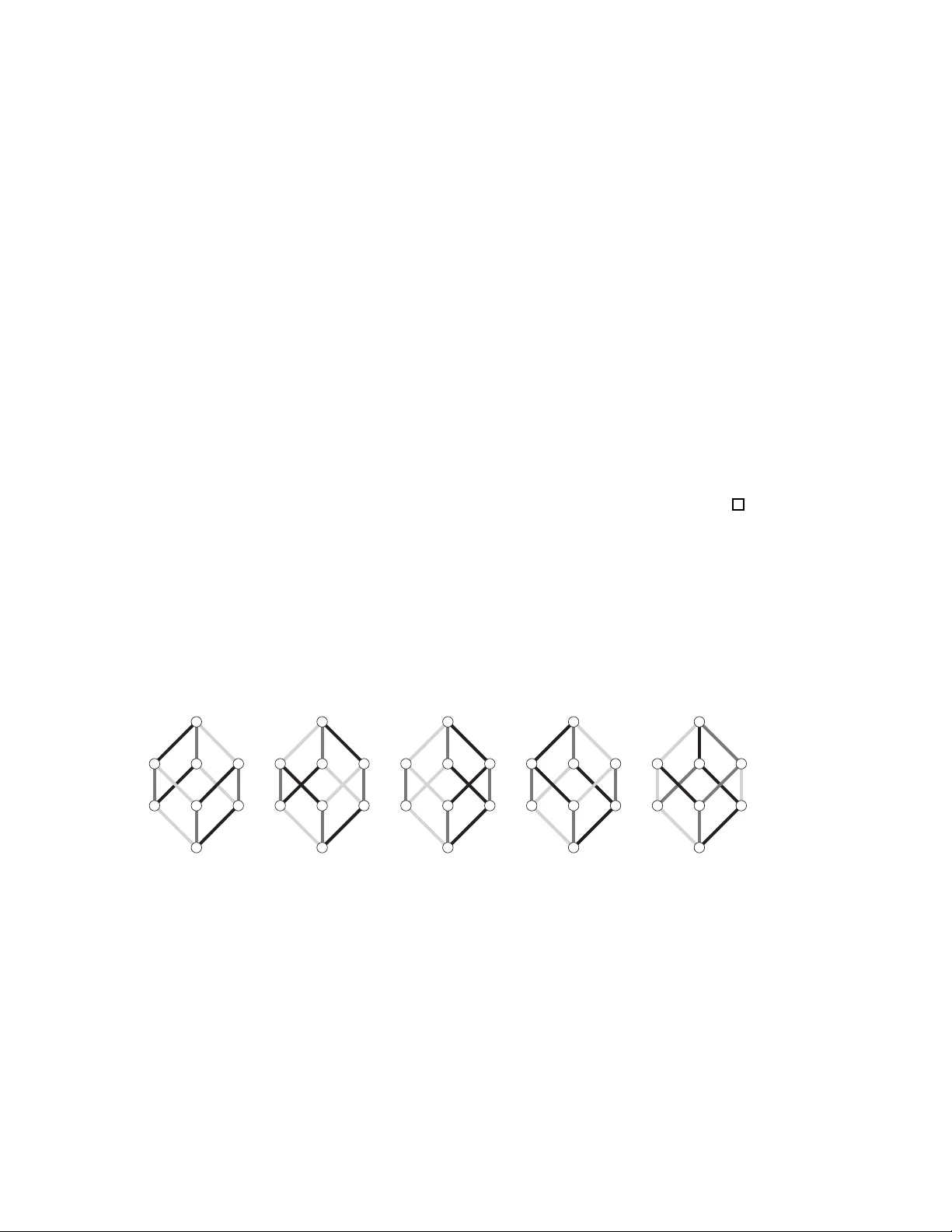
Under considera tion for publication in Math. Struct. in Comp. Science Garside monoids vs divisibility monoids M A T T H I E U P I C A N T I N † Laborato ir e Nicolas Or esme, UMR 6139 CNRS Universit ´ e de Caen, F-14000 Caen Email: picantin@math.unicaen .fr Received 31 J anua ry 2003; r ev ised 12 J anuary 2004 Divisibility monoids ( r esp . Garside mon oids) are a natural algebraic generalization of Mazu rkie wicz trace monoids ( r esp. spherical Artin monoids), namely monoid s in which the distributi vity of the underlying lattices ( r esp. the existen ce of common multiples) is kept as an hypothesis, but th e relations between the generators are not supposed to necessarily be commutations ( r esp. be of Coxeter type). Here, we sho w that the quasi-center of these monoids can be studied and described similarly , and then we exhib it the intersection between the two classes of monoids. 1. Intr oduction The purpo se of this paper is to study some possible con nections betwee n the classes o f Gar- side monoids and divisibility mono ids, which are natural alg ebraic generalization s of monoids in volved in two mathema tical areas, namely braid theory and trace theory , respectively . Garside monoids can be u sed as a p o werful to ol in the study of automatic structures for groups arising in topological or geometric contexts. Gen eralizing M azurkiewicz trace mon oids, d i v isi- bility mon oids hav e been introd uced as a mathem atical model for th e sequential behavior of some concur rent systems considered in several areas in com puter s cience and in which two sequ ential transform ations of the form ab an d cd —with a, b, c, d viewed as atom ic tran sitions—can give rise to the same effect. Here we show that Garside mono ids and divisibility monoid s a re both strang ely similar (al- though they come fro m apparently un related mathema tical theories) and g enuinely different (even if they share some essential algeb raic p roperties). Their similarity will be illustrated b y the fact that their qu asi-center—roughly speaking, some supmonoid of the center—can be stud- ied with close techniqu es and described through a same statement. Th eir particular ity will be emphasized by the fact that th e intersection between the tw o classes—that we exhibit by using the result abou t the quasi-center—is reduced to a somewhat confined subclass. Main Theorem. (i) A divisibility m onoid is a Ga rside monoid if an d only if every pair o f its irreducib le elements admits commo n multiples. † The a uthor tha nks Prof. M. Droste and D. K uske from the Institut f ¨ ur Al gebra, TU Dresden, German y , whe re he wrote this paper . He is grateful to the two anonymous refer ees for comments on an earlier draft. Matthieu Picantin 2 (ii) A Garside monoid is a di v isibility mono id if and only if the lattice of its simple elements is a hyperc ube. The paper is organized as follows. In Section 1, we gather t he needed basic properties o f Garside monoid s and divisibility mono ids. In Section 2, w e introdu ce a specific tool th at we call lo cal delta and which allows us to com pute a min imal gen erating set for the quasi-cen ter of every divisibility mo noid (Prop ositions 3. 12 an d 3.1 4). W e compare these results with those obtained for Garside monoids in (Picantin 2001 b ). In Section 3, we fi nally prove th e main theorem of this paper (Theore m 4.1) and illustrate it. 2. Background from Garside and divisibility monoids In this section, we list some basic proper ties of Garside mon oids a nd di visibility monoids, and summarize results by Dehornoy & Paris abou t Garside mo noids and by Droste & Kuske abo ut di- visibility monoid s. For all the results quo ted h ere, we refer the reader to (Deho rnoy and Paris 1999; Picantin 2000; Dehorn oy 2 002) and to (Droste and Kusk e 2001; K uske 2001). 2.1. Divisor s and multiples in a mono id Assume that M is a monoid. W e say that M is conical if 1 is the on ly in vertib le element in M . For a, b in M , we say th at b is a left divisor o f a —or that a is a right multiple of b —if a = bd holds for so me d in M . T he set of th e left divisors o f b is denoted b y ↓ ( b ) . An element c is a rig ht lower common multiple—or a rig ht lcm—of a and b if it is a right multiple of both a an d b , and ev ery righ t common mu ltiple of a and b is a r ight multiple o f c . Right divisor , left multiple, and left lcm are d efined symmetr ically . For a, b in M , we say that b divides a —or that b is a d i visor of a —if a = cbd hold s for some c, d in M . If c , c ′ are tw o right lcm ’ s of a and b , ne cessarily c is a lef t d i v isor of c ′ , and c ′ is a left divisor of c . If we assume M to be conical and cancellati ve, we have c = c ′ : th e uniq ue right lcm of a and b is then deno ted by a ∨ b . If a ∨ b exists , and M is left can cellati ve, there exists a unique element c satisfyin g a ∨ b = ac : this element is d enoted b y a \ b . In particular, we obtain th e identities : a ∨ b = a · ( a \ b ) = b · ( b \ a ) . Cancellativity and conicity imply that lef t and right divisibility ar e orde r relations. Now , the additional assumption that any two elements admitting a c ommon multiple admit an lcm—th at we will see is satisfied by both Gar side mon oids and d i v isibility mon oids—allows to obtain the following algebraic properties for the operatio n \ . Lemma 2.1. Assume that M is a cancellative conical monoid in which any two elements admit- ting a commo n right multiple admit a right lcm. Then the following identities hold in M : ( ab ) ∨ ( ac ) = a ( b ∨ c ) , c \ ( ab ) = ( c \ a )(( a \ c ) \ b ) , ( ab ) \ c = b \ ( a \ c ) , ( a ∨ b ) \ c = ( a \ b ) \ ( a \ c ) = ( b \ a ) \ ( b \ c ) , c \ ( a ∨ b ) = ( c \ a ) ∨ ( c \ b ) . For each identity , this means that bo th sides exist and are equal or that neither exists . Garside monoids vs divisibility monoids 3 Notatio n 2.2. For some subsets A, B of elemen ts, we denote by A \ B the set of ele ments a \ b provided that all of them exist. 2.2. Th e quasi-center of a monoid The quasi-center of a monoid turns out to be a useful supmon oid of its center . Definition 2.3. Let M be a m onoid. An irr ed ucible elemen t of M is d efined to be a non tri via l element a such that a = bc implies either b = 1 o r c = 1 . The set of the irre ducible elements in M can be written as ( M \ { 1 } ) \ ( M \ { 1 } ) 2 . Definition 2.4. Assum e th at M is a m onoid with set of irreducible elements Σ . The q uasi-center of M is defined to be its submono id { a ∈ M ; a Σ = Σ a } . Although straightforward, the tw o following lemmas capture ke y properties of quasi-central ele- ments. They will be frequently used in the remaining sections. Lemma 2.5. Assume that M is a can cellati ve monoid . Then, for every elemen t a in M and every quasi-centr al element b in M , the following are equiv alent : (i) a divides b ; (ii) a divides b on the left; (iii) a divides b on the right. Pr oof. By very definitio n, (ii) ( r esp. ( iii)) imp lies (i). Now , assume (i) . Th en there exist el- ements c, d in M s atisfying b = cad . Since b is q uasi-central, we have cb = bc ′ for some c ′ in M . W e find cb = bc ′ = ca dc ′ , hence, by left can cellation, b = adc ′ , which implies (ii). Symmetrically , (i) implies (iii). Lemma 2 .6. Assume that M is a can cellati ve monoid an d a is a quasi-cen tral element in M . Then, for any tw o elements b, c satisfyin g a = bc , b is q uasi-central if and only if s o is c . Pr oof. Assume c to be q uasi-central. Let x be an irredu cible element in M . Since a is quasi- central, there e xists an irreducib le element x ′ in M satisfying xa = ax ′ , hence xbc = bcx ′ . No w , since c is quasi-c entral, there exists an irred ucible element x ′′ in M satisfying cx ′ = x ′′ c . W e find xbc = bx ′′ c , hence, by right can cellation, xb = bx ′′ , which implies th at b is q uasi-central. Symmetrically , if b is q uasi-central, so is c . 2.3. Ma in definitions and pr operties for Garside monoids Definition 2 .7. A m onoid M is said to b e Garside ‡ if M is co nical and can cellati ve, e very p air of elements in M admits a left lcm and a right lcm, and M admits a Garside element , defined to be an element whose left and right divisors coincide, are fi nite in numb er and generate M . ‡ Garside monoids as define d above a re calle d Garside monoids in (Cha rney et al. 2002; Dehorn oy 2002; Picanti n 2002; Picantin 2003a), but they were called either ”small Gaussian” or ”thin Gaussian” in pre vious pa- pers (Dehorno y and Paris 1999; Picant in 2000; Picantin 2001a; Picant in 2001b), where a more restricte d notion of Garside monoid was also consider ed. Matthieu Picantin 4 1 x y z ∆ 1 x y ∆ Fig. 1. The lattice of simple elements of the Garside monoid s M χ (left) and M κ (right). Example 2.8. All spherical Artin mo noids are Garside mon oids. Braid monoid s of comp lex re- flection groups (Brou ´ e et a l. 1998; Pi cantin 2000), Garside’ s hypercube m onoids (Garside 1969; Picantin 2000), Birman-Ko-Lee mono ids fo r spherical Artin groups (Birman et al. 1998; Picantin 2002) and mono ids for torus link group s in (Picantin 2003a) are also Garside monoids. The monoid M χ with presentation h x, y , z : xz xy = y z x 2 , y z x 2 z = z xy z x , z xy z x = xz xy z i . is a typical example of a Garside mono id, which has the distinguishing feature to be not antiau- tomorp hic. The monoid M κ defined by th e p resentation h x, y : xy xy xy x = y y i is another example of a Garside monoid , which, as for it, admits n o add iti ve n orm, i.e. , n o no rm ν satisfying ν ( ab ) = ν ( a ) + ν ( b ) ( a no rm for a mo noid M is a mappin g µ from M to N satisfying µ ( a ) > 0 for ev ery a 6 = 1 in M , and satisfying µ ( ab ) ≥ µ ( a ) + µ ( b ) for ev ery a, b in M ). Every element in a Garside mon oid has finitely many left divisors, only then, for any two ele- ments a, b , the left comm on divisors of a and b admit a righ t lcm, which is therefore the left gcd of a and b . This left gcd is denoted by a ∧ b . Every Garside monoid admits a minimal Garside elem ent, denoted in general by ∆ . The set of the di v isors of ∆ —called the simple elements —endowed with th e oper ations ∨ and ∧ is a finite lattice. Example 2.9. The lattices of simple elements of monoid s M χ and M κ of Exam ple 2.8 are displayed in Fig ure 1, using Hasse diagrams, wh ere clear ( r esp. middle, d ark) edge s represent the irreducible element x ( r esp. y , z ). It is ea sy to c heck that every Garside element is a quasi-centr al element. Now , this is far from being sufficient to describe what th e quasi-center of every Garside monoid looks like. The latter was done in (Picantin 2001b), where the following structural result was established. Garside monoids vs divisibility monoids 5 Theorem 2.10. Every Garside monoid is an itera ted crossed product of Garside monoid s with an infinite cyclic quasi-center . 2.4. Ma in definitions and pr operties for divisibility monoid s Definition 2.11 . A mono id M is c alled a left divisibility mon oid or simply a divisibility mono id if M is cancellati ve and finitely generated by its irreducible elements, if any tw o elements admit a left gcd and if ev ery element a do minates a finite ¶ distributi ve lattice ↓ ( a ) . Note that cancellativity and the lattice condition imply c onicity . Like in the Garside case, the left gcd of two elements a, b will b e den ote by a ∧ b . The length | a | of an elemen t a is defined to be the height of the lattice ↓ ( a ) . Example 2.12. Every finitely generated trace mon oid is a di visibility monoid. The mon oids h x, y , z : xy = y z i , h x, y , z : x 2 = y z i and h x, y , z : x 2 = y z , y x = z 2 i ar e not trace but divisibility monoids. The monoid h x, y , z : x 2 = yz , xy = z 2 i is not a divisibility monoid (but a Garside mono id!) ; indeed, the lattice ↓ ( x 3 ) is not distributi ve. An easy but crucial fact about divisibility monoids is the follo wing. Lemma 2.1 3. Assume that M is a divisibility monoid. Then finitely many elements in M ad- mitting at least a right commo n multiple admit a unique right lcm. The following result states that there exists a decidable class of presentation s that g i ves rise precisely to all divisibility monoid s. Theorem 2.14. Assume that M is a monoid finitely g enerated by th e set Σ of its irred ucible elements. Then M is a left divisibility monoid if and only if (i) ↓ ( xy z ) is a distributiv e latti ce, (ii) xy z = xy ′ z ′ or y z x = y ′ z ′ x implies y z = y ′ z ′ , (iii) xy = x ′ y ′ , xz = x ′ z ′ and y 6 = z imply x = x ′ , for any x, y , z , x ′ , y ′ , z ′ in Σ , and if (iv) we have M ∼ = Σ ∗ / ∼ , wh ere ∼ is the congru ence on Σ ∗ generated b y th e pair s ( xy , z t ) with x, y , z , t in Σ satisfying xy = z t . 3. The quasi-center of a di v isibility monoid This section deals only with d i v isibility monoid s, and no knowledge of Garside mo noids is needed—excep t possibly f or the final remark. After defining the loca l delta , we use it as a fun - damental tool in o rder to gi ve a generating set for the quasi-center of e very di visibility monoid and s how that it is minimal. W e establish then that the quasi-center of e very divisibility mo noid is a free Abelian submono id. ¶ This fini teness requi rement is in fac t not necessary since i t foll o ws from the other stipul ations (see e.g. (Kusk e 2001)). Matthieu Picantin 6 3.1. A g enerating set for the quasi-ce nter W e first intr oduce a partial version of what the author called local delta in (Picantin 2001b). Definition 3.1. Assum e that M is a divisibility monoid . Let a be an element in M . If the set { b \ a ; b ∈ M } is well-defined † and admits a right lcm, the latter is called the right local delta of a or simply the local delta of a and is denoted by ∆ a = W { b \ a ; b ∈ M } . Otherwise, we say that a do es not admit a r ight local delta. No te that the eq uality 1 \ a = a implies a to be a lef t divisor of ∆ a , when e ver it exists, and that, having b \ 1 = 1 for every b in M , we obtain ∆ 1 = 1 . Lemma 3.2 . Assume that M is a divisibility monoid. The n an element a in M admits a lo cal delta if and only if a ∨ b exists for e very element b in M . Pr oof. Assume that M is a di visibility mon oid with Σ the set of its ir reducible elements and Σ 1 = Σ ∪ { 1 } . For every a in M , we de fine Υ i ( a ) by Υ 0 ( a ) = { a } and Υ i ( a ) = Σ 1 \ Υ i − 1 ( a ) for i > 0 wh enev er b oth Υ i − 1 ( a ) exists and c \ b exists for ev ery c in Σ 1 and ev ery b in Υ i − 1 ( a ) . Assume that a is an elemen t such that a ∨ b exists fo r e very b in M . From th e distributi vity of ↓ ( a ∨ b ) , w e can deduce | b \ a | ≤ | a | . The set { b \ a ; b ∈ M } is then finite, and there exists a positive integer i a satisfying { a } = Υ 0 ( a ) ( Υ 1 ( a ) ( . . . ( Υ i a ( a ) = Υ i a +1 ( a ) = . . . = { b \ a ; b ∈ M } . Indeed , by Lem ma 2.1, we have M \ a = Σ i a 1 \ a = Σ 1 \ (Σ i a − 1 1 \ a ) . Now , assume c, d belong- ing to M \ a and h satisfying d = h \ a . By hy pothesis, the element ( hc ) \ a exists, hen ce, b y Lemma 2. 1, the element c \ d —which is c \ ( h \ a ) —exists, so does c ∨ d . Ther efore, th e finite set { b \ a ; b ∈ M } adm its a right lcm, namely ∆ a . The conv erse implication is straightf orward. Remark 3.3. F ollowing th e previous p roof, we can comp ute the right local delta of any ele- ment a by recursively computing the s ets Υ i ( a ) wh enev er they exist and then by computing the right lcm of Υ i a ( a ) , which must exist by Lemma 3.2. See Examples 3.10 and 4.2 belo w . W e are g oing to prove that the qu asi-center of any divisibility mo noid is generated b y the (pos- sibly empty ) set of the local d elta of its irredu cible elements (Proposition 3.9). The pro of of this result relies on sev eral preliminary statements. Lemma 3.4. Assume that M is a divisibility mon oid. Then, f or every element a and e very qu asi- central element b in M , a dividing b implies ∆ a existing and di v iding b . Pr oof. By hypothesis and Lemma 2.5, there exists an element d in M satisfyin g b = ad . As b is quasi-ce ntral, for every c in M , there exists an element c ′ in M satisfyin g cb = adc ′ . By Lemma 2.13, f or ev ery c in M , c ∨ a —which exists and is c ( c \ a ) —divides c b on the left, and, by † that is, the element b \ a exists—or equi valent ly , the element a ∨ b e xists—for e very b in M . Garside monoids vs divisibility monoids 7 left cancellation, c \ a exists an d divides b on the left. Therefo re, ∆ a exists (by Lemma 3 .2) an d divides b on the left. A weaker but con venient version of Lemma 3.4 is the follo wing : Lemma 3.5 . Assume that M is a divisibility monoid. Then every quasi-central element a in M satisfies ∆ a = a . The conv erse assertion is as follows : Lemma 3 .6. Assume that M is a d i v isibility monoid. Then every element a in M satisfy- ing ∆ a = a is q uasi-central. Pr oof. Let x be an irreducib le elem ent of M . From W ( M \ a ) = a , we dedu ce that x \ a is a left divisor of a . Theref ore, x ( x \ a ) is a left di visor of xa . No w , by definition, x ( x \ a ) is a ( a \ x ) , so there exists d in M satisfyin g xa = ad . W e o btain | xa | = | ad | , h ence | x | + | a | = | a | + | d | . W e deduce | d | = | x | = 1 , thus d is an irreducible element of M . So, there exists a mapping f a from the irreduc ible elemen ts o f M in to themselves such that xa = af a ( x ) hold s for e very irreducible element x . By cancellativity , f a is injective, hence surjectiv e : a is qua si-central by definition. Proposition 3. 7. Assume that M is a divisibility monoid. Then, for every a in M , th e ele- ment ∆ a is quasi-centra l, whenever it exists. Pr oof. Let a be an element in M such that ∆ a exists. W e claim t hat ∆ ∆ a exists and i s ∆ a . By hypoth esis, th e set { b \ a ; b ∈ M } is well-defined and admits a right l cm, namely ∆ a . As ↓ ( ∆ a ) is finite (by definition of a di visibility monoid) , so is the set { b \ a ; b ∈ M } . Theref ore, M ad mits a finite sub set T satisfyin g M \ a = T \ a . Let T = { c 1 , . . . , c r } . F or e very element b in M , th e element (( c 1 b ) \ a ) ∨ · · · ∨ (( c r b ) \ a ) exists an d divides ∆ a on the left. By u sing Lem ma 2.1, we find (( c 1 b ) \ a ) ∨ · · · ∨ (( c r b ) \ a ) = b \ (( c 1 \ a ) ∨ · · · ∨ ( c r \ a )) = b \ ∆ a , which implies tha t b \ ∆ a exists an d di vides ∆ a (on the left) f or e very b in M . W e ded uce that ∆ ∆ a exists (by Lemma 3 .2) an d divides ∆ a . No w , ∆ a dividing ∆ ∆ a , cancellati v ity and conicity im- ply ∆ ∆ a = ∆ a . Theref ore, by Lemma 3.6, ∆ a is quasi-centra l. Corollary 3.8. Assume th at M is a divisibility monoid . Then the p artial application a 7→ ∆ a is a surjection from M onto the quasi-center of M . Proposition 3.9. Assume that M is a divisibility mono id with Σ the set of its irredu cible ele- ments. Then { ∆ x ; x ∈ Σ } is a gen erating s et of the qu asi-center of M . Pr oof. Let b be a quasi-central elemen t in M . W e show using inductio n on the length | b | of b that ther e exist an integer n and irredu cible elemen ts x 1 , . . . , x n satisfying b = ∆ x 1 · · · ∆ x n . For | b | = 0 , n is 0 . Assume now | b | > 0 . Th en th ere exist an irred ucible elemen t x and an element b ′ in M satisfying b = xb ′ . By Lemma 3. 4 , ∆ x exists and we have b = ∆ x b ′′ for some b ′′ in M with | b ′′ | < | b | . By Proposition 3.7, the element ∆ x is quasi-cen tral, hen ce, by Lemma 2 .6, so is b ′′ . B y induction hypothesis, there exist an integer m and irreducible elemen ts y 1 , . . . , y m admitting local delta and satisfying b ′′ = ∆ y 1 · · · ∆ y m . W e obtain b = ∆ x ∆ y 1 · · · ∆ y m . Matthieu Picantin 8 Example 3.10. Let us consider the following d i visibility mono ids M 1 = h x, y , z : xy = y z , y x = z y i and M 2 = h x, y , z : xz = y x, y z = z x i . In both mono ids, by Lemma 3.2, the irredu cible elements x and z c learly d o n ot ad mit righ t local delta. On the one h and, th e quasi-center of M 1 is thus generated by the single element ∆ y = W { y } = y . On the other hand, let u s try to c ompute the local d elta of y . Acco rding to Remark 3. 3, we compute Υ 0 ( y ) = { y } , Υ 1 ( y ) = { 1 , x, y , z }\{ y } = { 1 , x, y , z } . Now , since x ∨ z do es not exist, Υ 2 ( y ) c annot exist either . T herefore, no irreducible elemen t admits local delta : { ∆ s ; s ∈ { x, y , z }} is empty and the quasi-center of M 2 is then trivial. 3.2. Minima lity of the generating set W e now prove that the generating set gi ven in Proposition 3.9 is minimal. Lemma 3.11. Assume that M is a d i visibility monoid. Then any two irreducible e lements x, y in M admitting local delta satisfy either ∆ x = ∆ y or ∆ x ∧ ∆ y = 1 . Pr oof. W e first p rove that, fo r any two irredu cible elem ents x, y adm itting lo cal delta and ev ery b in M , ∆ x = b ∆ y implies b = 1 . Accordin g to Proposition 3.7, ∆ x and ∆ y are quasi- central, and, by L emma 2 .6, b is also quasi-central. Now , as 1 \ x = x holds, x di v ides ∆ x , and, by Lemma 2.5, we have ∆ x = dx for some d in M . W e find ∆ x = dx = b ∆ y , and, by left cancellation, the element d \ b —which exists by L emma 2.13—divides x : since x is irr educible, d \ b is either x or 1 . Assume d \ b = x . Then , b b eing quasi-cen tral, Lemma 3 .5 implies ∆ b = b = W ( M \ b ) , and, therefo re, x divides b . By Lemma 3.4, ∆ x divides b , which, by c ancellativity a nd con icity , implies ∆ y = 1 , a con tradiction. W e deduce d \ b = 1 . W e find then ∆ y = ( b \ d ) x , and, by Lemm as 2.5 an d 3.4, ∆ x divides ∆ y , which, by cancellativity an d conicity , implies b = 1 . Finally , let x, y be irredu cible elements in M adm itting local d elta. Assume ∆ x ∧ ∆ y 6 = 1 . Then there exists an irr educible e lement z in M dividing both ∆ x and ∆ y . B y Lemma 3.4, ∆ z divides both ∆ x and ∆ y , which, by the result above, implies ∆ x = ∆ z = ∆ y . Proposition 3 .12. Assume that M is a di v isibility mon oid with Σ th e set of its irreducible ele- ments. Then { ∆ x ; x ∈ Σ } is a min imal generating set of the quasi-center of M . Pr oof. By Pr oposition 3.9, the set { ∆ x ; x ∈ Σ } ge nerates the q uasi-center of M . Let x b e an irredu cible eleme nt such that ∆ x exists, and a, b be quasi-cen tral elem ents in M . It suf fices to show that ∆ x = ab implies either a = 1 or b = 1 . Assume a 6 = 1 . Then we have a = y a ′ for some irreducible element y an d so me a ′ in M . As a is quasi-centr al, by Lemma 3.4, ∆ y exists and is a left di v isor of a , and, therefore, ∆ y is a left d i v isor of ∆ x . W e hav e ∆ y 6 = 1 , hence, by Lemma 3.11, ∆ y = ∆ x . Cancellativity and conicity imply then b = 1 . 3.3. A fr ee Abelian submono id W e conclude with the o bservation that the qu asi-center of every divisibility m onoid is a fre e Abelian submonoid ( that is , a m onoid isomorph ic to a direct produ ct of copies of the m onoid N ). Garside monoids vs divisibility monoids 9 Lemma 3.13. Assum e that M is a divisibility monoid . Let a, b be ele ments in M admitting local delta. Then a ∨ b exists and admits a local delta, namely ∆ a ∨ ∆ b . Pr oof. Let a, b be elements in M admitting loc al delta. Fir st, b y Le mma 3 .2, a ∨ b exists. Next, by Lemma 3.2 again, the element b ∨ c exists for e very element c in M , so does a ∨ ( b ∨ c ) . Associativity of the o peration ∨ implies that ( a ∨ b ) ∨ c exists for every element c in M . Therefore, by Lemma 3.2, ∆ a ∨ b exists. No w , b y Lemma 2.1, ( c \ a ) ∨ ( c \ b ) = c \ ( a ∨ b ) holds for ev ery c in M . W e obtain then ∆ a ∨ ∆ b = ∆ a ∨ b . Proposition 3.14. Assume that M is a di visibility mono id. Let Q Z be its quasi-center . Then Q Z is a free Abelian submono id of M , and the partial function a 7→ ∆ a is a partial surjectiv e semilattice homo morphism from ( M , ∨ ) o nto ( Q Z, ∨ ) . Pr oof. Let Σ be the set of th e irreducib le elemen ts in M . By Propo sition 3 .12, { ∆ x ; x ∈ Σ } is the m inimal generating set of Q Z . So, in ord er to prove that Q Z is free Ab elian, it suffices to sh o w that, for any two x, y in Σ admitting local delta with ∆ x 6 = ∆ y , the element ∆ x \ ∆ y —which exists by Lemm a 3.13—is ∆ y . Let x, y b e irreducible elements admitting loca l delta with ∆ x 6 = ∆ y . Then, by Lemma 3.11, we have ∆ x \ ∆ y 6 = 1 . No w , ∆ x \ ∆ y divides ∆ y , an d, by Lemma 3.1 3, the element ∆ x \ ∆ y is quasi-centra l, which imp lies ∆ x \ ∆ y = ∆ y by Proposition 3. 12. The second part of the assertion follows then from Lemma 3.13 . Both Propositions 3.12 and 3.14 hold for e very Garside monoid. The correspond ing proo fs how- ev er are different, ev en though the cur rent approach closely follows (Picantin 2001b). The p oint is that, in th e Garside case, the fun ction a 7→ ∆ a is total and coincide with its left counter- part a 7→ e ∆ a , but there need not e xist an additiv e length (see for instance the mono id M κ in Ex- ample 2.8), while, in the d i visibility ca se, th ere exists an additiv e length b ut the fun ction a 7→ ∆ a is only partial and does not admit a left counter part in general. 4. The intersection W e can finally state : Theorem 4.1 . (i) A d i visibility monoid is a Garside mono id if and only if every pair of its irreducib le elements admits common multiples. (ii) A Garside monoid is a di visibility mono id if and only if the lattice of its simple elements is a hyperc ube. Pr oof. (i) The condition is necessary b y very defin ition of a Garside monoid . W e h a ve to show th at it is a lso sufficient. Let M b e a divisibility m onoid with Σ th e finite set o f its irre- ducible elem ents. Assume that every pair of irreducib le elem ents in M adm its right multiples. Then, by L emma 2 .13, every p air of irreducib le elements in M adm its a uniqu e right lcm, a nd, by Theorem 2 .14 ( iv ) or simp ly by distributi v ity , such an lcm is o f length 2. From this, a straig ht- forward in duction shows that any tw o elements a, b in M admit a unique r ight lcm. Therefore, by Lemma 3.2, ∆ a exists for every a in M . In particular, ∆ x exists for every irreducib le element x of M . Finally , by Propo sition 3.14, W x ∈ Σ ∆ x is a minimal Garside elemen t for M , thus M is a Garside monoid . (ii) Let M be a Garside mon oid with Σ the fin ite set of its irredu cible elements and ∆ its Matthieu Picantin 10 minimal Garside elemen t. Assume first that M is divisibility monoid. Then the finite lattice of its simp le elements ↓ ( ∆) is distributi ve. By Pro position 3.14, we ha ve ∆ = W x ∈ Σ ∆ x . Now , by Theorem 2.14 ( iv ), for e very x in Σ , M \ x is a subset of Σ 1 = Σ ∪ { 1 } in cluding x , say M \ x = Σ x ∪ { x } , so we have ∆ x = W y ∈ Σ x ∪{ x }⊂ Σ 1 y , henc e ∆ = W x ∈ Σ ∆ x = W x ∈ Σ x . Ther efore, the lattice ↓ (∆) is a finite distrib utiv e lattice, whose upper bo und i s the jo in of its atoms, so ↓ (∆) is a hyper cube (see (Birkhoff 1967) or for instance (Stanley 1998, page 107)). Con versely , assume that the lattice ↓ (∆) is a hyper cube, that is, ↓ (∆) is isomo rphic to 1 | Σ | with 1 the rank 1 chain. According to (Picantin 2001a, Proposition 3.12), for e very po siti ve integer k , every element a d i viding ∆ k admits a un ique decomp osition as a = b 1 ∨ . . . ∨ b k with b i ∨ -indeco mposable fo r 1 ≤ i ≤ k , that is, b i = b ′ i ∨ b ′′ i implying either b i = b ′ i or b i = b ′′ i . Th en, f or every positiv e integer k , ↓ (∆ k ) is isom orphic to k | Σ | with k the r ank k chain, which is a distributi ve lattice. Now , for ev ery elem ent a in M , the lattice ↓ ( a ) is a sublattice of a lattice ↓ (∆ k ) for some positive integer k . Every sublattice of a d istrib utiv e lattice b eing distributi ve, th e lattice ↓ ( a ) is thu s distributive for ev ery elemen t a in M . Theref ore, all th e requirem ents in the definition of a divisibility monoid are gathered . Example 4.2 . Up to isomorph ism, there are 2 ( r e sp. 5, 2 3) Garside divisibility m onoids with rank 2 ( r esp. 3, 4). Those with rank 2 are N 2 = h x, y : xy = y x i and K = h x, y : x 2 = y 2 i ‡‡ . Figure 2 (to be co mpared with Figure 1) sh o ws the lattice of simple elem ents of each of the 5 Garside divisibility monoids with rank 3. No te that, by using The orem 2.10, we can re cognize (from the left to the r ight) the mo noids N 3 , N ⊲ ⊳ N 2 , N × K , N ⊲ ⊳ K and some ind ecomposable (as a cr ossed produ ct) monoid. By using Propo sition 3.14, we comp ute that their qua si-center is isomorph ic to N 3 , N 2 , N 2 , N 2 and N , respectively . 1 1 1 1 1 x x x x x y y y y y z z z z z ∆ x ∆ x ∆ x ∆ x ∆ x ∆ y ∆ y ∆ y ∆ y ∆ y ∆ z ∆ z ∆ z ∆ z ∆ z Fig. 2. The lattices of simple elements of the rank 3 Garside divisibility monoids. In Remark 3.3 and Ex ample 3.10, we have seen how local delta in a divisibility mo noid are effecti vely c omputable. For instance, let us compute the q uasi-center of the fifth rank 3 G arside divisibility monoid, namely M 3 , 5 = h x, y , z : x 2 = y z , y 2 = z x, z 2 = xy i . W e have Υ 1 ( x ) = { 1 , x, y , z }\{ x } = { 1 , x, z } , Υ 2 ( x ) = { 1 , x, y , z }\{ 1 , x, z } = { 1 , x, y , z } = Σ ∪ { 1 } = Υ 3 ( x ) = M \ x . Then x admits a local delta, namely ∆ x = W { 1 , x, y , z } = x 3 . Sym metrically , we have ∆ y = ∆ z = x 3 . Theref ore, th e quasi-center of M 3 , 5 is quite isomorph ic to N . ‡‡ K is for Klein Bottle. Garside monoids vs divisibility monoids 11 References Birkhof f, G. (1967) Lattice theory . Third Edition, Colloq. Publ. 25, American Math. Soc., Providence. Birman, J., K o, K. H. and Lee, S. J. (19 98) A ne w approach to the w ord and co njugac y problems in the braid groups Advances in Math. 139 322–353 . Bourbaki, N. (1968) Gr oupes et alg ` ebres of Lie . Chapitres 4, 5 et 6, Hermann, Paris. Brou ´ e, M., Malle, G. and Rouquier , R. (1998) Complex reflection groups, braid groups, Hecke algebras. J. Reine Ange w . Math. 500 127–19 0. Brieskorn, E. and Saito, K. (1972 ) Artin-Gruppen und C ox eter-Gruppe n. In vent. Math. 17 245–271 . Charney , R., Meier , J. and Whittlesey , K. (2002) Bestvina’ s normal form complex and t he homology of Garside groups. Preprint. Clifford, A. H. and Preston , G. B. (1961) The algebra ic theory of semigrou ps . V ol. 1, AMS Surve ys 7 . Dehorno y , P . (2000 ) Braids and Self-Distributivity . Progress in Math. 192 , Bir kh ¨ auser . Dehorno y , P . (2002 ) Groupes de Garside. Ann. Scient. ´ Ec. Norm. Sup. 35 267–3 06. Dehorno y , P . a nd Paris, L. (1999) Gaus sian g roups and Garside g roups, two g eneralizations of Artin g roups. Pr oc. London Math. Soc. 79-3 569–60 4. Diekert, V . and Rozenbe rg, G. (1995) The book of T races, W orld Sci entific Publ. CO. Droste, M. an d Kuske, D. (2001) Reco gnizable l angua ges in divisibility monoids. Math. Struc t. in Comp. Science 11 743–770. Epstein, D. B. A. et al. (1992) W or d Pro cessing in Gr oups. Jones & Bartlett Publ. Kusk e, D. (2000) Con tributions to a T race Theory be yond Mazurkiewicz T races , Habilitationsschrift, TU Dresden. Kusk e, D. (2001) Divisibility monoids : presentation, word prob lem, and rational languages. Lectur e Notes in Computer Science 2138 227–239. Garside, F . A. (1969) The braid group and other groups. Quart. J . Math. Oxford 20 235– 254. Picantin, M. (2000) P etit s gr oupes gaussiens . PhD Thesis, Uni versit ´ e de Caen. Picantin, M. (2001a) The conjugacy problem i n small Gaussian groups. Comm. in Algeb ra 29-3 1021– 1039. Picantin, M. (2001b) The center of thin Gaussian groups. J. of Alg ebra 245-1 92–122. Picantin, M. (20 02) Explicit presentations for the dual braid mono ids. C. R. Acad. S ci. P aris S ´ erie I 334 843–84 8. Picantin, M. (2003a) Au tomatic str uctures for torus link group s. J . Knot T heory & its Ramifications 12-6 833–86 6. Picantin, M. (2003b) Finite transducers for di visibility monoids. Preprint. Stanley , R. P . (1998) Enumera tive combinatorics . Camb. Stud. Adv . Math. 49 .
Original Paper
Loading high-quality paper...
Comments & Academic Discussion
Loading comments...
Leave a Comment