Performance Analysis of Publish/Subscribe Systems
The Desktop Grid offers solutions to overcome several challenges and to answer increasingly needs of scientific computing. Its technology consists mainly in exploiting resources, geographically dispersed, to treat complex applications needing big pow…
Authors: ** Heithem Abbes, Christophe Cérin, Jean‑Christophe Dubacq
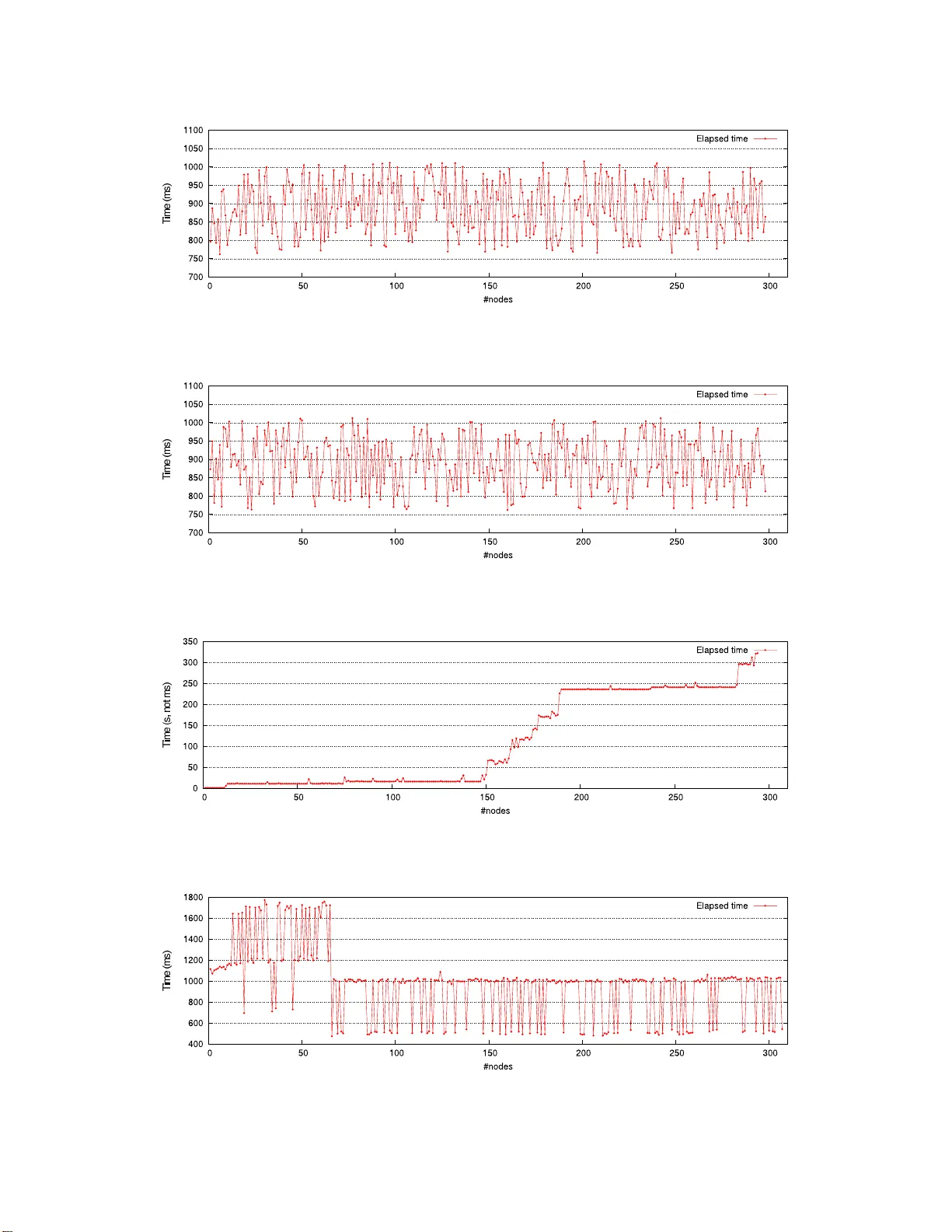
P erformance Analysis of Publish/Su b scrib e Systems Heithem Abb es 1 , Christophe C ´ erin 2 , Jean-Christophe Dubacq 2 , and Mohamed Jemni 1 1 ´ Ecole Sup´ erieure des Sciences et T ec hniqu es de T unis, Unit´ e de recherc he UTIC 5, A v. T aha Hussein, B.P . 56, Bab Mn ara, T un is, Tuni sia T el: (+216) 71 496 066 F ax: (+ 216) 71 391 166 heithem.ab bes@esstt.rnu.tn, mohamed.jemni@fst. rnu.tn 2 LIPN — UMR CNRS 7030 — Institut Galil´ ee — Universit ´ e Par is-N ord 99, av enue Jean-Baptiste Cl´ emen t, 93430 Villetaneuse, France T el: + 33(0)1 49 40 35 78 F ax: +33(0)1 48 26 07 12 {christoph e.cerin,jean-chris tophe.dubacq}@lipn.univ-paris13 .fr Abstract. The D esktop G rid offers solutions to ov ercome sev eral challe n ges a n d to answer increas- ingly needs of scien tific comput ing. Its tec hnology consists mainly in exploiting resources, geographicall y disp ersed, to treat complex applications needing big pow er of calculation and/or imp ortant storage ca- pacit y . How ever, as resources num b er increases, the need for scalabili ty , self-organisation, dynamic reconfigurations, decentralisa t ion and p erformance b ecomes more and more essen tial. Since such prop- erties are exhibited by P2P sy stems, the conve rgence of grid computing and P2P computin g seems natural. In this context, th is pap er ev aluates the scalability and p erformance of P2P to ols for disco ver- ing and registering services. Three proto cols are u sed for this p urp ose: Bonjour, Av ahi and F ree-P astry . W e hav e stu died th e b ehaviour of theses p rotocols related to tw o criteria: the elapsed time for registra- tions services and th e needed time to disco ver new services. Our aim is t o analyse t hese results in order to c h oose the b est proto col we can use in order to create a decentralised middleware for desktop grid. Key wor ds: P eer-t o-P eer systems, Desktop grid, Performance ev aluation, Zero-Configuration, Bonjour, Av ahi, mD NSResp onder, F ree-Pastry 1 In tro du ction The exploitation of new instrumen ts, suc h as, v ery high energy accelerators, telescopes and satellites in astro physic s, big dat a bases of imagery in biology and medicine, n umerous sen- sors in geology , generated an imp o rtan t expans io n of the needs in scie n tific computation. Th us, it b ecomes necessary to establish new computing infrastructures. On the other hand, the computer netw o rks equipmen ts kn ew these last y ears, an imp ortant dev elopment of transmission sp eed p erformances and devices b ecame equipped b y p o werful pro cessors and imp ortant s to rage capacities. These factors adv a n taged the emergence of new infrastructures, suc h as grid computing, to resp ond to computation needs with a n economic cost. One v arian t of grid computing is the Desktop Grid where no des a r e merely desktop PCs. This category constitutes the setting of our w ork. Researc h in grid has dev elop ed some sp ecific soft ware (middlew are) for the managemen t of data and resources. The most Desktop Grid middlew ares ar e cen tr a lised. In this setting, our w ork consists in conceiving a decen t r alised grid computing middlew are based on p eer- to-p eer systems. T o realise this, we w ould profit fr o m existing decen tralised p eer-to-p eer systems . The service disco v ery in the Grid is among the principle c hallenges. F or instance, Globus middlew are impleme nted the s ervice publish/disco v ery mec hanism base d on Monitoring and Disco v ery of Se rvices (MDS- 2) [7, 6] whic h uses cen tr a lised register se rver. Although MDS- 2 solv ed the scalability pro blem using hierarc hical arc hitecture, it is still vulnerable to single p oin t of failure. Moreo v er, adaptation to the dynamic feature of serv ers is a nother c hallenge for MDS-2. F urthermore, another alternativ e consists of using dec entralised approac h for service disco very [3 , 15]. Recen tly , P2P comm unities hav e deve lo p ed a n um b er of fully decen- tralised proto cols, suc h as Bonjour [12, 17, 27], Av ahi [21] and P astry [11, 22 ] for registe r ing, routing and disco v ering in P2P net w orks. The core idea b ehind these pro t o cols is to build self-organised ov erla y net w orks when no des join t he grid. On the other hand, it is impor t an t to kno w the p erfo rmance and the limits of suc h systems. In this context, sev eral ex p erimen ts ha ve been done in this w ork to analyse the p erformance of Bonjour, Av ahi and F ree-Pastry . W e choo se Bonjour and Av ahi (tw o p opular middlew ares running on a lo cal a rea net w o r k) b ecause our w orking conte xt is the connectivit y issues that w e are faced to when w e tr y to share resources b elonging to differen t institutions. In t his pap er, w e assume that w e ha ve a high leve l middlew a r e able to virtualise the net w or k (we hav e no more problems with firew alls and NA T) and w e are able to run Bonjour and Av ahi on top o f suc h middlew are. Instan t Grid / Priv at e Virtual Cluster (see [10, 24]) is one of the candidate for net work virtualisation. Its main requiremen ts are: 1) simple net work configura tion 2) no degradation of resource securit y 3) no need t o re-implemen t existing distributed applications. Under these assumptions, it is reasonable t o c hec k if Bonjour and Av ahi can scale up. This pap er is organised as f ollo ws. In section 2, we remind the notion of large scale distributed systems by fo cusing on grid computing a nd p eer-to-p eer systems. Then, in the section 3, w e illustrate the notion of desktop gr id. In section 4, w e highligh t the adv an tag e of p eer to p eer systems in building a new decen tralised middlew are fo r grid computing. In section 5, w e describ e the exp erimen tal setup used to ev aluate the p erformance of Bonjour, Av ahi and F ree-Pastry . In section 6 and section 7 , we pro vide n umerical results obtained from sev eral exp erimen ts done on Grid’50 0 0 (w e hav e used up to 3 0 8 mac hines). W e finish this pap er with some pro sp ective and a conclusion, resp ectiv ely in section 8 a nd 9. 2 Distributed large scale systems 2.1 Grid Computing In [4], F oster and Kesselman define grid computing a s follows : “ A computational grid is a hardw are and soft ware inf r astructure tha t provides dep endable, consisten t, p erv asiv e, and inexpensiv e a ccess t o high-end computational capabilities” . Th us, a Grid Computing or a Computational grid is a hardware and soft w are infrastruc- ture allowing the sharing of a big num b er of heterogeneous resources thanks to connection b et we en sev eral sites. The r esources sharing ob jectiv e is to resolv e problems confronted in organisations whic h are often multi-sites and require an impo rtan t v o lume of dat a and an imp ortant computation p ow er. These organisations are called virtual organisations (V O). A computational grid is analog ous to the electric netw ork whic h p ermits to an y subscriber, at an y time, to accede instan taneously to the electric resource whatev er is its origin or lo cation, via standardised interface [8, 7]. But the grid computing offers more service s t han the elec- tric grid and should guaran tee criteria o f reliability , securit y and a ccess tr a nsparency while taking accoun t of constraints o f t he high throughput a nd the ch o ice of the qualit y of service (QoS). 2.2 P eer-to-p eer System One definition o f a p eer-to- p eer system is: “p eer-to-p eer refers to a class of systems and applications that employ distributed resources to p erform a critical function in a decen t ralised manner” [1]. Exc hanges b etw een systems can carry on the informatio n, the pro cessors cycles, the mem- ory or the files storage on disk. Con trary to the clien t/serv er mo del, eac h no de is a net work en tity whic h has the ro les of the serv er a nd the clien t at the same time. With p eer-to- p eer, the p ersonal computer can b e part o f the netw ork. The p eer-t o -p eer concerns a class of applications whic h require hardw are or human resources a v ailable on the Inte r net. W e dis- tinguish t wo t yp es of p eer-to- p eer systems: 1) files sharing systems suc h a s Gn ut ella, Napster and Kazaa, whic h knew a great succes s on In ternet and 2) in tensiv e computation orien ted systems , equiv alent to computational grids, such as SETI@Home [20], XtremW eb [26 ] a nd XtremW eb-CH [25]. 3 Desktop G rid Grids aim at providing a p o w erful infrastructure with qualit y-of-service (QoS) guaran tees to a ve ra ge size, homogeneous r esources and certified comm unities. In contrast, P eer-to- P eer sys- tems f o cus on constructing a v ery large infra structure from larg er comm unities of entrusted , anon ymous individuals a nd v ola t ility resources. How ev er, the con ve r gence o f the t wo systems seems natural [14, 5]. In fact, P2P researc h fo cuses more and more on providin g infrastruc- ture and div ersifying t he set of applications; G rid researc h is starting to pay attention to increasing scalabilit y . Desktop Grid combine s the tw o concepts. In this conte xt, w e aim at dev eloping a new decen tralised desktop grid middlew are using the features offered by sev eral p eer-to-p eer to ols as Bonjour , Av ahi and F ree-P astry . W e w ill not build a new middlew are from scratc h, but w e w ould c ho ose the most adequate pro t o col from these three ones to build a decen tralised middlew are. R emark tha t others proto cols exist suc h as CAN [9] and CHORD [13], but w e c ho ose these three proto cols b ecause Bonjour and Av ahi are tw o implemen tations of Zero- configuration whic h already pro ved g o o d success in lo cal a rea netw orks and fo r small organisations, whereas F ree-P astry , which is v ery similar to CAN and CHORD , is based on DHT (Distributed Hash T able). In next section, we exp o se how we can build a Desktop Grid b y using P eer-to-Peer tec hnology . 4 Using Pe er-to-P eer tec hniques to bu ild Desktop Grid T o provide a p o werful D esktop Grid, it is imp ortan t to hav e an imp ortan t num b er of re- sources. Therefore, it is necessary to in tegra t e resources made a v ailable b y sev eral institu- tions. The b ottlenec k, that limits the scalability of suc h systems, is t he cen tralisation c harac- ter of ex isting to ols (see [26, 25] fo r the XtremW eb platfor ms or [16] for the Boinc platf o rm). Th us, it is primordial that grids need more flexible distributed mec hanisms allo wing them to b e efficien tly managed. Suc h c haracteristics are presen ted by Pee r- to-P eer systems, which pro ve d their p erformance and ability to manage v ery big num b er of interc o nnected p eers in a decen tralised manner. In addition, theses systems supp o r t high v olatility of resources. Belo w, w e describe three Pe er-to-Pe er systems, Bonjour, Av ahi and F ree-Pastry , whic h are the candidates of our exp erimen ts tests. 4.1 Bonjour Bonjour, also kno wn as zero-configuration net working, enables automatic disco ve ry of com- puters, devices, and services on IP net w o r ks. Bonjo ur uses industry standard IP proto cols to allow devices to automatically discov er each other without the nee d to e nter IP addresse s or configure DNS se rvers . F urt hermore, Bonjour can allo cate IP addres ses without a DHCP serv er, can t r a nslate b et wee n names and addresses without a DNS serv er and can lo cate o r adv ertise services without using a directory serv er. As a technic a l lev el, zero-configuration is a com binat io n of three tec hnolo gies: link-lo cal addressing, Multicast DNS, and DNS Service D iscov ery . Link lo cal addressing is view ed a safet y net. When DHCP fails or is not a v a ilable, link-local addressing lets a computer mak e up an address for itse lf , so that it can, at least, communicate o n the lo cal link, ev en if wider comm unication is not p ossible. Like link-lo cal addressing, Multicast DNS is a safety net, so that when conv entional D NS serv ers are una v ailable, unreac hable, badly configured or otherwise brok en, computers and devices can s t ill refer to eac h other by name in a wa y that is not dep endent on the correct op eratio n o f outside infra structure. DNS Service Discov ery is built on top of DNS. It w orks not only for with Multicast D NS (for disco v ering lo cal services) but also with go o d old-fashioned, wide-area Unicast DNS (for disco vering remote services). 4.2 Av ahi Av ahi is a system w hich fa cilita t es service disco v ery on a lo cal net w o rk. This means that y o u can plug your lapto p or computer in to a ne tw ork and instan tly b e able to view other p eople y ou can c hat with, find printers to print o r find files being shared. Av ahi is mainly base d on mDNS implemen tat io n for Lin ux. It allo ws programs to publish a nd disco ver services and hosts running on a lo cal net w ork with no sp ecific configura tion. Av ahi is an Implemen tation of DNS Service Disco v ery and Multicast DNS specifications for Zero-configura tion Net w orking. It uses D-Bus f o r comm unication b et w een user applica- tions and a system daemon. The daemon is used to co ordinate application effort s in cach ing replies, necessary to minimise the traffic imp osed on net works . 4.3 F ree-P astry F ree-Pastry is a generic, scalable and efficien t substrate for p eer-to-p eer applications. F ree- P astry no des form a decen tralised, self-organising and fault-tolerant ov erla y net w or k within the Internet. F ree-Pastry pro vides efficien t req uest routing, deterministic ob ject lo cation and load balancing in an applicatio n-indep enden t manner. F urthermore, F ree-P astry provides mec hanisms that supp ort and facilitate application-sp ecific ob ject replication, cac hing, and fault reco ve ry . F ree-Pastry p erforms applicatio n-lev el routing and ob ject lo cation in a p oten t ia lly very large o verla y netw ork of no des connected via the In ternet. It can b e used to supp ort a v ar iety of p eer-to-p eer applications, including global data storage, data sharing, group communica- tion and naming. Eac h no de in t he F ree-Pastry net w o r k has a unique iden tifier (no deId). When presen ted with a message and a k ey , a F ree-P astry no de efficien tly routes the message to the no de with a no deId that is nume rically closest to the k ey , among all curren t ly liv e F ree-P astry no des. Each F ree-Pastry no de ke eps trac k of its immediate neigh b o urs in the no deId space, and notifies applications of new no de arriv a ls, no de f ailures and recov eries. F ree-P astry tak es in to accoun t net w ork lo cality ; it seeks to minimise the distance messages trav el, according to a scalar pro ximity metric lik e the num b er of IP routing hops. F ree-P astry is completely decen tralised, scalable, and self-organising; it automatically adapts to the arriv al, departure and failure of no des. 5 Description of the exp erimen tal setup Our goal is to study the scalabilit y a nd the time resp onse of the to ols describ ed in the pre- vious s ection. In fact, we fo cus on searching the maxim um n um b er of supp or ted registration no des and the resp onse time to discov er a giv en service. Note that the same b enc hmarks are applied for the three Pee r- to-P eer systems (Bonjour, Av ahi and F ree-P a stry). The ex- p erimen tal platform is Grid’5 0 00, highly reconfigurable and controllable experimental grid platform gathering 9 sites geographically distributed in F ra nce. Eve r y site hosts a cluster from 256 CPU to 1K CPU. All sites are connected by RENA TER (10 Gb/s). 5.1 Sp ecific k ernel on Grid’5000 Grid’5000 [23 ] offers an infrastructure with standard ke rnels. T o run o ur exp erimen tal test, it is necess ar y to customise one k ernel to supp ort Av ahi, Bonjour a nd F ree-P astry . Th us, w e create a specific k ernel containing the en tire needed pa ck age to r un our co des (registratio n and disco ve r ing co des for each system). After that, using the tw o to ols OAR and Kadeplo y (see [19, 18]), we reserv e and we deplo y this sp ecific k ernel in all the reserv ed mac hines. W e use only one site and all mac hines are made with AMD Opteron pro cessors with a 1 Gb/s net w ork card. 5.2 Sequen tial registr ations In this test, the first step is to reserv e N no des on Grid’5000 (N will v a r y from 100 no des un til a v alue for witc h w e observ e a saturation of the registration service ) . The num b er N represen ts the maxim um no des t ha t can b e used for the exp erimen t. Eac h no de requests a registration for a give n service at giv en time. Initially , all no des hav e the needed co des to request a service but are inactiv e. L et δ b e the activ ation time. W e activ ate sequen tially all the requests (and we receiv e bac k an ac know ledgemen t ) . Indeed, the k th request will b e activ ated at time k × δ . W e increase δ to analyse the b eha viour of the system when the dela y b et we en ev en ts b ecomes larger. Ob viously , at the b eginning the num b er of registration is small, thu s the time of regis- tration will be fast. W e increase N un til the saturation v alue (i.e. the registration se r vice no longer resp onds fo r a new registration). W e aim at analysing the scalability of the system without ov erloading the net w ork: in this test, only one m ulticast a pp ears at a given time. 5.3 Sim ultaneous registrations In the first test, the registrations are done sequen tially . This leads to a limited n um b er of comm unications to exc hange infor ma t ion. In this exp erimen t, we stress the scalability of the syste m and its capacit y to mana ge the comm unications b etw een the registered no des. Therefore, we request N (the num b er of reserv ed no des) simultaneous registrations and w e compute the time to complete the registration step. If we obtain a “reasonable” resp onse time, w e increase N until the saturat ion v alue. In others w ords, we ar e lo oking fo r t he maximum registered no des t ha t t he system handle w hen the net w o r k is ov erloa ded b y se veral multicast pac k et headers at the same time. 5.4 P erio dic registr ations It’s also imp ortan t to study the efficiency of the sys tem when there a re some nodes with the high v olatilit y prop ert y . In suc h case, the sy stem needs to b e up da t ed b y sending the global state to eac h no de. T o sim ula t e suc h b eha viour, w e r egister N no des then w e cancelled ψ services ( N > ψ ) and w e register them again r andomly . It is c lear that the v alue of ψ influences the effi ciency of the system. Therefore, w e mo dify this v a lue to obtain the maxim um v alue for the v olatility of no des. 5.5 Real registrations In the p erio dic registration exp erimen t, w e simulate only one disconnection/registration and this do es not corresp ond to the r eal b ehav iour of the op erational grid systems since discon- nections are more frequen t. In this test the same set of no des is connected/disconnected for sev eral times. In t his con text, we are a pproac hing the b eha viour of P2P systems and we measure the efficiency of such systems if they inte r a ct as real grid system. 5.6 Bro wsing services The o ther imp ortant metric is the time needed to bro wse a g iv en service. Indeed, in all the previous tests, we compute the registratio n time. W e need also to compute the disco vering time which is the elapsed time b et wee n the end of the registration of a unique service and the date at whic h a brow ser no de has disco vered the service. Note that the resp onse time dep ends on the replicas n umber of a give n services and the registered no des. The bro wsing progra m listen any new eve nt, i.e. a new registration o r deleting services. With t he four setup mentioned b efore, w e can analyse the p erformance of the disco ve r y service of the system. W e hav e also the p ossibilit y to increase the n um b er of bro wsers. W e dra w the c hart where p oint ( i, j, k ) is the resp onse time i for browse r j when w e use a total of k browse r s. Fig. 1. Elapsed time for simultaneous registrations of Bonjour services Fig. 2. Elapsed time for sequential registrations of Bonjour serv ices 6 P erformance of registration services analysis 6.1 Registration of Bonjour services Figure 1 corresp onds to a sim ultaneous registration. At the instan t t w e launch a registration of one service on each mac hine (the activ ation time is the same for all registratio ns). With up to 308 machines , the elapsed time of registration v aries b etw een 1017 and 230 7 ms. Nev ertheless, b etter registration times are giv en by the sequen tial test. In this test, ev ery min ute, w e a ctiv ate a registration requ est of a service. Figure 2 shows that t he elapsed time for the ma jorit y of services is b et w een 1015 and 1030 ms. W e men tion that Bonjour do es not sho w saturatio n until 308 mac hines in b oth sim ultaneous and sequen tial registration. 6.2 Registration of Av ahi services Figure 3 and 4 p oin t out that Av ahi has almost the same registration time in both simulta- neous and s equen tia l tests. The elapsed time v aries b etw een 760 and 111 0 ms. Comparing to Bonjour, Av ahi has b etter registration times. Note that with up to 308 machine s Av a hi has not b een saturated. 6.3 Registration of F ree-Pastry services Con trarily to Av ahi and Bonj o ur, F ree-P astry sh ows a big difference betw een sequen tial and sim ultaneous registration tests. Indeed, figure 5 sho ws that in the sim ult a neous registra- tion, until the 1 6 0 th service, the elapsed time v aries b etw een 600 and 100 0 ms. Bey ond, the registration time increases from one registration to another to reach 320000 ms. Fig. 3. Elapsed time for simultaneous registrations of Av ahi services Fig. 4. Elapsed time for sequential registrations of A vahi services Fig. 5. Elapsed time for simultaneous registrations of F ree-Pas t ry services Fig. 6. Elapsed time for sequential registrations of F ree-Pastry services Fig. 7. Browse services after a simultaneous registration Fig. 8. Bro wse services after a sequential registrations On the other hand, as sho wn in figure 6, the sequen tial test demonstrates when activ ating just one request at eac h minute , we obtain b etter time registration. Besides, the elapsed time for the registration is almost stable and v aries since the 60 th service from 500 to 1000 ms. Lik e Bonjour and Av ahi, t he 2 9 5 registration (o ne registration o n one mac hine) doses not saturate F ree-Pastry . 7 P erformance of disco v ery of services analysis The second metric is to measure the necessary time to brows e a registered service. Then for eac h system (Bonjour, Av a hi and F ree-P astry) w e measure the elapsed t ime b et wee n the termination of registration and the disco v ery time. W e rep eat the same b enc hmarks for b o t h sim ultaneous and sequen tial registration. F or that, w e dedicate one mac hine whic h runs the bro wser to disco v er services. 7.1 Disco very b eha viour of B onjour Bonjour pro v es a goo d p erfo rmance in disco v ering services. In fact, it is able to disco ver 307 services registered on 307 mac hines (one service on o ne mac hine). F urthermore, the disco very time doses not exceed 1 second. W e men tion that for the sac k of simplicit y and clearness w e did not put the nume r ic results in this pap er for these tw o tests. Fig. 9. Elapsed t imes for simultaneo us registrations of services for Bonjour, Av ahi and F ree-Pa stry (note that F ree- P astry is represented twi ce: once with the left-hand time axis, and a second time with the right-hand time axis, 140 times larger) 7.2 Disco very b eha viour of A v ahi Av ahi loses a lmo st 60% of registered services. Besides, the disco v ery time increases b ey ond 49 registratio ns to reac h 900 s o n 7 3 rd . Af t er that, the brow se pro gram of av a hi sp ends a b out 220 seconds to find a registered service (see figure 7). Con v ersely , when w e bro wse services after a sequen tial registration (eac h minute, w e request a registration), Av ahi is able to disco v er more services (3 03 from 307 r egistered services ) . F urthermore, the disco v ery time is m uc h b etter (less than 2 seconds for all services). Only for one service did the disco very program sp end 4203 seconds to find a service (see figure 8). 7.3 Disco very b eha viour for F ree-Pastry F ree-Pastry has a go o d resp onse time o f services discov ery but it loses sev eral services. In fact, w e registered 306 services (one service o n one machine ) and we launc hed the bro wsing program on another mac hine. The brow ser can disco v er the service in a t most one second. The exp erimental tests s how that , in se quential registration, the bro wser finds j ust 270 from 293 services. Whereas, in sim ultaneous r egistrations, the browse r finds more services (27 5 from 292 services). 8 Syn thesis and future w ork Figure 9 illustrates the difference b et we en the three proto cols: Bonjour, Av ahi and F ree- P astry in the time elapsed to register simultaneous ly ab out 30 0 services in a Pe er- t o-P eer Net w ork. Av ahi is the b est one b ecause it sp ends the minim um times (90 0 –1000 ms). Bonjo ur needs more time to register services. Ho w ever, the difference is not imp ortant. Whereas F ree- P astry - whic h has times near to Av ahi up to 150 services – needs distinctly higher t imes than Av ahi and Bonjour a s show n in figure 9 (time corresp o nding to the F ree-P astry curv e are giv en on the secondary axe). Fig. 10. Elapsed t imes for sequential registrations of services for Bonjour, Av ah i and F ree-Pastry Figure 10 sho ws the p erformance of these to ols (Bonjour, Av ahi and F ree-P astry) when w e register sequen tially one service on eac h mac hine (we attend ab o ut 3 00 mac hines). W e can men tion that there is not a big difference b etw een the three proto cols. In fact, Bonjour and Av a hi giv e v ery similar results. Whereas F r ee-Pastry , need less time to register some services (30 % of the tota l mac hines), need the same time fo r others machines (60%) and more time than Av ahi and Bonjour for the rest (10%). The lessons learn t from experimen t s are the fo llo wing for our future work tha t aims to replace the cen tr alised registration service of no des for a desktop Gr id platform suc h as XtremW eb by a decen tralised service: 1. None of the t hree to o ls are sup erior for all the criteria ; it remains to understand (for instance) why F ree-Pastry p erfo rmance decreases dra stically for sim ulta neous registration after 160 registrations and why Av a hi loses almost 6 0% o f registered services as so on as w e brow se more than 75 services which is not a lot. Clearly , Av a hi do es not scale at presen t time. 2. A lot of “clo ck - in terv al” artifacts can b e seen in F ree-Pastry and Av ahi, esp ecially in figures 6 and 7. These artifacts are due t o the even t mo del used in these proto cols, where a “w a t c h lo op” do es p erio dic p olling o f resources to b e aw ar e of state c ha nges (and thence create notifications). 3. The Bonjour implemen tation that w e hav e used seems to offer the b est compromise. Ho w ever the Bonjo ur API is no t as ric h as F ree-P astry’s API. In F ree-P astry w e ha v e the P AST mo dule that implemen ts archiv a l storage that could b e used, in our con t ext, for storing the prop erties (C PU Mhz, RAM a v ailable...) or data produce on nodes asking for participating to the desktop grid. Exp eriments and analyses of P2P net w orks hav e b een conducted ov er the Grid’5000 platform fo r the generic JXT A P2P f r amew ork [2]. In this a r t icle, the goal of the p erformed b enc hmarks is similar to our g oal. It conce rns to a nswe r common a nd unansw ered questions: ho w man y rendezv ous p eers are supp o rted by JXT A in a given group a nd what is the exp ected time to disco ver resources in suc h groups? Tw o main proto cols of JXT A hav e b een ev aluated in [2]: 1 ) the p eerview proto col used to organize sup er peers, know n as rendezv ous p eers, in a JXT A ov erla y and 2) the disco ve r y proto col, that relies o n t he p eerview proto col, used t o find resources inside a JXT A netw ork. All sites of G rid’5000 w ere used and a mix of h undreds of rendezv ous p eers and normal p eers, called edge p eers, ha v e b een deplo y ed o n at mo st 580 no des. Results s how that w ith default v alues for para meters of t he p eerview proto col, the goal o f the algorithm is not ac hiev ed, ev en with a s few as 45 rendezv ous p eers. Ho we ver, parameter tuning mak es it p ossible to reac h larger configurations in terms of num b er of rendezv ous p eers. F or the disco ve ry proto col, authors show tha t disco v ery time is ra ther smaller, provide d tha t all rendezv ous p eers satisfy a g iv en prop ert y . These results giv e dev elop ers a b etter view o f the scalability of JXT A proto cols. Our results, a ug men ted with those o f [2] clearly demonstrate that for o p en source pro jects as w ell as for industrial softw are with pro duction quality , there is a strong need to test and ev aluate the prop erties of the distributed system in real scale platform suc h as Grid’500 0. 9 Conclusion T o launc h computing w ork on the no des of the g rid, it is essen tial to bro wse the no des a nd then execute works. F urthermore, in the mean time, it is p ossible that new no des comes and w ant to register to the grid. Then it is imp ortant to register this new mac hine in the minim um time p o ssible to b e added to t he grid. In this pap er, w e hav e illustrated the p erformance of three P2P systems whic h are Bo n- jour, Av ahi and F ree-Pas t ry . Sev eral experimen ta l tests w ere executed on Grid’5000 where the used machines num b er could go un til 308. Bonjour pro v es a high p erfo r mance in reg- istration services and is able to browse all registered services (307 services) and, esp ecially , can disco v er them in at most 1 second each o ne. Av ahi is p o werful in registratio n of new services but it is not able to br owse all the services (it lo ses 60% services in sim ultaneous registration) and need a long t ime (4200 seconds) to disco ver service s whic h ha v e b een reg- istered in a sequen tial manner. On the other hand, F ree-Pastry sho ws go o d results in the sequen tia l registration of 2 9 5 services (at most 1 second needed to register one service on eac h mac hine), but it sp ends more time (300 seconds) to find a services when w e a ctiv ate 295 registration requests of new services at the same time. Finally , w e did not include the results for p erio dic and real registrations (presen ted in the ab ov e sections 5.4 and 5.5) b ecause there is no imp ortant difference in disco v ering service s or registrations to b e mentioned. In fact, as illustrated b efore, the b eha viour of disco v ering or registration dep ends o nly of t he registrations mo de (sequen tial or sim ultaneous). Ac kno wledgemen t Exp eriments presen ted in this pap er w ere car r ied out using the Grid’5000 exp erimen tal testb ed, an initiat iv e from the F rench Ministry of Researc h through the A CI GR ID incen tive action, INRIA , CNRS and RENA TER and other con t r ibuting partners (see [23]). W e w ould lik e to thank Mathieu Jan for his fruitful comment on an early v ersion of this pap er. References 1. Karl Ab erer and Manfred Hauswirth. Peer-to-p eer information systems: concept s and mo dels, state-of-the-art, and fut u re systems. I n ESEC/FSE-9: Pr o c e e dings of the 8th Eur op e an softwar e engine ering c onfer enc e held jointly with 9th ACM SI GSOFT international symp osium on F oundations of softwar e engine ering , pages 326–327 , N ew Y ork, NY, U SA, 2001. ACM Press. 2. Gabriel Antoniu, Lo ¨ ıc Cudennec, Mike Duigou, and Mathieu Jan. Perfor mance scalability of the JXT A P2P framew ork. In Pr o c. 21st IEEE International Par al l el and Di stribute d Pr o c essing Symp osium (I PD PS 2007) , pages 108–131, Long Beach, CA, USA, March 2007. 3. Miguel Castro, Peter Druschel, Anne-Marie Kermarrec, and Antony Rowstro n . One ring to ru le them all: service disco very and binding in struct ured p eer-to-p eer ov erlay n etw orks. In EW10: Pr o c e e dings of the 10th workshop on ACM SIGOPS Eur op e an workshop: b eyond the PC , pages 140–145 , N ew Y ork, NY , USA , 2002. ACM Press. 4. Ian F oster. What is the grid? A th ree p oint chec klist. GRIDT o day , pages 1–4, July 2002. 5. Ian F oster and Ad riana Iamnitchi. On d eath, taxes, and th e con vergence of p eer-to-p eer a n d gri d computing. In M. F rans Kaashoek and Ion Stoica, editors, Pe er-to-Pe er Syste m s II , Se c ond International Workshop, I PTPS 2003 , volume 2735 of L e ctur e Notes in C omputer Scienc e . Springer V erlag, 2003. 6. Ian F oster and Carl Kesselman. The Globus pro ject: a status rep ort. F utur e Gener ation Computer Systems , 15(5–6):60 7–621, 1999. 7. Ian F oster, Carl Kesselman, Jeffrey M. Nick, and Steven T ueck e. Grid services for distributed system integration. Computer , 35(6):37–46, 2002. 8. Ian F oster, Carl Kesselman, and Steven T ueck e. The anatom y of the grid: Enabling scalable virtu al organizations. Int. J. High Perform. Comput. Appl. , 15(3):200– 222, 20 01. 9. Sylvia R atnasam y , Paul F rancis, Mark Handley , Richard Karp, and Scott Schenker. A scalable content-addressable netw ork. In SIGCOMM ’01: Pr o c e e di ngs of the 2001 c onfer enc e on Applic ations, te chnolo gies, ar chite ctur es, and pr oto c ols for c omputer c ommuni c ations , pages 161–172, New Y ork, NY, USA, 2001. ACM Press. 10. A la Rezmerita, T angu i Morl ier, Vincen t N´ eri, and F ranck Capp ello. Priv ate virtu al cluster: In frastructure and protocol for instant grids. In W olfgang E. N agel, W olfgang V . W alter, and W olfgang Lehner, editors, Eur o-Par 2006, Par al lel Pr o c essing, 12th International Eur o-Par Confer enc e , v olume 4128 of L e ctur e Notes in Computer Scienc e , pages 393–404. Sp rin ger, August 2006. 11. A nton y I. T. Rowstron an d P eter Druschel. P astry: S calable, decentralized ob ject lo cation, and routing for large-scale p eer-to-p eer systems. In Mi dd lewar e ’01: Pr o c e e dings of the IFI P/ACM I nternat i onal Confer enc e on Distribute d Systems Platforms , pages 329–350 , London, UK, 2001. Sp ringer-V erlag. 12. D aniel Steinberg and Stuart Cheshire. Zer o Configur ation Networking: The Definitive Guide . O’Reilly Media, Inc., first edition, December 2005. 13. I on Stoica, Rob ert Morris, D a v id Karger, M. F rans Kaashoek , and Hari Balakrishnan. Chord: A scalable p eer- to-p eer lo okup service for internet applications. In SIGCOMM ’01: Pr o c e e dings of the 2001 c onfer enc e on Appli- c ations, te chnolo gies, ar chite ctur es, and pr oto c ols f or c omputer c ommunic ations , pages 149–160, New Y ork, N Y, USA, 2001. ACM Press. 14. D omenico T alia and Paolo T run fio. T o ward a synergy b etw een P2P and grids. IEEE Internet Computing , 7(4):96–95 , 2003. 15. Q i Xia, W einong W ang, and Ruijun Y ang. A f u lly decen tralized app roac h to grid service discov ery using self- organized ov erla y netw orks. I n Peter M. A. Slo ot, A lfons G. H o ekstra, Thierry Priol, Alexan d er Reinefeld, and Marian Bubak, editors, A dvanc es in Grid Com puting - EGC 2005, Eur op e an Grid Confer enc e , vol u me 3470 of L e ctur e Not es in C omputer Scienc e , pages 164–172. S pringer-V erlag, F ebruary 2005. 16. Berkeley Op en Infrastructure for N etw ork Computing. UR L: http://boinc. berkeley.edu . 17. Bonjour. UR L: http://develo per.apple.com/netwo rking/bonjour/ . 18. K ADeploy . U RL: http://gforge.i nria.fr/projects/ka deploy/ . 19. OAR. U RL: http://gforg e.inria.fr/project s/oar/ . 20. S eti@home. UR L: http://http ://setiathome.berk eley.edu/ . 21. A v ahi. URL : http://www.av ahi.org . 22. F reePastry . U RL: http://www.freep astry.org . 23. Grid’5000. UR L: http://www.gr id5000.fr . 24. I nstant grid. URL: http://www.l ri.fr/~rezmerit/In stant%20Grid.html . 25. X tremWeb-CH. UR L: http://www.xtre mwebch.net . 26. X tremWeb. URL: http://www.xt remweb.org . 27. ZeroConfguration. UR L: http://ww w.zeroconf.org .
Original Paper
Loading high-quality paper...
Comments & Academic Discussion
Loading comments...
Leave a Comment